Article

Temperature-Dependent Sn Incorporation and Defect Formation in Pseudomorphic SiSn Layers on Si (001) via Molecular Beam Epitaxy


1
Department of Electrical Engineering and Computer Science, University of Arkansas, Fayetteville, AR 72701, USA
2
Institute for Nanoscience and Engineering, University of Arkansas, Fayetteville, AR 72701, USA
3
Department of Physics, University of Arkansas, Fayetteville, AR 72701, USA
*
Author to whom correspondence should be addressed.
Crystals 2026, 16(4), 262; https://doi.org/10.3390/cryst16040262
Submission received: 13 March 2026 / Revised: 7 April 2026 / Accepted: 11 April 2026 / Published: 13 April 2026
(This article belongs to the Section Inorganic Crystalline Materials)

Abstract

SiSn alloys have attracted growing interest for group-IV bandgap engineering, although their epitaxial growth remains challenging due to the extremely low equilibrium solubility of Sn in Si. In this work, fully strained (pseudomorphic) SiSn epitaxial layers were grown on Si (001) substrates by means of molecular beam epitaxy. A systematic investigation reveals a strong inverse correlation between growth temperature and Sn incorporation efficiency. Despite a constant Sn flux, the incorporated Sn composition decreases from 5.5% to 3.2% as the growth temperature increases, indicating a pronounced temperature dependence of Sn incorporation. Reflection high-energy electron diffraction indicates a gradual transition of the growth from two-dimensional to three-dimensional with increasing film thickness. Structural characterization by means of X-ray diffraction, atomic force microscopy, and transmission electron microscopy confirms the pseudomorphic growth and smooth surface morphology and reveals twins and stacking faults near the surface region. These results establish a quantitative reference for SiSn growth kinetics and provide guidance for future studies of SiSn and SiGeSn alloys in silicon-compatible electronic and optoelectronic applications.

1. Introduction

Silicon (Si) has been the foundational material for the electronics industry for decades due to its excellent scalability, cost-effectiveness, and mature processing technology [1,2,3]. However, conventional group-IV semiconductors such as Si and Ge possess an indirect bandgap that fundamentally limits their effectiveness for photonic applications, including light emission, detection, and modulation [4,5]. In this context, group-IV semiconductor alloys, such as GeSn, SiSn, and SiGeSn, have attracted considerable attention due to their ability to undergo an indirect-to-direct bandgap transition, therefore extending the functionality of silicon-based electronic and optoelectronic devices [6,7,8,9,10,11]. Among them, SiSn alloys provide a versatile platform for lattice and band-structure engineering. The effects of Sn incorporation and strain relaxation enable significant bandgap reduction, making them promising for Si-based electronic and optoelectronic applications [12,13,14,15,16]. Beyond its direct applications, SiSn serves as a fundamental compositional “endpoint” for SiGeSn ternary alloys. Moreover, due to the substantial atomic size mismatch between Si and Sn, SiSn exists in a highly metastable regime, providing an ideal platform for investigating non-equilibrium growth kinetics, thermodynamic phase stability, and short-range ordering effects in Sn-containing group-IV materials [17,18,19,20,21,22].
However, the synthesis of high-quality SiSn layers on Si substrates is fundamentally constrained by the negligible equilibrium solubility of Sn (<0.1%) and the large lattice mismatch between Si and Sn. These factors typically provide a strong driving force for the formation of high-density structural defects such as vacancies and threading dislocations and surface Sn segregation, where Sn atoms tend to float on the growth front rather than incorporating into substitutional sites, thereby resulting in surface droplet formation and compositional inhomogeneity [23,24,25]. Molecular beam epitaxy (MBE) offers a powerful approach to navigate these limits through low-temperature kinetic control, which “freezes” Sn atoms into the lattice before they can segregate [24,26]. Nevertheless, finding the precise “growth window”, where the temperature is low enough to suppress Sn segregation but high enough to maintain crystalline quality, remains a significant challenge. Unlike GeSn, the epitaxial growth of SiSn is significantly more challenging due to the inherently higher growth temperatures required for Si compared to Ge. This, combined with the larger lattice mismatch between Sn and Si, creates a severe barrier to Sn incorporation, as elevated temperatures further worsen Sn segregation and structural degradation.
To date, a variety of high-performance optoelectronic devices including photodetectors and lasers based on GeSn have been extensively reported [9,10,27,28], while research concerning SiGeSn has also seen significant progress, with numerous studies focusing on its epitaxial growth, band-structure tailoring, and the design of advanced heterostructure architectures [29,30,31,32,33]. In contrast, while research on amorphous, polycrystalline SiSn films and nanocrystals is relatively well documented, investigations focusing on the high-quality epitaxial growth of binary SiSn alloys remain remarkably sparse [6,34,35,36,37].
In this work, we demonstrate the MBE growth of pseudomorphic SiSn epitaxial layers on Si (001) substrates with Sn concentrations ranging from 3.2% to 5.5%, systematically investigating the growth kinetics and structural evolution. By employing a suite of in situ and ex-situ characterization techniques to monitor the growth front evolution, surface morphology, and defect formation, this study aims to establish the critical links between growth temperature, Sn incorporation, and surface evolution, while revealing the underlying mechanisms of defect formation during pseudomorphic SiSn epitaxy. This integrated analysis provides a quantitative reference for SiSn growth kinetics, underscoring the structural features essential for high-quality, Si-compatible Sn-based materials.

2. Materials and Methods

In this work, SiSn thin films were synthesized in a Riber (Bezons, France) ultra-high vacuum (UHV) MBE chamber. Growth was performed on undoped Si(001) substrates (WaferPro, San Jose, CA, UAS) possessing a nominal miscut of less than 0.5°. To ensure high crystal quality, ultra-high purity (7N) intrinsic Ge and metallic Sn (American GMG Inc., Union City, CA, USA) were evaporated from pyrolytic boron nitride (PBN) Knudsen cells (Riber, Bezons, France), while Si was provided by a Si sublimation source (SUSI, Dr. Eberl MBE-Komponenten GmbH, Weil der Stadt, Germany). The substrates were initially immersed in a 2.5% HF:H2O (1:20) solution for 60 s to remove the native oxide layer and to obtain a hydrogen-terminated surface, followed by a thorough rinse in deionized (DI) water. To minimize surface re-oxidation and contamination, the cleaned substrates were immediately loaded into the load-lock chamber.
Prior to epitaxial growth, a comprehensive two-step in situ degassing and deoxidation process was performed. The substrates were first baked at 250 °C for 2 h in the degassing chamber to remove moisture and adsorbed species, followed by high-temperature annealing at 900 °C for 30 min in the growth chamber to ensure a pristine, reconstructed surface. Throughout the process, the base pressure of the growth chamber was maintained at a UHV level of about 3 × 10⁻¹¹ Torr.
To provide a high-quality template for SiSn growth, a 20 nm thick Si buffer layer was deposited using the SUSI source at 760 °C. The Si cell temperature was consistently maintained at 1080 °C throughout the process, yielding a stable growth rate of approximately 20 nm/h. For Sn incorporation, a dual-filament Knudsen cell was employed to precisely control the Sn flux, with the tip and base temperatures set at 1010 °C and 980 °C, respectively. After the growth of the Si buffer layer, the substrate temperature was gradually decreased to the target growth temperatures for the subsequent SiSn epitaxial deposition. To investigate the effect of growth temperature on Sn incorporation, four primary samples were grown at temperatures ranging from 230 °C to 290 °C with a step of 20 °C, while keeping the Si and Sn source fluxes constant. The standard growth duration for the SiSn layers was 1 h. Additionally, sample E011B-03 was synthesized with an extended growth time of 1.5 h, specifically to evaluate the impact of layer thickness on the structural properties of the SiSn alloys. The comprehensive growth parameters and sample configurations are summarized in Table 1.
The crystalline quality, lattice parameters, and strain state of the epitaxial layers were comprehensively investigated using HR-XRD. Measurements were performed on a Philips X’pert MRD system (Malvern Panalytical, Almelo, The Netherlands) equipped with a 1.8 kW Cu Kα1 X-ray tube (λ = 1.540598 Å), a four-bounce Ge(220) monochromator, a two-bounce Ge(220) analyzer, and a PIXcel detector. Post-growth surface morphology and root-mean-square (RMS) roughness were characterized by means of atomic force microscopy using a Bruker D3100 Nanoscope V system (Bruker Corporation, Billerica, MA, USA). The measurements were performed in tapping mode, providing lateral and vertical resolutions at the nanometer scale. Detailed structural analysis and interface quality were further examined using a FEI Titan 80–300 TEM (FEI Company, Hillsboro, OR, USA) operating at an accelerating voltage of 300 kV. Cross-sectional samples for TEM were prepared via standard thinning and ion-milling techniques to ensure high-resolution imaging of the atomic arrangement. Mechanical thinning was performed using a MultiPrep Precision Polishing System (Allied High Tech Products, Rancho Dominguez, CA, USA), followed by final thinning to electron transparency using a Fischione Model 1010 low-angle ion milling and polishing system (E.A. Fischione Instruments, Export, PA, USA). During the epitaxial growth process, the surface evolution and growth dynamics were monitored in real-time using in situ RHEED. This allowed for the precise control of layer thickness and the observation of surface reconstructions.

3. Results

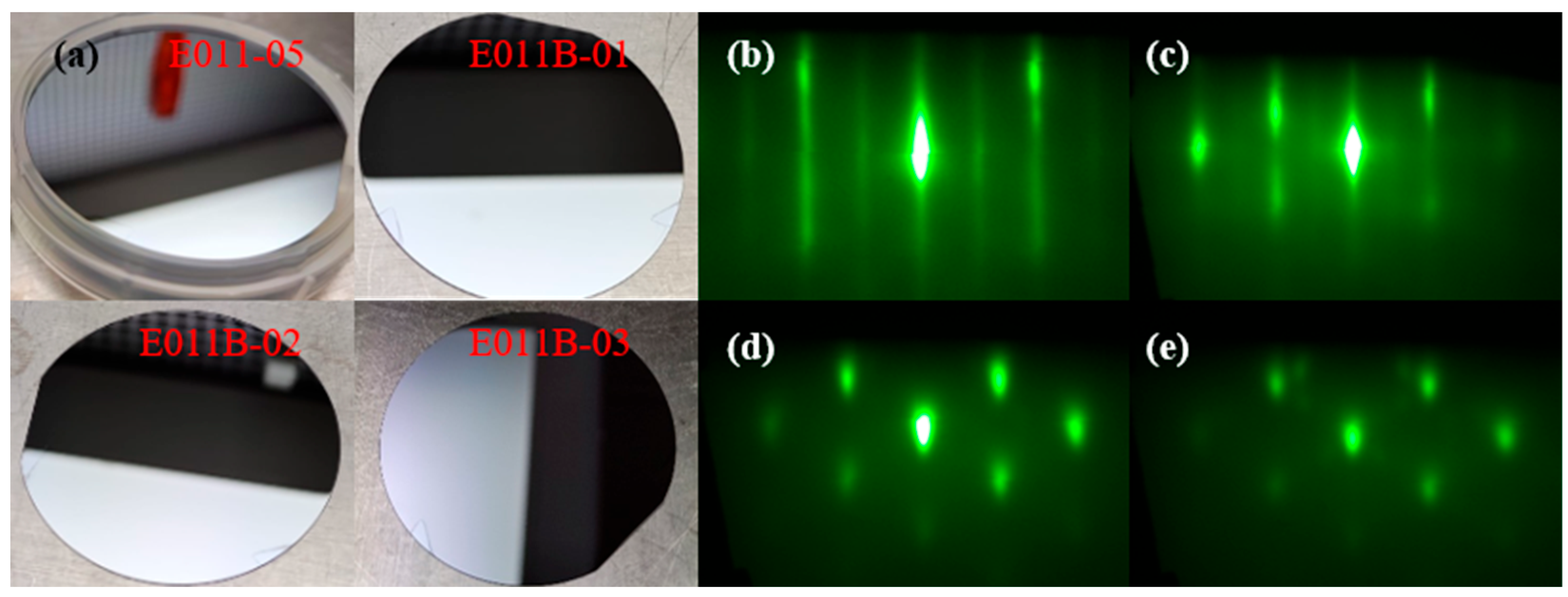
Figure 1 shows optical images of the entire wafer taken after growth and the RHEED patterns of E011-05 captured during the growth process. All samples exhibit mirror-like surfaces without macroscopic Sn segregation. Figure 1b–e show the evolution of the RHEED patterns during growth. As shown in Figure 1b, the Si buffer layer displays a typical (2 × 1) reconstruction pattern, indicating a good two-dimensional (2D) layer-by-layer growth mode and a flat surface. As the SiSn layer grows, the surface reconstruction gradually changes, and the RHEED pattern starts to transition from streaky to spotty, as shown in Figure 1c, indicating the 2D growth mode is increasingly difficult to maintain. From Figure 1d, it can be observed that at 37 min into the growth, the RHEED pattern consists primarily of spots, indicating that the growth is shifting toward a three-dimensional (3D) islanding mode. When the growth reaches 1 h, it exhibits 3D-like growth, as shown in Figure 1e.
The observed transition from 2D layer-by-layer growth to 3D islanding is primarily attributed to the continuous accumulation of strain energy within the SiSn epilayer during the epitaxial process. In lattice-mismatched systems such as SiSn on Si, this transition typically follows the Stranski–Krastanov (S-K) growth mode. This transition is driven by the thermodynamic competition between strain energy and surface free energy. As the film thickness increases, the total elastic strain energy accumulated within the coherently strained layer scales with the thickness [38,39]. Beyond a critical thickness, the accumulated strain energy exceeds the energetic cost associated with the formation of additional surfaces, making the planar morphology unstable. To minimize the total Gibbs free energy, the system undergoes a morphological instability that favors the formation of three-dimensional islands, where lattice strain can be partially relaxed at the island sidewalls. During the growth of this sample, a decrease in the intensity of the RHEED pattern was observed, indicating a significant decline in material quality. It can be predicted that if the growth continues, epitaxial breakdown will occur.
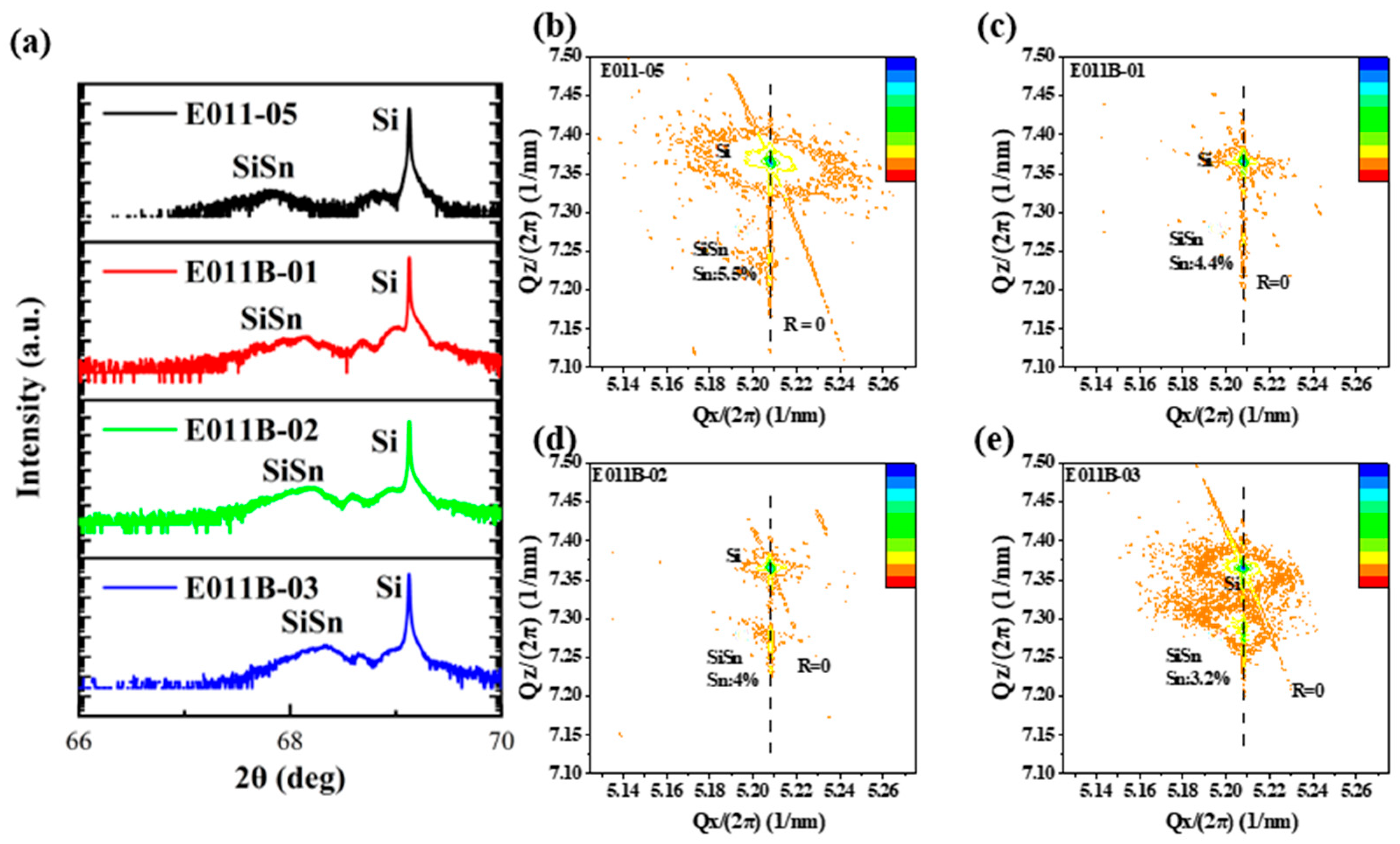
HR-XRD was performed to examine the crystallinity of the SiSn layers. As shown in Figure 2a, all samples exhibit a distinct SiSn (004) reflection peak located at a lower diffraction angle (to the left) relative to the Si substrate peak. This characteristic confirms the successful incorporation of Sn, while the well-defined peak profiles, in conjunction with the RHEED patterns observed in situ (Figure 1), further verify the single-crystalline nature of the epitaxial layers. As the growth temperature increases, the SiSn diffraction peak is observed to shift progressively toward the Si substrate peak. This shift signifies a continuous decrease in the out-of-plane lattice constant (a) of the SiSn epilayer. To decouple the effects of Sn incorporation and the strain state on this lattice contraction, reciprocal space mapping (RSM) was further employed, as discussed in the following section.
Figure 2b–e show the (224) RSM of the SiSn samples. Since the samples were characterized using different machines (including both +224 and −224 reflections), the absolute values of Qx were employed in all RSM plots to ensure a consistent and clear comparison of the strain-induced peak shifts across all samples. As clearly shown in these maps, the vertical alignment of the SiSn and Si diffraction spots in the RSM suggests that the SiSn layer is coherently grown on the Si substrate, where the in-plane lattice parameter of the SiSn layer remains locked to that of the Si substrate, resulting in an elastic strain within the epilayer. Using the following equation, the in-plane (a//) and out-of-plane lattice constant (a) can be quickly obtained:
a //   =   2 2 / Q x ,   a   =   4 / Q z  
where Qx and Qz are the coordinates of (2 2 4) RSM. However, due to the presence of tetragonal distortion in the epitaxial layers, the intrinsic lattice constant (a0) and the Sn content were extracted by simultaneously solving Vegard’s law and the Poisson relationship [40,41]. The strain (ε//) and relaxation degree (R) can be calculated by using the following equations:
ε //   =   a / / a 0 a 0 ,   R = a / / a s u b a 0 a s u b
where a0 and asub are the lattice constants of SiSn and the Si substrate, respectively. By utilizing the (224) RSM data, which provides both in-plane and out-of-plane scattering vectors, the influence of strain was decoupled from the determination of the intrinsic lattice parameter a0.
The in-plane and out-of-plane lattice parameters were calculated from these maps. The Sn content in these samples is calculated to be 5.5% (a0 = 0.549 nm), 4.4% (a0 = 0.548 nm), 4.0% (a0 = 0.547 nm), and 3.2% (a0 = 0.546 nm), respectively. While the SiSn diffraction peaks exhibit broadening due to the finite thickness of the layers, the determination of their positions is highly reliable. Specifically, for these fully strained epitaxial layers, the Qx coordinate of the SiSn peak is constrained by the Si substrate peak position. Furthermore, the Qz position was accurately determined by cross-referencing the RSM data with the (004) reflections. The associated uncertainty in Sn composition is estimated to be approximately ±0.1%, confirming that the observed temperature-dependent trend in Sn incorporation (ranging from 3.2% to 5.5%) significantly exceeds the measurement error margin. Furthermore, despite the large lattice mismatch, the SiSn diffraction peaks remain well-defined and distinct in the reciprocal space maps. It is observed that Sn incorporation decreases as the growth temperature increases. Since all samples were grown consecutively with constant Si and Sn cell temperatures (and thus stable fluxes), we conclude that the higher substrate temperature limits the incorporation efficiency of Sn, a phenomenon similar to what is observed in GeSn epitaxy [42]. It should be noted that for sample E011B-03, both the growth temperature and layer thickness were increased. Although the increased thickness could theoretically influence Sn segregation via strain relaxation, no significant segregation was observed in our structural characterization. The reduction in Sn content in E011B-03 is thus primarily attributed to the temperature-dependent incorporation limit. Notably, this observation remains highly consistent with the trend established by the first three samples, where Sn incorporation decreases with increasing temperature. This sample is included herein to further illustrate the impact of increased thickness on the evolution of surface morphology, as discussed in the following AFM analysis.
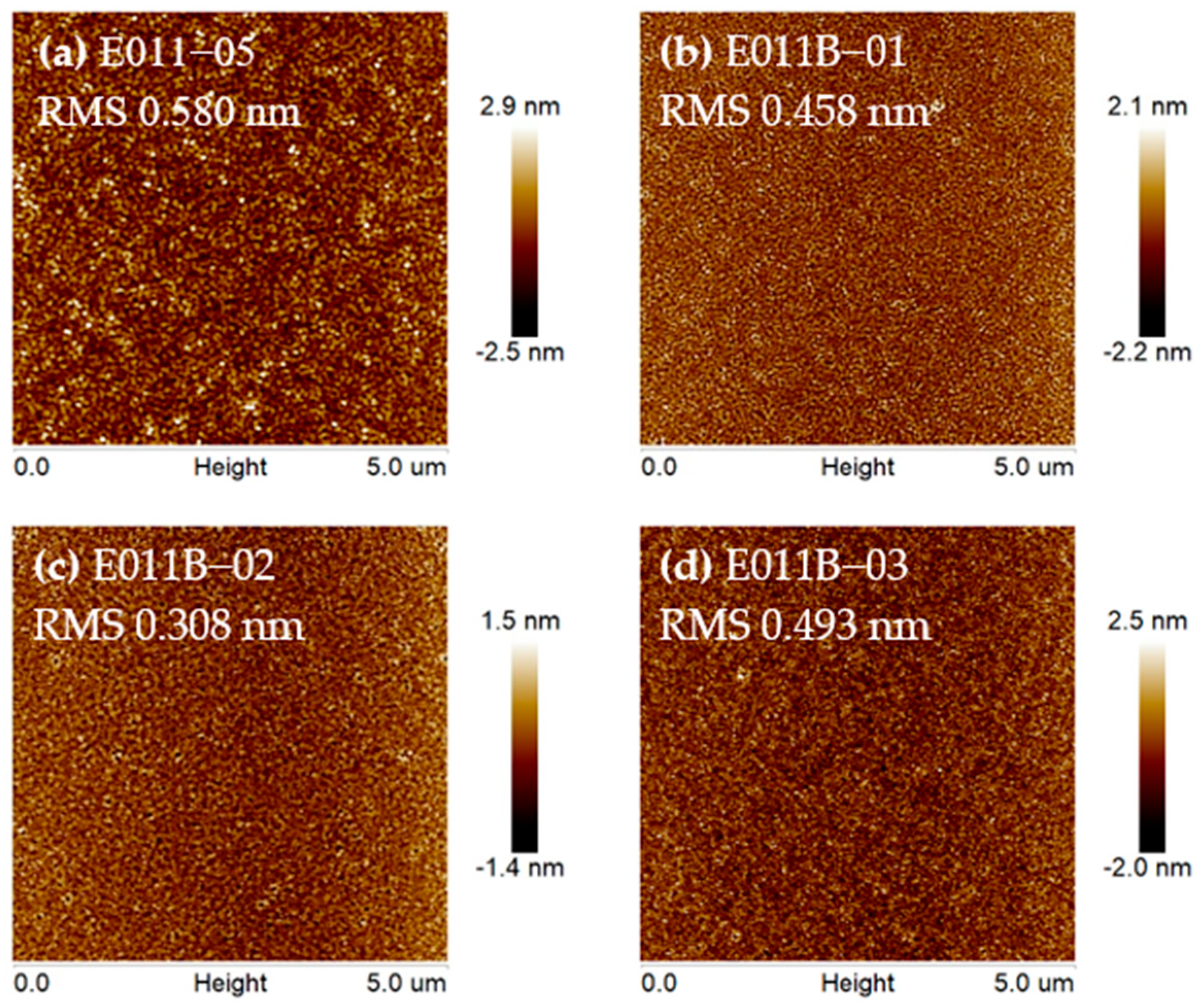
AFM was employed to characterize the surface morphology of the SiSn layers, as shown in Figure 3. All samples exhibit an atomically smooth surface with RMS roughness values maintained below 1 nm. For the first three samples (a–c), where the layer thickness is comparable, a clear correlation is observed between Sn content and surface roughness. As the Sn concentration decreases from 5.5% to 4.0%, the RMS roughness correspondingly drops from 0.580 nm to 0.308 nm. This trend suggests that higher Sn incorporation increases the lattice mismatch, which promotes surface undulation to minimize the strain energy.
However, the sample with the lowest Sn content (3.2%) shows a slight increase in roughness to 0.493 nm. This deviation is attributed to its greater thickness. Although the Sn-induced strain is reduced, the increased volume of the epitaxial layer leads to significant strain accumulation over time, which eventually enhances the surface roughness. Despite these variations, the sub-nanometer RMS values confirm that the low-temperature MBE process effectively suppresses Sn segregation and prevents large-scale 3D islanding, even as the surface begins to roughen at 5.5% Sn content.
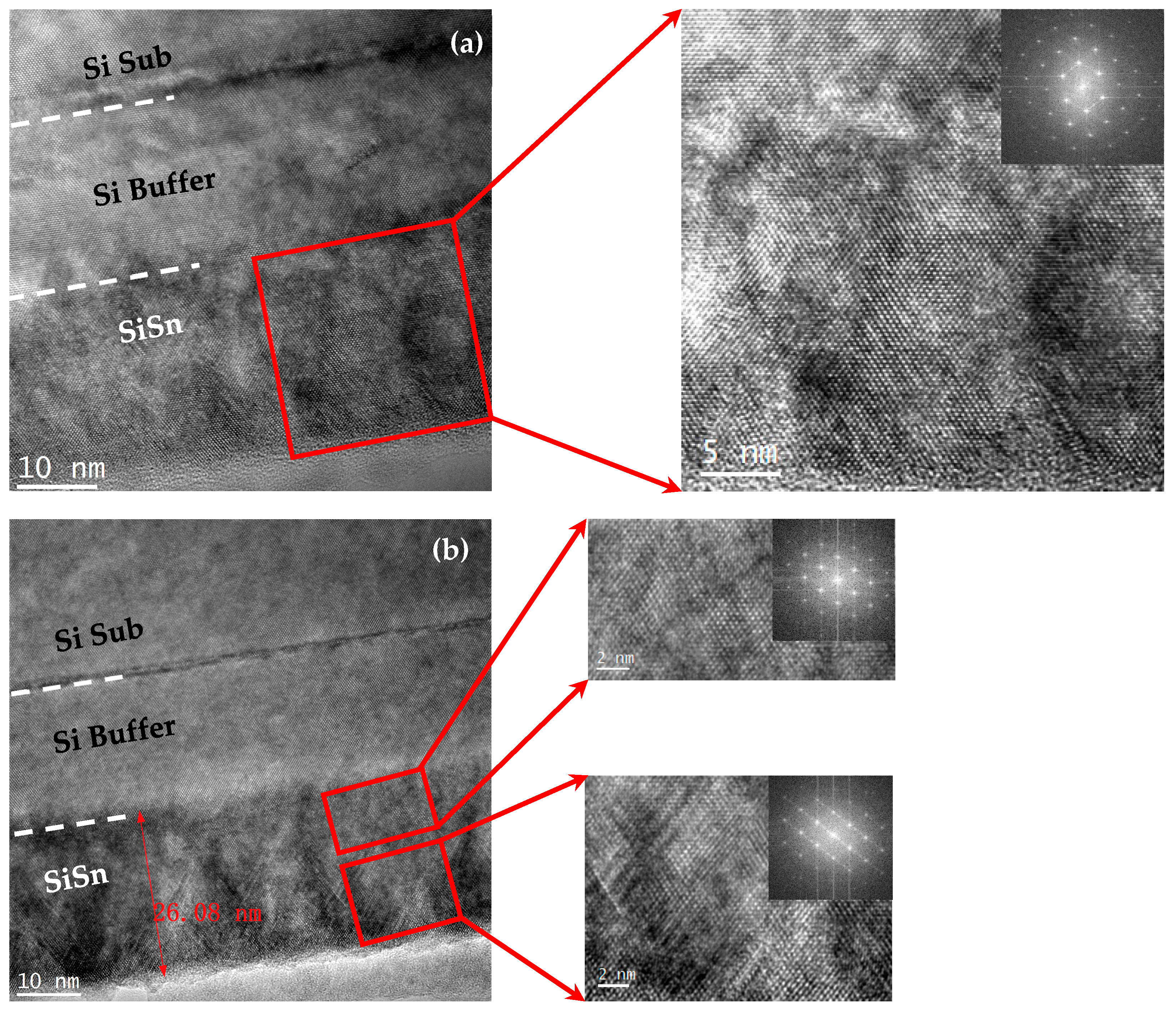
To further evaluate the crystalline quality of the SiSn epilayer with the highest Sn concentration (Sample E011-05), cross-sectional TEM analysis was performed, with the results presented in Figure 4. Figure 4a displays a region with a relatively low density of defects. The interfaces between the Si substrate, Si buffer, and the SiSn epitaxial layer are sharp and well-defined, indicating high-quality initial growth. The interface between the Si substrate and the buffer layer can be attributed to small perturbations during the initial stage of growth. A magnified cross-sectional view of the top SiSn layer, indicated by the red box in Figure 4a, reveals clear and continuous lattice fringes throughout the observed region. The absence of significant lattice distortions or amorphous domains demonstrates the high crystalline integrity and good structural quality of the epitaxial layer. To further evaluate the local crystallinity, FFT analysis was performed on the HR-TEM images. The resulting FFT pattern exhibits well-defined and sharp diffraction spots, validating the single-crystal growth and the preservation of long-range periodic order. A closer inspection, however, reveals faint streaks connecting the main Bragg reflections. These features are characteristic of one-dimensional structural disorder, likely originating from a low density of stacking faults or twin boundaries that formed to accommodate the local lattice strain between the Si and Sn atoms.
In contrast, Figure 4b reveals a region with a significantly higher density of defects, as clearly illustrated in the area near the sample surface. While the Si/SiSn interface remains distinct, a clear gradient in defect density is observed: the defect density increases substantially from the Si/SiSn interface toward the growth surface. This is further confirmed by the FFT analysis. The FFT pattern taken near the Si/SiSn interface shows no stacking faults or twin-related signals, indicating excellent crystalline quality during the early stages of epitaxy. However, in the FFT patterns near the surface, well-defined twin reflections at 1/3 positions along with continuous streaks are observed, confirming the formation of micro-twins and stacking faults.
The formation of stacking faults and micro-twins in the SiSn layers is likely driven by the interplay between limited surface adatom mobility at low growth temperatures and the progressive accumulation of elastic strain with increasing thickness. In comparison, the initial epitaxial region near the interface remains defect-free, owing to the relatively low total strain energy. This suggests that defect nucleation is triggered by the combined effects of kinetic constraints and strain accumulation. Notably, these localized defects provide a pathway for localized strain relief without inducing a global relaxation, consistent with the observed pseudomorphic state of the film.

4. Conclusions

In summary, we have systematically investigated the epitaxial growth of fully strained SiSn layers on Si (001) substrates by means of MBE, achieving Sn concentrations ranging from 3.2% to 5.5%. High-resolution XRD and RSM mapping confirm that all epitaxial layers remain pseudomorphic, providing a detailed compositional profile across different samples. Critically, a clear inverse correlation between growth temperature and Sn incorporation efficiency was established, highlighting the fundamental trade-off necessary for achieving target compositions. In situ RHEED observations reveal a gradual transition from two-dimensional to three-dimensional growth, reflecting the evolution of the growth front during layer accumulation. Furthermore, AFM analysis demonstrates smooth surface morphology with sub-nanometer roughness, while revealing the dependence of surface evolution on growth temperature and layer thickness. Cross-sectional TEM and FFT analyses show the presence of twins and stacking faults predominantly near the surface, while the interface region remains largely defect-free. These defects are likely influenced by a combination of kinetic limitations at low growth temperatures and strain accumulation in the epitaxial layer. Collectively, these results establish a quantitative reference for SiSn growth kinetics, provide insight into the morphological and structural constraints governing high-quality Si-integrated Sn-based materials, and lay a foundation for future exploration of SiSn and SiGeSn alloys in silicon-compatible electronic and optoelectronic applications.

Author Contributions

Conceptualization, G.J.S. and S.-Q.Y.; methodology, D.Z.; formal analysis, D.Z.; investigation, D.Z., N.M.E., D.B., H.S. and M.B.; resources, G.J.S. and S.-Q.Y.; data curation, D.Z.; writing—original draft preparation, D.Z.; writing—review and editing, W.D., G.J.S. and S.-Q.Y.; visualization, D.Z.; supervision, W.D., G.J.S. and S.-Q.Y.; project administration, S.-Q.Y.; funding acquisition, S.-Q.Y. All authors have read and agreed to the published version of the manuscript.

Funding

This work was supported by the μ-ATOMS, an Energy Frontier Research Center funded by the U.S. Department of Energy, Office of Science, Basic Energy Sciences, under Award No. DE-SC0023412, and by the Multidisciplinary University Research Initiative (MURI) program of the U.S. Air Force Office of Scientific Research (AFOSR) under Grant No. FA9550-19-1-0341. This work was also supported, in part, by the Office of Naval Research (Grant Nos. N00014-24-1-2651 and N00014-23-1-2872).

Data Availability Statement

The data that support the findings of this study are available from the corresponding author upon reasonable request.

Acknowledgments

During the preparation of this manuscript, the authors used Gemini 3 Flash to refine the language and improve the professional tone. The authors have reviewed and edited the output and take full responsibility for the content of this publication.

Conflicts of Interest

The authors declare no conflicts of interest.

References

  1. Thomson, D.; Zilkie, A.; Bowers, J.E.; Komljenovic, T.; Reed, G.T.; Vivien, L.; Marris-Morini, D.; Cassan, E.; Virot, L.; Fédéli, J.-M.; et al. Roadmap on silicon photonics. J. Opt. 2016, 18, 073003. [Google Scholar] [CrossRef]
  2. Soref, R. Silicon Photonics: A Review of Recent Literature. Silicon 2010, 2, 1–6. [Google Scholar] [CrossRef]
  3. Paul, D.J. Silicon photonics: A bright future? Electron. Lett. 2009, 45, 582–584. [Google Scholar] [CrossRef]
  4. Moutanabbir, O.; Assali, S.; Gong, X.; O’Reilly, E.; Broderick, C.A.; Marzban, B.; Witzens, J.; Du, W.; Yu, S.Q.; Chelnokov, A.; et al. Monolithic infrared silicon photonics: The rise of (Si)GeSn semiconductors. Appl. Phys. Lett. 2021, 118, 110502. [Google Scholar] [CrossRef]
  5. Han, Y.; Park, H.; Bowers, J.; Lau, K.M. Recent advances in light sources on silicon. Adv. Opt. Photonics 2022, 14, 404–454. [Google Scholar] [CrossRef]
  6. Timofeev, V.A.; Nikiforov, A.I.; Tuktamyshev, A.R.; Mashanov, V.I.; Loshkarev, I.D.; Bloshkin, A.A.; Gutakovskii, A.K. Pseudomorphic GeSiSn, SiSn and Ge layers in strained heterostructures. Nanotechnology 2018, 29, 154002. [Google Scholar] [CrossRef]
  7. Sadullah, M.; Kaur, J.; Basu, R.; Sharma, A.K. Analysis of thin-film direct band-gap SiGeSn alloy based heterostructure solar cell featuring SiGe absorber layer. Optik 2020, 202, 163715. [Google Scholar] [CrossRef]
  8. von den Driesch, N.; Stange, D.; Wirths, S.; Mussler, G.; Holländer, B.; Ikonic, Z.; Hartmann, J.M.; Stoica, T.; Mantl, S.; Grützmacher, D.; et al. Direct Bandgap Group IV Epitaxy on Si for Laser Applications. Chem. Mater. 2015, 27, 4693–4702. [Google Scholar] [CrossRef]
  9. Zhou, Y.; Ojo, S.; Wu, C.-W.; Miao, Y.; Tran, H.; Grant, J.M.; Abernathy, G.; Amoah, S.; Bass, J.; Salamo, G.; et al. Electrically injected GeSn lasers with peak wavelength up to 2.7 μm. Photonics Res. 2021, 10, 222–229. [Google Scholar] [CrossRef]
  10. Acharya, S.; Stanchu, H.; Kumar, R.; Ojo, S.; Alher, M.; Benamara, M.; Chang, G.E.; Li, B.; Du, W.; Yu, S.Q. Electrically Injected Mid-Infrared GeSn Laser on Si Operating at 140 K. IEEE J. Sel. Top. Quantum Electron. 2025, 31, 1500507. [Google Scholar] [CrossRef]
  11. Hussain, A.M.; Fahad, H.M.; Singh, N.; Rader, K.R.; Sevilla, G.A.T.; Schwingenschlögl, U.; Hussain, M.M. Exploring SiSn as channel material for LSTP device applications. In Proceedings of the 71st Device Research Conference, Notre Dame, IN, USA, 23–26 June 2013; pp. 93–94. [Google Scholar]
  12. Tonkikh, A.A.; Zakharov, N.D.; Eisenschmidt, C.; Leipner, H.S.; Werner, P. Aperiodic SiSn/Si multilayers for thermoelectric applications. J. Cryst. Growth 2014, 392, 49–51. [Google Scholar] [CrossRef]
  13. Khan, A.-S.T.; Berger, P.R.; Guarin, F.J.; Iyer, S.S. Band-edge photoluminescence from pseudomorphic Si0.96Sn0.04 alloy. Appl. Phys. Lett. 1996, 68, 3105–3107. [Google Scholar] [CrossRef]
  14. Saidov, A.S.; Usmonov, S.N.; Kalanov, M.U.; Madaminov, K.M.; Nishanova, D.A. Effect of gamma irradiation on photoconductivity and photosensitivity of Si1−xSnx solid solutions. Appl. Sol. Energy 2011, 47, 48–51. [Google Scholar] [CrossRef]
  15. Nagae, Y.; Kurosawa, M.; Araidai, M.; Nakatsuka, O.; Shiraishi, K.; Zaima, S. Evaluation of energy band offset of Si1−xSnx semiconductors by numerical calculation using density functional theory. Jpn. J. Appl. Phys. 2017, 56, 04CR10. [Google Scholar] [CrossRef]
  16. Saidov, A.S.; Usmonov, S.N.; Kalanov, M.U.; Kurmantayev, A.N.; Bahtybayev, A.N. Structural and some electrophysical properties of the solid solutions Si1−xSnx (0 ≤ x ≤ 0.04). Phys. Solid State 2013, 55, 45–53. [Google Scholar] [CrossRef]
  17. Jiang, L.; Xu, C.; Gallagher, J.D.; Favaro, R.; Aoki, T.; Menéndez, J.; Kouvetakis, J. Development of Light Emitting Group IV Ternary Alloys on Si Platforms for Long Wavelength Optoelectronic Applications. Chem. Mater. 2014, 26, 2522–2531. [Google Scholar] [CrossRef]
  18. von den Driesch, N. Epitaxy of Group IV Si-Ge-Sn Alloys for Advanced Heterostructure Light Emitters. Ph.D. thesis, RWTH Aachen University, Aachen, Germany, 2018. [Google Scholar]
  19. Beeler, R.T.; Xu, C.; Smith, D.J.; Grzybowski, G.; Menéndez, J.; Kouvetakis, J. Compositional dependence of the absorption edge and dark currents in Ge1−x−ySixSny/Ge(100) photodetectors grown via ultra-low-temperature epitaxy of Ge4H10, Si4H10, and SnD4. Appl. Phys. Lett. 2012, 101, 221111. [Google Scholar] [CrossRef]
  20. Zhang, R.; Zhao, S.; Ding, J.; Chong, Y.; Jia, T.; Ophus, C.; Asta, M.; Ritchie, R.O.; Minor, A.M. Short-range order and its impact on the CrCoNi medium-entropy alloy. Nature 2020, 581, 283–287. [Google Scholar] [CrossRef]
  21. Liu, J.; Liu, S.; Chen, S.; Jin, X.; Bae, J.-H.; Bikmukhametov, I.; Jaeger, D.; Concepcion, O.; Covian, A.; Wang, X.; et al. Atomic short-range order in SiGeSn alloys. Res. Sq. 2024, 1–27. [Google Scholar] [CrossRef]
  22. Liu, S.; Liang, Y.; Zhao, H.; Eldose, N.M.; Bae, J.-H.; Concepcion, O.; Jin, X.; Chen, S.; Bikmukhametov, I.; Wang, X. Comparison of short-range order in GeSn grown by molecular beam epitaxy and chemical vapor deposition. arXiv 2024, arXiv:2407.02767v2. [Google Scholar]
  23. Thurmond, C.D.; Trumbore, F.A.; Kowalchik, M. Germanium Solidus Curves. J. Chem. Phys. 1956, 25, 799–800. [Google Scholar] [CrossRef]
  24. Shiryaev, S.Y.; Lundsgaard Hansen, J.; Kringho/j, P.; Nylandsted Larsen, A. Pseudomorphic Si1−xSnx alloy films grown by molecular beam epitaxy on Si. Appl. Phys. Lett. 1995, 67, 2287–2289. [Google Scholar] [CrossRef]
  25. Fyhn, M.F.; Chevallier, J.; Nylandsted Larsen, A. Relaxation of strained, epitaxial Si1−xSnx. J. Vac. Sci. Technol. B Microelectron. Nanometer Struct. Process. Meas. Phenom. 1998, 16, 1777–1785. [Google Scholar] [CrossRef]
  26. Timofeev, V.A.; Nikiforov, A.I.; Kokhanenko, A.P.; Tuktamyshev, A.R.; Mashanov, V.I.; Loshkarev, I.D.; Novikov, V.A. Growth of Epitaxial SiSn Films with High Sn Content for IR Converters. Russ. Phys. J. 2017, 60, 354–359. [Google Scholar] [CrossRef]
  27. Abernathy, G.; Ojo, S.; Said, A.; Grant, J.M.; Zhou, Y.; Stanchu, H.; Du, W.; Li, B.; Yu, S.Q. Study of all-group-IV SiGeSn mid-IR lasers with dual wavelength emission. Sci. Rep. 2023, 13, 18515. [Google Scholar] [CrossRef] [PubMed]
  28. Miao, Y.; Wang, G.; Kong, Z.; Xu, B.; Zhao, X.; Luo, X.; Lin, H.; Dong, Y.; Lu, B.; Dong, L.; et al. Review of Si-Based GeSn CVD Growth and Optoelectronic Applications. Nanomaterials 2021, 11, 2556. [Google Scholar] [CrossRef]
  29. Xie, J.; Chizmeshya, A.V.G.; Tolle, J.; D’Costa, V.R.; Menendez, J.; Kouvetakis, J. Synthesis, Stability Range, and Fundamental Properties of Si−Ge−Sn Semiconductors Grown Directly on Si(100) and Ge(100) Platforms. Chem. Mater. 2010, 22, 3779–3789. [Google Scholar] [CrossRef]
  30. Ghetmiri, S.A.; Zhou, Y.; Margetis, J.; Al-Kabi, S.; Dou, W.; Mosleh, A.; Du, W.; Kuchuk, A.; Liu, J.; Sun, G.; et al. Study of a SiGeSn/GeSn/SiGeSn structure toward direct bandgap type-I quantum well for all group-IV optoelectronics. Opt. Lett. 2017, 42, 387–390. [Google Scholar] [CrossRef] [PubMed]
  31. von den Driesch, N.; Stange, D.; Rainko, D.; Povstugar, I.; Zaumseil, P.; Capellini, G.; Schroder, T.; Denneulin, T.; Ikonic, Z.; Hartmann, J.M.; et al. Advanced GeSn/SiGeSn Group IV Heterostructure Lasers. Adv. Sci. 2018, 5, 1700955. [Google Scholar] [CrossRef] [PubMed]
  32. Schwarz, D.; Kasper, E.; Bärwolf, F.; Costina, I.; Oehme, M. Determination of the indirect bandgap of lattice-matched SiGeSn on Ge. Mater. Sci. Semicond. Process. 2024, 180, 108565. [Google Scholar] [CrossRef]
  33. Sun, G.; Soref, R.; Khurgin, J.; Yu, S.Q.; Chang, G.E.; Cheng, H.H. Design of Ge/GeSiSn Quantum Cascade Laser and Detector. In Proceedings of the 2025 IEEE Silicon Photonics Conference (SiPhotonics), London, UK, 14–17 April 2025; pp. 1–2. [Google Scholar]
  34. Kurosawa, M.; Kato, M.; Yamaha, T.; Taoka, N.; Nakatsuka, O.; Zaima, S. Near-infrared light absorption by polycrystalline SiSn alloys grown on insulating layers. Appl. Phys. Lett. 2015, 106, 171908. [Google Scholar] [CrossRef]
  35. Lozac’h, M.; Švrček, V.; Askari, S.; Mariotti, D.; Ohashi, N.; Koganezawa, T.; Miyadera, T.; Matsubara, K. Semiconducting silicon-tin alloy nanocrystals with direct bandgap behavior for photovoltaic devices. Mater. Today Energy 2018, 7, 87–97. [Google Scholar] [CrossRef]
  36. Kurosawa, M.; Kato, M.; Takahashi, K.; Nakatsuka, O.; Zaima, S. Self-organized lattice-matched epitaxy of Si1−xSnx alloys on (001)-oriented Si, Ge, and InP substrates. Appl. Phys. Lett. 2017, 111, 192106. [Google Scholar] [CrossRef]
  37. Kurosawa, M.; Nakatsuka, O.; Zaima, S. (Invited) Growth and Applications of Si1−xSnx Thin Films. ECS Trans. 2017, 80, 253. [Google Scholar] [CrossRef]
  38. Freund, L.; Suresh, S. Thin Film Materials: Stress, Defect Formation, and Surface Evolution; Cambridge University Press: Cambridge, UK, 2003. [Google Scholar]
  39. Matthews, J.W.; Blakeslee, A.E. Defects in epitaxial multilayers: I. Misfit dislocations. J. Cryst. Growth 1974, 27, 118–125. [Google Scholar] [CrossRef]
  40. Hornstra, J.; Bartels, W.J. Determination of the lattice constant of epitaxial layers of III-V compounds. J. Cryst. Growth 1978, 44, 513–517. [Google Scholar] [CrossRef]
  41. Vegard, L. Die Konstitution der Mischkristalle und die Raumfüllung der Atome. Z. Für Phys. 1921, 5, 17–26. [Google Scholar] [CrossRef]
  42. Wei, L.; Miao, Y.; Pan, R.; Zhang, W.-w.; Li, C.; Lu, H.; Chen, Y.-F. Highly strained Ge1−xSnx alloy films with high Sn compositions grown by MBE. J. Cryst. Growth 2021, 557, 125996. [Google Scholar] [CrossRef]
Figure 1. (a) Optical image of as-grown SiSn samples on Si. (be) RHEED patterns of sample E011-05 taken at different times: (b) Si buffer, (c) SiSn 80 s, (d) SiSn 37 min, and (e) SiSn 1 h.
Crystals 16 00262 g001
Figure 2. (a) The 2θ-ω scan of SiSn samples on Si. (be) RSM mapping of SiSn samples; the vertical dashed lines indicate the condition of complete pseudomorphic strain.
Crystals 16 00262 g002
Figure 3. AFM images of SiSn samples: (a) E011-05, (b) E011B-01, (c) E011B-02, and (d) E011B-03.
Crystals 16 00262 g003
Figure 4. (a) High-resolution TEM image of sample E011-05 (region with low defect density), with a magnified view of the SiSn layer (indicated by the red box) shown on the right. (b) High-resolution TEM image of sample E011-05 (region with high defect density). Magnified images of the SiSn layer near the Si/SiSn interface and the surface are shown on the right. The insets in the magnified images display the Fast Fourier Transform (FFT) patterns corresponding to each respective region.
Crystals 16 00262 g004
Table 1. Summary of SiSn samples on Si via MBE.
SampleTGrowth (°C)TSi
(°C)
TSn
(°C)
Buffer Thickness (nm)SiSn Thickness (nm)Sn Incorporation
E011-0523010801010/980~20~255.5%
E011B-0125010801010/980~20~254.4%
E011B-0227010801010/980~20~254.0%
E011B-0329010801010/980~20~403.2%
Note: TGrowth represents the growth temperature of the SiSn layer. For all samples, the Si buffer was grown at 760 °C.
Disclaimer/Publisher’s Note: The statements, opinions and data contained in all publications are solely those of the individual author(s) and contributor(s) and not of MDPI and/or the editor(s). MDPI and/or the editor(s) disclaim responsibility for any injury to people or property resulting from any ideas, methods, instructions or products referred to in the content.