Article

Structural Study of L-Arabinose Isomerase from Latilactobacillus sakei

Department of Food Science and Biotechnology, Kyungsung University, Busan 48434, Republic of Korea
*
Author to whom correspondence should be addressed.
These authors contributed equally to this work.
Crystals 2026, 16(2), 84; https://doi.org/10.3390/cryst16020084
Submission received: 10 January 2026 / Revised: 22 January 2026 / Accepted: 23 January 2026 / Published: 25 January 2026
(This article belongs to the Special Issue Structure and Characterization of Enzymes)

Abstract

D-Tagatose is a rare sugar of interest as a low-calorie sweetener, and enzymatic isomerization of D-galactose is a practical production route. L-arabinose isomerase (L-AI; EC 5.3.1.4) is a promising catalyst for the above process, but many characterized L-AIs perform best at alkaline pH and high temperature and often require substantial divalent metal supplementation (e.g., Mn2+/Co2+), which complicates food-grade processing. Lactic acid bacteria (LAB) are attractive sources of food-compatible enzymes, yet structural information for LAB-derived L-AIs has been limited. Here, we report the 2.6 Å X-ray crystal structure of L-AI from Latilactobacillus sakei 23K (LsAI) and define its oligomeric assembly. Although the asymmetric unit contains a single monomer, crystallographic symmetry reconstructs a D3-symmetric homohexamer composed of two face-to-face trimers, consistent with a higher-order assembly in solution. Interface analysis shows predominantly polar interaction networks, and normalized B-factor mapping reveals localized flexibility near active-site-proximal regions. These findings provide a structural basis for understanding LAB-derived L-AIs and support structure-guided engineering toward food-grade, low-metal biocatalysts for rare-sugar production.

1. Introduction

D-Tagatose is a rare ketohexose with approximately 90% of the sweetness of sucrose but a lower caloric value and a low glycemic index [1]. Owing to its reported benefits for glycemic control and lipid metabolism, D-tagatose has been approved as generally recognized as safe (GRAS) and is increasingly used as a functional sweetener in food and beverage applications [1,2]. Because D-tagatose occurs only in trace amounts in nature, industrial production relies largely on enzymatic conversion from abundant aldoses such as D-galactose [3,4]. In this context, L-arabinose isomerase (L-AI; EC 5.3.1.4) is among the most attractive biocatalysts, as it catalyzes reversible aldose–ketose isomerization and is capable of converting D-galactose to D-tagatose in addition to its native reaction (L-arabinose to L-ribulose) [3,4].
To improve productivity and operational robustness, L-AIs from thermophilic and hyperthermophilic microorganisms have been extensively explored [5,6,7,8]. Their enhanced thermostability enables operation at elevated temperatures, which often accelerates reaction rates and can improve equilibrium conversion [5,6,7,8]. Accordingly, structure-guided engineering and directed evolution have been applied to thermophilic L-AIs to tune substrate specificity, catalytic efficiency, and long-term stability under industrially relevant conditions [7,9,10,11,12]. Despite these advances, thermophilic L-AIs are not always optimal for food manufacturing. Many exhibit maximal activity under alkaline pH (typically 8–9) and at high temperatures (often 60–90 °C), which may be incompatible with food matrices that are frequently mildly acidic and temperature-limited [6,7,9,11]. Moreover, several thermophilic L-AIs require relatively high concentrations of divalent metal ions (commonly Mn2+ or Co2+) to sustain robust activity and/or stability, raising concerns regarding regulatory compliance, product safety, and downstream metal-removal steps [8,12,13,14].
Lactic acid bacteria (LAB) represent an attractive alternative enzyme source for food applications because of their long history of safe use and their natural adaptation to mildly acidic environments [12,14]. Latilactobacillus sakei 23K, a food-associated LAB strain, encodes an L-AI (hereafter LSAI) whose gene and basic biochemical properties have been reported previously, including appreciable activity at comparatively low temperatures and across a broad pH range that includes mildly acidic conditions [3,14]. However, the structural basis by which an LAB-derived L-AI operates under low-temperature and low-metal conditions has remained unclear, limiting rational design efforts aimed at improving food-compatible D-tagatose bioprocesses.
Structural studies across L-AIs from distinct thermal niches have established that these enzymes share a conserved fold and assemble into higher-order oligomers [8,15,16]. Oligomeric architecture and the quality of inter-subunit interaction networks are increasingly recognized as important determinants of stability: more thermostable L-AIs often exhibit larger buried interface areas and denser networks of hydrogen bonds and salt bridges, whereas less thermostable enzymes tend to display greater flexibility at interface-adjacent regions that can overlap with the active-site vicinity [6,8,15]. In addition, divalent metal ions can influence not only catalytic chemistry but also conformational transitions relevant to substrate engagement, and in some L-AIs metal binding is coupled to changes in oligomer stability [5,6,13].
Here, we report the X-ray crystal structure of LSAI at 2.6 Å resolution and present a comparative analysis with representative mesophilic, thermophilic, and hyperthermophilic L-AIs. Although the asymmetric unit contains a single monomer, crystallographic symmetry reconstructs a D3-symmetric homohexamer composed of two face-to-face trimers, consistent with the assembly observed in structurally characterized bacterial and archaeal L-AIs, including a lactic acid bacterium homolog. We further analyze subunit interfaces using interaction-network and buried-surface-area metrics, and map normalized B-factors to relate local flexibility to oligomeric stability across L-AIs with different thermostability profiles. Finally, we examine the putative metal-binding environment and the effect of metal chelation on the oligomeric state, providing structural hypotheses for how LAB-derived L-AIs maintain a conserved catalytic scaffold while adapting to food-relevant conditions and offering design principles for engineering food-grade L-AI platforms for D-tagatose production.

2. Materials and Methods

2.1. Cloning, Protein Expression and Purification

The gene encoding LSAI in the genome of L. sakei 23K (araA, Genebank, Bethesda, MD, USA, No. CR936503) was synthesized (IDT Inc., Coralville, IA, USA) and cloned into the pET-28a expression vector (Novagen, Madison, WI, USA) using the NdeI and XhoI restriction sites. The sequence of the cloned gene was verified by DNA sequencing (Macrogen, Seoul, Republic of Korea). The verified plasmid was transformed into Escherichia coli BL21(DE3) cells. The transformed cells were cultured in LB medium (Duchefa, Haarlem, The Netherland) at 37 °C until the optical density at 600 nm (OD600) reached 0.5. Protein expression was then induced by adding 1 mM isopropyl β-D-1-thiogalactopyranoside (IPTG), followed by further incubation at 18 °C overnight. After induction, the cultured cells were harvested by centrifugation at 7000 rpm for 30 min at 4 °C. The cell pellet was resuspended in 15 mL of lysis buffer containing 20 mM Tris-HCl (pH 7.4) and 400 mM NaCl. The cells were lysed using sonication, and the lysate was centrifuged again at 17,000 rpm for 1 h at 4 °C to collect supernatant. Ni-NTA affinity chromatography was performed to purify the recombinant protein from the collected supernatant using the N-terminal 6xHis-tag of LSAI. In brief, the supernatant was applied to a Ni-NTA resin (Bio-Works, Uppsala, Sweden), and the resin was washed with buffer containing 20 mM Tris-HCl (pH 7.4) and 400 mM NaCl. The protein was eluted with elution buffer containing 50 mM Tris-HCl (pH 7.4), 400 mM NaCl and 250 mM imidazole. The final purification step involved size exclusion chromatography (SEC) with HiLoad Superdex 200 pg column (Cytiva, Marlborough, MA, USA), during which the buffer was exchanged to 5 mM Tris-HCl (pH 7.4) containing 50 mM NaCl. The purity of the eluted protein solution was assessed using 15% sodium dodecyl sulfate polyacrylamide gel electrophoresis (SDS-PAGE), and protein concentration was determined using the Bradford assay. The purified protein was concentrated to 10 mg/mL, aliquoted and stored at −70 °C until crystallization.

2.2. Crystallization

Crystallization screening was performed using the sitting drop vapor diffusion method at 20 °C using a commercial crystallization kit, including the Crystal Screen 1, 2, MembFac and Natrix (Hampton Research, Aliso Viejo, CA, USA) and Wizard Classic 1, 2, 3 and 4 (Rigaku, The woodlands, TX, USA). The protein solution (1 µL) was mixed with the crystallization screen solution (1 µL) and equilibrated with a reservoir solution (50 µL). Three different microcrystals were obtained from the initial screening within 4 weeks. Through a preliminary diffraction experiment, suitable crystals for X-ray diffraction were obtained from one condition. To obtain higher-resolution diffraction data, crystals from the initial screening (≤0.05 mm) were further optimized. Optimization included micro-/macro-seeding and systematically slowing crystallization by reducing the protein and/or precipitant concentrations. Under the final optimized condition (6 mg/mL protein, 100 mM sodium citrate tribasic dihydrate, pH 5.6, 100 mM lithium sulfate monohydrate, and 3% (v/v) polyethylene glycol 400), crystals grew to >0.1 mm and diffracted to ~2.6 Å.

2.3. X-Ray Diffraction Data Collection

X-ray diffraction data were collected at beamline 5C at Pohang Light Source II (PLS-II, Pohang, Republic of Korea) [17]. The LSAI crystal was cryoprotected using a reservoir solution supplemented with 20% (v/v) glycerol. The crystal was mounted on a goniometer under a 100 K nitrogen gas stream. Diffraction data were recorded on an Eiger 9M detector (DECTRIS, Baden, Switzerland). Diffraction data were indexed, integrated, and scaled using HKL2000 [18].

2.4. Structure Determination

The phase problem was solved by molecular replacement using Phaser in PHENIX (1.14-3260) [19]. A three-dimensional molecular model generated with AlphaFold2 was used as the search model [20]. Coot (0.8.2) was used for manual model building based on the electron density map [21]. Structure refinement was conducted with phenix.refine in PHENIX [19].

2.5. Bioinformatics and Structure Analysis

A structural similarity search was performed using the DALI server [22]. From the returned hits, we selected structures annotated as L-arabinose isomerase (L-AI) with Z-scores ≥ 44.6. Specifically, we chose one close homolog derived from lactic acid bacteria and three representative L-AIs from mesophilic, thermophilic, and hyperthermophilic organisms. Based on these criteria, Limosilactobacillus fermentum L-arabinose isomerase (LFAI; PDB ID: 4LQL), Escherichia coli L-arabinose isomerase (ECAI; PDB ID: 2AJT), Geobacillus kaustophilus L-arabinose isomerase (GKAI; PDB ID: 4R1Q), and Thermotoga maritima L-arabinose isomerase (TMAI; PDB ID: 7CWV) were selected for comparative structural analysis (Table S1). Amino acid sequence alignment was performed using Clustal Omega [23]. The structure-based multiple sequence alignment was visualized with ESPript 3.0 [24]. The protein structures were visualized using PyMOL (1.8.6.1) (https://pymol.org, accessed on 1 March 2025). The molecular structure model of the substrate D-galactose was obtained from PubChem and used in this study. Docking calculations for Mn2+ were performed using AutoDock Vina (2.0) [25]. Manual docking of the substrate into the LSAI active site was carried out in Coot [21], with reference to the L-arabitol-bound crystal structure of GKAI. B-factor normalization was performed using BANΔIT [26]. Protein surface calculations and interaction analyses were conducted using PDBePISA [27].

2.6. Analysis of the Effect of Metal Ions on the Oligomeric State of LSAI

To remove Mn2+, the LSAI protein sample was treated with 10 mM EDTA in the SEC running buffer (5 mM Tris–HCl, pH 7.4, 50 mM NaCl) and dialyzed against the same buffer for 12 hrs prior to SEC analysis with a HiLoad Superdex 200 pg column (Cytiva, Marlborough, MA, USA). As a control, an aliquot of the same protein sample without EDTA treatment was analyzed by SEC under identical conditions.

3. Results

3.1. Structure Determination

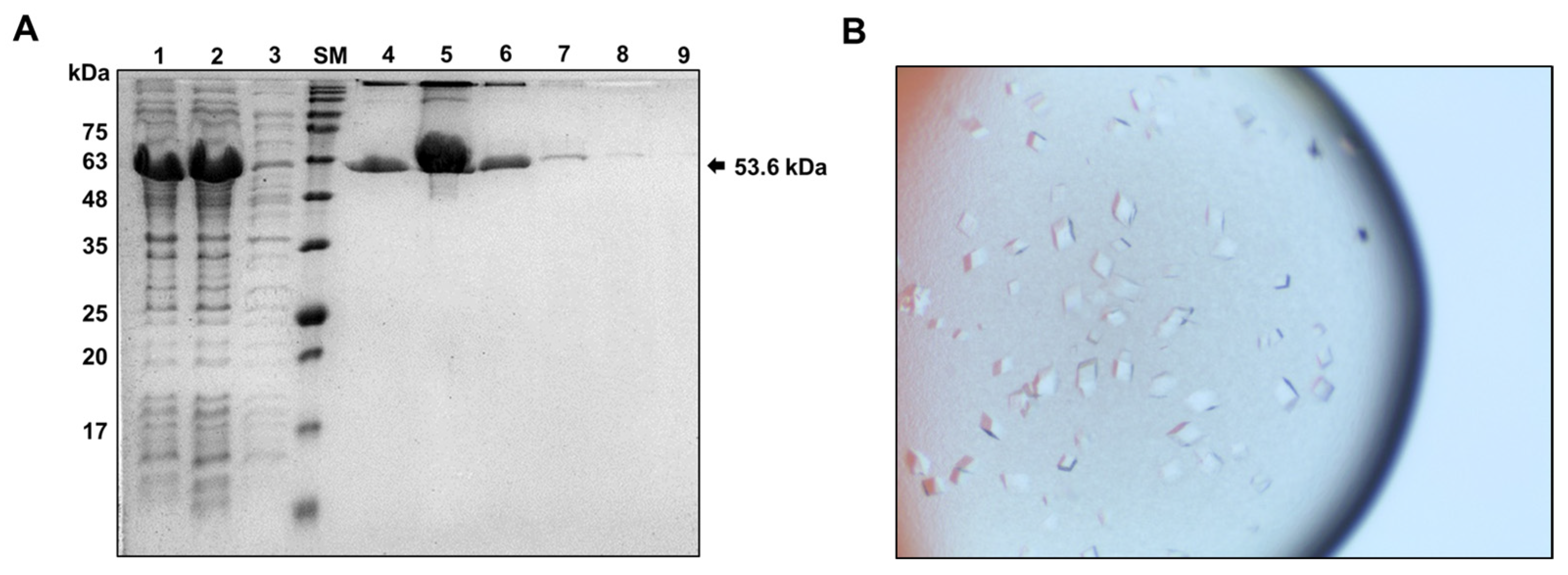
Recombinant LSAI showed a single band at approximately 54 kDa on SDS–PAGE analysis, confirming consistency with the theoretical monomeric molecular weight calculated from its amino acid sequence (Figure 1A). The initial crystallization trials yielded crystals under the following three conditions: (i) 100 mM of Tris-HCl (pH 8.5) and 8% (w/v) polyethylene glycol 8000; (ii) 200 mM ammonium acetate, 100 mM sodium citrate tribasic dihydrate (pH 5.6), and 30% (w/v) polyethylene glycol 4000; and (iii) 100 mM sodium citrate tribasic dihydrate (pH 5.6), 100 mM lithium sulfate monohydrate, and 3% (v/v) polyethylene glycol 400. Among the three initial crystallization conditions, crystals grown in condition (iii) exhibited comparatively better diffraction, reaching ~5 Å, whereas crystals from the other two conditions showed poor or no diffraction. Therefore, condition (iii) was selected for further optimization. To obtain higher-resolution diffraction data, we optimized crystal growth by applying micro-/macro-seeding and by slowing crystallization through reducing the protein and/or precipitant concentrations. Under the optimized condition, lowering the protein concentration to 6 mg/mL yielded crystals larger than 0.1 mm (Figure 1B), which diffracted to ~2.6 Å and were suitable for high-resolution data collection.
The LSAI crystals belonged to the R32 space group, with unit-cell parameters a = b = 135.37 Å, c = 239.76 Å, and α = β = 90°, γ = 120° (Table 1). The structure of LSAI was determined at a resolution of 2.6 Å, with Rwork and Rfree values of 22% and 27%, respectively (Table 1).

3.2. Overall Structure of LSAI

X-ray crystallographic analysis of recombinant LSAI revealed that the crystals belonged to the space group R32, and the asymmetric unit contained a single monomer. The LSAI structure could be clearly modeled for the entire polypeptide chain, except for two regions lacking electron density (a total of 14 residues), corresponding to residues 115–120 and 411–418. Because these missing segments are located in flexible loop regions, the absence of electron density is likely due to their high conformational mobility.
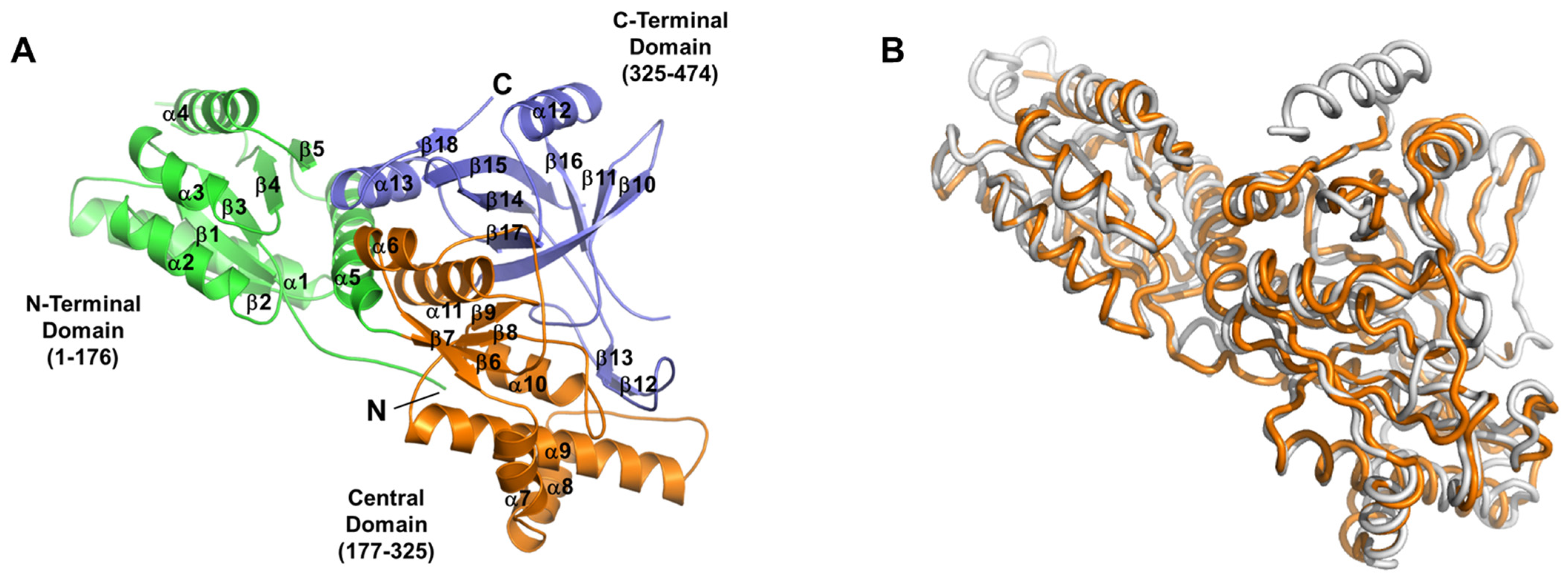
The LSAI monomer comprises 18 β-strands and 13 α-helices, adopting the characteristic α/β fold of the L-AI/L-FI family [15], which can be divided into the N-terminal (1–176 aa), central (177–325 aa), and C-terminal (326–474 aa) domains (Figure 2A). This domain organization and overall fold were further confirmed by structural superimposition with other L-AIs, including E. coli L-AI (ECAI) (Figure 2B) as well as G. kaustophilus L-AI (GKAI), T. maritima L-AI (TMAI), and L. fermentum L-AI (LFAI). The Cα r.m.s.d. values against these enzymes were approximately 1.7–1.9 Å, indicating that LSAI exhibits high structural similarity to canonical L-AI family enzymes.
The N-terminal domain is structurally reminiscent of a Rossmann fold, a typical dinucleotide-binding motif [15,28]. The β-sheet within this domain consists of five parallel strands (β1–β5), flanked by helices α2–α4 on one side and α1 and α5 on the other. The central domain (176–325 aa) shows a secondary-structure composition broadly similar to that of the N-terminal domain; however, it contains only four parallel β-strands (β6–β9) connected by helices (α6–α11) and loops, and therefore does not appear to form a Rossmann fold [28]. The C-terminal domain includes an antiparallel β-barrel composed of six β-strands (β10–β11 and β14–β17).

3.3. Oligomeric Assembly State of LSAI

To date, all L-AIs whose structures have been experimentally determined are known to form homohexamers. However, a previous study on LSAI proposed that the enzyme exists as a homotetramer in solution, based on the apparent molecular weights observed by SEC [14]. Therefore, in this study, the oligomeric state of LSAI was re-evaluated using SEC analysis and X-ray crystallographic interpretation.
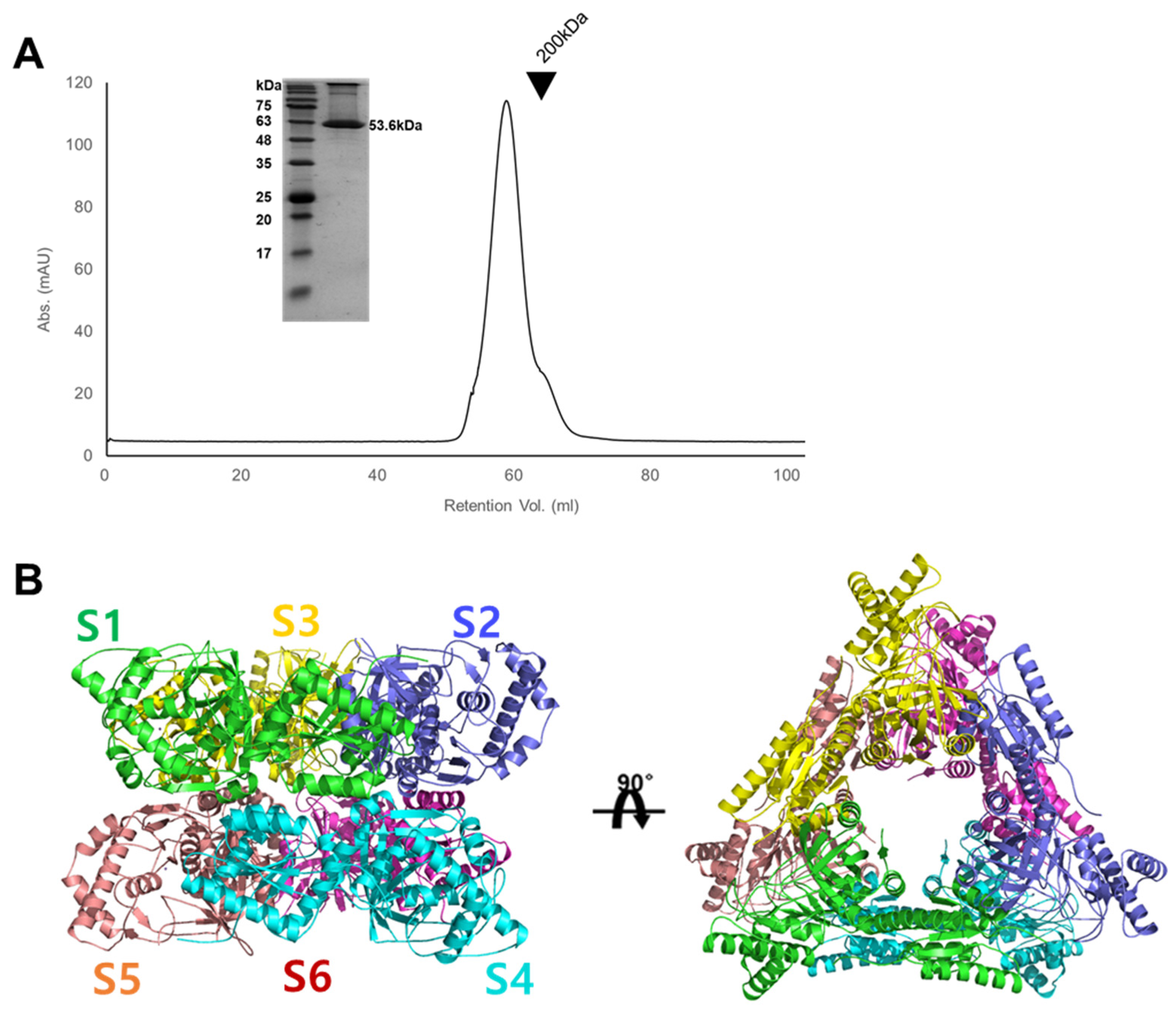
In our SEC experiments, purified LSAI eluted at approximately 250 kDa, corresponding to ~4.6 times the monomeric molecular weight (54 kDa) (Figure 3A and Figure S1). Because molecular weight estimation by SEC can show substantial deviations depending on the protein’s hydration radius and overall shape [29], these data provide qualitative evidence that LSAI does not exist as a monomer but rather forms higher-order oligomers in the range of 4–6 subunits. Nevertheless, SEC alone was insufficient to clearly discriminate between tetrameric and hexameric assemblies.
Although the asymmetric unit of the crystal contained only a single LSAI monomer, application of crystallographic symmetry operations generated a trimer arranged along a threefold axis, and two such trimers associated in a face-to-face manner via a twofold symmetry operation, reconstructing a D3-symmetric homohexamer (Figure 3B). This assembly mode is consistent with the hexameric architecture reported for bacterial and archaeal L-AIs, including LFAI (PDB ID: 4LQL), a phylogenetically related enzyme from lactic acid bacteria. Thus, although the biological unit of LSAI was previously suggested to be tetrameric [14], integration of our SEC data, crystallographic evidence, and the known assembly patterns of related L-AIs strongly supports that LSAI is likely to form a homohexamer.
Notably, the LSAI hexamer reconstructed by crystallographic symmetry exhibited a slightly different subunit arrangement compared with other L-AI hexamers. Structural superimposition with the sequence-similar LFAI hexamer revealed that the central domains located at the three corners of each trimer were rotated in a markedly different direction relative to those of LFAI (Figure S2). However, given that the LSAI monomer itself shows very close structural agreement with other L-AIs (low RMSD) and that previously reported L-AI crystal structures generally contain trimers or hexamers within the asymmetric unit, this difference is more likely attributable to symmetry-driven, non-physiological packing rather than a genuine domain rearrangement or intrinsic twisting of the monomer (Figure S3).
An additional prominent difference was observed during comparison of the LSAI hexamer with other L-AIs. While both LFAI and LSAI (lactic acid bacteria) lack a C-terminal α-helix, a corresponding C-terminal α-helix is present in ECAI (mesophilic), GKAI (thermophilic), and TMAI (hyperthermophilic) enzymes. This helix fills the central cavity of the trimeric core and provides additional inter-subunit interactions (Figure S4). The calculated buried surface areas (total surface areas) for each L-AI hexamer were 23,457 (96,436) Å2 for LSAI, 27,220 (101,720) Å2 for LFAI, 27,803 (109,305) Å2 for ECAI, 40,121 (89,518) Å2 for GKAI, and 45,052 (88,528) Å2 for TMAI. Overall, more thermostable L-AIs tended to exhibit larger inter-subunit interfaces, along with an increased ratio of buried surface area to total surface area. These results suggest that the thermostability of L-AIs is closely associated with oligomeric assembly and the extent of inter-subunit interactions.

3.4. Active-Site Architecture and Metal-Binding Environment of LSAI

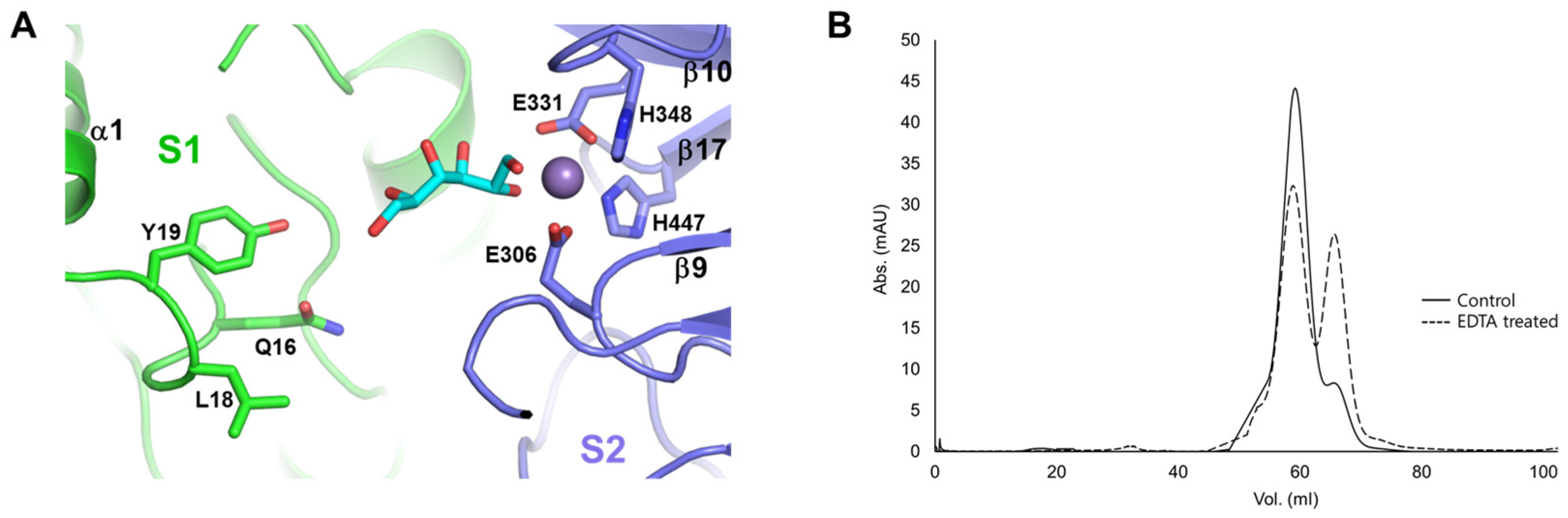
To identify the active site and the metal-binding site in the LSAI crystal structure, crystals were soaked with the substrate analog L-arabitol and Mn2+; however, no corresponding electron density was observed, indicating that their binding could not be confirmed from the electron-density maps. Accordingly, docking calculations were performed to place the substrate D-galactose and Mn2+ into the active site based on the LSAI structure. While a stable docking pose for D-galactose could not be obtained, a model containing only Mn2+ bound to the enzyme could be generated. Based on the Mn2+ binding position, the putative active site of LSAI is located within a cleft formed at the interface between the N-terminal domains of two subunits and the C-terminal domain of another subunit within the trimeric assembly (Figure 4A). To examine the residues involved in substrate interactions, the LSAI structure was superimposed with the L-arabitol-bound GKAI structure (PDB ID: 4R1Q), and D-galactose was manually docked according to the L-arabitol position in GKAI. This analysis revealed that several conserved residues known to participate in substrate recognition in L-AIs, such as Gln16, Leu18, and Tyr19, were located far from the predicted substrate position (Figure 4A and Figure S3). As a consequence, sufficient complementary interactions with the substrate could not be formed, which likely accounts for the failure to obtain a stable D-galactose pose in the automated docking calculations. In contrast, Mn2+ was coordinated by residues Glu306, Glu331, His348, and His447, which are known to participate in metal coordination (Figure 4A and Figure S5).
In L-AIs, metal ions are known to contribute not only to catalytic activity but also to structural stability [5,6,13]. For the mesophilic ECAI, measurable activity is retained even in the absence of Mn2+ [30], whereas in thermophilic L-AIs, metal ions have been reported to be essential for both activity and structural stabilization [6,13]. Although LSAI, being relatively closer to mesophilic enzymes, has been reported to exhibit lower dependence on metal ions for maintaining catalytic activity [14], we investigated whether a similar trend applies to structural stability by removing metal ions with EDTA and subsequently performing SEC (Figure 4B). Upon EDTA treatment, partial dissociation of the oligomer was observed, yielding a smaller species that is presumed to be a trimer (Figure 4B). These results suggest that metal ions may play an important role in stabilizing the oligomeric assembly of LSAI.

3.5. Structural Stability and Inter-Subunit Interaction Analysis of LSAI

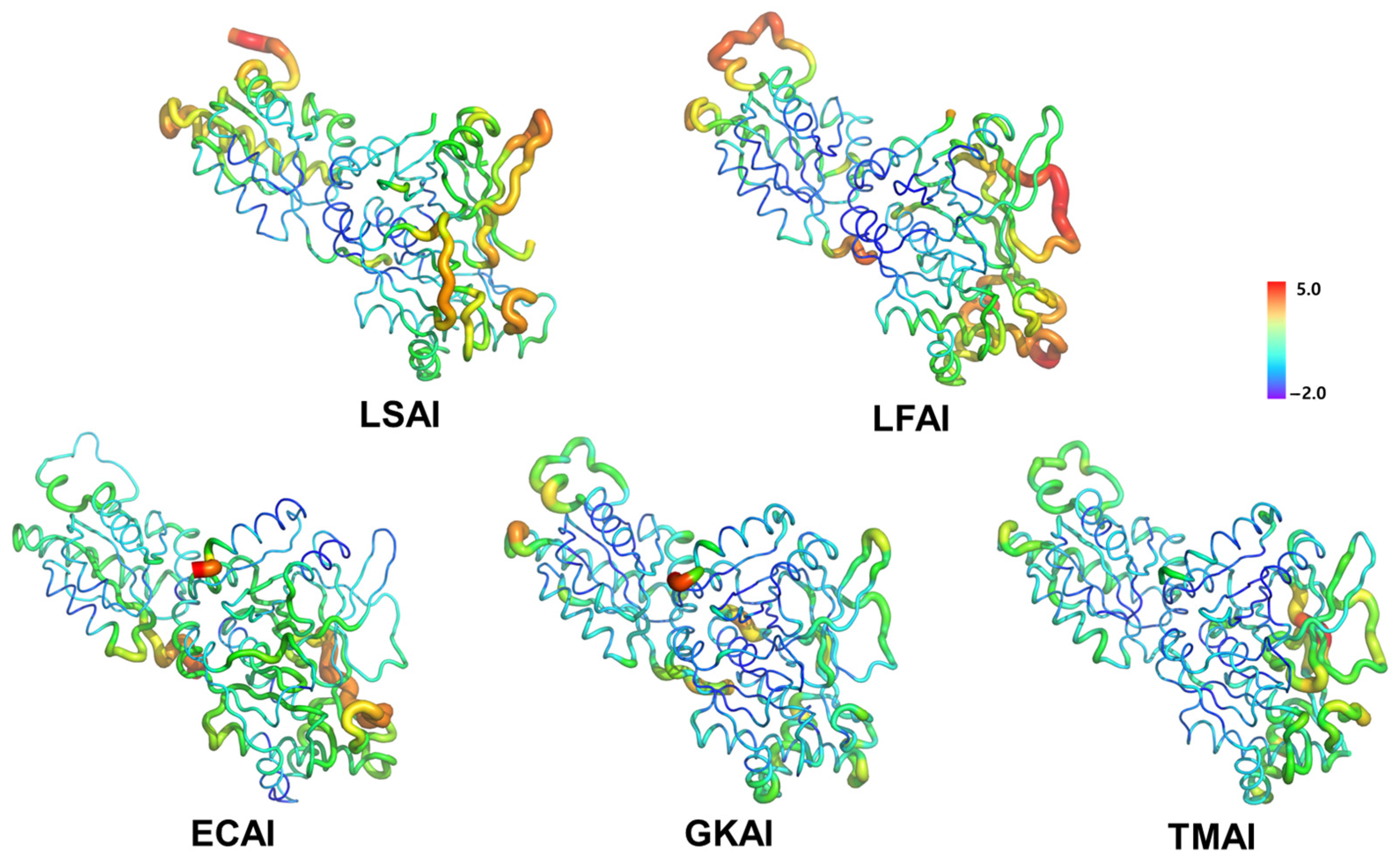
To evaluate the structural stability of LSAI, the B-factors of crystal structures of LSAI, together with those of LFAI, ECAI, GKAI, and TMAI, were normalized and mapped onto each structure for comparative analysis (Figure 5). In general, a lower B-factor indicates smaller atomic displacement due to thermal motion and thus reflects higher structural stability in the corresponding region [31].
As a result, the cores of the N-terminal and central domains consistently exhibited very low B-factors across all L-AIs, indicating that these regions form a structurally stable scaffold. In contrast, the inter-subunit interaction region between the N-terminal and C-terminal domains showed relatively higher B-factors, and this trend was more pronounced in L-AIs with lower thermostability (Figure 5). This observation is consistent with our earlier results showing that more thermostable L-AIs tend to have larger inter-subunit interface areas and higher buried-surface-area ratios relative to total surface area, collectively suggesting that the thermostability of L-AIs is closely correlated with oligomeric assembly and the extent of inter-subunit interactions. Notably, these highly flexible regions substantially overlapped with the region where the active site is located.
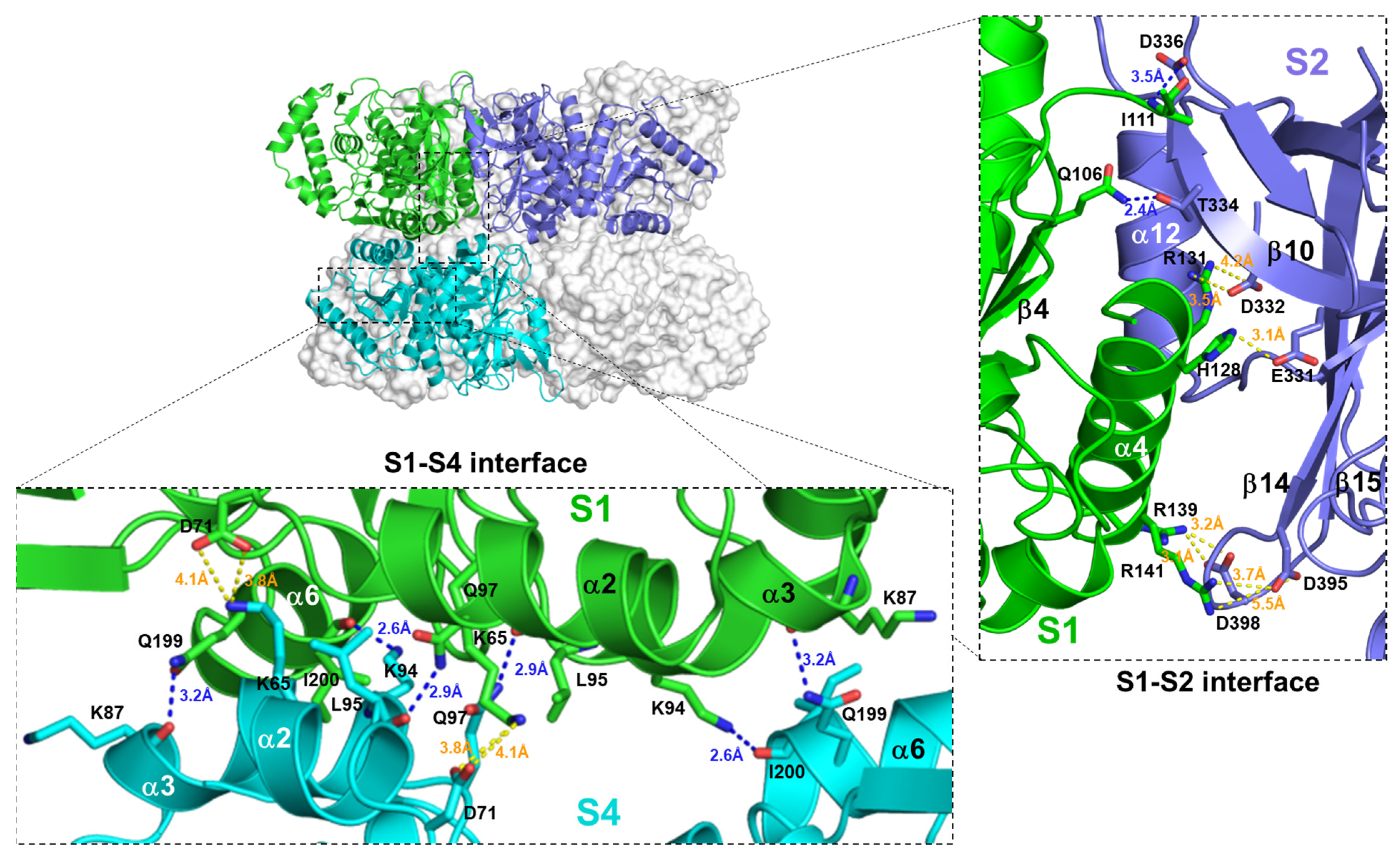
To further quantify and structurally characterize inter-subunit interactions in LSAI, we analyzed the interfaces formed by each subunit. Each LSAI subunit forms two interfaces with two adjacent subunits located in the same plane within the trimer (Figure 6, S1–S2 interfaces) and one interface with a subunit from the opposing trimer (Figure 6, S1–S4 interface), and these interactions are mediated largely by hydrogen bonds and salt bridges (Figure 6, Table 2). Because the two trimers associate with an ~30° twist, an additional interface (S2–S4) is present; however, no notable residue–residue interactions were detected at this interface.
At the S1–S2 interface, the N-terminal domain of one subunit and the C-terminal domain of the neighboring subunit associate in a head-to-tail manner, forming a total of four salt bridges accompanied by hydrogen bonds and two additional hydrogen bonds (Figure 6, S1–S2 interface; Table 2). The S1–S4 interface, which mediates trimer–trimer association, involves antiparallel packing of α2 and α3 in the N-terminal domain and α6 in the central domain, generating a robust interaction network consisting of two salt bridges accompanied by six hydrogen bonds.
To assess how inter-subunit interactions contribute to structural and thermal stability in L-AIs, we compared the interaction networks at the corresponding interfaces in LFAI, ECAI, GKAI, and TMAI (Table 2). Overall, more thermostable L-AIs exhibited a greater number of hydrogen bonds and more sequence-conserved salt bridges at their interfaces (Table 2; Figure 6). These observations strongly suggest that enhanced oligomerization and increased inter-subunit interactions contribute to improved overall structural stability and thermostability in L-AIs.

4. Discussion

In this study, we determined the X-ray crystal structure of the L-arabinose isomerase from the food-grade, psychrotrophic strain L. sakei 23K (LSAI) at 2.6 Å resolution. By comparing LSAI with previously reported mesophilic, thermophilic, and hyperthermophilic L-AIs, we analyzed differences in oligomeric assembly, active-site architecture and metal-binding environment, and inter-subunit interaction/flexibility to identify structural determinants that support D-galactose isomerization under low-temperature and metal-limited conditions.
First, the LSAI monomer adopts the canonical α/β fold characteristic of the L-AI/L-fucose isomerase family, comprising three domains: the N-terminal, central, and C-terminal domains. Structural superimposition showed high overall conservation, with Cα r.m.s.d. values of ~1.7–1.9 Å relative to ECAI, GKAI, TMAI, and LFAI. Thus, although LSAI differs from thermophilic L-AIs in biochemical properties (e.g., low metal requirement, low-temperature activity, and stability under acidic conditions), its fundamental catalytic scaffold and domain architecture are well preserved.
Second, SEC indicated that LSAI exists as a higher-order oligomer in the range of 4–6 subunits in solution. Although the asymmetric unit contained a single monomer, application of crystallographic symmetry operations reconstructed a D3-symmetric homohexamer composed of two trimers. This assembly mode closely matches the hexameric organization reported for other L-AIs [8,15], including the lactic acid bacterium-derived LFAI, supporting the conclusion that LSAI is also highly likely to adopt a hexameric physiological oligomeric state rather than the tetrameric model proposed previously [14].
Third, soaking and docking analyses aimed at defining the LSAI active site and its metal-binding environment did not provide unambiguous evidence for L-arabitol binding. In contrast, Mn2+ was predicted to localize within a cleft formed between the N-terminal domains of two subunits and the C-terminal domain of a third subunit, coordinating with Glu306, Glu331, His348, and His447. Comparison with the L-arabitol-bound GKAI structure and manual docking of the substrate into the LSAI structure suggests that key residues implicated in substrate recognition, Gln17, Leu18, and Tyr19, adopt an “open” conformation positioned away from the putative substrate site. Accordingly, it is plausible that LSAI may also undergo an Mn2+-associated conformational rearrangement of the β1–α1 loop prior to productive substrate binding, consistent with the Mn2+-triggered induced-fit mechanism proposed for GKAI [8]. Moreover, SEC analysis after EDTA treatment revealed partial dissociation of the oligomer into a smaller species consistent with a trimer, indicating that although LSAI may exhibit relatively low metal dependence in terms of catalytic activity [14], metal ions play an important role in stabilizing its oligomeric assembly.
Fourth, comparative mapping of normalized B-factors for LSAI, LFAI, ECAI, GKAI, and TMAI showed that the cores of the N-terminal and central domains consistently display low B-factors, forming a structurally stable scaffold, whereas the inter-subunit interface between the N- and C-terminal domains exhibits higher B-factors. Importantly, L-AIs with lower thermostability tended to show higher B-factors at these interface regions. This trend agrees well with our observations that more thermostable enzymes possess increased buried surface areas and greater numbers of sequence-conserved hydrogen bonds and salt bridges, which collectively strengthen inter-subunit interactions. Together, these results support the notion that L-AI thermostability is governed not only by local stability within individual domains but also by the overall packing and interaction network within the oligomeric assembly.
In this work, we focused on structural determination and comparative analysis. The absence of direct activity measurements under the conditions tested represents a limitation of the present study. Activity confirmation using an established assay is currently underway and will be reported in future work
In summary, this work systematically elucidates the high-resolution three-dimensional structure of the food-grade, lactic acid bacterium-derived LSAI, along with its oligomeric assembly mode, metal-binding environment, and inter-subunit interface characteristics, thereby providing structural insights into the adaptive strategies of L-AIs functioning under low-temperature and low-metal conditions. These structural data are expected to serve as a foundation for rational protein engineering of LSAI and related enzymes, such as enhancing thermostability by reinforcing subunit interfaces, or optimizing substrate affinity and metal dependence by modulating loop flexibility near the active site. Furthermore, the structural insights presented here provide essential groundwork for developing food-grade L-AI platforms for the efficient bioproduction of functional rare sugars, including D-tagatose.

Supplementary Materials

The following supporting information can be downloaded at https://www.mdpi.com/article/10.3390/cryst16020084/s1: Table S1: Summary of DALI comparison results for the structures used in this study. Figure S1: SEC calculation for determination of molecular weight of LSAI oligomer in solution. Figure S2: Difference in subunit arrangement of LSAI. Figure S3: Crystal artifact in hexameric structure of LSAI. Figure S4: Structural comparison of the LSAI hexamer (gray) and the ECAI hexamer (orange). Figure S5: Multiple sequence alignment of L-arabinose isomerases (L-AIs).

Author Contributions

Conceptualization, J.-M.C.; methodology, S.Y. and J.C.; software, S.Y. and J.C.; validation, S.Y., J.C. and J.-M.C.; formal analysis, S.Y. and J.C.; investigation, S.Y. and J.C.; resources, S.Y., J.C. and J.-M.C.; data curation, S.Y., J.C. and J.-M.C.; writing—original draft preparation, S.Y.; writing—review and editing, J.C. and J.-M.C.; visualization, J.C.; supervision, J.-M.C.; project administration, J.-M.C.; funding acquisition, J.-M.C. All authors have read and agreed to the published version of the manuscript.

Funding

This research was supported by BB21plus, funded by Busan Metropolitan City and Busan Techno Park, and the Regional Innovation System & Education (RISE) program through the Institute for Regional Innovation System & Education in Busan Metropolitan City, funded by the Ministry of Education (MOE) and the Busan Metropolitan City, Republic of Korea (grant number; 2025-RISE-02-005-009).

Data Availability Statement

Coordinates and structure factor amplitudes for LSAI structure have been deposited in PDB under the accession code 22DQ (https://www.rcsb.org/structure/22DQ (accessed on 7 January 2026)).

Acknowledgments

The authors would like to thank the beamline staff at the 5C beamline at the Pohang Accelerator Laboratory for their assistance with data collection.

Conflicts of Interest

The authors declare no conflicts of interest.

References

  1. Guerrero-Wyss, M.; Durán Agüero, S.; Angarita Dávila, L. D-Tagatose is a promising sweetener to control glycaemia: A new functional food. BioMed Res. Int. 2018, 2018, 8718053. [Google Scholar] [CrossRef]
  2. Ensor, M.; Banfield, A.B.; Smith, R.R.; Williams, J.; Lodder, R.A. Safety and efficacy of D-tagatose in glycemic control in subjects with type 2 diabetes. J. Endocrinol. Diabetes Obes. 2014, 3, 1065. [Google Scholar]
  3. Miao, P.; Wang, Q.; Ren, K.; Zhang, Z.; Xu, T.; Xu, M.; Zhang, X.; Rao, Z. Advances and Prospects of d-Tagatose Production Based on a Biocatalytic Isomerization Pathway. Catalysts 2023, 13, 1437. [Google Scholar] [CrossRef]
  4. Ravikumar, Y.; Ponpandian, L.N.; Zhang, G.; Yun, J.; Qi, X. Harnessing l-arabinose isomerase for biological production of d-tagatose: Recent advances and its applications. Trends Food Sci. Technol. 2021, 107, 16–30. [Google Scholar] [CrossRef]
  5. Lee, D.-W.; Jang, H.-J.; Choe, E.-A.; Kim, B.-C.; Lee, S.-J.; Kim, S.-B.; Hong, Y.-H.; Pyun, Y.-R. Characterization of a thermostable L-arabinose (D-galactose) isomerase from the hyperthermophilic eubacterium Thermotoga maritima. Appl. Environ. Microbiol. 2004, 70, 1397–1404. [Google Scholar] [CrossRef] [PubMed]
  6. Lee, D.-W.; Hong, Y.-H.; Choe, E.-A.; Lee, S.-J.; Kim, S.-B.; Lee, H.-S.; Oh, J.-W.; Shin, H.-H.; Pyun, Y.-R. A thermodynamic study of mesophilic, thermophilic, and hyperthermophilic L-arabinose isomerases: The effects of divalent metal ions on protein stability at elevated temperatures. FEBS Lett. 2005, 579, 1261–1266. [Google Scholar] [CrossRef]
  7. Lee, S.-J.; Lee, D.-W.; Choe, E.-A.; Hong, Y.-H.; Kim, S.-B.; Kim, B.-C.; Pyun, Y.-R. Characterization of a thermoacidophilic L-arabinose isomerase from Alicyclobacillus acidocaldarius: Role of Lys-269 in pH optimum. Appl. Environ. Microbiol. 2005, 71, 7888–7896. [Google Scholar] [CrossRef]
  8. Choi, J.M.; Lee, Y.-J.; Cao, T.-P.; Shin, S.-M.; Park, M.-K.; Lee, H.-S.; Di Luccio, E.; Kim, S.-B.; Lee, S.-J.; Lee, S.J. Structure of the thermophilic L-arabinose isomerase from Geobacillus kaustophilus reveals metal-mediated intersubunit interactions for activity and thermostability. Arch. Biochem. Biophys. 2016, 596, 51–62. [Google Scholar] [CrossRef]
  9. Oh, D.K.; Oh, H.J.; Kim, H.J.; Cheon, J.; Kim, P. Modification of optimal pH in L-arabinose isomerase from Geobacillus stearothermophilus for D-galactose isomerization. J. Mol. Catal. B Enzym. 2006, 43, 108–112. [Google Scholar] [CrossRef]
  10. Jebors, S.; Tauran, Y.; Aghajari, N.; Boudebbouze, S.; Maguin, E.; Haser, R.; Coleman, A.W.; Rhimi, M. Supramolecular stabilization of acid tolerant L-arabinose isomerase from Lactobacillus sakei. Chem. Commun. 2011, 47, 12307–12309. [Google Scholar] [CrossRef]
  11. Lee, S.-J.; Lee, S.J.; Lee, Y.-J.; Kim, S.-B.; Kim, S.-K.; Lee, D.-W. Homologous alkalophilic and acidophilic L-arabinose isomerases reveal region-specific contributions to the pH dependence of activity and stability. Appl. Environ. Microbiol. 2012, 78, 8813–8816. [Google Scholar] [CrossRef]
  12. Lu, C.; Chen, Z.; Ravikumar, Y.; Zhang, G.; Tang, X.; Zhang, Y.; Zhao, M.; Sun, W.; Qi, X. Improving catalytic efficiency of L-Arabinose isomerase from Lactobacillus plantarum CY6 towards D-Galactose by molecular modification. Foods 2024, 13, 1727. [Google Scholar] [CrossRef]
  13. Lee, D.-W.; Choe, E.-A.; Kim, S.-B.; Eom, S.-H.; Hong, Y.-H.; Lee, S.-J.; Lee, H.-S.; Lee, D.-Y.; Pyun, Y.-R. Distinct metal dependence for catalytic and structural functions in the L-arabinose isomerases from the mesophilic Bacillus halodurans and the thermophilic Geobacillus stearothermophilus. Arch. Biochem. Biophys. 2005, 434, 333–343. [Google Scholar] [CrossRef] [PubMed]
  14. Rhimi, M.; Ilhammami, R.; Bajic, G.; Boudebbouze, S.; Maguin, E.; Haser, R.; Aghajari, N. The acid tolerant L-arabinose isomerase from the food grade Lactobacillus sakei 23K is an attractive D-tagatose producer. Bioresour. Technol. 2010, 101, 9171–9177. [Google Scholar] [CrossRef] [PubMed]
  15. Manjasetty, B.A.; Chance, M.R. Crystal structure of Escherichia coli L-arabinose isomerase (ECAI), the putative target of biological tagatose production. J. Mol. Biol. 2006, 360, 297–309. [Google Scholar] [CrossRef]
  16. Prabhu, P.; Jeya, M.; Lee, J.-K. Probing the molecular determinant for the catalytic efficiency of L-arabinose isomerase from Bacillus licheniformis. Appl. Environ. Microbiol. 2010, 76, 1653–1660. [Google Scholar] [CrossRef] [PubMed][Green Version]
  17. Park, S.-Y.; Ha, S.-C.; Kim, Y.-G. The protein crystallography beamlines at the pohang light source II. Biodesign 2017, 5, 30–34. [Google Scholar]
  18. Otwinowski, Z.; Minor, W. [20] Processing of X-ray diffraction data collected in oscillation mode. In Methods in Enzymology; Academic Press: Cambridge, MA, USA, 1997; Volume 276, pp. 307–326. [Google Scholar]
  19. Liebschner, D.; Afonine, P.V.; Baker, M.L.; Bunkóczi, G.; Chen, V.B.; Croll, T.I.; Hintze, B.; Hung, L.-W.; Jain, S.; McCoy, A.J. Macromolecular structure determination using X-rays, neutrons and electrons: Recent developments in Phenix. Biol. Crystallogr. 2019, 75, 861–877. [Google Scholar] [CrossRef]
  20. Jumper, J.; Evans, R.; Pritzel, A.; Green, T.; Figurnov, M.; Ronneberger, O.; Tunyasuvunakool, K.; Bates, R.; Žídek, A.; Potapenko, A.; et al. Highly accurate protein structure prediction with AlphaFold. Nature 2021, 596, 583–589. [Google Scholar] [CrossRef]
  21. Emsley, P.; Lohkamp, B.; Scott, W.G.; Cowtan, K. Features and development of Coot. Biol. Crystallogr. 2010, 66, 486–501. [Google Scholar] [CrossRef]
  22. Holm, L.; Laiho, A.; Törönen, P.; Salgado, M. DALI shines a light on remote homologs: One hundred discoveries. Protein Sci. 2023, 32, e4519. [Google Scholar] [CrossRef]
  23. Sievers, F.; Higgins, D.G. Clustal Omega for making accurate alignments of many protein sequences. Protein Sci. 2018, 27, 135–145. [Google Scholar] [CrossRef]
  24. Robert, X.; Gouet, P. Deciphering key features in protein structures with the new ENDscript server. Nucleic Acids Res. 2014, 42, W320–W324. [Google Scholar] [CrossRef] [PubMed]
  25. Eberhardt, J.; Santos-Martins, D.; Tillack, A.F.; Forli, S. AutoDock Vina 1.2.0: New Docking Methods, Expanded Force Field, and Python Bindings. J. Chem. Inf. Model. 2021, 61, 3891–3898. [Google Scholar] [CrossRef]
  26. Barthels, F.; Schirmeister, T.; Kersten, C. BANΔIT: B’-factor analysis for drug design and structural biology. Mol. Inform. 2021, 40, 2000144. [Google Scholar] [CrossRef]
  27. Krissinel, E.; Henrick, K. Inference of macromolecular assemblies from crystalline state. J. Mol. Biol. 2007, 372, 774–797. [Google Scholar] [CrossRef] [PubMed]
  28. Shin, W.-H.; Kihara, D. 55 Years of the Rossmann Fold. In Protein Supersecondary Structures: Methods and Protocols; Kister, A.E., Ed.; Springer: New York, NY, USA, 2019; pp. 1–13. [Google Scholar]
  29. Richter, W. Determining the Subunit Structure of Phosphodiesterases Using Gel Filtration and Sucrose Density Gradient Centrifugation. In Phosphodiesterase Methods and Protocols; Lugnier, C., Ed.; Humana Press: Totowa, NJ, USA, 2005; pp. 167–180. [Google Scholar]
  30. Patrick, J.W.; Lee, N.; Barnes, N.B.; Englesberg, E. Coordination of Enzyme Synthesis in the L-Arabinose Operon in Escherichia coli: I. THE EFFECT OF MANGANOUS ION ON THE SYNTHESIS OF L-ARABINOSE ISOMERASE. J. Biol. Chem. 1971, 246, 5102–5106. [Google Scholar] [CrossRef] [PubMed]
  31. Sun, Z.; Liu, Q.; Qu, G.; Feng, Y.; Reetz, M.T. Utility of B-Factors in Protein Science: Interpreting Rigidity, Flexibility, and Internal Motion and Engineering Thermostability. Chem. Rev. 2019, 119, 1626–1665. [Google Scholar] [CrossRef]
Figure 1. Purification and crystallization of LSAI. (A) SDS-PAGE gel image after Ni-NTA afiinity purification. Lane 1, crude lysate; Lane 2, soluble fraction; Lane 3, flow-through; SM, molecular weight marker; Lane 4, elution 1; Lane 5, elution 2; Lane 6, elution 3; Lane 7, elution 4; Lane 8, elution 5; Lane 9, elution 6. (B) Photo of LSAI crystals from condition (iii).
Crystals 16 00084 g001
Figure 2. Overall structure of LSAI. (A) Monomeric form of LSAI found in the asymmetric unit of the crystal. Annotations of each secondary structure are assigned on the structure. (B) Superimposition of crystal structure of LSAI (orange) and ECAI (gray).
Crystals 16 00084 g002
Figure 3. Oligomeric state of LSAI. (A) SEC elution profile of LSAI. An SDS–PAGE analysis of the high-molecular-weight peak fraction used for crystallization is shown in the inset. (B) Reconstitution of the LSAI homohexamer using crystallographic symmetry operations. S1 to 6 idicate the subunits of homohexamer with same color.
Crystals 16 00084 g003
Figure 4. Active site of LSAI. (A) Docking model of D-tagatose and Mn2+. Active site revealed by docking of Mn2+ (sphere in slate) and D-tagatose (substrate, cyan). Residues coordinating Mn2+ resides in the cleft located in the interface of two subunits (S1–S2). Residues conserved and known to function in the binding of substrate in the other subunit (S1) located at a distance from the substrate. (B) SEC analysis of oligomeric state of LSAI in the presence or absence of Mn2+.
Crystals 16 00084 g004
Figure 5. B-factor comparisons of L-AIs. Normalized B-factors derived from the diffraction data of each crystal structure are represented by the color and radius of tubes; B-factor increases from blue color with small radius to red color with large radius. Scale bars indicate the normalized B-factor. Orientation of the structures are same as overall structure of LSAI monomer in Figure 3.
Crystals 16 00084 g005
Figure 6. Structural analysis of oligomeric interfaces of LSAI. Each of the residues are denoted in the structure of each interfaces. Salt bridges are colored in blue dashes and H-bind in yellow dashes. Distances of the interactions are also denoted.
Crystals 16 00084 g006
Table 1. Data and refinement statistics for LSAI.
Parameter
X-ray source5C beamline, PLS-II
Wavelength (Å)1.0
Space groupR32
Cell dimension
a, b, c (Å)135.37, 135.37, 239.76
α, β, γ (°)90, 90, 120
Resolution (Å)50.00–2.60 (2.64–2.60)
Unique reflections26,281 (1282)
Completeness (%)100.0 (99.8)
Redundancy18.5 (9.9)
I/σ25.3 (1.1)
Rmerge0.250 (5.564)
Rmeas0.339 (4.993)
CC1/21.000 (0.435)
CC*1.000 (0.779)
Refinement
Resolution (Å)43.57–2.60
Rwork a0.224
Rfree b0.270
R.m.s. deviations
Bonds (Å)0.008
Angles (°)0.983
B factors (Å2)
Protein41.53
Ramachandran plot
Favored (%)95.37
Allowed (%)4.41
Disallowed (%)0.22
Values for the outer shell are noted in parentheses. a Rwork = Σ||Fobs | Σ|Fcalc ||/Σ|Fobs |, where Fobs and Fcalc are the observed and calculated structure factor amplitudes, respectively. b Rfree was calculated as Rwork using a and a randomly selected subset of unique reflections not used for structural refinement.
Table 2. Summary of interactions in the interfaces of L-AIs’ subunits.
LSAILFAIECAIGKAITMAI
S1–S2S1–S2S1–S2S1–S2S1–S2
SBsS1S2SBsS1S2SBsS1S2SBsS1S2SBsS1S2
E331H128 R131D332 E467K486 K488E465 H128E329
D332R131 H128E333 E332H129 R131D330
D395R139 R131D334 D333R132 R139D393
D398R141 R141E493 R141E488
R141D401 E153K431
E493 E155
R159E440 E462K481
R485
E483K482
HBs9HBs15HBs18HBs16HBs25
S1–S4S1–S4S1–S4S1–S4S1–S4
SBsS1S4SBsS1S4SBsS1S4SBsS1S4SBsS1S4
K65D71 R139D194 K177D58 R62E72 R139D194
D71K65 D194R139 R65D71 R98E96 D194R139
R139D194 R140D195 E197R139
D58K177 E96R175
D71R65 D195R140
D194R139
HBs6HBs18HBs18HBs10HBs11
S2–S4S2–S4S2–S4S2–S4S2–S4
SBsS2S4SBsS2S4SBsS2S4SBsS2S4SBsS2S4
R180D183 R180D183 R180D183 R180D183
D183R180 H283D213 H283D213 H279E213
D183R180 D183R180 D183R180
D213H283 D213H283 E192K195
E213H279
HBs HBs2HBs8HBs10HBs9
Residue types and numbers and interacting counterparts are presented in salt bridges (SBs). Types and numbers of residues are omitted to save space in H-bonds (HBs). Instead, numbers of the H-bonds are reported.
Disclaimer/Publisher’s Note: The statements, opinions and data contained in all publications are solely those of the individual author(s) and contributor(s) and not of MDPI and/or the editor(s). MDPI and/or the editor(s) disclaim responsibility for any injury to people or property resulting from any ideas, methods, instructions or products referred to in the content.