Article

Softening of Hard Magnetic Behavior and the Maximum Coercive Field in Zr2RhTl as Revealed by Effective Field Theory

by
Semih Doğruer
1,2,
Ziya Merdan
1 and
Yasin Göktürk Yıldız
3,*
1
Department of Physics, Faculty of Science, Gazi University, Ankara 06560, Türkiye
2
Health Services Vocational School, Ankara Yıldırım Beyazıt University, Ankara 06760, Türkiye
3
Department of Electronics and Automation, Kırıkkale University, Kırıkkale 71450, Türkiye
*
Author to whom correspondence should be addressed.
Crystals 2026, 16(2), 144; https://doi.org/10.3390/cryst16020144
Submission received: 21 January 2026 / Revised: 5 February 2026 / Accepted: 14 February 2026 / Published: 16 February 2026
(This article belongs to the Section Crystalline Metals and Alloys)

Abstract

The present study investigated the magnetic hysteresis properties (coercivity and remanent magnetization) of the Zr2RhTl Heusler alloy using effective field theory (EFT). The study found that the coercive field of Zr2RhTl reaches a maximum at a specific critical temperature, Tch, at which the hardness of magnetic materials increases with the coercive field. This behavior is called the “critical hardness temperature (Tch)”. The hardness of the Zr2RhTl Heusler alloy increases with temperature until Tch, reaching a maximum at Tch. In contrast, it exhibits soft magnetic behavior at T < Tch and T > Tch. We suggest that this maximum hardness behavior can enable a new class of thermo-hardness sensors (THSs) and actuators (THAs).

1. Introduction

Half-metallic ferromagnets (HMFs) in spintronics have been an appealing subject of study in recent decades. Half metals, owing to their 100% spin polarization, electronic band structure, and magnetic properties, behave like semiconductors, and are widely used in spintronics, MR, and MRAM components [1,2,3]. Exploration of half-metallic Heusler alloys is widely anticipated both from a fundamental and an application perspective. In 1983, de Groot et al. [4] first presented the half-Heusler compound NiMnSb as an HMF material. Heusler alloys have attracted considerable attention due to their high Curie temperature (TC) and tunable electronic structure [5,6,7]. Generally, Heusler compounds can be classified into ternary and equiatomic quaternary Heusler compounds. Ternary Heusler compounds consist of half-Heusler and full-Heusler families. The chemical formulas of these compounds are XYZ and X2YZ, respectively. X and Y elements are represented by various transition metals (B group), and Z elements stand for main group elements (3A–8A) in the periodic table. Novel Heusler compounds can also be achieved with the XX’YZ composition. In this case, one of the X atoms is replaced with a new transition element, X′. Half-metallic properties can be observed in different examinations. Among these, a key indicator is the band structure, which shows a band gap for each spin state. While one of the spin band structures behaves like a metal, the other acts like a semiconductor. In addition, to classify the investigated alloy as a half metal, the alloy’s total magnetization must match the Slater–Pauling rule (SP rule), Mt = Zt–24 [8,9,10,11,12,13,14,15,16,17]. However, a modified SP rule, Mt = Zt–28, has also been suggested for these alloys [8]. In conductors, when an external magnetization is applied while current is flowing in the circuit, the voltage difference created by the Hall effect can be measured more precisely and effectively using the high spin polarization of Heusler alloys. This precision is also important in actuators for converting electromagnetic effects into mechanical responses. Therefore, better performance can be achieved with Heusler compounds in applications such as sensors and actuators.
The unique characteristics of Heusler alloys confer multifunctional properties arising from magnetoelastic coupling, including shape memory, magnetic super elasticity, and magnetocaloric and barocaloric effects. These properties of Heusler alloys have attracted researchers for their use as sensors, actuators, magnetic storage media, energy harvesters, and magnetic cooling devices [18,19,20,21].
The present study investigated the magnetic hysteresis properties (coercivity and remanence magnetization) of the Zr2RhTl Heusler alloy using the effective field theory (EFT) developed by Kaneyoshi [22,23,24,25,26,27,28,29,30,31,32,33,34,35,36,37,38,39,40]. We found that Zr2RhTl and its components behave as both soft and hard magnets, depending on temperature. Zr2RhTl and its components act as a hard magnet at a specific critical temperature (Tch, critical hardness temperature), whereas they behave as a soft magnet at T < Tch and T > Tch. This maximum-hardness behavior can open the door to modeling and produce a new class of thermo-hardness sensors (THSs) and actuators (THAs).

2. Materials and Methods

2.1. Model and EFT Formulations

In our previous study [41], we modeled and investigated the temperature dependence of the magnetization of the Zr2RhTl Heusler alloy using EFT [22]. The necessary DFT data for the materials and methods were obtained using the Wien2k program with GGA and GGA+U approaches, as described in our previously published article [41]. Volume–energy optimization was performed using the Murnaghan equation of state, and the lattice constant, equilibrium energy, band structure, and density of states were calculated.
This paper examines the external-field dependence of the magnetization of that alloy. Since the crystal structure of Zr2RhTl and its EFT equations are the same, we follow the same procedures as given below.
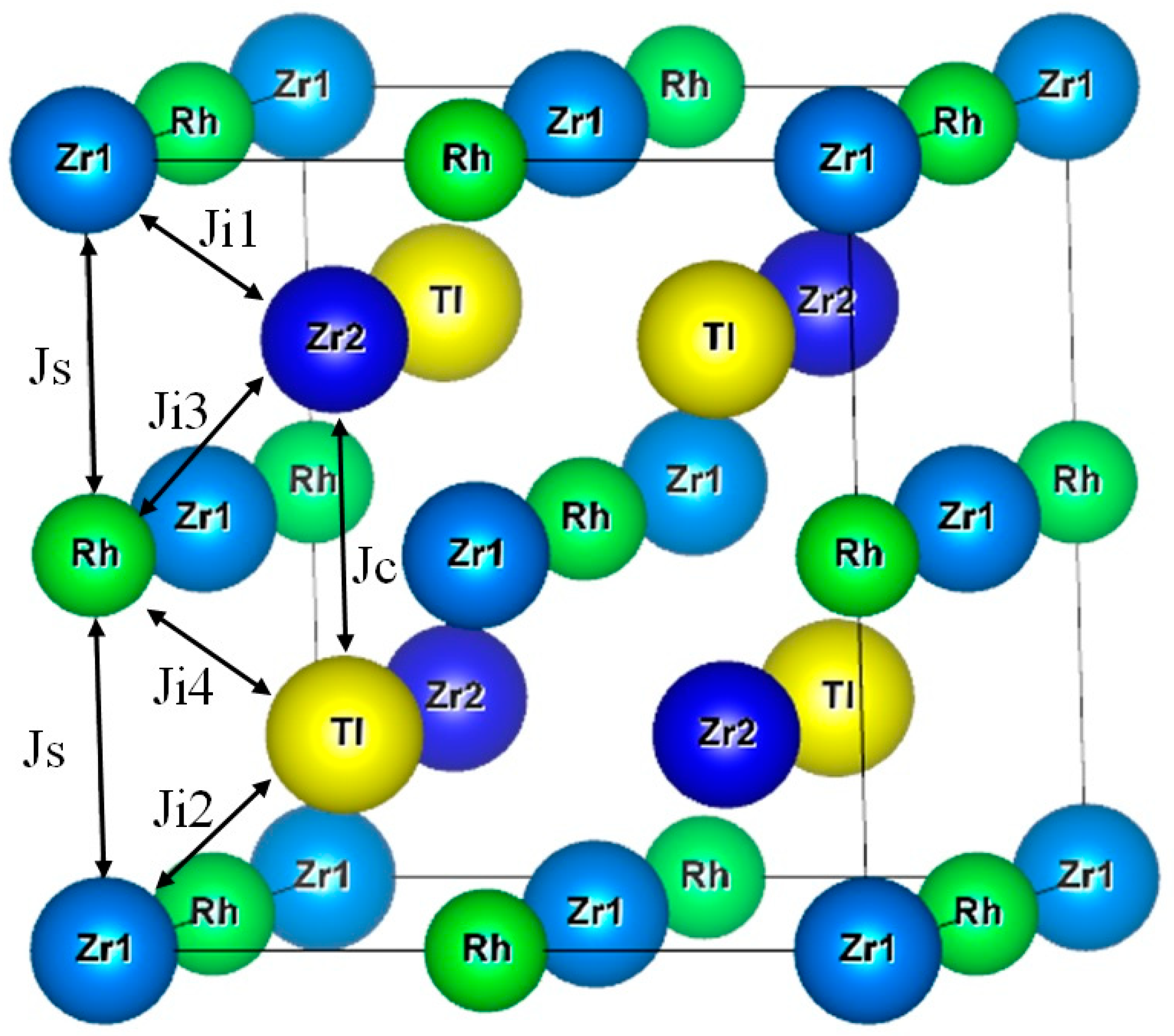
Figure 1 illustrates the crystal structure of the Zr2RhTl Heusler alloy. In Figure 1, Zr1 is Zirconium atoms in the surface, Zr2 is Zirconium atoms in the core, Rh is Rhodium atoms, and Tl is thallium atoms in the core. Zr1 and Zr2 occupy two distinct crystallographic positions. In full Heusler compounds, element X occupies two separate positions in the unit cell in the form X2YZ. For cubic (α = β = γ = 90) space group 216 (f-43 m), elements X1 and X2 should be in the 0/0.25 Wyckoff positions, respectively.

2.2. Hamiltonian

The Hamiltonian and magnetizations of Zr2RhTl are given as follows [41]:
H Zr 2 RhTl = J s Zr 1 , Rh S Zr 1 z S Rh z J c Zr 2 , Tl S Zr 2 z S Tl z J i 1 Zr 1 , Zr 2 S Zr 1 z S Zr 2 z J i 2 Zr 1 , Tl S Zr 1 z S Tl z J i 3 Zr 2 , Rh S Zr 2 z S Rh z J i 4 Tl , Rh S Tl z S Rh z Ω Zr 1 Zr 1 S Zr 1 r Ω Zr 2 Zr 2 S Zr 2 r Ω Rh Rh S Rh r Ω Tl Tl S Tl r h Zr 1 S Zr 1 z + Zr 2 S Zr 2 z + Rh S Rh z + Tl S Tl z
In the Hamiltonian, Sr = ±1 µB (r = z or x) denotes the Pauli spin operator, and the external magnetic field is denoted by h. The transverse field is Ω i (i = Zr1, Zr2, Rh, and Tl). Ji (i = s, c, i1, i2, i3, and i4) represents the exchange interaction between two nearest-and next-nearest-neighbor atoms, and the values of the J are calculated from the relationship Ji = ki/di [29,30,31,32,33,34,35,36,37,38,39,40,41,42]. The parameters di (i = s, c, i1, i2, i3, and i4) are the distances between two magnetic atoms on the unit lattice, and they are obtained from the lattice constant (ds = dc = 6.37 Å, di1 = di2 = di3 = di4 = 2.758 Å). k is the exchange interaction constant, J is ferromagnetic if k > 0, and J is antiferromagnetic if k < 0. In this work, the partial exchange interaction constants are obtained as ks = 100, ki1 = 1390, ki2 = 100, ki3 = 0.001, ki4 = 0.001, and kc = 0.001 to fit with the results of the DFT calculation for Zr2RhTl [41].

2.3. Magnetizations

The magnetizations of Zr1 (mZr1), Zr2 (mZr2), Rh (mRh), and Tl (mTl) are given by Equation (2) within EFT [22,41]. The numbers (6, 4, 4) represent the nearest- and next-nearest-neighbor atoms. For example, Zr1 has six Rh, four Zr2, and four Tl.
m Zr 1 = cos h ( J s ) + m Rh sin h ( J s ) 6 cos h ( J i 1 ) + m Zr 2 sin h ( J i 1 ) 4 cos h ( J i 2 ) + m Tl sin h ( J i 2 ) 4 F s 1 / 2 ( x ) x = 0 , m Zr 2 = cos h ( J c ) + m Tl sin h ( J c ) 6 cos h ( J i 1 ) + m Zr 1 sin h ( J i 1 ) 4 cos h ( J i 3 ) + m Rh sin h ( J i 3 ) 4 F s 1 / 2 ( x ) x = 0 , m Rh = cos h ( J s ) + m Zr 1 sin h ( J s ) 6 cos h ( J i 3 ) + m Zr 2 sin h ( J i 3 ) 4 cos h ( J i 4 ) + m Tl sin h ( J i 4 ) 4 F s 1 / 2 ( x ) x = 0 , m Tl = cos h ( J c ) + m Zr 2 sin h ( J c ) 6 cos h ( J i 2 ) + m Zr 1 sin h ( J i 2 ) 4 cos h ( J i 4 ) + m Rh sin h ( J i 4 ) 4 F s 1 / 2 ( x ) x = 0 ,
The terms in Equation (2) include the differential operator, and F1/2(x) is given for spin-1/2 particles, as described in [22],
F 1 / 2 ( x ) = x + h x + h 2 + Ω i 2 tan h β x + h 2 + Ω i 2 ; ( i = Zr 1 ,   Zr 2 ,   Rh   and   Tl ) ,
where kB is Boltzmann’s constant, β = 1/kBTA, and the absolute temperature is given by TA. H is the external applied field. Finally, the equations for the total magnetization (MTZr2RhTl) and Slater–Pauling (MTSP) magnetization (mI is the interstitial magnetization) of Zr2RhTl are written as follows,
MT Zr 2 RhTl = m Zr 1 + m Zr 2 + m Rh + m Tl
MT SP = m Zr 1 + m Zr 2 + m Rh + m Tl + m I
In addition to the partial magnetization of atoms in the unit cell, there is another type of magnetization that arises from the interaction of the density of states (DOS) of the atoms in the unit cell. This interaction, which we call interstitial magnetization, arises from the interaction of the d orbitals of the elements in the regions between the atoms within the cell. This magnetization is calculated using the Generalized Gradient Approximation—Perdew Burke Ernzerhof (GGA-PBE) method in Density Functional Theory (DFT) in two regions: (1) muffin-tin spheres (MTs), which determine the magnetization of the atoms in the unit cell, and (2) internal interactions in the unit cell outside the MT spheres. The magnetizations obtained from the regions outside the MT spheres are interstitial magnetizations. When calculating the total magnetic moment, the partial magnetic moments and interstitial magnetizations of the elements are added together, thus determining the magnetization of the entire unit cell.

3. Results

Numerical Results

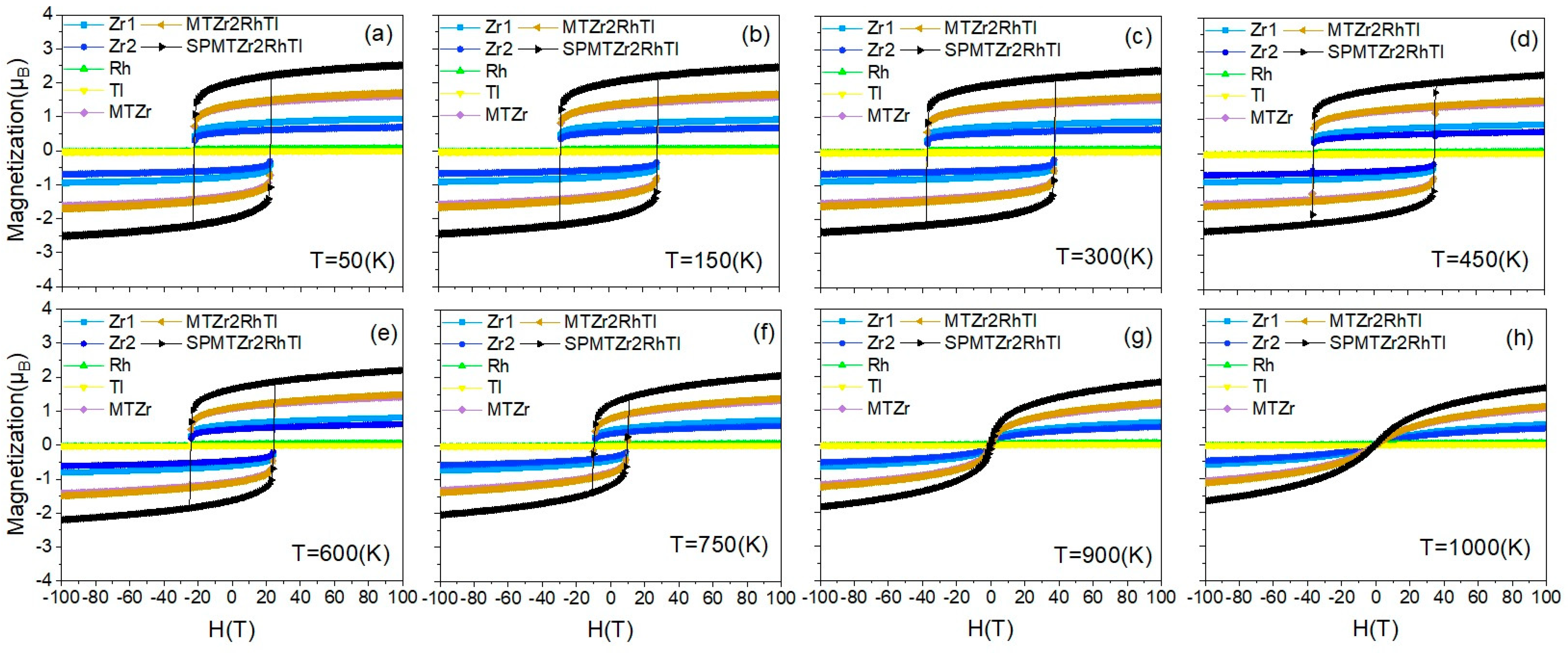
Figure 2 shows the dependence of magnetization on the external magnetic field (magnetic hysteresis curves) for Zr2RhTl and its components (Zr1, Zr2, Rh, and Tl) at isothermal temperatures of T = 50, 150, 300, 450, 600, 750, 900, and 1000 K in Figure 2a–h, respectively. As shown, the areas and coercive field points of the hysteresis loops increase as the temperature increases until a certain critical temperature, T < Tch = 350 K (see Table S1), and then reach a maximum at T = Tch = 350 K, after which they decrease. However, they decrease as the temperature increases at T > Tch = 350 K. Since the hardness and softness of magnetic materials are characterized by their coercivity [17], we suggest a new critical temperature for Zr2RhTl and its components as “critical hardness temperature (Tch = 350 K)”.
Zr2RhTl and its components exhibit hard magnetic behavior at T = Tch but are soft magnets at T < Tch and T > Tch. Similar hysteresis behavior is observed in the Co2FeSn Heusler alloy synthesized using a simple low-cost electrodeposition method by Duan and Kou [43]. Duan and Kou found that higher defect concentrations result in higher HC values in the samples. When the current density exceeds 2.0 A/dm2, the Co content in the samples decreases with increasing current density, which in turn decreases the HC of the Co2FeSn samples. Tian et al. found that the saturation magnetization (Ms) and coercivity (Hc) increase from 144.84 kAm−1 and 15.27 kAm−1 to 175.13 kAm−1 and 125.20 kAm−1 as the Co content increases in Ni–Co coatings synthesized by electrodeposition [44]. Mizusaki et al. found that coercivity appears at about x = 0.4, decreasing after reaching a maximum of 4.13 kOe (0.41 T) at x = 0.45. This indicates that the ferromagnetic behavior changes from hard magnetic (Ru2Mn0.6Fe0.4Ge) to soft magnetic (Ru2FeGe) as the Fe content increases in the Ru2Mn1−xFexGe system [45].
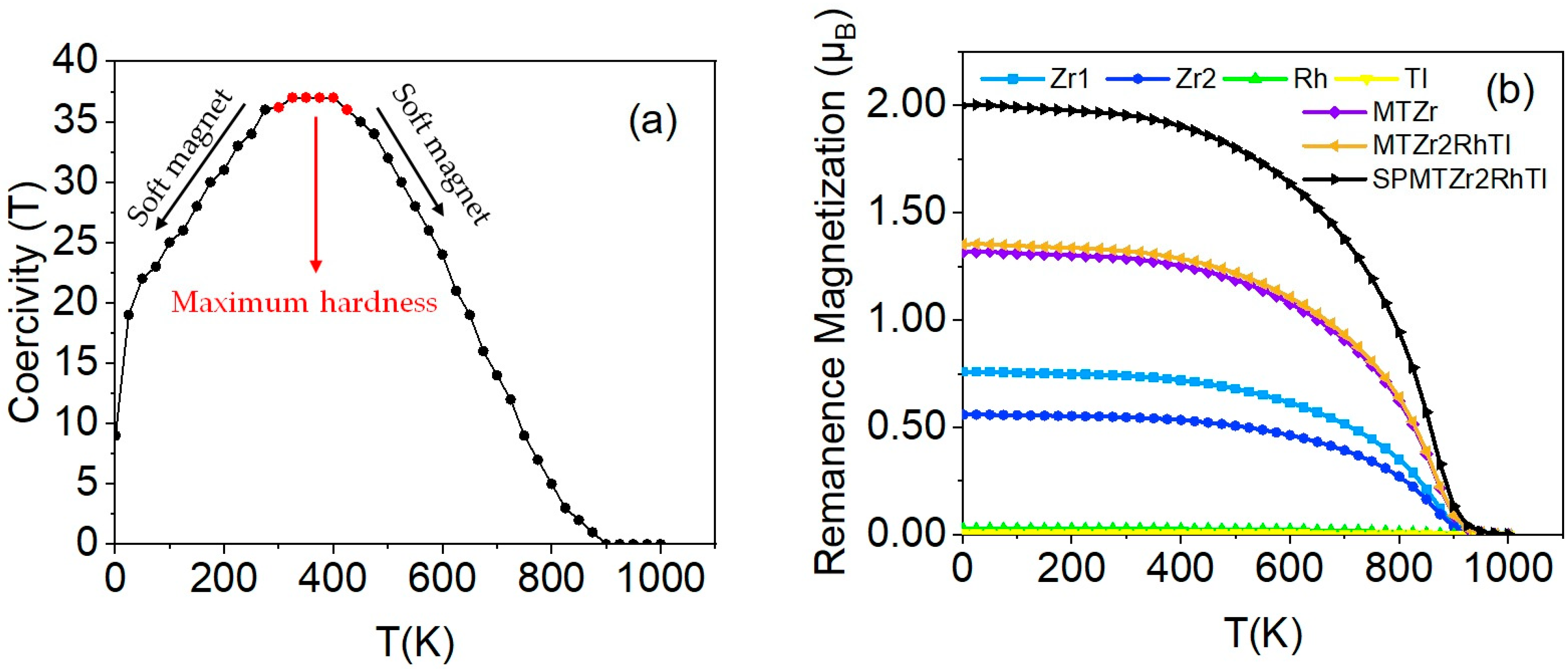
Figure 3 shows the temperature dependence of the coercivity and remanent magnetizations of the Zr2RhTl. In Figure 3a, coercive field points are obtained at Hc = 9, 19, 22, 23, 25, 26, 28, 30, 31, 33, 34, 35, 36, 37, 38, 37, 36, 35, 34, 32, 31, 30, 28, 26, 24, 21, 19, 16, 14, 12, 9, 7, 5, 3, 2, 1, 0, 0, 0, 0 and 0 T for T = 1, 25, 50, 75, 100, 125, 150, 175, 200, 225, 250, 275, 300, 325, 350, 375, 400, 425, 450, 475, 500, 525, 550, 575, 600, 625, 650, 675, 700, 725, 750, 775, 800, 825, 850, 875, 900, 925, 950, 975, and 1000 K, respectively.
One notes that the coercive field points of Zr2RhTl increase as the temperature increases until Tch = 350 K. Above Tch = 350 K, they decrease as the temperature rises. These results are significant because the hardness and softness of magnetic materials are characterized by their coercivity. Namely, magnetic materials are hard when their coercivity is high, or they are soft [17,46] when their coercivity is lower. Soft magnetic materials have low coercive field points and narrow hysteresis loop areas, whereas hard magnetic materials have high coercive field points and wide hysteresis loop areas [17,46]. However, Zr2RhTl has high coercive field points at a certain temperature (Tch = 350 K) but low coercive field points at other temperatures (Tch ≠ 350 K). Thus, Zr2RhTl exhibits both soft and hard behaviors. At this point, the Zr2RhTl Heusler alloy has a maximum coercive field point (Hcmax = 38 T) at Tch = 350 K. In contrast, the coercive field points decrease at T < Tch = 350 K and at T > Tch = 350 K. Thus, Zr2RhTl exhibits a maximum hardness behavior at T = Tch and shows soft magnetic behavior at T < Tch and T > Tch (see Table S1). Therefore, the hardness of Zr2RhTl depends on temperature. Similar coercivity maximum behavior versus temperature is observed by Sanchez Llamazares et al. [47]. They found that as the temperature increases, HC rises and peaks at 1017 Oe around 50 K. Above 50 K, HC progressively decreases, approaching zero close to 195 K. Still, above this temperature, HC increases again to 20 Oe, becoming zero close to 308 K. The very different coercivity values measured in both temperature intervals suggest a notable difference in the magnetocrystalline anisotropy of both martensites (i.e., the low-temperature MST shows higher magnetocrystalline anisotropy than the one existing above 195 K) in Ni51.2Mn36.8Sn12.0 ribbons. In Figure 3b, remanence magnetizations (Mr) of the total Zr2RhTl and its components (Zr1, Zr2, Rh, and Tl) are obtained at 1–1000 K with 25 K steps (see Table S1). The remanent magnetization of Zr1 has the highest value among the other components. On the other hand, the remanent magnetization of Tl has the lowest value. Additionally, Alrahamneh et al. [48] reported that Tc = 536.28 K for Zr2RhGa, 972 K for Zr2RhIn, and 607 K for Zr2RhAl [49]. We find that Tc = 897.43 K for Zr2RhTl [41]. Therefore, Ga and Al have a softness effect, whereas In and Tl have a hardness effect on the Zr2Rh Heusler alloys. Therefore, we suggest that the Zr atoms dominate the magnetic properties of Zr2RhTl. Using the theoretical and experimental results for the maximum coercivity (maximum hardness) behavior at a certain temperature, we suggest that Zr2RhTl Heusler alloy is a potential candidate for producing a new class of thermo-hardness sensors (THSs) and actuators (THAs).

4. Conclusions

Using the effective field theory (EFT) developed by Kaneyoshi [22], the magnetic hysteresis properties of the Zr2RhTl Heusler alloy were analyzed, revealing a peak in the coercive field and maximum hardness at a critical hardness temperature Tch = 350 K. While the alloy and its individual components behave as soft magnets both below and above this threshold, the Zr atoms (Zr1 and Zr2) exhibit higher remanence than Rh and Tl, making them the dominant influence on the system’s magnetic properties. This observation of maximum coercivity at a specific temperature aligns with experimental results for similar systems, such as Co2FeSn [43], Ni–Co coatings [44], the Ru2Mn1−xFexGe system [45], and Ni51.2Mn36.8Sn12.0 ribbons [47], suggesting that the unique transition between soft and hard magnetic behaviors in Zr2RhTl could be leveraged to develop a new class of thermo-hardness sensors (THSs) and actuators (THAs).

Supplementary Materials

The following supporting information can be downloaded at https://www.mdpi.com/article/10.3390/cryst16020144/s1. Table S1: Coercive field points and remanent magnetizations of the Zr2RhTl Heusler alloy.

Author Contributions

Conceptualization, S.D. and Y.G.Y.; methodology, S.D. and Z.M.; software, Y.G.Y.; validation, S.D., Y.G.Y., and Z.M.; formal analysis, Y.G.Y.; investigation, S.D. and Y.G.Y.; data curation, Y.G.Y.; writing—original draft preparation, S.D., Y.G.Y., and Z.M.; writing—review and editing, S.D., Y.G.Y., and Z.M.; visualization, S.D.; project administration, Z.M.; funding acquisition, Z.M. All authors have read and agreed to the published version of the manuscript.

Funding

This work has been supported by a Gazi University Scientific Research Project Coordination Unit grant #FGA-2022-7364#.

Data Availability Statement

The original contributions presented in this study are included in the article. Further inquiries can be directed to the corresponding authors.

Acknowledgments

The authors thank Numan Şarlı of Osmaniye Korkut Ata University for helpful discussions.

Conflicts of Interest

The authors declare no conflicts of interest.

References

  1. Zhang, X.; Xu, H.; Lai, B.; Lu, Q.; Lu, X.; Chen, Y.; Niu, W.; Gu, C.; Liu, W.; Wang, X.; et al. Direct observation of high spin polarization in Co2FeAl thin films. Sci. Rep. 2018, 8, 8074. [Google Scholar] [CrossRef]
  2. Kundu, A.; Ghosh, S.; Banerjee, R.; Ghosh, S.; Sanyal, B. New quaternary half-metallic ferromagnets with large Curie temperatures. Sci. Rep. 2017, 7, 1803. [Google Scholar] [CrossRef] [PubMed]
  3. Xiao, D.; Yao, Y.; Feng, W.; Wen, J.; Zhu, W.; Chen, X.-Q.; Stocks, G.M.; Zhang, Z. Half-Heusler compounds as a new class of three-dimensional topological insulators. Phys. Rev. Lett. 2010, 105, 096404. [Google Scholar] [CrossRef]
  4. De Groot, R.A.; Mueller, F.M.; van Engen, P.G.; Buschow, K.H.J. New class of materials: Half-metallic ferromagnets. Phys. Rev. Lett. 1983, 50, 2024. [Google Scholar] [CrossRef]
  5. Felser, C.; Fecher, G.H.; Balke, B. Spintronics: A challenge for materials science and solid-state chemistry. Angew. Chem. Int. Ed. 2007, 46, 668–699. [Google Scholar] [CrossRef]
  6. Nguyen, Q.T.; Ho, T.H.; Tien, T.B.; Kawazoe, Y.; Bui, V.Q. Data-driven design of high-curie temperature full-heusler alloys for spintronic applications. Mater. Today Phys. 2024, 47, 101541. [Google Scholar] [CrossRef]
  7. Inomata, K.; Ikeda, N.; Tezuka, N.; Goto, R.; Sugimoto, S.; Wojcik, M.; Jedryka, E. Highly spin-polarized materials and devices for spintronics. Sci. Technol. Adv. Mater. 2008, 9, 014101. [Google Scholar] [CrossRef]
  8. Skaftouros, S.; Özdoğan, K.; Şaşıoğlu, E.; Galanakis, I. Generalized Slater-Pauling rule for the inverse Heusler compounds. Phys. Rev. B Condens. Matter Mater. Phys. 2013, 87, 024420. [Google Scholar] [CrossRef]
  9. Li, C.-M.; Hu, Q.M.; Yang, R.; Johansson, B.; Vitos, L. Magnetic ordering and physical stability of X2Mn1+xSn1−x (X = Ru, Os, Co, Rh, Ni, Pd, Cu, and Ag) Heusler alloys from a first-principles study. Phys. Rev. B Condens. Matter Mater. Phys. 2013, 88, 014109. [Google Scholar] [CrossRef]
  10. Sutou, Y.; Imano, Y.; Koeda, N.; Omori, T.; Kainuma, R.; Ishida, K.; Oikawa, K. Magnetic and martensitic transformations of NiMnX (X = In, Sn, Sb) ferromagnetic shape memory alloys. Appl. Phys. Lett. 2004, 85, 4358–4360. [Google Scholar] [CrossRef]
  11. Priolkar, K.R.; Lobo, D.N.; Bhobe, P.A.; Emura, S.; Nigam, A.K. Role of Ni-Mn hybridization in magnetism of martensitic state of Ni-Mn-In shape memory alloys. arXiv 2011, arXiv:1104.0297. [Google Scholar] [CrossRef]
  12. Khan, M.; Jung, J.; Stoyko, S.S.; Mar, A.; Quetz, A.; Samanta, T.; Dubenko, I.; Ali, N.; Stadler, S.; Chow, K.H. The role of Ni-Mn hybridization on the martensitic phase transitions in Mn-rich Heusler alloys. Appl. Phys. Lett. 2012, 100, 172403. [Google Scholar] [CrossRef]
  13. Xuan, H.C.; Cao, Q.Q.; Zhang, C.L.; Ma, S.C.; Chen, S.Y.; Wang, D.H.; Du, Y.W. Large exchange bias field in the Ni–Mn–Sn Heusler alloys with high content of Mn. Appl. Phys. Lett. 2010, 96, 202502. [Google Scholar] [CrossRef]
  14. Khan, M.; Dubenko, I.; Stadler, S.; Jung, J.; Stoyko, S.S.; Mar, A.; Quetz, A.; Samanta, T.; Ali, N.; Chow, K.H. Enhancement of ferromagnetism by Cr doping in Ni-Mn-Cr-Sb Heusler alloys. Appl. Phys. Lett. 2013, 102, 112402. [Google Scholar] [CrossRef]
  15. Luo, H.; Liu, G.; Feng, Z.; Li, Y.; Ma, L.; Wu, G.; Zhu, X.; Jiang, C.; Xu, H. Effect of the main-group elements on the electronic structures and magnetic properties of Heusler alloys Mn2NiZ (Z = In, Sn, Sb). J. Magn. Magn. Mater. 2009, 321, 4063–4066. [Google Scholar] [CrossRef]
  16. Liu, G.D.; Dai, X.F.; Liu, H.Y.; Chen, J.L.; Li, Y.X.; Xiao, G.; Wu, G.H. Mn2COz (z = Al, Ga, In, Si, Ge, Sn, Sb) compounds: Structural, electronic, and magnetic properties. Phys. Rev. B—Condens. Matter Mater. Phys. 2008, 77, 014424. [Google Scholar] [CrossRef]
  17. Coey, J.M.D. Magnetism and Magnetic Materials; Cambridge University Press: Cambridge, UK, 2010; Chapter 9; pp. 8–9. [Google Scholar]
  18. Sagar, J.; Fleet, L.R.; Hirohata, A.; O’GRady, K. Activation volumes in Co2FeSi thin films. IEEE Trans. Magn. 2011, 47, 2440–2443. [Google Scholar] [CrossRef]
  19. El-Hilo, M.; O’grady, K.; Chantrell, R.W. Demagnetised states and activation volumes in thin-film media. J. Magn. Magn. Mater. 1993, 120, 244–246. [Google Scholar] [CrossRef]
  20. Wohlfarth, E.P. The coefficient of magnetic viscosity. J. Phys. F Met. Phys. 1984, 14, L155. [Google Scholar] [CrossRef]
  21. Gasi, T.; Nayak, A.K.; Nicklas, M.; Felser, C. Structural and magnetic properties of the Heusler compound Fe2MnGa. J. Appl. Phys. 2013, 113, 17E301. [Google Scholar] [CrossRef]
  22. Kaneyoshi, T. Differential operator technique in the Ising spin systems. Acta Phys. Pol. A 1993, 83, 703–738. [Google Scholar] [CrossRef]
  23. Kaneyoshi, T. Compensation point phenomena in a graphene-like Ising nanoparticle decorated with spin-3/2 atoms. J. Phys. Chem. Solids 2021, 150, 109880. [Google Scholar] [CrossRef]
  24. Kaneyoshi, T. Compensation point phenomena in nanoscale Ising particles with high critical temperature. Phase Transit. 2020, 93, 826–842. [Google Scholar] [CrossRef]
  25. Kaneyoshi, T. Decoration in a Graphene-like Ising nanoparticle for the possibility of high critical temperature. Chem. Phys. Lett. 2020, 745, 137224. [Google Scholar] [CrossRef]
  26. Kaneyoshi, T. Unique phenomena induced by an exchange interaction between two graphene-like Ising nanoparticles in an applied transverse field. Chem. Phys. Lett. 2019, 715, 72–76. [Google Scholar] [CrossRef]
  27. Kaneyoshi, T. Reduced magnetization curves of Ising nanoparticles with high critical temperature. Phase Transit. 2020, 93, 376–387. [Google Scholar] [CrossRef]
  28. Kaneyoshi, T. Shape dependences of magnetic properties in 2D Ising nano-particles. Phase Transit. 2013, 86, 404–418. [Google Scholar] [CrossRef]
  29. Keskin, M.; Şarlı, N. Superconducting phase diagram of the yttrium, barium, and YBa-core in YBa2Cu3O7–δ by an Ising model. J. Exp. Theor. Phys. 2018, 127, 516–524. [Google Scholar] [CrossRef]
  30. Şarlı, N.; Keskin, M. Effects of the copper and oxygen atoms of the CuO-plane on magnetic properties of the YBCO by using the effective-field theory. Chin. J. Phys. 2019, 59, 256–264. [Google Scholar] [CrossRef]
  31. Şarlı, N.; Keskin, M. Effect of the distance range between the YBa-core and CuO-shell on the superconducting properties in the YBCO by an Ising model. Chin. J. Phys. 2020, 63, 375–381. [Google Scholar] [CrossRef]
  32. Şarlı, N.; Ak, F.; Özdemir, E.G.; Saatçi, B.; Merdan, Z. Key role of central antimony in magnetization of Ni0.5Co1.5MnSb quaternary Heusler alloy revealed by comparison between theory and experiment. Phys. B Condens. Matter 2019, 560, 46–50. [Google Scholar] [CrossRef]
  33. Yıldız, G.D.; Yıldız, Y.G.; Şarlı, N. Spin induced quantum tunneling of the magnetization. In Spin; World Scientific Publishing Company: Singapore, 2021; p. 2150011. [Google Scholar]
  34. Yıldız, Y.G. Exchange bias effect revealed by irreversible structural transformation between the HCP and FCC structures of Cobalt nanoparticles. Phase Transit. 2020, 93, 429–437. [Google Scholar] [CrossRef]
  35. Yıldız, Y.G. Origin of the hardness in the monolayer nanographene. Phys. Lett. A 2019, 383, 2333–2338. [Google Scholar] [CrossRef]
  36. Yıldız, G.D. Intersection magnetization and temperature revealed by FCC-FCT phase transformation in the FePd binary alloy system. J. Supercond. Nov. Magn. 2020, 33, 2051–2058. [Google Scholar] [CrossRef]
  37. Ocak, H.Y.; Yıldız, G.D.; Yıldız, Y.G.; Saatçi, B.; Başar, R.; Sarıoğlu, G. Transverse field effects of Al concentration on magnetic properties of B2-FeAl nanoparticle. Acta Phys. Pol. A 2021, 139, 20–24. [Google Scholar] [CrossRef]
  38. Yıldız, Y.G.; Yıldız, G.D. Modeling of the magnetization and magnetocaloric effect in Ni2MnGa heusler alloy with the effective field theory. J. Low Temp. Phys. 2022, 207, 171–180. [Google Scholar] [CrossRef]
  39. Duran, A. Magnetic properties of Mn2RhSi Heusler alloy: Phase transition and hysteresis behavior at a very low temperature. J. Low Temp. Phys. 2021, 203, 127–142. [Google Scholar] [CrossRef]
  40. Malkoç, T. A transverse Ising model for the Fe50−xCr25+xV25 Heusler alloy. Chin. J. Phys. 2022, 80, 378–384. [Google Scholar] [CrossRef]
  41. Özdemir, E.G.; Doğruer, S.; Merdan, Z. Electronic, magnetic, half-Metallic, pressure-induced elastic and curie temperature predictions of Zr2RhTl Heusler alloy: DFT and EFT studies. Philos. Mag. 2024, 104, 115–135. [Google Scholar] [CrossRef]
  42. Kittel, C. Introduction to Solid State Physics, 7th ed.; John Wiley & Sons, Inc.: New York, NY, USA, 1996; pp. 333–378. [Google Scholar]
  43. Duan, J.; Kou, X. Effect of current density on the microstructure and magnetic properties of electrodeposited Co2FeSn Heusler alloy. J. Electrochem. Soc. 2013, 160, D471. [Google Scholar] [CrossRef]
  44. Tian, L.; Xu, J.; Xiao, S. The influence of pH and bath composition on the properties of Ni–Co coatings synthesized by electrodeposition. Vacuum 2011, 86, 27–33. [Google Scholar] [CrossRef]
  45. Mizusaki, S.; Douzono, A.; Ohnishi, T.; Ozawa, T.; Samata, H.; Noro, Y.; Nagata, Y. Effect of Fe substitution on magnetic properties of antiferromagnetic Heusler alloy Ru2MnGe. J. Alloys Compd. 2012, 510, 141–146. [Google Scholar] [CrossRef]
  46. Vargas, B.R.R.; Stornelli, G.; Folgarait, P.; Ridolfi, M.R.; Miranda Pérez, A.F.; Di Schino, A. Recent Advances in Additive Manufacturing of Soft Magnetic Materials: A Review. Materials 2023, 16, 5610. [Google Scholar] [CrossRef] [PubMed]
  47. Sánchez Llamazares, J.L.; Flores-Zúñiga, H.; Ríos-Jara, D.; Sánchez-Valdes, C.F.; García-Fernández, T.; Ross, C.A.; García, C. Structural and magnetic characterization of the intermartensitic phase transition in NiMnSn Heusler alloy ribbons. J. Appl. Phys. 2013, 113, 17A948. [Google Scholar] [CrossRef]
  48. Alrahamneh, M.J.; Khalifeh, J.M.; Mousa, A.A. Ab-initio calculations of the structural, mechanical, electronic, magnetic and thermoelectric properties of Zr2RhX (X = Ga, In) Heusler alloys. Physica B 2020, 581, 411941. [Google Scholar] [CrossRef]
  49. Alrahamneh, M.J.; Mousa, A.A.; Khalifeh, J.M. First principles study of the structural, electronic, magnetic and thermoelectric properties of Zr2RhAl. Physica B 2019, 552, 227–235. [Google Scholar] [CrossRef]
Figure 1. Crystal structure of the Zr2RhTl Heusler alloy and its components (Zr1, Zr2, Rh, and Tl) from DFT and EFT [41].
Crystals 16 00144 g001
Figure 2. M-H curves of the Zr2RhTl and its components. (a) for 50 K, (b) for 150 K, (c) for 300 K, (d) for 450 K, (e) for 600 K, (f) for 750 K, (g) for 900 K, (h) for 1000 K.
Crystals 16 00144 g002
Figure 3. (a) Hc-T and (b) Mr-T curves for Zr2RhTl and its components.
Crystals 16 00144 g003
Disclaimer/Publisher’s Note: The statements, opinions and data contained in all publications are solely those of the individual author(s) and contributor(s) and not of MDPI and/or the editor(s). MDPI and/or the editor(s) disclaim responsibility for any injury to people or property resulting from any ideas, methods, instructions or products referred to in the content.