Article

Liquid Crystal Dimers Based on Seven-Membered Bridged Stilbene Exhibiting Twist-Bend Nematic Phases


1
Department of Chemical Science and Engineering, Institute of Science Tokyo, Tokyo 152-8552, Japan
2
Department of Applied Chemistry and Life Science, Graduate School of Engineering, Toyohashi University of Technology, 1-1 Hibarigaoka, Tempaku-cho, Toyohashi 441-8580, Japan
*
Authors to whom correspondence should be addressed.
Crystals 2026, 16(2), 111; https://doi.org/10.3390/cryst16020111
Submission received: 30 December 2025 / Revised: 29 January 2026 / Accepted: 30 January 2026 / Published: 3 February 2026
(This article belongs to the Collection Liquid Crystals and Their Applications)

Abstract

We report the first examples of bent-shaped LC dimers based on a seven-membered bridged stilbene. We synthesized nonylene- and ether-linked cyano-terminated dimers (sC9-tCN and sOC7O-tCN, respectively) and a homologous series of nonylene-linked alkyl-terminated dimers (sC9-tCn) with alkyl carbon atoms n = 1–6. Polarizing optical microscopy, differential scanning calorimetry, and X-ray diffraction measurement were employed to investigate the phase-transition behavior and LC phase structures. sC9-tCN and sOC7O-tCN only exhibited a nematic (N) phase, whereas sC9-tCn (n = 1–5) formed both the NTB and N phases. sC9-tC5 additionally formed an unidentified X phase from the NTB phase and sC9-tC6 exhibited a smectic A phase from the N phase. The weak dispersion force and intermolecular affinity provided by the terminal alkyl chains are likely to be preferable to the large dipole–dipole interactions by the cyano termini for the NTB phase formation of the present dimers. The isotropic points of sC9-tCn showed an odd–even oscillation with n, whereas the N–NTB phase transition temperatures were comparable. Remarkably, the NTB stripe textures of sC9-tCn appeared perpendicular to the rubbing direction, and the N–NTB phase transitions exhibited their second-order nature. This study revealed the unique NTB phase properties of the 7-membered bridged stilbene-based LC dimers.

1. Introduction

Liquid crystal (LC) dimers consist of two rigid mesogenic groups connected by a flexible alkyl chain spacer. One of the fascinating properties of LC dimers is the odd–even effect in terms of the number of atoms in the central spacer. Specifically, the relative orientations of the two mesogenic moieties are approximately parallel for even numbers and inclined for odd ones. Therefore, odd-spacer dimers exhibit characteristics similar to those of bent-shaped LC molecules. Particularly, odd-numbered bent-shaped LC dimers have garnered attention because of their rich mesomorphism associated with spontaneous polarization and chirality [1,2,3,4,5], as observed for bent-core molecules.
In the last decade, there has been a surge in studies on bent-shaped LC dimers since the discovery of a new helical LC phase, namely, the twist-bend nematic (NTB) phase [6,7,8,9]. This phase features nanoscopic heliconical periodicity (approximately 10 nm) [10,11,12,13] with degeneracy in both the left- and right-handed chiral domains [14]. These heliconical structures provide the NTB phase with a pseudo-layered nature, similar to the layered smectic A (SmA) phase [15,16,17,18,19,20].
Building upon these foundational discoveries, extensive synthetic research has identified several molecular architectures capable of forming the NTB phase, such as major bent-shaped LC dimers [21,22,23,24,25,26,27,28,29,30,31,32,33,34,35,36,37,38,39,40,41,42,43,44,45,46,47,48,49,50,51,52,53,54,55,56,57], minor linear/nonlinear oligomers [41,45,58,59,60,61,62,63,64,65,66,67,68,69,70,71,72,73], polymers [70,71,72], and “bent-core” molecules [74,75,76]. The primary molecular factor for the NTB phase is the bent molecular shape. The molecular design of bent-shaped LC dimers is modified by mesogenic groups and linkage types. Typically, the mesogenic groups of LC dimers comprise benzene rings, such as biphenyl, terphenyl, tolane, azobenzene, and N-benzylideneaniline, with various substituents. In addition, naphthalene [40,77], pyrene [78], thiophene [25], selenophene [79], cholesterol [26,80,81], cyclohexane [36,61,82], and cubane [61] are available in the mesogenic groups for NTB dimers and trimers. In addition, the linkage type between the mesogenic group and central alkyl spacer plays a crucial role in molecular bending and, therefore, in the NTB phase formation [28,41,83,84,85]. For example, the methylene linkage (C–CH2–C) is more favorable for inducing the NTB phase than the ether linkage (C–O–C) since the smaller C–CH2–C angle (~110°) renders the entire dimeric shape more curved than that of C–O–C (~118°).
Recently, our group reported a new molecular design strategy for stabilizing the conventional nematic (N) phase by incorporating a partly aliphatic 7-membered intramolecular cyclic structure in mesogenic groups [86,87,88,89,90,91,92], as shown in Figure 1. The introduction of the flexible intra-cyclic structure moderately provides rigid π-conjugated molecules with lateral molecular width, steric hindrance, and flexibility, which contribute to reducing the phase-transition temperature and suppressing crystallization and highly ordered LC phase formation. These features enable large π-conjugated molecules, such as intramolecularly cyclized 4-phenylstilbene and phenyltolane, to form N phases supercooled to room temperature. Thus, the examination of the seven-membered bridged stilbene as a new building block of LC dimers for the NTB phase could be interesting.
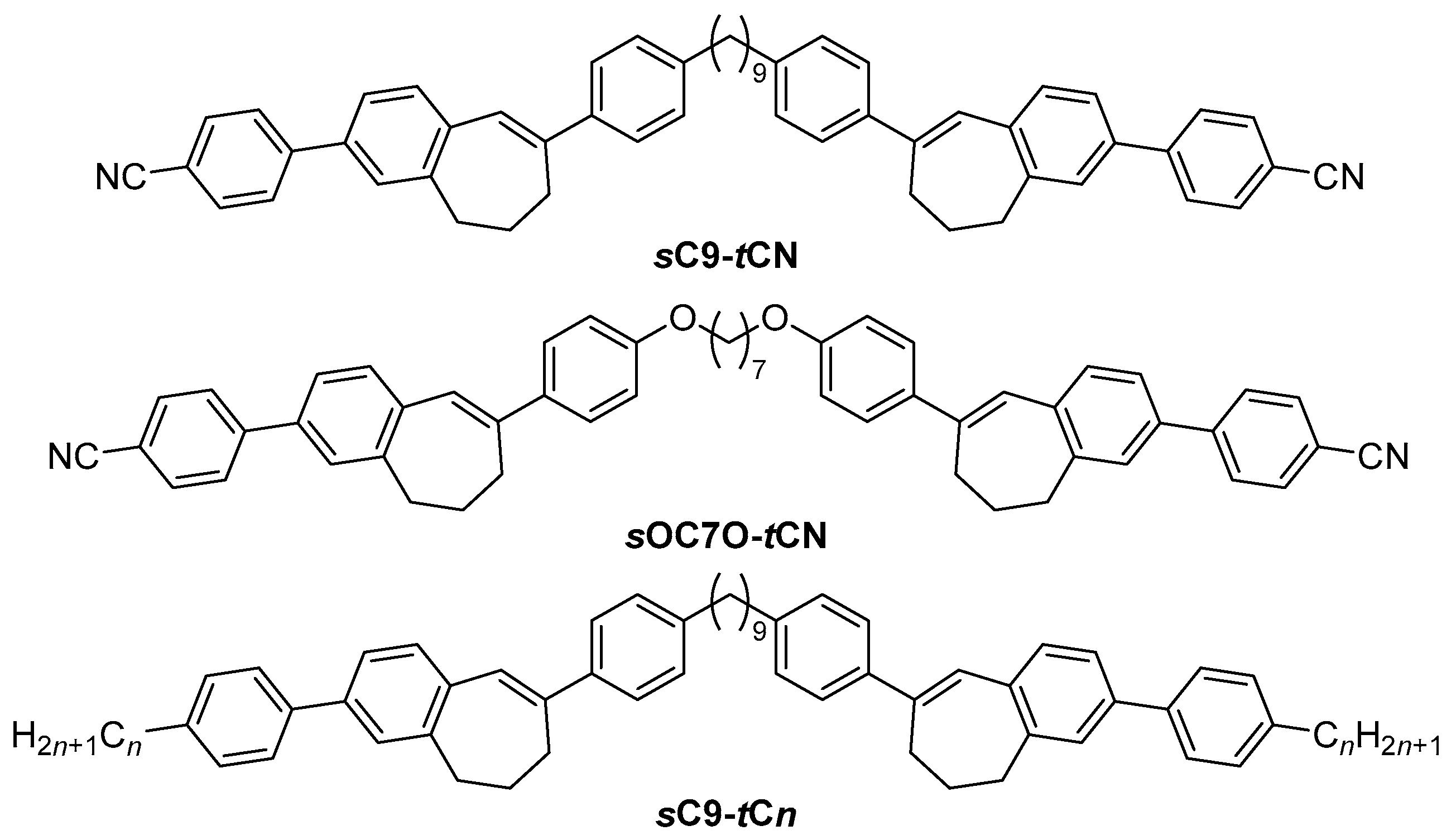
In this study, we report the synthesis and phase transition behaviors of a series of nonylene- or corresponding ether-linked dimers based on seven-membered bridged stilbene cores bearing either a terminal cyano group (sC9-tCN and sOC7O-tCN) or alkyl groups (sC9-tCn, n = 1–6) (Figure 1). Their phase transition behaviors were investigated using polarized optical microscopy (POM) and differential scanning calorimetry (DSC). In addition, the LC phase structures of sC9-tCn (n = 3–6) were examined using X-ray diffraction (XRD) measurements.

2. Materials and Methods

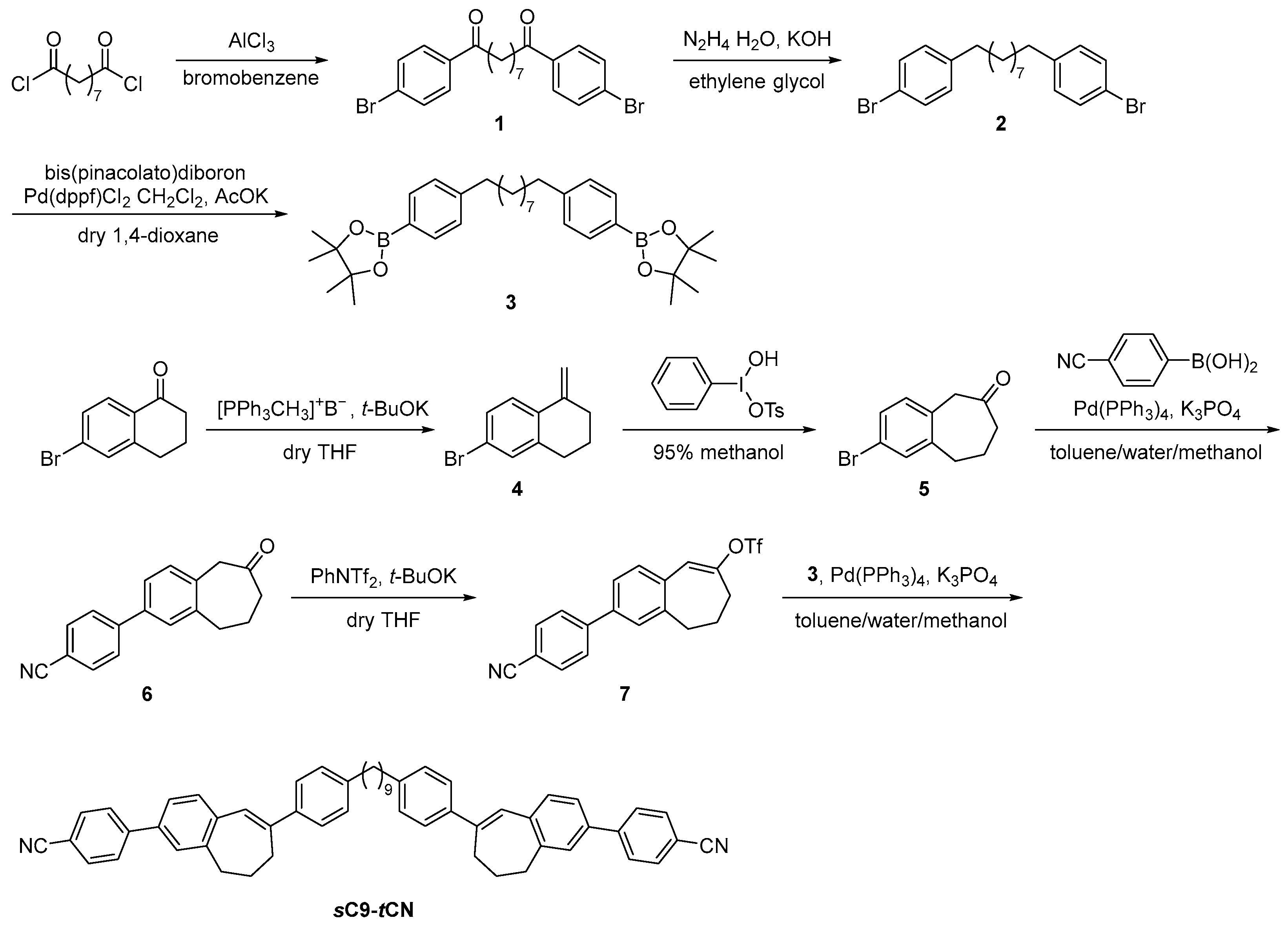
The synthesis route for sC9-tCN is shown in Scheme 1. Friedel–Crafts acylation with azelaoyl chloride followed with Wolf–Kischner reduction produced dibromo 2. Subsequently, linker part 3 was prepared by Ishiyama–Miyaura borylation [93]. The bridged stilbene core was synthesized according to our previous report [87]. Alkene 4 was obtained via Wittig reaction of 6-bromo-1-tetralone. Seven-membered ring molecule 5 was synthesized by a ring-expansion reaction using [hydroxy(tosyloxy)iodo]benzene [94]. Bridged stilbene core 7 was prepared by Suzuki–Miyaura cross-coupling with 4-cyanophenylboronic acid, followed by triflation. Finally, sC9-tCN was synthesized via Suzuki–Miyaura cross-coupling between linker part 3 and bridged stilbene core 7. sOC7O-tCN and sC9-tCn were obtained through the similar procedure, shown in the Supplementary Materials. The molecular structures were confirmed using 1H- and 13C-NMR spectroscopy, recorded on a Bruker Ascend 500 spectrometer (500 MHz for 1H-NMR, 126 MHz for 13C-NMR) (Bruker, Billerica, MA, USA) and a JNM-ECZ400S/L spectrometer (100 MHz for 13C-NMR) (JEOL Ltd., Tokyo, Japan). Additionally, high-resolution mass spectrometry (HRMS) was conducted using a JMS700 mass spectrometer (JEOL Ltd., Tokyo, Japan). The characterization data are provided in the Supplementary Materials.
Phase identification and phase transition behaviors were investigated using POM and DSC following a standardized thermal protocol to eliminate thermal history effects. POM was carried out using a Leica DM2500P polarized optical microscope (Leica microsystems, Tokyo, Japan) equipped with a Mettler Toledo HS82 hot-stage system (Mettler Toledo, Zurich, Switzerland) and an Olympus BX51 polarized optical microscope (Olympus Corporation, Tokyo, Japan) equipped with a Mettler Toledo HS82 hot-stage system (Mettler Toledo, Zurich, Switzerland) at a rate of 10 °C min−1. In the POM observations, the samples were sandwiched between standard slide and cover glasses. POM observations were also performed for uniaxially and planarly aligned samples in 5 μm cells (EHC Co., Tokyo, Japan). DSC was performed using a DSC 8500 (PerkinElmer, Waltham, MA, USA) instrument at rates of 10 °C min−1 and 30 °C min−1 under a flow of dry nitrogen gas.
XRD investigations were carried out with samples kept in glass capillary tubes (1 mm diameter) for oriented patterns under a magnetic field upon cooling. The WAXD measurements were conducted using a Bruker D8 DISCOVER diffractometer (Bruker, Billerica, MA, USA) equipped with a Vantec-500 detector (Bruker, Billerica, MA, USA) under CuKα radiation in the reflection mode.

3. Results and Discussion

3.1. Phase Transition Behaviors

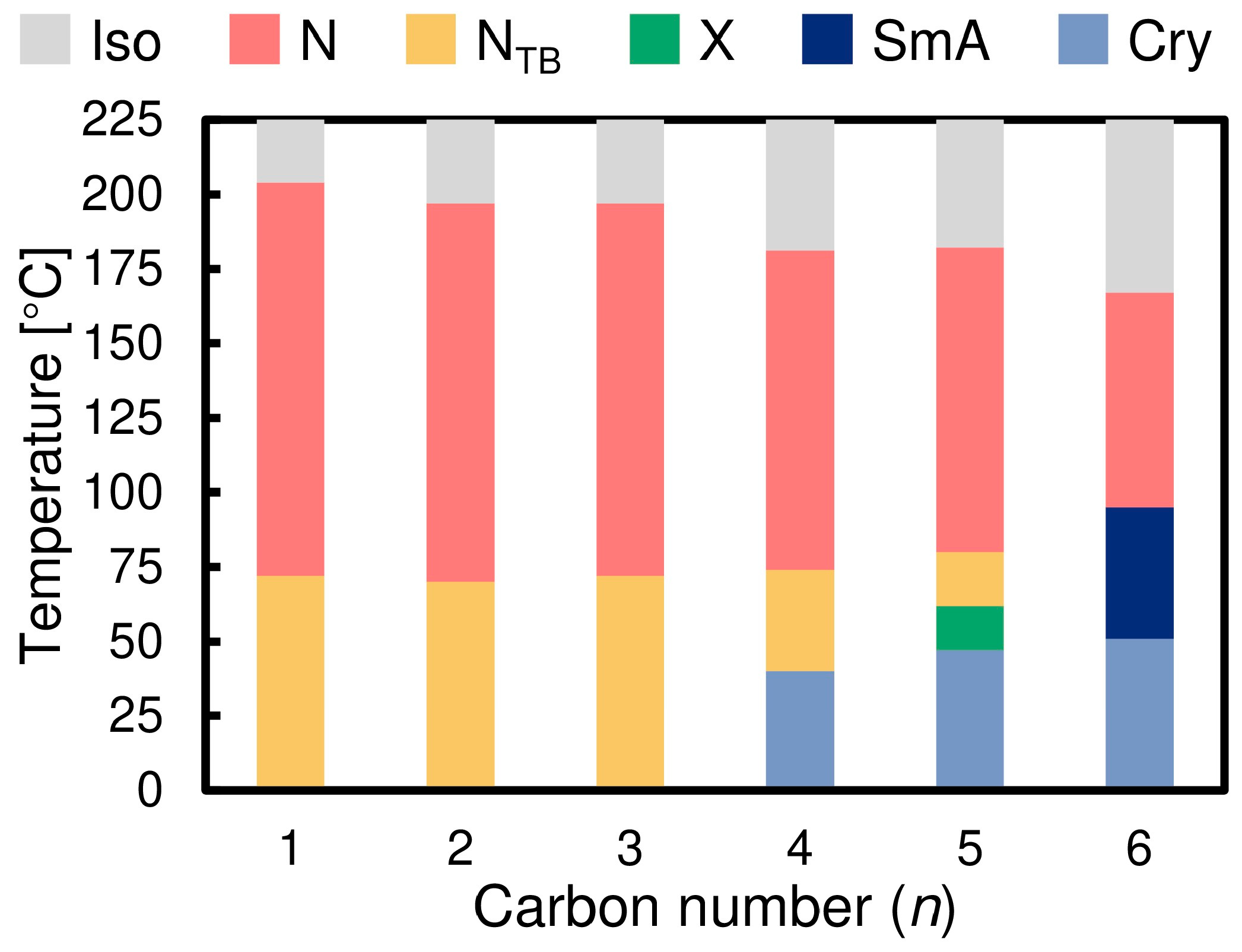
The phase transition behaviors of sC9-tCN, sOC7O-tCN, and sC9-tCn (n = 1–6) upon cooling are summarized in Table 1 and Figure 2. Their melting points (Tm) are also listed in Table 1. Their 3rd heating/cooling DSC charts are shown in Figures S1–S6, and the POM images are shown in Figures S7–S13.

3.1.1. sC9-tCN and sOC7O-tCN

The cyano-terminated sC9-tCN and sOC7O-tCN dimers exhibited an enantiotropic N phase, whereas no formation of the NTB phase was observed. They displayed schlieren textures typical of the conventional N phase, which were supercooled to room temperature. The Iso–N phase transition temperature (TIN: 312 °C) of sOC7O-tCN is significantly higher than 268 °C of sC9-tCN. This is because of the larger molecular anisotropy (less molecular bending) of sOC7O-tCN with the larger C–O–C bond angle (118°) than that of sC9-tCN with the smaller C–CH2–C bond angle (110°).
Generally, the presence of the terminal cyano group is effective in inducing the NTB phase because of the large longitudinal dipolar moment, which facilitates the more pronounced antiparallel intermolecular packing of the mesogenic groups desired for the NTB phase formation [95,96,97]. However, neither sC9-tCN nor sOC7O-tCN formed the NTB phase. The flexible, bulky, slightly bent seven-membered bridged stilbene could be disadvantageous for the pronounced antiparallel intermolecular arrangements facilitated by longitudinal dipole moments, suppressing the NTB phase formation for sC9-tCN and sOC7O-tCN.

3.1.2. sC9-tCn

In contrast to sC9-tCN and sOC7O-tCN, the alkyl-terminated sC9-tCn dimers (n = 1–5) exhibited a monotropic NTB phase as well as the enantiotropic N phase. Thus, it was found that the terminal alkyl chain is preferable to the cyano group for the NTB phase formation of the bridged stilbene-based LC dimers. In fact, there are some NTB molecules with alkyl chains at both termini [9,26,36,54,73,74,75,76,80,81]. As mentioned earlier, the antiparallel intermolecular arrangement for the NTB phase of the cyano-terminated dimers is facilitated by the large longitudinal dipole moments of their mesogenic moieties. However, the terminal alkyl chain should cause weak dispersion force and intermolecular affinity between the aliphatic and aromatic moieties. The intermolecular inhomogeneities or local segregation should facilitate the NTB phase formation of sC9-tCn, which is different from the typical dipole-driven case of the cyano terminal group. The TIN values of sC9-tCn show an odd–even oscillation for the terminal alkyl chain length, whereas their N–NTB phase transition temperatures (TNNTB) are roughly comparable (~70–80 °C) and the odd–even oscillation was not clear. Lengthening the alkyl chain likely led to an increase in the TNNTB for sC9-tCn (n = 4 and 5). sC9-tC5 additionally formed an unidentified X phase from the NTB phase, whereas sC9-tC6 exhibited a SmA phase from the N phase without the NTB phase. Such layered Sm formation from the NTB phase is relatively rare [24,98,99,100,101,102,103]. Increasing the terminal alkyl chain length leads to the formation of some layered Sm phases assisted by microphase separation of alkyl chains and mesogenic moieties, which ultimately vanishes the NTB phase for the longest sC9-tC6.
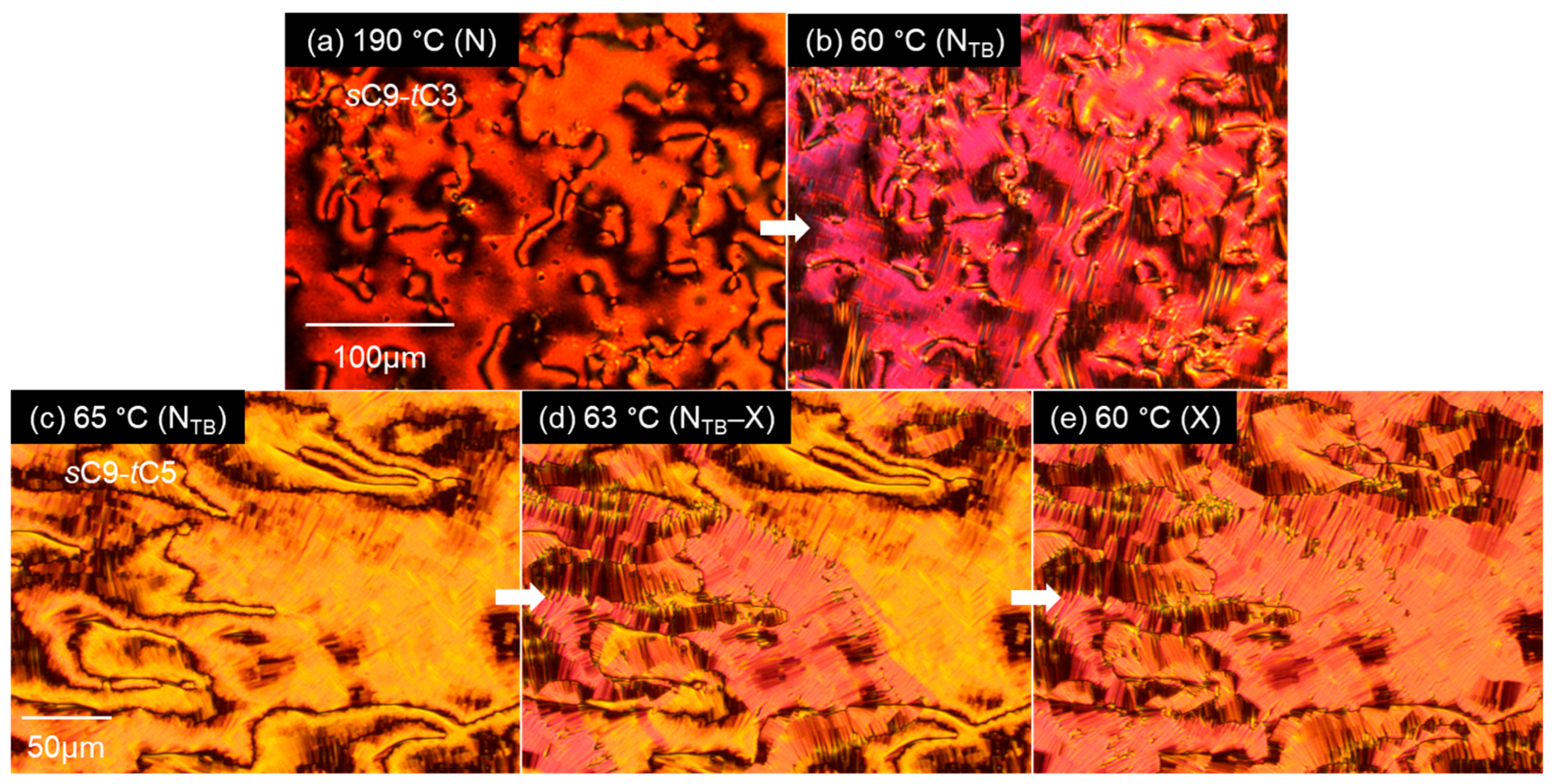
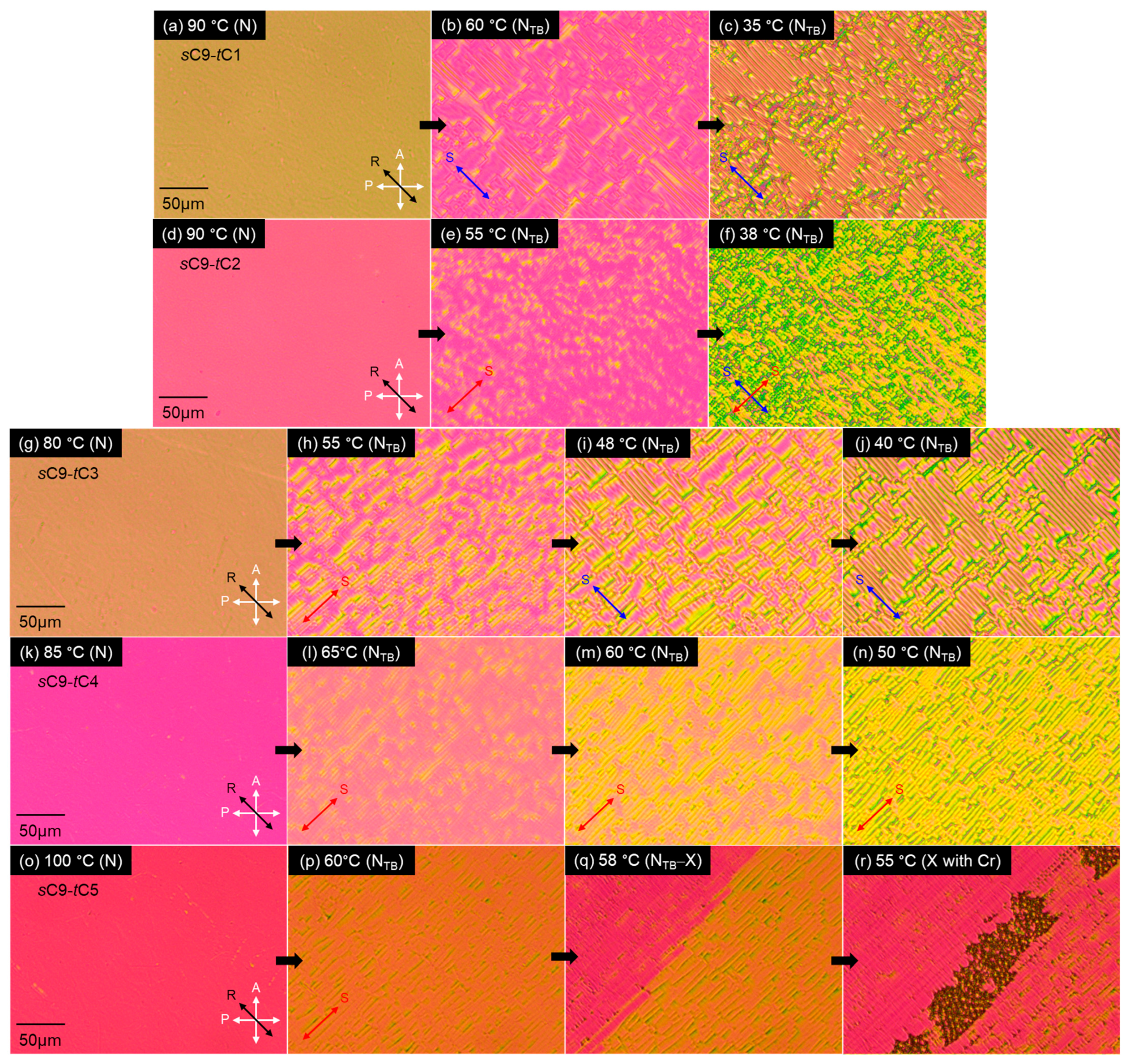
Specifically, upon cooling the sC9-tCn (n = 1–5) samples in standard glass cells, the POM observations revealed that the N schlieren textures transformed into stripe- or blocky-like textures of the NTB phase at approximately ~70–80 °C, as representatively shown for sC9-tCn (n = 3 and 5) in Figure 3. The NTB textures of sC9-tCn (n =1–3) were supercooled to room temperature. Additionally, POM observations were performed for the uniaxially and planarly aligned sC9-tCn (n = 1–5) samples, as shown in Figure 4. When the rubbing directions of the sample cells were oriented at 0° and 45° to the directions of the two crossed polarizer and analyzer, dark and uniform bright color optical textures were correspondingly observed. This indicates the uniaxial orientation of the N directors or the molecular long axis of the dimers along the rubbing direction. Entering into the NTB phase temperature of sC9-tC1, stripes grew parallel to the rubbing direction, which became apparent as the temperature decreased. This stripe texture is characteristic of the NTB phase, which is due to the undulation of the pseudo-layers with splay deformation of the helical axes to maintain periodic pseudo-layer spacings when confined between uniaxially rubbed substrates, called the Helfrich–Hurault buckling instability [10,16,19,104]. In this case, the pseudo-layers in the NTB phase are perpendicular to the rubbing direction and are referred to as a bookshelf geometry. In contrast to the normal parallel stripes of the NTB phase, remarkably, the stripes for sC9-tCn (n = 2–5) appeared mainly perpendicular to the rubbing direction after the N–NTB phase transition, as shown by the red double-headed arrows in Figure 4e,h,i,p. Strictly, their optical textures also had less visible stripes parallel to the rubbing direction. With decreasing temperature, the stripes parallel to the rubbing direction gradually grew, coexisting with the perpendicular stripes for sC9-tC2 as a grid-like texture (Figure 4f) and ultimately becoming predominant for sC9-tC3 (Figure 4i,j). For sC9-tCn (n = 4 and 5), the stripes perpendicular to the rubbing direction remained predominant until the phase transition to the lower-temperature X phase and crystallization occurred, as shown in Figure 4l–n and Figure 4p–r, respectively. Overall, lengthening the terminal alkyl chains of sC9-tCn likely induced and maintained the perpendicular stripes. The stripes perpendicular to the rubbing direction of sC9-tCn (n = 2–5) correspond to the pseudo-layer directions in the NTB phase. Stripes perpendicular to the rubbing direction are rarely observed, [80,105,106,107,108] particularly in chiral dimers. In the present uniaxially and planarly aligned geometry, the formation of a stripe perpendicular to the rubbing direction may be associated with the periodic bend deformation (bend-splay modulation) of the helical axes in the NTB phase [80]. Decreasing temperature reduces the helical pitch, tilts the helices in the NTB phase, and generates mechanical stress for the pseudo-layer undulation, [104] likely inducing stripes parallel to the rubbing direction for the short-chain sC9-tCn (n = 1–3) dimers. The NTB phase transitions of sC9-tCn (n = 1–5) were not observed by DSC at a cooling rate of 10 °C min−1, whereas increasing the cooling rate to 30 °C min−1 revealed significantly small baseline shifts at approximately ~70–80 °C, as shown in Figures S1–S5. This behavior suggests the second-order nature of the N–NTB phase transitions for the sC9-tCn (n = 1–5) dimers. The second-order N–NTB phase transition also indicates some specific properties of the bridged stilbene-based dimers, in addition to the formation of the unusual perpendicular stripe texture.
As shown in Figure 3c–e, sC9-tC5 exhibited a bold blocky texture from the NTB phase at approximately 62 °C, and the blocky domains persisted from those of the NTB phase and became bolder. The bold blocky texture appears to be different from the typical fan textures of the Sm phases. Another polydomain texture of the X phase contained ill-defined fan shapes and focal conics, whereas the homeotropic state exhibited an almost dark texture with pale wavy lines (Figure S12). This suggests a layered Sm or pseudo-layered nature with optical uniaxiality, which may exclude syn-clinic and anti-clinic tilted structures of the smectic C phases. Although the planarly and uniaxially aligned sC9-tC5 sample did not exhibit stripes (Figure 4q,r) like the twist-bend smectic (SmTB) phases [109,110], the X phase might be associated with some helical structures. DSC detected a first-order-like peak at 62 °C (Figure S5). However, the sample crystallization disturbed the XRD measurement for the X phase in this study. sC9-tC6 did not exhibit any characteristic optical texture of the NTB phase. Instead, a fan-shaped texture of the SmA phase formed from the conventional N phase.

3.2. XRD Measurements

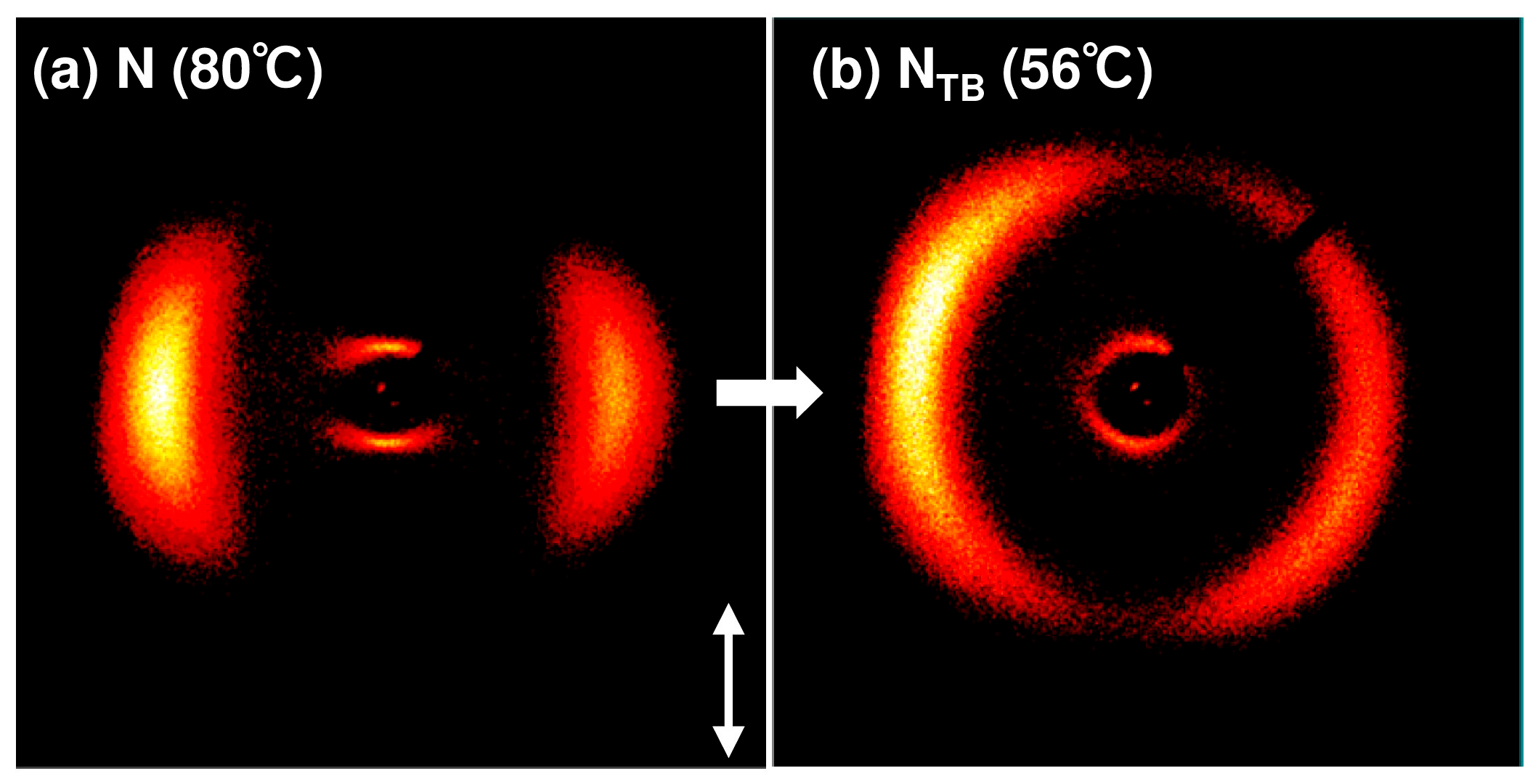
To investigate the relationship between the terminal alkyl chain length and the LC phase structures, we performed XRD measurements for sC9-tCn (n = 3–6) upon cooling. The XRD patterns are shown in Figure 5 and Figure S14–S17, and the d-spacings estimated from the wide- and small-angle diffraction peaks (dwax and dsax, respectively) are summarized in Table 2.
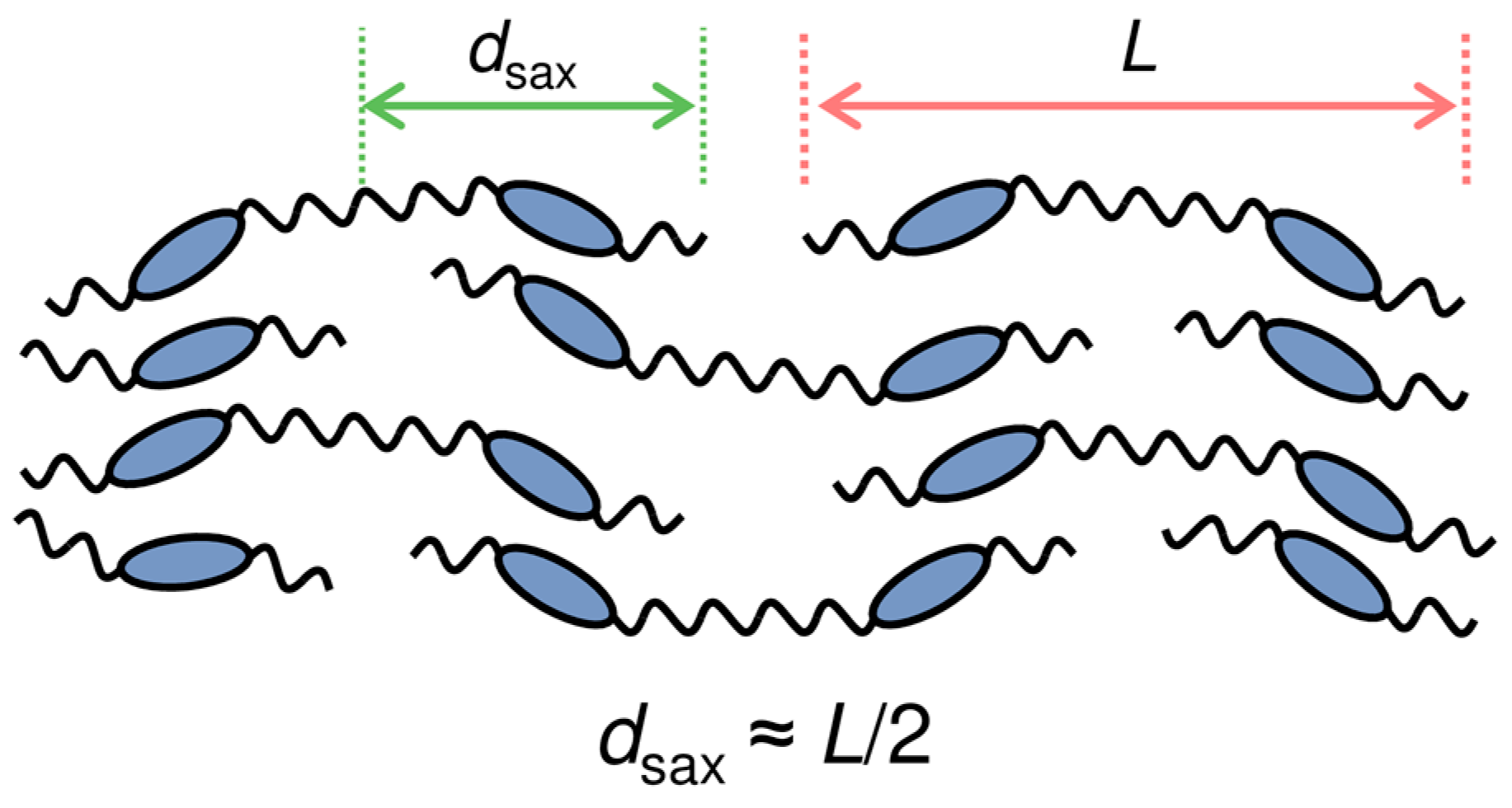
The dwax values (~4.6–4.8) of the dimers, which correspond to lateral intermolecular distances, were typical of those in the N, NTB, and SmA phases. As shown in Figure 5, all sC9-tCn (n = 3–6) dimers exhibited small-angle diffractions in the N phase, which persisted in the NTB phase. This observation indicates the presence of nanoscopic SmA-like (cybotactic) clusters in the N and NTB phases. In the N and NTB phases, the dsax values were similar to half the molecular lengths of sC9-tCn with all-trans conformations of the alkyl chains (L/2) (Table 2). This is consistent with the typical intercalation trend of LC dimers, as shown in Figure 6. The dsax values in the NTB phase were consistently smaller than those in the N phase. This could be due to the molecular tilt in forming the heliconical structures and more profound intermolecular packing in the NTB phase. The difference in the dsax values between the N and NTB phases (0.68 Å for n = 3, 0.56 Å for n = 4, and 0.14 Å for n = 5) decreased slightly with increasing terminal alkyl chain length. This trend may be associated with more pronounced antiparallel intermolecular arrangements of the mesogenic moieties in the N phase, assisted by increasing terminal chains. As shown in Figures S14–S17, lengthening the terminal alkyl chains of the dimers increased the intensities of the small-angle diffractions relative to those of the wide-angle diffractions. The growth in the cybotactic clusters and nanophase separation between the alkyl chains and aromatic moieties were facilitated by increasing chain length, leading to the formation of the Sm phase for the long-chain homolog.

4. Conclusions

We synthesized a series of LC dimers based on a bridged stilbene core, namely cyano-terminated sC9-tCN and sOC7O-tCN and alkyl-terminated sC9-tCn (n = 1–6). Nonylene-linked sC9-tCN and ether-linked sOC7O-tCN only exhibited a N phase, whereas sC9-tCn with n = 1–5 formed the NTB and N phases. It was suggested that the weak dispersion force and intermolecular affinity afforded by the alkyl chains are preferable to the strong dipole–dipole interactions by the cyano termini for the NTB phase formation of LC dimers with flexible, bulky, and slightly bent seven-membered bridged stilbene structures. sC9-tC5 additionally displayed an unidentified X phase from the NTB phase and sC9-tC6 exhibited a SmA phase from the N phase without the NTB phase. The TIN values showed a typical odd–even oscillation on the terminal alkyl chain length, whereas the TNNTB values of sC9-tCn (n = 1–5) were relatively comparable. Interestingly, POM revealed that the stripe textures in the NTB phases of sC9-tCn appeared perpendicular to the rubbing direction, which differs from the typical ones parallel to the rubbing direction. This perpendicular stripe formation may be due to the periodic bend deformation of the helical axes. Lengthening the terminal alkyl chain tended to induce and maintain the perpendicular stripes. The DSC results suggested the second-order nature of the N–NTB phase transitions in the dimers. XRD measurements indicated half-intercalated structures in the LC phases of the dimers. We are currently pursuing the development of functional materials based on organic π-electronic rod-like molecules exhibiting unique luminescent properties [111,112,113,114,115] as mesogenic units. The present study offers a new molecular design for LC dimers incorporating seven-membered bridged stilbene and the uniqueness of the NTB phases of the synthesized dimers.

5. Experimental Section

5.1. 1,9-Bis(4-bromophenyl)nonane-1,9-dione (1)

Azelaoyl chloride (1.95 mL, 10.0 mmol) was added dropwise to a stirred, cooled (0 °C) mixture of bromobenzene (3.14 mL, 30.0 mmol) and anhydrous aluminum chloride (4.02 g, 30.0 mmol) under an argon atmosphere. The resulting mixture was stirred at 0 °C for 1 h, heated at 80 °C for 4 h, cooled to room temperature and quenched with hydrochloric acid. The mixture was partitioned between dichloromethane and water and transferred to a separatory funnel. The organic layer was separated, washed with water and brine three times, dried over MgSO4, and concentrated in vacuo to a yellow solid, which was subjected to column chromatography on silica gel (2/1 (v/v) dichloromethane/hexane). The purified organic layer was concentrated in vacuo to give 1 as a colorless solid; yield, 4.62 g, (99%); 1H NMR (500 MHz, CDCl3) δ 7.81 (d, J = 8.5 Hz, ArH, 4H), 7.60 (d, J = 8.5 Hz, ArH, 4H), 2.92 (t, J = 7.3 Hz, CH2, 4H), 1.77–1.68 (m, CH2, 4H), 1.42–1.36 (m, CH2, 6H) ppm (Figure S18) [16].

5.2. 1,9-Bis(4-bromophenyl)nonane (2)

A stirred mixture of 1 (4.62 g, 9.91 mmol) and hydrazine monohydrate (1.9 mL, 39.6 mmol) in ethylene glycol (40 mL) was heated to 130 °C, at which point water and excess hydrazine monohydrate were distilled off for 1 h. The solution was allowed to cool to below 60 °C, and potassium hydroxide (2.24 g, 39,9 mmol) was added with stirring. The stirred solution was heated at 190 °C for 15 h, cooled to 0 °C, and quenched with a mixture of crushed ice and concentrated hydrochloric acid. The mixture was partitioned between dichloromethane and water and transferred to a separatory funnel. The organic layer was separated, washed with water and brine three times, dried over MgSO4, and concentrated in vacuo to a yellow oil, which was subjected to column chromatography on silica gel (1/3 (v/v) dichloromethane/hexane) The purified organic layer was concentrated in vacuo to give 2 as a colorless oil; yield, 3.10 g, (71%); 1H NMR (500 MHz, CDCl3) δ 7.38 (d, J = 8.2 Hz, ArH, 4H), 7.04 (d, J = 8.5 Hz, ArH, 4H), 2.54 (t, J = 7.8 Hz, CH2, 4H), 1.61–1.53 (m, CH2, 4H), 1.34–1.21 (m, CH2, 10H) ppm (Figure S19) [16].

5.3. 1,9-Bis(4-(4,4,5,5-tetramethyl-1,3,2-dioxaborolan-2-yl)phenyl)nonane (3)

2 (3.10 g, 7.07 mmol), bis(pinacolato)diboron (4.50 g, 17.7 mmol), potassium acetate (AcOK) (3.49 g, 35.6 mmol) and Pd(dppf)Cl2·CH2Cl2 (0.30 g, 5 mol%) were added to 1,4-dioxane (20 mL) under argon atmosphere. The solution was stirred and kept refluxing at 80 °C for 4 h. The solution was quenched with water (10 mL). The mixture was partitioned between dichloromethane and water and transferred to a separatory funnel. The organic layer was separated, washed with water and brine three times, dried over MgSO4, and concentrated in vacuo to a brown solid, which was subjected to column chromatography on silica gel (1/2/5 (v/v/v) ethyl acetate/dichloromethane/hexane). The organic layer was concentrated in vacuo, and the residue was recrystallized with 1/9 (v/v) dichloromethane/methanol to give 3 as a brown solid; yield, 3.55 g, (99%); 1H NMR (500 MHz, CDCl3) δ 7.72 (d, J = 7.9 Hz, ArH, 4H), 7.18 (d, J = 7.9 Hz, ArH, 4H), 2.60 (t, J = 7.6 Hz, CH2, 4H), 1.63–1.55 (m, CH2, 4H), 1.38–1.22 (m, CH2, CH3, 34H) ppm (Figure S20).

5.4. 6-Bromo-1-methylene-1,2,3,4-tetrahydronaphthalene (4)

Methyltriphenylphosphonium bromide (2.68 g, 7.5 mmol) was dissolved in THF (25 mL). The solution was cooled to 0 °C under an argon atmosphere. Potassium tert-butoxide (0.84 g, 7.49 mmol) and 6-bromo-1-tetralone (1.13 g, 5.02 mmol) were added to the stirred solution. The solution was stirred at room temperature for 2 h. The solution was quenched with an NH4Cl aqueous solution (20 mL). The mixture was partitioned between ethyl acetate and water and transferred to a separatory funnel. The organic layer was separated, washed with water and brine three times, dried over MgSO4, and concentrated in vacuo to a colorless oil, which was subjected to column chromatography on silica gel (1/4 (v/v) dichloromethane/hexane). The purified organic layer was concentrated in vacuo to give 4 as a colorless oil; yield, 1.06 g, (95%); 1H NMR (500 MHz, CDCl3) δ 7.49 (d, J = 9.2 Hz, ArH, 1H), 7.27–7.24 (m, ArH, 2H), 5.45 (s, C=CH2, 1H), 4.97 (s, C=CH2, 1H), 2.81 (t, J = 6.3 Hz, CH2, 2H), 2.52 (t, J = 5.6 Hz, CH2, 2H), 1.88–1.83 (m, CH2, 2H) ppm (Figure S21) [87].

5.5. 2-Bromo-5,7,8,9-tetrahydro-6H-benzo[7]annulen-6-one (5)

[Hydroxy(tosyloxy)iodo]benzene (1.88 g, 4.79 mmol) was added to a stirred solution of 4 (1.06 g, 4.75 mmol) in 95% methanol (20 mL), and a colorless solution was given. The solution was stirred at room temperature for 20 min and the solvent was removed in vacuo to give an oily mixture. This mixture was partitioned between dichloromethane and water and transferred to a separatory funnel. The organic layer was separated, washed with water and brine three times, dried over MgSO4, and concentrated in vacuo to a yellow solid, which was subjected to column chromatography on silica gel (1/3 (v/v) ethyl acetate/hexane). The purified organic layer was concentrated in vacuo to give 5 as a colorless solid; yield, 0.98 g, (86%); 1H NMR (500 MHz, CDCl3) δ 7.34–7.30 (m, ArH, 2H), 7.02 (d, J = 8.4 Hz, ArH, 1H), 3.67 (s, CH2, 2H), 2.92 (t, J = 6.4 Hz, CH2, 2H), 2.56 (t, J = 6.9 Hz, CH2, 2H), 2.03–1.96 (m, CH2, 2H) ppm (Figure S22) [87].

5.6. 4-(6-Oxo-6,7,8,9-tetrahydro-5H-benzo[7]annulen-2-yl)benzonitrile (6)

5 (0.83 g, 3.47 mmol), K3PO4 (2.24 g, 10.6 mmol), (4-cyanophenyl)boronic acid (0.77 g, 5.24 mmol) and Pd(PPh3)4 (0.20 g, 5 mol%) were added to a solution composed of toluene, water, and methanol in the proportion of 5:2:1 (16 mL) under an argon atmosphere. The solution was stirred and kept refluxing at 100 °C for 2 h. The solution was quenched with water (10 mL). The mixture was partitioned between dichloromethane and water and transferred to a separatory funnel. The organic layer was separated, washed with water and brine for 3 times, dried over MgSO4, and concentrated in vacuo to a brown oil, which was subjected to column chromatography on silica gel (ethyl acetate, dichloromethane and hexanes in the proportion of 1:2:3). The purified organic layer was concentrated in vacuo, then the residue was recrystallized with 1/3 (v/v) dichloromethane/hexane to give 6 as a yellow solid; yield, 0.74 g, (82%); 1H NMR (500 MHz, CDCl3) δ 7.70 (dd, J = 22.9, 8.2 Hz, ArH, 4H), 7.44–7.39 (m, ArH, 2H), 7.28–7.27 (m, ArH, 1H), 3.79 (s, CH2, 2H), 3.04 (t, J = 6.1 Hz, CH2, 2H), 2.62 (t, J = 6.9 Hz, CH2, 2H), 2.07–2.02 (m, CH2, 2H) ppm (Figure S23).

5.7. 3-(4-Cyanophenyl)-6,7-dihydro-5H-benzo[7]annulen-8-yl trifluoromethanesulfonate (7)

6 (0.59 g, 2.26 mmol) was dissolved in THF (15 mL) under an argon atmosphere. The solution was cooled to −20 °C. Potassium tert-butoxide (0.36 g, 3.21 mmol) was added to the stirred solution. The solution was stirred for 10 min, warmed to 0 °C, and stirred for another 1 h. After that, the solution was cooled to −20 °C again. PhNTf2 (1.05 g, 2.94 mmol) was added to the stirred solution. After 1 h of reaction, the solution was warmed to 0 °C and reacted for 4 h. The solution was quenched with water (10 mL). The mixture was partitioned between ethyl acetate and water and transferred to a separatory funnel. The organic layer was separated, washed with water and brine for 3 times, dried over MgSO4, and concentrated in vacuo to a yellow oil, which was subjected to column chromatography on silica gel (1/2/5 (v/v/v) ethyl acetate/dichloromethane/hexane). The purified organic layer was concentrated in vacuo to give 7 as a light green solid; yield, 0.81 g, (91%); 1H NMR (500 MHz, CDCl3) δ 7.71 (dd, J = 23.5, 8.5 Hz, ArH, 4H), 7.44 (dd, J = 7.8, 2.0 Hz, ArH, 1H), 7.35 (d, J = 1.8 Hz, ArH, 1H), 7.28 (d, J = 7.9 Hz, ArH, 1H), 6.63 (s, CH=C-OTf, 1H), 2.97 (t, J = 5.0 Hz, CH2, 2H), 2.83 (t, J = 6.3 Hz, CH2, 2H), 2.07–2.02 (m, CH2, 2H) ppm (Figure S24).

5.8. sC9-tCN

7 (0.81 g, 2.06 mmol), K3PO4 (1.40g, 6.6 mmol), 3 (0.52g, 0.98 mmol) and Pd(PPh3)4 (0.12 g, 5 mol%) were added to 5/1 (v/v) THF/water solution (15 mL) under an argon atmosphere. The solution was stirred and kept refluxing at 50 °C for 5 h. The solution was quenched with water (10 mL). The mixture was partitioned between dichloromethane and water and transferred to a separatory funnel. The organic layer was separated, washed with water and brine three times, dried over MgSO4, and concentrated in vacuo to a brown oil, which was subjected to column chromatography on silica gel (3/1 (v/v) dichloromethane/hexane). The purified organic layer was concentrated in vacuo to give, then the residue was recrystallized with 1/3 (v/v) dichloromethane/hexane to give sC9-tCN as a colorless solid; yield, 0.63 g, (80%); 1H NMR (500 MHz, CDCl3) δ 7.71 (s, ArH, 8H), 7.45–7.40 (m, ArH, 6H), 7.40 (s, ArH, 2H), 7.30 (d, J = 7.9 Hz, ArH, 2H), 7.19 (d, J = 8.2 Hz, ArH, 4H), 6.82 (s, CH=C–CH2, 2H), 2.88 (t, J = 6.0 Hz, CH2, 4H), 2.70 (t, J = 6.7 Hz, CH2, 4H), 2.63 (t, J = 7.6 Hz, CH2, 4H), 2.28–2.21 (m, CH2, 4H), 1.67–1.61 (m, CH2, 4H), 1.40–1.25 (m, CH2, 10H) ppm (Figure S25); 13C-NMR (126 MHz, CDCl3) δ 145.4, 144.0, 142.2, 142.0, 141.2, 138.1, 136.8, 132.5, 131.2, 128.4, 127.8, 127.4, 127.2, 126.1, 124.7, 119.0, 110.6, 35.6, 34.7, 32.9, 31.5, 30.3, 29.5, 29.3 ppm (Figure S26); HRMS (ESI) m/z = 789.4161 [M + Na]+, 789.4179 calcd for C57H54N2Na (Figure S54).

Supplementary Materials

The following supporting information can be downloaded at: https://www.mdpi.com/article/10.3390/cryst16020111/s1, Figure S1–S6: DSC thermogram; Figure S7–S13: POM images; Figure S14–S17: 1D XRD patterns; Figure S18–S53: NMR spectra; Figure S54–S61: HRMS spectra; Schemes S1 and S2: Synthesis of sCOC7O-tCN and sC9-tCn.

Author Contributions

Conceptualization, Y.S., Y.A. and G.-i.K.; methodology, Y.S., R.I. and Y.A.; validation, Y.S., Y.A. and G.-i.K.; investigation, B.S., R.I., Y.S., and Y.A.; data curation, Y.S.; writing—original draft preparation, Y.S. and B.S.; writing—review and editing, Y.A., Y.S. and G.-i.K. All authors have read and agreed to the published version of the manuscript.

Funding

This research was funded by MEXT/JSPS KAKENHI grants 24KJ1084 (Y.S.), 23K04874 (Y.A.), 23H02036 (G.-i.K.), and Iketani Science and Technology Foundation (Y.S.).

Data Availability Statement

Data is contained within the article or Supplementary Materials.

Acknowledgments

We also thank Masato Koizumi (Materials Analysis Division, Tokyo Institute of Technology) for the HRMS measurements. This division is independent of our laboratory to ensure fairness.

Conflicts of Interest

The authors declare no conflicts of interest.

References

  1. Watanabe, J.; Komura, H.; Niiori, T. Thermotropic liquid crystals of polyesters having a mesogenic 4,4-bibenzoate unit smectic mesophase properties and structures in dimeric model compounds. Liq. Cryst. 1993, 13, 455–465. [Google Scholar] [CrossRef]
  2. Watanabe, J.; Niori, T.; Choi, S.-W.; Takanishi, Y.; Takezoe, H. Antiferroelectric smectic liquid crystal formed by achiral twin dimer with two mesogenic groups linked by alkylene spacer. Jpn. J. Appl. Phys. 1998, 37, L401. [Google Scholar] [CrossRef]
  3. Prasad, V.; Rao, D.S.; Prasad, S.K. Ferroelectric switching in a novel bent-shaped mesogen having two non-mesogenic units linked by an alkylene spacer. Liq. Cryst. 2000, 27, 585–590. [Google Scholar] [CrossRef]
  4. Yelamaggad, C.; Nagamani, S.A.; Hiremath, U.S.; Rao, D.S.; Prasad, S.K. Salicylaldimine-based symmetric dimers: Synthesis and thermal behaviour. Liq. Cryst. 2002, 29, 1401–1408. [Google Scholar] [CrossRef]
  5. Białecka-Florjańczyk, E.; Śledzińska, I.; Górecka, E.; Przedmojski, J. Odd–even effect in biphenyl-based symmetrical dimers with methylene spacer–evidence of the B4 phase. Liq. Cryst. 2008, 35, 401–406. [Google Scholar] [CrossRef]
  6. Dozov, I. On the spontaneous symmetry breaking in the mesophases o achiral banana-shaped molecules. Europhys. Lett. 2001, 58, 247–253. [Google Scholar] [CrossRef]
  7. Cestari, M.; Diez-Berart, S.; Dunmur, D.A.; Ferrarini, A.; de la Fuente, M.R.; Jackson, D.J.B.; Lopez, D.O.; Luckhurst, G.R.; Perez-Jubindo, M.A.; Richardson, R.M.; et al. Phase behavior and properties of the liquid-crystal dimer 1″,7″-bis(4-cyanobiphenyl-4′-yl) heptane: A twist-bend nematic liquid crystal. Phys. Rev. E 2011, 84, 031704. [Google Scholar] [CrossRef]
  8. Memmer, R. Liquid crystal phases of achiral banana-shaped molecules: A computer simulation study. Liq. Cryst. 2002, 29, 483–496. [Google Scholar] [CrossRef]
  9. Panov, V.P.; Nagaraj, M.; Vij, J.K.; Panarin, Y.P.; Kohlmeier, A.; Tamba, M.G.; Lewis, R.A.; Mehl, G.H. Spontaneous Periodic Deformations in Nonchiral Planar-Aligned Bimesogens with a Nematic-Nematic Transition and a Negative Elastic Constant. Phys. Rev. Lett. 2010, 105, 167801. [Google Scholar] [CrossRef]
  10. Borshch, V.; Kim, Y.-K.; Xiang, J.; Gao, M.; Jákli, A.; Panov, V.P.; Vij, J.K.; Imrie, C.; Tamba, M.G.; Mehl, G.H.; et al. Nematic twist-bend phase with nanoscale modulation of molecular orientation. Nat. Commun. 2013, 4, 2635. [Google Scholar] [CrossRef]
  11. Cao, Y.; Feng, J.; Nallapaneni, A.; Arakawa, Y.; Zhao, K.Q.; Zhang, H.J.; Mehl, G.H.; Zhu, C.H.; Liu, F. Deciphering helix assembly in the heliconical nematic phase via tender resonant X-ray scattering. J. Mater. Chem. C 2021, 9, 10020–10028. [Google Scholar] [CrossRef]
  12. Zhu, C.; Tuchband, M.R.; Young, A.; Shuai, M.; Scarbrough, A.; Walba, D.M.; Maclennan, J.E.; Wang, C.; Hexemer, A.; Clark, N.A. Resonant Carbon K-Edge Soft X-Ray Scattering from Lattice-Free Heliconical Molecular Ordering: Soft Dilative Elasticity of the Twist-Bend Liquid Crystal Phase. Phys. Rev. Lett. 2016, 116, 147803. [Google Scholar] [CrossRef]
  13. Chen, D.; Hooper, J.B.; Clark, N.A. Chiral heliconical ground state of nanoscale pitch in a nematic liquid crystal of achiral molecular dimers. Proc. Nati. Acad. Sci. USA 2013, 110, 15931–15936. [Google Scholar] [CrossRef] [PubMed]
  14. Yu, H.; Welch, C.; Mehl, C.H. Mapping the local ambidextrous chirality in thin films of NTB phase by circular dichroism spectra. Spectrochim. Acta Part A 2025, 330, 125682. [Google Scholar] [CrossRef] [PubMed]
  15. Salili, S.M.; Kim, C.; Sprunt, S.; Gleeson, J.T.; Parri, O.; Jakli, A. Flow properties of a twist-bend nematic liquid crystal. RSC Adv. 2014, 4, 57419–57423. [Google Scholar] [CrossRef]
  16. Challa, P.K.; Borshch, V.; Parri, O.; Imrie, C.T.; Sprunt, S.N.; Gleeson, J.T.; Lavrentovich, O.D.; Jakli, A. Twist-bend nematic liquid crystals in high magnetic fields. Phys. Rev. E 2014, 89, 060501. [Google Scholar] [CrossRef]
  17. Dozov, I.; Meyer, C. Analogy between the twist-bend nematic and the smectic A phases and coarse-grained description of the macroscopic NTB properties. Liq. Cryst. 2017, 44, 4–23. [Google Scholar] [CrossRef]
  18. Meyer, C.; Stoenescu, D.; Luckhurst, G.; Davidson, P.; Dozov, I. Smectic-like bâtonnets in nematic/twist-bend nematic biphasic samples. Liq. Cryst. 2017, 44, 232–243. [Google Scholar] [CrossRef]
  19. Zhou, J.; Tang, W.; Arakawa, Y.; Tsuji, H.; Aya, S. Viscoelastic properties of a thioether-based heliconical twist–bend nematogen. Phys. Chem. Chem. Phys. 2020, 22, 9593–9599. [Google Scholar] [CrossRef]
  20. Kumar, M.P.; Kula, P.; Dhara, S. Smecticlike rheology and pseudolayer compression elastic constant of a twist-bend nematic liquid crystal. Phys. Rev. Mater. 2020, 4, 115601. [Google Scholar] [CrossRef]
  21. Šepelj, M.; Lesac, A.; Baumeister, U.; Diele, S.; Nguyen, H.L.; Bruce, D.W. Intercalated liquid-crystalline phases formed by symmetric dimers with an α,ω-diiminoalkylene spacer. J. Mater. Chem. 2007, 17, 1154–1165. [Google Scholar] [CrossRef]
  22. Henderson, P.A.; Imrie, C.T. Methylene-linked liquid crystal dimers and the twist-bend nematic phase. Liq. Cryst. 2011, 38, 1407–1414. [Google Scholar] [CrossRef]
  23. Adlem, K.; Čopič, M.; Luckhurst, G.; Mertelj, A.; Parri, O.; Richardson, R.; Snow, B.; Timimi, B.; Tuffin, R.; Wilkes, D. Chemically induced twist-bend nematic liquid crystals, liquid crystal dimers, and negative elastic constants. Phys. Rev. E—Stat. Nonlinear Soft Matter Phys. 2013, 88, 022503. [Google Scholar] [CrossRef]
  24. Mandle, R.; Davis, E.J.; Lobato, S.; Cowling, S.J.; Goodby, J.W. Synthesis and characterisation of an unsymmetrical, ether-linked, fluorinated bimesogen exhibiting a new polymorphism containing the N TB or ‘twist-bend’phase. Phys. Chem. Chem. Phys. 2014, 16, 6907–6915. [Google Scholar] [CrossRef]
  25. Ahmed, Z.; Welch, C.; Mehl, G. The design and investigation of the self-assembly of dimers with two nematic phases. RSC Adv. 2015, 5, 93513–93521. [Google Scholar] [CrossRef]
  26. Gorecka, E.; Vaupotič, N.; Zep, A.; Pociecha, D.; Yoshioka, J.; Yamamoto, J.; Takezoe, H. A Twist-Bend Nematic (NTB) Phase of Chiral Materials. Angew. Chem. Int. Ed. 2015, 54, 10155–10159. [Google Scholar] [CrossRef]
  27. Mandle, R.J.; Davis, E.J.; Archbold, C.T.; Voll, C.C.; Andrews, J.L.; Cowling, S.J.; Goodby, J.W. Apolar bimesogens and the incidence of the twist–bend nematic phase. Chem. Eur. J. 2015, 21, 8158–8167. [Google Scholar] [CrossRef] [PubMed]
  28. Mandle, R.J.; Archbold, C.T.; Sarju, J.P.; Andrews, J.L.; Goodby, J.W. The dependency of nematic and twist-bend mesophase formation on bend angle. Sci. Rep. 2016, 6, 36682. [Google Scholar] [CrossRef]
  29. Dawood, A.A.; Grossel, M.C.; Luckhurst, G.R.; Richardson, R.M.; Timimi, B.A.; Wells, N.J.; Yousif, Y.Z. On the twist-bend nematic phase formed directly from the isotropic phase. Liq. Cryst. 2016, 43, 2–12. [Google Scholar] [CrossRef]
  30. Ivšić, T.; Vinković, M.; Baumeister, U.; Mikleušević, A.; Lesac, A. Towards understanding the N TB phase: A combined experimental, computational and spectroscopic study. RSC Adv. 2016, 6, 5000–5007. [Google Scholar] [CrossRef]
  31. Mandle, R.J.; Voll, C.C.; Lewis, D.J.; Goodby, J.W. Etheric bimesogens and the twist-bend nematic phase. Liq. Cryst. 2016, 43, 13–21. [Google Scholar] [CrossRef]
  32. Panov, V.P.; Vij, J.K.; Mehl, G.H. Twist-bend nematic phase in cyanobiphenyls and difluoroterphenyls bimesogens. Liq. Cryst. 2017, 44, 147–159. [Google Scholar] [CrossRef]
  33. Paterson, D.A.; Abberley, J.P.; Harrison, W.T.; Storey, J.M.; Imrie, C.T. Cyanobiphenyl-based liquid crystal dimers and the twist-bend nematic phase. Liq. Cryst. 2017, 44, 127–146. [Google Scholar] [CrossRef]
  34. Dawood, A.A.; Grossel, M.C.; Luckhurst, G.R.; Richardson, R.M.; Timimi, B.A.; Wells, N.J.; Yousif, Y.Z. Twist-bend nematics, liquid crystal dimers, structure-property relations. Liq. Cryst. 2017, 44, 106–126. [Google Scholar] [CrossRef]
  35. Scarbrough, A.N.; Tuchband, M.R.; Korblova, E.D.; Shao, R.; Shen, Y.; Maclennan, J.E.; Glaser, M.A.; Clark, N.A.; Walba, D.M. The heliconical nematic twist-bend phase from “classic” bent-core benzylideneanilines with oligomethylene cores. Mol. Cryst. Liq. Cryst. 2017, 647, 430–438. [Google Scholar] [CrossRef]
  36. Watanabe, K.; Tamura, T.; Kang, S.; Tokita, M. Twist bend nematic liquid crystals prepared by one-step condensation of 4-(4-pentylcyclohexyl) benzoic acid and alkyl diol. Liq. Cryst. 2018, 45, 924–930. [Google Scholar] [CrossRef]
  37. Arakawa, Y.; Komatsu, K.; Tsuji, H. Twist-bend nematic liquid crystals based on thioether linkage. New J. Chem. 2019, 43, 6786–6793. [Google Scholar] [CrossRef]
  38. Cruickshank, E.; Salamonczyk, M.; Pociecha, D.; Strachan, G.J.; Storey, J.M.D.; Wang, C.; Peng, J.; Zhu, C.H.; Gorecka, E.; Imrie, C.T. Sulfur-linked cyanobiphenyl-based liquid crystal dimers and the twist-bend nematic phase. Liq. Cryst. 2019, 46, 1595–1609. [Google Scholar] [CrossRef]
  39. Abberley, J.P.; Storey, J.M.; Imrie, C.T. Structure-property relationships in azobenzene-based twist-bend nematogens. Liq. Cryst. 2019, 46, 2102–2114. [Google Scholar] [CrossRef]
  40. Arakawa, Y.; Ishida, Y.; Tsuji, H. Ether- and Thioether-Linked Naphthalene-Based Liquid-Crystal Dimers: Influence of Chalcogen Linkage and Mesogenic-Arm Symmetry on the Incidence and Stability of the Twist-Bend Nematic Phase. Chem.—A Eur. J. 2020, 26, 3767–3775. [Google Scholar] [CrossRef]
  41. Arakawa, Y.; Komatsu, K.; Inui, S.; Tsuji, H. Thioether-linked liquid crystal dimers and trimers: The twist-bend nematic phase. J. Mol. Struct. 2020, 1199, 126913. [Google Scholar] [CrossRef]
  42. Arakawa, Y.; Komatsu, K.; Ishida, Y.; Tsuji, H. Thioether-linked azobenzene-based liquid crystal dimers exhibiting the twist-bend nematic phase over a wide temperature range. Liq. Cryst. 2020, 48, 641–652. [Google Scholar] [CrossRef]
  43. Abberley, J.P.; Walker, R.; Storey, J.M.D.; Imrie, C.T. Molecular structure and the twist-bend nematic phase: The role of terminal chains. Liq. Cryst. 2020, 47, 1232–1245. [Google Scholar] [CrossRef]
  44. Knežević, A.; Dokli, I.; Novak, J.; Kontrec, D.; Lesac, A. Fluorinated twist-bend nematogens: The role of intermolecular interaction. Liq. Cryst. 2021, 48, 756–766. [Google Scholar] [CrossRef]
  45. Arakawa, Y.; Komatsu, K.; Shiba, T.; Tsuji, H. Phase behaviors of classic liquid crystal dimers and trimers: Alternate induction of smectic and twist-bend nematic phases depending on spacer parity for liquid crystal trimers. J. Mol. Liq. 2021, 326, 115319. [Google Scholar] [CrossRef]
  46. Arakawa, Y.; Komatsu, K.; Shiba, T.; Tsuji, H. Methylene- and thioether-linked cyanobiphenyl-based liquid crystal dimers CBnSCB exhibiting room temperature twist-bend nematic phases and glasses. Mater. Adv. 2021, 2, 1760–1773. [Google Scholar] [CrossRef]
  47. Arakawa, Y.; Komatsu, K.; Ishida, Y.; Igawa, K.; Tsuji, H. Carbonyl- and thioether-linked cyanobiphenyl-based liquid crystal dimers exhibiting twist-bend nematic phases. Tetrahedron 2021, 81, 131870. [Google Scholar] [CrossRef]
  48. Arakawa, Y.; Komatsu, K.; Feng, J.; Zhu, C.H.; Tsuji, H. Distinct twist-bend nematic phase behaviors associated with the ester-linkage direction of thioether-linked liquid crystal dimers. Mater. Adv. 2021, 2, 261–272. [Google Scholar] [CrossRef]
  49. Arakawa, Y.; Ishida, Y.; Komatsu, K.; Arai, Y.; Tsuji, H. Thioether-linked benzylideneaniline-based twist-bend nematic liquid crystal dimers: Insights into spacer lengths, mesogenic arm structures, and linkage types. Tetrahedron 2021, 95, 132351. [Google Scholar] [CrossRef]
  50. Alshammari, A.F.; Pociecha, D.; Walker, R.; Storey, J.M.; Gorecka, E.; Imrie, C.T. New patterns of twist-bend liquid crystal phase behaviour: The synthesis and characterisation of the 1-(4-cyanobiphenyl-4′-yl)-10-(4-alkylaniline-benzylidene-4′-oxy) decanes (CB10O·m). Soft Matter 2022, 18, 4679–4688. [Google Scholar] [CrossRef]
  51. Tufaha, N.; Gibb, C.J.; Storey, J.M.; Imrie, C.T. Can even-membered liquid crystal dimers exhibit the twist-bend nematic phase? The preparation and properties of disulphide and thioether linked dimers. Liq. Cryst. 2023, 50, 1362–1374. [Google Scholar] [CrossRef]
  52. Ožegović, A.; Knežević, A.; Novak, J.; Šegota, S.; Davidson, P.; Lesac, A. The Interplay of Spacer Chirality and Parity in Mesogenic Dimers. Chemphyschem 2024, 25, e202400065. [Google Scholar] [CrossRef]
  53. Arakawa, Y.; Shiba, T.; Igawa, K. Selenium-linked cyanobiphenyl-based liquid crystal dimers: The effects of chalcogen linkage and spacer length on the twist-bend nematic phase. Liq. Cryst. 2024, 51, 1506–1522. [Google Scholar] [CrossRef]
  54. Baishya, B.; Dua, H.; Sarkar, U.; Paul, M.K. Synthesis, mesophase behavior, and computational studies of dimers composed of three-ring rod-shaped ester-imine linkage monomeric unit. J. Mol. Struct. 2024, 1313, 138754. [Google Scholar] [CrossRef]
  55. Gibb, C.J.; Majewska, M.; Pociecha, D.; Storey, J.M.; Gorecka, E.; Imrie, C.T. Liquid Crystal Dimers and the Twist-Bend Phases: Non-Symmetric Dimers Consisting of Mesogenic Units of Differing Lengths. Chemphyschem 2024, 25, e202300848. [Google Scholar] [CrossRef] [PubMed]
  56. Cruickshank, E.; Strachan, G.J.; Thapa, K.; Pociecha, D.; Salamończyk, M.; Storey, J.M.; Gorecka, E.; Lavrentovich, O.; Imrie, C.T. Cyanobiphenyl-based liquid crystal dimers and the twist-bend nematic phase: On the role played by the length and parity of the spacer. Liq. Cryst. 2024, 51, 1446–1470. [Google Scholar] [CrossRef]
  57. Ožegović, A.; Hobbs, J.; Mandle, R.; Lesac, A.; Knežević, A. Chiral cyanobiphenyl dimers–significance of the linking group for mesomorphic properties and helical induction. J. Mater. Chem. C 2024, 12, 13985–13993. [Google Scholar] [CrossRef]
  58. Jansze, S.M.; Martínez-Felipe, A.; Storey, J.M.; Marcelis, A.T.; Imrie, C.T. A twist-bend nematic phase driven by hydrogen bonding. Angew. Chem. Int. Ed. 2015, 127, 653–656. [Google Scholar] [CrossRef]
  59. Wang, Y.; Singh, G.; Agra-Kooijman, D.M.; Gao, M.; Bisoyi, H.K.; Xue, C.; Fisch, M.R.; Kumar, S.; Li, Q. Room temperature heliconical twist-bend nematic liquid crystal. CrystEngComm 2015, 17, 2778–2782. [Google Scholar] [CrossRef]
  60. Saha, R.; Babakhanova, G.; Parsouzi, Z.; Rajabi, M.; Gyawali, P.; Welch, C.; Mehl, G.H.; Gleeson, J.; Lavrentovich, O.D.; Sprunt, S. Oligomeric odd–even effect in liquid crystals. Mater. Horiz. 2019, 6, 1905–1912. [Google Scholar] [CrossRef]
  61. Al-Janabi, A.; Mandle, R.J. Utilising Saturated Hydrocarbon Isosteres of para Benzene in the Design of Twist-Bend Nematic Liquid Crystals. Chemphyschem 2020, 21, 697–701. [Google Scholar] [CrossRef]
  62. Walker, R.; Pociecha, D.; Martinez-Felipe, A.; Storey, J.M.; Gorecka, E.; Imrie, C.T. Twist-bend nematogenic supramolecular dimers and trimers formed by hydrogen bonding. Crystals 2020, 10, 175. [Google Scholar] [CrossRef]
  63. Arakawa, Y.; Komatsu, K.; Ishida, Y.; Shiba, T.; Tsuji, H. Thioether-linked liquid crystal trimers: Odd–even effects of spacers and the influence of thioether bonds on phase behavior. Materials 2022, 15, 1709. [Google Scholar] [CrossRef]
  64. Arakawa, Y.; Komatsu, K.; Tsuji, H. 2, 7-substituted fluorenone-based liquid crystal trimers: Twist-bend nematic phase induced by outer thioether linkage. Phase Transit. 2022, 95, 331–339. [Google Scholar] [CrossRef]
  65. Strachan, G.J.; Majewska, M.M.; Pociecha, D.; Gorecka, E.; Storey, J.M.; Imrie, C.T. Liquid crystal trimers containing secondary amide groups. Liq. Cryst. 2024, 51, 2059–2068. [Google Scholar] [CrossRef]
  66. Mandle, R.J.; Goodby, J.W. A Liquid Crystalline Oligomer Exhibiting Nematic and Twist-Bend Nematic Mesophases. Chemphyschem 2016, 17, 967–970. [Google Scholar] [CrossRef] [PubMed]
  67. Simpson, F.P.; Mandle, R.J.; Moore, J.N.; Goodby, J.W. Investigating the Cusp between the nano-and macro-sciences in supermolecular liquid-crystalline twist-bend nematogens. J. Mater. Chem. C 2017, 5, 5102–5110. [Google Scholar] [CrossRef]
  68. Majewska, M.M.; Forsyth, E.; Pociecha, D.; Wang, C.; Storey, J.M.; Imrie, C.T.; Gorecka, E. Controlling spontaneous chirality in achiral materials: Liquid crystal oligomers and the heliconical twist-bend nematic phase. Chem. Commun. 2022, 58, 5285–5288. [Google Scholar] [CrossRef] [PubMed]
  69. Mandle, R.J.; Goodby, J.W. A Nanohelicoidal Nematic Liquid Crystal Formed by a Non-Linear Duplexed Hexamer. Angew. Chem. Int. Ed. 2018, 57, 7096–7100. [Google Scholar] [CrossRef]
  70. Ungar, G.; Feijoo, J.; Keller, A.; Yourd, R.; Percec, V. Simulataneous X-ray/DSC study of mesomorphism in polymers with a semiflexible mesogen. Macromolecules 1990, 23, 3411–3416. [Google Scholar] [CrossRef]
  71. Ungar, G.; Percec, V.; Zuber, M. Liquid crystalline polyethers based on conformational isomerism. 20. Nematic-nematic transition in polyethers and copolyethers based on 1-(4-hydroxyphenyl) 2-(2-R-4-hydroxyphenyl)ethane with R = fluoro, chloro and methyl and flexible spacers containing an odd number of methylene units. Macromolecules 1992, 25, 75–80. [Google Scholar] [CrossRef]
  72. Stevenson, W.D.; An, J.; Zeng, X.-B.; Xue, M.; Zou, H.-X.; Liu, Y.-S.; Ungar, G. Twist-bend nematic phase in biphenylethane-based copolyethers. Soft Matter 2018, 14, 3003–3011. [Google Scholar] [CrossRef] [PubMed]
  73. Parsouzi, Z.; Bebakhanova, G.; Rajabi, M.; Saha, R.; Gyawali, P.; Turiv, T.; Wang, H.; Beldwin, A.R.; Weich, C.; Mehl, G.H.; et al. Pretransitional behavior of viscoelastic parameters at the nematic to twist-bend nematic phase transition in flexible n-mers. Phys. Chem. Chem. Phys. 2019, 21, 13078–13089. [Google Scholar] [CrossRef]
  74. Schröder, M.W.; Diele, S.; Pelzl, G.; Dunemann, U.; Kresse, H.; Weissflog, W. Different nematic phases and a switchable SmCP phase formed by homologues of a new class of asymmetric bent-core mesogens. J. Mater. Chem. 2003, 13, 1877–1882. [Google Scholar] [CrossRef]
  75. Chen, D.; Nakata, M.; Shao, R.F.; Tuchband, M.R.; Shuai, M.; Baumeister, U.; Weissflog, W.; Walba, D.M.; Glaser, M.A.; Maclennan, J.E.; et al. Twist-bend heliconical chiral nematic liquid crystal phase of an achiral rigid bent-core mesogen. Phys. Rev. E 2014, 89, 022506. [Google Scholar] [CrossRef] [PubMed]
  76. Sreenilayam, S.P.; Panov, V.P.; Vij, J.K.; Shanker, G. The NTB phase in an achiral asymmetrical bent-core liquid crystal terminated with symmetric alkyl chains. Liq. Cryst. 2017, 44, 244–253. [Google Scholar] [CrossRef]
  77. Ožegović, A.; Dokli, I.; Knežević, A.; Šegota, S.; Lesac, A. Bent-shaped dimers with chiral spacer–unravelling the potential of the naphthyl mesogenic unit. Liq. Cryst. 2024, 1–11. [Google Scholar] [CrossRef]
  78. Walker, R.; Majewska, M.; Pociecha, D.; Makal, A.; Storey, J.M.D.; Gorecka, E.; Imrie, C.T. Twist-Bend Nematic Glasses: The Synthesis and Characterisation of Pyrene-based Nonsymmetric Dimers. ChemPhysChem 2021, 22, 461–470. [Google Scholar] [CrossRef]
  79. Mandle, R.J.; Goodby, J.W. Does Topology Dictate the Incidence of the Twist-Bend Phase? Insights Gained from Novel Unsymmetrical Bimesogens. Chem. Eur. J. 2016, 22, 18456–18464. [Google Scholar] [CrossRef]
  80. Zep, A.; Aya, S.; Aihara, K.; Ema, K.; Pociecha, D.; Madrak, K.; Bernatowicz, P.; Takezoe, H.; Gorecka, E. Multiple nematic phases observed in chiral mesogenic dimers. J. Mater. Chem. C 2013, 1, 46–49. [Google Scholar] [CrossRef]
  81. Zep, A.; Pruszkowska, K.; Dobrzycki, Ł.; Saktas, K.; Szałański, P.; Marek, P.H.; Cyrański, M.K.; Sicinski, R.R. Cholesterol-based photo-switchable mesogenic dimers. Strongly bent molecules versus an intercalated structure. CrystEngComm 2019, 21, 2779–2789. [Google Scholar] [CrossRef]
  82. Mandle, R.J.; Goodby, J.W. Dependence of Mesomorphic Behaviour of Methylene-Linked Dimers and the Stability of the NTB/NX Phase upon Choice of Mesogenic Units and Terminal Chain Length. Chem. Eur. J. 2016, 22, 9366–9374. [Google Scholar] [CrossRef] [PubMed]
  83. Luckhurst, G.R. Liquid crystal dimers and oligomers: Experiment and theory. Macromol. Symp. 1995, 96, 1–26. [Google Scholar] [CrossRef]
  84. Kocot, A.; Loska, B.; Arakawa, Y.; Mehl, G.H.; Merkel, K. Study of the Experimental and Simulated Vibrational Spectra Together with Conformational Analysis of Thioether Cyanobiphenyl-Based Liquid Crystal Dimers. Int. J. Mol. Sci. 2022, 23, 8005. [Google Scholar] [CrossRef]
  85. Yu, G.; Wilson, M.R. All-atom simulations of bent liquid crystal dimers: The twist-bend nematic phase and insights into conformational chirality. Soft Matter 2022, 18, 3087–3096. [Google Scholar] [CrossRef]
  86. Iwai, R.; Suzuki, S.; Sasai, S.; Sairi, A.S.; Igawa, K.; Suenobu, T.; Morokuma, K.; Konishi, G. Bridged Stilbenes: AIEgens Designed via a Simple Strategy to Control the Non-radiative Decay Pathway. Angew. Chem. Int. Ed. 2020, 59, 10566–10573. [Google Scholar] [CrossRef] [PubMed]
  87. Iwai, R.; Yoshida, H.; Arakawa, Y.; Sasaki, S.; Iida, Y.; Igawa, K.; Sakurai, T.; Suzuki, S.; Tokita, M.; Watanabe, J.; et al. Near-room-temperature π-conjugated nematic liquid crystals in molecules with a flexible seven-membered ring structure. Aggregate 2025, 6, e660. [Google Scholar] [CrossRef]
  88. Konishi, G.; Sawatari, Y.; Iwai, R.; Tanaka, T.; Shimomura, Y.; Tokita, M. Synthesis of Side-Chain Liquid Crystalline Polyacrylates with Bridged Stilbene Mesogens. Molecules 2024, 29, 5220. [Google Scholar] [CrossRef]
  89. Shimomura, Y.; Iida, Y.; Tsurumaki, E.; Konishi, G. Innovative molecular design of bridged biphenyls for calamitic nematic liquid crystals with extensive π-conjugated mesogens. Mater. Chem. Front. 2025, 9, 1127–1138. [Google Scholar] [CrossRef]
  90. Shimomura, Y.; Igawa, K.; Sasaki, S.; Sakakibara, N.; Goseki, R.; Konishi, G. Flexible Alkylene Bridges as a Tool to Engineer Crystal Distyrylbenzene Structures Enabling Highly Fluorescent Monomeric Emission. Chem. Eur. J. 2022, 28, e202201884. [Google Scholar] [CrossRef] [PubMed]
  91. Shimomura, Y.; Konishi, G. Push-Pull Bridged Distyrylbenene with Highy Bright Solid-State Red-Orange Sggregation-Induced Emission. Chem. Eur. J. 2023, 29, e202301191. [Google Scholar] [CrossRef]
  92. Konishi, K.; Tsurumaki, E.; Konishi, G. Aggregation-Induced Emission in Bridged (E,E)-1,4-Diphenyl-1,3-butadiene Derivatives with Six- and Seven-Membered Rings. Chem. Asian J. 2025, 20, e202500191. [Google Scholar] [CrossRef]
  93. Ishiyama, T.; Murata, M.; Miyaura, N. Palladium(0)-Catalyzed Cross-Coupling Reaction of Alkoxydiboron with Haloarenes: A Direct Procedure for Arylboronic Esters. J. Org. Chem. 1995, 60, 7508–7510. [Google Scholar] [CrossRef]
  94. Justik, M.; Koser, G. Application of [Hydroxy(tosyloxy)iodo]benzene in the Wittig-Ring Expansion Sequence for the Synthesis of β-Benzocyclo-alkenones from α-Benzocycloalkenones. Molecules 2005, 10, 217–225. [Google Scholar] [CrossRef]
  95. Kocot, A.; Loska, B.; Arakawa, Y.; Merkel, K. Structure of the twist-bend nematic phase with respect to the orientational molecular order of the thioether-linked dimers. Phys. Rev. E 2022, 105, 044701. [Google Scholar] [CrossRef]
  96. Loska, B.; Arakawa, Y.; Merkel, K. Theoretical Insights into Twist-Bend Nematic Liquid Crystals: Infrared Spectra Analysis of Naphthalene-Based dimers. Materials 2025, 18, 1971. [Google Scholar] [CrossRef]
  97. Zavvou, E.E.; Ramou, E.; Ahmed, Z.; Chris, W.; Mehl, G.H.; Vanakaras, A.G.; Karahaliou, P.K. Dipole-dipole correlations in the nematic phases of symmetric cyanobiphenyl dimers and their binary mixtures with 5CB. Soft Matter 2023, 19, 9224–9238. [Google Scholar] [CrossRef]
  98. Pocock, E.E.; Mandle, R.J.; Goodby, J.W. Experimetnal and Computational Study of a Liquid Crystalline Dimesogen Exhibiting Nematic, Twist-Bend Nematic, Intercalated Smectic, and Soft Crystalline Mesophases. Molecules 2021, 26, 532. [Google Scholar] [CrossRef] [PubMed]
  99. Ivši’c, T.; Baumeister, U.; Dokli, I.; Mikleuševi’c, A.; Lesac, A. Sensitivity of the NTB phase formation to the molecular structure of imino-linked dimers. Liq. Cryst. 2017, 44, 93–105. [Google Scholar] [CrossRef]
  100. Mandle, R.J.; Goodby, J.W. A twist-bend nematic to an intercalated, anticlinic, biaxial phase transition in liquid crystal bimesogens. Soft Matter 2016, 12, 1436–1443. [Google Scholar] [CrossRef]
  101. Mandle, R.J.; Goodby, J.W. Intercalated soft-crystalline mesophase exhibited by an unsymmetrical twist-bend nematogen. CrystEngComm 2016, 18, 8794–8802. [Google Scholar] [CrossRef]
  102. Mandle, R.J.; Cowling, S.J.; Goodby, J.W. Combined microscopy, calorimetry and x-ray scattering study of fluorinated dimesogens. Sci. Rep. 2017, 7, 13323. [Google Scholar] [CrossRef] [PubMed]
  103. Knezevic, A.; Dokli, I.; Sapunar, M.; Segota, S.; Baumeister, U.; Lesac, A. Induced smectic phase in binary mixtures of twist-bend nematogens. Beilstein J. Nanotech. 2018, 9, 1297–1307. [Google Scholar] [CrossRef]
  104. Blanc, C.; Durey, G.; Kamien, R.D.; Lopez-Leon, T.; Lavrentovich, M.O.; Tran, L. Helfrich-Hurault elastic instabilities driven by geometrical frustration. Rev. Mod. Phys. 2023, 95, 015004. [Google Scholar] [CrossRef]
  105. Balachandran, R.; Panov, V.P.; Panarin, Y.P.; Vij, J.K.; Tamba, M.G.; Mehl, G.H.; Song, J.K. Flexoelectric behavior of bimesogenic liquid crystals in the nematic phase–observation of a new self-assembly pattern at the twist-bend nematic and the nematic interface. J. Mater. Chem. C 2014, 2, 8179–8184. [Google Scholar] [CrossRef]
  106. Walker, R.; Pociecha, D.; Storey, J.M.D.; Gorecka, E.; Imrie, C.T. The Chiral Twist-Bend Nematic Phase (N*TB). Chem. Eur. J. 2019, 25, 13329–13335. [Google Scholar] [CrossRef]
  107. Zhang, X.; Zhou, Z.; Shin, Y.; Halder, S.; Hu, L.; Yang, D.-K. Structure and optical properties of twist-bend nematic liquid crystals doped with chiral dopants. Phys. Rev. E 2022, 106, 014704. [Google Scholar] [CrossRef] [PubMed]
  108. Salili, S.M.; Ribeiro de Almeida, R.R.; Challa, P.K.; Sprunt, S.N.; Gleeson, J.T.; Jákli, A. Spontaneously modulated chiral nematic structures of flexible bent-core liquid crystal dimers. Liq. Cryst. 2017, 44, 160–167. [Google Scholar] [CrossRef]
  109. Abberley, J.P.; Killah, R.; Walker, R.; Storey, J.M.D.; Imrie, C.T.; Salamonczyk, M.; Zhu, C.H.; Gorecka, E.; Pociecha, D. Heliconical smectic phases formed by achiral molecules. Nat. Commun. 2018, 9, 228. [Google Scholar] [CrossRef]
  110. Imrie, C.T.; Walker, R.; Storey, J.M.D.; Gorecka, E.; Pociecha, D. Liquid Crystal Dimers and Smectic Phases from the Intercalated to the Twist-Bend. Crystals 2022, 12, 1245. [Google Scholar] [CrossRef]
  111. Iida, Y.; Shimomura, Y.; Tokita, M.; Konishi, G. Push-pull biphenyl and tolane derivatives as novel luminescent liquid crystals: Synthesis and properties. Liq. Cryst. 2024, 51, 2032–2045. [Google Scholar] [CrossRef]
  112. Uzair, M.S.b.; Shimomura, Y.; Tanaka, T.; Kajitani, T.; Konishi, G. Development of 2,1,3-Benzothiadiazole-Based Room-Temperature Fluorescent Nematic Liquid Crystals. Molecules 2025, 30, 2438. [Google Scholar] [CrossRef] [PubMed]
  113. Sawatari, Y.; Shimomura, Y.; Takeuchi, M.; Iwai, R.; Tanaka, T.; Tsurumaki, E.; Tokita, M.; Watanabe, J.; Konishi, G. Supramolecular liquid crystals from the dimer of L-shaped molecules with tertiary amide end groups. Aggregate 2024, 5, e507. [Google Scholar] [CrossRef]
  114. Hori, A.; Matsumoto, A.; Ikenouchi, J.; Konishi, G. D–π–A Fluorophores with Strong Solvatochromism for Single-Molecule Ratiometric Thermometers. J. Am. Chem. Soc. 2025, 147, 9953. [Google Scholar] [CrossRef]
  115. De Luca, C.; Galleposo, E.C.; Ferreira, R.R.; Puccinelli, C.; Peterlik, H.; Mondal, P.K.; van Dam, L.; Dietschreit, J.C.B.; Shimomura, Y.; Konishi, G.; et al. Benzoyl-Xanthenoxanthenes: Versatile Chromophores for Light-Engaging Applications. Angew. Chem. Int. Ed. 2025. early view. [Google Scholar] [CrossRef]
Figure 1. Molecular structures of bridged stilbene-based dimers investigated in this study.
Crystals 16 00111 g001
Scheme 1. Synthesis of sC9-tCN.
Crystals 16 00111 sch001
Figure 2. Phase transition temperatures of sC9-tCn as a function of n upon cooling.
Crystals 16 00111 g002
Figure 3. POM images of the N, NTB and X phases of (a,b) sC9-tC3 and (ce) sC9-tC5 upon cooling. The scale bar in the panels (a) and (c) apply to the other corresponding panels.
Crystals 16 00111 g003
Figure 4. POM images of the NTB and N phases for the uniaxially and planarly samples of (ac) sC9-tC1, (df) sC9-tC2, (gj) sC9-tC3, (kn) sC9-tC4, and (or) sC9-tC5 upon cooling. The scale bars apply to the other corresponding panels. P, A, R, and S with double-headed arrows refer to the directions of the polarizer, analyzer, rubbing, and stripes, respectively.
Crystals 16 00111 g004
Figure 5. XRD patterns of the NTB and N phases of sC9-tC3 upon cooling. The magnetic field direction represented by the double-headed arrow in the panel (a) applies to the panel (b).
Crystals 16 00111 g005
Figure 6. A schematic illustration of intercalated structure.
Crystals 16 00111 g006
Table 1. TNI and phase transition behaviors of sC9-tCN, sOC7O-tCN, and sC9-tCn.
EntryTm/°CPhase Transition Behavior (Cooling)/°C
sC9-tCN151Iso 268 N
sOC7O-tCN156Iso 312 N
sC9-tC1136Iso 204 N 72 a NTB
sC9-tC2123Iso 197 N 70 a NTB
sC9-tC3110Iso 197 N 72 a NTB
sC9-tC4112Iso 181 N 74 a NTB 40 Cry
sC9-tC5102Iso 182 N 80 a NTB 62 X 47 Cry
sC9-tC6103Iso 167 N 95 SmA 51 Cry
a Determined by DSC at a cooling rate of 30 °C min−1.
Table 2. dwax and dsax of sC9-tCn (n = 3–6) estimated by XRD pattern, and their molecular lengths with all-trans conformation of the alkyl chains (L).
ndwax (Å)dsax (Å)L (Å)
SmANTBNSmANTBN
3/4.684.80/20.6921.3744.8
4/4.73 4.71/21.4522.0147.2
5/4.724.74/22.6822.8649.5
64.75/4.8124.04/23.9851.8
XRD measurements were conducted upon cooling, for n = 3: 56 °C (NTB) and 80 °C (N); n = 4: 70 °C (NTB) and 90 °C (N); n = 5: 80 °C (NTB) and 90 °C (N); n = 6: 90 °C (SmA) and 105 °C (N).
Disclaimer/Publisher’s Note: The statements, opinions and data contained in all publications are solely those of the individual author(s) and contributor(s) and not of MDPI and/or the editor(s). MDPI and/or the editor(s) disclaim responsibility for any injury to people or property resulting from any ideas, methods, instructions or products referred to in the content.