
Communication

Synthesis, Structure, and Physical Properties of RbCr2Se2O

1
Institute of Mathematics and Physics, Beijing Union University, Beijing 100101, China
2
Institute of Fundamental and Interdisciplinary Sciences, Beijing Union University, Beijing 100101, China
3
School of Materials Science and Engineering, Fujian University of Technology, Fuzhou 350118, China
*
Authors to whom correspondence should be addressed.
Crystals 2026, 16(1), 56; https://doi.org/10.3390/cryst16010056
Submission received: 16 December 2025 / Revised: 10 January 2026 / Accepted: 12 January 2026 / Published: 13 January 2026
(This article belongs to the Section Inorganic Crystalline Materials)

Abstract

Layered compounds containing the T2O plane (T = transition metal), which is the anti-type of the CuO2 plane in cuprate superconductors, have been explored widely because of their diverse physical properties. Among them, KV2Se2O has attracted much attention due to its interesting physical properties, especially the magnetic order. In this work, we report a new isostructural chromium oxyselenide, RbCr2Se2O. It was synthesized using a solid-state method using Rb2CO3 as the source of Rb and O for the title compound, with the assistance of Ba. The compound crystallizes in the space group P4/mmm with lattice parameters a = 4.01123(8) Å and c = 7.49357(18) Å. Magnetic susceptibility measurements indicate an antiferromagnetic transition at 345 K for RbCr2Se2O and also above room temperature, as the Néel temperature is TN ≈ 400 K for KV2Se2O. The analysis of variable temperature XRD data reveals the anisotropic thermal expansion of the RbCr2Se2O lattice. The almost unchanged lattice parameter a near the transition temperature and the broad peak with an onset temperature of ~360 K in the differential scanning calorimetry data may have a relationship with the magnetic ordering. The measurement of electrical resistivity demonstrates the semiconducting behavior of RbCr2Se2O. The thermal activation model and variable-range hopping model are proposed to describe the conduction mechanism in the high- and low-temperature ranges, respectively.

1. Introduction

Layered compounds containing 3d transition metals have attracted great attention due to their diverse structures and fascinating properties. The species of 3d transition metal always plays a key role in physical properties. For example, superconductivity can be induced in cuprates with CuO2 layers [1] and iron-based compounds with FeAs/FeSe(S) [2,3,4] planar layers in a square lattice. The AT2Q2O compounds (A = K, Rb, Cs, Ba, (LaO)2, etc.; T = 3d transition metal; Q = S, Se, As, Sb, etc.) crystallized in tetragonal lattices form a rich family, which all own T2O planes with an anti-CuO2 structure in T2Q2O layers. BaTi2Sb2O [5] and Ba1−xNaxTi2Sb2O [6] were discovered as superconductors with transition temperatures of Tc = 1.2 K and 5.5 K, respectively. (LaO)2Mn2Se2O, (CeO)2Mn2Se2O, and (PrO)2Mn2Se2O were reported to have antiferromagnetic ordering with transition temperatures TN = 164–184 K and undergo a structural distortion relating to the static displacement of the oxide ions out of the square planar [Mn2O]2+ layer [7]. (LaO)2Fe2Se2O [8] and (LaO)2Co2Se2O [9] showed antiferromagnetism and Mott-insulating behavior. (LaO)2Ni2Se2O was proposed as a potential candidate for superconductivity on doping or applying pressure [10]. CsV2Se2O was reported as a semiconductor exhibiting a density wave-like transition at 168 K. The isostructural CsV2Se1.5O, with the deficiency of Se, tended to behave like a metal. V2Se2O was obtained by extracting the Cs ions from the structure and became a strong correlated insulator [11]. Similar van der Waals layered materials V2Te2O [12] and Ti2Te2O [13] were synthesized through deintercalation based on their alkali metal-containing parent compounds. Recently, KV2Se2O was reported as a metallic room-temperature altermagnet with d-wave spin-momentum locking [14]. But another study demonstrated that KV2Se2O exhibited a G-type antiferromagnetic structure with a Néel temperature of TN ≈ 400 K, and altermagnetism was absent in bulk KV2Se2O [15]. Among the numerous AT2Q2O compounds, the chromium-based counterparts are still rare [16]. Cr2As2O layers were found in Sr2CrO2Cr2OAs2, showing a long-range antiferromagnetic ordering below 590 K. Attempts had been made to introduce Cr onto the T site of (K/Rb/Cs)T2Q2O but failed [13]. Monolayer Cr2Se2O and Cr2S2O were proposed as potential two-dimensional altermagnets and half-metals in a first-principles study [17].
In this work, RbCr2Se2O was first obtained as a new member of the AT2Q2O family. Based on the reported methods for (K/Rb/Cs)T2Q2O compounds, minor adjustments were made to synthesize polycrystalline RbCr2Se2O successfully. The compound is an antiferromagnetic semiconductor. Anisotropic thermal expansion of the layered crystal structure is observed. Around the antiferromagnetic transition temperature, anomalies are observed in the temperature dependence of lattice parameters a and c, as well as a hump in the differential scanning calorimetry data, which may be relevant to the magnetic ordering.

2. Materials and Methods

Polycrystalline samples of RbCr2Se2O and the CrSe precursor were synthesized via conventional solid-state methods. First, for the preparation of CrSe, 4 g of a mixture containing powdered elements Cr (99.99%, Alladin, Shanghai, China) and Se (99.99%, Alladin, Shanghai, China), weighted according to the stoichiometric ratio, was ground and pressed into a pellet. The pellet was sealed in an evacuated quartz tube and heated at 800 °C for 20 h. Then, 0.2915 g of Rb2CO3 powder (99.99%, Alladin, Shanghai, China) and 0.6295 g of CrSe powder with a molar ratio of 1.05:4 were mixed homogeneously and pressed into a pellet. The pellet was loaded into the Al2O3 crucible. A total of 0.2 g of Ba pieces was cut off from a Ba rod. The molar ratio of Ba to Rb2CO3 was 1.2:1. As shown in Figure S1c, both the Ba pieces and the Al2O3 crucible containing the pellet of Rb2CO3 and CrSe were placed in the same quartz tube, keeping the Ba pieces inside the quartz tube and outside the Al2O3 crucible, ensuring no direct contact between the pellet and Ba pieces. The tube was evacuated and heated to 800 °C, kept for 24 h, and cooled to room temperature. Finally, the polycrystalline sample of RbCr2Se2O was obtained, which was dark black and air-sensitive. In the ideal situation, the 5% excess of Rb2CO3 leads to a 5% excess of Rb2O and 5% excess of CO2, which should be left in the pellet and absorbed by Ba, respectively. Rb2O is highly reactive towards water and it is consumed during the short-time exposure to the air when sampling for X-ray diffraction (XRD). So, no discernible reflection due to Rb2O was found in XRD, maybe because of the small amount, bad crystallinity, formation of other phases, such as RbCr5Se8, or reaction with H2O or other things during synthesis and measurement operations. The Ba pieces after reaction were collected and weighed. The actual mass increment was 0.0324 g, 0.0029 g lighter than the calculated mass based on the supposed reactions in Section 3. All sample preparations were performed inside a glovebox with a controlled Ar atmosphere (Labmaster, O2 and H2O < 1 ppm).
Room-temperature powder X-ray diffraction data were collected using a PANalytical X’Pert PRO diffractometer (Cu Kα radiation, Malvern Panalytical, Almelo, The Netherlands) with a graphite monochromator in reflection mode (2θ = 10–120°, step 0.02° (2θ)). Rietveld refinements were performed with the Fullprof software suite (Version 2.0 August 2008) [18]. The XRD sample was prepared in a glovebox. The collection of XRD patterns was conducted in the air, lasting 10 min for one XRD pattern. The variable-temperature powder XRD patterns were collected (2θ = 10–120°, step 0.02° (2θ)) in an Ar atmosphere. A constant temperature was maintained for more than half an hour before data collection in the setting temperature range of 300–380 K.
The bond valence sum (BVS) method can be used to estimate the oxidation states of metal ions in coordination compounds [19]. For atom i, its oxidation state Vi is given as Vi = Σsij = Σ{exp[(r0-di-j)/B]}, where sij is the valence of the bond between atoms i and j, di-j is the bond length between atoms i and j, and r0 and B are empirically determined parameters. B was set to be 0.37 [19] and r0 was 2.29 Å for the Cr-Se bond [20]. For RbCr2Se2O, atom Cr is coordinated with six atoms, including two O atoms and four Se atoms. The Cr-Se distance and Cr-O distance are dCr-Se = 2.6542(10) Å and dCr-O = 2.0056(4) Å. So the oxidation state of Cr is VCr = 4 × exp[(r0-dCr-Se)/B] + 2 × [exp(r0-dCr-O)/B]. Taking r0 = 1.73 Å for the Cr2+-O bond and r0 = 1.724 Å for the Cr3+-O bond [20], the oxidation state of Cr is +2.44 and +2.43, respectively.
Magnetic susceptibilities were measured using a vibrating sample magnetometer (VSM, Quantum Design, San Diego, CA, USA). For magnetic measurements, samples were sealed in a capsule in a glovebox and then transferred from the glovebox to the equipment. Electrical resistivity measurements were performed by a standard four-probe method on a physical property measurement system (PPMS-9T, Quantum Design, San Diego, CA, USA). The differential scanning calorimetry (DSC) measurement was performed using a NETZSCH STA 449 F3 Jupiter 21 thermal analyzer (NETZSCH, Selb, German). The sample was heated from room temperature to 1273 K under a dynamic atmosphere of Ar (flow rate: 100 mL/min) with a controlled heating rate of 5 K min−1. Approximately 10–15 mg of the powdered sample was placed in an Al2O3 crucible, and an empty Al2O3 crucible served as a reference. The time of exposure to air was less than 3 min in the measurement operation.

3. Results and Discussion

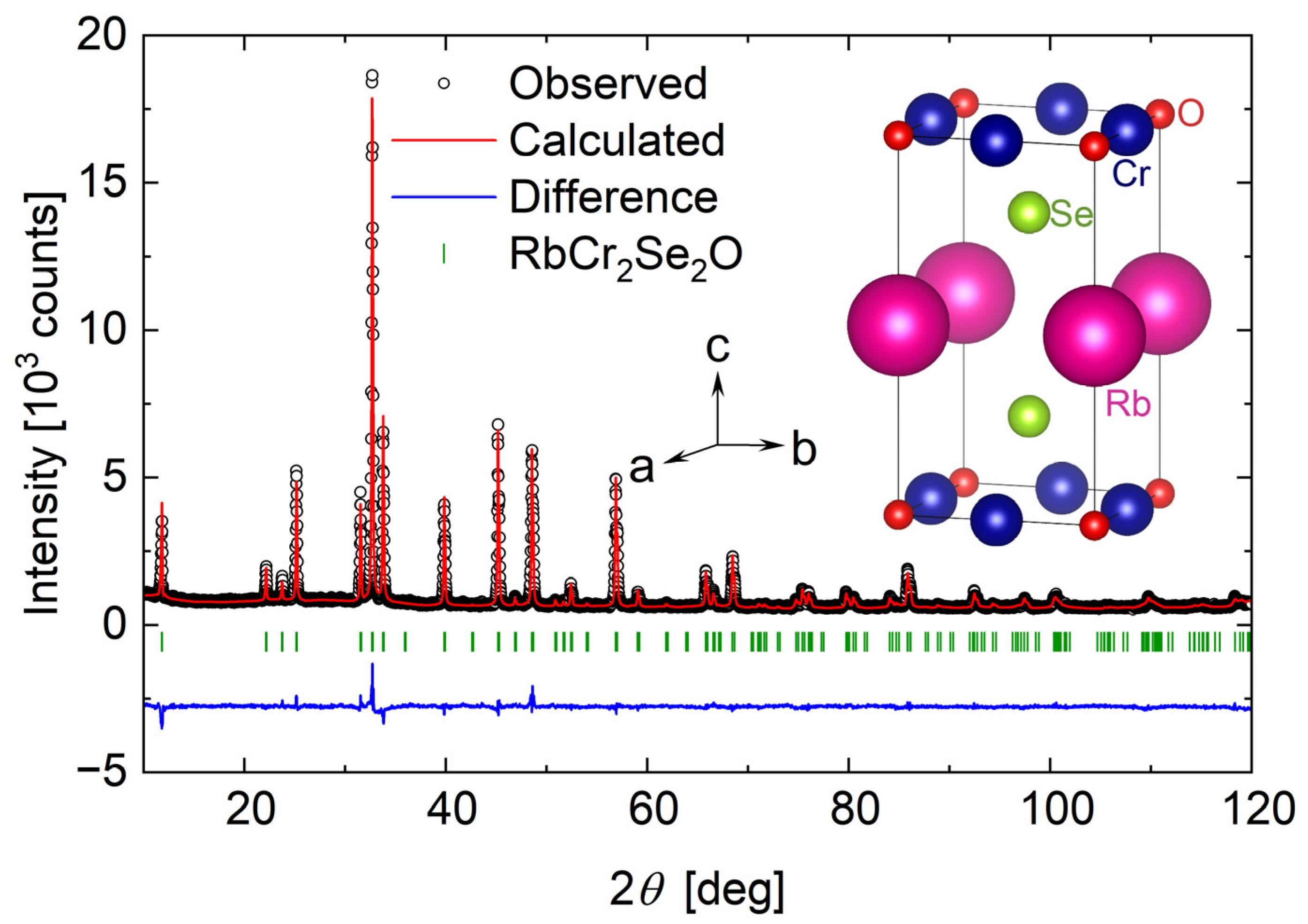
Figure 1 shows the experimental, calculated, and difference powder X-ray diffraction (XRD) profiles of the RbCr2Se2O polycrystalline sample. All reflections were well-indexed based on the tetragonal crystal structure with the space group P4/mmm. No peaks due to impurities were detected. Room-temperature structural parameters obtained from the Rietveld refinement are presented in Table 1 and Table 2, and the corresponding parameters of the titanium analog RbTi2Se2O and the vanadium analog RbV2Se2O are displayed in Table S1. RbCr2Se2O has Cr2O planes, which have an anti-CuO2 structure typical in copper-based superconductors. Se atoms are located directly above and below the center of the Cr2O squares, together forming the Cr2Se2O layers, which are separated by Rb atomic layers.
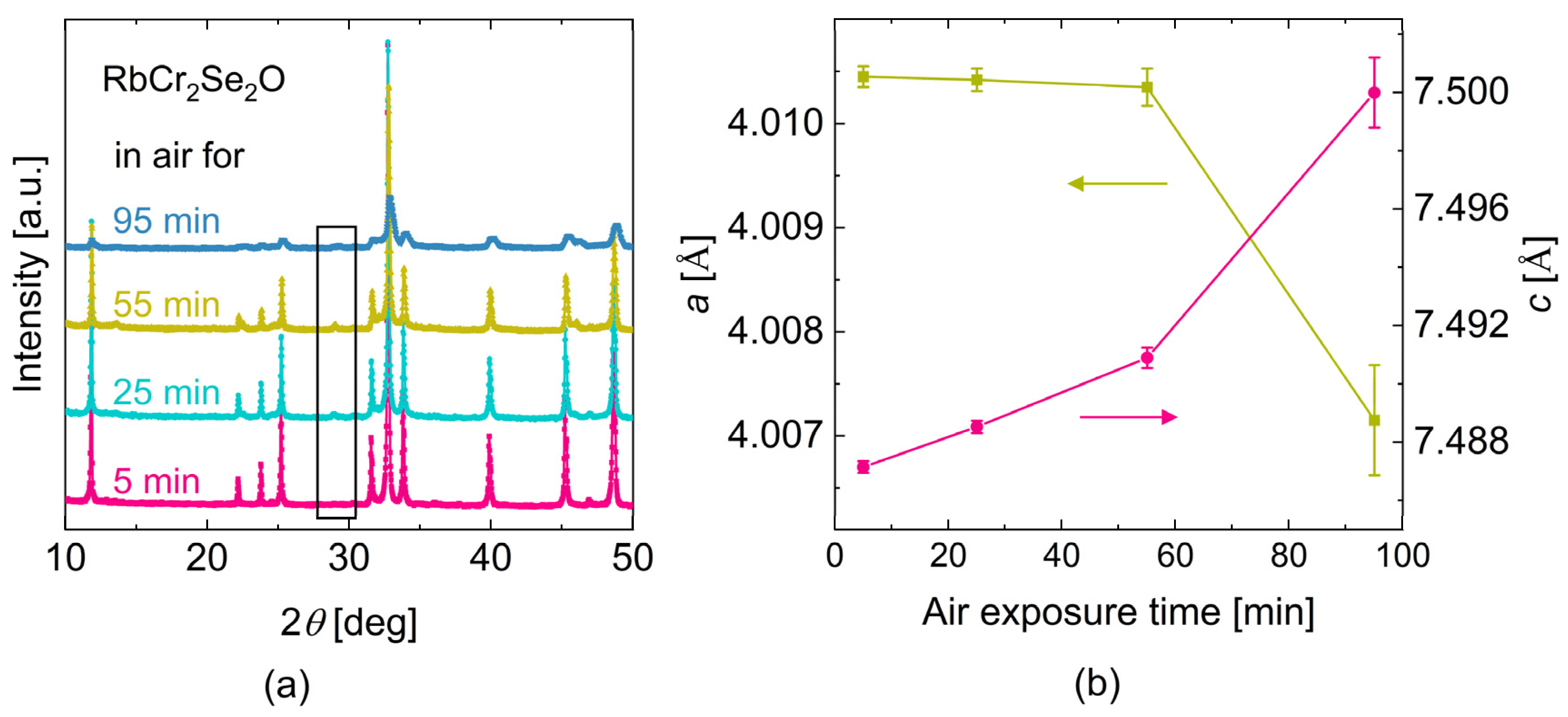
Preliminary air sensitivity was measured by exposing the sample to the air. As shown in Figure 2a, four XRD patterns were displayed with different air exposure times. Each pattern was collected for 10 min. The air exposure time was set as the time interval between the start time of exposure to air and the midpoint time of XRD pattern collection. Peak broadening and the appearance of new peaks, such as the one in the figure, suggest RbCr2Se2O cannot remain stable in the air. As the air exposure time increases, the lattice parameter a decreases and lattice parameter c increases, both in a nonlinear way. The change in lattice parameter a and c may be caused by the deintercalation of Rb [13].
The value of the Cr-O distance is 2.0056(4) Å, equal to half the lattice parameter a of RbCr2Se2O. Similar values have been reported [21,22,23]. The Cr-O distance within the CrO2 square-planar sheets of Sr2CrO2Cr2As2 is 2.00400(1) Å [21]. In Sr2CrO2Cr2OAs2, there are two unique Cr sublattices, one containing Cr2+ in a CrO4As2 environment and the other Cr3+ in CrO2As4 coordination. The Cr-O distance in the CrO2As4 coordination is 2.02245(4) Å [23]. The oxidation state of Cr differs from +2 to +6 and the Cr-O distance spans from ~1.65 Å to ~2.05 Å [24]. Both the oxidation state and the coordination number of chromium have an effect on the Cr-O distance, with the former playing a predominant role. The chromium ion, with a lower valence, usually has a longer Cr-O distance [19,24]. The oxidation state of Cr is evaluated by its bond valence sum (BVS) here [19].The nominal valence of Cr in RbCr2Se2O is +2.5, between +2 and +3, so both values of r0 for Cr2+ and Cr3+ are used for calculation. The obtained Cr BVS value is +2.44 for Cr2+and +2.43 for Cr3+, indicating no significant difference and consistency with the expected value. Further analysis by X-ray absorption spectroscopy may be needed to verify the result [25,26]. Since there is only one crystallographic site for Cr, this result indicates an electron delocalization or a mixed distribution of Cr2+and Cr3+. The Cr-Se distance with a value of 2.6542(10) Å is larger than corresponding values of 2.54–2.59 Å for Cr3+ [27,28,29,30]. Compared with the Cr-Se distance of 2.60542 Å in the CrSe6 octahedron observed in CrSe (Crystallography Open Database ID 9008890), the Cr-Se distance in RbCr2Se2O is slightly elongated to 2.6542(10) Å as compensation for the introduction of two shorter Cr-O bonds into the CrSe4O2 octahedron.
Stabilizing the low oxidation state for Cr in oxides increases the difficulty in sample syntheses, frequently accompanied by impurities [21,22]. Similar situations also occur with vanadium oxyselenides [11,13] and our work. RbCr2Se2O appears to be in a complex phase space near other competing compounds which are still awaiting discovery. We found that unknown phases appeared as byproducts of RbCr2Se2O, with typical peaks at 8.6° in the XRD patterns, as shown in Figure S2 in the Supplementary Materials. These peaks could be suppressed effectively by 5% excess Rb2CO3. In 2016, polycrystalline CsV2S2O was obtained through a solid-state reaction between stoichiometric amounts of a mixed cesium oxide Cs2O1.3, VS, S, and V2O5 [31]. The cesium oxide precursor was prepared from Cs and O2 in a complex way. Based on the relative composition of Cs2O and Cs2O2 determined by XRD, the nominal formula was determined as Cs2O1.3. In the following studies, alkali metals, instead of alkali metal oxide, and 3d transition metal oxides were commonly used as starting materials to obtain the isostructural analogs [11,13]. Still, this method did not work in the synthesis of RbCr2Se2O [13]. In this work, the most significant difference in the synthesis method is using Rb2CO3 as the source of Rb and O for RbCr2Se2O, shown in Figure S1. Meanwhile, the addition of Ba was proven to play an indispensable role in success.
How RbCr2Se2O was formed by the reactions between CrSe, Rb2CO3, and Ba was confusing. We have tried to explain the reaction process here and the supposed reactions are displayed in Figure S1d. Ba pieces and the pellet of a mixture of CrSe powder and Rb2CO3 powder were placed separately in a vacuumed silica tube before the reaction, as shown in Figure S1c. As the tube was heated to 800 °C, Rb2CO3 decomposed to produce Rb2O and CO2, the reaction in yellow background color in Figure S1d. Rb2O was needed but only provided half the amount of oxygen for RbCr2Se2O. The other half of the oxygen was carried by CO2 gas. CO2 then reacted complicatedly with excess Ba [32], the reaction in green background color in Figure S1d. Although the reaction process was not explicit, the result showed that these reactions released oxygen from CO2, which RbCr2Se2O needed, the reaction in red background color in Figure S1d, and turned Ba into BaO, barium carbides, and other possible phases. The Ba pieces became crispy and showed white and dark gray colors. These pieces were collected and examined by XRD. Only BaO was identified, leaving some undefined peaks. In this synthesis route, the absence of Ba would lead to complete failure. As demonstrated in Figure S3, no RbCr2Se2O could be found in the mixture. Most of the starting materials were consumed, and only a small amount of Rb2CO3 remained after the reactions. The product contained, but was not limited to, Cr2O3, RbCr5Se8, Cr3Se4, Rb2Se5, and Rb2CO3.
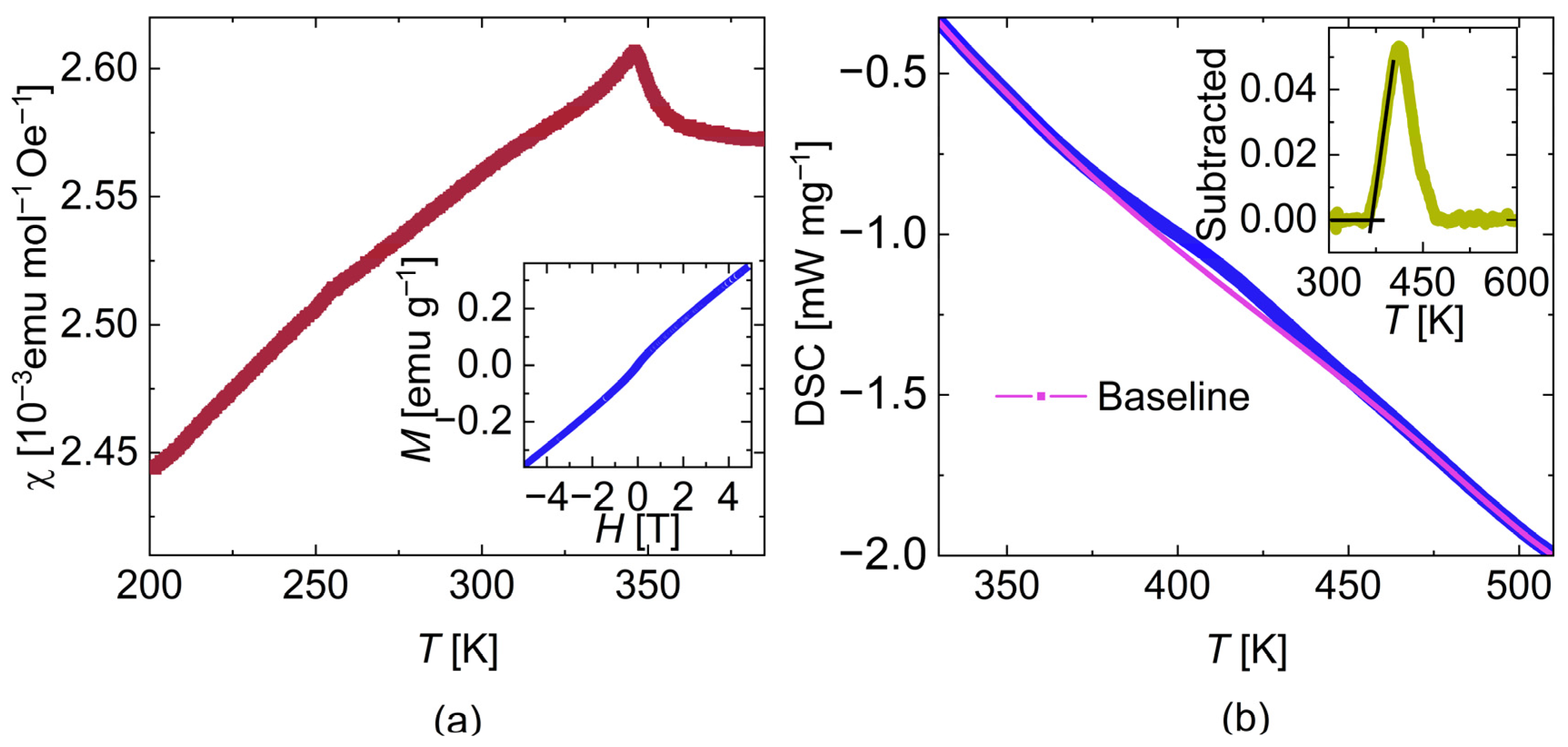
An antiferromagnetic transition at 345 K was identified in RbCr2Se2O. When it comes to magnetic measurements for antiferromagnetic materials, it has to be mentioned that a small level of contamination by ferromagnetic/ferrimagnetic impurities will seriously disturb the magnetic signals [22]. When exploring the magnetic property of RbCr2Se2O, the magnetization of one sample could be several times greater than another one, affected by random amounts of impurities with a strong magnetic response, as shown in Figure S4. There are some anomalies below 200 K in the magnetic susceptibility curves displayed in Figure S4a, but it is hard to distinguish between intrinsic transitions and signals of impurities. However, all magnetic susceptibility curves shared the same anomaly around 345 K which was sometimes barely discernible in the ferromagnetic background. The anomaly was probably intrinsic. Figure 3a shows the temperature-dependent magnetic susceptibility for RbCr2Se2O, measured at a magnetic field of 1 T with field-cooling mode. With decreasing temperature, the magnetic susceptibility increases from 380 K to 345 K. Then the magnetic transition occurs at 345 K, accompanied with a drop in magnetic susceptibility, suggestive of an antiferromagnetic transition. A field-dependent magnetization curve gives a consistent result, exhibiting a linear relationship between magnetization and the applied magnetic field, as displayed in the inset of Figure 3a. The small deviation from the straight line arises from minor impurities. Differential scanning calorimetry (DSC) measurement was conducted to explore this transition. A previous study suggests materials with low self-magnetization and low magnetic susceptibility values cannot show any noticeable DSC changes for a magnetic transition [33]. For RbCr2Se2O, no change is found at 345 K in DSC data but a broad hump is observed, as shown in Figure 3b. By subtracting the baseline, a peak with an onset temperature of 360 K is demonstrated in the inset of Figure 3b. Unlike sharp peaks induced by first-order transition, this peak has a second-order transition-like profile and may be correlated with the antiferromagnetic transition.
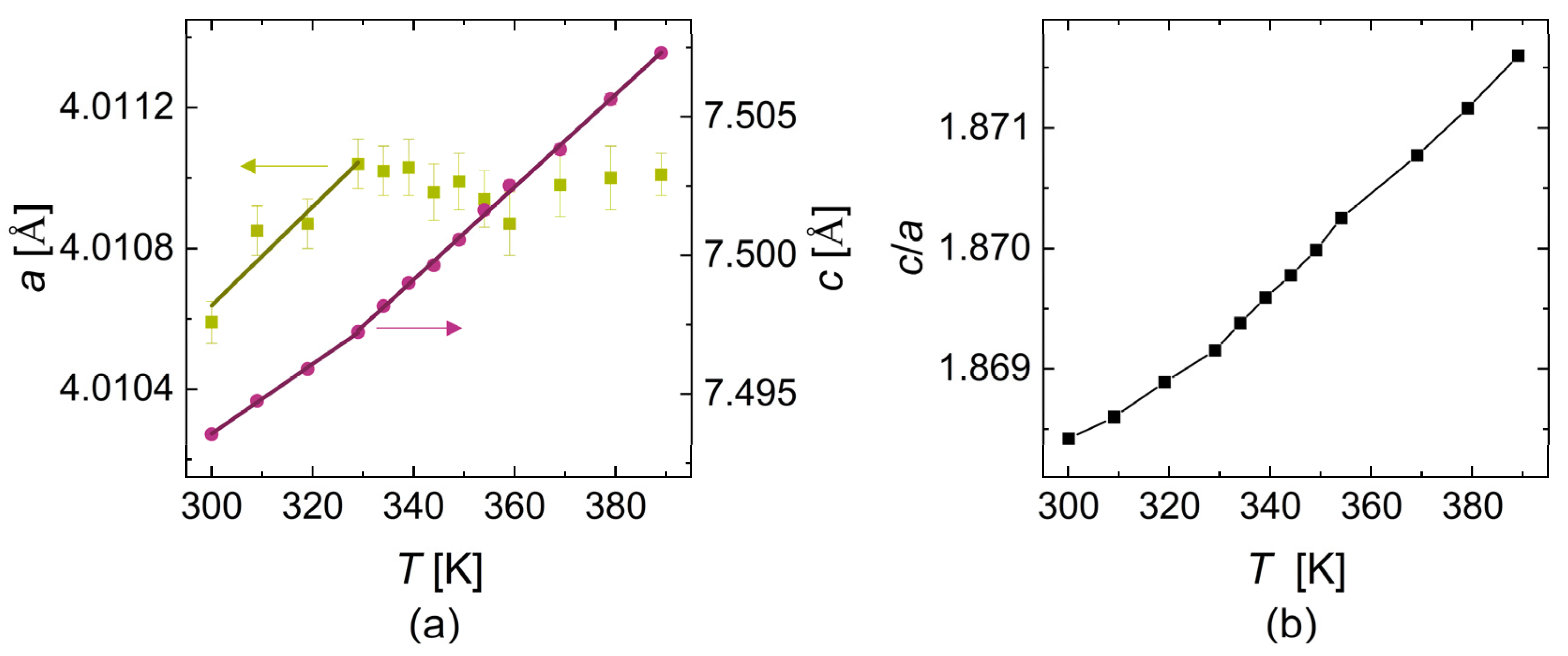
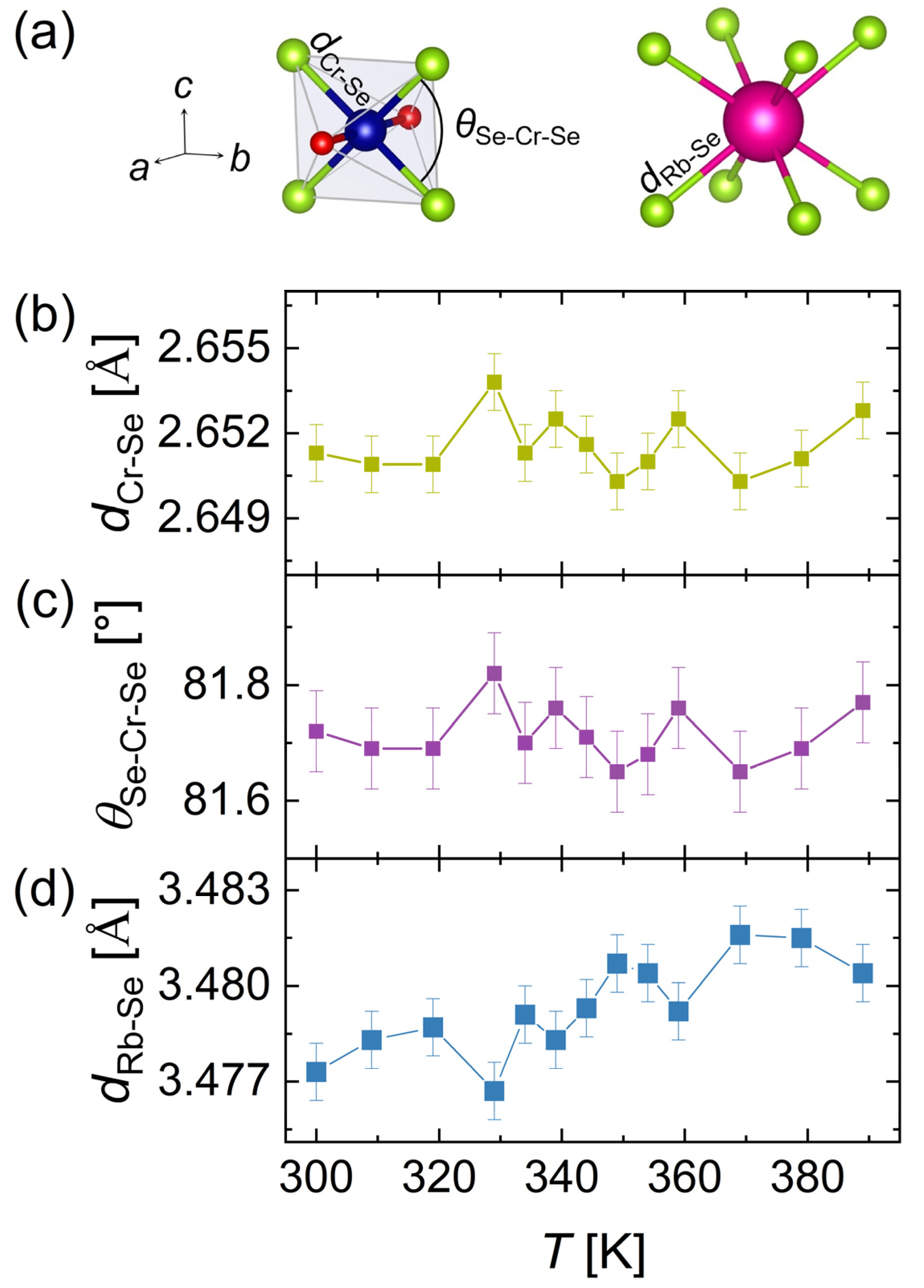
Variable-temperature XRD is performed to explore the evolution of the crystal structure of RbCr2Se2O in the temperature range of 300–390 K. No new diffraction peaks indicating a structural phase transition are observed over the temperature range. The temperature dependence of the lattice parameters a and c and the c/a ratio obtained via Rietveld refinement of the powder XRD data are demonstrated in Figure 4. As temperature increases from 300 K to 330 K, the lattice parameter a increases in a linear-like way. The coefficient of thermal expansion is αa = da/(a300KdT) = 3.45 × 10⁻⁶ K−1 (coefficient of determination R2 = 0.8424), where a300K is the value of a at 300 K. In the temperature range of 330 K to 390 K, there is no obvious monotonic trend of change, indicating a possible zero coefficient of thermal expansion. The lattice parameter c and the ratio of c/a increase with increasing temperature. Treated in the same way as for the lattice parameter a, the coefficient of thermal expansion of lattice parameter c is αc = dc/(c300KdT) = 16.8 × 10⁻⁶ K−1 (coefficient of determination R2 = 0.9987) and αc = dc/(c330KdT) = 22.3 × 10⁻⁶ K−1 (coefficient of determination R2 = 0.9985) for the temperature range of 300–330 K and 330–390 K, respectively. The coefficient αc is about 4.9 times greater than αa in the temperature range of 300–330 K, suggesting the anisotropic thermal expansion of the RbCr2Se2O crystal structure. The Cr-O distance dCr-O, equal to half the lattice parameter a, changes in the same way, as shown in Figure 4a. The Cr-Se distance dCr-Se (shown in Figure 5b) and the angle θSe-CrSe (shown in Figure 5c) are basically unchanged with increasing temperature, while the Rb-Se distance dRb-Se (shown in Figure 5d) is increased by more than 0.04 Å. In the warming process, it is easy for the weak interlayer ionic Rb-Se bonding to be elongated, becoming the main contribution to the increase in the c axis. Meanwhile, the Cr2Se2O layers containing covalent Cr-O bonds and Cr-Se bonds remain robust. In magnetic materials, magnetic ordering offers a negative contribution to the thermal expansion, opposite to the positive contribution of phonons, leading to abnormal thermal expansion and even negative thermal expansion [34]. It is reported that, in antiferromagnetic CrSb, negative thermal expansion is induced by the antiferromagnetic ordering of the Cr atom over a broad temperature window (360–600 K) when the magnetic moment is reduced significantly [35]. The change in αa may be influenced by the antiferromagnetic transition in a similar way in RbCr2Se2O. Further measurements are needed to reveal the relationship between the magnetic transition and thermal expansion.
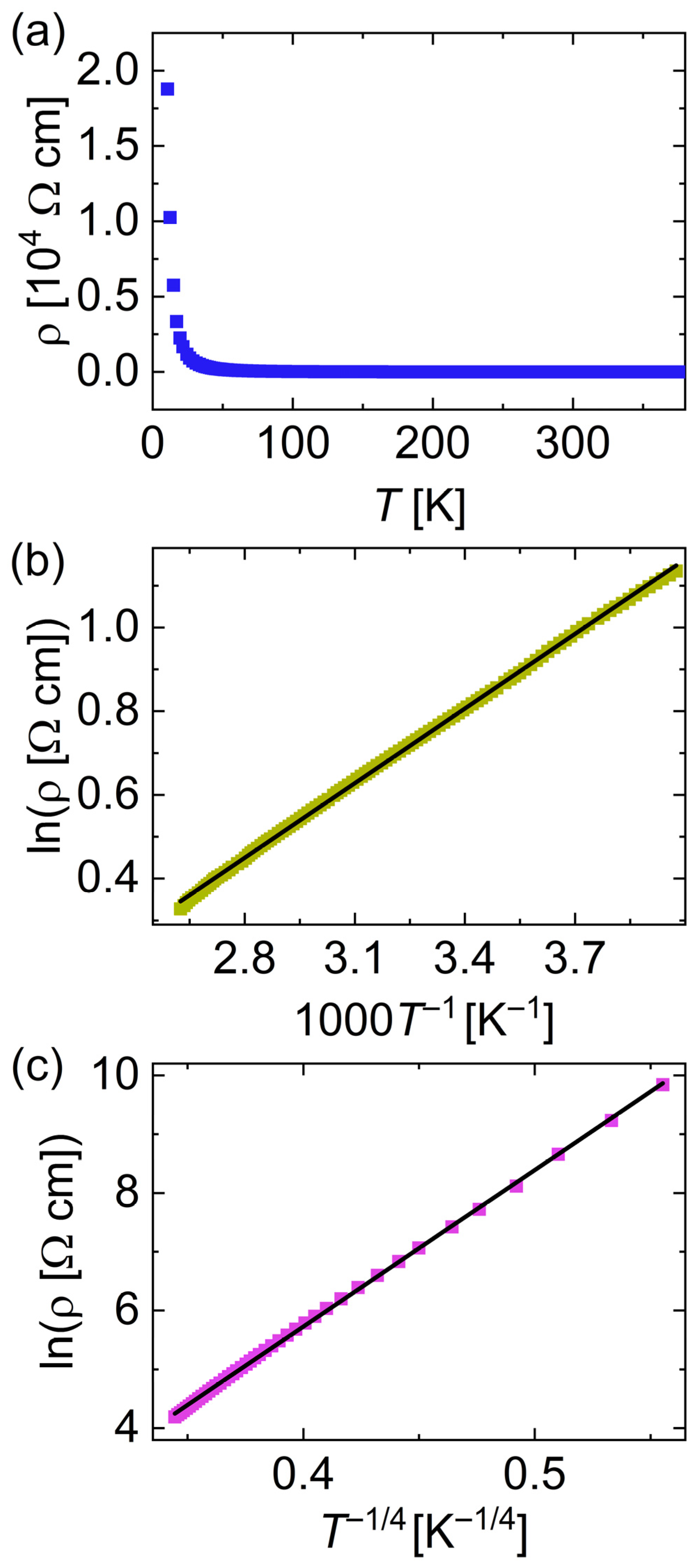
Figure 6a shows the temperature-dependent resistivity ρ(T) curve of a pressed tablet of polycrystalline RbCr2Se2O measured in the absence of an externally applied magnetic field. With decreasing temperature, the resistivity increased rapidly from 1.4 Ω cm at 380 K to 1.9 × 10⁴ Ω cm at 10 K, indicating the semiconducting behavior of RbCr2Se2O. The thermal activation model (lnρ ∝ 1/T), the three-dimensional variable-range hopping (VRH) model (lnρT −1/4), and the small-polaron hopping (SPH) model [ln(ρ/T) ∝ 1/T)] were tried to fit the temperature dependence of resistivity in the whole temperature range of 10–380 K, but all failed. Two mechanisms of charge transfer were used for different temperature intervals, 10–70 K and 250–380 K, chosen based on a better coefficient of determination (R2) of the fitting. In the high-temperature interval of 250–380 K, the resistivity curve can be explained by the thermal activation model ρ = ρ0exp (Ea/kBT), where ρ0 is a constant prefactor, Ea is the activation energy, and kB is Boltzmann’s constant. lnρ shows a linear relationship with T−1, and the corresponding fitting line is shown in Figure 6b. The fitted activation energy, Ea, is approximately 51 meV (coefficient of determination R2 = 0.9995). When the temperature is low, the behavior of charge carriers may be influenced by the disordered distribution of Cr2+ and Cr3+ on a single crystallographic site [36]. The VRH model describes a low-temperature situation when the thermal energy is not high enough for charge carriers to hop to their nearest neighbors. Hence, carriers need to hop further to a site with a smaller potential difference. In the model ρ = Aexp[(T0/T)1/4], A is a prefactor, and T0 is the characteristic temperature. As demonstrated in Figure 6c, lnρ versus T−1/4 exhibits a linear behavior, and the characteristic temperature T0 = 5 × 10⁵ K (coefficient of determination R2 = 0.9995) can be obtained from the slope of lnρ versus T−1/4. The magnitude of T0 can be used as an indicator of the VRH phenomenon, and the relatively low value of T0 compared with those in the scale of 106–108 suggests that RbCr2Se2O is not a very strong disordered or localized system [37,38,39,40].

4. Conclusions

In conclusion, RbCr2Se2O is reported here as the first chromium oxychalcogenide in the AT2Q2O system. It was successfully synthesized via a conventional solid-state method, taking RbCO3 and CrSe as starting materials and introducing Ba to balance the reaction. RbCr2Se2O crystallizes in a tetragonal crystal structure containing Cr2Se2O layers separated by Rb ions. No structural transition was found over the temperature range of 300–390 K. RbCr2Se2O exhibited anisotropic thermal expansion in the crystal structure, driven by the large strength difference between the weak interlayer ionic bond and the robust covalent bonds in the Cr2Se2O layers. Magnetic and electrical property measurements revealed that RbCr2Se2O is a semiconductor with an antiferromagnetic transition at 345 K. Both the temperature dependence of lattice parameters and differential scanning calorimetry data showed anomalies that may be associated with the magnetic ordering. Resistivity at low temperatures was described by the three-dimensional variable-range hopping mechanism. Monolayer Cr2Se2O is predicted as a two-dimensional altermagnet by theoretical calculation, and the van der Waals phase Cr2Se2O may be obtained by extracting Rb+ ions from the parent compound RbCr2Se2O. Hence, RbCr2Se2O offers an opportunity for further exploration of altermagnets.

Supplementary Materials

The following supporting information can be downloaded at: https://www.mdpi.com/article/10.3390/cryst16010056/s1. Figure S1. (a) A schematics diagram of the synthesis process for (K/Rb/Cs)V2Se2O [13]. * In the prereaction, to prevent evaporation of volatile reagents, the crucible was placed in a long silica tube with a lid or a second crucible on top, and the base of the tube was submerged in liquid N2 during sealing. (b) A schematic diagram of the synthesis process for RbCr2Se2O in this work. (c) A schematic diagram showing the location of the reagents in the quartz tube. (d) The supposed reaction during the synthesis process. ** The molar ratio of Ba to Rb2CO3 is 1.2:1. The exact reaction equation of Ba is still not explicit now. After reaction, Ba maybe turned into Ba-O binary compounds, Ba-C binary compounds or other possible phases. Figure S2. Powder XRD patterns of samples synthesized with stoichiometric ratio Rb2CO3:CrSe = 1:4 and 5% excess of Rb2CO3 for RbCr2Se2O. Unknown reflections are marked with arrows. Figure S3. Powder XRD patterns of the mixture after reaction without Ba, compared with RbCr2Se2O and the homemade CrSe. Powder Diffraction File (PDF) codes of Cr2O3, RbCr5Se8, Cr3Se4, Rb2Se5 and Rb2CO3 are 84-0312, 81-1736, 74-1241, 83-1452 and 71-1980, respectively. Unknown reflections are marked with arrows. Figure S4. Field cooling temperature-dependent magnetic susceptibility measured at (a) 0.1 T for sample 1, (b) 1 T for sample 2, and (c) 0.1 T for sample 3. The insets show the dχ/dT curves. (d) XRD patterns for sample 1, 2, and 3. Unknown reflections are marked with arrows. Table S1. Crystallographic information for RbT2Se2O (T = Ti [13], V [13], Cr [this work]).

Author Contributions

Conceptualization, X.S. and H.C.; Formal analysis, X.S. and P.C.; Funding acquisition, X.S., X.W. and H.C.; Methodology, X.S., X.W. and H.C.; Investigation and Methodology, X.S. and P.C.; Project administration, X.S., X.W. and H.C.; Supervision, X.S., X.W. and H.C.; Visualization, X.S. and P.C.; Writing—original draft, X.S.; Writing—review and editing, X.S. and H.C. All authors have read and agreed to the published version of the manuscript.

Funding

This project was financially supported by the Beijing Natural Science Foundation (No. 2234092), the R&D Program of Beijing Municipal Education Commission (No. KM202311417001), the China Postdoctoral Science Foundation (No. 2023M740630), the Young Elite Scientists Sponsorship Program by CAST (No. 2024QNRC001), and the Natural Science Foundation of Fujian Province, China (No. 2024J01838).

Data Availability Statement

The crystallographic data presented in this study are openly available in the Cambridge Crystallographic Data Centre (CCDC), CCDC number 2504936. All data are available from the corresponding authors upon reasonable request.

Conflicts of Interest

The authors declare no conflicts of interest.

References

  1. Bednorz, J.G.; Müller, K.A. Possible highTc superconductivity in the Ba−La−Cu−O system. Z. Für Phys. B Condens. Matter 1986, 64, 189–193. [Google Scholar] [CrossRef]
  2. Kamihara, Y.; Watanabe, T.; Hirano, M.; Hosono, H. Iron-Based Layered Superconductor La[O1−xFx]FeAs (x = 0.05−0.12) with Tc = 26 K. J. Am. Chem. Soc. 2008, 130, 3296–3297. [Google Scholar] [CrossRef]
  3. Guo, J.; Jin, S.; Wang, G.; Wang, S.; Zhu, K.; Zhou, T.; He, M.; Chen, X. Superconductivity in the iron selenide KxFe2Se2 (0 ≤ x ≤ 1.0). Phys. Rev. B 2010, 82, 180520. [Google Scholar] [CrossRef]
  4. Lin, H.; Kang, R.; Kong, L.; Zhu, X.; Wen, H.-H. Superconductivity in LiOHFeS single crystals with a shrunk c-axis lattice constant. Sci. China Phys. Mech. Astron. 2016, 60, 027411. [Google Scholar] [CrossRef][Green Version]
  5. Yajima, T.; Nakano, K.; Takeiri, F.; Ono, T.; Hosokoshi, Y.; Matsushita, Y.; Hester, J.; Kobayashi, Y.; Kageyama, H. Superconductivity in BaTi2Sb2O with a d1 Square Lattice. J. Phys. Soc. Jpn. 2012, 81, 103706. [Google Scholar] [CrossRef]
  6. Doan, P.; Gooch, M.; Tang, Z.; Lorenz, B.; Möller, A.; Tapp, J.; Chu, P.C.W.; Guloy, A.M. Ba1–xNaxTi2Sb2O (0.0 ≤ x ≤ 0.33): A Layered Titanium-Based Pnictide Oxide Superconductor. J. Am. Chem. Soc. 2012, 134, 16520–16523. [Google Scholar] [CrossRef]
  7. Free, D.G.; Withers, N.D.; Hickey, P.J.; Evans, J.S.O. Synthesis, Structure and Properties of Several New Oxychalcogenide Materials with the General Formula A2O2M2OSe2 (A = La−Sm, M = Fe, Mn). Chem. Mater. 2011, 23, 1625–1635. [Google Scholar] [CrossRef]
  8. Mayer, J.M.; Schneemeyer, L.F.; Siegrist, T.; Waszczak, J.V.; Van Dover, B. New Layered Iron-Lanthanum-Oxide-Sulfide and -Selenide Phases: Fe2La2O3E2(E = S,Se). Angew. Chem. Int. Ed. Engl. 1992, 31, 1645–1647. [Google Scholar] [CrossRef]
  9. Wang, C.; Tan, M.-q.; Feng, C.-m.; Ma, Z.-f.; Jiang, S.; Xu, Z.-a.; Cao, G.-h.; Matsubayashi, K.; Uwatoko, Y. La2Co2Se2O3: A Quasi-Two-Dimensional Mott Insulator with Unusual Cobalt Spin State and Possible Orbital Ordering. J. Am. Chem. Soc. 2010, 132, 7069–7073. [Google Scholar] [CrossRef]
  10. Le, C.; Zeng, J.; Gu, Y.; Cao, G.-H.; Hu, J. A possible family of Ni-based high temperature superconductors. Sci. Bull. 2018, 63, 957–963. [Google Scholar] [CrossRef]
  11. Lin, H.; Si, J.; Zhu, X.; Cai, K.; Li, H.; Kong, L.; Yu, X.; Wen, H.-H. Structure and physical properties of CsV2Se2−xO and V2Se2O. Phys. Rev. B 2018, 98, 075132. [Google Scholar] [CrossRef]
  12. Ablimit, A.; Sun, Y.-L.; Cheng, E.-J.; Liu, Y.-B.; Wu, S.-Q.; Jiang, H.; Ren, Z.; Li, S.; Cao, G.-H. V2Te2O: A Two-Dimensional van der Waals Correlated Metal. Inorg. Chem. 2018, 57, 14617–14623. [Google Scholar] [CrossRef] [PubMed]
  13. Kelly, N.D.; Clarke, S.J. Structure and compositional trends in alkali-metal containing titanium and vanadium oxide chalcogenides and the new van der Waals phase Ti2Te2O. J. Solid State Chem. 2023, 327, 124276. [Google Scholar] [CrossRef]
  14. Jiang, B.; Hu, M.; Bai, J.; Song, Z.; Mu, C.; Qu, G.; Li, W.; Zhu, W.; Pi, H.; Wei, Z.; et al. A metallic room-temperature d-wave altermagnet. Nat. Phys. 2025, 21, 754–759. [Google Scholar] [CrossRef]
  15. Sun, Y.; Huang, Y.; Cheng, J.; Zhang, S.; Li, Z.; Luo, H.; Ma, X.; Yang, W.; Yang, J.; Chen, D.; et al. Antiferromagnetic structure of KV2Se2O A neutron diffraction study. Phys. Rev. B 2025, 112, 184416. [Google Scholar] [CrossRef]
  16. Kelly, N.D. Chemistry and physics of layered oxychalcogenides containing an anti-cuprate type square lattice. Solid State Sci. 2025, 169, 108085. [Google Scholar] [CrossRef]
  17. Zou, K.; Yang, Y.; Xin, B.; Wu, W.; Cheng, Y.; Dong, H.; Liu, H.; Luo, F.; Lu, F.; Wang, W.-H. Monolayer M2X2O as potential 2D altermagnets and half-metals: A first principles study. J. Phys. Condens. Matter 2025, 37, 055804. [Google Scholar] [CrossRef]
  18. Rodríguez-Carvajal, J. Recent advances in magnetic structure determination by neutron powder diffraction. Phys. B Condens. Matter 1993, 192, 55–69. [Google Scholar] [CrossRef]
  19. Brown, I.D.; Altermatt, D. Bond-valence parameters obtained from a systematic analysis of the Inorganic Crystal Structure Database. Acta Crystallogr. Sect. B 1985, 41, 244–247. [Google Scholar] [CrossRef]
  20. Brese, N.E.; O’Keeffe, M. Bond-valence parameters for solids. Acta Crystallogr. Sect. B 1991, 47, 192–197. [Google Scholar] [CrossRef]
  21. Xu, X.; Jones, M.A.; Cassidy, S.J.; Manuel, P.; Orlandi, F.; Batuk, M.; Hadermann, J.; Clarke, S.J. Magnetic Ordering in the Layered Cr(II) Oxide Arsenides Sr2CrO2Cr2As2 and Ba2CrO2Cr2As2. Inorg. Chem. 2020, 59, 15898–15912. [Google Scholar] [CrossRef]
  22. Jiang, H.; Bao, J.-K.; Zhai, H.-F.; Tang, Z.-T.; Sun, Y.-L.; Liu, Y.; Wang, Z.-C.; Bai, H.; Xu, Z.-A.; Cao, G.-H. Physical properties and electronic structure of Sr2Cr3As2O2 containing CrO2 and Cr2As2 square-planar lattices. Phys. Rev. B 2015, 92, 205107. [Google Scholar] [CrossRef]
  23. Sheath, B.C.; Xu, X.; Manuel, P.; Hadermann, J.; Batuk, M.; O’Sullivan, J.; Bonilla, R.S.; Clarke, S.J. Structures and Magnetic Ordering in Layered Cr Oxide Arsenides Sr2CrO2Cr2OAs2 and Sr2CrO3CrAs. Inorg. Chem. 2022, 61, 12373–12385. [Google Scholar] [CrossRef] [PubMed]
  24. McKeown, D.A.; Buechele, A.C.; Tappero, R.; McCoy, T.J.; Gardner-Vandy, K.G. X-ray absorption characterization of Cr in forsterite within the MacAlpine Hills 88136 EL3 chondritic meteorite. Am. Mineral. 2014, 99, 190–197. [Google Scholar] [CrossRef]
  25. Pęczkowski, P.; Zachariasz, P.; Jastrzębski, C.; Piętosa, J.; Drzymała, E.; Gondek, Ł. On the Superconductivity Suppression in Eu1−xPrxBa2Cu3O7−δ. Materials 2021, 14, 3503. [Google Scholar] [CrossRef]
  26. Pęczkowski, P.; Zachariasz, P.; Kowalik, M.; Tokarz, W.; Kumar Naik, S.P.; Żukrowski, J.; Jastrzębski, C.; Dadiel, L.J.; Tabiś, W.; Gondek, Ł. Iron diffusivity into superconducting YBa2Cu3O7−δ at oxygen-assisted sintering: Structural, magnetic, and transport properties. J. Eur. Ceram. Soc. 2021, 41, 7085–7097. [Google Scholar] [CrossRef]
  27. Kobayashi, S.; Ueda, H.; Michioka, C.; Yoshimura, K. Competition between the Direct Exchange Interaction and Superexchange Interaction in Layered Compounds LiCrSe2, LiCrTe2, and NaCrTe2 with a Triangular Lattice. Inorg. Chem. 2016, 55, 7407–7413. [Google Scholar] [CrossRef]
  28. Bongers, P.F.; Van Bruggen, C.F.; Koopstra, J.; Omloo, W.P.F.A.M.; Wiegers, G.A.; Jellinek, F. Structures and magnetic properties of some metal (I) chromium (III) sulfides and selenides. J. Phys. Chem. Solids 1968, 29, 977–984. [Google Scholar] [CrossRef]
  29. Rudorff, W.; Ruston, W.R.; Scherhaufer, A. The crystal structure of sodium selenochromite, NaCrSe2, and preliminary investigations on related compounds. Acta Crystallogr. 1948, 1, 196–200. [Google Scholar] [CrossRef]
  30. Sun, X.; Song, Y.; Deng, J.; Jin, S.; Chen, X. New layered chromium chalcogenides CsLiCrSe2, RbLiCrS2 and CsLiCrS2: Structures and properties. Dalton Trans. 2019, 48, 17572–17578. [Google Scholar] [CrossRef]
  31. Valldor, M.; Merz, P.; Prots, Y.; Schnelle, W. Bad-Metal-Layered Sulfide Oxide CsV2S2O. Eur. J. Inorg. Chem. 2016, 2016, 23–27. [Google Scholar] [CrossRef]
  32. Shih, A.; Marrian, C.R.K.; Haas, G.A. Reaction products and subsequent thermal decomposition of Ba films exposed to CO, CO2, H2O and O2. Appl. Surf. Sci. 1983, 16, 106–124. [Google Scholar] [CrossRef]
  33. Reddy, J.A.; Lakshya, A.K.; Raj, R.; Kumar, L.; Chowdhury, A. Characterizing Curie and Néel Point Phase Transitions via Thermal Techniques. Phys. Status Solidi (B) 2023, 260, 2300008. [Google Scholar] [CrossRef]
  34. Hausch, G. Magnetovolume effects in invar alloys: Spontaneous and forced volume magnetostriction. Phys. Status Solidi (A) 1973, 18, 735–740. [Google Scholar] [CrossRef]
  35. Yuan, J.; Song, Y.; Xing, X.; Chen, J. Magnetic structure and uniaxial negative thermal expansion in antiferromagnetic CrSb. Dalton Trans. 2020, 49, 17605–17611. [Google Scholar] [CrossRef] [PubMed]
  36. Volkov, N.V.; Eremin, E.V.; Sablina, K.A.; Sapronova, N.V. Dielectric properties of a mixed-valence Pb3Mn7O15 manganese oxide. J. Phys. Condens. Matter Inst. Phys. J. 2010, 22, 375901. [Google Scholar] [CrossRef] [PubMed]
  37. Zahrin, A.; Azhar, N.A.; Ibrahim, N.; Mohamed, Z. Structural, Magnetic, and Electrical Properties and Magnetoresistance of Monovalent K-Substituted La0.7Ba0.3−xKxMnO3 (x = 0 and 0.04) Manganite. Condens. Matter 2022, 7, 51. [Google Scholar] [CrossRef]
  38. Paraskevopoulos, M.; Mayr, F.; Hemberger, J.; Loidl, A.; Heichele, R.; Maurer, D.; Müller, V.; Mukhin, A.A.; Balbashov, A.M. Magnetic properties and the phase diagram of La1−xSrxMnO3 for x ≤ 0.2. J. Phys. Condens. Matter 2000, 12, 3993. [Google Scholar] [CrossRef]
  39. Ali, A.I.; Hassen, A.; Kim, B.; Wu, Y.; Kim, B.-G.; Park, S.H. Magnetic Phase Transition and Variable Range Hopping Conduction of Y1−xSrxCoO3−δ. J. Korean Phys. Soc. 2007, 51, 1736–1742. [Google Scholar] [CrossRef]
  40. Wu, J.; Leighton, C. Glassy ferromagnetism and magnetic phase separation in La1−xSrxCoO3. Phys. Rev. B 2003, 67, 174408. [Google Scholar] [CrossRef]
Figure 1. The crystal structure and Rietveld refinement of RbCr2Se2O. The black circles, red line, green vertical lines, and blue line represent the powder X-ray diffraction pattern, Rietveld refinement profiles, the Bragg peak positions, and the differences between the calculated data and the observed data. The inset is the crystal structure of RbCr2Se2O in a unit cell.
Crystals 16 00056 g001
Figure 2. (a) XRD patterns of fresh RbCr2Se2O sample collected after exposure for 5 min, 25 min, 55 min, and 95 min. The atmosphere temperature was 18.4 °C and the relative humidity was 37%. (b) Relationships between air exposure time and lattice parameters.
Crystals 16 00056 g002
Figure 3. (a) Field-cooling temperature-dependent magnetic susceptibility measured at 1 T for RbCr2Se2O. The inset displays the M-H curve measured at 10 K. (b) DSC data and the baseline for RbCr2Se2O, and the inset shows the subtracted result of DSC. The intersection of two straight lines indicates the onset temperature of the transition.
Crystals 16 00056 g003
Figure 4. Refinement results of the variable-temperature XRD data. (a) Lattice parameters a and c; the solid lines are the corresponding linear fits. (b) The ratio of c/a.
Crystals 16 00056 g004
Figure 5. (a) The Cr-Se distance dCr-Se, angle θSe-Cr-Se, and Rb-Se distance dRb-Se in RbCr2Se2O. Refinement results of the variable-temperature XRD data showing changes in (b) Cr-Se distance dCr-Se, (c) angle θSe-Cr-Se, and (d) Rb-Se distance dRb-Se.
Crystals 16 00056 g005
Figure 6. (a) Temperature dependence of resistivity for RbCr2Se2O. (b) The plot of lnρ versus 1000 T−1 in the temperature range from 250 K to 380 K. The line is a linear fit according to the thermal activation model. (c) The plot of lnρ versus T−1/4 in the temperature range from 10 K to 70 K. The line is a linear fit according to the three-dimensional variable-range hopping model.
Crystals 16 00056 g006
Table 1. Crystal data and structural refinement parameters for RbCr2Se2O at 300 K.
ParameterValue
CompoundRbCr2Se2O
Space groupP4/mmm
a (Å)4.01123(8)
c (Å)7.49357(18)
ρ (g cm−3)5.005
Rp (%)4.29
Rwp(%)5.59
GoF2.60
Table 2. Details of the crystal structure of RbCr2Se2O.
AtomSitexyzOccupancyBiso
Rb1b000.511.21(5)
Cr2f0.50010.72(5)
Se2h0.50.50.2320(2)10.79(4)
O1a00012.2(3)
Disclaimer/Publisher’s Note: The statements, opinions and data contained in all publications are solely those of the individual author(s) and contributor(s) and not of MDPI and/or the editor(s). MDPI and/or the editor(s) disclaim responsibility for any injury to people or property resulting from any ideas, methods, instructions or products referred to in the content.