Article

Dual-Bifurcation Model and Numerical Analysis of Driving Forces on the Keyhole Boundary in Variable Polarity Plasma Arc Welding

1
College of Mechanical & Energy Engineering, Beijing University of Technology, Beijing 100124, China
2
School of Materials Science and Engineering, Inner Mongolia University of Technology, Hohhot 010051, China
3
Joining and Welding Research Institute, Osaka University, Osaka 5670047, Japan
*
Author to whom correspondence should be addressed.
Crystals 2026, 16(1), 3; https://doi.org/10.3390/cryst16010003
Submission received: 14 November 2025 / Revised: 11 December 2025 / Accepted: 16 December 2025 / Published: 21 December 2025

Abstract

Molten pool flow and keyhole status during Variable Polarity Plasma Arc (VPPA) welding directly affect the weld quality and stability. The lack of a clear correlation between them, however, prevents this process approach from being developed further. To investigate the keyhole morphology and liquid metal flow, the experimental examination of fluid flow by the X-ray imaging method and numerical simulation of plasma arc under the effect of the keyhole were carried out. By changing the tungsten electrode setback while keeping all other parameters, it is possible to vary the keyhole status and maintain the consistency of heat input to the base metal. This work establishes a dual-bifurcation flow model to characterize the keyhole molten pool, where the bifurcation point on the keyhole rear wall significantly affects the stability of the keyhole molten pool. The rear wall of the keyhole is divided into three sections from top to bottom, with the arc pressure in the middle section being significantly higher than in the upper and lower sections. As the degree of arc constriction increases—i.e., as arc stiffness or arc force increases—the middle section becomes more vertical. By the calculated distribution of driving forces, the arc pressure has a high possibility of being one of the dominances for the metal flow in keyhole welding of aluminum alloys. Arc pressure is also important for the bifurcation point position, which is closely related to the three welding states: blind keyhole, keyhole, and cutting.

1. Introduction

In the applied thermal engineering field, plasma arc has been widely used as a high-energy heat source to carry out metal processing such as welding, cutting, spraying, remelting, removal, and additive manufacturing [1,2,3,4]. Variable Polarity Plasma Arc (VPPA) was developed for welding aluminum alloy or magnesium alloy because the oxide layer can be automatically cleaned by the plasma arc in electrode positive (EP) phase [5]. In the VPPA welding process, the keyhole exists through the whole workpiece due to the high energy density. The keyhole welding stability control becomes more complex and difficult than that of traditional arc welding because of the special boundary of gas–liquid and liquid–solid existence [6,7]. Therefore, the study of the behavior of keyhole and liquid metal is very important for a deep understanding of the welding process, thus optimizing parameters for stability control.
Some studies about the keyhole status and material flow of VPPA welding have conducted by experimental observation and numerical simulation [8,9,10,11,12]. In the experimental observation of keyhole welding, Liu et al. [13,14] detected the images of keyhole exit with time, extracting some features such as keyhole diameter and the tilt distance. Zhang et al. [15] measured the voltage of efflux plasma and plasma cloud to estimate the keyhole status, which was associated with the welding quality. Zhou et al. [16] observed the evolution of keyhole growth and molten pool flow through the thickness direction of the workpiece under different welding conditions, and investigated the evolution characteristics of keyhole dimensions along different orientations during various welding processes. Keyhole images can even reflect the welding state directly, but it is difficult to understand the dynamics of the keyhole molten pool because the internal information of the liquid metal cannot be obtained.
Two methods for material flow measurement in keyhole welding have been used, element tracing [17] and particle tracing [18]. Due to the high thermal conductivity of aluminum alloys and the easy formation of an oxide film on the surface, the liquid metal in the keyhole molten pool is very thin, and its flow usually does not exhibit long-lasting vortices. Meanwhile, since the increased metal volume facilitates vortex formation, vortices only occasionally appear during thick aluminum alloy welding [19]. In VPPA keyhole welding of aluminum alloys, variations in molten pool flow patterns correspond to different keyhole shapes [20], and the polarity pressure difference was analyzed as the driving force for liquid metal flow. However, quantitative analysis of the driving force is difficult to achieve through experiments alone.
A relatively intuitive and effective analysis of heat transfer and force in the molten pool is typically conducted by establishing a welding process model and performing numerical calculations. Wu et al. [21,22,23,24,25,26] were among the first to conduct modeling research on plasma arc keyhole welding. When performing numerical simulations using arc heat sources, factors such as heat transfer and force are generally considered. Combined with this model, the Volume of Fluid (VOF) method is commonly employed for simulating the molten pool surface [27,28]. To better investigate the interactions between the arc, keyhole, and molten pool, an integrated arc–keyhole–molten pool model based on VOF was proposed [29,30]. This model enables a more detailed study of the keyhole formation process; however, it involves an extremely high computational cost and still has limitations when calculating variable parameters or analyzing welding defects. During keyhole welding of aluminum alloys, the molten pool flow behavior and material properties differ significantly from those of steel [18]. Currently, there is no well-developed model to describe the VPPA keyhole molten pool flow behavior and its driving mechanism.
In previous studies, several flow and stagnation-point models have been proposed to interpret the stability of keyhole and high-current arc welding processes. Liu et al. [13] inferred the existence and location of a separation or stagnation point in VPPA welding from keyhole-exit images and surface-flow observations, assuming that the point coincides with a geometric inflection on the keyhole boundary. Mendez and co-workers [Y,Z] developed a transport/stagnation-point model for high-current GTA welding, in which a single transition point on the trailing free surface governs the partition of liquid metal between the weld bead and the hump, and its position determines the transition between penetration states. These models provided important conceptual frameworks, but they are essentially based on surface or exit observations and simplified free-surface representations, and they do not resolve the three-dimensional flow in the thin liquid layer along the keyhole wall. Our previous X-ray studies [18,19,20,31] further revealed complex circulation patterns in molten pools under different arc conditions, but they did not establish a specific flow topology and force balance model for VPPA keyhole welding of aluminum alloys.
To better understand the dynamics of the keyhole molten pool in VPPA welding, we conducted a detailed analysis of the three-dimensional flow of the molten pool at different keyhole sizes and summarized it into a dual-bifurcated flow model. The numerical analysis of the plasma arc effect on the keyhole boundary was performed based on the model of a pre-set keyhole in the previous work [19]. This study not only provides a quantitative understanding of the forces acting on the keyhole molten pool but also serves as a reference for the subsequent development of a thermodynamic coupling model for numerical analysis of the molten pool’s dynamic behavior.

2. Experimental Procedure

2.1. Three-Dimensional X-Ray Imaging Experiment

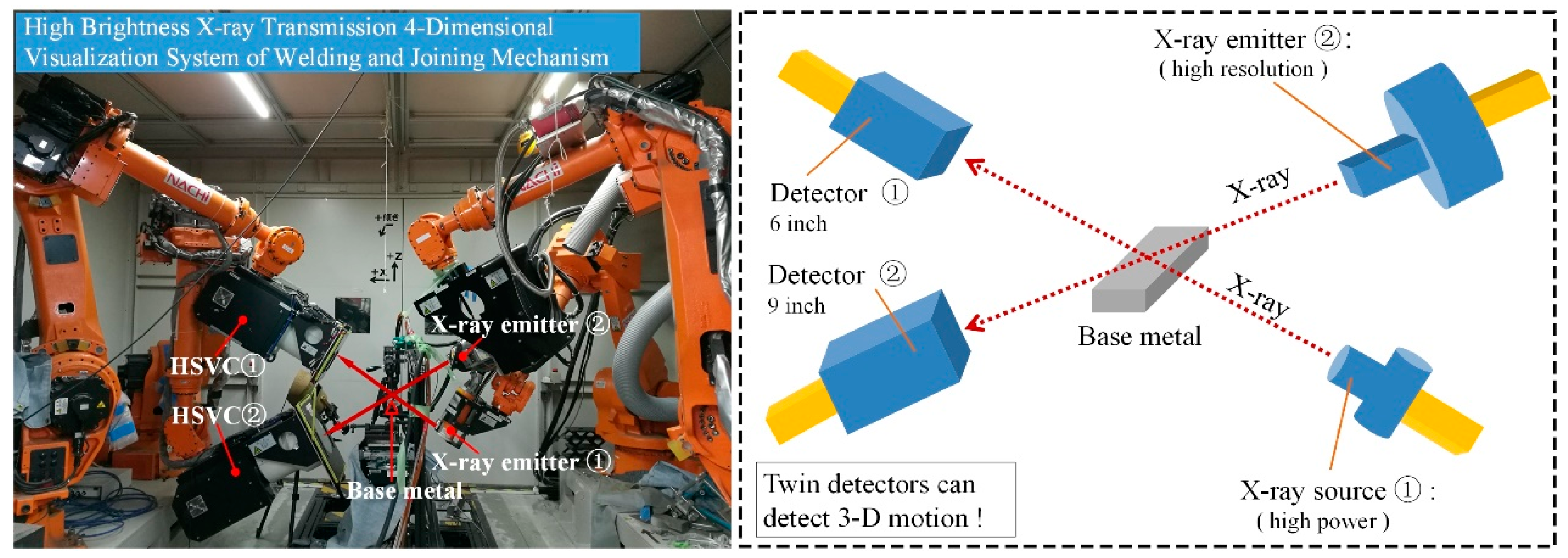
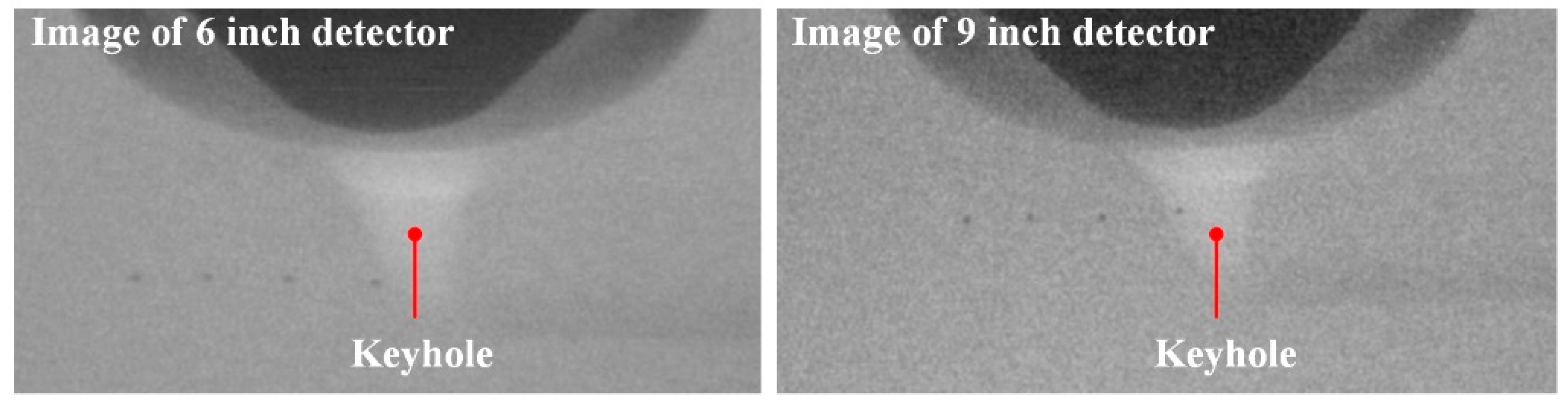
The three-dimensional X-ray imaging experiment was carried out using the observation system schematically shown in Figure 1. During VPPA welding, a high-intensity X-ray beam passes through the thickness of the aluminum plate in a direction perpendicular to the welding direction. The transmitted X-rays are converted into visible light on two scintillator–camera assemblies (Detector 1 and Detector 2) arranged at different viewing angles. Typical synchronized images from these two detectors are shown in Figure 2. The frame rate of the high-speed camera is 2000 fps. The spatial coordinates are obtained through calibration before detection. A dual X-ray imaging system with high-gray-level X-ray transmission capability (Toshiba, Japan) was employed to visualize the welding process and to obtain the spatial positions of the tracer particles at different times; thus, the flow velocity could be calculated by combining this with the time from the high-speed camera. The observation system adopts the principle of binocular vision, utilizing the disparity between two cameras to obtain the third coordinate of the observation point. In each projection image, the tungsten tracer particles appear as dark spots, while the keyhole boundary and the solid–liquid interface can be identified from the contrast variations in the surrounding region. The keyhole molten pool is at the intersection of two X-ray beams. The tungsten electrode balls with a 0.3 mm diameter, as tracer particles, were put into the base metal on the welding path in advance.
The density of tungsten (~19.3 g/cm3) is much higher than that of molten aluminum (~2.37 g/cm3), and the tracer particles remain solid because their melting point (~3703 K) is far above the melt temperature. In the present VPPA keyhole welding of aluminum alloy, the liquid layer between the keyhole boundary and the solid–liquid interface is very thin, typically on the order of 0.5–1.0 mm. With a diameter of 0.3 mm, the tungsten particles quickly settle towards the solid–liquid interface or the keyhole wall and then move constrained by the local geometry. Consequently, gravity-induced settling mainly affects the wall-normal position of the particles, while their motion along the keyhole boundary is governed by the convection of the surrounding liquid metal. Within the spatial and temporal resolution of the X-ray imaging system, the apparent size and contrast of the particles remain nearly constant during their passage through the molten pool, indicating negligible melting or fragmentation. A simple Stokes-drag estimate, using the viscosity of molten aluminum and the particle diameter, gives a velocity relaxation time of O(10−2–10−1 s), which is smaller than the characteristic convection time O(10−1 s) along the rear-wall flow. Therefore, the particle inertia introduces only a limited lag in the acceleration and does not significantly alter the measured flow paths and mean velocities. In regions where different tracers are available, the velocity magnitudes obtained from tungsten particles are also consistent with those measured using lighter surface tracers reported in our previous work [20], supporting the reliability of the tungsten tracers.
Following our previous work 31, the three-dimensional positions of the tracer particles in the keyhole molten pool are obtained by stereo reconstruction. First, the imaging geometry of the two X-ray tube–camera assemblies is calibrated using a plastic plate with drilled holes at known positions, so that the three-dimensional coordinates of a point in the weld pool can be related to its pixel coordinates in both projections. During welding, the positions of each tungsten tracer particle (0.3 mm in diameter) are tracked frame by frame in the two synchronized X-ray image sequences. By matching the particle images in the two views and applying the calibrated projection matrices, the three-dimensional coordinates of the particle are determined via triangulation. Connecting these reconstructed positions in time yields the three-dimensional flow trajectories, and the local flow velocities are obtained from the particle displacements divided by the inter-frame time. The detailed mathematical formulation and validation of this reconstruction procedure can be found in our previous study [31].

2.2. Numerical Simulation Model of VPPA Welding

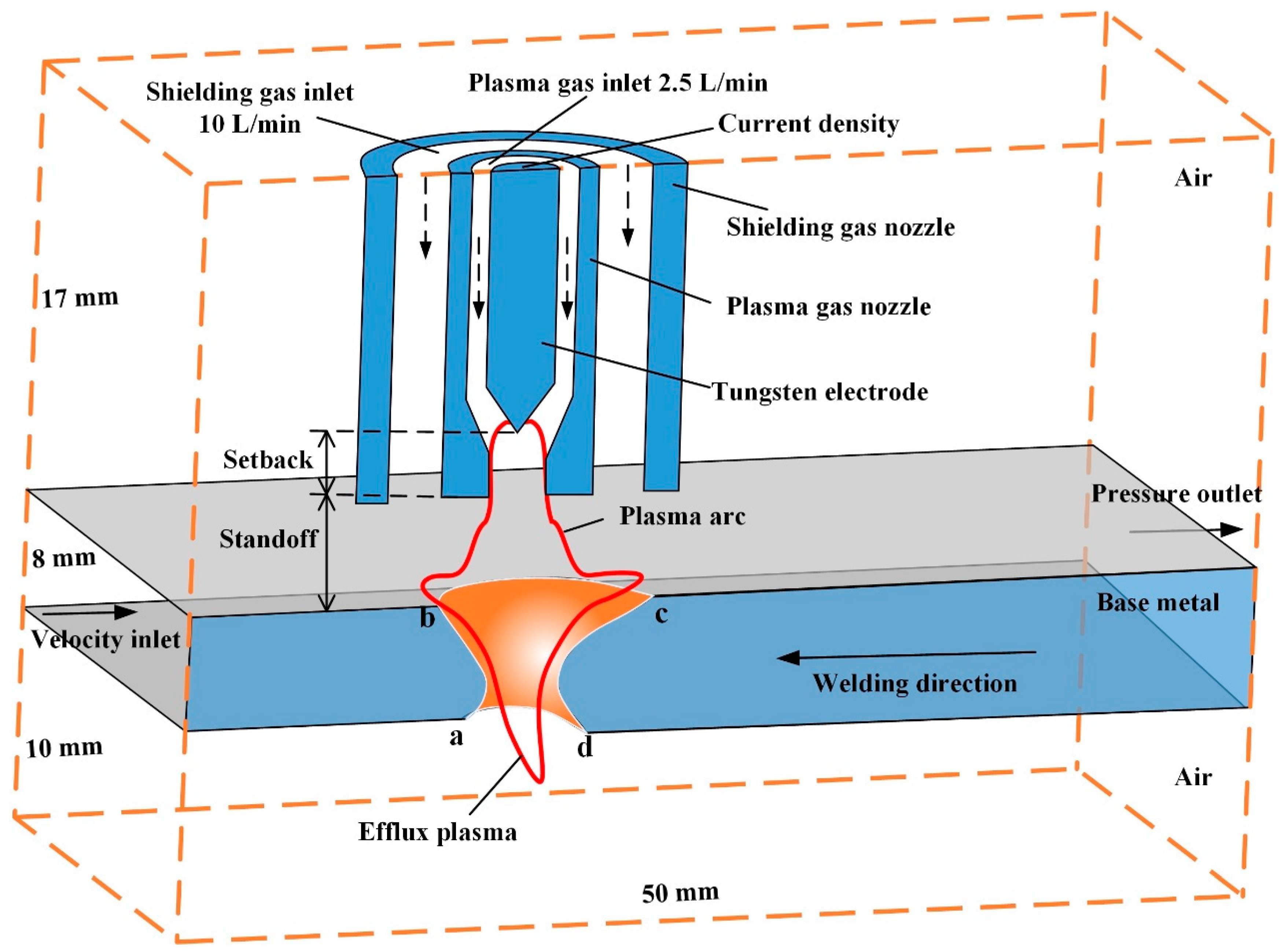
Figure 3 is the schematic illustration of the three-dimensional calculation domain. This domain includes the tungsten electrode, nozzle, arc region, and base metal. The electrode diameter is 4.8 mm. The nozzle diameter is 4.0 mm. The current density on the tungsten electrode section is obtained by dividing the current by the area. The side boundary of the base metal is set to be at a potential of zero. The keyhole is preset in the base metal. In the region where the temperature is below the solidus line, the speed is limited to the welding speed, with the direction opposite to the welding direction. The welding torch remains stationary. The other conditions are shown in Table 1. The keyhole boundary abcd in Figure 3 is preset in the base metal.
The calculation of plasma arc is based on the model of magneto-hydrodynamics, including conservation equations of mass, momentum, and energy, and Maxwell’s equations. The current density, electric field intensity, and magnetic field intensity obtained by solving Maxwell’s equations are used in the source terms of the momentum and energy conservation equations. In VPPA welding, the temperature on the tungsten electrode surface changes dramatically with the polarity switching because the tungsten electrode emits electrons in EN phase and receives electrons in EP phase, which affects the heat transfer. And the electron emission mainly occurs on the melting tungsten electrode surface. The electron emission process on the tungsten surface has been considered in this model through setting local electrical conductivity. For detailed information about the model, please refer to the previous publication [19].
In this study, the keyhole boundary is not solved as a free surface but is prescribed from the time-averaged keyhole geometry extracted from the X-ray images for each welding condition. The numerical model, therefore, represents an experimentally constrained quasi-steady flow in the thin liquid layer along the keyhole wall, aimed at analyzing the local force balance rather than predicting the full transient evolution of the VPPA keyhole.

3. Results and Discussion

3.1. Experimental Observation of the Key Molten Pool Flow Topology

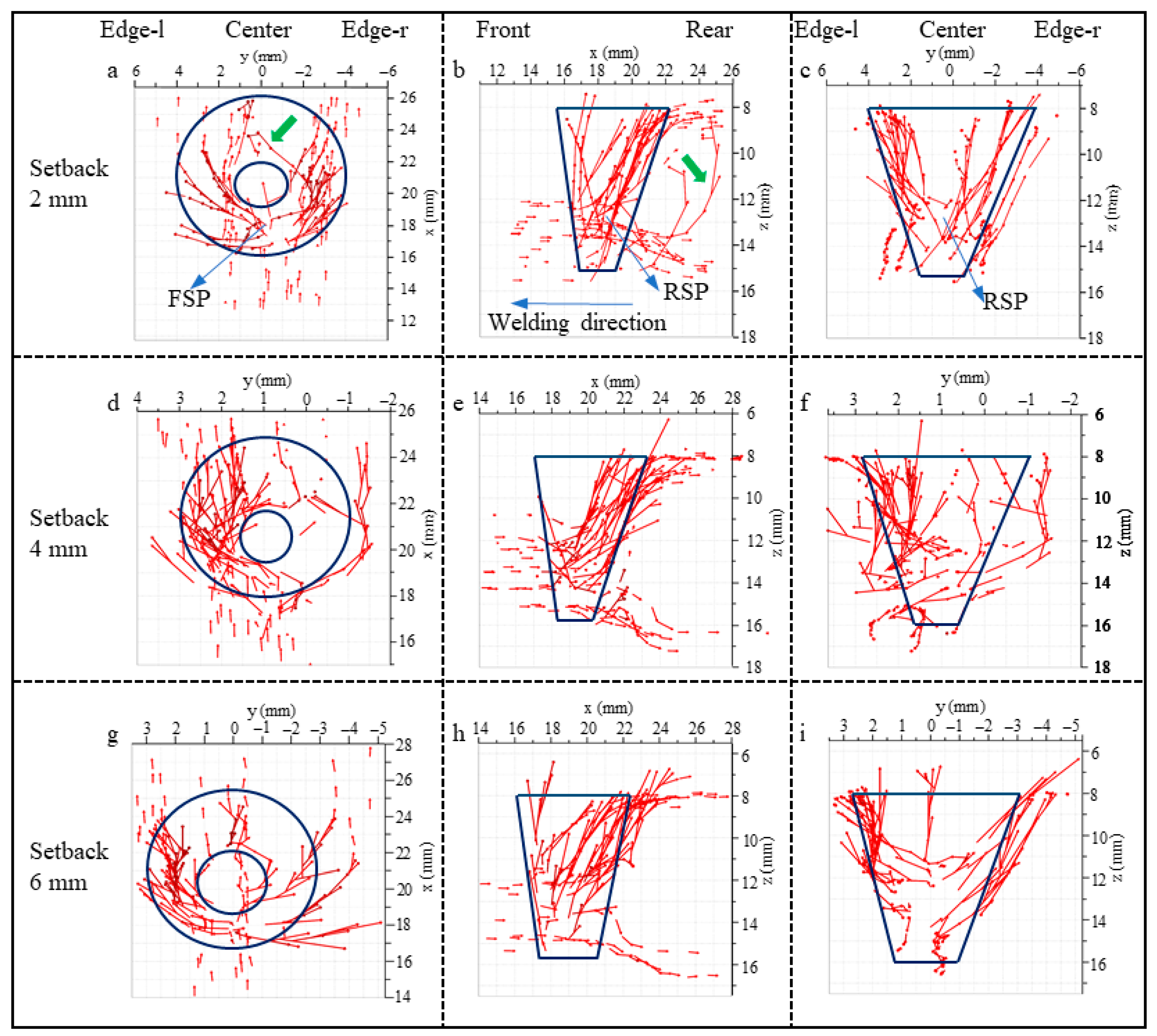
In this subsection, we analyze only the experimental X-ray data. The three-dimensional trajectories of the tungsten tracer particles and the keyhole geometry extracted from the radiographs are used to reconstruct the flow topology in the keyhole molten pool. To obtain the flow stagnation information, the three-dimensional flow trajectories were reconstructed from the stereo X-ray images using the method described in our previous work 31. Figure 4 shows the flow vector of the liquid metal in the keyhole molten pool with different tungsten electrode setbacks. (a) to (c) are the figure with top view, front view, and left side view of three-dimensional flow vectors with 2 mm setback, respectively. Based on X-ray images of the keyhole and tracer particle trajectories, the location of the keyhole can be roughly determined within the flow vector map, as indicated by the thick black lines in the figure. From the results of the x-y plane and y-z plane, it is found that most of the metal stops at the left and right sides of the weld bead after detouring around the keyhole. Fewer detected streamlines that flow to the middle of the weld bead after detouring are obtained, which indicates that the metal of most regions in the keyhole front side flows to both sides of the weld bead. After melting, the metal in the very small area at the front of the keyhole bypasses the keyhole and enters the middle region of the weld. Most of it remains at the edges of the weld. However, the amount of metal needed to fill the middle of the weld is very large, which means that this small area just mentioned has a high melting volume. Combined with the results of the x-z plane, the metal that detoured the keyhole and flows into the middle of the weld bead is mainly from the bottom region of the keyhole. After bypassing the keyhole, it reaches the rear boundary of the keyhole and then splits, flowing upward and downward, forming the middle region of the weld. Moreover, there are two streamlines that flow into the deep region of the weld pool, as shown in Figure 3. The metal detours the keyhole at the bottom region and then enters the rear side weld pool. After the entrance, the metal flows to the middle of the weld bead and upward. This does not appear significantly under the conditions of the other two parameters.
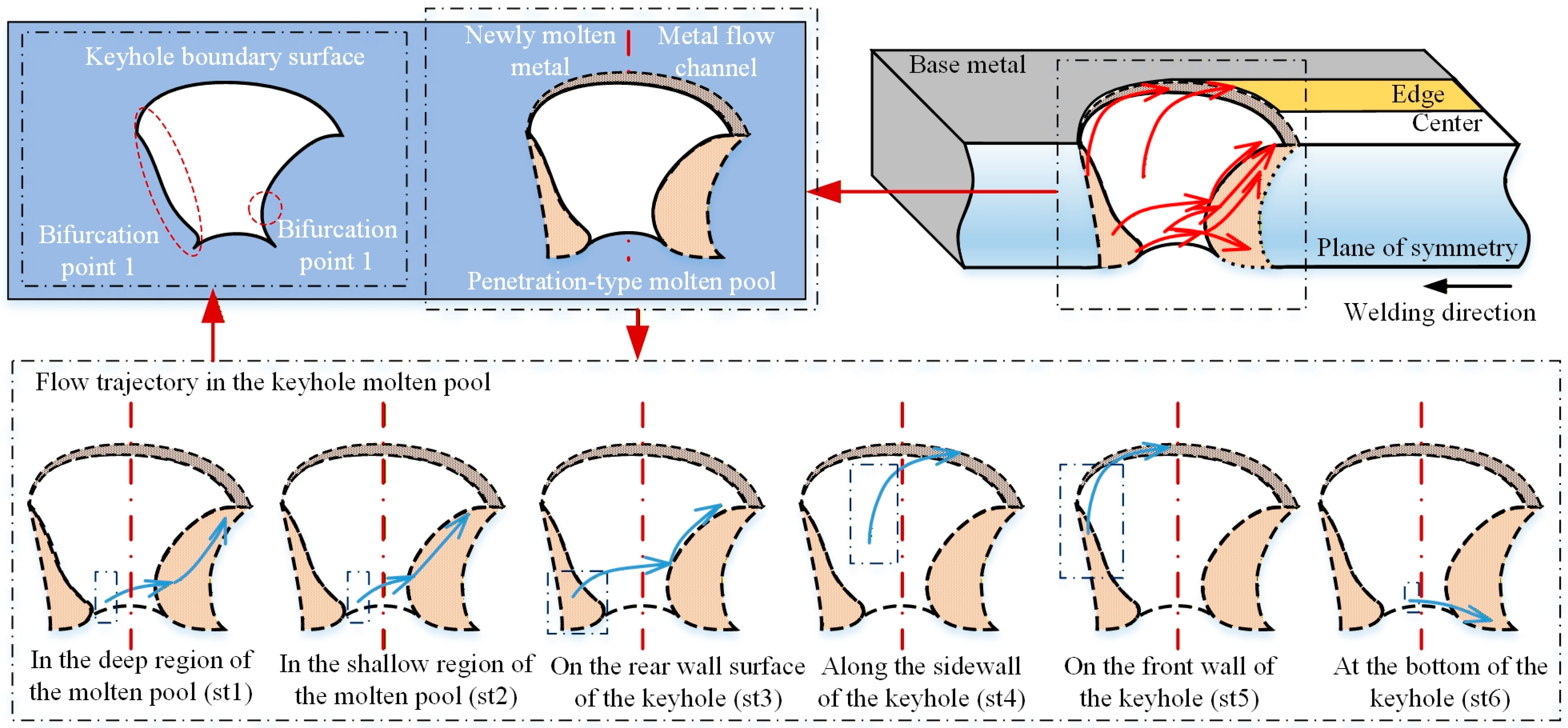
Therefore, based on the above analysis, we can draw two conclusions: first, the melting rate is high at the bottom of the front side of the keyhole; second, the molten metal in the keyhole undergoes the following two stages of splitting: the molten metal on the front wall of the keyhole splits to both sides, and the metal entering the middle region behind the keyhole splits upward and downward. Although the three-dimensional trajectories in Figure 4 were assembled from repeated welds, leading to a small uncertainty in the absolute coordinate of the separation point, the topology of the flow is highly repeatable. In all experiments, the streamlines that bypass the keyhole and enter the rear region split into upward and downward branches within a narrow band close to the keyhole bottom. As the keyhole size increases, this band moves toward the top of the keyhole. Combined with the geometric information of the keyhole boundary, this indicates that the rear-wall separation point is located in the vicinity of the geometric inflection near the bottom. The dual-bifurcation model in Figure 5, therefore, describes robust features of the flow topology rather than relying on an exact point location.
Unlike the elliptical or oval-shaped molten pool obtained through conventional welding methods, the keyhole-type molten pool exhibits a highly distinctive three-dimensional morphology, as shown in Figure 5. By referring to the previous experimental observations of the cross-section and longitudinal section of the keyhole [20], it can be reasonably inferred that the keyhole molten pool resembles a hollow cylinder. The gas–liquid interface is the keyhole boundary. Additionally, the liquid metal of the keyhole molten pool is distributed between the keyhole boundary and the solid–liquid interface. The molten pool in aluminum alloy keyhole welding is very thin, which can be confirmed not only by the absence of complex internal vortices in the molten pool detected in this study but also by the fusion line observations in previous research [18]. Vortices typically require a larger molten pool to form, such as in the case of direct current plasma arc welding of stainless steel. The molten pool metal is relatively thin primarily for two reasons. First, the plasma arc enters from the top of the keyhole and exits from the bottom, causing part of the plasma arc’s energy to be carried away without being transferred to the workpiece. Second, the high thermal conductivity of aluminum alloy leads to rapid heat dissipation.
In the direction perpendicular to the welding path, the molten pool can be divided into two parts—the front and rear portions—using the location where the keyhole molten pool reaches its maximum size as the boundary. The front portion consists of newly melted metal, while the rear portion serves as a flow channel for the liquid metal. As the liquid metal flows through this channel, it solidifies to form the weld bead. The newly melted metal can be divided into six regions, corresponding to six typical flow trajectories (st1–st6). Among them, st1 and st2 are similar, both originating from the bottom of the keyhole sidewall. They then flow into the rear part of the molten pool and move upward. The st3 originates from the bottom region of the keyhole’s front wall. After bypassing the keyhole, it flows upward along the surface of the keyhole’s rear wall. The metal from the middle and upper parts of the keyhole sidewall flows upward while bypassing the keyhole, as illustrated by st4. The st5 starts from the upper half of the keyhole’s front wall, first flowing to the top of the keyhole before bypassing it. The st6 involves part of the metal from the bottom region of the keyhole’s sidewall flowing downward after bypassing the keyhole. The metal flowing along st1–st3 solidifies to form the center region of the weld bead, while st4, st5, and st6 contribute to the formation of the edge region of the weld bead. Whether welding, rather than cutting, can be achieved depends on the successful formation of the weld’s central region. The study should mainly focus on the stable realization of st1–st3.
From the perspective along the welding direction at the center of the weld bead, the newly melted metal splits and flows to the left and right sides. From the opposite perspective, looking in the welding reverse direction, there is an upward and downward splitting process on the rear wall of the keyhole within the aforementioned channel. The former seems to form naturally, while the presence of the latter directly determines whether it is welding or cutting. In summary, this work establishes a dual-bifurcation flow model to characterize the flow process of the keyhole molten pool in aluminum alloy welding. This makes it easier to understand and better identify the key points for control. In this paper, the term ‘flow bifurcation point’ is used in a kinematic sense to denote a location on the keyhole boundary where the molten metal streamlines split into two distinct branches (e.g., left/right around the keyhole or upward/downward in the rear region). It does not refer to a parameter-induced bifurcation of a dynamical system, but rather to the topology of the steady flow field reconstructed from the X-ray trajectories.
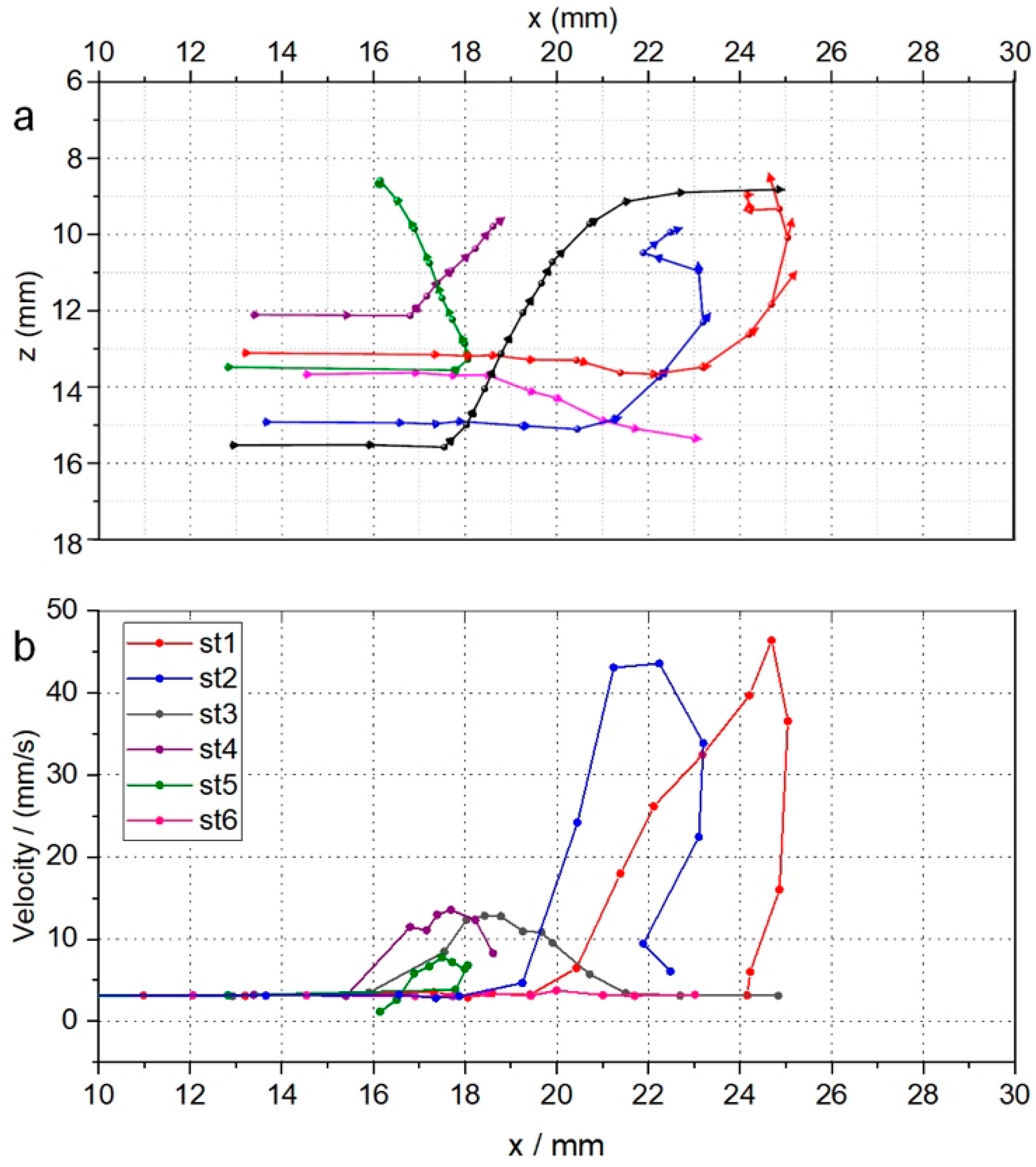
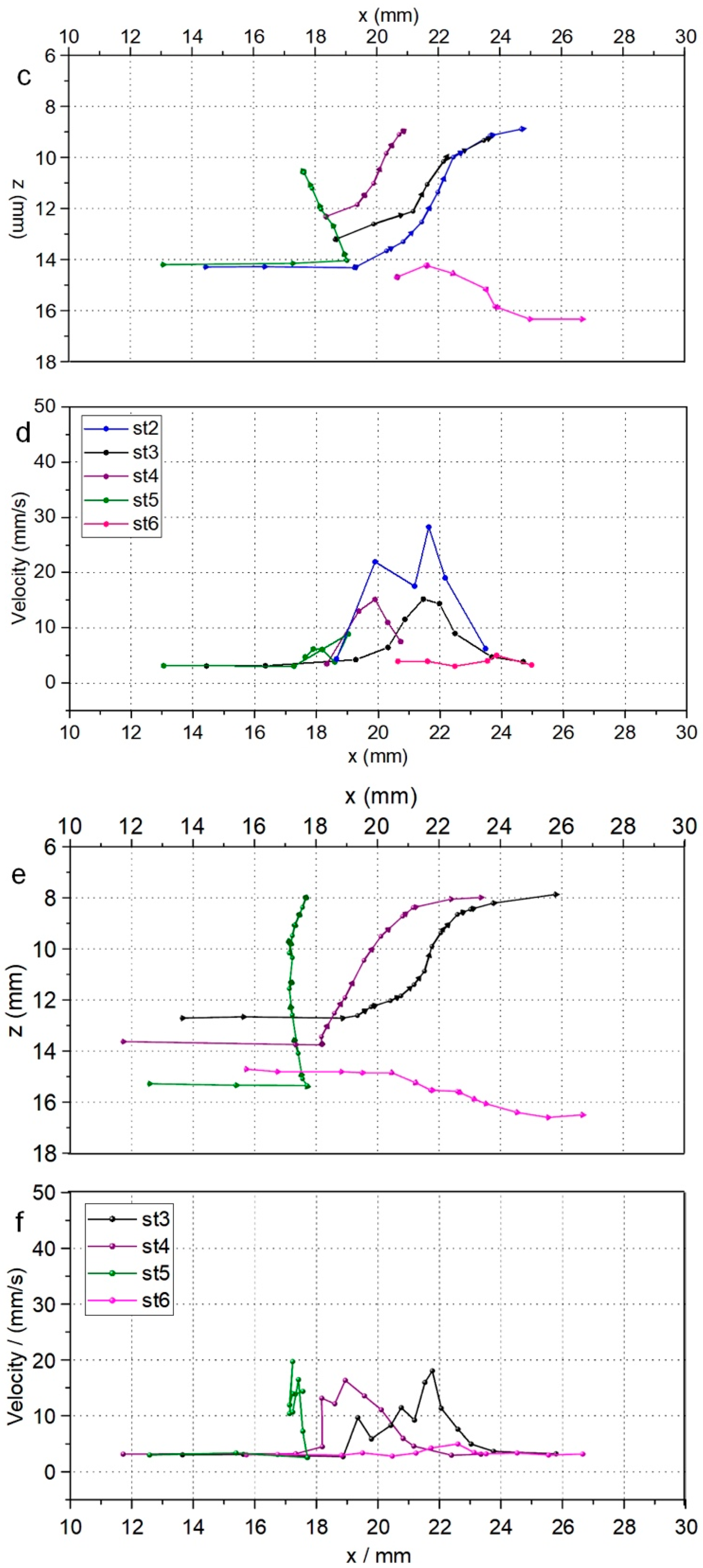
The velocities of the typical streamlines are shown in Figure 6. The flow velocities on st1 and st2 are similar, with maximum velocities ranging between 40 mm/s and 50 mm/s. These velocities are higher than those on other flow streamlines. The flow velocity on the surface of the molten pool is mostly below 20 mm/s, which is considered relatively low compared with other welding methods [32,33]. In the previous two-dimensional flow velocity measurement results [20], although the same trend as the current three-dimensional flow measurement was observed, the two-dimensional imaging stretched the observation field of view, leading to an overestimation of the flow velocity measurement results. Through the three-dimensional flow in Figure 4a,b, it flows upward while moving toward the “center” region after the metal on st1 (indicated by green arrows) enters the molten pool behind the keyhole. As the keyhole moves forward, this area is prone to forming a low-pressure zone, which may be the reason for the high flow velocity inside the molten pool. The low flow velocity on the molten pool surface can be understood through the subsequent force numerical analysis.
As the tungsten electrode setback increases, the arc force intensifies, and the keyhole size enlarges. More arc plasma escapes from the bottom of the keyhole, leading to increased heat loss from the arc. This causes the liquid metal at the rear wall of the keyhole to become thinner, and as a result, a low-pressure zone may not appear. Additionally, the velocity of bifurcation1 on the front wall first increases and then decreases. The flow velocity directed toward the top behind the keyhole of bifurcation2 increases (black), while that toward the bottom is very low (pink). The lack of shielding gas protection at the bottom makes it prone to forming an oxide film, which may be the reason for low velocity.
Compared with the classical stagnation- or transport-point models, the present dual-bifurcation flow model introduces several important refinements. First, instead of a single stagnation or transport point on the trailing surface [Y,Z] or at a geometric inflection [X], the present X-ray trajectories reveal a two-stage flow splitting structure: the molten metal first bifurcates on the front wall and flows around both sides of the keyhole, and then bifurcates again on the rear wall into upward and downward branches near the keyhole bottom. Second, the location of the rear-wall flow bifurcation is determined directly from three-dimensional internal trajectories in the thin liquid layer, and is shown to lie in the high-pressure middle section of the rear wall, rather than being assumed to coincide with the geometric inflection. Third, by combining the experimentally based dual-bifurcation topology with numerical simulations, the present work quantitatively evaluates the pressure, shear, Marangoni, and Lorentz forces in this critical region, thereby extending the earlier qualitative stagnation-point models into a more complete force-balance framework for VPPA keyhole welding.

3.2. Numerical Simulation of the Driving Forces and Verification of the Dual-Bifurcation Model

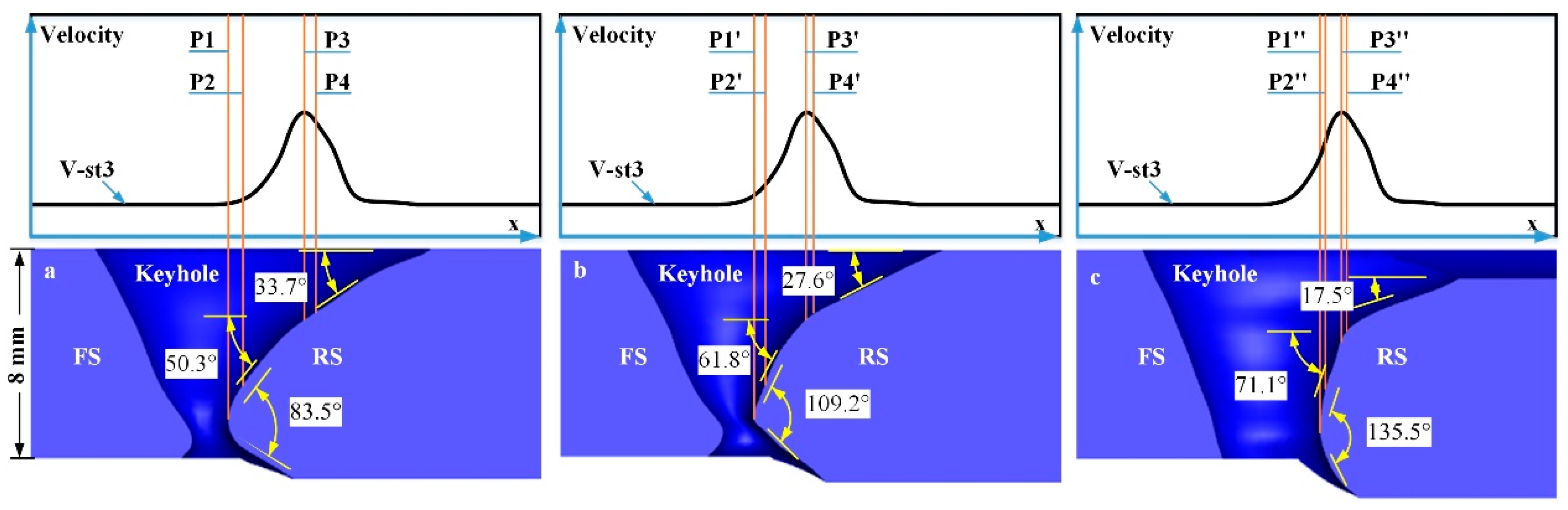
In this subsection, we use the numerical simulation to quantify and interpret the experimentally observed flow topology. Based on the keyhole geometry and separation regions identified in Section 3.1, the distributions of velocity, pressure, wall shear stress, and Lorentz force along the keyhole wall are calculated to evaluate the relative contributions of the different driving forces and to verify the dual-bifurcation model. Based on the experimental results [20], during the modeling process, we predefined the keyhole boundary as a fixed wall. This approach simplifies the calculations and improves computational efficiency. Although it is described as a dual-bifurcation flow mode, bifurcation1 on the front wall is relatively stable and easy to understand, so it is not discussed in detail here. The focus is on analyzing the bifurcation2 at the rear wall of the keyhole. Figure 7 shows the keyhole shape with different tungsten setbacks and a schematic diagram of the flow velocity on the rear wall (on the st3).
The rear boundary of the keyhole is divided into three sections, with P1, P1′, P1″, and P4, P4′, P4″ serving as the geometric transition points. From top to bottom, the first and second sections incline upward to the right, while the third section inclines upward to the left. At different tungsten setbacks, the angle between the first section boundary and the horizontal plane is 33.7°, 27.6°, and 17.5°, respectively, while the angle for the second section is 50.3°, 61.8°, and 71.1°, respectively. The angles between the third and second sections are 83.5°, 109.2°, and 135.5°, respectively. The variations in these parameters are closely related to the increase in arc force. P2, P2′, and P2″ indicate the bifurcation point on the keyhole rear wall. Although Liu et al. [34] explained that this point coincides with the geometric inflection point P1, this conclusion was based solely on observations of molten pool surface flow and lacks sufficient evidence. While it is uncertain whether these two points coincide, it is certain that the separation point is relatively close to the bottom of the keyhole [18,19]. Therefore, it is assumed to be near point P1. Within the spatial resolution of the X-ray experiment, the separation point always appears within one to two computational grid cells of this geometric inflection. Consequently, treating P2 as coincident with P1 in the numerical model does not affect the qualitative distribution of the driving forces along the rear wall or the classification of welding states. P3, P3′, and P3″ are the points of maximum flow velocity, which are inferred based on the results of Figure 6. P3 is close to P4. After passing P4, it enters the first section, where the velocity continues to decrease.
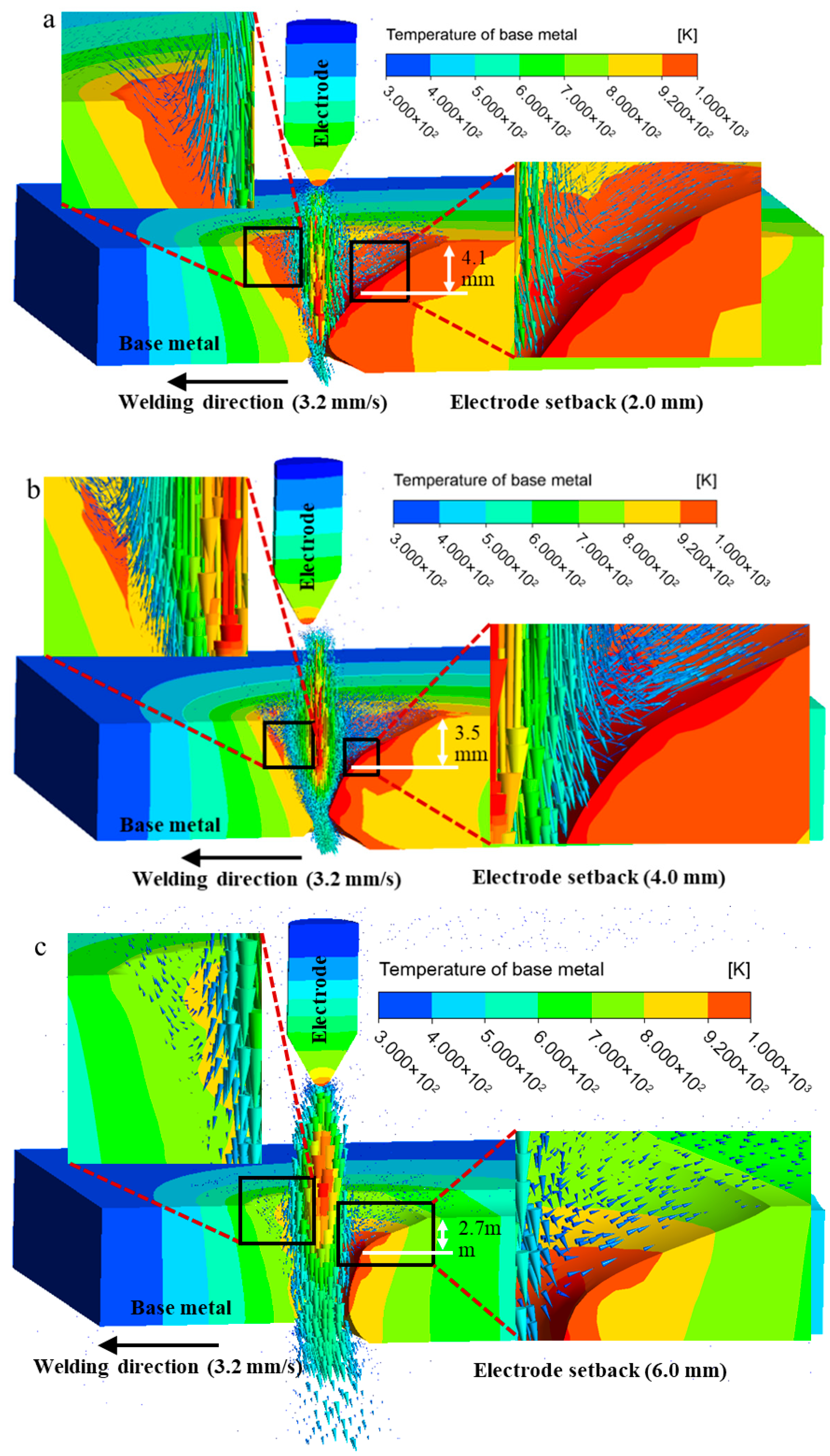
Figure 8 shows the arc plasma flow vector inside the keyhole with different tungsten electrode setbacks. The arc plasma diverges on the inclined keyhole boundary, with part of it flowing to the topside and part to the bottom side. The distances from the top surface of the base metal to the flowing separation points of the arc plasma are 4.1 mm, 3.5 mm, and 2.7 mm, respectively. More arc plasma flows out from the keyhole exits as the tungsten electrode setback increases. The separation position of the arc plasma on the rear wall of the keyhole is close to the P3 and P4. The shape of the keyhole is determined by the arc force, and in turn, the keyhole shape influences the arc effect. As the tungsten electrode setback increases, the inclination of the second section of the keyhole boundary decreases, allowing more arc plasma to enter the middle and lower parts of the keyhole, which significantly alters the thermal distribution along the keyhole boundary. From the workpiece temperature, it can be observed that the more arc plasma dissipates from the bottom, the less molten metal remains in the weld pool, and the lower the temperature.
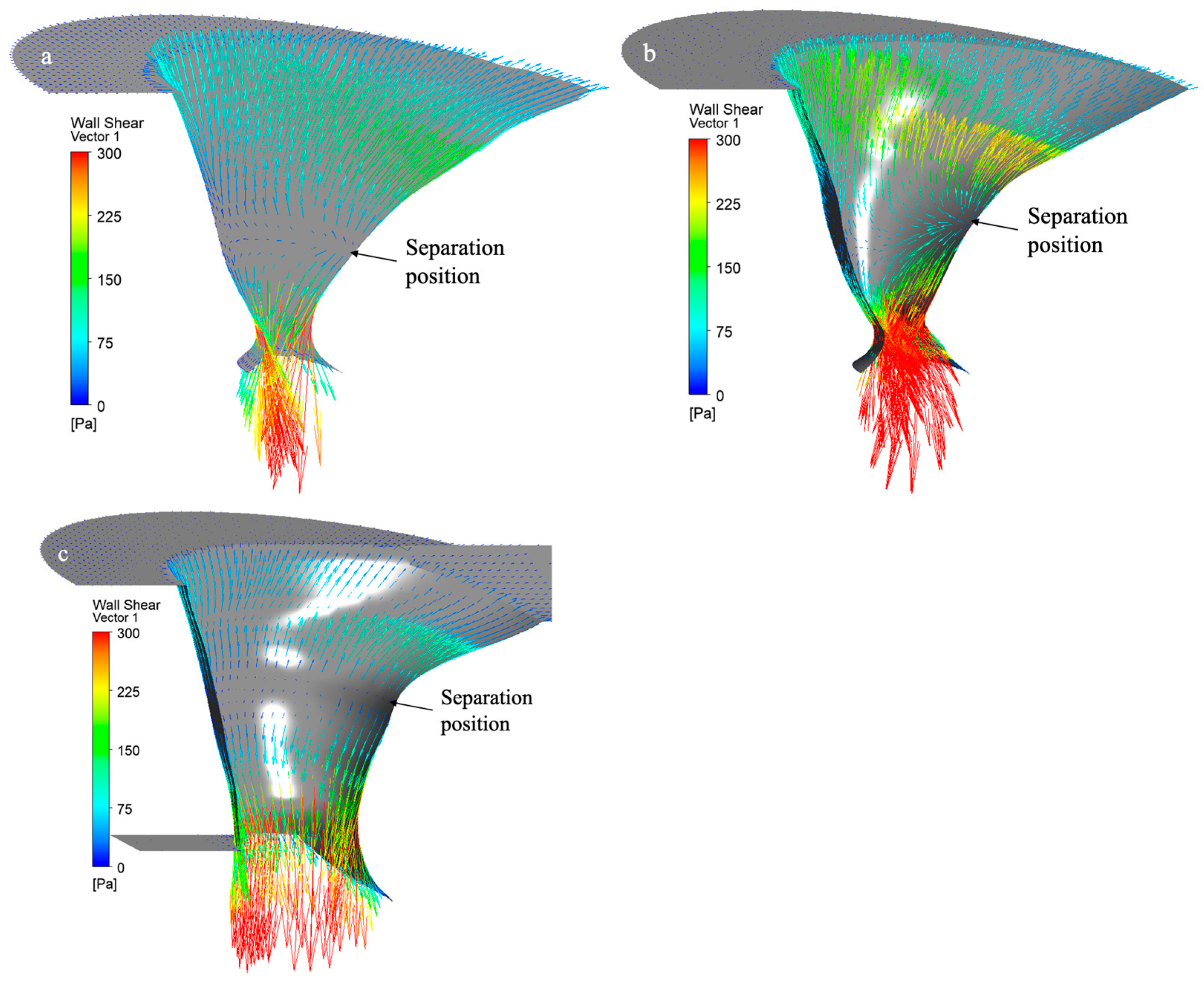
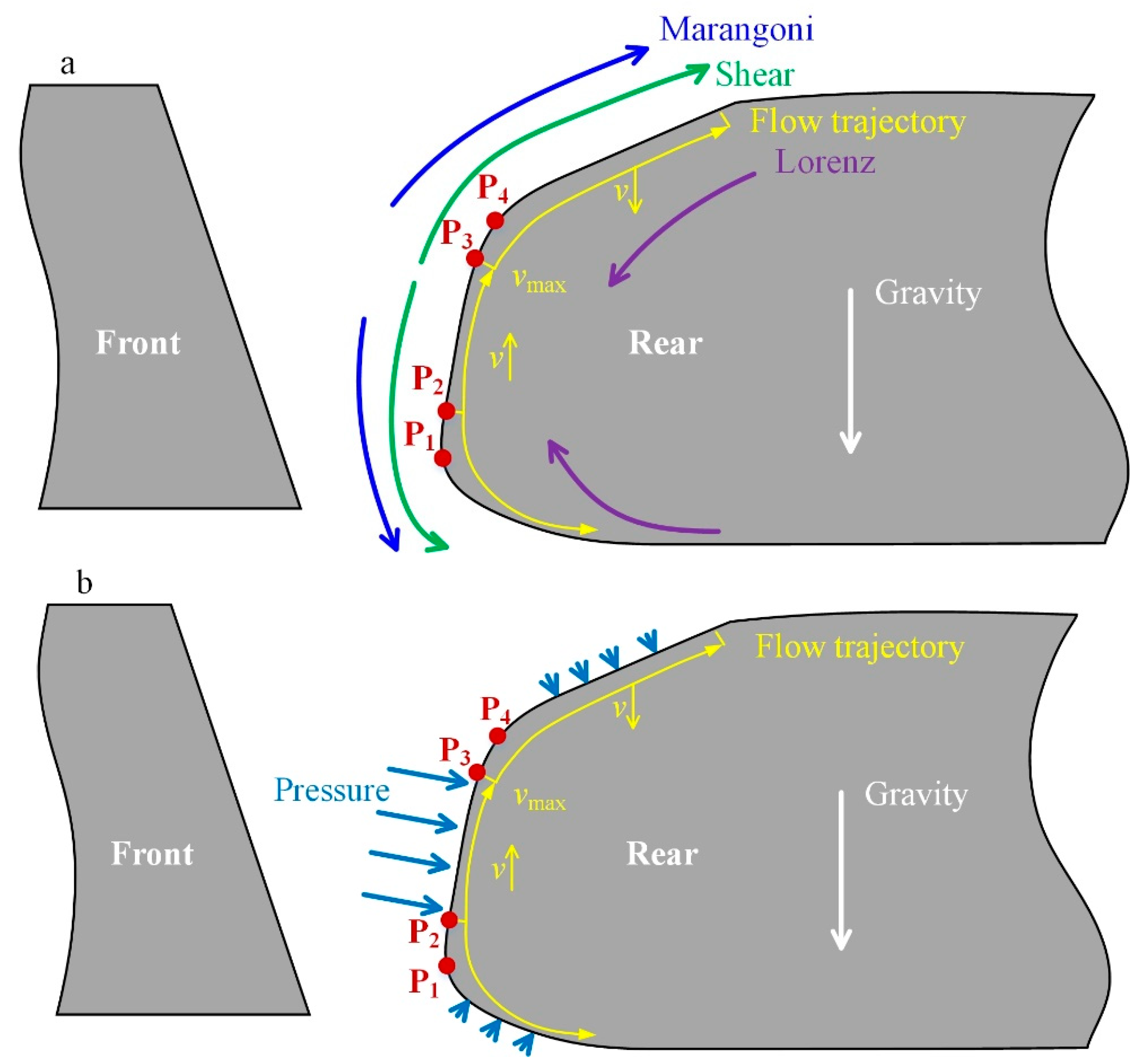
Figure 9 shows the wall shear on the keyhole boundary by plasma jet. The direction of the shear force on the wall of the keyhole corresponds entirely to the direction of arc plasma flow. As mentioned earlier, the metal flow on the rear wall of the keyhole (i.e., st3 and st6 in Figure 5) is crucial for determining whether welding is formed. Therefore, we primarily analyze the shear vector in this region. The separation point of the shear seems not to coincide with the metal bifurcation point (P2). This shear by arc plasma flow may not be the dominant factor for metal flow. The maximum shear is directed downward at the keyhole bottom, but the downward flow velocity of the metal (st6) is very small, which serves as additional evidence.
Additionally, the wall shear stress on most parts of the keyhole boundary is below 300 Pa. This value is one order of magnitude smaller than the peak normal pressure of 1.1–2.1 kPa acting on the second section (Figure 10). In the momentum equation along the rear wall, shear stress and pressure gradient both appear as driving terms. Therefore, our conclusion is not that such a level of shear stress can never drive metal flow, but rather that, in the present VPPA keyhole of aluminum alloy, its contribution is secondary compared with the pressure gradient. This is consistent with the numerical and experimental results: the maximum shear stress occurs near the keyhole bottom where the metal velocity along st6 is very small, whereas the upward acceleration of the rear-wall flow takes place in the second section between P2 and P3, where a strong pressure gradient is present but the shear stress is only moderate (Figure 9 and Figure 10).
The Marangoni force, arising from gradients of surface tension, is another tangential driving force that is widely considered in weld pool flow analyses. A rough estimate based on the calculated temperature gradient of order 107 K/m along the keyhole wall (Figure 8) and a typical surface-tension coefficient of order 10−4 N/(m·K) gives a characteristic Marangoni shear stress of order 103 Pa. This magnitude is comparable to, but does not greatly exceed, the pressure variations along the rear wall. In the present aluminum VPPA keyhole, the molten layer is thin and the temperature along the keyhole sidewall is relatively uniform, and no long-lived surface vortices—typical signatures of strong Marangoni convection—were observed in the X-ray measurements. Together with the numerical results, this suggests that Marangoni convection is not the primary mechanism controlling the rear-wall bifurcation under the present conditions, although it may still contribute locally to the flow and should not be completely neglected. A more rigorous treatment of Marangoni effects, including the influence of surface-active elements, will be addressed in future work.
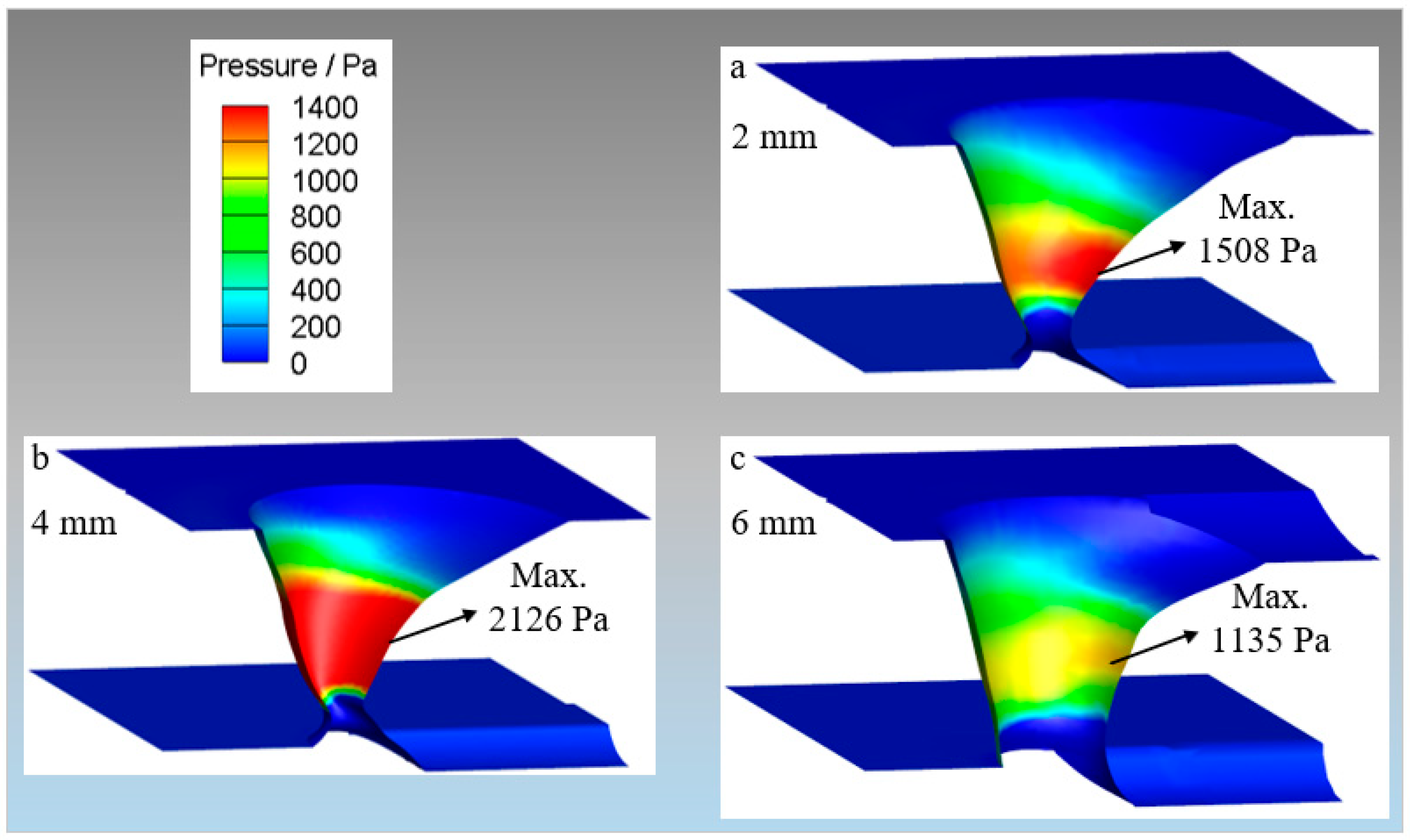
The metal in the molten pool can be driven to move if the pressure inside is uneven. The pressure at the gas–liquid boundary can transmit into the molten pool, thus affecting the liquid metal flow. Figure 10 shows the pressure on the keyhole boundary. There is a high-pressure zone at the lower half of the keyhole corresponding to the second section (between P1 and P4). This pressure drops to very low values in the first and third sections. This uneven pressure distribution causes the molten pool metal to be “pushed” by the high pressure in the middle toward the entrance and exit regions of the keyhole. When the tungsten electrode standoff distances are 2 mm, 4 mm, and 6 mm, the maximum pressures are 1508 Pa, 2126 Pa, and 1135 Pa, respectively, which are at a relatively high level in arc welding [35,36,37]. Although the keyhole boundary is fixed in this simulation, the gas–liquid interface can move freely in actual welding. When pressure transmits to the metal through the gas–liquid interface, the metal flows toward the top and bottom of the keyhole, while the newly melted metal at the front of the keyhole replenishes the high-pressure region at the rear wall in time. This allows the keyhole to maintain relatively stable forward movement.
The pressure is the highest when the tungsten electrode is 4 mm. The size of the bottom keyhole is not different from that at 2 mm, which may be because the axial characteristics of the arc do not change significantly. However, the inclination of the second section of the keyhole rear wall is smaller than that of 2 mm, allowing more arc plasma to flow into the central region, thereby increasing the pressure. The plasma arc becomes stiffer, and the flow velocity increases, causing the keyhole size to enlarge when the tungsten setback is 6 mm. The farther the keyhole boundary is from the arc center, the smaller the arc pressure on the boundary.
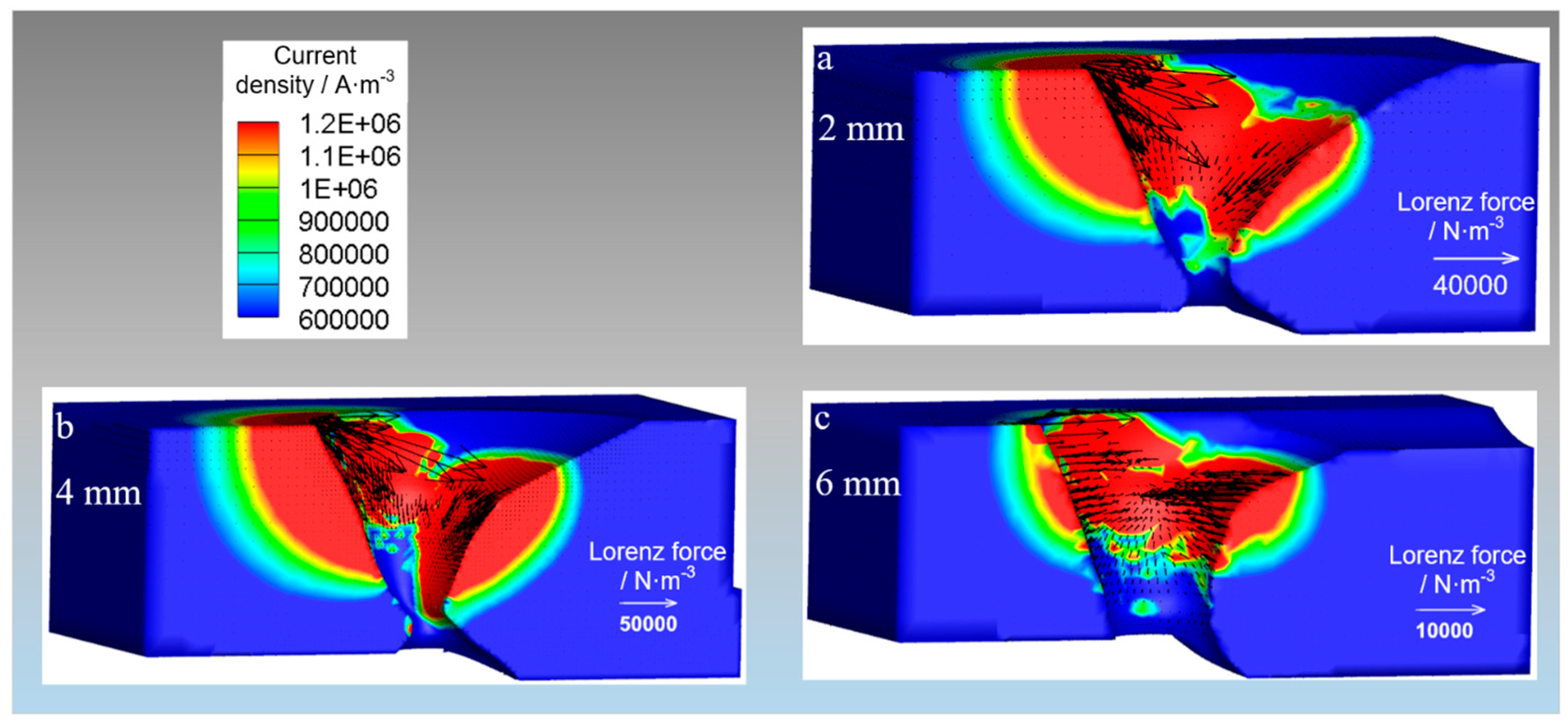
Figure 11 shows the current density distribution and Lorenz force vector diagram in the keyhole region. The Lorentz force is closely related to the magnitude and direction of the current density. The shape of the keyhole affects the current density distribution. When the tungsten setbacks are 2 mm and 4 mm, the keyhole exhibits a higher degree of inclination, allowing current to reach deeper into the keyhole. When it is 6 mm, the inclination of the keyhole walls decreases, becoming nearly vertical. In this case, the current density is mainly concentrated at the top of the keyhole, which is caused by the variation between the relative position of the keyhole wall and the tungsten electrode. A bigger inclination brings the bottom of the keyhole closer to the tungsten electrode, facilitating the flow of current more easily.
To evaluate the influence of the Lorentz force on the rear-wall flow, we treat J × B as a volumetric body force acting within the thin liquid layer along the keyhole wall and convert it into an equivalent surface traction. The tangential component along the rear-wall flow direction is given by
τ L ( s ) = 0 δ ( s ) ( J × B ) t ( s , z )   d z ( J × B ) t mean ( s )   δ ( s )
where s is the arc-length coordinate along the rear wall, z is the local normal coordinate and δ s is the local thickness of the molten layer. Using the current density and magnetic field distributions in Figure 11 and a melt-layer thickness of δ 0.5 1.0 mm, the maximum value of τ L is on the order of 10–50 Pa. This is more than one order of magnitude smaller than the normal pressure variation of 1–2 kPa, along the rear wall, indicating that the Lorentz force has only a minor effect on the molten metal flow compared with the pressure gradient and plasma-induced shear.
A force analysis schematic of the keyhole rear wall is shown in Figure 12 to summarize the driving factor for the metal flow. The upward flow consists of an acceleration phase from P2 to P3 and a deceleration phase after P3. Below point P2, the metal flows downward at a very slow speed. The acceleration distance of upward flow is short and only occurs within the second section. Although both shear forces have upward and downward components, during this acceleration phase of the metal, the direction of the shear force does not seem to correspond exactly to it. The values of the shears are both too low to be the primary driving forces of the metal flow. The Lorentz force opposes the flow direction and has an even smaller magnitude, making its effect on molten pool metal flow weaker.
The pressure acting in the normal direction is unevenly distributed along the keyhole boundary, with higher pressure in the second section and lower pressure in the first and third sections. This pressure distribution generates thrust toward the top and bottom. And its value is relatively high. The pressure distribution corresponds to the shape of the keyhole boundary, where the high-pressure region reduces the inclination of the middle section of the keyhole. According to the fluid momentum equation, changes in pressure generate fluid acceleration, driving metal flow. Therefore, the pressure gradient may be the key force influencing flow in variable polarity plasma arc keyhole welding of aluminum alloys. This agrees with the previous speculation based on experimental data [18,20].
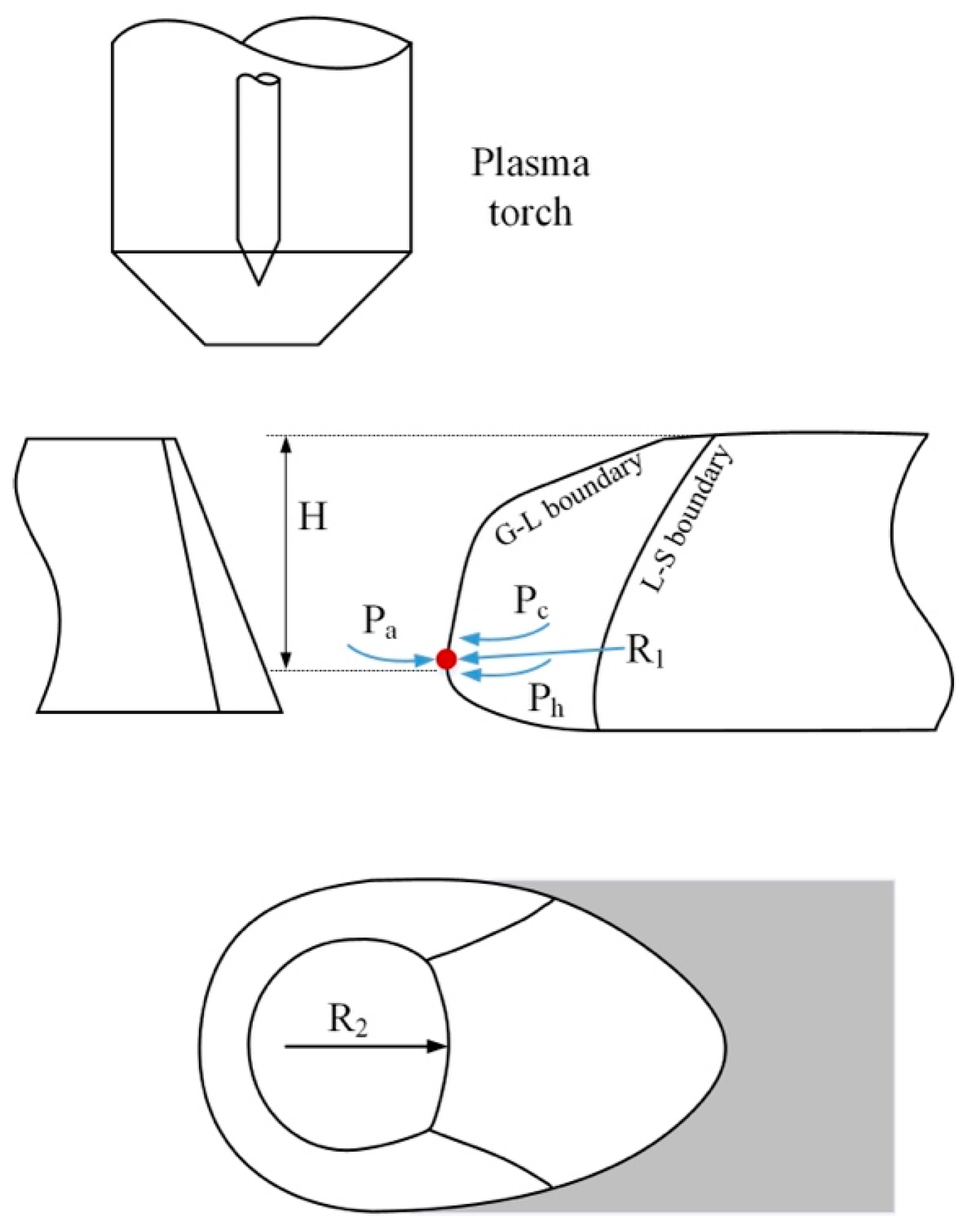
The most salient feature of the keyhole molten pool in aluminum alloy is that the metal melted at the front wall circulates around the sidewalls and flows into the rear molten pool. The front and side both have very thin liquid [20,38]. Both the front wall and sidewalls are very thin. The rear wall is divided into three sections. The geometric boundary point near the bottom of the keyhole is close to or coincides with the bifurcation point. This keyhole boundary changes as the arc intensity increases. The location of the bifurcation point on the rear keyhole wall is very important for the welding stability, which is similar to the high-current GTA welding process. As shown in Figure 13, Mendez et al. [39,40] showed that the position of this transition point in high-current GTA welding is governed by a local balance between arc pressure, hydrostatic pressure, and capillary forces acting on the liquid surface. Following this approach, and in line with the analysis of plasma keyhole welding by Wu et al. [26], the location of the rear-wall bifurcation point P 2 in the present, the VPPA keyhole is determined by the following force balance:
p a r c ( P 2 ) + p h ( P 2 ) = p 0 + p σ ( P 2 ) ,
where p a r c is the local arc pressure acting normal to the keyhole wall, p h = ρ g h c o s α is the hydrostatic pressure component along the rear-wall normal direction at a depth h , ρ is the density of the molten aluminum alloy, g is the gravitational acceleration, p 0 is the ambient pressure inside the keyhole, and p σ = 2 γ / R is the capillary pressure associated with surface tension, with γ the surface-tension coefficient and R the local radius of curvature of the keyhole surface. The angle α denotes the inclination of the rear-wall segment with respect to the horizontal.
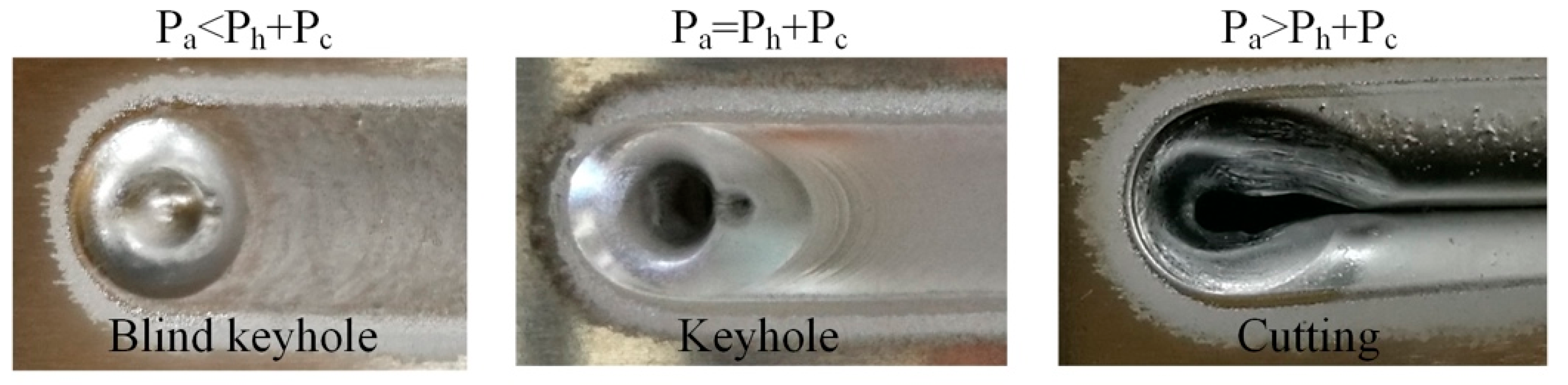
The formation mechanism of hump defects in high-current welding has been well explained by calculating the stable location of the transport point using this equation. The stability of plasma arc welding in this work can also be similarly understood through this theory. As Figure 14 shows, a blind keyhole is formed when the arc pressure is always less than the sum of the other two. Cutting occurs if the arc pressure is much greater. The keyhole can keep stable even when there are some disturbances when the arc pressure is equal to the others. The position of this point in three-dimensional space is influenced by complex plasma arc process parameters, which require detailed experimental research in the future.
It should be emphasized that polarity switching is a fundamental feature of VPPA welding. Our recent AC TIG/X-ray study on aluminum alloys [31] showed that the Marangoni force is actually larger in the EN phase, owing to a higher temperature gradient, whereas the molten pool velocity is higher in the EP phase. This indicates that, for aluminum alloys, Marangoni convection is not the dominant driving mechanism and that arc-induced pressure and cathode-spot-related forces play a more important role. In the present VPPA keyhole case, the pressure distributions used in the model can be regarded as effective, time-averaged fields resulting from the EP/EN cycle. The dual-bifurcation structure observed in the X-ray flow trajectories does not reverse within the cycle, suggesting that the effective arc pressure field, rather than the Marangoni force, controls the rear-wall bifurcation under the investigated conditions. A fully time-resolved analysis of the EP and EN phases and their instantaneous pressure and flow fields will be carried out in future work based on the present modeling framework.
From an engineering viewpoint, the proposed dual-bifurcation flow model provides a physical basis for interpreting weld quality in VPPA keyhole welding. The high-pressure middle section of the rear wall, where the rear-wall flow bifurcation point P2–P3 is located, is the critical zone that controls whether the process results in a blind keyhole, a stable keyhole, or cutting. If the inclination angle of this section becomes too small, the molten metal tends to collapse downward along the rear wall, promoting cutting, whereas an excessively large angle favors premature closure of the keyhole and incomplete penetration. Process parameters that strongly influence the rear-wall geometry and arc-pressure distribution—such as welding current, travel speed, shielding gas flow rate, and, indirectly, the polarity balance—should therefore be adjusted to maintain a favorable rear-wall shape and pressure gradient in this region. In addition, the sidewall transfer channel identified by the model represents the main path by which molten metal feeds the weld seam, which is relevant for understanding lack-of-fusion and underfill defects.


4. Conclusions

This study combines in situ X-ray observation and numerical simulation to clarify the relationship between keyhole boundary morphology, molten pool flow, and driving forces in variable polarity plasma arc (VPPA) keyhole welding of aluminum alloy. The main conclusions are as follows:
(1) This work establishes a dual-bifurcation flow model consisting of the front-wall and rear-wall stagnation points of the keyhole to characterize the molten pool flow behavior in aluminum alloy plasma arc keyhole welding. The rear-wall stagnation points exhibit more complex flow characteristics, significantly affecting welding stability. The sidewall region of the keyhole serves as a transfer channel, directing newly melted metal to the rear-wall region, where it solidifies to form the weld seam. Most of the molten metal flows towards the keyhole entrance, without forming complex vortices. This dual-bifurcation flow model refines the traditional single stagnation/transport point descriptions by explicitly resolving the front- and rear-wall flow splitting in the thin liquid layer and linking them to the keyhole geometry and force balance in VPPA keyhole welding.
(2) After flowing around the keyhole bottom into the rear region, the molten metal splits and solidifies upwards and downwards to form the central weld bead, making this region critical for keyhole closure or cutting. The rear wall can be divided into three sections; the middle section corresponds to a high-pressure zone that controls the keyhole state. A larger inclination angle of this section promotes keyhole closure, whereas an excessively small angle causes downward collapse of the molten pool and may lead to cutting.
(3) Numerical calculations reveal the distribution of driving forces along the keyhole wall. The thickness-direction pressure difference induced by the arc plasma has a much stronger effect on the rear-wall molten metal flow than the shear stress caused by the plasma jet, which differs from plasma arc welding of stainless steel. Possible additional influences, such as polarity-dependent arc characteristics and cathode spots, remain to be investigated in future work. Although the present work focuses on the fundamental flow and force mechanisms, the dual-bifurcation model and the identification of the critical rear-wall region provide a physical framework that can be used in future studies to design weld quality control strategies and to guide process parameter optimization for VPPA keyhole welding of aluminum alloys.
(4) It should be noted that the numerical model in this work is calibrated for a specific set of welding parameters (tungsten setback, shielding gas flow rate, and polarity switching mode) corresponding to a stable VPPA keyhole. The influence of these parameters on the keyhole geometry, force balance, and flow topology is not explored in a systematic way here. Preliminary tests indicate that small variations in the rear-wall contour within the experimental fluctuation range do not change the qualitative structure of the dual-bifurcation flow or the dominance of the pressure-driven component in the P2–P3 region. A comprehensive parametric study on the effects of tungsten setback, gas flow rate, and polarity will be carried out in future work based on the present experimentally constrained modeling framework. A systematic and quantitative optimization of the process parameters based on this model would require an extended parametric study under industrially relevant conditions and will be addressed in future work.

Author Contributions

Conceptualization, B.X. (Boyu Xiao) and F.J.; methodology, S.T., M.T. and S.C.; validation, Y.H., G.L. and Z.S.; formal analysis, B.X. (Boyu Xiao); investigation, Y.H., G.L. and Z.S.; resources, B.X. (Bin Xu) and S.C.; data curation, B.X. (Boyu Xiao); writing—original draft preparation, B.X. (Boyu Xiao); writing—review and editing, B.X. (Bin Xu); supervision, S.C.; funding acquisition, B.X. (Bin Xu), F.J. and S.C. All authors have read and agreed to the published version of the manuscript.

Funding

The authors are grateful to the financial support for this research from the National Natural Science Foundation of China (Grant No. 52275302), National Natural Science Foundation of China (Grant No. 52375301, and Grant No. 52322508).

Data Availability Statement

The raw data supporting the conclusions of this article will be made available by the authors on request.

Acknowledgments

During the preparation of this manuscript, the authors used the Chatgpt5.0 for the purposes of translating content from Chinese to English. All authors have reviewed and edited the output and take full responsibility for the content of this publication.

Conflicts of Interest

The authors have no conflicts to disclose.

References

  1. Samal, S. Thermal plasma technology: The prospective future in material processing. J. Clean. Prod. 2017, 142, 3131–3150. [Google Scholar] [CrossRef]
  2. Qi, B.J.; Cai, L.W. Research status of control measures for aluminum alloy arc additive manufacturing. Trans. China Weld. Inst. 2024, 2024, 1–13. [Google Scholar]
  3. Debroy, T.; Wei, H.L.; Zuback, J.S.; Mukherjee, T.; Elmer, K.W.; Milewski, J.O.; Beese, A.M.; Wilson-Heid, A.; De, A.; Zhang, W. Additive manufacturing of metallic components–Process, structure and properties. Prog. Mater. Sci. 2018, 92, 112–224. [Google Scholar] [CrossRef]
  4. Cooke, S.; Ahmadi, K.; Willerth, S.; Herring, R. Metal additive manufacturing: Technology, metallurgy and modelling. J. Manuf. Process. 2020, 57, 978–1003. [Google Scholar] [CrossRef]
  5. Prasad, K.S.; Rao, C.S.; Rao, N. Advances in Plasma Arc Welding: A review. J. Mech. Eng. Technol. 2012, 4, 35–59. [Google Scholar]
  6. Murphy, A.B. A perspective on arc welding research: The importance of the arc, unresolved questions and future directions. Plasma Chem. Plasma Process. 2015, 35, 471–489. [Google Scholar] [CrossRef]
  7. Zhang, J.X.; Gan, S.M.; Liu, H.Y. A review of arc stability analysis methods for aluminum alloy welding. In Journal of Physics: Conference Series; IOP Publishing: Bristol, UK, 2023; Volume 2419, No. 1. [Google Scholar]
  8. Huo, Y.S.; Wu, C.S.; Chen, M.A. Numerical Simulation of Keyhole Shape and Transformation From Partial to Open States in Plasma Arc Welding. Acta Metall. Sin. 2011, 47, 704–710. [Google Scholar]
  9. Zhang, Q.L.; Yang, C.L.; Lin, S.B.; Sun, S.X.; Li, Z.H.; Liu, Z.; Jiang, Y.K.; Liu, J.; Ma, J.B. Research on Novel Soft Variable Polarity Plasma Arc Welding Technology for Aluminum Alloys in Horizontal Position. J. Mech. Eng. 2015, 51, 75–81. [Google Scholar] [CrossRef]
  10. Wang, X.J.; Wu, C.S.; Chen, M.A. Numerical Simulation of Weld Pool Keyholing Process in Stationary Plasma Arc Welding. Acta Metall. Sin. 2010, 46, 984–990. [Google Scholar]
  11. Qiu, T.; Li, T.Q.; Chen, C.X.; Wang, H.; Chen, L. Process control based on double-side image sensing of the keyhole in VPPA welding. J. Netshape Form. Eng. 2023, 15, 178–190. [Google Scholar]
  12. Bao, W.; Yang, L.; Liu, H.B.; Wang, F.; Du, J.H. Progress in Numerical Simulation of Plasma Arc Welding. Mech. Sci. Technol. Aerosp. Eng. 2025, 44, 913–919. [Google Scholar]
  13. Liu, Z.M.; Wu, C.S.; Liu, Y.K.; Luo, Z. Keyhole behaviors influence weld defects in plasma arc welding process. Weld. J. 2015, 94, 281s–290s. [Google Scholar]
  14. Zhang, G.; Wu, C.S.; Liu, Z. Experimental observation of both keyhole and its surrounding thermal field in plasma arc welding. Int. J. Heat Mass Transf. 2014, 70, 439–448. [Google Scholar] [CrossRef]
  15. Zhang, Y.M.; Zhang, S.B.; Liu, Y.C. A plasma cloud charge sensor for pulse keyhole process control Related content Keyhole arc welding. Meas. Sci. Technol. 2001, 12, 1365. [Google Scholar] [CrossRef]
  16. Zhou, W.L.; Jia, C.B.; Zhou, F.Z.; Wu, C.S. Dynamic evolution of keyhole and weld pool throughout the thickness during keyhole plasma arc welding. J. Mater. Process. Technol. 2023, 322, 118206. [Google Scholar] [CrossRef]
  17. Mugada, K.K.; Adepu, K. Influence of ridges shoulder with polygonal pins on material flow and friction stir weld characteristics of 6082 aluminum alloy. J. Manuf. Process. 2018, 32, 625–634. [Google Scholar] [CrossRef]
  18. Lu, H.; Xing, J.W.; Xing, L.W.; Ling, Z.M. Arc morphology and weld pool flowing in A-MAG welding process. Trabsactions China Weld. Inst. 2014, 35, 41–44. [Google Scholar]
  19. Xu, B.; Tashiro, S.; Tanaka, M.; Jiang, F.; Chen, S. Physical mechanisms of fluid flow and joint inhomogeneity in variable-polarity plasma arc welding of thick aluminum alloy plates. Phys. Fluids 2021, 33, 087103. [Google Scholar] [CrossRef]
  20. Xu, B.; Chen, S.; Tashiro, S.; Jiang, F.; Tanaka, M. Physical mechanism of material flow in variable polarity plasma arc keyhole welding revealed by in situ x-ray imaging. Phys. Fluids 2021, 33, 017121. [Google Scholar] [CrossRef]
  21. Wu, C.S.; Wang, L.; Ren, W.J.; Zhang, X.Y. Plasma arc welding: Process, sensing, control and modeling. J. Manuf. Process. 2014, 16, 74–85. [Google Scholar] [CrossRef]
  22. Wu, C.S.; Hu, Q.X.; Gao, J.Q. An adaptive heat source model for finite-element analysis of keyhole plasma arc welding. Comput. Mater. Sci. 2009, 46, 167–172. [Google Scholar] [CrossRef]
  23. Wu, C.S.; Wang, H.G.; Zhang, Y.M. A New Heat Source Model for Keyhole Plasma Arc Welding in FEM Analysis of the Temperature Profile. Weld. J. 2006, 85, 284-s–291-s. [Google Scholar]
  24. Huo, Y.; Wu, C. Determining the keyhole geometry based on double-elliptic distribution of plasma arc pressure. China Weld. 2009, 18, 12–15. [Google Scholar]
  25. Wu, C.S.; Zhang, T.; Feng, Y.H. Numerical analysis of the heat and fluid flow in a weld pool with a dynamic keyhole. Int. J. Heat Fluid Flow 2013, 40, 186–197. [Google Scholar] [CrossRef]
  26. Jian, X.; Wu, C.S.; Zhang, G.; Chen, J. A unified 3D model for an interaction mechanism of the plasma arc, weld pool and keyhole in plasma arc welding. J. Phys. D Appl. Phys. 2015, 48, 465504. [Google Scholar] [CrossRef]
  27. Li, T.Q.; Wu, C.S.; Chen, J. Transient variation of arc heat flux and pressure distribution on keyhole wall in PAW. Weld. World 2016, 60, 363–371. [Google Scholar] [CrossRef]
  28. Li, T.Q.; Chen, L.; Zhang, Y.; Yang, X.M.; Lei, C. Metal flow of weld pool and keyhole evolution in gas focusing plasma arc welding. J. Heat Mass Transf. 2020, 150, 119296. [Google Scholar] [CrossRef]
  29. Jian, X.; Wu, C.S. Numerical analysis of the coupled arc–weld pool–keyhole behaviors in stationary plasma arc welding. J. Heat Mass Transf. 2015, 84, 839–847. [Google Scholar] [CrossRef]
  30. Li, Y.; Su, C.; Zhou, X.; Wu, C.S. A more precise unified model to describe comprehensive multiphysics and multiphase phenomena in plasma arc welding. J. Manuf. Process. 2020, 59, 668–678. [Google Scholar] [CrossRef]
  31. Xu, B.; Zhang, C.; Zhang, G.; Jing, F.; Tashiro, S.; Tanaka, M.; Chen, S. Metal flow mechanisms during alternating current arc welding and additive manufacturing of aluminium alloy. Commun. Mater. 2025, 6, 94. [Google Scholar] [CrossRef]
  32. Wang, L.; Wu, C.; Chen, J.; Gao, J. Experimental measurement of fluid flow in high-speed GMAW assisted by transverse magnetic field. J. Manuf. Process. 2020, 56, 1193–1200. [Google Scholar] [CrossRef]
  33. Aucott, L.; Dong, H.; Mirihanage, W.; Atwood, R.; Kidess, A.; Gao, S.; Wen, S.; Marsden, J.; Feng, S.; Tong, M.; et al. Revealing internal flow behaviour in arc welding and additive manufacturing of metals. Nat. Commun. 2018, 9, 5414. [Google Scholar] [CrossRef] [PubMed]
  34. Liu, J.; Jiang, F.; Tashiro, S.; Chen, S.; Tanaka, M.; Zhang, C.; Xu, B.; Zhang, G. The mechanism of dual-stagnation points flow phenomenon in keyhole plasma arc melt pool and corresponding control strategy. J. Manuf. Process. 2024, 125, 473–488. [Google Scholar] [CrossRef]
  35. Fan, H.G.; Shi, Y.W. Numerical Simulation of the Arc Pressure in Gas Tungsten Arc Welding. J. Mater. Process. Technol. 1996, 61, 302–308. [Google Scholar] [CrossRef]
  36. Yin, F.; Hu, S.; Yu, C.; Li, L. Computational simulation for the constricted flow of argon plasma arc. Comput. Mater. Sci. 2007, 40, 389–394. [Google Scholar] [CrossRef]
  37. Campbell, S.W.; Galloway, A.M.; Mcpherson, N.A. Arc pressure and weld metal fluid flow while using alternating shielding gases. Part 1: Arc pressure measurement. Sci. Technol. Weld. Join. 2013, 18, 591–596. [Google Scholar] [CrossRef]
  38. Zhang, Q.L.; Yang, C.L.; Lin, S.B.; Fan, C.L. Soft variable polarity plasma arc horizontal welding technology and weld asymmetry. Sci. Technol. Weld. Join. 2015, 20, 297–306. [Google Scholar] [CrossRef]
  39. Mendez, P.F.; Niece, K.L.; Eagar, T.W. Humping Formation in High Current GTA Welding. In International Conference on Joining of Advanced and Speciality Materials II; ASM International: Cincinnati, OH, USA, 1999. [Google Scholar]
  40. Mendez, P.F.; Eager, T.W. Penetration and Defect Formation in High-Current Arc Welding. Weld. J. 2003, 82, 296–306. [Google Scholar]
Figure 1. X-ray observation system and the schematic.
Crystals 16 00003 g001
Figure 2. Image from two different detectors.
Crystals 16 00003 g002
Figure 3. The calculation domain and boundary condition.
Crystals 16 00003 g003
Figure 4. Three-dimensional trajectories of tungsten tracer particles in the keyhole molten pool obtained by X-ray imaging. (ac) 2 mm tungsten electrode setback. (df) 4 mm tungsten electrode setback. (gi) 6 mm tungsten electrode setback. FSP: Front Stationary Point, RSP: Rear Stationary Point.
Crystals 16 00003 g004
Figure 5. Schematic of dual-bifurcation model of the keyhole molten pool, st: streamline.
Crystals 16 00003 g005
Figure 6. The typical streamlines and the flow velocity (a) 6 typical streamlines with 2 mm tungsten setback, (b) Velocity on the streamlines of 2 mm tungsten setback, (c) 5 typical streamlines with 4 mm tungsten setback, (d) Velocity on the streamlines of 4 mm tungsten setback, (e) 4 typical streamlines with 6 mm tungsten setback, (f) Velocity on the streamlines of 6 mm tungsten setback.
Crystals 16 00003 g006aCrystals 16 00003 g006b
Figure 7. Velocity vectors along the keyhole wall obtained from the numerical simulation, (ac) Tungsten electrode setbacks 2 mm, 4 mm, and 6 mm, FS: Front Side, RS: Rear Side.
Crystals 16 00003 g007
Figure 8. Pressure distribution on the keyhole wall obtained from the numerical simulation. (ac), 2 mm, 4 mm, and 6 mm.
Crystals 16 00003 g008
Figure 9. Wall shear stress distribution on the keyhole wall obtained from the numerical simulation. (ac), 2 mm, 4 mm, and 6 mm.
Crystals 16 00003 g009
Figure 10. Distribution of the Lorentz force along the keyhole wall obtained from the numerical simulation, (a) 2mm, (b) 4 mm, (c) 6 mm.
Crystals 16 00003 g010
Figure 11. Current density distribution and Lorenz force vector in the keyhole region with different tungsten setback (a) 2 mm, (b) 4 mm, (c) 6 mm.
Crystals 16 00003 g011
Figure 12. Schematic diagram of molten pool rear wall metal flow and its driving force direction (a) tangential force, (b) normal force.
Crystals 16 00003 g012
Figure 13. Analysis of the force balance on the bifurcation point of the keyhole rear wall [39,40].
Crystals 16 00003 g013
Figure 14. Morphology of the keyhole under different force states.
Crystals 16 00003 g014
Table 1. Calculation condition.
Welding CurrentPlasma Gas Flow RateShielding Gas Flow RateStandoffTungsten Electrode Setback
200 AAr: 2.0 L/minAr: 10 L/min4 mm2/4/6 mm
Disclaimer/Publisher’s Note: The statements, opinions and data contained in all publications are solely those of the individual author(s) and contributor(s) and not of MDPI and/or the editor(s). MDPI and/or the editor(s) disclaim responsibility for any injury to people or property resulting from any ideas, methods, instructions or products referred to in the content.