
Article

Electrodeposition of Copper–Nickel Foams: From Separate Phases to Solid Solution
by
Eduard E. Levin
1,2,*,
Victoria P. Chertkova
1 and
Natalia A. Arkharova
2
1
Department of Chemistry, Lomonosov Moscow State University, 119991 Moscow, Russia
2
Shubnikov Institute of Crystallography of the Kurchatov Complex Crystallography and Photonics of the NRC “Kurchatov Institute”, Leninsky Prospect 59, 119333 Moscow, Russia
*
Author to whom correspondence should be addressed.
Crystals 2026, 16(1), 20; https://doi.org/10.3390/cryst16010020 (registering DOI)
Submission received: 7 December 2025 / Revised: 20 December 2025 / Accepted: 25 December 2025 / Published: 27 December 2025
(This article belongs to the Section Crystalline Metals and Alloys)

Abstract

Copper-based electrocatalytic materials with high surface area are essential for various processes, such as water splitting and the electroreduction of carbon dioxide and nitrates. Three-dimensional nanostructured electrodes offer distinct advantages in these applications due to their expansive surface area, which enhances charge transfer and mass transport. For bimetallic systems, however, the phase state, whether a solid solution or a mechanical mixture of metals, is critically important for catalytic performance. This study explores the formation of Cu-Ni solid solutions via electrodeposition using the dynamic hydrogen bubble template method. Two types of electrolyte were employed: sulfate-based and citrate-based. Through characterization by X-ray diffraction, scanning electron microscopy, elemental mapping, and X-ray fluorescence spectroscopy, we demonstrate that metallic foams deposited from sulfate solutions are heterogeneous, with poor control over nickel content. In contrast, the use of citrate-based solutions allows the nickel content in the deposits to be effectively controlled by varying the solution composition, thereby enabling the formation of a solid solution.

1. Introduction

Electrodeposition is a versatile and cost-effective method for synthesizing nanoparticles with diverse morphologies [1,2]. This technique is particularly advantageous for producing high-performance electrocatalysts, crucial components in energy conversion systems such as electrolyzers and fuel cells [3,4,5]. It enables straightforward control over the amount, size, and shape of the deposits by varying electroplating parameters, including (but not limited to) deposition time, overpotential, bath composition, and temperature. The method is widely used to fabricate highly dispersed and faceted bimetallic alloy materials, which serve extensively as electrocatalysts in processes such as water splitting [6,7,8,9,10,11], oxygen reduction and hydrogen oxidation [12,13,14,15,16], as well as carbon dioxide [17,18,19,20,21] and nitrate [22,23] reduction reactions. Typically, electrodeposition occurs under conditions far from equilibrium, promoting the formation of finely dispersed materials. Consequently, the phase distributions in electrodeposited alloys can differ significantly from those in thermally equilibrated (recrystallized) alloys [24].
For instance, even in binary metallic systems exhibiting complete miscibility, such as copper–nickel [25], the resulting highly dispersed deposits frequently form phase mixtures rather than pure solid solutions [22,23,26,27,28,29,30]. While thermal annealing is a common method to achieve alloy equilibration, it typically leads to nanoparticle coarsening and a consequent reduction in the electrochemically active surface area—a critical parameter for effective electrocatalytic coatings. Furthermore, electrocatalytic activity is governed by the specific atomic arrangement of alloy atoms on the surface. Significant differences in activity and selectivity have been observed between single-phase and phase-separated alloy nanoparticles [31,32,33]. Consequently, identifying the necessary conditions to produce well-mixed, single-phase, and highly dispersed electrocatalytic coatings is essential.
Copper–nickel is a notable binary alloy characterized by the complete miscibility of its constituent elements, and it has been widely utilized in electrocatalytic research, particularly for nitrate [22,34] and CO2 [35,36] reduction reactions. However, well-mixed copper–nickel solid solutions are rarely achieved via electrodeposition. For instance, preparing Cu-Ni alloys in dendritic form from aqueous chloride solutions at a high current density of 2 A·cm−2 has resulted in a mixture of alloy and distinct nickel phases [26]. Analysis of X-ray diffraction data for foam-type Cu-Ni materials electrodeposited at 3 A·cm−2 from mildly acidic sulfate baths also suggests the coexistence of individual phases alongside the target alloy [22]. Furthermore, electrodeposition from acidic sulfate baths using a pulsed regime with surfactants has yielded phase-separated deposits [27]. This observation is consistent with previous studies [29] where multiphase Cu-Ni metallic foams were produced under constant current conditions from similar electrolytes. Other reports further underscore the general challenge of obtaining true solid solutions in dispersed electrodeposited Cu-Ni materials [23,28,30].
In this study, we aim to address the existing knowledge gap concerning the specific conditions that facilitate the formation of Cu-Ni solid solutions. We present a comparative analysis of deposits obtained from two contrasting solutions, a simple salt electrolyte and a complex one, using X-ray diffraction, scanning electron microscopy, and compositional mapping. Furthermore, we explore various electrodeposition parameters, such as current application mode and electrolyte agitation, to correlate their effects on both the phase and chemical composition of the Cu-Ni metallic foams.

2. Materials and Methods

2.1. Electrodeposition

Copper–nickel foam samples were obtained via electrodeposition in a two-electrode configuration, operating under either constant or intermittent current modes. The electrodeposition was performed using four distinct solutions:
  • 75 mM CuSO4 (puriss., Component-Reaktiv, Moscow, Russia), 200 mM NiSO4 (puriss., Component-Reaktiv, Moscow, Russia), 50 mM KCl (puriss. spec., Component-Reaktiv, Moscow, Russia), 0.5 M H2SO4 (puriss. spec., Component-Reaktiv, Moscow, Russia), 30 g·L−1 H3BO3 (puriss. spec., Component-Reaktiv, Moscow, Russia);
  • 0.3 M sodium citrate (puriss., Component-Reaktiv, Moscow, Russia), 1 M (NH4)2SO4 (p.a., Component-Reaktiv, Moscow, Russia), 80 mM CuSO4, 175 mM NiSO4;
  • 0.3 M sodium citrate, 1 M (NH4)2SO4, 125 mM CuSO4, 125 mM NiSO4;
  • 0.3 M sodium citrate, 1 M (NH4)2SO4, 175 mM CuSO4, 80 mM NiSO4.
The compositions of the solutions were adapted from formulations reported in Refs. [22,37,38]. Solution 1 was prepared by dissolving the reagents in a minimum required water quantity, followed by adjusting volume in a volumetric flask. Solutions 2–4 were made dissolving Cu and Ni sulfates in a solution containing sodium citrate followed by dissolution of the rest of the reagents and volume adjustment in a volumetric flask. While Solution 1 had a pH of 0.5, the pH of solutions 3 and 4 was adjusted to 4.3 using a 50 wt.% NaOH (puriss. spec., Component-Reaktiv, Moscow, Russia) solution to match the natural pH of the as-prepared Solution 2. This adjustment minimized the number of variables during electrodeposition from the citrate-based electrolytes. A pH above 4 is generally required for stable operation of the deposition electrolyte. Moreover, when accounting for cathodic alkalinization, stable deposition can be maintained up to at least pH 6, particularly at relatively low current densities [39].
Electrodeposition was carried out in a rectangular PTFE vessel containing approximately 50 mL of the electroplating solution. The dimensions of the vessel were 100 × 18 × 35 mm (Length × Width × Height, respectively). The vessel was refilled after every two or three depositions to avoid significant changes in its composition and thereby minimize the influence of this variable on the final foam structure. A copper foil of 99.96% purity (0.3 mm thick, with an exposed area of 1 cm2) served as the working electrode, while a sacrificial anode was made from a 99.99% pure copper foil (1 mm thick, area 1.5–2 cm2). The electrodes were fixed at a distance of 2 cm using a custom PTFE electrode holder. Prior to deposition, the working electrode surface was pretreated by etching in hot H2SO4 solution (195 g·L−1, 60 °C) for 10–15 s to remove the oxide film. The electrode was then rinsed with water, dried, and activated in a separate H2SO4 solution (17.5 g·L−1, room temperature) for 1–3 s. Electrodeposition was performed at current densities ranging from 1 to 3 A·cm−2, with the total deposition charge maintained at 90 C·cm−2. In intermittent current mode, a pulse time of 1 s was followed by a 2 s pause. Current was supplied by a PC-controlled RuiDeng Riden RD6012P DC power source. For selected experiments, the electrolyte was vigorously stirred using a compact RS Electrical RS-248A (Zhongshan Risheng Electrical Products Co., Ltd., Guangdong, China) air compressor; air flow was approximately 300 mL·min−1. After deposition, the samples were rinsed with 300–350 mL of deionized water applied as a fine mist and then dried in a DOF-43H (Actan Vacuum, Moscow, Russia) vacuum oven (70 °C, 0.07 bar) for 30 min.

2.2. Copper–Nickel Foam Characterization

X-ray diffraction (XRD) patterns of the foams were collected using a Rigaku Miniflex 600 (Rigaku Holdings Corporation, Tokyo, Japan) diffractometer (Bragg–Brentano geometry, CuKα radiation, D/teX Ultra detector) over a 2θ range of 25° to 100°. To prepare samples for XRD, foam particle suspensions were created by ultrasonication: a foam-coated foil was placed in a glass beaker with isopropanol, and the resulting suspension was drop-cast onto the backside of a standard glass holder. Full-profile analysis of the XRD patterns from these detached samples was performed to determine unit cell parameters and the relative phase content, using the Rietveld method [40,41] as implemented in the DDM v. 1.95e software package [42,43]. Scanning electron microscopy (SEM) was conducted using two instruments: an FEI Scios (FEI Company, Hillsboro, OR, USA) (Schottky field emission gun, Everhart–Thornley detector with positive bias, and in-lens secondary electron detector, landing energy 1–2 kV) and a JEOL JSM-6490 LV (JEOL, Ltd., Tokyo, Japan) (tungsten hairpin gun, Everhart–Thornley detector with positive bias, accelerating voltage 30 kV) scanning electron microscopes. Image contrast was enhanced by applying the contrast-limited adaptive histogram equalization (CLAHE) algorithm [43], and element distribution maps were smoothed using a Gaussian blur with a 0.5-pixel radius to reduce noise. All image processing was performed with the Fiji v. 1.54f software package [44], adhering to ethical processing guidelines to avoid distortion of the microscopic data [45]. Energy-dispersive X-ray microanalysis (EDXM) was performed using an INCA X-sight (Oxford Instruments plc, Abingdon, England) energy-dispersive X-ray spectrometer. Quantitative processing of the EDS data employed a standardless approach within the Microanalysis Suite software v. 17b (Oxford Instruments plc, Abingdon, England). For cross-sectional analysis, deposits on copper foil were sectioned using a Leica EM TXP (Leica Microsystems GmbH, Wetziar, Germany) target preparation device and then polished by Ar+ ion milling with a Hitachi IM4000Plus ion milling system (acceleration voltage 5 kV, ion current 1 mA). Composition mapping of the cross-sections was performed at 20 kV using an EDAX Octane Super Elect EDX spectrometer (AMETEK, Inc., Berwyn, PA, USA), with visualization in the EDAX Apex v. 2.1 software package. Finally, compositional analysis via energy-dispersive X-ray fluorescence (ED-XRF) was conducted using an EDAX Orbis PC spectrometer (AMETEK, Inc., Berwyn, PA, USA). Specimens were prepared similarly to the XRD procedure. Spectra were collected using a 1 mm collimator with the tube operating at 30 kV and 400 μA, under a chamber pressure of 6.6 × 10⁻⁴ bar. Composition was calculated using a standardless approach in the EDAX VisionPlus V.1.00 software package.

3. Results and Discussion

3.1. Structure, Morphology and Composition of Copper–Nickel Foams: Solution 1 (Complex Agent Free, Sulfate)

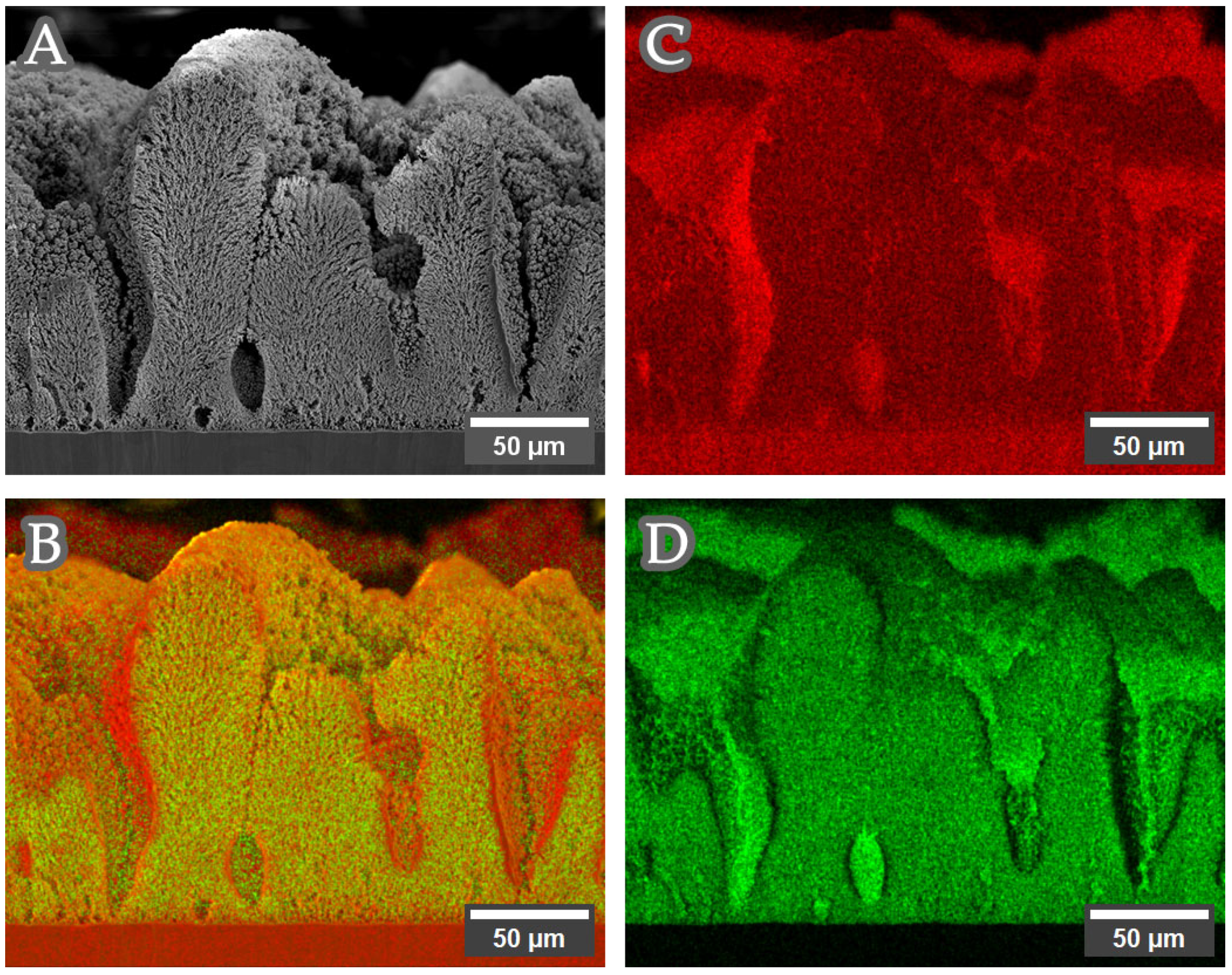
At a constant current density of 3 A·cm−2, the deposited structures exhibited large pores and small particles—a morphology typical for electrodeposition accompanied by intense gas evolution, as shown in Figure 1A. EDXM analysis performed to determine the nickel content revealed a significant discrepancy between the concentrations measured on the pore walls (3.8 at.%) and within the pores themselves (11.2 at.%). Although accurate composition measurement by EDXM requires smooth surfaces [46], copper and nickel are adjacent elements and, consequently, all factors in the ZAF correction should affect them similarly, distorting their absolute concentrations comparably while preserving their ratio. To investigate the heterogeneity of the elemental distribution in greater detail, nickel and copper distribution maps were acquired (Figure 1A).
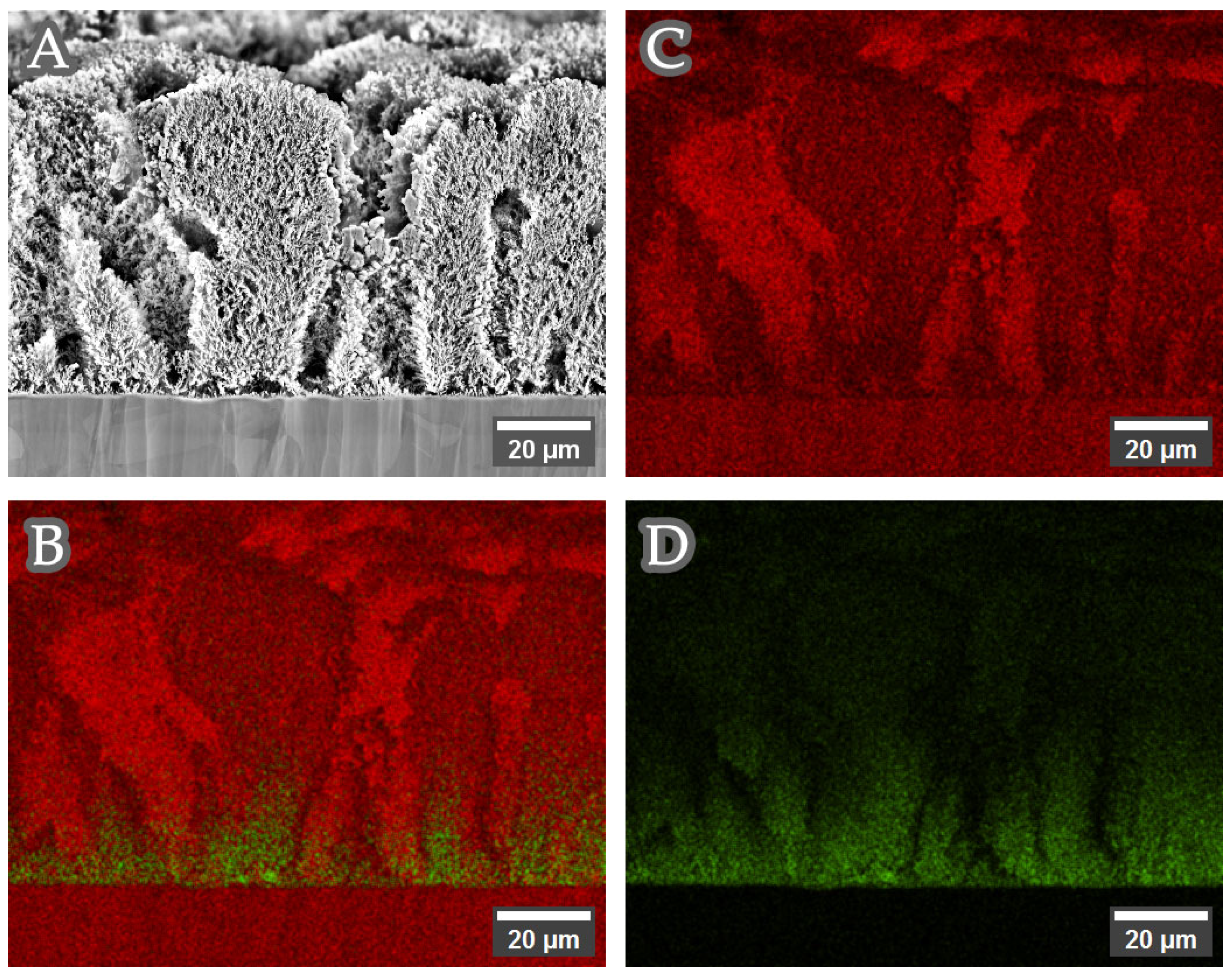
The maxima in nickel content observed on the elemental maps, which correspond spatially to the pore locations, qualitatively confirm the results of the point composition analysis. However, visualization of a specimen cross-section (Figure 2) reveals that the nickel concentration is significantly higher in the lower portion of the foam and drops considerably toward the top layer. This cross-sectional evidence indicates that nickel is not preferentially deposited in the pore regions. The apparent correlation between nickel signal maxima and pore positions is therefore an artifact related to the sample’s morphology. Given that the metal foam is approximately 100 µm thick, the electron beam cannot probe the lower sections of a pore wall without significant attenuation by the overlying wall material. Such an attenuation that does not occur when probing the open pore space itself.
This non-uniform nickel distribution is probably related to the pH dependence of its deposition kinetics, as the hydrogen bubble template method creates a strong pH gradient within the forming pores. Although nickel can be deposited across a wide pH range (from 0.5 to 5.9, depending on the solution composition [47]), its deposition kinetics are known to be pH-sensitive, at least in Watts-type baths [48]. The overpotential for nickel ion discharge increases rapidly with rising pH until approximately pH 4, followed by a sharp decrease and then a steady rise until pH 7, where nickel hydroxide formation occurs [49]. Direct experimental verification of this pH influence hypothesis is challenging. Common methods for measuring the true near-electrode pH [50] are inapplicable here due to the solution’s strong coloration, intense gas evolution, and the high rate of metal deposition, which causes continuous movement of the electrode boundary. Insufficient transport of a key reagent from the bulk electrolyte may also be a contributing factor.
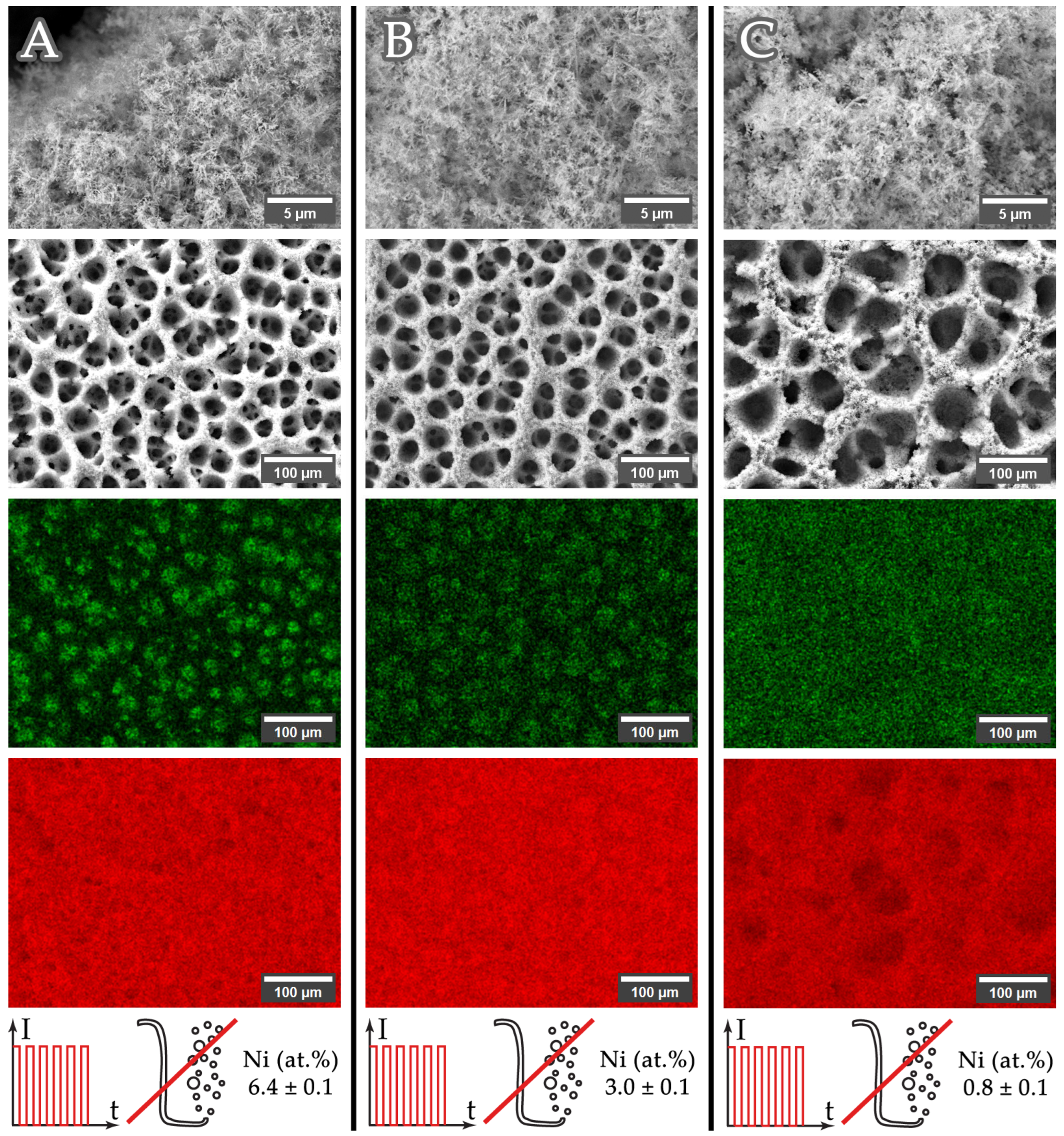
To investigate these potential influences, three experimental parameters were varied: (1) the current application mode (constant vs. intermittent), (2) the electrolyte agitation method, and (3) the current density. The overall composition was additionally assessed using the ED-XRF method, which offers lower spatial resolution but is less sensitive to surface roughness than EDXM. The morphological results for the first two factors are presented in Figure 1. All deposits exhibited a similar metallic foam structure composed of small particles and large, open pores. A minor difference was observed in the form of some wall cracking in samples produced without electrolyte agitation, which is better visualized in the lower-magnification SEM images provided in Figure S1. While copper distribution remained relatively uniform in all cases, nickel was consistently concentrated in the lower part of the foams. This heterogeneity was slightly less pronounced under intermittent deposition with simultaneous electrolyte agitation (Figure 1C), indicating that neither agitation nor current mode fundamentally alter the nickel distribution pattern. These factors, however, did significantly affect the total nickel content in the deposits. Agitating the electrolyte with compressed air reduced the nickel content by approximately a factor of 1.5. Employing an intermittent deposition mode reduced it even more substantially, by more than half. The nickel content in the intermittent mode was not further influenced by the introduction of air agitation.
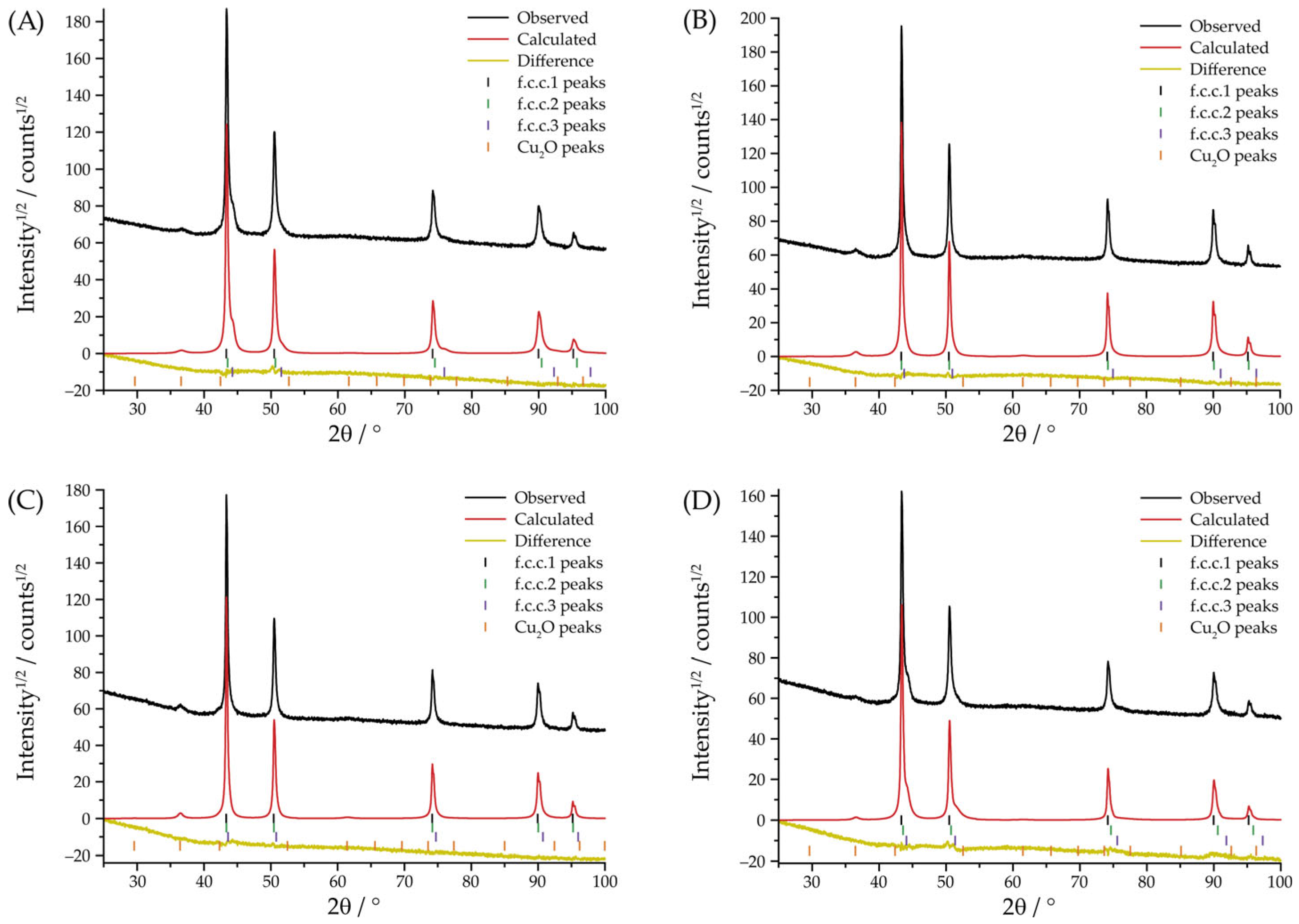
Given the significant compositional heterogeneity observed, a detailed structural analysis was performed using X-ray diffraction. The XRD patterns of the studied samples, along with their full-profile refinement, are presented in Figure 3. Intensities are shown on a square root scale to better visualize low-intensity peaks. Quantitative data on the phase composition and unit cell parameters are summarized in Table 1. To interpret the calculated unit cell parameters, reference values for pure copper and nickel are necessary: 3.6148(3) Å and 3.5241(7) Å, respectively [51]. As copper and nickel are isostructural, both possessing a face-centered cubic (f.c.c.) lattice, and their phase diagram shows complete miscibility without intermetallic or ordered phases [25], the various solid solution phases are designated for brevity in the text and tables as f.c.c.1, f.c.c.2, etc. These phases are listed in Table 1 in order of decreasing unit cell parameters, forming a sequence between the Cu and Ni end-members. The data indicate that each sample is a complex mixture of solid solutions. An enlarged fragment of the superimposed XRD patterns for the four samples is provided in Figure S2. Close inspection of the peak shapes reveals not only a clear separation into nickel-poor and nickel-rich phases (with peaks of nickel-rich phases shifted to higher 2θ angles, consistent with a smaller unit cell), but also a noticeable asymmetry on the right side of the peaks belonging to the nickel-poor phases. This right-side asymmetry is not an artifact of the Bragg–Brentano geometry used, as instrumental contributions typically induce asymmetry on the left side of a peak [52]. Therefore, the observed asymmetry suggests a compositional distribution, such as the presence of two phases with very similar unit cell parameters. While phase separation during the deposition of copper–nickel foams has been reported previously, those studies either did not specify the method for determining lattice parameters [22,53] or omitted such analysis entirely [26,27]. It is important to emphasize that, in powder diffractometry, numerous factors influence peak position [54,55]; calculating unit cell parameters from peak positions without accounting for these contributions can yield incorrect values. Analyzing the data in Table 1 shows that, although using intermittent current or air agitation does not significantly reduce the spatial inhomogeneity of nickel distribution, it markedly decreases the content of the most copper-rich phase, f.c.c.1. The simultaneous application of both measures reduces its content from 63.9 wt.% to 12.2 wt.%, which aligns with the compositional mapping results (Figure 1C). The calculated cell parameter for the f.c.c.1 phase is nearly identical to that of pure copper, differing by 0.001 Å or less in all samples. However, this phase should likely not be considered pure copper, as suggested indirectly by the quantified amount of Cu2O, which forms via air oxidation. In our previous work [56], Cu2O content was 14 wt.% in copper foam deposited from a sulfate electrolyte, and 36.7 wt.% in highly dispersed foam from a KCl-containing solution (similar to Solution 1 but without boric acid). In contrast, for the samples discussed here, the Cu2O content does not exceed 4.3 wt.%, which can be explained by nickel incorporation into the copper lattice, apparently inhibiting oxidation. The lowest total content of the extreme-composition phases (the most copper-rich and nickel-rich) is also observed for samples deposited using intermittent current with electrolyte agitation. In this case, the main phase constitutes 72.3 wt.%, although its nickel content remains low, as evidenced by its unit cell parameter and the ED-XRF data. Finally, the full-profile analysis revealed the presence of anisotropic peak broadening along the [100] direction. This effect is well-documented in the literature for cubic crystals and is associated with the presence of edge dislocations in the structure [57,58].
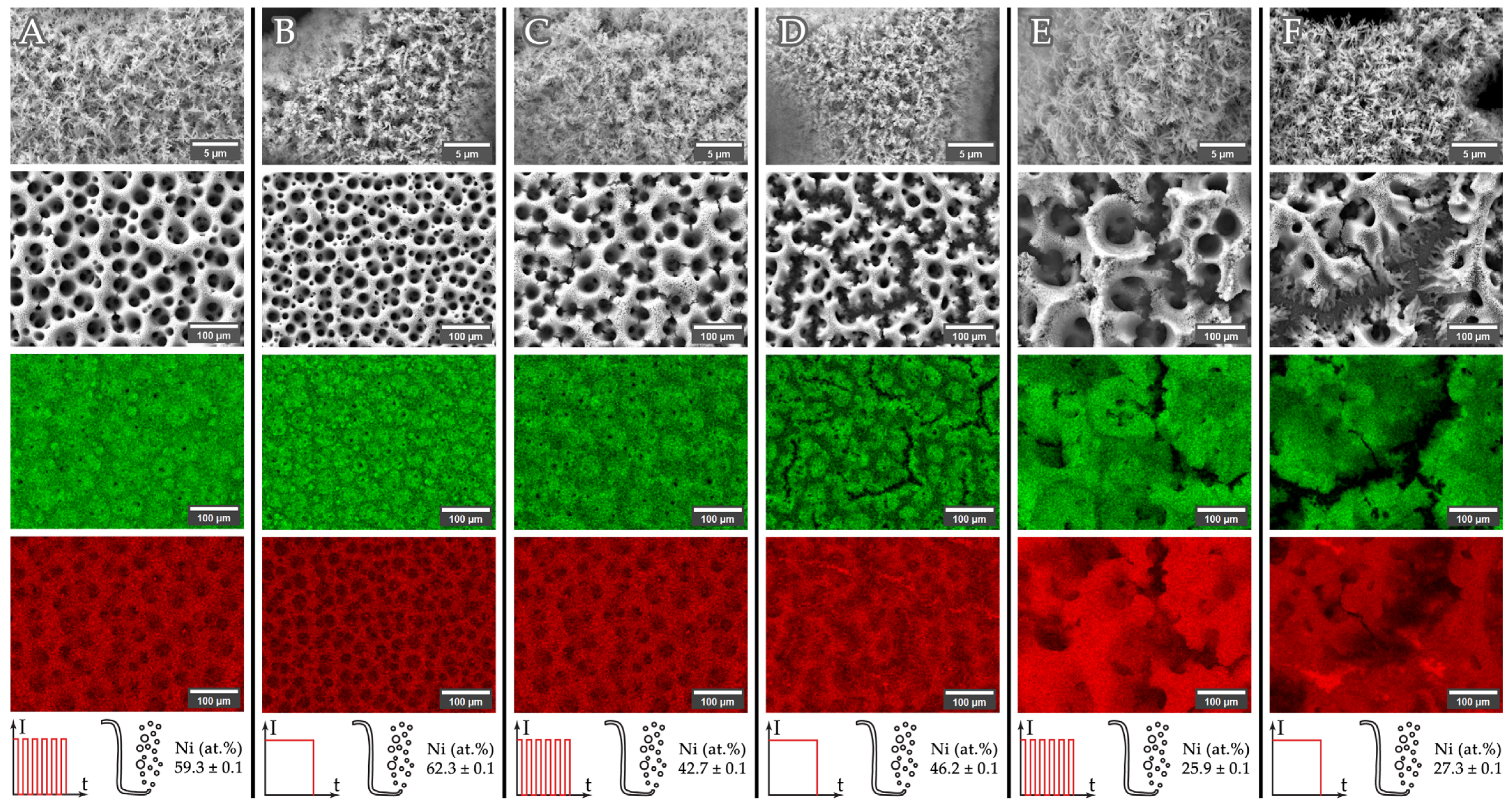
The third factor considered for its potential influence on nickel distribution and concentration in the foam was the deposition current density. In conventional alloy electrodeposition, current density determines composition when one component deposits at the limiting diffusion current [24,59]. Given the standard potentials (E°(Cu2+/Cu) = 0.3419 V, E°(Ni2+/Ni) = −0.257 V [60]), the copper concentration in our system would be expected to remain constant, while the nickel concentration should be proportional to the current. SEM images of samples deposited under intermittent current without electrolyte agitation at varying current densities are presented in Figure 4, alongside elemental maps and ED-XRF results. While particle shape and size appear largely unaffected by the current, the pore structure changes significantly. This is particularly evident at 1 A·cm−2 (Figure 4C), where pores are enlarged and pore walls exhibit pronounced protrusions. Lower-magnification images highlighting these differences are provided in Figure S3. Regarding chemical composition, qualitative assessment shows that the nickel distribution heterogeneity observed at 3 A·cm−2 is also present in samples deposited at 2 A·cm−2. A high-quality nickel distribution map could not be obtained for the sample deposited at 1 A·cm−2 due to weak X-ray emission, which correlates with its low nickel concentration of only 0.8 wt.% as determined by ED-XRF. Therefore, it can be concluded that a reduction in deposition current density leads to a decrease in nickel concentration, rather than the inverse relationship.
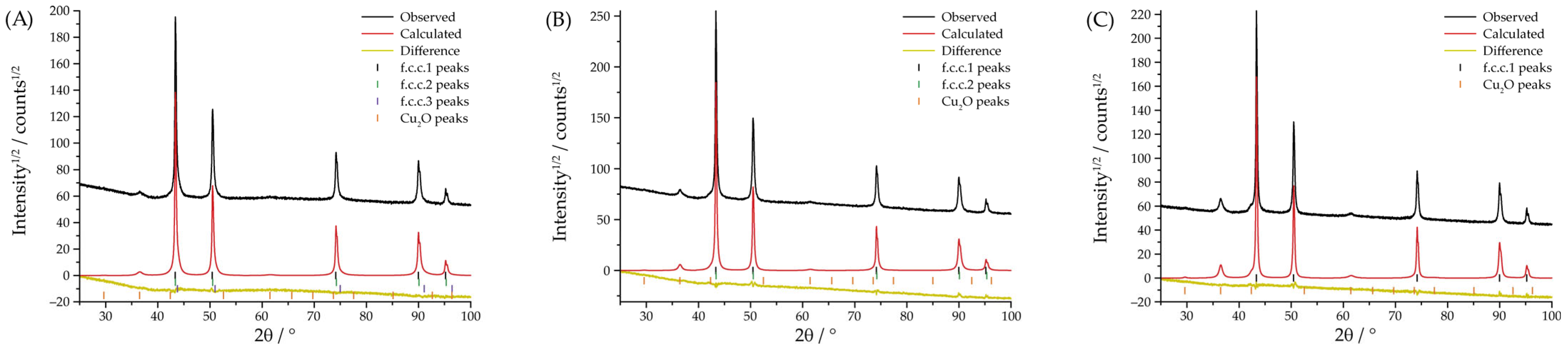
X-ray diffraction analysis reveals that the homogeneity of the deposits improves as the deposition current density decreases (Figure 5, Table 2). An enlarged region of the diffractograms is provided in Figure S4. The dominant phase remains f.c.c.1, with a unit cell parameter nearly identical to that of pure copper; in the sample deposited at 1 A·cm−2, this is the only metallic phase detected. Notably, the mass fraction of Cu2O increases with lower deposition current. Considering the corresponding ED-XRF data, this trend supports the earlier indication that even minimal nickel incorporation into the copper lattice inhibits its subsequent air oxidation.
Therefore, it can be concluded that under the conditions employed, obtaining a single-phase copper–nickel solid solution with appreciable nickel content is not feasible from the simple salt electrolyte.

3.2. Structure, Morphology and Composition of Copper–Nickel Foams: Solutions 2–4 (With Complexing Agent, Citrate-Based)

In conventional electrodeposition, complexation is a common strategy to reduce the difference in the redox potentials of depositing metals, thereby enabling their co-deposition [24]. Citrate ions are known to act as strong complexing agents for both copper and nickel cations [39,61,62]. In this study, citrate-based Solutions 2–4 were formulated with varying Ni/Cu molar ratios (2.2:1, 1:1, and 1:2.2) while maintaining a constant total metal ion concentration. Deposition was conducted at 2 A·cm−2, as the cell configuration used here required a voltage exceeding 30 V to sustain 3 A·cm−2, the current density used for Solution 1, leading to undesirable rapid heating of the electrolyte. Depositions were performed using both constant current and intermittent current modes, with simultaneous air agitation of the solution.
SEM images, elemental distribution maps, and ED-XRF data are presented in Figure 6. While the particles constituting the pore walls appear similar across all samples, the overall pore structure is highly sensitive to both the solution composition and the current application mode. Lower-magnification images provided in Figure S5 allow for a clearer comparison of these structural differences. Increasing the copper concentration in the solution leads to a progression from a continuous foam network to a cracked structure and eventually to isolated island-like deposits. As a result of this loss of structural integrity in some samples, it was not possible to define a consistent set of microstructural parameters for quantitative comparison across the entire series. Nevertheless, it is evident that applying an intermittent current significantly reduces cracking in the resulting deposits, even for the solution with the highest copper concentration. Regarding nickel distribution and content, some heterogeneity persists in samples from the solution with the highest nickel ratio (Figure 6A,B), though it is markedly less pronounced than in deposits from Solution 1. Since the nickel and copper contents in this sample series are comparable, assessing the homogeneity of copper distribution is equally important. However, this analysis is problematic for severely cracked samples, as bright maxima in the copper maps (e.g., Figure 6D,F) likely originate from characteristic X-ray emission from the underlying copper substrate exposed in deep cracks. Despite this, the images obtained from characteristic copper X-ray emission correspond well to the features observed in the electron micrographs. As the nickel content in the solution decreases, the uniformity of its distribution within the deposit improves. The ED-XRF data confirm that the total nickel content in the foam can be effectively controlled by adjusting the Ni:Cu ratio in the deposition solution.
For an adequate comparison with sulfate-based Solution 1, a cross-section was prepared for one of the samples (Solution 2, intermittent deposition mode, air agitation, Figure 6A) and examined similarly using scanning electron microscopy and compositional mapping. The resulting images are presented in Figure 7. It can be noted that the deposit retains a dendritic structure analogous to the sample obtained from the sulfate solution (Figure 2), although the dendrite branch sizes are significantly smaller. Another distinct feature is the absence of pores extending through the entire deposit down to the substrate. The elemental maps presented in the figure do not reveal pronounced heterogeneity. On the contrary, nickel and copper are distributed uniformly across the entire field of view, as evident in both the individual maps and their overlay. This observation is fully consistent with the top-view composition analysis data (Figure 6).
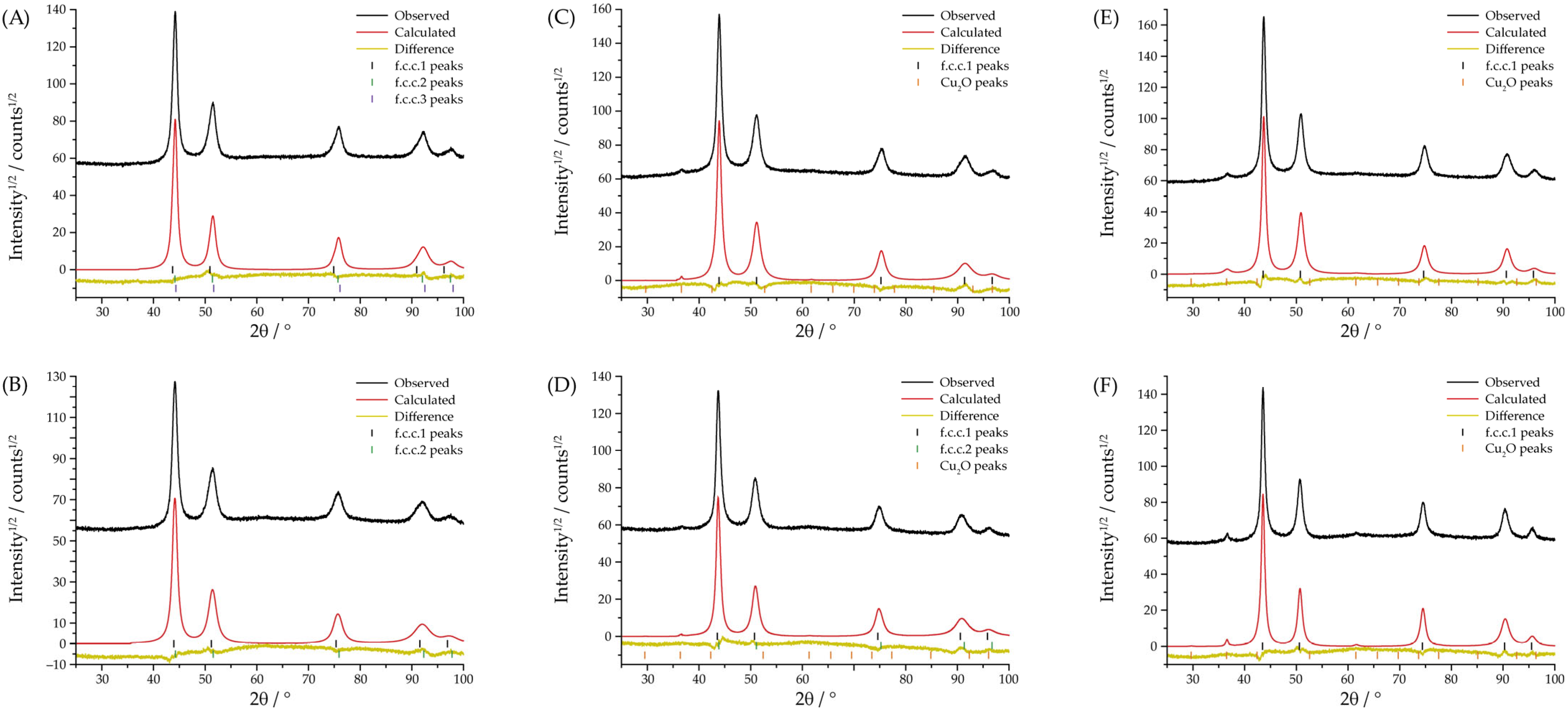
The XRD patterns of the studied samples, along with full-profile refinement, are presented in Figure 8, with quantitative phase composition and unit cell parameters summarized in Table 3. As in Table 1 and Table 2, the phase labeled f.c.c.1 corresponds to the composition with the lowest nickel content. An enlarged region of the XRD patterns is provided in Figure S6, where a clear shift in peak position toward larger 2θ angles is evident. This shift indicates a corresponding increase in unit cell parameter as the copper content in the solution increases. This is an expected trend, given that copper has a larger lattice parameter than nickel, and a strong indicator of solid solution formation. Full-profile analysis (Table 3) reveals the complete absence of any phase with a unit cell parameter close to that of pure copper, a result that is independent of deposition conditions. This finding points to significantly improved elemental mixing compared to the system without a complexing agent. Nevertheless, the phase composition remains complex for solutions with high nickel content, featuring several f.c.c. phases spanning a relatively wide range of nickel concentrations. The overall nickel quantity, calculated from phase weights and unit cell parameters, shows fair agreement with ED-XRF data. By decreasing the nickel content in the solution, metallic foams consisting of only a single f.c.c. phase can be obtained. Analogously to observed for Solution 1, lower nickel concentrations in these samples are accompanied by the formation of Cu2O. It is also noteworthy that the phase composition depends in a non-linear manner not only on solution composition but also on the current application mode and agitation. This behavior may stem from more complex cathodic processes, since the electroreduction of citrate, which can lead to the formation of complex organic compounds [63], cannot be disregarded at the high current densities employed. Achieving more uniform composition likely requires finer control over solution agitation, which might be realized in a flow-cell configuration with external solution pumping. However, such a setup would require a specialized design to manage the intense gas evolution from the electrodes. Additionally, samples from this series exhibit more complex microstructural features than those obtained from Solution 1. Accounting for anisotropic peak broadening along the [100] direction proved insufficient to fully describe the observed peak shapes. Given that the largest discrepancies occur for the (311) peak (2θ ≈ 90.5°), we suggest the presence of a significant density of stacking faults. In an f.c.c. lattice, the (311) peak is the most sensitive to deformation-type stacking faults [64,65]. While more advanced analytical approaches are required to fully account for these microstructural features [66], applying them to such a complex phase mixture could lead to over-parameterization and ambiguity in the derived model parameters.

4. Conclusions

This study demonstrates that effective elemental mixing in electrodeposited metal foams can be achieved by utilizing solutions containing complexing agents. In contrast, solutions without complexing agents do not yield Cu-Ni foams with a sufficiently homogeneous distribution of nickel in copper. For instance, a sulfate solution with a Ni:Cu ratio of 2.7:1 produces metallic foam with a nickel concentration not exceeding 15 at.%, and this nickel is distributed across several distinct solid solution phases. While adjustments to deposition parameters, such as current application mode, current density, and electrolyte agitation, can moderately reduce the inhomogeneity, they cannot fully overcome the inherent limitations of these simple salt systems. These solutions, however, may be suitable for creating metal foams with intentional chemical composition gradients. Conversely, citrate-based solutions with comparable concentrations of nickel and copper enable the production of metallic foams containing between 26 and 63 at.% nickel. Samples where copper predominates over nickel often consist of a single solid solution phase, indicating efficient elemental mixing.
This work also underscores the necessity for thorough characterization of such complex, structured materials. For example, microprobe analysis, a common method for assessing chemical composition, may not reliably reveal chemical heterogeneity due to its localized nature. Elemental distribution mapping, including cross-sectional analysis, proves to be a more powerful diagnostic tool for evaluating compositional uniformity. Determining the overall elemental composition requires supplementary techniques, such as XRF spectroscopy or dissolved sample analysis, as supported by our observations. Furthermore, quantitative analysis of XRD patterns demands careful attention; only full-profile refinement provides detailed phase composition information, whereas routine peak matching, frequently employed in the literature, can often be misleading.

Supplementary Materials

The following supporting information can be downloaded at: https://www.mdpi.com/article/10.3390/cryst16010020/s1, Figure S1: Low-magnification SEM images of the foams, solution 1; Figure S2: XRD patterns details, solution 1, current application mode and agitation effects; Figure S3: Low-magnification SEM images of the foams, solution 1, current density effect; Figure S4: XRD patterns details, solution 1, current density effect; Figure S5: Low-magnification SEM images of the foams, solutions 2–4; Figure S6: XRD patterns details, solutions 2–4, current application mode and agitation effects.

Author Contributions

Conceptualizaton, E.E.L.; Methodology, E.E.L.; Validation, E.E.L. and V.P.C.; Formal analysis, E.E.L., V.P.C. and N.A.A.; Investigation, E.E.L., V.P.C. and N.A.A.; Writing—original draft preparation, E.E.L., V.P.C. and N.A.A.; Visualization, E.E.L. and N.A.A.; Supervision, E.E.L.; Project administration, E.E.L. All authors have read and agreed to the published version of the manuscript.

Funding

This work was supported by Russian Science Foundation (grant #24-13-00317).

Data Availability Statement

The data presented in this study are available on a reasonable request from the corresponding author.

Acknowledgments

The authors thank Anna G. Ivanova for performing ED XRF measurements. The authors sincerely thank Sergey Ya. Istomin for reading of the manuscript and valuable remarks provided. This work was performed within the State assignment for the Shubnikov Institute of Crystallography of the Kurchatov Complex Crystallography and Photonics of the NRC “Kurchatov Institute” in part of X-ray diffraction and X-ray fluorescence using the equipment of the Shared Research Center “Structural Diagnostics of Materials” of the Shubnikov Institute of Crystallography of the Kurchatov Complex Crystallography and Photonics of the NRC “Kurchatov Institute”.

Conflicts of Interest

The authors declare no conflicts of interest.

References

  1. Lahiri, A.; Endres, F. Review—Electrodeposition of Nanostructured Materials from Aqueous, Organic and Ionic Liquid Electrolytes for Li-Ion and Na-Ion Batteries: A Comparative Review. J. Electrochem. Soc. 2017, 164, D597–D612. [Google Scholar] [CrossRef]
  2. Walter, E.C.; Zach, M.P.; Favier, F.; Murray, B.J.; Inazu, K.; Hemminger, J.C.; Penner, R.M. Metal nanowire arrays by electrodeposition. ChemPhysChem 2003, 4, 131–138. [Google Scholar] [CrossRef]
  3. Bernal Lopez, M.; Ustarroz, J. Electrodeposition of nanostructured catalysts for electrochemical energy conversion: Current trends and innovative strategies. Curr. Opin. Electrochem. 2021, 27, 100688. [Google Scholar] [CrossRef]
  4. Lee, S.A.; Yang, J.W.; Choi, S.; Jang, H.W. Nanoscale electrodeposition: Dimension control and 3D conformality. Exploration 2021, 1, 20210012. [Google Scholar] [CrossRef]
  5. Kale, M.B.; Borse, R.A.; Gomaa Abdelkader Mohamed, A.; Wang, Y. Electrocatalysts by Electrodeposition: Recent Advances, Synthesis Methods, and Applications in Energy Conversion. Adv. Funct. Mater. 2021, 31, 2101313. [Google Scholar] [CrossRef]
  6. Kumar, A.; Deka, S. Focused Review on the Use of Bimetallic Alloy Nanoparticle Electrocatalysts in Water Splitting Reactions. J. Phys. Chem. C 2024, 128, 19037–19054. [Google Scholar] [CrossRef]
  7. Makhafola, M.D.; Balogun, S.A.; Modibane, K.D. A Comprehensive Review of Bimetallic Nanoparticle–Graphene Oxide and Bimetallic Nanoparticle–Metal–Organic Framework Nanocomposites as Photo-, Electro-, and Photoelectrocatalysts for Hydrogen Evolution Reaction. Energies 2024, 17, 1646. [Google Scholar] [CrossRef]
  8. Lu, Q.; Hutchings, G.S.; Yu, W.; Zhou, Y.; Forest, R.V.; Tao, R.; Rosen, J.; Yonemoto, B.T.; Cao, Z.; Zheng, H.; et al. Highly porous non-precious bimetallic electrocatalysts for efficient hydrogen evolution. Nat. Commun. 2015, 6, 6567. [Google Scholar] [CrossRef]
  9. Wang, X.; Zhu, Y.; Vasileff, A.; Jiao, Y.; Chen, S.; Song, L.; Zheng, B.; Zheng, Y.; Qiao, S.-Z. Strain Effect in Bimetallic Electrocatalysts in the Hydrogen Evolution Reaction. ACS Energy Lett. 2018, 3, 1198–1204. [Google Scholar] [CrossRef]
  10. Wang, F.; Yu, H.; Feng, T.; Zhao, D.; Piao, J.; Lei, J. Surface Roughed and Pt-Rich Bimetallic Electrocatalysts for Hydrogen Evolution Reaction. Front. Chem. 2020, 8, 422. [Google Scholar] [CrossRef]
  11. Barua, S.; Balčiūnaitė, A.; Upskuvienė, D.; Vaičiūnienė, J.; Tamašauskaitė-Tamašiūnaitė, L.; Norkus, E. Bimetallic Ni–Mn Electrocatalysts for Stable Oxygen Evolution Reaction in Simulated/Alkaline Seawater and Overall Performance in the Splitting of Alkaline Seawater. Coatings 2024, 14, 1074. [Google Scholar] [CrossRef]
  12. Zhao, K.; Shu, Y.; Li, F.; Peng, G. Bimetallic catalysts as electrocatalytic cathode materials for the oxygen reduction reaction in microbial fuel cell: A review. Green Energy Environ. 2023, 8, 1043–1070. [Google Scholar] [CrossRef]
  13. Escudero-Escribano, M.; Jensen, K.D.; Jensen, A.W. Recent advances in bimetallic electrocatalysts for oxygen reduction: Design principles, structure-function relations and active phase elucidation. Curr. Opin. Electrochem. 2018, 8, 135–146. [Google Scholar] [CrossRef]
  14. Zhang, B.W.; Yang, H.L.; Wang, Y.X.; Dou, S.X.; Liu, H.K. A Comprehensive Review on Controlling Surface Composition of Pt-Based Bimetallic Electrocatalysts. Adv. Energy Mater. 2018, 8, 1703597. [Google Scholar] [CrossRef]
  15. Bampos, G.; Bebelis, S. Pd-Based Bimetallic Electrocatalysts for Hydrogen Oxidation Reaction in 0.1 M KOH Solution. Nanomaterials 2024, 14, 500. [Google Scholar] [CrossRef]
  16. Guterman, V.; Alekseenko, A.; Belenov, S.; Menshikov, V.; Moguchikh, E.; Novomlinskaya, I.; Paperzh, K.; Pankov, I. Exploring the Potential of Bimetallic PtPd/C Cathode Catalysts to Enhance the Performance of PEM Fuel Cells. Nanomaterials 2024, 14, 1672. [Google Scholar] [CrossRef]
  17. Zhu, W.; Tackett, B.M.; Chen, J.G.; Jiao, F. Bimetallic Electrocatalysts for CO2 Reduction. Top. Curr. Chem. 2018, 376, 41. [Google Scholar] [CrossRef]
  18. Yang, H.; Chuai, H.; Meng, Q.; Wang, M.; Zhang, S.; Ma, X. Copper-based bimetallic electrocatalysts for CO2 reduction: From mechanism understandings to product regulations. Mater. Rep. Energy 2023, 3, 100174. [Google Scholar] [CrossRef]
  19. Guo, P.; Liu, K.; Liu, X.; Liu, R.; Yin, Z. Perspectives on Cu–Ag Bimetallic Catalysts for Electrochemical CO2 Reduction Reaction: A Mini-Review. Energy Fuels 2024, 38, 5659–5675. [Google Scholar] [CrossRef]
  20. Chen, W.; Wang, Y.; Li, Y.; Li, C. Electrocatalytic CO2 Reduction over Bimetallic Bi-Based Catalysts: A Review. CCS Chem. 2023, 5, 544–567. [Google Scholar] [CrossRef]
  21. Yang, X.; Wu, S.; Zhang, Q.; Qiu, S.; Wang, Y.; Tan, J.; Ma, L.; Wang, T.; Xia, Y. Surface Structure Engineering of PdAg Alloys with Boosted CO2 Electrochemical Reduction Performance. Nanomaterials 2022, 12, 3860. [Google Scholar] [CrossRef] [PubMed]
  22. Mattarozzi, L.; Cattarin, S.; Comisso, N.; Gerbasi, R.; Guerriero, P.; Musiani, M.; Vazquez-Gomez, L.; Verlato, E. Electrodeposition of Cu-Ni Alloy Electrodes with Bimodal Porosity and Their Use for Nitrate Reduction. ECS Electrochem. Lett. 2013, 2, D58–D60. [Google Scholar] [CrossRef]
  23. Bai, Z.; Li, X.; Ding, L.; Qu, Y.; Chang, X. Artificial Cu-Ni catalyst towards highly efficient nitrate-to-ammonia conversion. Sci. China Mater. 2023, 66, 2329–2338. [Google Scholar] [CrossRef]
  24. Despić, A.R.; Jović, V.D. Electrochemical Deposition and Dissolution of Alloys and Metal Composites—Fundamental Aspects. In Modern Aspects of Electrochemistry; White, R.E., Bockris, J.O.M., Conway, B.E., Eds.; Springer: Boston, MA, USA, 1995; Volume 27, pp. 143–232. [Google Scholar]
  25. Franke, P.; Neuschütz, D. Binary systems. Part 3: Binary Systems from Cs-K to Mg-Zr·Cu-Ni. In Landolt-Börnstein—Group IV Physical Chemistry; Binary Systems. Part 3: Binary Systems from Cs-K to Mg-Zr; Franke, P., Neuschütz, D., Eds.; Springer: Berlin/Heidelberg, Germany, 2005; Volume 19B3. [Google Scholar]
  26. Hu, B.; Yu, J.; Meng, J.; Xu, C.; Cai, J.; Zhang, B.; Liu, Y.; Yu, D.; Zhou, X.; Chen, C. Porous Ni-Cu Alloy Dendrite Anode Catalysts with High Activity and Selectivity for Direct Borohydride Fuel Cells. ACS Appl. Mater. Interfaces 2022, 14, 3910–3918. [Google Scholar] [CrossRef]
  27. Modghan, N.-S.; Mirjalili, M.; Moayed, M.-H.; Darband, G.B. A Suitable Porous Micro/Nanostructured Cu and Cu–Ni Film: Evaluation of Electrodeposition Behavior, Electrocatalytic Activity, and Surface Characterization of Porous Film. J. Electrochem. Soc. 2023, 170, 076506. [Google Scholar] [CrossRef]
  28. Wang, Y.; Xie, T.; Zhu, Q.; Fu, J.; Peng, Y.; Wang, J.; Liu, S. Three-dimensional Nanoporous Cu-Doped Ni Coating as Bifunctional Electrocatalyst for Hydrazine Sensing and Hydrogen Evolution Reaction. Nanotechnology 2021, 32, 305502. [Google Scholar] [CrossRef]
  29. Wang, X.; Bai, J.; Zhang, M.; Chen, Y.; Fan, L.; Yang, Z.; Zhang, J.; Guan, R. A Comparison between Porous to Fully Dense Electrodeposited CuNi Films: Insights on Electrochemical Performance. Nanomaterials 2023, 13, 491. [Google Scholar] [CrossRef]
  30. Negem, M.; Nady, H.; Dunnill, C.W. Nanocrystalline Ni–Cu Electroplated Alloys Cathodes for Hydrogen Generation in Phosphate-Buffered Neutral Electrolytes. J. Bio-Tribo-Corros. 2020, 6, 116. [Google Scholar] [CrossRef]
  31. Wan, L.; Zhang, X.; Cheng, J.; Chen, R.; Wu, L.; Shi, J.; Luo, J. Bimetallic Cu–Zn Catalysts for Electrochemical CO2 Reduction: Phase-Separated versus Core–Shell Distribution. ACS Catal. 2022, 12, 2741–2748. [Google Scholar] [CrossRef]
  32. Jeon, H.S.; Timoshenko, J.; Scholten, F.; Sinev, I.; Herzog, A.; Haase, F.T.; Roldan Cuenya, B. Operando Insight into the Correlation between the Structure and Composition of CuZn Nanoparticles and Their Selectivity for the Electrochemical CO2 Reduction. J. Am. Chem. Soc. 2019, 141, 19879–19887. [Google Scholar] [CrossRef] [PubMed]
  33. Ren, D.; Ang, B.S.-H.; Yeo, B.S. Tuning the Selectivity of Carbon Dioxide Electroreduction toward Ethanol on Oxide-Derived CuxZn Catalysts. ACS Catal. 2016, 6, 8239–8247. [Google Scholar] [CrossRef]
  34. Zou, Z.; Zhang, H.; Pan, X.; Shen, H.; Yu, J.; Guo, T.; Wang, Y. Role of electrons and H* in electrocatalytic nitrate reduction to ammonium for CuNi alloy. Surf. Interfaces 2024, 54, 105308. [Google Scholar] [CrossRef]
  35. Song, H.; Tan, Y.C.; Kim, B.; Ringe, S.; Oh, J. Tunable Product Selectivity in Electrochemical CO2 Reduction on Well-Mixed Ni-Cu Alloys. ACS Appl. Mater. Interfaces 2021, 13, 55272–55280. [Google Scholar] [CrossRef]
  36. Hu, C.; Jiang, Z.; Wu, Q.; Cao, S.; Li, Q.; Chen, C.; Yuan, L.; Wang, Y.; Yang, W.; Yang, J.; et al. Selective CO2 reduction to CH3OH over atomic dual-metal sites embedded in a metal-organic framework with high-energy radiation. Nat. Commun. 2023, 14, 4767. [Google Scholar] [CrossRef]
  37. Shin, H.-C.; Liu, M. Copper Foam Structures with Highly Porous Nanostructured Walls. Chem. Mater. 2004, 16, 5460–5464. [Google Scholar] [CrossRef]
  38. Nikolić, N.D.; Pavlović, L.J.; Pavlović, M.G.; Popov, K.I. Formation of dish-like holes and a channel structure in electrodeposition of copper under hydrogen co-deposition. Electrochim. Acta 2007, 52, 8096–8104. [Google Scholar] [CrossRef]
  39. Green, T.A.; Russell, A.E.; Roy, S. The Development of a Stable Citrate Electrolyte for the Electrodeposition of Copper-Nickel Alloys. J. Electrochem. Soc. 1998, 145, 875–881. [Google Scholar] [CrossRef]
  40. Rietveld, H.M. A profile refinement method for nuclear and magnetic structures. J. Appl. Crystallogr. 1969, 2, 65–71. [Google Scholar] [CrossRef]
  41. Hill, R.J.; Howard, C.J. Quantitative phase analysis from neutron powder diffraction data using the Rietveld method. J. Appl. Crystallogr. 1987, 20, 467–474. [Google Scholar] [CrossRef]
  42. Solovyov, L.A. Full-profile refinement by derivative difference minimization. J. Appl. Crystallogr. Erratum in J. Appl. Crystallogr. 2005, 38, 401. https://doi.org/10.1107/s0021889805004899.. 2004, 37, 743–749. [Google Scholar] [CrossRef]
  43. Zuiderveld, K. VIII.5. Contrast limited adaptive histogram equalization. In Graphics Gems IV; Heckbert, P.S., Ed.; Academic Press: San Diego, CA, USA, 1994; pp. 474–485. [Google Scholar]
  44. Schindelin, J.; Arganda-Carreras, I.; Frise, E.; Kaynig, V.; Longair, M.; Pietzsch, T.; Preibisch, S.; Rueden, C.; Saalfeld, S.; Schmid, B.; et al. Fiji: An open-source platform for biological-image analysis. Nat. Methods 2012, 9, 676–682. [Google Scholar] [CrossRef]
  45. Cromey, D.W. Avoiding twisted pixels: Ethical guidelines for the appropriate use and manipulation of scientific digital images. Sci. Eng. Ethics 2010, 16, 639–667. [Google Scholar] [CrossRef]
  46. Newbury, D.E.; Ritchie, N.W. Performing elemental microanalysis with high accuracy and high precision by scanning electron microscopy/silicon drift detector energy-dispersive X-ray spectrometry (SEM/SDD-EDS). J. Mater. Sci. 2015, 50, 493–518. [Google Scholar] [CrossRef]
  47. Di Bari, G.A. Electrodeposition of Nickel. In Modern Electroplating, 5th ed.; Schlesinger, M., Paunovic, M., Eds.; John Wiley & Sons, Inc.: Hoboken, NJ, USA, 2010. [Google Scholar]
  48. Saraby-Reintjes, A.; Fleischmann, M. Kinetics of electrodeposition of nickel from Watts baths. Electrochim. Acta 1984, 29, 557–566. [Google Scholar] [CrossRef]
  49. Matulis, J.; Sližys, R. On some characteristics of cathodic processes in nickel electrodeposition. Electrochim. Acta 1964, 9, 1177–1188. [Google Scholar] [CrossRef]
  50. Monteiro, M.C.O.; Koper, M.T.M. Measuring local pH in electrochemistry. Curr. Opin. Electrochem. 2021, 25, 100649. [Google Scholar] [CrossRef]
  51. Donohue, J. The Structures of the Elements; John Wiley & Sons: Chichester, UK, 1974; p. 436. [Google Scholar]
  52. Cline, J.P.; Mendenhall, M.H.; Black, D.; Windover, D.; Henins, A. The Optics and Alignment of the Divergent Beam Laboratory X-ray Powder Diffractometer and its Calibration Using NIST Standard Reference Materials. J. Res. Natl. Inst. Stand. Technol. 2015, 120, 173–222. [Google Scholar] [CrossRef]
  53. Eugénio, S.; Silva, T.M.; Carmezim, M.J.; Duarte, R.G.; Montemor, M.F. Electrodeposition and characterization of nickel–copper metallic foams for application as electrodes for supercapacitors. J. Appl. Electrochem. 2013, 44, 455–465. [Google Scholar] [CrossRef]
  54. Young, R.A. Introduction to the Rietveld method. In The Rietveld Method; Young, R.A., Ed.; Oxford University Press: Oxford, UK, 1993. [Google Scholar]
  55. Jenkins, R.; Snyder, R.L. Chapter 7. Instruments for the measurement of powder patterns. In Introduction to X-Ray Powder Diffractometry; John Wiley & Sons, Inc.: New York, NY, USA, 1996. [Google Scholar]
  56. Levin, E.E.; Morozov, D.A.; Frolov, V.V.; Arkharova, N.A.; Khmelenin, D.N.; Antipov, E.V.; Nikitina, V.A. Roughness Factors of Electrodeposited Nanostructured Copper Foams. Nanomaterials 2023, 13, 3011. [Google Scholar] [CrossRef]
  57. Stokes, A.R.; Wilson, A.J.C. The diffraction of X rays by distorted crystal aggregates—I. Proc. Phys. Soc. 1944, 56, 174–181. [Google Scholar] [CrossRef]
  58. Ungár, T.; Dragomir, I.; Révész, Á.; Borbély, A. The contrast factors of dislocations in cubic crystals: The dislocation model of strain anisotropy in practice. J. Appl. Crystallogr. 1999, 32, 992–1002. [Google Scholar] [CrossRef]
  59. Despic, A.R.; Jović, V.D. Formation of Metallic Materials of Desired Structure and Properties by Electrochemical Deposition. Mater. Sci. Forum 1996, 214, 239–248. [Google Scholar] [CrossRef]
  60. Haynes, W.M.; Lide, D.R.; Bruno, T.J. (Eds.) CRC Handbook of Chemistry and Physics, 97th ed.; CRC Press: Boca Raton, FL, USA, 2017; p. 2670. [Google Scholar]
  61. Rode, S.; Henninot, C.; Vallières, C.; Matlosz, M. Complexation Chemistry in Copper Plating from Citrate Baths. J. Electrochem. Soc. 2004, 151, C405. [Google Scholar] [CrossRef]
  62. Rode, S.; Henninot, C.; Matlosz, M. Complexation Chemistry in Nickel and Copper-Nickel Alloy Plating from Citrate Baths. J. Electrochem. Soc. 2005, 152, C248. [Google Scholar] [CrossRef]
  63. Berkh, O.; Burstein, L.; Shacham-Diamand, Y.; Gileadi, E. The Chemical and Electrochemical Activity of Citrate on Pt Electrodes. J. Electrochem. Soc. 2011, 158, F85–F91. [Google Scholar] [CrossRef]
  64. Leoni, M. Diffraction analysis of layer disorder. Z. Kristallogr. 2008, 223, 561–568. [Google Scholar] [CrossRef]
  65. Beyerlein, K.R.; Snyder, R.L.; Scardi, P. Faulting in finite face-centered-cubic crystallites. Acta Crystallogr. A 2011, 67, 252–263. [Google Scholar] [CrossRef]
  66. Scardi, P.; Leoni, M. Whole powder pattern modelling. Acta Crystallogr. A 2002, 58, 190–200. [Google Scholar] [CrossRef]
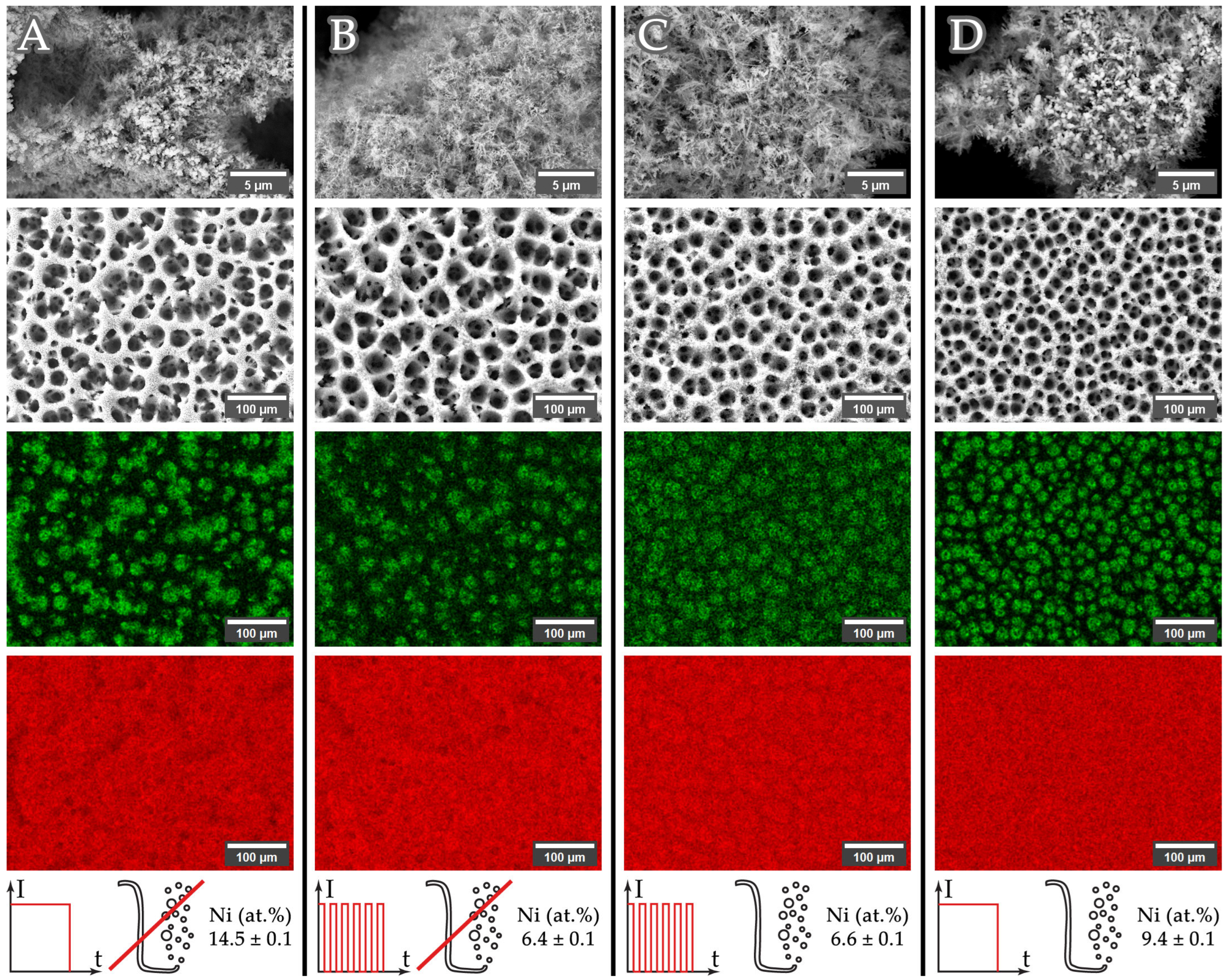
Figure 1. SEM images and composition mapping of the samples of solution 1. Deposition current density 3 A·cm−2. Effects of current application mode and agitation. (A) constant current, no agitation; (B) intermittent, no agitation; (C) intermittent, air agitation; (D) constant current, air agitation. From top to bottom: (1) electron image at ×5000 magnification, (2) electron image at ×250 magnification, (3) nickel distribution map (green), (4) copper distribution map (red), (5) deposition conditions. Pictograms denote current application mode (I-t dependence, constant or intermittent) and air agitation (on or off). Ni concentration is from ED-XRF.
Crystals 16 00020 g001
Figure 2. SEM images of cross-section and composition mapping of the sample deposited at constant current 3 A·cm−2 with no agitation (see Figure 1A). (A)—electron image of the cross-section, (B)—overlay of Cu and Ni distribution maps, (C)—copper distribution map, (D)—nickel distribution map.
Crystals 16 00020 g002
Figure 3. XRD patterns of the foam samples deposited from solution 1. Deposition current density 3 A·cm−2. Constant current (A,D), intermittent current (B,C). Solution agitation (C,D). Bars represent Bragg peak positions of the respective phases.
Crystals 16 00020 g003
Figure 4. SEM images and composition mapping of the samples of solution 1. Effects of current density. From top to bottom: (1) electron image at ×5000 magnification, (2) electron image at ×250 magnification, (3) nickel distribution map (green), (4) copper distribution map (red), (5) deposition conditions. Pictograms denote current application mode (I-t dependence, constant or intermittent) and air agitation (on or off). Pictograms denote current application mode (I-t dependence, constant or intermittent) and air agitation (on or off). (A)—3 A·cm−2, (B)—2 A·cm−2, (C)—1 A·cm−2. Ni concentration is from ED-XRF.
Crystals 16 00020 g004
Figure 5. XRD patterns of the foam samples deposited from solution 1. (A)—3 A·cm−2, (B)—2 A·cm−2, (C)—1 A·cm−2. Intermittent current, no agitation. Bars represent Bragg peak positions of the respective phases.
Crystals 16 00020 g005
Figure 6. SEM images and composition mapping of the samples of solutions 2–4. Effects of solution composition and current application mode. Deposition current density 2 A·cm−2. From top to bottom: (1) electron image at ×5000 magnification, (2) electron image at ×250 magnification, (3) nickel distribution map (green), (4) copper distribution map (red), (5) deposition conditions. Pictograms denote current application mode (I-t dependence, constant or intermittent) and air agitation (on or off). Pictograms denote current application mode (I-t dependence, constant or intermittent) and air agitation (on or off). (A,B)—solution 2, (C,D)—solution 3, (E,F)—solution 4. (A,C,E)—intermittent current. (B,D,F)—constant current. Ni concentration is from ED-XRF.
Crystals 16 00020 g006
Figure 7. SEM images of cross-section and composition mapping of the sample deposited from solution 2. Deposition mode: current density 2 A·cm−2, intermittent, air agitation (see Figure 6A). (A)—electron image of the cross-section, (B)—overlay of Cu and Ni distribution maps, (C)—copper distribution map, (D)—nickel distribution map.
Crystals 16 00020 g007
Figure 8. XRD patterns of the foam samples deposited from solutions 2–4. Deposition current density 2 A·cm−2. (A,B)—solution 2, (C,D)—solution 3, (E,F)—solution 4. (A,C,E)—intermittent current. (B,D,F)—constant current. Solution is agitated. Bars represent Bragg peak positions of the respective phases.
Crystals 16 00020 g008
Table 1. The results of the full-profile analysis of XRD patterns of the foam samples deposited from solution 1. Impact of intermittent current and solution agitation.
CurrentIntermittentAgitatedPhase Composition (wt.%)Ni XRD
(at. %) 1
Ni XRF
(at. %) 2
3 ANoNof.c.c.1: 63.9 ± 4.7 (a = 3.6138(1) Å)17 ± 914.5 ± 0.1
f.c.c.2: 17.9 ± 6.2 (a = 3.596(4) Å)
f.c.c.3: 15.4 ± 1.9 (a = 3.543(1) Å)
Cu2O: 2.8 ± 0.4
3 AYesNof.c.c.1: 33.0 ± 1.0 (a = 3.6142(1) Å)8 ± 16.4 ± 0.1
f.c.c.2: 50.7 ± 0.9 (a = 3.6103(3) Å)
f.c.c.3: 12.0 ± 0.9 (a = 3.578(4) Å)
Cu2O: 4.3 ± 0.1
3 AYesYesf.c.c.1: 12.2 ± 1.5 (a = 3.6144(1) Å)5 ± 16.6 ± 0.1
f.c.c.2: 72.3 ± 1.6 (a = 3.6123(2) Å)
f.c.c.3: 11.2 ± 1.4 (a = 3.590(4) Å)
Cu2O: 4.3 ± 0.3
3 ANoYesf.c.c.1: 56.0 ± 1.3 (a = 3.6134(2) Å)27 ± 79.4 ± 0.1
f.c.c.2: 5.5 ± 0.5 (a = 3.593(1) Å)
f.c.c.3: 36.7 ± 5.2 (a = 3.554(2) Å)
Cu2O: 1.9 ± 0.3
1 From Vegard’s law, corrected for Cu2O content. 2 ED-XRF value for reference.
Table 2. The results of the full-profile analysis of XRD patterns of the foam samples deposited from solution 1. Impact of current density.
CurrentIntermittentAgitatedPhase Composition (wt.%)Ni XRD
(at. %) 1
Ni XRF
(at. %) 2
3 AYesNof.c.c.1: 33.0 ± 1.0 (a = 3.6142(1) Å)8 ± 16.4 ± 0.1
f.c.c.2: 50.7 ± 0.9 (a = 3.6103(3) Å)
f.c.c.3: 12.0 ± 0.9 (a = 3.578(4) Å)
Cu2O: 4.3 ± 0.1
2 AYesNof.c.c.1: 58.8 ± 2.9 (a = 3.6137(2) Å)3 ± 0.43.0 ± 0.1
f.c.c.2: 35.9 ± 2.8 (a = 3.6090(6) Å)
Cu2O: 5.3 ± 0.2
1 AYesNof.c.c.1: 89.4 ± 0.5 (a = 3.6139(2) Å)1 ± 0.10.8 ± 0.1
Cu2O: 10.6 ± 0.4
1 From Vegard’s law, corrected for Cu2O content. 2 ED-XRF value for reference.
Table 3. The results of the full-profile analysis of XRD patterns. Solutions 2–4. Impact of solution composition. Deposition current density is 2 A·cm−2.
SolutionIntermittedAgitatedPhase Composition (wt.%)Ni XRD
(at. %) 1
Ni XRF
(at. %) 2
2YesYesf.c.c.1: 12.7 ± 0.5% (a = 3.583(2) Å)70 ± 1459.3 ± 0.1
f.c.c.2: 65.0 ± 2.4 (a = 3.550(1) Å)
f.c.c.3: 22.3 ± 2.8 (a = 3.535(3) Å)
2NoYesf.c.c.1: 53.2 ± 1.8 (a = 3.565(1) Å)67 ± 562.3 ± 0.1
f.c.c.2: 46.8 ± 1.5 (a = 3.541(1) Å)
3YesYesf.c.c.1: 99.5 ± 2.6 (a = 3.5716(9) Å)47 ± 142.7 ± 0.1
Cu2O: 0.5 ± 0.1
3NoYesf.c.c.1: 76.6 ± 2.8 (a = 3.595(1) Å)28 ± 646.2 ± 0.1
f.c.c.2: 22.6 ± 2.1 (a = 3.570(3) Å)
Cu2O: 0.8 ± 0.1
4YesYesf.c.c.1: 96.9 ± 2.1 (a = 3.5944(6) Å)22 ± 0.525.9 ± 0.1
Cu2O: 3.1 ± 0.1
4NoYesf.c.c.1: 96.8 ± 1.7 (a = 3.6044(6) Å)11 ± 0.227.3 ± 0.1
Cu2O: 3.2 ± 0.1
1 From Vegard’s law, corrected for Cu2O content. 2 ED-XRF value for reference.
Disclaimer/Publisher’s Note: The statements, opinions and data contained in all publications are solely those of the individual author(s) and contributor(s) and not of MDPI and/or the editor(s). MDPI and/or the editor(s) disclaim responsibility for any injury to people or property resulting from any ideas, methods, instructions or products referred to in the content.