



Protic Ionic-Liquid Precursor Engineering with Methylammonium Acetate for Efficient and Stable Inverted Triple-Cation Perovskite Solar Cells
Abstract
1. Introduction
2. Materials and Methods
2.1. Materials
2.2. Device Fabrication
2.3. Characterization
3. Results and Discussion
3.1. Analysis of Crystallization Performance
3.2. Optical and Electrical Performance Analysis
3.3. Photovoltaic Performance Analysis
4. Conclusions
Author Contributions
Funding
Data Availability Statement
Acknowledgments
Conflicts of Interest
References
- Liu, S.; Li, J.; Xiao, W.; Chen, R.; Sun, Z.; Zhang, Y.; Lei, X.; Hu, S.; Kober-Czerny, M.; Wang, J.; et al. Buried interface molecular hybrid for inverted perovskite solar cells. Nature 2024, 632, 536–542. [Google Scholar] [CrossRef] [Scilit]
- Li, Q.; Liu, H.; Hou, C.-H.; Yan, H.; Li, S.; Chen, P.; Xu, H.; Yu, W.-Y.; Zhao, Y.; Sui, Y.; et al. Harmonizing the bilateral bond strength of the interfacial molecule in perovskite solar cells. Nat. Energy 2024, 9, 1506–1516. [Google Scholar] [CrossRef] [Scilit]
- Gao, W.; Ding, J.; Ma, Q.; Zhang, H.; Zhang, J.; Zhang, Z.; Li, M.; Wang, Y.; Zhang, B.; Pauporte, T.; et al. Synergistic Modulation of Orientation and Steric Hindrance Induced by Alkyl Chain Length in Ammonium Salt Passivator Toward High-performance Inverted Perovskite Solar Cells and Modules. Adv. Mater. 2025, 37, e2413304. [Google Scholar] [CrossRef] [Scilit]
- Yao, Q.; Gu, Z.; Chen, C.; Jiang, Y.; Su, Z.; Wang, J.; Niu, T.; Pan, T.; Xia, Y.; Zheng, L.; et al. Weakening Solvent-Solute Interactions for High-Efficiency Screen-Printed Perovskite Solar Cells. Angew. Chem. Int. Ed. Engl. 2025, 64, e202501350. [Google Scholar] [CrossRef] [Scilit] [PubMed]
- Chen, C.; Guo, C.; Yao, Q.; Wang, J.; Xu, Y.; Wang, D.; Huang, X.; Ran, X.; Xia, Y.; Chao, L.; et al. Robust Fully Screen-Printed Perovskite Solar Cells Based on Synergistic Ostwald Ripening. Angew. Chem. Int. Ed. Engl. 2025, 64, e202425162. [Google Scholar] [CrossRef] [Scilit] [PubMed]
- Wang, F.; Zhou, X.; Liang, X.; Duan, D.; Ge, C.-Y.; Lin, H.; Zhu, Q.; Li, L.; Hu, H. Solvent Engineering of Ionic Liquids for Stable and Efficient Perovskite Solar Cells. Adv. Energy Sustain. Res. 2022, 4, 2200140. [Google Scholar] [CrossRef] [Scilit]
- Wei, D.; Wang, M.; Cai, S.; Meng, N.; Li, Y.; Gao, J.; He, X.; Zhang, R.; Cai, Q.; Chen, G.; et al. Bidirectional Synergistic Crystallization Strategy for Regulating Growth Kinetics Toward Highly Efficient and Stable Perovskite Solar Cells. Adv. Funct. Mater. 2024, 34, 2410679. [Google Scholar] [CrossRef] [Scilit]
- Jiang, X.; Wang, X.; Wu, X.; Zhang, S.; Liu, B.; Zhang, D.; Li, B.; Xiao, P.; Xu, F.; Lu, H.; et al. Strain Regulation via Pseudo Halide-Based Ionic Liquid toward Efficient and Stable α-FAPbI3 Inverted Perovskite Solar Cells. Adv. Energy Mater. 2023, 13, 2300700. [Google Scholar] [CrossRef] [Scilit]
- Xie, H.; Chen, S.; Yang, X.; Pan, Q.; Xue, T.; Zhang, Z.; Hu, Y.; Chi, J.; Cheng, L.; Chen, B.; et al. Printed On-Chip Perovskite Heterostructure Arrays for Optical Switchable Logic Gates. Adv. Mater. 2024, 36, e2404740. [Google Scholar] [CrossRef] [Scilit]
- Wang, J.; Zheng, X.; Zhang, C.; Chen, C.; Yao, Q.; Niu, T.; Chao, L.; Guo, Q.; Zhang, H.; Xia, Y.; et al. Multifunctional anion-cation modulation engineering for Sn-Pb perovskite solar cells. Nano Energy 2024, 128, 109851. [Google Scholar] [CrossRef] [Scilit]
- Huang, G.; Chen, J.; Wang, B.; Cheng, Q.; Li, Y.; Zafar, S.U.; Yue, T.; Yan, Y.; Du, W.; Zhang, H.; et al. Solvent Effect on Film Formation and Trap States of Two-Dimensional Dion-Jacobson Perovskite. Nano Lett. 2022, 22, 7545–7553. [Google Scholar] [CrossRef] [Scilit]
- Guo, L.; Yang, X.; Liang, Y.; Wu, Z.; San, X.; Wang, Z.; Li, L.; Liu, Z.; Chen, J.; Wang, S.; et al. Synergistic Effect of Ionic Liquid and Embedded QDs on 2D Ferroelectric Perovskite Films with Narrow Phase Distribution for Self-Powered and Broad-Band Photodetectors. Nano Lett. 2024, 24, 11599–11606. [Google Scholar] [CrossRef] [Scilit]
- Yao, Q.; Xie, Y.M.; Zhou, Y.; Xue, Q.; Xu, X.; Gao, Y.; Niu, T.; Chu, L.; Zhou, Z.; Lin, F.R.; et al. Dual Sub-Cells Modification Enables High-Efficiency n–i–p Type Monolithic Perovskite/Organic Tandem Solar Cells. Adv. Funct. Mater. 2023, 33, 2212599. [Google Scholar] [CrossRef] [Scilit]
- Wang, S.; Yao, H.; Zhu, W.; Wu, C.; Tang, Z.; Liu, J.; Ding, L.; Hao, F. Stabilization of Perovskite Lattice and Suppression of Sn2+/Sn4+ Oxidation via Formamidine Acetate for High Efficiency Tin Perovskite Solar Cells. Adv. Funct. Mater. 2023, 33, 2215041. [Google Scholar] [CrossRef] [Scilit]
- Li, H.; Feng, X.; Huang, K.; Lu, S.; Wang, X.; Feng, E.; Chang, J.; Long, C.; Gao, Y.; Chen, Z.; et al. Constructing Additives Synergy Strategy to Doctor-Blade Efficient CH(3) NH(3) PbI(3) Perovskite Solar Cells under a Wide Range of Humidity from 45% to 82. Small 2023, 19, e2300374. [Google Scholar] [CrossRef] [Scilit]
- Chen, C.; Ran, C.; Guo, C.; Yao, Q.; Wang, J.; Niu, T.; Li, D.; Chao, L.; Xia, Y.; Chen, Y. Fully Screen-Printed Perovskite Solar Cells with 17% Efficiency via Tailoring Confined Perovskite Crystallization within Mesoporous Layer. Adv. Energy Mater. 2023, 13, 2302654. [Google Scholar] [CrossRef] [Scilit]
- Zhang, K.; Yang, W.; Wang, H. Regulating Growth Kinetics of Tin-Based Perovskites via Ionic Liquid Additives for High-Performance Field-Effect Transistors. Small 2025, 21, e08031. [Google Scholar] [CrossRef] [Scilit]
- Zahid, U.; Riaz, M.A.; Iqbal, A. Effect of MAAc capping on the enhanced photophysical and photoluminescence properties of Pb-free Cs2SnCl6 double perovskites. J. Lumin. 2025, 284, 121306. [Google Scholar] [CrossRef] [Scilit]
- Xie, Y.; Chen, S.; Gu, Z.; Xu, K.; Chao, L.; Xia, Y. Role of Water in the Stability and Efficiency of Ionic Liquid-Based Perovskite Solar Cells. J. Phys. Chem. Lett. 2025, 16, 1597–1603. [Google Scholar] [CrossRef] [Scilit]
- Guo, L.; Sun, J.; Wang, J.; Duan, M.; Li, T.; Hu, Z.; Zhang, H.; Chen, Y. Homogenized Wide Bandgap Perovskites for Photostable and Efficient Four-Terminal All-Perovskite Tandem Solar Cells. Adv. Funct. Mater. 2025, 35, 2422674. [Google Scholar] [CrossRef] [Scilit]
- Liang, J.; Du, D.; Gao, C.; Qiao, F.; He, L.; Zhang, D.; Bao, J.; Liu, H.; Shen, W. Controllable Cosolvent Blade-Coating Strategy toward Low-Temperature Fabrication of Perovskite Solar Cells. ACS Appl. Energy Mater. 2023, 6, 10842–10852. [Google Scholar] [CrossRef] [Scilit]
- Chen, C.; Ran, C.; Yao, Q.; Wang, J.; Guo, C.; Gu, L.; Han, H.; Wang, X.; Chao, L.; Xia, Y.; et al. Screen-Printing Technology for Scale Manufacturing of Perovskite Solar Cells. Adv. Sci. 2023, 10, e2303992. [Google Scholar] [CrossRef] [Scilit] [PubMed]
- Howlader, C.Q.; Khakurel, N.; Amyx, D.W.; Geerts, W.; Gibson, G.; Chen, M. Pin-hole free MAPb0.75 Sn0.25(I0.5Br0.5)3 films spin casted without anti solvent by adding MAAc additive to Perovskite ink. Renew. Energy Power Qual. J. 2024, 20, 274–278. [Google Scholar] [CrossRef] [Scilit]
- Wang, F.; Zhou, K.; Liang, X.; Zhou, X.; Duan, D.; Ge, C.; Zhang, X.; Shi, Y.; Lin, H.; Zhu, Q.; et al. Revealing Size-Dependency of Ionic Liquid to Assist Perovskite Film Formation Mechanism for Efficient and Durable Perovskite Solar Cells. Small Methods 2024, 8, e2300210. [Google Scholar] [CrossRef] [Scilit] [PubMed]
- Shooshtari, M.; Kim, S.Y.; Pahlavan, S.; Rivera-Sierra, G.; Través, M.J.; Serrano-Gotarredona, T.; Bisquert, J.; Linares-Barranco, B. Advancing Logic Circuits With Halide Perovskite Memristors for Next-Generation Digital Systems. SmartMat 2025, 6, e70032. [Google Scholar] [CrossRef] [Scilit]
- Gu, L.; Ran, C.; Chao, L.; Bao, Y.; Hui, W.; Wang, Y.; Chen, Y.; Gao, X.; Song, L. Designing Ionic Liquids as the Solvent for Efficient and Stable Perovskite Solar Cells. ACS Appl. Mater. Interfaces 2022, 14, 22870–22878. [Google Scholar] [CrossRef] [Scilit]
- Gu, H.; Niu, T.; Zuo, S.; Cai, Y.; Chao, L.; Müller-Buschbaum, P.; Xia, Y.; Zhang, J.; Xing, G.; Chen, Y. Stable Metal–Halide Perovskite Colloids in Protic Ionic Liquid. CCS Chem. 2022, 4, 3264–3274. [Google Scholar] [CrossRef] [Scilit]
- Zhai, Z.; Chen, J.; Liu, Q.; Yang, J.; Wang, S.; Zhu, Y.; Jiang, Q.; Li, Y. Ionic liquid tailoring defect/interface-induced recombination loss toward efficient Dion-Jacobson quasi-2D perovskite solar cells. Chem. Eng. J. 2024, 481, 148586. [Google Scholar] [CrossRef] [Scilit]
- Wang, D.; Zhang, Z.; Huang, T.; She, B.; Liu, B.; Chen, Y.; Wang, L.; Wu, C.; Xiong, J.; Huang, Y.; et al. Crystallization Kinetics Control Enabled by a Green Ionic Liquid Additive toward Efficient and Stable Carbon-Based Mesoscopic Perovskite Solar Cells. ACS Appl. Mater. Interfaces 2022, 14, 9161–9171. [Google Scholar] [CrossRef] [Scilit]
- Yu, H.; Cao, B. A green ionic liquid solvent for additive-free, efficient and stable bladed perovskite solar cells under ambient conditions. New J. Chem. 2024, 48, 13342–13349. [Google Scholar] [CrossRef] [Scilit]
- Luo, H.; Pi, M.; Zhan, Z.; Liu, N.; Zeng, X.; Zeng, J.; Xiang, Y.; Kuang, X.; Huang, Y.; Du, J.; et al. Solution chemistry strategies to construct a stable MAPbI3 film toward high performance of amplified spontaneous emission. Chem. Eng. J. 2024, 482, 148838. [Google Scholar] [CrossRef] [Scilit]
- Shi, L.; Yuan, H.; Sun, X.; Li, X.; Zhu, W.; Wang, J.; Duan, L.; Li, Q.; Zhou, Z.; Huang, Z.; et al. MAAc Ionic Liquid-Assisted Defect Passivation for Efficient and Stable CsPbIBr2 Perovskite Solar Cells. ACS Appl. Energy Mater. 2021, 4, 10584–10592. [Google Scholar] [CrossRef] [Scilit]
- Wang, Z.; Zhu, Z.; Jin, J.; Zhang, X.; Zhou, Y.; Cui, X.; Hou, X.; Zhao, X.; Tai, Q. Modulated crystal growth enables efficient and stable perovskite solar cells in humid air. Chem. Eng. J. 2022, 442, 136267. [Google Scholar] [CrossRef] [Scilit]
- Dong, H.; Ran, C.; Gao, W.; Sun, N.; Liu, X.; Xia, Y.; Chen, Y.; Huang, W. Crystallization Dynamics of Sn-Based Perovskite Thin Films: Toward Efficient and Stable Photovoltaic Devices. Adv. Energy Mater. 2021, 12, 2102213. [Google Scholar] [CrossRef] [Scilit]
- Tao, Y.; Liang, Z.; Ye, J.; Xu, H.; Liu, G.; Aldakov, D.; Pan, X.; Reiss, P.; Tian, X. Bidirectional Anions Gathering Strategy Afford Efficient Mixed Pb-Sn Perovskite Solar Cells. Small 2023, 19, e2207480. [Google Scholar] [CrossRef] [Scilit]
- Fu, S.; Li, X.; Wan, J.; Zhang, W.; Song, W.; Fang, J. In Situ Stabilized CsPbI3 for Air-Fabricated Inverted Inorganic Perovskite Photovoltaics with Wide Humidity Operating Window. Adv. Funct. Mater. 2021, 32, 2111116. [Google Scholar] [CrossRef] [Scilit]
- Peng, H.; Li, D.; Li, Z.; Xing, Z.; Hu, X.; Hu, T.; Chen, Y. Ionic Liquid Assisted Imprint for Efficient and Stable Quasi-2D Perovskite Solar Cells with Controlled Phase Distribution. Nanomicro Lett. 2023, 15, 91. [Google Scholar] [CrossRef] [Scilit]
- Tao, L.; Du, X.; Hu, J.; Wang, S.; Lin, C.; Wei, Q.; Xia, Y.; Xing, G.; Chen, Y. Stabilizing wide-bandgap halide perovskites through hydrogen bonding. Sci. China Chem. 2022, 65, 1650–1660. [Google Scholar] [CrossRef] [Scilit]
- Zeng, X.; Liu, Z.; Du, H.; Wang, Z.; Li, M.; Pi, M.; Tan, J.; Zhang, D.; Yang, J.; Du, J. Achieving Low Threshold and High Optical Gain Amplified Spontaneous Emission in MAPbI3 Perovskite Films via Symmetric Waveguide Effect. Adv. Opt. Mater. 2022, 10, 2201328. [Google Scholar] [CrossRef] [Scilit]
- Chen, Y.; Xu, Y.; Liu, J.; Lin, Y.; Hu, J.; Cao, C.; Xia, Y.; Chen, Y. A universal ionic liquid solvent for non-halide lead sources in perovskite solar cells. J. Energy Chem. 2022, 71, 445–451. [Google Scholar] [CrossRef] [Scilit]
- Zhao, X.; Li, D.; Zhang, X.; Huang, H.; Zhao, C.; Ma, W.; Yuan, J. Room-temperature synthesis of full-component APbX3 perovskite nanocrystal inks for optoelectronic applications. J. Energy Chem. 2024, 92, 87–94. [Google Scholar] [CrossRef] [Scilit]
- Wang, T.; Zhang, T.; Zhang, J.; Zhao, B.; Song, C.; Yin, H.; Zhu, S.; Sun, X.; Liu, H.; Chen, Y.; et al. Additive-regulated one-step dynamic spin-coating for fabricating high-performance perovskite solar cells under high humidity conditions. J. Mater. Chem. C 2024, 12, 913–921. [Google Scholar] [CrossRef] [Scilit]



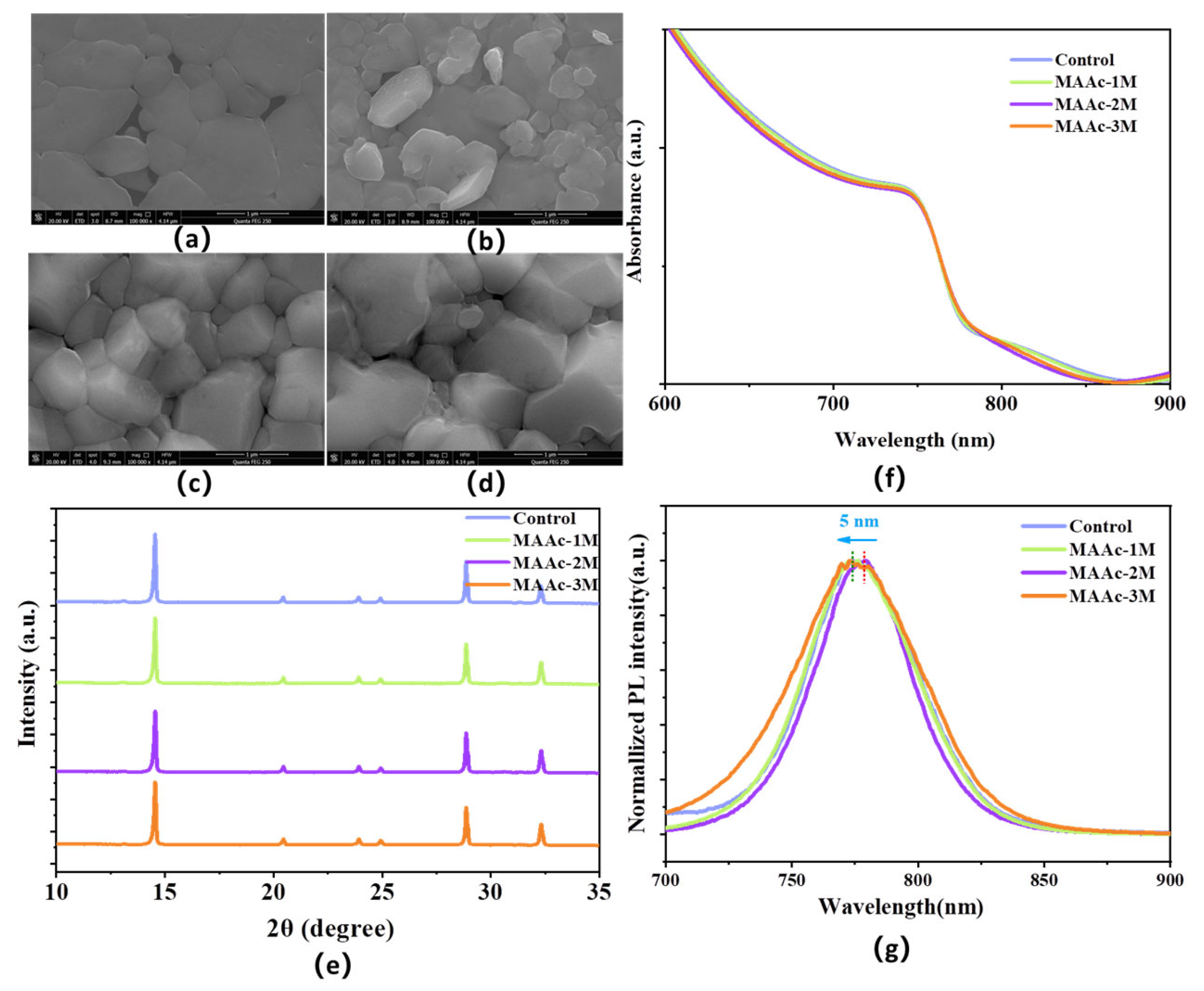
| Samples | I(110)/I(220) | I(310)/I(220) | I(110)/ΣI(6peaks) | I(310)/ΣI(6peaks) |
|---|---|---|---|---|
| Control | 1.573 | 0.515 | 0.455 | 0.149 |
| MAAc-1M | 1.532 | 0.648 | 0.425 | 0.180 |
| MAAc-2M | 1.456 | 0.665 | 0.413 | 0.189 |
| MAAc-3M | 1.547 | 0.655 | 0.425 | 0.180 |
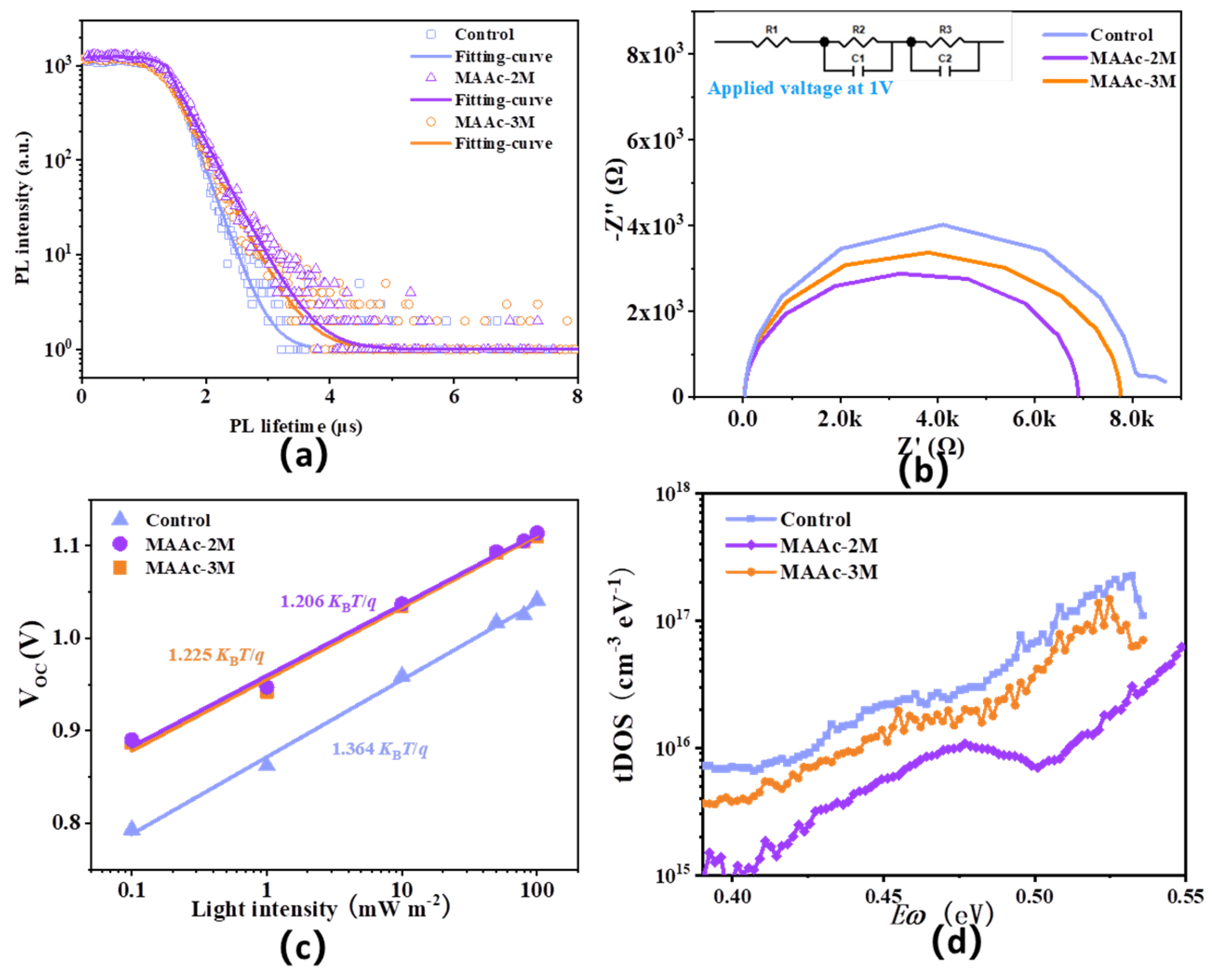
| Samples | τ1 (μs) | A1τ1/ΣAxτx (%) | τ2 (μs) | A2τ2/ΣAxτx (%) | τave (μs) |
|---|---|---|---|---|---|
| Control | 137.3 | 54.2 | 340.2 | 45.8 | 230.2 |
| MAAc-2M | 225.0 | 54.7 | 557.6 | 45.7 | 375.3 |
| MAAc-3M | 199.7 | 54.8 | 494.9 | 45.2 | 335.4 |
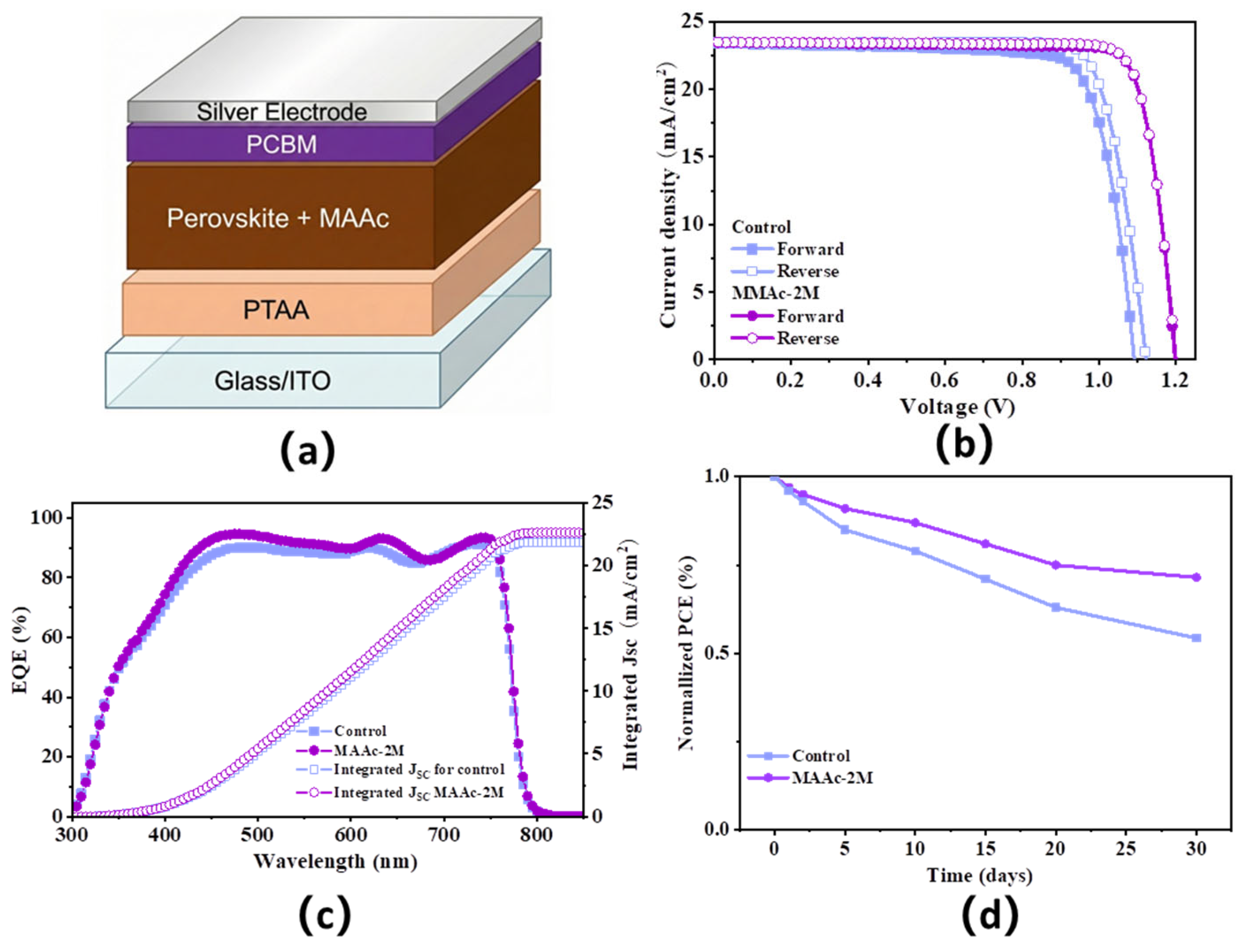
| Samples | Scan Direction | VOC (V) | JSC (mA cm−2) | FF | PCE (%) |
|---|---|---|---|---|---|
| Control | forward | 1.081 | 23.29 | 0.79 | 19.88 |
| reverse | 1.092 | 23.37 | 0.80 | 20.41 | |
| MAAc-2M | forward | 1.206 | 23.51 | 0.826 | 23.50 |
| reverse | 1.208 | 23.45 | 0.829 | 23.68 |
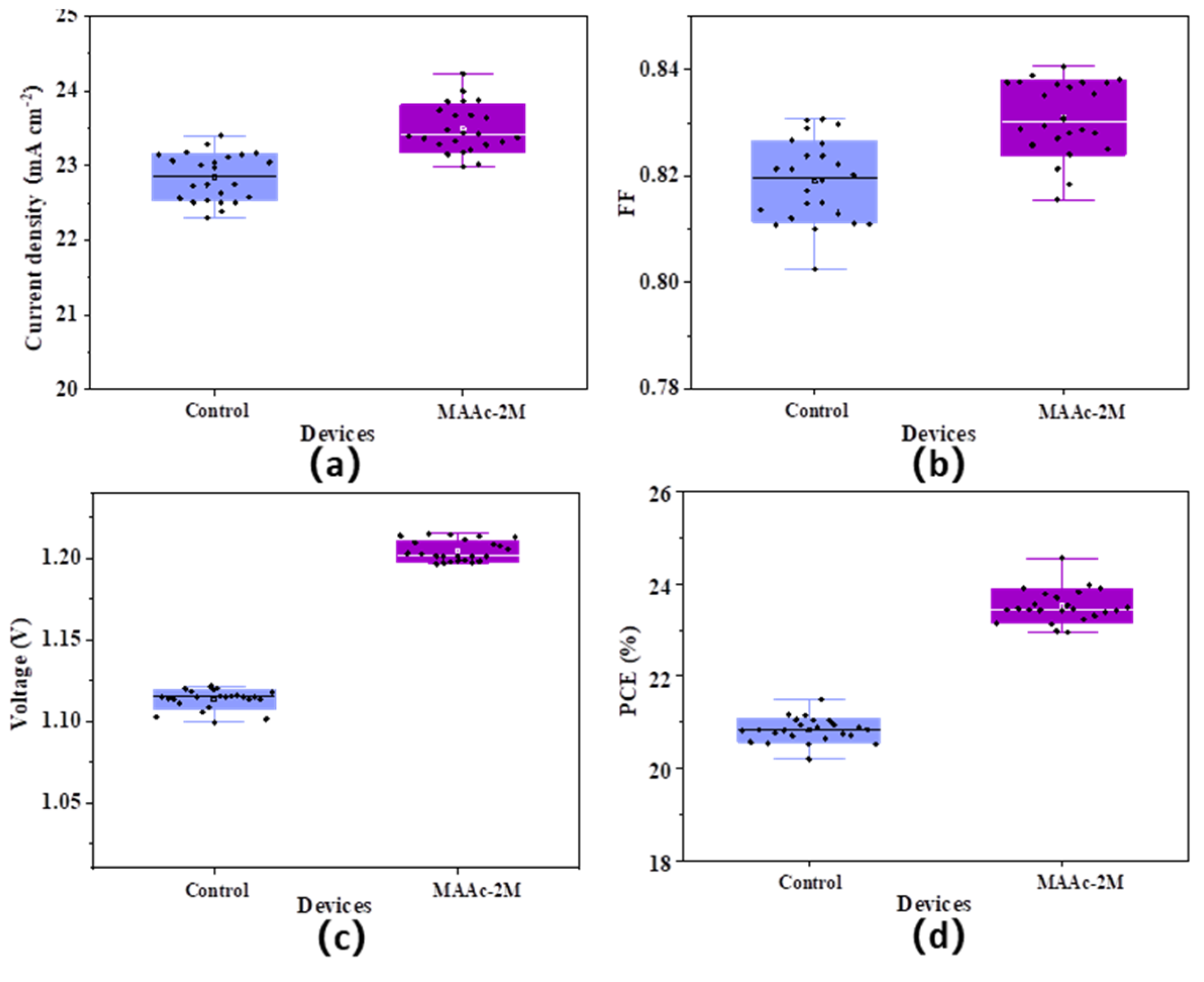
| Styles | VOC (V) | JSC (mA cm−2) | FF | PCE (%) |
|---|---|---|---|---|
| Control | 1.113 ± 0.006 | 22.84 ± 0.32 | 0.813 ± 0.008 | 20.51 ± 0.37 |
| MAAc-2M | 1.203 ± 0.006 | 23.49 ± 0.32 | 0.822 ± 0.007 | 23.42 ± 0.26 |
Disclaimer/Publisher’s Note: The statements, opinions and data contained in all publications are solely those of the individual author(s) and contributor(s) and not of MDPI and/or the editor(s). MDPI and/or the editor(s) disclaim responsibility for any injury to people or property resulting from any ideas, methods, instructions or products referred to in the content. |
© 2025 by the authors. Licensee MDPI, Basel, Switzerland. This article is an open access article distributed under the terms and conditions of the Creative Commons Attribution (CC BY) license.
Share and Cite
Zhang, H.; Song, J.; Deng, Y. Protic Ionic-Liquid Precursor Engineering with Methylammonium Acetate for Efficient and Stable Inverted Triple-Cation Perovskite Solar Cells. Crystals 2026, 16, 19. https://doi.org/10.3390/cryst16010019
Zhang H, Song J, Deng Y. Protic Ionic-Liquid Precursor Engineering with Methylammonium Acetate for Efficient and Stable Inverted Triple-Cation Perovskite Solar Cells. Crystals. 2026; 16(1):19. https://doi.org/10.3390/cryst16010019
Chicago/Turabian StyleZhang, Hanhong, Jun Song, and Yuanlong Deng. 2026. "Protic Ionic-Liquid Precursor Engineering with Methylammonium Acetate for Efficient and Stable Inverted Triple-Cation Perovskite Solar Cells" Crystals 16, no. 1: 19. https://doi.org/10.3390/cryst16010019
APA StyleZhang, H., Song, J., & Deng, Y. (2026). Protic Ionic-Liquid Precursor Engineering with Methylammonium Acetate for Efficient and Stable Inverted Triple-Cation Perovskite Solar Cells. Crystals, 16(1), 19. https://doi.org/10.3390/cryst16010019