Abstract
Three doping models with different aluminum atomic contents on the δ-Pu surface are established. The surface energy of the doping model and the electronic structure at the Fermi level is calculated. After finding out the stable structure, the adsorption behavior of the H atoms at three different positions is simulated. It is concluded that the surface energy of the doping model obtained by substituting two Al for plutonium (100) is the lowest (0.041 eV), and the structure is the most stable. In the H adsorption, the heart site has the largest adsorption energy (4.659 eV), which is the most stable adsorption. In the work function analysis, the Pu-Al system, after adsorbing an H atom, less likely to lose electrons, thus slowing down further chemical corrosion. In the doping model, the 5f and 6d electrons of the plutonium and the 3d electrons of the aluminum have strong interactions to form a stable structure.
1. Introduction
Plutonium (Pu), located in the third subgroup of the periodic table, has atomic number 94, and belongs to actinides. Plutonium is located between the light actinides, which contain delocalized 5f electrons, and the heavy actinides, which contain localized 5f electrons. The electronic properties of plutonium are extremely special, with singular f-f electron interactions and obvious relativistic effects [1]. Among transuranic elements, plutonium is a reactive metal, which is prone to surface reactions with active gases such as hydrogen, oxygen, water vapor, and carbon monoxide in the air, and even weak chemical interactions with rare gases [2], which is mainly determined by the electronic properties of the 5f layer [3,4]. In dry air, because of the dense oxide film formed on the surface of plutonium, the oxidation rate will be slowed down, but in a hydrogen or humid environment, the oxide film will be destroyed and the corrosion rate will increase dramatically [5]. The first stage of chemical corrosion is the adsorption of molecules or atoms. Therefore, this paper starts with the study of the adsorption of H atoms on the metal surface, hoping to provide effective theoretical support for aging and corrosion research.
The melting point of plutonium is 913 K. There are six stable phases in the range from absolute zero to melting point [1], namely, monoclinic (α-plutonium and β-plutonium), oblique (γ-plutonium), face-centered cubic (δ-plutonium), body-centered tetragonal (δ-plutonium), and body-centered cubic (ε-plutonium). Among them, δ-plutonium has the best mechanical properties and mechanical processing properties, so it has attracted the most attention. The phase transition of plutonium metal not only exhibits complex relationships at different temperatures but is also very sensitive to chemical doping and environmental pressure. Moreover, the addition of gallium or aluminum can increase the temperature stability of δ-plutonium, and improve the flexibility and ductility of the metal [6], which plays an important role in the processing, storage and application of plutonium materials. At present, a large number of theoretical calculations on corrosion aging of pure δ-Pu metals on each surface under different atmosphere conditions have been performed [7,8,9,10]. According to the study by Wei Hongyuan et al., the adsorption of hydrogen on the δ-Pu (100) surface is physical adsorption, and when hydrogen dissociates, the adsorption of hydrogen on the δ-Pu (100) surface changes to strong chemisorption. Luo Wenlang explained in detail the reaction mechanism of hydrogen on the surface of plutonium metal [11]. At present, there are not many studies on the Plutonium-Aluminum doping system. In this paper, the Plutonium-Aluminum doping system is chosen to study the related topics.
In this paper, we use the first principle calculation method to study the adsorption of hydrogen atoms on the surface of Plutonium-Aluminum systems. The most stable structure of δ-Pu is fitted by structure optimization calculation, the δ-Pu lattice constant of the stable structure is determined from theoretical calculation. The models with different aluminum doping concentrations are established, and the differences in surface energy, adsorption energy and electronic structure between the post-doping model and the pre-doping model are calculated and compared. In the study, three different hydrogen atom adsorption sites are simulated to analyze the surface stability of the Plutonium-Aluminum system and the electronic structure, energy state and other properties of the adsorption behavior of H atoms.
2. Materials and Methods
2.1. Calculation Method
In this paper, all of the first principles based electronic structure calculations are made by Vienna Ab-Initio Simulation Package (VASP) software based on density functional theory (DFT) to completion [12,13]. The wave function of the valence electrons outside the nucleus is expanded with the Projector Augmented Wave (PAW) basis set [14,15]. The exchange-correlation generalization is handled by the Perdew-Burke-Emzerh (PBE) approximation in the framework of the Generalized Gradient Approximation (GGA) [16,17]. The pseudopotential of UPSS is used to describe the interaction of valence electrons with the core. The pseudopotential method treats the inner electrons and nuclei as “cores”, replaces them with an equivalent potential field, and computes only the wave functions of the outer valence electrons. The cutoff energy for all calculations is chosen to be 400 eV. The valence electrons of Pu are described as 6s26p66d25f47s2, and Al’s valence electrons are described as 3s23p1. The Gamma protocol is used to sample in the irreducible Brillouin zone. In terms of calculation parameter setting, the K point parameter of Brillouin zone integration is selected as 5 × 5 × 2. The Slab supercell surface is set with a vacuum layer of 15 Å and the Slab position is set aside for 2 Å. Spin polarization effects are taken into account in all calculations. The convergence criterion of the self-consistent field iteration is: The self-consistency is considered to be completed when the total energy difference between the last two times does not exceed 10−5 eV. The convergence criterion of Hellmann Feyman force field optimization is: when the forces of all ions are less than 0.05 eV/Å, the structure optimization is considered complete.
Surface energy is an important concept in solid state physics, and its most rigorous scientific definition is the non-volumetric work required to reversibly increase the surface area of a substance. According to the definition of surface energy, the surface energy of a solid can be calculated from the first principles by subtracting the energy of the same number of bulk atoms from the total surface energy of the slab cell and then dividing it by the total surface area above and below the slab cell, i.e.,
In the above equation, is the surface energy of the surface system, is the total energy of the slab cell, is the total number of atoms in the slab cell, is the energy of bulk phase atoms, and is the area of the upper and lower bottom surfaces of the slab cell.
Adsorption energy, the energy generated in the adsorption process, occurs because the movement speed of the molecules in the adsorption process changes from fast to slow and finally stops on the surface of the adsorption medium, so a part of the energy will be released due to the reduction of the speed, this part of the energy is called adsorption energy. The heat of adsorption is the negative value of the adsorption energy. When the adsorption energy is positive, the heat of adsorption is negative, which means that the adsorption is an exergonic reaction. The larger the value, the stronger the adsorption is, and the higher the stability of the adsorption is.
In the above equation, is the energy of the optimized adsorption configuration, is the energy of the H atom itself, is the energy of the surface of the system optimized separately before adsorption, and each energy on the right side of the equation is the energy optimized in the same way and with the same precision. According to this formula, the larger the adsorption energy is, the more stable the corresponding structure is.
In the calculation involved in this paper, the system energy after atomic adsorption and the system energy without hydrogen adsorption are obtained under the same calculation conditions, parameter settings, and precision requirements.
2.2. Calculation Model
2.2.1. δ-Pu Lattice Optimization
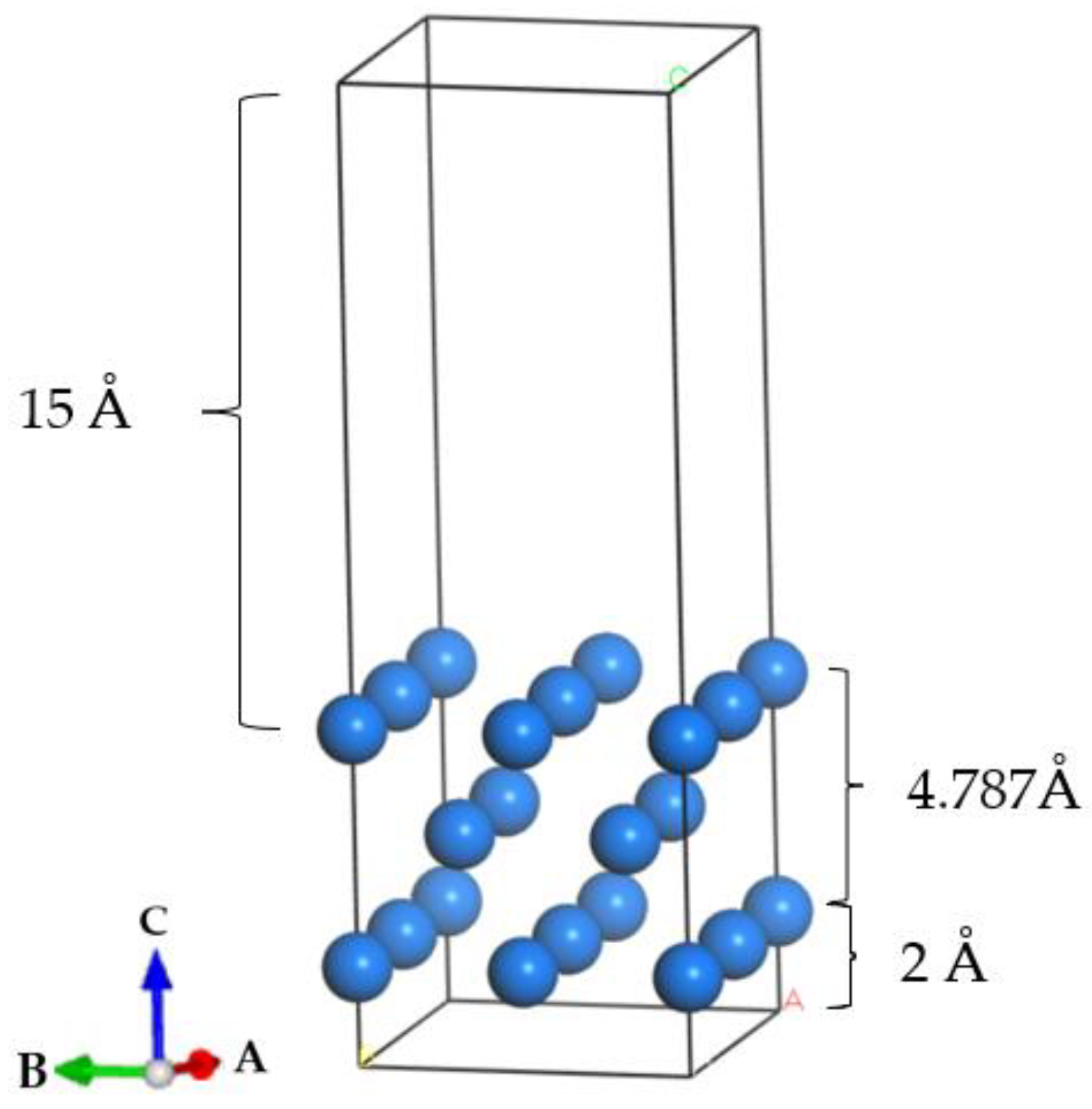
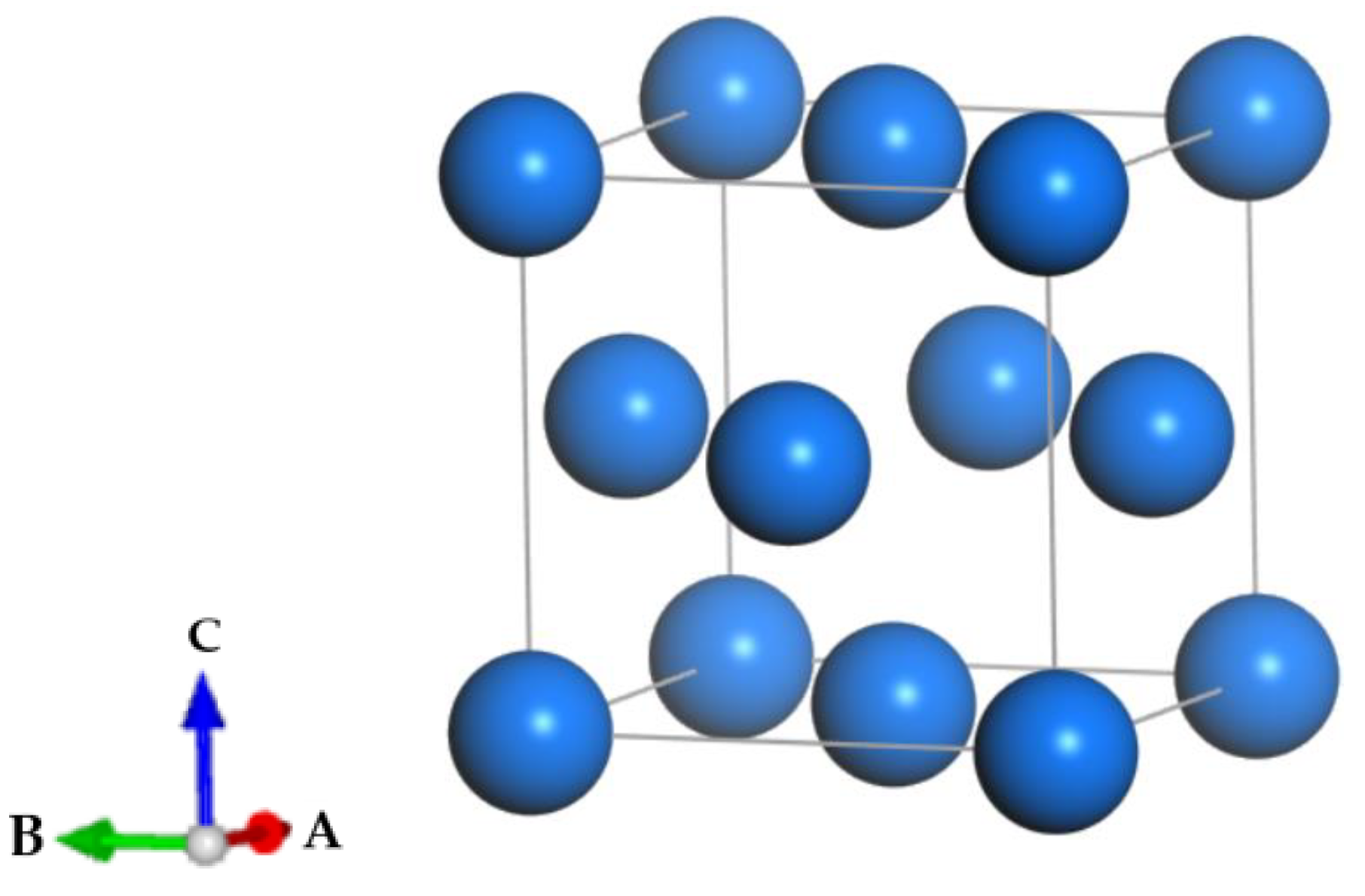
The crystal structure of the δ-Pu metal is face-centered cubic (FCC). The space group code is FM-3M. The experimental values of lattice constants are A = B = C = 4.637 Å [18], the volume of A single cell is 99.7037 Å 3. According to the principle of minimum energy, the structure with the lowest δ-Pu cell energy is the most stable. After optimization calculation, the lattice constant of the stable structure of the δ-Pu cell is A = B = C = 4.787 Å, and the volume V = 109.6959 Å 3. The error between the lattice constant and the experimental value is 3.2%, which is in good agreement. The crystal structure model optimized for δ-Pu is shown in Figure 1.
Figure 1.
A single cell structure of δ-Pu.
2.2.2. Establishment of Doping System Model
Theoretically, because δ-Pu is a face-centered cubic structure with high symmetry, each crystal plane family is completely equivalent. There are three crystal plane families of δ-Pu, which are {100}, {110}, and {111}, respectively. According to Lee’s research [19], (100) surface is more stable. Therefore, according to the optimized δ-Pu cell structure, the (100) plane is selected to build the crystal orientation plane model of δ-Pu in this paper. When constructing the adsorption model, three atomic layers are used to simulate the δ-Pu surface. The vacuum layer thickness is set to 15 Å, and the slab position is set aside for 2 Å. The structure of the crystal plane is shown in Figure 2. The crystallographic coordinates are the same for the 3D presentations in Figure 2, Figure 3, Figure 4, Figure 5 and Figure 6.
Figure 2.
A surface model of δ-Pu (100). (A, B, C are the direction of coordinate axis, same below).
Figure 3.
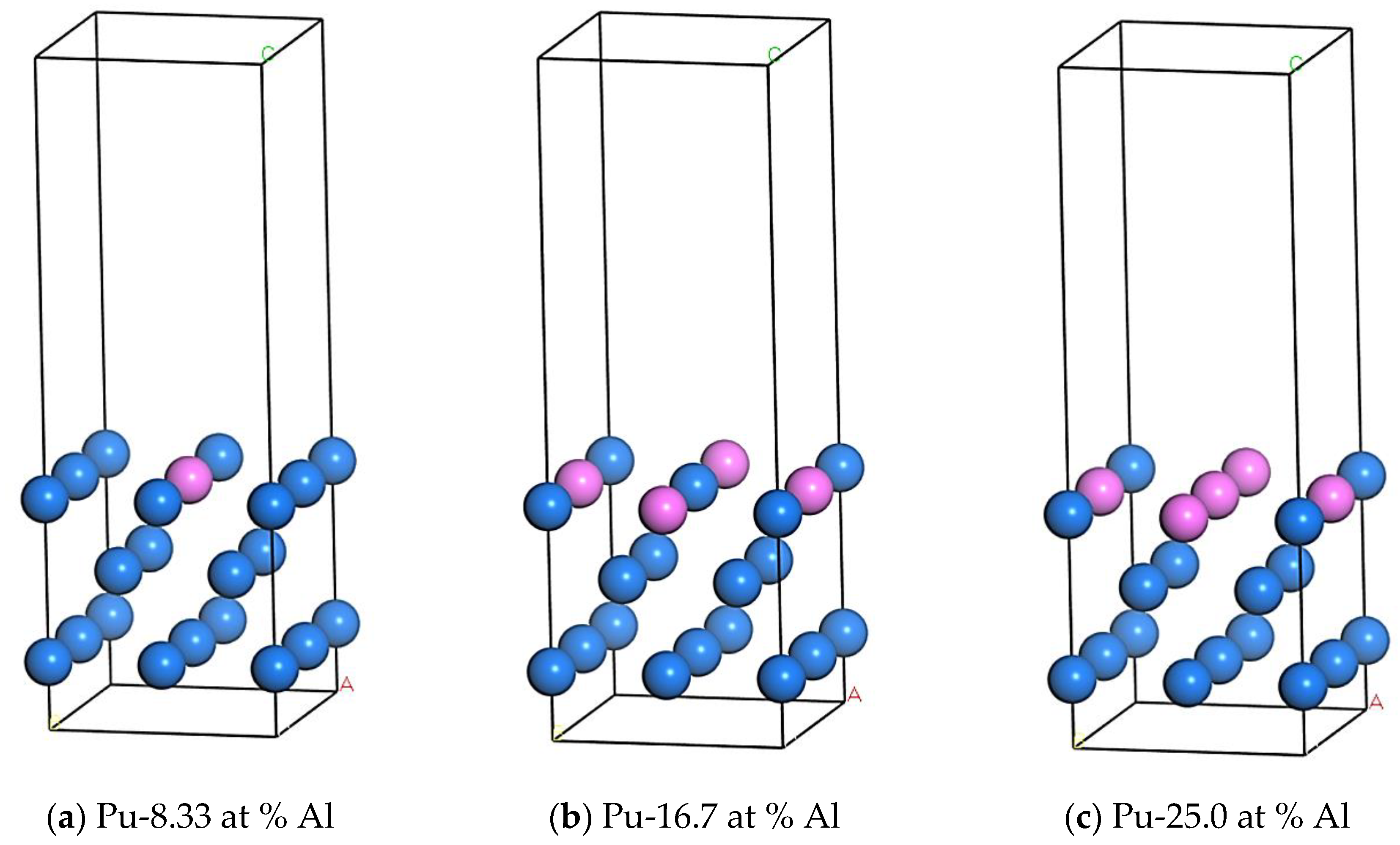
Pu-Al system model with different Al doping amounts. (The blue spheres represent plutonium atoms, and the pink spheres represent aluminum atoms).
Figure 4.
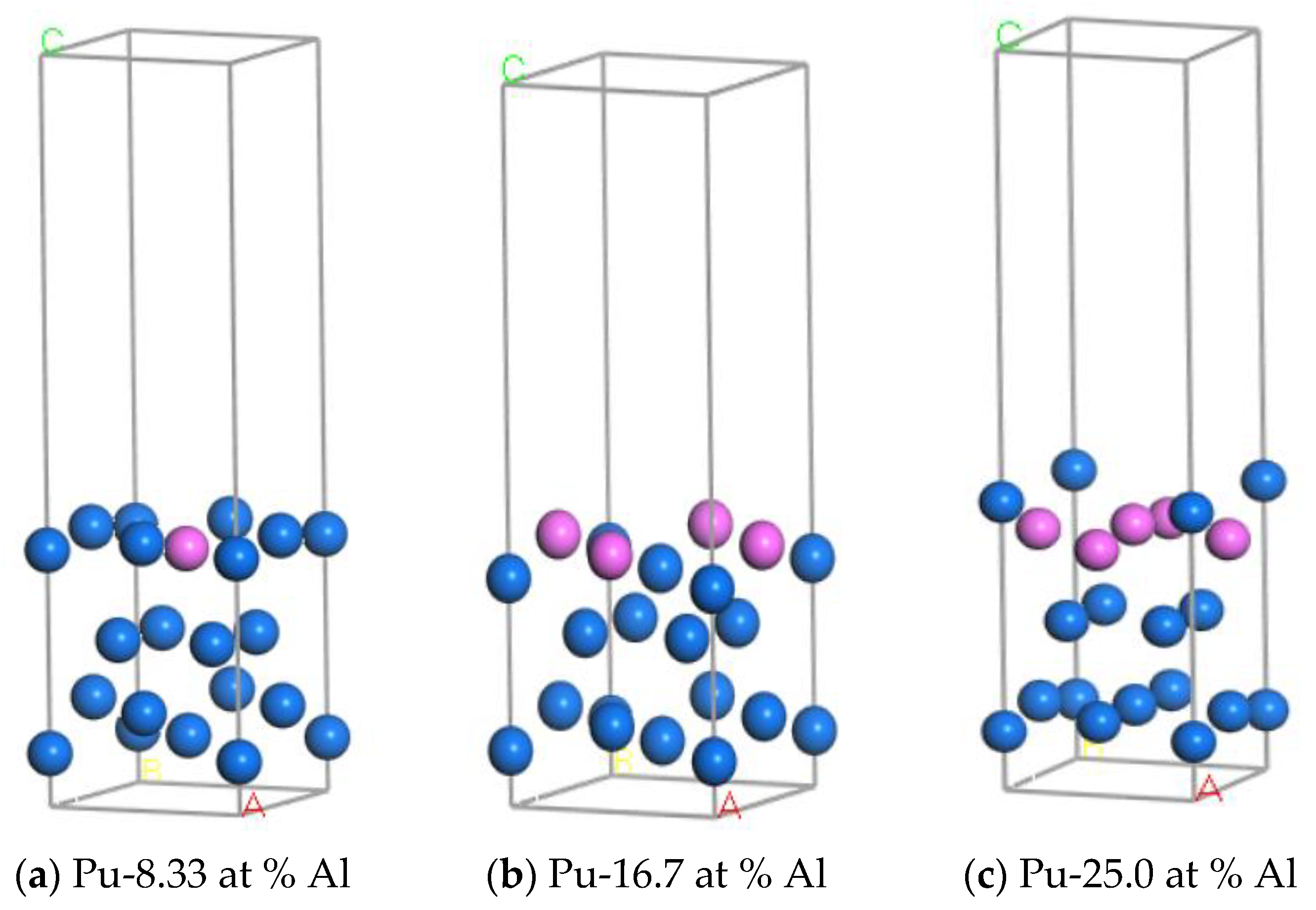
The relaxed Pu-Al system model with different Al doping amounts.
Figure 5.
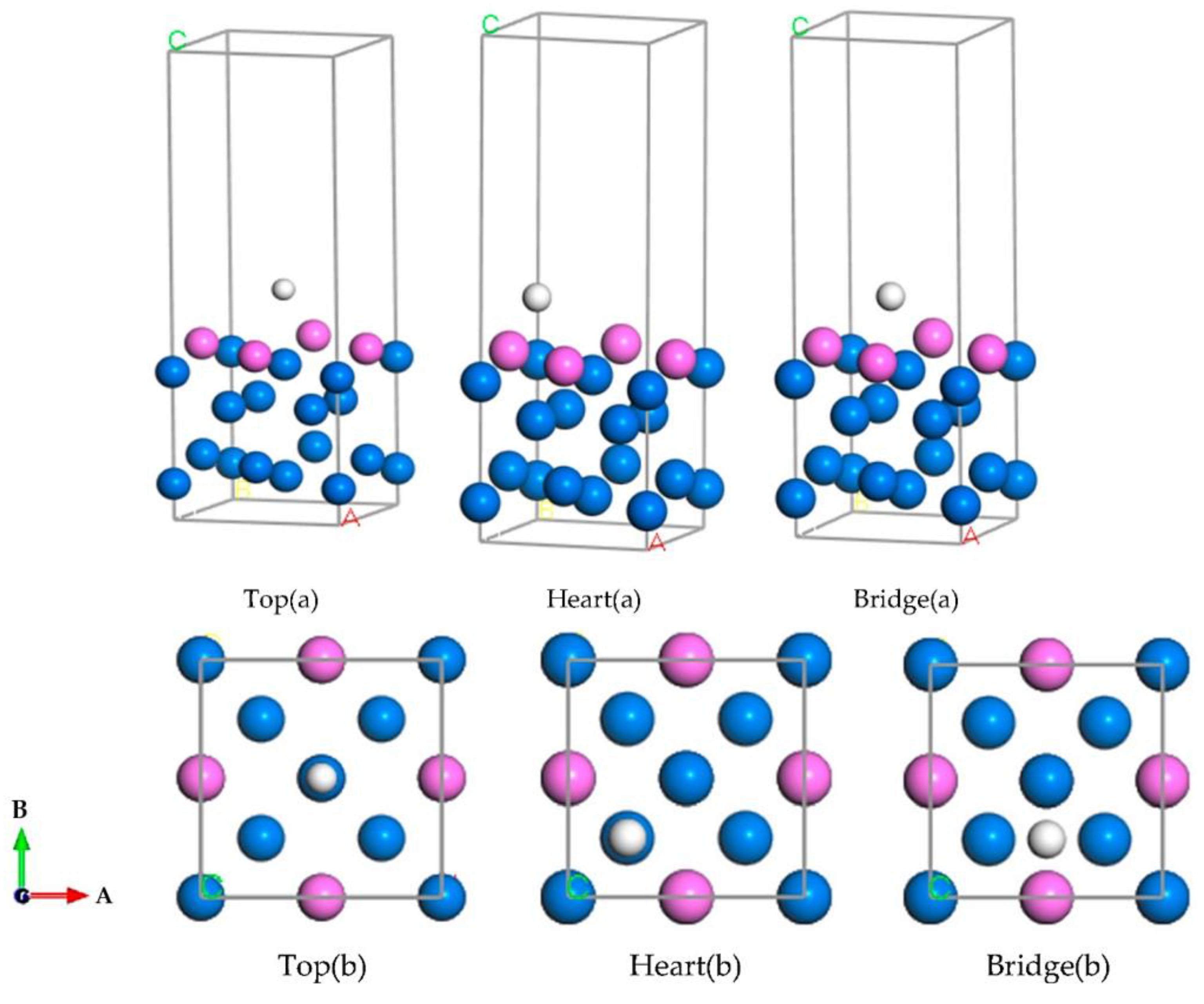
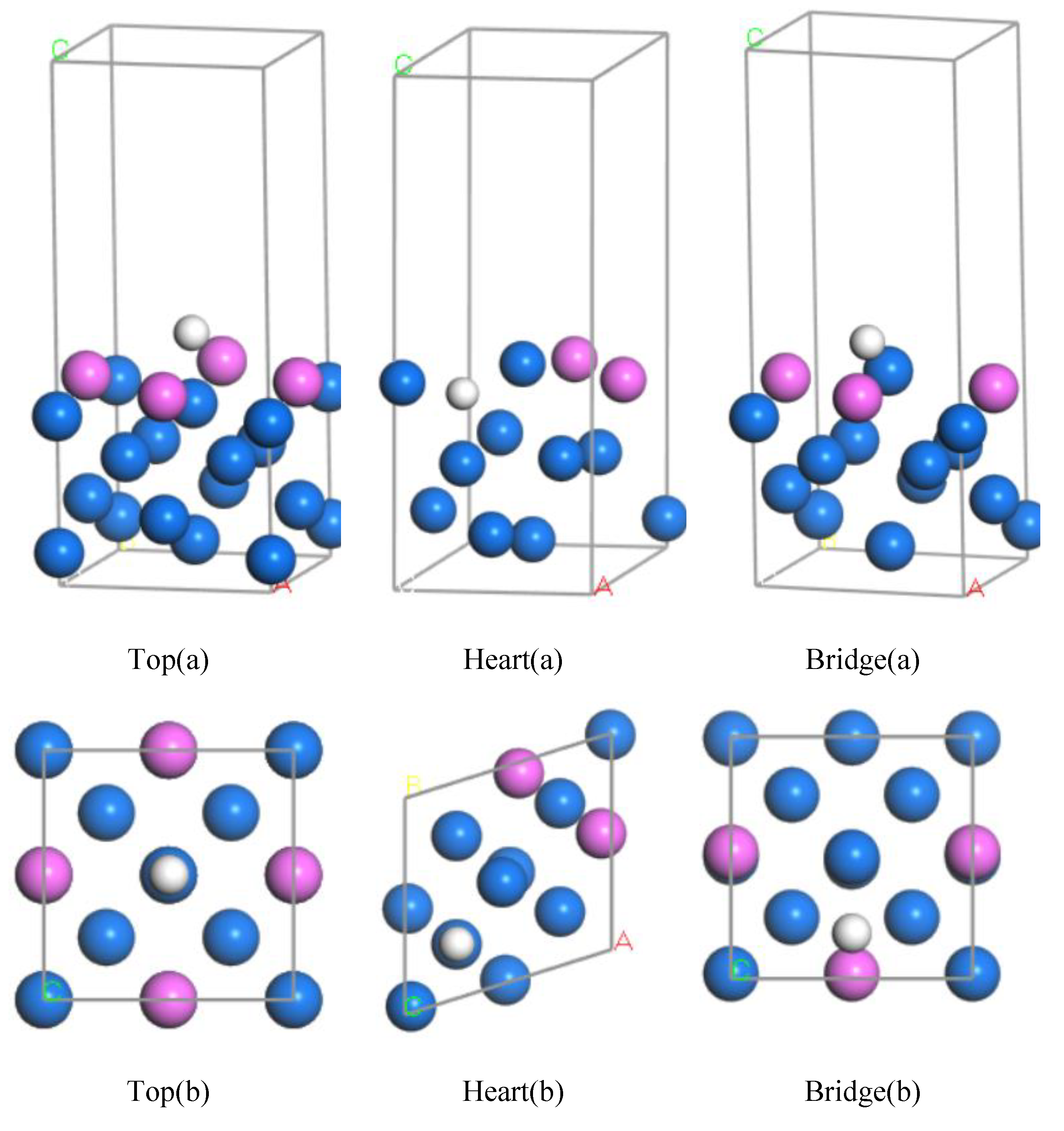
Different initial adsorption configurations of H on the surface of the plutonium-aluminum system (a is an oblique view, b is a top view; The blue spheres represent plutonium atoms, the pink spheres represent aluminum atoms, the white spheres represent H atoms).
Figure 6.
Model of H atom adsorbed Plutonium-Aluminum system after structure optimization (a is oblique view, b is top view).
The aim was to investigate the effect of aluminum atom doping on the surface properties, which are strongly influenced by the outermost atoms. Therefore, according to the surface symmetry, by replacing different numbers of aluminum atoms in the outermost layer of δ-Pu (100), the following three doping models with different aluminum atom contents were conceived and established. The doping amounts were 8.33%, 16.7% and 25.0%, respectively. As shown in Figure 3.
2.2.3. Structure Optimization and Surface Energy Calculation of Doped System
After Al replacement, it is necessary to re-optimize the new configuration. Similarly, the conjugate gradient optimization algorithm is used to optimize the structure of the three configurations, and the parameters are set in the same way as the previous steps. During optimization, the atomic position, cell shape, and volume are optimized at the same time, so the supercell parameters of the optimized structure are changed. After optimization, three results were obtained, as shown in Figure 4.
As can be seen from the results in Table 1, Pu-16.7 at % Al has the lowest surface energy. Therefore, this configuration is the most stable doping case. Afterwards, the subsequent calculations are based on this configuration. What is remarkable is that the stable doping model in the Plutonium-Aluminum system is different from that in the plutonium gallium system, which is Pu-8.33 at % Ga in Li’s research [20].
Table 1.
Surface energy of each doping model.
2.2.4. Adsorption Model and Calculation of H Atom
After confirming a stable Pu-Al model, an H atom is placed on the surface of the model, which means that there are equivalent to 10 Pu atoms, 2 Al atoms and 1 H atom in the model. The H atom is placed at an initial distance of 3 Å from the outermost atom of the plutonium aluminum alloy to simulate the initial state of the adsorption process and ensure that the interaction at this distance is small enough. For the adsorption position of the H atom, there are three conditions: the distribution is top, heart and bridge, as shown in Figure 5. These three sites are also the most common adsorption sites in adsorption studies by others [2,9,11].
The adsorption process of the three prespecified H atom adsorption models is calculated by first principles, and the results are shown in Figure 6. As the symmetry in the structure is destroyed after the optimization calculation, the single supercell seems to become “irregular”. The reason for this is that the optimization calculation process relaxes both the atoms and the lattice, which makes the supercells lose the original symmetry.
3. Results
3.1. Calculation of Adsorption Energy
According to the definition of adsorption energy, it is the difference between the energy of the system after adsorption and the energy of the system before adsorption. As shown in Table 2 below.
Table 2.
Adsorption energy of each adsorption site.
According to the calculation results, the adsorption energy of each adsorption site has the relationship of Heart > Bridge > Top. According to the definition of adsorption energy, a positive number of the adsorption energy means that the adsorption is an exothermic reaction, and the entropy of the system is decreasing. The larger the value of adsorption energy means the stronger the adsorption strength and the stronger the adsorption stability. Therefore, it can be concluded that the H atom is more inclined to adsorb on the heart site during the adsorption on the plutonium aluminum surface. Macroscopically, compared with the top position and bridge position, the H atom in the heart site has better structural symmetry and more comprehensive coordination with the metal surface atoms around it, and the force situation is also the most stable. Compared with Wei’s study [21], the adsorption site of the H atom on the plutonium surface is also a heart site, but the adsorption energy of the H atom under the plutonium system is only 3.16 eV, while it can be seen in the above table that the adsorption energy is larger under the Plutonium-Aluminum system (a difference of 1.49 eV). At the same time, since the adsorption energy is much higher than 0.415 eV; preliminarily, it can be confirmed that the adsorption process of H atoms on the surface of the Plutonium-Aluminum alloy belongs to chemisorption, while the adsorption process of H atoms on the surface of the plutonium system belongs to physical adsorption [21].
Therefore, this more stable adsorption situation is adopted for the following calculation and analysis.
3.2. Surface Work Function Analysis
The surface work function is defined as the minimum energy needed to move an electron from the Fermi level on the solid surface to infinity, that is, the energy needed to excite the electron at the Fermi level, which is also reflected as the absolute energy of the Fermi level. The size of the work function indicates how strongly the electron is bound in the metal. The larger the work function is, the less easily the electron will leave the metal. In a reaction, the surface work function can be understood as the charge transfer barrier when an atom is in contact with a surface material. By definition, the work function can be calculated using the following formula.
where is the charge of an electron, is the electrostatic potential of the vacuum surface accessory, and is the Fermi energy level of the metal.
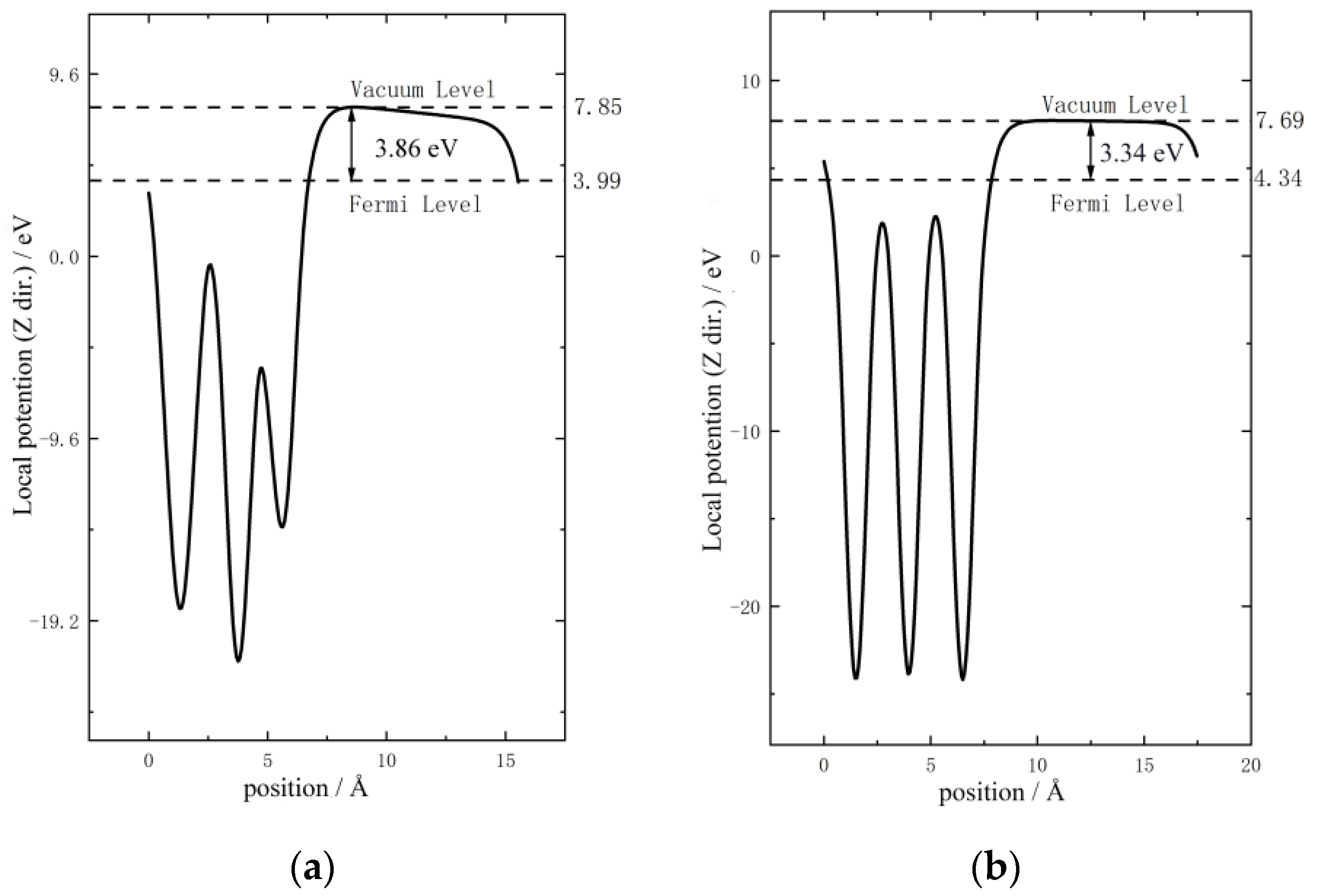
The electrostatic potential energy of the system can be obtained through a self-consistent calculation, as shown in Figure 7. For the Pu-Al system, when the horizontal coordinate reaches 8 Å, the data between positions 9–13 Å are almost stable, and the average of this section is used as the electrostatic potential energy of 7.85 eV. The Fermi level of the system is 3.99 eV in the Pu-Al system. The surface work function of the Pu-Al system is 3.86 eV. Using the same method, we can calculate that the work function of the δ-Pu system is 3.34 eV. The surface work function of H in the δ-Pu (100) system is 0.51 eV larger than that of 3.35 eV calculated when the H atoms are adsorbed on the δ-Pu (100) surface. Compared with the δ-Pu system adsorbed with H, the Pu-Al doped system adsorbed with H has stronger electron binding ability, which makes it less likely to release electrons outwardly, thus reducing the chemical reactivity of the system. There is no experimental data available on the surface work function of plutonium. The work function of plutonium (100) calculated by Hao et al. using the FLMTO method is 3.68 eV [22], which is not a big difference from ours. It can be concluded that the Pu-Al system with an adsorbed H atom is less likely to have electrons leaving the metal surface than the δ-Pu system with an adsorbed H atom, which can be understood as the surface of the Pu-Al system with an adsorbed H atom has a higher ability to capture electrons than that of the δ-Pu system with an adsorbed H atom. This makes the Pu-Al system, after adsorbing an H atom, less likely to lose electrons, thus slowing down further chemical corrosion. Therefore, the Pu-Al system has higher applicability.
Figure 7.
Local electrostatic potential energy in the Z direction of different systems (Pu-Al system (a) δ-Pu system (b)).
3.3. Density of States Analysis
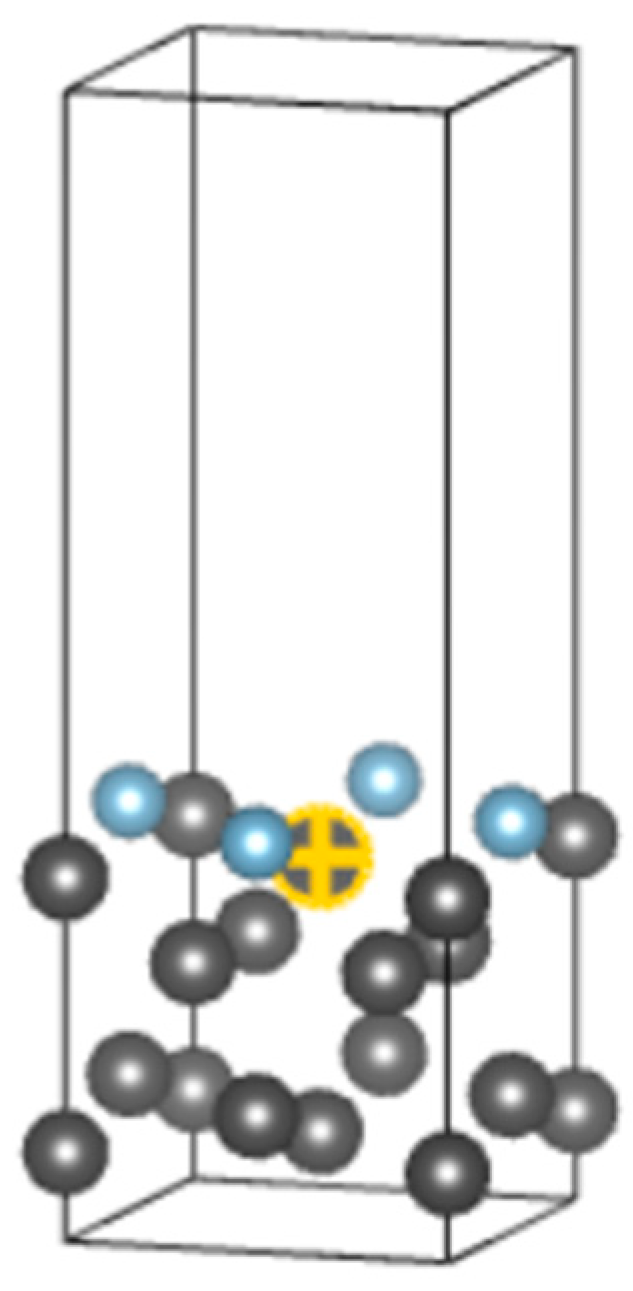
Density of states (DOS) is the number of states (number of vibration modes) per unit frequency interval. Further calculational analysis of the density of states can give the characteristics of electronic states intuitively and provide further study of the interaction between atoms. To further investigate the microscopic interactions between the H atom and surface atoms of the Plutonium-Aluminum system and pure plutonium system, the most stable configuration for H adsorption is selected, and the density of states is calculated and analyzed. The central plutonium atom is selected, Figure 8.
Figure 8.
The selected Pu atoms for DOS analysis. (The blue spheres represent aluminum atoms, the grey spheres represent plutonium atoms, the selected one is in yellow).
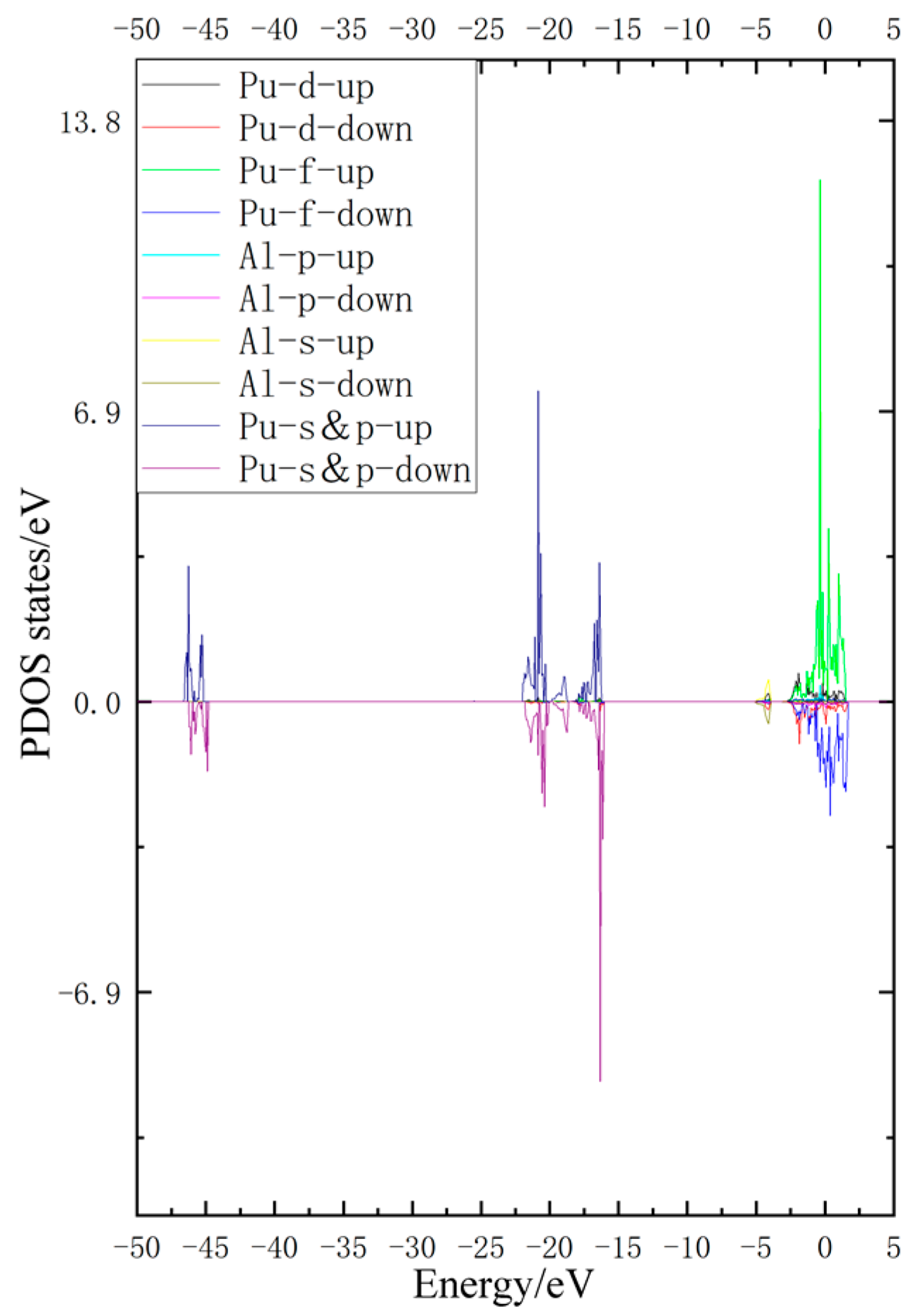
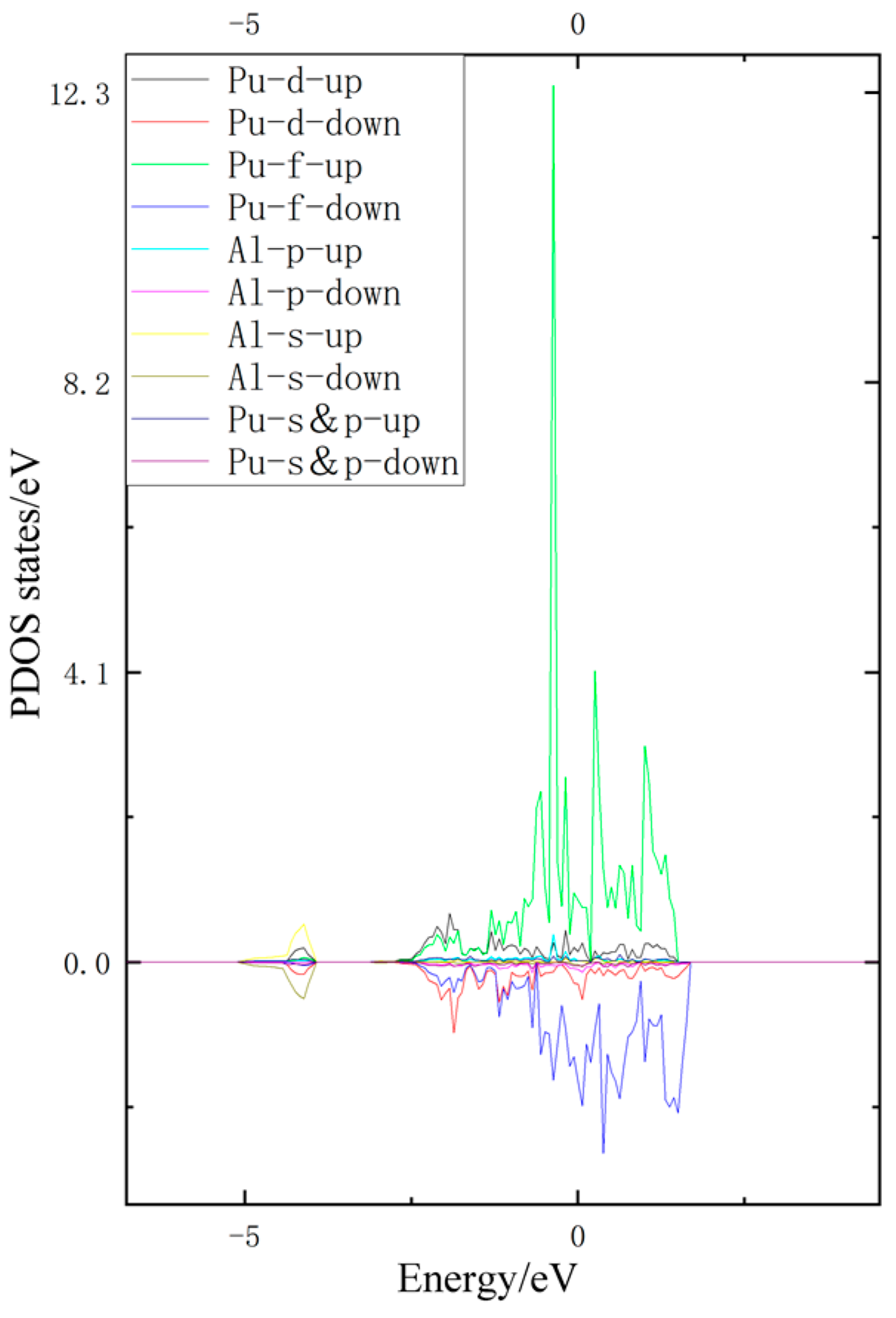
Since the Pu/6s and Pu/6p are close to the nucleus, Figure 9 shows that the density of states energy of Pu/6s and Pu/6p is much lower than the Fermi level, which does not belong to the valence electrons and does not participate in bonding. Near the Fermi level, the DOS of the Pu/5f orbitals is generally a large spike with a correspondingly narrow energy band, indicating that the f-electrons are relatively localized. The energy of Pu/6d electrons is lower than that of Pu/5f electrons, and they are roughly distributed in the same energy interval. The Al/3s and Al/3p orbital electronic states of aluminum atoms occupy lower orbitals than others of Pu and are mainly distributed near the Fermi level.
Figure 9.
PDOS of Pu-Al system.
As shown in Figure 10, the microscopic interaction between plutonium and aluminum atoms can be further understood by analyzing the partial-wave density of states. As shown in Figure 10, the zero point of the horizontal axis is the Fermi level, and the electronic states near the Fermi level are mainly the Pu/5f and Pu/6d electrons and the Al/3p electrons. The electronic states of the three orbitals are distributed in the same energy interval of −2.5 eV~1.5 eV, indicating that the hybridization occurs between the three orbitals of the plutonium atom and the aluminum atom, forming metal bonds. There is a strong interaction. Compared to the study of f-orbital DOS in the pure plutonium system by Xiong et al. [23], the Pu/5f in the Plutonium-Aluminum system has a wider energy band width (−1.25–2.5) and crosses the Fermi energy level. In other respects, the electronic structure characterization of plutonium atoms in the Plutonium-Aluminum system is similar to that of the pure plutonium system. Notably, at −4 eV away from the Fermi level, the Al/3s and the Pu/6d also undergo hybridization to a lesser extent.
Figure 10.
PDOS of Pu-Al system (near the Fermi level).
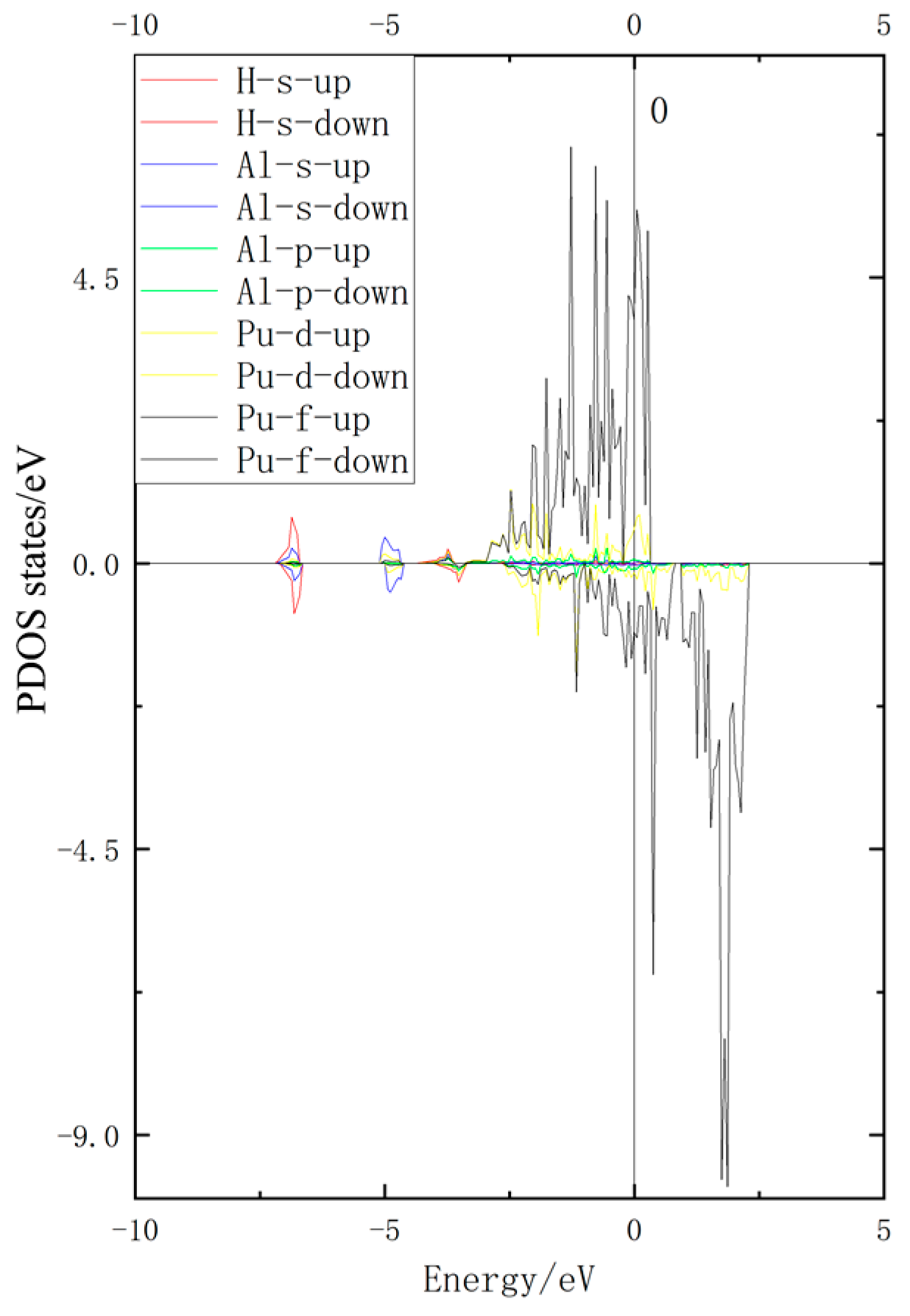
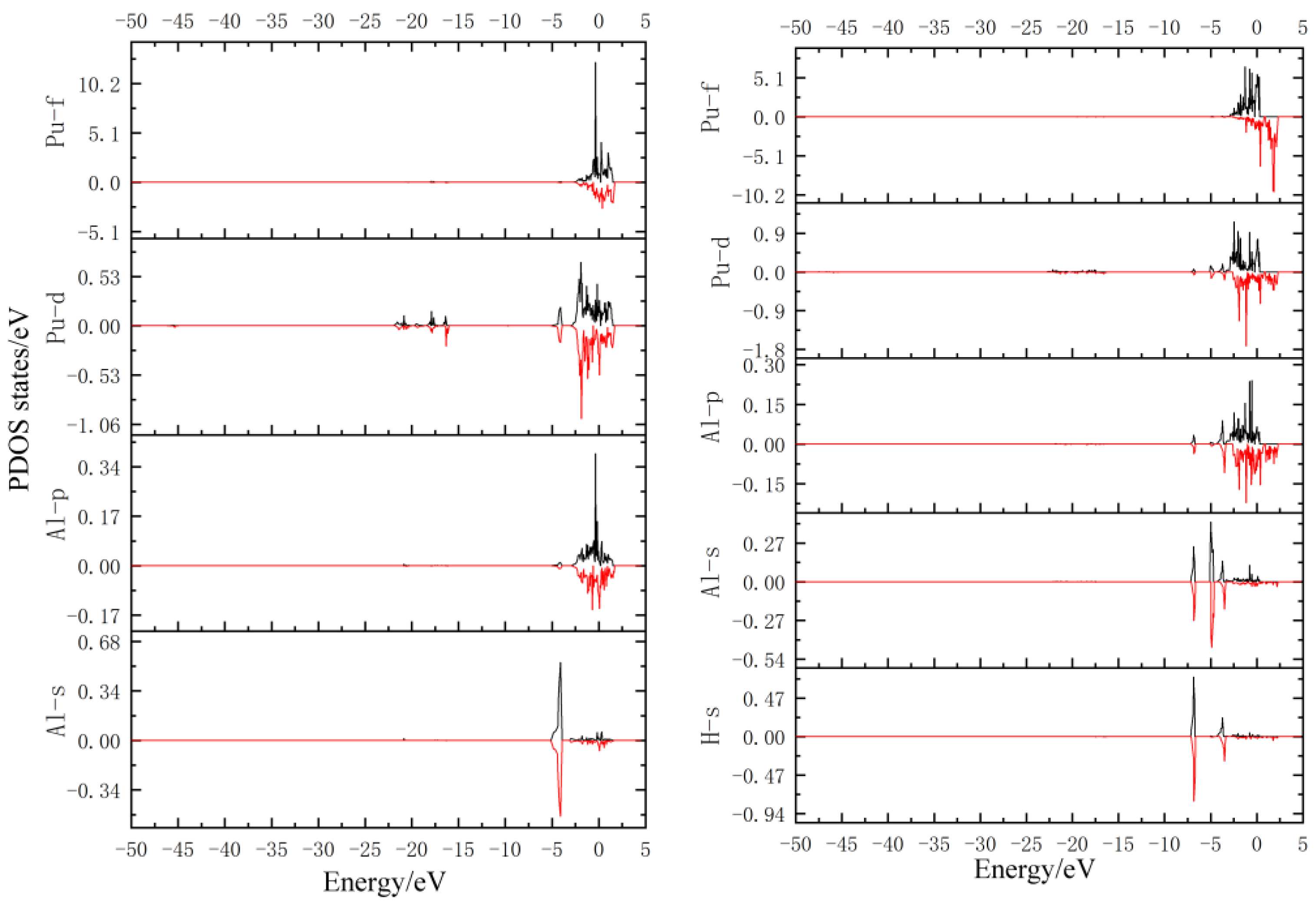
The PDOS figure after absorption of the hydrogen atom, as shown in Figure 11 and Figure 12, and analysis of the partial density of states, can realize the hydrogen atoms with recent plutonium atoms and aluminum, as well as track microscopic interaction between atoms. As shown in Figure 11 and Figure 12, the zero point of the horizontal axis is the Fermi level, and the electronic states near the Fermi level are still mainly Pu/5f and Pu/6d electrons and Al/3p electrons. The two elements exhibit obvious metal properties. Figure 12, on the right, shows the H/1s atom occupies −4 eV, overlapping with the position of Al/3s and Pu/6d. Seeing Al/3s and Pu/6d of peak change, this suggests that the H/1s atom is hybridized with the Al/3s and the Pu/6d. Both of them are involved in the interaction with the hydrogen atom, and only the electron of the hydrogen atom is occupied in this orbital.
Figure 11.
PDOS of Pu-Al system adsorbed with H (near the Fermi level).
Figure 12.
PDOS of Pu-Al system without H adsorbed (left), PDOS of Pu-Al system with H adsorbed (right). (Black and red represent spin up and down respectively).
3.4. Bader Charge Analysis
Bader charge analysis is an intuitive method for breaking down molecules into atoms developed by Richard Bader of McMaster University [23,24]. His definition of an atom is based on charge density, using what is called a zero-flux surface to split atoms; where a zero-flux surface is a two-dimensional surface whose charge density is the minimum perpendicular to the surface. Using Bader’s method in this way is useful for charge analysis.
According to the Bader charge calculation, results can be obtained from quantitative electron transfer. Two small aluminum atoms to four of the first floor plutonium atoms around 1, 2, 3, 4 shift, shown in Table 3. In a single cell in the middle of the four plutonium atoms is a small amount of 5–8 aluminum plutonium atoms near 1, 2, 3, 4 shift. In particular, it can be seen that the plutonium atoms at Pu-9 and Pu-10 transfer more electrons to the plutonium atoms at positions 1, 2, 3 and 4 in the first layer. From the calculation results, it can be seen that electrons are transferred from aluminum atoms to plutonium atoms, and also from inner plutonium atoms to outer plutonium atoms.
Table 3.
Surface atom charge transfer in Pu-Al system without H absorbed.
Comparing the two different surfaces after adsorption of the heart site hydrogen atom, shown in Table 4 and Table 5, the electron transfer can be quantitatively obtained from the results of the Bader charge calculations. More electron transfer occurs from aluminum and plutonium atoms to H atoms (0.75) in the surface layer of the Pu-Al system compared to that of the δ-Pu system (0.54), which are consistent with the surface work function. The bonds formed by the chemisorption of the Pu-Al system with H atoms are more stable than those formed by the adsorption of the δ-Pu system with H atoms. More plutonium atoms in the inner layer of the supercell surface of the Pu-Al system obtained a small amount of electron transfer.
Table 4.
Surface atomic charge transfer in Pu-Al system with H absorbed.
Table 5.
Surface atomic charge transfer in δ-Pu system with H absorbed.
4. Conclusions
The lattice structure and lattice constants of the δ-Pu cell are determined by using the conjugate gradient method of VASP. Three models with different aluminum atom contents are developed to obtain the optimal doping amount. The most stable Pu-Al dopant is determined by a first principles calculation of the surface energy of the doping model. The adsorption positions of three kinds of H atoms are simulated on the surface of the configuration, and the adsorption simulation is carried out. The electron transfer and the electronic structure at the Fermi level are calculated by first principles. The following conclusions are obtained:
- The surface energy of the Pu-16.7 at % Al doping model is the lowest, 0.040925 eV, and the structure is the most stable when two aluminum atoms replace the intermittent position on the plutonium (100) surface.
- By DOS analysis of the unabsorbed doping model, the Pu/5f and Pu/6d electrons interact strongly with the Al/3p electrons, forming a stable structure. At −4 eV away from the Fermi level, the Al/3s and the Pu/6d are also hybridized to a lesser extent.
- According to the adsorption energy analysis of the adsorption model, among the three adsorption positions of the H atoms, the central position has the largest adsorption energy and the most stable adsorption. The energy of the whole system is the lowest, and the H atoms are chemisorbed.
- According to the density of states analysis, the H/1s hybridizes with the Al/3s and the Pu/6d, and the H atom interacts with both atoms.
- According to the surface work function analysis, the Pu-Al doped system is less likely to lose electrons than the δ-Pu system after co-adsorption of the H atoms, thus slowing down further chemical corrosion.
Author Contributions
Conceptualization, M.Z. and L.L.; Data curation, M.Z.; Formal analysis, H.S.; Funding acquisition, L.L.; Investigation, H.S.; Methodology, H.S.; Resources, L.L. and H.H.; Software, H.S. and Y.Y.; Supervision, L.L. and H.H.; Validation, Y.Y.; Writing—original draft, H.S.. All authors have read and agreed to the published version of the manuscript.
Funding
This research received no external funding.
Data Availability Statement
Not applicable.
Conflicts of Interest
The authors declare no conflict of interest.
References
- Hecker, S.S. Plutonium—An Element Never at Equilibrium. Metall. Mater. Trans. A 2008, 39, 1585–1592. [Google Scholar] [CrossRef]
- Chen, Q.; Cao, K.; Ao, B.; Lai, X. First-principles Investigation of Adsorption of Rare Gas Atoms on Pu(100) Surface. At. Energy Sci. Technol. 2013, 47, 1931–1936. [Google Scholar]
- Boring, A.M.; Smith, J.L. Plutonium condensed-matter physics—A survey of theory and experiment. Los Alamos Sci. 2000, 26, 90–127. [Google Scholar]
- Jvan Ek, J.; Sterne, P.A.; Gonis, A. Phase stability of plutonium. Phys. Rev. B Condens. Matter 1993, 48, 16280. [Google Scholar] [CrossRef]
- Haschke, J.M.; Allen, T.H.; Stakebake, J.L. Reaction kinetics of plutonium with oxygen, water and humid air: Moisture enhancement of the corrosion rate. J. Alloys Compd. 1997, 28, 23–35. [Google Scholar] [CrossRef]
- Smith, C.S. Properties of Plutonium Metal. Phys. Rev. 1954, 94, 233–239. [Google Scholar] [CrossRef]
- Meng, D.; Luo, W.; Gan, L.; Chen, H. Density functional study of CO2 adsorption on Pu(100) surface. Acta Phys. Sin. 2009, 58, 8224–8229. [Google Scholar] [CrossRef]
- Qi, C.; Wang, T.; Wang, J.; Tao, S.; Qin, M. Study on Adsorption Behavior of CO2 on the δ-Pu(100) Surface Based on First-principles. Rare Met. Mater. Eng. 2021, 50, 2728–2737. [Google Scholar]
- Wei, H.; Hu, R.; Xiong, X.; Wang, G.; Song, H.; Luo, S. A first principle theory study of molecular hydrogen adsorption on δ-Pu(100) surface. J. Mol. Sci. 2010, 26, 37–41. [Google Scholar]
- Xiong, X.; Wei, H.; Luo, S.; Liu, G. A periodical density functional theory study of CO adsorption on δ-Pu(111) surface. J. Mol. Sci. 2009, 25, 50–54. [Google Scholar]
- Luo, W.; Wang, Q.; Ruan, W.; Xie, A.; Zhang, D.; Wang, X.; Gao, T. Study on Reaction Mechanism and Electron Density of Plutonium-hydrogen Interaction. At. Energy Sci. Technol. 2018, 52, 1345–1352. [Google Scholar]
- Hohenberg, P.; Kohn, W. Inhomogneous electron gas. Phys. Rev. 1964, 136, B864. [Google Scholar] [CrossRef]
- Kohn, W.; Sham, L.J. Quantum Density Oscillations in an Inhomogeneous Electron Gas. Phys. Rev. 1965, 137, 1697–1705. [Google Scholar] [CrossRef]
- Blöchl, P.E. Projected augmented-wave method. Phys. Rev. B Condens. Matter 1994, 50, 17953–17979. [Google Scholar] [CrossRef] [PubMed]
- Kresse, G.; Joubert, D. From ultrasoft pseudopotentials to the projector augmented-wave method. Phys. Rev. B 1999, 59, 1758–1775. [Google Scholar] [CrossRef]
- Perdew, J.; Burke, P.K.; Ernzerhof, M. Generalized Gradient Approximation Made Simple. Phys. Rev. Lett. 1998, 77, 3865–3868. [Google Scholar] [CrossRef]
- Perdew, J.P.; Chevary, J.A.; Vosko, S.H.; Jackson, K.A.; Pederson, M.R.; Singh, D.J.; Fiolhais, C. Erratum: Atoms, molecules, solids, and surfaces: Applications of the generalized gradient approximation for exchange and correlation. Phys. Rev. B Condens. Matter 1993, 46, 6671–6687. [Google Scholar] [CrossRef]
- Huda, M.N.; Ray, A.K. Electronic structures and bonding of oxygen on plutonium layers. Eur. Phys. J. B Condens. Matter Complex Syst. 2004, 40, 337–346. [Google Scholar] [CrossRef]
- Li, G.; Lai, X.; Sun, Y. An All-electron FLAPW Study of Geometric and Electronic Structures for δ-Pu Monolayer. Acta Phys.-Chim. Sin. 2005, 21, 686–689. [Google Scholar]
- Li, L.; Zhu, M.; Zheng, G.; Li, Y.; Yang, Y.; Liu, Y.; Su, H. First-Principles Study on the Adsorption Behavior of O2 on the Surface of Plutonium Gallium System. Materials 2022, 15, 5035. [Google Scholar] [CrossRef]
- Wei, H. Study of Adsorption, Dissociation and Diffusion Processes of Atoms and Molecules on δ-Pu. Ph.D. Thesis, China Academy of Engineering Physics, Beijing, China, 2010. [Google Scholar]
- Eriksson, O.; Cox, L.E.; Cooper, B.R.; Wills, J.M.; Fernando, G.W.; Hao, Y.G.; Boring, A.M. Possibility of a δ-like surface for α-Pu: Theory. Phys. Rev. B Condens. Matter 1992, 46, 13576–13583. [Google Scholar] [CrossRef] [PubMed]
- Xiong, Q.; Wang, J.; Hang, G.; Yu, W.; Wang, T. First-principles study on δ-Pu surface stability. AIP Adv. 2022, 12, 065001. [Google Scholar] [CrossRef]
- Bader, R.; Matta, C.F. Atomic charges are measurable quantum expectation values: A rebuttal of criticisms of QTAIM charges. J. Phys. Chem. A 2004, 108, 8385–8394. [Google Scholar] [CrossRef]
Publisher’s Note: MDPI stays neutral with regard to jurisdictional claims in published maps and institutional affiliations. |
© 2022 by the authors. Licensee MDPI, Basel, Switzerland. This article is an open access article distributed under the terms and conditions of the Creative Commons Attribution (CC BY) license (https://creativecommons.org/licenses/by/4.0/).