Article

Axial Error of Spindle Measurements Using a High-Frequency-Modulated Interferometer
School of Mechanical Engineering, Hanoi University of Science and Technology, Hanoi 100000, Vietnam
*
Authors to whom correspondence should be addressed.
Crystals 2021, 11(7), 801; https://doi.org/10.3390/cryst11070801
Submission received: 31 May 2021 / Revised: 25 June 2021 / Accepted: 8 July 2021 / Published: 9 July 2021
(This article belongs to the Special Issue Organic Optoelectronic Materials (Volume II))

Abstract

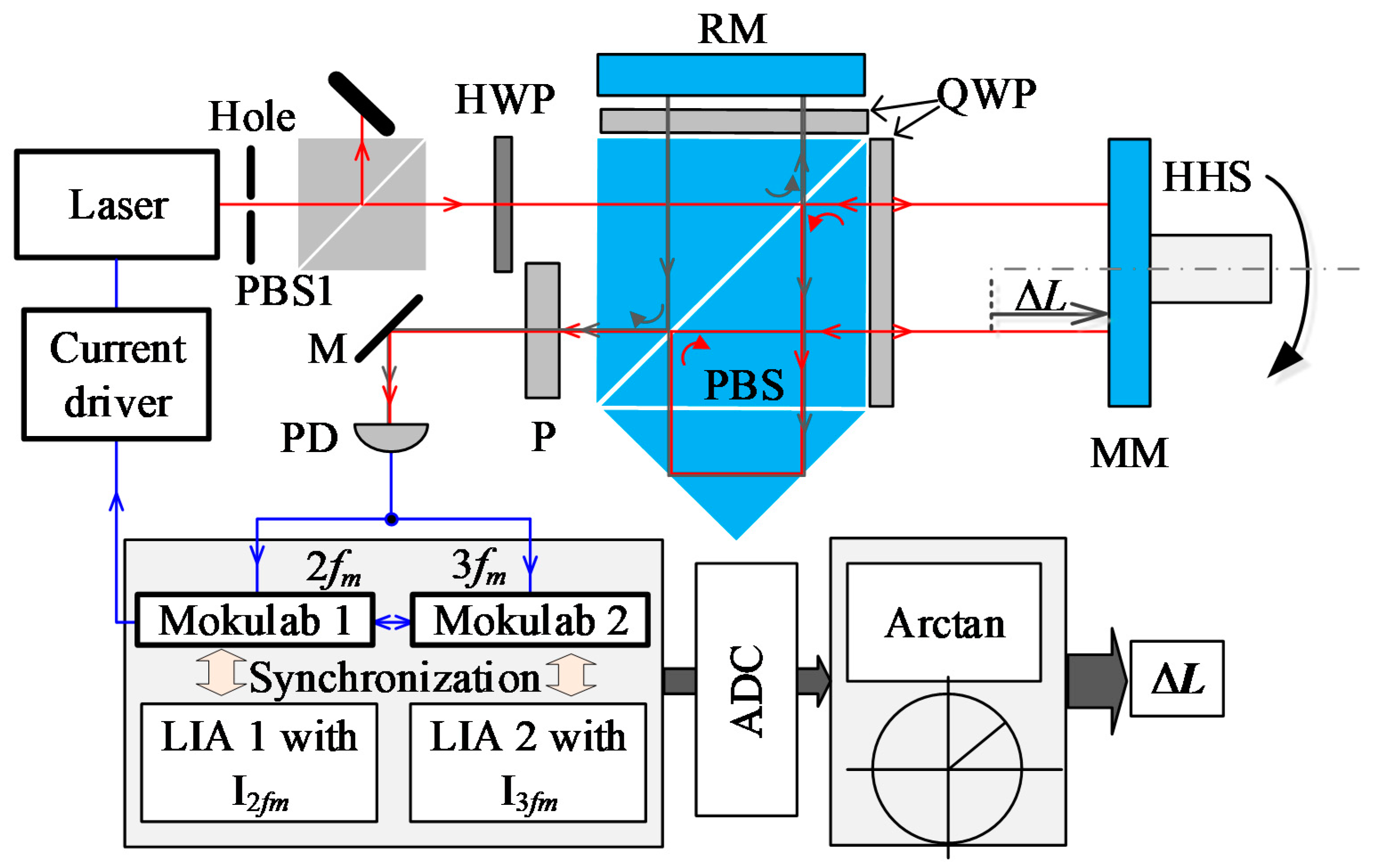
In this paper, a novel, compact, and high-precision axial error measurement using a frequency-modulated interferometer is developed. Normally, heterodyne interferometers are a powerful system for small displacement measurements due to their property of being less sensitive to temperature and pressure variations. However, the maximum measurement speed of the heterodyne interferometer is around 5 m/s because it is usually limited by the difference in frequency between the two components of the laser beam, which is no larger than 3 MHz or 20 MHz corresponding laser source based on the Zeeman effect and acousto-optic modulator, respectively. The proposed measuring system is realized by modulating the frequency of the laser diode source at a high modulation frequency and using lock-in amplifiers to extract the harmonics of the interference signal. The measurement speed is proportional to the modulation frequency. Thus, the higher the modulation frequency, the higher the measuring speed attains. The frequency-modulated interferometer is then applied to measure the axial error of an ultra-precision spindle. The proposed system can be a capable solution for noncontact and high-precision spindle error measurements in the machining process.
Keywords: axial error of spindle; displacement measurement; frequency modulation; interferometry; optical instruments axial error of spindle; displacement measurement; frequency modulation; interferometry; optical instruments