

Effect of Aggregate Type and Specimen Configuration on Concrete Compressive Strength



Abstract
1. Introduction
1.1. Effect of Aggregate Type on Compressive Strength
1.2. Effect of Aggregate Size and Shape
1.3. Effect of Specimen Configuration
1.4. Research Significance
2. Experimental Program
2.1. Materials
2.2. Mix Proportioning
2.3. Testing Program
3. Results
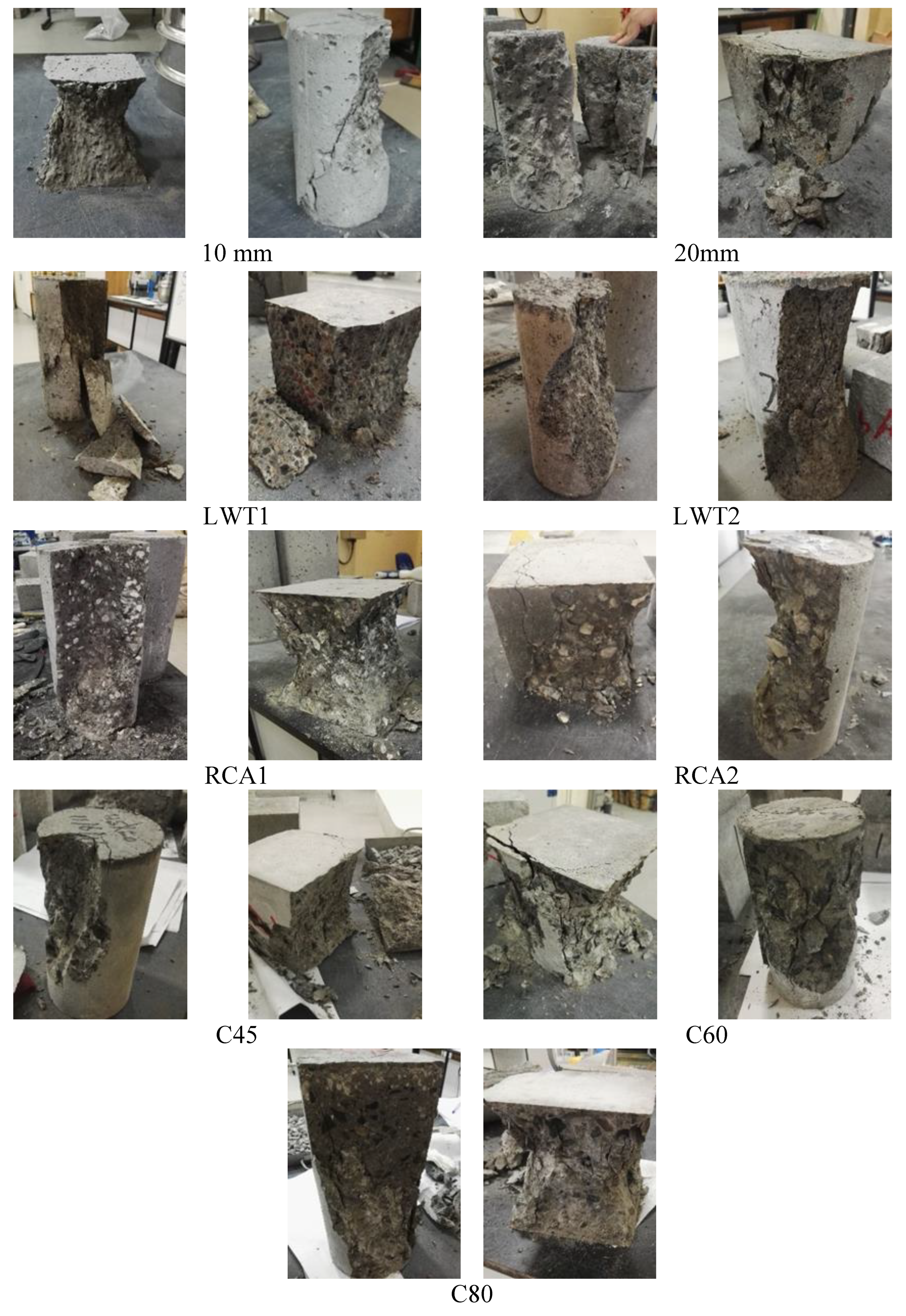
3.1. Compressive Strength
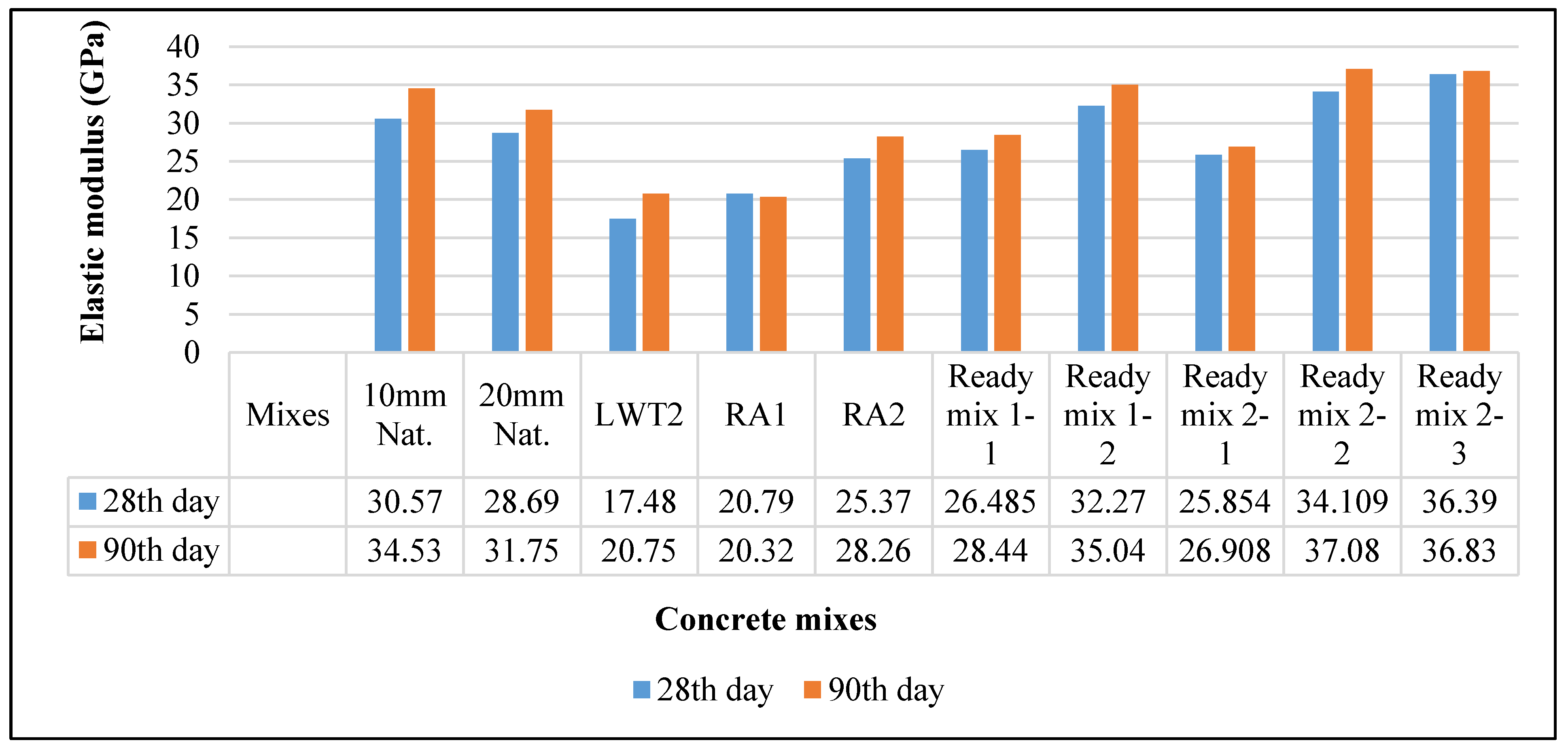
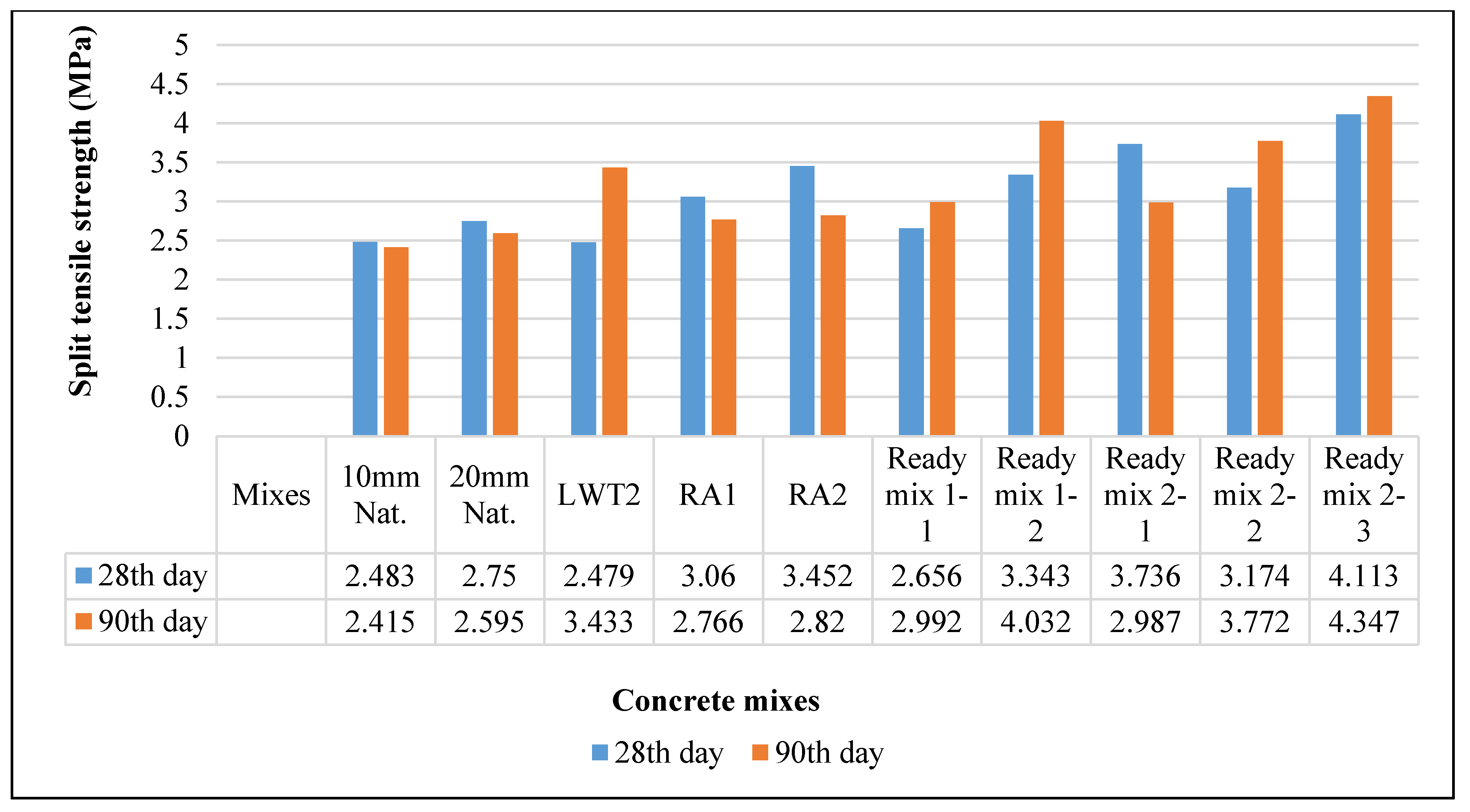
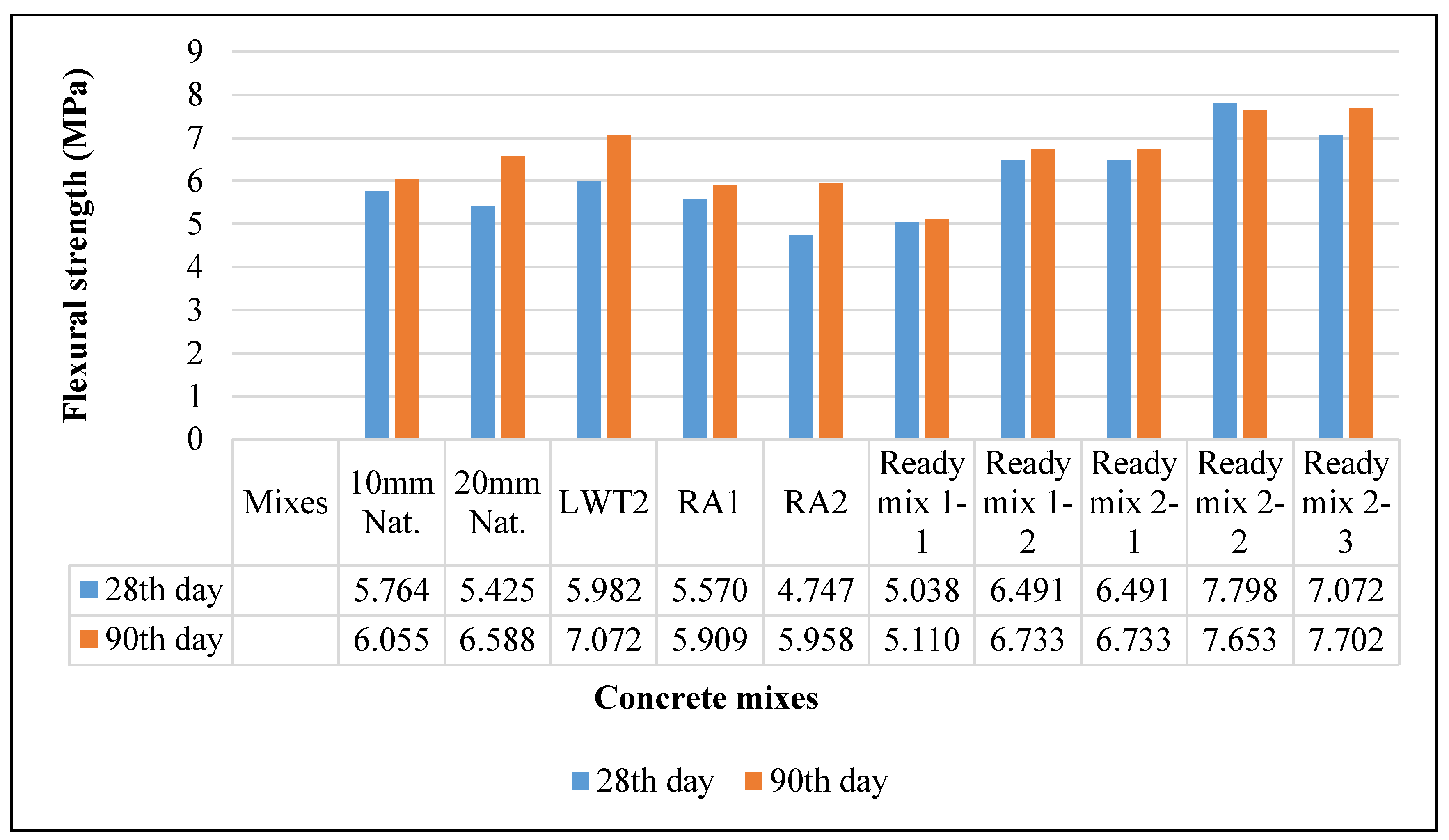
3.2. Modulus of Elasticity, Split Strength, and Flexure Strength Results
4. Discussion
4.1. Shape Factor Analysis
4.1.1. Effect of Aggregate Type on Shape Factor
4.1.2. Effect of Concrete Target Strength on Shape Factor
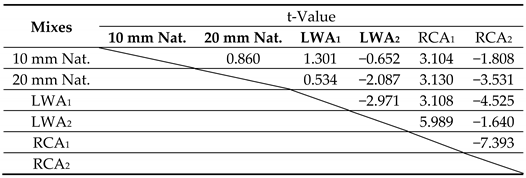
4.2. Effect of Aggregate Type on Concrete Compressive Strength Analysis
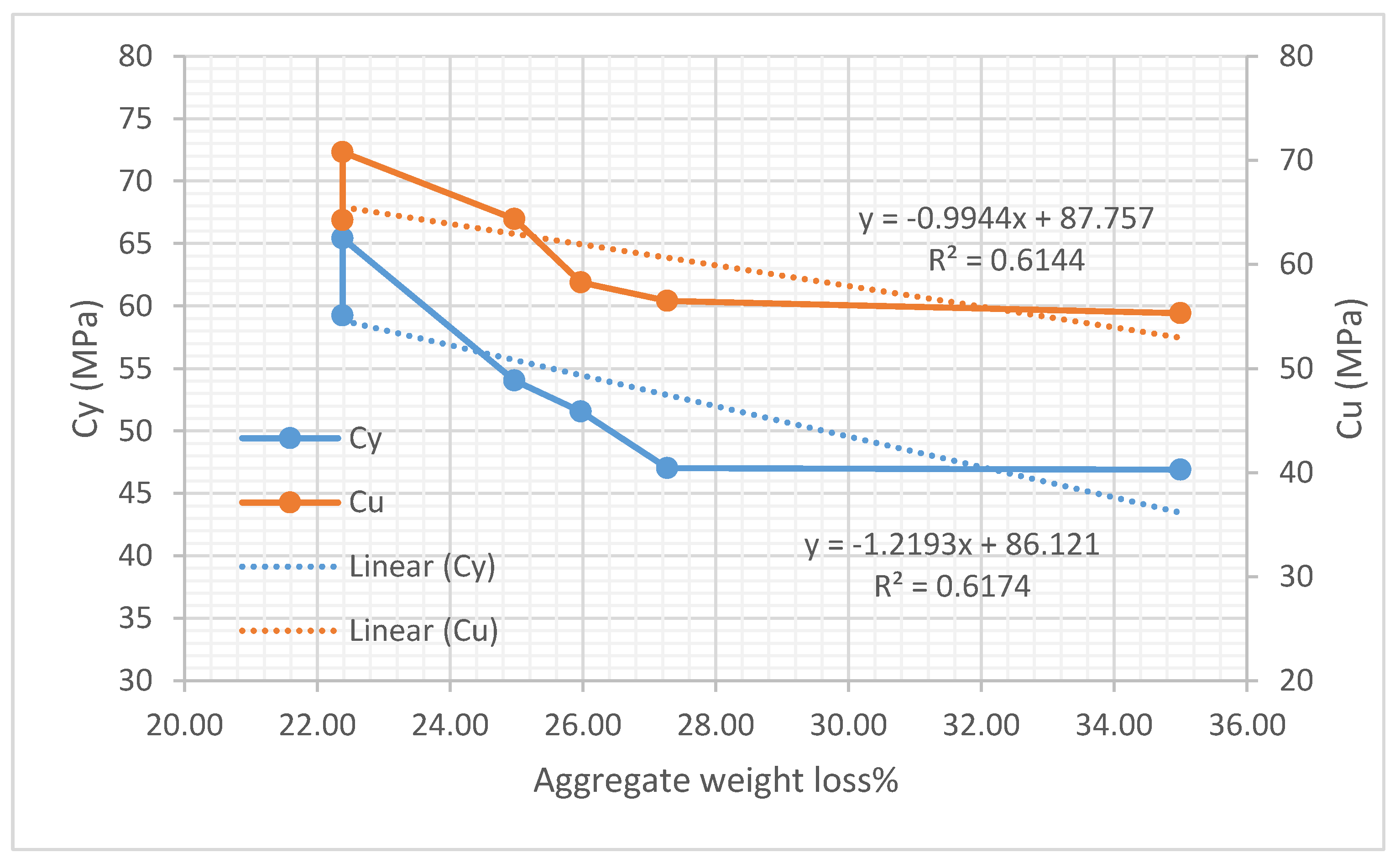
4.3. Correlation between Aggregate Strength and Concrete Compressive Strength
4.4. Comparing Test Results to ACI Standards
- is the cylinder Cy2 compressive strength at 28-day in MPa.
- λ is a reduction factor to account for aggregate type. λ = 0.85 for sand lightweight concrete.
5. Conclusions
Author Contributions
Funding
Acknowledgments
Conflicts of Interest
Disclaimer
References
- Neville, A.M. Properties of Concrete; Addison Wesley Longman: London, UK, 1995. [Google Scholar]
- MacGregor, J.G.; Wight, J.K. Reinforced Concrete: Mechanics and Design; Prentice-Hall: Singapore, 2016. [Google Scholar]
- Mamlouk, M.S.; Zaniewski, J. Materials for Civil and Construction Engineers, 3rd ed.; Pearson Education, Inc.: Upper Saddle River, NJ, USA, 2016. [Google Scholar]
- Nikbin, I.M.; Beygi, M.H.; Kazemi, M.T.; Vaseghi, J.A.; Rabbanifar, S.; Rahmani, E.; Rahimi, S. A comprehensive investigation into the effect of water to cement ratio and powder content on mechanical properties of self-compacting concrete. Constr. Build. Mater. 2014, 57, 69–80. [Google Scholar] [CrossRef]
- Toutanji, H.; Delatte, N.; Aggoun, S.; Duval, R.; Danson, A. Effect of supplementary cementitious materials on the compressive strength and durability of short-term cured concrete. Cem. Concr. Res. 2004, 34, 311–319. [Google Scholar] [CrossRef]
- Yaqub, M.; Bukhari, I. Effect of size of coarse aggregate on compressive strength of high strength concrete. In Proceedings of the 31st Conference Our World in Concrete & Structures, Singapore, 16–17 August 2006. [Google Scholar]
- Loannides, A.M.; Mills, J.C. Effect of Larger Sized Coarse Aggregates on Mechanical Properties of Portland Cement Concrete Pavements and Structures; FHWA/OH-2006/10A; Ohio Department of Transportation Office of Research and Development: Columbus, OH, USA, 2006. [Google Scholar]
- Prem, P.R.; Bharatkumar, B.H.; Iyer, N.R. Influence of curing regimes on compressive strength of ultra high performance concrete. Sadhana 2013, 38, 1421–1431. [Google Scholar] [CrossRef]
- Del Viso, J.; Carmona, J.R.; Ruiz, G. Shape and size effects on the compressive strength of high-strength concrete. Cem. Concr. Res. 2008, 38, 386–395. [Google Scholar] [CrossRef]
- Yi, S.-T.; Yang, E.I.; Choi, J.-C. Effect of specimen sizes, specimen shapes, and placement directions on compressive strength of concrete. Nucl. Eng. Des. 2006, 236, 115–127. [Google Scholar] [CrossRef]
- Tokyay, M.; Ozdemir, M. Specimen shape and size effect on the compressive strength of higher strength concrete. Cem. Concr. Res. 1997, 27, 1281–1289. [Google Scholar] [CrossRef]
- Abd, M.K.; Habeeb, Z.D. Effect of specimen size and shape on compressive strength of self-compacting concrete. Diyala J. Eng. Sci. 2014, 7, 17–29. [Google Scholar]
- Tabsh, S.W.; Abdelfatah, A.S. Influence of recycled concrete aggregates on strength properties of concrete. Constr. Build. Mater. 2009, 23, 1163–1167. [Google Scholar] [CrossRef]
- Sharma, R. Effect of wastes and admixtures on compressive strength of concrete. J. Eng. Des. Technol. 2020. [Google Scholar] [CrossRef]
- Zhang, S.Y.; Fan, Y.F.; Li, N.N. The Effect of Superplasticizer on Strength and Chloride Permeability of Concrete Containing GGBFS. Adv. Mater. Res. 2013, 804, 12–16. [Google Scholar] [CrossRef]
- Mardani-Aghabaglou, A.; Tuyan, M.; Yılmaz, G.; Arıöz, Ö.; Ramyar, K.; Yilmaz, G. Effect of different types of superplasticizer on fresh, rheological and strength properties of self-consolidating concrete. Constr. Build. Mater. 2013, 47, 1020–1025. [Google Scholar] [CrossRef]
- Chi, J.; Huang, R.; Yang, C.; Chang, J. Effect of aggregate properties on the strength and stiffness of lightweight concrete. Cem. Concr. Compos. 2003, 25, 197–205. [Google Scholar] [CrossRef]
- Wasserman, R.; Bentur, A. Effect of lightweight fly ash aggregate microstructure on the strength of concretes. Cem. Concr. Res. 1997, 27, 525–537. [Google Scholar] [CrossRef]
- Lo, Y.T.; Cui, H. Effect of porous lightweight aggregate on strength of concrete. Mater. Lett. 2004, 58, 916–919. [Google Scholar] [CrossRef]
- Topçu, I.B.; Uygunoğlu, T. Effect of aggregate type on properties of hardened self-consolidating lightweight concrete (SCLC). Constr. Build. Mater. 2010, 24, 1286–1295. [Google Scholar] [CrossRef]
- Poon, C.S.; Lam, C.S. The effect of aggregate-to-cement ratio and types of aggregates on the properties of pre-cast concrete blocks. Cem. Concr. Compos. 2008, 30, 283–289. [Google Scholar] [CrossRef]
- Seo, D.; Choi, H. Effects of the old cement mortar attached to the recycled aggregate surface on the bond characteristics between aggregate and cement mortar. Constr. Build. Mater. 2014, 59, 72–77. [Google Scholar] [CrossRef]
- Xiao, J.; Li, W.; Fan, Y.; Huang, X. An overview of study on recycled aggregate concrete in China (1996–2011). Constr. Build. Mater. 2012, 31, 364–383. [Google Scholar] [CrossRef]
- Tsoumani, A.A.; Matikas, T.E.; Barkoula, N.M. Influence of Recycled Aggregates on Compressive Strength of Concrete. In Proceedings of the 2nd International Conference on Sustainable Solid Waste Management, Athens, Greece, 12–14 June 2014. [Google Scholar]
- Katz, A. Properties of concrete made with recycled aggregate from partially hydrated old concrete. Cem. Concr. Res. 2003, 33, 703–711. [Google Scholar] [CrossRef]
- McNeil, K.; Thomas, H.; Kang, K. Recycled Concrete Aggregates: A Review. Int. J. Concr. Struct. Mater. 2013, 7, 61–69. [Google Scholar] [CrossRef]
- Wardeh, G.; Ghorbel, E.; Gomart, H. Mix Design and Properties of Recycled Aggregate Concretes: Applicability of Eurocode 2. Int. J. Concr. Struct. Mater. 2014, 9, 1–20. [Google Scholar] [CrossRef]
- Choi, H.; Choi, H.; Lim, M.; Inoue, M.; Kitagaki, R.; Noguchi, T. Evaluation on the Mechanical Performance of Low-Quality Recycled Aggregate Through Interface Enhancement Between Cement Matrix and Coarse Aggregate by Surface Modification Technology. Int. J. Concr. Struct. Mater. 2016, 10, 87–97. [Google Scholar] [CrossRef]
- Petrounias, P.; Giannakopoulou, P.P.; Rogkala, A.; Stamatis, P.M.; Tsikouras, B.; Papoulis, D.; Lampropoulou, P.; Hatzipanagiotou, K. The Influence of Alteration of Aggregates on the Quality of the Concrete: A Case Study from Serpentinites and Andesites from Central Macedonia (North Greece). Geosciences 2018, 8, 115. [Google Scholar] [CrossRef]
- Petrounias, P.; Giannakopoulou, P.P.; Rogkala, A.; Stamatis, P.M.; Lampropoulou, P.; Tsikouras, B.; Hatzipanagiotou, K. The Effect of Petrographic Characteristics and Physico-Mechanical Properties of Aggregates on the Quality of Concrete. Minerals 2018, 8, 577. [Google Scholar] [CrossRef]
- Elices, M.; Rocco, C. Effect of aggregate size on the fracture and mechanical properties of a simple concrete. Eng. Fract. Mech. 2008, 75, 3839–3851. [Google Scholar] [CrossRef]
- Rocco, C.; Elices, M. Effect of aggregate shape on the mechanical properties of a simple concrete. Eng. Fract. Mech. 2009, 76, 286–298. [Google Scholar] [CrossRef]
- Ajamu, S.O.; Ige, J.A. Effect of Coarse Aggregate Size on the Compressive Strength and the Flexural Strength of Concrete Beam. J. Eng. Res. Appl. 2015, 5, 67–75. [Google Scholar]
- Meddah, M.S.; Zitouni, S.; Belâabes, S. Effect of content and particle size distribution of coarse aggregate on the compressive strength of concrete. Constr. Build. Mater. 2010, 24, 505–512. [Google Scholar] [CrossRef]
- Sim, J.-I.; Yang, K.-H.; Kim, H.-Y.; Choi, B.-J. Size and shape effects on compressive strength of lightweight concrete. Constr. Build. Mater. 2013, 38, 854–864. [Google Scholar] [CrossRef]
- Van Mier, J.G.M. Strain-Softening of Concrete under Multiaxial Loading Conditions. Ph.D. Thesis, Eindhoven University of Technology, Eindhoven, The Netherlands, 1986. [Google Scholar]
- ASTM Standards. Standard Test Method for Compressive Strength of Cylindrical Concrete Specimens; Annual Book of ASTM Standards (ASTM C39–01); American Society for Testing and Materials: Philadelphia, PA, USA, 2001. [Google Scholar]
- Yazıcı, Ş.; Sezer, G.I. The effect of cylindrical specimen size on the compressive strength of concrete. Build. Environ. 2007, 42, 2417–2420. [Google Scholar] [CrossRef]
- Kampmann, R.; Roddenberry, M.; Ping, W.V. Contribution of Specimen Surface Friction to Size Effect and Rupture Behavior of Concrete. ACI Mate. J. 2013, 110, 169–176. [Google Scholar]
- Elwell, D.J.; Fu, G. Compression Testing of Concrete: Cylinders vs. Cubes; New York State Department of Transportation, State Campus: Albany, NY, USA, 1995; Report FHWA/NY/SR-95/119. [Google Scholar]
- BS 1881: Part 120 Method of Determination of the Compressive Strength of Concrete Core. Mag. Concr. Res. 1983, 27, 161–170.
- ENV 206. Concrete: Performance, Production, Placing, and Compliance Criteria; European Standard: London, UK, 1990; ISBN 0-580-20943-1. [Google Scholar]
- Cormack, H.W. Notes on Cubes Versus Cylinders; New Zealand Engineering: Wellington, New Zealand, 1956; Volume 11, pp. 98–99. [Google Scholar]
- De Brito, J.; Kurda, R.; Da Silva, P.R. Can We Truly Predict the Compressive Strength of Concrete without Knowing the Properties of Aggregates? Appl. Sci. 2018, 8, 1095. [Google Scholar] [CrossRef]
- Evans, R.H.; Abeles, P.W.; E Reynolds, C.; Konyi, K.H.; Squire, R.H. Correspondence. the Plastic Theories for the Ultimate Strength of Reinforced Concrete Beams. J. Inst. Civ. Eng. 1944, 22, 383–398. [Google Scholar] [CrossRef]
- Sigvaldason, O.T. The influence of testing machine characteristics upon the cube and cylinder strength of concrete. Mag. Concr. Res. 1966, 18, 197–206. [Google Scholar] [CrossRef]
- Gyengo, T. Effect of Type of Test Specimen and Gradation of Aggregate on Compressive Strength of Concrete. J. Am. Concr. Inst. 1938, 34, 269–282. [Google Scholar]
- Gonnerman, H.F. Effect of Size and Shape of Test Specimen on Compressive Strength of Concrete. In Proceedings of ASTM; ASTM International: West Conshohocken, PA, USA, 1925; Volume 25, pp. 237–250. [Google Scholar]
- Plowman, J.M.; Smith, W.F.; Sheriff, T. Cores, Cubes, and the Specified Strength of Concrete; The Institution of Structural Engineer: London, UK, 1974; Volume 52, pp. 421–426. [Google Scholar]
- Raju, N.K.; Basavarajaiah, B.S. Experimental Investigations on Prismatic Control Specimens for Compressive, Flexural, and Tensile Strength of Concrete. J. Inst. Eng. (India) Civil Eng. Div. 1976, 56, 254–257. [Google Scholar]
- Lasisi, F.; Osunade, J.A.; Olorunniwo, A. Strength Characteristics of Cube and Cylinder Specimens of Laterized Concrete. West Indian J. Eng. 1987, 12, 50–59. [Google Scholar]
- ASTM C33–01. Standard Specification for Concrete Aggregates; ASTM International: West Conshohocken, PA, USA, 2002. [Google Scholar]
- ASTM C136/C136M-14. Standard Test Method for Sieve Analysis of Fine and Coarse Aggregates; ASTM International: West Conshohocken, PA, USA, 2014. [Google Scholar]
- ASTM C127–15. Standard Test Method for Relative Density (Specific Gravity) and Absorption of Coarse Aggregate; ASTM International: West Conshohocken, PA, USA, 2015. [Google Scholar]
- ASTM C131/C131M-14. Standard Test Method for Resistance to Degradation of Small-Size Coarse Aggregate by Abrasion and Impact in the Los Angeles Machine; ASTM International: West Conshohocken, PA, USA, 2006. [Google Scholar]
- ASTM C496/C496M-11. Standard Test Method for Splitting Tensile Strength of Cylindrical Concrete Specimens; ASTM International: West Conshohocken, PA, USA, 2004. [Google Scholar]
- ASTM C78/C78M-16. Standard Test Method for Flexural Strength of Concrete (Using Simple Beam with Third-Point Loading); ASTM International: West Conshohocken, PA, USA, 2016. [Google Scholar]
- ASTM C469/C469M-14. Standard Test Method for Static Modulus of Elasticity and Poisson’s Ratio of Concrete in Compression; ASTM International: West Conshohocken, PA, USA, 2014. [Google Scholar]
- Yehia, S.; Helal, K.; Abusharkh, A.; Zaher, A.; Istaitiyeh, H. Strength and Durability Evaluation of Recycled Aggregate Concrete. Int. J. Concr. Struct. Mater. 2015, 9, 219–239. [Google Scholar] [CrossRef]
- Yehia, S.; Alhamaydeh, M.; Farrag, S. High-Strength Lightweight SCC Matrix with Partial Normal-Weight Coarse-Aggregate Replacement: Strength and Durability Evaluations. J. Mater. Civ. Eng. 2014, 26, 04014086. [Google Scholar] [CrossRef]
- Yehia, S.; Abudayyeh, O.; Bhusan, B.; Maurovich, M.; Zalt, A. Self-Consolidating Concrete Mixture with Local Materials: Proportioning and Evaluation. Mater. Sci. Res. J. 2009, 3, 41–64. [Google Scholar]
- Beshr, H.; Almusallam, A.; Maslehuddin, M. Effect of coarse aggregate quality on the mechanical properties of high strength concrete. Constr. Build. Mater. 2003, 17, 97–103. [Google Scholar] [CrossRef]
- Beushausen, H.; Dittmer, T. The influence of aggregate type on the strength and elastic modulus of high strength concrete. Constr. Build. Mater. 2015, 74, 132–139. [Google Scholar] [CrossRef]
- Jones, R.; Kaplan, M.F. The effect of coarse aggregate on the mode of failure of concrete in compression and flexure. Mag. Concr. Res. 1957, 9, 89–94. [Google Scholar] [CrossRef]
- Zimbelmann, R. A contribution to the problem of cement-aggregate bond. Cem. Concr. Res. 1985, 15, 801–808. [Google Scholar] [CrossRef]
- Yehia, S.; Abdelfatah, A. Examining the Variability of Recycled Concrete Aggregate Properties. In Proceedings of the International Conference on Civil, Architecture and Sustainable Development, London, UK, 1–2 December 2016. [Google Scholar]
- Feret, R. On the Compactness of Hydraulic Mortars (in French–Sur la compacité des mortiers hydrauliques); C. Dunod: Paris, France, 1892. [Google Scholar]
- Abrams, L.D. Properties of Concrete, 3rd ed.; Pitman Publishing Ltd.: London, UK, 1919. [Google Scholar]
- Powers, T.; Brownyard, T. Studies of the Physical Properties of Hardened Portland Cement Paste; American Concrete Institute (ACI): Farmington Hills, MI, USA, 1946; Volume 18, pp. 669–712. [Google Scholar]
- Popovics, S.; Ujhelyi, J. Contribution to the concrete strength versus water-cement ratio relationship. J. Mater. Civ. Eng. 2008, 20, 459–463. [Google Scholar] [CrossRef]
- Behnood, A.; Behnood, V.; Gharehveran, M.M.; Alyamaç, K. Prediction of the compressive strength of normal and high-performance concretes using M5P model tree algorithm. Constr. Build. Mater. 2017, 142, 199–207. [Google Scholar] [CrossRef]
- ACI363R-10. Report on High-Strength Concrete. Farmington Hills; American Concrete Institute: Farmington Hills, MI, USA, 2010. [Google Scholar]
- ACI318–19. Building Code Requirements for Structural Concrete. Farmington Hills; American Concrete Institute: Farmington Hills, MI, USA, 2019. [Google Scholar]
- Kılıç, A.; Atiş, C.; Teymen, A.; Karahan, O.; Özcan, F.; Bilim, C.; Ozdemir, M.; Kılıç, A. The influence of aggregate type on the strength and abrasion resistance of high strength concrete. Cem. Concr. Compos. 2008, 30, 290–296. [Google Scholar] [CrossRef]
- Wu, K.-R.; Chen, B.; Yao, W.; Zhang, N. Effect of coarse aggregate type on mechanical properties of high-performance concrete. Cem. Concr. Res. 2001, 31, 1421–1425. [Google Scholar] [CrossRef]
- Zhou, F.; Lydon, F.; Barr, B. Effect of coarse aggregate on elastic modulus and compressive strength of high performance concrete. Cem. Concr. Res. 1995, 25, 177–186. [Google Scholar] [CrossRef]
- Özturan, T.; Çeçen, C. Effect of coarse aggregate type on mechanical properties of concretes with different strengths. Cem. Concr. Res. 1997, 27, 165–170. [Google Scholar] [CrossRef]
- Aitcin, P.C.; Mehta, P.K. Effect of Coarse Aggregate Characteristics on Mechanical Properties of High-Strength Concrete. ACI Mater. J. 1998, 95, 252–261. [Google Scholar]
- Mehta, P.; Ezeldin, A.; Aitcin, P.-C. Effect of Coarse Aggregate on the Behavior of Normal and High-Strength Concretes. Cem. Concr. Aggreg. 1991, 13, 121–124. [Google Scholar] [CrossRef]
- Sengul, O.; Tasdemir, C.; Mehmet Ali Tasdemir, M.A. Influence of Aggregate Type on Mechanical Behavior of Normal and High Strength Concretes. ACI Mater. J. 2002, 99, 528–533. [Google Scholar]

| Factors Affecting Compressive Strength | Comments |
|---|---|
| Type of cement | Different concrete applications according to exposure conditions might require cement with specific properties. Five basic types of Portland cement are commonly used in the construction industry. A blend of cement and cementitious materials is also available in the market. The main bonding material and responsible for strength. |
| Supplementary Cementitious materials | Used to reduce heat of hydration, to improve workability and durability depending on the materials. They also ensure quality of concrete during the stages of mixing, transporting, placing, and curing in adverse weather conditions. |
| Water/cement ratio (w/c) | A low water/cement ratio increases resistance to weathering, provides a good bond between successive concrete layers. Excess water increases the porosity and permeability of the concrete and reduces strength. |
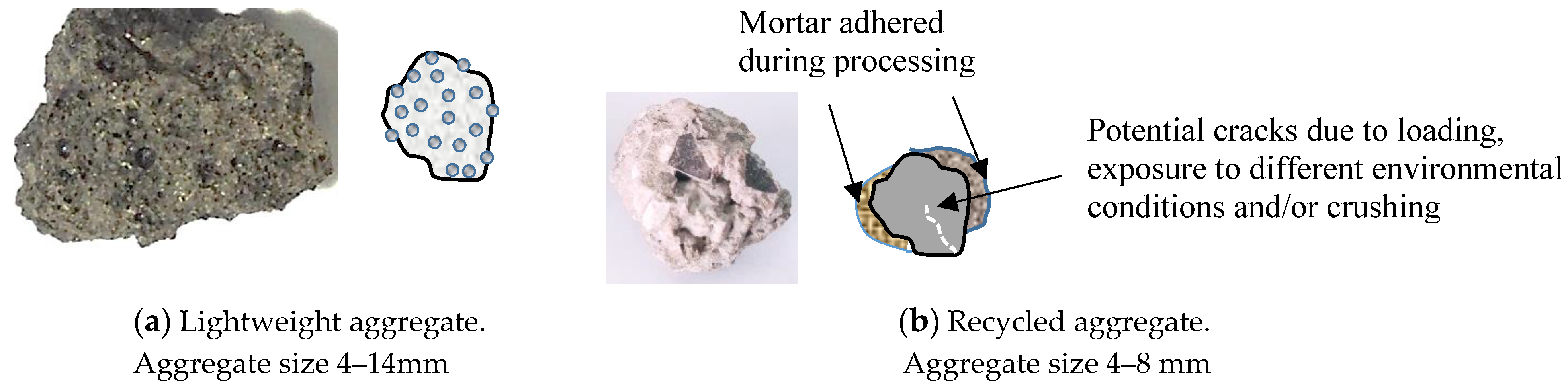
| Aggregate | Concrete strength is affected by the strength, surface texture, grading, and maximum size of the aggregate. |
| Mixing water | Impurities in the mixing water might affect concrete set time, strength, and long-term durability. It is generally thought that the pH of water should be between 6.0 and 8.0. |
| Curing | Moisture during curing: prolonged moist curing leads to the highest concrete strength. 3- and 7-day moist curing period will lead to 60% and 80% of the strength of the continuously cured concrete. |
| Temperature during curing: increasing curing temperature while preventing moisture loss leads to an increase in the rate of hydration and, consequently, the rate of strength development. In cold weather, if concrete freezes soon after it has been placed will have a severe strength loss. | |
| Age of concrete | Concrete gains strength with age. |
| Maturity of concrete | It indicates the progress of hydration and it is the relationship between strength gain, time, and concrete temperature. |
| Rate of loading | The axial compressive strength is reduced by about 75% of the standard test strength under slow rates of loading. Whereas, at high rates of loading, the strength increases, reaching 115% of the standard strength tests. |
| Specimen shape and size | Cube specimen generally gives more strength than that of cylinder specimen. Moreover, increasing the specimen size decreases the compressive strength. |
| Admixtures | Air-entraining admixtures increase resistance to freeze and thaw cycles by adding a stable bubble of air which might lead to a reduction of compressive strength. However, target compressive strength could be achieved by careful mix proportioning and reduced w/c ratio. |
| Using superplasticizers can improve the strength, marginally, when using recycled aggregates or GGBFS. For self-compacting concrete, the use of superplasticizers has a slight effect on the concrete strength and that effect is more apparent in the early stages. |
| References | Aggregate Used in the Study | Effect on Strength (Compressive and Modulus of Elasticity) | Comments |
|---|---|---|---|
| Chi et al. [17] | Three types of LWA | Both compressive strength and elastic modulus were affected by the aggregate type and decreased with an increase in w/c ratio. | Different concrete strength, Portland cement, w/c ratio 0.3, 0.4, and 0.5 |
| Wasserman and Bentur [18] | Fly ash LWA | Concrete strength does not depend only on the aggregate strength but affected by other characteristics such as its rough surface, porosity, and pozzolanic nature. | Portland cement, w/c ratio 0.4 |
| Lo and Cui [19] | LWA | Porous surface of LWA improved the interfacial bond between aggregate and cement paste, resulting in better interlocking. Development of initial strength was much higher in LWC than in NWC. | Portland cement, w/c ratio 0.36 |
| Topçu, and Uygunoğlu [20] | Normal crushed limestone and three types of LWA | Compressive strength increased with w/c decrease. Replacement of natural aggregate with LWA cause decrease in modulus of elasticity. Pumice is a useful aggregate for production of SCLC with high interlocking in ITZ and high compressive strength. | Different concrete strength. Portland cement, w/c ratio 0.36, 0.4, 0.43, 0.46, and 0.48 |
| Tabsh and Abdelfatah [13] | RA | Concrete strength is affected by the source of the recycled aggregate. In addition, bond strength is affected by the quantity and the shape of the old cement mortar adhered on the aggregate surface. | |
| Poon and Lam [21] | Natural crushed aggregate and three types of RCA | Compressive strength increased when aggregate/cement ratio decreased. Using RCA instead of NCA reduced density and strength. The compressive strength was directly proportional to strength of the blended aggregate | |
| Seo and Choi [22] | RCA | The amount of the used recycled aggregate has a remarkable effect on the compressive strength. If amount of old cement mortar is about 10%, the mortar can improve the bond quality. | Portland cement |
| Xiao et al. [23] | Natural and RCA | Both compressive strength and modulus of elasticity reduced as the RCA percentage increased. | |
| Tsounami et al. [24] | Natural and RCA | For RCA replacement percentage higher than 25%, compressive strength reduces as replacement percentage increases. | Portland cement |
| Katz [25] | RCA | Concrete with 100% recycled aggregate was weaker than that of the natural aggregate, and about 25% reduction of the compressive strength was observed. | Portland cement |
| McNeil et al. [26] | RCA | RCA is less dense, more porous, and has higher water absorption than NCA due to the residual adhered mortar on RCA, which weakens the interfacial zone and reduces both compressive strength and modulus of elasticity. | |
| Wardeh et al. [27] | Recycled gravel with 30%, 65%, and 100% replacement ratio. | The use of recycled aggregate up to 30% caused a 14% reduction in the compressive strength, while increasing the replacement ratio had increased the cement content, causing an increase in the compressive strength that counterbalances the negative effect of the recycled aggregate. | C35, CEM I CALCIA 52.5 N CE CP2 NF cement, w/c ratio 0.5–0.52 |
| Choi et al. [28] | RA | Enhancing the ITZ help suppress the occurrence of microcracks and improve the mechanical performance of the aggregate, resulting in improved strength, permeability, and durability of concrete. | Normal strength concrete, Portland cement, w/c ratio 0.55 |
| References | Aggregate Used in the Study | Cementitious Materials (Mineral Admixtures) | Effect on Strength (Compressive and Modulus of Elasticity) | Comments |
|---|---|---|---|---|
| Loannides and Mills [7] | Natural aggregate with different sizes | Air entraining admixtures | Smaller aggregates tended to shear under loading while larger aggregate was more prone to pull out. | Normal strength concrete Portland cement w/c ratio 0.5 |
| Rocco and Elices [31,32] | Mullite aggregate with different sizes | Fracture energy increased with increasing the aggregate size and not affected significantly by the aggregate shape. Modulus of elasticity decreased as the aggregate size increased. Using crushed aggregates (with strong matrix-aggregate interfaces) showed higher modulus of elasticity than that while using spherical ones of the same size. | Normal strength concrete Portland cement w/c ratio 0.42, 0.7 | |
| Ajamu and Ige [33] | Aggregate with different sizes | Compressive strength increased as the aggregate size increase from 13mm to 19mm. | Normal strength concrete Portland cement w/c ratio 0.65 | |
| Meddah et al. [34] | Aggregate with different size and distribution | HRWRA | Compressive strength increased as the aggregate size increased in normal strength concrete. While in HSC, Compressive strength increased with decreasing the aggregate size. Increasing coarse aggregate content in NSC enhanced the compressive strength, while in HSC there is an optimum content. Effect of aggregate content and particle size is more significant in HSC than NSC. | Normal and High-strength concrete w/c ratio 0.58, 0.4 |
| Yaqub and Bukhari [6] | Aggregate with different sizes | Smaller aggregate sizes exhibited higher compressive strength in the case of HSC. | High-strength concrete Portland cement w/c ratio 0.23–0.35 |
| Physical Property | Absorption % | Bulk Dry Sp. Gr.* | Moisture Content% | LA Abrasion | |||
|---|---|---|---|---|---|---|---|
| Aggregate Type | Grade B % | Grade C % | Grade D % | ||||
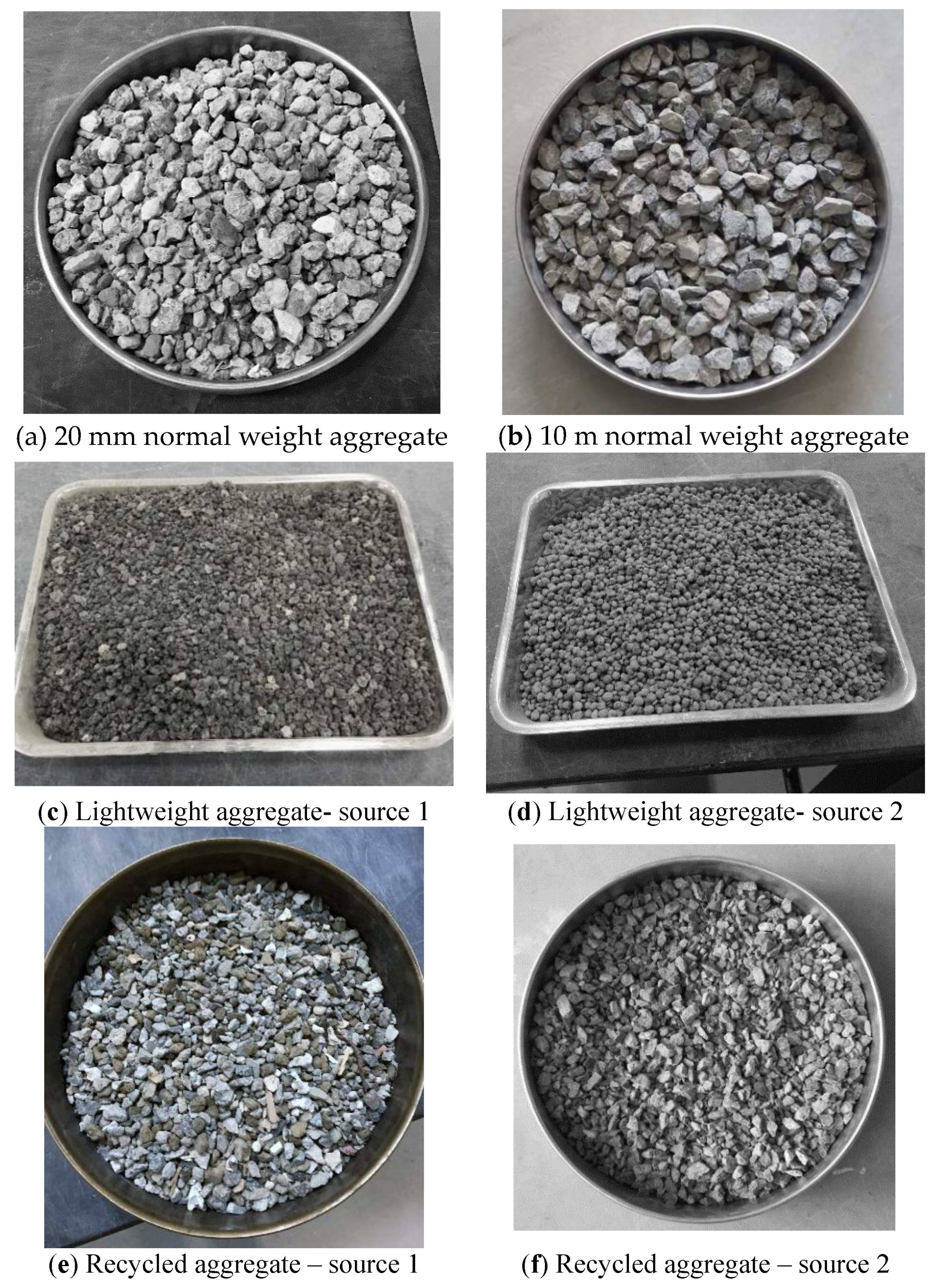
| Natural Aggregate | 0.65 | 2.685 | 0.558 | 22.38 | |||
| Sintered pulverized–fuel ash | 24.32 | 1.336 | 0.564 | 25.97 | |||
| Pumice | 12.6 | 1.605 | 0.604 | 27.27 | |||
| Recycled Aggregate - 1 | 3.94 | 2.36 | 0.719 | 35 | 31 | ||
| Recycled Aggregate - 2 | 3.35 | 2.47 | 0.84 | 24.97 | |||
| Material | Absolute Volume |
|---|---|
| Cement | 0.08 |
| GGBS | 0.06 |
| Silica fume | 0.02 |
| water | 0.18 |
| Coarse aggregate | 0.33 |
| FA (1/2 dune and 1/2 crushed) | 0.33 |
| Total Volume | 1 |
| Test | Test Specifications | Specimen Size (mm) | No. of Specimens Per Test | Testing Events (day) |
|---|---|---|---|---|
| Compressive strength | ASTM C39/C39M-17 [37] | 150 × 300 cylinder 100 × 200 cylinder 150 × 150 × 150 cube 100 × 100 × 100 cube | 2 cylinders* 2 cylinders* 2 cubes* 2 cubes* | 7th, 28th and 90th |
| Modulus of Elasticity | ASTM C469/C469M-14 [58] | 150 × 300 cylinder | 1 cylinder | 28th and 90th |
| Splitting tensile strength | ASTM C496/C496M-11 [56] | 150 × 300 cylinder | 2 cylinders | 28th and 90th |
| Flexural strength | ASTM C78/C78M-16 [57] | 100 × 100 × 500 beam | 2 beams | 28th and 90th |
| Test Date | 7-day | 28-day | 90-day | ||||||||||
|---|---|---|---|---|---|---|---|---|---|---|---|---|---|
| Mixes | Cy1 | Cy2 | Cu1 | Cu2 | Cy1 | Cy2 | Cu1 | Cu2 | Cy1 | Cy2 | Cu1 | Cu2 | |
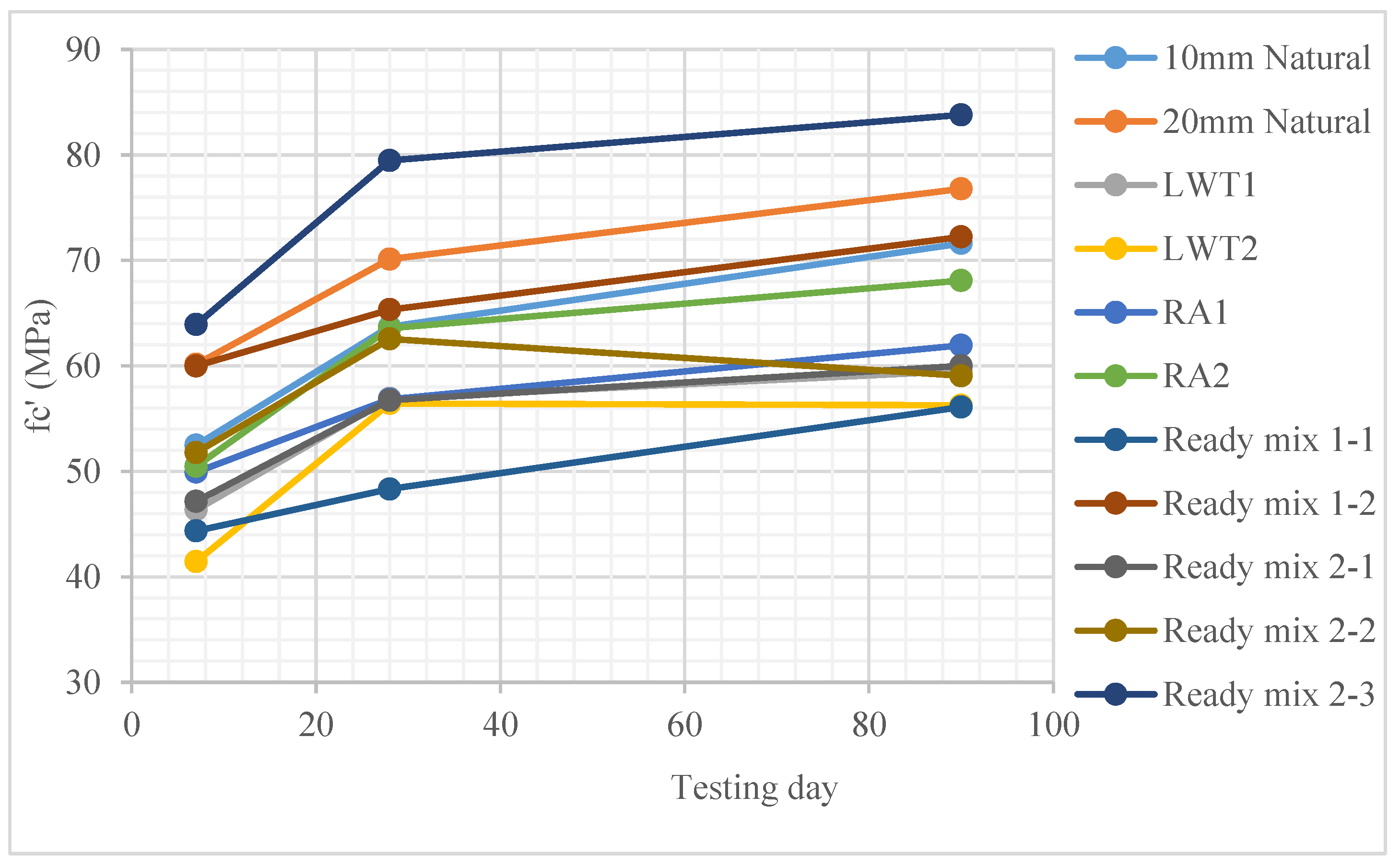
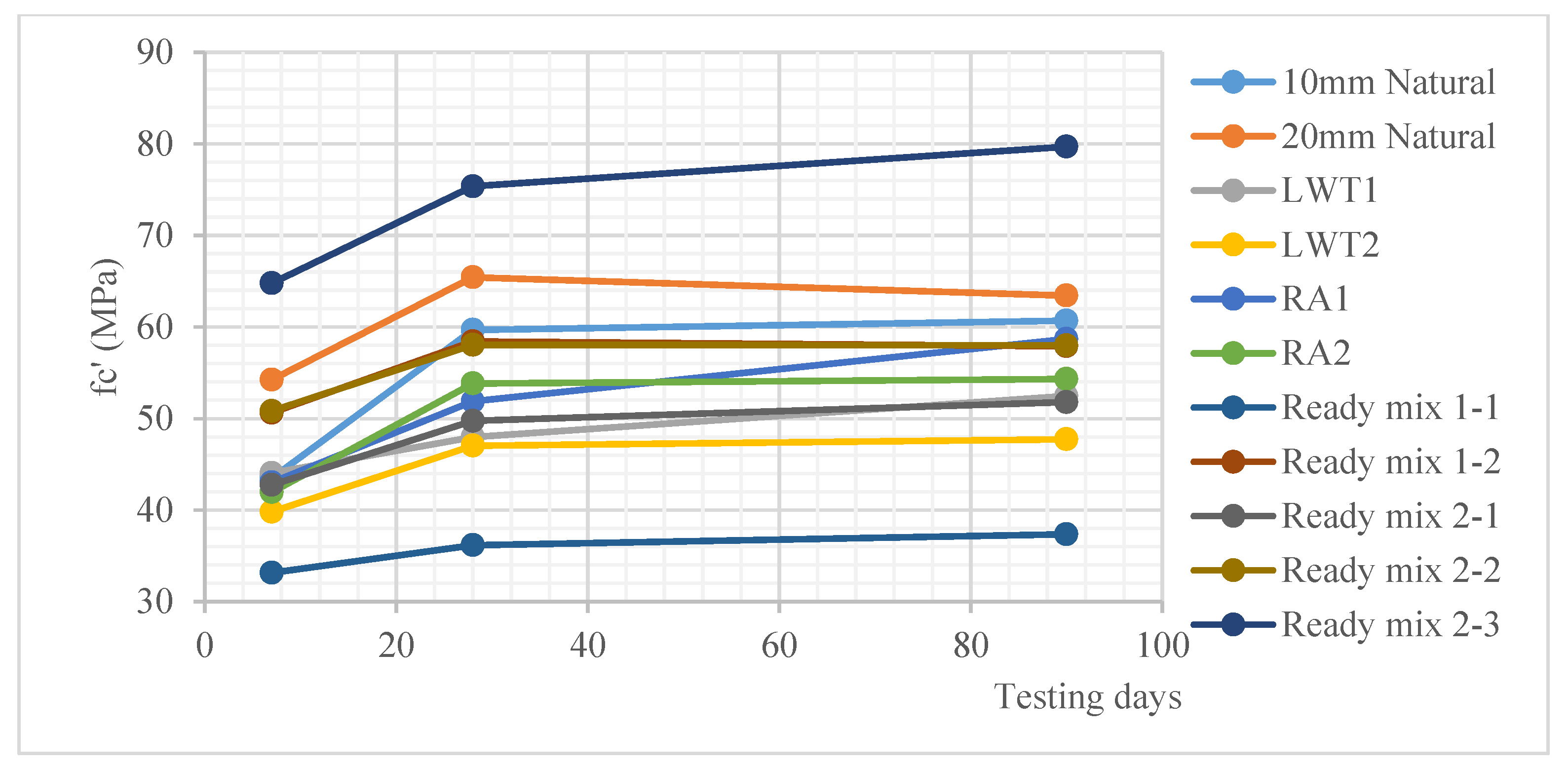
| 10mm Natural | 46.06 | 40.9 | 52.1 | 52.83 | 63.31 | 56.05 | 59.47 | 67.93 | 63.01 | 58.35 | 64.07 | 79.13 | |
| 20mm Natural | 59.67 | 48.8 | 61.97 | 58.31 | 65.19 | 65.65 | 67.6 | 72.63 | 72.68 | 54.16 | 76.55 | 77.01 | |
| LWA1 | 44.9 | 43.2 | 43.49 | 49.2 | 53.54 | 42.4 | 52.89 | 60.92 | 54.67 | 50.25 | 57.37 | 61.65 | |
| LWA2 | 38.47 | 41.15 | 37.78 | 45.1 | 47.65 | 46.4 | 52.28 | 60.57 | 51.69 | 43.76 | 52.94 | 59.57 | |
| RCA1 | 44.89 | 41.15 | 51.4 | 48.44 | 52.34 | 51.4 | 52.72 | 60.93 | 56.9 | 60.46 | 57.49 | 66.4 | |
| RCA2 | 45.56 | 38.35 | 45.98 | 54.97 | 54.56 | 53.1 | 60.52 | 66.63 | 59.82 | 48.8 | 66.56 | 69.6 | |
| Ready mix 1-1 | 35 | 31.3 | 43.7 | 45 | 36.57 | 35.75 | 44.43 | 52.2 | 37.66 | 37.05 | 55.6 | 56.59 | |
| Ready mix 1-2 | 48.17 | 53.1 | 60.66 | 59.32 | 58.98 | 57.85 | 62.51 | 68.13 | 58.09 | 57.7 | 67.61 | 76.83 | |
| Ready mix 2-1 | 43.61 | 41.87 | 46.39 | 47.91 | 50.49 | 49 | 54.35 | 59.11 | 54.28 | 49.3 | 59 | 61 | |
| Ready mix 2-2 | 53.08 | 48.55 | 49.49 | 54.07 | 58.23 | 57.85 | 58.7 | 66.4 | 60.47 | 55.5 | 55.76 | 62.35 | |
| Ready mix 2-3 | 64.4 | 65.14 | 63.19 | 64.64 | 67.91 | 82.8 | 75.74 | 83.19 | 78.49 | 80.89 | 81.11 | 86.47 | |
| Test Date | Ratio between 7th /28th- Day Compressive Strength | Ratio between 90th /28th-Day Compressive Strength | Cu2/TS Ratios | Average Cy/Cu Ratio | |||||||||||
|---|---|---|---|---|---|---|---|---|---|---|---|---|---|---|---|
| 7th | 28th | 90th | 7th | 28th | 90th | ||||||||||
| Mixes | Cy1 | Cy2 | Cu1 | Cu2 | Cy1 | Cy2 | Cu1 | Cu2 | Cu2/TS | Cu2/TS | Cu2/TS | Cy/Cu | Cy/Cu | Cy/Cu | |
| 10 mm Natural | 0.73 | 0.73 | 0.88 | 0.78 | 1.00 | 1.04 | 1.08 | 1.16 | 0.75 | 0.97 | 1.13 | 0.839 | 0.922 | 0.839 | |
| 20 mm Natural | 0.92 | 0.74 | 0.92 | 0.80 | 1.11 | 0.82 | 1.13 | 1.06 | 0.83 | 1.04 | 1.10 | 0.925 | 0.925 | 0.866 | |
| LWA1 | 0.84 | 1.02 | 0.82 | 0.81 | 1.02 | 1.19 | 1.08 | 1.01 | 0.70 | 0.87 | 0.88 | 0.946 | 0.806 | 0.878 | |
| LWA2 | 0.81 | 0.89 | 0.72 | 0.74 | 1.08 | 0.94 | 1.01 | 0.98 | 0.64 | 0.87 | 0.85 | 0.957 | 0.829 | 0.818 | |
| RCA1 | 0.86 | 0.80 | 0.97 | 0.80 | 1.09 | 1.18 | 1.09 | 1.09 | 0.69 | 0.87 | 0.95 | 0.872 | 0.934 | 0.929 | |
| RCA2 | 0.84 | 0.72 | 0.76 | 0.83 | 1.10 | 0.92 | 1.10 | 1.04 | 0.79 | 0.95 | 0.99 | 0.855 | 0.836 | 0.781 | |
| Ready mix C45_1 | 0.96 | 0.88 | 0.98 | 0.86 | 1.03 | 1.04 | 1.25 | 1.08 | 1.00 | 1.16 | 1.25 | 0.747 | 0.748 | 0.666 | |
| Ready mix C75 | 0.82 | 0.92 | 0.97 | 0.87 | 0.98 | 1.00 | 1.08 | 1.13 | 0.79 | 0.91 | 1.02 | 0.844 | 0.894 | 0.802 | |
| Ready mix C45_2 | 0.86 | 0.85 | 0.85 | 0.81 | 1.08 | 1.01 | 1.09 | 1.03 | 1.06 | 1.31 | 1.35 | 0.906 | 0.877 | 0.863 | |
| Ready mix C60 | 0.91 | 0.84 | 0.84 | 0.81 | 1.04 | 0.96 | 0.95 | 0.94 | 0.90 | 1.11 | 1.04 | 0.981 | 0.928 | 0.982 | |
| Ready mix C80 | 0.95 | 0.79 | 0.83 | 0.78 | 1.16 | 0.98 | 1.07 | 1.04 | 0.81 | 1.04 | 1.08 | 1.013 | 0.948 | 0.951 | |
| Reference | Average cylinder/cube Ratio | Remarks |
|---|---|---|
| Cormack [43] | 0.87 | Study focused on high-strength concrete. Few data were generated for fc’<41 MPa |
| Evans [45] | 0.77–0.96 | Lower-strength concrete had generally lower cylinder/cube strength ratios |
| Sigvaldason [46] | 0.71–0.77 0.76–0.84 | Segregating concrete Non-segregating concrete |
| Gyengo [47] | 0.65–0.84 | Variation due to changing coarseness of aggregate grading |
| Gonnerman [48] | 0.85–0.88 | Tests performed using standard cylinders and 6” and 8” cubes |
| Plowman, Smith, and Sheriff [49] | 0.74 0.64 | Water-cured specimens Air-cured specimens In both cases, portions of steel bars were embedded in cylinder specimens |
| Raju and Basavarajaiah [50] | 0.61 0.51 | Using 150 mm cubes Using 100 mm cubes |
| Lasisi et al. [51] | 0.67–0.76 0.55–0.86 | Landcrete specimens (small agg. From lateric soil) Concrete specimens |
| Current study | 0.66–0.98 0.82–0.88 0.78–0.93 | Normal and high-strength concrete. Lightweight aggregate concrete. Recycled aggregate concrete. |
 |
| Test Date | 7-day | 28-day | 90-day | ||||
|---|---|---|---|---|---|---|---|
| Mixes | Cy1/Cu1 | Cy2/Cu2 | Cy1/Cu1 | Cy2/Cu2 | Cy1/Cu1 | Cy2/Cu2 | |
| Ready mix 1-1 (45 MPa) | 0.80 | 0.70 | 0.82 | 0.68 | 0.68 | 0.65 | |
| Ready mix 1-2 (75 MPa) | 0.79 | 0.90 | 0.94 | 0.85 | 0.86 | 0.75 | |
| Ready mix 2-1 (45 MPa) | 0.94 | 0.87 | 0.93 | 0.83 | 0.92 | 0.81 | |
| Ready mix 2-2 (60 MPa) | 1.07 | 0.90 | 0.99 | 0.87 | 1.08 | 0.89 | |
| Ready mix 2-3 (80 MPa) | 1.02 | 1.01 | 0.90 | 1.00 | 0.97 | 0.94 | |
 |
| Mix | Modulus of Elasticity (GPa) | Split Strength (MPa) | Flexure Strength (MPa) | ||||||
|---|---|---|---|---|---|---|---|---|---|
| Calculated | Tested | Ratio+ | Calculated | Tested | Ratio+ | Calculated | Tested | Ratio+ | |
| 10 mm Nat. | 31.76 | 30.57 | 0.96 | 4.42 | 2.48 | 0.56 | 7.04 | 5.76 | 0.82 |
| 20 mm Nat. | 33.80 | 28.69 | 0.85 | 4.78 | 2.75 | 0.58 | 7.62 | 5.43 | 0.71 |
| LWA2 | 32.02 | 17.48 | 0.55 | 3.81 | 2.48 | 0.65 | 3.59* | 5.98 | 1.67 |
| RCA1 | 33.70 | 20.79 | 0.62 | 4.01 | 3.06 | 0.76 | 4.45 | 5.57 | 1.25 |
| RCA2 | 34.25 | 25.37 | 0.74 | 4.08 | 3.45 | 0.85 | 4.52 | 4.75 | 1.05 |
| Ready mix 1-1 | 26.75 | 26.49 | 0.99 | 3.53 | 2.66 | 0.75 | 5.62 | 5.04 | 0.90 |
| Ready mix 1-2 | 32.15 | 32.27 | 1.00 | 4.49 | 3.34 | 0.74 | 7.15 | 6.49 | 0.91 |
| Ready mix 2-1 | 30.14 | 25.85 | 0.86 | 4.13 | 3.74 | 0.90 | 6.58 | 6.49 | 0.99 |
| Ready mix 2-2 | 32.15 | 34.11 | 1.06 | 4.49 | 3.17 | 0.71 | 7.15 | 7.80 | 1.09 |
| Ready mix 2-3 | 37.11 | 36.39 | 0.98 | 5.37 | 4.11 | 0.77 | 8.55 | 7.07 | 0.83 |
| Reference | Flexural Strength (MPa) | Split Tensile Strength (MPa) | Modulus of Elasticity (GPa) | Remarks |
|---|---|---|---|---|
| Topcu and Uygunoglu [20] | 3.7–3.9 1.6–1.7 | 33–39 17–18 | Natural aggregate concrete. Lightweight aggregate concrete. | |
| Tabsh and Abdelfatah [13] | 4 2.9–4 | Natural aggregate concrete. Recycled aggregate concrete. | ||
| Poon and Lam [21] | 3–4.2 | Normal and high-strength concrete. | ||
| Katz [25] | 5.4 | 3.1 | 11.3 | Recycled aggregate concrete. |
| McNeil et al. [26] | 10.2 8.9–9.7 | 3.3 2.7–3 | Natural aggregate concrete. 15%, 30%, and 50% RCA. | |
| Beshr et al. [62] | 2.4–4 | 21–28 | High-strength concrete. | |
| Beushausen and Dittmer [63] | 2.66–2.93 | 3.74–4.35 | 27.03–44.81 | High-strength concrete. |
| Kilic et al. [74] | 5.2–17.3 | High-strength concrete. | ||
| Wu et al. [75] | 5–5.3 | 31–39.5 | w/c = 0.44. | |
| Zhou et al. [76] | 18.6–51.3 | High-performance concrete. | ||
| Ozturan and Cecen [77] | 4.7–5.3 | 3.9–5.2 | Normal and high-strength concrete. | |
| Aitcin and Mehta [78] | 31.7–37.9 | High-strength concrete. | ||
| Ezeldin and Aitcin [79] | 7.4–9.2 | High-strength concrete. | ||
| Sengul et al. [80] | 2.59–3.88 4.44–8.14 | 25.3–-38 36.3–51.1 | Normal strength concrete. High-strength concrete. | |
| Ajamu and Ige [33] | 4.4-4.93 | Normal concrete with different aggregate sizes. | ||
| Meddah et al. [34] | 28.5–37 | Normal and high-strength concrete. | ||
| Wardeh et al. [27] | 4.9 3.95–4.75 | 3.6 3–3.3 | 39.5 30–36 | Natural aggregate concrete. 300%, 65%, and 100% RCA. |
| Choi et al. [28] | 1.8–2.5 | Recycled aggregate concrete. | ||
| Current study | 5.5–7.8 6 4.75–5.57 | 2.5–4.11 2.5 3–3.5 | 28–36 17.5 21–25 | Normal and high-strength concrete. Lightweight aggregate concrete. Recycled aggregate concrete. |
© 2020 by the authors. Licensee MDPI, Basel, Switzerland. This article is an open access article distributed under the terms and conditions of the Creative Commons Attribution (CC BY) license (http://creativecommons.org/licenses/by/4.0/).
Share and Cite
Yehia, S.; Abdelfatah, A.; Mansour, D. Effect of Aggregate Type and Specimen Configuration on Concrete Compressive Strength. Crystals 2020, 10, 625. https://doi.org/10.3390/cryst10070625
Yehia S, Abdelfatah A, Mansour D. Effect of Aggregate Type and Specimen Configuration on Concrete Compressive Strength. Crystals. 2020; 10(7):625. https://doi.org/10.3390/cryst10070625
Chicago/Turabian StyleYehia, Sherif, Akmal Abdelfatah, and Doaa Mansour. 2020. "Effect of Aggregate Type and Specimen Configuration on Concrete Compressive Strength" Crystals 10, no. 7: 625. https://doi.org/10.3390/cryst10070625
APA StyleYehia, S., Abdelfatah, A., & Mansour, D. (2020). Effect of Aggregate Type and Specimen Configuration on Concrete Compressive Strength. Crystals, 10(7), 625. https://doi.org/10.3390/cryst10070625

