


Abstract
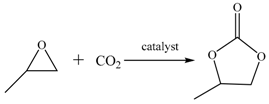
Based on the ligand H2dpPzda (1), a novel cobalt complex [Co(H2dpPzda)(NCS)2]·CH3OH(2) has been synthesized and characterized. The Complex 2 exhibited excellent catalytic performance for converting CO2 into cyclic carbonates under mild conditions. For propylene oxide (PO) and CO2 synthesis of propylene carbonate (PC), the catalytic system showed a remarkable TOF as high as 29,200 h−1. The catalytic system also showed broad substrate scope of epoxide. Additionally, the catalyst could be recycled to maintain the integrity of the structure and remained equal to the level of its catalytic activity even after seven catalytic rounds. Additionally, a possible catalytic mechanism was proposed due to the high catalytic activity which might be owing to the synergism of Lewis acidic metal centers and N group.
1. Introduction
As one of the main gases that produce the greenhouse effect, CO2 destroys the ecological balance of nature and threatens the survival of various organisms. At the same time, its cheapness, abundance and safety make it one of the main research directions of green chemistry [1,2,3]. Indeed, the synthesis of cyclic carbonates with epoxides is one of the most effective routes to utilize carbon dioxide resources. Cyclic carbonate has quite a lot of application as an intermediate for many chemical syntheses [4,5]. Therefore, there have been many studies on the catalytic synthesis of cyclic carbonates over the past few decades.
The cycloaddition reaction of epoxide and CO2 is generally carried out over various catalysts, including metal complexes [6,7,8], metal oxides [9], molecular sieves [10], ionic liquids [11,12] and organic catalysts [13,14,15]. Among these catalysts, metal complexes show superiority due to their easy-to-synthetize, high stability, and abundant spatial structure. However, it has been reported in the past that most of the catalysts for converting CO2 into cyclic carbonates are insufficient, such as harsh reaction conditions, excessive catalyst loading, and the need for solvent to be added. On the other hand, most homogeneous catalysts are non-recycled. Therefore, it is urgently needed to synthesize catalysts with more stable, higher recyclability that can work under milder reaction conditions.
Owing to multiple metal coordination sites and the intermolecular interaction, supramolecular metal catalysts with high catalytic activity and selectivity have emerged as highly promising materials for wide applications, including the cycloaddition reaction of CO2 [16,17,18]. It has been found that the nitrogen-containing heterocyclic group possessed by the oligopyrazinediamine ligand has various coordination modes, which can be combined with transition metals under neutral conditions (for example, nickel, manganese, iron, cobalt, etc.) to form a series of metal-organic coordination compounds. Interestingly, a supramolecular catalyst with an oligopyrazinediamine ligand can be synthesized by optimizing the synthesis process [19,20,21,22].
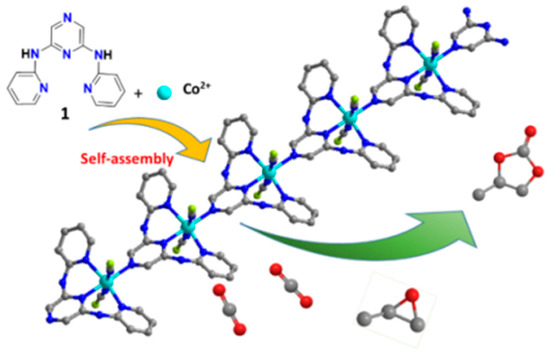
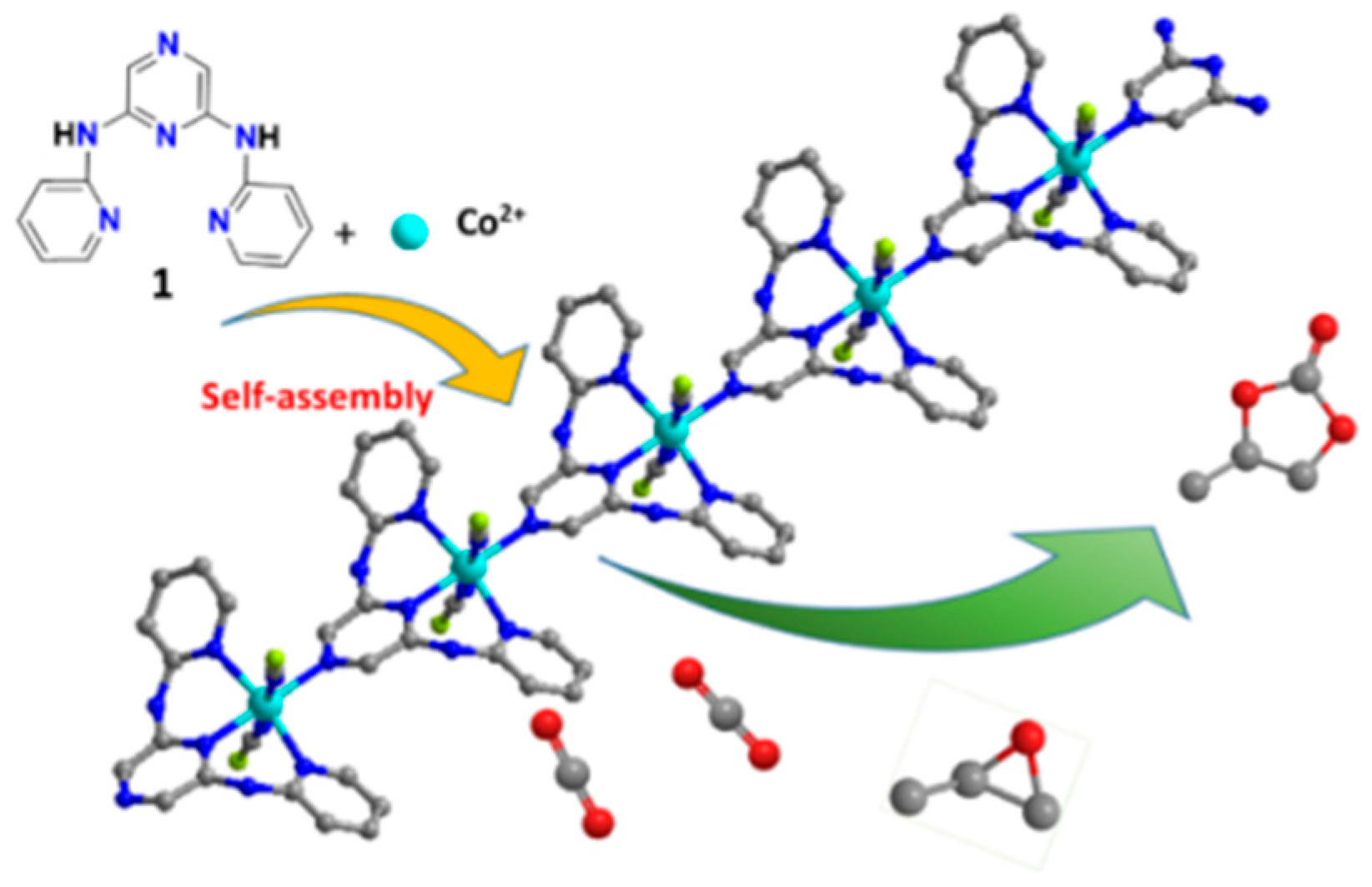
Herein, H2dpPzda(1) [22] was used as a ligand, and we have designed and synthesized a novel cobalt complex [Co(H2dpPzda)(NCS)2]·CH3OH(2) (Scheme 1). Complex 2, which was used as a catalyst for the cycloaddition of CO2 and epoxides under mild conditions, exhibited excellent catalytic performance with high selectivity and yield and turnover frequency (TOF). Additionally, the insolubility of Complex 2 in the reactants and products allows the catalyst to be easily recycled by simple centrifugation with almost no loss. Therefore, we propose a possible mechanism that the synergism of Lewis acidic metal centers and N group make it highly catalytically active.
Scheme 1.
Self-assembly of complex 2 for CO2 conversion (N, blue; C, gray; S, yellow).
2. Results and Discussion
2.1. Structure and Characterization
Complex 2 was synthesized when Co(NCS)2 reacted with the ligand H2dpPzda in methanol. The experimental conditions, data collection, structural analysis, correction methods and crystal data of the complex related to X-ray diffraction analysis were shown in Table S1. The main bond lengths were listed in Table S2.
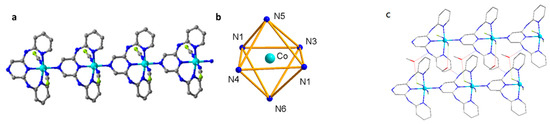
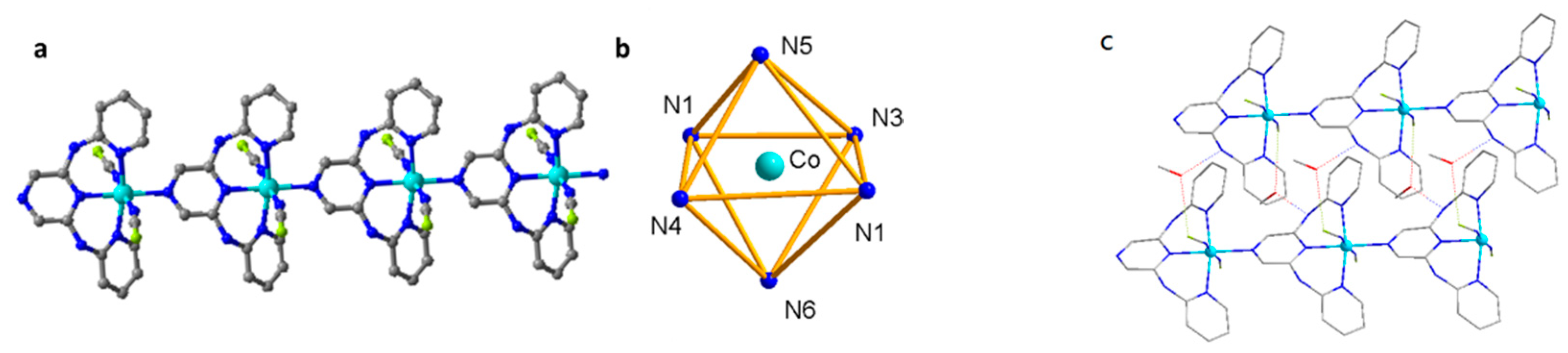
Complex 2 was a one-dimensional straight chain polymeric structure of neutral molecular type, and its crystal belonged to the Aba2 space group of orthorhombic system. The crystal structure diagram of the Complex 2 was shown in Figure 1a. In the Complex 2, each ligand had four aromatic nitrogen atoms as coordination atoms, the ligand was tetradentate coordination, and the pyrazine ring acted as a bridging ligand to link the small molecular units of the complex into a one-dimensional chain polymerization. Co(II) coordinated with six nitrogen atoms to form an elongated octahedral geometry. The equatorial plane was constructed through four nitrogen atoms, three of which came from one ligand and the fourth nitrogen atom from the pyrazine ring of another ligand. The two nitrogen atoms of the pyrazinyl group and the Co(II) ion were coordinated at the equatorial position. In the axial position, the other two nitrogen atoms were derived from thiocyanate. Adjacent ligands were on the same plane (Co–Co–Co = 180.00°) and the spacing between Co–Co reached 7.14 Å. The bond length of the Co–N (H2dpPzda) bond varied from 2.121 to 2.202, and the bond length of the Co-N (NCS-) bond was 2.059 Å which indicated that the anionic NCS had strong binding ability to Co(II). The N-C-S participating in the coordination of the N-C-S had an angle of 179.30° and was almost straight. For Co(II) ions, the coordination environment could be considered as an elongated square bipyramid (Figure 1b). All of the bond lengths of Co–N fell into the normal ranges. In Complex 2, the ligand coordinated in a bidentate bridging mode with two ligands in a cis conformation. The hydrogen bonded N2-H2···O1 and O1-H1B···S1 between the amine group, and the thiocyanate and the methanol solvent (Table S3) transformed the one-dimensional chain structure into a two-dimensional plane as shown in Figure 1c.
Figure 1.
(a) The coordination environment of complex 2 (hydrogen atoms were omitted for clarity); (b) the coordination polyhedron of Co2+; and (c) 2-D supramolecular structure of complex 2 with H atoms omitted for clarity. H bonds were indicated with dashed lines. (Hydrogen atoms were omitted for clarity. Color scheme: Co atoms, light blue; C atoms, gray; N atoms, blue; S atoms, yellow; O atoms, red).
2.2. Catalytic Activity for CO2 Fixation
In this section, we designed a series of experiments to explore the potential catalytic performance of compounds 1 and 2. The pyridyl and cobalt metals in 2 could give the catalyst a high density of Lewis-basic and Lewis-acid active sites, giving it multiple functionalities, indicating that they have broad prospects in catalytic applications. Thus, we designed a series of experiments to examine their catalytic activities. As shown in Table 1, the catalyst and the co-catalyst had a significant effect on the cycloaddition of CO2 and propylene oxide (substrate). We utilized 0.025 mol% complex 2 in combination with 0.5 mol% TBAB as binary catalysts to obtain solvent-free cyclic carbonates under the conditions of 90 °C, 1MPa, which achieved excellent conversion (89%) and showed high catalytic activity with initial turnover frequency (TOF) of up to 3560 h−1 after 1 h reaction (entry 5, Table 1). We compared it with representative catalysts under different conditions so as to evaluate the high catalytic performance of this catalytic system (Table 2). The results show that the catalytic activity of complex 2 is higher than most of the published catalysts, such as Zn(OPO)2, Al-iPOP-2, Co-Salen and so on. Considering that co-catalysts such as ammonium salts were effective in improving the catalytic activity of complexes, different co-catalysts (DMAP and TBAB) were tested with the best performance of TBAB (entries 5 and 12, Table 1). Neither 1, 2 nor TBAB alone could catalyze the reaction with satisfactory yields (9%, 16% and 25%, respectively), while the conversion was increased to 89% via the co-existence of 2 and TBAB. However, in the absence of co-catalysts, catalysts 1 and 2 still showed a certain catalytic activity which might be due to the synergism of N groups (entries 2–3, Table 1). The conversion was decreased from 89% to 49% with the temperature dropping from 90 °C to 60 °C, though it showed excellent catalytic activity with relatively high initial TOF >1800 h−1 (entries 5–8, Table 1). Nonetheless, the catalytic activity was less sensitive to CO2 pressure than temperature. The conversions remained hardly changed when the CO2 pressure was reduced from 15 to 8 bar, but the conversions would drop dramatically when the pressure dropped to 6 bar (Table 1, entries 9–11). Good yields were still obtained at lower TBAB loading (0.25 mol% and 0.1 mol%, respectively), with the initial TOF of up to 3000 h−1 and 2480 h−1 (entries 13–14, Table 1), respectively. It was noteworthy that the propylene oxide was used without removal of either oxygen or moisture in advance. Besides, air or water (volume ratio = 20%) (entries 15–16, Table 1) had little influence on the reactions in the catalytic process, indicating that complex 2 had better stability in this process. Gratifyingly, the loading of 0.0025 mol% 2 and 0.5 mol% TBAB for the cycloaddition of PO under the conditions of 120 °C, 1MPa after 1 h reaction, brought about a moderate conversion of 73% and a remarkable TOF as high as 29,200 h−1 (entry 18, Table 1). This result proved that the reaction was still extremely active with a little catalyst content.
Table 1.
Cycloaddition of CO2 and propylene oxide (PO) using 1 and 2 a.
Table 2.
Representative homogeneous and heterogeneous cobalt catalysts with high TOF used for the synthesis of cyclic carbonates.
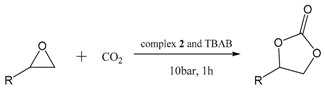
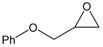
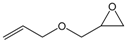
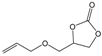
To further investigate the catalytic performance of complex 2, different epoxy substrates were tested under mild conditions. As shown in Table 3, all terminal expoxides could be converted into the corresponding cyclic carbonates with high yields and selectivities under the conditions of 90 °C and 10 bar CO2 after 1h reaction. In addition, epichlorohydrin and allyl glycidyl ether exhibited the best catalytic activity with the highest conversions (99%) and TOF (3960 h−1).
Table 3.
Cycloaddition of CO2 to different epoxide substrates using complex 2 as a catalyst.
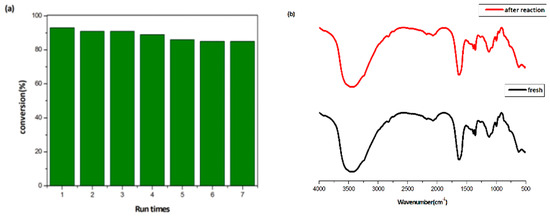
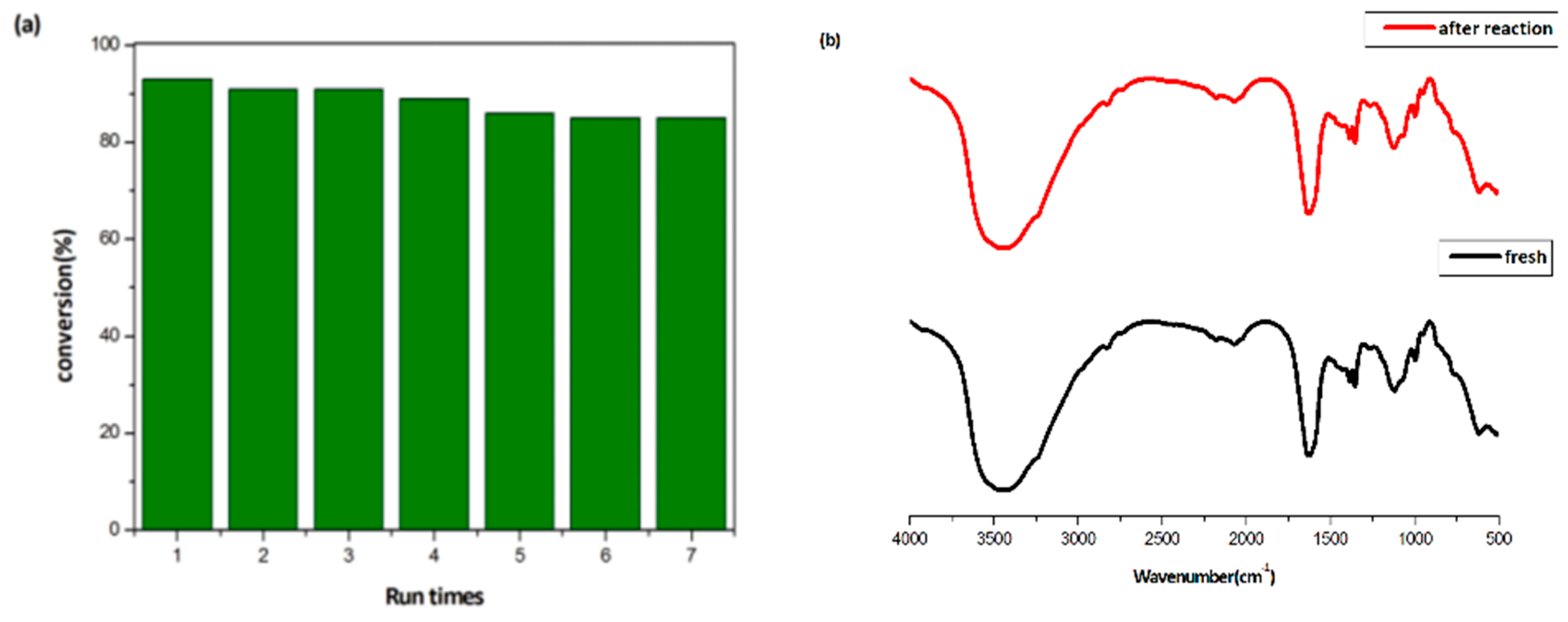
The recyclability and stability of a catalyst plays an integral role in practical application [24,28,29]. The recycling experiment was carried out by the optimal reaction conditions obtained under the above experiment, i.e., 60 °C and 10 bar of CO2 and 12 h. 1 mol% of the catalyst and propylene oxide were placed in an autoclave and passed through 10 bar of CO2 for 12 h to calculate the yield. Subsequently, the catalyst was recovered by centrifugation, washed and dried, and reused under the same conditions. The IR spectrum of 2 confirmed that the structural integrity of 2 was well maintained after catalysis (Figure 2b). The cycle of the catalytic system was successfully repeated seven times with little change in conversion (Figure 2a).
Figure 2.
(a) Recycling experiments of CO2 cycloaddition of propylene oxide. (Reaction conditions: 10 mmol propylene oxide, 1 mol% catalyst, 1 mol% TBAB, r.t., 60 °C, 12 h, 10 bar CO2) and (b) IR spectra of complex 2 and its sample after recycled reactions.
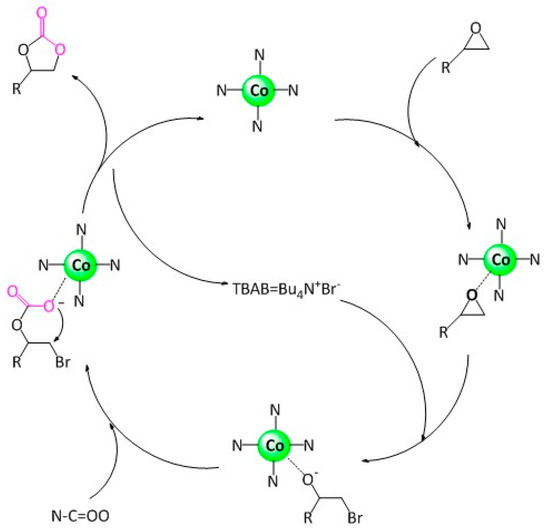
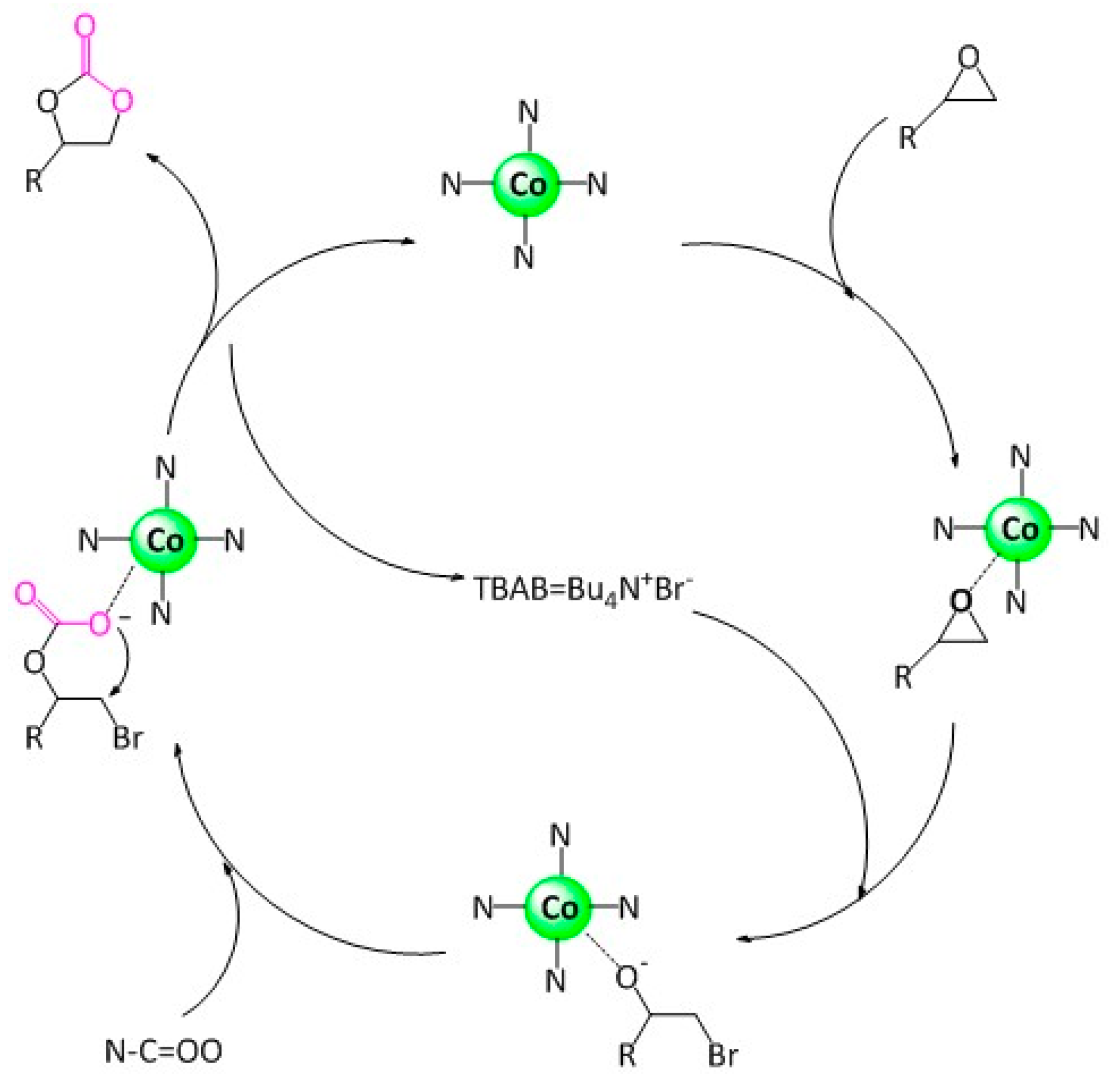
Considering the mechanism for coupling reaction of epoxides and CO2 reported earlier, and frontier molecular orbital calculation results (Table S4), we tentatively proposed a possible catalyzed cycloaddition mechanism of complex 2 in Scheme 2 [12,30,31,32]. Firstly, epoxide was activated by the coordination with multiple Lewis acidic metal centers, and intermediate II was formed. Secondly, nucleophilic reagent Br− of TBAB intermediate III was formed. Finally, CO2, which was polarized by pyridine groups of complex 2 (N-C = OO), was inserted into the M-O epoxide bonds to generate cyclic carbonates and was epoxidized by an internal attack of CO2 on the C-Br bond with re-generation of the co-catalyst. Experimental evidence showed that besides the high density of Lewis acid active sites, the existence of nitrogen-containing functionalized ligands 1, which was used in combination with TBAB, was used as a catalyst for the model reaction. Either 1 or 2 TBAB alone could also catalyze the reaction with conversions 9% and 16%, respectively. This mechanism denoted that the high catalytic activity might be due to the synergism of Lewis acidic metal centers and N group.
Scheme 2.
Possible mechanism for cycloaddition of CO2 catalyzed by complex 2.
3. Materials and Methods
3.1. Materials and Characterizations
All samples and solvents were of analytical grade and were ready to use. The ligand N,N’-Di(pyridin-2-yl)pyrazine-2,6-diamine(H2dpPzda) was synthesized following the reported procedure [19]. FT-IR spectra were obtained on a VERTEX-70 Fourier transform infrared spectrometer with a band ranging from 4000 to 400 cm−1. The elemental analysis of complex was performed using Elementar Germany’s Vario MICRO elemental analyzer. The thermogravimetric analysis data of complex was obtained by using America METTLER TOLEDO thermogravimetric analysis. The UV spectrum data of complex was obtained by using Japan Shimadzu UV-2600 ultraviolet spectrophoto-meter. 1H NMR spectra were recorded on a JEOL ECS400M spectrometer with reference to the solvent signals. A single crystal of size 0.30 × 0.15 × 0.03 mm3 was placed on the diffractometer, and the crystal structure was determined by graphite monochromated Mo Ka (λ = 0.071073 nm) radiation and ω-2θ scanning. All calculations were performed using the SHLXL-97 program and refined with SHELXL-2014 by full-matrix least-squares on |F|2 values. The CCDC data of complex 2 is 1903857.
3.2. Synthesis of Complex 2
A mixture of Co(NCS)2 (0.42 mmol) and H2dpPzda (0.38 mmol) in methanol (50 mL) was stirred overnight and then the solution was filtered to remove impurities and concentrated under vacuum. Natural volatilization obtained deep orange single crystals (33% yield). EA (%) C18H20CoN8O2S2: calcd. C 42.94, H 3.97, N 22.27, S 12.72; found: C 43.42, H 3.61, N 22.39, S 12.68; UV-Vis (CH3OH) λmax/nm (ε/dm3mol−1·cm−1): 206 (1.70 × 10⁵), 208 (2.48 × 10⁵), 360 (1.96 × 10⁵); IR(KBr, cm−1): 3416 (s); 2050 (w); 1635 (s); 1385 (m); 1151 (m); 772 (w); 624 (w).
3.3. Catalytic Procedure
The detailed catalytic procedure was described in our previous work [33]. The catalyst, cocatalyst, and epoxide were sequentially added to a 100 mL high pressure reactor, then the reactor was pressurized to a required pressure with CO2, and the mixture was heated and stirred for a while. After completion of the reaction, unreacted CO2 was evacuated to remove pressure, the lid was removed, the product was taken out and separated, and the conversion of the epoxide was analyzed by 1H NMR spectroscopy.
4. Conclusions
In summary, we have successfully synthesized a novel cobalt complex [Co(H2dpPzda)(NCS)2]·CH3OH (2) with H2dpPzda (1) as the chelating and bridging ligand. The structure of complex 2 is Co(II) coordinating with six nitrogen atoms to form an elongated octahedral geometry, with the pyrazine ring acting as a bridging ligand to link molecular units of complex 2 into a one-dimensional chain complex.
The complex 2 has been used for CO2 conversion, and the results have shown that complex 2/TBAB exhibits high catalytic activity for converting CO2 into cyclic carbonates under mild conditions. The catalyst could be recycled to maintain the integrity of the structure and remained equal to the level of its catalytic activity even after 6 catalytic rounds, indicating that the novel 1 D supramolecular chain catalysts act as relatively robust materials.
Supplementary Materials
The following are available online at https://www.mdpi.com/2073-4344/9/11/951/s1, Table S1–S3: Crystal data of Complex 2, Table S4: Highest Occupied Molecular Orbital (HOMO), and Lowest Unoccupied Molecular Orbital (LUMO) of complex 2, Table S5: Representative homogeneous and heterogeneous cobalt catalysts with high TOF used for the synthesis of cyclic carbonates, Figure S1–S5: NMR spectra of carbon dioxide fixation reactions, X-ray molecular structure reported for complex 2. (CIF).
Author Contributions
Data curation, W.F.; Formal analysis, W.F., L.W. and X.-G.J.; Funding acquisition, W.-Z.W., L.-L.L. and X.-G.J.; Investigation, W.F.; Methodology, W.F., L.W. and L.-L.L.; Project administration, W.-Z.W.; Writing—original draft, W.F.; Writing—review & editing, W.-Z.W., T.-C.X. and P.P.E.
Funding
This research was funded by the National Natural Science Foundation of China (No. 11847140), the Natural Science Foundation of Shannxi Province (No. 2019JZ-44; 2017JQ2009), the Natural Science Basic Research Plan in Shaanxi Province of China (No. 2019JQ-490), the Scientific Research Program Funds by Shannxi Provincial Education Department (No. Z18165), the Xi’an Shiyou University Postgraduate Innovation and Practical Ability Training Project (No.YCS17211017).
Conflicts of Interest
The authors declare no conflicts of interest.
References
- Gao, L.; Feng, J. A one-step strategy for thermally and mechanically reinforced pseudo-interpenetrating poly (propylene carbonate) networks by terpolymerization of CO2, propylene oxide and pyromellitic dianhydride. J. Mater. Chem. A 2013, 1, 3556–3560. [Google Scholar] [CrossRef] [Scilit]
- Xu, Y.; Wang, S.; Lin, L.; Xiao, M.; Meng, Y. Semi-crystalline terpolymers with varying chain sequence structures derived from CO2, cyclohexene oxide and ε-caprolactone: One-step synthesis catalyzed by tri-zinc complexes. Polym. Chem. 2015, 6, 1533–1540. [Google Scholar] [CrossRef] [Scilit]
- Kember, M.R.; Buchard, A.; Williams, C.K. Feature Article Catalysts for CO2/epoxide copolymerisation. Chem. Commun. 2011, 47, 141–146. [Google Scholar] [CrossRef] [Scilit] [PubMed]
- Subramanian, S.; Park, J.; Byun, J.; Jung, Y.; Yavuz, C.T. Highly Efficient Catalytic Cyclic Carbonate Formation by Pyridyl Salicylimines. ACS Appl. Mater. Interfaces 2018, 10, 9478–9484. [Google Scholar] [CrossRef] [Scilit] [PubMed]
- Liu, N.; Xie, Y.F.; Wang, C.; Li, S.J.; Wei, D.H.; Li, M.; Dai, B. Cooperative Multifunctional Organocatalysts for Ambient Conversion of Carbon Dioxide into Cyclic Carbonates. ACS Catal. 2018, 8, 9945–9957. [Google Scholar] [CrossRef] [Scilit]
- Taherimehr, M.; Sertã, J.P.C.C.; Kleij, A.W.; Whiteoak, C.J.; Pescarmona, P.P. New Iron Pyridylamino-Bis (Phenolate) Catalyst for Converting CO2 into Cyclic Carbonates and Cross-Linked Polycarbonates. ChemSusChem 2015, 8, 1034–1042. [Google Scholar] [CrossRef] [Scilit] [PubMed]
- Montoya, C.A.; Gómez, C.F.; Paninho, A.B.; Nunes, A.V.M.; Mahmudov, K.T.; Najdanovic-Visak, V.; Nunes da Ponte, M. Cyclic carbonate synthesis from CO2 and epoxides using zinc(II) complexes of arylhydrazones of β-diketones. J. Catal. 2016, 335, 135–140. [Google Scholar] [CrossRef] [Scilit]
- Peng, J.; Geng, Y.; Yang, H.J.; He, W.; Wei, Z.; Yang, J.; Guo, C.Y. Efficient solvent-free fixation of CO2 into cyclic carbonates catalyzed by Bi(III) porphyrin/TBAI at atmospheric pressure. Mol. Catal. 2017, 432, 37–46. [Google Scholar] [CrossRef] [Scilit]
- Sengupta, M.; Bag, A.; Ghosh, S.; Mondal, P.; Bordoloi, A.; Islam, S.M. CuxOy@COF: An efficient heterogeneous catalyst system for CO2 cycloadditions under ambient conditions. J. CO2 Util. 2019, 34, 533–542. [Google Scholar] [CrossRef] [Scilit]
- Sudakar, P.; Sivanesan, D.; Yoon, S. Copolymerization of Epichlorohydrin and CO2 Using Zinc Glutarate: An Additional Application of ZnGA in Polycarbonate Synthesis. Macromol. Rapid Commun. 2016, 37, 788–793. [Google Scholar] [CrossRef] [Scilit]
- Zhang, W.H.; He, P.P.; Wu, S.; Xu, J.; Li, Y.; Zhang, G.; Wei, X.Y. Graphene oxide grafted hydroxyl-functionalized ionic liquid: A highly efficient catalyst for cycloaddition of CO2 with epoxides. Appl. Catal. A Gen. 2016, 509, 111–117. [Google Scholar] [CrossRef] [Scilit]
- Liu, M.; Lan, J.; Liang, L.; Sun, J.; Arai, M. Heterogeneous catalytic conversion of CO2 and epoxides to cyclic carbonates over multifunctional tri-s-triazine terminal-linked ionic liquids. J. Catal. 2017, 347, 138–147. [Google Scholar] [CrossRef] [Scilit]
- Wang, X.; Zhao, Y.; Kodama, K.; Hirose, T. Poly (4-vinylphenol)/tetra-n-butylammonium iodide: Efficient organocatalytic system for synthesis of cyclic carbonates from CO2 and epoxides. J. Appl. Polym. Sci. 2017, 134, 45189–45196. [Google Scholar] [CrossRef] [Scilit]
- Wu, X.; Chen, C.; Guo, Z.; North, M.; Whitwood, A.C. Metal and halide free catalyst for the synthesis of cyclic carbonates from epoxides and carbon dioxide. ACS Catal. 2019, 9, 1895–1906. [Google Scholar] [CrossRef] [Scilit]
- Verma, S.; Kumar, G.; Ansari, A.; Kureshy, R.I.; Khan, N.H. A nitrogen rich polymer as an organo-catalyst for cycloaddition of CO2 to epoxides and its application for the synthesis of polyurethane. Sustain. Energy Fuels 2017, 1, 1620–1629. [Google Scholar]
- Milani, J.L.S.; Oliveira, I.S.; Santos, P.A.D.; Valdo, A.K.S.M.; Martins, F.T.; Cangussu, D.; Chagas, R.P.D. Chemical fixation of carbon dioxide to cyclic carbonates catalyzed by zinc (II) complex bearing 1,2-disubstituted benzimidazole ligand. Chin. J. Catal. 2018, 39, 245–249. [Google Scholar] [CrossRef] [Scilit]
- Liang, J.; Huang, Y.B.; Cao, R. Metal–organic frameworks and porous organic polymers for sustainable fixation of carbon dioxide into cyclic carbonates. Coord. Chem. Rev. 2019, 378, 32–65. [Google Scholar] [CrossRef] [Scilit]
- José, A.C.; Javier, M.; Felipe, C.M.; María, P.C.; Juan, F.B.; Julián, R.L.; Antonio, O.; Agustín, L.S.; Juan, T. Development of hydroxy-containing imidazole organocatalysts for CO2 fixation into cyclic carbonates. Catal. Sci. Technol. 2018, 8, 1981–1987. [Google Scholar]
- Stößer, T.; Li, C.; Unruangsri, J.; Saini, P.K.; Sablong, R.J.; Meier, M.A.R.; Koning, C. Bio-derived polymers for coating applications: Comparing poly (limonene carbonate) and poly (cyclohexadiene carbonate). Polym. Chem. 2017, 8, 6099–6113. [Google Scholar] [CrossRef] [Scilit]
- Zhang, H.; Liu, B.; Ding, H.; Chen, J.; Duan, Z. Polycarbonates derived from propylene oxide, CO2, and 4-vinyl cyclohexene oxides terpolymerization catalyzed by bifunctional salcyCoIIINO3 complex and its post-polymerization modification. Polymer 2017, 129, 5–11. [Google Scholar] [CrossRef] [Scilit]
- Chang, T.; Jin, L.; Jing, H. Bifunctional Chiral Catalyst for the Synthesis of Chiral Cyclic Carbonates from Carbon Dioxide and Epoxides. ChemCatChem 2009, 1, 379–384. [Google Scholar] [CrossRef] [Scilit]
- Ismayilov, R.H.; Wang, W.Z.; Lee, G.H.; Wang, R.R.; Liu, I.C.P.; Yeh, C.Y.; Peng, S.M. New versatile ligand family, pyrazine-modulated oligo-α-pyridylamino ligands, from coordination polymer to extended metal atom chains. Dalton Trans. 2007, 27, 2898–2912. [Google Scholar] [CrossRef] [Scilit] [PubMed]
- Khattak, Z.A.; Younus, K.H.A.; Ahmad, N.; Ullah, H.; Suleman, S.; Hossain, M.S.; Verpoort, F. Highly active dinuclear cobalt complexes for solvent-free cycloaddition of CO2 to epoxides at ambient pressure. Chem. Commun. 2019, 55, 8274–8277. [Google Scholar] [CrossRef] [Scilit] [PubMed]
- Ma, R.; He, L.N.; Zhou, Y.B. An efficient and recyclable tetraoxo-coordinated zinc catalyst for the cycloaddition of epoxides with carbon dioxide at atmospheric pressure. Green Chem. 2016, 18, 226–231. [Google Scholar] [CrossRef] [Scilit]
- Chen, Y.; Luo, R.; Xu, Q.; Jiang, J.; Zhou, X.; Ji, H. Charged Metalloporphyrin Polymers for Cooperative Synthesis of Cyclic Carbonates from CO2 under Ambient Conditions. ChemSusChem 2017, 10, 2534–2537. [Google Scholar] [CrossRef] [Scilit]
- Ema, T.; Miyazaki, Y.; Shimonishi, J.; Maeda, C.; Hasegawa, J.Y. Bifunctional Porphyrin Catalysts for the Synthesis of Cyclic Carbonates from Epoxides and CO2: Structural Optimization and Mechanistic Study. J. Am. Chem. Soc. 2014, 136, 15270–15279. [Google Scholar] [CrossRef] [Scilit]
- Xie, Y.; Wang, T.T.; Yang, R.X.; Huang, N.Y.; Zou, K.; Deng, W.Q. Efficient Fixation of CO2 by a Zinc-Coordinated Conjugated Microporous Polymer. ChemSusChem 2014, 7, 2110–2114. [Google Scholar] [CrossRef] [Scilit]
- Wang, L.; Zhang, R.L.; Han, Q.X.; Xu, C.; Chen, W.M.; Yang, H.; Gao, G.S.; Qin, W.W.; Liu, W.S. Amide-functionalized heterometallic helicate cages as highly efficient catalysts for CO2 conversion under mild conditions. Green Chem. 2018, 20, 5311–5317. [Google Scholar] [CrossRef] [Scilit]
- Gao, G.; Wang, L.; Zhang, R.; Xu, C.; Yang, H.; Liu, W. Hexanuclear 3d–4f complexes as efficient catalysts for converting CO2 into cyclic carbonates. Dalton Trans. 2019, 48, 3941–3945. [Google Scholar] [CrossRef] [Scilit]
- Hu, J.; Ma, J.; Liu, H.; Qian, Q.; Xie, C.; Han, B. Dual-ionic liquid system: An efficient catalyst for chemical fixation of CO2 to cyclic carbonates under mild conditions. Green Chem. 2018, 20, 2990–2996. [Google Scholar] [CrossRef] [Scilit]
- Guo, Z.; Cai, X.; Xie, J.; Wang, X.; Zhou, Y.; Wang, J. Hydroxyl-Exchanged Nanoporous Ionic Copolymer toward Low-Temperature Cycloaddition of Atmospheric Carbon Dioxide into Carbonates. ACS Appl. Mater. Interfaces 2016, 8, 12812–12821. [Google Scholar] [CrossRef] [Scilit] [PubMed]
- Karamé, I.; Zaher, S.; Eid, N.; Christ, L. New zinc/tetradentate N4 ligand complexes: Efficient catalysts for solvent-free preparation of cyclic carbonates by CO2/epoxide coupling. Mol. Catal. 2018, 456, 87–95. [Google Scholar] [CrossRef] [Scilit]
- Xia, L.; Wang, W.Z.; Liu, S.; Jia, X.G.; Zhang, Y.H.; Li, L.L.; Wu, Y.; Su, B.Y.; Geng, S.B.; Fan, W. New Coordination Complexes Based on 2,6-bis [1-(phenylimino)ethyl Ligand: Effective Catalysts for the Synthesis of Propylene Carbonates from Carbon Dioxide and Epoxides. Molecules 2018, 23, 2304. [Google Scholar] [CrossRef] [Scilit] [PubMed]




© 2019 by the authors. Licensee MDPI, Basel, Switzerland. This article is an open access article distributed under the terms and conditions of the Creative Commons Attribution (CC BY) license (http://creativecommons.org/licenses/by/4.0/).