Article

Photopolymer-Based Carbon with Iron Nanoparticles as Electrodes in Microbial Fuel Cells for Efficient Industrial Effluent Wastewater Treatment

by
Ricardo da Silva Furlan
1,2,
Noelia Corrochano
2,3,
Rodrigo Brackmann
1,
Mariana de Souza Sikora
1,*,
Carlos Sotelo-Vazquez
2,3 and
Jose L. Diaz de Tuesta
2,3,*
1
Department of Chemistry, Universidade Tecnológica Federal do Paraná (UTFPR), Via do Conhecimento Km 1, Pato Branco 85503-390, Brazil
2
Chemical and Environmental Engineering Group, ESCET, Rey Juan Carlos University, c/Tulipán s/n, 28933 Móstoles, Spain
3
Instituto de Investigación de Tecnologías para la Sostenibilidad, Rey Juan Carlos University, c/Tulipán s/n, 28933 Móstoles, Spain
*
Authors to whom correspondence should be addressed.
Catalysts 2026, 16(4), 348; https://doi.org/10.3390/catal16040348
Submission received: 7 December 2025 / Revised: 6 February 2026 / Accepted: 2 March 2026 / Published: 13 April 2026

Abstract

Accelerated industrial development demands the search for efficient remediation technologies. Microbial fuel cells (MFCs) have the capacity to remediate organic matter-rich effluent by utilizing bacteria as biocatalysts capable of oxidizing organic material while simultaneously producing electricity. In this paper, a novel electrode is prepared through the carbonization of a tailored photopolymer with iron nanoparticles and carbon black (C-iNPCB) and its performance tested as an anode using dual chamber MFCs for the remediation of paper recycling plant effluent. Its efficiency is compared to a graphite rod (GR) and a carbon black-coated 3D-printed structure (3D-CB). The paper effluent containing chemical oxygen demand 5.0 g/L was used as feedstock in the MFCs. The GR anode (0.91 A/m2; 0.32 W/m2) and 3D-CB anode (0.88 A/m2; 0.30 W/m2) both achieved 56% COD removal, while the C-iNPCB-anode (5.71 A/m2; 3.75 W/m2) was the best performing, with over 80% COD removal. The photopolymerized doped anode exhibited superior performance in terms of both organic matter oxidation and conductivity, indicating higher effectiveness of this type of electrode in MFC technology.

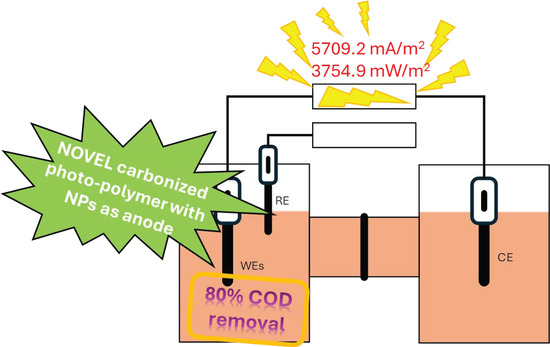
Graphical Abstract

1. Introduction

The accelerating pace of industrial development has intensified concerns regarding water quality, primarily due to the inadequate disposal of effluent streams. Consequently, the need for efficient technologies to remediate these wastewater streams is paramount.
Historically, conventional treatment processes have played a crucial role in removing pollutants. However, the complexity of industrial effluents mandates the development of more sophisticated remediation strategies. With the increasing worldwide consumption of paper products and natural fibers, the concentration of organic matter in paper recycling facilities tends to rise. This type of wastewater contains soluble organics and particulates generated during the paper-making process, making its degradation challenging for traditional wastewater treatment systems [1]. One method with promising aspects for paper wastewater treatment is the use of microbial fuel cells (MFCs), which benefit from the cellulose fermentation and degradation derived from the anaerobic nature of the bacteria used as a catalyst [2,3].
MFCs exhibit substantial potential for simultaneous pollutant removal and clean energy generation [4]. MFCs represent a promising bioelectrochemical system for sustainable energy production. They also offer a viable solution for treating organic effluents by harnessing the natural capacity of exoelectrogenic microorganisms to degrade organic substrates. The anode is arguably the core component of an MFC, where design specifications and material selection are critical determinants of the cell’s overall performance. The continuous pursuit of optimized materials and anode architectures remains an active field of research, focused on enhancing both the current efficiency and operational durability of these cells [2,3]. The deployment of MFCs possesses the capability to provide superior removal efficiency for organic pollutants relative to conventional methods [2,5,6].
Carbon, in its various allotropic forms, is one of the most widely employed electrode materials in MFCs due to its excellent conductive properties, chemical stability, and low cost. Nevertheless, certain inherent limitations of carbon can constrain cell performance, such as the challenge of bacterial adhesion to its relatively hydrophobic surface, and electron transfer limitations stemming from the material’s internal resistance and porosity [2,7]. Additive manufacturing (3D printing) is an emerging technology capable of fabricating electrodes with customized specifications, effectively mitigating some of these limitations and consequently augmenting cell performance. Additionally, electrodes focused on nanotechnology, specifically iron nanoparticles containing carbon electrodes, have demonstrated increased performance of microbial electrochemical systems [8,9].
This study focused on the treatment of industrial effluent from a paper recycling facility through the application of MFC technology, investigating the cell’s treatment efficiency in terms of organic substrate removal from the medium and its subsequent electrical power generation efficiency, while also providing a comparative analysis between a conventional graphite rod anode and two advanced alternatives: one fabricated via 3D printing technology and another produced through bulk photopolymerization of a carbonaceous resin doped with nanoparticles to enhance electronic conductivity [8,10]. Conventional carbon materials, such as graphite rods, carbon cloth, and carbon felt, offer biocompatibility and chemical stability but are limited by their intrinsic conductivity and restricted tunability. Recent developments highlight the use of photopolymerizable carbon composites as customizable electrode platforms, in which polymer matrices are shaped and cured before carbonization to yield porous, conductive structures with surface chemistries favorable for biofilm formation [10]. In contrast, incorporating iron-based nanomaterials into carbon matrices has emerged as a promising strategy to accelerate electron-transfer kinetics. Iron nanoparticles and iron–carbon hybrids enhance catalytic activity, introduce pseudo-capacitive behavior, and increase the density of redox-active sites, collectively improving extracellular electron transfer in MFC systems. Iron–carbon nanocomposites produced via pyrolysis of Fe-containing precursors have demonstrated improved charge transport pathways and enhanced microbial adhesion [11,12]. Within this context, the MFCs developed in the present study were designed to compare these anode configurations under an identical microbial consortium, enabling a direct evaluation of how each material’s structural and electrochemical characteristics influence both wastewater treatment performance and electrical output.

2. Results and Discussion

2.1. Wastewater Treatment Using MFCs

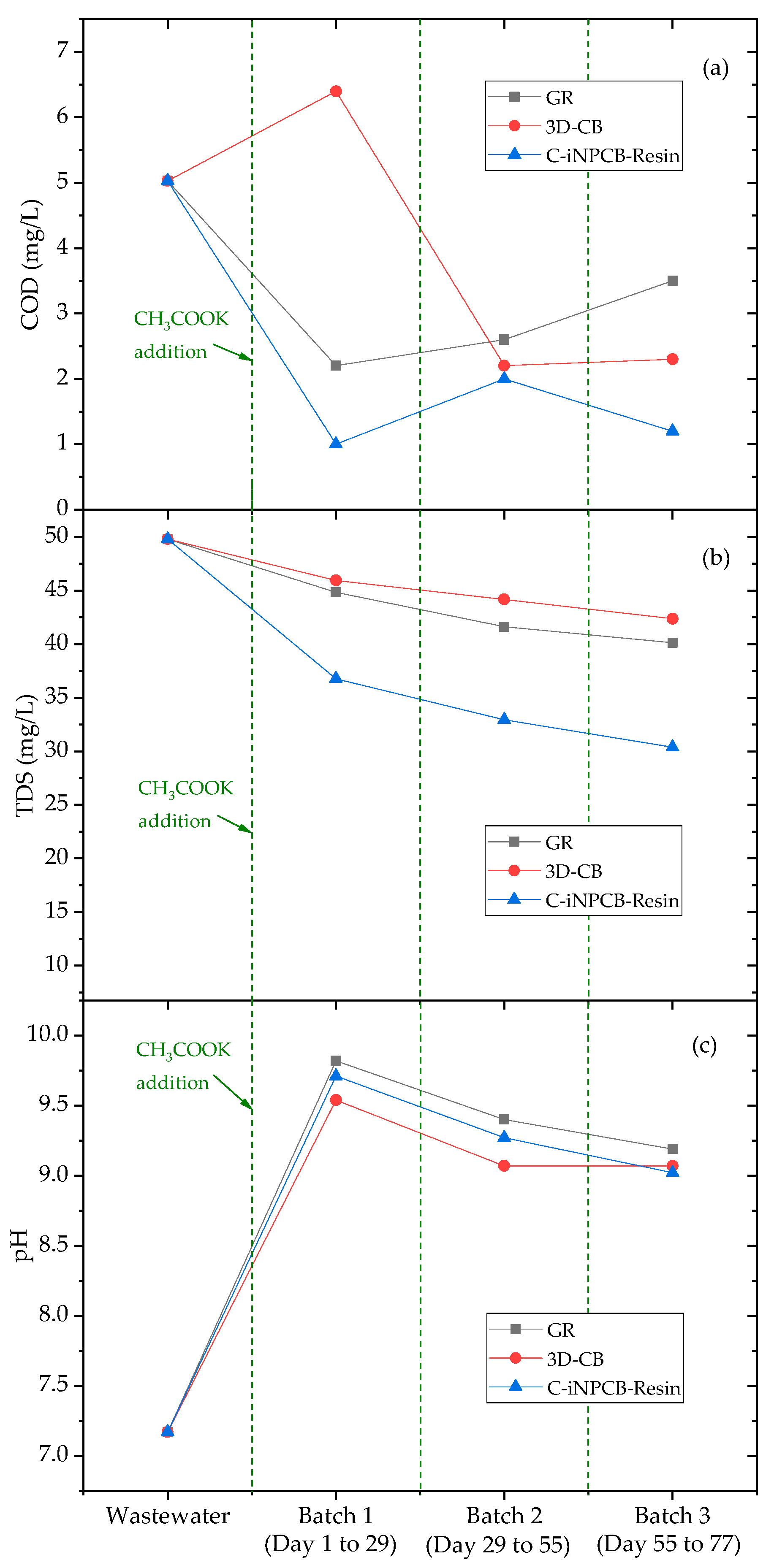
The change in physical chemical characteristics of the anaerobic sludge coming from the paper recycling plant was monitored to determine the effectiveness of the MFCs using GR, 3D-CB and C-iNPCB-Resin electrodes (Figure 1).
The initial concentration of COD in the wastewater (without potassium acetate) was 5.0 g/L. The first batch of the MFC treatment resulted in COD concentrations of 2.2, 6.4, and 1.0 g/L, the second batch showed decreased COD concentrations to 2.6, 2.2, and 2.0 g/L, and the third batch led to values of 3.5, 2.3, and 1.2 g/L of COD for GR, 3D-CB, and C-iNPCB-Resin anodes, respectively. Thus, organic matter removal was satisfactory for all trials, reaching COD removals of 30.4, 54.3 and 76.1% (determined without considering the COD increase by potassium acetate addition prior to first batch, i.e., considering initial COD, which was measured for wastewater as received) after three batches with GR, 3D-CB, and C-iNPCB-Resin anodes, respectively. When normalized by anode’s surface area, the C-iNPCB-Resin anode consistently exhibited higher COD removal efficiency per unit area compared to the GR and 3D-CB anodes, since area-normalized COD removals reached 0.12, 0.21 and 0.99 g·L−1·cm−2 after three operational batches, for GR, 3D-CB, C-iNPCB-Resin anodes, respectively.
The COD increase relative to the initial measurement with the 3D-CB electrode may be attributed to the COD contribution of potassium acetate for the first batch [11,12]. The increase in COD for GR runs after first batch can also be ascribed to the consecutive additions of potassium acetate and, likely, because of a loss of efficiency in the MFC with the GR anode after the first batch. The developed electrode made from carbon-based photoresin with iron nanoparticles and carbon black (C-iNPCB-Resin) led to obtaining the highest COD removals after the first batch (up to 80.1%) and presented the highest removal after the third one. The higher COD removal observed for the C-iNPCB-Resin electrode can be explained by its electrochemical behavior under biotic conditions, as shown in the voltammetry results in the following sections. Compared to GR and 3D-CB, the C-iNPCB-Resin anode operates at much lower oxidation potential (+0.1 V) while still delivering high current densities, and it exhibits smoother, more stable voltammetric profiles [13]. These features indicate more efficient and consistent electron transfer pathways within the biofilm, reduced activation losses, and more controlled biofilm development, conditions that favor rapid and more complete oxidation of organic matter [14]. Palanisamy et al. (2019) compiled a comprehensive review on MFC technology, exploring the use of MFCs to treat municipal wastewater, with results reaching a total COD removal of 87% [15]. Liang et al. (2018) investigated the effectiveness of a 1000 L microbial fuel cell in municipal wastewater with similar characteristics, and encountered COD removal ranging from 67% to 90% when optimizing the anode front [16].
As observed in Figure 1, TDSs continuously decreases after each batch, reaching TDS removals of 10%, 16% and 19% with the GR; 8%, 11% and 15% with the 3D-CB; and 26%, 34% and 39% with C-iNPCB-Resin, after first, second and third batches, respectively. The TPCs (total phenolic compounds) measurement demonstrated a higher efficiency, reaching 84.2% and 94.6% removal after the first batch in MFCs with GR and 3D-CB anodes, respectively. Afterwards, TPCs reached the detection limit of the technique (<20 mg/L) after the second and third batches. The MFC with the C-iNPCB-Resin anode also reached complete removal of TPCs after the first batch, indicating a mostly efficient system of degrading complex phenolic compounds like cellulose [11,12].
The difference in pH from the source wastewater rose from 7.2 initially to an average of 9.7 among the MFCs after the first batch, because of the addition of 20 mmol of potassium acetate as an electrolyte to increase conductivity, which rose from 3.6 mS/cm to an average of 28.8 mS/cm for the MFCs after the first batch. Another result that deserves attention is that the consecutive addition of potassium acetate after batches 1 and 2 does not result in an incremental increase in the pH after each batch, likely due to the degradation of the organic matter into carboxylic acids. However, the differences in pH in the MFCs are the result of many other mechanisms, such as the migration of cations from the anode chamber to the cathode chamber [4,15,17]. This could also be observed in the cathodic chamber’s pH, which rose to a consistent 9.5 value. Puig et al., in 2010, observed that the optimal pH for treating urban wastewater was around 9.5, which could indicate a reason for the higher energy production observed in this study [18]. The turbidity, along with the total dissolved solids, did not change significantly, decreasing from 49.8 mg/L to an average of 39.9 mg/L in all three MFCs. The conductivity of the medium was significantly higher than initially measured, ranging from 3.59 mS/cm to an average of 32.8 mS/cm for all the MFCs, derived from the constant addition of a conductive substance (potassium acetate).

2.2. Electrical Efficiency and Characterization of the MFC

2.2.1. Voltage Evolution over Time

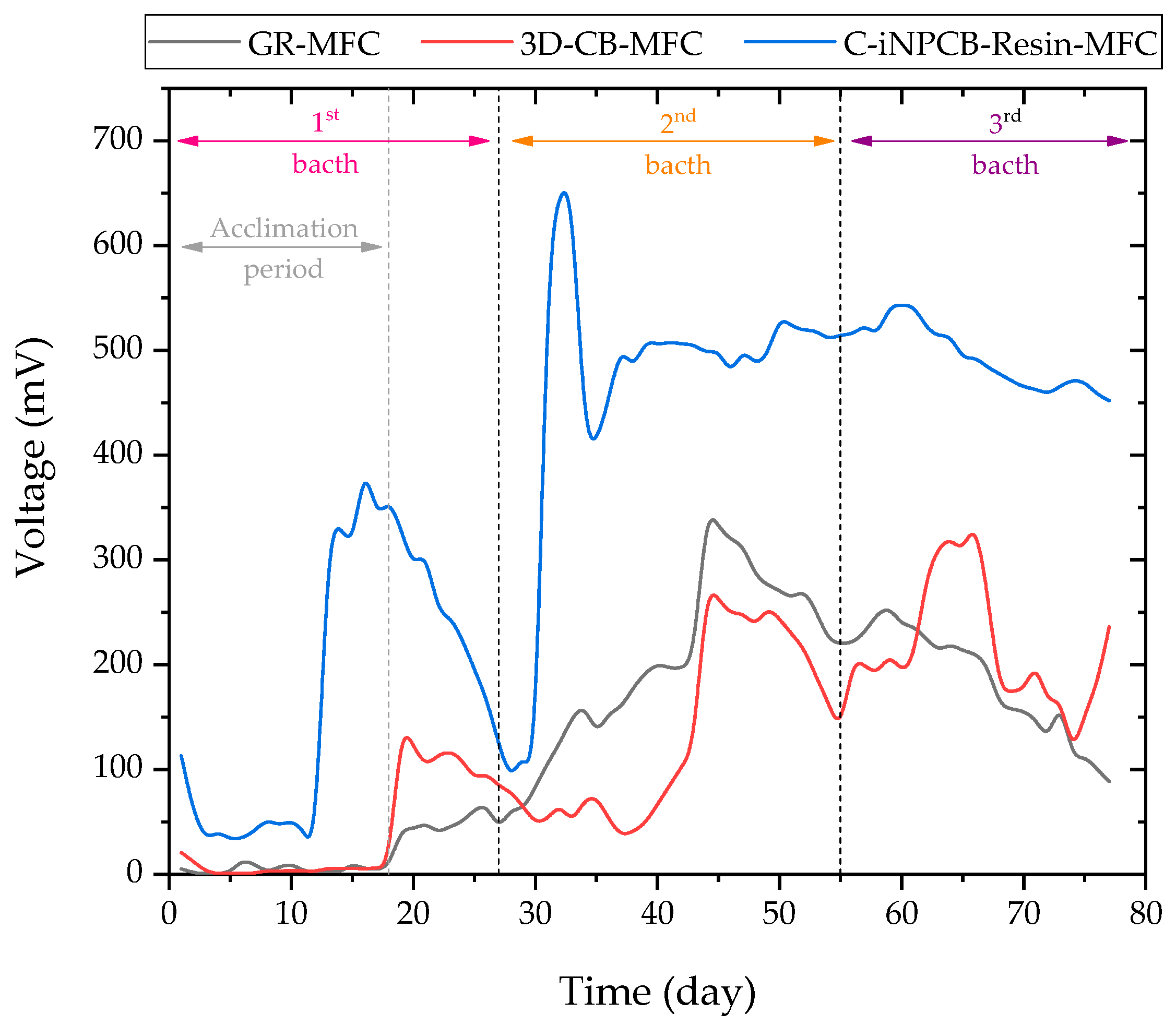
The oxidative process utilized by bacteria can be directly influenced by the anode’s morphology and surface roughness [19]. Thus, the utilization of different anodes in this study aimed to monitor the differences in voltage/current generation. Figure 1 shows the voltage (mV) over time in three different MFCs, during three batch studies performed using GR, 3D-CB and C-iNPCB-Resin as anodes. The voltage over time was measured to reflect key points in the cells’ operation, as the bacterium forms the biofilm in the anode, consumes the organic matter in the chamber, and, consequently, shows the evolution in electrical current [2]. Batch 1 lasted from day 1 to 29, batch 2 from day 29 to 55, and batch 3 from day 55 to 77 of the experiment, resulting in each batch having a duration of around 26 days.
Figure 2 shows the development of the bacterial medium, along with its response to environmental changes. The first few days were ascribed to the acclimation period, relative to the slow growth of bacteria and adhesion to the anode [20]. On day 18 of the experiment (after acclimation), the polarization curve analysis was performed. As observed in Figure 1, GR-MFC and 3D-CB-MFC exhibited an increase in voltage, derived from the change in external resistance in the system from 1000 Ω to 300 Ω. The same behavior was not observed in C-iNPCB-Resin-MFC; however, it had a significant spike in potential difference on day 13.
On day 29, the wastewater in the anodic chamber was removed for analysis, following a decrease in current even after the addition of a carbon source (potassium acetate) on day 27 (the beginning of batch 2), indicating a significant reduction in substrate concentration. After the substrate change, a rise in voltage generation can be observed, especially in C-iNPCB-Resin-MFC, which increased from around 100 mV to over 590 mV.
On day 43, cyclic voltammetry analysis was performed; again, a rise in potential can be observed in GR-MFC and 3D-CB-MFC, indicating better bacterial adhesion in the anode. The cyclic voltammetry performed varies the potential of the working electrode, which can, in some cases, stimulate bacteria to attach to it [21]. Similarly, this process can help clean the surface of the electrode of certain non-electroactive bacteria, thereby enriching the biofilm with highly electroactive microorganisms [22]. On the other hand, C-iNPCB-Resin-MFC did not exhibit a significant increase in voltage, indicating that the electrode’s biofilm was already stable and well-developed.
As observed, the MFC using the C-iNPCB-Resin anode shows the highest values of voltage along the three batches (maximum value registered = 658 mV) compared to the MFCs with GR and 3D-CB anodes (top values as 351 and 339 mV, respectively), derived from the higher capacity to adhere bacteria from the increased hydrophilicity and specific surface from the electrode, alongside its heightened capacity to transfer electrons through the body, in turn facilitating extracellular electron transfer from the bacterium to the electrode [10,18,19].

2.2.2. External Resistance Effects

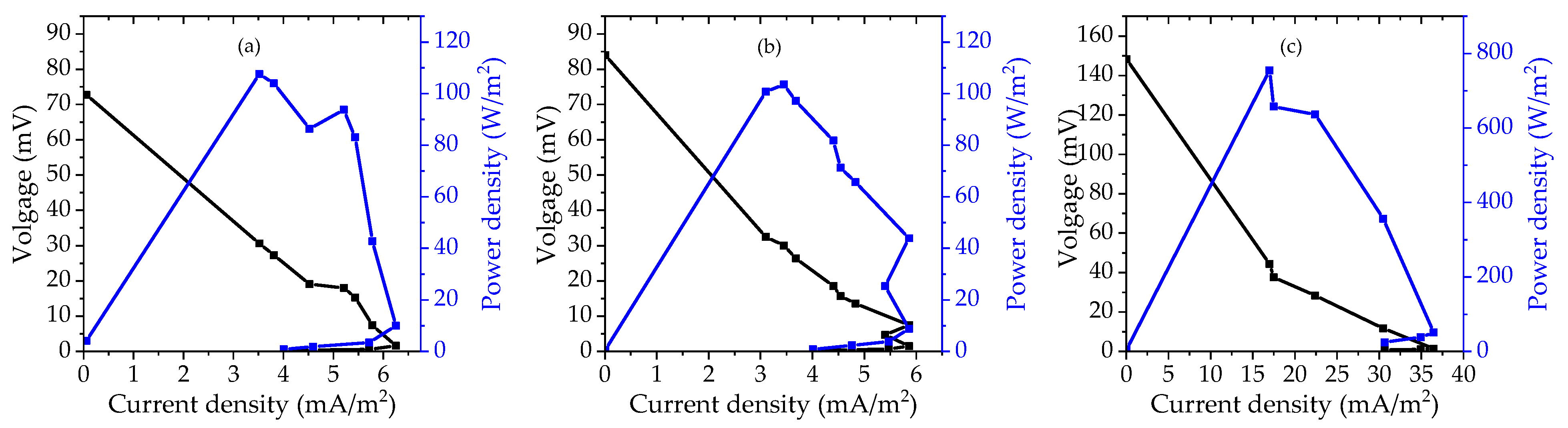
Figure 3 represents the behavior of the MFCs in relation to the changes in external resistance (polarization curves). The polarization curves typically present three distinct regions, each characterized by a predominant overpotential. In the first region, the limitations arise from the activation losses, which are controlled by the kinetics of the electrochemical reaction. The second region is dominated by ohmic losses, characterized by the internal resistance of the system. In the third region, the limiting factor is the mass transfer from the reagents to the electrode surface.
The polarization data reveals a clear dependence of MFC performance on anode architecture. The GR anode presents steep declining voltage with increasing current density, indicating a relatively large internal resistance. The power curve reaches a modest peak and then exhibits a sharp decline followed by a secondary rise, a typical signature of overshoot on higher currents. Compared with the GR anode, the 3D-CB anode shows a slightly smaller slope through the ohmic region, pointing to a reduction in internal resistance, consistent with the increased surface area and improved mass transport that three-dimensional designs provide. However, the power curve also shows pronounced overshoot, which implies that rapid load changes or short dwell times during the test forced the system away from the steady state [23].
The C-iNPCB-anode delivers the highest current density and power density with the smallest voltage drop per current unit, which indicates a lower internal resistance pathway combining improved electrode conductivity with larger surface area and a biofilm with more effective interface interaction with the anode. Advanced electrode materials report similar gains when carbon-based and conductive polymer structures are used to promote extracellular electron transfer [24]. In contrast, the GR anode and 3D-CB anode both display strong power overshoot with a double back in higher currents of the curve. Power overshoot is widely recognized as a measurement artifact that appears when polarization tests outrun the biological and transport time constants of electroactive biofilms [23].
The strength of overshoot depends on both biofilm development and medium properties. Studies have shown stronger overshoot for immature or perturbed biofilms, likely the case for the biofilms studied [23]. These findings explain the multiple points seen for the GR anode and 3D-CB anode and the mild slope in panel in the C-iNPCB anode. The C-iNPCB anode likely reduces the effective internal resistance and partially buffers transient compounds, which shortens the overshoot without completely removing it [25].

2.2.3. MFCs Electrical Performance

Table 1 summarizes the density, power density, and coulombic efficiency (CE) determined for the MFCs.
The current density generation in the GR-MFC was observed to be the lowest overall, with a minimum current of 1.0 mA/m2 while C-iNPCB-Resin had the highest, with a minimum current of 159.7 mA/m2. The maximum current density observed was 914.1 mA/m2 for GR-MFC, 882.8 mA/m2 for 3DCB-MFC, and 5709.2 mA/m2 for C-iNPCB-Resin-MFC, as shown in Table 1. The power density of the cells in relation to the anode area can also be observed, while 3D-CB-MFC produced 299.3 mW/m2 at its maximum, GR-MFC surpassed it at only 320.8 mW/m2. In contrast, the C-iNPCB-Resin-MFC presented a maximum power generation of 3754.9 mW/m2.
Yaqoob et al. (2021) utilized a carbonized electrode, provenient of cellulose waste biomass and composed with polyaniline, and reported a power density of 0.11 mW/m2 [26]. Zheng et al. (2015) explored the use of a carbon black/stainless steel composite anode, and reported a power generation of 3215 mW/m2, close to the value obtained in this study [27]. Yang et al. (2016) reported a power generation of 2520 mW/m2 when utilizing an anode composed of graphene oxide aerogel and a graphene riboflavin composite [28].
The CE observed is significantly higher in the C-iNPCB-Resin-MFC. This efficiency can be attributed to the anode having a higher affinity for bacterial adhesion, which facilitates electron transference [22]. Although low, the CE encountered in this study is consistent with some of the paper wastewater MFCs found in the literature. Nimje et al. (2012) explored the treatment of different wastewaters in a single bacterial culture, and reported CEs ranging from 0.0002% for agricultural wastewater to up to 2.9% with dairy wastewater, with paper wastewater CEs ranging from 0.008 to 1.5% [29].

2.2.4. Mechanism of MFCs Through Cyclic Voltammetry

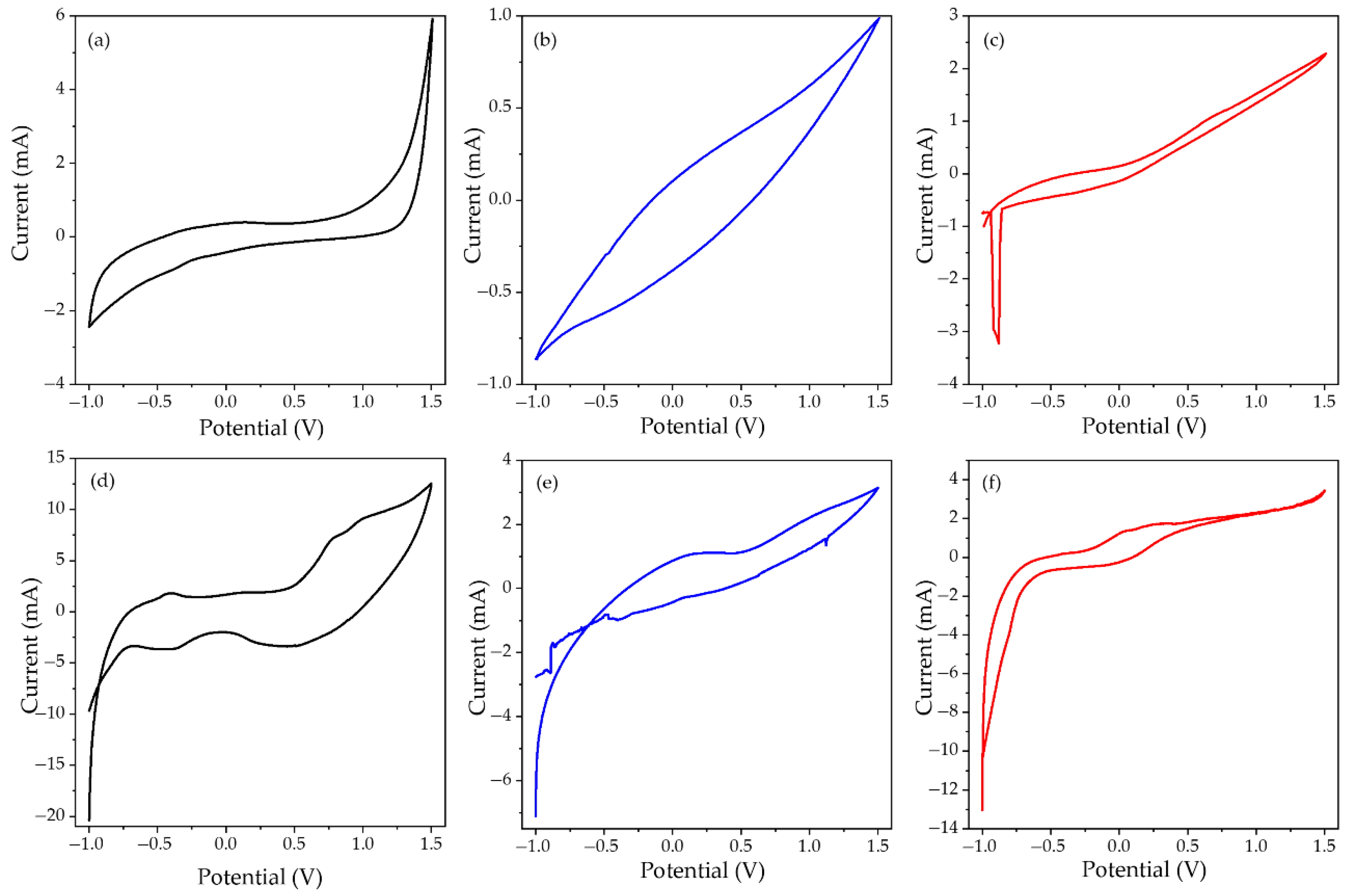
When used in bioelectrochemical systems, cyclic voltammetry (CV) is utilized for determining electron transfer mechanisms and redox centers of the active biofilm, which in turn can give an insight into the kind of bacterium contained in the biofilms [30]. CV was performed for the electrodes in an aqueous solution of potassium acetate and in the MFCs (biofilm and wastewater). CV of the MFCs was performed after the first batch (exactly, on day 43). The voltammograms produced mostly noiseless curves, with no significant faradic peaks between the measured potentials (−1 to 1.5 V vs. SHE) (Figure 4).
The analysis showing the highest anode potential (highest current values) for the three electrodes can be related to the oxidation of water to form oxygen gas (>1 V), while the highest cathode potential (lowest current values) can be ascribed to the reduction in water, producing hydrogen gas (<−0.6 V) [22].
The GR anode (Figure 4a) showed an oxidation peak at a potential of 0.9 V (0.65 mA), with a reduction peak observed in −0.35 V (−0.8 mA). The 3D-CB anode (Figure 4b) presented an oxidation peak at a potential of 0.5 V (0.6 mA), and a reduction peak was observed in −0.4 V (−0.55 mA). The C-iNPCB-Resin anode (Figure 4c) presented an oxidation peak at a potential of 0.8 V (1.2 mA) and a reduction peak at −0.25 V (−0.3 mA). Under potassium acetate alone, all electrodes exhibit CVs characterized by smooth or triangular shapes indicative of non-faradaic, double-layer charging typical of inert carbon materials. In the absence of biological redox species, carbon electrodes show capacitive behavior [31]. When operated in MFCs (biotic conditions), all three electrodes demonstrate substantial increases in current magnitude (Figure 4d–f) and the appearance of redox-associated features. These outcomes match with established findings that electroactive biofilms produce catalytic waves or peaks in CV as a result of extracellular electron transfer (EET) [22,25].
An oxidation peak for the GR-MFC (Figure 4c) was observed at the potential of +0.95 V (6.9 mA), while a wide reduction peak can be observed at the potential of +0.4 V (−3.8 mA). Compared to the voltammogram in Figure 4a, the GR-MFC showed an increase in oxidation (from 0.9 to 0.95 V) and reduction (−0.35 to 0.4 V) peaks. The redox peaks observed (0.95 and 0.4 V) can be indicative of mediated electron transfer (MET) mechanisms in the form of electroactive compounds on the biofilm. The broad and wider peaks shown in the voltammogram can be indicative of direct electron transfer mechanisms due to the thin biofilm present, most consistent with outer membrane cytochromes (OMCs), the most common being OmcAs and OmcCs, mostly present in the EET mechanisms of the Shewanella and Geobacter species [32,33].
For the 3D-CB-MFC (Figure 4e), the peak potentials for oxidation and reduction can be observed at +0.5 V (+1.1 mA) and +0.1 V (−0.2 mA), respectively. Oxidation peaks from the 3D-CB anode (Figure 4b) were maintained (around 0.5 V), while reduction peaks presented an increase (from −0.4 to 0.1 V). CV presented noisier and more complex redox behavior, indicative of irregular mass transport in porous structures and potential involvement of MET-associated species, consistent with thick, porous biofilms documented to create diffusion limitations and fluctuating redox responses [22]. Broad plateaus in the voltammogram are also indicative of the primary use of direct electron transfer, accentuating the presence of OMCs in the biofilm [32].
The C-iNPCB-MFC (Figure 4e) presented peaks at 0.1 V (+1.7 mA) for oxidation and −0.5 V (−1.0 mA) for reduction. For comparison, the C-iNPCB-Resin anode (Figure 4c) presented a decrease in oxidation (from 0.8 to 0.1 V) and reduction (from −0.25 to −0.5 V) peaks. Smoother and more stable voltammetric profiles suggest consistent electron pathways and controlled biofilm development. Similar outcomes have been described in engineered carbon electrodes designed for electrochemical stability and uniform microbial colonization [34].
All three systems presented a high variation in potential with broadened, undefined peaks, indicating high resistance in the electrolyte, membrane (as Ohmic losses), or slow diffusion rate of electroactive species on the electrode’s surface (mass transfer limitations). The base abiotic condition studies confirm inert electrode behavior, consistent with capacitive carbon responses, while biotic conditions showed strong faradaic activity, consistent with EET processes mediated by cytochromes, nanowires and redox shuttles. All electrode structures dictate both the magnitude and stability of EET, while being in agreement with studies on porous carbons and engineered composites [24,25]. Voltammetry analysis indicates a diverse range of mechanisms in the electron transfer of the three cells, with direct electron transfer being prioritized, but not restricted, as observed for the various routes for mediated transport, attributed not only to a difference in biofilm formation or affinity to the electrode, but also in the presence of a diverse consortium of bacteria, provenient of the anaerobic sludge used in the start of the MFCs.

2.3. Characterization of Materials

2.3.1. Crystallography and Structure

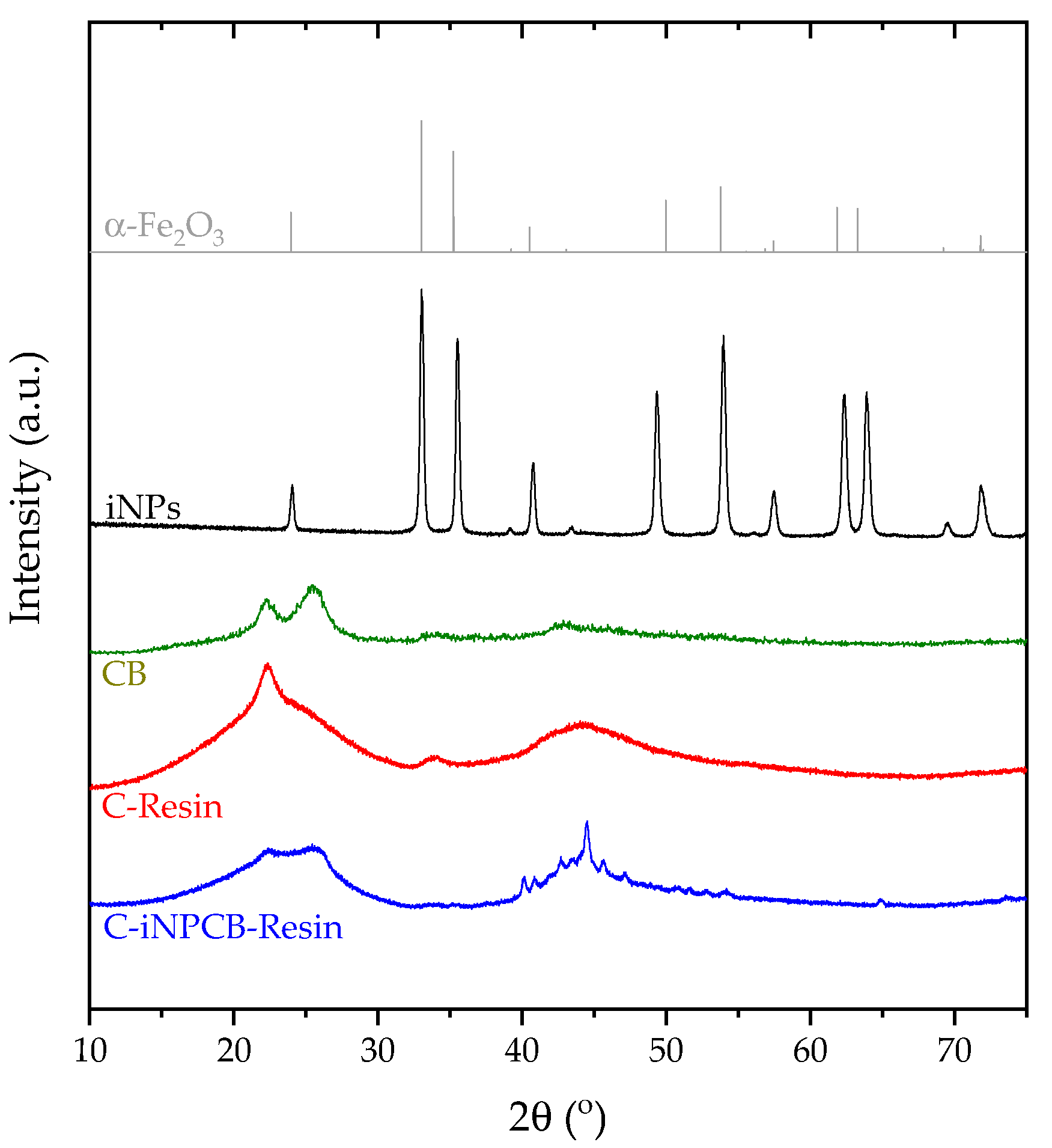
Figure 5 shows the X-ray patterns of four materials for the identification of crystal compositions for the iron nanoparticles (iNPs), carbon black (CB), the carbonized photopolymer without additives (C-Resin), and with iron and CB (C-iNPCB-Resin).
iNPs present characteristic peaks at 24°, 33°, 36°, 41°, 50°, 54°, 58°, 63°, and 64°, revealing that they are composed of just a hematite phase [35,36].
The CB diffractogram revealed a small peak at 43 °C, consistent with the carbon back patterns in the literature. The results also presented a characteristic peak at 26.6°, consistent with graphite, and, to a lesser degree, the presence of graphene in the sample. Signals at approximately 22°, 34°, and 45° in the C-Resin material align with 3D printing carbon-based materials [37]. The C-iNPCB-Resin material exhibits a band from around 20 to 27°, which is present in the composition of the phases of the C-Resin and carbon black (CB) patterns. The patterns present in the broad peaks from 42° to 56° emerge after the calcination of the C-iNPCB-Resin sample, and are highly attributed to iron carbide, and could be indicative of Fe3C (Cementite), Fe7C3, ε-Fe2C, and χ-Fe5C2 iron carbide phases [38,39]. These results could indicate part of the reason for the higher conductivity of the C-iNPCB-Resin electrode in the progression of the MFC.

2.3.2. Thermal Stability of Electrode Materials

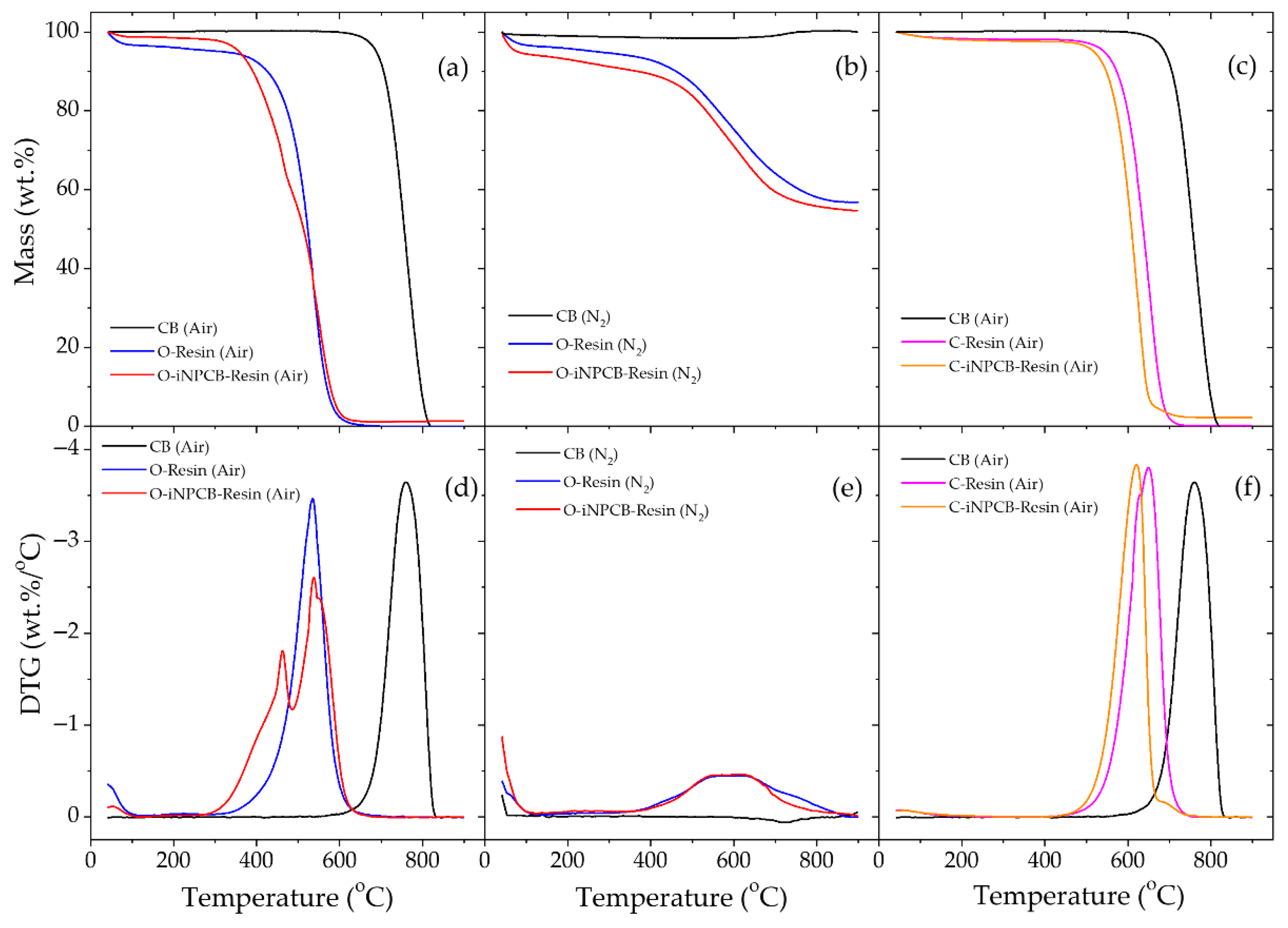
Carbonaceous materials were analyzed by TGA in air and nitrogen atmospheres at 10 °C/min to compare their thermal stability in oxidizable and non-oxidizable conditions. Pure CB and resin without additives were tested to compare their properties to the developed C-iNPCB-Resin anode. Also, resin with/out additives (iron nanoparticles and CB) was analyzed in two stages of its preparation: (1) after its stabilization through preoxidation at 400 °C in an air atmosphere, i.e., O-Resin and O-iNPCB-Resin; and (2) after its carbonization, i.e., C-Resin and C-iNPCB-Resin. In the atmospheric air, oxidized materials (treated to 400 °C) showed good thermal stability until around 300 to 350 °C, with minimal losses due to moisture content at 4.9 wt.% and 3.4 wt.%, for O-iNPCB-Resin and O-Resin materials, respectively (Figure 6a,d).
In this oxidizable atmosphere, O-Resin presented significant degradation beginning at 350 °C, leaving behind almost 0% ash at 650 °C, with its peak mass loss at 535 °C, indicating a total mass loss derived from the organic composition of the 3D-printed resin. O-iNPCB-Resin exhibited a different response, with significant degradation starting at 300 °C and continuing up to 650 °C, demonstrating reduced thermal stability in the range of 300 to 490 °C, at which point the degradation continued at almost the same rate as O-Resin. This difference in degradation rate is observed in the derivative plot, seen as two mass loss peaks at 460 and 540 °C (1.8 and 2.6 wt.%/°C), respectively. That can be explained as the material not being composed as a well-defined structure, leaving breaches that disrupt its stability [35], which accompanies the use of CB in the preparation of the material, being composed of multiple carbonaceous structures [40]. Almost total material degradation can also be observed in O-iNPCB-Resin, with only 1.9 wt.% of ash remaining after 650 °C, which is most likely iron leftover. CB demonstrated the highest stability, with significant oxidation starting only at 600 °C, with total degradation achieved at around 820 °C, similar to graphite and graphene decomposition analysis, evidencing the mix of its structures and lattices, and a strong presence of graphene-stacked layers held by Van Der Waals forces, due to its complex 3D carbon network [30,41]. CB degradation presented its peak mass loss at 760 °C (3.6 wt.%/°C).
In a non-oxidizable atmosphere, the analysis showed that the oxidized materials had higher stability than their oxidizable atmosphere counterparts (Figure 6b,e). Both O-Resin and O-iNPCB-Resin started to decompose significantly at higher temperatures compared to oxidized conditions, at 415 and 460 °C, respectively, and continued to decompose up to 815 and 860 °C. O-Resin showed mass loss up to 42.9 wt.%, while presenting a mass loss plateau from 550 to 630 °C (0.4 wt.%/°C). O-iNPCB-Resin presented mass loss up to 45.3 wt.%, presenting a derivative mass loss plateau from 540 to 630 °C (0.5 wt.%/°C). This analysis demonstrated the quantity of volatile matter and moisture contained in the electrode materials, derived from the organic composition of the 3D-printed resin.
As expected, the carbonized materials (C-Resin and C-iNPCB-Resin, treated to 900 °C), presented higher thermal stability counterparts (Figure 6c,f), due to the volatile matter already being eliminated in the treatment process.
For the C-Resin, the temperature at which significant degradation can be observed increased from 350 °C to 460 °C, with degradation finishing at 740 °C, resulting in the total degradation of the material. The peak of its degradation, as seen in the derivative plot, occurred at 650 °C (3.8 wt.%/°C), indicating a faster mass loss rate than the non-carbonized O-Resin sample. C-INPCB-Resin also exhibited higher thermal stability, starting at 480 °C and reaching 760 °C, an increase of 80 °C from O-iNPCB-Resin. The peak of mass loss occurred at 620 °C (3.85 wt.%/°C).

2.3.3. Composition of Carbonaceous Electrodes

Proximate and ultimate analyses were determined though TGA and CHNS-elemental analysis for all carbonaceous materials (Table 2).
The contents of nitrogen and sulfur in all materials analyzed were observed to be lower than the detection limit of the equipment, and, thus, considered negligible. As observed, carbon black (CB) presented 98.3% carbon content, based on its fixed carbon content of 99.3 wt.%, demonstrating a slight percentage of contamination at the time of analysis.
Oxidized materials (O-Resin and O-iNPCB-Resin) showed high quantities of oxygen (23.4 and 28.7 wt.%, respectively) and volatile matter (39.6 and 40.4 wt.%, respectively), both released during carbonization (8.4 and 16.8 wt.% of oxygen, and 2.7 and 3.5 wt.% of volatile matter for C-Resin and C-iNPCB-Resin, respectively). The fixed carbon content of the samples after pyrolysis was shown to be 96.4 wt.% and 93.1 wt.% for C-Resin and C-iNPCB-Resin, respectively.
The carbon content in the C-iNPCB-Resin material was expected to be lower than pure resin, derived from the doping of iron nanoparticles. However, the fact that the ash content that remained was higher than the initial preparation of the material by weight (0.5 wt.%) agrees with the mass losses between O-iNPCB-Resin and C-iNPCB-Resin (82.7% and 89.7% of burn-off).
The H/C atomic ratios of the O-Resin and O-iNPCB-Resin materials were calculated to 0.35 and 0.27, respectively. However, the ratios for C-Resin and C-iNPCB-Resin were 0.08 and <0.02. This can be attributed to the dehydration reactions that occurred during the thermal treatment process. O/C atomic ratios were also determined as 0.24 and 0.32 for O-Resin and O-iNPCB-Resin, respectively. In contrast, the carbonized versions presented values of 0.07 and 0.14 for C-Resin and C-iNPCB-Resin, respectively. Most of the reduction in oxygen content can be attributed to the dehydration of the samples. However, the reduction for the C-iNPCB-Resin sample was slightly over 50%, which could be attributed to a higher degree of oxidation of the material [19,40,42].

2.3.4. Morphology and Nanoparticle Distribution

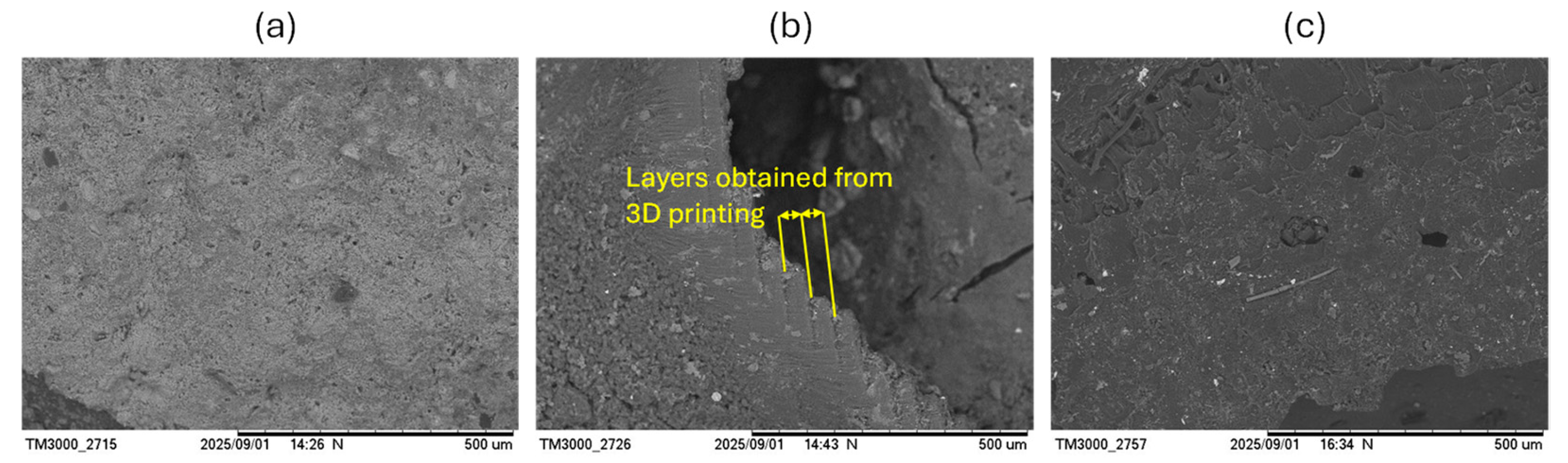
Figure 7 presents scanning electron microscopy images of the anodes used in MFCs, viz. GR, 3D-CB, and C-iNPCB-Resin.
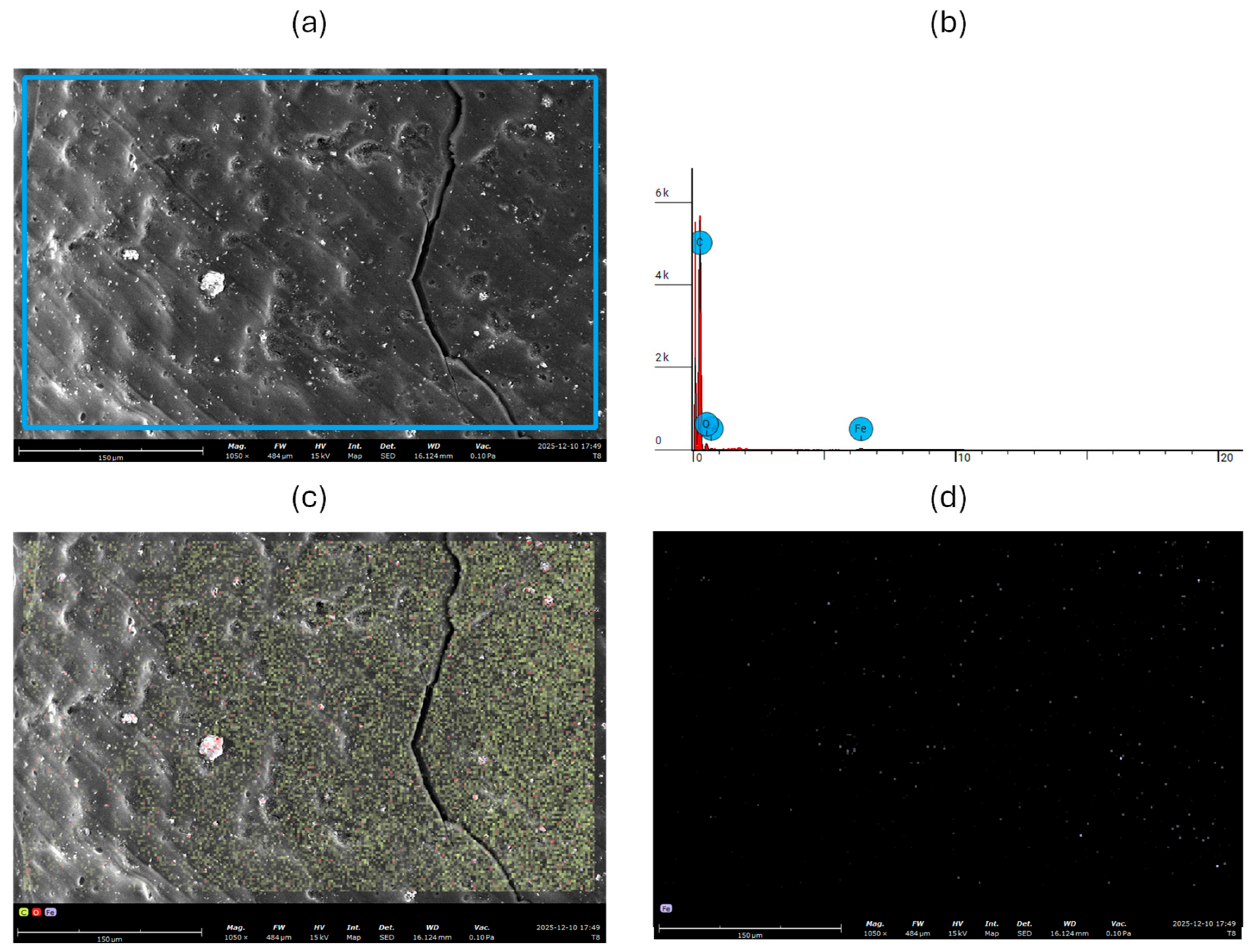
The images reveal the relatively smooth surface of the GR anode (Figure 7a), with small pores visible. The entrances on the surface of the 3D-CB anode (Figure 7b) can be observed, alongside the streaks of resin left behind from the 3D printing process, measuring around 50 μm (minimum surface resolution of DLP printer) [17,43]. Imperfections and cracks can also be observed, resulting from the carbon adhesion and calcination process at 275 °C. The C-iNPCB-Resin anode (Figure 6c) also presents a smooth surface, but some fractions of a rough and brittle surface can also be observed, which facilitates bacterial adhesion and may contribute to the higher performance observed during MFC operation compared to the other electrodes [4]. Figure 8 presents an additional SEM image of the C-iNPCB-Resin sample with an EDS map. The SEM–EDS analysis of the C-iNPCB-Resin anode evidences a carbon-rich matrix with dispersed Fe-containing domains and measurable oxygen. Such mapping is consistent with polymer-derived carbons loaded with transition-metal nanoparticles: after pyrolysis, the carbon phase (from the photopolymer and carbon black) acts as a conductive scaffold, while iron remains as nanoscale Fe/Fe-oxide regions distributed across the surface.
In our maps, Fe appears broadly but discretely distributed, with partial co-localization of O. This pattern is compatible with (i) Fe nanoparticles that have undergone surface oxidation upon exposure to air, or (ii) the formation of Fe-oxide phases (e.g., Fe2O3/Fe3O4) during carbonization/cooling, both of which are frequently reported in Fe–carbon anode systems. For instance, polymer- or MOF-derived Fe-oxide/carbon composites typically show EDS maps where Fe and O overlap at nanoscale clusters embedded in a continuous carbon background, analogous to our observations [43].
A fairly uniform Fe distribution at the microscale suggests good dispersion during resin formulation and retention of that dispersion post-carbonization. The literature on 3D-printed or photopolymer-derived carbon electrodes emphasizes that controlled pyrolysis creates percolating carbon frameworks that facilitate charge transport—conditions under which dispersed metal/oxide nanoparticles can act as active sites without causing severe agglomeration [44].

3. Materials and Methods

3.1. Reactants and Materials

Iron(III) nitrate nonahydrate (≥98%) from Labkem and ethylene glycol (≥99%) supplied by Honeywell were used for the synthesis of the iron nanoparticles.
Anycubic UV tough resin (365–405 nm), isopropanol (Sigma Aldrich, St. Louis, MO, USA, 99.9%), carbon black (Thermo Fisher Scientific, Waltham, MA, USA, 99.9%), PTFE (12.5% w/w, Sigma Aldrich, 93–95%), pentaerythritol tetraacrylate (PETA, Sigma Aldrich, 350 ppm hydroquinone), 35% divinylbenzene (DVB, Sigma Aldrich), 30% bis(2-ethylhexyl) phthalate (DoCT, Sigma Aldrich ≥ 98%), 1% phenylbis(2,4,6-trimethylbenzoyl) phosphine oxide (BAPO, Sigma Aldrich) and 1-phenylazo-2-nafthol (Sudan 1, Sigma Aldrich, ≥95%) were used for the preparation of the electrodes.
Industrial wastewater (IWW) and anaerobic sludge from a UASB (Upflow Anaerobic Sludge Blanket) reactor were collected from Penha Papéis (Coronel Vivida, Paraná, Brazil), a paper recycling plant. Both were used in the cells within 2 h of collection and subsequently stored in a constant refrigeration for future use.
Potassium acetate (Thermal Scientific, Beaumont, TX, USA, 99.9%) was used as a carbon source and electrolytic solution in the operation of the MFCs.

3.2. Preparation of Materials

3.2.1. Iron Nanoparticles Synthesis

Iron oxide nanoparticles (iNPs) were synthesized via a sol–gel method. For this purpose, 20 mmol of iron(III) nitrate nonahydrate (Fe(NO3)3·9H2O) was dissolved in 25 mL of ethylene glycol [36]. The solution was stirred at 25 °C for 3 h in a round-bottom flask to ensure complete dissolution and the formation of a stable sol. Subsequently, the sol was heated to 120 °C and maintained at this temperature until it dried and transformed into a reddish-brown gel. The resulting gel was collected and annealed in an air atmosphere at 500 °C for 2 h in a furnace.

3.2.2. Carbonaceous Electrodes

Three different electrodes were assessed in this work: a graphite rod (GR) electrode, carbon black on 3D-printed rod (3D-CB) and a carbon-based photoresin with embedded iron nanoparticles and carbon black (C-INPCB-Resin).
The GR electrode was used as a control anode. Prior to its use, GR electrodes were treated with 10% v/v nitric acid to remove residual metallic impurities and organic molecules, ensuring a smooth surface.
For the 3D-CB electrode, the support first was manufactured with interconnected gyroid-shaped unit cells [45] using a digital light processing (DLP)-based stereolithography printer (Anycubic Photon D2, Shenzhen Zongwei Cube Technology Co., Ltd., Shenzhen, China) with Anycubic UV Tough Resin (365–405 nm, Shenzhen Zongwei Cube Technology Co., Ltd.). The printed polymer was then dip-coated with a mixture of 50 mL isopropanol, 2.065 g carbon black (CB), and 292.5 µL PTFE. The electrodes were shaken in an ultrasound shaker for 10 min and dried in an 80 °C oven for 30 min to remove the solvent. This procedure was repeated 3 times, with gentle shaking of the dried electrode after each, to free space in the interior passages. The electrode was then calcined in a muffle at a heating rate of 5 °C/min until 275 °C, where it remained for 1 h.
The C-iNPCB-Resin electrode was synthesized by adapting the method described by Henrique et al. [46]. First, 100 g of resin was prepared with the following reagents: 39.60 g of PETA and 30.28 g of DVB as resin monomers, 28.12 g of DoCT as a porogen, 0.95 g of BAPO as a photoinitiator, 0.038 g of Sudan I as a color agent, and two additional components were added to increase the conductivity of the anode—0.5 g of CB and 0.5 g of iNPs. The quantity of CB and iNPs were optimized with between 0 and 1 g of each one and 0.5 g was found as the best amount to accurately prepare the material with the highest electrical conductivity. Photopolymerization of the mixture was performed in a UV oven (395–405 nm) for 20 min. The photopolymers were then carbonized in a Hobersal ST-11 tubular muffle with a heating rate of 5 °C/min until it reached 400 °C under a 100 mL min−1 air flow rate, followed by a heating rate of 5 °C/min until it reached 900 °C under nitrogen at a 100 mL min−1 flow rate. In order to study the carbonization process, an additional sample was prepared, just reaching 400 °C with air during thermal treatment and resulting in the O-iNPCB-Resin sample. Furthermore, additional samples (O-Resin and C-Resin) were prepared without iNPs and CB to study the addition of these additives in photopolymerization, curing and carbonization.

3.3. MFC Operation

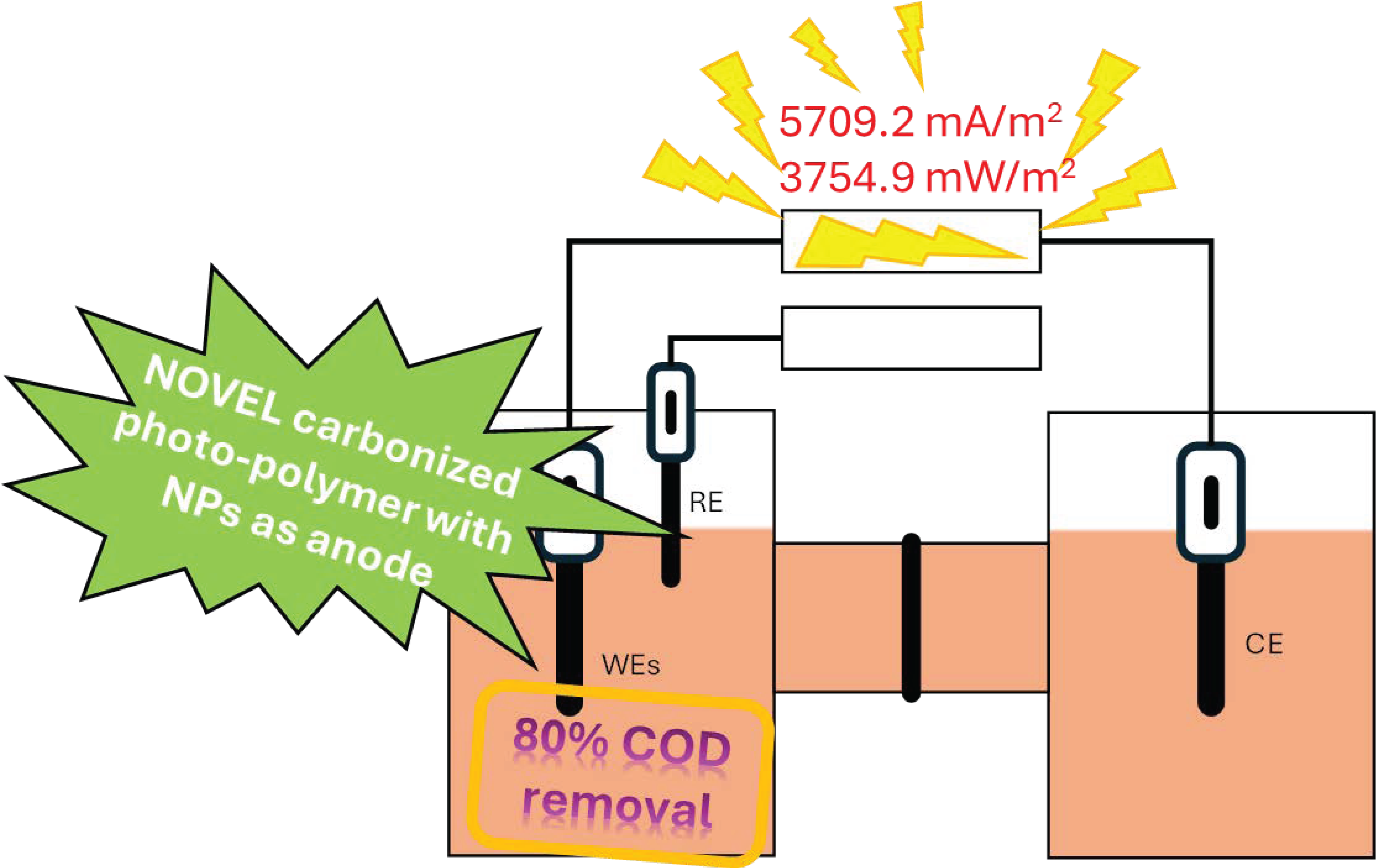
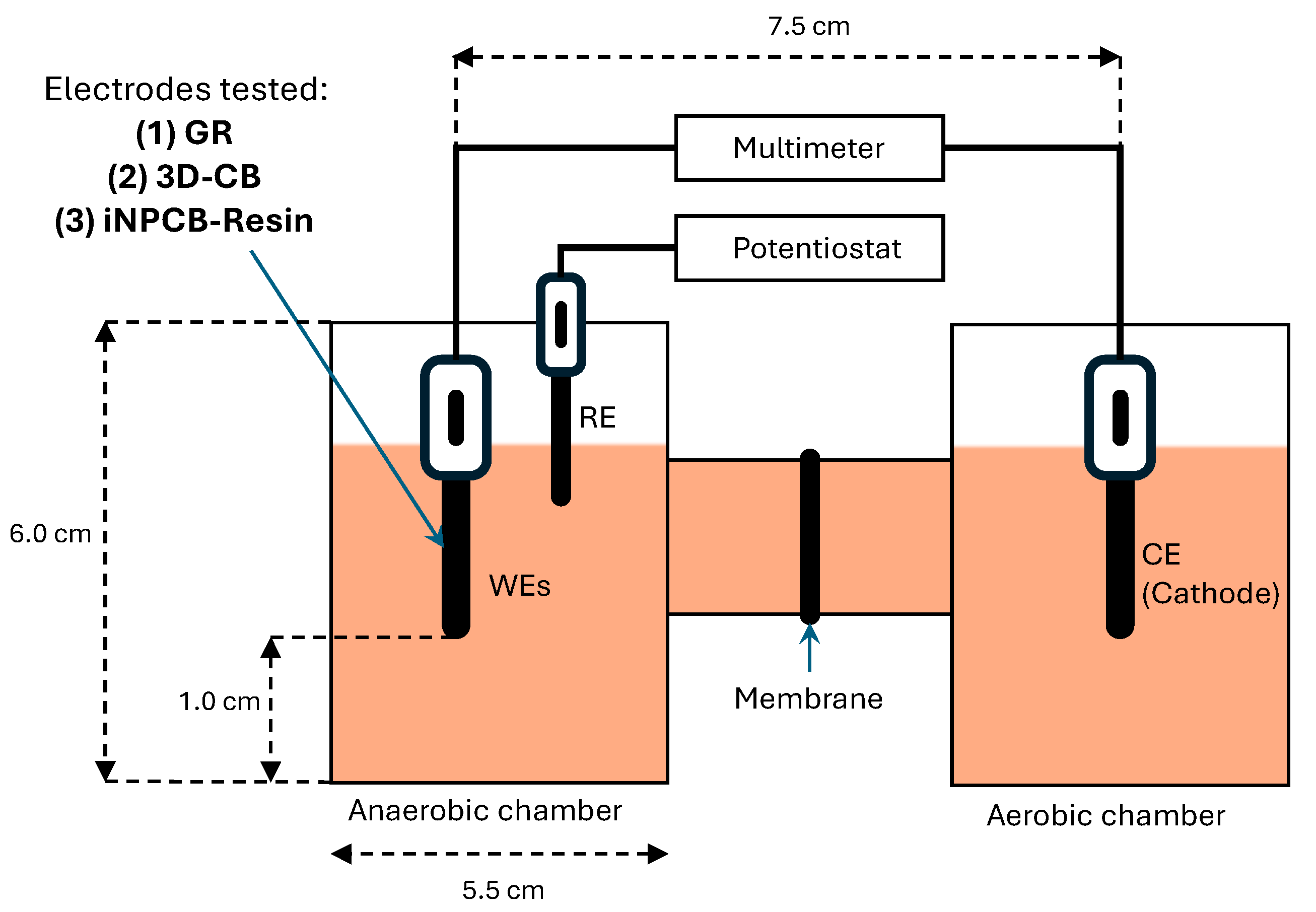
The constructed microbial fuel cells were made in an H-shaped format (two-chamber MFC), consisting of two 180 mL poly (methyl methacrylate) chambers (5.5 × 5.5 × 6.0 cm) separated by a membrane, as shown in Figure 9. Three different MFCs were constructed in this study. All three MFCs used a GR as the cathode (4 mm diameter × 47 mm long, surface area of 12.8 cm2). The first MFC had a GR anode (4 × 47 mm, with a surface area of 12.8 cm2), the same as the cathode, the second MFC used a 3D-CB electrode (4 × 47 mm, with a surface area of 12.8 cm2) and the third MFC used an C-iNPCB-Resin anode (8 × 8 × 8 mm, with a surface area of 3.84 cm2). The electrodes in each cell were spaced 7.5 cm away from each other.
Three MFCs operated in batch mode were labeled as GR-MFC, 3D-CB-MFC and C-iNPCB-Resin-MFC, according to the working electrode used as the anode. The MFCs operated at the same time and experimental variables, viz. reactor configuration, electrolyte composition, inoculum, operating conditions, and performance normalization were kept constant across all MFCs. The anode chambers of the 3 MFCs were filled with 50 mL of anaerobic sludge and 80 mL of wastewater. Then, 20 mmol of potassium acetate was added to provide a carbon source and to increase conductivity [7], and no other nutrient solution was required to facilitate bacterial growth. The electrodes were immersed 1 cm from the bottom, ensuring the entirety of the structure was submerged in the medium. The electrical couplings were sealed from the cell environment, exposing only the electrodes. The anodic chambers were purged with nitrogen gas for 30 min to expel oxygen from the environment, and the external system was then closed. The anode chamber was sealed to maintain anaerobiosis. The cathode chamber was filled with 130 mL of 100 mmol potassium acetate electrolytic solution. The system was initially connected by an external circuit containing a 1000 Ω resistor at startup [4,19].
The first 18 days of operation (acclimation period) were monitored to allow time for the microorganisms (typically electrogenic and acidogenic bacteria) to grow on the anodes, forming a biofilm.
Wastewater treatment analysis was conducted by monitoring pH, conductivity, turbidity, and total dissolved solids (TDSs), following standard methods. Chemical oxygen demand (COD) was determined using a commercial reagent kit for high-range samples (0–15,000 ppm, HANNA Instruments HI93754C-25 kit, HANNA Instruments, Woonsocket, RI, USA). Total phenolic compounds (TPCs) were determined by the Folin–Ciocalteu reagent (FCR) methodology [47]. The calibration curve was created from gallic acid at dilutions of 2.5, 5, 10, 25, 40, 70, 85, 100, and 125 ppm. Then, 0.5 mL of the aliquot was mixed with 2.5 mL of diluted Folin–Ciocalteu reagent (1:10 v/v) and allowed to stand for 5 min. Then, 2 mL of 4% sodium carbonate was added and allowed to stand again for 2 h. Readings were taken on a UV–Visible spectrophotometer (Evolution 60S, Thermo Fisher Scientific) at 740 nm of wavelength.
The potential difference was measured daily using a Minipa ET-1110B model digital multimeter (Minipa do Brasil Ltda., Sao Paulo, Brazil).
This acclimation period was monitored until the voltage reached a peak point, indicating that the substrate had begun to decrease via consumption. At that point, 20 mmol of dried potassium acetate powder was added to the anode chamber [6]; this process was repeated every 6 days. The three cells were operated in batch mode and maintained in a constant cathodic ambient air aeration through a diffuser at approximately 1 L/min, while being monitored for a decrease in potential difference. Each cycle was completed when the measured voltage reached its maximum, after which it began to decrease drastically. After the first three voltage peaks (on day 18), a study of its polarization curve was made. The duration of batches used in this study was determined by measuring the decrease in current in the days following the addition of potassium acetate, which indicated the removal of the substrate. Three batches were monitored to observe the functioning of the MFCs in a prolonged time of usage [44,45].
The coulombic efficiency (CE) is the ratio of the total charge transferred to the anode from the substrate, or the efficiency of electron transfer. It can also be defined as the potential for converting the supplied electrodes into an electrical current. The EC of the cell can be calculated based on the operation of the cell, as shown in the following (Equation (1)):
C E =   0 t I d t / [ ( Δ C O D / 32 · 1000 ) · 4 · V · F ] · 100
where I is the current, F is the faraday constant (96,485 C/mol), ΔCOD is the difference in COD (mg/L) during MFC operation without taking into account potassium acetate, V (L) is the volume of the MFC containing the wastewater, 32 is the molecular weight of O2 (g/mol), and 4 corresponds to 1 mol of electrons in 1 mol of O2 released in the oxidation reactions [4,19,48].

3.4. Electrochemical Characterization

3.4.1. Polarization Curve

The polarization curve was used for each MFC to determine the voltage of the system in relation to its current density. Multiple methods exist for this analysis [48]. In this study, the multiple-cycle method was employed to determine the internal resistance of the system by varying the external resistance from the Open-Circuit Voltage (OCV > 10,000 Ω) to 10 Ω and verifying the voltage generated. The current is then calculated using Ohm’s Law (Equation (2)):
V = I·R
For this study, the variation in resistance was achieved by starting from the Open-Circuit Voltage (OCV) and decreasing the external resistance. With the results, a graph of V·I can be plotted and used to determine the internal resistance to the cell, and, with it, a similar external resistance can be applied [13,19]. A Minipa ET-1110B model digital multimeter (Minipa do Brasil Ltda.) was utilized for measurements in the polarization analysis.

3.4.2. Cyclic Voltammetry

Cyclic voltammetry was performed to determine the redox peaks of the electrodes in relation to the MFC. The voltammograms were constructed using a potentiostat (EmStat 3+, PalmSens BV, Houten, The Netherlands) in a three-electrode system, with a reversible hydrogen electrode (RHEK model, supplied by ALS Co.Ltd/CHI, Tokyo, Japan) as the reference electrode, the anodes (GR, 3D-CB, and C-iNPCB-Resin) as the working electrodes, and a GR as the cathode and counter electrode. Two analyses were performed with the electrodes: (1) when the MFCs were on day 43 of operation and (2) submerged in 130 mL with 100 mmol potassium acetate solution (no bacteria or wastewater). The voltage was changed from −1 to 1.5 V, with forward and reverse scans at a scan rate of 5 mV/s for 4 sequential scans [22,49]. The working electrodes and counter electrodes were maintained under the same conditions, as previously mentioned. In the MFCs, the reference electrode was submerged 1 cm from the bottom of the anode chamber. The analyses were conducted after the first substrate change (second batch), following the stabilization of the current measured, with residual water serving as the electrolyte in the anode chamber and potassium acetate as the electrolyte in the cathode chamber.

3.5. Physico-Chemical Characterization of Materials

XRD measurements of the carbonaceous electrodes were carried out using a Miniflex 600 Rigaku system (Rigaku Corporation, Tokyo, Japan) with Cu Ka radiation (40 kV, 40 mA and λ = 0.154 nm) at a range of 3° to 70° and at a scan rate of 0.02° s−1. SEM analysis was carried out to examine the surface of the anodes after use in the MFCs, using a Hitachi TM3000 scanning electron microscope (5 kV−15 kV, Hitachi High-Tech Corporation, Tokyo, Japan) in analysis mode. The distribution of iron on the surface of the C-iNPCB-Resin sample was determined using a Phenom XL G2 Desktop SEM (Thermo Fisher Scientific) with Energy-dispersive X-ray spectroscopy (EDS). Thermogravimetric analysis (TGA) of carbonaceous materials was performed on a TGA-DSC thermobalance (TGA-DCS1, Mettler-Toledo, S.A.E., Mettler-Toledo International, Inc., Columbus, OH, USA) using a flow rate of 100 mL/min of nitrogen or air and a heating rate of 10 °C/min. The proximate analysis (on a wet basis) of the samples was determined from TGA profiles. Briefly, moisture and volatile matter (VM) were defined as weight losses up to 105 °C and 900 °C, respectively, in an inert atmosphere. The ash content was calculated as the final percentage weight of the samples after heating at 900 °C in an oxidizing atmosphere (TGA performed under continuous air flow rate). The fixed carbon (FC) content was determined using (Equation (3)).
FC (wt.%) = 100 − moisture (wt.%) − volatile matter (wt.%) − ashes (wt.%)
The elemental composition of the materials was determined using a CHNS analyzer (Flash 2000, Thermo Fisher Scientific, Waltham, MA, USA), equipped with a thermal conductivity detector (TCD).
The oxygen content was determined from the ultimate analysis and ashes (dry basis), as shown in (Equation (4)):
O (wt.%) = 100 − C (wt.%) − H (wt.%) − N (wt.%) − S (wt.%) − ashes (wt.%)

4. Conclusions

In this study, a novel photopolymer-based carbon anode (C-iNPCB-Resin) was developed and used for the treatment of industrial wastewater from a paper recycling facility in a microbial fuel cell (MFC). The electrochemical performance and organic matter removal efficiency obtained with the anode were compared to the performance of carbon black (3D-CB) and graphite rod (GR) anodes operating in MFCs under identical conditions.
Regarding wastewater treatment, three anodes allowed us to achieve substantial organic matter removal, with COD reductions ranging from 56% to 80% and phenolic compound removal exceeding 96% over the operational cycles. The lower performance of the 3D-CB anode, including carbon detachment during the first batch, indicates that improvements in coating composition and structural integrity are necessary to prevent mechanical degradation and enhance effective conductivity.
The carbonized photopolymerized electrode with iron nanoparticles and carbon black (C-iNPCB-Resin) exhibited clearly superior performance, achieving a maximum power density of 3754.9 mW/m2, current densities up to 5.71 A/m2, and the highest coulombic efficiencies among the systems evaluated (914.1 mW/m2 and 0.32 A/m2, which were obtained using a GR anode, and 882.8 mW/m2 and 0.30 A/m2 when 3D-CB was used as the anode). This enhanced performance is attributed to its highly rough carbonaceous surface, the increased conductivity resulting from the formation of iron carbide phases, and its greater affinity for electroactive biofilm formation—as evidenced by reduced activation losses and improved operational stability.
Although the coulombic efficiency values remained low (as commonly observed for lignocellulosic effluents), the overall results highlight that anode engineering is a critical factor to overcome intrinsic substrate limitations and enhance electron conversion into usable current.
In summary, the developed C-iNPCB-Resin anode emerges as a highly promising alternative for the development of complex structures prepared by 3D printing in order to obtain optimal architecture, which, coupled with the excellent compatibility of our electrode with complex bacterial consortia, promise both the treatment of wastewater and the generation of electricity. Future studies should focus on optimizing additives (CB and iron nanoparticles) quantities, tailoring porosity, and scaling geometric configurations, as well as evaluating long-term durability under continuous operation. These advances may ultimately consolidate photopolymerized carbonaceous anodes as key components in high-performance MFCs designed for the treatment of complex industrial wastewater.

Author Contributions

Conceptualization, R.d.S.F., M.d.S.S. and J.L.D.d.T.; methodology, R.d.S.F., M.d.S.S. and J.L.D.d.T.; validation, all authors; formal analysis, R.d.S.F., N.C., C.S.-V. and J.L.D.d.T.; investigation, R.d.S.F.; resources, R.d.S.F., M.d.S.S. and J.L.D.d.T.; data curation, R.d.S.F., M.d.S.S. and J.L.D.d.T.; writing—original draft preparation, R.d.S.F. and N.C.; writing—review and editing, R.d.S.F., M.d.S.S. and J.L.D.d.T.; visualization, R.d.S.F., M.d.S.S. and J.L.D.d.T.; supervision, R.B., M.d.S.S. and J.L.D.d.T.; project administration, C.S.-V., M.d.S.S. and J.L.D.d.T.; funding acquisition, C.S.-V., M.d.S.S. and J.L.D.d.T. All authors have read and agreed to the published version of the manuscript.

Funding

Araucária Foundation—Paraná (PRD2023361000383 Conv 355/2025). Atracción al Talento of Comunidad de Madrid (2022-T1/AMB-23946 and 2023-T1/ECO-29048). Consolidación Investigadora 2024 of Agencial Estatal de Investigación (CNS2024-154264).

Data Availability Statement

The original contributions presented in this study are included in the article. Further inquiries can be directed to the corresponding authors.

Acknowledgments

The authors are grateful to the Analysis Center of UTFPR-PB. Ricardo Furlan acknowledges financial support through the research grants from the National Council for Scientific and Technological Development—CNPq. Mariana S. Sikora acknowledges the Araucária Foundation—Paraná for the research productivity fellowship (PRD2023361000383 Conv 355/2025). N. Corrochano, C. Sotelo-Vázquez and J.L. Diaz de Tuesta acknowledge financial support through the program of Atracción al Talento of Comunidad de Madrid (Spain) for the grants 2022-T1/AMB-23946 and 2023-T1/ECO-29048. In addition, J.L. Diaz de Tuesta is grateful for financial support though the program Consolidación Investigadora 2024 of Agencial Estatal de Investigación for the individual research grant CNS2024-154264.

Conflicts of Interest

The authors declare no conflicts of interest.

References

  1. Chaudhry, S.; Paliwal, R. Techniques For Remediation Of Paper And Pulp Mill Effluents: Processes And Constraints. In Handbook of Environmental Materials Management; Hussain, C.M., Ed.; Springer International Publishing: Cham, Switzerland, 2018; pp. 1–19. [Google Scholar] [CrossRef]
  2. Huang, L.; Logan, B.E. Electricity generation and treatment of paper recycling wastewater using a microbial fuel cell. Appl. Microbiol. Biotechnol. 2008, 80, 349–355. [Google Scholar] [CrossRef] [PubMed]
  3. Huang, L.; Cheng, S.; Rezaei, F.; Logan, B.E. Reducing organic loads in wastewater effluents from paper recycling plants using microbial fuel cells. Environ. Technol. 2009, 30, 499–504. [Google Scholar] [CrossRef]
  4. Logan, B.E.; Hamelers, B.; Rozendal, R.; Schröder, U.; Keller, J.; Freguia, S.; Aelterman, P.; Verstraete, W.; Rabaey, K. Microbial Fuel Cells: Methodology and Technology. Environ. Sci. Technol. 2006, 40, 5181–5192. [Google Scholar] [CrossRef] [PubMed]
  5. Yaqoob, A.A.; Ibrahim, M.N.M.; Guerrero-Barajas, C. Modern trend of anodes in microbial fuel cells (MFCs): An overview. Environ. Technol. Innov. 2021, 23, 101579. [Google Scholar] [CrossRef]
  6. Al Moinee, A.; Sanzida, N. Performance Analysis of different Anode Materials of a Double Chambered Microbial Fuel Cell. Chem. Eng. Res. Bull. 2021, 22, 26–31. [Google Scholar] [CrossRef]
  7. Scott, K.; Rimbu, G.; Katuri, K.; Prasad, K.; Head, I. Application of Modified Carbon Anodes in Microbial Fuel Cells. Process. Saf. Environ. Prot. 2007, 85, 481–488. [Google Scholar] [CrossRef]
  8. Harshiny, M.; Samsudeen, N.; Kameswara, R.J.; Matheswaran, M. Biosynthesized FeO nanoparticles coated carbon anode for improving the performance of microbial fuel cell. Int. J. Hydrogen Energy 2017, 42, 26488–26495. [Google Scholar] [CrossRef]
  9. Rani, G.; Krishna, K.; Yogalakshmi, K. Enhancing the electrochemical performance of Fe3O4 nanoparticles layered carbon electrodes in microbial electrolysis cell. J. Environ. Chem. Eng. 2021, 9, 106326. [Google Scholar] [CrossRef]
  10. Chang, Y.; Cao, Q.; Venton, B. 3D printing for customized carbon electrodes. Curr. Opin. Electrochem. 2023, 38, 101228. [Google Scholar] [CrossRef]
  11. Yang, C.; Cao, Q.; Puthongkham, P.; Lee, S.T.; Ganesana, M.; Lavrik, N.V.; Venton, B.J. 3D-Printed Carbon Electrodes for Neurotransmitter Detection. Angew. Chem. Int. Ed. Engl. 2018, 57, 14255–14259. [Google Scholar] [CrossRef]
  12. Abaddi, M.A.; Sasso, L.; Dimaki, M.; Svendsen, W.E. Fabrication of 3D nano/microelectrodes via two-photon-polymerization. Microelectron. Eng. 2012, 98, 378–381. [Google Scholar] [CrossRef]
  13. Angelaalincy, M.J.; Krishnaraj, R.N.; Shakambari, G.; Ashokkumar, B.; Kathiresan, S.; Varalakshmi, P. Biofilm Engineering Approaches for Improving the Performance of Microbial Fuel Cells and Bioelectrochemical Systems. Front. Energy Res. 2018, 6, 63. [Google Scholar] [CrossRef]
  14. Marsili, E.; Rollefson, J.B.; Baron, D.B.; Hozalski, R.M.; Bond, D.R. Microbial Biofilm Voltammetry: Direct Electrochemical Characterization of Catalytic Electrode-Attached Biofilms. Appl. Environ. Microbiol. 2008, 74, 7329–7337. [Google Scholar] [CrossRef] [PubMed]
  15. Palanisamy, G.; Jung, H.-Y.; Sadhasivam, T.; Kurkuri, M.D.; Kim, S.C.; Roh, S.-H. A comprehensive review on microbial fuel cell technologies: Processes, utilization, and advanced developments in electrodes and membranes. J. Clean. Prod. 2019, 221, 598–621. [Google Scholar] [CrossRef]
  16. Liang, P.; Duan, R.; Jiang, Y.; Zhang, X.; Qiu, Y.; Huang, X. One-year operation of 1000-L modularized microbial fuel cell for municipal wastewater treatment. Water Res. 2018, 141, 1–8. [Google Scholar] [CrossRef]
  17. Bian, B.; Shi, D.; Cai, X.; Hu, M.; Guo, Q.; Zhang, C.; Wang, Q.; Sun, A.X.; Yang, J. 3D printed porous carbon anode for enhanced power generation in microbial fuel cell. Nano Energy 2018, 44, 174–180. [Google Scholar] [CrossRef]
  18. Puig, S.; Serra, M.; Coma, M.; Cabré, M.; Balaguer, M.D.; Colprim, J. Effect of pH on nutrient dynamics and electricity production using microbial fuel cells. Bioresour. Technol. 2010, 101, 9594–9599. [Google Scholar] [CrossRef]
  19. Nosek, D.; Jachimowicz, P.; Cydzik-Kwiatkowska, A. Anode Modification as an Alternative Approach to Improve Electricity Generation in Microbial Fuel Cells. Energies 2020, 13, 6596. [Google Scholar] [CrossRef]
  20. Babauta, J.; Renslow, R.; Lewandowski, Z.; Beyenal, H. Electrochemically active biofilms: Facts and fiction. A review. Biofouling 2012, 28, 789–812. [Google Scholar] [CrossRef]
  21. Ruiz, Y.; Baeza, J.A.; Montpart, N.; Moral-Vico, J.; Baeza, M.; Guisasola, A. Repeatability of low scan rate cyclic voltammetry in bioelectrochemical systems and effects on their performance. J. Chem. Technol. Biotechnol. 2020, 95, 1533–1541. [Google Scholar] [CrossRef]
  22. Zavala, M.Á.L.; Peña, O.I.G.; Ruelas, H.C.; Mena, C.D.; Guizani, M. Use of Cyclic Voltammetry to Describe the Electrochemical Behavior of a Dual-Chamber Microbial Fuel Cell. Energies 2019, 12, 3532. [Google Scholar] [CrossRef]
  23. Watson, V.J.; Logan, B.E. Analysis of polarization methods for elimination of power overshoot in microbial fuel cells. Electrochem. Commun. 2011, 13, 54–56. [Google Scholar] [CrossRef]
  24. Grover, S.; Doyle, L.E. Advanced electrode materials for microbial extracellular electron transfer. Trends Chem. 2024, 6, 144–158. [Google Scholar] [CrossRef]
  25. Winfield, J.; Ieropoulos, I.; Greenman, J.; Dennis, J. The overshoot phenomenon as a function of internal resistance in microbial fuel cells. Bioelectrochemistry 2011, 81, 22–27. [Google Scholar] [CrossRef] [PubMed]
  26. Yaqoob, A.A.; Ibrahim, M.N.M.; Umar, K.; Bhawani, S.A.; Khan, A.; Asiri, A.M.; Khan, M.R.; Azam, M.; AlAmmari, A.M. Cellulose Derived Graphene/Polyaniline Nanocomposite Anode for Energy Generation and Bioremediation of Toxic Metals via Benthic Microbial Fuel Cells. Polymers 2020, 13, 135. [Google Scholar] [CrossRef] [PubMed]
  27. Zheng, S.; Yang, F.; Chen, S.; Liu, L.; Xiong, Q.; Yu, T.; Zhao, F.; Schröder, U.; Hou, H. Binder-free carbon black/stainless steel mesh composite electrode for high-performance anode in microbial fuel cells. J. Power Sources 2015, 284, 252–257. [Google Scholar] [CrossRef]
  28. Yang, X.; Ma, X.; Wang, K.; Wu, D.; Lei, Z.; Feng, C. Eighteen-month assessment of 3D graphene oxide aerogel-modified 3D graphite fiber brush electrode as a high-performance microbial fuel cell anode. Electrochimica Acta 2016, 210, 846–853. [Google Scholar] [CrossRef]
  29. Nimje, V.R.; Chen, C.-Y.; Chen, H.-R.; Chen, C.-C.; Huang, Y.M.; Tseng, M.-J.; Cheng, K.-C.; Chang, Y.-F. Comparative bioelectricity production from various wastewaters in microbial fuel cells using mixed cultures and a pure strain of Shewanella oneidensis. Bioresour. Technol. 2012, 104, 315–323. [Google Scholar] [CrossRef]
  30. Silveira, G.; Neto, S.d.A.; Schneedorf, J.M. Development, characterization and application of a low-cost single chamber microbial fuel cell based on hydraulic couplers. Energy 2020, 208, 118395. [Google Scholar] [CrossRef]
  31. Brown, K.L.; Banks, O.; Ortega, A.; Kraay, B. Preparation and cyclic Voltammetric characterization of three-dimensional macroporous carbon electrodes. Int. J. Chem. Stud. 2021, 9, 01–05. [Google Scholar] [CrossRef]
  32. Hou, L.; Cortez, R.; Hagerman, M.; Hu, Z.; Majumder, E.L.-W. Co-occurrence of direct and indirect extracellular electron transfer mechanisms during electroactive respiration in a dissimilatory sulfate reducing bacterium. Microbiol. Spectr. 2025, 13, e0122624. [Google Scholar] [CrossRef]
  33. Kracke, F.; Vassilev, I.; Krömer, J.O. Microbial electron transport and energy conservation—the foundation for optimizing bioelectrochemical systems. Front. Microbiol. 2015, 6, 575. [Google Scholar] [CrossRef] [PubMed]
  34. Ghanam, A.; Cecillon, S.; Sabac, A.; Mohammadi, H.; Amine, A.; Buret, F.; Haddour, N. Untreated vs. Treated Carbon Felt Anodes: Impacts on Power Generation in Microbial Fuel Cells. Micromachines 2023, 14, 2142. [Google Scholar] [CrossRef] [PubMed]
  35. de Tuesta, J.L.D.; Silva, A.S.; Roman, F.F.; Sanches, L.F.; da Silva, F.A.; Pereira, A.I.; Silva, A.M.; Faria, J.L.; Gomes, H.T. Polyolefin-derived carbon nanotubes as magnetic catalysts for wet peroxide oxidation of paracetamol in aqueous solutions. Catal. Today 2023, 419, 114162. [Google Scholar] [CrossRef]
  36. Xu, J.; Yang, H.; Fu, W.; Du, K.; Sui, Y.; Chen, J.; Zeng, Y.; Li, M.; Zou, G. Preparation and magnetic properties of magnetite nanoparticles by sol–gel method. J. Magn. Magn. Mater. 2007, 309, 307–311. [Google Scholar] [CrossRef]
  37. Senthooran, V.; Weng, Z.; Wu, L. Enhancing Mechanical and Thermal Properties of 3D-Printed Samples Using Mica-Epoxy Acrylate Resin Composites—Via Digital Light Processing (DLP). Polymers 2024, 16, 1148. [Google Scholar] [CrossRef]
  38. Chang, Q.; Zhang, C.; Liu, C.; Wei, Y.; Cheruvathur, A.V.; Dugulan, A.I.; Niemantsverdriet, J.W.; Liu, X.; He, Y.; Qing, M.; et al. Relationship between Iron Carbide Phases (ε-Fe2C, Fe7C3, and χ-Fe5C2) and Catalytic Performances of Fe/SiO2 Fischer–Tropsch Catalysts. ACS Catal. 2018, 8, 3304–3316. [Google Scholar] [CrossRef]
  39. Liu, X.-W.; Zhao, S.; Meng, Y.; Peng, Q.; Dearden, A.K.; Huo, C.-F.; Yang, Y.; Li, Y.-W.; Wen, X.-D. Mössbauer Spectroscopy of Iron Carbides: From Prediction to Experimental Confirmation. Sci. Rep. 2016, 6, 26184. [Google Scholar] [CrossRef]
  40. Lee, S.-M.; Lee, S.-H.; Roh, J.-S. Analysis of Activation Process of Carbon Black Based on Structural Parameters Obtained by XRD Analysis. Crystals 2021, 11, 153. [Google Scholar] [CrossRef]
  41. Martincic, M.; Sandoval, S.; Oró-Solé, J.; Tobías-Rossell, G. Thermal Stability and Purity of Graphene and Carbon Nanotubes: Key Parameters for Their Thermogravimetric Analysis (TGA). Nanomaterials 2024, 14, 1754. [Google Scholar] [CrossRef]
  42. Quan, H.; Zhang, T.; Xu, H.; Luo, S.; Nie, J.; Zhu, X. Photo-curing 3D printing technique and its challenges. Bioact. Mater. 2020, 5, 110–115. [Google Scholar] [CrossRef]
  43. Fei, H.; Peng, Z.; Li, L.; Yang, Y.; Lu, W.; Samuel, E.L.G.; Fan, X.; Tour, J.M. Preparation of carbon-coated iron oxide nanoparticles dispersed on graphene sheets and applications as advanced anode materials for lithium-ion batteries. Nano Res. 2014, 7, 502–510. [Google Scholar] [CrossRef]
  44. Rezaei, B.; Pan, J.Y.; Gundlach, C.; Keller, S.S. Highly structured 3D pyrolytic carbon electrodes derived from additive manufacturing technology. Mater. Des. 2020, 193, 108834. [Google Scholar] [CrossRef]
  45. Silva, C.; Pais, A.I.; Caldas, G.; Gouveia, B.P.P.A.; Alves, J.L.; Belinha, J. Study on 3D printing of gyroid-based structures for superior structural behaviour. Prog. Addit. Manuf. 2021, 6, 689–703. [Google Scholar] [CrossRef]
  46. Henrique, A.; Steldinger, H.; de Tuesta, J.L.D.; Gläsel, J.; Rodrigues, A.E.; Gomes, H.T.; Etzold, B.J.; Silva, J.A. Separation of alkane isomers in a hierarchically structured 3D-printed porous carbon monolith. Chem. Eng. J. 2023, 472, 145138. [Google Scholar] [CrossRef]
  47. Box, J. Investigation of the Folin-Ciocalteau phenol reagent for the determination of polyphenolic substances in natural waters. Water Res. 1983, 17, 511–525. [Google Scholar] [CrossRef]
  48. Rabaey, K.; Angenent, L.; Schröder, U.; Keller, J. Bioelectrochemical Systems: From Extracellular Electron Transfer to Biotechno-logical Application, 1st ed.; IWA Publishing: London, UK, 2010; pp. 401–430. ISBN 9781843392330. [Google Scholar] [CrossRef]
  49. Scott, K. Electrochemical principles and characterization of bioelectrochemical systems. In Microbial Electrochemical and Fuel Cells; Scott, K., Yu, E.H., Eds.; Woodhead Publishing: Cambridge, MA, USA, 2016; pp. 29–66. [Google Scholar] [CrossRef]
Figure 1. Evolution of (a) pH, (b) total dissolved solids (TDSs) and (c) COD upon the operation with GR, 3D-CB and C-iNPCB-Resin anodes.
Catalysts 16 00348 g001
Figure 2. Potential of anode (vs. RHE) observed for the MFCs in relation to time: 1st batch (1–29 days), 2nd batch (29–55 days) and 3rd batch (55–77 days).
Catalysts 16 00348 g002
Figure 3. Polarization and power curves for (a) GR, (b) 3D-CB and (c) C-iNPCB-Resin anodes.
Catalysts 16 00348 g003
Figure 4. Cyclic voltammograms of the electrodes studied in pure potassium acetate medium with GR (a), 3D-CB (b) and C-iNPCB-Resin (c) anodes, and while operating MFCs with GR (d), 3D-CB (e) and C-iNPCB-Resin (f) anodes.
Catalysts 16 00348 g004
Figure 5. XRD patterns of iron nanoparticles (iNPs), carbon black (CB), pure resin electrode (C-Resin), and photopolymerized doped (C-iNPCB-Resin) electrode materials.
Catalysts 16 00348 g005
Figure 6. Thermogravimetric analysis of oxidized materials in air (a), in nitrogen (b) and carbonized materials in air (c), and their respective derivative signals (df), of carbon black (CB), pure resin, and photopolymerized doped (iNPCB-Resin) electrode.
Catalysts 16 00348 g006
Figure 7. SEM images of different anodes in MFC operations. SEM images of (a) GR anode, (b) 3D-CB anode and (c) C-iNPCB-Resin anode.
Catalysts 16 00348 g007
Figure 8. SEM micrograph and EDS elemental maps of C-iNPCB-Resin anode: (a) SEM image, (b) EDS spectrum of the mapped area, (c) overlay elemental maps with C, O and Fe, and (d) Fe-only map.
Catalysts 16 00348 g008
Figure 9. Diagram of the MFCs operated in the study (RE = reference electrode, WEs = working electrodes, CE = counter electrodes).
Catalysts 16 00348 g009
Table 1. Maximum current density, power density, and coulombic efficiency (CE) of the three anodes (GR, 3D-CB, and C-iNPCB-Resin) in the MFC batches performed.
BatchElectrodeCurrent Density
(A/m2)
Power Density
(mW/m2)
CE (%)
1GR0.17110.56
3D-CB0.3855<0.1
C-iNPCB-Resin3.4513681.08
2GR0.913210.65
3D-CB0.721800.51
C-iNPCB-Resin5.7137551.44
3GR0.661691.03
3D-CB0.882990.53
C-iNPCB-Resin4.7125601.14
Table 2. Proximate (wet basis) and ultimate (CHNS, dry basis) analysis obtained for carbon black (CB) oxidized resin (O-Resin), carbonized resin (C-Resin), oxidized iNPCB-Resin (O-iNPCB-Resin), and carbonized iNPCB-Resin (C-iNPCB-Resin) samples.
Proximate AnalysisUltimate Analysis
MaterialMoisture
Content (wt.%)
Volatile
Matter (wt.%)
Fixed Carbon * (wt.%)Ash (wt.%)C (wt.%)H (wt.%)O (wt.%) **Burn-off (%)
CB0.7<0.199.3<0.198.3<0.1<0.1-
O-Resin3.439.657.1<0.174.52.223.484.0
O-iNPCB-Resin4.940.452.81.967.31.528.782.7
C-Resin0.92.796.4<0.191.00.68.490.3
C-iNPCB-Resin1.23.593.12.289.0<0.116.889.7
* Fixed carbon (wt.%) = 100 − moisture (wt.%) − volatile matter (wt.%) − ashes (wt.%). ** Determined as O (wt.%) = 100 − C (wt.%) − H (wt.%) − N (wt.%) − S (wt.%) − ashes (wt.%). Weight percentage of ashes were used on a dry basis.
Disclaimer/Publisher’s Note: The statements, opinions and data contained in all publications are solely those of the individual author(s) and contributor(s) and not of MDPI and/or the editor(s). MDPI and/or the editor(s) disclaim responsibility for any injury to people or property resulting from any ideas, methods, instructions or products referred to in the content.