A “Goldilocks Zone” in Bilayer Cobalt Phthalocyanine: Optimizing Confinement for Efficient CO2RR

Abstract
1. Introduction
2. Results and Discussion
2.1. Structural Stability and Interlayer Interactions of (CoPc)2
- (1)
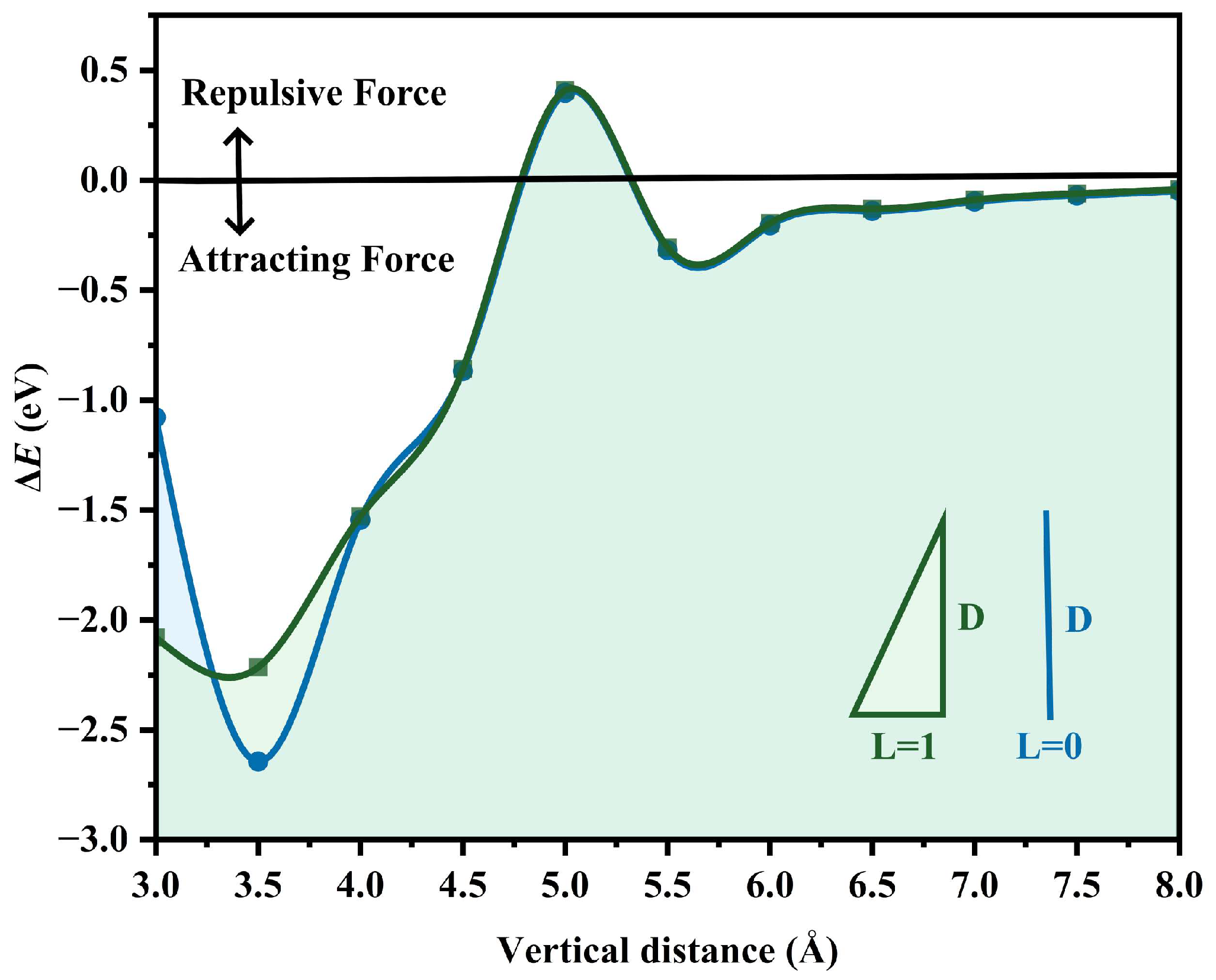
- Attracting force range (D = 3.0–4.5 Å): Within this range, the negative ΔE confirms an attracting force between the two CoPc layers. The system reaches its thermodynamic minimum of −2.64 eV at D = 3.5 Å (L = 0 Å). But here we must remind all the readers that, although D = 3.5 Å performs best in stability, the space between Co-Co catalyzing sites is too narrow to accommodate CO2 molecules, which brings great hindrance to the interlayer catalyzing processes. This difficulty is directly emphasized in the subsequent discussions of the present article.
- (2)
- Repulsive force range (D = ~5 Å): Along with the continuous elongation of D, ΔE undergoes a process of first increasing and then decreasing, resulting in a repulsive range of D = ~5 Å.
- (3)
- The range of weakly coupled double catalytic layers (D = 5.5–8.0 Å): As D increases further, the binding energy rapidly diminishes and plateaus toward zero. This indicates a dissipation of interlayer electronic coupling, where the system virtually transitions into two quasi-independent molecules.
2.2. Catalytic Performance Evaluation Based on Gibbs Free Energy Profiles
2.3. Evolution of Reaction Intermediates and Microscopic Mechanisms
2.4. Electronic Effect Analysis and Site-Preference Mechanisms
2.5. Self-Assessment and Outlook to This (CoPc)2 Confinement System
3. Model and Computational Details
3.1. Ideal Model and Reaction Mechanism

3.2. Computational Details
4. Conclusions
Supplementary Materials
Author Contributions
Funding
Data Availability Statement
Conflicts of Interest
References
- Intergovernmental Panel on Climate Change (IPCC). Climate Change 2021: The Physical Science Basis: Contribution of Working Group I to the Sixth Assessment Report of the Intergovernmental Panel on Climate Change; Masson-Delmotte, V., Zhai, P., Pirani, A., Connors, S.L., Péan, C., Berger, S., Caud, N., Chen, Y., Goldfarb, L., Gomis, M.I., et al., Eds.; Cambridge University Press: Cambridge, UK; New York, NY, USA, 2021. [Google Scholar]
- Liu, Y.; Du, M.; Yang, L.; Cui, Q.; Liu, Y.; Li, X.; Zhu, N.; Li, Y.; Jiang, C.; Zhou, P.; et al. Mitigation Policies Interactions Delay the Achievement of Carbon Neutrality in China. Nat. Clim. Change 2025, 15, 147–152. [Google Scholar] [CrossRef]
- Ruan, Z.; Wang, Y.; Lu, X.; Li, D.; Qin, H.; Yu, G.; Jiang, H.; Zhao, X.; Luo, Y.; He, J.; et al. A Systems-Oriented Review of China’s Wind and Solar Power Development toward Carbon Neutrality. Technol. Rev. Carbon Neutrality 2025, 1, 9550010. [Google Scholar] [CrossRef]
- Rogelj, J.; Schaeffer, M.; Meinshausen, M.; Knutti, R.; Alcamo, J.; Riahi, K.; Hare, W. Zero Emission Targets as Long-Term Global Goals for Climate Protection. Environ. Res. Lett. 2015, 10, 105007. [Google Scholar] [CrossRef]
- Wei, Y.-M.; Han, R.; Liang, Q.-M.; Yu, B.-Y.; Yao, Y.-F.; Xue, M.-M.; Zhang, K.; Liu, L.-J.; Peng, J.; Yang, P.; et al. An Integrated Assessment of INDCs under Shared Socioeconomic Pathways: An Implementation of C3IAM. Nat. Hazard. 2018, 92, 585–618. [Google Scholar] [CrossRef]
- Wei, Y.-M.; Chen, K.; Kang, J.-N.; Chen, W.; Wang, X.-Y.; Zhang, X. Policy and Management of Carbon Peaking and Carbon Neutrality: A Literature Review. Engineering 2022, 14, 52. [Google Scholar] [CrossRef]
- Wang, Y.; Park, B.J.; Paidi, V.K.; Huang, R.; Lee, Y.; Noh, K.-J.; Lee, K.-S.; Han, J.W. Precisely Constructing Orbital Coupling-Modulated Dual-Atom Fe Pair Sites for Synergistic CO2 Electroreduction. ACS Energy Lett. 2022, 7, 640–649. [Google Scholar] [CrossRef]
- Chen, Y.; Lin, J.; Pan, Q.; Liu, X.; Ma, T.; Wang, X. Inter-Metal Interaction of Dual-Atom Catalysts in Heterogeneous Catalysis. Angew. Chem. Int. Ed. 2023, 62, e202306469. [Google Scholar] [CrossRef] [PubMed]
- Shao, Y.; Yuan, Q.; Zhou, J. Single-atom Catalysts and Dual-atom Catalysts for CO2 Electroreduction: Competition or Cooperation? Small 2023, 19, 2303446. [Google Scholar] [CrossRef] [PubMed]
- Li, Y.; Wang, H.; Yang, X.; O’Carroll, T.; Wu, G. Designing and Engineering Atomically Dispersed Metal Catalysts for CO2 to CO Conversion: From Single to Dual Metal Sites. Angew. Chem. 2024, 136, e202317884. [Google Scholar] [CrossRef]
- Zhang, M.; Zhou, D.; Mu, X.; Wang, D.; Liu, S.; Dai, Z. Regulating the Critical Intermediates of Dual-atom Catalysts for CO2 Electroreduction. Small 2024, 20, 2402050. [Google Scholar] [CrossRef]
- Lyu, F.; Ma, B.; Xie, X.; Song, D.; Lian, Y.; Yang, H.; Hua, W.; Sun, H.; Zhong, J.; Deng, Z.; et al. Pre-Activation of CO2 at Cobalt Phthalocyanine-Mg(OH)2 Interface for Enhanced Turnover Rate. Adv. Funct. Mater. 2023, 33, 2214609. [Google Scholar] [CrossRef]
- Yang, G.; Li, S.; Li, N.; Zhang, P.; Su, C.; Gong, L.; Chen, B.; Qu, C.; Qi, D.; Wang, T.; et al. Enhanced Photocatalytic CO2 Reduction through Hydrophobic Microenvironment and Binuclear Cobalt Synergistic Effect in Metallogels. Angew. Chem. Int. Ed. 2022, 61, e202205585. [Google Scholar] [CrossRef]
- Zhang, C.; Follana-Berná, J.; Dragoe, D.; Halime, Z.; Gotico, P.; Sastre-Santos, Á.; Aukauloo, A. Cobalt Tetracationic 3,4-pyridinoporphyrazine for Direct CO2 to Methanol Conversion Escaping the CO Intermediate Pathway. Angew. Chem. Int. Ed. 2024, 63, e202411967. [Google Scholar] [CrossRef]
- Singh, A.; Zamader, A.; Khakpour, R.; Laasonen, K.; Busch, M.; Robert, M. Molecular Electrochemical Catalysis of CO-to-Formaldehyde Conversion with a Cobalt Complex. J. Am. Chem. Soc. 2024, 146, 22129–22133. [Google Scholar] [CrossRef]
- Luo, Y.; Yang, J.; Qin, J.; Miao, K.; Xiang, D.; Kuchkaev, A.; Yakhvarov, D.; Hu, C.; Kang, X. Cobalt Phthalocyanine Promoted Copper Catalysts toward Enhanced Electro Reduction of CO2 to C2: Synergistic Catalysis or Tandem Catalysis? J. Energy Chem. 2024, 92, 499–507. [Google Scholar] [CrossRef]
- Li, Y.-L.; Jiang, X.-L.; Cao, H.; Zhao, H.-Y.; Li, J.; Wang, Y.-G. Potential Dependence and Substituent Effect in CO2 Electroreduction on a Cobalt Phthalocyanine Catalyst. ACS Catal. 2024, 14, 9575–9585. [Google Scholar] [CrossRef]
- Hutchison, P.; Smith, L.E.; Rooney, C.L.; Wang, H.; Hammes-Schiffer, S. Proton-Coupled Electron Transfer Mechanisms for CO2 Reduction to Methanol Catalyzed by Surface-Immobilized Cobalt Phthalocyanine. J. Am. Chem. Soc. 2024, 146, 20230–20240. [Google Scholar] [CrossRef] [PubMed]
- Wang, C.; Chen, X.; Pan, H.; Qi, D.; Jiang, J. Towards Developing Efficient Aminopyridine-Based Electrochemical Catalysts for CO2 Reduction. A Density Functional Theory Study. J. Catal. 2019, 373, 75–80. [Google Scholar] [CrossRef]
- Fu, X.; Zhang, P.; Sun, T.; Xu, L.; Gong, L.; Chen, B.; Xu, Q.; Zheng, T.; Yu, Z.; Chen, X.; et al. Atomically Dispersed Ni—N3 Sites on Highly Defective Micro-mesoporous Carbon for Superior CO2 Electroreduction. Small 2022, 18, 2107997. [Google Scholar] [CrossRef] [PubMed]
- Chen, B.; Gong, L.; Li, N.; Pan, H.; Liu, Y.; Wang, K.; Jiang, J. Synergistic Modulation of Electronic Structure in Molecular Catalysts. Adv. Funct. Mater. 2023, 34, 2310029. [Google Scholar] [CrossRef]
- Wang, X.; Ding, X.; Jin, Y.; Qi, D.; Wang, H.; Han, Y.; Wang, T.; Jiang, J. Post-nickelation of a Crystalline Trinuclear Copper Organic Framework for Synergistic Photocatalytic Carbon Dioxide Conversion. Angew. Chem. 2023, 135, e202302808. [Google Scholar] [CrossRef]
- Gao, Y.; Li, S.; Gong, L.; Li, J.; Qi, D.; Liu, N.; Bian, Y.; Jiang, J. Unprecedented POSS-linked 3D Covalent Organic Frameworks with 2-fold Interpenetrated Scu or Sqc Topology Regulated by Porphyrin Center for Photocatalytic CO2 Reduction. Angew. Chem. Int. Ed. 2024, 63, e202404156. [Google Scholar] [CrossRef]
- Huang, M.; Chen, B.; Zhang, H.; Jin, Y.; Zhi, Q.; Yang, T.; Wang, K.; Jiang, J. Interlayer Polarization Engineering in 2D Catalysts. Small Methods 2024, 8, 2301652. [Google Scholar] [CrossRef]
- Li, M.; Han, B.; Li, S.; Zhang, Q.; Zhang, E.; Gong, L.; Qi, D.; Wang, K.; Jiang, J. Constructing 2D Phthalocyanine Covalent Organic Framework with Enhanced Stability and Conductivity via Interlayer Hydrogen Bonding as Electrocatalyst for CO2 Reduction. Small 2024, 20, 2310147. [Google Scholar] [CrossRef]
- Zheng, T.; Ding, X.; Sun, T.; Yang, X.; Wang, X.; Zhou, X.; Zhang, P.; Yu, B.; Wang, Y.; Xu, Q.; et al. Nanostructurally Engineering Covalent Organic Frameworks for Boosting CO2 Photoreduction. Small 2024, 20, 2307743. [Google Scholar] [CrossRef] [PubMed]
- Wang, Q.; Chen, J.; Pan, H.; Liu, W.; Liu, Y.; Chen, B.; Qi, D.; Wang, K.; Jiang, J. Advances in Dual-Site Molecular Catalysts for Electrochemical CO2 Reduction. Adv. Mater. 2025, 37, 2502644. [Google Scholar] [CrossRef]
- Machan, C.W.; Chabolla, S.A.; Yin, J.; Gilson, M.K.; Tezcan, F.A.; Kubiak, C.P. Supramolecular Assembly Promotes the Electrocatalytic Reduction of Carbon Dioxide by Re(I) Bipyridine Catalysts at a Lower Overpotential. J. Am. Chem. Soc. 2014, 136, 14598–14607. [Google Scholar] [CrossRef]
- Kumar, A.; Sun, K.; Duan, X.; Tian, S.; Sun, X. Construction of Dual-Atom Fe via Face-to-Face Assembly of Molecular Phthalocyanine for Superior Oxygen Reduction Reaction. Chem. Mater. 2022, 34, 5598–5606. [Google Scholar] [CrossRef]
- Chaykun, K.; Febriansyah, B.; Nguyen, T.T.; Lekina, Y.; Li, Y.; Li, S.; Teng, J.; Tan, Z.; Mathews, N.; Shen, Z. Intercalation of Transition-metal Complexes into 2D Hybrid Perovskites for Tailored Dual-band Emission. Angew. Chem. Int. Ed. 2025, 64, e202503957. [Google Scholar] [CrossRef] [PubMed]
- Ghatak, A.; Shanker, G.S.; Pearlmutter, Y.; Fryder, A.; Shimoni, R.; Hod, I. Dual Molecular Catalyst-Based Tandem That Enables Electrocatalytic CO2—Formaldehyde−methanol Cascade Conversion. J. Am. Chem. Soc. 2025, 147, 20329–20337. [Google Scholar] [CrossRef]
- Zhang, K.; Liu, Y.; Qin, X.; Hou, P.; Zhang, C.; Yan, D.; Lv, C.; Chen, D.; Feng, Y.; Wu, Z.; et al. Designing Molecular Reactor of Interlayer Dual-atom toward Urea Electrosynthesis. Angew. Chem. Int. Ed. 2025, 64, e202513341. [Google Scholar] [CrossRef] [PubMed]
- Dong, H.; Wang, Y.; Fang, L.; Wu, D.; Bai, L.-W.; Jiang, Y.; Chu, X.; Zhang, H.-Y.; Yang, Y.; Zhang, F.-M. Design Synergistic Dual Metal Sites in Z-Scheme System of Metal Phthalocyanine and Metal-Covalent Organic Framework for Photocatalytic Diluted CO2 Reduction. Nano Energy 2025, 143, 111305. [Google Scholar] [CrossRef]
- Lu, X.; Xia, Y.; Bao, Y.; Ye, Z.; Chen, H.; Huang, H. Interlayer-Confined-Enabled Dual-Site Synergy Strategy: A Bilayer FeN4 Catalyst for Enhanced CO2 Reduction and C-C Coupling. Chem. Eng. Sci. 2025, 314, 121728. [Google Scholar] [CrossRef]
- Huang, Z.-W.; Hu, K.-Q.; Li, X.-B.; Bin, Z.-N.; Wu, Q.-Y.; Zhang, Z.-H.; Guo, Z.-J.; Wu, W.-S.; Chai, Z.-F.; Mei, L.; et al. Thermally Induced Orderly Alignment of Porphyrin Photoactive Motifs in Metal–Organic Frameworks for Boosting Photocatalytic CO2 Reduction. J. Am. Chem. Soc. 2023, 145, 18148–18159. [Google Scholar] [CrossRef]
- Jiang, G.; Zou, W.; Ou, Z.; Zhang, L.; Zhang, W.; Wang, X.; Song, H.; Cui, Z.; Liang, Z.; Du, L. Tuning the Interlayer Interactions of 2D Covalent Organic Frameworks Enables an Ultrastable Platform for Anhydrous Proton Transport. Angew. Chem. Int. Ed. 2022, 61, e202208086. [Google Scholar] [CrossRef]
- Liu, Y.; Yao, H.; Zhang, H.; Ma, C.; Guo, J.; Fan, Y.; Chen, H.; Wu, X.; Yang, L.; Huang, X.; et al. Asymmetrical Substitution Manipulates Stacking Modes in 2D Conductive MOF Crystals. J. Am. Chem. Soc. 2025, 147, 48127–48135. [Google Scholar] [CrossRef]
- He, M.; Wang, Y.; Ma, Y.; Li, L.; Yang, N.; Ye, Z.; Zhou, X.; Cheng, Y.; Zhang, Y.; Gui, B.; et al. Tailored Metalloporphyrin-Based Three-Dimensional Covalent Organic Frameworks for Enhanced Photocatalytic CO2 Reduction. J. Am. Chem. Soc. 2026, 148, 2511–2518. [Google Scholar] [CrossRef]
- Zheng, T.; Li, W.; Liu, Y.Z.; Liu, J.Y.; Qiao, Y.X.; Huang, W.C.; Jian, J.X. Pore-Space Design of Cobalt–Porphyrin Covalent Organic Frameworks Suppresses Inactive Bridged-CO Intermediates for Selective CO2 Electroreduction. J. Am. Chem. Soc. 2026, 148, 5387−5399. [Google Scholar] [CrossRef]
- Lu, T.; Chen, Q. Independent Gradient Model Based on Hirshfeld Partition: A New Method for Visual Study of Interactions in Chemical Systems. J. Comput. Chem. 2022, 43, 539–555. [Google Scholar] [CrossRef]
- Sun, G.; Zhao, Z.-J.; Mu, R.; Zha, S.; Li, L.; Chen, S.; Zang, K.; Luo, J.; Li, Z.; Purdy, S.C.; et al. Breaking the Scaling Relationship via Thermally Stable Pt/Cu Single Atom Alloys for Catalytic Dehydrogenation. Nat. Commun. 2018, 9, 4454. [Google Scholar] [CrossRef] [PubMed]
- Cheng, H.; Wu, X.; Li, X.; Nie, X.; Fan, S.; Feng, M.; Fan, Z.; Tan, M.; Chen, Y.; He, G. Construction of Atomically Dispersed Cu-N4 Sites via Engineered Coordination Environment for High-Efficient CO2 Electroreduction. Chem. Eng. J. 2021, 407, 126842. [Google Scholar] [CrossRef]
- Zhang, E.; Wang, T.; Yu, K.; Liu, J.; Chen, W.; Li, A.; Rong, H.; Lin, R.; Ji, S.; Zheng, X.; et al. Bismuth Single Atoms Resulting from Transformation of Metal–Organic Frameworks and Their Use as Electrocatalysts for CO2 Reduction. J. Am. Chem. Soc. 2019, 141, 16569–16573. [Google Scholar] [CrossRef]
- Cao, S.; Zhou, S.; Chen, H.; Wei, S.; Liu, S.; Lin, X.; Chen, X.; Wang, Z.; Guo, W.; Lu, X. How Can the Dual-atom Catalyst FeCo–NC Surpass Single-atom Catalysts Fe–NC/Co–NC in CO2RR?—CO Intermediate Assisted Promotion via a Synergistic Effect. Energy Environ. Mater. 2023, 6, e12287. [Google Scholar] [CrossRef]
- Mayer, I. Charge, Bond Order and Valence in the AB Initio SCF Theory. Chem. Phys. Lett. 1983, 97, 270–274. [Google Scholar] [CrossRef]
- Mayer, I. A Review of the Mayer Bond Order and Related Bond-Order Measures. J. Comput. Chem. 2007, 28, 204–221. [Google Scholar] [CrossRef]
- Uddin, A.T.; Zhao, Q.; Toroz, D.; Crespo-Otero, R.; Di Tommaso, D. Computational Screening of Metalloporphyrin Catalysts for the Activation of Carbon Dioxide. Mol. Catal. 2024, 565, 114386. [Google Scholar] [CrossRef]
- Li, H.; Wei, J.; Zhu, X.; Gan, L.; Cheng, T.; Li, J. Stimulating the Pre-Catalyst Redox Reaction and the Proton-Electron Transfer Process of Cobalt Phthalocyanine for CO2 Electroreduction. J. Phys. Chem. C 2022, 126, 9665–9672. [Google Scholar] [CrossRef]
- Conquest, O.J.; Roman, T.; Marianov, A.; Kochubei, A.; Jiang, Y.; Stampfl, C. First Principles Investigation of Cobalt-Phthalocyanine Active Site Tuning via Atomic Linker Immobilization for CO2 Electroreduction. J. Catal. 2023, 422, 43–55. [Google Scholar] [CrossRef]
- Medford, A.J.; Vojvodic, A.; Hummelshøj, J.S.; Voss, J.; Abild-Pedersen, F.; Studt, F.; Bligaard, T.; Nilsson, A.; Nørskov, J.K. From the Sabatier Principle to a Predictive Theory of Transition-Metal Heterogeneous Catalysis. J. Catal. 2015, 328, 36–42. [Google Scholar] [CrossRef]
- Zhou, Q.; Zhang, M.; Zhu, B.; Gao, Y. Investigation of the Stability and Hydrogen Evolution Activity of Dual-Atom Catalysts on Nitrogen-Doped Graphene. Nanomaterials 2022, 12, 2557. [Google Scholar] [CrossRef]
- Weinhold, F.; Landis, C.R. Discovering Chemistry with Natural Bond Orbitals; Wiley: Hoboken, NJ, USA, 2012; ISBN 978-1-118-11996-9. [Google Scholar]
- Xu, Y.; Zhao, Z.-H.; Wang, Y.; Ma, X.; Liu, H.; Hu, J.-S.; Wang, H.; Wang, D. Boosting CO2 Photoreduction via Ligand-Engineered Single-Atom Cobalt Sites in Covalent Organic Frameworks. Angew. Chem. Int. Ed. 2026, 65, e17289. [Google Scholar] [CrossRef] [PubMed]
- Parr, R.G.; Yang, W. Density Functional Approach to the Frontier-Electron Theory of Chemical Reactivity. J. Am. Chem. Soc. 1984, 106, 4049–4050. [Google Scholar] [CrossRef]
- Qi, D.; Zhang, L.; Wan, L.; Zhang, Y.; Bian, Y.; Jiang, J. Conformational Effects, Molecular Orbitals, and Reaction Activities of Bis(Phthalocyaninato) Lanthanum Double-Deckers: Density Functional Theory Calculations. Phys. Chem. Chem. Phys. 2011, 13, 13277–13286. [Google Scholar] [CrossRef]
- Wang, B.; Rong, C.; Chattaraj, P.K.; Liu, S. A Comparative Study to Predict Regioselectivity, Electrophilicity and Nucleophilicity with Fukui Function and Hirshfeld Charge. Theor. Chem. Acc. 2019, 138, 124. [Google Scholar] [CrossRef]
- Murray, J.S.; Politzer, P. Electrostatic Potentials: Chemical Applications. In Encyclopedia of Computational Chemistry; Schleyer, P.v.R., Ed.; John Wiley & Sons: Chichester, UK, 1998; Volume 2, pp. 912–920. [Google Scholar]
- Peng, P.; Shi, L.; Huo, F.; Mi, C.; Wu, X.; Zhang, S.; Xiang, Z. A Pyrolysis-Free Path toward Superiorly Catalytic Nitrogen-Coordinated Single Atom. Sci. Adv. 2019, 5, eaaw2322. [Google Scholar] [CrossRef] [PubMed]
- Yang, X.; Gong, L.; Wang, K.; Ma, S.; Liu, W.; Li, B.; Li, N.; Pan, H.; Chen, X.; Wang, H.; et al. Ionothermal Synthesis of Fully Conjugated Covalent Organic Frameworks for High-Capacity and Ultrastable Potassium-Ion Batteries. Adv. Mater. 2022, 34, 2207245. [Google Scholar] [CrossRef]
- Li, Q.; Ma, D.-D.; Wei, W.-B.; Han, S.-G.; Zheng, L.; Zhu, Q.-L. Value-Added Cascade Synthesis Mediated by Paired-Electrolysis Using an Ultrathin Microenvironment-Inbuilt Metalized Covalent Organic Framework Heterojunction. Adv. Energy Mater. 2024, 14, 2401314. [Google Scholar] [CrossRef]
- Yin, Q.; Alexandrov, E.V.; Si, D.-H.; Huang, Q.-Q.; Fang, Z.-B.; Zhang, Y.; Zhang, A.-A.; Qin, W.-K.; Li, Y.-L.; Liu, T.-F.; et al. Metallization-Prompted Robust Porphyrin-Based Hydrogen-Bonded Organic Frameworks for Photocatalytic CO2 Reduction. Angew. Chem. Int. Ed. Engl. 2022, 61, e202115854. [Google Scholar] [CrossRef]
- Liu, M.; Gu, X.-W.; Lin, C.; Dong, B.; He, Z.; Xie, B.; Zhang, X.; Li, B.; Wen, H.-M.; Hu, J. Highly Efficient Separation of C2H2 from CO2 and C2H4 Enabled by an Anion-Pillared Metalloporphyrin MOF with Sandwich-like Binding Sites. J. Mater. Chem. A 2025, 13, 1034–1041. [Google Scholar] [CrossRef]
- Huang, Q.-Q.; Li, N.; Han, M.-S.; Liu, J.; Lan, Y.-Q. Conductive Knitting of Covalent Organic Framework Manipulates Spin Density, Orbital Reorganization, and Charge Mobility for Outstanding Photoreactivity. Angew. Chem. Int. Ed. 2025, 64, e202513848. [Google Scholar] [CrossRef]
- Zhang, D.; Crawley, M.R.; Fang, M.; Kyle, L.J.; Cook, T.R. The Rigidity of Self-Assembled Cofacial Porphyrins Influences Selectivity and Kinetics of Oxygen Reduction Electrocatalysis. Dalton Trans. 2022, 51, 18373–18377. [Google Scholar] [CrossRef] [PubMed]
- Crawley, M.R.; Zhang, D.; Oldacre, A.N.; Beavers, C.M.; Friedman, A.E.; Cook, T.R. Tuning the Reactivity of Cofacial Porphyrin Prisms for Oxygen Reduction Using Modular Building Blocks. J. Am. Chem. Soc. 2021, 143, 1098–1106. [Google Scholar] [CrossRef]
- Kramer, W.W.; McCrory, C.C.L. Polymer Coordination Promotes Selective CO2 Reduction by Cobalt Phthalocyanine. Chem. Sci. 2016, 7, 2506–2515. [Google Scholar] [CrossRef]
- Xia, Y.; Kashtanov, S.; Yu, P.; Chang, L.-Y.; Feng, K.; Zhong, J.; Guo, J.; Sun, X. Identification of Dual-Active Sites in Cobalt Phthalocyanine for Electrochemical Carbon Dioxide Reduction. Nano Energy 2020, 67, 104163. [Google Scholar] [CrossRef]
- Fang, J.; Zhu, Y.N.; Long, X.; Li, X.B.; Zhang, Q.; Yang, G.; Peng, F. Theoretical Calculations and Experimental Verification of Carbon Dioxide Reduction Electrocatalyzed by Metalloporphyrin. J. Colloid Interface Sci. 2024, 668, 366–374. [Google Scholar] [CrossRef]
- Kochubei, A.S.; Marianov, A.N.; Conquest, O.J.; Lu, T.; Liu, Y.; Stampfl, C.; Jiang, Y. Improved Charge Delivery within a Covalently Ligated Cobalt Phthalocyanine Electrocatalyst for CO2 Reduction. J. Mater. Chem. A 2025, 13, 1874–1886. [Google Scholar] [CrossRef]
- Liu, T.; Zhang, D.; Chu, Y.; Ohashi, K.; Hirai, Y.; Ito, K.; Ishibashi, K.; Matsuo, Y.; Yoshida, J.; Ono, S.; et al. Breaking the Single-Molecule Paradigm: Multilayer Cobalt Phthalocyanine/Carbon Core-Shell Structure as the Superior Active Unit for CO2-to-CO Electroreduction. Appl. Catal. B Environ. Energy 2026, 381, 125852. [Google Scholar] [CrossRef]
- Grimme, S. Semiempirical GGA-Type Density Functional Constructed with a Long-Range Dispersion Correction. J. Comput. Chem. 2006, 27, 1787–1799. [Google Scholar] [CrossRef]
- Zhang, H.; Li, J.; Xi, S.; Du, Y.; Hai, X.; Wang, J.; Xu, H.; Wu, G.; Zhang, J.; Lu, J.; et al. A Graphene-Supported Single-Atom FeN5 Catalytic Site for Efficient Electrochemical CO2 Reduction. Angew. Chem. Int. Ed. 2019, 58, 14871–14876. [Google Scholar] [CrossRef] [PubMed]
- Li, Y.; Chen, C.; Cao, R.; Pan, Z.; He, H.; Zhou, K. Dual-Atom Ag2/Graphene Catalyst for Efficient Electroreduction of CO2 to CO. Appl. Catal. B 2020, 268, 118747. [Google Scholar] [CrossRef]
- Frisch, M.J.; Trucks, G.W.; Schlegel, H.B.; Scuseria, G.E.; Robb, M.A.; Cheeseman, J.R.; Scalmani, G.; Barone, V.; Petersson, G.A.; Nakatsuji, H.; et al. Gaussian 16 Revision A.03 2016; ScienceOpen, Inc.: Berlin, Germany, 2016. [Google Scholar]
- Lu, T.; Chen, F. Multiwfn: A Multifunctional Wavefunction Analyzer. J. Comput. Chem. 2012, 33, 580–592. [Google Scholar] [CrossRef] [PubMed]
- Marenich, A.V.; Cramer, C.J.; Truhlar, D.G. Universal Solvation Model Based on Solute Electron Density and on a Continuum Model of the Solvent Defined by the Bulk Dielectric Constant and Atomic Surface Tensions. J. Phys. Chem. B 2009, 113, 6378–6396. [Google Scholar] [CrossRef] [PubMed]
- Lin, Y.-S.; Li, G.-D.; Mao, S.-P.; Chai, J.-D. Long-Range Corrected Hybrid Density Functionals with Improved Dispersion Corrections. J. Chem. Theory Comput. 2013, 9, 263–272. [Google Scholar] [CrossRef] [PubMed]
- Höllwarth, A.; Böhme, M.; Dapprich, S.; Ehlers, A.W.; Gobbi, A.; Jonas, V.; Köhler, K.F.; Stegmann, R.; Veldkamp, A.; Frenking, G. A Set of D-Polarization Functions for Pseudo-Potential Basis Sets of the Main Group Elements Al Bi and f-Type Polarization Functions for Zn, Cd, Hg. Chem. Phys. Lett. 1993, 208, 237–240. [Google Scholar] [CrossRef]
- Krishnan, R.; Binkley, J.S.; Seeger, R.; Pople, J.A. Self-Consistent Molecular Orbital Methods. XX. A Basis Set for Correlated Wave Functions. J. Chem. Phys. 1980, 72, 650–654. [Google Scholar] [CrossRef]
- Clark, T.; Chandrasekhar, J.; Spitznagel, G.W.; Schleyer, P.V.R. Efficient Diffuse Function-augmented Basis Sets for Anion Calculations. III. The 3-21+G Basis Set for First-row Elements, Li–F. J. Comput. Chem. 1983, 4, 294–301. [Google Scholar] [CrossRef]





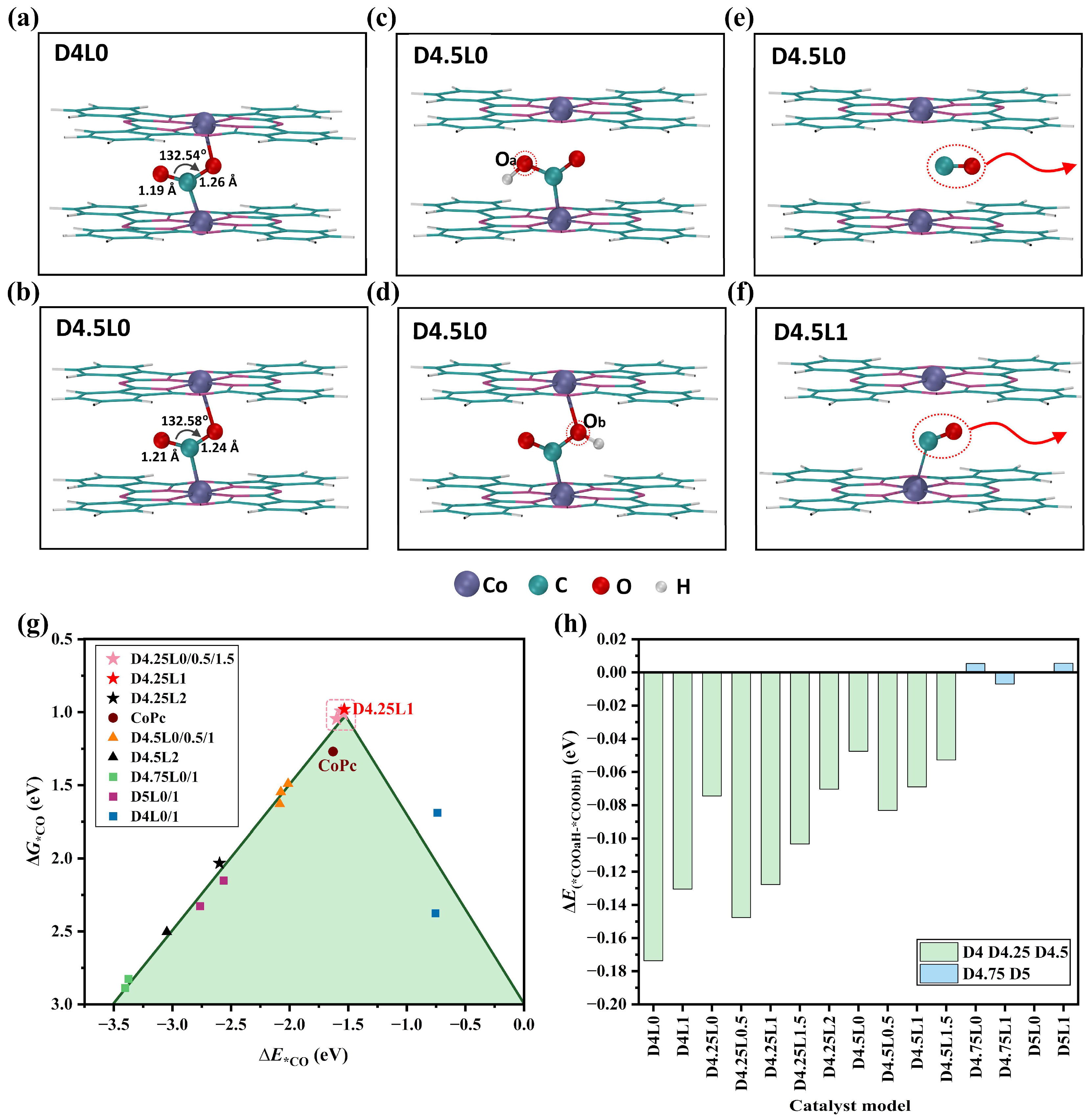
| Geometric Parameters | MBO | ||||
|---|---|---|---|---|---|
| Oa-C-Ob (°) | C-Oa (Å) | C-Ob (Å) | C-Oa | C-Ob | |
| D4L0 | 132.54 | 1.19 | 1.26 | 1.77 | 1.15 |
| D4L1 | 133.18 | 1.19 | 1.27 | 1.76 | 1.15 |
| D4.25L0 | 134.80 | 1.21 | 1.23 | 1.69 | 1.40 |
| D4.25L0.5 | 137.11 | 1.20 | 1.23 | 1.71 | 1.42 |
| D4.25L1 | 134.94 | 1.21 | 1.24 | 1.68 | 1.40 |
| D4.25L1.5 | 136.35 | 1.21 | 1.23 | 1.69 | 1.46 |
| D4.25L2 | 135.90 | 1.21 | 1.23 | 1.69 | 1.48 |
| D4.5L0 | 132.58 | 1.21 | 1.24 | 1.68 | 1.42 |
| D4.5L0.5 | 133.00 | 1.21 | 1.24 | 1.68 | 1.43 |
| D4.5L1 | 133.35 | 1.21 | 1.24 | 1.68 | 1.43 |
| D4.5L1.5 | 133.78 | 1.22 | 1.24 | 1.67 | 1.46 |
| D4.75L0 | 134.60 | 1.21 | 1.23 | 1.70 | 1.50 |
| D4.75L1 | 135.54 | 1.21 | 1.23 | 1.71 | 1.51 |
| D5L0 | 134.76 | 1.21 | 1.23 | 1.70 | 1.54 |
| D5L1 | 137.73 | 1.21 | 1.22 | 1.70 | 1.54 |
Disclaimer/Publisher’s Note: The statements, opinions and data contained in all publications are solely those of the individual author(s) and contributor(s) and not of MDPI and/or the editor(s). MDPI and/or the editor(s) disclaim responsibility for any injury to people or property resulting from any ideas, methods, instructions or products referred to in the content. |
© 2026 by the authors. Licensee MDPI, Basel, Switzerland. This article is an open access article distributed under the terms and conditions of the Creative Commons Attribution (CC BY) license.
Share and Cite
Yin, L.; Qi, D.; Wang, T.; Jiang, J. A “Goldilocks Zone” in Bilayer Cobalt Phthalocyanine: Optimizing Confinement for Efficient CO2RR. Catalysts 2026, 16, 328. https://doi.org/10.3390/catal16040328
Yin L, Qi D, Wang T, Jiang J. A “Goldilocks Zone” in Bilayer Cobalt Phthalocyanine: Optimizing Confinement for Efficient CO2RR. Catalysts. 2026; 16(4):328. https://doi.org/10.3390/catal16040328
Chicago/Turabian StyleYin, Longlei, Dongdong Qi, Tianyu Wang, and Jianzhuang Jiang. 2026. "A “Goldilocks Zone” in Bilayer Cobalt Phthalocyanine: Optimizing Confinement for Efficient CO2RR" Catalysts 16, no. 4: 328. https://doi.org/10.3390/catal16040328
APA StyleYin, L., Qi, D., Wang, T., & Jiang, J. (2026). A “Goldilocks Zone” in Bilayer Cobalt Phthalocyanine: Optimizing Confinement for Efficient CO2RR. Catalysts, 16(4), 328. https://doi.org/10.3390/catal16040328