Article

First-Principles Investigation of the Stability and CH4 Activation Capability of Defective h-BN

1
Department of Chemical and Environmental Engineering, University of California, Riverside, CA 92521, USA
2
Department of Chemistry, University of California, Riverside, CA 92521, USA
3
Department of Physiology, University of Texas Southwestern Medical Center, Dallas, TX 75390, USA
*
Author to whom correspondence should be addressed.
Catalysts 2026, 16(4), 321; https://doi.org/10.3390/catal16040321
Submission received: 29 January 2026 / Revised: 7 March 2026 / Accepted: 20 March 2026 / Published: 2 April 2026
(This article belongs to the Section Computational Catalysis)

Abstract

Hexagonal boron nitride (h-BN) has been widely applied in catalysis. Nevertheless, most research has focused on using h-BN as a substrate to anchor active transition metals, without probing the intrinsic activity of h-BN vacancies. In this work, we investigated the stability and catalytic activity of different h-BN vacancies. We found that B-terminated vacancies are more likely to be exposed under static conditions. The Nv, BN2, and BN3 vacancies show intermediate reaction energies for CH4 activation. Although the B–N pair over the BN2 vacancy model has the lowest barrier for CH4 activation, the negative reaction energy could lead to a high potential for surface poisoning. Interestingly, the unsaturated B–B pair over Nv is a promising site for C–H bond activation. Further COHP analysis implies that the high C–H bond homolytic cleavage activity of the B–B pair arises from its relatively weak interaction, which can promote H insertion.

1. Introduction

Since their first successful synthesis by Balmain in 1842 [1], boron nitride materials have gradually been brought to the attention of the public. Boron nitride materials exist primarily in three crystalline forms: the hexagonal, cubic, and wurtzite forms [2]. Among these, hexagonal boron nitride (h-BN) is the most stable form under normal conditions [2]. Additionally, with the flourishing research on two-dimensional materials [3,4,5], h-BN has been extensively studied in recent decades [6]. Like graphene, hexagonal boron nitride (h-BN) possesses a layered structure characterized by sp2-hybridized B–N covalent bonds, which grant h-BN excellent thermal conductivity along the layers. Moreover, h-BN exhibits remarkable thermal stability, remaining stable at temperatures up to 1000 °C [7]. Such high stability makes h-BN a promising candidate for catalytic applications.
Pristine boron nitride (BN) is chemically inert owing to its high stability. A common strategy for functionalizing h-BN involves creating vacancy sites on its surface [8,9,10]. Dr. Jin’s group fabricated defective h-BN via energetic electron irradiation, and by combining high-resolution transmission electron microscopy (HRTEM) with exit-wave (EW) reconstruction, they successfully resolved the N-edge vacancy sites [11]. In contrast to Prof. Jin’s finding, Ovidiu Cretu’s group observed the B-terminated vacancy on h-BN at a high temperature by high-resolution electron energy loss spectroscopy (EELS) mapping [12]. As for the catalytic application of h-BN, researchers have used the vacancy sites as the anchoring points for the active phase for the CO oxidation reaction [13,14] or synthesized h-BN coating Pt/Al2O3 core–shell structures. The vacancy over the h-BN can selectively allow small reactant molecules to pass through [15]. In addition, numerous computational studies have been carried out to probe the reaction over single-atom-doped BN [16,17,18,19,20]. All these studies focus on the auxiliary role of BN vacancy for chemical reactions while seldom discussing the catalytic effect of the vacancies themselves. Previous studies have demonstrated that defect-regulated B–N frustrated Lewis pair (FLP) sites in h-BN can activate small molecules such as H2 via heterolytic bond cleavage [21]. However, whether h-BN vacancy can promote methane C–H bond activation through alternative mechanisms remains largely unexplored. In this work, we reveal that unsaturated B–B pairs exposed at B-terminated vacancies can activate methane via a homolytic C–H cleavage mechanism, which is fundamentally different from the previously reported FLP-type activation pathways.
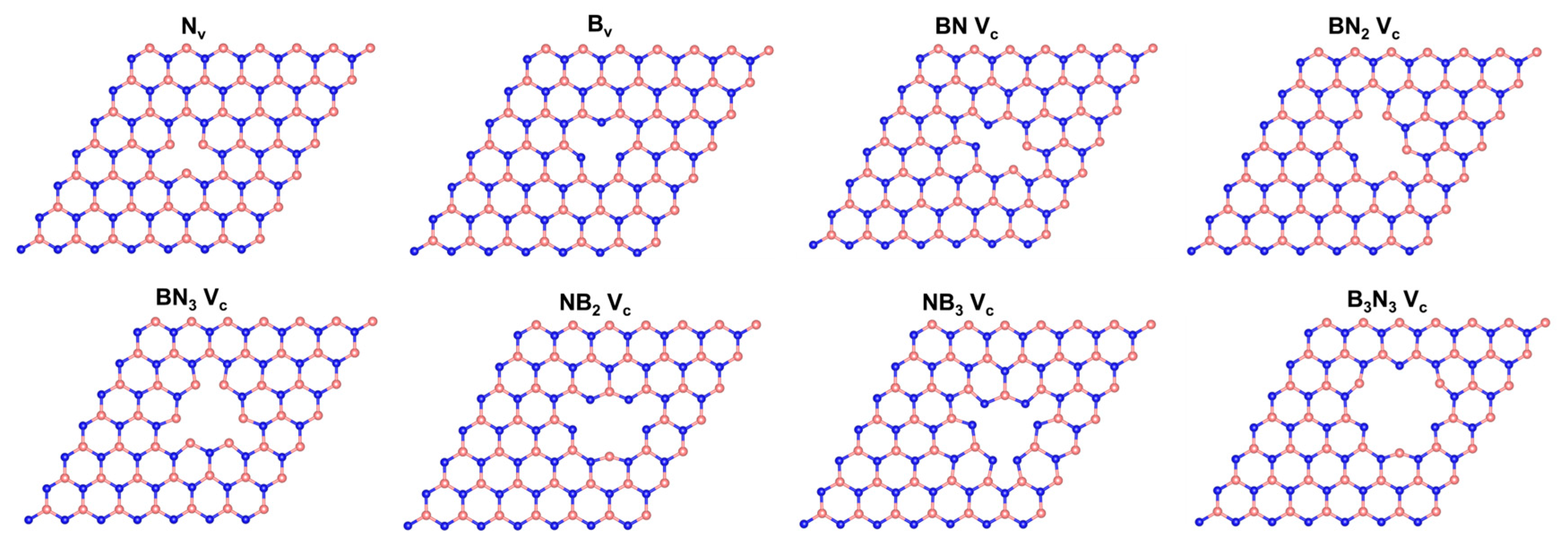
Herein, this study focuses on both N-terminated vacancy (Vc) and B-terminated vacancy in h-BN. A series of h-BN vacancies with different sizes were constructed, including the mono N vacancy (Nv), mono B vacancy (Bv), BN Vc, BN2 Vc, BN3 Vc, NB2 Vc, NB3 Vc and B3N3 Vc, which are shown in Figure 1. Among these vacancy structures, the BN, BN2, BN3, and B3N3 vacancies have been investigated in a previous study [21] for hydrogenation reactions using a 6 × 6 lateral unit cell, which differs from the computational model employed in this work. The stability of these vacancies was first analyzed, then we utilized CH4 activation as the probe reaction to investigate the activity of different vacancies. The homolytic activation and heterolytic activation were both studied in different terminations followed by a deeper analysis of the electronic effect.

2. Results and Discussion

2.1. Formation Energy of Different h-BN Vacancies

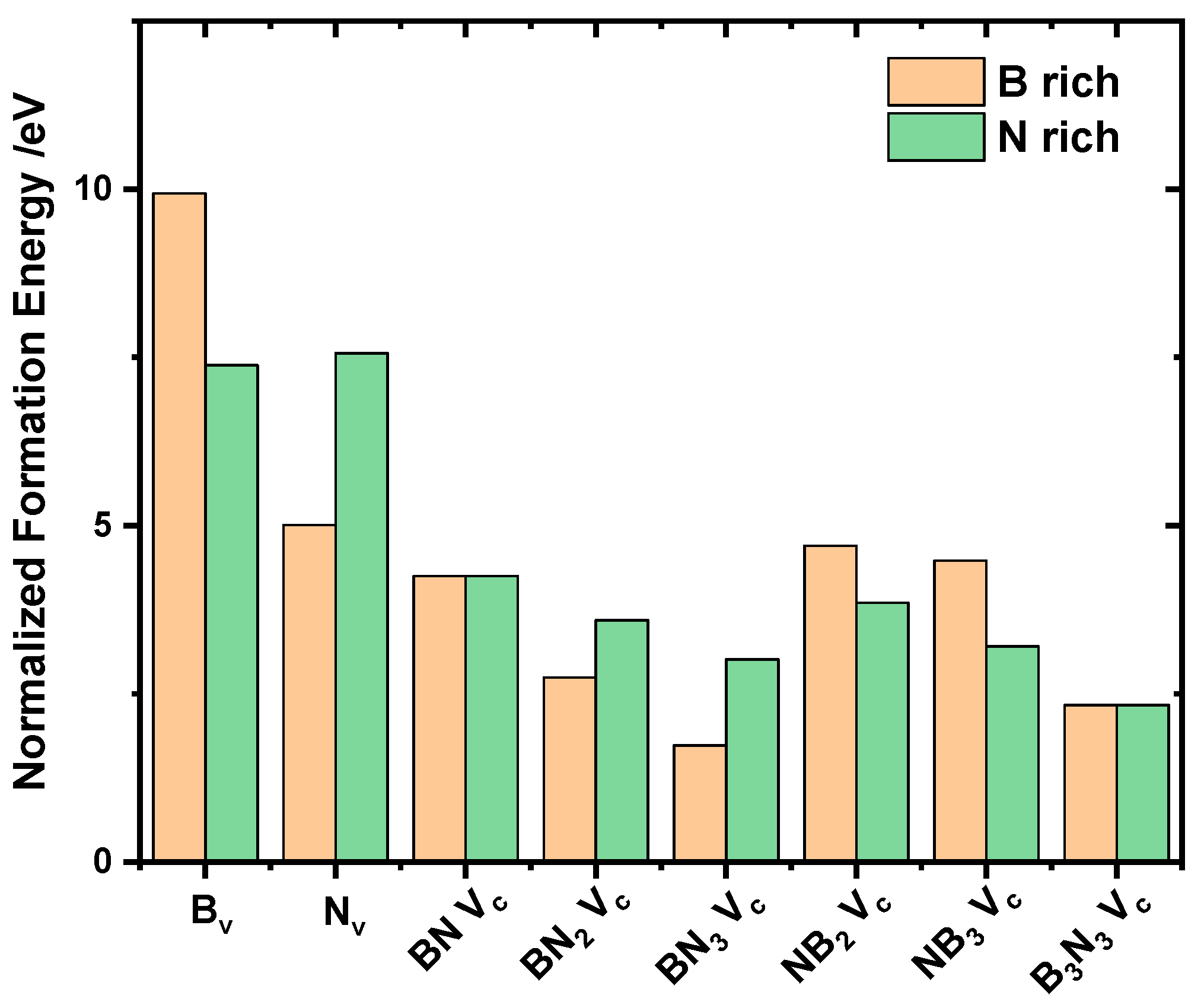
The stability of the active site is of vital importance for a catalyst. Therefore, we first investigated the normalized formation energy based on the number of atoms removed from the surface. As shown in Figure 2, the mono B/N vacancy normalized formation energies are larger than those of the larger vacancies. In the B-rich condition, the mono N vacancy forms more easily, while in the N-rich condition, the mono B vacancy forms more easily. Interestingly, we also observe a general trend that with the increase in the vacancy size (number of atoms removed), the normalized formation energy decreases. Also, the formation energy of the BN2 vacancy is lower than that of the NB2 vacancy in both the B-rich condition and N-rich condition, although they have the same vacancy size. The same is true of the comparison between the BN3 and NB3 vacancy. For both B-rich and N-rich scenarios, the BN3 vacancy formation energies are always lower than those of the NB3 vacancy. This phenomenon suggests that for a medium-sized vacancy, the B edge is thermodynamically favorable as both BN2 and BN3 have more B termination than N termination (Figure 1). As for the mono vacancy, the Bv formation energy is only slightly lower than Nv in N-rich conditions. This finding also implies that the B-terminated vacancies tend to be exposed. The phenomenon is consistent with previous computational results showing that Nv forms slightly more easily [22] and that triangle-shaped BN3 vacancies have been directly observed using high-resolution STEM-EELS experiments [12].
For the B-rich vacancies, both Nv and BN2 Vc exhibit a total magnetic moment of 1 μB. As shown in Table S1, the magnetic moments remain essentially unchanged upon adsorption of CH3 and H species, indicating that the spin state of the defective surface is preserved during the CH4 activation process. Furthermore, calculations with constrained total magnetic moments were performed to examine alternative spin configurations. As shown in Table S2, the lowest-energy configurations correspond to magnetic moments of 1 μB for Nv and BN2 Vc and 0 μB for BN3 Vc, confirming that the spin states used in the reaction pathway calculations correspond to the most stable magnetic configurations.

2.2. Activity of h-BN Vacancies

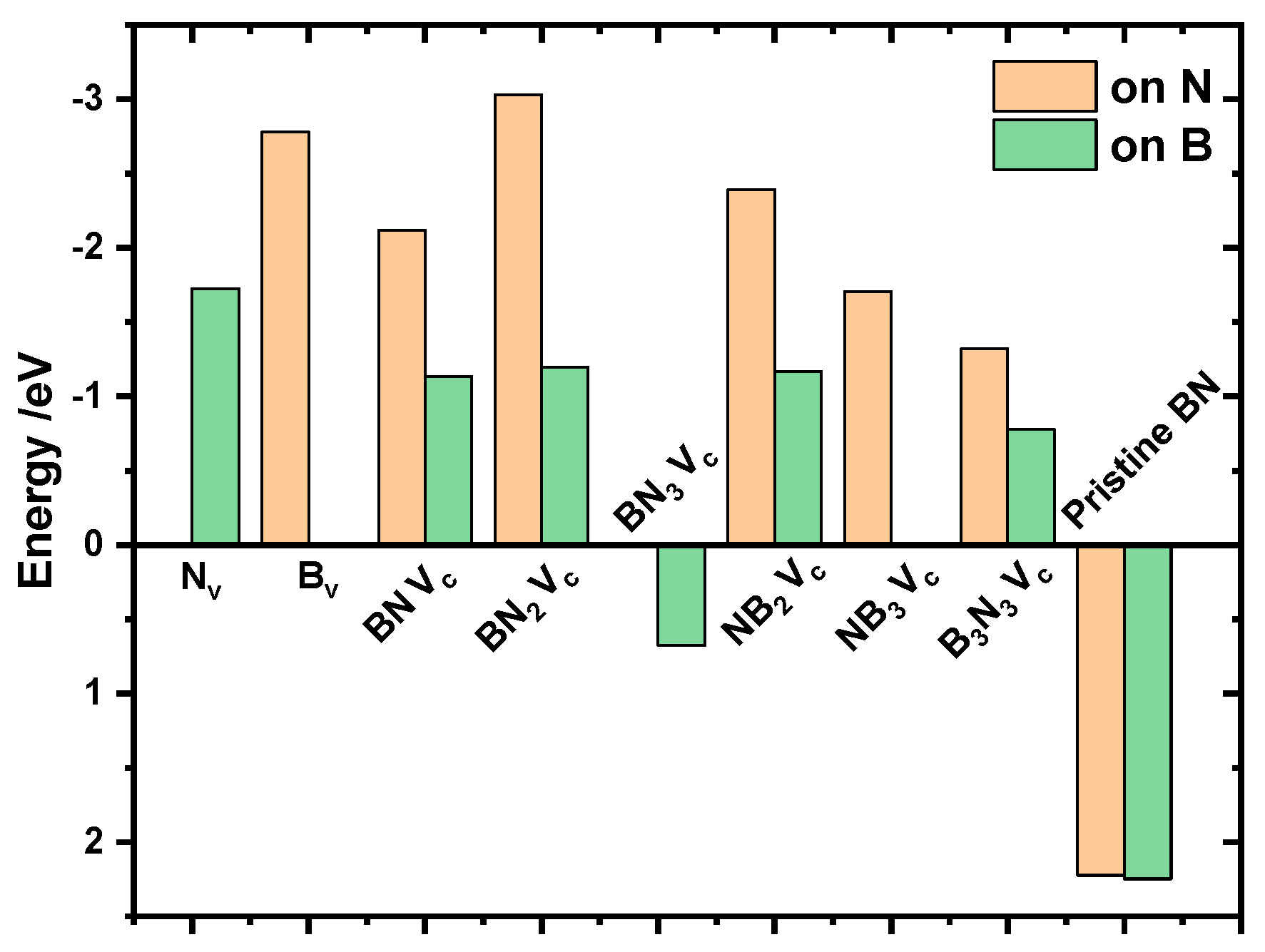
In recent years, a number of researchers have used H binding strength as a quick descriptor for screening catalytic surface activity in various reactions such as CH4 activation [23], HER [24] and HOR [25] reactions. Therefore, we applied the H2 dissociation energy as the descriptor for screening the activity of the B/N termination in the defective h-BN. As we can see in Figure 3, the pristine boron nitride is inert toward H2 dissociation. As for each defective site, the unsaturated N is always more reactive than unsaturated B. Especially for the BN2 vacancy, the H2 dissociation energy on the unsaturated N over the BN2 vacancy has already reached 3.03 eV, indicating that the unsaturated N site over the BN2 vacancy is highly active. In the h-BN system, the H2 dissociation energy exhibits a positive correlation with the activation barrier for methane C–H bond cleavage (Figure S3).
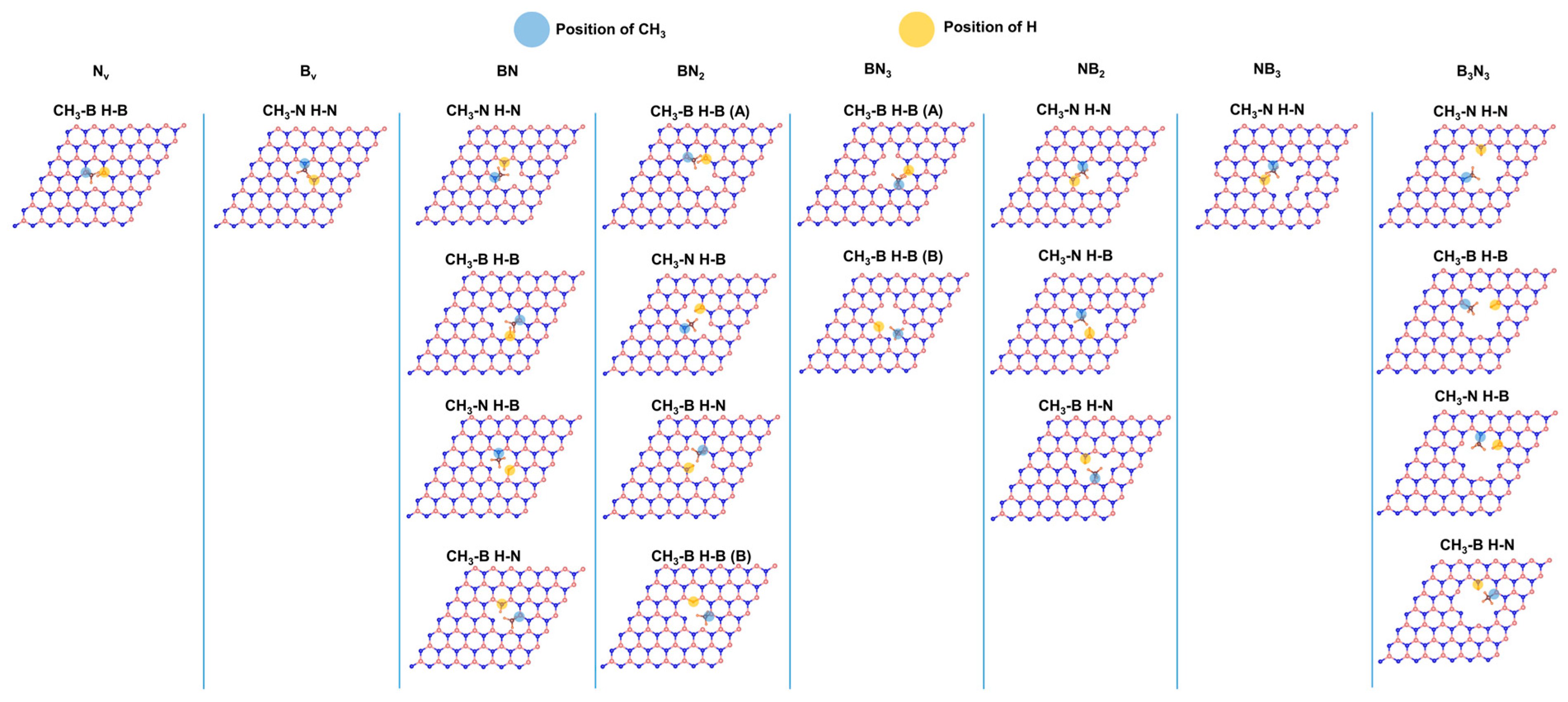
We further examine the CH4 activation reaction over our defective h-BN models. CH4 activation [26,27] is an endothermic reaction, and activating light alkanes has been a critical challenge over recent decades [28]. We also calculated the physical adsorption energies of CH4 on both defective and pristine h-BN surfaces, as shown in Figure S2. The adsorption energies range from 0 to approximately −0.15 eV, indicating weak physical adsorption. These results suggest that CH4 can readily approach the surface prior to C–H bond activation without being strongly bound. The thermodynamic screening of the first C–H bond activation step was performed prior to the transition-state search. An intermediate reaction energy (ΔE) is considered desirable, because a highly positive ΔE would make the reaction thermodynamically unfavorable, whereas an excessively negative ΔE would lead to overly stable final states that may hinder subsequent reaction steps. Multiple possible final-state configurations were examined for each BN vacancy model. In Figure 4, the optimized structures of the final states for CH4 activation on various h-BN vacancies are displayed, highlighting the different adsorption configurations of the CH3 and H fragments. For the Nv and Bv, the final states correspond to CH3 and H fragments bound to the B-terminated and N-terminated sites, respectively. For the BN and B3N3 vacancies, four configurations were considered: (i) both CH3 and H adsorbed on B sites; (ii) both fragments on N sites; (iii) CH3 on N and H on B; and (iv) CH3 on B and H on N. For the BN2 vacancy, which exposes four unsaturated B atoms and one unsaturated N atom, four configurations were evaluated: (i) CH3 and H adsorbed on adjacent B–B sites; (ii) CH3 on N and H on B; (iii) CH3 on B and H on N; and (iv) CH3 and H adsorbed on non-adjacent B atoms. For the BN3 vacancy, which has purely B-terminated edges, two configurations were considered: (i) adsorption of CH3 and H on adjacent B–B sites and (ii) adsorption on non-adjacent B atoms. For the NB2 vacancy, three configurations were examined: (i) both CH3 and H adsorbed on N sites; (ii) CH3 on N and H on B; and (iii) CH3 on B and H on N. Finally, for the NB3 vacancy, the configuration with CH3 and H adsorbed on an adjacent N–N pair was considered.
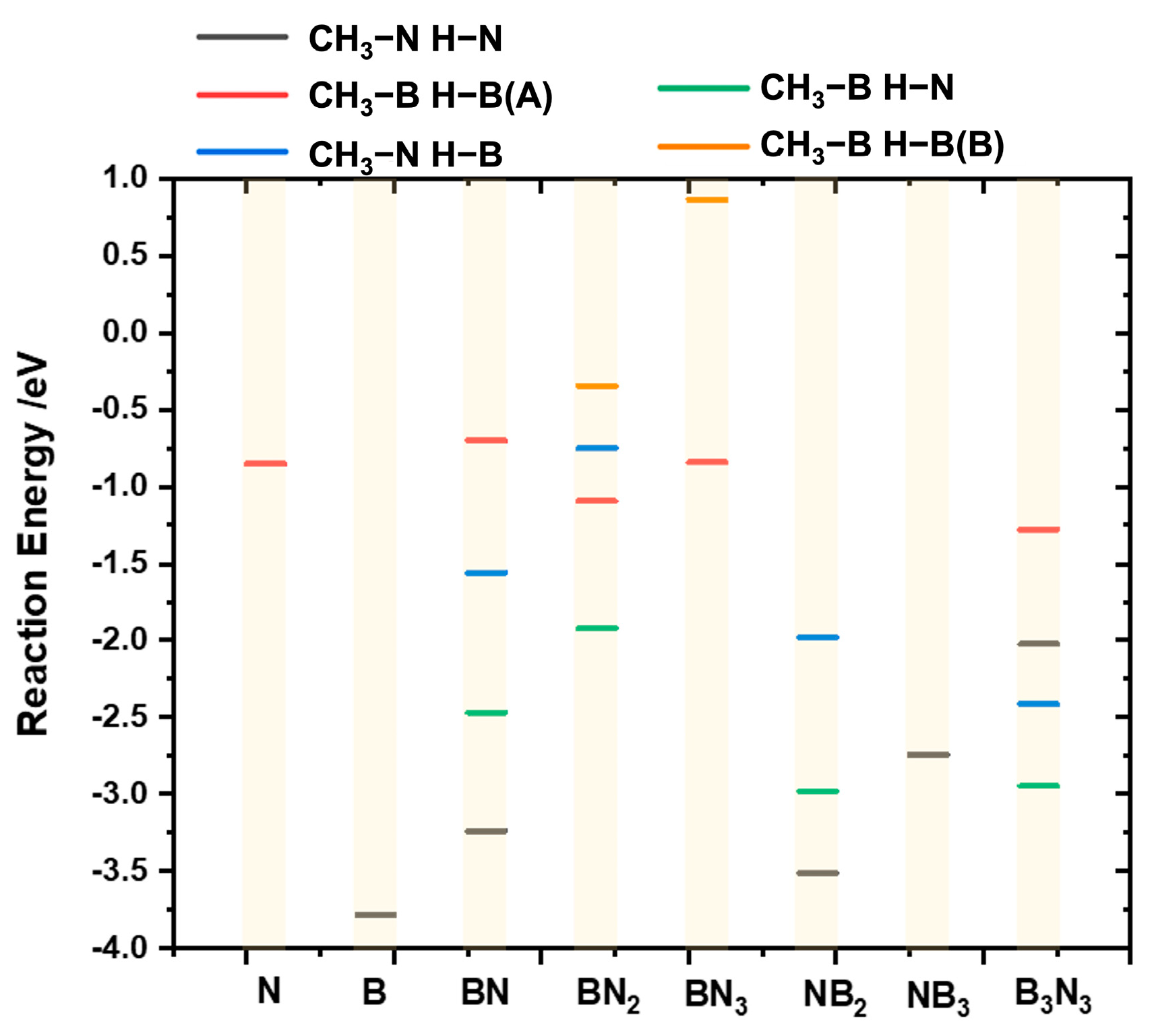
In Figure 5, the calculated reaction energies for CH4 C–H bond cleavage for different h-BN vacancies are summarized. The unsaturated N sites exhibit very strong reactivity toward CH3 and H adsorption, resulting in highly negative reaction energies. In contrast, the B sites are less reactive, and the reaction energies become more positive when both CH3 and H fragments bind to B atoms. In addition, the CH3 radical preferentially adsorbs at B sites, whereas the H atom is more favorably stabilized at N sites. By screening all vacancy models, we find that the Nv and BN2 vacancies exhibit intermediate reaction energies for C–H bond activation (between 0 and −2 eV), which are considered favorable for catalytic reactions. We also observe that for the BN3 vacancy, although the distant B–B pair cannot stabilize the final state of CH3 and H adsorption, the adjacent B–B pair can still stabilize the dissociation products. Therefore, the BN3 vacancy was also included in the subsequent transition-state barrier calculations. The B3N3 vacancy exposes three boron and three nitrogen atoms, creating multiple potential active sites for methane activation. As shown in Figure 5, CH4 dissociation on N-exposed sites of the B3N3 vacancy exhibits highly exothermic reaction energies. Although such strong exothermicity suggests that methane activation can occur readily, the excessively strong binding of reaction intermediates may hinder product desorption and limit catalytic turnover. Therefore, compared with smaller vacancies, the B3N3 vacancy is less favorable for efficient methane activation due to the overbinding of intermediates.
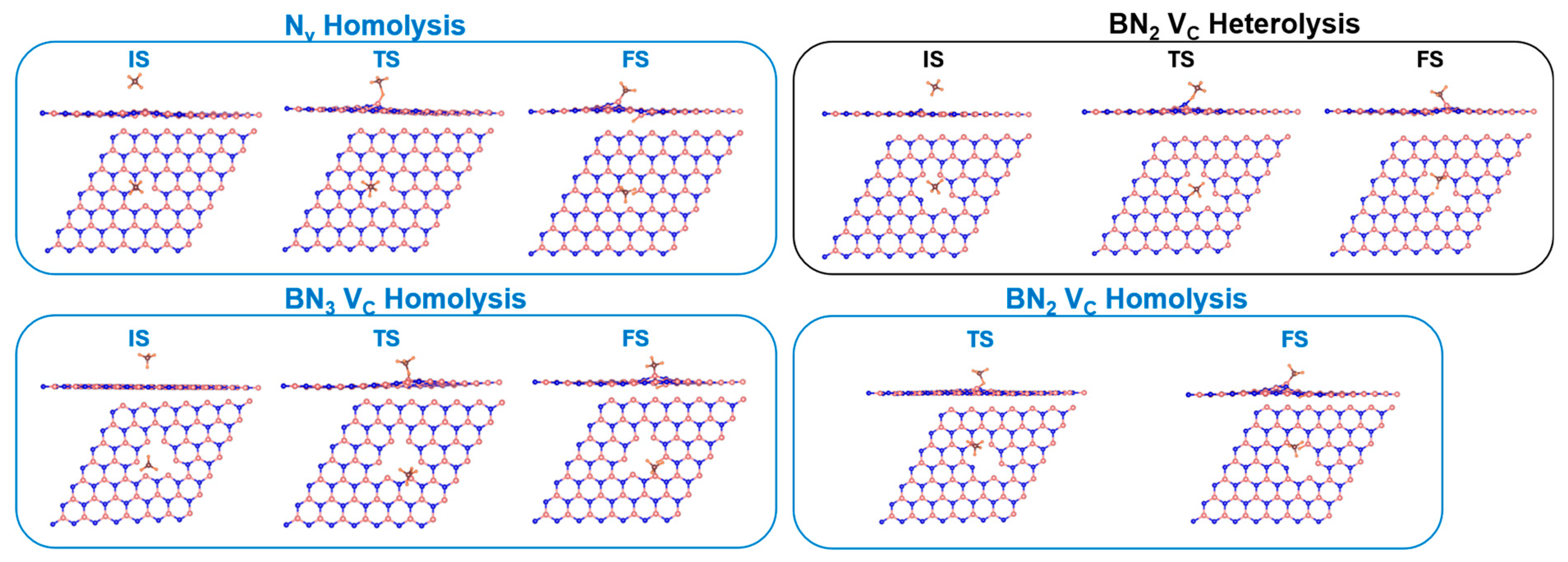
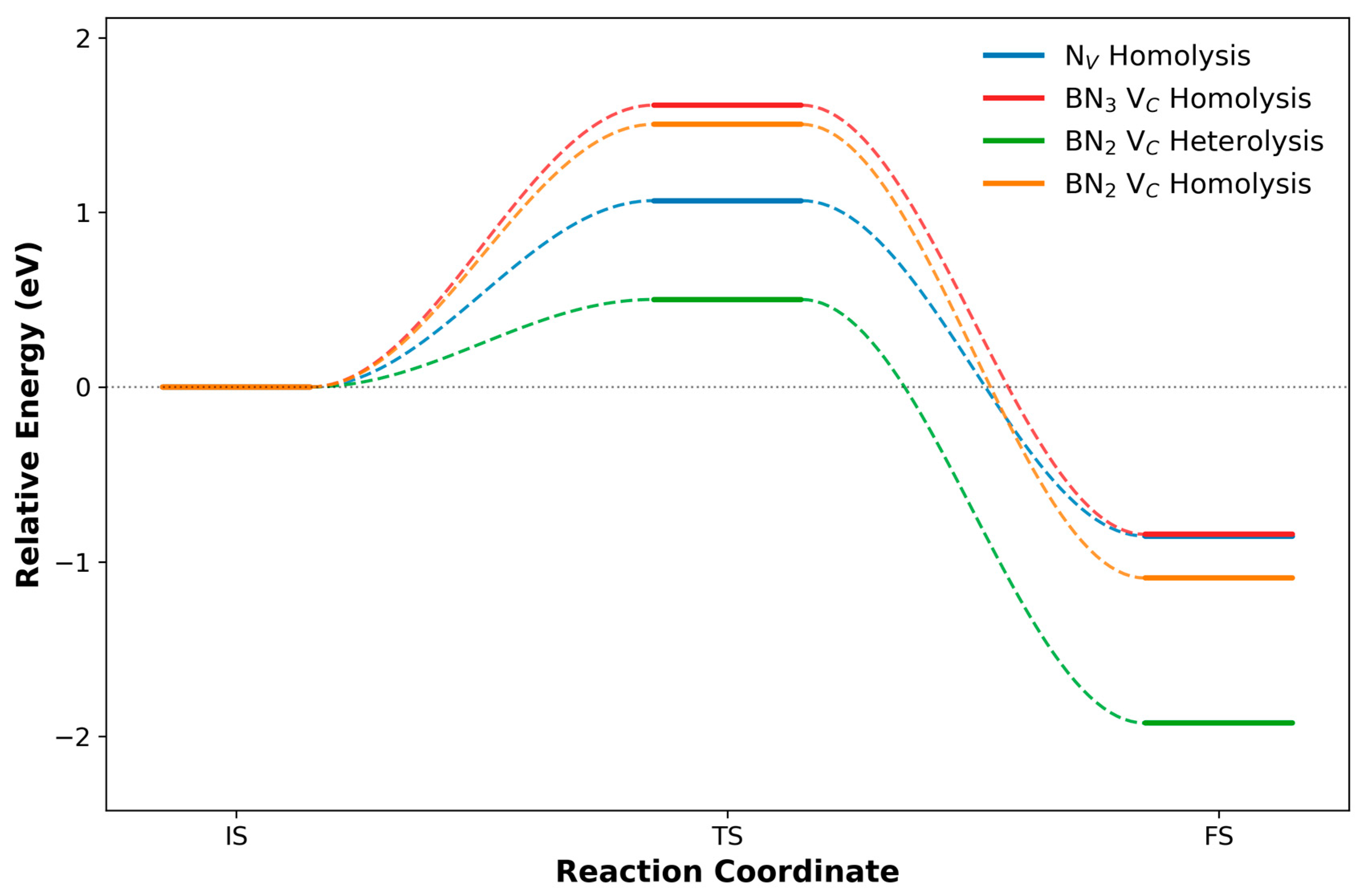
As for the Nv and BN3 vacancies (Figure 6), owing to their pure B termination, they can activate CH4 by homolytic cleavage on the adjacent B–B pair. As for the BN2 Vc, it can activate CH4 by homolysis on its unsaturated B–N pair or heterolysis on its unsaturated B –B pair. Owing to the very negative reaction energy of CH4 heterolysis activation over BN2 Vc, the barrier is as low as 0.50 eV (Figure 7), which is much lower than the homolysis over the adjacent B–B pair of the Nv, BN Vc and BN2 Vc. The high activity of the B–N pair over the BN2 vacancy can be attributed to the frustrated Lewis acid–base pair, which is commonly active for the C-H bond activation reaction [29,30]. However, the reaction energy is still as negative as −1.92 eV, which has the tendency to poison the surface. Interestingly, we found that the adjacent unsaturated B–B pair over Nv, BN2 Vc and BN3 Vc can activate the C–H bond by homolytic cleavage. Moreover, the reaction energy of homolytic cleavage is between −0.5 eV and −1 eV, which is a promising value for C–H activation, especially the B–B pair over Nv; the C-H activation barrier is only 1.07 eV, making it an excellent active site for C–H bond cleavage. The calculated activation barriers for CH4 dissociation at the defective h-BN sites are 0.50 eV for the B–N pair in BN2 Vc and 1.07 eV for the B–B pair in Nv. These values are comparable to those reported for precious metal catalysts, such as Pt [31] (~1.15 eV) and Ru [32] (~0.4–0.7 eV). This comparison highlights the remarkable catalytic potential of defective h-BN for methane activation, even in the absence of metal components. Such metal-free catalytic activity could significantly reduce reliance on expensive noble metals, lowering catalytic costs while offering promising opportunities for alkane activation and subsequent transformation.

2.3. Intrinsic Nature of the Unsaturated B–B Pair

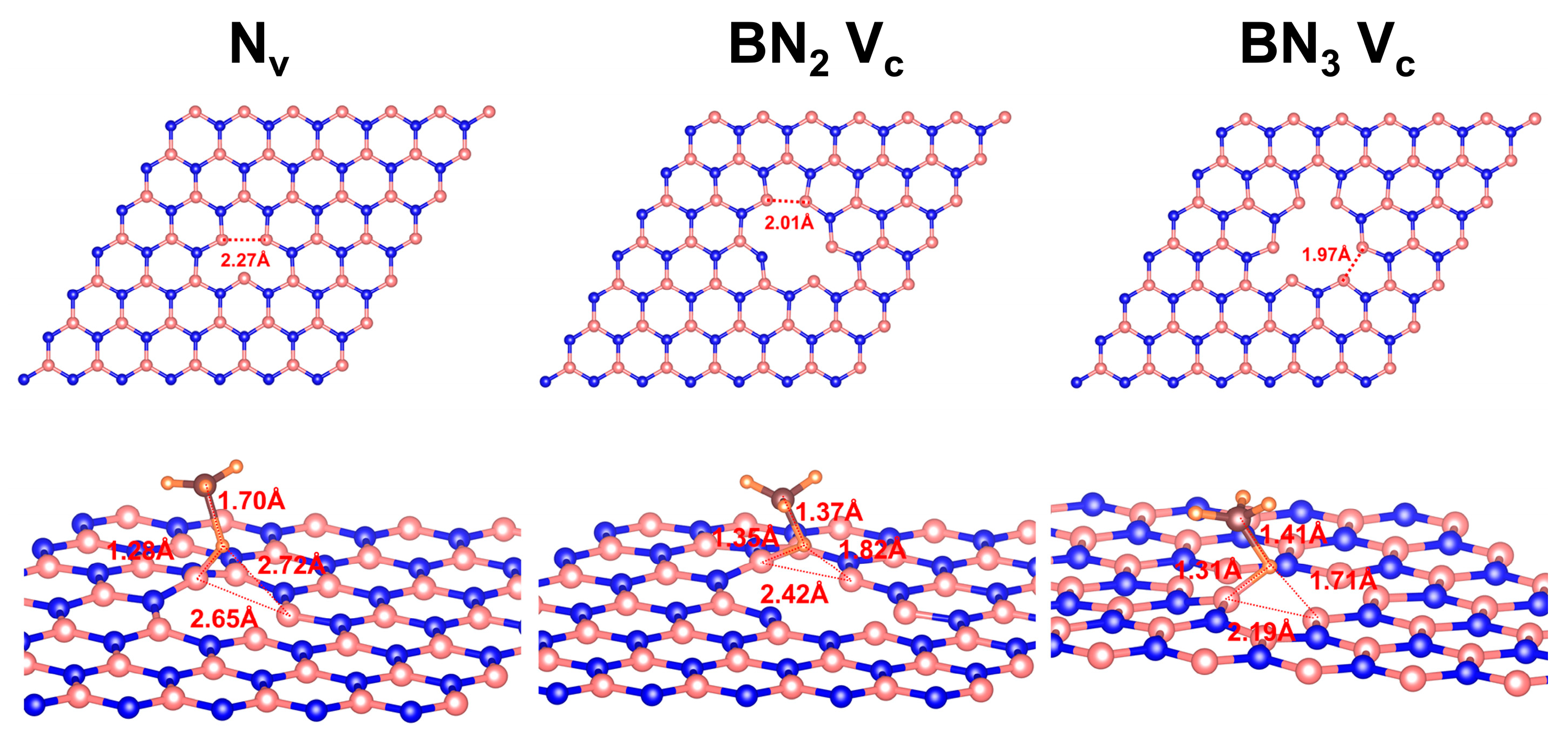
To gain deeper insight into the role of the unsaturated B–B pair, we further examined the structures of the original vacancy surfaces and the transition states of CH4 homolytic cleavage on these vacancies. As shown in Figure 8, the B–B distance on the pristine Nv vacancy is 2.27 Å, which is significantly longer than those in the BN2 (2.01 Å) and BN3 (1.97 Å) vacancies. A similar trend is observed in the transition states for CH4 dissociation. The B–B distance in the transition state on the Nv vacancy (2.65 Å) remains larger than that on the BN2 (2.42 Å) and BN3 (2.19 Å) vacancies. The larger separation between the unsaturated B atoms facilitates the insertion of hydrogen during the C–H bond cleavage process, which contributes to the lower activation barrier observed on the Nv vacancy. Furthermore, the B–H bond length in the transition state on the Nv vacancy (1.28 Å) is shorter than those on BN2 (1.35 Å) and BN3 (1.31 Å) vacancies. This indicates a stronger interaction between hydrogen and the unsaturated boron sites on the Nv vacancy. This observation is consistent with the more negative H2 dissociation energy on the unsaturated B sites of Nv compared with those of BN2 and BN3 vacancies, as shown in Figure 3.
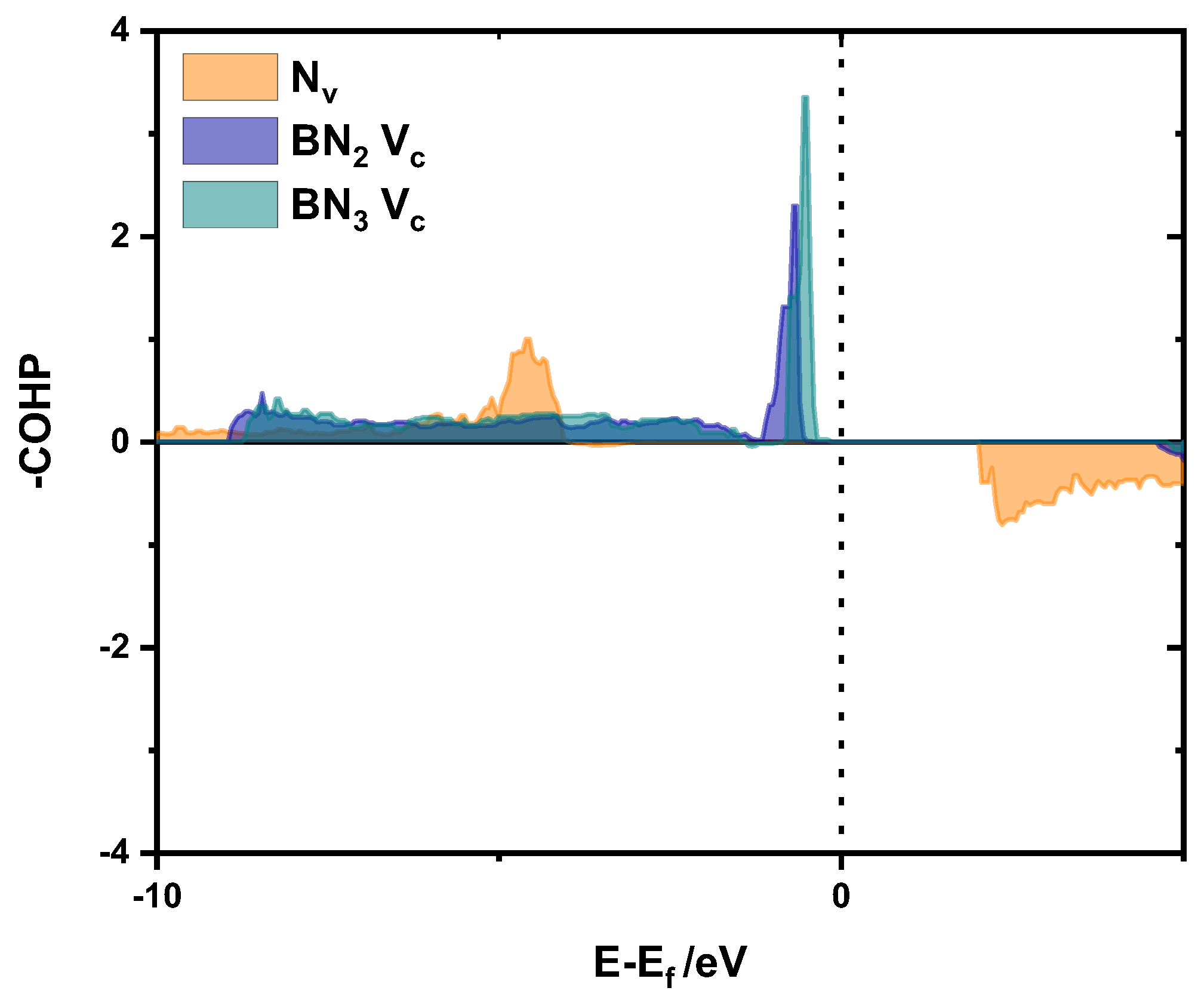
To further understand the electronic interaction between the unsaturated B–B pairs, crystal orbital Hamilton population (COHP) analysis was performed. COHP analysis decomposes the bonding and antibonding contributions between specific atomic pairs, where bonding states stabilize the interaction and antibonding states weaken it. As shown by the –COHP curves in Figure 9, both the BN2 Vc and BN3 Vc sites exhibit pronounced bonding peaks below the Fermi level. These occupied bonding states indicate stronger B–B interactions in these vacancy configurations, which could make structural rearrangement during hydrogen insertion less favorable.
The integrated COHP (ICOHP) values further quantify the interaction strength between the B atoms. More negative ICOHP values correspond to stronger bonding interactions between atom pairs. As listed in Table 1, the ICOHP value of the B–B pair in the Nv vacancy is less negative than those of the BN2 Vc and BN3 Vc sites, indicating relatively weaker B–B interactions in the Nv configuration. Combined with the larger B–B distance observed in the Nv vacancy (Figure 8), this weaker interaction may facilitate structural flexibility during methane activation. These results suggest that the unsaturated B–B pair on the Nv vacancy provides a more favorable geometric and electronic environment for CH4 activation.
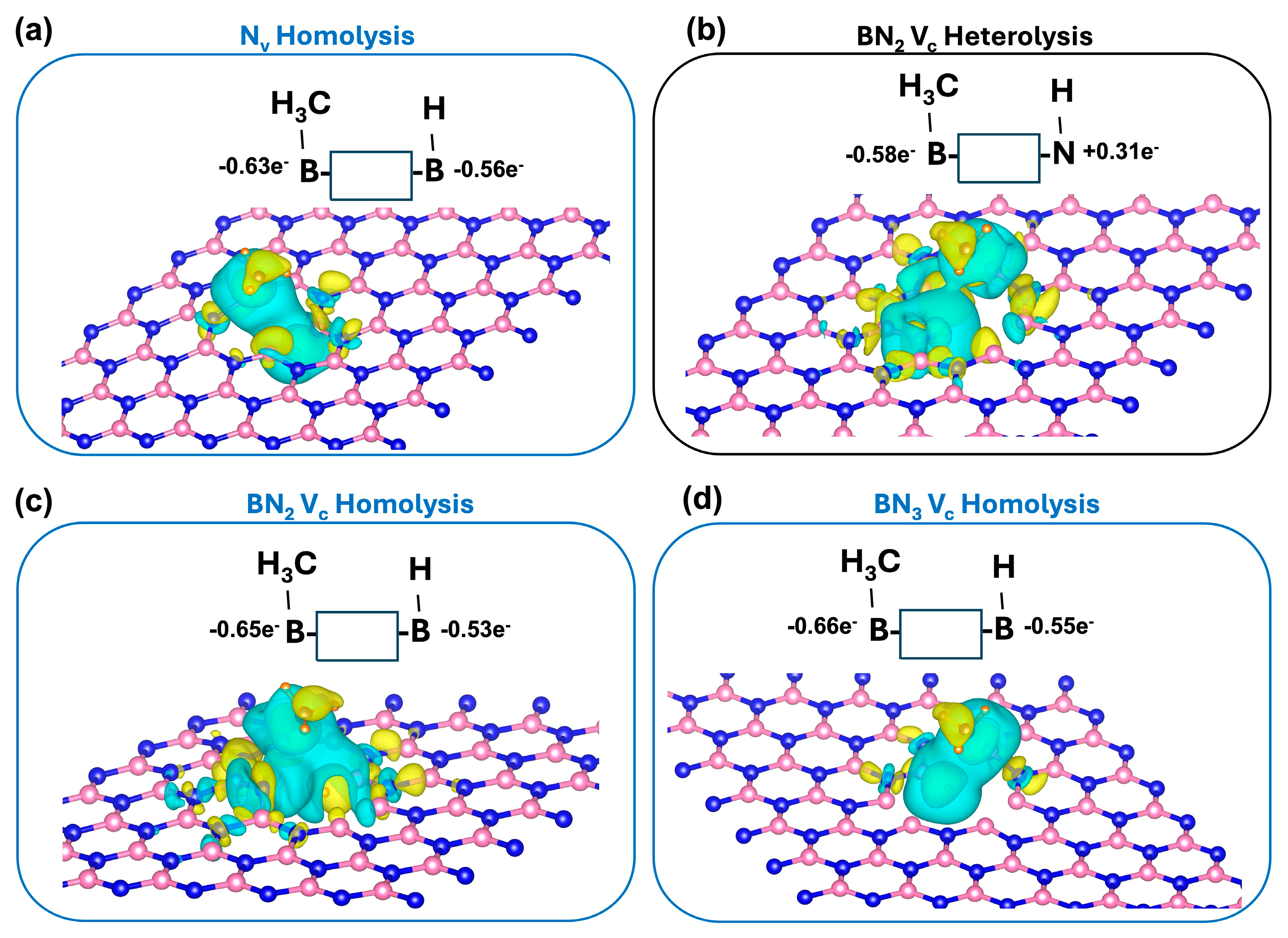
To further examine the electronic redistribution during the reaction, charge density difference analysis and Bader charge calculations were also performed. As shown in Figure 10, during the homolytic activation of CH4 on the Nv vacancy, both boron atoms of the unsaturated B–B pair exhibit electron depletion after adsorption of the CH3 and H radicals. In contrast, for the heterolytic activation on the BN2 Vc vacancy with an unsaturated B–N pair, electron accumulation occurs at the nitrogen atom bonded to hydrogen, while the boron atom interacting with the CH3 fragment shows electron depletion. In addition, the CH3 fragment consistently gains electron density, as indicated by the yellow regions in the charge density difference maps, while electron depletion is observed around the vacancy region. These results indicate significant charge redistribution during CH4 activation and provide additional electronic evidence supporting the proposed homolytic and heterolytic activation mechanisms.

3. Computational Methods

Spin-polarized calculations were carried out using the Vienna Ab initio Simulation Package (VASP) version 5.4.4 [33]. In terms of the exchange-correlation functional, Perdew, Burke, and Ernzerhof (PBE) [34] were utilized with the projector augmented wave potentials [35]. For the Van der Waals correction, D3 method [36] was used. A 1 × 1 × 1 k-point mesh sampling was chosen for the 7 × 7 h-BN lateral unit cell with a vacuum layer of ~20 Å. For single-point calculations, a 5 × 5 × 1 k-point grid was adopted. To verify the reliability of our computational setup, a k-point convergence test was performed for the pristine 7 × 7 h-BN supercell (Figure S1). The total energy differences are negligible (<0.01 eV) upon increasing the k-point density, indicating that 1 × 1 × 1 k-point sampling is sufficient for structural optimization, while a 5 × 5 × 1 mesh provides well-converged electronic properties. Although the GGA functional is known to underestimate the band gap [37], the purpose of this test is to assess numerical convergence rather than to reproduce the experimental band gap value.
The transition states were located by the climbing-image nudged elastic band method (CI-NEB) [38]. The convergence criterion was set as 0.05 eV/Å for structural optimization and transition-state searches. The vibrational frequencies of the transition states are shown in Tables S3–S6. The presence of one large imaginary frequency confirms that the structures correspond to transition states.
The normalized vacancy formation energy (vacancy formation energy per missing atom) is calculated as follows in Equation (1) and the chemical potentials of boron ( μ B ) and nitrogen ( μ N ) are constrained by the stability condition of pristine h-BN, as expressed in Equation (2):
E f * = ( E B N   d e f e c t n B   d e f e c t μ B n N   d e f e c t μ N ) / N
E p r i s t i n e   B N = n B   p r i s t i n e μ B + n N   p r i s t i n e μ N
Experimentally, the relative concentration of active boron and nitrogen species can be tuned during h-BN growth by adjusting the precursor feeding rate, temperature, and carrier gas composition [39], thereby enabling B-rich or N-rich environments. Under B-rich conditions, the chemical potential of boron is referenced to bulk boron, i.e., μ B = E bulk   B . Under N-rich conditions, the chemical potential of nitrogen is referenced to nitrogen gas, i.e., μ N = 1 2 E N 2 . The remaining chemical potential in each case is determined from the constraint given in Equation (2).
Crystal Orbital Hamiltonian Population (COHP) analysis [40] was performed by the Local Orbital Basis Suite Towards Electronic-Structure Reconstruction (LOBSTER 3.2.0) program [41,42].

4. Conclusions

The stability and catalytic activity of various h-BN vacancies were systematically investigated. The calculations show that B-terminated vacancies, particularly the BN2 and BN3 vacancies, are thermodynamically more stable than their N-terminated counterparts under both B-rich and N-rich conditions, suggesting that B-terminated vacancies are more likely to be exposed on defective h-BN surfaces. Regarding methane activation, the B–N pair over the BN2 vacancy exhibits very high reactivity toward C–H bond cleavage; however, the excessively exothermic reaction energy indicates strong binding of intermediates, which may lead to surface poisoning and limit catalytic turnover. In contrast, the unsaturated B–B pair exposed at the Nv provides a more balanced reaction energetics with a moderate reaction energy and a relatively low activation barrier for CH4 activation.
Interestingly, while B–N pairs behave as frustrated Lewis pairs that activate molecules through heterolytic pathways, our results demonstrate that unsaturated B–B pairs provide a distinct catalytic motif that promotes homolytic methane activation. COHP analysis further reveals that the relatively weak electronic interaction between the two B atoms facilitates hydrogen insertion during C–H bond cleavage. These findings reveal a novel promising catalytic principle for defective h-BN surfaces, where B-terminated vacancies containing unsaturated B–B pairs can act as active centers for metal-free methane activation. This work provides mechanistic insight into the intrinsic catalytic role of h-BN vacancies and highlights their potential for metal-free alkane activation and conversion. Also, it should be noted that the present study focuses on the elementary C–H bond activation step. A comprehensive catalytic evaluation, including catalyst regeneration, possible surface poisoning by intermediates, competitive adsorption, and subsequent reaction pathways, would require the construction of a full reaction network and microkinetic analysis, which will be explored in future work.

Supplementary Materials

The following supporting information can be downloaded at: https://www.mdpi.com/article/10.3390/catal16040321/s1, Figure S1: K-point convergence test for the pristine 7 × 7 h-BN supercell; Figure S2: Calculated CH4 adsorption energies on various h-BN vacancies and pristine h-BN; Figure S3: Correlation between the H2 dissociation Energy and methane C-H bond activation barrier; Table S1: VASP-calculated magnetic moments (MAGMOM) of the defective h-BN surfaces with and without adsorbates; Table S2: VASP-calculated relative energies (eV) of the final states for CH4 dissociation forming surface CH3· and H· species on Nv, BN2 Vc, and BN3 Vc defects under different total magnetic moments (NUPDOWN values); Table S3: Calculated vibrational frequencies (cm−1) for the transition state of CH4 homolytic C–H bond activation on the Nv; Table S4: Calculated vibrational frequencies (cm−1) for the transition state of CH4 homolytic C–H bond activation on the BN2 Vc; Table S5: Calculated vibrational frequencies (cm−1) for the transition state of CH4 heterolytic C–H bond activation on the BN2 Vc; Table S6: Calculated vibrational frequencies (cm−1) for the transition state of CH4 homolytic C–H bond activation on the BN3 Vc.

Author Contributions

Conceptualization, C.X. and J.T.; methodology, C.X.; software, C.X.; validation, C.X. and J.T.; formal analysis, C.X.; investigation, C.X.; resources, C.X.; data curation, C.X.; writing—original draft preparation, C.X.; writing—review and editing, J.T.; visualization, C.X.; supervision, J.T.; project administration, J.T. All authors have read and agreed to the published version of the manuscript.

Funding

This research received no external funding.

Data Availability Statement

Data will be made available upon reasonable request.

Acknowledgments

The authors sincerely acknowledge the computing resources provided by Southern Methodist University O’Donnell Data Science and Research Computing Institute (ODSRCI) and the University of California, Riverside High-Performance Computing Center (HPCC). This article is based on material previously presented in Chapter 4 of the author’s doctoral dissertation: Xiong, C. Novel Single-Atom Catalysts (SACs) Design Based on First Principles; Ph.D. Dissertation, UC Riverside, 2024 [43]. Portions of the text and figures have been reproduced or adapted with permission.

Conflicts of Interest

The authors declare no conflicts of interest.

References

  1. Balmain, W.H. Bemerkungen Über Die Bildung von Verbindungen Des Bors Und Siliciums Mit Stickstoff Und Gewissen Metallen. J. Für Prakt. Chem. 1842, 27, 422–430. [Google Scholar] [CrossRef]
  2. Weng, Q.; Wang, X.; Wang, X.; Bando, Y.; Golberg, D. Functionalized Hexagonal Boron Nitride Nanomaterials: Emerging Properties and Applications. Chem. Soc. Rev. 2016, 45, 3989–4012. [Google Scholar] [CrossRef] [PubMed]
  3. Yu, S.; Wu, X.; Wang, Y.; Guo, X.; Tong, L. 2D Materials for Optical Modulation: Challenges and Opportunities. Adv. Mater. 2017, 29, 1606128. [Google Scholar] [CrossRef] [PubMed]
  4. Luo, B.; Liu, G.; Wang, L. Recent Advances in 2D Materials for Photocatalysis. Nanoscale 2016, 8, 6904–6920. [Google Scholar] [CrossRef]
  5. Kobernik, T.N.; Kartsev, A.I. Gas Adsorption on the Co2Te3 Monolayer: Density Functional Theory Study. J. Phys. Chem. Lett. 2024, 15, 12151–12155. [Google Scholar] [CrossRef]
  6. Pakdel, A.; Bando, Y.; Golberg, D. Nano Boron Nitride Flatland. Chem. Soc. Rev. 2014, 43, 934–959. [Google Scholar] [CrossRef]
  7. Kostoglou, N.; Polychronopoulou, K.; Rebholz, C. Thermal and Chemical Stability of Hexagonal Boron Nitride (h-BN) Nanoplatelets. Vacuum 2015, 112, 42–45. [Google Scholar] [CrossRef]
  8. Lin, Y.; Williams, T.V.; Cao, W.; Elsayed-Ali, H.E.; Connell, J.W. Defect Functionalization of Hexagonal Boron Nitride Nanosheets. J. Phys. Chem. C 2010, 114, 17434–17439. [Google Scholar] [CrossRef]
  9. Beheshtian, J.; Peyghan, A.A.; Bagheri, Z. Functionalization of BN Nanosheet with N2H4 May Be Feasible in the Presence of Stone–Wales Defect. Struct. Chem. 2013, 24, 1565–1570. [Google Scholar] [CrossRef]
  10. Tissen, M.; Kushchuk, L.I.; Bagzhanov, D.; Vasenko, A.S.; Pashkovskaia, V.D.; Lvov, B.G.; Vasilyev, D.; Kartsev, A. Impact of Vacancies on 2D Transition Metal Trichloridies TMCl3 (TM = V, Ni, and Mo) Electric and Magnetic Characteristics. J. Phys. Chem. Lett. 2026, 17, 466–475. [Google Scholar] [CrossRef]
  11. Jin, C.; Lin, F.; Suenaga, K.; Iijima, S. Fabrication of a Freestanding Boron Nitride Single Layer and Its Defect Assignments. Phys. Rev. Lett. 2009, 102, 195505. [Google Scholar] [CrossRef] [PubMed]
  12. Cretu, O.; Lin, Y.-C.; Koshino, M.; Tizei, L.H.G.; Liu, Z.; Suenaga, K. Structure and Local Chemical Properties of Boron-Terminated Tetravacancies in Hexagonal Boron Nitride. Phys. Rev. Lett. 2015, 114, 075502. [Google Scholar] [CrossRef] [PubMed]
  13. Li, L.; Liu, X.; He, H.; Zhang, N.; Liu, Z.; Zhang, G. A Novel Two-Dimensional MgO-h-BN Nanomaterial Supported Pd Catalyst for CO Oxidation Reaction. Catal. Today 2019, 332, 214–221. [Google Scholar] [CrossRef]
  14. Zhu, W.; Wu, Z.; Foo, G.S.; Gao, X.; Zhou, M.; Liu, B.; Veith, G.M.; Wu, P.; Browning, K.L.; Lee, H.N.; et al. Taming Interfacial Electronic Properties of Platinum Nanoparticles on Vacancy-Abundant Boron Nitride Nanosheets for Enhanced Catalysis. Nat. Commun. 2017, 8, 15291. [Google Scholar] [CrossRef]
  15. Bi, W.; Hu, Y.; Li, W.; Jiang, H.; Li, C. Construction of Nanoreactors Combining Two-Dimensional Hexagonal Boron Nitride (h-BN) Coating with Pt/Al2O3 Catalyst toward Efficient Catalysis for CO Oxidation. Ind. Eng. Chem. Res. 2018, 57, 13353–13361. [Google Scholar] [CrossRef]
  16. Xiong, C.; Dai, S.; Wu, Z.; Jiang, D. Single Atoms Anchored in Hexagonal Boron Nitride for Propane Dehydrogenation from First Principles. ChemCatChem 2022, 14, e202200133. [Google Scholar] [CrossRef]
  17. Zhao, J.; Chen, Z. Single Mo Atom Supported on Defective Boron Nitride Monolayer as an Efficient Electrocatalyst for Nitrogen Fixation: A Computational Study. J. Am. Chem. Soc. 2017, 139, 12480–12487. [Google Scholar] [CrossRef]
  18. Sredojević, D.N.; Belić, M.R.; Šljivančanin, Ž. Hydrogen Evolution Reaction over Single-Atom Catalysts Based on Metal Adatoms at Defected Graphene and h-BN. J. Phys. Chem. C 2020, 124, 16860–16867. [Google Scholar] [CrossRef]
  19. Gao, M.; Lyalin, A.; Taketsugu, T. Catalytic Activity of Au and Au2 on the h-BN Surface: Adsorption and Activation of O2. J. Phys. Chem. C 2012, 116, 9054–9062. [Google Scholar] [CrossRef]
  20. Datta, J.; Majumder, C. Stabilizing Co, Ni and Cu on the h-BN Surface: Using O–O Bond Activation to Probe Their Performance as Single Atom Catalyst. Catal. Today 2021, 370, 75–82. [Google Scholar] [CrossRef]
  21. Chen, H.; Xiong, C.; Moon, J.; Ivanov, A.S.; Lin, W.; Wang, T.; Fu, J.; Jiang, D.; Wu, Z.; Yang, Z.; et al. Defect-Regulated Frustrated-Lewis-Pair Behavior of Boron Nitride in Ambient Pressure Hydrogen Activation. J. Am. Chem. Soc. 2022, 144, 10688–10693. [Google Scholar] [CrossRef] [PubMed]
  22. Fartab, D.S.; Kordbacheh, A.A. Lithium Doping and Vacancy Effects on the Structural, Electronic and Magnetic Properties of Hexagonal Boron Nitride Sheet: A First-Principles Calculation. Superlattices Microstruct. 2018, 118, 185–195. [Google Scholar] [CrossRef]
  23. Latimer, A.A.; Kulkarni, A.R.; Aljama, H.; Montoya, J.H.; Yoo, J.S.; Tsai, C.; Abild-Pedersen, F.; Studt, F.; Nørskov, J.K. Understanding Trends in C–H Bond Activation in Heterogeneous Catalysis. Nat. Mater. 2017, 16, 225–229. [Google Scholar] [CrossRef]
  24. Dubouis, N.; Grimaud, A. The Hydrogen Evolution Reaction: From Material to Interfacial Descriptors. Chem. Sci. 2019, 10, 9165–9181. [Google Scholar] [CrossRef] [PubMed]
  25. Zheng, J.; Nash, J.; Xu, B.; Yan, Y. Perspective—Towards Establishing Apparent Hydrogen Binding Energy as the Descriptor for Hydrogen Oxidation/Evolution Reactions. J. Electrochem. Soc. 2018, 165, H27. [Google Scholar] [CrossRef]
  26. Taifan, W.; Baltrusaitis, J. CH4 Conversion to Value Added Products: Potential, Limitations and Extensions of a Single Step Heterogeneous Catalysis. Appl. Catal. B Environ. 2016, 198, 525–547. [Google Scholar] [CrossRef]
  27. Nkinahamira, F.; Yang, R.; Zhu, R.; Zhang, J.; Ren, Z.; Sun, S.; Xiong, H.; Zeng, Z. Current Progress on Methods and Technologies for Catalytic Methane Activation at Low Temperatures. Adv. Sci. 2023, 10, 2204566. [Google Scholar] [CrossRef]
  28. Sattler, J.J.H.B.; Ruiz-Martinez, J.; Santillan-Jimenez, E.; Weckhuysen, B.M. Catalytic Dehydrogenation of Light Alkanes on Metals and Metal Oxides. Chem. Rev. 2014, 114, 10613–10653. [Google Scholar] [CrossRef]
  29. Wischert, R.; Copéret, C.; Delbecq, F.; Sautet, P. Optimal Water Coverage on Alumina: A Key to Generate Lewis Acid–Base Pairs That Are Reactive Towards the C-H Bond Activation of Methane. Angew. Chem. Int. Ed. 2011, 50, 3202–3205. [Google Scholar] [CrossRef]
  30. Stephan, D.W.; Liu, L.L. Radicals Derived from Lewis Acid/Base Pairs. Chem. Soc. Rev. 2019, 48, 3454–3463. [Google Scholar] [CrossRef]
  31. Psofogiannakis, G.; St-Amant, A.; Ternan, M. Methane Oxidation Mechanism on Pt(111):  A Cluster Model DFT Study. J. Phys. Chem. B 2006, 110, 24593–24605. [Google Scholar] [CrossRef]
  32. Kokalj, A.; Bonini, N.; Sbraccia, C.; de Gironcoli, S.; Baroni, S. Engineering the Reactivity of Metal Catalysts:  A Model Study of Methane Dehydrogenation on Rh(111). J. Am. Chem. Soc. 2004, 126, 16732–16733. [Google Scholar] [CrossRef] [PubMed]
  33. Kresse, G.; Furthmüller, J. Efficient Iterative Schemes for Ab Initio Total-Energy Calculations Using a Plane-Wave Basis Set. Phys. Rev. B 1996, 54, 11169–11186. [Google Scholar] [CrossRef]
  34. Perdew, J.P.; Burke, K.; Ernzerhof, M. Generalized Gradient Approximation Made Simple. Phys. Rev. Lett. 1996, 77, 3865–3868. [Google Scholar] [CrossRef] [PubMed]
  35. Blöchl, P.E. Projector Augmented-Wave Method. Phys. Rev. B 1994, 50, 17953–17979. [Google Scholar] [CrossRef]
  36. Grimme, S.; Antony, J.; Ehrlich, S.; Krieg, H. A Consistent and Accurate Ab Initio Parametrization of Density Functional Dispersion Correction (DFT-D) for the 94 Elements H-Pu. J. Chem. Phys. 2010, 132, 154104. [Google Scholar] [CrossRef]
  37. Xiao, H.; Tahir-Kheli, J.; Goddard, W.A.I. Accurate Band Gaps for Semiconductors from Density Functional Theory. J. Phys. Chem. Lett. 2011, 2, 212–217. [Google Scholar] [CrossRef]
  38. Henkelman, G.; Uberuaga, B.P.; Jónsson, H. A Climbing Image Nudged Elastic Band Method for Finding Saddle Points and Minimum Energy Paths. J. Chem. Phys. 2000, 113, 9901–9904. [Google Scholar] [CrossRef]
  39. Stehle, Y.; Meyer, H.M.I.; Unocic, R.R.; Kidder, M.; Polizos, G.; Datskos, P.G.; Jackson, R.; Smirnov, S.N.; Vlassiouk, I.V. Synthesis of Hexagonal Boron Nitride Monolayer: Control of Nucleation and Crystal Morphology. Chem. Mater. 2015, 27, 8041–8047. [Google Scholar] [CrossRef]
  40. Steinberg, S.; Dronskowski, R. The Crystal Orbital Hamilton Population (COHP) Method as a Tool to Visualize and Analyze Chemical Bonding in Intermetallic Compounds. Crystals 2018, 8, 225. [Google Scholar] [CrossRef]
  41. Maintz, S.; Deringer, V.L.; Tchougréeff, A.L.; Dronskowski, R. LOBSTER: A Tool to Extract Chemical Bonding from Plane-Wave Based DFT. J. Comput. Chem. 2016, 37, 1030–1035. [Google Scholar] [CrossRef]
  42. Dronskowski, R.; Bloechl, P.E. Crystal Orbital Hamilton Populations (COHP): Energy-Resolved Visualization of Chemical Bonding in Solids Based on Density-Functional Calculations. J. Phys. Chem. 1993, 97, 8617–8624. [Google Scholar] [CrossRef]
  43. Xiong, C. Novel Single-Atom Catalysts (SACs) Design Based on First Principles. Ph.D. Thesis, University of California, Riverside, CA, USA, 2024. [Google Scholar]
Figure 1. Atomic structures of different h-BN vacancy configurations: mono Nv, mono Bv, BN, BN2, BN3, NB2, NB3 and B3N3 vacancies. Blue and pink spheres represent nitrogen and boron atoms, respectively.
Catalysts 16 00321 g001
Figure 2. Normalized formation energies of different h-BN vacancy structures under B-rich and N-rich conditions. Orange and green bars represent B-rich and N-rich conditions, respectively.
Catalysts 16 00321 g002
Figure 3. H2 dissociation energies at various defective h-BN vacancy sites and pristine BN. Orange and green bars represent H2 dissociation occurring on surface unsaturated N and B sites, respectively.
Catalysts 16 00321 g003
Figure 4. Optimized structures of the final states for CH4 activation at different h-BN vacancy sites. The dissociated CH3 fragment is marked in blue, while the dissociated H fragment is highlighted in yellow.
Catalysts 16 00321 g004
Figure 5. Calculated reaction energies for CH4 C–H bond cleavage for different h-BN vacancy defects, including mono Nv, mono Bv, BN, BN2, BN3, NB2, NB3, and B3N3 vacancies.
Catalysts 16 00321 g005
Figure 6. Optimized structures along the CH4 activation pathways at Nv, NB2 Vc, and NB3 Vc sites, including the initial state (IS), transition state (TS), and final state (FS) for both homolytic and heterolytic C–H bond cleavage.
Catalysts 16 00321 g006
Figure 7. Reaction energy profiles for CH4 cleavage at Nv, BN2 Vc, and BN3 Vc sites. The energy changes along the reaction coordinate from the initial state (IS) through the transition state (TS) to the final state (FS) are shown for both homolytic and heterolytic C–H bond cleavage pathways.
Catalysts 16 00321 g007
Figure 8. Optimized structures of the clean vacancy surfaces (top) for Nv, BN2 Vc, and BN3 Vc sites and the corresponding transition-state structures for CH4 homolytic C–H bond cleavage (bottom).
Catalysts 16 00321 g008
Figure 9. COHP analysis for the B–B interaction at the Nv, BN2 Vc, and BN3 Vc sites.
Catalysts 16 00321 g009
Figure 10. Charge density difference maps with corresponding Bader charge variations relative to the clean defective surface for CH4 activation on h-BN vacancies: (a) homolytic C–H cleavage on the Nv; (b) heterolytic C–H cleavage on the BN2 Vc; (c) homolytic C–H cleavage on the BN2 Vc; and (d) homolytic C–H cleavage on the BN3 Vc. Cyan and yellow regions represent electron depletion and electron accumulation, respectively.
Catalysts 16 00321 g010
Table 1. ICOHP value over Nv, BN2 Vc, and BN3 Vc.
VacancyICOHP
Nv−1.03
BN2 Vc−2.30
BN3 Vc−2.47
Disclaimer/Publisher’s Note: The statements, opinions and data contained in all publications are solely those of the individual author(s) and contributor(s) and not of MDPI and/or the editor(s). MDPI and/or the editor(s) disclaim responsibility for any injury to people or property resulting from any ideas, methods, instructions or products referred to in the content.