Article

One-Pot Methods for Obtaining Photocatalysts Based on β-C3N4 and g-C3N4 Modified with Titanium and Copper Oxides


1
G. A. Krestov Institute of Solution Chemistry of RAS, 153045 Ivanovo, Russia
2
N. S. Kurnakov Institute of General and Inorganic Chemistry of RAS, 119071 Moscow, Russia
*
Author to whom correspondence should be addressed.
Catalysts 2026, 16(4), 320; https://doi.org/10.3390/catal16040320
Submission received: 26 December 2025 / Revised: 27 January 2026 / Accepted: 24 February 2026 / Published: 2 April 2026

Abstract

In this paper, we present one-pot methods for synthesizing β- and g-C3N4 composites with titanium and copper oxides using underwater plasma and solution combustion techniques. The resulting structures were characterized using a range of complementary analytical methods. Analysis revealed that solution combustion produces composites containing mixed-phase titanium dioxide and Cu4O3, whereas plasma incorporation results in the integration of Cu and Ti ions, forming a composite based on copper oxide and copper titanate. These composites were successfully evaluated for the photocatalytic degradation of a mixture of three dyes under both UV and visible light irradiation. Composites synthesized via solution combustion exhibited remarkable photocatalytic activity toward all three dyes. The rates of photodecomposition of dyes in the presence of composites are 1.5–2.5 times higher compared to pure C3N4. Furthermore, all composite materials demonstrated high stability in photocatalytic performance after six cycles.

1. Introduction

Photocatalysis is one of the most effective and environmentally friendly technologies for removing contaminants. This technology remains highly promising due to ongoing research focused on developing new materials with enhanced photocatalytic properties. Carbon nitride (C3N4) is a notable material in this field because of its non-toxicity and the absence of drawbacks commonly associated with metal oxide-based photocatalysts. Several modifications of C3N4 are currently known, with the graphitic form (g-C3N4) being the most extensively studied as a potential photocatalyst [1,2,3]. Interest in g-C3N4 stems from the relatively simple synthesis method, which involves the calcination of nitrogen- and carbon-rich precursors such as urea, melamine, and cyanamide. Varying the nature of the starting materials allows control over the morphology and surface properties of the resulting carbon nitride. However, many authors note that pure g-C3N4 as a photocatalyst has limitations, including a low absorption edge (~420 nm) and a small specific surface area [1]. These limitations can be addressed by creating carbon nitride-based composites [2]. Due to its layered structure, g-C3N4 serves as an excellent substrate for constructing heterostructures, where the choice of materials is guided by the need to align electronic band structures to achieve optimal band arrangements. Another approach to enhancing performance is doping, where metallic or non-metallic elements with narrower band gaps are introduced as dopants.
Harder modifications of carbon nitride, such as diamond-like α-, β-, cubic, and pseudocubic modifications, are rarely considered potential photocatalysts due to the complexity of their preparation methods, which require high temperature and pressure, and their low yield [4,5,6]. Despite these challenges, there are some published data related to the applicability of dense modifications of carbon nitride as a photocatalyst. For instance, Wu and co-workers successfully synthesized the α-modification of carbon nitride using a solution combustion method with a urea solution [7]. The photocatalytic activity of the resulting sample was evaluated using the dye Rhodamine B, achieving 100% degradation within 70 min. In the process of photodecomposition of water, the alpha modification showed a higher rate of hydrogen formation compared to graphitic C3N4 when irradiated with visible light. In another study, the authors produced a β-C3N4/CuO composite in a single step via thermal synthesis of a mixture of urea and copper chloride [8]. Under visible light irradiation, this composite removed 43.8% of Methylene Blue dye in 4 h. When the light source was switched to UV, over 60% of the dye was degraded within 15 min. In another study, the authors demonstrated the feasibility of using the beta phase to remove Methylene Orange dye from the solution under the influence of visible light. The results showed that over 91% of the dye was removed for 50 h [9]. The TiO2/β-C3N4 composite exhibits enhanced photocatalytic activity in water decomposition processes. The hydrogen evolution rate is 2–10 times higher than that of g-C3N4 and significantly increases the oxygen evolution rate compared to pure β-C3N4 [10]. Recent studies have demonstrated the feasibility of producing β-C3N4 using underwater plasma generated in urea or acetonitrile solutions [11]. The carbon nitride obtained by this method has shown relatively high efficiency as a photocatalyst for decomposing dye mixtures. Additionally, binary composites can be synthesized through a single-step plasma-chemical process [12].
In this paper, we present novel methods for synthesizing composites based on carbon nitride and copper and titanium oxides. The techniques employed include low-temperature underwater plasma and solution combustion. Solution combustion is a single-step process that enables the production of small particles with a high specific surface area [13]. Moreover, this method allows us to obtain copper oxides in the form of paramelaconite (Cu4O3) with enhanced photocatalytic properties [14]. Due to conflicting reports regarding the conductivity type of carbon nitride [5,7,10,15,16], copper and titanium oxides with different conductivity types—n-type TiO2 and p-type CuO—were selected as composite components. The objective of this study was to develop composites based on diamond-like (β-) and graphitic (g-) modifications of carbon nitride combined with metal oxides (CuO, TiO2) to enhance photocatalytic properties. The synthesis of such composites using underwater plasma and solution combustion is reported here for the first time.

2. Results and Discussions

2.1. Phase Composition

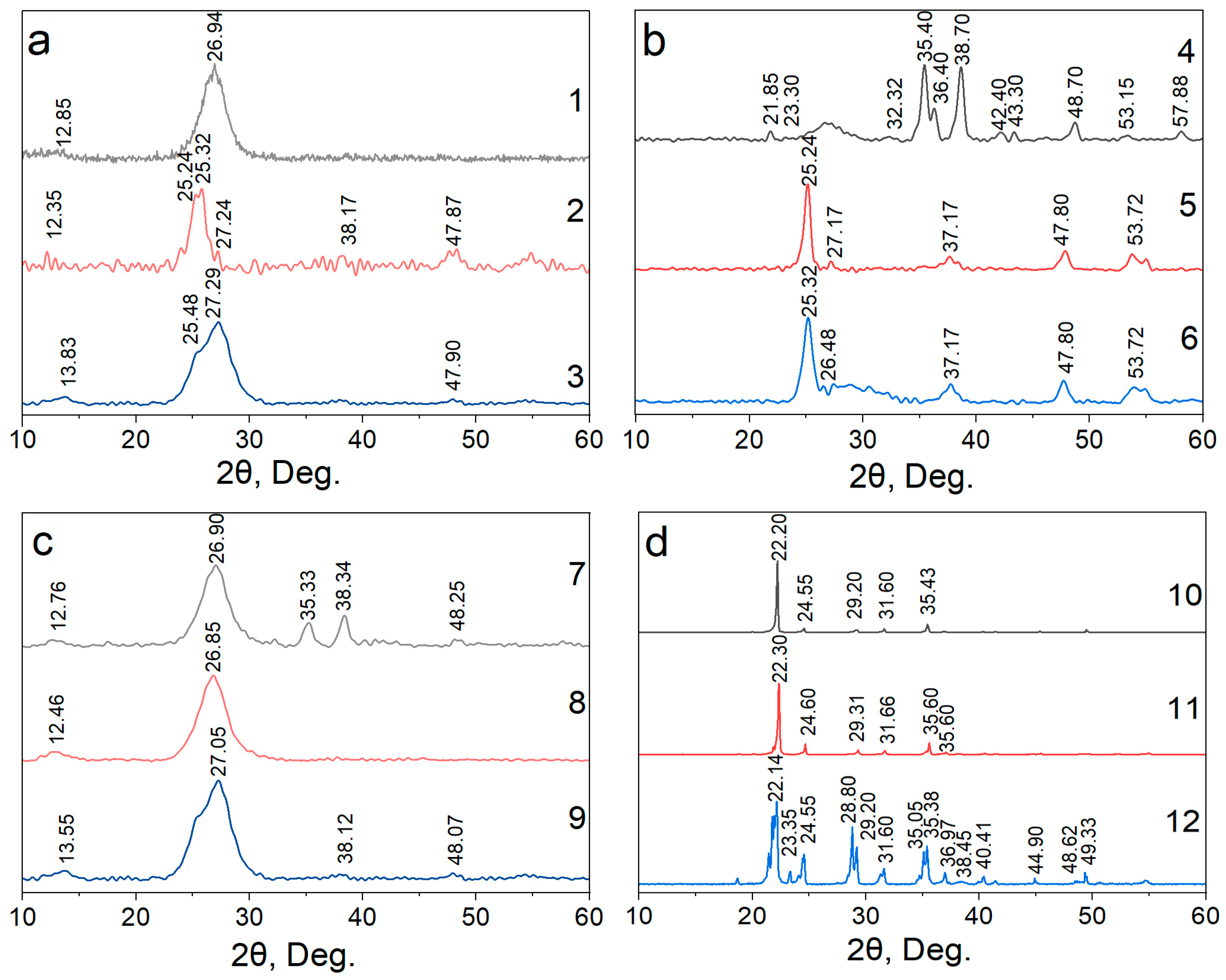
Figure 1 presents the X-ray diffraction (XRD) patterns of the obtained samples. The patterns reveal characteristic peaks corresponding to g-C3N4 (JCPDS 871526) and β-C3N4 [17]. In the samples prepared via solution combustion, the XRD patterns exhibit peaks corresponding to the anatase phase of TiO2 (JCPDS 21-1272) for composites based on graphitic carbon nitride, and mixed anatase–rutile (JCPDS 21-1276) phases for composites with the denser modification (Figure 1a,b). The anatase:rutile phase ratio is 77% to 23%. Notably, in the g-C3N4/Cu(c) composite (line 1, Figure 1a), no additional peaks are observed; however, a shift in the main carbon nitride peaks indicates doping. In the β-C3N4/Cu(c) sample (line 4, Figure 1b), peaks attributed to Cu4O3 (JCPDS 83-1665) are present. When titanium and copper coexist during synthesis, peaks corresponding to copper oxides are not observed, but the main carbon nitride peaks are shifted. The coexistence of copper and titanium precursors likely induces competition for ion incorporation into the carbon nitride lattice (line 3, Figure 1a; line 6, Figure 1b).
In contrast, plasma-liquid modification using copper and titanium electrodes results in a shift in the primary diffraction peaks associated with carbon nitride (Figure 1c,d). During underwater plasma treatment, a measurable loss of electrode mass was observed, indicating sputtering. The mass percentage of sputtered material was 3% for Ti and 6% for Cu. In the case of a combined Cu-Ti electrode pair, the XRD patterns exhibit peaks corresponding to mixed-phase titanium dioxide (the anatase:rutile phase ratio is 90% to 10%) and copper titanate (JCPDS 73-6023) [18], but no peaks related to copper oxides, similar to the solution combustion method. The measured mass loss of the electrodes was 0.0074 g for Ti and 0.004 g for Cu. A shift in the main diffraction peaks related to both carbon nitride modifications was also observed. Therefore, the plasma modification process involves simultaneous and sequential processes of copper titanate synthesis, carbon nitride doping, and the formation of a two-component composite.
Table 1 presents the calculated crystallite sizes and interplanar distances for the (100) planes of β-C3N4 and the (002) planes of g-C3N4. The interplanar distance values (dhkl) differ from the theoretical values (3.36 Å for g-C3N4 and 3.2 Å for β-C3N4). For graphitic carbon nitride, a shift of the (002) peak toward higher 2θ values indicates denser layer packing due to an increased degree of polymerization caused by elevated temperatures during modification. For β-C3N4, the modification processes lead to an increase in interplanar spacing, suggesting structural doping.
For the pristine carbon nitrides, the crystallite sizes were 12 nm and 16 nm for g-C3N4 and β-C3N4, respectively. As shown in Table 1, the formation of graphitic carbon nitride-based composites generally results in a decrease in crystallite size, likely due to the influence of temperature and high quenching rates. The crystallite sizes for the denser β-modification are larger. A definitive comparative analysis of the crystallite sizes of the different phases is not currently possible. It is suggested that the larger crystallite size for the beta phase is related to its synthesis route. Furthermore, plasma modification tends to yield particles with increased crystallite sizes, suggesting higher temperatures in the plasma zone during synthesis. The β-C3N4/Cu(c) composite is an exception, possibly due to the formation of a distinct binary composite.

2.2. Morphology and Surface Characteristics

The average particle sizes and zeta potentials obtained by dynamic light scattering are presented in Table 2. For unmodified carbon nitride, the average particle sizes (Def) are 450 nm and 86 nm for the g- and β-modifications, respectively, with zeta potentials (ζ) of −17.2 mV (g-C3N4) and −29.3 mV (β-C3N4), attributed to the presence of amino groups. Composite formation significantly increases the average particle size, which in turn affects the surface charge. The decrease in zeta potential values is caused by the presence of oxide structures or doping agents with higher isoelectric points.
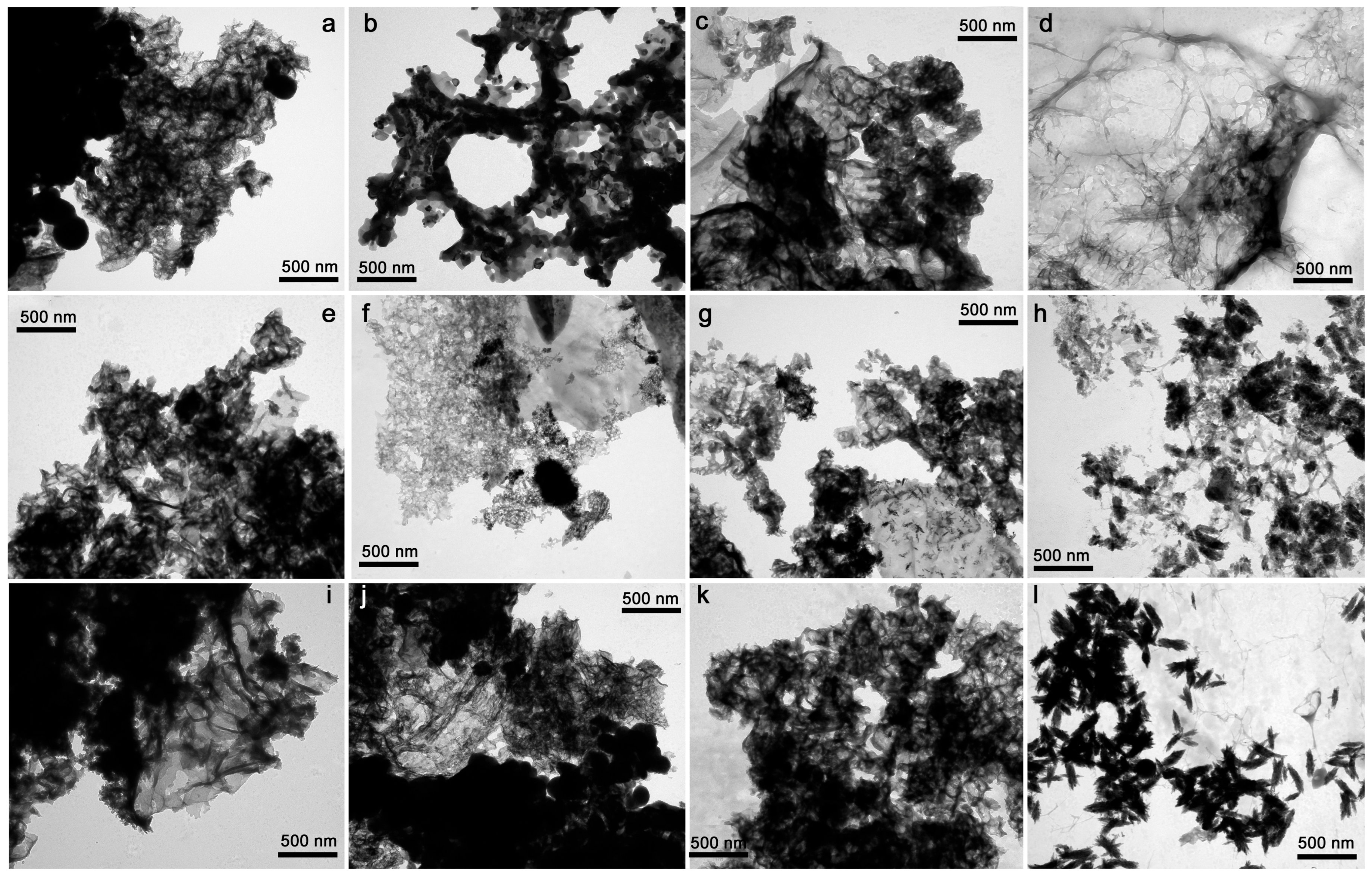
The surface morphology of the samples is shown in Figure 2. The layered structures of graphitic carbon nitride (Figure 3a,c,e,g,i,k) and the framework structures of β-C3N4 (Figure 3b,d,f,h,j,l) are clearly visible. The solution combustion method results in the formation of oxide structures on the g-C3N4 substrate or within the framework of the denser modification, whereas plasma modification promotes the incorporation of carbon nitride into these oxide-based structures.
The textural properties of the samples are presented in Table 3. The specific surface areas for pure carbon nitrides are 55.35 m2 g−1 (g-C3N4) and 5.0 m2 g−1 (β-C3N4). Modification processes result in both increases and decreases in specific surface area. Specifically, solution combustion produces modified samples with a more developed specific surface area, likely due to greater gas evolution during combustion, particularly for β-C3N4. In contrast, plasma treatment yields samples with a denser structure, a consequence of the higher local temperatures in the plasma. Composites based on β-C3N4 exhibit lower specific surface areas and pore volumes compared to those based on graphitic carbon nitride. However, the pore diameters for all samples are comparable, ranging from 35 to 46 nm, classifying the materials as mesoporous.

2.3. X-Ray Photoelectron Spectroscopy

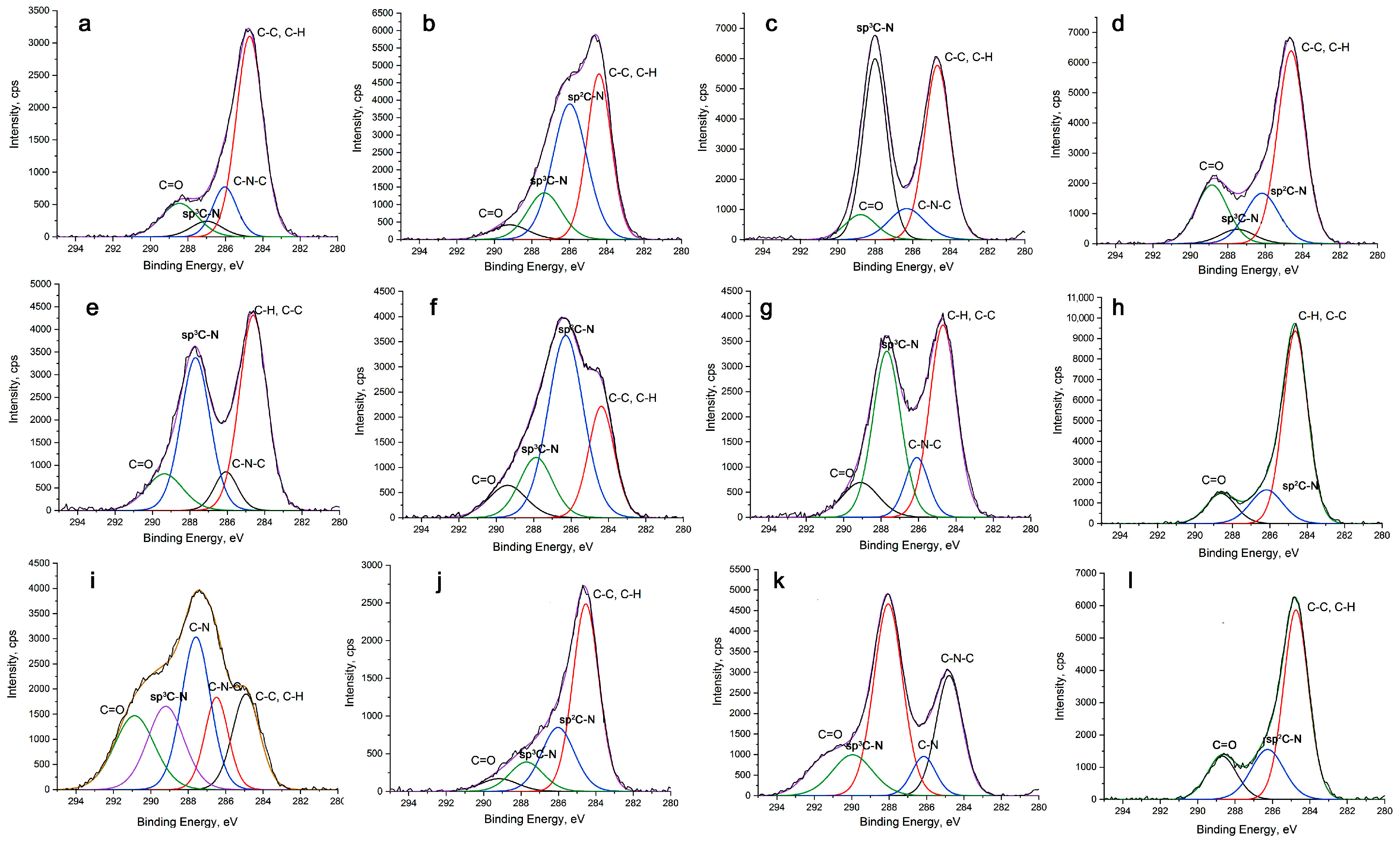
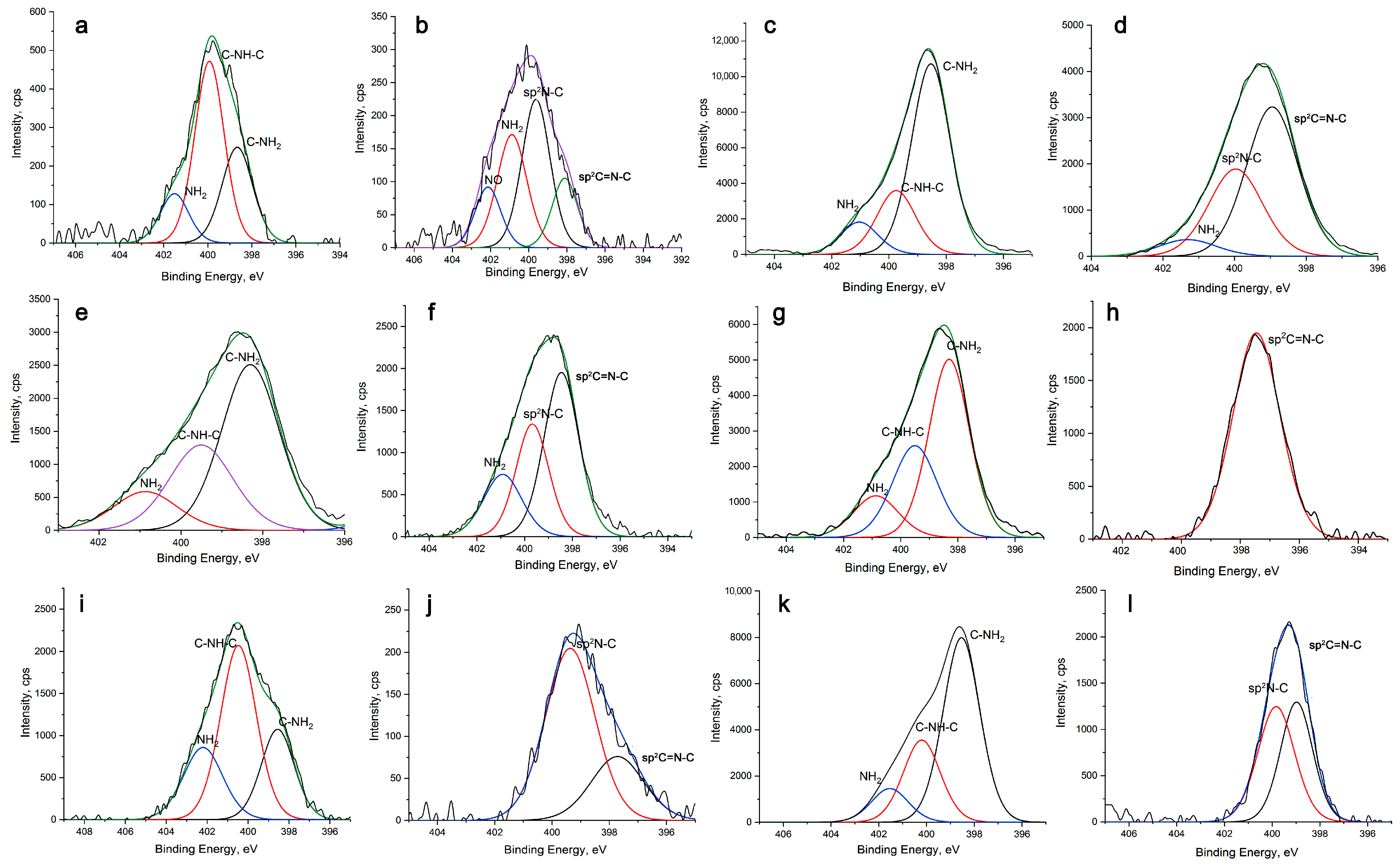
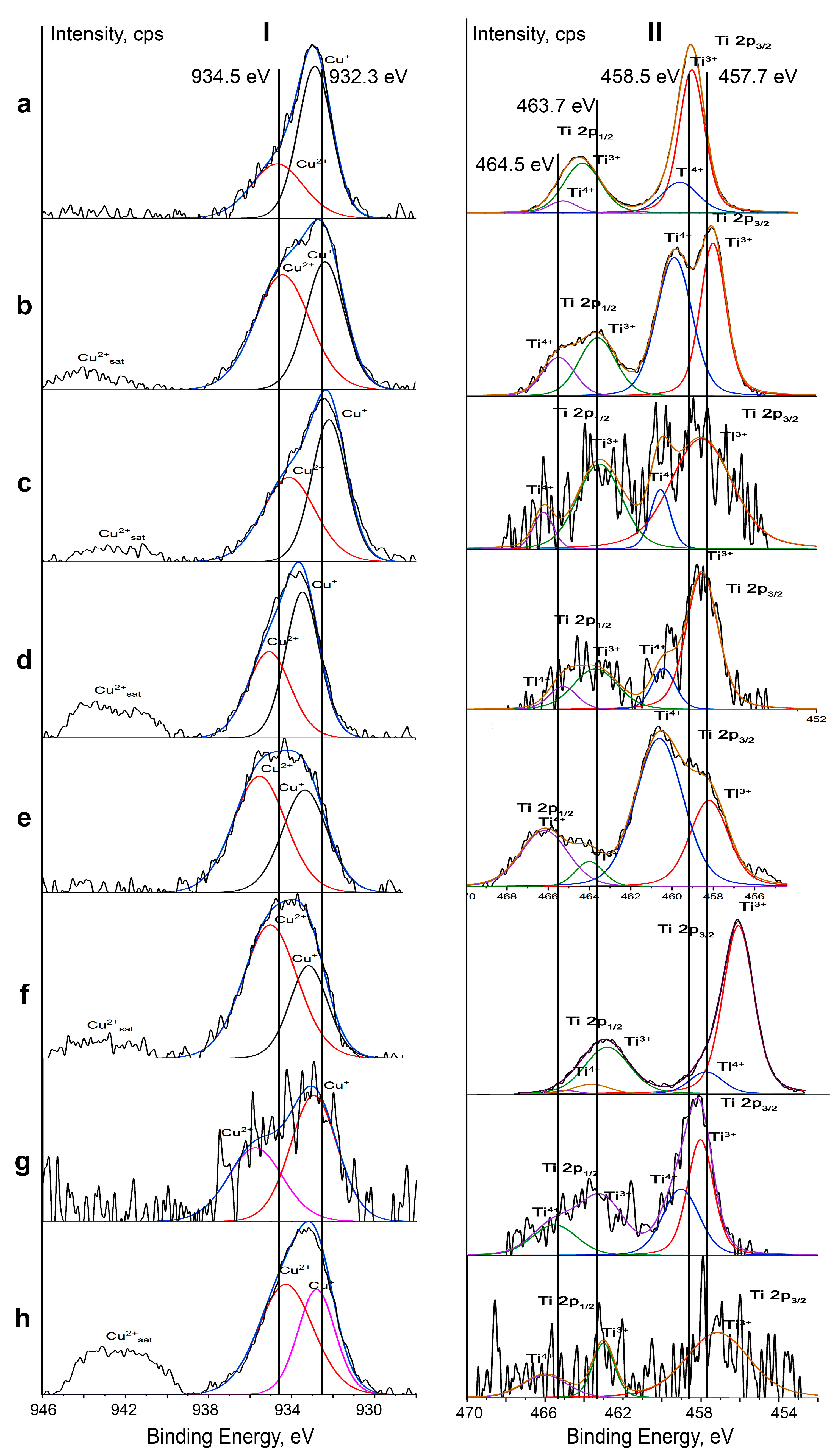
High-resolution XPS spectra of C 1s, N 1s, Cu 2p, and Ti 2p are presented in Figure 3, Figure 4 and Figure 5. For C 1s, each sample exhibits peaks at 284.4–284.7 eV (corresponding to reference (unreacted) carbon), 286–286.3 eV (sp2 C=N–C bond), and 288.5–289.0 eV (sp3 C–N) (Figure 3). The presence of peaks at 287.8 and 291.6 eV indicates oxygen on the sample surfaces in the form of O=C–N and CO32−, respectively. In the N 1s spectra of all samples, peaks appear at 398 eV (N-sp2 C bond) [19], 399.5 eV (N-sp3 C bond), and 400.1–400.8 eV (N-sp2 C bond) [20] (Figure 4). Additionally, the peak at 401.0–401.9 eV is attributed to N-sp2 C bonding. Variations in the environment, such as the presence of different ions, shift the peak positions. Different ratios of the areas under these peaks indicate the presence of carbon nitride in graphitized or diamond-like modifications. For copper, all samples exhibit two peaks corresponding to Cu+ (932.3 eV) and Cu2+ (934.5 eV) (Figure 5). The latter shows a satellite peak in the β-C3N4/Cu(c), g-C3N4/Cu(p), β-C3N4/Cu(p), β-C3N4/CuTi(c), and β-C3N4/CuTi(p) samples, indicating the predominance of Cu2+ ions. Ti 2p XPS spectra reveal two titanium oxidation states: Ti3+ (457.7 and 463.7 eV for Ti 2p3/2 and Ti 2p1/2, respectively) and Ti4+ (458.5 and 464.5 eV for Ti 2p3/2 and Ti 2p1/2, respectively) (Figure 5) [21].
It should be noted that shifts in the main peaks of copper and titanium ions were recorded both toward lower and higher energies. Differences in the ratios of the C 1s and N 1s peaks for the composites were also recorded. According to the electrostatic shielding effect, increasing the number of outer electrons will result in a weakening of the binding energy, suggesting that charges from one ion are transferred to another. Also, peak shifts may indicate the interaction of the ion with the surface of the “substrate”, which is carbon nitride.

2.4. Photocatalytic Activity of Samples Under UV Light Irradiation

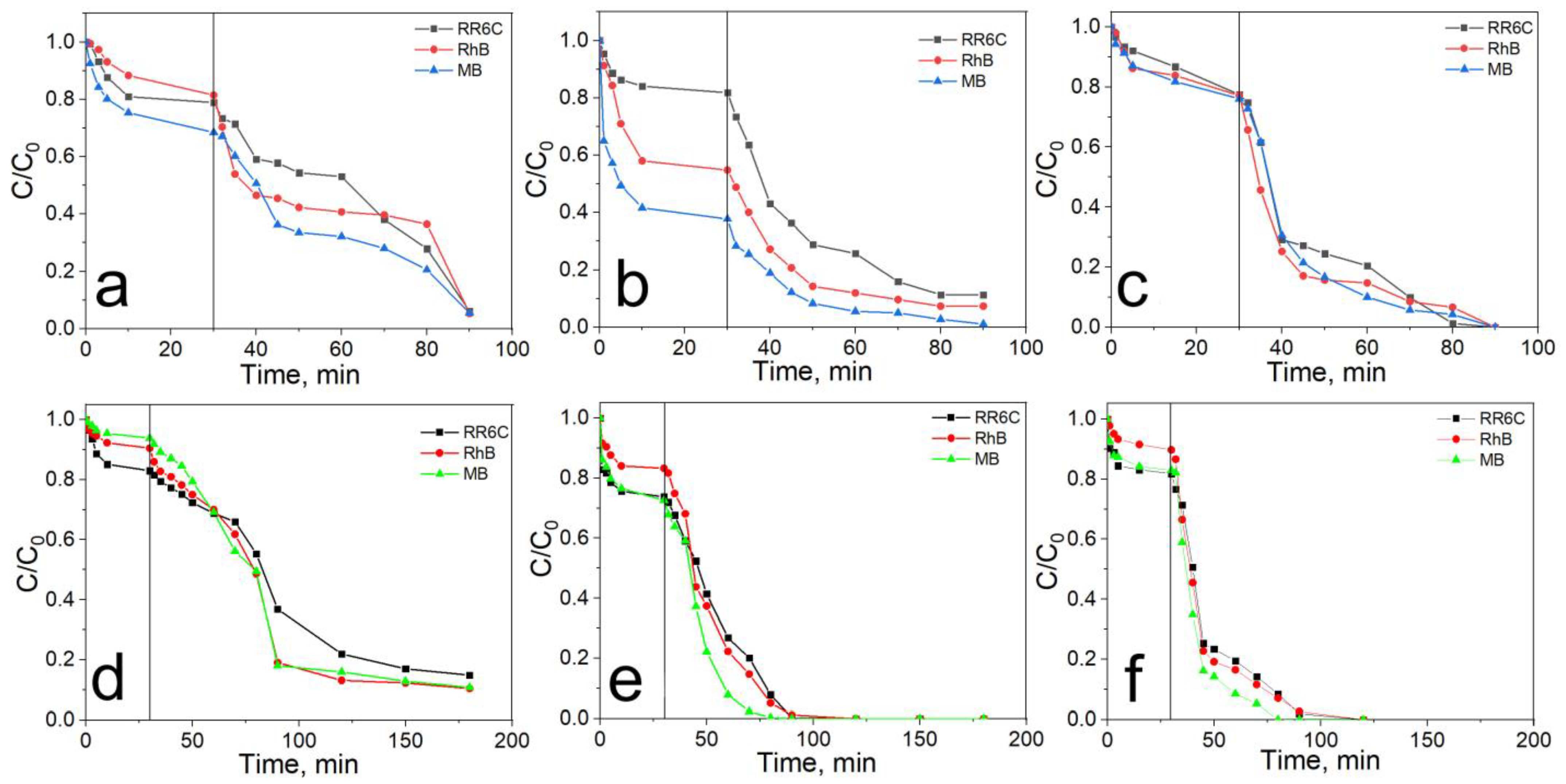
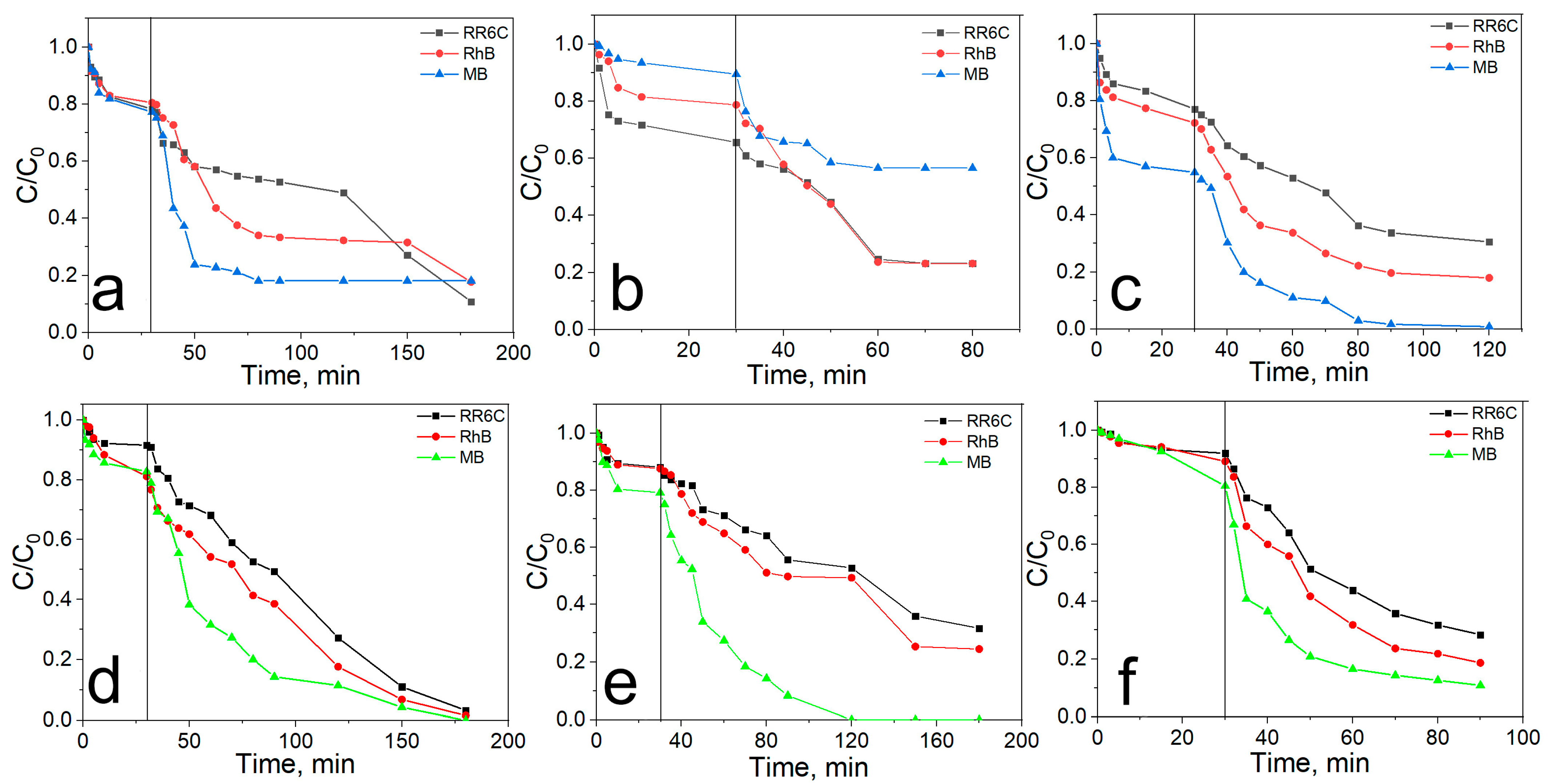
The kinetic curves of photodegradation for the three-dye mixture in the presence of the synthesized samples are shown in Figure 6 and Figure 7. The dark phase (0–30 min) corresponds to the adsorption stage. For the g-C3N4/Ti(c) (Figure 6b) and g-C3N4/CuTi(p) (Figure 7c) samples, the adsorption stage is predominant for Methylene Blue. This observation aligns with the SBET and ζ-potential data (Table 1 and Table 2). The highest degradation efficiency for all three dyes is demonstrated by samples based on the denser β-modification. Furthermore, high dye removal efficiency was recorded for composites containing both Cu and Ti. The kinetics of photodegradation of dyes under the influence of UV radiation is shown in Figure S1. All curves are described by pseudo-first-order kinetic equations ln(C/C0) = −kt. A change in slope was observed for almost all composites, indicating a shift in the degradation rate, potentially due to factors such as the formation of intermediate products.
Table 4 presents the effective rate constants (keff) for the photodegradation of dyes in the presence of the obtained samples. For all dyes, keff values are generally higher for samples modified by solution combustion. For RR6C and RhB, the effective rate constants are higher in g-C3N4-based composites. In contrast, for the MB dye, samples modified with copper oxides—using both methods—show higher activity for the β-modification. The selectivity of each sample for specific dyes can be inferred from these results. The superior performance of graphitic carbon nitride-based composites for RR6C and RhB can be explained by their morphology. During modification, oxides form on the layered structure of g-C3N4, creating interfacial interactions that enhance photocatalytic activity.
The results of experiments with reactive species traps are presented in Figure S2. The data showed that for Reactive Red 6C and Rhodamine B dyes, the primary reactive species are the hydroxyl radicals. For Methylene Blue, the reactive species responsible for the degradation process are photoholes and O2. It was also noted that the contribution of reactive species to the degradation process is more significant in the presence of plasma-modified composites. This can be explained by the modification method itself, as underwater plasma treatment not only forms composites but also creates active groups on the material surface.

2.5. Optical Characteristics

The band gap (Eg) is a key factor in the development of photocatalysts. For carbon nitride, the beta and m-modifications exhibit an indirect band gap transition [15,16,22]. The Eg values were calculated from spectrophotometric measurements of suspensions using the Tauc Equation (1).
α h v = B 0 ( h v E g ) n ,
Here, n is the index related to the type of optical transition. For an indirect transition, n = 1/2. Calculated values are presented in Table 5. For unmodified carbon nitride samples, the band gap values are 3.02 eV for β-C3N4 and 2.77 eV for g-C3N4 [11,23]. The variation in the band gap (Eg) values may be attributed to changes in crystallite size. A comparison of the data in Table 1 and Table 5 suggests that an increase in crystallite size leads to a decrease in Eg values. Conversely, an increase in band gap values may result from the incorporation of metal ions into the carbon nitride structure, which disrupts the π-complex due to the formation of metal–nitrogen bonds.
To assess the efficiency of photocharge migration and separation, photoluminescence (PL) spectra were recorded (Figure S3, SI). It should be noted that the PL spectra of composites based on g-C3N4 and β-C3N4 differ. Composites derived from graphitic C3N4 show an emission peak near 453 nm, whereas those based on β-C3N4 display multiple peaks.
The PL intensity of g-C3N4/CuTi is lower than that of g-C3N4/Ti and g-C3N4/Cu for both synthesis methods, indicating a lower rate of photocharge recombination and, consequently, improved photocatalytic activity. For composites based on the dense β-modification, no clear trend is observed. When modified by solution combustion, the lowest PL intensity is recorded for β-C3N4/Ti, while for the plasma method, it is observed for β-C3N4/CuTi.

2.6. Photocatalytic Activity of Samples Under Visible Light Irradiation

Under visible light irradiation, the efficiency of the composites decreases (see Figures S4 and S5 in the Supplementary Materials). The effective rate constants for photodegradation (Table S1) are an order of magnitude lower than those under UV light, a direct consequence of the increased band gap values. Under these conditions, plasma-modified materials show relatively higher efficiency. Similar to UV irradiation, the denser β-modification generally exhibits higher efficiency than g-C3N4, except for the C3N4/CuTi composites synthesized by both methods. This exception may be attributed to the specific chemical composition of the resulting composites—a mixture of oxides in solution combustion and copper titanate in plasma synthesis.
Table 6 presents published data on the photocatalytic activity of carbon nitride-based structures toward organic dyes. The analysis suggests that, depending on the synthesis conditions of carbon nitride, dye class, nature of the oxide component, and experimental parameters, high removal efficiencies can be achieved [7,8,24,25,26,27,28,29,30,31].
The stability of photocatalytic activity is a crucial characteristic for practical applications. Reusability tests were conducted under identical conditions (see Figures S6 and S7). The results show that the adsorption capacity and photocatalytic activity remained virtually unchanged after six cycles, demonstrating the significant durability of the synthesized photocatalysts.

2.7. Mechanism of Photocatalytic Dye’s Destruction

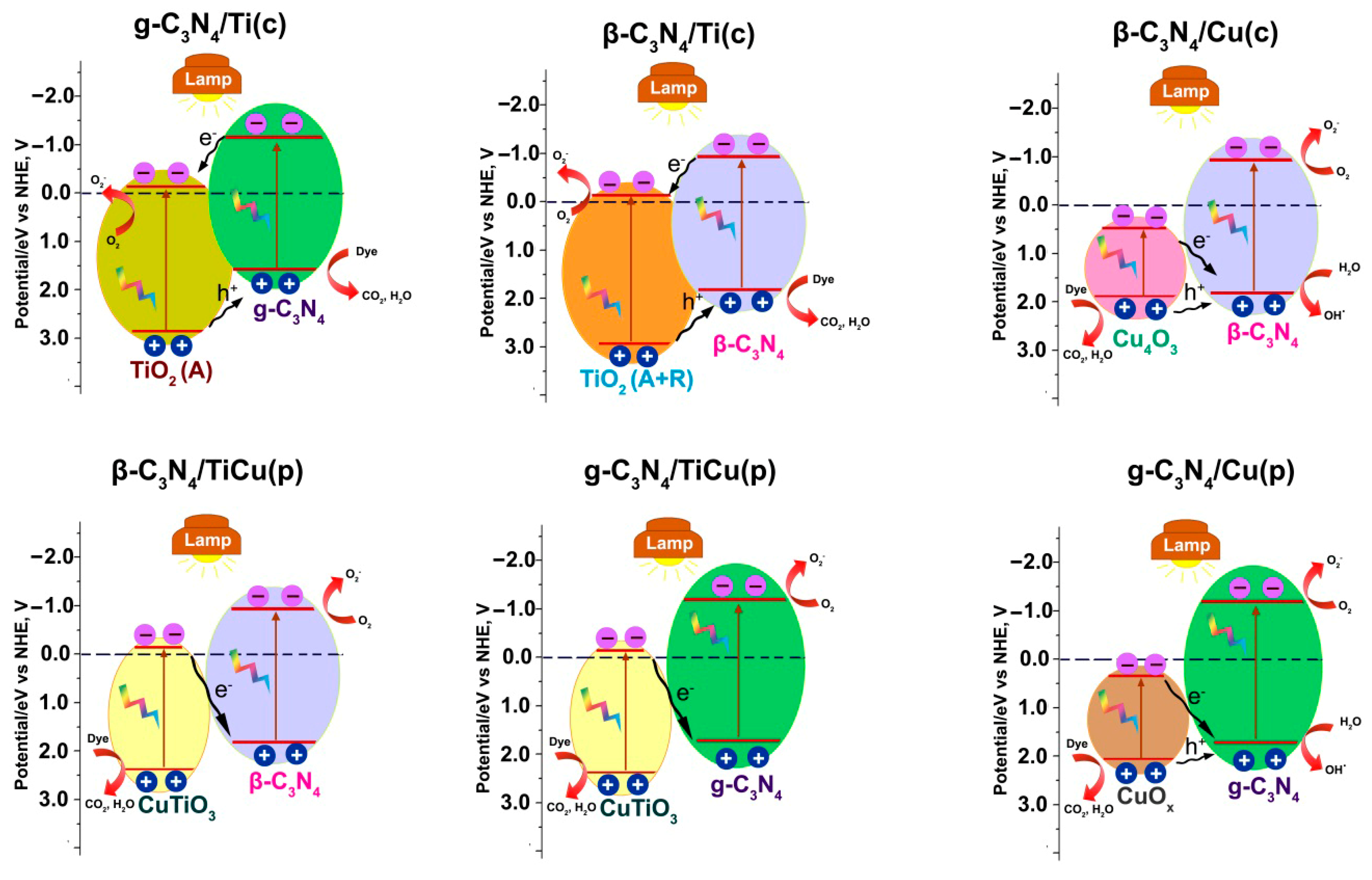
A possible mechanism for electron–hole separation and transport at the C3N4/oxide interface is shown in Figure 8. The conduction band (ECB) and valence band (EVB) potentials for carbon nitride and oxide additives can be determined using the equations
EVB = χ − Ee + 0.5Eg
ECB = EVBEg,
where χ is electronegativity of the materials [8,24,32,33,34], Ee is the energy of free electrons on the scale of hydrogen, and Eg is the band gap of materials. The calculated values of ECB and EVB are summarized in Table S2.
It should be noted that the β-C3N4/Ti(c) and g-C3N4/Ti(c) samples exhibit a Type-II heterojunction, as titanium dioxide is an n-type semiconductor. In contrast, the β-C3N4/Cu(c), β-C3N4/CuTi(p), g-C3N4/CuTi(p), and g-C3N4/Cu(p) composites typically form a Z-scheme heterojunction, owing to the p-type nature of copper oxides (CuO, Cu4O3) and CuTiO3.
As illustrated in Figure 8, titanium dioxide possesses a lower conduction band positioned near the hydrogen reduction potential, whereas carbon nitride (both modifications) has a higher valence band close to the oxidation level.
For composites containing copper oxide structures, photogenerated charges (electrons and holes) are created in the conduction and valence bands of the copper oxides under light irradiation due to their narrower band gap. The photogenerated electrons can subsequently migrate to the conduction band of carbon nitride. These electrons can then be captured by oxygen molecules adsorbed on the sample surface, forming hydroxyl radicals (•OH). These radicals participate in the oxidation of dye molecules. Meanwhile, photogenerated holes in the valence band can directly oxidize dye molecules [11].
Consequently, this charge-transfer pathway promotes efficient separation of electron–hole pairs and suppresses charge recombination, thereby enhancing the overall photocatalytic activity.

3. Materials and Methods

3.1. Synthesis of Composites

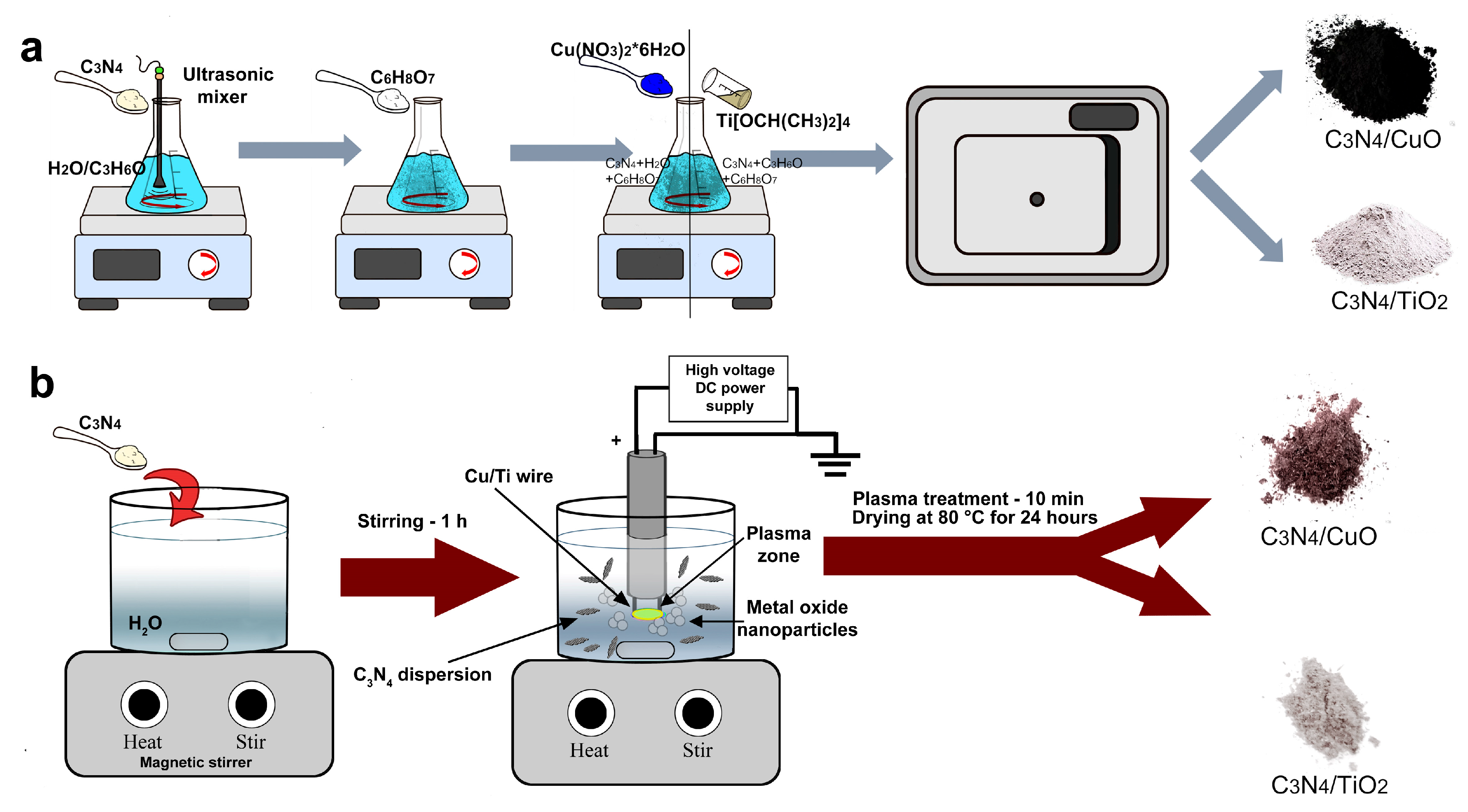
The two carbon nitride modifications were synthesized via thermal sintering of urea and by using an underwater plasma discharge, respectively, as detailed previously [11,23]. The composites were prepared using underwater pulsed plasma and solution combustion techniques (Figure 9).
The solution combustion synthesis was performed as follows: 1 g of g-C3N4 or β-C3N4 was dispersed in 100 mL of acetone and sonicated for 2 h under continuous stirring. Then, 0.11 g of titanium isopropoxide, 0.18 g of copper nitrate, or a mixture of both (0.11 g Ti[OCH(CH3)2]4 and 0.18 g Cu(NO3)2) was added to the suspension with continuous stirring. Subsequently, 0.11 g of citric acid (C6H8O7) was added and stirred for an additional hour. The resulting suspension was placed in a muffle furnace and heated to 500 °C. After spontaneous combustion occurred, the powder was maintained in the furnace for another 20 min (Figure 9a).
For the plasma-based synthesis, two experimental series were performed (Figure 9b). In the first series, 1 g of g-C3N4 (obtained via solution combustion) was dispersed in 180 mL of distilled water under vigorous stirring for 2 h. In the second series, 1 g of β-C3N4 (produced by plasma-liquid synthesis) was similarly dispersed. The resulting suspensions were then placed in a discharge cell. The discharge was generated using a direct current source (model BP-0.25-2, TD ARS TERM LLC, Novosibirsk, Russia), capable of providing an output voltage of up to 10 kV, in series with a 1000 ohm ballast resistor. The power consumption of the high-voltage source was maintained below 200 W, as measured by a series-connected PC-7 wattmeter (Lin’an CF Co., Ltd., Hangzhou, China). Synthesis was conducted in a glass discharge cell with a volume of 180 mL. Titanium and copper wires (Shenzhen Tangda Technology Co., Ltd., Shenzhen, China, 99.99% purity), each with a diameter of 1.0 mm, were used as electrodes without prior treatment. The electrodes were placed in a fireproof ceramic mullite tube, ensuring a constant inter-electrode distance of 1.0 mm. Three different electrode combinations were tested: titanium anode and cathode, copper anode and cathode, and titanium anode with copper cathode. A direct current discharge (average current 0.25 A) was then ignited between the electrodes. The treatment duration was 10 min. Afterwards, the suspension was dried in a drying oven at 80 °C for 24 h (Figure 9b). The sample designations are presented in Table 7.

3.2. Characterization

The average particle size and electrophoretic mobility (zeta potential) were determined using dynamic light scattering (DLS) with a Malvern Zetasizer Nano (Malvern, UK). The absorption spectra of the dispersions were recorded using an SF-56 spectrophotometer (SDB Spectr, Saint Petersburg, Russia) over the wavelength range of 190–1100 nm. The phase composition was analyzed by X-ray diffraction (XRD) over a 2θ range of 10° to 60°, with a step size of 0.02°, using a D2 Advance X-ray diffractometer equipped with a CuKα source (Bruker, Billerica, MA, USA). Surface morphology was examined by transmission electron microscopy (TEM) using a JEOL JEM-2000 FXII instrument (JEOL, Tokyo, Japan). The specific surface area was determined by nitrogen adsorption–desorption at 77 K using a NOVA Series 1200e surface analyzer (Quantachrome, Boynton Beach, FL, USA). X-ray photoelectron spectroscopy (XPS) with a Kratos Ultra DLD spectrometer (Kratos Analytical, Stretford, UK) was employed to assess the chemical composition of the sample surfaces. The binding energy data were calibrated using the C 1s peak at 284.6 eV. Fluorescence spectra were obtained with a FluoTime 300 fluorometer (PicoQuant GmbH, Berlin, Germany).

3.3. Photocatalytic Tests of the Obtained Samples

The photocatalytic activity of the synthesized composites was evaluated by decomposing a mixture of three dyes under both UV and visible light irradiation. A mixture of three dyes of different classes was chosen as a model solution for photocatalysis. Reactive Red 6C is a representative of the class of reactive dyes; it is an anion in solution. Rhodamine B is a representative of the class of xanthene dyes, which in solution manifests itself as a zwitter ion. And Methylene Blue represents a class of thiazine dyes, and in solution it is a cation. The concentration of each dye in the mixture was 1.2 mg/L. The catalyst mass was 0.03 g. The dye mixture solution, with a volume of 500 mL, was placed in a photoreactor described in detail elsewhere [35]. The irradiation sources included a UV mercury lamp with a maximum emission at 254 nm (the intensity of light radiation energy is 40 W m−2) (250 W, TDM Electric, Wenzhou, China and a visible light source—a 35 W xenon lamp emitting in the 450–650 nm range (the intensity of light radiation energy is 15 W m−2). Dye removal was monitored spectrophotometrically using an SF–56 spectrophotometer (SDB Spectr, Saint Petersburg, Russia) over the wavelength range of 400–700 nm. The experiments were carried out three times.
To elucidate the mechanism of dye photodegradation, a series of experiments with reactive species scavengers were conducted. Ethylenediaminetetraacetic acid (EDTA), isopropyl alcohol (IPA), and para-benzoquinone (p-BQ) were used as traps for photoholes (h+), hydroxyl radicals (OH), and superoxide radicals (O2).

4. Conclusions

In conclusion, it is worth noting that this study presents the first single-step methods for producing composites based on β- and g-modifications of carbon nitride and copper and titanium oxides by using the underwater plasma and solution combustion routes. The resulting composites demonstrate enhanced photocatalytic activity toward a mixture of three dyes (Rhodamine B, Reactive Red 6C, and Methylene Blue) under UV (100%) and visible (more than 50%) light irradiation. Furthermore, all composites exhibit high stability without loss of photocatalytic activity after six cycles of use.

Supplementary Materials

The following supporting information can be downloaded at https://www.mdpi.com/article/10.3390/catal16040320/s1, Figure S1: Kinetic curves of dye’s photodegradation in the presence of synthesized composites; Figure S2: Efficiency of photocatalytic decomposition of dyes in the presence of reactive species scavengers; Figure S3: PL spectra of synthesized composites; Figure S4: Kinetic curves of photocatalytic degradation of dyes in their mixture in the presence of carbon nitrides modified by combusting method—g-C3N4/Cu (a), g-C3N4/Ti (b), g-C3N4/Ti-Cu (c), β-C3N4/Cu (d), β-C3N4/Ti (e), β-C3N4/Ti-Cu (f)—under visible light irradiation; Figure S5: Kinetic curves of photocatalytic degradation of dyes in their mixture in the presence of carbon nitrides after plasma modification—g-C3N4/Cu (a), g-C3N4/Ti (b), g-C3N4/Ti-Cu (c), β-C3N4/Cu (d), β-C3N4/Ti (e), β-C3N4/Ti-Cu (f)—under visible light irradiation; Table S1: Effective constant rates of dye’s photodestruction at visible light irradiation; Figure S6: Reuse of carbon nitrides modified by combusting method: g-C3N4/Cu (a), g-C3N4/Ti (b), g-C3N4/Ti-Cu (c), β-C3N4/Cu (d), β-C3N4/Ti (e), β-C3N4/Ti-Cu (f); Figure S7: Reuse of carbon nitrides after plasma modification: g-C3N4/Cu (a), g-C3N4/Ti (b), g-C3N4/Ti-Cu (c), β-C3N4/Cu (d), β-C3N4/Ti (e), β-C3N4/Ti-Cu (f); Table S2: The calculated values of ECB and EVB.

Author Contributions

Conceptualization, A.K. and A.A.; methodology, N.S. and V.S.; investigation, A.L., D.Y., V.S., and T.S.; writing—original draft preparation, A.K.; writing—review and editing, A.K. and N.S.; supervision, A.A.; project administration, A.A. All authors have read and agreed to the published version of the manuscript.

Funding

This work was supported by the Russian Science Foundation (project no. 25-13-00259).

Data Availability Statement

The original contributions presented in this study are included in the article/Supplementary Material. Further inquiries can be directed to the corresponding author.

Conflicts of Interest

The authors declare no conflicts of interest.

References

  1. Wen, J.; Xie, J.; Chen, X.; Li, X. A review on g-C3N4-based photocatalysts. Appl. Surf. Sci. 2017, 391, 72–123. [Google Scholar] [CrossRef]
  2. Khan, M.A.; Mutahir, S.; Shaheen, I.; Qunhui, Y.; Bououdina, M.; Humayun, M. Recent advances over the doped g-C3N4 in photocatalysis: A review. Coord. Chem. Rev. 2025, 522, 216227. [Google Scholar] [CrossRef]
  3. Ragupathi, V.; Panigrahi, P.; Subramaniam, N.G. Bandgap engineering in graphitic carbon nitride: Effect of precursors. Optik 2020, 202, 163601. [Google Scholar] [CrossRef]
  4. Chen, Y.A.; Guo, L.; Wang, E.G. Alpha beta experimental evidence for alpha-and beta-phases of pure crystalline C3N4 in films deposited on nickel substrates. Philos. Mag. Lett. 1997, 75, 155–162. [Google Scholar] [CrossRef]
  5. He, D.W.; Zhang, F.X.; Zhang, X.Y.; Qin, C.; Zhang, M.; Liu, R.P.; Xu, Y.F.; Wang, W.K. Synthesis of carbon nitride crystals at high pressures and temperatures. J. Mater. Res. 1998, 13, 3458–3462. [Google Scholar] [CrossRef]
  6. Collins, C.; Thadhani, N.; Iqbal, Z. Shock-compression of C–N precursors for possible synthesis of β-C3N4. Carbon 2001, 39, 1175–1181. [Google Scholar] [CrossRef]
  7. Wu, G.; Thind, S.S.; Wen, J.; Yan, K.A.; Chen, A. A novel nanoporous α-C3N4 photocatalyst with superior high visible light activity. Appl. Catal. B Environ. 2013, 142, 590–597. [Google Scholar] [CrossRef]
  8. Zou, L.R.; Huang, G.F.; Li, D.F.; Tian, Q.N.; Yang, K.; Si, Y.; Chang, S.; Zhang, X.A.; Huang, W.Q. Novel β-C3N4/CuO nanoflakes: Facile synthesis and unique photocatalytic performance. J. Phys. D Appl. Phys. 2017, 50, 355501. [Google Scholar] [CrossRef]
  9. Hu, C.C.; Wang, M.S.; Guo, Z.W. Carbon nitride (C3N4) photocatalysts synthesized from different methods for photocatalytic reaction under visible light irradiation. ECS Trans. 2016, 72, 9. [Google Scholar] [CrossRef]
  10. Jiang, R.; Li, W.; Zhu, K.; Ye, W.; Zhu, G.; Jia, G.; Xu, F.; Wang, J.; Tao, Y.; Wang, Y.; et al. TiO2/β-C3N4 for sunlight-driven overall water splitting. J. Alloys Compnd. 2022, 920, 166045. [Google Scholar] [CrossRef]
  11. Sirotkin, N.; Khlyustova, A.; Shibaeva, V.; Agafonov, A. A novel method for synthesizing β-C3N4 using the plasma-liquid technique. Diam. Relat. Mater. 2025, 158, 112644. [Google Scholar] [CrossRef]
  12. Sirotkin, N.; Khlyustova, A.; Belikova, J. Fabrication of dye-sensitized solar cells based on novel mixed tungsten–molybdenum and tungsten–titanium oxides nanoparticles prepared by impulse underwater plasma. Phys. Status Solidi A 2023, 220, 2200435. [Google Scholar] [CrossRef]
  13. Varma, A.; Mukasyan, A.S.; Rogachev, A.S.; Manukyan, K.V. Solution combustion synthesis of nanoscale materials. Chem. Rev. 2016, 116, 14493–14586. [Google Scholar] [CrossRef] [PubMed]
  14. Evdokimova, A.V.; Larionov, A.I.; Kraev, A.S.; Sirotkin, N.A.; Khlyustova, A.V.; Agafonov, A.V. Synthesis of CuO–Cu4O3 composite in combustion reactions of nitrate–organic precursors. Russ. J. Appl. Chem. 2022, 95, 1834–1839. [Google Scholar] [CrossRef]
  15. Teter, D.M.; Hemley, R.J. Low-compressibility carbon nitrides. Science 1996, 271, 53–55. [Google Scholar] [CrossRef]
  16. Xu, Y.; Gao, S.P. Band gap of C3N4 in the GW approximation. Int. J. Hydrogen Energy 2012, 37, 11072–11080. [Google Scholar] [CrossRef]
  17. Matsumoto, S.; Xie, E.Q.; Izumi, F. On the validity of the formation of crystalline carbon nitrides, C3N4. Diam. Relat. Mater. 1999, 8, 1175–1182. [Google Scholar] [CrossRef]
  18. Safari, S.; Ahmadian, S.M.S.; Amani-Ghadim, A.R. Visible light photocatalytic activity enhancing of MTiO3 perovskites by M cation (M=Co, Cu, and Ni) substitution and Gadolinium doping. J. Photochem. Photobiol. A Chem. 2020, 394, 112461. [Google Scholar] [CrossRef]
  19. Wei, J.; Hing, P.; Mo, Z.Q. TEM, XPS and FTIR characterization of sputtered carbon nitride films. Surf. Interface Anal. 1999, 28, 208. [Google Scholar] [CrossRef]
  20. Li, Y.G.; Wee, A.T.S.; Huan, C.H.A.; Li, W.S.; Pan, J.S. Reactive atom synthesis and characterization of C3N4 crystalline films. Surf. Interface Anal. 1999, 28, 221. [Google Scholar] [CrossRef]
  21. Mizuno, Y.; King, F.K.; Yamauchi, Y.; Homma, T.; Tanaka, A.; Takakuwa, Y.; Momose, T. Temperature dependence of oxide decomposition on titanium surfaces in ultrahigh vacuum. J. Vac. Sci. Technol. A Vac. Surf. Films 2002, 20, 1716–1721. [Google Scholar] [CrossRef]
  22. Corkill, J.L.; Cohen, M.L. Calculated quasiparticle band gap of β-C3N4. Phys. Rev. B 1993, 48, 17622. [Google Scholar] [CrossRef] [PubMed]
  23. Agafonov, A.V.; Sirotkin, N.A.; Shibaeva, V.D.; Radina, A.D.; Kvashnin, A.G.; Khlyustova, A. Comparative characteristics of β- and g-modifications of carbon nitride. Russ. J. Inorg. Chem. 2025, 70, 1–6. [Google Scholar] [CrossRef]
  24. Ivanov, K.; Melnik, E.; Sirotkin, N.; Khlyustova, A.; Agafonov, A. Synthesis, structure, and photocatalytic properties of the organic–inorganic nanocomposite photocatalyst SrTiO3/β-C3N4. Inorg. Chem. Commun. 2026, 183, 115823. [Google Scholar] [CrossRef]
  25. Lu, X.; Wang, Q.; Cui, D. Preparation and photocatalytic properties of g-C3N4/TiO2 hybrid composite. J. Mater. Sci. Technol. 2010, 26, 925–930. [Google Scholar] [CrossRef]
  26. He, Y.; Cai, J.; Li, T.; Wu, Y.; Yi, Y.; Luo, M.; Zhao, L. Synthesis, characterization, and activity evaluation of DyVO4/g-C3N4 composites under visible-light irradiation. Ind. Eng. Chem. Res. 2012, 51, 14729–14737. [Google Scholar] [CrossRef]
  27. Kumar, S.T.S.; Kumar, B.; Baruah, A.; Shanker, V. Synthesis of magnetically separable and recyclable g-C3N4–Fe3O4 hybrid nanocomposites with enhanced photocatalytic performance under visible-light irradiation. J. Phys. Chem. C 2013, 117, 26135–26143. [Google Scholar] [CrossRef]
  28. Ye, S.; Qiu, L.G.; Yuan, Y.P.; Zhu, Y.J.; Xia, J.; Zhu, J.F. Facile fabrication of magnetically separable graphitic carbon nitride photocatalysts with enhanced photocatalytic activity under visible light. J. Mater. Chem. A 2013, 1, 3008–3015. [Google Scholar] [CrossRef]
  29. Boonprakob, N.; Wetchakun, N.; Phanichphant, S.; Waxler, D.; Sherrell, P.; Nattestad, A.; Chen, J.; Inceesungvorn, B. Enhanced visible-light photocatalytic activity of g-C3N4/TiO2 films. J. Colloid Interface Sci. 2014, 417, 402–409. [Google Scholar] [CrossRef]
  30. Hong, S.; Yu, Y.; Yi, Z.; Zhu, H.; Wu, W.; Ma, P. Highly efficient and recyclable g-C3N4/CuO hybrid nanocomposite towards enhanced visible-light photocatalytic performance. Nano 2016, 11, 1650121. [Google Scholar] [CrossRef]
  31. Muthuganesh, A.; Rafi, S.M.; Jacob, I.D.; Soundranayagam, J.P.; Surender, S.; Elangovan, P.; Flora, X.H. Efficient methylene blue dye degradation via visible light-activated g-C3N4/CuO nanocomposites. Hybrid Adv. 2025, 9, 100420. [Google Scholar] [CrossRef]
  32. Ju, M.G.; Sun, G.; Wang, J.; Meng, Q.; Liang, W. Origin of high photocatalytic properties in the mixed-phase TiO2: A first-principles theoretical study. ACS Appl. Mater. Interfaces 2014, 6, 12885–12892. [Google Scholar] [CrossRef]
  33. Wang, Y.; Lany, S.; Ghanbaja, J.; Fagot-Revurat, Y.; Chen, Y.P.; Soldera, F.; Horwat, D.; Mucklich, F.; Pierson, J.F. Electronic structures of Cu2O, Cu4O3, and CuO: A joint experimental and theoretical study. Phys. Rev. B 2016, 94, 245418. [Google Scholar] [CrossRef]
  34. Li, F.; Xie, S.; Zhou, Y.; Wu, Z.; Wang, Q.; Wu, P.; Huang, H.; He, Q.; Li, F.; Zhao, K.; et al. Fabrication of directly 2D Z-scheme CuTiO3/g-C3N4 with high photocatalytic activities for CO2 reduction and hydrogen production. J. Solid State Chem. 2024, 329, 124399. [Google Scholar] [CrossRef]
  35. Khlyustova, A.; Sirotkin, N.; Kraev, A.; Titov, V.; Agafonov, A. Plasma–liquid synthesis of MoOx and WO3 as potential photocatalysts. Dalton Trans. 2020, 49, 6270–6279. [Google Scholar] [CrossRef]
Figure 1. XRD patterns of obtained samples after modification by combustion (a,b) and underwater plasma (c,d) g-C3N4/Cu(c) (1), g-C3N4/Ti(c) (2), g-C3N4/CuTi(c) (3), β-C3N4/Cu(c) (4), β-C3N4/Ti(c) (5), β-C3N4/CuTi(c) (6), g-C3N4/Cu(p) (7), g-C3N4/Ti(p) (8), g-C3N4/CuTi(p) (9), β-C3N4/Cu(p) (10), β-C3N4/Ti(p) (11), and β-C3N4/CuTi(p) (12).
Catalysts 16 00320 g001
Figure 2. TEM images of synthesized samples: (a)—g-C3N4/Ti(c), (b)—β-C3N4/Ti(c), (c)—g-C3N4/Ti(p), (d)—β-C3N4/Ti(p), (e)—g-C3N4/Cu(c), (f)—β-C3N4/Cu(c), (g)—g-C3N4/Cu(p), (h)—β-C3N4/Cu(p), (i)—g-C3N4/CuTi(c), (j)—β-C3N4/CuTi(c), (k)—g-C3N4/CuTi(p), (l)—β-C3N4/CuTi(p).
Catalysts 16 00320 g002
Figure 3. High-resolution spectra of C 1s for samples g-C3N4/Ti(c) (a), β-C3N4/Ti(c) (b), g-C3N4/Ti(p) (c), β-C3N4/Ti(p) (d), g-C3N4/Cu(c) (e), β-C3N4/Cu(c) (f), g-C3N4/Cu(p) (g), β-C3N4/Cu(p) (h), g-C3N4/CuTi(c) (i), β-C3N4/CuTi(c) (j), g-C3N4/CuTi(p) (k), β-C3N4/CuTi(p) (l).
Catalysts 16 00320 g003
Figure 4. High-resolution spectra of N 1s for samples g-C3N4/Ti(c) (a), β-C3N4/Ti(c) (b), g-C3N4/Ti(p) (c), β-C3N4/Ti(p) (d), g-C3N4/Cu(c) (e), β-C3N4/Cu(c) (f), g-C3N4/Cu(p) (g), β-C3N4/Cu(p) (h), g-C3N4/CuTi(c) (i), β-C3N4/CuTi(c) (j), g-C3N4/CuTi(p) (k), β-C3N4/CuTi(p) (l).
Catalysts 16 00320 g004
Figure 5. High-resolution spectra of Cu 2p and Ti 2p for samples g-C3N4/Cu(c) (Ia), β-C3N4/Cu(c) (Ib), g-C3N4/Cu(p) (Ic), β-C3N4/Cu(p) (Id), g-C3N4/Ti(c) (IIa), β-C3N4/Ti(c) (IIb), g-C3N4/Ti(p) (IIc), β-C3N4/Ti(p) (IId), g-C3N4/CuTi(c) (e), β-C3N4/CuTi(c) (f), g-C3N4/CuTi(p) (g), β-C3N4/CuTi(p) (h). (I)—analysis data for copper (Cu 2p) atoms, (II) analysis data for titanium (Ti 2p) atoms.
Catalysts 16 00320 g005
Figure 6. Kinetic curves of photocatalytic degradation of dyes in their mixture in the presence of carbon nitrides modified by combusting method—g-C3N4/Cu (a), g-C3N4/Ti (b), g-C3N4/Ti-Cu (c), β-C3N4/Cu (d), β-C3N4/Ti (e), β-C3N4/Ti-Cu (f)—under UV light irradiation.
Catalysts 16 00320 g006
Figure 7. Kinetic curves of photocatalytic degradation of dyes in their mixture in the presence of carbon nitrides after plasma modification—g-C3N4/Cu (a), g-C3N4/Ti (b), g-C3N4/Ti-Cu (c), β-C3N4/Cu (d), β-C3N4/Ti (e), β-C3N4/Ti-Cu (f)—under UV light irradiation.
Catalysts 16 00320 g007
Figure 8. Schematic presentation of charge transfer in C3N4 composites.
Catalysts 16 00320 g008
Figure 9. Schemes for the synthesis of composites based on carbon nitride by combustion (a) and underwater plasma (b) routes.
Catalysts 16 00320 g009
Table 1. Crystallite size (D) and interplanar distance (dhkl) of samples.
g-C3N4/Tiβ-C3N4/Tig-C3N4/Cuβ-C3N4/Cug-C3N4/CuTiβ-C3N4/CuTi
Combustion
D, nm8.5016.702.874.268.7010.80
dhkl, Å3.303.553.323.233.323.53
Underwater plasma
D, nm3.6557.563.8764.588.5216.68
dhkl, Å3.323.973.304.013.304.04
Table 2. Particle size and zeta potential of dispersed phase samples.
g-C3N4/Tiβ-C3N4/Tig-C3N4/Cuβ-C3N4/Cug-C3N4/CuTiβ-C3N4/CuTi
Combustion
Def, nm38058018083014001700
ζ, mV−15.1−21.5−11.0−17.45−16.3−19.1
Underwater plasma
D, nm350260250013001700164
ζ, mV−14.5−23.3−15.76−20.6−15.1−15.3
Table 3. Textural properties of sample surfaces.
g-C3N4/Tiβ-C3N4/Tig-C3N4/Cuβ-C3N4/Cug-C3N4/CuTiβ-C3N4/CuTi
Combustion
SBET, m2/g49.2216.5436.6526.0937.336.42
SBJH, m2/g22.459.1830.2419.0921.1925.37
Vpore, cm3/g0.050.0150.0810.0390.0490.060
Dpore, nm35.8736.1140.4540.445.9936.14
Underwater plasma
SBET, m2/g53.71.0552.541.8648.643.67
SBJH, m2/g28.751.8133.143.1121.383.04
Vpore, cm3/g0.0660.0030.0810.0050.0510.005
Dpore, nm40.0945.7340.0940.3335.7540.03
Table 4. Effective constant rates of dye’s photodestruction at UV light irradiation.
SampleRR6CRhBMB
k, min−1/R2α, %k, min−1/R2α, %k, min−1/R2α, %
β-C3N4/Ti(p)0.007/0.9768.30.0106/0.9975.60.0364/0.99100
g-C3N4/Ti(p)0.0289/0.8576.70.0291/0.9976.90.0169/0.843.4
β-C3N4/Ti(c)0.0339/0.981000.0456/0.981000.0729/0.92100
g-C3N4/Ti(c)0.0395/0.9589.70.0673/0.9992.60.0644/0.9898.9
β-C3N4/Cu(p)0.0103/0.9896.750.0117/0.9898.390.0289/0.98100
g-C3N4/Cu(p)0.0061/0.889.10.0167/0.9682.30.0307/0.8581.9
β-C3N4/Cu(c)0.0071/0.9585.20.0107/0.9490.60.0129/0.9689.2
g-C3N4/Cu(c)0.0184/0.9493.90.0309/0.894.80.042/0.9494.5
β-C3N4/CuTi(p)0.0286/0.9971.60.0349/0.9981.40.0693/0.9889.1
g-C3N4/CuTi(p)0.0121/0.9769.40.036/0.9982.10.0549/0.9899.2
β-C3N4/TiCu(c)0.0478/0.921000.0713/0.971000.0864/0.97100
g-C3N4/CuTi(c)0.1007/0.881000.1137/0.971000.0932/0.88100
Table 5. Eg values of obtained samples (eV).
g-C3N4/Tiβ-C3N4/Tig-C3N4/Cuβ-C3N4/Cug-C3N4/CuTiβ-C3N4/CuTi
Combustion
2.922.992.993.142.983.11
Underwater plasma
3.052.913.022.993.013.00
Table 6. Efficiency of photocatalyst composites on the base of C3N4.
Composite Experimental ConditionsEfficiency, %Ref.
α-C3N4mcat = 20 mg, RhB 12 mg/L, V = 20 mL, 70 min irradiation by visible light100[7]
β-C3N4/CuOmcat = 5 mg, MB 10 mg/L, V = 80 mL, 4 h irradiation by visible light, 15 min irradiation by UV light source67.4 (UV)
43.3 (visible)
[8]
SrTiO3/10% β-C3N4mcat = 0.5 g, RhB 1.2 mg/L, V = 500 mL, 2 h irradiation by visible and UV light sources76 (UV)
23 (visible)
[24]
g-C3N4/TiO2mcat = 0.15 g, RhB 100 mg/L, V = 30 mL, 5 h irradiation by UV and visible light sources100 (UV)
80 (visible)
[25]
DyVO4/g-C3N4mcat = 0.1 g/100 mL, RhB 10 mg/L, V = 300 mL, 2 h irradiation by visible light100[26]
g-C3N4/Fe3O4mcat = 25 mg, RhB 5 mg/L, V = 100 mL, 60 min irradiation by visible light100[27]
Fe2O3/g-C3N4mcat = 50 mg, RhB 5 mg/L, V = 60 mL, 200 min irradiation by visible light100[28]
g-C3N4/TiO2MB 10 mg/L, V = 10 mL, 180 min by visible light68[29]
g-C3N4/CuOmcat = 0.01 g, RhB 10−5 M, V = 10 mL, 5 min irradiation by visible light100[30]
g-C3N4/CuOmcat = 100 mg, MB 5 mg/L, V = 100 mL, 40 min irradiation by visible light98[31]
Table 7. Description of samples.
SampleExperimental Conditions
g-C3N4/Ti(p)Treatment by underwater plasma with Ti electrodes at discharge current 0.25 A; treatment time was 10 min
β-C3N4/Ti(p)
g-C3N4/Ti(c)Modification by combustion in the presence of Ti
β-C3N4/Ti(c)
g-C3N4/Cu(p)Treatment by underwater plasma with Cu electrodes at discharge current 0.25 A; treatment time was 10 min
β-C3N4/Cu(p)
g-C3N4/Cu(c)Modification by combustion in the presence of CuO
β-C3N4/Cu(c)
g-C3N4/CuTi(p)Treatment by underwater plasma with Cu (cathode) and Ti (anode) electrodes at discharge current of 0.25 A; treatment time was 10 min
β-C3N4/CuTi(p)
g-C3N4/CuTi(c)Modification by combustion in the presence of CuO and TiO2
β-C3N4/CuTi(c)
Disclaimer/Publisher’s Note: The statements, opinions and data contained in all publications are solely those of the individual author(s) and contributor(s) and not of MDPI and/or the editor(s). MDPI and/or the editor(s) disclaim responsibility for any injury to people or property resulting from any ideas, methods, instructions or products referred to in the content.