Article

Production of Methane and Ethane with Photoreduction of CO2 Using Nanomaterials of TiO2 (Anatase–Brookite) Modifications with Cobalt


by
Israel Rangel-Vázquez
1,*,
Esthela Ramos-Ramírez
1,*,
G. Del Angel
2,
L. Huerta
3,
F. González
4,
Próspero Acevedo-Peña
5,
Diana Nolasco-Guerrero
2,
Claudia M. Gómez
1,
E. Palacios-González
6 and
Marina Caballero Díaz
7
1
División de Ciencias Naturales y Exactas, Departamento de Química, Universidad de Guanajuato, Noria Alta, S/N, Guanajuato 36050, Mexico
2
Departamento de Química, Universidad Autónoma Metropolitana-Iztapalapa, Av. Ferrocarril San Rafael Atlixco, Núm. 186, Col. Leyes de Reforma 1 A Sección, Iztapalapa, Ciudad de México 09340, Mexico
3
Instituto de Investigaciones en Materiales, Universidad Nacional Autónoma de México, P.O. Box 70-360, Ciudad de México 04510, Mexico
4
Departamento de Ingeniería de Procesos e Hidráulica, Universidad Autónoma Metropolitana-Iztapalapa, Av. Ferrocarril San Rafael Atlixco, Núm. 186, Col. Leyes de Reforma 1 A Sección, Iztapalapa, Ciudad de México 09310, Mexico
5
SECIHTI (Secretaría de Ciencia, Humanidades, Tecnología e Innovación), Laboratorio Nacional de Conversión y Almacenamiento de Energía, CICATA Centro de Investigación en Ciencia Aplicada y Tecnología Avanzada)-Legaria, Instituto Politécnico Nacional, Calzada Legaria 694, Col. Irrigación, Ciudad de México 11500, Mexico
6
Laboratorio de Microscopía Electrónica de Ultra Alta Resolución (LAMEUAR), Instituto Mexicano del Petróleo, Eje Central Lázaro Cárdenas Núm. 152, Edificio 33-11, Col. San Bartolo Atepehuacan, Ciudad de México 07730, Mexico
7
Departamento de Ingeniería Química, Facultad de Estudios Superiores Zaragoza, Campus II, Universidad Nacional Autónoma de México, Batalla 5 de Mayo S/N, Ejército de Oriente Zona Peñón, Iztapalapa, Ciudad de México 09230, Mexico
*
Authors to whom correspondence should be addressed.
Catalysts 2026, 16(2), 146; https://doi.org/10.3390/catal16020146
Submission received: 5 December 2025 / Revised: 30 January 2026 / Accepted: 30 January 2026 / Published: 2 February 2026
(This article belongs to the Special Issue Advances in Photocatalytic Degradation, 2nd Edition)

Abstract

In this study, we present the synthesis of TiO2 nanomaterials doped with different mol% cobalt, prepared by the sol–gel method for CO2 reduction using UV light. The nanomaterials were calcined at 400 °C for 4 h. Characterization of the nanomaterials was performed using XRD-Rietveld refinement, XPS, Raman spectroscopy, diffuse reflectance spectroscopy (DRS), SEM-EDS, TEM-HRTEM, BET area, photoluminescence, and electrochemical techniques. The results show that the incorporation of cobalt into TiO2 modifies the structural properties, binding energies, and oxygen vacancy generation, it undergoes a shift towards the visible region, the recombination of charge carriers decreases, and the BET area is slightly modified. The photoreduction of CO2 with the highest production of methane and ethane is with 1% mol% of cobalt in TiO2, exhibiting values 3 and 14 times higher with respect to TiO2, which is attributed to the efficiency in the separation of photogenerated species (e/h+) as a consequence of the generation of energetic states that function as an electron trap and thus improve the photocatalytic activity for the photoreduction of CO2.

1. Introduction

One of the major concerns today is the increase in atmospheric CO2 concentrations caused by the burning of fossil fuels, as it negatively impacts human health and the environment. The consequence of the excessive use of this type of fuel is the generation of CO2; this gas is primarily responsible for the greenhouse effect, thus contributing to global warming worldwide [1,2,3]. To mitigate this environmental problem, it is necessary to develop new alternatives and implement clean, renewable technologies that are effective in achieving a sustainable world. Currently, there are some alternative renewable energy sources, such as biomass, wind, and geothermal, but they are insufficient and do not meet the current and future energy demand [4,5,6].
Another alternative is through the capture and transformation of CO2 into safe chemicals. However, this conversion process is very complex and is not cost-effective, as it requires a large amount of energy and a catalyst with certain characteristics because CO2 is a chemically stable molecule. Another natural alternative is photosynthesis by plants, but CO2 fixation in plants is impossible. Over the past two decades, researchers have focused on imitating artificial photosynthesis (CO2 reduction), as it is an alternative with the potential to convert CO2 into high-value products at constant pressure and temperature, which can then be used as fuel or raw material for industry [6,7,8].
The photocatalytic reduction in CO2 is a process that contains several stages, and, to date, different nanomaterials have been used for this process and a wide range of products such as CO, CH4, HCHO, HCOOH, and CH3OH have been obtained [9,10,11]. In the photoreduction reaction of CO2, several researchers have used different semiconductors, such as g-C3N4 [5], CeO2 [7] TiO2 [9,10,11], and ZnO [12], among others. However, the most widely used is TiO2 (anatase) as it has low toxicity, is environmentally friendly, and is low cost [7,8,13]. However, it has some disadvantages that limit its efficiency, such as a performance limitation due to the rapid recombination of charge carriers and its band gap that only adsorbs light in the UV region. TiO2 has low efficiency in CO2 reduction, due to the complex reaction routes, poor adsorption, and subsequent activation on the TiO2 surface, which delay the conversion of CO2. To overcome these types of deficiencies, we have tried to find strategies using different methods to modify the properties of TiO2, such as doping with a metal or non-metal [9,14], impregnation with metals or non-metals [1,10,11,15], and synthesis of heterostructures [13], with the purpose of improving photocatalytic efficiency for CO2 photoreduction.
One of the most important strategies is doping, since it allows for higher photocatalytic performance due to the modification of the electronic structure of the photocatalyst, as it increases the lifetime of the charge carriers and thus efficiently improves the transfer of charge carriers to the adsorbed species, such as CO2 [10,16,17]. Additionally, cobalt-modified nanomaterials have advantages over other metals, such as high electrical conductivity, thermal stability, unique electronic properties, chemical properties, and high catalytic performance, making these types of materials promising for the CO2 reduction reaction [18,19]. Furthermore, using cobalt as an impurity in the TiO2 structural lattice modifies the positions of the conduction and valence bands of the band gap (Eg). Therefore, the energy levels introduced by doping with cobalt (impurity) have the function of donors or acceptors, which prevents the recombination of charge carriers and improves the efficiency of photogenerated charge separation. The incorporation of cobalt as a dopant is effective for semiconductor oxides, because it increases the density of surface oxygen vacancies and these function as surface electron donors [20,21].
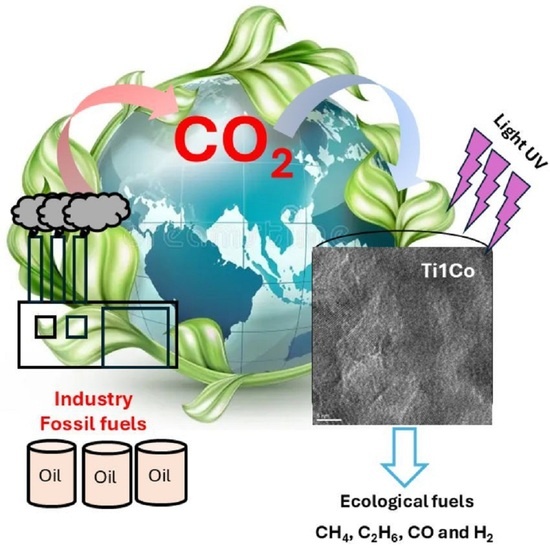
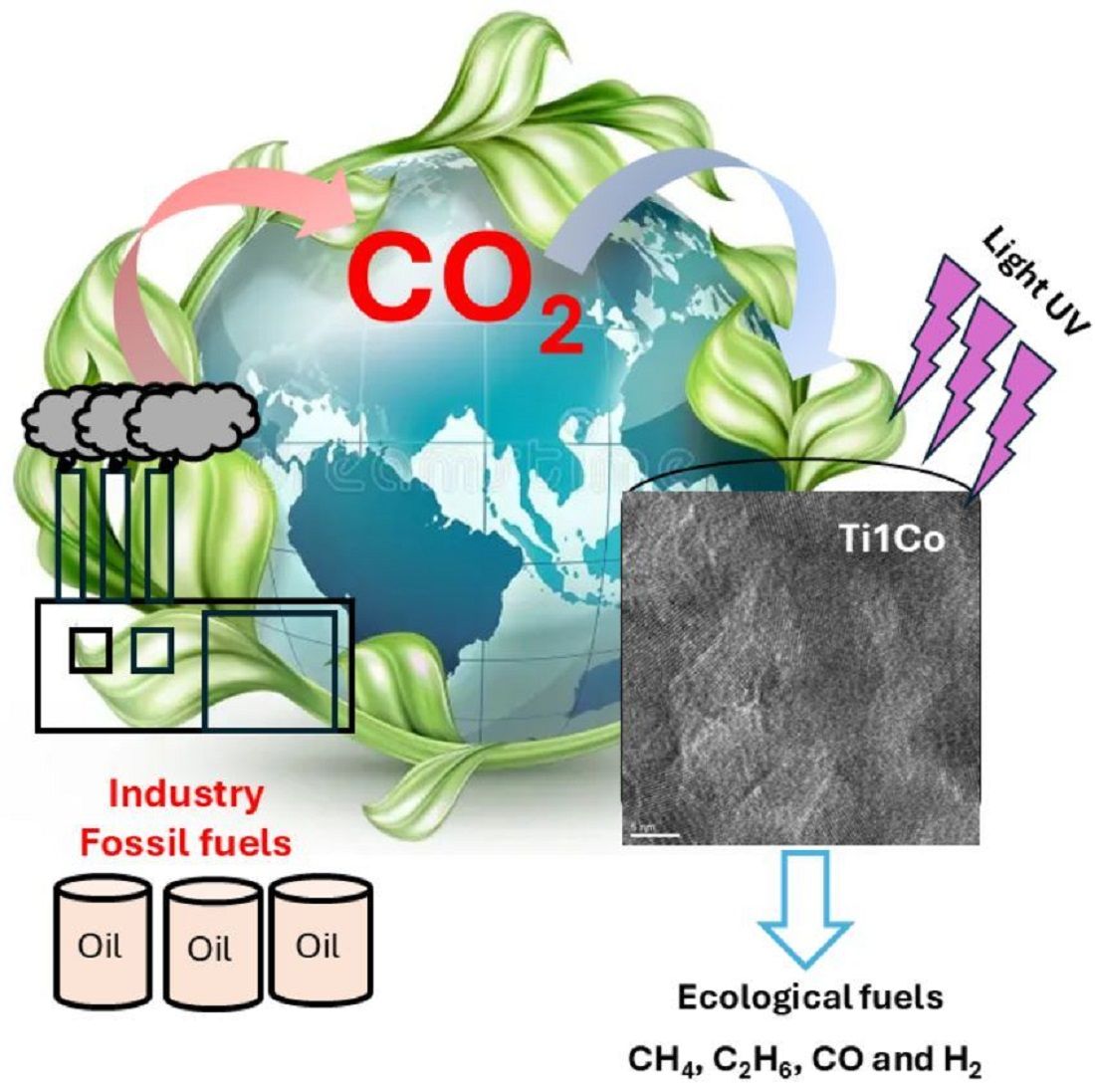
In this sense, cobalt has two valence states (Co3+ and Co2+) and these states can directly affect the migration of charge carriers (e/h+), which can serve as an electron trap and thus reduce the recombination of charge carriers and increase photocatalytic efficiency [21,22,23]. Therefore, in this work, nanomaterials based on TiO2 modified with different mol% of cobalt were synthesized by the sol–gel method. Nanomaterials were tested by photocatalytic reduction of CO2 to obtain chemical compounds with high added value, such as CH4, C2H6, CO, and H2 at room temperature under a UV light source. The objective is studying the effect of adding different mol% of cobalt to TiO2 on its structural, optical, and morphological properties and to correlate them with the photocatalytic reduction of CO2. Likewise, the possible photocatalytic mechanism by which the CO2 reduction reaction is carried out in the Ti1Co nanomaterial is proposed.

2. Results

2.1. X-Ray Diffraction (XRD)

X-ray diffraction (XRD) patterns of the photocatalysts calcined at 400 °C cobalt-free Ti0Co (TiO2) and doped with different TiXCo contents, where X = 0, 1, 3, 5, and 10% mol% cobalt, can be observed in Figure S1 (Supplementary materials). In the diffractograms (see Figure S1) obtained for the TiXCo nanomaterials, seven peaks located at 25.28°, 37.80°, 48.05°, 53.89°, 55.06°, 62.69°, and 75.03° can be observed as a function of the angle 2θ, which correspond to the planes (101), (004), (200), (105), (211), (204), and (215) that are characteristic of TiO2 in anatase phase whose diffraction card is JCPDS 21-1272 Quality Star (*). Likewise, a peak located at 30.8° can be observed as a function of the angle 2θ, which corresponds to the (121) plane that is characteristic of TiO2 in the brookite phase whose diffraction card is JCPDS 29-1360 Quality Star (*). In our photocatalysts, a mixture of TiO2 phases was obtained, this mixture of crystalline phases of TiO2 depends on the synthesis method, dopant content, precursor type, and the temperature at which the different nanomaterials are thermally treated, as reported by several authors [17,24,25,26]. In nanomaterials, the incorporation of different mol% of cobalt to TiO2 does not significantly influence the crystallization process of the crystalline phases of TiO2 (anatase and brookite); the production of these phases is due to the preparation conditions, aging time, and calcination temperature of our photocatalysts synthesized by the sol–gel method compared to what has been reported [24,27]. Also, in the different X-ray diffraction patterns of the TiXCo photocatalysts, no other secondary phases correlated to the production of rutile phase, metallic cobalt, or cobalt oxides (CoO, Co(OH)2 and Co3O4) were observed. In the diffraction patterns of our photocatalysts, a shift in the anatase peak (101) was not clearly observed because there is a mixture of phases (anatase and brookite), attributed to the overlap of the planes (101) of anatase and (120) and (111) of brookite, contrary to what was previously reported in other works where only the anatase phase was obtained [16,17,28]. On the other hand, a notable change in the decrease and widening of the diffraction peak was observed in the (101) plane of anatase and (121) of brookite due to the incorporation of different contents in mol% of cobalt (TiXCo); this effect is correlated to the incorporation of Co2+ into the structural lattice and to the structural irregularity of TiO2 as a consequence of cobalt doping [28,29,30,31]. The existence of a small proportion of cobalt oxides can also be considered, since they are not detectable due to the detection limit and the normal measurement of XRD.
In order to confirm the insertion of cobalt to the crystalline structure of TiO2 and the non-segregation of cobalt oxides, and verify the respective lattice parameters, crystal size, and relative composition of each of the phases identified by XRD, it was necessary to perform the Rietveld refinement to the TiXCo photocatalysts.

2.2. Rietveld Refinement

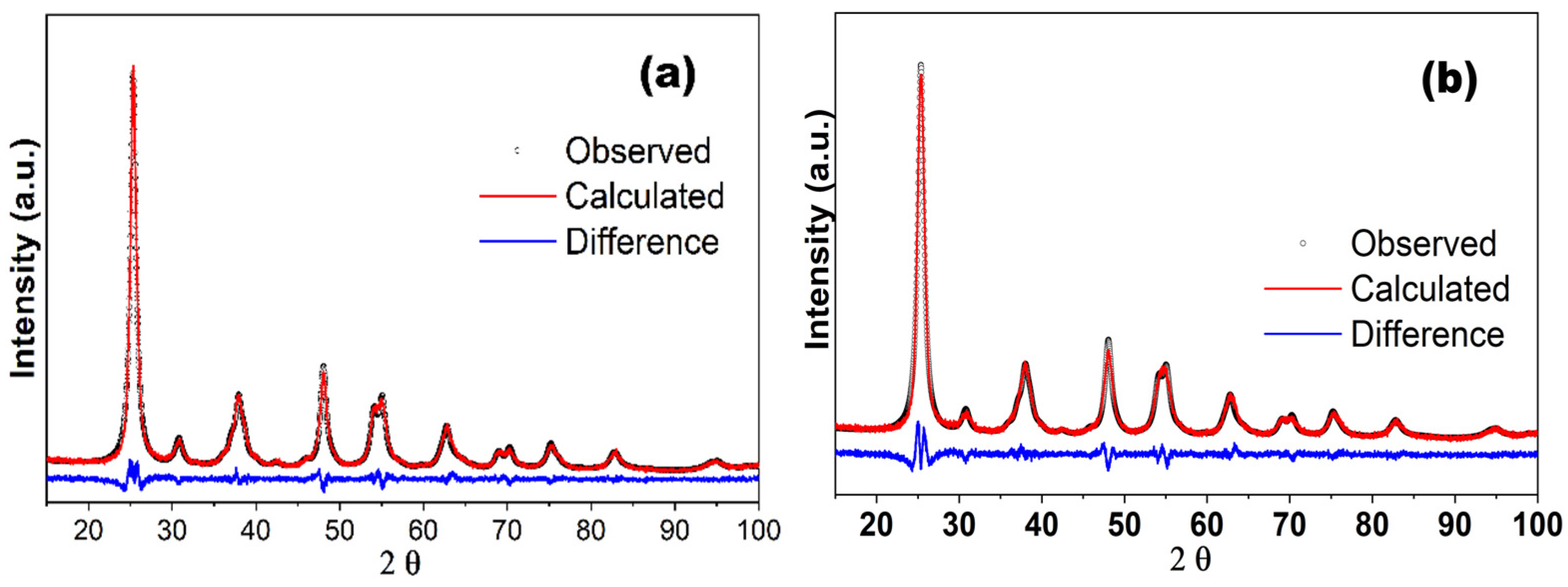
Characterization of diffraction patterns by Rietveld refinement is used to understand the effect of cobalt doping on TiO2 in TiXCo nanomaterials. To obtain the refined diffraction patterns, their symmetry and respective space group were used: tetragonal and I41/amd (anatase) and orthorhombic Pcab (brookite). In Figure 1, the diffraction patterns obtained from the Rietveld method of Ti0Co (Figure 1a) and Ti1Co (Figure 1b) are shown, and for Ti3Co, Ti5Co, and Ti10CO they are shown in Figure S2. The information obtained from the refined patterns confirms that there is only a mixture of TiO2 phases (anatase and brookite) and that there is no segregation or detection of cobalt oxides (CoO, Co(OH)2, Co3O4, or metallic cobalt) due to the synthesis method and thermal treatment in the photocatalysts (TiXCo) [28,30,31,32,33]. Table 1 shows the results of cell parameters, crystal size, cell volume, and relative composition of each of the phases in the TiXCo photocatalysts obtained from the Rietveld refinement.
The results obtained from the Rietveld refinement show that the incorporation of different cobalt contents (mol%) into TiO2 modifies the lattice parameters, crystal size, relative composition, and cell volume of both TiO2 phases (anatase and brookite) as the mol% of cobalt increases. The increase in the lattice parameters in anatase (a and c) and in brookite shows a decrease in parameter (a) and (b and c) an increase; it is attributed to the substitution of the dopant in the TiO2 structure (see Table 1) by the following: the ionic radius of Ti4+ in an octahedral coordination is 0.605 Å and the ionic radii of Co2+ and Co3+ in an octahedral coordination are 0.65 Å and 0.545 Å, respectively [28,31,34,35]. The increase in the lattice parameters can also be associated with a higher ratio of Co2+/Co3+ species within the TiO2 structure due to the difference in their ionic radii compared to Ti4+ [23,35]. Cobalt substitution, regardless of the species incorporated into the structural lattice, promotes oxygen vacancies to compensate for the charge difference in TiO2 [23,31,32]. Another effect that must be considered is the decrease in crystal size due to the increase in the mol% of cobalt, which is in the range of 9.3–10.6 nm compared to the Ti0Co reference; this decrease is correlated to the insertion of cobalt into the TiO2 structure (see Table 1). The relative compositions of the anatase and brookite phases range from 80% to 20%, respectively. This is correlated with the addition of cobalt to the TiO2 structure, the synthesis method, reaction conditions, and aging time. Another factor that must be considered is the increase in the volume of anatase and brookite as a function of the cobalt content (mol%); this is attributed to the incorporation of cobalt into the TiO2 structural lattice, so this effect coincides with Vegard’s law [23,31].

2.3. X-Ray Photoelectron Spectroscopy (XPS)

The measurements carried out using XPS were to determine the chemical states (oxidation states) of the elements that make up the TiXCo photocatalysts. Survey spectra of the TiXCo series (X = 0, 1, 3, 5, and 10% mol cobalt) are shown in Figure S3a. In the TiXCo survey spectra, peaks are presented that are correlated to the elements C, Ti, and O, and only the peak based on the cobalt (Co) content in the nanomaterials is presented, and there is no other element detected in the survey spectra that functions as an impurity in our photocatalysts. The calibration performed to obtain the high-resolution spectra was with respect to C 1s (see Figure S3b), with a binding energy of 284.5 eV.
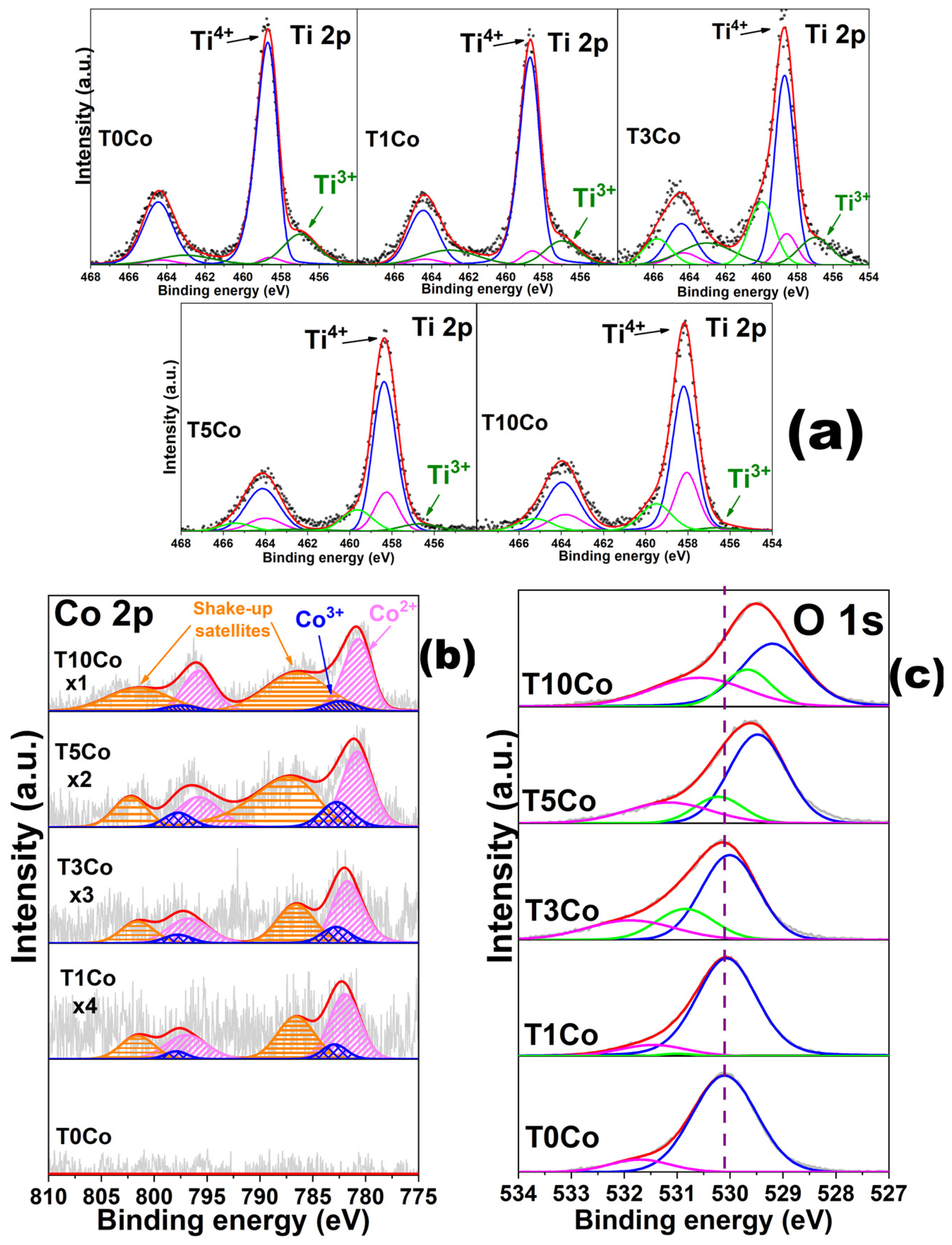
High-resolution spectra of Ti 2p, Co 2p, and O 1s are shown in Figure 2a–c. The high-resolution XPS spectrum of Ti 2p (Figure 2a) of TiXCo photocatalysts shows two peaks corresponding to the Ti 2p3/2 and Ti 2p1/2 doublets. Subsequently, the deconvolution of the high-resolution spectrum in Ti 2p3/2 of our reference (Ti0Co) is performed and three peaks are obtained that are located at 458.7, 458.5, and 456.9 eV (see Table 2). The first two binding energies (BEs) are assigned to the anatase and brookite crystalline phase of TiO2 (Ti4+) and the third is assigned to Ti2O3 (Ti3+). The third contribution present in the reference nanomaterial is due to the preparation of the sample under ultra-high vacuum conditions and cleaning of the sample by Ar+, as reported in the literature [36,37]. The separation line in our analysis (DE) between Ti 2p3/2 and Ti 2p1/2 is 5.7 eV; this result is comparable with that reported by several authors in the literature [31,38,39,40]. Binding energies (BEs) obtained in the high-resolution spin–orbit coupling spectrum of Ti 2p as a function of the cobalt content (mol%) of the nanomaterials (TiXCo) decompose into four components with their respective relative abundances of each of them and exhibit a slight shift at low energy compared to our reference Ti0Co (see Table 2). The first two energies are associated with anatase and brookite TiO2 and are in the range of 458.5–458.1 eV and 458.3–458.0 eV, respectively. The third in the range of 456.8–456.6 eV is associated with Ti2O3 and, finally, the energies located at 459.9–459.5 eV are attributed to the TixOy species. The slight shift in binding energies in the different nanomaterials with different mol% cobalt is attributed to the insertion of cobalt into the lattice in both TiO2 crystal structures (anatase and brookite), as previously reported by various authors [29,40,41]. On the other hand, the incorporation of cobalt presents two phenomena: the first is reflected below 3% mol, where an increase in the proportion of Ti3+ and the generation of the TixOy species is observed, and the second is observed above 5% mol of cobalt in which the proportions of Ti3+ and TixOy decrease and the proportion of brookite increases with the content of the mol% of cobalt; this can be attributed to the generation of oxygen vacancies by the insertion of cobalt into the TiO2 structure and in this way can generate surface and structural defects in nanomaterials. These results corroborate what was observed in XRD-Rietveld refinement.
High-resolution Co 2p spectra for all nanomaterials (TiXCo) can be observed in Figure 2b. The spectrum can be decomposed into two correlated contributions to Co 2p3/2 and Co 2p1/2 spin–orbital coupling. Deconvolution of Co 2p3/2 spin–orbital coupling reveals three peaks in each of the samples analyzed (see Figure 2b). The attribution of the first of the peaks found in the range of 782.9–782.4 eV (see Table 2) corresponds to Co3+ in the Co 2p3/2 spectrum. On the other hand, it is observed that there is another contribution in the range of 781.9–780.7 eV, which is related to Co2+ in the same Co 2p3/2 spectrum and the last peak found at higher binding energy in Co 2p3/2 is associated with a satellite shake-up, which is attributed to the characteristic high spin signal of Co2+ [29,31,42,43]. The afore mentioned results of our analysis show us that we have a mixture of valences (Co2+ and Co3+); the separation between the spin–orbit coupling of Co 2p3/2 and Co 2p1/2 is 15.5 eV and is comparable with that reported in the literature by several authors [31,35,42]. No other contribution to the binding energy was detected from Co0 (metallic cobalt), Co(OH)2, CoO, Co2O3, and Co3O4 [40,44], and this fact is confirmed since no other surface segregated phase was observed in the different nanomaterials analyzed by XRD-Rietveld refinement analysis.
In Figure 2c the high-resolution O 1s spectra of our TiXCo nanomaterials can be observed. In Figure 2c, it can be observed that in the high-resolution O 1s spectrum of reference it is deconvoluted into two peaks that are located at 530.1 eV, associated with the structural oxygen (OL) belonging to TiO2, and 531.7 eV, attributed to the hydroxyl groups (Osurf) on the Ti0Co surface. In Figure 2c it can be observed that by adding different contents (mol%) of cobalt two effects can be seen and are attributed as follows: The first is in the oxygen associated with the structure (OL) is found in the range of 530.0–529.2 eV and the surface hydroxyls (Osurf) 531.4–529.7 eV when compared with Ti0Co. The second effect that can be observed is the formation of a species corresponding to the peak found in the range of 531.0–530.6 eV, which is associated with the formation of oxygen vacancies and defects (Ovac) in the TiO2 structure. The high-resolution spectrum of O 1s shows the effect of the decrease in the binding energy, which is attributed to the insertion of cobalt in the structural lattice, formation of oxygen vacancies in TiO2, and the formation of the Ti-O-Co bond, as can be seen in Table 2; our results agree with what has been reported in the literature [35,40,45].

2.4. Raman Spectroscopy

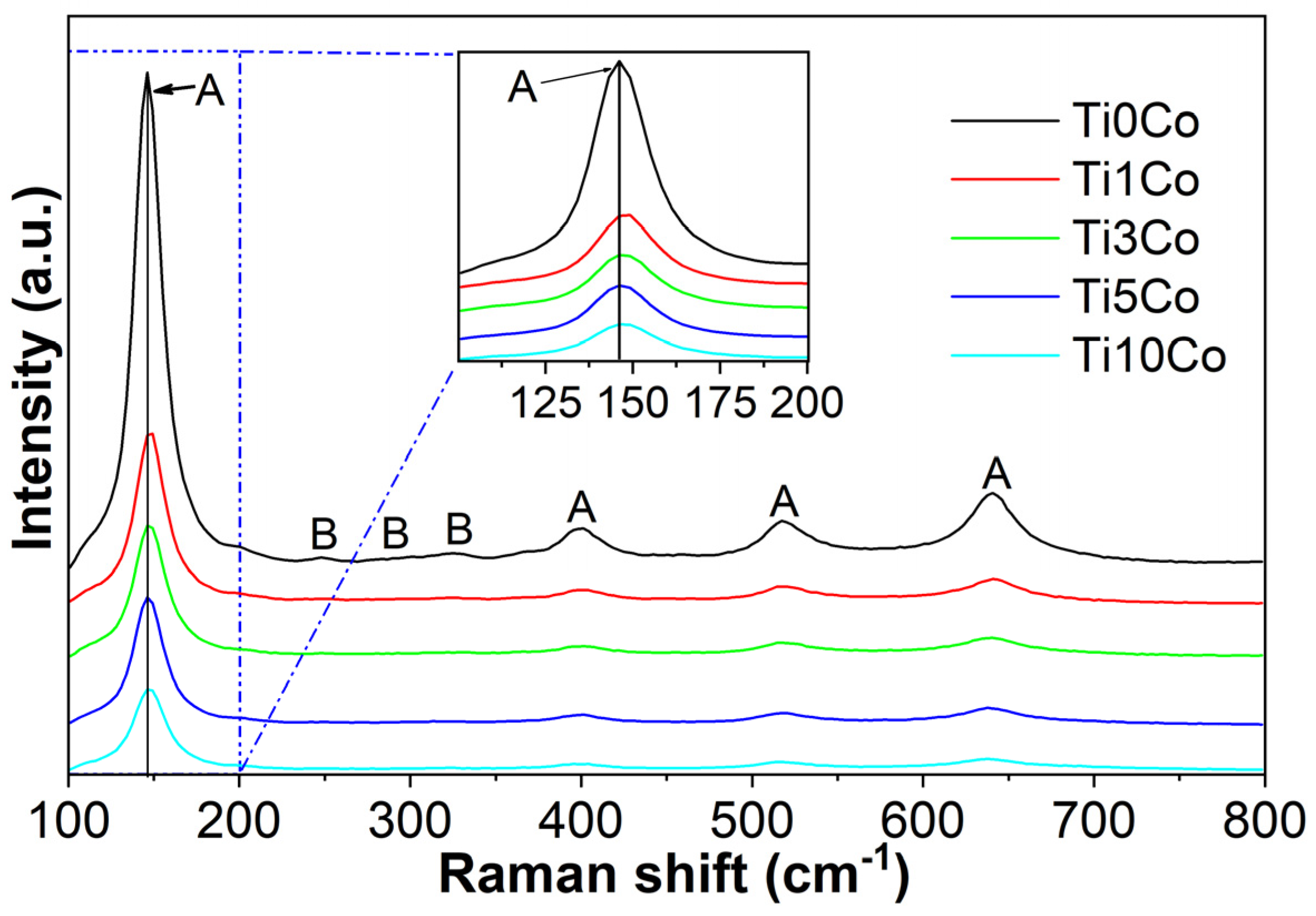
Raman spectroscopy was used as an additional tool to observe the crystalline phases, disorder, and defects that are generated by incorporating a dopant into the TiO2 (Ti0Co) structural lattice. Measurements were made at room temperature in a range between 100 and 800 cm−1. The six characteristic vibration modes of the anatase phase according to the literature are located at 144, 197, 399, 514, 519, and 640 cm−1 [23,31,46] and the characteristic bands of the brookite phase are reported at 128, 135, 153, 172, 195, 214, 247, 288, 322, 412, 454, 461, 502, 545, 585, and 636 cm−1 [47,48]. Figure 3 shows the Raman spectra of TiXCo nanomaterials. For our reference Ti0Co (TiO2), the vibration modes located at 145, 398, 517, and 639 cm−1 are observed, corresponding to TiO2 in the anatase phase (see Figure 3, symbol A). Also in Ti0Co, three additional vibration modes are observed and are located at 248, 287, and 324 cm−1 (see Figure 3, symbol B), which correspond to the brookite phase of TiO2; these results confirm that there are only two phases and that there is no segregation of cobalt oxides or any other phase of TiO2, so these results coincide with what was observed in DRX-Rietveld refinement. For nanomaterials doped with different contents (mol% of cobalt TiXCo, see Figure 3), it is observed that the intensity of the most intense peak around 145 cm−1 decreases as a function of the cobalt content and exhibits a blue shift when compared to Ti0Co (Figure 3 inserted). This effect is attributed to the formation of oxygen vacancies, distortion of the structural lattice, phonon confinement effect, and the broadening of vibration modes because of the incorporation of cobalt atoms into the TiO2 structure [23,31,38]. Moreover, it is worth mentioning that despite the decrease in the intensity of the maxima as Co concentration increases, their relative intensities remain almost unchanged, as it is unveiled in the normalized Raman spectra depicted in Figure S4 (Supplementary Information). This is consistent with the results of the X-ray diffraction pattern analysis; namely, there are similar concentrations and crystallite sizes of the anatase and brookite phases for all samples.

2.5. Diffuse Reflectance (DRS)

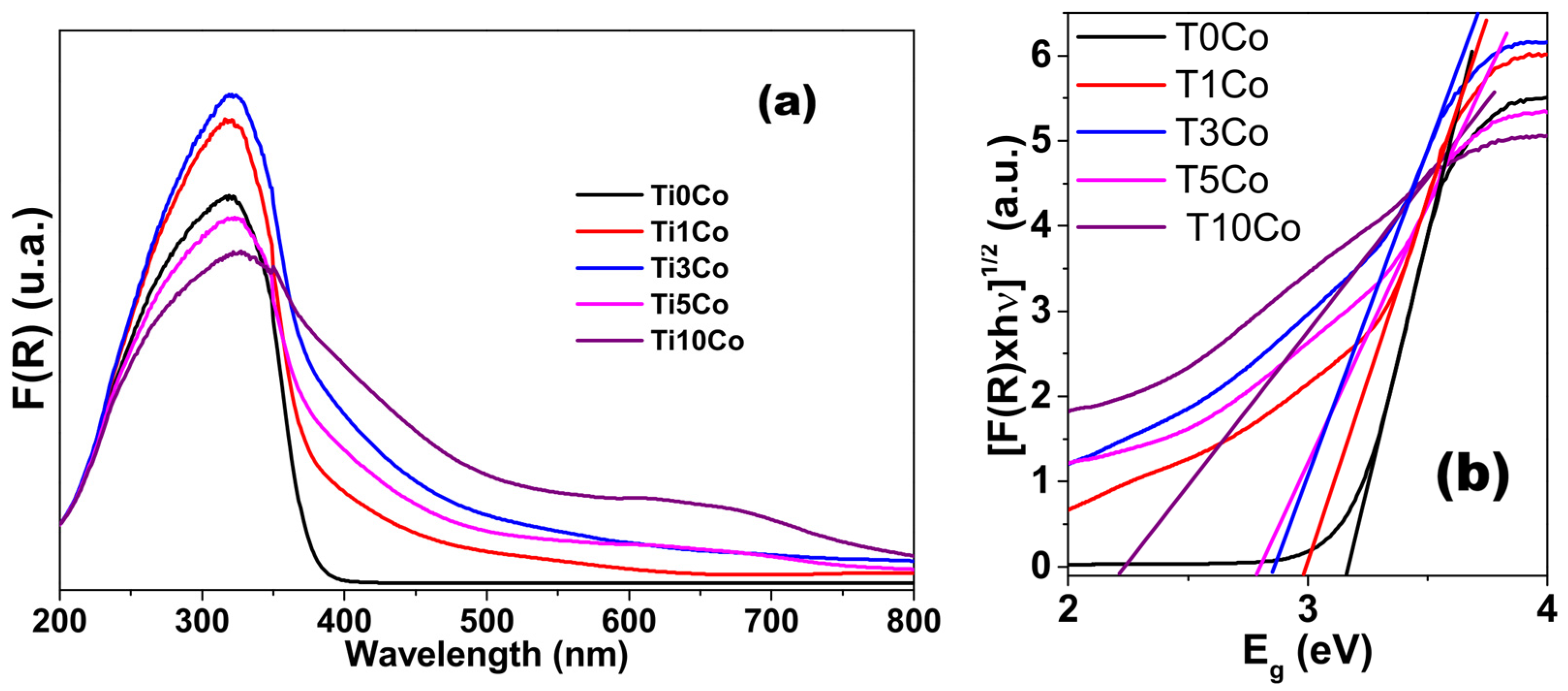
UV–Vis spectroscopy allows the study of optical transitions and defects caused by the incorporation of a dopant into the crystalline structure. The diffuse reflectance spectra of the synthesized TiXCo nanomaterials, where X = 1, 3, 5, and 10% mol of cobalt, are shown in Figure 4a. The absorption spectrum of the Ti0Co nanomaterial has an absorption edge around 380 nm, which is related to the charge transfer from the valence band (O 2p) to the conduction band (Ti 3d) and commonly has an absorption edge in the UV region and no absorption in the visible region, as has been reported in the literature [31,35,40].
In the different TiXCo nanomaterials with different mol% of cobalt, it can be observed (see Figure 4a) that the absorption edges are modified with a slight shift towards the visible region. This shift in cobalt-modified nanomaterials (TiXCo) is associated with the incorporation of cobalt into the TiO2 structural lattice and has been commonly explained because of exchange interactions between electrons located in the sp-d band and electrons located in the d band of the dopant cation (cobalt). These interactions between the s-d and p-d bands cause a decrease in the conduction band edge and an increase in the valence band edge, causing a decrease in the band gap, as reported in the literature [29,31,49].
Two effects of the incorporation of cobalt to TiO2 can also be observed in Figure 4a: The first is the increase in the absorption in the range of 400–700 nm as a function of the cobalt content in the visible region compared to Ti0Co, this is correlated to the transition of the ligand field of Co2+/Co3+ in an octahedral coordination and will experience a strong crystalline force due to the surrounding oxygens so that the states of the d band will be divided into fundamental and excited states, generating an electronic d-d transition that is localized in the visible region, since the Ti4+ coordination has an octahedral coordination in TiO2 [29,40,42]. The second can be observed below 400 nm; it is observed that below 3% mol of cobalt there is an increase in absorption in the UV region and above 5% mol of cobalt there is a decrease in UV absorption; this can be correlated to the relative concentration of the Co2+/Co3+ species according to the XPS analysis and to the different species with their relative concentrations of TiO2.
The values of the band gap energies (Eg) of the TiXCo nanomaterials are used in Figure 4b using the Kubelka–Munk (K-M) function at F(R). Obtaining F(R) uses Equation (1):
α/s = [(1 − R)2/2R] = F(R)
where R is the reflectance and F(R) are proportional to the ratio α/s. To obtain the Tauc’s plot, Equation (2) is used to obtain Equation (3).
hν)1/n = A(hν − Eg)
[F(R) × hν]1/n = A(hν − Eg)
where h is the Planck constant (J.s), hν is the photon energy, and n is the coefficient associated with an electronic transition for an interband transition (n = 2 for indirect transitions). To find the values of Eg, they are calculated by extrapolating the absorption edge using a line that intercepts the X axis. The values found for the different TiXCo nanomaterials are shown in Table 3. The decrease in the band gap as a function of the cobalt content modifies the values and they are in the range of 2.98–2.20 eV (see Figure 4b and Table 3). This decrease in the forbidden band width causes a slight blue shift and improves the absorption in the visible region compared to the pure TiO2 material with a value of Eg = 3.16 eV (Ti0Co). This is due to the pseudo-octahedral coordination that Co2+ possesses when it is replaced by Ti4+ in the TiO2 structural lattice, inducing intermediate states in the forbidden band and the exchange interactions between the bands (sp-d) of the structural network (sp) and the dopant (d). The Eg values obtained from TiXCo nanomaterials in our work are like the values reported in the literature [32,35,38,41,50].

2.6. Energy-Dispersive X-Ray-Scanning Electron Microscopy (SEM-EDS)

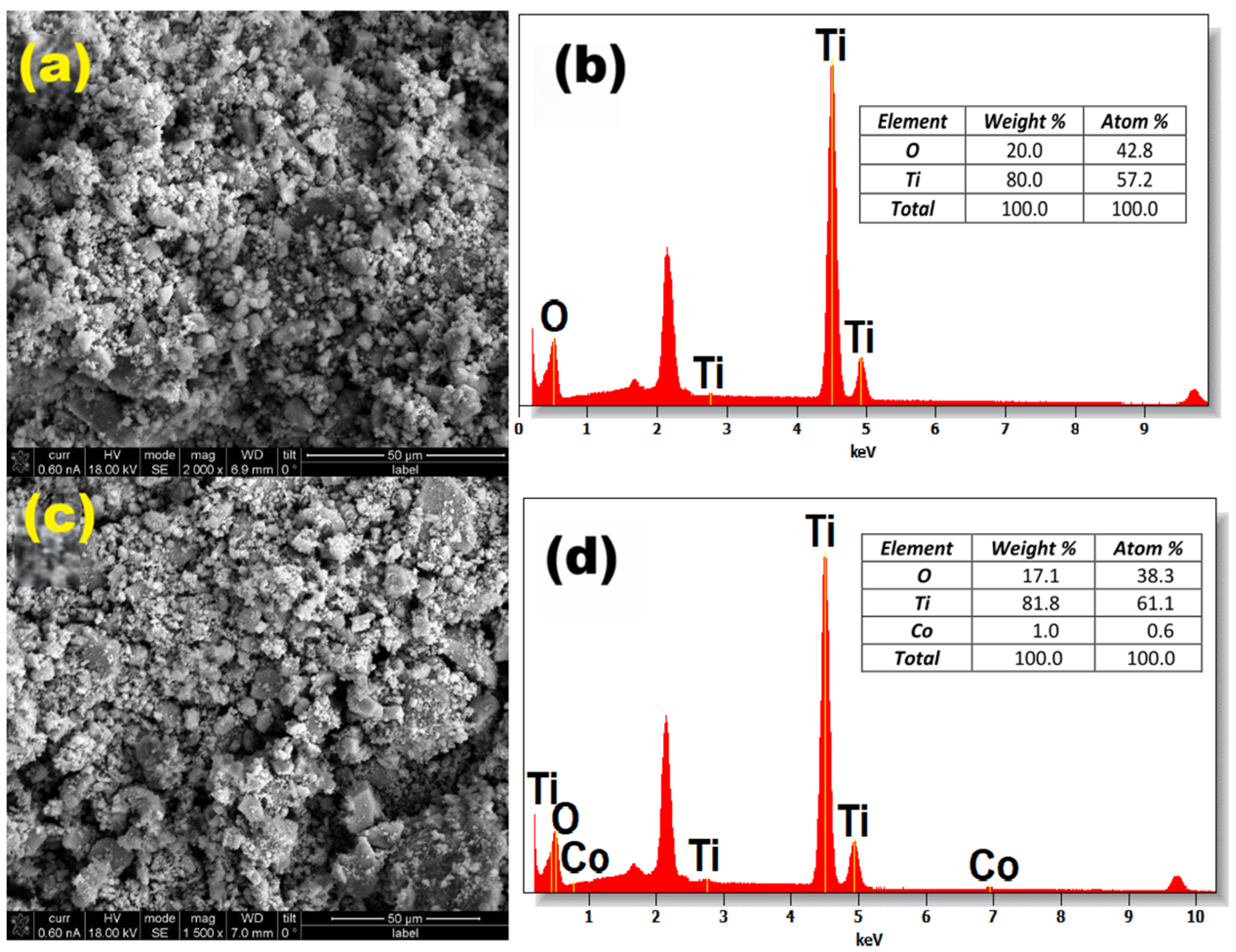
In Figure 5, the SEM images of the Ti0CO (Figure 5a) and Ti1Co (Figure 5c) materials can be observed. The morphology of the particles in the Ti0Co nanomaterial shows that they are agglomerated particles with semi-spherical and non-regular shapes. The incorporation of 1% mol of cobalt to TiO2 (Ti1Co) is observed in the same way: the particles are of non-regular semi-spherical shape and there is no significant change in the morphology due to the incorporation of 1% mol of cobalt to the TiO2 structure; this can be correlated to the fact that there is a mixture of phases and that a heterojunction (anatase and brookite) is formed between them, not allowing a notable morphological modification, contrary to what has been reported in the literature, where the addition of cobalt to TiO2 is morphologically modified and suffers an increase in the size of the nanoparticles [35,41,44,49].
The nanomaterials Ti0Co (Figure 5b) and Ti1Co (Figure 5d) are analyzed using EDS. The analysis provides information on the composition and presence of each of the atoms that make up the nanomaterials studied. The elemental analysis of the TiO2 nanomaterial can be observed in Figure 5b and only the presence of Ti and O is obtained with a composition of 80% and 20% by weight and 57.2 and 42.8% atomic; no other element corresponding to impurities that could come from the precursors used in the synthesis of our nanomaterial were presented.
Elemental analysis by EDS of the nanomaterial containing 1% mol of cobalt (Ti1Co) confirms that it only contains the presence of Ti, O, and Co, with the corresponding compositions of 17.1%, 81.8%, and 1.0% by weight and 38.3%, 61.1%, and 0.6%, and there is no evidence of external impurities to the nanomaterial. The value obtained from the EDS analysis with respect to the mol% of cobalt (Ti1Co) is below that added (1% mol cobalt); this can be correlated to the fact that the cobalt is dispersed in the structural lattice and does not form segregated cobalt oxide on the TiO2 surface. This fact is corroborated by Rietveld refinement and Raman, by not presenting reflection intensities as a function of 2q and vibration modes corresponding to cobalt oxide.

2.7. TEM-HRTEM

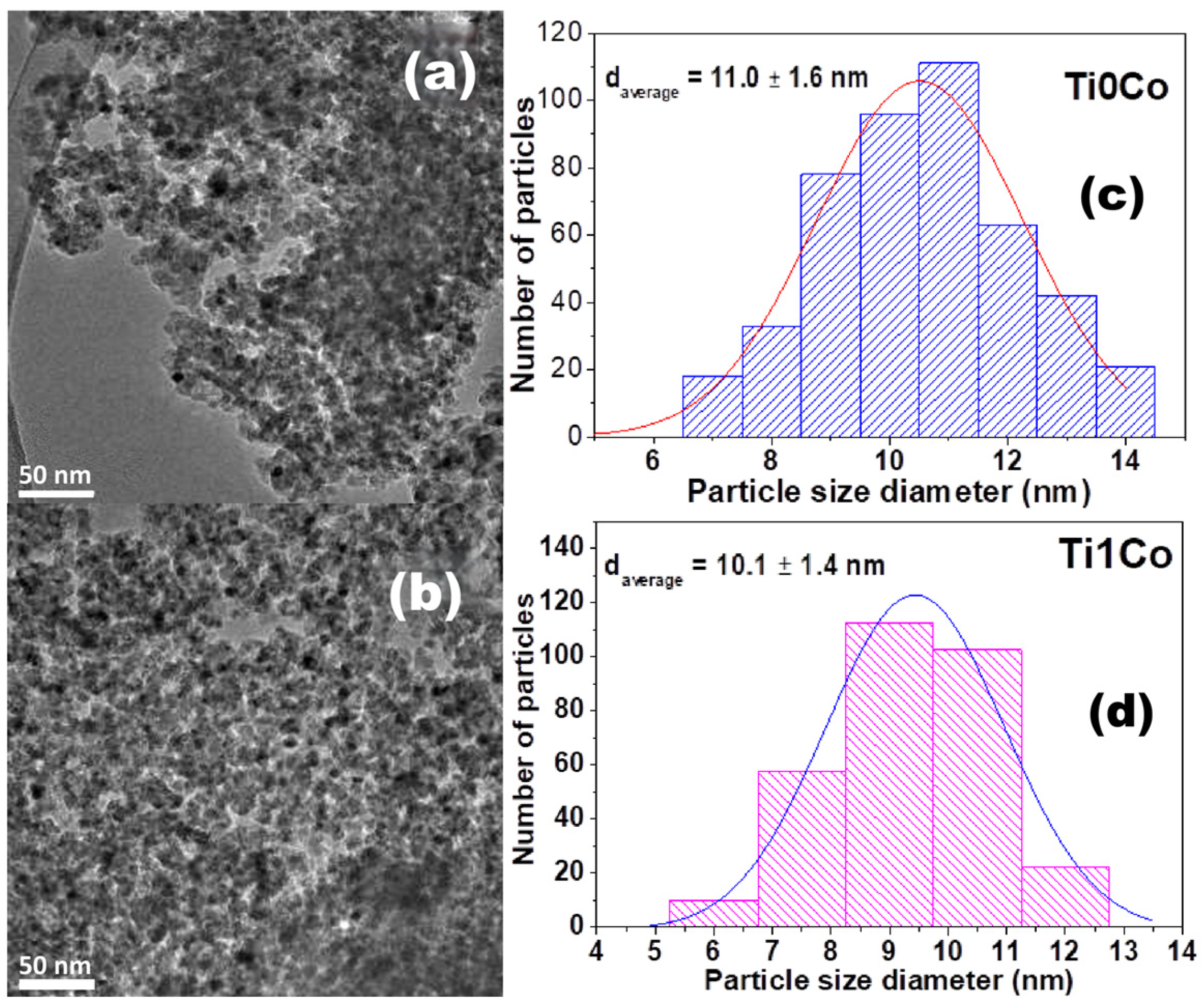
Figure 6 shows the TEM micrographs of the nanomaterials Ti0Co (a) and Ti1Co (c). From the TEM analysis of Ti0Co and Ti1Co (see Figure 6a,b, it can be observed that both samples have semi-spherical particles with uniform sizes; this can be attributed to the synthesis method and the low calcination temperature (400 °C). To obtain an estimate of the crystal size distribution, approximately 250 particles were counted in both TEM micrographs of Ti0Co and Ti1Co (see Figure 6c,d). The results obtained from the TEM analysis show that the average crystal size distribution lies approximately between 11.0 nm (Ti0Co) and 10.1 nm (Ti1Co).
Therefore, the addition of 1% mol of cobalt to TiO2 induces a reduction in crystal size when compared to Ti0Co. This fact is consistent with the results obtained by XRD-Rietveld refinement, where it is observed that the crystal size decreases as a function of the cobalt content. The effect of decreasing crystal size by incorporating an impurity as a dopant into the TiO2 crystal structure has been previously reported in the literature [24]. However, it has been reported in the literature that when cobalt is incorporated into TiO2, two effects are observed: the increase in crystal size with respect to the reference material [41,44,49] and the decrease in crystal size, as in our case. This effect shows that the incorporation of cobalt to TiO2 could be correlated with the following variables: precursors used, synthesis method, calcination temperature, and the different oxidation states of each of the species that make up the nanomaterials [30,33].
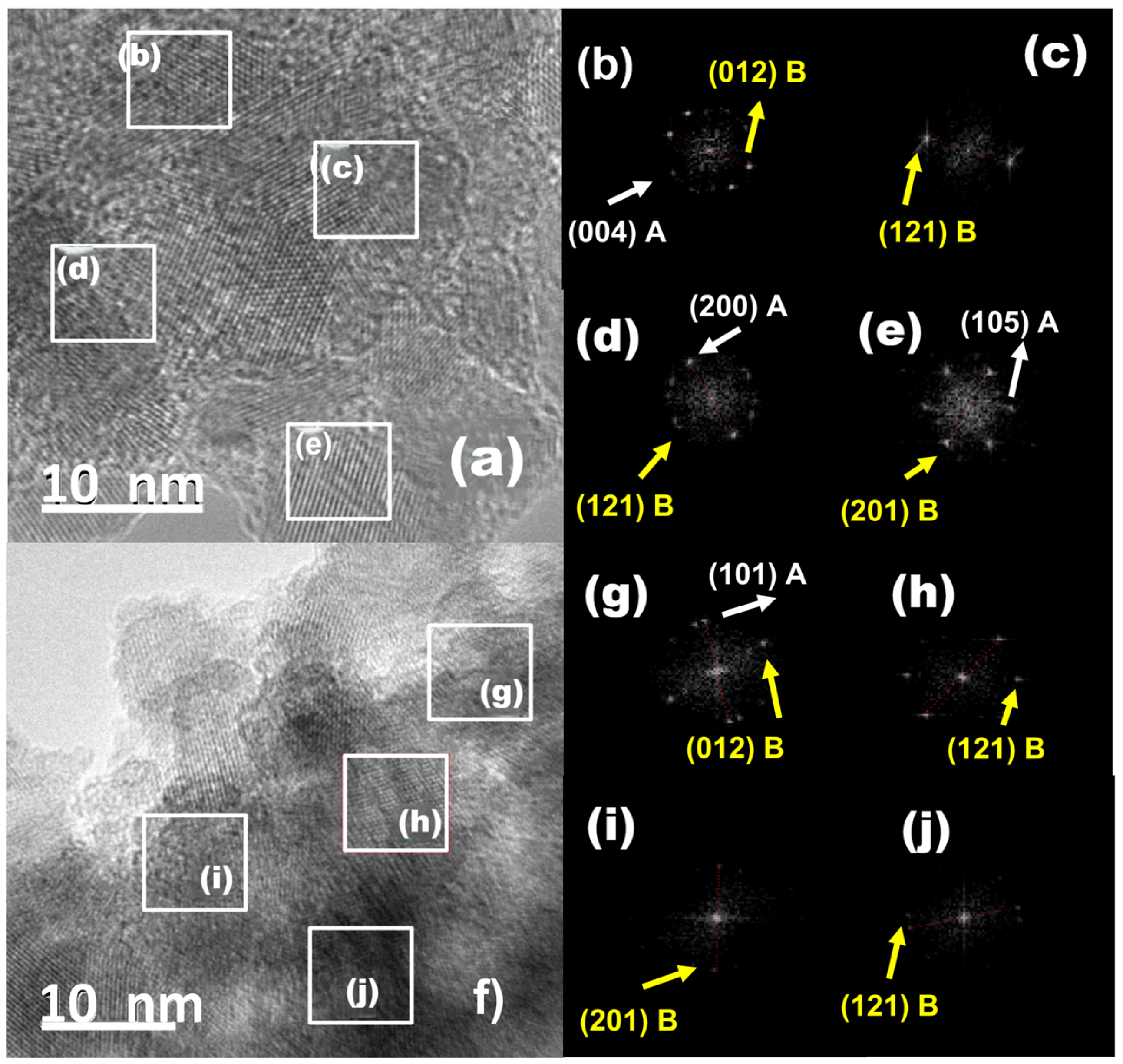
HRTEM micrographs (Figure 7) of the nanomaterials Ti0CXo (Figure 7a) and Ti1Co (Figure 7f) are shown. The analysis for each of the images is performed separately; subsequently, the different areas marked for Ti0Co, as shown in Figure 7b–e, and for Ti1Co, which are labeled as Figure 7g–j, were analyzed. For each of the selected areas, FFT-HRTEM is performed to obtain information on the different crystallographic planes belonging to each of the crystalline phases that constitute the nanomaterial. The first four areas analyzed in Figure 7b–e show six crystalline planes in the Ti0Co nanomaterial: the first three planes (012), (121), and (201) correspond to the interplanar distances 0.2476, 0.2900, and 0.2409 nm of TiO2 in the brookite phase (labeled as B in Figure 7), whose diffraction card is JCPS PDF-029-1360 Quality: Star (*) and the other three planes (200), (105), and (004) have distances of 0.1892, 0.1699, and 0.2378 nm that correspond to the TiO2 in the anatase phase (labeled as A in Figure 7), whose diffraction card is JCPDS PDF 021-1272 Quality: Star (*). Figure 7f shows the micrograph of the Ti1Co nanomaterial with the different analyzed areas labeled as Figure 7g–j and on the right side of the image the corresponding FFT-HRTEM of each analyzed area can be observed. In the four analyzed areas, four crystalline planes were obtained, as can be seen in Figure 7g–j, and they correspond as follows: the interplanar distances with values located approximately at 0.2480, 0.2988, and 0.2400 nm correspond to the planes (012), (121), and (201), belonging to TiO2 in brookite phase (B) associated with the aforementioned diffraction card. The (101) plane corresponds to the approximate interplanar distance of 0.3529 nm of TiO2 in anatase phase (A), which can be associated with the diffraction card. The values found in the FFT-HRTEM analysis of Ti1Co are slightly modified when compared with the values found in the JCPDS of brookite and anatase. No planes associated with crystallographic phases of CoO, Co3O4, or Co0 (metallic cobalt) were found; this is further evidence that cobalt is present in the structural lattice of TiO2, which is confirmed by XRD-Rietveld refinement and Raman, by the absence of cobalt oxides on the surface of TiO2.

2.8. Textural Analysis (Specific Areas Determined by BET Method)

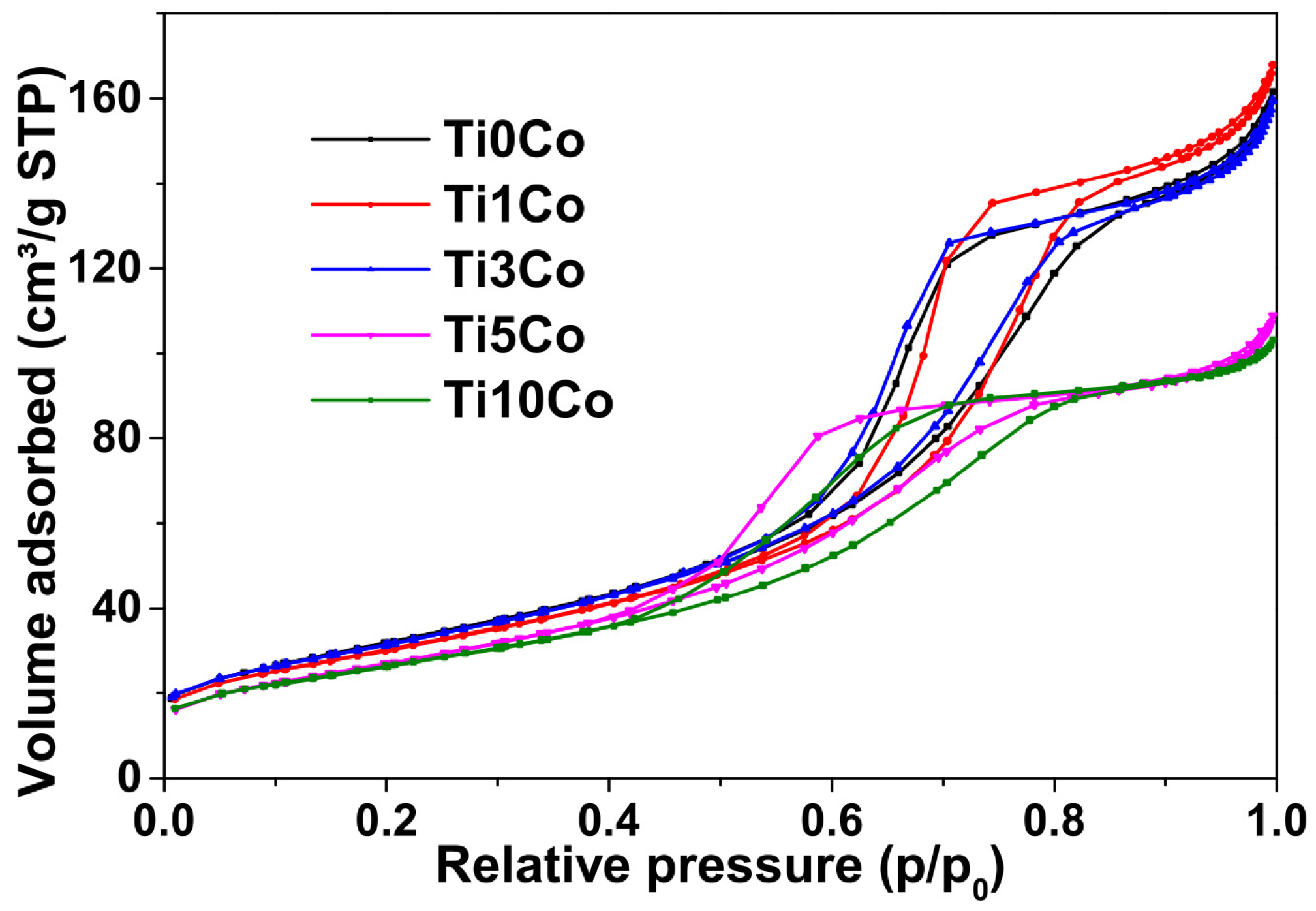
Figure 8 shows the N2 adsorption–desorption isotherms of the different TiXCo nanomaterials. The obtained parameters, such as the estimated BET area, the average pore size, and the pore volume of each of the nanomaterials, are shown in Table 3. The isotherms of TiXCo nanomaterials are associated with a type IV one that corresponds to mesoporous materials according to the IUPAC classification [51]; the same effect of having type IV isotherms with mesopores has been observed in TiO2 when modified by doping with metals [24,52]. The hysteresis loop for TiXCo nanomaterials is of type H2, which is characteristic of materials with a pore distribution with wide bodies and narrow necks according to the IUPAC classification [51]. In Figure 8, it is shown that for nanomaterials containing above 5% mol of cobalt, the hysteresis cycle is more pronounced because they have an increase in the narrow distribution of the pore necks, because of the increase in the amount mol% and by the synthesis method. The calculated BET surface area and pore size of the nanomaterials are summarized in Table 3. The incorporation of 1 mol% (Ti1Co) increases the surface area compared to Ti0Co; this same effect has been observed and reported in the literature [24]. However, in nanomaterials above 3% mol of cobalt, a decrease in the specific surface area is observed when compared to Ti0Co (see Table 3), which is attributed to the blocking effect on the TiO2 pores by the increase in cobalt.

2.9. Photoluminescence (PL)

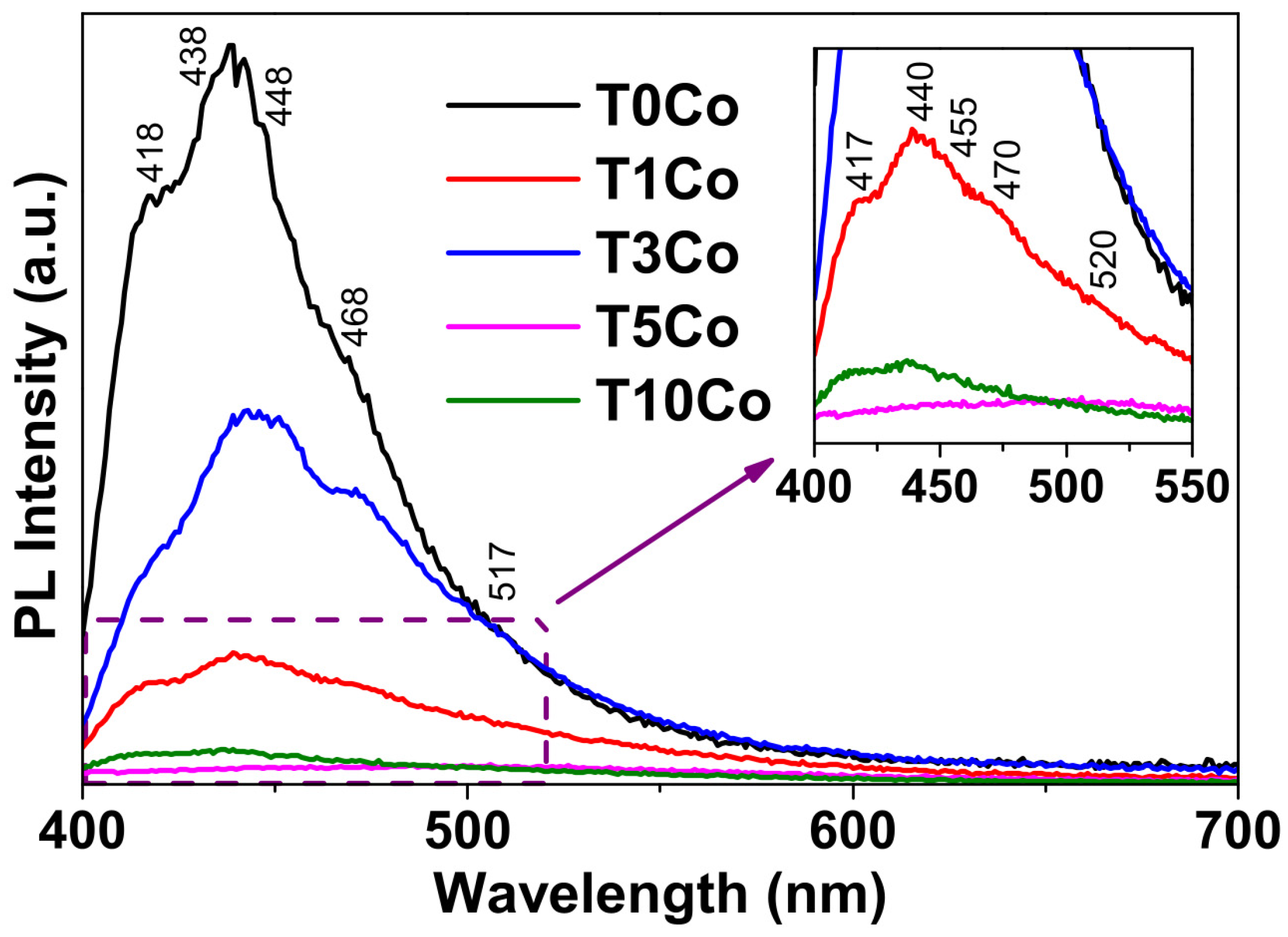
For the electronic properties, migration, and recombination of charge carriers and nature of defects in materials, it is necessary to perform and study photoluminescence (PL) spectra. Photoluminescence spectra of TiXCo nanomaterials are shown in Figure 9; all measurements were performed with an excitation wavelength of 370 nm at room temperature. Several authors report on the analysis of PL with different excitation lengths [30,31,32,35]. Therefore, in our work, the wavelengths attributed to each of the observed species will suffer a slight shift compared to what was reported and are attributed accordingly to each of them. The assignment of the PL signals obtained from our nanomaterials are assigned (see Figure 9) as follows: the first peak can be observed in all TiXCo nanomaterials located approximately at 418–420 nm, attributed to the excitons located at the TiO2 band edge; the two signals located in the range of 438–440 nm ARE assigned to self-trapped excitons in TiO6; the values between 448 and 490 nm are associated with charge transfer from Ti3+ to TiO2 and defects attributed to oxygen vacancies and finally; and the values located between 517 and 520 nm are attributed to F+ centers. Regarding the intensity of the PL spectra (see Figure 9), it decreases according to the following order from highest to lowest: Ti0CO, Ti3Co, Ti1Co, Ti10Co, and Ti5Co. The results obtained according to the reduction in the intensity of the PL spectra indicate that the incorporation of cobalt into TiO2 inhibits the recombination process of the charge carriers and thus improves the photocatalytic activity of the nanomaterials [30,32].

2.10. Electrochemical Tests

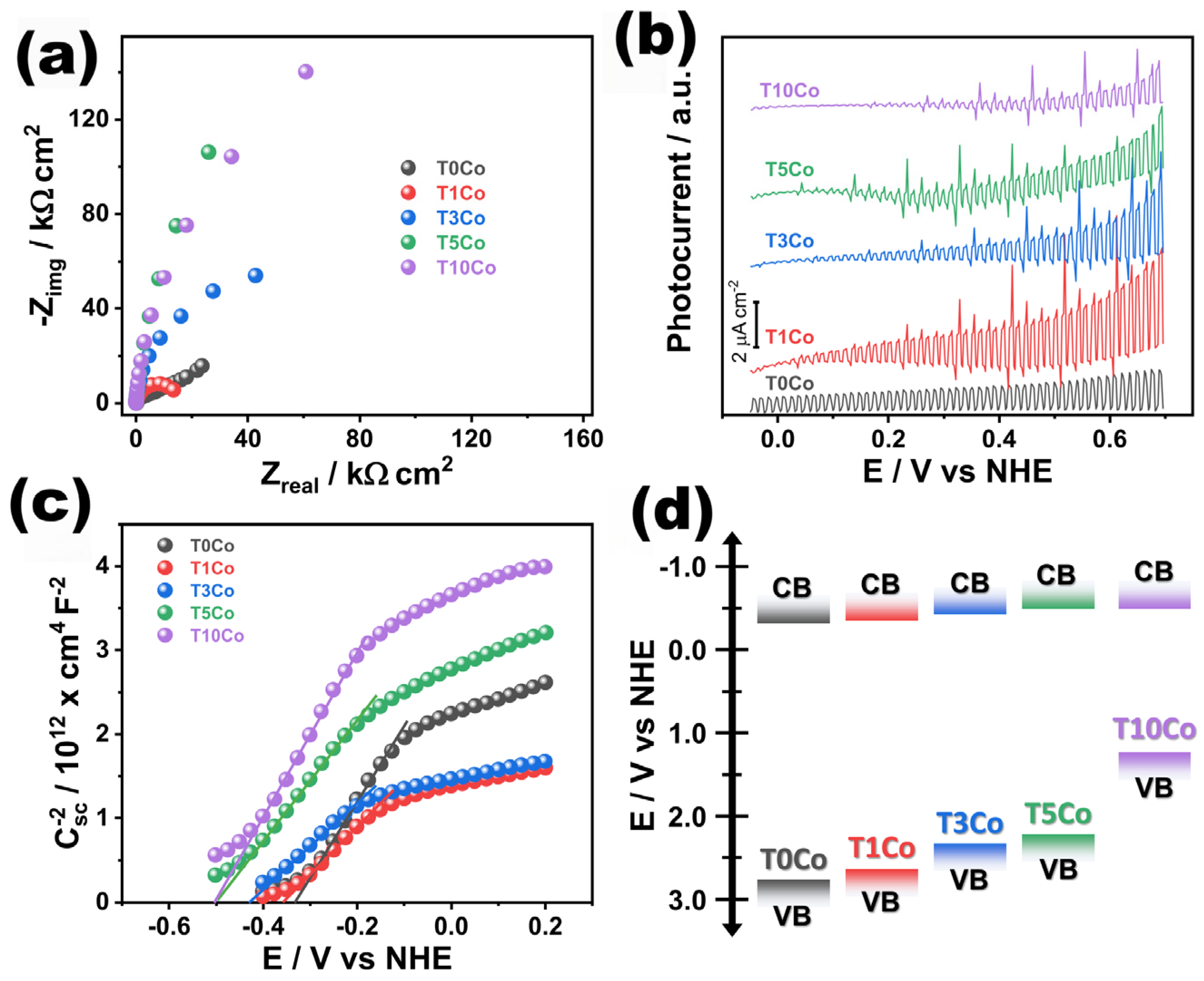
Electrochemical techniques are powerful tools for obtaining information regarding the impact of illumination on the performance of the photocatalysts and their band-edge positions. Figure 10a shows the Nyquist diagrams recorded at open-circuit potential under illumination. Doping with cobalt at 1% mol of TiO2 (Ti1Co) causes a reduction in the impedance values compared to bare Ti0Co. However, the impedance value continuously increases at higher cobalt contents, hindering the charge transfer reactions at the film/electrolyte interface. It is worth keeping in mind that the generation of value-added products from CO2 reduction depends on the mechanism of the reduction reaction and not on the rate of the process. On the other hand, photocurrent generation was evaluated using linear sweep voltammetry under chopped illumination, as seen in Figure 10b. TiO2 doping with cobalt increases the photocurrent generation at low contents, evincing favorable photon harvesting for T1Co. However, at higher cobalt contents, registered photocurrents drop, following a similar trend to what is registered by EIS.
The Mott–Schottky measurements in Figure 10c show that all photocatalysts exhibit a positive slope characteristic of n-type semiconductors [53]. The flat band potential of the TiO2, derived by extrapolating the linear region towards the potential axis, displaces towards more negative potential values as the cobalt amount increases. This variation indicates that cobalt doping induces energetic states close to the TiO2 conduction band. The band-edge position of the photocatalysts was schematized in Figure 10d by approaching the flat-band potential to the conduction band of the solid and estimating the valence band position by adding the band gap of the semiconductors [54]. Cobalt doping drives the conduction band toward more reductant potentials, favoring the reduction reaction over the photocatalysts. Meanwhile, the oxidant power of photogenerated holes in the TiO2 drastically decreases when increasing the cobalt doping, hindering the oxidation reaction of the solid, particularly at the highest cobalt doping amount. The combination of these two effects seems to be well-balanced at lower cobalt doping amounts, which resulted in advantageously obtaining value-added products from the photocatalytic CO2 reduction.

3. Photocatalytic CO2 Reduction

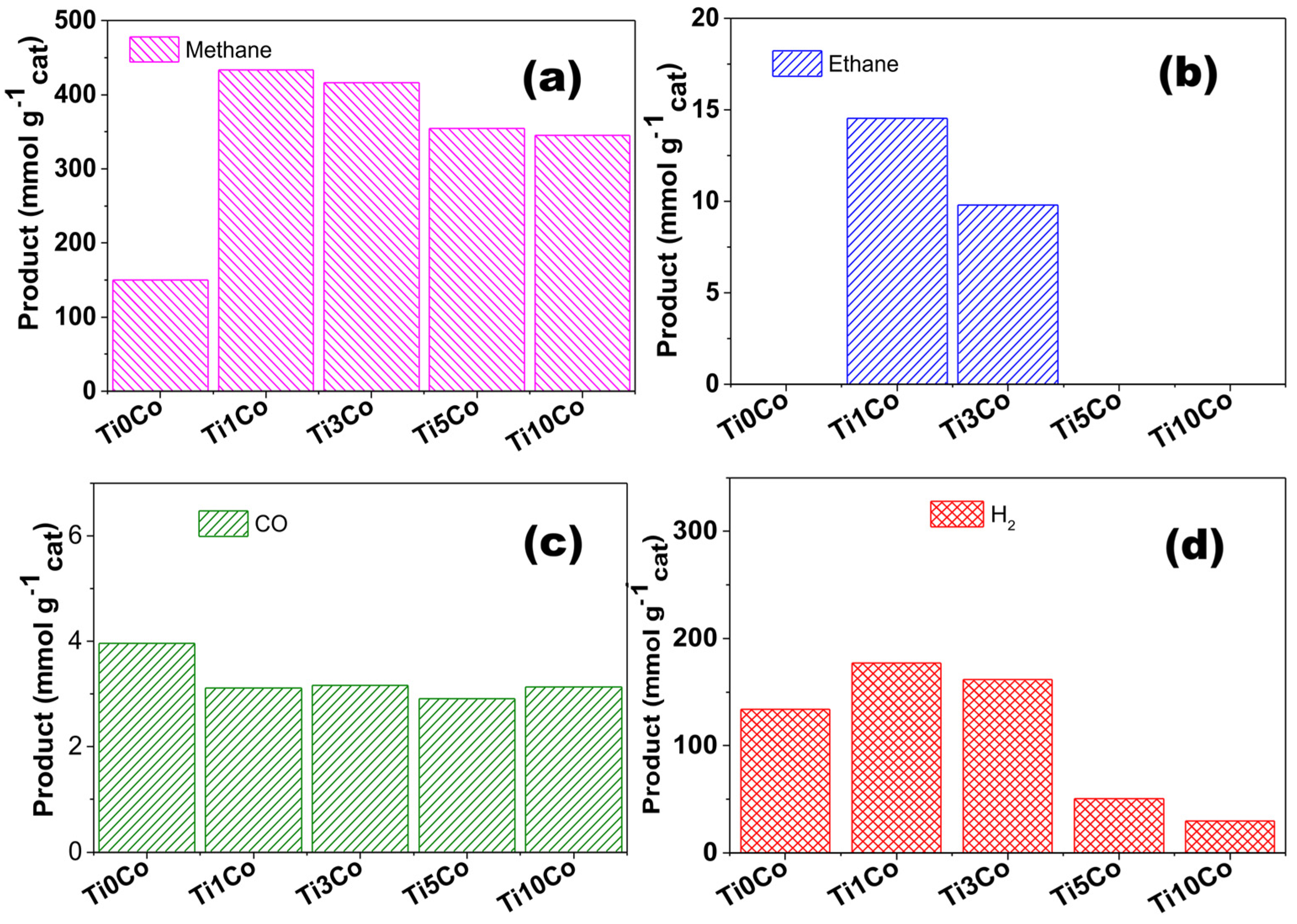
Photocatalytic evaluation of TiXCo nanocatalysts is by photoreduction of CO2 using a UV light source at room temperature for 6 h of reaction and injecting into a chromatograph each hour. Experiments were carried out in which it was verified that the CO2 reduction reaction does not involve organic remains on the surface of the nanomaterial. For this purpose, experiments were carried out separately: in darkness (the absence of light), without a photocatalyst, in the absence of CO2, and without a light. The results obtained do not show the generation of any carbon-based by-product after the reaction by organic residues found on the surface of the photocatalyst, as has been previously reported in the literature [24,46,55]. Figure 11a–d show the results of the by-products after photoreduction of CO2 at 6 h with a UV light irradiation source. The by-products after the photoreduction of CO2 are methane, ethane, carbon monoxide, and hydrogen. In Figure 11a–d, you can see the photoreduction of CO2 using Ti0Co (TiO2) was obtained as a product of the reaction CH4, H2, and CO; this can be attributed to the different redox potentials that each species has according to Equations (4)–(6), methane (150.2 mmolg−1cat), hydrogen (140.1 mmolg−1cat), and CO (3.9 mmolg−1cat), according to the literature [8,24,55,56].
C O 2 + 8 H + + 8 e           C H 4 + 2 H 2 O
2 H + + 2 e             H 2
C O 2 + 2 H + + 2 e         C O + H 2 O
The low production of methane as the main product of CO2 photoreduction is due to the rapid recombination of charge carriers in the reaction because there are no oxygen vacancies or structural defects that function as electron traps, and it also has an intense peak intensity in the photoluminescence spectrum (Ti0Co) compared to other nanomaterials. The intense peak has been reported in the literature to be associated with a high rate in the charge carrier recombination process; therefore, hydrocarbon production is very low using only TiO2 [28,57].
On the other hand, it can be observed in Figure 11a–d that the CO2 reduction reaction using nanomaterials with the incorporation of different mol% of cobalt (TiXCo) improves the photocatalytic activity with respect to Ti0CO. It can be observed that in nanomaterials with 1% and 3% mol cobalt, CH4, C2H6, H2, and CO are generated (see Table 4). In these nanomaterials, according to the results obtained with the different analyses performed, such as DRX-Rietveld, XPS, and UV–Vis, photoluminescence can be correlated to the production of the products by the photoreduction of CO2. DRX-Rietveld shows that the crystal size of both phases is in the range between 10 and 8 nm; a relative composition between 80 and 20% of anatase and brookite approximately and a modification of the unit cell volume occurs in both phases, causing a distortion of the lattice causing structural defects, so that in this way sites are generated that function as electron traps to improve the photoreduction of CO2 [27,57]. XPS can be observed (see Table 2) and it was found that Ti 2p species suffer a slight shift at low energy and the relative abundances of each species are affected by the incorporation of cobalt. Additionally, the relative abundance of Co3+/Co2+ species is in the range of approximately 30–70% and a relative ratio of oxygen vacancies is generated due to the incorporation of cobalt in each of the nanomaterials, all these factors mentioned above cause the recombination rate of the charge carriers to decrease with respect to Ti0Co [28]. Using UV–Vis, it can be observed that materials with 1 and 3% mol have a greater absorption of UV light due to the incorporation of cobalt with respect to Ti0Co. Photoluminescence shows that the incorporation of cobalt modifies the emission spectra, significantly decreasing the peak intensity. This indicates a marked increase in carrier separation efficiency compared to TiO2 (T0Co). This same effect has been observed using doping of TiO2 with metals and non-metals [9,24,46,55]. However, when comparing these two nanomaterials that generate the same products, Ti1Co is more active than Ti3Co, due to the lower peak intensity in Ti1Co than in Ti3Co; therefore, it has greater efficiency in the separation and migration of charge carriers (e and h+). Using electrochemical characterization, it can be observed that the conduction and valence band edges are modified by the incorporation of cobalt as a dopant, inducing energy levels below the conduction band, causing them to function as an electron trap and reducing the band gap, as can be seen in Figure 10d. In addition, it can be observed (Figure 10a) that Ti1Co presents a greater decrease in curvature; this indicates that it has less resistance in charge transport, which implies better separation and faster charge transport in the nanomaterial.
For nanomaterials with cobalt content above 5% mol, CO2 reduction shows that less CH4, CO, and H2 are produced, and there is no ethane (see Table 4). Incorporation of cobalt above 5% mol results in modifications to its structural properties, with a decrease in crystal size, crystalline phase composition, and unit cell volume. Using characterization by XPS, it can be observed that the species of Ti4+, Ti3+, and TixOy, Co3+/Co2+ are also generated and increase in oxygen vacancies is seen, each of the species mentioned above with its respective relative abundance. Using UV–vis, a decrease in the absorption intensity in the absorption spectra can be observed. Photoluminescence, although at higher content the intensity of the peak, decreases considerably and this results in a more efficient separation of the charge carriers; it implies that these species (observed in XPS) act as recombination centers for the charge carriers and thus reduce the photocatalytic efficiency of the nanomaterial.
Additionally, CO2 photoreduction experiments were performed to observe the effect of a light source in the visible region (Argon lamp) on TiXCo nanomaterials (same reaction conditions). Results obtained are shown in Table S1, which is included in the Supplementary Information.
The results (see Table S1) show low photoactivity in the photoreduction of CO2 using the visible light source in the production of methane, ethane, CO, and hydrogen when compared to the results obtained with the UV light source after 6 h of reaction. The low photoactivity of TiXCo nanomaterials using a visible light source is attributed to the fact that the abundance of the Ti3+ species decreases as a function of the cobalt content, thus modifying the defects that act as an electron trap during the photocatalytic process and additionally showing a higher resistivity, as shown in Figure 10a. Despite the observations in Figure 4a, where the nanomaterials show increased photon absorption in the visible region, a shift in the band gap (Eg), and decreased photoluminescence as a function of cobalt content (see Figure 9), they are not ideal for CO2 reduction to obtain methane, ethane, and CO using visible light.

Proposed Reaction Mechanism

Based on the results obtained from the various characterizations described above and the evaluation of the photocatalytic activity, a mechanism by which CO2 photoreduction with water is carried out on the synthesized nanomaterials can be proposed. The possible pathways that occur during CO2 photoreduction in our work are through the following reactions [7,10,28,58]:
T i O 2   + h v           T i O 2 e     +   T i O 2 h +
C o 3 + + T i O 2 e           C o 2 +   + T i O 2
C o 2 + + T i O 2 h +           C o 3 +   + T i O 2
2 H 2 O + 4 h +       O 2 +   4 H +
2 H + + 2 e   H 2
2 C O 2 + 2 e         2 · C O 2
· C O 2   + · C O 2 + 4 H +       2 C O + 2 H 2 O
C O + 2 H + + 2 e       · C + H 2 O
· C + 4 H + + 4 e     C H 4
C O 2 + 8 H + + 8 e     C H 4   + 2 H 2 O
2 C O 2 + 14 H + + 14 e   C 2 H 6     + 4 H 2 O
C H 4 + h +       · C H 3   + H +
· C H 3 + · C H 3     C 2 H 6
For the formation of products such as CO, CH4, and C2H6 during the CO2 reduction period, the reactions described above (7)–(19) occur and it is necessary to provide the necessary number of electrons for their formation, two, eight, and fourteen electrons individually, according to the literature [10,24,28]. Another route to obtain CO has also been reported in the literature, which involves the oxidation of CO2 (Equation (12)) and the radical ∙CO is produced and, subsequently, with the oxidation reaction (Equation (13)) CO is produced. In Figure 11a, it can be observed that in Ti1Co there is an increase in the production of methane and a slight decrease in the production of CO; this effect has been observed in the literature and is associated with the fact that there is another reaction route (Equations (14) and (15)) by which methane is produced, which consists of the reduction of CO for the formation of more radicals •C with the general consumption of six electrons for the production of methane [24,59,60]. Another alternative reaction route to promote the production of C2H6 are reactions (Equations (18) and (19)) that consist of the oxidation of methane to produce the methyl radical (∙CH3) and, subsequently, two methyl radicals react and form ethane. Therefore, in all reactions, the electrons (conduction band) and holes (valence band) that are photogenerated when light is absorbed by the nanomaterial (Ti1Co) are important since they play an important role in the oxidation and reduction reactions that promote the production of CO, CH4, and C2H6 [58].
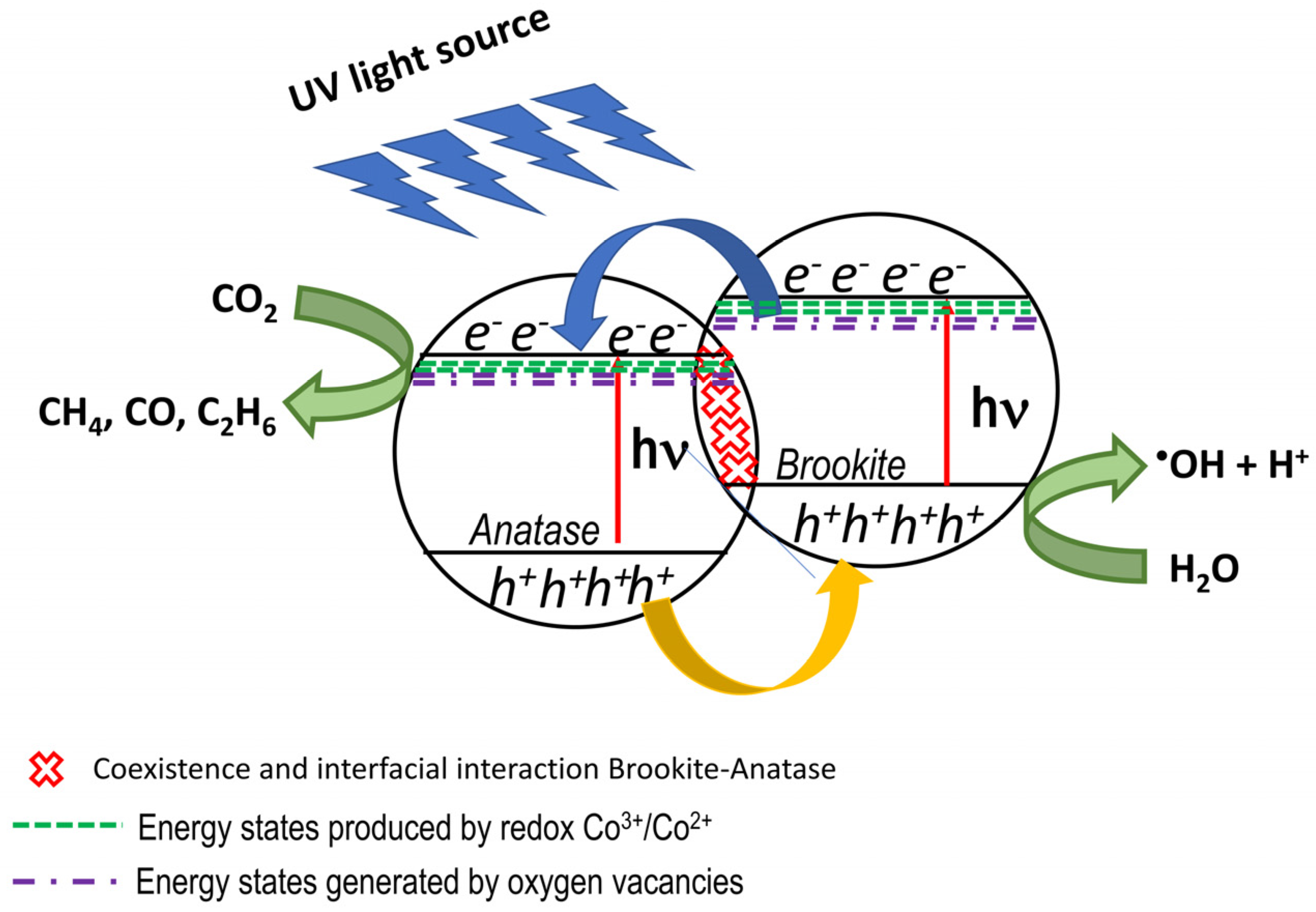
In the literature [27,55] and in our work, it is observed that hydrogen production (H2) is also an additional product in the CO2 reduction reaction. Hydrogen production is a reaction present in the photoreduction of CO2. However, in Figure 11d it is observed that hydrogen production follows the following order: Ti1Co > Ti3Co > Ti0Co > Ti5Co > Ti10Co; in the first two nanomaterials, there is a greater yield of products derived (CH4 and C2H6) from the CO2 photoreduction than Ti1Co and Ti3Co. The above can be attributed to the fact that the oxygen vacancies in the different nanomaterials, the Co3+/Co2+ species, and the different Ti4+, TixOy, and Ti3+ species function as recombination centers and accelerate the recombination process of the charge carriers, despite the fact that the evidence in the photoluminescence spectra shows that they have a relatively low intensity compared to Ti0Co. Figure 12 shows the proposed mechanism by which CO2 photoreduction is carried out using the Ti1Co nanomaterial, since it was the most active for the production of CH4 and C2H6. Figure 12 shows a mixture of TiO2 phases (anatase and brookite) modified by the addition of 1% mol cobalt, which presents a heterojunction between both phases. Additionally, by incorporating 1% mol of cobalt, oxygen vacancies are generated and there is a relative abundance of Co3+/Co2+ species; both species present generate energy levels below the TiO2 conduction band. After the nanomaterial (Ti1Co) is irradiated with a light source that is equal to or greater than the band gap, many charge carriers (e-) and holes (h+) are generated in the conduction band and valence band, respectively. The species found in the Ti1Co nanomaterial have the function of trapping electrons and thus slow the recombination process of charge carriers and improve the photocatalytic performance in the CO2 reduction reaction e-.

4. Materials and Methods

4.1. Materials

The reagents used are titanium isopopoxide (>99.9%), cobalt (III) acetyl acetonate (>99.9%), and hydrochloric acid (HCL > 38%), and were purchased from Sigma-Aldrich Merck KGaA, Darmstadt, Germany and/or its affiliates, (Merck Mexico a subsidiary of Merck KGaA, Darmstadt, Germany, Calle 5, No. 7, Frac. Industrial Alce, Blanco Naucalpan de Juarez, 53370, Mexico; deionized water is used in the synthesis and in all experiments in this work.

4.2. Synthesis of Nanomaterials

The synthesis of the different nanocomposites is by the sol–gel method. The preparation of the reference and the modified TiXCo is carried out as follows: In a flask in an inert atmosphere, 40 mL of isopropanol and 10 mL of isopropanol are added, and 30 mL of titanium isopropoxide are added to a flask. This solution is left stirring for 1 h at room temperature to obtain a homogeneous mixture (step A).
The flask is then transferred to a heating mantle and left under reflux for 24 h with stirring throughout the synthesis of the nanomaterial. At the end of the time period, it is allowed to cool to room temperature to immediately incorporate the amount of alkoxide/isopropanol/water and have a ratio of 1:16:8 (step B). It is then refluxed again for another 24 h. At the end of this time, it is filtered and dried in an oven at 120 °C for 12 h for subsequent grinding, storage, and labeling. For nanocomposites with different mol% of cobalt, the same step A is carried out, and the calculated amount of cobalt precursor is added (1, 3, 5, and 10% mol) and the same time is left to obtain a uniform and reflux mixture. The procedure has the same alkoxide/propanol/water ratio and reflux, to subsequently grind, store, and label. The nomenclature used for the TiO2- and TiO2-doped photocatalysts with different mol% of cobalt is TiXCo, where x represents 0, 1, 3, 5, and 10% mol of cobalt. The photocatalysts were subsequently calcined at 400 °C for 4 h.

4.3. Physicochemical Characterization

The structure and crystalline phase of the photocatalysts were identified by diffraction patterns measured at room temperature on a Bruker D8 Advance diffractometer (Bruker AXS SE Östliche Rheinbrückenstr. 49, 76187 Karlsruhe, Germany) with a Cu irradiation source with a Kα (λ = 0.15406 nm) in the range of 10–80° as a function of 2θ. The diffraction structures were refined using the Rietveld method, using the fundamental parameters during the refinements and implementing the TOPAS version 4.2 code, using a step of 0.020 °/s in the range 10–100° as a function of the 2θ angle.
The chemical compositions of the photocatalysts were evaluated by X-ray photoelectron spectroscopy (XPS) using a PHI 5000 Versa Probe II from Physical Electronics (ULVAC-PHI, Inc. 2500 Hagisono, Chigasaki, Kanagawa, 253-8522, Japan). A monochromatic aluminum irradiation source with a Kα (hν = 1486.6 eV) was used during the analysis. The C 1s signal is located at 245.50 eV and is used as a reference for the other binding energies of the other atoms.
Raman spectroscopy spectra were measured in the range of 100–1000 cm−1 and collected using a Renishaw Invia model with a 532 nm green laser, operating at 0.5% of the laser power, with 10 accumulations of 10 s each.
Absorption spectra and optical properties for all photocatalysts were measured in the range of 190–800 nm using diffuse reflectance spectroscopy. The Kubelka–Munk theory was used to calculate the band gap of nanomaterials using diffuse reflectance spectra measured on a Varian Cary 100 spectrophotometer (Agilent Technologies, Inc. Headquarters 5301 Stevens Creek Blvd, Santa Clara, CA 95051, USA) equipped with an integrating sphere, using Ba2SO4 as a reference. The Tauc’s plot was used to calculate the band gap using data from the Kubelka–Munk theory.
Morphological aspects of the photocatalysts were observed by taking images acquired by a field-emission scanning electron microscope (SEM) using JEOL 7600F equipment (JEOL USA, INC. 11 Dearborn Road, Peabody, MA 01960, USA) and, simultaneously, EDS was performed for the evaluation of the composition of the different elements contained in the photocatalysts.
TEM and HRTEM images of the photocatalysts were obtained using a JEOL-JSM7600-F transmission electron microscope ((JEOL USA, INC. 11 Dearborn Road, Peabody, MA 01960, USA). The TEM and HRTEM images were analyzed using DigitalMicrograph 3.6 software. For TEM images, approximately 150 particles were counted to obtain an approximation of the crystal size, and for HRTEM images, different areas of the image were analyzed to obtain the crystalline planes of the different crystalline phases in the material.
The specific surface area of the photocatalysts was determined by the BET method using nitrogen adsorption–desorption isotherms at 77 K. The analyses were performed on a Tristar II Plus Micromeritics instrument (Headquartered in Norcross, GA, USA). Before starting the BET analysis, the samples were degassed at 200 °C for 24 h.
Photoluminescence spectra of the photocatalysts were measured on an Edinburgh Instruments FSP920 Fluorometer with detection in the visible (200–750 nm) through a Hamamatsu R928P photomultiplier tube and a 450 W Xenon lamp (Head office and enquiries Edinburgh Instruments Ltd. 2 Bain Square Kirkton Campus EH54 7DQ UK). Emission spectra were obtained in the range of 400–700 nm using an excitation wavelength of λex = 350 nm.

4.4. Electrochemical Characterization

TiXCo photocatalysts were evaluated through electrochemical techniques to obtain information regarding the charge-transfer resistance under illumination, photocurrent generation, and band-edge position. For this purpose, TiXCo powders were supported by FTO following the procedure previously reported [61]. In brief, 10 µL of a 20 gL−1 suspension of the photocatalyst in an ethanol/Nafion solution was drop-cast onto a delimited area of 0.5 × 0.5 cm2 of the substrate and left to dry at room temperature overnight. The (photo)electrochemical characterization was performed in a three-electrode cell with a quartz window to illuminate the film employing Newport Q Housing (Model 60025) equipped with a 100 W Hg arc Xe lamp (Newport Corporation 8 East Forge Parkway Franklin, MA 02038 United States. A graphite bar (99.999%) was used as the counter-electrode, and Ag/AgCl (3 M NaCl) as the reference electrode. All measurements were performed in a 0.1 M K2CO3 (pH = 5) electrolyte. The potential reported in this document was not corrected for ohmic losses. The EIS was measured at the open-circuit potential under illumination. For this, the sample was irradiated until a pseudo-stationary open-circuit potential was reached. Then, the spectra were recorded by applying a sinusoidal AC perturbation of ±10 mV between 100 kHz and 100 mHz. Interrupted-light linear swept voltammetry was recorded (v = 10 mVs−1) in the backward direction from 0.7 V to −0.1 V with a light-on and light-off period of 1 s. Mott–Schottky plots were obtained by measuring the space-charge capacitance at 25 mV intervals using an AC perturbation of ±10 mV at 400 Hz.

4.5. Photocatalytic Tests in CO2 Photoreduction

Experiments on the photocatalytic reduction of the different TiXCo photocatalysts were evaluated using a photoreactor (made in the laboratory) with a capacity of 200 mL and placed in a black box with the respective stirring grid. The reaction mixture contained 0.25% methanol, and the remainder was water; this mixture was bubbled for 30 min with nitrogen to remove air inside the reactor. Subsequently, 50 mg of photocatalyst (nanomaterial) was added to the reactor and subsequently purged with CO2 for 30 min to saturate the solution in the photoreactor. The container was sealed and subsequently irradiated with a UV light source with a wavelength of 254 nm for 6 h of reaction and the entire experiment was maintained at 25 °C. The products of CO2 photoreduction were measured at 1 h intervals until completing 6 h of reaction by injecting 1 μL of the mixture into a Shimadzu GC 2014 chromatograph (Shimadzu Inc. Analytical & Measuring Instruments Division, International Operations Department 1-3, Kanda Nishiki-cho, Chiyoda-ku, Tokyo 101-8448, Japan), equipped with a thermal conductivity detector (TCD), flame ionization detector (FID), and metallizer at 380 °C. Subsequently, CO2 photoreduction tests were performed using a visible light source (Argon lamp (UVP Pen-Ray Light Sources) Analytik Jena US LLC (Formerly UVP LLC) 2066 W. 11th Street Upland, CA 91786, USA) under the same reaction conditions, and the by-products were identified using gas chromatography, as previously described.

5. Conclusions

Nanomaterials doped with different mol% of cobalt (TiXCo) were synthesized by the sol–gel method and were tested in the photoreduction of CO2 with H2O under a UV irradiation source for 6 h of reaction. The results obtained show that when using the Ti1Co nanomaterial, the production of CH4 (440.0 mmol g−1cat), C2H6 (14.6 mmol g−1cat), and CO (3.1 mmol g−1cat) is achieved and when compared with Ti1Co, is approximately 3 and 14 times greater than with Ti0Co since it only produces CH4 (150.2 mmol g−1cat) and CO (3.9 mmol g−1cat) and does not present production of C2H6. Ti1Co nanomaterial significantly presents a better activity in CO2 reduction; this is because the incorporation of 1% mol of cobalt introduces energetic states below the conduction band that are produced by oxygen vacancies and the redox properties of Co3+/Co2+, which function as an electron trap and in this way efficiently improve the separation of charge carriers and present a greater response under UV light. Therefore, the incorporation of transition metals is a good option to improve photoactivity in TiO2-based nanomaterials.

Supplementary Materials

The following supporting information can be downloaded at: https://www.mdpi.com/article/10.3390/catal16020146/s1, Figure S1: Diffraction patterns of Ti0Co (TiO2) and TiXCo nanomaterials calcined at 400 °C, where x = 1, 3, 5, and 10 mol% of cobalt, Figure S2: Diffraction patterns obtained by Rietveld refinement of Ti3Co (Figure S2a), Ti5Co (Figure S2b), and Ti10Co (Figure S2c), Figure S3: Survey spectra (XPS) (Figure S3a) and high-resolution C 1s spectra (Figure S3b) of Ti0Co and TiXCo nanomaterials, Figure S4: Raman spectra normalized nanomaterials TiXCo and Table S1: Results of CO2 photoreduction using TiXCo materials with a visible light irradiation source (Argon lamp).

Author Contributions

Formal analysis, I.R.-V., E.R.-R. and G.D.A.; investigation, I.R.-V., E.R.-R., G.D.A., F.G. and L.H.; writing—original draft preparation, I.R.-V., E.R.-R., G.D.A., F.G. and P.A.-P.; writing—review and editing, I.R.-V., E.R.-R., G.D.A. and C.M.G.; visualization, E.R.-R., D.N.-G., C.M.G. and E.P.-G.; conceptualization, I.R.-V., E.R.-R., G.D.A., P.A.-P., D.N.-G., C.M.G. and M.C.D.; methodology, I.R.-V., E.R.-R., L.H., F.G., P.A.-P., C.M.G. and M.C.D., validation, I.R.-V., E.R.-R., G.D.A., P.A.-P., C.M.G. and M.C.D. All authors have read and agreed to the published version of the manuscript.

Funding

This research received no external funding.

Data Availability Statement

The raw data supporting the conclusions of this article will be made available by the authors on request.

Acknowledgments

We would like to especially thank SECIHTI for the scholarship awarded and the University of Guanajuato for all the support provided in developing this work. We also thank the Metropolitan Autonomous University for technical support.

Conflicts of Interest

The authors declare no conflicts of interest.

References

  1. Zhao, T.; Hu, J.; Zhang, W.; Cheng, G.; Li, W.; Xiong, J. Oxygen Vacancy/Metallic Sites Synergically Assists Hollow TiO2–Induced CO2 Photoreduction: Categories and Roles. Fuel 2025, 385, 134107. [Google Scholar] [CrossRef]
  2. Du, C.; Sheng, J.; Zhong, F.; He, Y.; Guro, V.P.; Sun, Y.; Dong, F. Rational Design and Mechanistic Insights of Advanced Photocatalysts for CO2 to C2+ Production: Status and Challenges. Chin. J. Catal. 2024, 60, 25–41. [Google Scholar] [CrossRef]
  3. Wang, X.; Ng, D.; Du, H.; Hornung, C.H.; Polyzos, A.; Seeber, A.; Li, H.; Huo, Y.; Xie, Z. Copper Decorated Indium Oxide Rods for Photocatalytic CO2 Conversion under Simulated Sun Light. J. CO2 Util. 2022, 58, 101909. [Google Scholar] [CrossRef]
  4. Lee, D.E.; Jin Kim, D.; Devthade, V.; Jo, W.K.; Tonda, S. Size-Dependent Selectivity and Activity of Highly Dispersed Sub-Nanometer Pt Clusters Integrated with P25 for CO2 Photoreduction into Methane Fuel. Appl. Surf. Sci. 2022, 584, 152532. [Google Scholar] [CrossRef]
  5. Kumar, D.P.; Rangappa, A.P.; Shim, H.S.; Do, K.H.; Hong, Y.; Gopannagari, M.; Reddy, K.A.J.; Bhavani, P.; Reddy, D.A.; Song, J.K.; et al. Nanocavity-Assisted Single-Crystalline Ti3+ Self-Doped Blue TiO2 (B) as Efficient Cocatalyst for High Selective CO2 Photoreduction of g-C3N4. Mater. Today Chem. 2022, 24, 100827. [Google Scholar] [CrossRef]
  6. Fu, Z.; Yang, Q.; Liu, Z.; Chen, F.; Yao, F.; Xie, T.; Zhong, Y.; Wang, D.; Li, J.; Li, X.; et al. Photocatalytic Conversion of Carbon Dioxide: From Products to Design the Catalysts. J. CO2 Util. 2019, 34, 63–73. [Google Scholar] [CrossRef]
  7. Li, X.; Wang, M.; Wang, R.; Shen, M.; Wu, P.; Fu, Z.; Zhu, M.; Zhang, L. A Distinctive Semiconductor-Metalloid Heterojunction: Unique Electronic Structure and Enhanced CO2 Photoreduction Activity. J. Colloid Interface Sci. 2022, 615, 821–830. [Google Scholar] [CrossRef]
  8. Morawski, A.W.; Kusiak-Nejman, E.; Wanag, A.; Narkiewicz, U.; Edelmannová, M.; Reli, M.; Kočí, K. Influence of the Calcination of TiO2 Reduced Graphite Hybrid for the Photocatalytic Reduction of Carbon Dioxide. Catal. Today 2021, 380, 32–40. [Google Scholar] [CrossRef]
  9. Tahir, M.; Tahir, B. Dynamic Photocatalytic Reduction of CO2 to CO in a Honeycomb Monolith Reactor Loaded with Cu and N Doped TiO2 Nanocatalysts. Appl. Surf. Sci. 2016, 377, 244–252. [Google Scholar] [CrossRef]
  10. Permporn, D.; Khunphonoi, R.; Wilamat, J.; Khemthong, P.; Chirawatkul, P.; Butburee, T.; Sangkhun, W.; Wantala, K.; Grisdanurak, N.; Santatiwongchai, J.; et al. Insight into the Roles of Metal Loading on CO2 Photocatalytic Reduction Behaviors of TiO2. Nanomaterials 2022, 12, 474. [Google Scholar] [CrossRef] [PubMed]
  11. Ricka, R.; Wanag, A.; Kusiak-Nejman, E.; Filip Edelmannová, M.; Reli, M.; Łapinski, M.; Słowik, G.; Morawski, A.W.; Kočí, K. Defective TiO2 for CO2 Photoreduction: Influence of Alkaline Agent and Reduction Temperature Modulation. Catal. Today 2025, 448, 115162. [Google Scholar] [CrossRef]
  12. Al-Hajji, L.A.; Ismail, A.A.; Alsaidi, M.; Nazeer, A.A.; El-Toni, A.M.; Al-Ruwayeh, S.F.; Ahmed, S.A.; Al-Sharrah, T. Fabrication of Mesoporous Sulfated ZnO-Modified g-C3N4 and TiO2 Photocatalysts for CO2 Reduction in Gas Phase. Catal. Today 2025, 445, 115089. [Google Scholar] [CrossRef]
  13. Sung, P.-H.; Huang, C.-Y.; Lin, C.-Y.; Chung, P.-W.; Chang, Y.-C.; Chen, L.-C.; Chen, H.-Y.; Liao, C.-N.; Chiu, E.-L.; Wang, C.-Y. Photocatalytic CO2 Reduction for C2-C3 Oxy-Compounds on ZIF-67 Derived Carbon with TiO2. J. CO2 Util. 2022, 58, 101920. [Google Scholar] [CrossRef]
  14. Hussain, M.K.; Iqbal, T. Critical Review on Modification of TiO2 for the Reduction of CO2. Res. Rev. J. Chem. 2018, 7, 37–44. [Google Scholar]
  15. Zhao, T.; Zhang, W.; Xiong, J.; Li, W.; Cheng, G. Lewis Base and Metallic Sites Cooperatively Promotes Photocatalytic CO2 Reduction in PO43−/Ag-TiO2 Hybrids. Sep. Purif. Technol. 2025, 360, 130849. [Google Scholar] [CrossRef]
  16. Liu, L.; Li, Y.Y.; Lingampalli, S.R.; Ayyub, M.M.; Rao, C.N.R.; Larimi, A.; Rahimi, M.R.; Khorasheh, F.; Liu, Y.; Zhou, S.; et al. Synergistic Effect of Surface and Bulk Single-Electron-Trapped Oxygen Vacancy of TiO2 in the Photocatalytic Reduction of CO2. Appl. Catal. B 2022, 904, 300–307. [Google Scholar] [CrossRef]
  17. Sorokina, L.; Savitskiy, A.; Shtyka, O.; Maniecki, T.; Szynkowska-Jozwik, M.; Trifonov, A.; Pershina, E.; Mikhaylov, I.; Dubkov, S.; Gromov, D. Formation of Cu-Rh Alloy Nanoislands on TiO2 for Photoreduction of Carbon Dioxide. J. Alloys Compd. 2022, 904, 164012. [Google Scholar] [CrossRef]
  18. Liu, C.; Wang, F.; Zhu, S.; Xu, Y.; Liang, Q.; Chen, Z. Controlled Charge-Dynamics in Cobalt-Doped TiO2 Nanowire Photoanodes for Enhanced Photoelectrochemical Water Splitting. J. Colloid Interface Sci. 2018, 530, 403–411. [Google Scholar] [CrossRef]
  19. de Oliveira, T.G.; de Oliveira, A.H.; da Silva, L.O.; Santana, M.d.V.; Nascimento, J.S.; de Abreu, G.J.P.; Guerra, Y.; Garcia, R.R.P.; dos Santos, F.E.P.; Viana, B.C. A Comprehensive Study of Structural, Optical, and Magnetic Properties of Co and Fe-Doped TiO2 Prepared by Different Sol-Gel Routes. J. Sol-Gel Sci. Technol. 2025, 116, 2670–2691. [Google Scholar] [CrossRef]
  20. Khalyavka, T.O.; Shymanovska, V.V.; Gavrilko, T.A.; Manuilov, E.V.; Klishevich, G.V.; Szymański, D.; Chaika, M.; Bezkrovnyi, O.; Baran, J.; Drozd, M.; et al. Synthesis and Characterization of Nanostructured Co-Si Co-Doped TiO2 with Enhanced Visible-Light Photocatalytic Performance in Phenol Red Degradation. Ceram. Int. 2026, 52, 1221–1236. [Google Scholar] [CrossRef]
  21. Guo, M.; Yao, S.; Zhang, W.; Wang, Q.; Lin, R.; Liang, D.; Shen, D. Cobalt-Doped Rutile/Anatase TiO2 Photoanode with Oriented Energy Band Offset for Photoelectrochemical Water Splitting. Appl. Surf. Sci. 2025, 700, 163159. [Google Scholar] [CrossRef]
  22. Castellanos-Leal, E.L.; Acevedo-Peña, P.; Güiza-Argüello, V.R.; Córdoba-Tuta, E.M. N and F, Co doped TiO2 Thin Films on Stainless Steel for Photoelectrocatalytic Removal of Cyanide Ions in Aqueous Solutions. Mater. Res. 2017, 20, 487–495. [Google Scholar] [CrossRef]
  23. Chanda, A.; Rout, K.; Vasundhara, M.; Joshi, S.R.; Singh, J. Structural and Magnetic Study of Undoped and Cobalt Doped TiO2 Nanoparticles. RSC Adv. 2018, 8, 10939–10947. [Google Scholar] [CrossRef] [PubMed]
  24. Huang, C.Y.; Guo, R.T.; Pan, W.G.; Tang, J.Y.; Zhou, W.G.; Qin, H.; Liu, X.Y.; Jia, P.Y. Eu-Doped TiO2 Nanoparticles with Enhanced Activity for CO2 Phpotcatalytic Reduction. J. CO2 Util. 2018, 26, 487–495. [Google Scholar] [CrossRef]
  25. Wu, H.Y.; Nguyen, N.H.; Bai, H.; Chang, S.M.; Wu, J.C.S. Photocatalytic Reduction of CO2 Using Molybdenum-Doped Titanate Nanotubes in a MEA Solution. RSC Adv. 2015, 5, 63142–63151. [Google Scholar] [CrossRef]
  26. Wang, T.; Meng, X.; Liu, G.; Chang, K.; Li, P.; Kang, Q.; Liu, L.; Li, M.; Ouyang, S.; Ye, J. In Situ Synthesis of Ordered Mesoporous Co-Doped TiO2 and Its Enhanced Photocatalytic Activity and Selectivity for the Reduction of CO2. J. Mater. Chem. A Mater. 2015, 3, 9491–9501. [Google Scholar] [CrossRef]
  27. Torres, J.A.; da Cruz, J.C.; Nogueira, A.E.; da Silva, G.T.S.T.; de Oliveira, J.A.; Ribeiro, C. Role of Cu0-TiO2 Interaction in Catalyst Stability in CO2 Photoreduction Process. J. Environ. Chem. Eng. 2022, 10, 107291. [Google Scholar] [CrossRef]
  28. Mgolombane, M.; Bankole, O.M.; Ferg, E.E.; Ogunlaja, A.S. Construction of Co-Doped TiO2/RGO Nanocomposites for High-Performance Photoreduction of CO2 with H2O: Comparison of Theoretical Binding Energies and Exploration of Surface Chemistry. Mater. Chem. Phys. 2021, 268, 124733. [Google Scholar] [CrossRef]
  29. Das, K.; Sharma, S.N.; Kumar, M.; De, S.K. Morphology Dependent Luminescence Properties of Co Doped TiO2 Nanostructures. J. Phys. Chem. C 2009, 113, 14783–14792. [Google Scholar] [CrossRef]
  30. Lassoued, M.S.; Lassoued, A.; Ammar, S.; Gadri, A.; Salah, A.B.; García-Granda, S. Synthesis and Characterization of Co-Doped Nano-TiO2 through Co-Precipitation Method for Photocatalytic Activity. J. Mater. Sci. Mater. Electron. 2018, 29, 8914–8922. [Google Scholar] [CrossRef]
  31. Akshay, V.R.; Arun, B.; Mandal, G.; Mutta, G.R.; Chanda, A.; Vasundhara, M. Observation of Optical Band-Gap Narrowing and Enhanced Magnetic Moment in Co-Doped Sol-Gel-Derived Anatase TiO2 Nanocrystals. J. Phys. Chem. C 2018, 122, 26592–26604. [Google Scholar] [CrossRef]
  32. Choudhury, B.; Choudhury, A. Luminescence Characteristics of Cobalt Doped TiO2 Nanoparticles. J. Lumin. 2012, 132, 178–184. [Google Scholar] [CrossRef]
  33. Siddhapara, K.; Shah, D. Characterization of Nanocrystalline Cobalt Doped TiO2 Sol-Gel Material. J. Cryst. Growth 2012, 352, 224–228. [Google Scholar] [CrossRef]
  34. Shannon, R.D. Revised Effective Ionic Radii and Systematic Studies of Interatomic Distances in Halides and Chalcogenides. Acta Crystallogr. Sect. A 1976, 32, 751–767. [Google Scholar] [CrossRef]
  35. El Mragui, A.; Zegaoui, O.; Esteves da Silva, J.C.G. Elucidation of the Photocatalytic Degradation Mechanism of an Azo Dye under Visible Light in the Presence of Cobalt Doped TiO2 Nanomaterials. Chemosphere 2021, 266, 128931. [Google Scholar] [CrossRef] [PubMed]
  36. Hashimoto, S.; Tanaka, A.; Murata, A.; Sakurada, T. Formulation for XPS Spectral Change of Oxides by Ion Bombardment as a Function of Sputtering Time. Surf. Sci. 2004, 556, 22–32. [Google Scholar] [CrossRef]
  37. Counsell, J.D.P.; Roberts, A.J.; Boxford, W.; Moffitt, C.; Takahashi, K. Reduced Preferential Sputtering of TiO2 Using Massive Argon Clusters. J. Surf. Anal. 2014, 20, 211–215. [Google Scholar] [CrossRef]
  38. Kamble, R.J.; Gaikwad, P.V.; Garadkar, K.M.; Sabale, S.R.; Puri, V.R.; Mahajan, S.S. Photocatalytic Degradation of Malachite Green Using Hydrothermally Synthesized Cobalt-Doped TiO2 Nanoparticles. J. Iran. Chem. Soc. 2022, 19, 303–312. [Google Scholar] [CrossRef]
  39. Li, J.-G.; Büchel, R.; Isobe, M.; Mori, T.; Ishigaki, T. Cobalt-Doped TiO2 Nanocrystallites: Radio-Frequency Thermal Plasma Processing, Phase Structure, and Magnetic Properties. J. Phys. Chem. C 2009, 113, 8009–8015. [Google Scholar] [CrossRef]
  40. Sadanandam, G.; Lalitha, K.; Kumari, V.D.; Shankar, M.V.; Subrahmanyam, M. Cobalt Doped TiO2: A Stable and Efficient Photocatalyst for Continuous Hydrogen Production from Glycerol: Water Mixtures under Solar Light Irradiation. Int. J. Hydrogen Energy 2013, 38, 9655–9664. [Google Scholar] [CrossRef]
  41. Khurana, C.; Pandey, O.P.; Chudasama, B. Synthesis of Visible Light-Responsive Cobalt-Doped TiO2 Nanoparticles with Tunable Optical Band Gap. J. Sol-Gel Sci. Technol. 2015, 75, 424–435. [Google Scholar] [CrossRef]
  42. Jiang, P.; Xiang, W.; Kuang, J.; Liu, W.; Cao, W. Effect of Cobalt Doping on the Electronic, Optical and Photocatalytic Properties of TiO2. Solid State Sci. 2015, 46, 27–32. [Google Scholar] [CrossRef]
  43. Zhang, Y.; Chu, W. Cooperation of Multi-Walled Carbon Nanotubes and Cobalt Doped TiO2 to Activate Peroxymonosulfate for Antipyrine Photocatalytic Degradation. Sep. Purif. Technol. 2022, 282, 119996. [Google Scholar] [CrossRef]
  44. El Mragui, A.; Zegaoui, O.; Daou, I.; Esteves da Silva, J.C.G. Preparation, Characterization, and Photocatalytic Activity under UV and Visible Light of Co, Mn, and Ni Mono-Doped and (P,Mo) and (P,W) Co-Doped TiO2 Nanoparticles: A Comparative Study. Environ. Sci. Pollut. Res. 2019, 28, 25130–25145. [Google Scholar] [CrossRef]
  45. Vindhya, P.S.; Suresh, S.; Kavitha, V.T. Annona Muricata Leaf Extract Mediated Synthesis of Pure and Co Doped TiO2 Nanoparticles: Evaluation of Catalytic Reduction, Antimicrobial and Antioxidant Activities. Int. J. Hydrogen Energy 2025, 103, 766–786. [Google Scholar] [CrossRef]
  46. Liu, L.; Li, Y. Understanding the Reaction Mechanism of Photocatalytic Reduction of CO2 with H2O on TiO2-Based Photocatalysts: A Review. Aerosol Air Qual. Res. 2014, 14, 453–469. [Google Scholar] [CrossRef]
  47. Tompsett, G.A.; Bowmaker, G.A.; Cooney, R.P.; Metson, J.B.; Rodgers, K.A.; Seakins, J.M. The Raman Spectrum of Brookite, TiO2 (Pbca, Z = 8). J. Raman Spectrosc. 1995, 26, 57–62. [Google Scholar] [CrossRef]
  48. Xiao, J.; Chen, S.; Jin, J.; Li, R.; Zhang, J.; Peng, T. Brookite TiO2 Nanoparticles Decorated with Ag/MnOx Dual Cocatalysts for Remarkably Boosted Photocatalytic Performance of the CO2 Reduction Reaction. Langmuir 2021, 37, 12487–12500. [Google Scholar] [CrossRef] [PubMed]
  49. Mugundan, S.; Rajamannan, B.; Viruthagiri, G.; Shanmugam, N.; Gobi, R.; Praveen, P. Synthesis and Characterization of Undoped and Cobalt-Doped TiO2 Nanoparticles via Sol–Gel Technique. Appl. Nanosci. 2015, 5, 449–456. [Google Scholar] [CrossRef]
  50. Almomani, F.; Al-Jaml, K.L.; Bhosale, R.R. Solar Photo-Catalytic Production of Hydrogen by Irradiation of Cobalt Co-Doped TiO2. Int. J. Hydrogen Energy 2021, 46, 12068–12081. [Google Scholar] [CrossRef]
  51. Sing, K.S.W.; Everett, D.H.; Haul, R.A.W.; Moscou, L.; Pierotti, R.S.; Rouquerol, J.; Siemieniewska, T. International Union of Pure Commission on Colloid and Surface Chemistry including catalysis Reporting Physisorption Data for Gas/Solid Systems with Special Reference to the Determination of Surface Area and Porosity. Pure Appl. Chem. 1985, 57, 603–619. [Google Scholar] [CrossRef]
  52. Hassan, S.M.; Ahmed, A.I.; Mannaa, M.A. Preparation and Characterization of SnO2 Doped TiO2 Nanoparticles: Effect of Phase Changes on the Photocatalytic and Catalytic Activity. J. Sci. Adv. Mater. Devices 2019, 4, 400–412. [Google Scholar] [CrossRef]
  53. Spagnol, V.; Sutter, E.; Debiemme-Chouvy, C.; Cachet, H.; Baroux, B. EIS Study of Photo-Induced Modifications of Nano-Columnar TiO2 Films. Electrochim. Acta 2009, 54, 1228–1232. [Google Scholar] [CrossRef]
  54. Cerezo, L.; Valencia, K.; Hernández-Gordillo, A.; Bizarro, M.; Acevedo-Peña, P.; Rodil, S.E. Increasing the H2 Production Rate of ZnS(En)x Hybrid and ZnS Film by Photoexfoliation Process. Int. J. Hydrogen Energy 2022, 47, 22403–22414. [Google Scholar] [CrossRef]
  55. Zhou, Y.; Zhang, Q.; Shi, X.; Song, Q.; Zhou, C.; Jiang, D. Photocatalytic Reduction of CO2 into CH4 over Ru-Doped TiO2: Synergy of Ru and Oxygen Vacancies. J. Colloid Interface Sci. 2022, 608, 2809–2819. [Google Scholar] [CrossRef]
  56. Liu, Y.; Zhou, S.; Li, J.; Wang, Y.; Jiang, G.; Zhao, Z.; Liu, B.; Gong, X.; Duan, A.; Liu, J.; et al. Photocatalytic Reduction of CO2 with Water Vapor on Surface La-Modified TiO2 Nanoparticles with Enhanced CH4 Selectivity. Appl. Catal. B 2015, 168–169, 125–131. [Google Scholar] [CrossRef]
  57. Ali, K.A.; Abdullah, A.Z.; Mohamed, A.R. Visible Light Responsive TiO2 Nanoparticles Modified Using Ce and La for Photocatalytic Reduction of CO2: Effect of Ce Dopant Content. Appl. Catal. A Gen. 2017, 537, 111–120. [Google Scholar] [CrossRef]
  58. Delavari, S.; Amin, N.A.S.; Ghaedi, M. Photocatalytic Conversion and Kinetic Study of CO2 and CH4 over Nitrogen-Doped Titania Nanotube Arrays. J. Clean. Prod. 2016, 111, 143–154. [Google Scholar] [CrossRef]
  59. Pan, B.; Luo, S.; Su, W.; Wang, X. Photocatalytic CO2 Reduction with H2O over LaPO4 Nanorods Deposited with Pt Cocatalyst. Appl. Catal. B 2015, 168–169, 458–464. [Google Scholar] [CrossRef]
  60. Wang, C.; Zhang, X.; Liu, Y. Promotion of Multi-Electron Transfer for Enhanced Photocatalysis: A Review Focused on Oxygen Reduction Reaction. Appl. Surf. Sci. 2015, 358, 28–45. [Google Scholar] [CrossRef]
  61. Rangel-Vázquez, I.; Del Angel, G.; Ramos-Ramírez, E.; González, F.; Acevedo-Peña, P.; Gómez, C.M.; Tzompantzi, F.; Gutiérrez-Ortega, N.; Torres-Torres, J.G. Improvement of Photocatalytic Activity in the Degradation of 4-Chlorophenol and Phenol in Aqueous Medium Using Tin-Modified TiO2 Photocatalysts. RSC Adv. 2023, 13, 13862–13879. [Google Scholar] [CrossRef] [PubMed]
Figure 1. X-ray diffraction patterns by Rietveld refinement of Ti0Co (a) and Ti1Co (1% mol cobalt (b)) nanomaterials.
Catalysts 16 00146 g001
Figure 2. High-resolution spectra of Ti 2p (a), Co 2p (b), and O 1s (c) of the TiXCo nanomaterials.
Catalysts 16 00146 g002
Figure 3. Raman spectra of TiXCo nanomaterials, where X = 0, 1, 3, 5, and 10% mol cobalt and the symbols A and B correspond to anatase and brookite phases of TiO2.
Catalysts 16 00146 g003
Figure 4. Diffuse reflectance UV–Vis spectra (a) and Tauc’s plot (b) of the TiXCo nanomaterials, where X = 0, 1, 3, 5, and 10% mol of cobalt.
Catalysts 16 00146 g004
Figure 5. SEM-EDS images of the nanomaterials Ti0Co, (a,b) and Ti1Co, (c,d).
Catalysts 16 00146 g005
Figure 6. TEM and average particle size distribution in Ti0C0 (a,c) and Ti1Co (b,d) nanomaterials.
Catalysts 16 00146 g006
Figure 7. HRTEM of the nanomaterials (a) Ti0CO and (f) Ti1Co with their respective FFT-HRTEM of the different analyzed areas of Ti0CO (be) and for Ti1Co (gj), and the symbols A and B correspond to the anatase and brookite crystalline phase of TiO2.
Catalysts 16 00146 g007
Figure 8. N2 adsorption–desorption isotherms of TiXCo nanomaterials.
Catalysts 16 00146 g008
Figure 9. Luminescence spectra of TiXCo nanomaterials, with lex = 320 nm.
Catalysts 16 00146 g009
Figure 10. (Photo)electrochemical characterization of TiXCo materials. (a) Nyquist diagram measured at open-circuit potential under illumination. (b) Linear sweep voltammetry (n = 10 mVs−1) measured under chopped illumination. (c) Mott–Schottky plots (f = 700 Hz). (d) Scheme of band-edge position derived from (c) and optical characterization of TxCo materials.
Catalysts 16 00146 g010
Figure 11. Reaction products at 6 h in the photoreduction of CO2 using the TiXCo nanomaterials, (a) methane, (b) ethane, (c) CO, and (d) H2.
Catalysts 16 00146 g011
Figure 12. Proposed mechanism for CO2 photoreduction using the Ti1Co nanomaterial.
Catalysts 16 00146 g012
Table 1. Obtained parameters from Rietveld refinement, cell parameters, crystal size, and relative composition (wt(%)) of TiO2 crystalline phases in the different TiXCo photocatalysts.
AnataseBrookite
Cell Parameters
(nm)
Crystal
Size
(nm)
Relative
Phase
Conc.
wt(%)
Volume Unit Cell
3)
Cell Parameters
(nm)
Crystal
Size
(nm)
Relative
Phase
Conc.
wt(%)
Volume Unit Cell
3)
Sampleac abc
Ti0Co0.37891 (3) *0.94908 (1)11.9 (6) *78.2 (3) *136.260.92020 (5) *0.54365 (3)0.51828 (2)9.0 (2) *21.7 (3) *259.28
Ti1Co0.37906 (3)0.94810 (1)10.4 (6)81.1 (4)136.220.91892 (8)0.54338 (5)0.52032 (3)8.6 (2)18.8 (3)259.80
Ti3Co0.37927 (4)0.94752 (1)9.5 (6)80.8 (4)136.290.91793 (9)0.54419 (6)0.52033 (4)8.0 (2)19.9 (4)259.92
Ti5Co0.37928 (4)0.94853 (1)10.6 (7)82.4 (5)136.440.91775 (1)0.54460 (8)0.52056 (6)7.0 (3)17.5 (5)260.18
Ti10Co0.37969 (5)0.94799 (1)9.3 (7)79.3 (6)136.660.91471 (1)0.54463 (8)0.52365 (7)6.9 (2)20.7 (6)260.87
* The number in parentheses corresponds to the standard deviation cell parameters, crystal size, and relative phase concentration.
Table 2. Binding energy, oxidation state, and relative composition of Ti2p, Co 2p, and O 1s in the TiXCo nanomaterials, where x = 0, 1, 3, 5, and 10% mol of cobalt.
Ti 2p3/2Co 2p3/2O 1s
Binding Energy (eV)
SampleTi4+Ti3+TixOyCo3+Co2+OLattOSurfOvac
AnataseBrookite
Ti0Co458.7458.5456.9---530.1531.7-
(77.3) *(3.7) *(19.0) *---(89.2) *(10.8) *-
Ti1Co458.5458.3456.8-782.9781.9530.0531.4531.0
(74.9)(5.9)(19.2)-(29)(71)(88.7)(10.2)(1.1)
Ti3Co458.5458.3456.9459.9782.8781.7529.8530.8531.8
(48.2)(9.3)(19.8)(22.7)(30.5)(69.5)(58.1)(21.3)(20.6)
Ti5Co458.3458.2456.6459.6782.7780.8529.4530.2531.1
(65.2)(17.8)(5.1)(11.9)(36.7)(63.3)(62.7)(15.8)(21.5)
Ti10Co458.1458.0456.6459.5782.4780.7529.2529.7530.6
(59.5)(22.9)(2.4)(15.2)(31.5)(68.5)(49.8)(19.7)(30.5)
* Values between ( ) are the relative abundances of each species found with their respective binding energy.
Table 3. Textural properties (BET area, average pore size, and pore volume) and optical properties of TiXCo nanomaterials.
SampleBET Surface
Area
(m2g−1)
Average Pore
Diameter
(nm)
Pore Volume
(cm3/g)
Band Gap
(eV)
Ti0Co114.815.20.3233.16
Ti1Co116.54.60.1492.98
Ti3Co110.54.50.1102.85
Ti5Co99.54.70.0962.78
Ti10Co95.67.20.3132.22
Table 4. Results after 6 h of the reaction by photoreduction of CO2 using cobalt-doped TiO2 nanomaterials (TiXCo), where X = 0, 1, 3, 5, and 10% mol cobalt.
SampleMethane
(mmol g−1cat)
Ethane
(mmol g−1cat)
CO
(mmol g−1cat)
H2
(mmol g−1cat)
Ti0Co150.2-3.9140.1
Ti1Co440.014.63.1177.0
Ti3Co416.59.83.0161.5
Ti5Co354.8-2.950.5
Ti10Co345.2-3.229.8
Disclaimer/Publisher’s Note: The statements, opinions and data contained in all publications are solely those of the individual author(s) and contributor(s) and not of MDPI and/or the editor(s). MDPI and/or the editor(s) disclaim responsibility for any injury to people or property resulting from any ideas, methods, instructions or products referred to in the content.