Review

Rhodium-Based Electrocatalysts for Ethanol Oxidation Reaction: Mechanistic Insights, Structural Engineering, and Performance Optimization


1
Department of Pharmaceutical Engineering, School of Life and Health Sciences, Huzhou College, Huzhou 313000, China
2
Beijing Advanced Innovation Center for Soft Matter Science and Engineering, Beijing University of Chemical Technology, Beijing 100029, China
3
College of Biological and Chemical Engineering, Qilu Institute of Technology, Jinan 250200, China
4
Jiangsu Key Laboratory of Zero-Carbon Energy Development and System Integration, Nanjing Xiaozhuang University, Nanjing 211171, China
*
Authors to whom correspondence should be addressed.
These authors contributed equally to this work.
Catalysts 2026, 16(2), 114; https://doi.org/10.3390/catal16020114
Submission received: 26 December 2025 / Revised: 19 January 2026 / Accepted: 22 January 2026 / Published: 23 January 2026

Abstract

Direct ethanol fuel cells (DEFCs) have gained considerable attention as promising power sources for sustainable energy conversion due to their high energy density, low toxicity, and renewable ethanol feedstock. However, the sluggish ethanol oxidation reaction (EOR) kinetics and the formation of strongly adsorbed intermediates (e.g., CO*, CHx*) severely hinder catalytic efficiency and durability. Rhodium (Rh)-based catalysts stand out for their balanced intermediate adsorption, efficient C–C bond cleavage, and superior CO tolerance arising from their unique electronic structure. This review summarizes recent advances in Rh-based EOR catalysts, including monometallic Rh nanostructures, Rh-based alloys, and Rh–support composites. The effects of morphology, alloying, and metal–support interactions on activity, selectivity, and stability are discussed in detail. Strategies for structural and electronic regulation—such as nanoscale design, alloying modulation and interfacial engineering—are highlighted to enhance catalytic performance. Finally, current challenges and future directions are outlined, emphasizing the need for Rh-based catalysts with high activity, selectivity and stability, integrating in situ characterization with theoretical modeling. This work provides insights into the structure–activity relationships of Rh-based catalysts and guidance for designing efficient and durable anode catalysts for practical DEFC applications.

1. Introduction

With the rapid depletion of fossil fuels and increasing concerns over environmental sustainability, it is imperative to develop clean and renewable energy conversion technologies. Fuel cells have emerged as a promising solution due to their ability to directly convert the chemical energy of fuels into electricity with high efficiency and minimal emissions [1,2,3,4]. Compared with other fuel cells, the direct alcohol fuel cell (DAFC) has attracted extensive interest due to its relatively simple operation, liquid fuel storability, and potential for portable and transportation applications [5,6]. Among them, ethanol, as a widely available, technologically mature, high energy-density (8.0 kWh kg−1) [7], and low-cost liquid fuel, has received particular attention from direct ethanol fuel cells (DEFC) [8,9]. In addition, efficient electrochemical utilization of ethanol via the C1 pathway maximizes energy output and, when derived from biomass, operates within a renewable carbon loop, thereby supporting carbon-neutral energy conversion [10,11]. These advantages make DEFC an important candidate for future clean energy in portable electronics, automotive propulsion, and distributed power generation.
Nevertheless, the practical application of DEFC is severely hampered by the sluggish kinetics of the ethanol oxidation reaction (EOR) at the anode. The EOR proceeds through two competitive pathways, the C1 pathway, which involves a 12-electron transfer to CO2, and the C2 pathway, which leads to partial oxidation products such as acetaldehyde and acetic acid [12,13,14]. Under practical fuel cell conditions, the C1 pathway is rarely dominant; instead, ethanol is mainly converted to acetaldehyde and acetic acid via incomplete oxidation. Additionally, the C1 process has a higher energy utilization efficiency and makes it easy to achieve the anode reaction of high-energy-density DEFCs. However, there are two major challenges with the C1 pathway of EOR. On the one hand, the C-C bonds in ethanol are not easily broken under mild chemical conditions [15]. On the other hand, the strong adsorption of carbonaceous intermediates (such as CO*, CHx*) leads to catalyst poisoning and performance degradation [16]. Hence, designing electrocatalysts that can accelerate C–C bond breaking, enhance tolerance to poisoning species, and improve selectivity toward complete oxidation products remains one of the central scientific and technological challenges in EOR electrocatalysis.
Over the past decades, significant efforts have been devoted to the development of noble metal-based catalysts for EOR, among which platinum (Pt) and palladium (mainly in alkaline media for Pd)-based catalysts have been the most extensively investigated [9,17,18,19]. Pt-based catalysts are generally regarded as benchmark materials because of their high intrinsic activity for alcohol oxidation [20]. However, the Pt active centers generally show a strong adsorption of CO-like intermediates, causing them to suffer from serious CO poisoning, limiting their long-term stability [21,22]. Pd-based catalysts have certain advantages over the Pt-based catalysts in terms of anti-poisoning ability, especially in alkaline electrolytes. This is because their binding strength with the reaction intermediates is moderate, thus exhibiting relatively good EOR activity. Meanwhile, the Pd-based catalysts still have some limitations, which are restricted by the pH of the reaction environment and cannot be used in a cation exchange membrane DEFC. In addition, the selectivity for the C1 pathway of most Pd-based catalysts needs to be improved [23,24,25]. These drawbacks highlight the necessity of exploring alternative catalytic systems with superior CO-tolerance, enhanced capability for C–C bond breaking, and improved C1 pathway selectivity.
To address these challenges, rhodium (Rh)-based catalysts have emerged as highly promising candidates owing to their unique catalytic properties [26]. Rh possesses an exceptional capability for C–C bond cleavage, which significantly increases the probability of achieving complete ethanol oxidation in CO2 [27,28,29]. Moreover, Rh sites show relatively weaker binding with CO compared to Pt, thereby exhibiting superior tolerance to poisoning intermediates and maintaining a higher density of active sites during long-term operation [27]. In addition, Rh facilitates favorable adsorption and transformation of CHxO* intermediates, accelerating reaction kinetics and suppressing the accumulation of surface poisons [29,30,31]. Beyond its intrinsic merits, Rh also demonstrates synergistic effects when combined with other metals or functional supports, which can optimize its electronic structure and reduce noble metal loading, while enhancing selectivity and durability [26,27,28].
In this review, we provide a comprehensive summary of recent advances in Rh-based catalysts for EOR. We first discuss the fundamental reaction pathways and mechanistic insights into EOR on Rh-containing systems, emphasizing the effects of Rh influences for C–C bond cleavage, intermediate transformation, and CO-tolerance. Then, we systematically classify recent design strategies for Rh-based catalysts, including constructing nanostructures with tailored morphologies, alloying with other transition or noble metals, engineering metal–support interactions, etc. Finally, we present current challenges and outline future research directions, with particular emphasis on catalyst cost reduction, mechanistic understanding at the atomic scale, and the integration of advanced in situ/operando characterization and theoretical modeling. This review is expected to provide not only a critical overview of the excellent Rh-based EOR catalysts but also guidance for rational catalyst design toward efficient and durable DEFCs.

2. EOR Mechanism

2.1. Fundamental Reaction Pathways of EOR

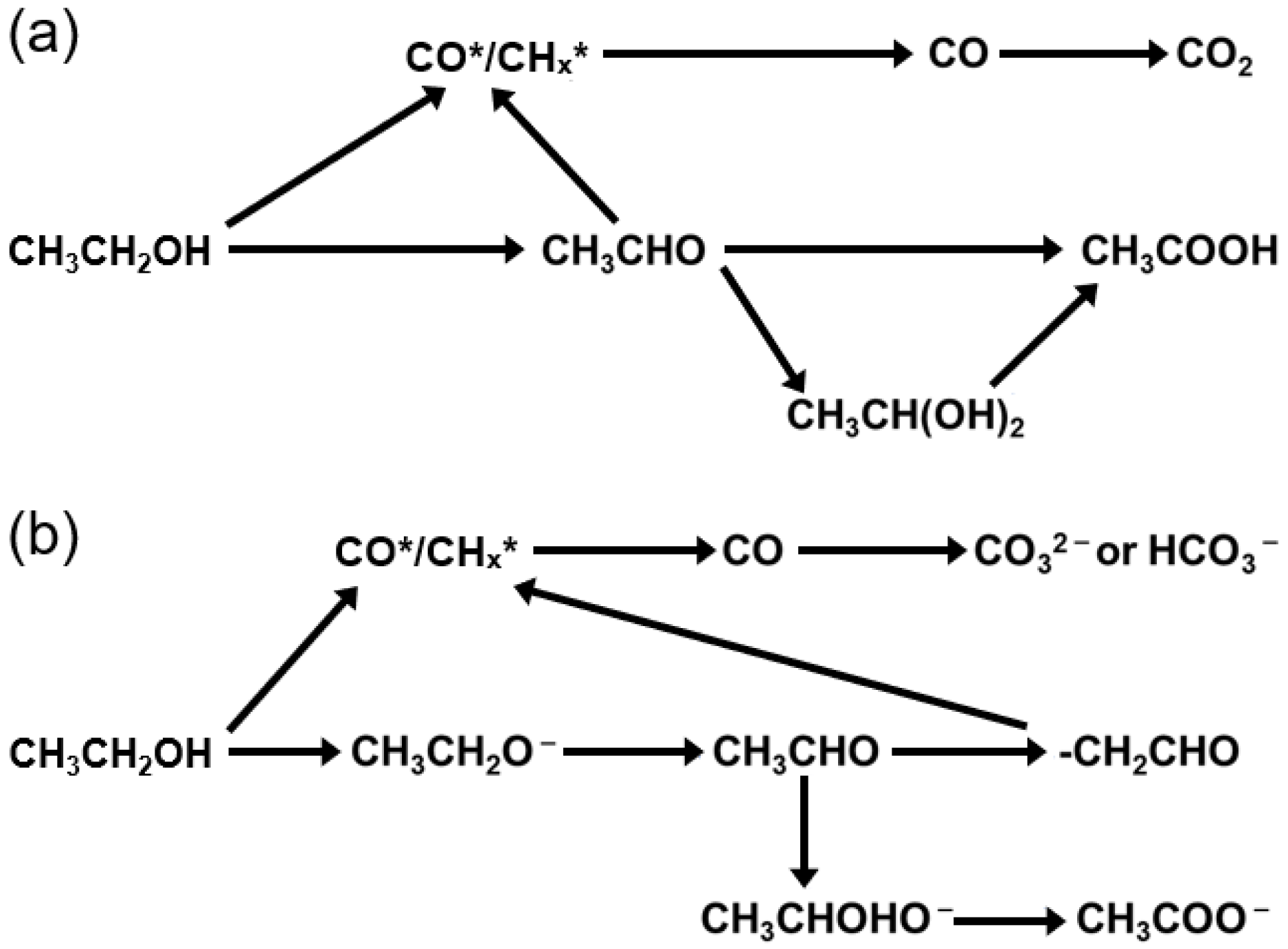
EOR is a complex multi-electron process that involves various parallel and consecutive reaction steps. As shown in Figure 1, the EOR proceeds via two primary pathways: complete oxidation of ethanol to CO2 (CO32−) (C1 pathway) with C–C bond cleavage and incomplete oxidation of ethanol to acetaldehyde (CH3CHO)/CH3COOH (CH3COO) (C2 pathway), respectively [8,9,32].
In acidic conditions, the C2 pathway involves stepwise dehydrogenation of CH3CH2OH to CH3CHO*, followed by further oxidation to CH3COOH, whereas the C1 pathway requires C–C bond cleavage to generate adsorbed C1 fragments (e.g., CO*/CHx*) which are first converted to CO and then further oxidized to CO2 [33,34,35]. However, the oxidation of CO-like intermediates is typically sluggish, leading to severe poisoning and thus compromising catalytic efficiency and stability. In alkaline media, overall EOR kinetics are enhanced because OH is more readily adsorbed and activated. CH3CHO* remains the key C2 intermediate and is easily converted to CH3COO, while the C1 pathway is more effectively promoted because surface OH accelerates the oxidation of C1 intermediates to CO32−, mitigating poisoning [33,34,35].
Through analysis, it can be found that the C1 pathway exhibits higher electron transfer efficiency and energy utilization capability, making it an ideal catalytic mechanism for the anode reaction of DEFCs. By promoting the C1 pathway, more electrons are extracted per ethanol molecule, enhancing fuel utilization and Faradaic efficiency toward CO2 [28,36].
For clarity, the C1 selectivity is quantified as the Faradaic efficiency toward C1 products (FEC1), mainly CO2 or CO32− in alkaline media. FEC1 is calculated by relating the amount of C1 products (e.g., CO2 quantified by operando DEMS/GC or CO32− quantified by IC) to the total charge passed during EOR. Sometimes, partial oxidation products (CH3COOH/CH3COO) are quantified by NMR/HPLC, and some studies report a “possible” C1 selectivity estimated by difference; in such cases, the value depends on analytical coverage and should be interpreted accordingly.

2.2. In Situ Characterization and Theoretical Calculation in Mechanism Research

The research on the mechanism of EOR catalysts involves rather complex processes on the catalyst surface, tracking the changes in species at the catalyst interface is of intuitive and significant importance. Recent advances by in situ/operando techniques—including FTIR, Raman spectroscopy, XAS, and DEMS—have provided direct evidence of the formation and evolution of EOR intermediates on Rh-based catalysts. These studies reveal that Rh can stabilize oxygenated species (e.g., CHxO*, CHO*, COH*) and promote their conversion to CO2 at lower potentials than Pt, confirming its superior oxidative capacity [8,9]. Complementarily, DFT simulations have quantified the energy barriers of key steps such as C–C bond cleavage and CO oxidation, showing that Rh possesses a lower activation energy for CH3CHO* dissociation and a more favorable pathway for CO* oxidation compared to Pt and Pd [33]. The combination of experimental and theoretical findings thus provides a comprehensive understanding of how Rh structure and electronic properties dictate EOR activity.
These mechanistic insights provide a foundation for rationally designing excellent Rh-based catalysts. By correlating atomic-scale structure with catalytic function, strategies such as increasing active Rh sites, tuning electronic properties through alloying or doping, and constructing oxide interfaces to supply oxygenated species can be effectively guided. Integrating in situ characterization with theoretical modeling will further increase the understanding of structure–activity relationships and accelerate the development of efficient, durable Rh-based electrocatalysts for practical DEFC applications.

2.3. Influence of Electrolyte and Reaction Microenvironment

In addition to the changes in the ethanol adsorption species, EOR is also strongly influenced by electrolyte conditions. In acidic media, CO-like intermediates tend to dominate, leading to severe catalyst poisoning, whereas in alkaline media, abundant OH promotes the formation of surface oxygenated species (e.g., OH*, O*), which facilitate oxidative removal of adsorbed intermediates [14,20]. Consequently, EOR generally exhibits higher activity and stability in alkaline environments [37,38]. It should be noted that the apparent C1 selectivity is highly sensitive to experimental parameters, including electrolyte composition/concentration, ethanol concentration, etc. Therefore, comparisons of C1 selectivity across different studies must be interpreted within their specific testing contexts.
However, even in a favorable reaction environment, the complete oxidation of ethanol to CO2 still fundamentally requires the cleavage of C–C bonds. Therefore, interfacial microenvironment engineering should be coupled with pathway control to improve C1 selectivity and mitigate poisoning intermediate accumulation [37,38]. Consequently, balancing and integrating selectivity, anti-poisoning capability, and micro-environment has become a key design principle for developing efficient EOR catalysts. Notably, such selectivity considerations are not limited to half-cell metrics but directly affect device-level losses in DEFCs, particularly those associated with fuel crossover.
In practical DEFCs, ethanol crossover from the anode to the cathode through the membrane remains a persistent challenge that lowers effective fuel utilization and can depress cell voltage by triggering parasitic cathodic reactions. Anode catalyst selectivity is therefore directly relevant to device efficiency, because it governs how much of the fed ethanol is electrochemically converted into charge at the anode versus remaining as unreacted fuel or partially oxidized products. Catalysts with higher C1 selectivity extract more electrons per ethanol molecule and reduce the fraction of ethanol that can escape the anode compartment, thereby mitigating crossover-induced losses. Consequently, improving anode C1 selectivity and intermediate-management is not only a mechanistic target but also a practical lever for enhancing DEFC efficiency under realistic operating conditions.

3. Rh-Based Catalysts

Rh exhibits a strong capability for C–C bond activation, while its marked oxygen-donating capability facilitates the adsorption and subsequent oxidative removal of carbonaceous intermediates, thereby accelerating EOR kinetics. This C–C activation is often attributed to Rh’s 4d electronic structure, which enables strong interaction with oxygenated intermediates (e.g., CH3CHO* and CH3CO*), stabilizing the transition state and lowering the barrier for C–C scission. Owing to its partially filled 4d orbitals, Rh binds key intermediates with moderate strength, achieving a favorable balance between adsorption and desorption. Compared with Pt, Rh displays weaker CO adsorption energy, which endows it with higher CO tolerance and mitigates surface poisoning. Importantly, the moderate CO binding also helps prevent persistent site blocking after C–C cleavage, allowing the generated C1 fragments (CO*/CHx*) to be further oxidized in the presence of oxygenated species (e.g., OH*). Mechanistic studies of EOR reported in the literature consistently identify Rh as a promising catalyst candidate due to its unique electronic structure and catalytic behavior [39]. Therefore, a deeper understanding of the interplay among Rh electronic structure, surface chemistry, and reaction microenvironment is essential not only for elucidating its intrinsic catalytic mechanisms but also for guiding the rational design of advanced Rh-based EOR catalysts for high-performance DEFCs.

3.1. Monometallic Rh Catalysts

Monometallic Rh catalysts exhibit remarkable catalytic activity and a unique ability to cleave C–C bonds, which can be seen as an important fundamental model catalyst for probing the intrinsic ethanol oxidation mechanism and studying the intrinsic mechanism of ethanol oxidation. The tunable nanostructures assist researchers in systematically investigating the effects of surface morphology and atomic configuration on reaction pathways and the adsorption of intermediates [39]. Based on these structure-related insights, combined with in situ electrochemical characterization, theoretical calculations, and electrochemical fundamental principles, the researchers tracked and studied the evolution mechanism of rhodium surface species as the potential changed, as well as the influence of these interface environment changes on the oxidation pathway of ethanol.
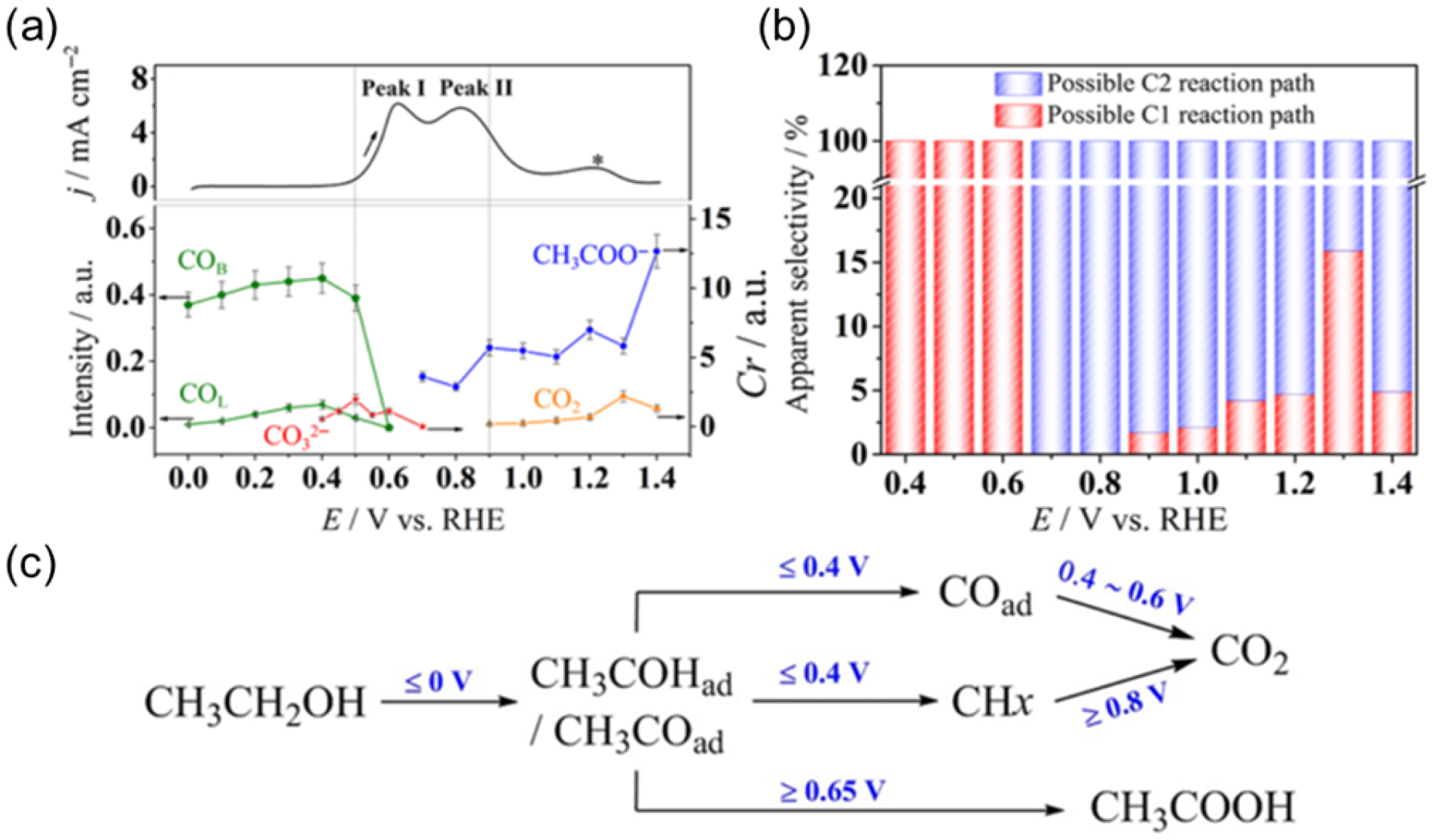
In Figure 2, in situ FTIR studies demonstrate that EOR on Rh surfaces proceeds through a potential-dependent dual-pathway mechanism [40]. At a low potential (0.4–0.6 V vs. RHE), CO* species can be found and are subsequently oxidized to CO2, corresponding to the C1 pathway and contributing to peak I. In this potential region, the C1 selectivity can reach nearly 100%, indicating efficient oxidation of adsorbed CO* intermediates. As the potential increases, CH3COOH becomes the dominant product (0.65–0.8 V vs. RHE), revealing the prevalence of the C2 pathway and explaining the second peak II. At even higher potentials (>0.8 V vs. RHE) CO2 formation reappears, which has been attributed to the oxidation of CHx* species generated from deeper C–C bond cleavage steps. It confirms that Rh follows a potential-dependent dual-path mechanism, where C1 oxidation dominates at lower potentials via CO* oxidation, while the C2 route is favored at intermediate potentials, and CHx* oxidation becomes significant at high overpotentials.
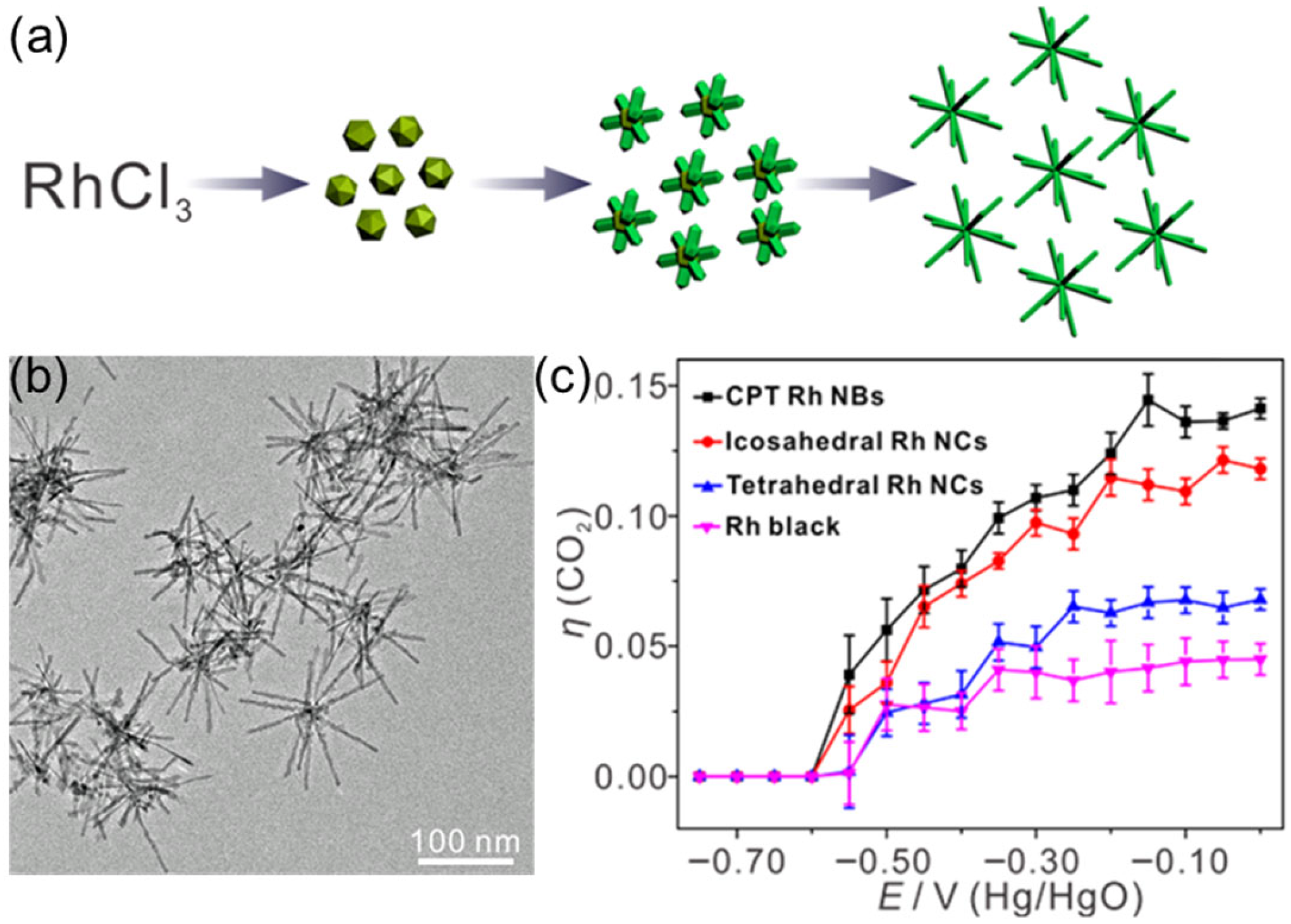
Guided by the mechanistic insights, the structure–property studies have further shown that careful morphological and facet engineering can amplify the intrinsic C–C cleavage capability of Rh and improve C1 selectivity by optimizing surface coordination and exposure of active sites. Xie et al. demonstrated that cyclic penta-twinned (CPT) Rh nanobranches assembled from 1D CPT nanorods expose abundant open (100) facets and substantial lattice strain (Figure 3), which collectively endow the catalyst with exceptional EOR activity in alkaline media [41]. These CPT Rh nanobranches achieved a remarkable C1 selectivity of 14.5 ± 1.1% at −0.15 V vs. RHE in 1.0 M NaOH and 1.0 M CH3CH2OH at room temperature, significantly exceeding commercial Rh and Pt/C. DFT calculations further revealed that the high density of Rh (100) sites dominates both the high activity and C1 selectivity, while the intrinsic tensile strain accelerates ethanol dehydrogenation. Building on this structure–property understanding, the same group subsequently developed excavated Rh nanobranches consisting of ultrathin nanosheets rich in high-energy (110) facets [42]. This architecture provided an enlarged active surface and structurally advantageous sites for C–C bond scission, yielding an even higher C1 selectivity of 15.8% in 1.0 M NaOH and 1.0 M CH3CH2OH at room temperature. Complementary in situ FTIR and DFT analyses confirmed that C–C cleavage of ethanol is strongly facet-dependent, and that the combined effects of (110) facet exposure and excavated polyhedral morphology account for the enhanced activity, C1 selectivity, and durability.
The tracking and research of the EOR process based on monometallic Rh-based catalysts form the basis for the design of efficient Rh EOR catalysts, which also proves that specific atomic arrangements can effectively enhance the performance of Rh-based EOR catalysts. However, the high cost and limited natural abundance of Rh remain major barriers to large-scale application for monometallic catalysts, and further improvements in activity and selectivity are still required under practical operating conditions. These considerations highlight the need for rational catalyst design beyond monometallic Rh. Accordingly, the following sections focus on how alloying strategies, support engineering, and interfacial modulation can simultaneously enhance C1 selectivity and reduce noble-metal utilization.

3.2. Rh-Noble-Metal Alloy Catalysts

To address the issue of the monometallic Rh-based catalyst, the construction of an efficient Rh alloy has become an effective design strategy. During the alloying process, both electronic effects and geometric effects are introduced simultaneously, fundamentally altering the pattern of the catalytic reaction. Electronic modulation arises from charge redistribution between Rh and the secondary metal, which shifts the Rh d-band center and tailors its binding with key intermediates. Especially for some noble metal elements, they inherently possess strong catalytic ability and selectivity for the cleavage of C-C bonds, thus becoming an important component of Rh-based alloy catalysts. For example, alloying with Au, Pt or Pd can weaken CO adsorption and enhance CO tolerance [43,44,45,46], whereas incorporating Au or Ag stabilizes the surface and facilitates desorption of oxygenated species [47,48]. Geometric effects, originating from lattice strain and coordination restructuring, further optimize active-site configurations, strengthen ethanol adsorption, and promote C–C bond cleavage essential for driving the reaction toward complete oxidation [44,49,50,51,52,53,54]. Through these synergistic modifications, Rh/noble-metal alloys not only enhance activity, C1 selectivity, and durability but also reduce Rh usage.
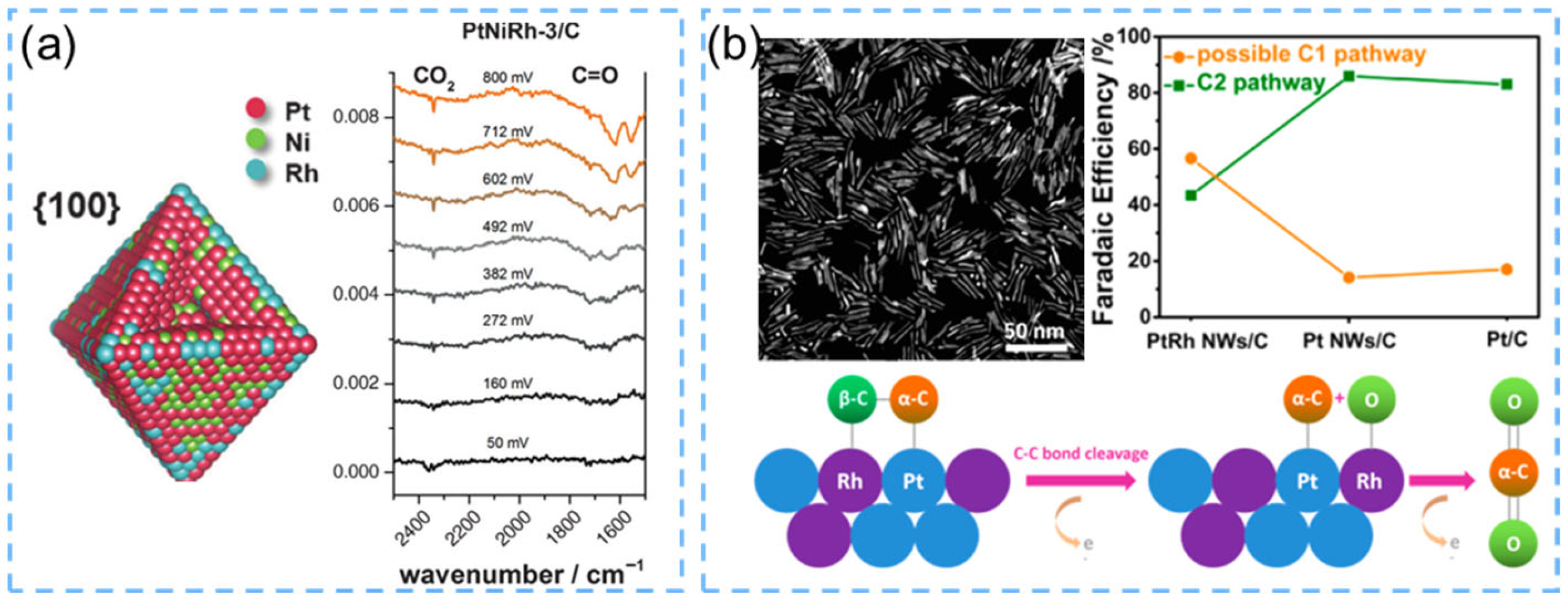
Among various Rh-based alloys, Rh–Pt alloys have received particular attention due to their synergistic catalytic behavior. Pt exhibits strong activity for C–H bond activation and oxygen species adsorption, while Rh facilitates C–C bond cleavage and mitigates CO poisoning [55]. The combination of these two metals results in a balanced adsorption environment, enabling both high reaction kinetics and improved durability. For example, shape-controlled PtNiRh-3 octahedral catalysts exhibited exceptional EOR activity, achieving an unprecedentedly low onset potential as low as 0.1 V versus RHE. Comprehensive physicochemical characterization, coupled with in situ ATR analysis, PtNiRh-3 displayed high C1 selectivity toward complete oxidation to CO2 in 0.1 M KOH and 0.5 M CH3CH2OH (Figure 4a) [56]. Specifically, the PtRh nanowires (NWs), with an average diameter of only 1.2 nm, maximize Pt atom utilization and leverage strong Pt–Rh electronic coupling, delivering a nearly 3-fold higher activity and superior durability than commercial Pt/C (Figure 4b) [57]. Their optimized bimetallic structure effectively suppressed the C2 pathway, delivering a C1 selectivity of 56.6% in 0.1 M HClO4 and 0.5 M CH3CH2OH at room temperature, markedly outperforming Pt NWs and commercial Pt/C. And EIS showed that PtRh NWs exhibited the highest conductivity and the lowest charge-transfer resistance. In PtRh NWs, Rh and Pt act cooperatively to enhance EOR performance. Rh preferentially interacts with the α-C while adjacent Pt binds the β-C of ethanol, facilitating C–C bond cleavage and suppressing the formation of CH3COOH and CH3CHO. Meanwhile, the oxophilic Rh sites supplied abundant OH* species to oxidize CO* on neighboring Pt sites, thereby improving C1 selectivity and CO-poisoning resistance. It demonstrated that the Rh–Pt alloy effectively integrates C–C bond activation, intermediate oxidation, and anti-poisoning capability.
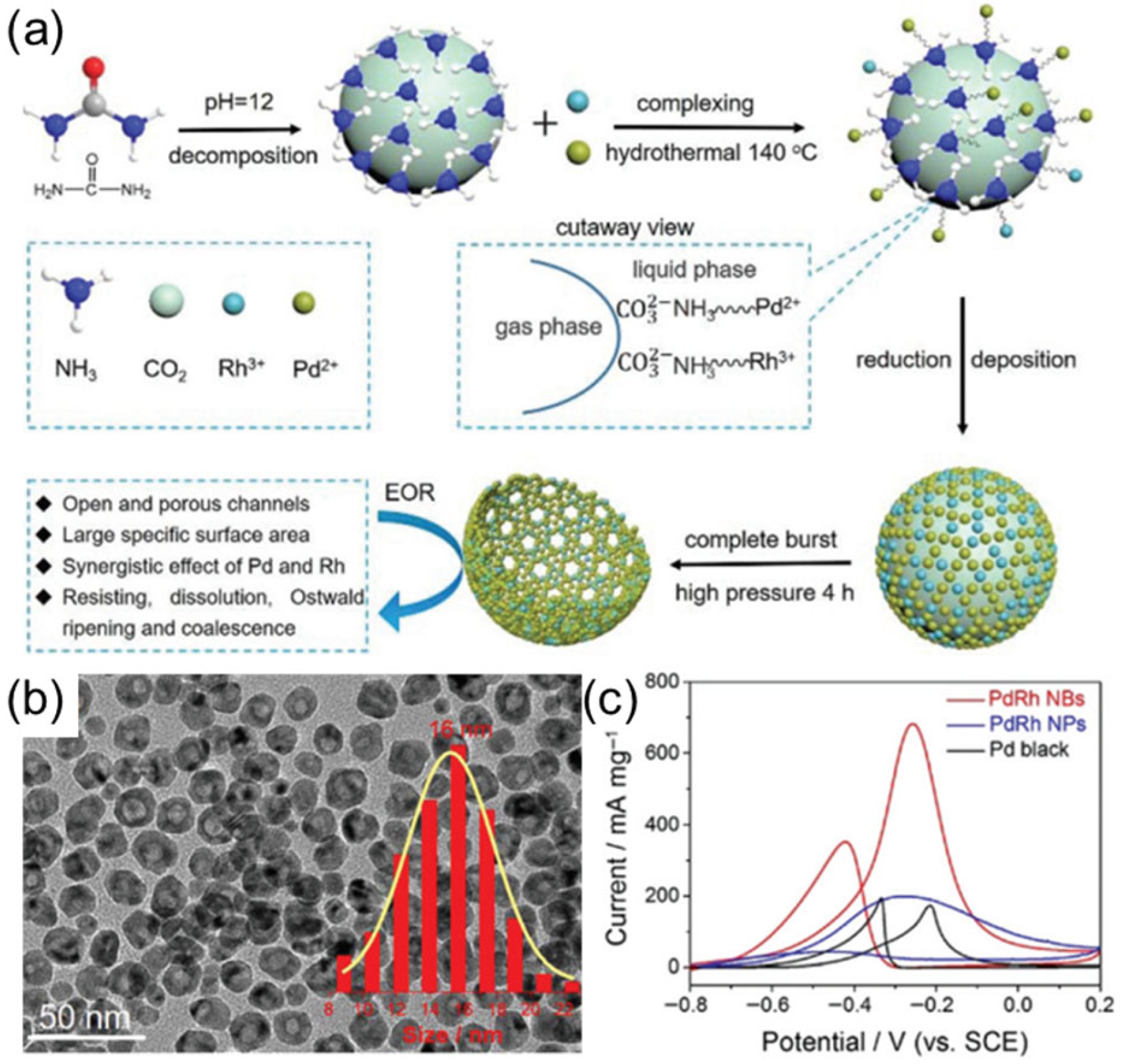
Beyond Rh–Pt alloys, Rh–Pd alloys represent a more cost-effective and practically oriented strategy for EOR catalysis, particularly under alkaline conditions. The incorporation of Rh into Pd markedly modifies the electronic structure of Pd, weakening the adsorption strength of poisoning intermediates and facilitating their oxidative removal [58,59]. In this bimetallic system, Rh provides active sites for C–C bond cleavage, while Pd offers abundant and kinetically favorable sites for ethanol adsorption and intermediate stabilization, resulting in enhanced overall reaction efficiency. For instance, hollow and porous PdRh nanobowls (NBs) with an average diameter of 16 nm, formed through gas-bubble-directed growth and alloying with Rh, provided a large accessible surface and enriched reactive interfaces that facilitated C–C bond cleavage and exhibited substantially higher C1 activity than commercial Pd black in 1.0 M KOH and 1.0 M CH3CH2OH at room temperature (Figure 5) [60]. And the trimetallic core-shell Ni20@Pd60Rh20/C exhibited a mass activity 9.3 times higher than that of Pd/C, a superior performance attributed to the synergistic interplay between its metallic components and its unique core-shell architecture [61]. Importantly, in situ FTIR analysis provided direct evidence for the Rh-induced enhancement of the C1 pathway. The peaks at 1650 cm−1 were attributed to the asymmetric stretching vibration of the O−C−O band for CH3COO. The peaks at about 1350 cm−1 were attributed to the symmetric stretching vibration of the O−C−O band from either CH3COO or CO32− species. The Ni20@Pd60Rh20/C exhibited a relatively stronger band than that of Pd/C, which meant producing a large amount of CO2. These results demonstrated that introducing Rh into Pd-based catalysts could effectively accelerate the cleavage of the C–C band and increase the C1 selectivity of the EOR, highlighting their promise as practically viable anode catalysts for alkaline DEFCs.
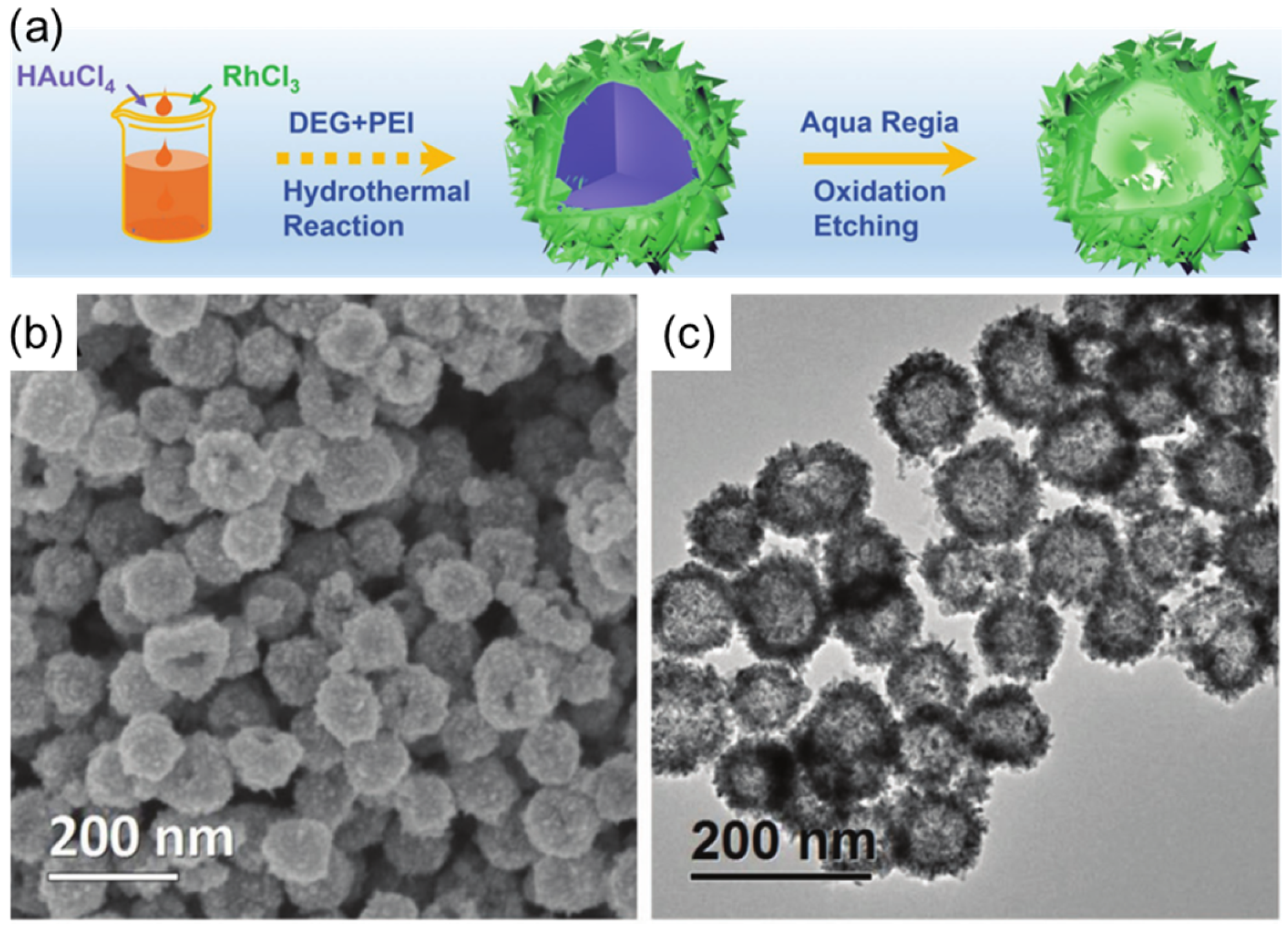
The addition of Au can also further enhance the anti-poisoning ability of the Rh-based catalyst. As shown in Figure 6, Rh H-NSs were synthesized by first preparing Au@Rh core-shell nanoshells (Rh H-NSs) via a one-pot hydrothermal method, followed by a selective etching process in aqua regia for 2 h to remove the surfactant and the Au core [62]. The high alcohol oxidation activity and durability of the Rh H-NSs could be attributed to their unique structural and intrinsic properties. The large specific surface area, porous channels, abundant atomic steps/corners, and clean surface collectively contributed to the high activity and excellent durability. Notably, Rh H-NSs delivered a mass activity of 105 A g−1 in 1.0 M KOH + 1.0 M CH3CH2OH at room temperature. Introducing Rh into multimetallic nanostructures could further amplify the C1 pathway. For example, one-dimensional Au@AuPt0.20Rh0.80 alloy shell nanowires (Au@AuPt0.20Rh0.80 CS-NWs) with a diameter of 6.48 nm displayed higher peak current density, better resistance to CO poisoning, and more lasting stability compared with commercial Pt black, which could be attributed to the trimetallic synergistic effect between the Au, Pt, and Rh atoms [63]. In 1.0 M KOH and 1.0 M CH3CH2OH at room temperature, Au@AuPt0.20Rh0.80 CS-NWs exhibited a high mass activity of 7.38 A g−1. Rh can promote the C–C bonds and adsorb OH* while Au can change the electronic structure of Pt, endowing Pt with a high anti-poisoning ability to CO* and promoting the complete oxidation of various C1 intermediates to CO2.
EOR performance is highly sensitive to electrolyte, ethanol concentration, temperature, etc. Alloying is generally beneficial because it enables charge redistribution that tunes the adsorption energies of key intermediates (often weakening CO binding while maintaining C–C activation), introduces lattice strain and ensemble effects that reshape surface coordination and enrich reactive sites for C–C scission, and incorporates oxophilic compositions or interfacial functionalities that promote OH* formation and accelerate oxidative removal of CO*/CHx* fragments. Collectively, these electronic, geometric, and bifunctional features provide the design rationale for Rh-based alloy catalysts targeting improved C1 selectivity.

3.3. Rh-Non-Noble Metal Alloy Catalysts

Apart from alloys composed exclusively of noble metals, the rational incorporation of non-noble metal components has emerged as a particularly attractive strategy for Rh-based EOR catalysts, as it simultaneously enhances activity, C1 selectivity, and reduces cost. Through introducing earth-abundant metals with Rh, it could regulate the Rh active sites through electronic modulation, lattice strain, and interfacial bifunctional effects. Such hybridization not only lowers noble-metal loading and improves economic viability but also creates new reaction microenvironments that favor C–C bond cleavage and the C1 pathway.
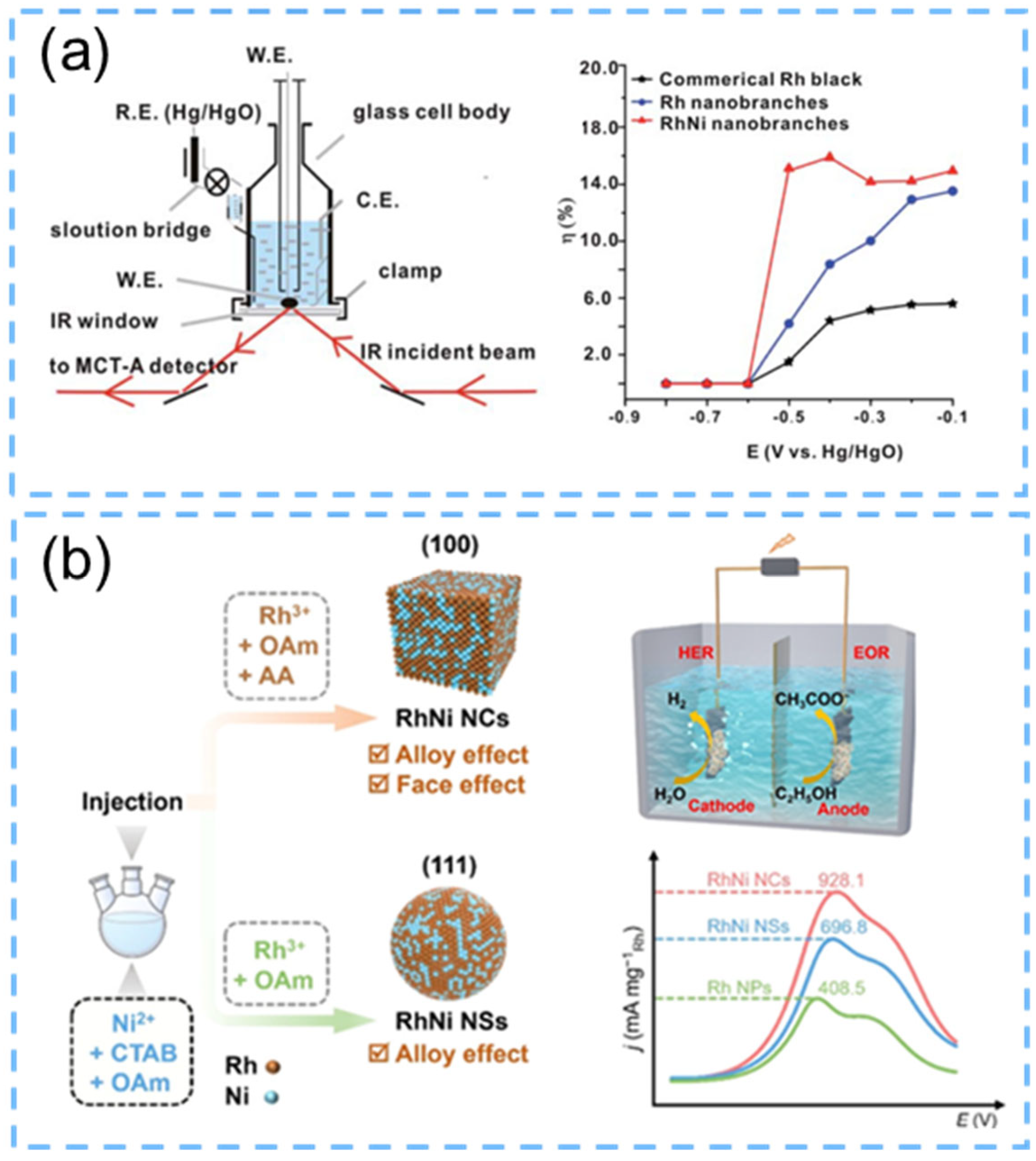
Rh/transition-metal alloys (e.g., Rh–Cu, Rh–Ni, Rh–Co) offer a cost-effective and mechanistically powerful strategy to overcome sluggish EOR kinetics, limited CO2 selectivity, and CO poisoning while reducing noble-metal usage. Incorporation of earth-abundant metals induces both electronic modulation and lattice strain, enhancing hydroxide adsorption and accelerating the oxidation of carbonaceous intermediates via a bifunctional mechanism. For example, RhCu alloy nanodendrites (NDs) with abundant stepped sites exhibit optimized electronic structures that strengthen ethanol adsorption while suppressing CO poisoning, delivering a markedly higher C1 selectivity (38.9%) than Rh NDs and commercial Rh/C in 0.1 M KOH and 1.0 M CH3CH2OH at room temperature [64]. Similarly, excavated RhNi alloy nanobranches composed of ultrathin nanosheets show enhanced C–C bond cleavage, elevated C1 selectivity, and strong tolerance to toxic intermediates (Figure 7a) [65]. In situ FTIR analyses revealed that Cu or Ni incorporation tuned the Rh electronic environment and lowered the energy barriers for both dehydrogenation and oxidation of CO*/CHx* species. Further structure–composition optimization, exemplified by RhNi nanocubes (NCs) enriched with (100) facets, promotes efficient H2O activation, facilitates intermediate oxidation, and improves resistance to CO poisoning (Figure 7b). And RhNi NCs could achieve a high C1 selectivity of ~54% at 0.6 V vs. RHE, significantly outperforming RhNi NPs and commercial Rh in 0.1 M KOH and 1.0 M CH3CH2OH at room temperature [66]. Through a pronounced spillover effect, Rh79Co21 NSs markedly mitigate Rh-site poisoning and promote deeper oxidation, delivering much higher mass activity of 485.1 mA mg−1 and C1 selectivity (75.5%) than pure Rh NSs in 1.0 M KOH and 1.0 M CH3CH2OH at room temperature [67]. These results collectively demonstrated that transition-metal alloying effectively improves the intrinsic C–C cleavage capability of Rh and C1 selectivity.
Beyond conventional d-band alloying with transition metals, non-noble main-group elements provide an alternative yet complementary method to regulate Rh surface chemistry through interfacial electronic and strain effects. For instance, activated carbon was first loaded with Rh nanoparticles via microwave-assisted deposition of RhCl3·3H2O, OH, and ethylene glycol to form Rh/C, and then Pb2+ was incorporated by immersion-reduction to yield core-shell Pb@Rh/C [68]. Pb incorporation primarily tuned the Rh surface electronic structure and adsorption geometry of carbonaceous intermediates. The optimized Pb0.53@Rh/C modulated the Rh surface via interfacial electronic and strain effects, delivering a ~13-fold higher mass activity (~1450 mA mg−1) than pristine Rh while retaining ~57% of the current after 20,000 s in 1.0 M NaOH and 1.0 M CH3CH2OH at room temperature. Importantly, the C1 selectivity was ~21%, confirming that a properly engineered Pb–Rh interface accelerates the oxidation of CO*/CHx* intermediates while preserving robust C–C cleavage capability. It demonstrated that main-group element modification represented a surface-focused extension of alloy engineering, particularly effective for suppressing poisoning intermediates under alkaline conditions.
Overall, it demonstrates that rational alloying serves as a unifying strategy to regulate electronic structure, interfacial chemistry, and reaction pathways. By balancing intermediate adsorption, facilitating OH* adsorption, and accelerating C–C bond scission toward the C1 pathway, alloying enhances the EOR performance and lowers the catalyst cost. These insights establish alloy-induced electronic and geometric effects as the design principles for achieving complete ethanol oxidation and provide a solid foundation for the subsequent discussion of Rh-based composite and hetero-structured catalysts.

3.4. Rh–Metal Oxide/Hydroxide Composite Catalysts

In addition to alloying, the Rh-based catalysts composed of transition metal compounds are also beneficial for the construction of efficient EOR catalysts. Especially for oxide and hydroxide compounds, which not only serve as structural anchors that prevent Rh nanomaterial agglomeration but also actively participate in the oxidation process by providing oxygen species. Furthermore, the complex electronic environment on the oxide and hydroxide surfaces can also regulate the distribution of the electron cloud of Rh, optimize the adsorption and desorption capabilities, and enhance C1 selectivity, which can significantly enhance catalytic activity and stability [69].
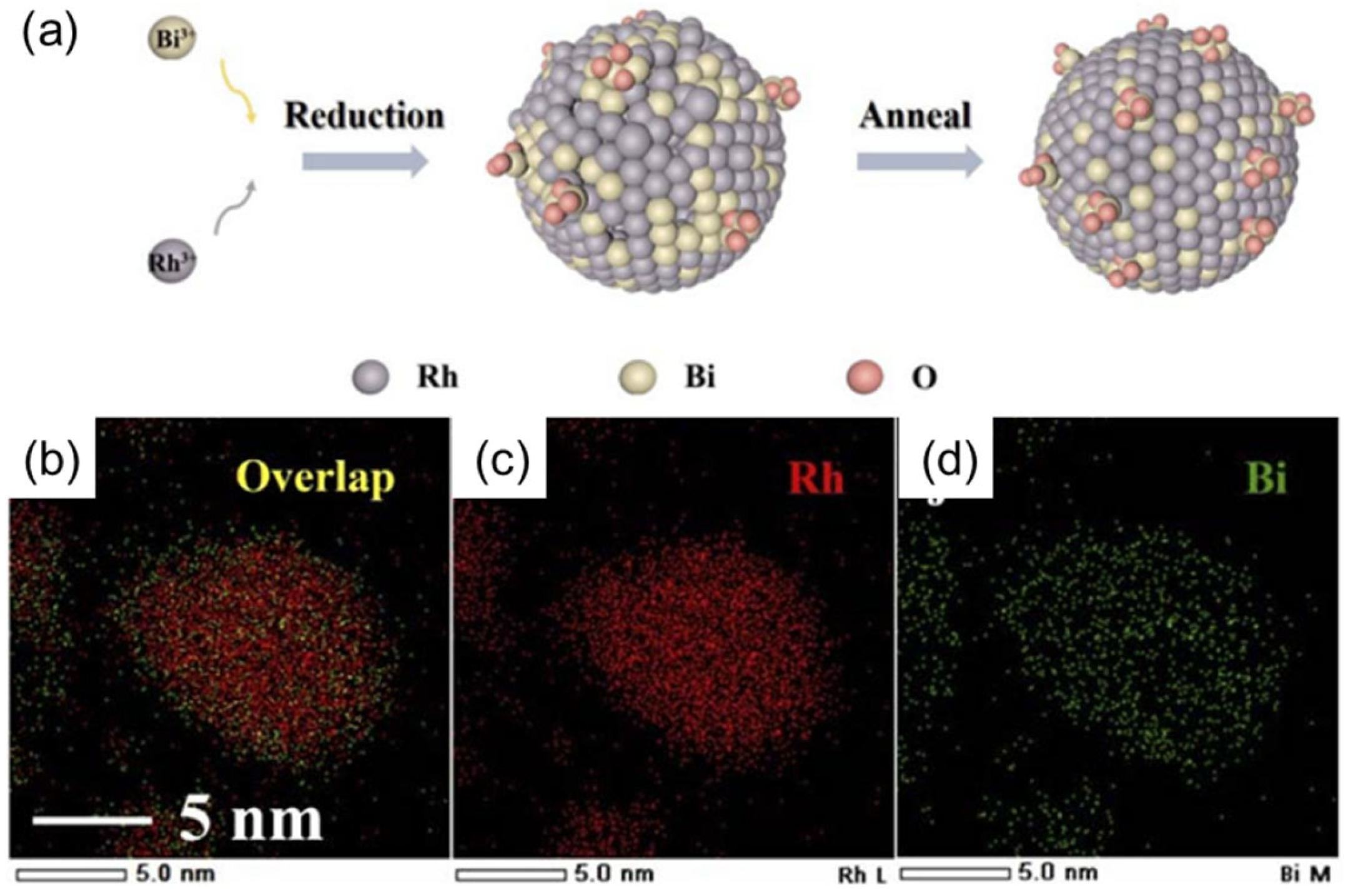
Well-defined Rh-metal oxide/hydroxide composite catalysts are a powerful strategy for simultaneously boosting C1 selectivity, catalytic activity, and structural durability. For instance, the heterogeneous Rh–Pb/PbO interface provided coordinated sites for both C–C bond dissociation and intermediates oxidation, enabling a much higher mass activity of ~2636 mA mgRh−1 and retaining a ~50% current after 4 h operation in 1.0 M NaOH and 1.0 M CH3CH2OH at room temperature [70]. In situ IR spectroscopy verified substantially enhanced CO2 generation, with the C1 selectivity reaching ~20% at 0.53 V. In addition, Rh–Bi(OH)3 achieved a remarkable C1 selectivity of 26.2% at 0.67 V vs. RHE, along with high mass activity (~3500 mA mgRh−1) and excellent 10 h stability in 1.0 M NaOH and 1.0 M CH3CH2OH at room temperature [71]. RhBi–Bi2O3 was synthesized by co-impregnating Bi(NO3)3·5H2O, Vulcan XC-72 carbon, and RhCl3 in HCl/H2O, followed by ultrasonic mixing, drying, reductive annealing at 200 °C in 5% H2/N2, and subsequent calcination at 400 °C under Ar (Figure 8). The optimal RhBi–Bi2O3 showed superior EOR mass activity, which was 80 times and 2.5 times higher than that of pristine Rh and commercial Pd/C, respectively. Meanwhile, it demonstrated excellent long-term durability, retaining 53.7% of its initial Faradaic current after a 10,000 s continuous measurement in 1.0 M NaOH and 1.0 M CH3CH2OH at room temperature [72].
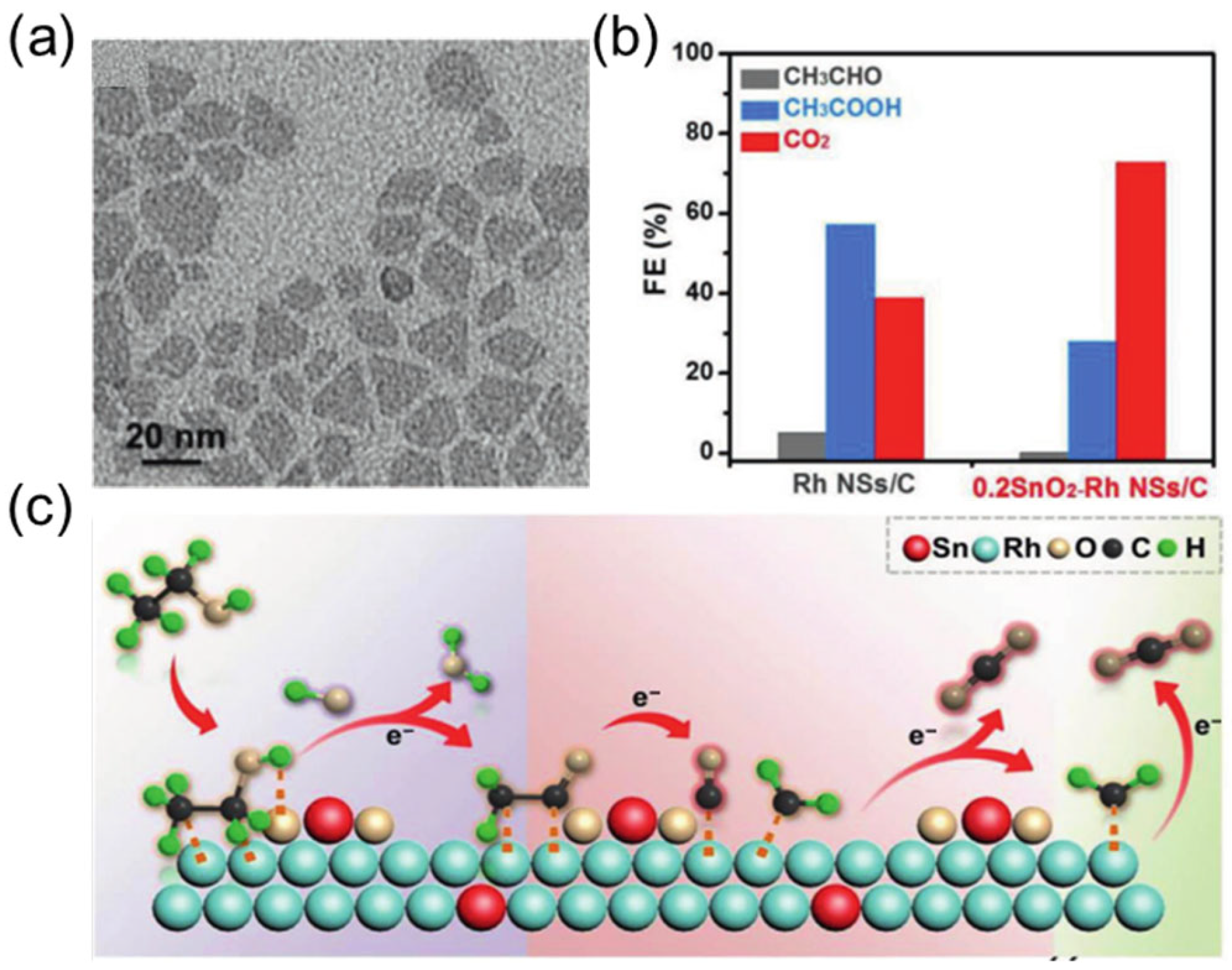
The Rh–oxide/hydroxide interfaces can also facilitate C–C bond cleavage and intermediate oxidation. For example, the presence of abundant oxygen vacancies and highly mobile lattice oxygen in SnO2 plays a particularly crucial role. These features enable the efficient provision of active oxygen species at the Rh-SnO2 interface, which is pivotal for the oxidative removal of CO-like poisoning intermediates and the facilitation of C–C bond cleavage, improving both activity and C1 selectivity [28,73,74]. The well-defined Rh–SnO2 interfaces in ultrathin SnO2–Rh nanosheets markedly boost alkaline EOR activity, where the optimized 0.2 SnO2–Rh NSs deliver a mass activity of 213.2 mA mgRh−1 and a C1 selectivity of 72.8%, surpassing Rh NSs in 0.1 M KOH and 0.5 M CH3CH2OH at room temperature (Figure 9) [75]. EIS measurements showed that 0.2SnO2–Rh NSs exhibited a much smaller Nyquist semicircle than Rh NSs, indicating that the Rh–SnO2 interface accelerates interfacial charge transfer during EOR. Mechanistic analyses revealed that the strong electronic and geometric coupling at the interfaces not only accelerates C–C bond scission but also promotes the oxidation of poisoning intermediates [76]. Beyond oxide supports, hydroxide-modified interfaces can induce a similar promotion effect. In Rh/Pd/Ni(OH)2/C hybrids, Ni(OH)2 served as an efficient reservoir for oxygenated species (e.g., OH*), which synergistically interacted with Rh and exposed Pd (100) facets to facilitate intermediate oxidation and suppress surface poisoning. Consequently, the composite catalyst delivered specific activities approximately 11.6 and 3.5 times higher than those of Pd/C in 1.0 M KOH and 1.0 M CH3CH2OH at room temperature [77].
The interface engineering strategy can also be further extended to the construction of the catalyst interface microenvironment, thereby assisting researchers in combining oxides and hydroxides as carrier materials to construct highly efficient Rh-based supported catalysts [78]. CeO2 possesses a high density of oxygen vacancies and can undergo facile Ce3+/Ce4+ redox cycling, which continuously supplies lattice oxygen to assist in the oxidative removal of adsorbed CO*/CHx* intermediates [79,80,81,82]. In the case of hydroxide supports, materials such as Ni(OH)2 or Co(OH)2 can promote the formation of surface hydroxyl groups, which play a crucial role in facilitating the oxidation of carbonaceous intermediates, accelerating the overall EOR process [77,83,84].
Overall, oxide/hydroxide supports are not merely passive carriers but active interfacial components that regulate oxygen availability, electronic structure, and reaction pathways, further underscoring interfacial engineering as a general strategy to mitigate poisoning and improve C1 selectivity.

3.5. Rh on Carbon-Based Supports and MXene

Carbon-based materials such as graphene, carbon nanotubes (CNTs), carbon black, and hollow carbon spheres are also common components for noble metal catalysts owing to their high electrical conductivity, large specific surface area, and tunable surface chemistry [85,86,87]. These attributes enable strong metal–support interactions and ensure rapid electron transport, which are essential for maximizing the utilization efficiency of Rh active sites during EOR, which can help researchers to expand the design concepts of Rh-based catalysts. It should be noted that under anodic polarization, especially during long-term operation or potential excursions, carbon supports may undergo gradual electrochemical oxidation, which can weaken metal support anchoring and contribute to performance decay.
Different carbon architectures provide distinct advantages for catalyst design. One-dimensional CNTs facilitate efficient mass transport of ethanol and reaction intermediates along their tubular channels, while their mechanically robust, curved surfaces help maintain catalyst integrity under prolonged electrochemical operation. Moreover, the strong metal–CNT interactions, together with the defect-rich and conductive surface of CNTs, can effectively regulate the electronic environment of Rh nanoparticles and provide abundant anchoring sites for oxygen-containing species. This promotes the adsorption, activation, and supply of reactive oxygenated intermediates (e.g., OH*), which facilitate the oxidative removal of CO* species from active sites, thereby alleviating catalyst poisoning and sustaining high catalytic activity and stability [85,86]. Meanwhile, employing more corrosion-resistant carbon architectures (e.g., CNTs or highly graphitized carbons) and strengthening interfacial bonding are also beneficial for mitigating carbon corrosion and preserving electrode integrity under practical EOR conditions.
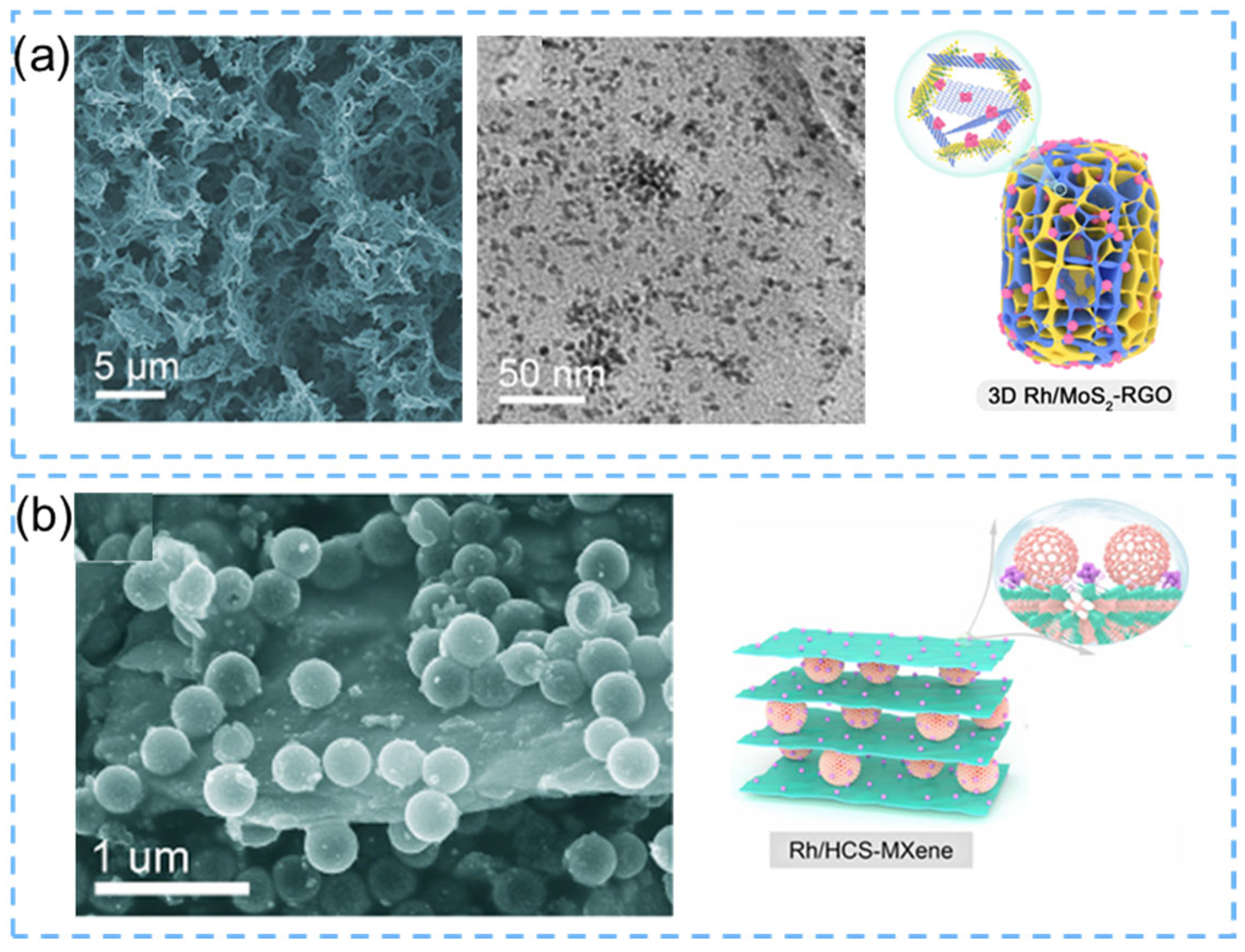
In contrast, two-dimensional graphene and reduced graphene oxide (RGO) offer extended conductive networks and defect-rich surfaces that promote uniform dispersion of Rh or Rh-based alloy nanoparticles and induce electronic coupling at the metal–support interface [88,89,90]. Huang et al. reported a 3D interconnected MoS2–RGO network uniformly decorated with ultrafine Rh nanoparticles, constructed via a controllable co-assembly strategy, in which the porous conductive framework enables homogeneous Rh dispersion and enhanced electrocatalytic performance (Figure 10a) [85]. Beyond improving Rh utilization through three-dimensional conductive supports, further modulation of the catalytic pathway can be achieved by introducing a second active metal to tailor the local electronic structure and active-site cooperation. Composition-tunable PtRh alloy nanoparticles supported on RGO further highlighted the role of conductive carbon supports in steering reaction pathways. Among these catalysts, Pt1Rh1/RGO exhibited an ultrahigh mass activity of 0.285 A mgPt−1 and a 16.2-fold enhancement in C1 selectivity in 0.1 M HClO4 and 0.1 M CH3CH2OH at room temperature [91]. Detailed structural and spectroscopic analyses revealed that cubic Pt1Rh1 nanoparticles exposing dominant (100) facets and abundant step sites, in combination with Rh-induced mitigation of CO* poisoning, synergistically promote C–C bond scission and deep alcohol oxidation via CH2CO* intermediates formed at adjacent Pt–Rh sites. Notably, maintaining the anode potential within the EOR-dominated window and avoiding unnecessary high-potential exposure are also important to suppress concurrent carbon oxidation, thereby sustaining long-term catalyst utilization.
Extending the concept of conductive and structurally engineered supports, emerging two-dimensional materials and hierarchical carbon architectures have attracted increasing attention for maximizing Rh utilization and interfacial synergy. Huang et al. reported a mesoporous hollow carbon-sphere-intercalated MXene architecture decorated with ultrafine Rh nanocrystals (Rh/HCS-MX), in which HCS spacing enhances mass transport while strong Rh–support coupling optimizes the Rh electronic structure, leading to pronounced synergistic catalytic effects (Figure 10b) [86]. It demonstrates that MXene as a support not only stabilizes Rh nanocrystals but also creates electronically coupled interfaces that can be further exploited by multimetallic alloying to amplify catalytic synergy. For example, porous ternary PtRhFe nanospheres were uniformly anchored on highly conductive Ti3C2Tx MXene nanosheets via a one-pot solvothermal strategy [92]. The optimized Pt69Rh8Fe23 PNS@MXene delivered the highest mass and specific activities together with excellent durability, benefiting from the porous architecture that facilitates charge/mass transport and the strong metal–support interactions that modulate the alloy electronic structure to promote ethanol adsorption and activation. Such non-carbon conductive supports (e.g., MXene) also provide an appealing alternative when carbon corrosion is a concern, because they can offer strong interfacial coupling while avoiding the intrinsic oxidation vulnerability of carbon frameworks.
More broadly, carbon supports with tailored surface chemistry provide a versatile platform to regulate metal–support interactions for alcohol oxidation. The heteroatom functionalization of carbon materials can effectively tune local electronic environments and improve nanocrystal dispersion [93,94]. Although direct evidence in Rh-based EOR catalysts remains limited, these findings imply that rational design of carbon supports may offer additional opportunities to optimize Rh utilization, interfacial charge transfer, and long-term stability. Based on relevant studies, it can be observed that the interface that has undergone engineering modification plays a specific role in controlling the ethanol oxidation pathway.
Table 1 summarizes representative Rh-based EOR catalysts in terms of electrolyte, mass activity, or C1 selectivity to provide an at-a-glance comparison for the discussion above.

4. Structure–Activity Relationship of Rh-Based Catalysts

Understanding the reaction mechanism and structure–activity relationship is essential for elucidating how Rh-based catalysts achieve high performance in EOR. The EOR process involves multiple proton–electron transfer steps, C–C bond cleavage, and the formation and oxidation of adsorbed intermediates. The catalytic activity and product selectivity of Rh-based materials are therefore governed by the interplay between their surface atomic structure and electronic configuration.

4.1. Structure–Activity Correlation

EOR on Rh-based catalysts proceeds through sequential dehydrogenation and oxidation steps, generating intermediates such as CH3CHO*, CH3COO*, and CO* [8,9]. The ability of Rh to moderately bind CO while efficiently activating C–C bonds enables deep oxidation and mitigates surface poisoning, thus promoting higher C1 selectivity [37]. This intrinsic balance between adsorption and activation is further influenced by the atomic arrangement and exposed surface facets of Rh. DFT calculations and in situ spectroscopic analyses have revealed that Rh (100) and stepped surfaces favor ethanol dehydrogenation and C–C bond breaking, while Rh (111) stabilizes intermediates such as CH3CHO* and CH3COO*, favoring partial oxidation [39]. Therefore, tailoring the surface structure to expose more undercoordinated Rh sites (edges, corners, or high-index planes) can significantly enhance C–C cleavage activity and promote full oxidation to CO2.
Additionally, particle size effects influence the electronic properties and adsorption behavior of Rh. Smaller nanoparticles or atomically dispersed Rh species exhibit higher specific activity due to the increased proportion of low-coordination sites and modified d-band centers. However, excessive downsizing can also lead to unstable intermediates or weaker binding strength, compromising reaction continuity. Thus, an optimal size regime is required to maintain a balance between activation and desorption.

4.2. Electronic Modulation and Intermediate Control

The electronic environment of Rh can be precisely tuned through alloying, doping, or support interactions, which directly affects the adsorption energy of key intermediates. For instance, alloying Rh with electron-donating metals (e.g., Cu, Ni) shifts the d-band center downward, weakening CO adsorption and enhancing CO tolerance [63,64,65]. Conversely, electron-withdrawing partners (e.g., Au, Ag) can stabilize oxygenated intermediates and promote the oxidation process [45,46]. These synergistic electronic effects not only adjust the energetics of ethanol activation but also modify the potential-determining step of the EOR.
Metal–support interactions also play a crucial mechanistic role. For Rh/CeO2 and Rh/TiO2, oxygen vacancies and lattice oxygen from the support can participate directly in the oxidation of CO* or CHxO* intermediates via a bifunctional mechanism, thereby accelerating complete oxidation [76]. Meanwhile, supports like Ni(OH)2 or Co(OH)2 can dynamically provide surface OH* species under alkaline conditions, further facilitating intermediate removal [77,83,84].

5. Structure and Performance Regulation Strategies

Optimizing the structural and electronic characteristics of Rh-based catalysts is essential for achieving high ethanol oxidation activity, selectivity, and durability. Designing Rh-based catalysts from multiple perspectives, including atomic and macroscopic structures, can maximize the catalytic performance in DEFC. The regulation of the components of Rh-based catalysts can directly affect their electronic structure, the adsorption and desorption ability of active sites, and the surface environment, which is the most common optimization design method. Regulating the electronic structure of Rh through alloying, heteroatom incorporation, and interfacial coupling enables precise control over adsorption energetics and reaction pathways. Alloying Rh with transition or noble metals not only tunes the d-band center but also introduces geometric strain and charge redistribution, optimizing the balance between intermediate binding and desorption [57,64]. Constructing strong metal–support interfaces further enhances electron transfer and supplies reactive oxygen species, thereby improving CO tolerance and catalytic robustness. These electronic and interfacial modulations provide an effective pathway for achieving both high activity and stability.
Engineering the morphology and architecture of Rh-based catalysts provides an effective way to modulate surface reactivity and mass transport. Designing low-dimensional structures (e.g., nanowires, nanosheets, hollow or porous nanostructures) enhances the exposure of active sites and facilitates reactant diffusion [62,95,96,97]. Hierarchical or core-shell architectures can further improve mechanical stability and electron transport while minimizing Rh consumption [61,64,98,99,100]. Such morphological control lays the foundation for maximizing intrinsic activity and utilization efficiency, providing a structural basis for deeper mechanistic understanding.
Efficient dispersion of Rh species on conductive or redox-active supports is critical to reducing Rh loading while maintaining high performance. Advanced synthetic methods such as atomic layer deposition, electrochemical deposition, and wet-chemical assembly enable atomic-scale dispersion and uniform distribution of Rh nanoparticles [7]. Recent advances in single-atom and sub-nanometer Rh catalysts highlight the potential to achieve nearly complete atom utilization, tunable coordination environments, and superior selectivity toward complete ethanol oxidation.
Apart from the influence of composition and structure optimization on activity, it is also necessary to note that a reasonable catalyst design can significantly enhance its stability. Under electrochemical operating conditions, Rh catalysts face challenges such as dissolution, sintering, and surface poisoning. Strategies to enhance stability include encapsulating active Rh within porous carbon or oxide shells, creating hydroxyl-rich interfaces that continuously remove carbonaceous species, and employing alloying or composite frameworks to relieve structural strain [90,91]. These approaches synergistically improve mechanical integrity and electrochemical durability, paving the way for long-term DEFC operation.
Structure and performance regulation strategies enable precise control of Rh catalytic behavior through coordinated design at the atomic, nanoscale, and interfacial levels. These design methods not only enhance the intrinsic activity and durability of the material but also enable a reduction in the usage of Rh, thereby achieving a simultaneous improvement in catalytic activity and economic benefits.

6. Conclusions and Perspectives

Rh-based catalysts have demonstrated strong potential for EOR because they can balance intermediate adsorption, promote C–C bond cleavage, and mitigate CO poisoning. Over the past decade, substantial progress has been achieved by tailoring the composition, nanostructure, and electronic properties of Rh-based materials, enabling notable improvements in activity, C1 selectivity, and stability. Mechanistic studies further suggest that Rh features moderate CO* binding and strong C–C activation capability, while alloying and heterostructure construction introduce electronic/strain effects that enhance CO tolerance and durability; in parallel, coupling Rh with oxides/hydroxides or conductive supports can improve dispersion, interfacial oxygenated-species supply, and operational robustness through strengthened metal–support interactions. Nevertheless, the high cost and scarcity of Rh limit its feasibility as a large-scale anode material in practical DEFCs; thus, Rh is better viewed as a mechanistic archetype and performance benchmark, with its main value being the transferable design principles it reveals for C–C activation, intermediate regulation, and anti-poisoning behavior that can guide low-Rh or Rh-free catalyst development. The high mass and intrinsically active Rh-based catalysts obtained through design optimization can also reduce the cost of the catalysts.
It should also be noted that complete oxidation to CO2 is emphasized here primarily from an energy-conversion viewpoint, whereas partial-oxidation products may be valuable chemicals depending on application. Moreover, C1 selectivity is strongly condition-dependent; elevated operating temperature has been reported to markedly enhance C1 selectivity under practical DEFC operation (e.g., H3PO4-doped PBI-based systems).
Despite significant progress, several challenges remain, particularly in identifying true active sites under realistic operation and translating mechanistic insights into scalable anode architectures. Future research should focus on the following:
(1)
Atomic- and interface-level design: developing well-defined nanostructures, atomically dispersed Rh sites, and heterointerfaces to precisely control electronic structures and reaction intermediates, thereby maximizing atomic utilization efficiency and minimizing Rh loading.
(2)
Dynamic mechanism exploration: employing in situ and operando characterization (e.g., XAS, FTIR, Raman, DEMS) combined with DFT calculations to reveal the evolution of active species and mechanistic pathways during EOR.
(3)
Low-Rh catalyst systems: exploring synergistic alloying with abundant transition metals (e.g., Ni, Cu, Co) or constructing bifunctional oxide-metal interfaces to reduce noble metal dependence without compromising performance, with the long-term goal of developing low Rh or Rh-free catalysts that retain high C1-pathway selectivity.
(4)
Integrated catalyst-electrode design: engineering hierarchical architectures and conductive supports to enhance mass transport, electron transfer, and mechanical stability under high current densities, thereby compensating for reduced noble-metal content through structural and interfacial efficiency.
In conclusion, continued integration of mechanistic insight, advanced material design, and system engineering will be the key to realizing the full potential of Rh-based catalysts for EOR.

Author Contributions

D.L. and Q.L. wrote the first draft of the manuscript. D.Z. reviewed and edited the manuscript. C.Z., S.C., and H.Y. contributed to the literature search and illustrations. L.C. and Y.Z. conceived the project. All authors contributed to manuscript revision, read and approved the submitted version. All authors have read and agreed to the published version of the manuscript.

Funding

This work is supported by Huzhou Municipal Science and Technology Bureau General Scientific Research Project (No. 2025YZ05); Shandong Provincial Natural Science Foundation (No. ZR2024QB122); Research Program of Qilu Institute of Technology (No. QIT23TP011); the National Natural Science Foundation of China (No. 22405229).

Data Availability Statement

No new data were created or analyzed in this study. Data sharing is not applicable to this article.

Acknowledgments

The authors acknowledge Scientific Compass (www.shiyanjia.com) for their graphic design services.

Conflicts of Interest

The authors declare no competing interests.

References

  1. Varcoe, J.R.; Atanassov, P.; Dekel, D.R.; Herring, A.M.; Hickner, M.A.; Kohl, P.A.; Kucernak, A.R.; Mustain, W.E.; Nijmeijer, K.; Scott, K.; et al. Anion-exchange membranes in electrochemical energy systems. Energy Environ. Sci. 2014, 7, 3135–3191. [Google Scholar] [CrossRef]
  2. Gottesfeld, S.; Dekel, D.R.; Page, M.; Bae, C.; Yan, Y.; Zelenay, P.; Kim, Y.S. Anion exchange membrane fuel cells: Current status and remaining challenges. J. Power Sources 2018, 375, 170–184. [Google Scholar] [CrossRef]
  3. Zhang, H.; Shen, P.K. Recent development of polymer electrolyte membranes for fuel cells. Chem. Rev. 2012, 112, 2780–2832. [Google Scholar] [CrossRef] [PubMed]
  4. Liu, D.; Lv, Q.; Zheng, D.; Zhou, C.; Chen, S.; Zhang, K.; Han, S.; Huang, H.-Z.; Zhang, Y.; Chen, L. Strategic design of ethanol oxidation catalysts: From active metal selection to mechanistic insights and performance engineering. Nanomaterials 2025, 15, 1477. [Google Scholar] [CrossRef]
  5. Antolini, E.; Gonzalez, E.R. Alkaline direct alcohol fuel cells. J. Power Sources 2010, 195, 3431–3450. [Google Scholar] [CrossRef]
  6. Berretti, E.; Osmieri, L.; Baglio, V.; Miller, H.A.; Filippi, J.; Vizza, F.; Santamaria, M.; Specchia, S.; Santoro, C.; Lavacchi, A. Direct alcohol fuel cells: A comparative review of acidic and alkaline systems. Electrochem. Energy Rev. 2023, 6, 30. [Google Scholar] [CrossRef]
  7. Akhairi, M.A.F.; Kamarudin, S.K. Catalysts in direct ethanol fuel cell (DEFC): An overview. Int. J. Hydrogen Energy 2016, 41, 4214–4228. [Google Scholar] [CrossRef]
  8. Zheng, Y.; Wan, X.; Cheng, X.; Cheng, K.; Dai, Z.; Liu, Z. Advanced catalytic materials for ethanol oxidation in direct ethanol fuel cells. Catalysts 2020, 10, 166. [Google Scholar] [CrossRef]
  9. Wang, Y.; Zou, S.; Cai, W.B. Recent advances on electro-oxidation of ethanol on Pt- and Pd-based catalysts: From reaction mechanisms to catalytic materials. Catalysts 2015, 5, 1507–1534. [Google Scholar] [CrossRef]
  10. Wang, B.; Tao, L.; Cheng, Y.; Yang, F.; Jin, Y.; Zhou, C.; Yu, H.; Yang, Y. Electrocatalytic oxidation of small molecule alcohols over Pt, Pd, and Au catalysts: The effect of alcohol’s hydrogen bond donation ability and molecular structure properties. Catalysts 2019, 9, 387. [Google Scholar] [CrossRef]
  11. Goldemberg, J. Ethanol for a sustainable energy future. Science 2007, 315, 808–810. [Google Scholar] [CrossRef] [PubMed]
  12. Ferre-Vilaplana, A.; Buso-Rogero, C.; Feliu, J.M.; Herrero, E. Cleavage of the C–C bond in the ethanol oxidation reaction on platinum: Insight from experiments and calculations. J. Phys. Chem. C 2016, 120, 11590–11597. [Google Scholar] [CrossRef]
  13. Colmati, F.; Tremiliosi-Filho, G.; Gonzalez, E.R.; Berna, A.; Herrero, E.; Feliu, J.M. The role of the steps in the cleavage of the C-C bond during ethanol oxidation on platinum electrodes. Phys. Chem. Chem. Phys. 2009, 11, 9114–9123. [Google Scholar] [CrossRef] [PubMed]
  14. Kavanagh, R.; Cao, X.M.; Lin, W.F.; Hardacre, C.; Hu, P. Origin of low CO2 selectivity on platinum in the direct ethanol fuel cell. Angew. Chem. 2012, 51, 1572–1575. [Google Scholar] [CrossRef]
  15. Kim, I.; Han, O.H.; Chae, S.A.; Paik, Y.; Kwon, S.H.; Lee, K.S.; Sung, Y.E.; Kim, H. Catalytic reactions in direct ethanol fuel cells. Angew. Chem. 2011, 50, 2270–2274. [Google Scholar] [CrossRef]
  16. Delpeuch, A.B.; Chatenet, M.; Rau, M.S.; Cremers, C. Influence of H-and OH-adsorbates on the ethanol oxidation reaction—A DEMS study. Phys. Chem. Chem. Phys. 2015, 17, 10881–10893. [Google Scholar] [CrossRef]
  17. Liu, D.; Huang, H.-Z.; Zhu, Z.; Li, J.; Chen, L.-W.; Jing, X.-T.; Yin, A.-X. Promoting the electrocatalytic ethanol oxidation activity of Pt by alloying with Cu. Catalysts 2022, 12, 1562. [Google Scholar] [CrossRef]
  18. Chen, L.; Lu, L.; Zhu, H.; Chen, Y.; Huang, Y.; Li, Y.; Wang, L. Improved ethanol electrooxidation performance by shortening Pd–Ni active site distance in Pd–Ni–P nanocatalysts. Nat. Commun. 2017, 8, 14136. [Google Scholar] [CrossRef]
  19. Jiang, K.; Wang, P.; Guo, S.; Zhang, X.; Shen, X.; Lu, G.; Su, D.; Huang, X. Ordered PdCu-based nanoparticles as bifunctional oxygen-reduction and ethanol-oxidation electrocatalysts. Angew. Chem. 2016, 128, 9176–9181. [Google Scholar] [CrossRef]
  20. Li, M.; Duanmu, K.; Wan, C.; Cheng, T.; Zhang, L.; Dai, S.; Chen, W.; Zhao, Z.; Li, P.; Fei, H.; et al. Single-atom tailoring of platinum nanocatalysts for high-performance multifunctional electrocatalysis. Nat. Catal. 2019, 2, 495–503. [Google Scholar]
  21. Han, S.; Ma, Y.; Yun, Q.; Wang, A.L.; Zhu, Q.; Zhang, H.; He, C.; Xia, J.; Meng, X.; Gao, L.; et al. The synergy of tensile strain and ligand effect in PtBi nanorings for boosting electrocatalytic alcohol oxidation. Adv. Funct. Mater. 2022, 32, 2208760. [Google Scholar] [CrossRef]
  22. Wang, Y.; Zheng, M.; Li, Y.; Ye, C.; Chen, J.; Ye, J.; Zhang, Q.; Li, J.; Zhou, Z.; Fu, X.Z. p–d orbital hybridization induced by a monodispersed Ga site on a Pt3Mn nanocatalyst boosts ethanol electrooxidation. Angew. Chem. 2022, 134, e202115735. [Google Scholar] [CrossRef]
  23. Chen, Z.; Zhang, J.; Zhang, Y.; Liu, Y.; Han, X.; Zhong, C.; Hu, W.; Deng, Y. NiO-induced synthesis of PdNi bimetallic hollow nanocrystals with enhanced electrocatalytic activities toward ethanol and formic acid oxidation. Nano Energy 2017, 42, 353–362. [Google Scholar] [CrossRef]
  24. Wang, H.; Zheng, H.; Ling, L.; Fang, Q.; Jiao, L.; Zheng, L.; Qin, Y.; Luo, Z.; Gu, W.; Song, W.; et al. Pd metallene aerogels with single-atom W doping for selective ethanol oxidation. ACS Nano 2022, 16, 21266–21274. [Google Scholar] [CrossRef] [PubMed]
  25. Zhang, Y.; Lyu, Z.; Chen, Z.; Zhu, S.; Shi, Y.; Chen, R.; Xie, M.; Yao, Y.; Chi, M.; Shao, M.; et al. Maximizing the catalytic performance of Pd@AuxPd1−x nanocubes in H2O2 production by reducing shell thickness to increase compositional stability. Angew. Chem. 2021, 60, 19643–19647. [Google Scholar] [CrossRef]
  26. Ardiyanti, A.R.; Gutierrez, A.; Honkela, M.L.; Krause, A.O.I.; Heeres, H.J. Hydrotreatment of wood-based pyrolysis oil using zirconia-supported mono- and bimetallic (Pt, Pd, Rh) catalysts. Appl. Catal. A Gen. 2011, 407, 56–66. [Google Scholar] [CrossRef]
  27. Bach Delpeuch, A.; Maillard, F.; Chatenet, M.; Soudant, P.; Cremers, C. Ethanol oxidation reaction (EOR) investigation on Pt/C, Rh/C, and Pt-based bi- and tri-metallic electrocatalysts: A DEMS and in situ FTIR study. Appl. Catal. B Environ. 2016, 181, 672–680. [Google Scholar] [CrossRef]
  28. Kowal, A.; Li, M.; Shao, M.; Sasaki, K.; Vukmirovic, M.B.; Zhang, J.; Marinkovic, N.S.; Liu, P.; Frenkel, A.I.; Adzic, R.R. Ternary Pt/Rh/SnO2 electrocatalysts for oxidizing ethanol to CO2. Nat. Mater. 2009, 8, 325–330. [Google Scholar] [CrossRef]
  29. Moreira, T.F.M.; Kokoh, K.B.; Napporn, T.W.; Olivi, P.; Morais, C. Insights on the C2 and C3 electroconversion in alkaline medium on Rh/C catalyst: In situ FTIR spectroscopic and chromatographic studies. Electrochim. Acta 2022, 422, 140507. [Google Scholar] [CrossRef]
  30. Shen, T.; Chen, S.; Wang, S.; Huang, X.; Song, M.; Zhao, X.; Hu, J.; Wang, D. Optimizing dual-intermediates adsorption on Rh-based intermetallics for formic acid electrooxidation. Appl. Catal. B Environ. Energy 2023, 333, 122766. [Google Scholar] [CrossRef]
  31. Zhang, J.; Zhong, Z.; Cao, X.M.; Hu, P.; Sullivan, M.B.; Chen, L. Ethanol steam reforming on Rh catalysts: Theoretical and experimental understanding. ACS Catal. 2014, 4, 448–456. [Google Scholar] [CrossRef]
  32. Miao, B.; Wu, Z.P.; Xu, H.; Zhang, M.; Chen, Y.; Wang, L. DFT studies on the key competing reaction steps towards complete ethanol oxidation on transition metal catalysts. Comput. Mater. Sci. 2019, 156, 175–186. [Google Scholar] [CrossRef]
  33. Zhao, F.; Yuan, Q.; Luo, B.; Li, C.; Yang, F.; Yang, X.; Zhou, Z. Surface composition-tunable octahedral PtCu nanoalloys advance the electrocatalytic performance on methanol and ethanol oxidation. Sci. China Mater. 2019, 62, 1877–1887. [Google Scholar] [CrossRef]
  34. Peng, H.; Ren, J.; Wang, Y.; Xiong, Y.; Wang, Q.; Li, Q.; Zhao, X.; Zhan, L.; Zheng, L.; Tang, Y.; et al. One-stone, two birds: Alloying effect and surface defects induced by Pt on Cu2−xSe nanowires to boost C-C bond cleavage for electrocatalytic ethanol oxidation. Nano Energy 2021, 88, 106307. [Google Scholar] [CrossRef]
  35. Yang, Y.Y.; Ren, J.; Li, Q.X.; Zhou, Z.Y.; Sun, S.G.; Cai, W.B. Electrocatalysis of ethanol on a Pd electrode in alkaline media: An in situ attenuated total reflection surface-enhanced infrared absorption spectroscopy study. ACS Catal. 2014, 4, 798–803. [Google Scholar] [CrossRef]
  36. Sun, B.; Zhong, W.; Ai, X.; Zhang, C.; Li, F.-M.; Chen, Y. Engineering low-coordination atoms on RhPt bimetallene for 12-electron ethanol electrooxidation. Energy Environ. Sci. 2024, 17, 2219–2227. [Google Scholar] [CrossRef]
  37. Xia, B.Y.; Wu, H.B.; Wang, X.; Lou, X.W. One-pot synthesis of cubic PtCu3 nanocages with enhanced electrocatalytic activity for the methanol oxidation reaction. J. Am. Chem. Soc. 2012, 134, 13934–13937. [Google Scholar] [CrossRef]
  38. Huang, M.; Jiang, Y.; Jin, C.; Ren, J.; Zhou, Z.; Guan, L. Pt–Cu alloy with high density of surface Pt defects for efficient catalysis of breaking C–C bond in ethanol. Electrochim. Acta 2014, 125, 29–37. [Google Scholar] [CrossRef]
  39. Nguyen, Q.N.; Li, K.K.; Ding, Y.; Janssen, A.; Huang, Z.; Chi, M.; Xia, Y. Facile Synthesis of rhodium-based nanocrystals in a metastable phase and evaluation of their thermal and catalytic properties. Small Methods 2025, 9, 2401143. [Google Scholar] [CrossRef]
  40. Zhu, C.; Lan, B.; Wei, R.L.; Wang, C.N.; Yang, Y.Y. Potential-dependent selectivity of ethanol complete oxidation on Rh electrode in alkaline media: A synergistic study of electrochemical ATR-SEIRAS and IRAS. ACS Catal. 2019, 9, 4046–4053. [Google Scholar] [CrossRef]
  41. Zhang, J.; Ye, J.; Fan, Q.; Jiang, Y.; Zhu, Y.; Li, H.; Cao, Z.; Kuang, Q.; Cheng, J.; Zheng, J.; et al. Cyclic penta-twinned rhodium nanobranches as superior catalysts for ethanol electro-oxidation. J. Am. Chem. Soc. 2018, 140, 11232–11240. [Google Scholar] [CrossRef] [PubMed]
  42. Li, H.; Fan, Q.; Ye, J.; Cao, Z.; Ma, Z.; Jiang, Y.; Zhang, J.; Cheng, J.; Xie, Z.; Zheng, L. Excavated Rh nanobranches boost ethanol electro-oxidation. Mater. Today Energy 2019, 11, 120–127. [Google Scholar] [CrossRef]
  43. Wu, X.; Li, X.; Yan, Y.; Luo, S.; Zhang, H. Facile synthesis of Pd@PtM (M = Rh, Ni, Pd, Cu) multimetallic nanorings as efficient catalysts for ethanol oxidation reaction. Front. Chem. 2021, 9, 683450. [Google Scholar] [CrossRef]
  44. Wang, Y.; Liu, S.; Liu, Z.; Zhang, X.; Ye, W.; Guo, P. Solvothermal synthesis of PdPtCuRhRu high-entropy alloy nanosheets for advanced alcohol oxidation reactions. Langmuir 2025, 41, 20613–20622. [Google Scholar] [CrossRef]
  45. Liu, C.; Wu, T.; Zeng, F.; Pan, X.; Li, G.; Teng, K.; Ran, X.; Qu, Q.; Li, L.; Yang, L. High-selective and effective carbon nanotubes supported ultrasmall PtPdRh electrocatalysts for ethanol oxidation. Electrochim. Acta 2023, 437, 141531. [Google Scholar] [CrossRef]
  46. Tian, H.; Zhu, R.; Deng, P.; Li, J.; Huang, W.; Chen, Q.; Su, Y.Q.; Jia, C.; Liu, Z.; Shen, Y. Ultrathin Pd3Pt1Rh0.1 nanorings with strong C-C bond breaking ability for the ethanol oxidation reaction. Small 2022, 18, e2203506. [Google Scholar] [CrossRef]
  47. Li, J.; Hu, M.; Liang, W.; Zhang, Y.; Tang, M.; Wu, Z.; Du, Y. 3D hollow superstructures endow PdAg electrocatalyst with selective ethanol electrooxidation. Chem. Eng. J. 2024, 474, 152536. [Google Scholar] [CrossRef]
  48. Rodrigues, M.P.S.; Dourado, A.H.B.; Krischer, K.; Torresi, S.I.C. Gold–rhodium nanoflowers for the plasmon enhanced ethanol electrooxidation under visible light for tuning the activity and selectivity. Electroch. Acta 2022, 420, 140439. [Google Scholar] [CrossRef]
  49. Wang, Q.; Zhu, R.; Deng, P.; Li, J.; Huang, W.; Chen, Q.; Su, Y.-Q.; Jia, C.; Liu, Z.; Kang, Z.; et al. Rhodium decorated stable platinum-nickel nanowires for effective ethanol oxidation reaction. Sci. China Mater. 2023, 66, 679–685. [Google Scholar] [CrossRef]
  50. Chen, C.; Xu, H.; Shang, H.; Jin, L.; Song, T.; Wang, C.; Gao, F.; Zhang, Y.; Du, Y. Ultrafine PtCuRh nanowire catalysts with alleviated poisoning effect for efficient ethanol oxidation. Nanoscale 2019, 11, 20090–20095. [Google Scholar] [CrossRef]
  51. Han, S.H.; Liu, H.M.; Chen, P.; Jiang, J.X.; Chen, Y. Porous trimetallic PtRhCu cubic nanoboxes for ethanol electrooxidation. Adv. Energy Mater. 2018, 8, 1801321–1801326. [Google Scholar] [CrossRef]
  52. Liu, C.; Wen, X.; Ge, L.; Chen, Y.; Wu, J.; Qu, Q.; Li, L. Composition engineering of carbon nanotubes supported PtxRhRu ultrafine nanocatalysts for ethanol electro-oxidation: Elucidating the role of trimetallic sites. Chem. Eng. J. 2023, 478, 147340. [Google Scholar] [CrossRef]
  53. Wang, K.; Du, H.; Sriphathoorat, R.; Shen, P.K. Vertex-type engineering of Pt–Cu–Rh heterogeneous nanocages for highly efficient ethanol electrooxidation. Adv. Mater. 2018, 30, 1804074. [Google Scholar] [CrossRef]
  54. Wang, P.; Yin, S.; Wen, Y.; Tian, Z.; Wang, N.; Key, J.; Wang, S.; Shen, P.K. Ternary Pt9RhFex nanoscale alloys as highly efficient catalysts with enhanced activity and excellent CO-poisoning tolerance for ethanol oxidation. ACS Appl. Mater. Interfaces 2017, 9, 9584–9591. [Google Scholar] [CrossRef]
  55. Yang, S.; Yang, X.; Cui, X.; Gao, X.; Zou, H.; Tong, X.; Yang, N. High C–C cleavage efficiencies of ethanol oxidation reaction on mesoporous RhPt electrocatalysts. SusMat 2022, 2, 689–698. [Google Scholar] [CrossRef]
  56. Erini, N.; Beermann, V.; Gocyla, M.; Gliech, M.; Heggen, M.; Dunin-Borkowski, R.E.; Strasser, P. The effect of surface site ensembles on the activity and selectivity of ethanol electrooxidation by octahedral PtNiRh nanoparticles. Angew. Chem. 2017, 56, 6533–6538. [Google Scholar] [CrossRef]
  57. Zhu, Y.; Bu, L.; Shao, Q.; Huang, X. Subnanometer PtRh nanowire with alleviated poisoning effect and enhanced C–C bond cleavage for ethanol oxidation electrocatalysis. ACS Catal. 2019, 9, 6607–6612. [Google Scholar] [CrossRef]
  58. Kleinikova, S.A.; Levchenko, M.G.; Yalmaev, A.B.; Talagaeva, N.V.; Dremova, N.; Gerasimova, E.; Zolotukhina, E.V. Some features of alcohols electrooxidation process on Pd, Rh and PdRh catalysts. Electroch. Acta 2022, 409, 139998. [Google Scholar] [CrossRef]
  59. Jin, L.; Xu, H.; Chen, C.; Shang, H.; Wang, Y.; Du, Y. Superior ethanol oxidation electrocatalysis enabled by ternary Pd–Rh–Te nanotubes. Inorg. Chem. 2019, 58, 12377–12384. [Google Scholar] [CrossRef]
  60. Li, Z.; Chen, Y.; Fu, G.; Chen, Y.; Sun, D.; Lee, J.-M.; Tang, Y. Porous PdRh nanobowls: Facile synthesis and activity for alkaline ethanol oxidation. Nanoscale 2019, 11, 2974–2980. [Google Scholar] [CrossRef]
  61. Almeida, C.V.S.; Tremiliosi-Filho, G.; Eguiluz, K.I.B.; Salazar-Banda, G.R. Improved ethanol electro-oxidation at Ni@Pd/C and Ni@PdRh/C core–shell catalysts. J. Catal. 2020, 391, 175–189. [Google Scholar] [CrossRef]
  62. Kang, Y.Q.; Xue, Q.; Zhao, Y.; Li, X.F.; Jin, P.J.; Chen, Y. Selective etching induced synthesis of hollow Rh nanospheres electrocatalyst for alcohol oxidation reactions. Small 2018, 14, 1801239. [Google Scholar] [CrossRef] [PubMed]
  63. Xue, Q.; Ge, Z.; Yuan, Z.; Huang, J.; He, B.; Chen, Y. Au core@AuPtRh alloy shell nanowires for ethanol oxidation. Mater. Today Phys. 2023, 31, 100980. [Google Scholar] [CrossRef]
  64. Liu, D.; Zhu, Z.; Li, J.; Chen, L.-W.; Huang, H.-Z.; Jing, X.-T.; Yin, A.-X. Rh–Cu alloy nano-dendrites with enhanced electrocatalytic ethanol oxidation activity. J. Energy Chem. 2023, 82, 343–349. [Google Scholar] [CrossRef]
  65. Li, H.; Ye, J.; Li, X.; Zhang, J.; Zhu, Y.; Zhou, Z.; Xue, Y.; Jiang, Y.; Xie, Z.; Zheng, L. Excavated RhNi alloy nanobranches enable superior CO-tolerance and CO2 selectivity at low potentials toward ethanol electro-oxidation. J. Mater. Chem. A 2019, 7, 26266–26271. [Google Scholar] [CrossRef]
  66. Huang, H.-Z.; Liu, D.; Zhu, Z.; Tian, W.; Chen, L.-W.; Li, J.; Yin, A.-X. Dual-functional RhNi nanocubes for coupling electrocatalytic water reduction and alcohol oxidation for energy-saving hydrogen production. Inorg. Chem. Front. 2025, 12, 3147–3156. [Google Scholar] [CrossRef]
  67. Li, L.; Chu, M.; Song, R.; Liu, S.; Ren, G.; Xu, Y.; Wang, L.; Xu, Q.; Shao, Q.; Lu, J.; et al. CO spillover on ultrathin bimetallic Rh/Rh-M nanosheets. Chem. Catal. 2022, 2, 1709–1719. [Google Scholar] [CrossRef]
  68. Huang, M.; Lan, B.; Jiang, X.-L.; Yang, Y.-Y.; Jia, W.-S. Interfacial engineering Pb skin-layer at Rh surface to promote ethanol electrooxidation into CO2 in alkaline media. Int. J. Hydrogen Energy 2022, 47, 34932–34942. [Google Scholar] [CrossRef]
  69. Fan, D.; Yao, H.; Sun, L.; Lv, H.; Liu, B. 2D PtRhPb mesoporous nanosheets with surface-clean active sites for complete ethanol oxidation electrocatalysis. Adv. Mater. 2024, 36, 2407940. [Google Scholar] [CrossRef]
  70. Lan, B.; Huang, M.; Wei, R.L.; Wang, C.N.; Wang, Q.L.; Yang, Y.Y. Ethanol electrooxidation on rhodium-lead catalysts in alkaline media: High mass activity, long-term durability, and considerable CO2 selectivity. Small 2020, 16, 2004380. [Google Scholar] [CrossRef]
  71. Lan, B.; Wang, Q.L.; Ma, Z.X.; Wu, Y.J.; Jiang, X.L.; Jia, W.S.; Zhou, C.X.; Yang, Y.Y. Efficient electrochemical ethanol-to-CO2 conversion at rhodium and bismuth hydroxide interfaces. Appl. Catal. B Environ. 2022, 300, 120728. [Google Scholar] [CrossRef]
  72. Liu, Y.; Lan, B.; Yang, Y. Boosting ethanol electrooxidation at RhBi alloy and Bi2O3 composite surfaces in alkaline media. J. Mater. Chem. A 2022, 10, 20946–20952. [Google Scholar] [CrossRef]
  73. Xu, C.; Li, Q.; Zhang, Q.; Li, K.; Yin, H.; Zhou, S. Structural identification and enhanced catalytic performance of alumina-supported well-defined Rh-SnO2 close-contact heteroaggragate nanostructures. ACS Appl. Nano Mater. 2019, 2, 5086–5095. [Google Scholar] [CrossRef]
  74. Inoue, H.; Haze, A.; Chiku, M.; Higuchi, E. Ethanol oxidation reaction on tandem-type Pt/Rh/SnOx electrocatalysts. ECS Meet. Abstr. 2012, 2, 1529. [Google Scholar] [CrossRef]
  75. Bai, S.; Xu, Y.; Cao, K.; Huang, X. Selective ethanol oxidation reaction at the Rh–SnO2 interface. Adv. Mater. 2020, 33, 2005767. [Google Scholar] [CrossRef]
  76. Gruze, G.; Szmuc, K.; Drzymaa, E.; Piekarz, P.; Pajor-Wierzy, A.; Budziak, A.; Pastor, E. Thin layer vs. nanoparticles: Effect of SnO2 addition to PtRhNi nanoframes for ethanol oxidation reaction. Int. J. Hydrogen Energy 2022, 47, 14823–14835. [Google Scholar] [CrossRef]
  77. Almeida, C.V.S.; Sherwin, C.; Russell, A.E.; Eguiluz, K.I.B.; Salazar-Banda, G.R. Rhodium-decorated palladium nanocubes supported on Ni(OH)2 nanosheets/C for enhanced ethanol oxidation. J. Electroanal. Chem. 2024, 967, 118437. [Google Scholar] [CrossRef]
  78. Lyu, F.; Cao, M.; Mahsud, A.; Zhang, Q. Interfacial engineering of noble metals for electrocatalytic methanol and ethanol oxidation. J. Mater. Chem. A 2020, 8, 15445–15457. [Google Scholar] [CrossRef]
  79. Zhang, D.; Wang, Z.; Wu, X.; Shi, Y.; Nie, N.; Zhao, H.; Miao, H.; Chen, X.; Li, S.; Lai, J. Single-atom Rh on high-index CeO2 facet for highly enhanced catalytic CO oxidation. Angew. Chem. 2023, 62, 202302877. [Google Scholar]
  80. Xu, J.; Wang, Y.; Wang, K.; Zhao, M.; Zhang, R.; Cui, W.; Liu, L.; Bootharaju, M.S.; Kim, J.H.; Hyeon, T.; et al. Ti-doped CeO2 stabilized single-atom rhodium catalyst for selective and stable CO2 hydrogenation to ethanol. Angew. Chem. 2022, 6, 202210991. [Google Scholar]
  81. Stubenrauch, J.; Vohs, J.M. Interaction of CO with Rh supported on stoichiometric and reduced CeO2(111) and CeO2(100) surfaces. J. Catal. 1996, 159, 50–57. [Google Scholar] [CrossRef]
  82. Zhao, B.; Chen, W.; Tan, Y.; Li, F.; Tian, M. Preparation of M/Ce1–xTixO2 (M = Pt, Rh, Ru) from sol-gel method and their catalytic oxidation activity for diesel soot. J. Rare Earths 2022, 40, 1849–1859. [Google Scholar]
  83. Wang, Y.; Luo, X.; Lu, W.; Huang, B.; Yang, Y. Fabrication of flower-like rhodium-doped β-Ni(OH)2 as an efficient electrocatalyst for methanol oxidation reaction in alkaline media. Langmuir 2023, 39, 423–432. [Google Scholar] [CrossRef] [PubMed]
  84. Fu, H.; Zhang, H.; Yang, G.; Liu, J.; Xu, J.; Wang, P.; Zhao, N.; Zhu, L.; Chen, B.H. Highly dispersed rhodium atoms supported on defect-rich Co(OH)2 for the chemo-selective hydrogenation of nitroarenes. New J. Chem. 2022, 46, 1158–1167. [Google Scholar] [CrossRef]
  85. Zhang, Q.; Li, Y.; He, H.; Huang, H. Building 3D Interconnected MoS2 nanosheet–graphene networks decorated with Rh nanoparticles for boosted methanol oxidation reaction. ACS Sustain. Chem. Eng. 2022, 10, 8940–8948. [Google Scholar] [CrossRef]
  86. Wang, Y.; Chen, Z.; Zhang, C.; Yang, L.; Jiang, Q.; Zhang, J.; He, H.; Huang, H. Mesoporous hollow carbon sphere-embedded MXene architectures decorated with ultrafine rh nanocrystals toward methanol electrooxidation. Inorg. Chem. 2024, 63, 16888–16896. [Google Scholar] [CrossRef]
  87. Jin, C.; Xia, W.; Nagaiah, T.C.; Guo, J.; Chen, X.; Bron, M.; Schuhmann, W.; Muhler, M. On the role of the thermal treatment of sulfided Rh/CNT catalysts applied in the oxygen reduction reaction. Electrochim. Acta 2009, 54, 7186–7193. [Google Scholar] [CrossRef]
  88. Deng, S.; Lei, J.; Huang, Y.; Cheng, Y.; Ju, H. Electrochemiluminescent quenching of quantum dots for ultrasensitive immunoassay through oxygen reduction catalyzed by nitrogen-doped graphene-supported hemin. Anal. Chem. 2013, 85, 5390–5396. [Google Scholar] [CrossRef]
  89. Chang, J.; Zhang, Y.; Yao, Y.; Liu, X.; Hildebrandt, D. Reduced graphene oxide supported cobalt catalysts for ethylene hydroformylation: Modified cobalt-support interaction by rhodium. Fuel 2022, 324, 124479. [Google Scholar] [CrossRef]
  90. Ren, Y.; Fan, G.; Wang, C. Aqueous hydrodechlorination of 4-chlorophenol over an Rh/reduced graphene oxide synthesized by a facile one-pot solvothermal process under mild conditions. J. Hazard. Mater. 2014, 274, 32–40. [Google Scholar]
  91. Zhu, F.; Tu, K.; Huang, L.; Qu, X.; Zhang, J.; Liao, H.; Zhou, Z.; Jiang, Y.; Sun, S. High selectivity PtRh/RGO catalysts for ethanol electro-oxidation at low potentials: Enhancing the efficiency of CO2 from alcoholic groups. Electrochim. Acta 2018, 292, 208–216. [Google Scholar] [CrossRef]
  92. Wang, P.; Cui, H.; Wang, C. In situ formation of porous trimetallic PtRhFe nanospheres decorated on ultrathin MXene nanosheets as highly efficient catalysts for ethanol oxidation. Nano Energy 2019, 66, 104196. [Google Scholar] [CrossRef]
  93. Tareq, F.K.; Lee, H.Y.; Shin, C.H.; Kojo, S.I.; Yu, J.S. Honeycomb-structured S and N-codoped highly graphitized carbon as a catalyst support for Rh nanoparticles: A new benchmark electrocatalyst for hydrogen evolution reaction. Electrochim. Acta 2024, 498, 14. [Google Scholar] [CrossRef]
  94. Luo, W.; Zhao, X.; Cheng, W.; Zhang, Y.; Wang, Y.; Fan, G. A Simple and straightforward strategy for synthesis of N, P Co-doped porous carbon: An efficient support for Rh nanoparticles for dehydrogenation of ammonia borane and catalytic application. Nanoscale Adv. 2020, 2, 1685–1693. [Google Scholar] [CrossRef]
  95. Liu, K.; Wang, W.; Guo, P.; Ye, J.; Wang, Y.; Li, P.; Lyu, Z.; Geng, Y.; Liu, M.; Xie, S. Replicating the defect structures on ultrathin Rh nanowires with Pt to achieve superior electrocatalytic activity toward ethanol oxidation. Adv. Funct. Mater. 2019, 29, 1806300. [Google Scholar] [CrossRef]
  96. Zhao, X.; Zhao, H.; Sun, J.; Li, G.; Liu, R. Blocking the defect sites on ultrathin Pt nanowires with Rh atoms to optimize the reaction path toward alcohol fuel oxidation. Chin. Chem. Lett. 2020, 31, 1782–1786. [Google Scholar] [CrossRef]
  97. Cheng, T.; Tian, J.; Du, J.; Wang, Z.; Ye, J.; Liu, A.; Chen, Q.; Zhu, Y. Self-interface in Rh nanosheets-supported tetrahedral Rh nanocrystals for promoting electrocatalytic oxidation of Ethanol. Small 2024, 20, 2306221. [Google Scholar] [CrossRef]
  98. Pu, H.; Zhang, T.; Dong, K.; Dai, H.; Zhou, L.; Wang, K.; Bai, S.; Wang, Y.; Deng, Y. Evolution of PtCu tripod nanocrystals to dendritic triangular nanocrystals and study of the electrochemical performance to alcohol electrooxidation. Nanoscale 2021, 13, 20592–20600. [Google Scholar] [CrossRef]
  99. Xue, Q.; Li, Z.; Yan, B.; Ullah, S.; Wang, Y.; Luo, G. Mesoporous silica encapsulated core-shell NiRh@NiO nanocatalyst for performance-enhanced ethanol steam reforming. J. Catal. 2024, 434, 115536. [Google Scholar] [CrossRef]
  100. Jiang, Y.C.; Sun, H.Y.; Li, Y.N.; He, J.W.; Xue, Q.; Tian, X.; Li, F.M.; Yin, S.B.; Li, D.S.; Chen, Y. Bifunctional Pd@RhPd core-shell nanodendrites for methanol electrolysis. ACS Appl. Mater. Interfaces 2021, 13, 35767–35776. [Google Scholar] [CrossRef]
Figure 1. Possible reaction pathways for EOR (a) in an acidic medium and (b) in an alkaline medium. The arrows indicate elementary reaction steps between surface intermediates.
Catalysts 16 00114 g001
Figure 2. (a) Potential-dependent variation in CO band intensity and relative concentration (Cr) of CH3COOH and CO2. Solid line is the linear scan voltammogram of Rh in 1.0 M CH3CH2OH + 0.1 M NaOH. (b) The apparent selectivity of the C1 pathway and C2 pathway at different electrode potentials. (c) Scheme of EOR on Rh electrode. The arrows indicate elementary reaction steps between surface intermediates. Reproduced with permission from Reference [40]. Copyright 2019, ACS Catal.
Catalysts 16 00114 g002
Figure 3. (a) Growth schematic. The arrows indicate the sequential synthesis steps, and the symbols represent the morphological evolution of Rh nanocrystals. (b)TEM image, and (c) selectivity for complete ethanol oxidation to CO2 of the CPT Rh NBs. Reproduced with permission from Reference [41]. Copyright 2018, J. Am. Chem. Soc.
Catalysts 16 00114 g003
Figure 4. (a) Schematic and in situ FTIR ATR spectra of the PtNiRh. Reproduced with permission from Reference [56]. Copyright 2017, Angew. Chem. (b) HAADF-STEM image, Faradaic efficiency, and EOR sketch of PtRh NWs/C. Reproduced with permission from Reference [57]. Copyright 2019, ACS Catal.
Catalysts 16 00114 g004
Figure 5. (a) Schematic illustrations of the formation of PdRh NBs, and the advantages of PdRh NBs as an electrocatalyst. (b) TEM, and (c) CVs of PdRh NBs. Reproduced with permission from Reference [60]. Copyright 2019, Nanoscale.
Catalysts 16 00114 g005
Figure 6. (a) Schematic synthesis process. The arrows indicate the sequential chemical transformations during synthesis. (b) SEM, and (c) TEM of Rh H-NSs. Reproduced with permission from Reference [62]. Copyright 2018, Small.
Catalysts 16 00114 g006
Figure 7. (a) The setup for in situ FTIR experiments and potential dependence of selectivity for complete oxidation of ethanol to CO2. Reproduced with permission from Reference [65]. Copyright 2019, J. Mater. Chem. A. (b) Schematic illustration of the controllable synthesis and catalysis performances of Rh–Ni alloy nanocrystals. Reproduced with permission from Reference [66]. Copyright 2025, Inorg. Chem. Front.
Catalysts 16 00114 g007
Figure 8. (a) Schematic illustration, and the arrows indicate the reduction and subsequent annealing steps. (bd) Elemental mapping images of RhBi–Bi2O3 catalysts. Reproduced with permission from Reference [72]. Copyright 2022, J. Mater. Chem. A.
Catalysts 16 00114 g008
Figure 9. (a) TEM image, (b) Faraday efficiency, and (c) schematic illustration of 0.2SnO2–Rh NSs and the red arrows represent EOR steps. Reproduced with permission from Reference [75]. Copyright 2021, Adv. Mater.
Catalysts 16 00114 g009
Figure 10. (a) Schematic illustration of the bottom-up synthesis of the 3D Rh/MoS2-RGO nanoarchitectures via a co-assembly process. Reproduced with permission from Reference [85]. Copyright 2022, ACS Sustainable Chem. Eng. (b) Illustration of the preparation process of the Rh/HCS-MX architectures. Reproduced with permission from Reference [86]. Copyright 2024, Inorg. Chem.
Catalysts 16 00114 g010
Table 1. A comprehensive summary of representative Rh-based EOR catalysts.
SamplesElectrolyteMass Activity (mA·mg−1)C1 SelectivityReference
CPT Rh NBs1.0 M NaOH + 1.0 M C2H5OH185.314.5%[41]
Rh nanobranches1.0 M NaOH + 1.0 M C2H5OH79.115.8%[42]
PtRh NWs0.1 M HClO4 + 0.5 M C2H5OH155056.6%[57]
RhCu NDs0.1 M KOH + 1.0 M C2H5OH472.438.9%[64]
RhNi NCs0.1 M KOH + 1.0 M C2H5OH928.154%[66]
Rh79Co21 NSs0.1 M KOH + 1.0 M C2H5OH485.175.5%[67]
Pb@Rh1.0 M NaOH + 1.0 M C2H5OH145021%[68]
RhPb–PbO21.0 M NaOH + 1.0 M C2H5OH263620% [70]
Rh–Bi(OH)31.0 M NaOH + 1.0 M C2H5OH350026.2%[71]
Rh–SnO2 NSs0.1 M KOH + 0.5 M C2H5OH213.272.8%[75]
PdRh NBs1.0 M KOH + 1.0 M C2H5OH682.1 [60]
Rh H-NSs1.0 M KOH + 1.0 M C2H5OH105 [62]
Au core@AuPtRh1.0 M KOH + 1.0 M C2H5OH7380 [63]
PtRh/RGO0.1 M HClO4 + 0.1 M C2H5OH414 [91]
Pt69Rh8Fe23-PNS@MXene1.0 M KOH + 1.0 M C2H5OH3407.7 [92]
Disclaimer/Publisher’s Note: The statements, opinions and data contained in all publications are solely those of the individual author(s) and contributor(s) and not of MDPI and/or the editor(s). MDPI and/or the editor(s) disclaim responsibility for any injury to people or property resulting from any ideas, methods, instructions or products referred to in the content.