
Review

Metalloporphyrin-Based Covalent Organic Frameworks: Design, Construction, and Photocatalytic Applications

College of Chemistry and Chemical Engineering, China University of Petroleum, Qingdao 266580, China
*
Author to whom correspondence should be addressed.
Catalysts 2026, 16(1), 76; https://doi.org/10.3390/catal16010076
Submission received: 17 December 2025 / Revised: 5 January 2026 / Accepted: 6 January 2026 / Published: 8 January 2026
(This article belongs to the Special Issue 15th Anniversary of Catalysts—Recent Advances in Photocatalysis)

Abstract

Metalloporphyrin-based covalent organic frameworks (MPor-COFs) are emerging porous crystalline materials that combine the optoelectronic properties of metalloporphyrins with the highly ordered structure of COFs. Such a combination not only extends the light absorption spectrum of COFs by incorporating porphyrins but also improves the separation and transport capabilities of photo-generated electrons and holes by leveraging the structural advantages of organic frameworks. At the same time, the metal ions embedded in the porphyrin ring provide abundant active sites and optimize charge transfer channels, showing particular advantages in photocatalysis. The molecular design, construction, and photocatalytic application of MPor-COFs were reviewed in this paper. The intrinsic relationship among the structure, optoelectronic properties, and specific photocatalytic application received special attention. First, the role of the metal center in regulating the electronic structure and photophysical property of porphyrin monomers was introduced, as well as the impact of bond type on framework stability and charge transport efficiency. Then, the synthesis strategies for MPor-COFs were summarized. Finally, the applications of these materials in photocatalysis were critically reviewed, and their prospects and challenges in energy conversion and environmental remediation were also discussed.

1. Introduction

The widespread use of fossil resources, such as coal, oil, and natural gas, become the foundation of modern industrial civilization. However, their non-renewable nature and over-exploitation lead to increasingly serious problems, including resource depletion and environmental pollution [1,2]. Solar energy is considered a cornerstone for building a renewable energy system owing to its advantages of large reserves, cleanliness, and environmental friendliness, which represent the strategic direction for resolving the current energy crisis [3,4]. Inspired by the directional transmission of photo-generated charges and precise regulation of redox reactions in natural photosynthesis, photocatalysis converting solar energy into storable chemical energy has become a green technological paradigm that integrates energy conversion and environmental remediation [5,6]. The photocatalyst is essential to photocatalysis, and thus, developing efficient photocatalysts is critical for improving solar energy conversion efficiency [7,8]. Photocatalysts with high photoelectric conversion efficiency require certain crucial characteristics, including wide spectral response, high carrier mobility, and an appropriate redox potential gradient [9].
Since the pioneering work of TiO2 in photocatalytic water splitting by Fujishima and Honda in 1972 [10], a diverse system of photocatalytic materials has been gradually established over fifty years, including inorganic semiconductors, organic polymers, and metal complexes [11,12]. Among them, inorganic photocatalysts such as TiO2 are noted for their high chemical stability and low preparation cost. In response to their inherent wide bandgap and the tendency for photogenerated charge carriers to recombine, researchers have developed various modification strategies. These approaches, including element doping, heterojunction construction, and morphology control, have effectively expanded the visible-light response and improved charge separation efficiency [13,14,15]. These efforts have significantly advanced the development and application exploration of TiO2-based materials in the field of photocatalysis.
In contrast, organic photocatalytic systems with tailorable molecular structure and tunable light absorption spectrum provide a new paradigm in overcoming the above shortcomings of inorganic photocatalysts [16,17]. In natural photosystems, chlorophyll captures light across a wide spectrum through a large π-conjugated framework, and the central metal of chlorophyll cooperates with enzyme systems to achieve efficient separation and directional transfer of charge carriers. Such a biological mechanism provides important inspiration for the design of artificial photocatalysts [17,18]. Porphyrin molecules exhibit excellent photoresponse properties, benefiting from their unique conjugated ring with 18 π electrons. The flexible modification of their peripheral substituents and central metals even aggregating states can precisely regulate the frontier orbital energy levels and redox potentials, making them highly promising for photocatalytic hydrogen production, CO2 reduction, and pollutant degradation [17,18,19,20,21,22].
Covalent organic frameworks (COFs), emerging crystalline porous materials, provide an ideal platform for photocatalyst design due to their high specific surface area [23], adjustable pore size [24], ordered pore structure [25], excellent stability [26], and tunable functionality [27]. The modular design of COFs allows for precise regulation of optical and electronic properties, thereby optimizing photocatalytic performance [28,29,30]. When porphyrin units are incorporated into the COFs, both the light-capturing ability and the charge separation and transfer efficiency will be improved, laying the foundation for efficient photocatalysis [31,32,33,34,35,36,37,38,39,40,41,42].
MPor-COFs facilitate photocatalytic performance by introducing metal ion coordination sites at the center of the porphyrin ring. The coordination of metal ions can alter the electronic structure of porphyrin, enhance the efficiency of photo-generated charge separation and provide abundant catalytically active sites [43,44,45,46,47]. The incorporation of metalloporphyrins enables COFs to have a wider absorption spectrum [48,49,50,51,52] and higher carrier mobility [53,54,55,56,57,58]. Through rational molecular design, metalloporphyrin-based COFs have also demonstrated wide applications in gas storage and separation [59,60], chemical sensing [61,62,63], energy storage devices [64,65,66,67], drug delivery [68,69] and photodynamic therapy [70,71], showcasing their great potential in solar energy conversion and utilization.

2. Strategies for the Design of MPor-COFs

Metalloporphyrin-based covalent organic frameworks (MPor-COFs), emerging porous crystalline materials, exhibit enormous potential in photocatalysis, energy conversion, and environmental remediation by integrating the optoelectronic properties of metal porphyrins with the highly ordered structure of COFs [72,73,74,75]. To achieve efficient photo-generated charge separation and transfer, and powerful photocatalytic activity, the key to the molecular design lies in the multi-scale precise regulation from the molecular level to the macroscopic frameworks [76,77,78,79,80]. Therefore, the design of MPor-COFs should focus on two aspects: the selection of the central metals in porphyrin and the organic linkers.

2.1. Selection of the Metal Center

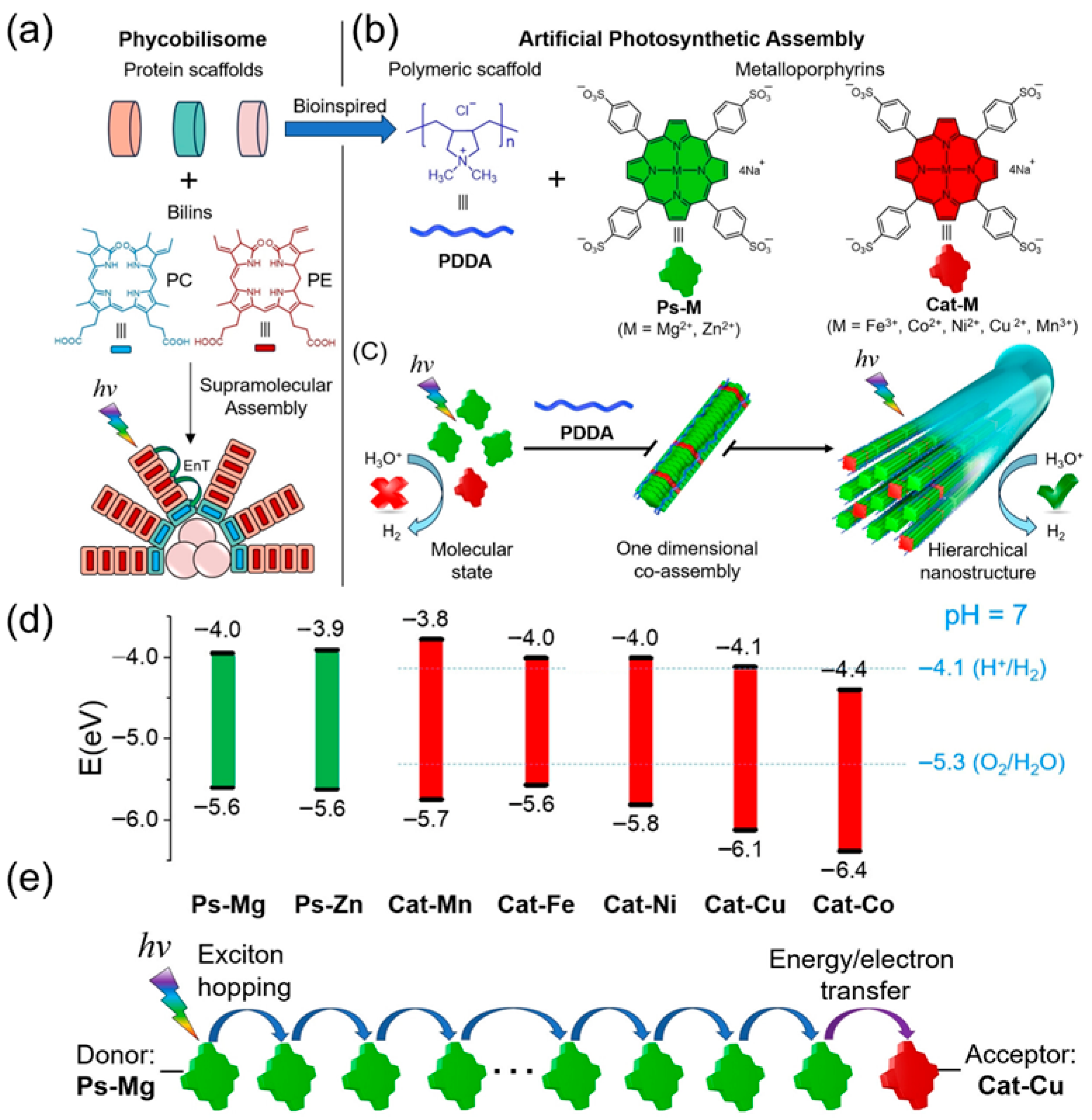
The design of metalloporphyrin monomers is essential for the construction of MPor-COFs. The selection of the metal center directly affects the optical properties, electronic structure, and catalytic activity of the porphyrin monomers [81]. Central metal ions influence the electronic density and energy levels of the porphyrin ring, and subsequently affect their light absorption, charge separation efficiency, and reaction pathways. Porphyrin with main group metal ions, such as Mg2+ and Zn2+, is typically an excellent photosensitizer. In contrast, porphyrin embedded with transition metal ions, such as Cu2+, Fe3+, Co2+, and Ni2+, is more likely to serve as catalytically active centers [82,83], as shown in Figure 1a–c.
The central metal ions are crucial in regulating the electronic structure of metalloporphyrins. The electronegativity, d-electron configuration, and ionic radius of the central metal ions directly decide the electronic cloud distribution of the porphyrin ring, altering the energy level of the highest occupied molecular orbital (HOMO) and lowest unoccupied molecular orbital (LUMO), thereby affecting the light absorption properties and redox potentials [84]. For example, the LUMO energy levels of Mg-porphyrin and Zn-porphyrin are obtained as −4.0 eV and −3.9 eV through electrochemical and UV-Vis spectral analysis, respectively, which are highly matched with the LUMO energy level of Cu-porphyrin (−4.1 eV), as shown in Figure 1d. This alignment of energy levels promotes the transfer of electrons from the photosensitizer (Mg-porphyrin and Zn-porphyrin) to the catalyst (Cu-porphyrin) [85], as shown in Figure 1e.
The metal center of porphyrins directly influences their light-capturing and energy-transfer efficiency. For example, metal ions such as Zn2+ and Mg2+, which have filled or vacant d-orbitals, prevent non-radiative energy decay caused by low-energy d-d transitions in the corresponding porphyrin complexes. Thus, they exhibit longer singlet and triplet lifetimes, a feature that enables them to act as efficient photosensitizers, allowing for prolonged excited-state persistence and efficient energy transfer [82]. The metal center also has a decisive impact on the absorption spectrum of porphyrins, which is directly related to the efficiency of light capture and energy transfer processes. Metalloporphyrins with central Mg2+ or Zn2+ ions showed strong absorption peaks in the Soret band (around 425 nm) and the Q band (around 550–600 nm), covering a large portion of the visible light spectrum. This makes them ideal for broad-spectrum light-capturing applications. In contrast, metalloporphyrins with central copper (Cu) or cobalt (Co) ions exhibit redshift or spectral broadening due to electronic transitions (d-d transitions) in the metal’s d-orbitals, which extends their absorption spectrum toward the red region. Additionally, they are often accompanied by fluorescence quenching [86].
The selection of the central metal ions should consider their photostability. Under photocatalytic conditions, Mg2+ and Zn2+ centers exhibit higher stability, with less attenuation of the Soret band absorption after prolonged irradiation. However, Cu2+ and Co2+ in the center of porphyrin may undergo valence change during the reduction process, which can affect their long-term application [87,88]. Therefore, it is essential to balance the light-capturing ability, charge separation efficiency, catalytic activity, and photostability when selecting the central metal for the MPor-COFs.
Figure 1. (a) Graphical representation of the formation of phycobilisome by the co-assembly of protein scaffolds and bilins; (b) Chemical structures of the anionic metalloporphyrins used as the photosensitizer (Ps-M, green) and catalysts (Cat-M, red) as well as PDDA used as a counterion polyelectrolyte; (c) Graphical representation of the co-assembly of the metalloporphyrins and PDDA into hierarchical supramolecular nanostructures for photocatalytic H2 production in water; (d) HOMO and LUMO energy levels of the metalloporphyrins as photosensitizers and catalysts in water (M = Mg2+, Zn2+, Mn3+, Fe3+, Ni2+, Cu2+, Co2+, [M] = 2 mM); (e) Graphical representation for the dissipation mechanism of the donor excitation energy. Reproduced with permission [85].
Catalysts 16 00076 g001

2.2. Design of the Linkage

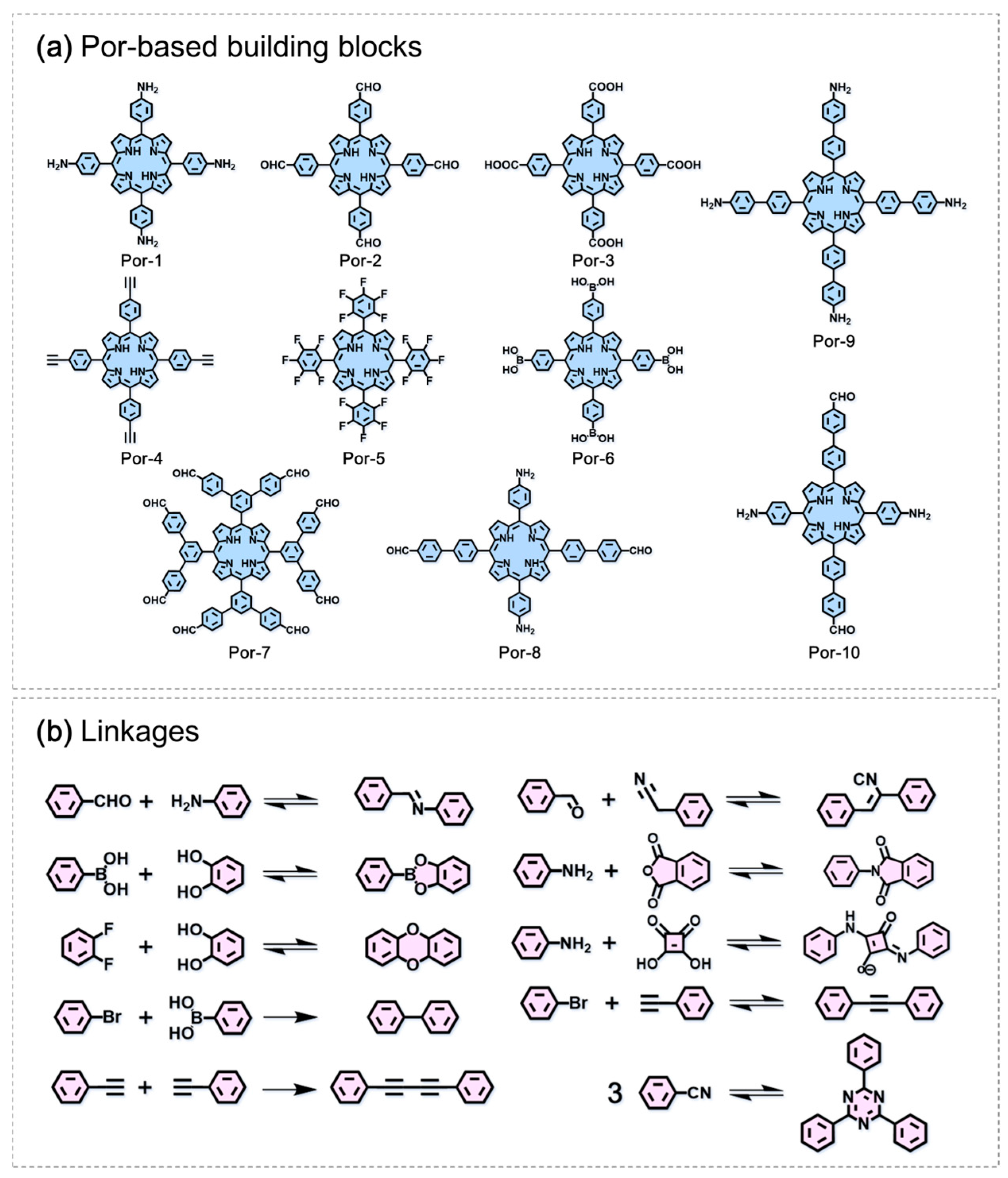
Porphyrin molecules serve as ideal building blocks for constructing covalent organic frameworks (COFs) owing to their highly symmetrical, rigid, and planar structure, as well as their extended macrocyclic conjugated system [89]. Such a molecular structure not only imparts inherent stability to the COFs but also provides numerous modifiable sites for further functionalization. This facilitates the introduction of diverse functional groups, thereby enabling precise customization of the functionality [90]. In the construction of COFs, the synergistic design of the building units and linking bonds is important in regulating the overall performance of the material [91,92,93,94,95]. Almost all mature linkages in COFs have been successfully combined with porphyrin units to construct porphyrin-based COFs with distinct structures and varied properties. The choice of the linkers directly affects the stability, crystallinity, and pore properties of the frameworks. Some representative porphyrin building units, along with corresponding linkers, were collected and shown in Figure 2. As the variety of the structural units continues to expand, researchers have conducted extensive studies on the structural characteristics of porphyrin-based COFs and explored their applications in different fields.
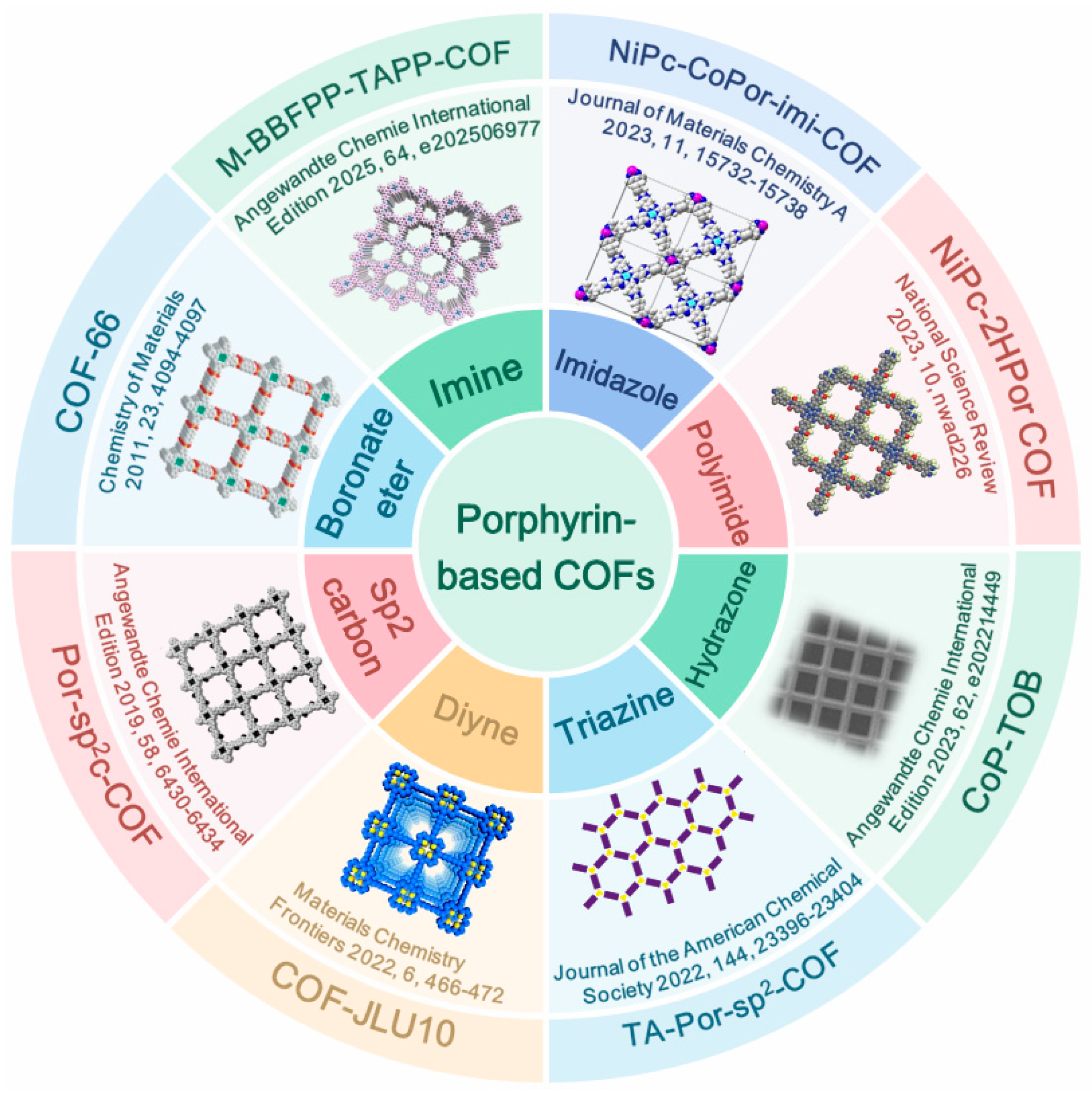
Porphyrins with peripheral amino or aldehyde groups are usually adopted to construct Por-COFs, although there are diversified porphyrin units. Borate ester bonds had been used to construct the first porphyrin-based covalent organic framework (COF-66), which was synthesized using borate bonds. However, the limited availability of monomers containing borate groups and the poor stability of the COFs restrict their practical application [96]. By comparison, imine bonds, formed through Schiff base condensation reactions [96,97], not only promote the formation of high-crystallinity COFs due to their excellent reversibility and dynamic equilibrium characteristics but also support the construction of complex topological structures. This provides great potential for subsequent functional modifications, including the introduction of donor–acceptor structures [98,99] and metal active sites [100,101], and has become a mainstream choice in the design of COFs. In addition, hydrazone linkages derived from imine bonds [73,102] have also been used to construct COFs and applied in photocatalytic hydrogen production [103] and other fields.
The development and upgrade of irreversible linking bonds significantly improve the structural stability and functional diversity of COFs. Por-COFs with sp2-carbon linkages, formed by Knoevenagel condensation, have an extended π-conjugated structure throughout the entire 2D lattice. This will effectively enhance the material’s acid-base resistance, reduce the electronic polarization caused by imine bonds, and improve the overall electronic transport capabilities [104]. The first sp2-carbon-linked COFs were prepared by Jiang’s group in 2017 [105], while the first sp2-carbon-linked Porphyrin-based COFs (Por-sp2c-COFs) were reported in 2019 [106], which exhibited high activity and cycling stability in photocatalytic oxidation reactions.
The introduction of imidazole linkages can extend the heterocyclic structure, allowing COFs with enhanced stability and biocompatibility. Zhao et al. [107] reported the synthesis of M-PyPor-COFs with imidazole linkages through the Debus-Radziszewski reaction in 2022. This material efficiently generates singlet oxygen under visible light irradiation. Meanwhile, Dong et al. [108] synthesized NiPc-CoPor-imi-COF by forming imidazole linkages between aldehyde and o-phenylenediamine units. The material exhibits bimetallic active sites and efficiently catalyzes the reduction of CO2. Recent studies have found that the nitrogen atom on the imidazole ring, with a lone pair of electrons, acts as a highly selective metal coordination site in manipulating COFs to capture metal ions with high efficiency and selectivity [109].
Polyimide bonds, classic irreversible linkages formed through the condensation of carboxyl and amine groups, are strong covalent bonds widely used in the electrocatalytic reduction of CO2. NiPc-2HPorCOF, prepared by Zhang et al. [110], is an efficient electrocatalyst for CO2 reduction. Polyimide bonds serve as important structural units for the green synthesis of COFs with high crystallinity and excellent stability. In addition, triazine linkages, diyne linkages, and other connecting bonds have also been used in the construction of porphyrin-based COFs, further enriching the material’s structure and properties. TA-Por-sp2-COF was synthesized by the reaction of cyanide’s cyclotrimerization under the catalysis of trifluoromethanesulfonic acid [111]. In this porphyrin-based COF, the triazine ring acts as a strong electron acceptor, while the porphyrin unit serves as an electron donor, and the two parts are covalently connected to form an over-conjugated system with enhanced photocatalytic performance. Similarly, a COF (COF-JLU10) with diyne linkages was formed [112], in which a fully π-conjugated framework was generated. An extended, delocalized 2D π-conjugated network was formed by the diyne-linked porphyrin macrocyclic conjugated system. These diverse linking strategies provide flexible pathways for the customized design of COFs (Figure 3).

3. Construction of MPor-COFs

The precise introduction of metal ions into the center of the porphyrin ring becomes a key step to unlock their high photocatalytic performance when MPor-COFs are synthesized. This metallization process can affect the electronic structure of the porphyrin units, the efficiency of photo-generated charge separation, and the photocatalytic activity of the materials [113,114,115,116,117,118,119,120,121,122,123]. Up to now, three methods are often used to introduce metal ions into the Por-COFs, which are post-synthesis metallization, pre-metallization followed by synthesis, and one-pot synthesis.

3.1. Post-Synthesis Metallization

Post-synthesis Metallization necessitates the prior synthesis of a high-quality porphyrin-based COF precursor. Fabrication of these precursors relies on methods that provide precise control over nucleation and growth dynamics [124], primarily including solvothermal, microwave-assisted, and ionothermal synthesis. The solvothermal method utilizes high-temperature and high-pressure conditions in sealed vessels to facilitate reversible covalent bonding formation, which promotes framework self-repair and high crystallinity [125,126]. However, it is characterized by long reaction times, sensitive to solvent conditions, and typically yields microcrystalline powders [127,128]. In contrast, microwave-assisted synthesis employs rapid microwave irradiation for uniform heating, significantly shortening the reaction times and often improving both crystallinity and yield, though it is strongly dependent on polar solvents [129,130]. Alternatively, the ionothermal method uses low-melting-point ionic liquids as combined solvents and catalysts, avoiding high-pressure risks. Its limitations include harsh conditions that may restrict monomer compatibility and result in poor crystallinity due to restricted bond reversibility [131].
Subsequently, using the synthesized porphyrin-based COF as the precursor, the metalation is carried out via a coordination reaction with target metal salts in an appropriate solvent. During this process, the nitrogen atoms within the porphyrin core coordinate with the metal ions, leading to the formation of stable metal-nitrogen bonds and the incorporation of metal centers into the framework. This strategy avoids possible dissociation or valence state changes of the metal center under the harsh conditions of COF synthesis [132]. In 2017, Xu et al. [132] successfully synthesized MPor-COFs (COF-366-Zn and COF-366-Co) using COF-366 as the precursor and zinc acetate or cobalt acetate as the target metal ions under solvent reflux conditions. X-ray photoelectron spectroscopy (XPS) analysis revealed that Zn in COF-366-Zn exists in the form of Zn2+. The metal loading before and after catalytic cycling was close to the theoretical stoichiometric value, confirming the efficient anchoring and uniform distribution of metal sites. The results prove that near-quantitative metallization of the porphyrin units can be obtained through careful selection of metal precursors and reaction conditions.

3.2. Pre-Metallization Followed by Synthesis

Pre-metallization followed by synthesis is one of the most versatile strategies for constructing MPor-COF materials [133,134]. The core concept of this method is to obtain metalloporphyrin first and then use it as a structural unit for MPor-COF formation. The success of this strategy depends on whether the metallization condition is compatible with the subsequent COF construction process or not. It is critical to maintain the structural stability and coordination integrity of the metalloporphyrin monomers during the condensation reaction [99]. Typical metallization processes are usually based on liquid coordination chemistry principles, where free porphyrins and corresponding metal salts are heated under reflux in an appropriate organic solvent and an inert atmosphere. This allows the efficient and selective embedding of the target metal ions into the porphyrin macrocycle to form well-defined metalloporphyrin monomers [133,134]. This pre-metallization procedure not only provides stoichiometrically controllable building units for subsequent COF formation but also avoids some issues, such as framework distortion or unsaturated coordination, that usually occur in post-synthesis metallization [132]. This provides inspiration for the rational design of structurally ordered and tunable MPor-COFs.

3.3. One-Pot Metallization Method

The one-pot metallization method refers to placing all reactants, including monomers, metal salts, and morphology control agents, in the same reaction system to simultaneously achieve framework construction, metal ion coordination, and in situ protonation in one step. This method omits intermediate separation and, through precise reaction condition design, allows multiple chemical processes (such as imine condensation, metal coordination, and acid protonation) to occur simultaneously. In this case, complex nanomaterials with different functionalities were prepared. One-pot metallization method was used to prepare MPor-COFs by the reaction of 5,10,15,20-tetra(4-aminophenyl)porphyrin, terephthalaldehyde and FeCl3 in a mixed solvent of acetonitrile and acetic acid at room temperature [38]. Imine condensation, Fe3+ coordination, and protonation were achieved simultaneously, simplifying the traditional multi-step process. However, the addition of FeCl3 requires balancing the protonation and metallization ratio to prevent the instability of COFs. A donor–acceptor structured Por-COF-Zn was also synthesized by one-pot reaction of 5,10,15,20-tetra(4-aminophenyl)porphyrin, thiophene[3,2-b]thiophene-2,5-dialdehyde, and zinc acetate [135]. The reaction temperature needs multiple optimizations to avoid the collapse of the pore structure.
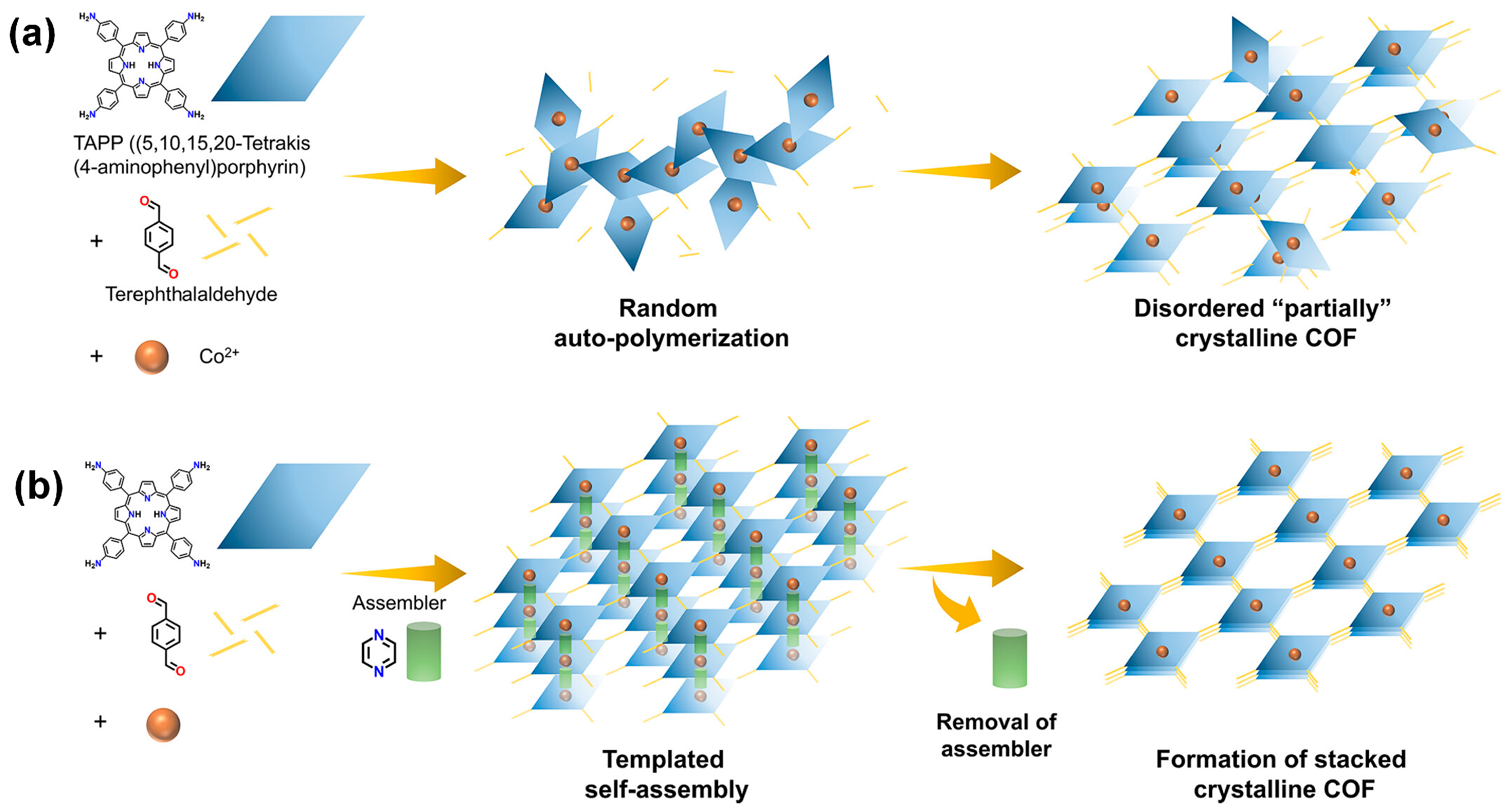
Nevertheless, traditional synthesis methods (pre-metallization followed by synthesis and post-synthesis metallization) often face the dilemma of insufficient crystallinity and irregular porosity in preparing high-quality MPor-COFs [136,137]. The underlying cause lies in the autoaggregation of porphyrin monomers, leading to disordered stacking [138,139,140]. Inspired by the concept of “porphyrin polymer ladders” [141,142], Bourda and coauthors [143] proposed an innovative synthesis strategy in which pyridine molecules were used as “assembly agents” in a one-pot method (Figure 4). Assembling agents were used to coordinate with metal ions in an octahedral coordination geometry. Linear coordination polymers were formed and used as templates to guide the ordered stacking of COF layers. The controllable construction of MPor-COFs with high crystallinity and high surface area can be achieved by this approach. The strategy not only effectively suppresses disordered aggregation but also provides a novel synthesis pathway for the design and preparation of structurally precise and functionally integrated MPor-COFs.
Overall, compared to traditional step-by-step synthesis strategies, the one-pot metallization method significantly simplifies the synthetic process by integrating multiple reaction steps into one single operation. This avoids repeated separation and purification steps and reduces energy consumption, and at the same time minimizes the risk of side reactions [144,145]. By the control of reaction parameters such as solvent polarity [146], temperature [127], and additives [147], the one-pot method can finely regulate the frameworks, including the microstructure, pore structure, and photophysical properties [148,149]. This provides a more efficient and controllable synthesis pathway for high-performance functional materials.

4. Photocatalytic Applications

The material’s energy band structure, photo-generated charge separation efficiency and active site distribution can be regulated by careful selection of the metal center and elaborate design of linking bonds. Meanwhile, highly crystalline and stable frameworks can be constructed through diverse synthetic methods. These structural characteristics established in earlier stages lead to outstanding performance in photocatalytic reactions. This chapter will focus on the specific applications of MPor-COFs in various cutting-edge fields.

4.1. Photocatalytic Hydrogen Production

Hydrogen energy is considered an efficient and environmentally friendly energy due to its high energy density and clean characteristics. Traditional hydrogen production processes rely on the water-gas shift reaction, which consumes a lot of energy and generates substantial CO2 emissions. In contrast, photocatalytic hydrogen production directly uses solar energy and water to produce hydrogen, becoming an environmentally friendly and sustainable hydrogen production pathway because there are no carbon emissions during the entire process [150,151]. Among various photocatalysts, MPor-COFs have attracted special attention due to their excellent visible light-responsive properties. The energy band structure and photo-generated carrier migration ability of these materials can be precisely controlled at a molecular level, providing an ideal platform for building high-performance photocatalytic systems, in which metal ion coordination plays a key role in the hydrogen production process.
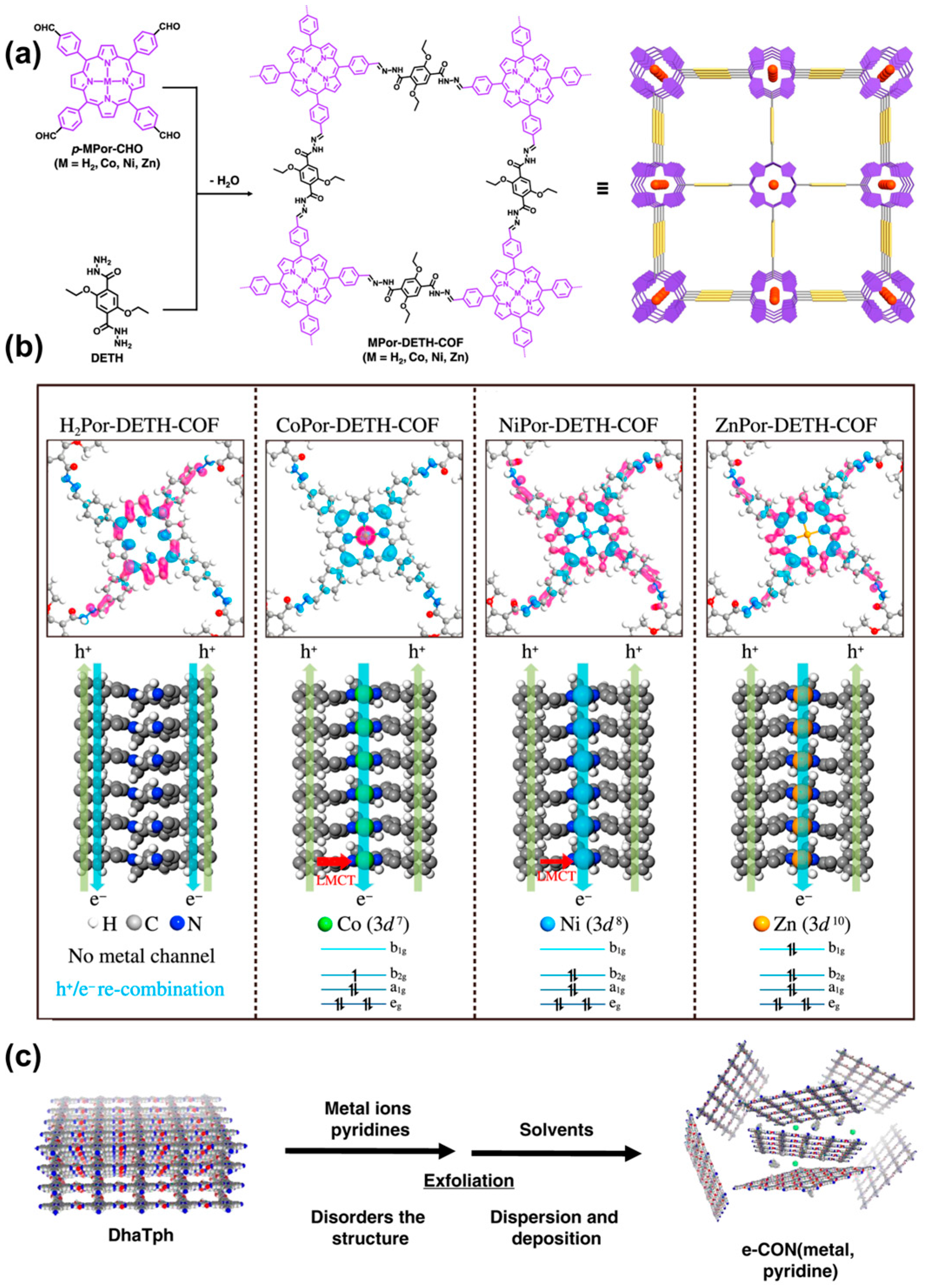
Metal ions in MPor-COFs can regulate charge separation and migration efficiency by influencing the LMCT (ligand-to-metal charge transfer) process, which directly influences charge-carrier dynamics. MPor-DETH-COFs (M = H2, Co, Ni, Zn) were synthesized by the condensation of aldehyde porphyrin precursor (p-MPor-CHO) and 2,5-diethoxyterephthalonitrile (DETH) [99] (Figure 5a). As photocatalysts, hydrogen production is sustained using H2PtCl6 as the co-catalyst and triethanolamine as the sacrificial agent under visible light irradiation. The hydrogen production rates are ranged as follows: CoPor-DETH-COF < H2Por-DETH-COF < NiPor-DETH-COF < ZnPor-DETH-COF. The photocatalyst exhibits excellent stability, and the average hydrogen evolution rate over ZnPor-DETH-COF reaches up to 413 μmol g−1 h−1. Notably, it maintains its photocatalytic hydrogen production activity without significant degradation after 120 h of continuous operation. The d-electron configuration of metal ions determines the strength of the LMCT process. As shown in Figure 5b, for Co2+ (3d7), a prominent LMCT process occurs, effectively trapping photogenerated holes at the metal center and severely suppressing their migration through the macrocycle-on-macrocycle pathway. This leads to rapid charge recombination, accounting for its lowest activity. In contrast, for Zn2+ (3d10), the LMCT process is forbidden. This allows for efficient hole migration via the porphyrin ring and electron transfer through a Zn···Zn chain. This prolongs the charge separation lifetime and improves hydrogen production efficiency. The fluorescence lifetime of ZnPor-DETH-COF is the longest (nanosecond scale), while CoPor-DETH-COF has almost no emission (picosecond scale), consistent with the electronic structure of the metal ions.
The simultaneous coordination of metal ions and axial ligands can also achieve ultrathin MPor-COFs, which can shorten the charge transport distance. Different metal ions have a distinct impact on the exfoliation effect (Figure 5c). Compared to Mg2+, Cu2+ produces a more stable metal porphyrin structure, resulting in more complete exfoliation and ultimately thinner nanoplatelets. The metal coordination alters the electronic structure of the porphyrin material. Solid-state diffuse reflectance spectra show that e-CON (Cu, epy) has an extended absorption band, close to the near-infrared region. Photoelectrochemical tests confirm that it generates photocurrents under both visible light and near-infrared light, predicting the potential in photocatalytic hydrogen evolution across a wide spectral range [152]. The photocatalytic hydrogen evolution activity of DhaMTph (M = Cu, Ni) 136 (P8, P10+L12) improved 3.7 times compared to DhaTph. The photocatalytic activity was further enhanced 2.2 times when they were made into a nanosheet structure [153].
Figure 5. (a) Schematic representation of the synthesis of MPor-DETH-COFs; (b) LMCT mechanism indicated by DFT calculations. The isosurface of the electron orbitals of blue VBM and magenta CBM (upper panel) and schematic illustrations of the hole-electron transport processes (lower panel) in MPor-DETH-COFs: H2Por-DETH-COF, CoPor-DETH-COF, NiPor-DETH-COF, ZnPor-DETH-COF. The balls in different colours represent different atoms: H, white; C, grey; N, blue; Co, olive green; Ni, light blue; Zn, orange. Reproduced with permission [99]; (c) Scheme for the synthesis of exfoliated DhaTph. The addition of metals and axial ligands induces exfoliation of the covalent organic frameworks composed of porphyrin units. Reproduced with permission [153].
Catalysts 16 00076 g005

4.2. Photocatalytic Carbon Dioxide Reduction

Photocatalytic reduction of carbon dioxide to high-value-added chemicals is considered a key strategy for achieving carbon neutrality with both environmental benefits and energy value [154,155]. COFs with tunable optoelectronic properties, high specific surface area, and ordered pore structure provide an ideal platform for photocatalytic CO2 reduction. Specifically, MPor-COFs offer various performance optimization strategies to enhance the catalytic efficiency.
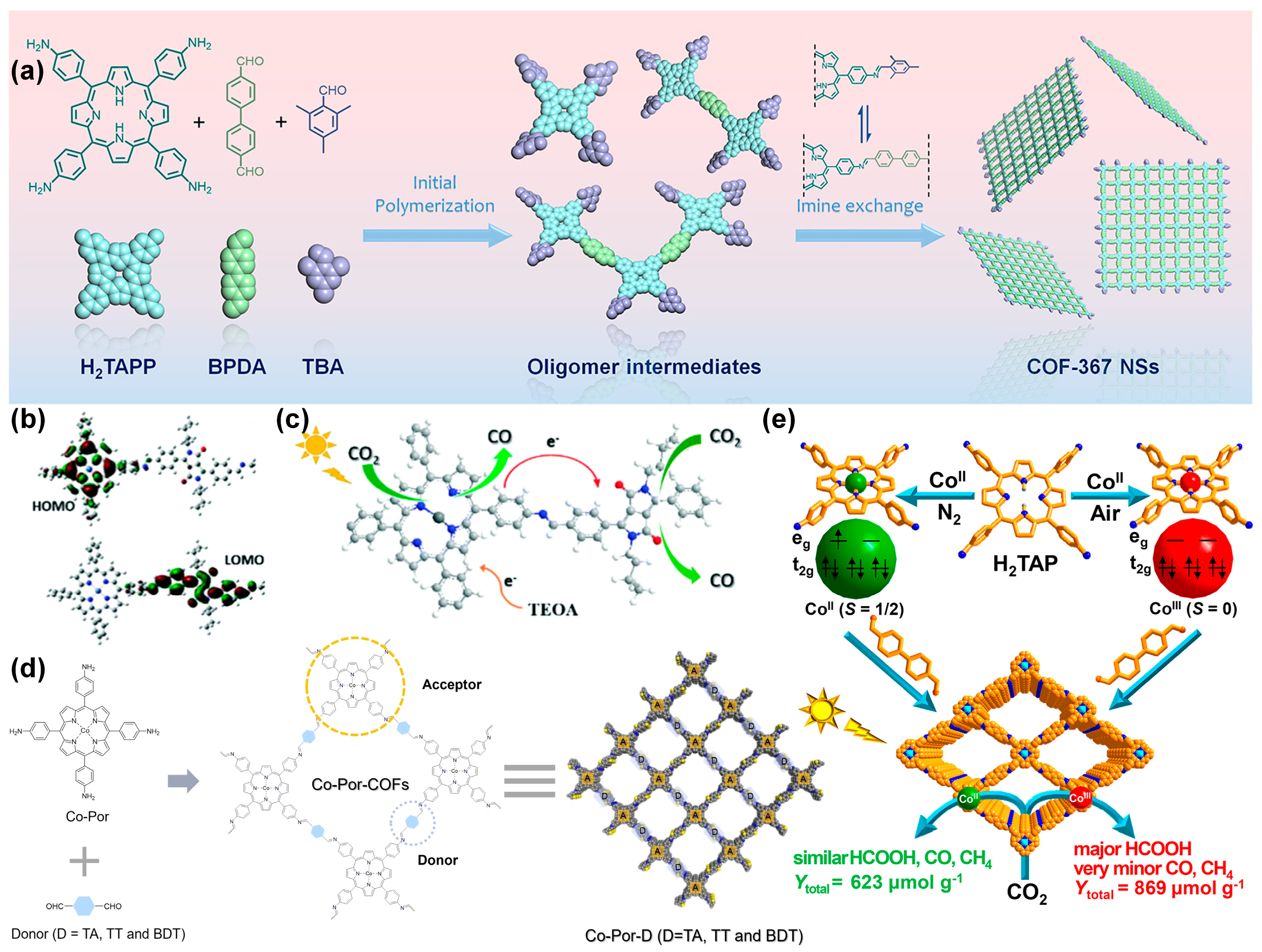
Firstly, the catalytic performance of materials can be improved by increasing the exposure of active sites. COF-367-Co, ultra-thin two-dimensional COF nanosheets, were prepared and successfully applied in the photocatalytic reduction of CO2 (Figure 6a) [156]. A production rate of 1062 μmol g−1 h−1 and a selectivity of 78% for CO were obtained using a ruthenium complex as the photosensitizer and ascorbic acid as the electron donor. In comparison, the COF nanosheets without cobalt or physically mixing with free Co2+ ions showed significantly lower photocatalytic activity. This proves that the Co-N4 center in the cobalt porphyrin is the actual catalytically active site, rather than metal ions physically adsorbed on the surface. Moreover, COF-367-Co nanosheets exhibited significantly improved CO2 adsorption capacity compared to the metal-free COF-367 nanosheets. This indicates that the presence of the cobalt center enhances the capturing ability for CO2, which is the precondition for efficient catalysis.
Periodic and ordered donor–acceptor (D-A) structures can be introduced into the COF framework to promote the separation of photo-generated charge carriers by utilizing their strong electron-donating and electron-withdrawing effects, and thus enhance the photocatalytic CO2 reduction performance of the material. For example, MPor-COFs with D-A structures (PD-COF-23-Ni) were prepared by the condensation of NiTAPP and DPP-CHO, and showed astonishing selectivity of 99% for CO and a higher reaction rate of 40.0 μmol g−1 h−1, 2-fold of that over the metal-free COFs [157]. Moreover, such photocatalytic reduction of CO2 didn’t require additional photosensitizers and noble metal cocatalysts. DFT calculations showed that the HOMO is mainly distributed in the porphyrin units, while the LUMO is located in the DPP units. The Ni(II) coordination optimized the energy level structure, accelerated the transfer of photo-generated electrons from porphyrins to DPP, and suppressed the recombination of electrons and holes. NiTAPP serves as a photosensitizer to absorb visible light and as a catalytic site. During the light irradiation, NiTAPP+ is reduced by TEOA to generate NiTAPP, then electrons in NiTAPP transfer to CO2, and thus a continuous catalytic cycle is formed, as shown in Figure 6c. Recently, cobalt-5,10,15,20-tetra(4-aminophenyl)porphyrin (Co-Por) was used as an electron acceptor unit, and three COFs (Co-Por-TA, Co-Por-TT, Co-Por-BDT) were synthesized via Schiff base condensation with three different conjugated donor units (phenyl TA, thienothiophene TT, and benzo[1,2-b:4,5-b’] dithiophene BDT) [158], as shown in Figure 6d. These COFs can catalyze the reduction of CO2 to CO using Re(bpy)(CO)3Cl as the photosensitizer and TEOA as the sacrificial agent under visible light irradiation. The activity sequence was Co-Por-BDT (1424 μmol g−1 h−1) > Co-Por-TT (1182 μmol g−1 h−1) > Co-Por-TA (642 μmol g−1 h−1). This trend in performance was linked to the charge-carrier densities of donor units and π-conjugation lengths, which influenced the light absorption and excitonic effects. Optical studies showed that Co-Por-BDT with the most extended conjugation had the narrowest band gap and highest absorbance. Theoretical simulations indicated that stronger D-A interactions in Co-Por-BDT reduced exciton binding energy, enhancing charge-carrier mobility and separation. Meanwhile, Co2+ ions directly participate in the CO2 reduction process in these reactions. They acted as electron transfer centers to promote the adsorption and activation of CO2 molecules. Besides, Co coordination optimized the electronic structure of the porphyrins, in which the HOMO mainly focused on the donor unit and the LUMO located in the Co-Por acceptor unit. In this way, a clear donor–acceptor structure was formed, and the recombination of electrons and holes was suppressed.
The adsorption energy of the active site on the reaction intermediates can also be adjusted by changing the metal ion or spin state of the porphyrin center. In this way, the activity and selectivity of the materials can be optimized. COF-367-Co3+ (S = 0) and COF-367-Co2+ (S = 1/2) were prepared and used in the reduction of CO2 to generate HCOOH [159]. They achieved the first spin state of metal ions in a COF, and then altered the spin state of the cobalt center without changing the framework structure by oxidizing Co2+ to Co3+ in air. This provided a new paradigm for regulating the electronic structure of COFs (Figure 6e). The production rate of HCOOH for COF-367-Co3+ (S = 0) reached 93.0 μmol g−1 h−1, significantly higher than that of COF-367-Co2+ (S = 1/2), while the production of CO and CH4 was suppressed. More importantly, its HCOOH production activity showed no significant decrease over five consecutive cycles, demonstrating excellent reusability. DFT calculations indicated that Co3+ (S = 0) lowered the energy barrier of HCOOH production but increased the energy barrier for further conversion of HCOOH, thereby improving the selectivity. The porphyrin ring provides a rigid coordination environment in which the Co2+/Co3+ ions were stabilized. The framework structure remained unchanging during the oxidation state change, and thus, single-variable regulation was achieved.
Figure 6. (a) Schematic illustration of the synthesis of the COF-367 NSs. Reproduced with permission [160]; (b) Frontier orbitals from DFT calculations; (c) the proposed photocatalytic mechanism of PD-COF-23-Ni. Reproduced with permission [157]; (d) Schematic illustration of the building units and synthesis process of Co-Por-COFs. Photocatalytic CO2 production and photo and electrochemical analyses of the Co-Por-COFs. Reproduced with permission [158]; (e) Rational Fabrication of COF-367-Co Featuring Different Spin States of Co Ions toward Photocatalytic CO2 Reduction. Reproduced with permission [159].
Catalysts 16 00076 g006

4.3. Photocatalytic Synthesis of Organics

Compared to photocatalytic hydrogen production and carbon dioxide reduction, the application of metal porphyrin-based COFs in the photocatalytic synthesis of organics is still in its infancy. Till now, only a few types of reactions have been reported. Therefore, expanding the photocatalytic systems to achieve more complex and diverse organic synthesis holds great potential.
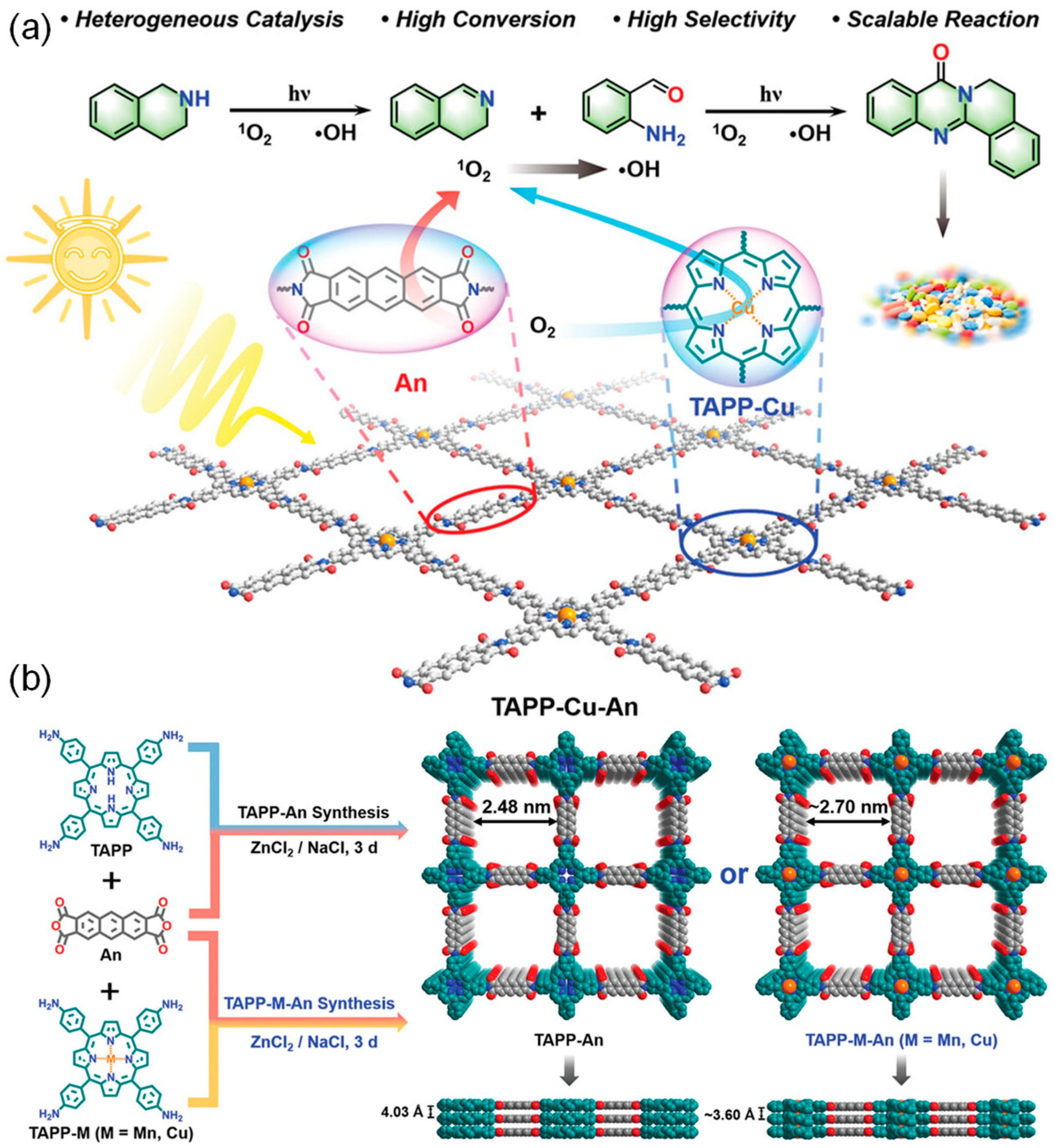
Quinolines and quinazolinones are a class of drug molecules with excellent physiological and pharmacological activities. They are widely used not only in the pharmaceutical field but also in the pesticide industry [160,161]. However, traditional synthetic methods for 4-quinazolinone often involve dehydrogenative cross-coupling reactions, suffering from harsh reaction conditions, low yields, and difficulties in recovering homogeneous catalysts [162]. Two photosensitive and stable COFs (TAPP-An and TAPP-Cu-An) were designed and synthesized (Figure 7a,b) [163]. These COFs were used as efficient, heterogeneous tandem photocatalysts for the rapid synthesis of 4-quinazolinone compounds at room temperature under light irradiation. This is the first time that crystalline COF tandem catalysts have been successfully applied in the synthesis of important drug molecules. This opens up a new pathway toward organic synthesis, particularly in drug synthesis. The metal site plays a crucial role in the synthesis of 4-quinazolinone (the intramolecular oxidative cross-coupling reaction). The Cu site in TAPP-Cu-An works with the An unit synergistically in the one-pot reaction. The An units ensure high selectivity of the first dehydrogenation oxidation step, while the Cu sites guarantee rapid and efficient conversion of the intermediates into the final products. This synergistic effect makes TAPP-Cu-An outperform TAPP-An (which contains only the An unit) and homogeneous TAPP-Cu molecules in the one-step reaction. The non-metallic TAPP-An catalyst exhibited lower selectivity (62%), whereas TAPP-Cu-An with Cu2+ ions achieves nearly 100% selectivity. Moreover, TAPP-Cu-An demonstrated excellent recyclability, showing no significant loss in substrate conversion or product selectivity over seven consecutive reaction cycles.
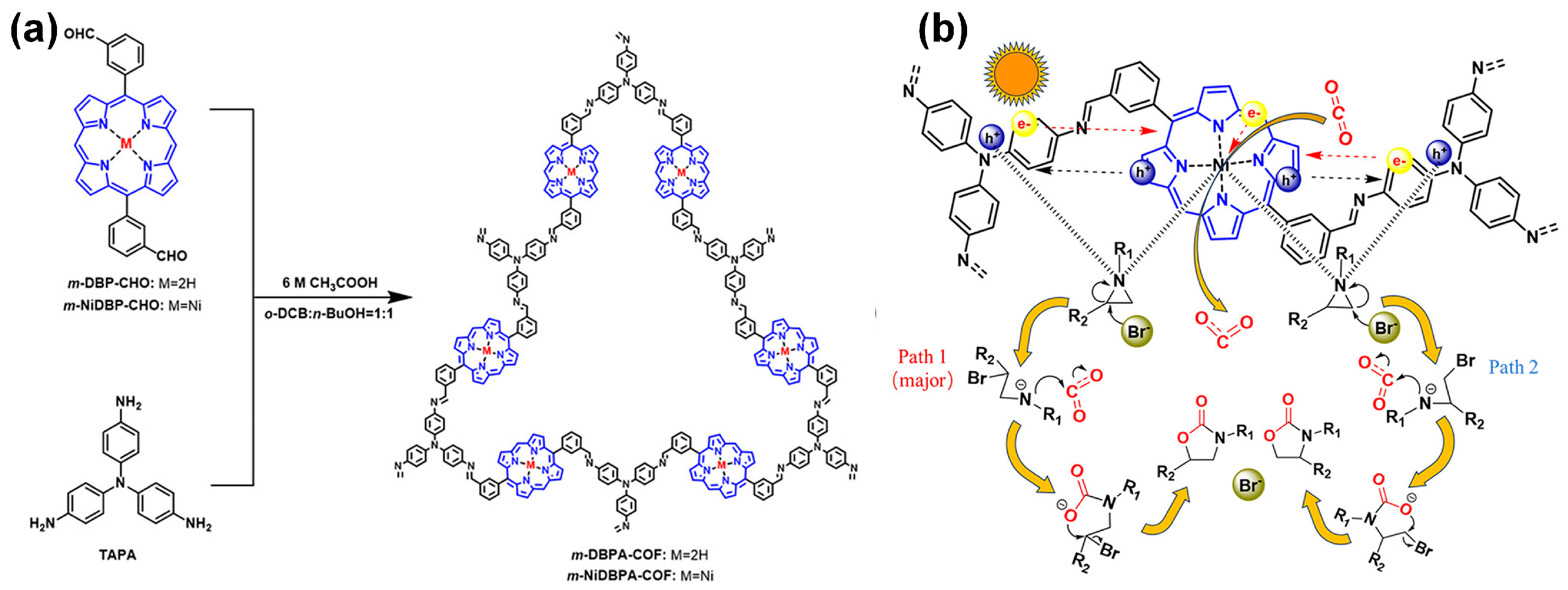
The sunlight-driven nitrating pyridine ring addition reaction provides a promising pathway for CO2 utilization and offers a green alternative to traditional thermocatalytic fixation methods that rely on high temperature or high pressure. Metal-free m-DBPA-COF and nickel-metallized m-NiDBPA-COF were prepared based on the trans-A2B2 type porphyrin D-A COFs [33] (Figure 8a). The materials can efficiently catalyze the CO2 and nitrating pyridine ring addition reaction under visible light irradiation. The introduction of nickel ions is crucial. Firstly, they synergize with the D-A electronic push-pull effect through ligand-to-metal charge transfer (LMCT) to significantly enhance the separation and transport efficiency of photo-generated charges. Secondly, they provide the Lewis acid sites required for substrate activation, as shown in Figure 8b. Thanks to these advantages, m-NiDBPA-COF exhibited excellent photocatalytic performance.

4.4. Photocatalytic Degradation of Pollutants

Efficient treatment of organic pollutants becomes crucial for environmental governance and human health [164]. Among various treatments, photocatalytic degradation of organic pollutants is an effective and energy-saving method. Semiconductor photocatalysts were originally designed for the removal of pollutants [165]. At present, more and more photocatalysts, including metal porphyrin-based COFs, have shown great potential in the degradation of pollutants.
Despite the unique advantages of photocatalytic technology, it has a series of technical challenges in practical application. Traditional Fenton technology relies on Fe2+ to activate H2O2 to generate reactive oxygen species (ROS) for pollutant degradation. However, it is facing problems such as safety and cost arising from the external addition of H2O2, stringent requirements for acidic conditions, and iron sludge deposition. Although photo-Fenton technology can achieve in situ generation of H2O2 with the help of photocatalysts, reducing dependence on external reagents, it still requires the introduction of Fe2+, and the efficiency of H2O2 synthesis is limited by the low separation efficiency of photo-generated carriers and poor proton adsorption capacity [166,167].
Figure 7. (a) Synthesis of 4-quinazolinone drug molecules through an efficient photocatalytic dehydrogenative cross-coupling reaction by photosensitive and stable porphyrin-based COF; (b) Schematic of the synthesis of TAPP-An and TAPP-M-An. Reproduced with permission [167].
Catalysts 16 00076 g007
Figure 8. (a) Design and synthesis of m-DBPA-COF and m-NiDBPA-COF; (b) Proposed photocatalytic CO2 cycloaddition reaction mechanism. Reproduced with permission [33].
Catalysts 16 00076 g008
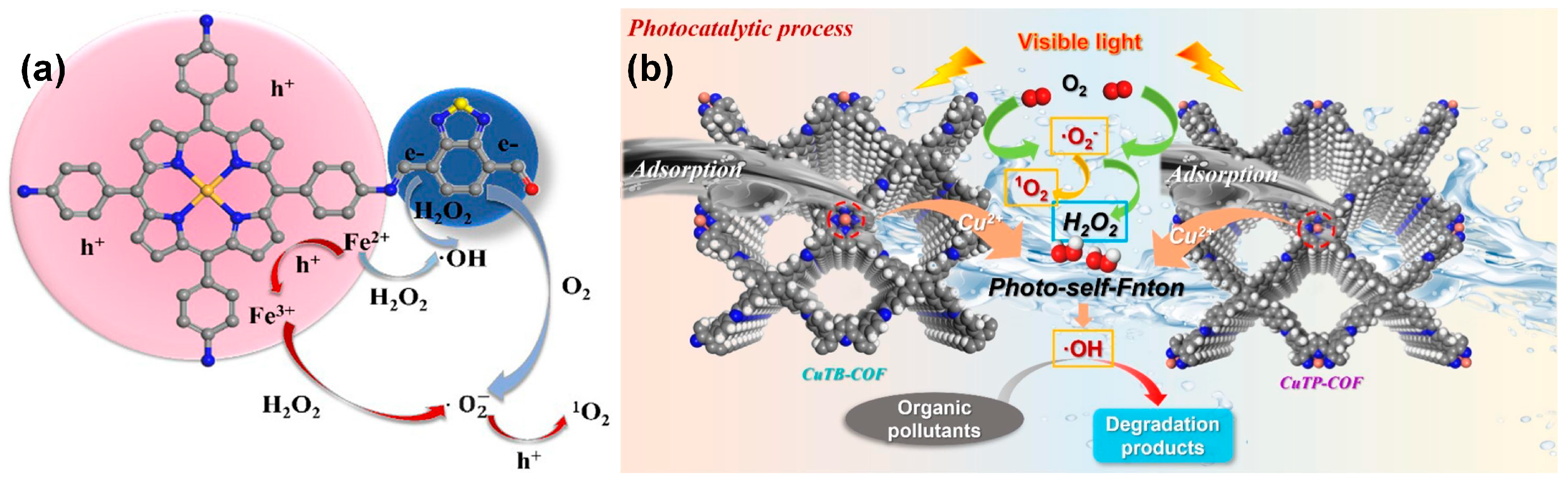
To overcome these problems, researchers have designed complex materials with dual functions: in situ generation and activation of H2O2. For example, Liu [168] and his colleagues synthesized COF-HMTBD by condensing tetrahydroporphyrin (TAPP) and metal porphyrins (M-TAPP, M = Fe/Co/Cu) with benzothiadiazole (BD), in which TAPP and M-TAPP were used as an electron donor while BD was an electron acceptor. This material showed outstanding performance in Rhodamine B (RhB) degradation and excellent cycle stability, in which RhB was completely degraded within 3 h (Figure 9a). Notably, the Fe3+/Fe2+ in the material can catalyze the decomposition of H2O2 into ·OH and ·O2 via a Fenton-like reaction, which results in approximately 60% of RhB degradation even in the dark conditions. The more detailed photocatalyst performance is shown in Table 1.
The design of catalysts has been developed towards “self-sustaining” to overcome the inherent limitations of traditional Fenton processes, in which exogenous addition of Fe2+ and H2O2 is required, iron sludge is generated, and the reaction usually operates at strict acidic conditions (pH ≤ 3). Two donor–acceptor COFs (CuTB-COF and CuTP-COF) were designed and synthesized through imine condensation reactions using CuTAPP as the electron donor [169]. In these systems, the CuTAPP unit acts as a dual-function active site, enabling simultaneous photocatalytic generation and activation of H2O2. Under visible light irradiation, the ordered D-A structure promotes charge separation efficiently. The photogenerated electrons reduce O2 to H2O2 via a two-electron oxygen reduction pathway; meanwhile, the Cu2+/Cu+ redox cycle activates H2O2 into hydroxyl radicals (·OH) through a Fenton-like mechanism. The higher performance of CuTP-COF is attributed to its enhanced charge separation efficiency, as evidenced by its stronger photocurrent response, longer lifetime of charge carriers, and narrower bandgap compared to that of CuTB-COF. This optimized electronic structure endows the materials with exceptional pollutant adsorption capacity and photocatalytic degradation performance. Notably, CuTP-COF achieved a remarkable RhB removal rate of 98.7% within 60 min without exogenous Fe2+ or H2O2. The crystallinity and activity of the material were preserved over five cycles. Compared to traditional Fenton processes, these “self-sustaining” COF catalysts offer significant advantages: they operate effectively under neutral conditions, eliminate iron sludge accumulation, avoid the safety risks associated with H2O2 storage, and enable a closed-loop degradation cycle through in situ H2O2 production and activation. Moreover, the integration of adsorption capability with photocatalytic function creates a synergistic system where pollutant concentration and degradation are optimized within the same material framework.
Metalloporphyrin-based COFs, with designable pore structures, ordered electron donor–acceptor units, and metal active sites, integrating the photocatalytic H2O2 production with the activation together, significantly improved the efficiency and economy of organic pollutant degradation via Fenton-like reactions. Compared to early Fenton-like systems that required external reagents such as H2O2 and Fe2+, the present self-cycling catalysts capable of in situ H2O2 generation and activation presented a clear development direction, offering new ideas for the design of efficient, low-energy wastewater treatment photocatalysts.

5. Conclusions and Outlook

In summary, MPor-COFs have shown unique advantages in photocatalysis by combining the optoelectronic properties of metalloporphyrins with the highly ordered porous structure of COFs. Metalloporphyrin units feature broad spectral absorption, long-lived excited states, and tunable electronic structures, while the COF framework endows them with high specific surface area, tunable pore sizes, excellent stability, and modular design capabilities. The introduction of metal ions further optimizes the electronic structure of the porphyrin rings, enhances the efficiency of photo-generated charge separation and provides more active sites for the catalytic reactions. On the one hand, conjugated chemical bonds and π-π stacking interactions construct efficient electron transport pathways, significantly enhancing carrier mobility and excited-state lifetimes. On the other hand, the tunability and precise structural control of COFs enable researchers to deeply understand the structure–activity relationship, facilitating the rational design of high-efficiency photocatalysts.
Although significant progress has been made in photocatalytic hydrogen production, CO2 reduction, organic synthesis, and pollutant degradation over MPor-COFs, several challenges have to be dealt with in practical applications. Problems, including complex preparation processes, difficulty in controlling crystallinity, insufficient structural stability, and low charge transport efficiency, limit their further application. Critically, the industrial scalability of these materials remains a bottleneck, as achieving large-scale production with consistent quality and performance poses considerable challenges. Future research should focus on precise design and synthesis at the molecular and even atomic level. Optimizing the metal center selection and linkage strategies can be used to enhance electron–hole separation. Additionally, synthesis methods need to enhance crystallinity, porosity, and morphological control. Furthermore, it is essential to achieve efficient light energy conversion and targeted applications, expanding the material’s light absorption range and regulating structural features. Metalloporphyrin-based COFs are expected to play a more significant role in energy conversion and environmental remediation through interdisciplinary innovation.

Author Contributions

Writing-original draft preparation, R.L. and Y.J.; writing-review and editing, Y.X. and S.W.; supervision, S.W.; foundation acquisition, S.W. All authors have read and agreed to the published version of the manuscript.

Funding

This research was funded by the Shandong Provincial Natural Science Foundation (No. ZR2025MS146).

Data Availability Statement

Data sharing is not applicable to this article.

Conflicts of Interest

The authors declare no conflict of interest.

References

  1. McGlade, C.; Ekins, P. The geographical distribution of fossil fuels is unused when limiting global warming to 2 °C. Nature 2015, 517, 187–190. [Google Scholar] [CrossRef]
  2. Yang, S.; Ruan, Y.; Sun, J.; Yang, Q. India’s coal mining plan undermines climate goals. Science 2024, 383, 268. [Google Scholar] [CrossRef]
  3. Wang, Y.; Wang, R.; Tanaka, K.; Ciais, P.; Penuelas, J.; Balkanski, Y.; Sardans, J.; Hauglustaine, D.; Liu, W.; Xing, X.; et al. Accelerating the energy transition towards photovoltaic and wind in China. Nature 2023, 619, 761–767. [Google Scholar] [CrossRef]
  4. Zhang, D.; Zhu, Z.; Chen, S.; Zhang, C.; Lu, X.; Zhang, X.; Zhang, X.; Davidson, M.R. Spatially resolved land and grid model of carbon neutrality in China. Proc. Natl. Acad. Sci. USA 2024, 121, e2306517121. [Google Scholar] [CrossRef]
  5. Balzani, V.; Bergamini, G.; Ceroni, P. Photochemistry and photocatalysis. Rend. Lincei 2017, 28, 125–142. [Google Scholar] [CrossRef]
  6. Wang, Q.; Domen, K. Particulate photocatalysts for light-driven water splitting: Mechanisms, challenges, and design strategies. Chem. Rev. 2020, 120, 919–985. [Google Scholar] [CrossRef] [PubMed]
  7. Tang, C.; Cao, H.; Gao, J.; Wang, S.; Liu, R.; Chen, B.; Si, Q.; Xia, Y.; Wang, S. Electron donor-acceptor metal-organic frameworks for efficient photocatalytic reduction and oxidation. J. Colloid Interface Sci. 2025, 692, 137561. [Google Scholar] [CrossRef]
  8. Cao, H.; Liu, F.; Tai, Y.; Wang, W.; Li, X.; Li, P.; Zhao, H.; Xia, Y.; Wang, S. Promoting photocatalytic performance of TiO2 nanomaterials by structural and electronic modulation. Chem. Eng. J. 2023, 466, 143219. [Google Scholar] [CrossRef]
  9. Buzzetti, L.; Crisenza, G.E.M.; Melchiorre, P. Mechanistic studies in photocatalysis. Angew. Chem. Int. Ed. 2019, 58, 3730–3747. [Google Scholar] [CrossRef] [PubMed]
  10. Fujishima, A.; Honda, K. Electrochemical photolysis of water at a semiconductor electrode. Nature 1972, 238, 37–38. [Google Scholar] [CrossRef]
  11. Wu, Z.; Ma, D. Recent advances in white organic light-emitting diodes. Mater. Sci. Eng. R Rep. 2016, 107, 1–42. [Google Scholar] [CrossRef]
  12. Lau, V.W.-h.; Moudrakovski, I.; Botari, T.; Weinberger, S.; Mesch, M.B.; Duppel, V.; Senker, J.; Blum, V.; Lotsch, B.V. Rational design of carbon nitride photocatalysts by identification of cyanamide defects as catalytically relevant sites. Nat. Commun. 2016, 7, 12165. [Google Scholar] [CrossRef] [PubMed]
  13. Liu, F.; Cao, H.; Xu, L.; Fu, H.; Sun, S.; Xiao, Z.; Sun, C.; Long, X.; Xia, Y.; Wang, S. Design and preparation of highly active TiO(2) photocatalysts by modulating their band structure. J. Colloid Interface Sci. 2023, 629, 336–344. [Google Scholar] [CrossRef] [PubMed]
  14. Tai, Y.; Yang, B.; Li, J.; Meng, L.; Xing, P.; Wang, S. Design and preparation of heterostructured Cu2O/TiO2 materials for photocatalytic applications. Molecules 2024, 29, 5028. [Google Scholar] [CrossRef] [PubMed]
  15. Tomić, J.; Malinović, N. Titanium dioxide photocatalyst: Present situation and future approaches. Aidasco Rev. 2023, 1, 26–30. [Google Scholar] [CrossRef]
  16. Kokona, B.; Kim, A.M.; Roden, R.C.; Daniels, J.P.; Pepe-Mooney, B.J.; Kovaric, B.C.; de Paula, J.C.; Johnson, K.A.; Fairman, R. Self assembly of coiled-coil peptide−porphyrin complexes. Biomacromolecules 2009, 10, 1454–1459. [Google Scholar] [CrossRef]
  17. Panda, M.K.; Ladomenou, K.; Coutsolelos, A.G. Porphyrins in bio-inspired transformations: Light-harvesting to solar cell. Coord. Chem. Rev. 2012, 256, 2601–2627. [Google Scholar] [CrossRef]
  18. Wang, S.; Li, M.; Patil, A.J.; Sun, S.; Tian, L.; Zhang, D.; Cao, M.; Mann, S. Design and construction of artificial photoresponsive protocells capable of converting day light to chemical energy. J. Mater. Chem. A 2017, 5, 24612–24616. [Google Scholar] [CrossRef]
  19. Xiu, Y.; Zhang, X.; Feng, Y.; Wei, R.; Wang, S.; Xia, Y.; Cao, M.; Wang, S. Peptide-mediated porphyrin based hierarchical complexes for light-to-chemical conversion. Nanoscale 2020, 12, 15201–15208. [Google Scholar] [CrossRef]
  20. Wang, S.; Zhang, D.; Zhang, X.; Yu, D.; Jiang, X.; Wang, Z.; Cao, M.; Xia, Y.; Liu, H. Short peptide-regulated aggregation of porphyrins for photoelectric conversion. Sustain. Energy Fuels 2019, 3, 529–538. [Google Scholar] [CrossRef]
  21. Hu, Y.; Peng, J.; Liu, R.; Gao, J.; Hua, G.; Fan, X.; Wang, S. Porphyrin-based supramolecular self-assemblies: Construction, charge separation and transfer, stability, and application in photocatalysis. Molecules 2024, 29, 6063. [Google Scholar] [CrossRef]
  22. Tang, C.; Li, X.; Hu, Y.; Du, X.; Wang, S.; Chen, B.; Wang, S. Porphyrin-based metal-organic framework materials: Design, construction, and application in the field of photocatalysis. Molecules 2024, 29, 467. [Google Scholar] [CrossRef]
  23. Yin, Y.; Zhang, Y.; Zhou, X.; Gui, B.; Wang, W.; Jiang, W.; Zhang, Y.-B.; Sun, J.; Wang, C. Ultrahigh–surface area covalent organic frameworks for methane adsorption. Science 2024, 386, 693–696. [Google Scholar] [CrossRef] [PubMed]
  24. Chen, Y.; Guo, Y.; Wang, T.; Ji, S.; Shao, H.; Lin, M.; Seki, S.; Yan, N.; Jiang, D. Covalent organic framework photocatalysts for green and efficient photochemical transformations. Nat. Commun. 2025, 16, 6495. [Google Scholar] [CrossRef] [PubMed]
  25. Wang, X.; Liu, M.; Liu, Y.; Shang, S.; Du, C.; Hong, J.; Gao, W.; Hua, C.; Xu, H.; You, Z.; et al. Topology-selective manipulation of two-dimensional covalent organic frameworks. J. Am. Chem. Soc. 2023, 145, 26900–26907. [Google Scholar] [CrossRef] [PubMed]
  26. Zhang, W.; Chen, L.; Dai, S.; Zhao, C.; Ma, C.; Wei, L.; Zhu, M.; Chong, S.Y.; Yang, H.; Liu, L.; et al. Reconstructed covalent organic frameworks. Nature 2022, 604, 72–79. [Google Scholar] [CrossRef]
  27. Li, X.; Tang, C.; Zhang, L.; Song, M.; Zhang, Y.; Wang, S. Porphyrin-based covalent organic frameworks: Design, synthesis, photoelectric conversion mechanism, and applications. Biomimetics 2023, 8, 171. [Google Scholar] [CrossRef]
  28. Auras, F.; Ascherl, L.; Bon, V.; Vornholt, S.M.; Krause, S.; Döblinger, M.; Bessinger, D.; Reuter, S.; Chapman, K.W.; Kaskel, S.; et al. Dynamic two-dimensional covalent organic frameworks. Nat. Chem. 2024, 16, 1373–1380. [Google Scholar] [CrossRef]
  29. Huang, F.; Wang, Y.; Dong, X.; Lang, X. Imine-linked 2D covalent organic frameworks based on benzotrithiophene for visible-light-driven selective aerobic sulfoxidation. J. Mater. Chem. A 2024, 12, 7036–7046. [Google Scholar] [CrossRef]
  30. Li, P.; Ge, F.; Yang, Y.; Wang, T.; Zhang, X.; Zhang, K.; Shen, J. 1D covalent organic frameworks triggering highly efficient photosynthesis of H2O2 via controllable modular design. Angew. Chem. Int. Ed. 2024, 63, e202319885. [Google Scholar] [CrossRef]
  31. Lin, S.; Diercks, C.S.; Zhang, Y.-B.; Kornienko, N.; Nichols, E.M.; Zhao, Y.; Paris, A.R.; Kim, D.; Yang, P.; Yaghi, O.M.; et al. Covalent organic frameworks comprising cobalt porphyrins for catalytic CO2 reduction in water. Science 2015, 349, 1208–1213. [Google Scholar] [CrossRef]
  32. Tang, Q.; Gu, Y.-Y.; Ning, J.; Yan, Y.; Shi, L.; Zhou, M.; Wei, H.; Ren, X.; Li, X.; Wang, J.; et al. Boosting photocatalysis of hydrazone-linked covalent organic frameworks through introducing electron-rich conjugated aldehyde. Chem. Eng. J. 2023, 470, 144106. [Google Scholar] [CrossRef]
  33. Xiong, J.; Chen, M.H.; Xu, Y.H.; Feng, Y.Q.; Song, J.; Zhang, B. Trans-A2B2-type metalloporphyrin-based donor-acceptor covalent organic frameworks for efficient photocatalytic CO2 cycloaddition to aziridines. Adv. Sci. 2025, e13754. [Google Scholar] [CrossRef]
  34. Chen, D.; Xu, J.; Liu, L.Z.H.; Sun, Q.Z.; Li, S.X.; Pan, Q.Y.; Zhao, Y.J. Metalloporphyrin-based highly conjugated three-dimensional covalent organic frameworks for the electrochemical hydrogen evolution reaction. Mater. Chem. Front. 2024, 8, 3186–3192. [Google Scholar] [CrossRef]
  35. Deng, L.L.; Su, Q.; Ding, W.L.; Liu, S.F.; Li, Z.X.; Cheng, W.G. Anions mediated electron-rich metalloporphyrin ionic framework as recyclable catalyst for conversion of urea into cyclic carbonates. J. Mol. Liq. 2024, 399, 124468. [Google Scholar] [CrossRef]
  36. Radzuan, N.H.M.; Ghazali, Z.; Hassan, N.I.; Bakar, M.B.; Hasbullah, S.A.; Abu Bakar, M. Synthesis and Characterization of 5,15 A2-Type porphyrin, metalloporphyrin and preliminary study on carbon dioxide adsorption. Sains Malays. 2025, 54, 1535–1549. [Google Scholar] [CrossRef]
  37. Rani, S.; AlMasoud, N.; Alomar, T.S.; Nadeem, M.; Bhatti, M.H.; Munawar, K.S.; Tariq, M.; Asif, H.M.; Sohail, M. Synthesis of heterogeneous mesoporous tetrafunctionalalized porphyrin-aliphatic diamine based framework encapsulated vanadium containing POM as electrocatalyst for hydrogen and oxygen evolution reactions. J. Electroanal. Chem. 2024, 967, 118445. [Google Scholar] [CrossRef]
  38. Zhang, J.; Wang, J.; Zhao, Y.; Zhao, X.; Jia, Z.; Wang, Y.; Shen, Y.; Wu, L.; Liu, J. π-Stacking-resistant cationic metalloporphyrin cof with dual-enzyme mimetics for infected wound therapy. ACS Appl. Polym. Mater. 2025, 7, 14082–14095. [Google Scholar] [CrossRef]
  39. Kumar, S.; Lis, T.; Bury, W.; Chmielewski, P.J.; Garbicz, M.; Stepien, M. Hierarchical self-assembly of curved aromatics: From donor-acceptor porphyrins to triply periodic minimal surfaces. Angew. Chem. Int. Ed. 2024, 63, e202316243. [Google Scholar] [CrossRef] [PubMed]
  40. Li, J.; Hou, L.; Jiang, Y.; Wei, M.J.; Wang, C.S.; Li, H.Y.; Kong, F.Y.; Wang, W. Photoelectrochemical detection of copper ions based on a covalent organic framework with tunable properties. Analyst 2024, 149, 2045–2050. [Google Scholar] [CrossRef]
  41. Guo, C.F.; Liu, T.C.; Wang, Z.Z.; Wang, Y.X.; Steven, M.; Luo, Y.H.; Luo, X.P.; Wang, Y. Regulating the spin-state of cobalt in three-dimensional covalent organic frameworks for high-performance sodium-iodine rechargeable batteries. Angew. Chem. Int. Ed. 2025, 64, e202415759. [Google Scholar] [CrossRef] [PubMed]
  42. Hui, Y.D.; Feng, Q.; Tan, Y.X.; Xiao, Z.W.; Wang, Z.D.; Wu, H.Y.; Zhang, X.; Wang, Y.B. Engineering electron- and ion-transporting active pore channels in ultrathin covalent organic framework nanosheets for enhanced photocatalysis. J. Mater. Chem. A 2026. [Google Scholar] [CrossRef]
  43. Xiu, L.; Zhang, L.; Du, X.; Cao, H.; Wang, D.; Hu, Y.; Qiao, Y.; Ma, Y.; Xia, Y.; Wang, S. Design and construction of noble-metal-free porphyrin-based light-harvesting antennas for efficient NADH generation. ACS Sustain. Chem. Eng. 2024, 12, 2656–2667. [Google Scholar] [CrossRef]
  44. Cui, K.; Wang, Q.; Bian, Z.; Wang, G.; Xu, Y. supramolecular modulation of molecular conformation of metal porphyrins toward remarkably enhanced multipurpose electrocatalysis and ultrahigh-performance Zinc–Air batteries. Adv. Energy Mater. 2021, 11, 2102062. [Google Scholar] [CrossRef]
  45. Wu, Q.-J.; Si, D.-H.; Ye, S.; Dong, Y.-L.; Cao, R.; Huang, Y.-B. Photocoupled electroreduction of CO2 over photosensitizer-decorated covalent organic frameworks. J. Am. Chem. Soc. 2023, 145, 19856–19865. [Google Scholar] [CrossRef]
  46. Jiao, S.; Han, X.; Bu, X.; Huang, Z.; Li, S.; Wang, W.; Wang, M.; Liu, Y.; Song, W.-L. d-Orbital induced electronic structure reconfiguration toward manipulating electron transfer pathways of metallo-porphyrin for enhanced AlCl2+ storage. Adv. Mater. 2024, 36, 2409904. [Google Scholar] [CrossRef]
  47. Xue, H.-Z.; Wu, J.-H.; Wang, B.-W.; Gao, S.; Zhang, J.-L. Coordination induced spin state transition switches the reactivity of Nickel (II) porphyrin in hydrogen evolution reaction. Angew. Chem. Int. Ed. 2025, 64, e202413042. [Google Scholar] [CrossRef]
  48. Li, W.; Wang, Y.; Li, L.; Huang, X.; Liu, M.; Gui, B.; Lang, X.; Wang, C. Promoting energy transfer pathway in porphyrin-based sp2 carbon-conjugated covalent organic frameworks for selective photocatalytic oxidation of sulfide. Chin. J. Struct. Chem. 2024, 43, 100299. [Google Scholar] [CrossRef]
  49. Ding, L.G.; Yao, B.J.; Wu, W.X.; Yu, Z.G.; Wang, X.Y.; Kan, J.L.; Dong, Y.B. Metalloporphyrin and ionic liquid-functionalized covalent organic frameworks for catalytic co2 cycloaddition via visible-light-induced photothermal conversion. Inorg. Chem. 2021, 60, 12591–12601. [Google Scholar] [CrossRef]
  50. Xia, J.J.; Liu, F.; Yan, L.S.; Suo, H.B.; Qian, J.Y.; Zou, B. Simultaneous determination of tert-butylhydroquinone, butylated hydroxyanisole and phenol in plant oil by metalloporphyrin-based covalent organic framework electrochemical sensor. J. Food Compos. Anal. 2023, 122, 105486. [Google Scholar] [CrossRef]
  51. Arisnabarreta, N.; Hao, Y.S.; Jin, E.Q.; Salamé, A.; Muellen, K.; Robert, M.; Lazzaroni, R.; Van Aert, S.; Mali, K.S.; De Feyter, S. Single-layered imine-linked porphyrin-based two-dimensional covalent organic frameworks targeting CO2 reduction. Adv. Energy Mater. 2024, 14, 2304371. [Google Scholar] [CrossRef]
  52. Borse, R.A.; Tan, Y.X.; Lin, J.; Zhou, E.B.; Hui, Y.D.; Yuan, D.Q.; Wang, Y.B. Coupling electron transfer and redox site in boranil covalent organic framework toward boosting photocatalytic water oxidation. Angew. Chem. Int. Ed. 2024, 63, e202318136. [Google Scholar] [CrossRef]
  53. Suleman, S.; Zhang, Y.; Qian, Y.; Zhang, J.; Lin, Z.; Metin, Ö.; Meng, Z.; Jiang, H.L. Turning on singlet oxygen generation by outer-sphere microenvironment modulation in porphyrinic covalent organic frameworks for photocatalytic oxidation. Angew. Chem. Int. Ed. 2023, 63, e202314988. [Google Scholar] [CrossRef]
  54. Zhou, Z.W.; Ding, X.; Liu, Z.X.; Xu, Q.M.; Wang, H.L.; Xie, Y.S.; Jiang, J.Z. Two-dimensional copper-porphyrin covalent triazine framework for lithium-ion batteries. Nano Res. 2025, 18, 94908091. [Google Scholar] [CrossRef]
  55. Li, Y.L.; Zhang, J.Q.; Zuo, K.M.; Li, Z.P.; Wang, Y.; Hu, H.; Zeng, C.Y.; Xu, H.J.; Wang, B.S.; Gao, Y.A. Covalent organic frameworks for simultaneous CO2 capture and selective catalytic transformation. Catalysts 2021, 11, 1133. [Google Scholar] [CrossRef]
  56. Suleman, S.; Guan, X.Y.; Zhang, Y.; Waseem, A.; Metin, O.; Meng, Z.; Jiang, H.L. Regulating the generation of reactive oxygen species for photocatalytic oxidation by metalloporphyrinic covalent organic frameworks. Chem. Eng. J. 2023, 476, 146623. [Google Scholar] [CrossRef]
  57. Sun, S.N.; He, L.L.; Huang, Q.; Liu, J.; Lan, Y.Q. Ferrocene-modified covalent organic framework for efficient oxygen evolution reaction and CO2 electroreduction. Chem. Commun. 2024, 60, 7922–7925. [Google Scholar] [CrossRef]
  58. Xiao, Z.W.; Wu, H.Y.; Jiao, L.; Zhang, X.; Wang, Y.B. A dual-functional metalloporphyrin-fluorenone covalent organic framework for solar hydrogen and oxygen production. J. Mater. Chem. A 2024, 12, 7515–7521. [Google Scholar] [CrossRef]
  59. Li, Z.; Feng, X.; Zou, Y.; Zhang, Y.; Xia, H.; Liu, X.; Mu, Y. A 2D azine-linked covalent organic framework for gas storage applications. Chem. Commun. 2014, 50, 13825–13828. [Google Scholar] [CrossRef]
  60. Das, P.; Mandal, S.K. In-depth experimental and computational investigations for remarkable gas/vapor sorption, selectivity, and affinity by a porous nitrogen-rich covalent organic framework. Chem. Mater. 2019, 31, 1584–1596. [Google Scholar] [CrossRef]
  61. Liu, M.; Chen, Y.-J.; Huang, X.; Dong, L.-Z.; Lu, M.; Guo, C.; Yuan, D.; Chen, Y.; Xu, G.; Li, S.-L.; et al. Porphyrin-Based COF 2D materials: Variable modification of sensing performances by post-metallization. Angew. Chem. Int. Ed. 2022, 61, e202115308. [Google Scholar] [CrossRef] [PubMed]
  62. Xie, Y.; Wang, N.; Sun, X.; Chu, H.C.; Wang, Y.; Hu, X.Y. Triple-signaling amplification strategy based electrochemical sensor design: Boosting synergistic catalysis in metal-metalloporphyrin-covalent organic frameworks for sensitive bisphenol A detection. Analyst 2021, 146, 4585–4594. [Google Scholar] [CrossRef]
  63. Lai, J.; Tian, Y.; Wei, H.; Bai, Y.; Wu, F.; Yu, F.; Yu, P.; Mao, L. Tailoring the electrocatalytic properties of porphyrin covalent organic frameworks for highly selective oxygen sensing in vivo. Anal. Chem. 2025, 97, 3418–3426. [Google Scholar] [CrossRef]
  64. Ke, S.-W.; Li, W.; Gu, Y.; Su, J.; Liu, Y.; Yuan, S.; Zuo, J.-L.; Ma, J.; He, P. Covalent organic frameworks with Ni-Bis(dithiolene) and Co-porphyrin units as bifunctional catalysts for Li-O2 batteries. Sci. Adv. 2023, 9, eadf2398. [Google Scholar] [CrossRef]
  65. Zhang, Y.; Zhong, R.L.; Lu, M.; Wang, J.H.; Jiang, C.; Gao, G.K.; Dong, L.Z.; Chen, Y.F.; Li, S.L.; Lan, Y.Q. Single metal site and versatile transfer channel merged into covalent organic frameworks facilitate high-performance Li-CO2 batteries. ACS Cent. Sci. 2021, 7, 175–182. [Google Scholar] [CrossRef]
  66. Bhunia, S.; Peña-Duarte, A.; Li, H.; Li, H.; Noufal, M.; Saha, P.; Addicoat, M.A.; Sasaki, K.; Strom, T.A.; Yacamán, M.J.; et al. [2,1,3]-Benzothiadiazole-spaced co-porphyrin-based covalent organic frameworks for O2 reduction. ACS Nano 2023, 17, 3492–3505. [Google Scholar] [CrossRef] [PubMed]
  67. Sun, Y.; Duan, W.; Wang, J.; Sun, P.; Zhuang, Y.; Li, Z. A novel fully conjugated COF adorned on 3D-G to boost the “D–π–A” electron regulation in oxygen catalysis performance. Chem. Sci. 2025, 16, 9951–9965. [Google Scholar] [CrossRef] [PubMed]
  68. Soroushmanesh, M.; Dinari, M.; Farrokhpour, H. Comprehensive computational investigation of the porphyrin-based COF as a nanocarrier for delivering anti-cancer drugs: A combined MD simulation and DFT calculation. Langmuir 2024, 40, 19073–19085. [Google Scholar] [CrossRef]
  69. Zhang, G.; Li, X.; Liao, Q.; Liu, Y.; Xi, K.; Huang, W.; Jia, X. Water-dispersible PEG-curcumin/amine-functionalized covalent organic framework nanocomposites as smart carriers for in vivo drug delivery. Nat. Commun. 2018, 9, 2785. [Google Scholar] [CrossRef]
  70. Wang, D.; Zhang, Z.; Lin, L.; Liu, F.; Wang, Y.; Guo, Z.; Li, Y.; Tian, H.; Chen, X. Porphyrin-based covalent organic framework nanoparticles for photoacoustic imaging-guided photodynamic and photothermal combination cancer therapy. Biomaterials 2019, 223, 119459. [Google Scholar] [CrossRef]
  71. Zhen, W.; Kang, D.W.; Fan, Y.; Wang, Z.; Germanas, T.; Nash, G.T.; Shen, Q.; Leech, R.; Li, J.; Engel, G.S.; et al. Simultaneous protonation and metalation of a porphyrin covalent organic framework enhance photodynamic therapy. J. Am. Chem. Soc. 2024, 146, 16609–16618. [Google Scholar] [CrossRef]
  72. Qin, W.-K.; Jin, Y.-N.; Zhang, L.-J.; Wang, C.; Sun, J.-P.; Tung, C.-H.; Wu, L.-Z. Topology-optimized 3D metalloporphyrin covalent organic framework for photocatalytic CO2 fixation. J. Am. Chem. Soc. 2025, 147, 33060–33070. [Google Scholar] [CrossRef]
  73. Tang, J.; Liang, Z.; Qin, H.; Liu, X.; Zhai, B.; Su, Z.; Liu, Q.; Lei, H.; Liu, K.; Zhao, C.; et al. Large-area free-standing metalloporphyrin-based covalent organic framework films by liquid-air interfacial polymerization for oxygen electrocatalysis. Angew. Chem. Int. Ed. 2023, 62, e202214449. [Google Scholar] [CrossRef] [PubMed]
  74. Li, J.; Tan, Y.-X.; Lin, J.; Feng, Y.; Zhang, X.; Zhou, E.; Yuan, D.; Wang, Y. Coupling electrocatalytic redox-active sites in a three-dimensional bimetalloporphyrin-based covalent organic framework for enhancing carbon dioxide reduction and oxygen evolution. J. Mater. Chem. A 2024, 12, 9478–9485. [Google Scholar] [CrossRef]
  75. Wang, H.; Zhang, X.; Wu, X.; Kang, Y.; Huang, Y.; Zhao, Z.; Li, Z.; Zhou, T.; Wang, J.; Zhu, W.; et al. Enhanced photo-Fenton catalysis via bandgap engineering of metalloporphyrin-based covalent organic framework shells on bimetallic metal–organic frameworks: Accelerating Fe(iii)/Fe(ii) loop activation. J. Mater. Chem. A 2025, 13, 9952–9962. [Google Scholar] [CrossRef]
  76. Chu, H.C.; Sun, X.; Zha, X.Q.; Khan, S.U.; Wang, Y. Ultrasensitive electrochemical detection of butylated hydroxy anisole via metalloporphyrin covalent organic frameworks possessing variable catalytic active sites. Biosensors 2022, 12, 975. [Google Scholar] [CrossRef] [PubMed]
  77. Gong, L.; Chen, B.T.; Gao, Y.; Yu, B.Q.; Wang, Y.H.; Han, B.; Lin, C.X.; Bian, Y.Z.; Qi, D.D.; Jiang, J.Z. Covalent organic frameworks based on tetraphenyl-p-phenylenediamine and metalloporphyrin for electrochemical conversion of CO2 to CO. Inorg. Chem. Front. 2022, 9, 3217–3223. [Google Scholar] [CrossRef]
  78. Lu, M.; Zhang, S.B.; Yang, M.Y.; Liu, Y.F.; Liao, J.P.; Huang, P.; Zhang, M.; Li, S.L.; Su, Z.M.; Lan, Y.Q. Dual Photosensitizer coupled three-dimensional metal-covalent organic frameworks for efficient photocatalytic reactions. Angew. Chem. Int. Ed. 2023, 62, e202307632. [Google Scholar] [CrossRef] [PubMed]
  79. Song, D.M.; Zhou, C.Y.; Wang, Y.J.; Xia, L.; Xue, D.; Li, J.; Wang, N. Construction of hydrophilic-and-cationic metalloporphyrin-based polymers for electrocatalytic small molecule activation. Nanoscale 2025, 17, 7385–7390. [Google Scholar] [CrossRef]
  80. Cheng, K.; Kong, S.; Wang, J.; Wang, Q.; Yuan, S.; Li, P.-Z.; Zhao, Y. Integrating multifunctionalities into a 3D covalent organic framework for efficient CO2 photoreduction. Angew. Chem. Int. Ed. 2025, 64, e202504772. [Google Scholar] [CrossRef]
  81. Zhang, Z.; Zhu, Y.; Chen, X.; Zhang, H.; Wang, J. A full-spectrum metal-free porphyrin supramolecular photocatalyst for dual functions of highly efficient hydrogen and oxygen evolution. Adv. Mater. 2019, 31, 1806626. [Google Scholar] [CrossRef]
  82. Otsuki, J. Supramolecular approach towards light-harvesting materials based on porphyrins and chlorophylls. J. Mater. Chem. A 2018, 6, 6710–6753. [Google Scholar] [CrossRef]
  83. Ladomenou, K.; Natali, M.; Iengo, E.; Charalampidis, G.; Scandola, F.; Coutsolelos, A.G. Photochemical hydrogen generation with porphyrin-based systems. Coord. Chem. Rev. 2015, 304–305, 38–54. [Google Scholar] [CrossRef]
  84. Beenish Bashir, A.Z.C. Modulating the electronic structure of diphenyl metalloporphyrins. Chemrxiv 2025. preprint. [Google Scholar] [CrossRef]
  85. Tang, Q.; Han, Y.; Chen, L.; Qi, Q.; Yu, J.; Yu, S.-B.; Yang, B.; Wang, H.-Y.; Zhang, J.; Xie, S.-H.; et al. Bioinspired self-assembly of metalloporphyrins and polyelectrolytes into hierarchical supramolecular nanostructures for enhanced photocatalytic H2 production in water. Angew. Chem. Int. Ed. 2024, 63, e202315599. [Google Scholar] [CrossRef]
  86. Zhang, Q.; Lu, B.; Liu, S.; Lü, X.; Cheng, X. Mechanism of optical limiting in metalloporphyrins under visible continuous radiation. Phys. Chem. Chem. Phys. 2023, 25, 28213–28219. [Google Scholar] [CrossRef] [PubMed]
  87. Zhang, F.; Ma, J.; Tan, Y.; Yu, G.; Qin, H.; Zheng, L.; Liu, H.; Li, R. Construction of porphyrin porous organic cage as a support for single cobalt atoms for photocatalytic oxidation in visible light. ACS Catal. 2022, 12, 5827–5833. [Google Scholar] [CrossRef]
  88. Huang, Z.-W.; Hu, K.-Q.; Li, X.-B.; Bin, Z.-N.; Wu, Q.-Y.; Zhang, Z.-H.; Guo, Z.-J.; Wu, W.-S.; Chai, Z.-F.; Mei, L.; et al. Thermally induced orderly alignment of porphyrin photoactive motifs in metal–organic frameworks for boosting photocatalytic CO2 reduction. J. Am. Chem. Soc. 2023, 145, 18148–18159. [Google Scholar] [CrossRef]
  89. Chen, M.; Li, H.; Liu, C.; Liu, J.; Feng, Y.; Wee, A.G.H.; Zhang, B. Porphyrin- and porphyrinoid-based covalent organic frameworks (COFs): From design, synthesis to applications. Coord. Chem. Rev. 2021, 435, 213778. [Google Scholar] [CrossRef]
  90. Xu, K.; Feng, Y.; Wen, F.; Xu, X.; Wang, H.; Shui, Q.-J.; Huang, N. Topological control over porphyrin-based covalent organic frameworks for elucidating electron transfer characteristics. Angew. Chem. Int. Ed. 2025, 64, e202506977. [Google Scholar] [CrossRef]
  91. Cheng, J.; Wu, Y.; Zhang, W.; Zhang, J.; Wang, L.; Zhou, M.; Fan, F.; Wu, X.; Xu, H. Fully Conjugated 2D sp2 carbon-linked covalent organic frameworks for photocatalytic overall water splitting. Adv. Mater. 2024, 36, 2305313. [Google Scholar] [CrossRef]
  92. Xing, L.-B.; Cheng, K.; Li, H.; Niu, K.; Luan, T.-X.; Kong, S.; Yu, W.W.; Li, P.-Z.; Zhao, Y. Integrating two photochromics into one three-dimensional covalent organic framework for synergistically enhancing multiple photocatalytic oxidations. Angew. Chem. Int. Ed. 2025, 64, e202425668. [Google Scholar] [CrossRef]
  93. Sun, R.; Yang, X.; Hu, X.; Guo, Y.; Zhang, Y.; Shu, C.; Yang, X.; Gao, H.; Wang, X.; Hussain, I.; et al. Unprecedented photocatalytic hydrogen peroxide production via covalent triazine frameworks constructed from fused building blocks. Angew. Chem. Int. Ed. 2025, 64, e202416350. [Google Scholar] [CrossRef]
  94. Dong, W.; Yu, X.; Qin, Z.; Chen, Y.; Ren, S.; Li, L. Synergistic enhancement of photocatalytic hydrogen evolution in covalent organic frameworks via isoreticular design, isomerism, and protonation. Angew. Chem. Int. Ed. 2025, 64, e202511200. [Google Scholar] [CrossRef] [PubMed]
  95. Li, X.; Yang, S.; Liu, M.; Yang, X.; Xu, Q.; Zeng, G.; Jiang, Z. Catalytic linkage engineering of covalent organic frameworks for the oxygen reduction reaction. Angew. Chem. Int. Ed. 2023, 62, e202304356. [Google Scholar] [CrossRef]
  96. Wan, S.; Gándara, F.; Asano, A.; Furukawa, H.; Saeki, A.; Dey, S.K.; Liao, L.; Ambrogio, M.W.; Botros, Y.Y.; Duan, X.; et al. Covalent organic frameworks with high charge carrier mobility. Chem. Mater. 2011, 23, 4094–4097. [Google Scholar] [CrossRef]
  97. Huang, S.; Chen, K.; Li, T.-T. Porphyrin and phthalocyanine based covalent organic frameworks for electrocatalysis. Coord. Chem. Rev. 2022, 464, 214563. [Google Scholar] [CrossRef]
  98. Lv, H.; Sa, R.; Li, P.; Yuan, D.; Wang, X.; Wang, R. Metalloporphyrin-based covalent organic frameworks composed of the electron donor-acceptor dyads for visible-light-driven selective CO2 reduction. Sci. China Chem. 2020, 63, 1289–1294. [Google Scholar] [CrossRef]
  99. Chen, R.; Wang, Y.; Ma, Y.; Mal, A.; Gao, X.-Y.; Gao, L.; Qiao, L.; Li, X.-B.; Wu, L.-Z.; Wang, C. Rational design of isostructural 2D porphyrin-based covalent organic frameworks for tunable photocatalytic hydrogen evolution. Nat. Commun. 2021, 12, 1354. [Google Scholar] [CrossRef]
  100. Feng, K.; Hao, H.; Huang, F.; Lang, X.; Wang, C. A 2D porphyrin-based covalent organic framework with TEMPO for cooperative photocatalysis in selective aerobic oxidation of sulfides. Mater. Chem. Front. 2021, 5, 2255–2260. [Google Scholar] [CrossRef]
  101. Huang, N.; Chen, X.; Krishna, R.; Jiang, D. Two-dimensional covalent organic frameworks for carbon dioxide capture through channel-wall functionalization. Angew. Chem. Int. Ed. 2015, 54, 2986–2990. [Google Scholar] [CrossRef]
  102. Wu, S.; Zhang, Y.F.; Ding, H.; Li, X.; Lang, X. Hydrazone-linked 2D porphyrinic covalent organic framework photocatalysis for visible light-driven aerobic oxidation of amines to imines. J. Colloid Interface Sci. 2022, 610, 446–454. [Google Scholar] [CrossRef] [PubMed]
  103. Zhuang, H.; Guo, C.; Huang, J.; Wang, L.; Zheng, Z.; Wang, H.-N.; Chen, Y.; Lan, Y.-Q. Hydrazone-linked covalent organic frameworks. Angew. Chem. Int. Ed. 2024, 63, e202404941. [Google Scholar] [CrossRef] [PubMed]
  104. Wang, Z.; Zhang, Z.; Qi, H.; Ortega-Guerrero, A.; Wang, L.; Xu, K.; Wang, M.; Park, S.; Hennersdorf, F.; Dianat, A.; et al. On-water surface synthesis of charged two-dimensional polymer single crystals via the irreversible Katritzky reaction. Nat. Synth. 2022, 1, 69–76. [Google Scholar] [CrossRef]
  105. Jin, E.; Asada, M.; Xu, Q.; Dalapati, S.; Addicoat, M.A.; Brady, M.A.; Xu, H.; Nakamura, T.; Heine, T.; Chen, Q.; et al. Two-dimensional sp2 carbon–conjugated covalent organic frameworks. Science 2017, 357, 673–676. [Google Scholar] [CrossRef]
  106. Chen, R.; Shi, J.-L.; Ma, Y.; Lin, G.; Lang, X.; Wang, C. Designed Synthesis of a 2D porphyrin-based sp2 carbon-conjugated covalent organic framework for heterogeneous photocatalysis. Angew. Chem. Int. Ed. 2019, 58, 6430–6434. [Google Scholar] [CrossRef]
  107. Luan, T.-X.; Wang, J.-R.; Li, K.; Li, H.; Nan, F.; Yu, W.W.; Li, P.-Z. Highly enhancing CO2 photoreduction by metallization of an imidazole-linked robust covalent organic framework. Small 2023, 19, 2303324. [Google Scholar] [CrossRef]
  108. Dong, X.-Y.; Yan, F.-Q.; Wang, Q.-Y.; Feng, P.-F.; Zou, R.-Y.; Wang, S.; Zang, S.-Q. A benzimidazole-linked bimetallic phthalocyanine–porphyrin covalent organic framework synergistically promotes CO2 electroreduction. J. Mater. Chem. A 2023, 11, 15732–15738. [Google Scholar] [CrossRef]
  109. Hu, P.; Yang, R.; Ma, X.; Zhang, M.; Wang, Y.; Yang, Y.; Yuan, H.; Peng, Q.; Huang, X. Imidazole-rich covalent organic frameworks for efficient and selective thorium ion capture. Sep. Purif. Technol. 2025, 368, 132986. [Google Scholar] [CrossRef]
  110. Zhang, M.; Liao, J.-P.; Li, R.-H.; Sun, S.-N.; Lu, M.; Dong, L.-Z.; Huang, P.; Li, S.-L.; Cai, Y.-P.; Lan, Y.-Q. Green synthesis of bifunctional phthalocyanine-porphyrin COFs in water for efficient electrocatalytic CO2 reduction coupled with methanol oxidation. Natl. Sci. Rev. 2023, 10, nwad226. [Google Scholar] [CrossRef]
  111. Liu, X.; Qi, R.; Li, S.; Liu, W.; Yu, Y.; Wang, J.; Wu, S.; Ding, K.; Yu, Y. Triazine–porphyrin-based hyperconjugated covalent organic framework for high-performance photocatalysis. J. Am. Chem. Soc. 2022, 144, 23396–23404. [Google Scholar] [CrossRef] [PubMed]
  112. Yao, Z.; Zhang, Z.; Li, J.; Jia, J.; Ma, S.; Zhi, Y.; Xia, H.; Liu, X. Fully π-conjugated, diyne-linked covalent organic frameworks formed via alkyne–alkyne cross-coupling reaction. Mater. Chem. Front. 2022, 6, 466–472. [Google Scholar] [CrossRef]
  113. Yoshikawa, A.; Shigemitsu, H.; Li, X.X.; Fujitsuka, M.; Osakada, Y.; Kida, T. Near-infrared light-driven H2O2 generation via metalloporphyrin-based covalent organic frameworks and nanodisks. ACS Appl. Energy Mater. 2024, 7, 9084–9088. [Google Scholar] [CrossRef]
  114. Zhang, Y.; Chen, Z.A.; Xu, Z.J.; Li, J.Y.; Li, X.Y.; Fang, Z.B.; Zhang, T. Anchoring single-atomic metal sites in metalloporphyrin-based covalent organic frameworks for enhanced photocatalytic hydrogen evolution. ChemSusChem 2024, 17, e202400556. [Google Scholar] [CrossRef]
  115. Wei, J.J.; Wang, D.; Li, J.; Zhang, J.L.; Wang, N.; Li, J. A benzimidazole-linked porphyrin covalent organic polymers as efficient heterogeneous catalyst/photocatalyst. Appl. Organomet. Chem. 2022, 36, e6820. [Google Scholar] [CrossRef]
  116. Zhao, Y.L.; Huang, H.L.; Zhu, H.J.; Zhong, C.L. Design and synthesis of novel pyridine-rich cationic covalent triazine framework for CO2 capture and conversion. Microporous Mesoporous Mater. 2022, 329, 111526. [Google Scholar] [CrossRef]
  117. Bin, Z.; Feng, L.; Ting, F.; Lishi, Y.; Hongbo, S. A novel sensor based on metalloporphyrins-embedded covalent organic frameworks for rapid detection of antioxidants in plant oil. Sens. Actuators B Chem. 2023, 379, 133227. [Google Scholar] [CrossRef]
  118. Liu, X.Y.; Zhang, D.H.; Liu, J.W.; Li, G.; Zhao, J.X. Two-dimensional metalloporphyrin-based covalent organic frameworks as bifunctional electrocatalysts for OER and ORR: A computational study. Mol. Catal. 2024, 568, 114517. [Google Scholar] [CrossRef]
  119. Shao, P.P.; Ren, Z.X.; Zhao, B.; Wang, X.; Li, J.; Xie, J.; Wang, B.; Feng, X. Theory-guided design of n-confused porphyrinic covalent organic frameworks for oxygen reduction reaction. J. Am. Chem. Soc. 2025, 147, 8769–8777. [Google Scholar] [CrossRef]
  120. Ren, Z.X.; Gong, K.; Zhao, B.; Chen, S.L.; Xie, J. Boosting the catalytic performance of metalloporphyrin-based covalent organic frameworks via coordination engineering for CO2 and O2 reduction. Mater. Chem. Front. 2024, 8, 1958–1970. [Google Scholar] [CrossRef]
  121. Sarkar, S.; Behera, S.; Munjal, R.; Chakraborty, A.; Mondal, B.; Mukhopadhyay, S. Non-noble-metal-based porphyrin covalent organic polymers as additive-/annealing-free electrocatalysts for water splitting and biomass oxidation. Energy Fuels 2024, 38, 5183–5191. [Google Scholar] [CrossRef]
  122. Gong, C.T.; Yang, X.Y.; Wei, X.F.; Dai, F.N.; Zhang, T.; Wang, D.F.; Li, M.Y.; Jia, J.H.; She, Y.B.; Xu, G.D.; et al. Three-dimensional porphyrin-based covalent organic frameworks with stp topology for an efficient electrocatalytic oxygen evolution reaction. Mater. Chem. Front. 2023, 7, 230–237. [Google Scholar] [CrossRef]
  123. Ma, H.C.; Sun, Y.N.; Chen, G.J.; Dong, Y.B. A BINOL-phosphoric acid and metalloporphyrin derived chiral covalent organic framework for enantioselective α-benzylation of aldehydes. Chem. Sci. 2022, 13, 1906–1911. [Google Scholar] [CrossRef]
  124. Zamel, D.; Khan, A.U. Covalent organic frameworks: A green approach to environmental challenges. Mater. Today Sustain. 2025, 30, 101096. [Google Scholar] [CrossRef]
  125. Geng, K.; He, T.; Liu, R.; Dalapati, S.; Tan, K.T.; Li, Z.; Tao, S.; Gong, Y.; Jiang, Q.; Jiang, D. Covalent organic frameworks: Design, synthesis, and functions. Chem. Rev. 2020, 120, 8814–8933. [Google Scholar] [CrossRef] [PubMed]
  126. Diercks, C.S.; Yaghi, O.M. The atom, the molecule, and the covalent organic framework. Science 2017, 355, eaal1585. [Google Scholar] [CrossRef]
  127. Smith, B.J.; Overholts, A.C.; Hwang, N.; Dichtel, W.R. Insight into the crystallization of amorphous imine-linked polymer networks to 2D covalent organic frameworks. Chem. Commun. 2016, 52, 3690–3693. [Google Scholar] [CrossRef]
  128. Feng, X.; Chen, L.; Dong, Y.; Jiang, D. Porphyrin-based two-dimensional covalent organic frameworks: Synchronized synthetic control of macroscopic structures and pore parameters. Chem. Commun. 2011, 47, 1979–1981. [Google Scholar] [CrossRef]
  129. Díaz de Greñu, B.; Torres, J.; García-González, J.; Muñoz-Pina, S.; de los Reyes, R.; Costero, A.M.; Amorós, P.; Ros-Lis, J.V. Microwave-assisted synthesis of covalent organic frameworks: A review. ChemSusChem 2021, 14, 208–233. [Google Scholar] [CrossRef] [PubMed]
  130. Kuhn, P.; Antonietti, M.; Thomas, A. Porous, covalent triazine-based frameworks prepared by ionothermal synthesis. Angew. Chem. Int. Ed. 2008, 47, 3450–3453. [Google Scholar] [CrossRef]
  131. Esrafili, A.; Wagner, A.; Inamdar, S.; Acharya, A.P. Covalent organic frameworks for biomedical applications. Adv. Healthc. Mater. 2021, 10, 2002090. [Google Scholar] [CrossRef]
  132. Xu, K.; Dai, Y.; Ye, B.; Wang, H. Two dimensional covalent organic framework materials for chemical fixation of carbon dioxide: Excellent repeatability and high selectivity. Dalton Trans. 2017, 46, 10780–10785. [Google Scholar] [CrossRef]
  133. Feng, X.; Liu, L.; Honsho, Y.; Saeki, A.; Seki, S.; Irle, S.; Dong, Y.; Nagai, A.; Jiang, D. High-rate charge-carrier transport in porphyrin covalent organic frameworks: Switching from hole to electron to ambipolar conduction. Angew. Chem. Int. Ed. 2012, 51, 2618–2622. [Google Scholar] [CrossRef]
  134. Qian, Y.; Li, D.; Han, Y.; Jiang, H.-L. Photocatalytic molecular oxygen activation by regulating excitonic effects in covalent organic frameworks. J. Am. Chem. Soc. 2020, 142, 20763–20771. [Google Scholar] [CrossRef]
  135. Sun, X.; Su, Q.; Luo, K.; Liu, S.; Ren, H.; Wu, Q. Photoactive donor–acceptor covalent organic framework material for synergistic cyclization approach to imidazole derivatives. Appl. Organomet. Chem. 2024, 38, e7671. [Google Scholar] [CrossRef]
  136. Bourda, L.; Krishnaraj, C.; Van Der Voort, P.; Van Hecke, K. Conquering the crystallinity conundrum: Efforts to increase quality of covalent organic frameworks. Mater. Adv. 2021, 2, 2811–2845. [Google Scholar] [CrossRef]
  137. Haase, F.; Lotsch, B.V. Solving the COF trilemma: Towards crystalline, stable and functional covalent organic frameworks. Chem. Soc. Rev. 2020, 49, 8469–8500. [Google Scholar] [CrossRef] [PubMed]
  138. Xiao, G.-B.; Yu, Z.-F.; Cao, J.; Tang, Y. Encapsulation and regeneration of perovskite film by in situ forming cobalt porphyrin polymer for efficient photovoltaics. CCS Chem. 2020, 2, 488–494. [Google Scholar] [CrossRef]
  139. Lin, K.-J. SMTP-1: The first functionalized metalloporphyrin molecular sieves with large channels. Angew. Chem. Int. Ed. 1999, 38, 2730–2732. [Google Scholar] [CrossRef]
  140. Endo, K.; Raza, A.; Yao, L.; Van Gele, S.; Rodríguez-Camargo, A.; Vignolo-González, H.A.; Grunenberg, L.; Lotsch, B.V. Downsizing porphyrin covalent organic framework particles using protected precursors for electrocatalytic CO2 reduction. Adv. Mater. 2024, 36, 2313197. [Google Scholar] [CrossRef] [PubMed]
  141. Taylor, P.; Anderson, H. Cooperative self-assembly of double-strand conjugated porphyrin ladders. J. Am. Chem. Soc. 1999, 121, 11538–11545. [Google Scholar] [CrossRef]
  142. Khelifa, A.B.; Ezzayani, K.; Guergueb, M.; Loiseau, F.; Saint-Aman, E.; Nasri, H. Synthesis, molecular structure, spectroscopic characterization and antibacterial activity of the pyrazine magnesium porphyrin coordination polymer. J. Mol. Struct. 2021, 1227, 129508. [Google Scholar] [CrossRef]
  143. Bourda, L.; Dansette, I.; Jena, H.S.; Chen, H.; Raza, A.; Vrielinck, H.; Van Hecke, K.; Van Der Voort, P.; Krishnaraj, C. Controlled synthesis of crystalline metalated porphyrin covalent organic frameworks through an assembler approach. Chem. Mater. 2024, 36, 9526–9534. [Google Scholar] [CrossRef]
  144. Xie, S.; Liu, R.; Liu, N.; Xu, H.; Chen, X.; Wang, X.; Jiang, D. Vertically expanded covalent organic frameworks for photocatalytic water oxidation into oxygen. Angew. Chem. Int. Ed. 2025, 64, e202416771. [Google Scholar] [CrossRef]
  145. Zhou, W.; Deng, W.-Q.; Lu, X. Metallosalen covalent organic frameworks for heterogeneous catalysis. Interdiscip. Mater. 2024, 3, 87–112. [Google Scholar] [CrossRef]
  146. Gruber, C.G.; Frey, L.; Guntermann, R.; Medina, D.D.; Cortés, E. Early stages of covalent organic framework formation imaged in operando. Nature 2024, 630, 872–877. [Google Scholar] [CrossRef]
  147. Gropp, C.; Ma, T.; Hanikel, N.; Yaghi, O.M. Design of higher valency in covalent organic frameworks. Science 2020, 370, eabd6406. [Google Scholar] [CrossRef]
  148. Jin, E.; Lan, Z.; Jiang, Q.; Geng, K.; Li, G.; Wang, X.; Jiang, D. 2D sp2 carbon-conjugated covalent organic frameworks for photocatalytic hydrogen production from water. Chem 2019, 5, 1632–1647. [Google Scholar] [CrossRef]
  149. Li, M.-H.; Yang, Z.; Li, Z.; Wu, J.-R.; Yang, B.; Yang, Y.-W. Construction of hydrazone-linked macrocycle-enriched covalent organic frameworks for highly efficient photocatalysis. Chem. Mater. 2022, 34, 5726–5739. [Google Scholar] [CrossRef]
  150. Yin, X.L.; Li, L.L.; Jiang, W.J.; Zhang, Y.; Zhang, X.; Wan, L.J.; Hu, J.S. MoS2/CdS Nanosheets-on-nanorod heterostructure for highly efficient photocatalytic H2 generation under visible light irradiation. ACS Appl. Mater. Interfaces 2016, 8, 15258–15266. [Google Scholar] [CrossRef] [PubMed]
  151. Zhang, Y.; Zhao, J.; Wang, H.; Xiao, B.; Zhang, W.; Zhao, X.; Lv, T.; Thangamuthu, M.; Zhang, J.; Guo, Y.; et al. Single-atom Cu anchored catalysts for photocatalytic renewable H2 production with a quantum efficiency of 56. Nat. Commun. 2022, 13, 58. [Google Scholar] [CrossRef] [PubMed]
  152. Fan, Z.; Nomura, K.; Zhu, M.; Li, X.; Xue, J.; Majima, T.; Osakada, Y. Synthesis and photocatalytic activity of ultrathin two-dimensional porphyrin nanodisks via covalent organic framework exfoliation. Commun. Chem. 2019, 2, 56. [Google Scholar] [CrossRef]
  153. Li, X.; Nomura, K.; Guedes, A.; Goto, T.; Sekino, T.; Fujitsuka, M.; Osakada, Y. Enhanced photocatalytic activity of porphyrin nanodisks prepared by exfoliation of metalloporphyrin-based covalent organic frameworks. ACS Omega 2022, 7, 7172–7178. [Google Scholar] [CrossRef] [PubMed]
  154. Wu, J.; Huang, F.; Hu, Q.; He, D.; Liu, W.; Li, X.; Yan, W.; Hu, J.; Zhu, J.; Zhu, S.; et al. Regulated photocatalytic CO2-to-CH3OH pathway by synergetic dual active sites of interlayer. J. Am. Chem. Soc. 2024, 146, 26478–26484. [Google Scholar] [CrossRef]
  155. Yu, M.; Li, M.; Zhang, X.; Ge, Z.; Xu, E.; Wang, L.; Yin, B.; Dou, Y.; Yang, Y.; Zhang, X.; et al. Coupling photocatalytic reduction and biosynthesis towards sustainable CO2 upcycling. Angew. Chem. Int. Ed. 2025, 64, e202423995. [Google Scholar] [CrossRef]
  156. Liu, W.; Li, X.; Wang, C.; Pan, H.; Liu, W.; Wang, K.; Zeng, Q.; Wang, R.; Jiang, J. A scalable general synthetic approach toward ultrathin imine-linked two-dimensional covalent organic framework nanosheets for photocatalytic CO2 reduction. J. Am. Chem. Soc. 2019, 141, 17431–17440. [Google Scholar] [CrossRef]
  157. Xu, N.; Diao, Y.; Qin, X.; Xu, Z.; Ke, H.; Zhu, X. Donor–acceptor covalent organic frameworks of nickel(ii) porphyrin for selective and efficient CO2 reduction into CO. Dalton Trans. 2020, 49, 15587–15591. [Google Scholar] [CrossRef]
  158. Kim, Y.H.; Jeon, J.-P.; Kim, Y.; Noh, H.-J.; Seo, J.-M.; Kim, J.; Lee, G.; Baek, J.-B. Cobalt-porphyrin-based covalent organic frameworks with donor-acceptor units as photocatalysts for carbon dioxide reduction. Angew. Chem. Int. Ed. 2023, 62, e202307991. [Google Scholar] [CrossRef]
  159. Gong, Y.-N.; Zhong, W.; Li, Y.; Qiu, Y.; Zheng, L.; Jiang, J.; Jiang, H.-L. Regulating Photocatalysis by spin-state manipulation of cobalt in covalent organic frameworks. J. Am. Chem. Soc. 2020, 142, 16723–16731. [Google Scholar] [CrossRef]
  160. Pratley, C.; Fenner, S.; Murphy, J.A. Nitrogen-centered radicals in functionalization of sp2 systems: Generation, reactivity, and applications in synthesis. Chem. Rev. 2022, 122, 8181–8260. [Google Scholar] [CrossRef]
  161. Sinha, S.K.; Guin, S.; Maiti, S.; Biswas, J.P.; Porey, S.; Maiti, D. Toolbox for distal C-H bond functionalizations in organic molecules. Chem. Rev. 2022, 122, 5682–5841. [Google Scholar] [CrossRef]
  162. Dinh, T.; Nguyen, T.; Foisal, A.R.M.; Phan, H.P.; Nguyen, T.K.; Nguyen, N.T.; Dao, D.V. Optothermotronic effect as an ultrasensitive thermal sensing technology for solid-state electronics. Sci. Adv. 2020, 6, eaay2671. [Google Scholar] [CrossRef]
  163. Chen, Y.; Sun, S.-N.; Chen, X.-H.; Chen, M.-L.; Lin, J.-M.; Niu, Q.; Li, S.-L.; Liu, J.; Lan, Y.-Q. Predesign of covalent-organic frameworks for efficient photocatalytic dehydrogenative cross-coupling reaction. Adv. Mater. 2025, 37, 2413638. [Google Scholar] [CrossRef] [PubMed]
  164. Yuan, R.; Qin, Y.; Wang, H.; He, X. Changes in water quality along the process of coal chemical reverse osmosis wastewater advanced treatment: Spectral analysis and molecular level exploration. Sep. Purif. Technol. 2025, 360, 131267. [Google Scholar] [CrossRef]
  165. Pang, X.; Skillen, N.; Gunaratne, N.; Rooney, D.W.; Robertson, P.K.J. Removal of phthalates from aqueous solution by semiconductor photocatalysis: A review. J. Hazard. Mater. 2021, 402, 123461. [Google Scholar] [CrossRef] [PubMed]
  166. Zou, C.; Wang, C.; Song, P.; Zeng, Y.; Liang, M.; Cui, B.; Ji, M.; Xia, H.; Lu, F.; Xia, H. Tailoring the surface and interface structures of carbon nitride for enhanced photocatalytic self-Fenton process in pollutant degradation. J. Colloid Interface Sci. 2025, 684, 831–843. [Google Scholar] [CrossRef]
  167. Meng, D.; Lei, Y.; Pang, M.; Qiu, J.; Fan, C.; Feng, Y.; Wang, D. Construction of highly active Fe/N-CQDs/MCN1 photocatalytic self-Fenton system for degradation of ciprofloxacin. J. Environ. Chem. Eng. 2023, 11, 110318. [Google Scholar] [CrossRef]
  168. Liu, C.; Chen, M.; Li, H.; Shi, Q.; Feng, Y.; Zhang, B. Crystalline covalent organic frameworks based on mixed metallo- and tetrahydroporphyrin monomers for use as efficient photocatalysts in dye pollutant removal. Cryst. Growth Des. 2022, 22, 4745–4756. [Google Scholar] [CrossRef]
  169. Xu, Z.; Duan, Q.; Cui, X. Copper-porphyrin-based covalent organic frameworks for efficient water remediation: A synergistic strategy of adsorption and photo-self-Fenton degradation. Chem. Eng. J. 2025, 511, 162241. [Google Scholar] [CrossRef]
Figure 2. Frequently used building blocks (a) and linkages (b) of porphyrin-based COFs.
Catalysts 16 00076 g002
Figure 3. Different Linkages of Por-COFs. Image for M-BBFPP-TAPP-COF: Reproduced with permission [90]. Image for NiPc-CoPor-imi-COF: Reproduced with permission [108]. Image for NiPc-2HPor COF: Reproduced with permission [110]. Image for COP-TOB: Reproduced with permission [73]. Image for TA-Por-sp2-COF: Reproduced with permission [111]. Image for COF-JLU10: Reproduced with permission [112]. Image forPor-sp2c-COF: Reproduced with permission [106]. Image for COF-66: Reproduced with permission [96].
Catalysts 16 00076 g003
Figure 4. Synthesis of a Metalated Porphyrin COF via the Standard Procedure (a) or via a One-Pot Assembly Approach (b). Reproduced with permission [143].
Catalysts 16 00076 g004
Figure 9. (a) Proposed photocatalytic degradation of RhB mechanism. Reproduced with permission [168]; (b) Proposed mechanism for the photocatalytic degradation of RhB in the COF-HFeTBD/H2O2 catalytic system. Reproduced with permission [169].
Catalysts 16 00076 g009
Table 1. Comparative Analysis of Photocatalytic Performance for Porphyrin-Based Covalent Organic Frameworks in Organic Pollutant Degradation.
MaterialPollutantDegradation Efficiency (%)Time
(min)
Specific Surface
Area (m2/g)
Charge Carrier
Lifetime (ns)
COF-HTBD [168]RhBNegligible18017.720.53
COF-HFeTBD [168]RhB100180322.76
COF-HCuTBD [169]RhB55180441.05
COF-HCoTBD [169]RhB47180776.98-
CuTB-COF [169]RhB66.4608004.13
CuTP-COF [169]RhB98.76017264.21
Disclaimer/Publisher’s Note: The statements, opinions and data contained in all publications are solely those of the individual author(s) and contributor(s) and not of MDPI and/or the editor(s). MDPI and/or the editor(s) disclaim responsibility for any injury to people or property resulting from any ideas, methods, instructions or products referred to in the content.