You are currently viewing a new version of our website. To view the old version click .
Catalysts
  • Article
  • Open Access

5 December 2025

Rational Designing and Stepwise Cascade for Efficient Biosynthesis of Raspberry Ketone

,
,
,
,
,
,
and
1
School of Biotechnology and Key Laboratory of Industrial Biotechnology, Ministry of Education, Jiangnan University, Wuxi 214122, China
2
School of Chemistry and Chemical Engineering, Linyi University, Linyi 276000, China
*
Authors to whom correspondence should be addressed.
These authors contributed equally to this work.
This article belongs to the Section Biocatalysis

Abstract

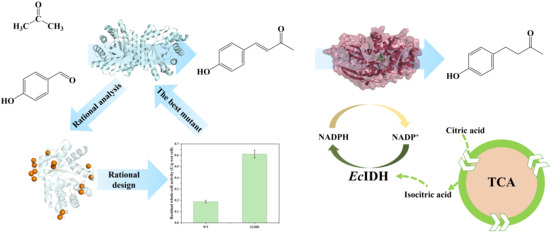
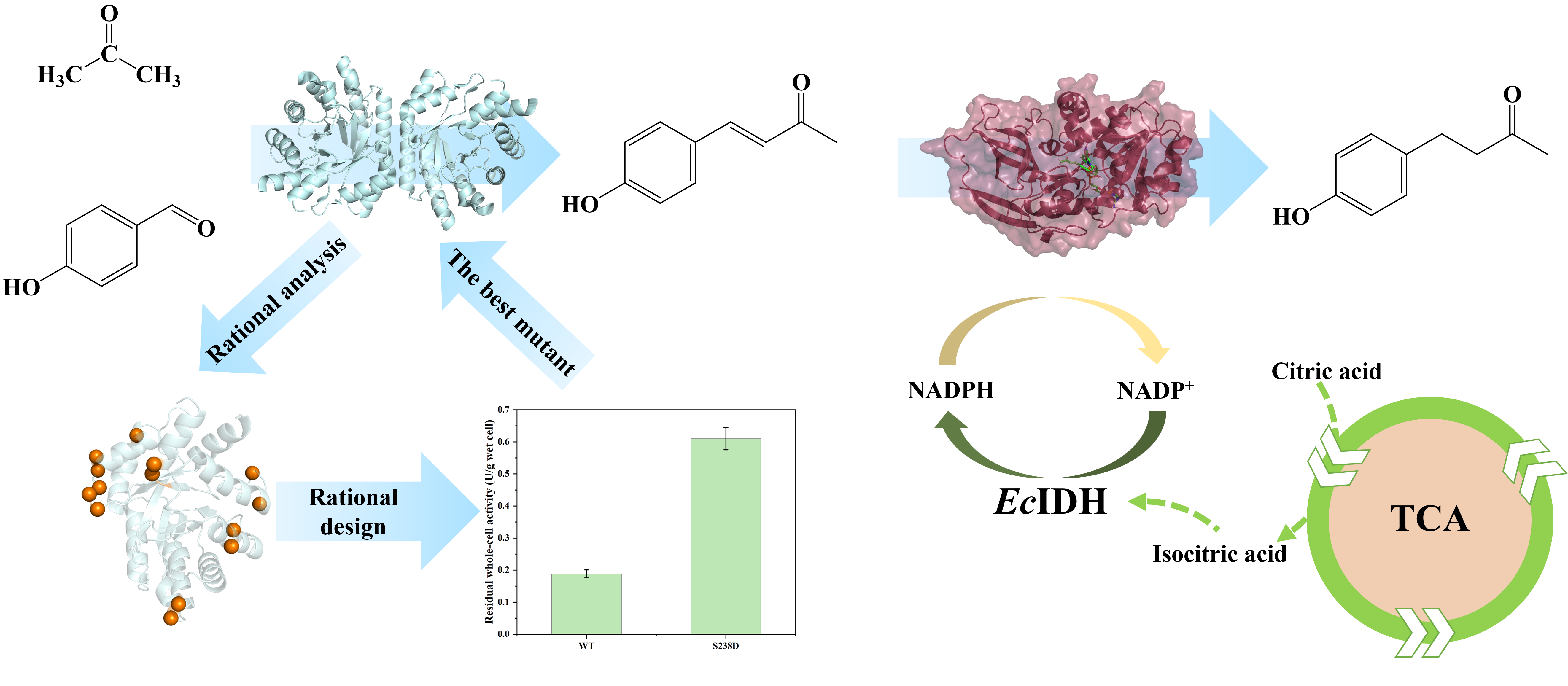
Raspberry ketone (RK) is the primary aromatic compound in raspberry fruit, which is widely utilized in perfume, cosmetics, and food additive industries. Currently, RK is predominantly produced chemically. RK biosynthesis through enzyme or whole cell has garnered significant attention due to the mild reaction conditions and the process being regarded as ‘natural’. This study proposed a ‘dual-microorganism, two-phase’ stepwise cascade strategy to produce RK from an economical precursor, 4-hydroxybenzaldehyde (4-HBD). An acetone-tolerant deoxyribose-phosphate aldolase DERAEc (S238D) mutant was obtained through a site-specific rigidification strategy for converting 4-HBD to 4-hydroxybenzylaceton (4-HBA). Then, an engineered E. coli co-expressing isocitrate dehydrogenase and raspberry ketone synthase RiRZS1 with a citrate-sodium citrate buffer to recycle nicotinamide adenine dinucleotide phosphate (NADPH) was constructed for the conversion of 4-HBA to RK. The final concentration of RK was 50.00 ± 1.92 mmol·L−1 with a yield of 86.96%. This strategy provides a scalable coenzyme self-recycling and two-phase catalysis platform for high-value phenolic compounds.

1. Introduction

Raspberry ketone is the key flavoring compound in red raspberry fruit. Due to its distinctive fruity aroma, it is widely utilized in the perfume, cosmetics, and food additive industries, ranking among the most valuable natural flavorings in the global market [1]. Recent studies have progressively demonstrated that RK possesses multiple physiological activities, including antioxidant, anti-obesity, hypolipidemic, hepatoprotection, and cardiovascular protection [2,3]. These mechanisms involve up-regulating superoxide dismutase and catalase, activating the key pathway regulating fat metabolism, and inhibiting lipid peroxidation and inflammatory responses [4,5].
However, the RK content in natural fruits is extremely low (merely 1–4 mg·kg−1), and RK extraction from natural fruits is constrained by seasonal availability and geographical origin. As a result, traditional plant extraction methods are difficult to meet the growing market demand of at least a thousand tons per year [6]. The large-scale production of raspberry ketone via chemical synthesis generally faces two core challenges: first, its synthetic pathways (such as the classical phenol-ketone condensation route) rely on petrochemical feedstocks and metal catalysts, which cannot be considered as ‘natural’ under European and American regulatory frameworks and thus limiting market applications [1]; second, the process may bring environmental burdens, mainly referring to the unsustainability of raw material sources, the toxicity of metal catalysts, and the difficulty of waste disposal. Consequently, developing biosynthetic pathways that simultaneously address natural certification, environmental sustainability, and production costs has become a focal point for both academia and industry.
With the development of bioinformatics, an increasing number of predictive approaches have been applied to strain engineering, providing different strategies for enzyme engineering and protein design. In recent years, through computer simulation-based prediction and semi-rational design, researchers have been able to identify specific sites for modification across a broad protein structure, significantly enhancing the efficiency of enzyme engineering. For example, through semi-rational engineering modifications to the hinge region of glutamate dehydrogenase, Yin et al. successfully obtained mutants exhibiting enhanced reductive amination activity towards non-natural substrates, demonstrating the crucial role of non-active sites in regulating conformational changes within the enzyme [7]. Gu et al. employed a strategy for modifying the distal sites of alcohol dehydrogenase based on co-evolutionary analysis, achieving highly efficient catalysis and high stereoselectivity towards multiple substrates [8]. Wang et al. employed an Ala-Leu-Phe scanning strategy to geometrically remodel the active pocket of acetonitrile hydratase, thereby enhancing the enzyme’s preference for aromatic acetonitrile substrates while significantly improving catalytic efficiency [9]. Moreover, in the field of glycosyltransferase engineering, Roy et al. successfully achieved the efficient synthesis of highly water-soluble phellanidin α-diglucoside through the engineering of O-α-glycosyltransferase [10]. These examples demonstrated the significant potential of bioinformatics-guided enzyme modification in enhancing the bioavailability of compounds.
Research into the biosynthesis of RK has progressed through three stages: plant cell culture, microbial fermentation, and enzyme/cell catalysis [11]. In early studies, suspended cell cultures combined with methyl jasmonate induction could lead to RK yields on a milligram scale, yet remained uncompetitive for industrial applications [6]. With advances in synthetic biology, researchers have reconstructed the pathway for plant-derived p-coumaric acid (p-CA) → 4-hydroxybenzylaceton (4-HBA) → RK in Saccharomyces cerevisiae, Bacillus subtilis, and Escherichia coli. By enhancing precursor supply and optimizing key enzyme expression, fermentation titers have been elevated to hundreds of milligrams per liter [12,13,14,15].
In recent years, in vitro multi-enzyme catalytic systems have garnered significant attention due to their high conversion rates and controllability. For instance, Yang et al. co-expressed raspberry ketone synthase RiRZS1 with glucose dehydrogenase SyGDH in Escherichia coli, establishing a cascade reaction regenerating NADPH using 4-HBA as the substrate and glucose as the co-substrate, achieving a spatiotemporal yield as high as 4.94 g·(L·h)−1 [16]. The more advanced iMECS strategy (in vitro multi-enzyme coordinated expression and cofactor self-recycling) further integrated cofactor regeneration with cell-free expression systems, enabling the efficient synthesis of multiple phenolic compounds, including RK, with yields exceeding 90% [17]. Moreover, these studies demonstrated good atom economy and process flexibility.
Nevertheless, current biosynthetic pathways of RK still face challenges such as the high cost of key precursors (e.g., 4-HBA), and the complexity of coenzyme regeneration systems producing byproducts. It is worth noting that 4-hydroxybenzaldehyde (4-HBD) is much more economical than 4-HBA, and the aldol condensation step converting 4-HBD to 4-HBA can be realized by deoxyribonucleic acid aldolase (DERA) [18]. However, this enzyme exhibits poor stability in organic solvents [19]. This study proposed a ‘dual-microorganism, two-phase’ stepwise cascade strategy: first, the mutation sites of DERAEc (Ec stands for Escherichia coli) were obtained based on molecular docking and molecular dynamics simulations, and a reasonably designed DERAEc (S238D) mutant with improved solvent stability was expressed in Escherichia coli, catalyzing the conversion of 4-HBD to 4-HBA.; subsequently, engineered Escherichia coli co-expressing isocitrate dehydrogenase (EcIDH) and RiRZS1 were constructed to produce RK. The citrate-citrate sodium buffer system used in this work enabled NADPH self-recycling, eliminating the need for exogenous glucose addition. This approach not only fills the gap in the biosynthesis of RK using 4-HBD as a feedstock, but also provides a scalable ‘coenzyme self-recycling and two-phase catalysis’ technology platform for other high-value phenolic compounds.

2. Results and Discussion

2.1. Optimization of DERAEc Stability in Acetone by Rational Design

2.1.1. Determination of Mutation Sites in DERAEc by Molecular Dynamics Simulation

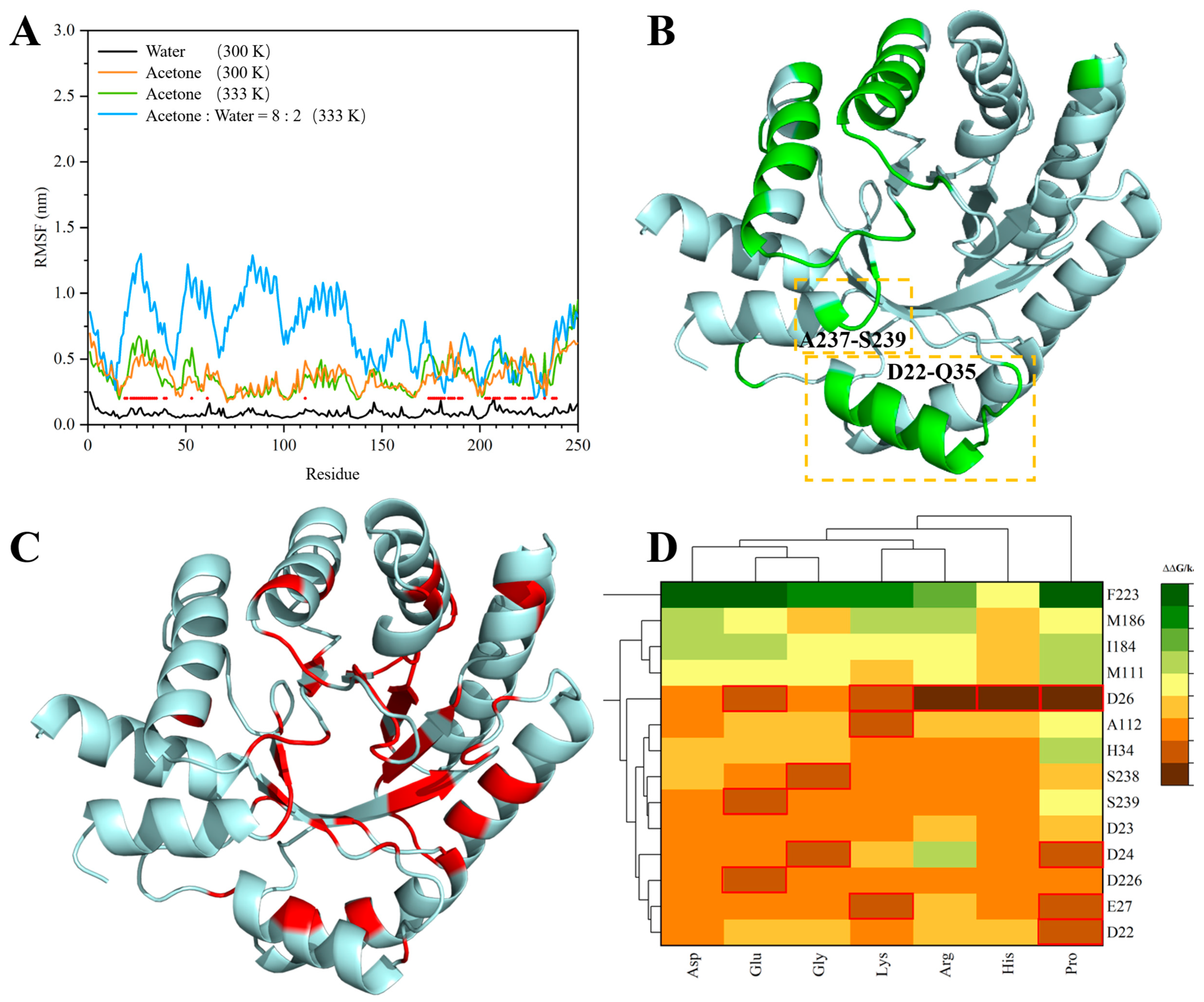
Root Mean Square Fluctuation (RMSF) values of DERAEc amino acids under varying conditions were analyzed in order to identify highly flexible amino acids. Molecular dynamics simulations of the DERAEc dimeric structure were conducted for 10 ns at 300 K and 333 K (room temperature and reaction temperature) within boxes containing aqueous acetone solution with 0, 80, and 100% molar ratio of acetone, respectively. The RMSF values of amino acids are extracted from the molecular dynamics trajectory results (Figure 1A). According to this Figure, the RMSF values markedly increased with the increase in acetone concentration or temperature, indicating that amino acids within the enzyme exhibited progressively greater motion ranges and reduced stability under the influence of temperature or acetone. Based on the RMSF values for each amino acid, those simultaneously satisfying RMSF > x ¯ + u (where x ¯ denoted the average RMSF of the amino acid residue, and u represented its standard deviation) under all four conditions showed in Figure 1A were designated as flexible amino acids.
Figure 1. Selection of Flexible Sites and Virtual Mutations. (A): RMSF of DERAEc under different conditions; red dashed lines indicate amino acid residues with RMSF > x ¯ + u. (B): Green regions denote relatively flexible protein areas with higher RMSF values, where D22-Q35 and A237-S239 constitute primary regions for subsequent mutation design. (C): Red regions denote highly conserved protein domains; (D): Heatmap of virtual mutations at potential flexible sites, with ∆∆G < 0 highlighted in red boxes; each color represents the range of ∆∆G values.
Mutations in highly conserved amino acid residues frequently result in a marked reduction in enzyme activity or even complete inactivation. We obtained amino acid sequences of aldehyde dehydrogenase from nine different sources: Escherichia coli HS (GenBank accession number: DEOC_ECOHS), Salmonella enterica LT2 (GenBank accession number: DEOC_SALTY), Klebsiella pneumoniae 342 (GenBank accession number: DEOC_KLEP3), Shigella sonnei Ss046 (GenBank accession number: DEOC_SHISS), Edwardsiella ictaluri 93-146 (GenBank accession number: DEOC_EDWI9), Vibrio cholerae M66-2 (GenBank accession number: DEOC_VIBCM), and Actinobacillus pleuropneumoniae sv. 7 str. AP76 (GenBank accession number: DEOC_ACTP7), Shewanella baltica OS155 (GenBank accession number: DEOC_SHEB5), Halalkalibacterium halodurans C-125 (GenBank accession number: DEOC_HALH5), and their amino acids in flexible regions and highly conserved regions were visualized, respectively. Flexible regions (Figure 1B) were marked in green, while highly conserved regions (Figure 1C) were highlighted in red. Overlapping regions were identified, and amino acids within these overlapping regions required exclusion. Moreover, those near previously reported catalytically active sites were excluded from the candidate mutation sites [20]. Therefore, based on the RMSF values at an acetone concentration of 80% molar ratio, residues D22-Q35 and A237-S239 are identified as the primary regions for subsequent mutation design.
Based on molecular dynamics simulation of the wild-type DERAEc and analysis of conserved amino acid sequences, these flexible sites were virtually mutated into more rigid residues: Asp, Glu, Gly, Lys, Arg, His, and Pro. The built-in ddg_monomer program within Rosetta was employed to calculate the Gibbs free energy difference ∆∆G between the mutant and wild-type structures induced by these mutations, and the results are shown in Figure 1D. A smaller ∆∆G value indicates a more stable protein structure. Mutants with significantly negative ∆∆G values were highlighted with red boxes. To reduce the size of the mutation library and subsequent computational workload, we selected the five mutants with the lowest binding energies (∆∆G ≤ −3 kJ/mol) (D22P, D26P, D26E, D26R, and S239E) for validation.

2.1.2. Determination of Mutation Sites in Derec by Molecular Docking Results

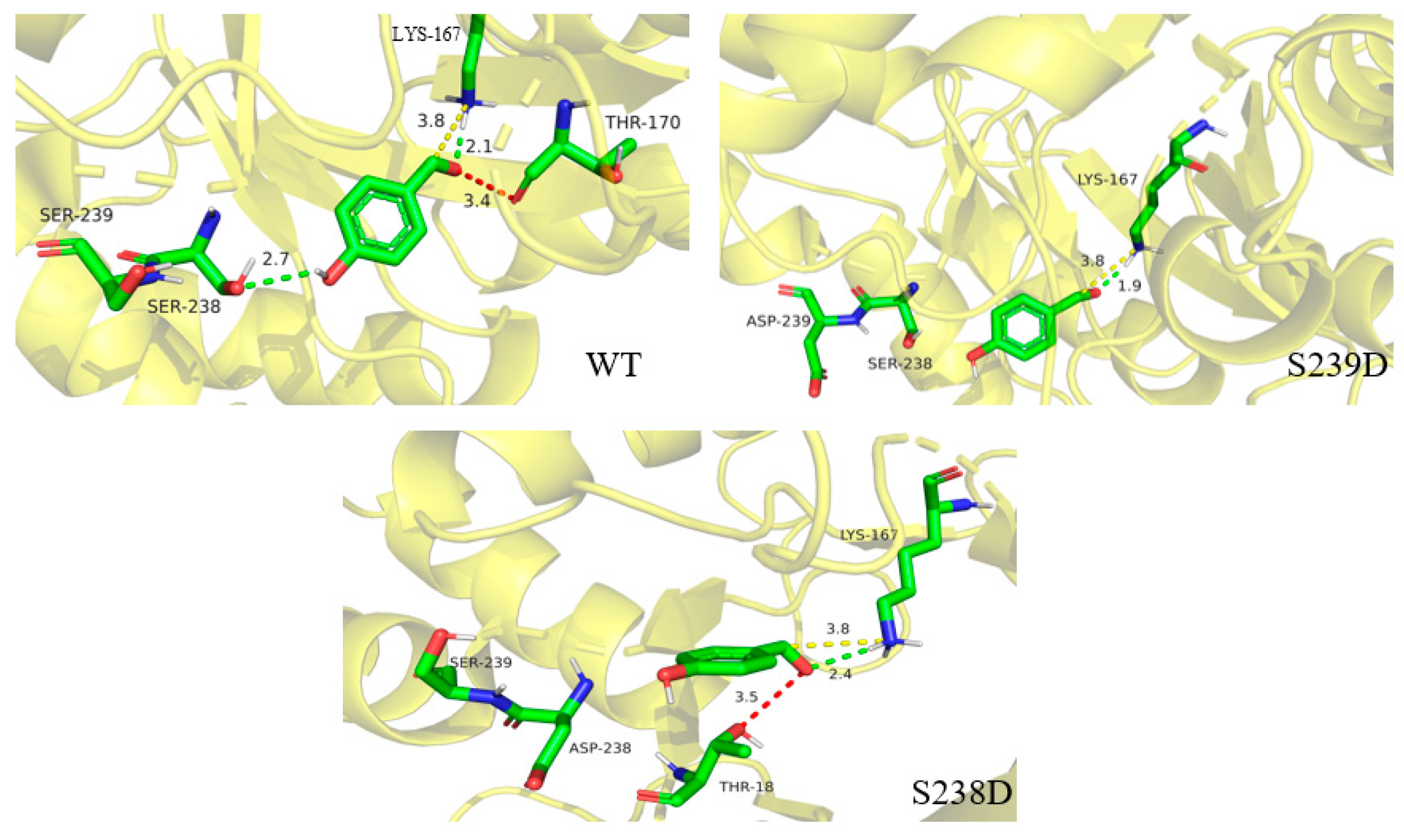
Previous reports indicated that the S238D and S239D mutants exhibited elevated activity towards non-phosphorylated substrates, 2-deoxyribonucleic acid, and acetaldehyde [21,22]. To investigate whether S238D and S239D possess robust activity and stability towards 4-HBD, molecular docking was performed in WT, S238D, and S239D mutants with 4-HBD as the substrate. The known reaction mechanism of DERAEc catalyzing the aldol reaction involves dehydration of the α hydrogen in the aldehyde group with a nitrogen atom from a lysine side chain to form a Schiff base intermediate [23]. Based on the docking results in Figure 2, LYS-167 was identified as the key residue. Furthermore, the docking results indicated that, compared with WT, the S239D mutant lacked the steric repulsion between the aldehyde oxygen and the carbonyl oxygen of THR-170. The O–H–N hydrogen bond distance between the aldehyde oxygen and the hydrogen of LYS-167s side-chain group decreased from 2.1 Å to 1.9 Å in S239D, favoring the formation of the Schiff base intermediate between the aldehyde carbon and the amino group of LYS-167s side chain. In S238D; however, the hydroxyl oxygen of THR-18 interacted competitively with the aldehyde oxygen of 4-HBD, causing 4-HBD to shift towards LYS-167. This shift may further promote Schiff base intermediate formation, thus S238D and S239D were also selected as candidate mutants for subsequent screening. Additionally, we observed that S238E exhibited a ∆∆G value of −2.73 kJ/mol, indicating this mutation may also exert a substantial impact on enzyme stability. Consequently, it was also included as a candidate mutant.
Figure 2. Molecular docking results for WT, S239D, and S238D mutants with 4-HBD as the substrate.

2.1.3. Validation of Advantageous Mutants by Molecular Dynamics Simulations

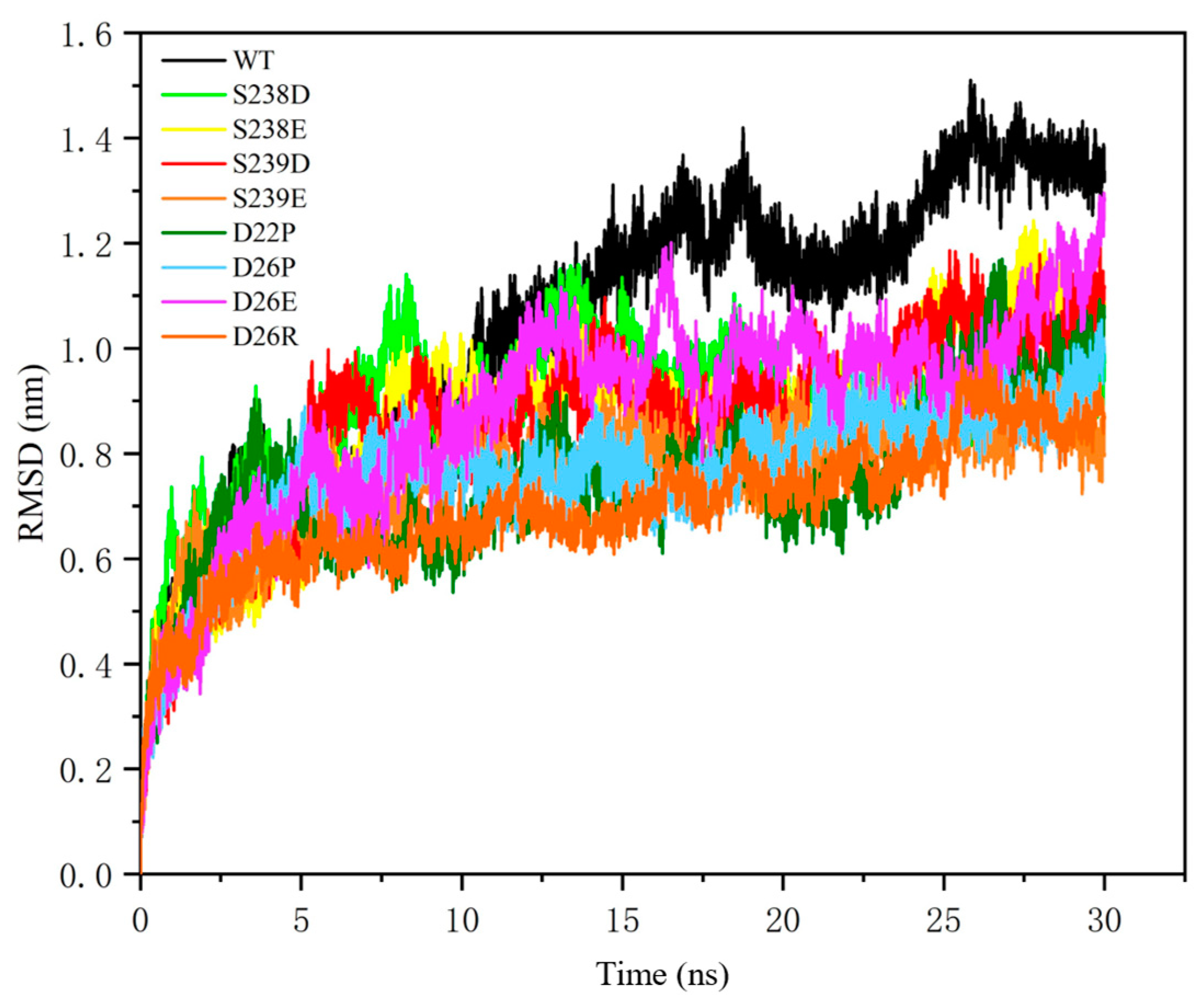
After identifying the candidate mutants, molecular dynamics simulations were conducted, with the results compared with the wild-type DERAEc. RMSD represents the overall displacement magnitude of all amino acids within a protein structure, and higher RMSD values usually indicate greater structural instability. Mutant PDB files were generated using Chimera-1.19to design mutations from the virtual screening results. These mutant PDBs were then employed for 30 ns molecular dynamics simulations under reaction conditions of 80% molar ratio of the acetone aqueous system at 333 K. The RMSD values of S238D, S238E, S239D, S239E, D22P, D26P, D26E, and D26R were significantly lower than those of the wild type during the stable period at 15 ns (Figure 3). Interestingly, although the ∆∆G value for the S238D mutant was not negative, its RMSD was markedly reduced. This result demonstrated that ∆∆G calculations did not entirely correlate with RMSD predictions, highlighting the inherent limitations of single-software predictions. Further experimental validation of these eight mutants is important in identifying the exact mutant with improved stability.
Figure 3. 30 ns RMSD for wild-type DERAEc and mutants.

2.1.4. Experimental Validation of Mutant Strains

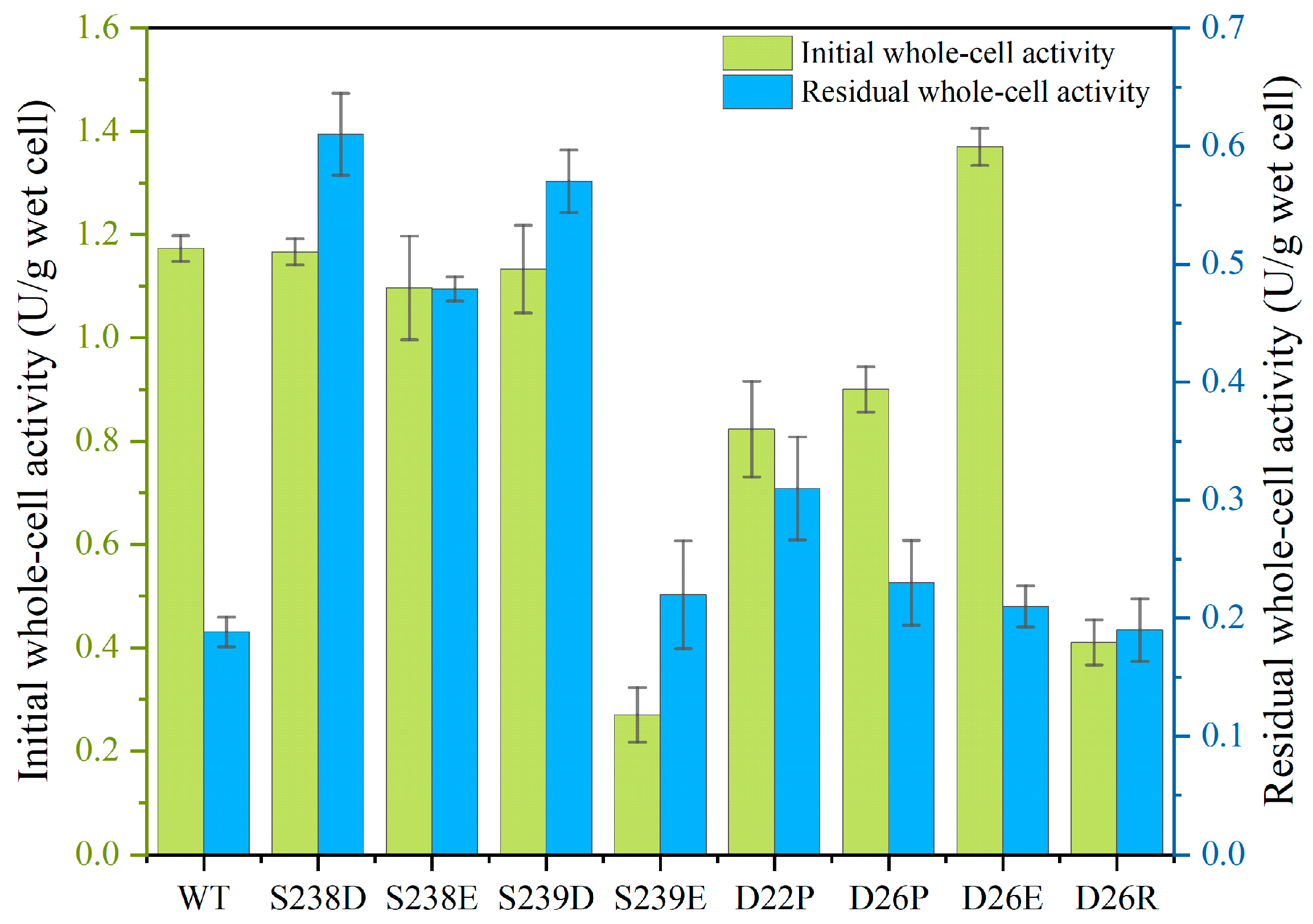
The residual activity of the modified whole-cell catalyst was determined following incubation at 60 °C, with results shown in Figure 4. The residual whole-cell activity of S238D, S239D, and S238E was markedly elevated, reaching 3.24-fold, 3.03-fold, and 2.38-fold that of DERAEc (WT), respectively, with their initial whole-cell activities showing no significant decline. Among them, mutant DERAEc (S238D) performed the best. In contrast, S239E, D22P, D26P, and D26R mutant strains exhibited only marginal increases in residual whole-cell activities alongside a marked reduction in initial whole-cell activities. These results indicate that although the mutated sites are not conserved, point mutations may induce alterations in the overall interaction network among amino acids in the protein, leading to diminished whole-cell activity.
Figure 4. Whole-cell activities and residual whole-cell activities of the mutants.

2.2. Redesign of the Coenzyme Cycle System

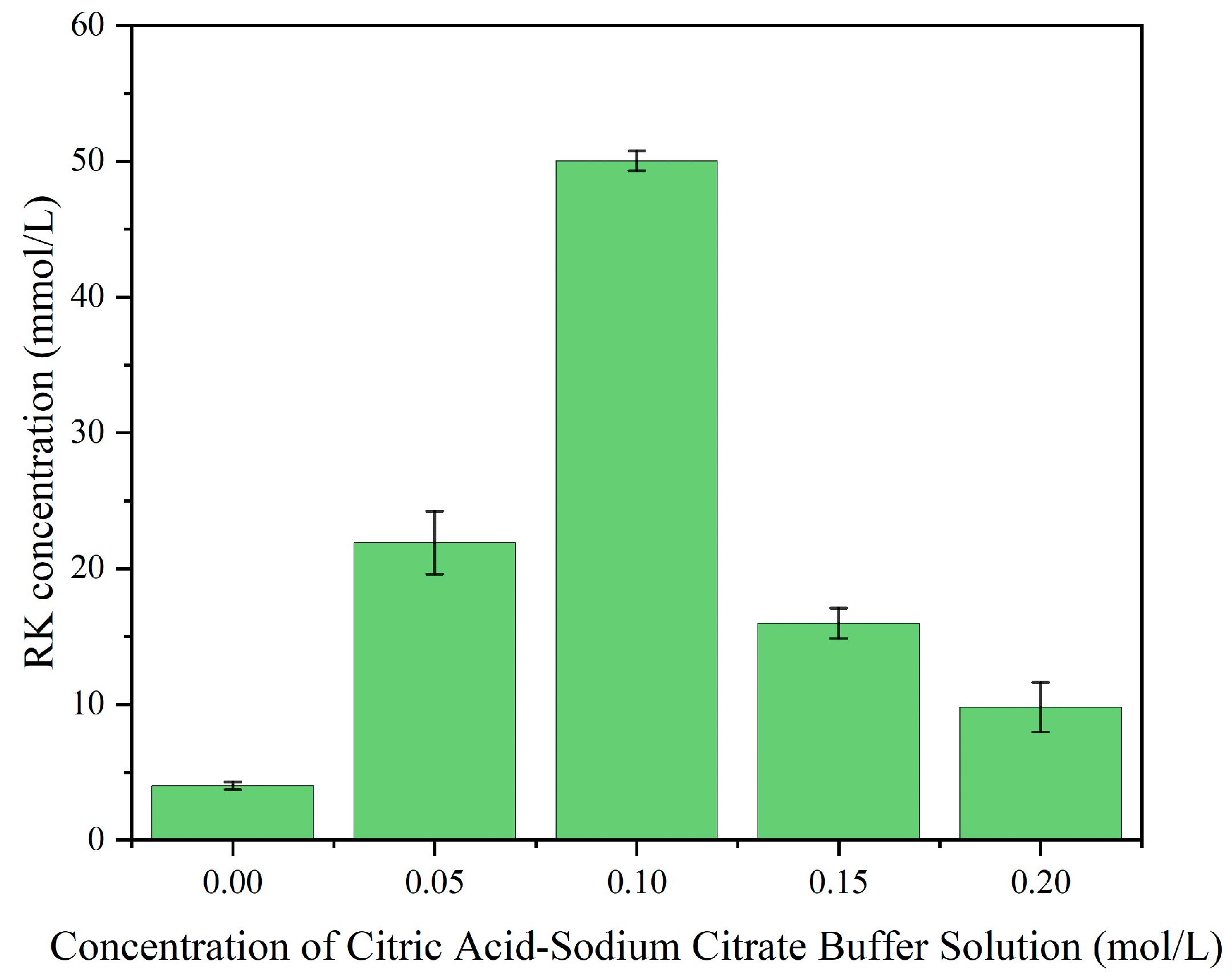
In preliminary studies, a whole-cell biocatalyst was constructed by co-expressing raspberry ketone synthase (RiRZS1) and glucose dehydrogenase (SyGDH) in Escherichia coli to achieve efficient conversion of 4-HBA to RK [16]. However, this system requires substantial glucose consumption, and the metabolic byproduct gluconic acid disrupts the system’s pH, which brought complications in RK extraction. Notably, the endogenous tricarboxylic acid cycle (TCA) in Escherichia coli can convert citric acid into isocitric acid. And the isocitrate dehydrogenase (EcIDH) in Escherichia coli possesses NADPH regeneration ability [24]. Consequently, this study constructed E. coli BL21(DE3)/pRSF-ecidh-rirzs1. Co-expression of the ecidh gene encoding EcIDH and the rirzs1 gene encoding RiRZS1 enhanced NADPH regeneration capacity, as verified by protein gel electrophoresis (Figure S1). In order to investigate whether both the buffering efficacy of citric acid-sodium citrate buffer and citrate supply within the TCA were enough for RK production, catalysis using 4-HBA as the substrate was performed in citric acid-sodium citrate buffer solutions at pH 5.5 with varying concentrations, and the results are shown in Figure 5. At 0.1 mol/L of citric acid-sodium citrate buffer solution, 51.02 ± 0.74 mmol/L of RK was produced from 61 mmol/L of 4-HBA, resulting in a yield of 83.61%.
Figure 5. Effect of citric acid-sodium citrate buffer concentrations on RK production.

2.3. Biosynthesis of Raspberry Ketone with Stepwise Cascade Strategy

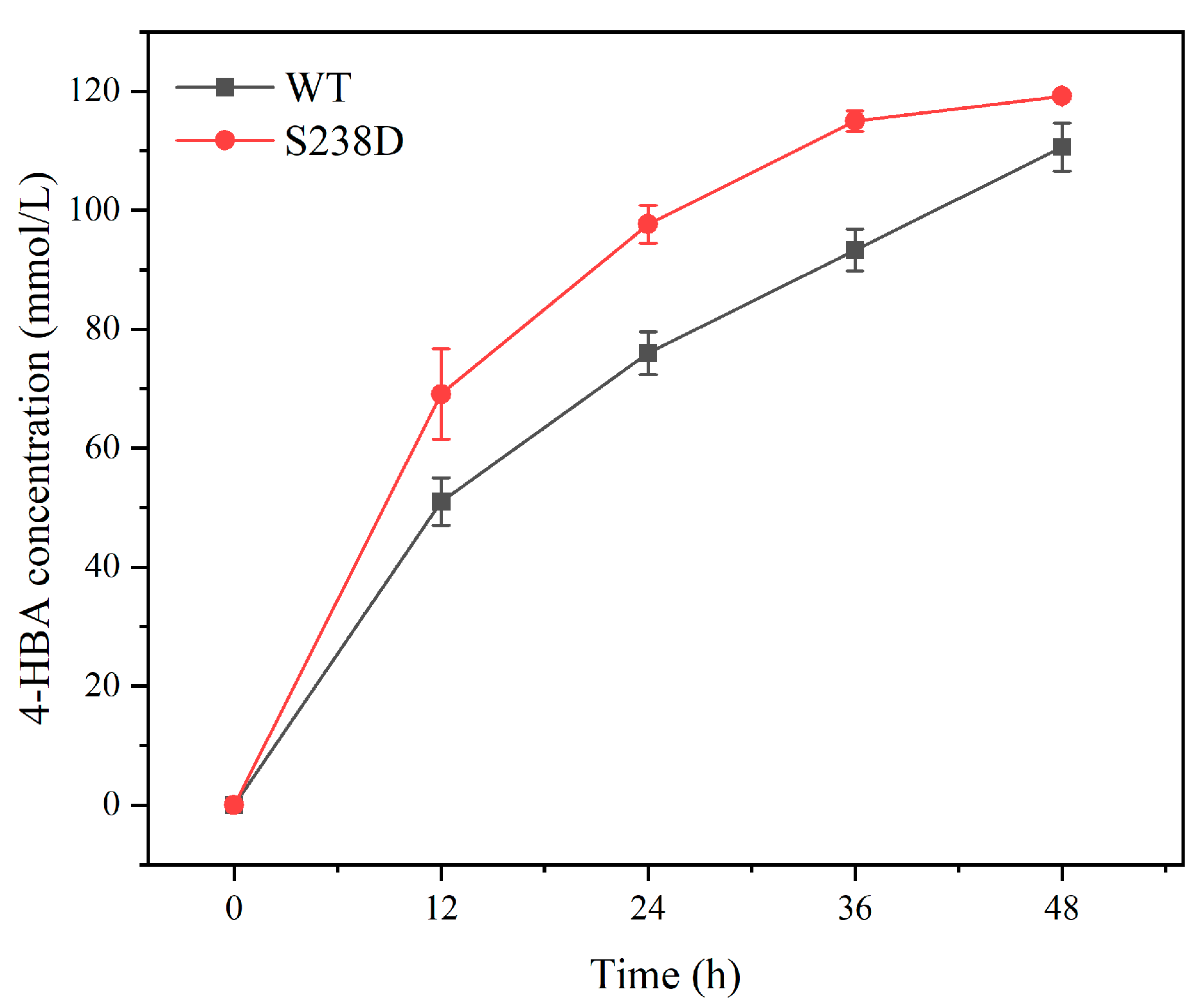
The optimal mutant DERAEc (S238D) was employed for whole-cell catalysis of 4-HBA synthesis, and the results are shown in Figure 6. Under conditions of 120 mmol/L 4-HBD, 60 °C, and 80% molar ratio of acetone aqueous solution, 115.02 ± 1.76 mmol/L 4-HBA was produced at 36 h with a yield of 95.85%. The wild-type DERAEc strain needed an extra 12 h to reach a similar 4-HBA concentration. Afterwards, the crude 4-HBA acetone solution, obtained by centrifuging the reaction mixture to remove the whole-cell catalysts and recovering the acetone by vacuum rotary evaporation, was diluted with 0.1 mol/L citric acid-sodium citrate buffer to a final 4-HBA of 57.50 mmol/L, and whole-cell catalyst co-expressing isocitrate dehydrogenase (EcIDH) and RiRZS1 was added at a final wet cell concentration of 200 g/L. After 2 h of biosynthesis reaction at 40 °C and 150 rpm, a final RK concentration of 50.00 ± 1.92 mmol/L was achieved with a yield of 86.96%.
Figure 6. Production of 4-HBA with WT and S238D mutant strains.
Previous studies regarding the production of ‘natural’ raspberry ketone offered feasible fermentation and microbial synthesis pathways [13,25] and laid a foundation for flavor compounds making use of plant genes. By decoupling the synthesis into two independent, optimized steps utilizing an engineered DERA mutant and a cofactor regeneration system, we achieved a remarkable RK titer of 8.15 g/L. Moreover, this approach circumvented intermediate toxicity and enhanced reaction efficiency and substrate loading, offering a solution to the industrial bioproduction of natural flavor compounds.

3. Materials and Methods

3.1. Strains and Chemical Compounds

Deoxyribose-phosphate aldolase (DERAEc, EC 4.1.2.4) gene deoc (GenBank accession number: CP081489.1) from Escherichia coli and raspberry ketone synthase (RiRZS1) gene rirzs1 (GenBank accession number: MK036000.1) from Rubus idaeus were cloned from laboratory-preserved strains using plasmids pRSF-deoc and pET-rirzs1. The isocitrate dehydrogenase (Isocitrate dehydrogenase, EcIDH, EC 1.1.1.42) gene ecidh (GenBank accession number: CP053602.1) was cloned from extracted E. coli BL21 (DE3) genomic DNA.
4-HBD and acetone were purchased from Sinopharm Chemical Reagent Co., Ltd. (Shanghai, China). RK and 4-HBA were obtained from Aladdin (Shanghai, China). Isopropyl β-D-thiogalactoside (IPTG), antibiotics, and protein markers were acquired from Shanghai Sangon (Shanghai, China). PrimeSTAR® Max DNA Polymerase and restriction endonucleases were purchased from Takara (Shanghai, China). The FastPure Plasmid Mini Kit, FastPure Gel DNA Extraction Mini Kit, and SDS-PAGE Gel Rapid Preparation Kit were purchased from Vazyme (Nanjing, China). All other chemicals were of analytical grade and purchased from Macklin (Shanghai, China).

3.2. Construction of a Mutant Library

Site-directed mutagenesis was performed via PCR using plasmid pRSF-deoc as the template. The primer sequences for the mutations are detailed in Table S1. The full-plasmid PCR reaction system comprised: 25 ng plasmid, 10 pmol of each primer, and 12.5 μL of 2× PrimeSTAR Max Master Mix (total volume 25 μL); The PCR cycling program was set as follows: pre-denaturation at 95 °C for 3 min, followed by denaturation at 98 °C for 10 s, annealing at 55 °C for 15 s, extension at 72 °C for 75 s, and finally a full extension at 72 °C for 10 min. The PCR product was digested with the restriction enzyme Dpn I at 37 °C for 1 h. The purified PCR product was then purified via agarose gel electrophoresis and transformed into E. coli BL21 (DE3) and stored in glycerol tubes.

3.3. Preparation of Whole-Cell Catalysts with DERAEc (WT) and Its Mutants

DERAEc (WT) and its mutant strains were taken from glycerol tubes and incubated upside down at 37 °C for 12 h in LB solid medium containing 50 mg/L kanamycin. Then, a single colony was picked and inoculated into liquid LB medium containing the same concentration of kanamycin. After 12 h of incubation at 37 °C and 220 r/min, this seed solution was transferred into kanamycin-resistant TB medium at an inoculum volume of 2% and incubated at 37 °C, 220 r/min. After the OD600 value of this mixture reached 0.6–0.8, IPTG was added to a final concentration of 0.8 mmol/L, and the mixture was incubated at 20 °C for another 24 h. Afterwards, recombinant cells were harvested by centrifugation at 8000 r/min and 4 °C for 10 min. The cells were washed with Na2HPO4-NaH2PO4 buffer (100 mmol/L, pH 7.4) and stored at 4 °C for use.

3.4. Activity Assay for Whole-Cell with DERAEc (WT) and Its Mutants

In a 10 mL reaction system using an 80% molar ratio of acetone aqueous solution as the solvent, a final whole-cell catalyst concentration of 200 g/L was adopted with a final 4-HBD concentration of 120 mmol/L, the reaction temperature was 30 °C, and the reaction speed was 200 rpm. The initial activity of the whole-cell catalysts was measured after 30 min of reaction time, while the residual activity was measured after incubating the whole-cell catalysts at 60 °C for 4 h and then reacting for 30 min. Whole-cell activity units were defined as U/g wet cell mass, where 1 U represented the amount of whole-cell catalyst required to convert 1 μmol of substrate into product per minute. Whole-cell catalytic activity was calculated according to the following formula.
Total cell activity ( U / g wet cell ) = c × v m × t
c: 4-HBA concentration (μmol/L); m: microbial biomass mass (g (wet weight));
v: reaction liquid volume (L); t: reaction time (min)

3.5. Cascade Biosynthesis of Raspberry Ketone

3.5.1. Whole-Cell Biosynthesis of 4-HBA

Bioconversion of 4-HBD to 4-HBA was conducted in 10 mL of an 80% molar ratio of acetone aqueous solution with a whole-cell concentration of 200 g/L and a 4-HBD concentration of 120 mmol/L. The reaction proceeded at 60 °C and 150 r/min. Samples were taken every 12 h with reactions terminated by adding a 9-fold volume of methanol. Then the mixture was centrifuged at 12,000 r/min for 1 min, and the supernatant was collected, filtered through a 0.22 μm membrane, and diluted for HPLC analysis.

3.5.2. Whole-Cell Biosynthesis of RK

The reaction mixture obtained in 3.5.1 was centrifuged to remove the whole-cell catalysts and then rotary evaporated at 40 °C for 30 min to recover acetone. The obtained crude 4-HBA aqueous solution was diluted with 0.1 mol/L citric acid-sodium citrate buffer to a final 4-HBA concentration of 57.50 mmol/L, and whole-cell catalysts were added at a concentration of 200 g/L. Biosynthesis of RK was conducted at 40 °C and at 150 r/min. After 2 h, the reaction was terminated by adding 9 9-fold volume of methanol. Then the mixture was centrifuged at 12,000 r/min for 1 min, and the supernatant was collected, filtered through a 0.22 μm membrane, and diluted for HPLC analysis for RK concentration.

3.6. Molecular Dynamics Simulation and Other Analysis Tools

The DERAEc dimeric protein crystal structure (PDB ID: 1KTN) was downloaded from the RCSB PDB database, and dehydration and hydrogenation operations were performed on the protein crystal structure. Molecular dynamics simulations were conducted using GROMACS, employing the amber99sb-idln force field for the protein molecule and the spce force field for water molecules. Force field parameters for acetone were generated using the sobtop software (Tian Lu, Sobtop, Version 1.0, http://sobereva.com/soft/Sobtop, accessed on 24 August 2025), with acetone molecular charges corrected using RESP.1.5 charges calculated by Multiwfn 3.8. A solvent box was created to fill the protein structure and system with the required molecules (acetone to water molecules at a molar ratio of 8:2), with the protein molecules subject to boundary conditions at 1 nm from the box edges. The protein and solvent molecular system underwent NVT and NPT equilibration at 300 K or 333 K. Once equilibrium was achieved, molecular dynamics simulations were conducted for 30 ns.
Molecular docking was performed using AutoDock-Vina v1.2.7 (https://github.com/ccsb-scripps/AutoDock-Vina/releases, accessed on 20 June 2025) [26]. The Gibbs free energies of mutants were predicted using Rosetta software (https://www.rosettacommons.org/software, accessed on 17 June 2025). Mutant structures were generated using Chimera software (https://www.cgl.ucsf.edu/chimera/, accessed on 15 August 2025) and visualized using the Pymol software (http://www.pymol.org, accessed on 22 May 2025) [27,28].

3.7. Analytical Methods

The whole-cell biocatalytic activity was determined by measuring the concentrations of 4-HBA and RK in the reaction system. HPLC system (Waters Co., Ltd., Milford, MA, USA) equipped with an Amethyst C18-H column (4.6 × 250 mm2, 5 μm, Sepax Technologies, Inc, Suzhou, China) was used for the detection of 4-HBA and RK, and the mobile phase comprised acetonitrile/water (20:80, v/v) with 0.1% (v/v) phosphoric acid. The sample (20 μL) had three replicates and was eluted at a flow rate of 1 mL/min and at 35 °C, and detected at 222 nm. The retention times for 4-HBA and RK were 20.68 min and 19.50 min, respectively.

4. Conclusions

This study employed a flexible regional stiffening strategy combined with molecular dynamics simulations to engineer the wild-type DERAEc, yielding the optimal mutant strain S238D with a 3.24-fold increase in residual whole-cell activity compared to the wild type, enabling the conversion of 120 mmol/L 4-HBD to 115.02 mmol/L 4-HBA with a yield of 95.85%. Subsequently, an engineered strain E. coli BL21(DE3)/pRSF-ecidh-rirzs1 E. coli with a citrate-sodium citrate buffer to recycle NADPH was constructed for the conversion of 4-HBA to RK, resulting in a RK concentration of 50.00 ± 1.92 mmol·L−1 with a yield of 86.96%. This study provides an efficient strategy for coenzyme self-recycling and biosynthesis of high-value phenolic compounds.

Supplementary Materials

The following supporting information can be downloaded at: https://www.mdpi.com/article/10.3390/catal15121148/s1, Figure S1: Protein gel verification of EcIDH and RiRZS1 gene expression; Figure S2: HPLC graphs of 4-HBA and RK; Table S1: Primer sequences used in this study.

Author Contributions

Conceptualization, P.Z., S.X., and P.C.; methodology, Y.Y. and K.S.; software, Y.Y. and X.Z.; validation, K.S., X.G., and M.L.; formal analysis, S.X.; data curation, Y.Y.; writing—original draft preparation, K.S.; writing—review and editing, Y.Y.; supervision, P.Z. and P.C.; funding acquisition, P.C. All authors have read and agreed to the published version of the manuscript.

Funding

This research was funded by the National Key Research and Development Program of the Ministry of Science and Technology (No. 2025YFA0921202) and Postgraduate Research and Practice Innovation Program of Jiangsu Province (SJCX24_1364).

Data Availability Statement

Data will be made available on request.

Conflicts of Interest

The authors declare that they have no known competing financial interests or personal relationships that could have appeared to influence the work reported in this paper.

References

  1. Moore, S.; Hleba, Y.; Bischoff, S.; Bell, D.; Polizzi, K.; Freemont, P. Refactoring of a synthetic raspberry ketone pathway with EcoFlex. Microb. Cell Factories 2021, 20, 2. [Google Scholar]
  2. Li, X.; Wei, T.; Wu, M.; Chen, F.; Zhang, P.; Deng, Z.; Luo, T. Potential metabolic activities of raspberry ketone. J. Food Biochem. 2022, 46, 10. [Google Scholar] [CrossRef]
  3. Rao, S.; Kurakula, M.; Mamidipalli, N.; Tiyyagura, P.; Patel, B.; Manne, R. Pharmacological exploration of phenolic compound: Raspberry ketone—Update 2020. Plants 2021, 10, 17. [Google Scholar] [CrossRef] [PubMed]
  4. Park, K. Raspberry ketone increases both lipolysis and fatty acid oxidation in 3T3-L1 adipocytes. Planta Medica 2010, 76, 1654–1658. [Google Scholar] [CrossRef] [PubMed]
  5. Lim, S.; Choi, C. Potentials of raspberry ketone as a natural antioxidant. Antioxidants 2021, 10, 13. [Google Scholar] [CrossRef] [PubMed]
  6. Pedapudi, S.; Chin, C.; Pedersen, H. Production and elicitation of benzalacetone and the raspberry ketone in cell suspension cultures of Rubus idaeus. Biotechnol. Prog. 2000, 16, 346–349. [Google Scholar] [CrossRef] [PubMed]
  7. Yin, X.; Liu, Y.; Meng, L.; Zhou, H.; Wu, J.; Yang, L. Semi-rational hinge engineering: Modulating the conformational transformation of glutamate dehydrogenase for enhanced reductive amination activity towards non-natural substrates. Catal. Sci. Technol. 2020, 10, 3376–3386. [Google Scholar] [CrossRef]
  8. Gu, J.; Sim, B.; Li, J.; Yu, Y.; Qin, L.; Wu, L.; Liu, H.; Xu, Y.; Zhao, Y.; Nie, Y. Coevolution-based protein engineering of alcohol dehydrogenase at distal sites enables enzymatic compatibility with substrate diversity and stereoselectivity. Int. J. Biol. Macromol. 2025, 306, 13. [Google Scholar] [CrossRef]
  9. Wang, Z.; Gong, J.; Feng, D.; Su, C.; Li, H.; Rao, Z.; Lu, Z.; Shi, J.; Xu, Z. Geometric remodeling of nitrilase active pocket based on ALF-scanning strategy to enhance aromatic nitrile substrate preference and catalytic efficiency. Appl. Environ. Microbiol. 2023, 89, 20. [Google Scholar] [CrossRef]
  10. Roy, J.; Ahn, H.; Lee, J.; Kim, J.; Yoo, S.; Kim, Y. Production of highly water-soluble genistein α-diglucoside using an engineered O-α-glycoligase with enhanced transglycosylation activity and altered substrate specificity. Food Chem. 2024, 437, 9. [Google Scholar] [CrossRef]
  11. Häkkinen, S.; Seppänen-Laakso, T.; Oksman-Caldentey, K.; Rischer, H. Bioconversion to raspberry ketone is achieved by several non-related plant cell cultures. Front. Plant Sci. 2015, 6, 9. [Google Scholar] [CrossRef]
  12. Lee, D.; Lloyd, N.; Pretorius, I.; Borneman, A. Heterologous production of raspberry ketone in the wine yeast Saccharomyces cerevisiae via pathway engineering and synthetic enzyme fusion. Microb. Cell Factories 2016, 15, 7. [Google Scholar] [CrossRef]
  13. Milke, L.; Mutz, M.; Marienhagen, J. Synthesis of the character impact compound raspberry ketone and additional flavoring phenylbutanoids of biotechnological interest with Corynebacterium glutamicum. Microb. Cell Factories 2020, 19, 12. [Google Scholar] [CrossRef]
  14. Chang, C.; Liu, B.; Bao, Y.; Tao, Y.; Liu, W. Efficient bioconversion of raspberry ketone in Escherichia coli using fatty acids feedstocks. Microb. Cell. Fact. 2021, 20, 12. [Google Scholar] [CrossRef]
  15. Wang, C.; Zheng, P.; Chen, P. Construction of synthetic pathways for raspberry ketone production in engineered Escherichia coli. Appl. Microbiol. Biotechnol. 2019, 103, 3715–3725. [Google Scholar] [CrossRef] [PubMed]
  16. Yang, B.; Zheng, P.; Wu, D.; Chen, P. Efficient biosynthesis of raspberry ketone by engineered Escherichia coli coexpressing zingerone synthase and glucose dehydrogenase. J. Agric. Food Chem. 2021, 69, 2549–2556. [Google Scholar] [CrossRef]
  17. Liu, L.; Wang, X.; Wu, Y.; Li, H.; Wang, J.; Li, C.; Zheng, H.; Ni, J. Chemoenzymatic platform with coordinated cofactor self-circulation for lignin valorization. Nat. Synth. 2025, 4, 13. [Google Scholar] [CrossRef]
  18. Feron, G.; Mauvais, G.; Martin, F.; Sémon, E.; Blin-Perrin, C. Microbial production of 4-hydroxybenzylidene acetone, the direct precursor of raspberry ketone. Lett. Appl. Microbiol. 2007, 45, 29–35. [Google Scholar] [CrossRef] [PubMed]
  19. Nara, T.; Togashi, H.; Ono, S.; Egami, M.; Sekikawa, C.; Suzuki, Y.; Masuda, I.; Ogawa, J.; Horinouchi, N.; Shimizu, S.; et al. Improvement of aldehyde tolerance and sequential aldol condensation activity of deoxyriboaldolase via immobilization on interparticle pore type mesoporous silica. J. Mol. Catal. B-Enzym. 2011, 68, 181–186. [Google Scholar] [CrossRef]
  20. Heine, A.; Luz, J.G.; Wong, C.-H.; Wilson, I.A. Analysis of the class I aldolase binding site architecture based on the crystal structure of 2-deoxyribose-5-phosphate aldolase at 0.99 Å resolution. J. Mol. Biol. 2004, 343, 1019–1034. [Google Scholar] [CrossRef]
  21. Li, J.; Yang, J.; Men, Y.; Zeng, Y.; Zhu, Y.; Dong, C.; Sun, Y.; Ma, Y. Biosynthesis of 2-deoxysugars using whole-cell catalyst expressing 2-deoxy-d-ribose 5-phosphate aldolase. Appl. Microbiol. Biotechnol. 2015, 99, 7963–7972. [Google Scholar] [CrossRef]
  22. Voutilainen, S.; Heinonen, M.; Andberg, M.; Jokinen, E.; Maaheimo, H.; Pääkkönen, J.; Hakulinen, N.; Rouvinen, J.; Lähdesmäki, H.; Kaski, S.; et al. Substrate specificity of 2-deoxy-D-ribose 5-phosphate aldolase (DERA) assessed by different protein engineering and machine learning methods. Appl. Microbiol. Biotechnol. 2020, 104, 10515–10529. [Google Scholar] [CrossRef]
  23. DeSantis, G.; Liu, J.; Clark, D.P.; Heine, A.; Wilson, I.A.; Wong, C.-H. Structure-based mutagenesis approaches toward expanding the substrate specificity of d-2-Deoxyribose-5-phosphate aldolase. Bioorganic Med. Chem. 2003, 11, 43–52. [Google Scholar] [CrossRef]
  24. Lee, H.; Yoo, S.; Yoo, H.; Yun, C.; Kim, G. Expression and Characterization of Monomeric Recombinant Isocitrate Dehydrogenases from Corynebacterium glutamicum and Azotobacter vinelandii for NADPH Regeneration. Int. J. Mol. Sci. 2022, 23, 12. [Google Scholar] [CrossRef]
  25. Beekwilder, J.; van der Meer, I.M.; Sibbesen, O.; Broekgaarden, M.; Qvist, I.; Mikkelsen, J.D.; Hall, R.D. Microbial production of natural raspberry ketone. Biotechnol. J. 2007, 2, 1270–1279. [Google Scholar] [CrossRef] [PubMed]
  26. Morris, G.; Huey, R.; Lindstrom, W.; Sanner, M.; Belew, R.; Goodsell, D.; Olson, A. AutoDock4 and AutoDockTools4: Automated Docking with Selective Receptor Flexibility. J. Comput. Chem. 2009, 30, 2785–2791. [Google Scholar] [CrossRef] [PubMed]
  27. Pettersen, E.; Goddard, T.; Huang, C.; Couch, G.; Greenblatt, D.; Meng, E.; Ferrin, T. UCSF chimera—A visualization system for exploratory research and analysis. J. Comput. Chem. 2004, 25, 1605–1612. [Google Scholar] [CrossRef] [PubMed]
  28. Yuan, S.; Chan, H.; Hu, Z. Using PyMOL as a platform for computational drug design. Wiley Interdiscip. Rev.-Comput. Mol. Sci. 2017, 7, 10. [Google Scholar] [CrossRef]
Disclaimer/Publisher’s Note: The statements, opinions and data contained in all publications are solely those of the individual author(s) and contributor(s) and not of MDPI and/or the editor(s). MDPI and/or the editor(s) disclaim responsibility for any injury to people or property resulting from any ideas, methods, instructions or products referred to in the content.

Article Metrics

Citations

Article Access Statistics

Multiple requests from the same IP address are counted as one view.