Article

Genetic and Process Engineering for the Simultaneous Saccharification and Biocatalytic Conversion of Lignocellulose for Itaconic Acid Production by Myceliophthora thermophila


1
State Key Laboratory of Chemical Resource Engineering, College of Life Science and Technology, Beijing University of Chemical Technology, Beijing 100029, China
2
College of Food Science and Engineering, Tianjin University of Science & Technology, Tianjin 300457, China
*
Authors to whom correspondence should be addressed.
These authors contributed equally to this work.
Catalysts 2025, 15(11), 1066; https://doi.org/10.3390/catal15111066
Submission received: 11 October 2025 / Revised: 3 November 2025 / Accepted: 7 November 2025 / Published: 9 November 2025
(This article belongs to the Section Biocatalysis)

Abstract

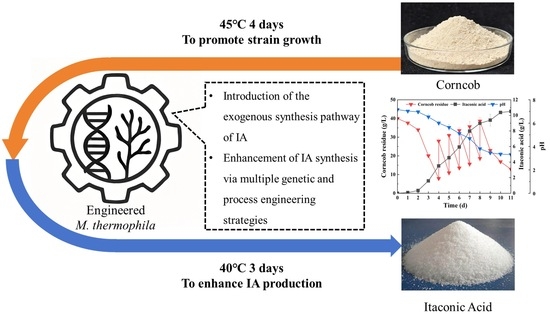
Itaconic acid (IA), one of the top twelve renewable platform chemicals, is a key precursor for polymer synthesis. Here, we engineered Myceliophthora thermophila for efficient consolidated biocatalytic IA production from lignocellulose by introducing the heterologous IA pathway (cis-aconitic acid decarboxylase (CAD), mitochondrial tricarboxylic transporter (MTT), major facilitator superfamily transporter (MFS) from Aspergillus terreus), and boosting CAD expression and precursor supply. A critical issue was temperature mismatch: optimal fungal growth vs. CAD activity. Transcriptomics analysis identified reduced expression of glycolytic rate-limiting enzymes (fructose-bisphosphate aldolase, FBA; phosphofructokinase, PFK) at 40 °C. Overexpressing these enzymes in strain IA32 generated strain IA41 (with 3.1-fold and 2.8-fold higher expression of pfk and fba, respectively), which accelerated glucose consumption by 53.2% and increased IA yield by 55.1% A two-stage temperature-shift strategy (45 °C for growth/saccharification, 40 °C for CAD activity) was developed. The engineered strain achieved 3.93 g/L IA in shake flasks and 10.51 g/L in corncob fed-batch fermentation—the highest reported titer for consolidated lignocellulose-to-IA processes. This establishes M. thermophila as a robust platform for cost-effective IA production from lignocellulose.

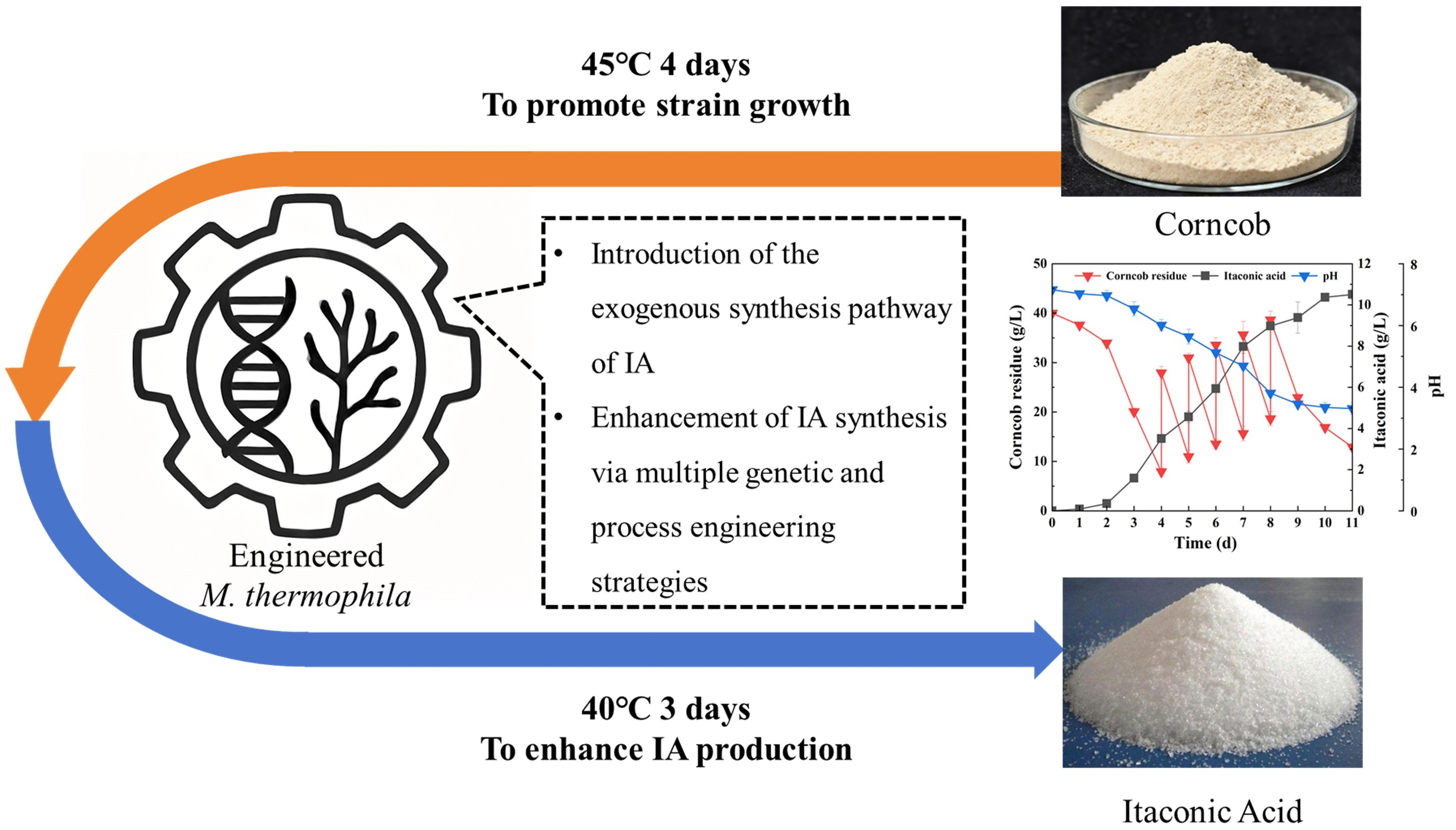
Graphical Abstract

1. Introduction

Global energy demand is growing continuously, and environmental problems are deteriorating increasingly. Thus, it is extremely urgent to develop green and sustainable approaches to replace traditional methods that rely on non-renewable fossil resources [1]. The conversion of renewable biomass to produce high-value chemicals using microbial cell factories is considered a viable approach to solving this problem [2]. Itaconic acid (IA) is one of the 12 most promising platform chemicals. It contains two carboxyl groups and an unsaturated carbon-carbon double bond, making it a precursor of many important compounds. Currently, IA is widely used in producing adhesives, plastics, resins, textiles, and superabsorbent polymers [3,4,5]. It is reported that the global IA market value is predicted to reach $135.6 million by 2028 [6,7].
Currently, the industrial production of IA mainly relies on the fermentation process of Aspergillus terreus [8]. However, the carbon sources for the production of itaconic acid by A. terreus mainly rely on starch-based raw materials, such as glucose, sucrose, and starch, which not only increases the production cost but also poses the problem of competing with humans for food resources. Therefore, the utilization of industrial and agricultural biomass waste as a raw material for itaconic acid production has gradually received attention [9]. Lignocellulose is the most abundant renewable biomass resource, widely present in agricultural and forestry wastes [10]. Bio-converting lignocellulose into high-value biochemicals offers multiple benefits: it reduces air pollution from straw incineration, enables waste resource utilization, and promotes circular economy development [11,12]. In addition, compared with traditional starch-based raw materials, lignocellulose does not require a large amount of cultivated land, avoiding competition with humans for food and land sources. It helps alleviate the pressure on food security and meets the requirements of sustainable development [13]. Therefore, lignocellulose is recognized as a potential sustainable source for green biosynthesis of IA. However, due to the dense structure and complex composition of lignocellulose, the natural IA-producer A. terreus cannot directly utilize lignocellulose, and a pretreatment and hydrolysis process is necessary to degrade it into fermentable sugars for IA production [14]. Traditional pretreatment and saccharification processes are costly and complex. In particular, the addition of expensive cellulase has been considered a major obstacle to the large-scale bioconversion of lignocellulose [15]. The simultaneous saccharification and conversion of lignocellulose for itaconic acid production by microbial cell factories can eliminate the treatment process and reduce production costs, which is thus considered an ideal production process [16,17].
With the development of synthetic biology and metabolic engineering, the IA synthesis pathway in A. terreus has been revealed. Bentley and Thiessen et al. first identified cis-aconitate decarboxylase (CADA) as the critical enzyme in the pathway catalyzing the conversion of cis-aconitate to IA [18]. Jaklitsch et al. discovered that CADA is located in the cytosol, while cis-aconitate must be transported from the mitochondria to the cytosol via mitochondrial tricarboxylic transporter (MTTA) before being catalyzed by CADA [19]. Li et al. also found the major facilitator superfamily transporter (MFSA) played an important role in the transport of IA outside the cells [20]. On this basis, more and more studies focused on the enhancement of IA production in various microbes including A. terreus, Yarrowia lipolytica, Aspergillus niger, Trichoderma reesei [21,22,23,24] and so on. However, most studies focus on glucose-based IA production. For example, Zhao et al. engineered Neurospora crassa to produce IA using corn stover (via cellulase overexpression), but the IA titer was only 871.3 mg/L—far lower than that from glucose [25,26,27]. At present, little research is on the direct conversion of lignocellulose for the synthesis of IA, and more potential hosts as well as engineering strategies need to be developed.
Myceliophthora thermophila is a thermophilic filamentous fungus with a capacity for lignocellulose degradation, due to its genome encoding over 200 hydrolytic and oxidative enzymes involved in lignocellulose degradation [28]. In addition, the thermophilic characteristics of M. thermophila and the thermal stability of its enzyme system ensure the activity of cellulase during cellulose hydrolysis [29]. Therefore, M. thermophila is a potential host for the conversion of lignocellulose, and it has been successfully engineered to produce various biochemicals, including fumaric acid, malonic acid, malic acid, and succinic acid [15,16,30,31].
In this work, we selected M. thermophila as the host for lignocellulose-based IA production. Specifically, we introduced the A. terreus-derived IA synthesis pathway into M. thermophila (Figure 1A) and optimized central carbon flow, thereby efficiently achieving IA synthesis. Meanwhile, temperature was found to be a key factor affecting the growth of M. thermophila cells and the synthesis of IA. Therefore, transcriptome analysis was conducted to analyze the effects of different temperatures on the expression levels of key enzymes and several key metabolic nodes were identified. On this basis, the synthesis of itaconic acid was enhanced through the regulation of the key enzyme expression, and a preferable two-stage variable-temperature fermentation process was established to balance the different temperature requirements of the cell growth and IA synthesis processes, which significantly improved the production efficiency of IA. Our work provided a promising platform and an excellent production process for the simultaneous saccharification and conversion of lignocellulose for the synthesis of IA.

2. Results and Discussion

2.1. Evaluation of the Capacity of M. thermophila for Utilizing Lignocellulose

M. thermophila has been reported as a preferred lignocellulose degradation strain [32]. To evaluate the fundamental characteristics of parent strain M. thermophila ATCC 42464 as a chassis strain for IA biosynthesis from lignocellulose, we first investigated its growth performance using different lignocellulose raw materials as carbon sources, including corncob, Avicel, and corn stover (Supplementary data, Figure S1). The strain exhibited robust biomass accumulation and efficient substrate utilization on all lignocellulose raw materials. Among them, the highest carbon utilization efficiency (93.25%) was observed with corncob as the carbon source, along with cellulase activity at 1.75 U/mL and DCW of 12.4 g/L. When corn stover was used as the carbon source, the highest xylanase activity (3.99 U/mL) was observed, which might be attributed to the higher hemicellulose content in corn stover. These results indicated that M. thermophila had a high capability in degrading both cellulose and hemicellulose.
Moreover, since the degradation of lignocellulose could produce by-products such as furfural, 5-HMF, and phenolics, which might affect the performance of microorganisms [33]. Meanwhile, IA as the main product in our work could also inhibit cell growth [34]. Therefore, the effects of these compounds were also investigated on the growth capacity of M. thermophila ATCC 42464 (Supplementary data, Figure S2A,B). It was observed that M. thermophila ATCC 42464 maintained normal growth in media containing excessive levels of hydrolysate inhibitors (2 g/L furfural, 2 g/L 5-HMF, and 1 g/L mixed phenolics). Moreover, when cultured in media supplemented with calcium carbonate and 30 g/L itaconic acid, the strain exhibited no significant changes in biomass or cellulase activity, indicating its exceptional robustness under complex fermentation environments (Figure S2C). In summary, the efficient lignocellulose degradation and demonstration of robustness in fermentation broth established M. thermophila as an ideal chassis strain for direct IA production from lignocellulose raw material.

2.2. Engineering M. thermophila ATCC 42464 for IA Production

2.2.1. The Introduction of the Exogenous Synthesis Pathway of IA into M. thermophila ATCC 42464

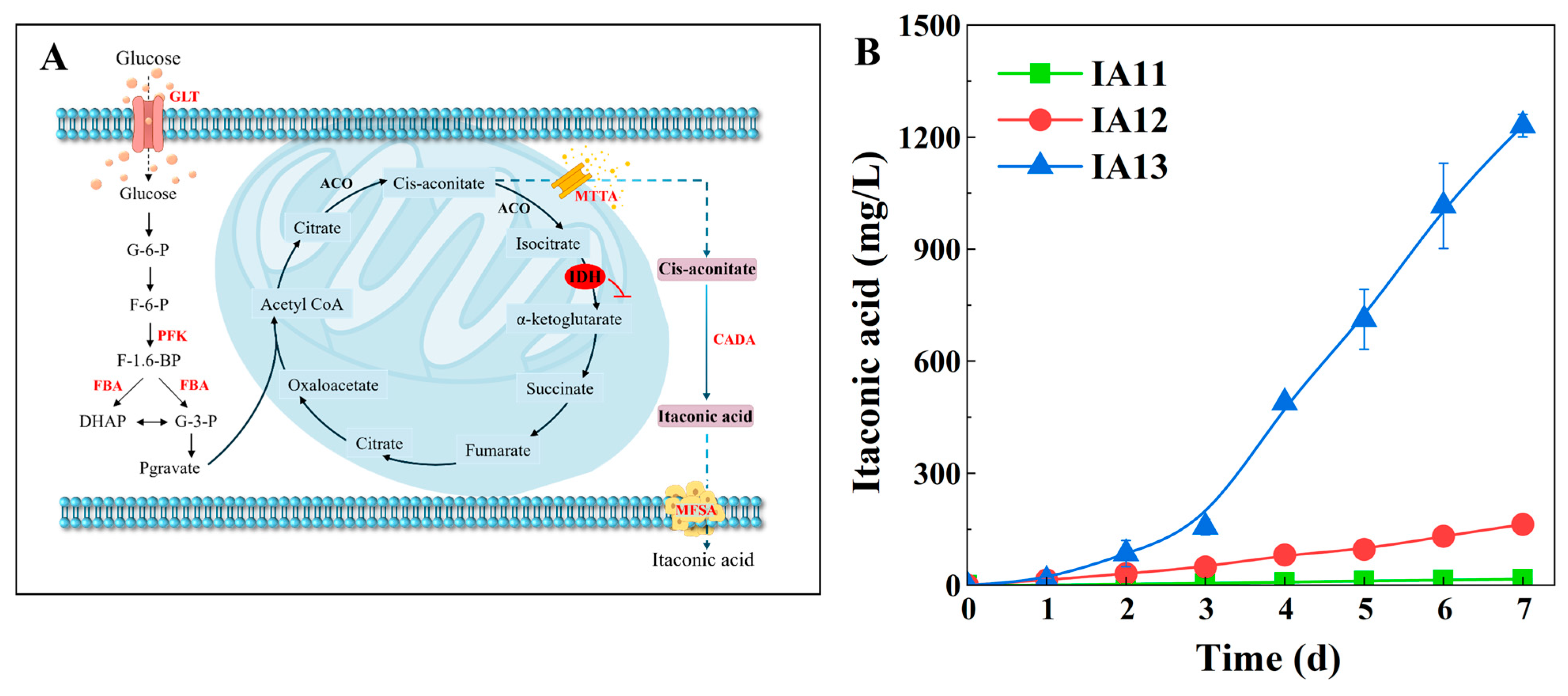
M. thermophila lacks the native capability to synthesize IA, whereas the biosynthetic gene cluster involved in IA production in A. terreus has been identified [23]. CADA catalyzes the conversion of cis-aconitate to itaconic acid, which is a critical enzyme in the IA biosynthetic pathway (Figure 1A) [35]. Meanwhile, the glt-1 gene from N. crassa has been demonstrated to enhance sugar uptake, thereby increasing glycolytic flux and promoting the conversion of carbon source into the target product [16]. Therefore, glt-1 from N. crassa and cadA from A. terreus were co-expressed under the control of the strong endogenous promoter Ptef (MYCTH_2298136), resulting in the IA11 strain, which produced 16 mg/L IA after 7 days cultivation in glucose-based medium (Figure 1B). It was reported that the heterologously expressed CADA was located in the cytoplasm, while the precursor cis-aconitic acid was mainly produced in mitochondria [19]. MTT (mitochondrial tricarboxylic transporter) has been reported to be a protein responsible for organic acid transport in mitochondria [36]. The overexpression of MTT could promote the transportation of cis-aconitic acid from mitochondria to the cytoplasm, thus improving iitaconic acid production [37]. Therefore, the mttA gene from A. terreus was introduced into the IA11 strain, yielding the IA12 with an IA titer increasing to 163 mg/L (Figure 1B), which was approximately 10.2-fold higher than that of IA11. MfsA is a membrane protein localized on the cell membrane [38]. As a member of the Major Facilitator Superfamily (MFS), it typically functions as a transmembrane transporter, mediating the transport of various small molecular substances across the cell membrane [39]. To enhance the transport of IA out of the cells, mfsA was further overexpressed in IA12 to obtain the engineered strain IA13, which led to the titer of IA up to 1231 mg/L in the glucose-based medium (Figure 1B). It was indicated that heterologous expression of cadA, mttA, and mfsA facilitated IA production in the engineered M. thermophila.

2.2.2. Enhancement of CADA Expression to Promote IA Synthesis

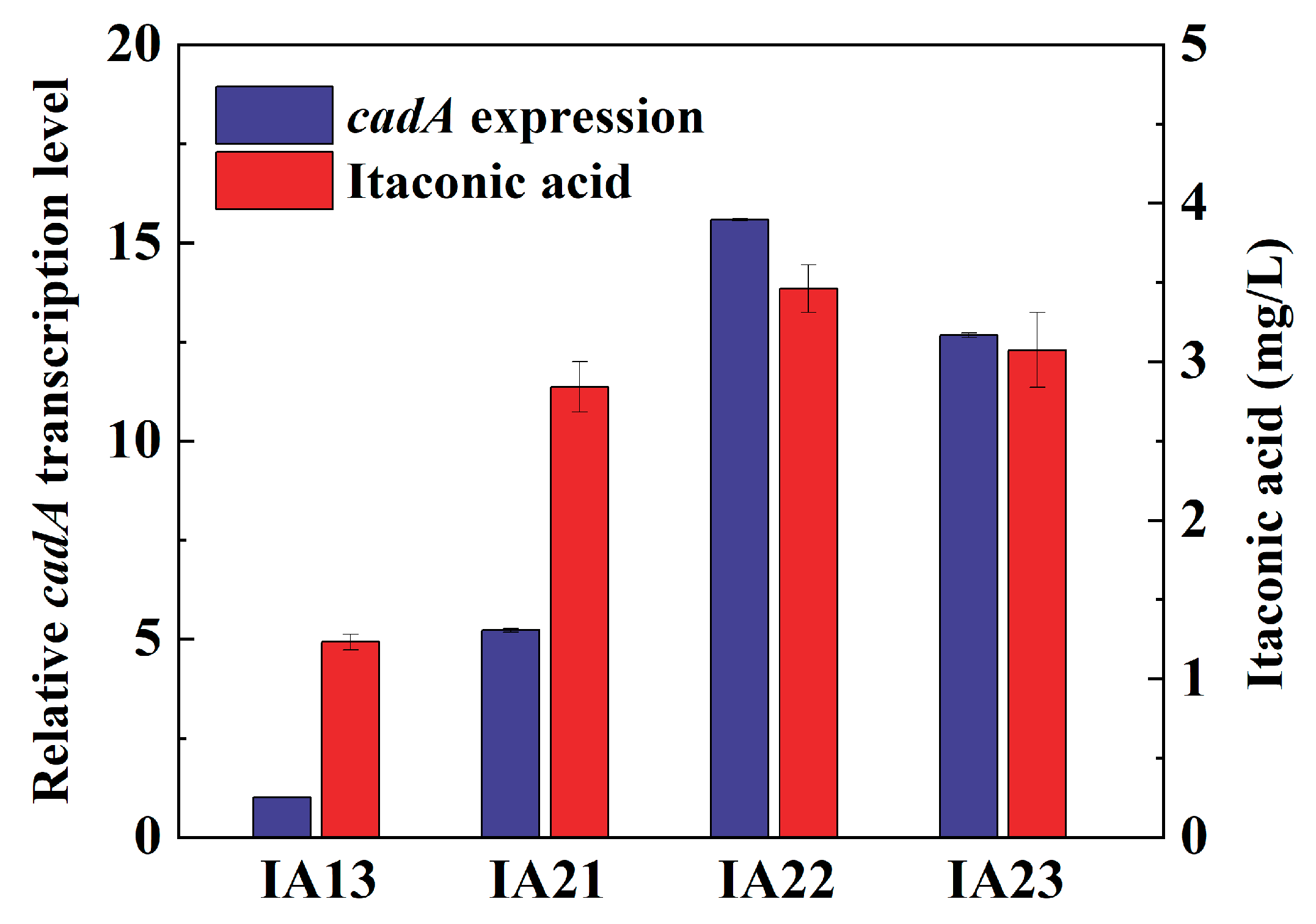
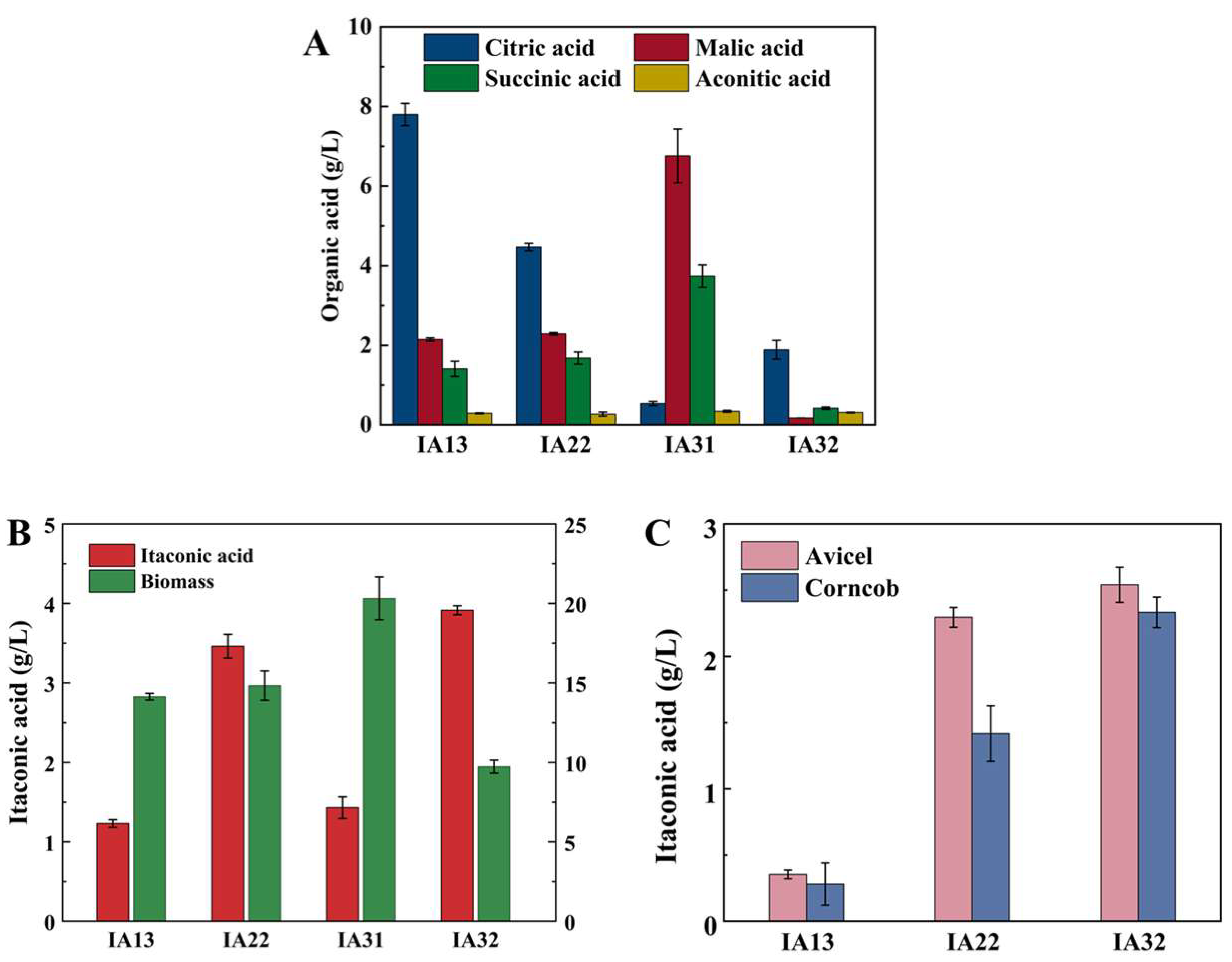
Multiple studies have demonstrated that CADA is essential forIA synthesis [35,40]. Here, we investigated the effect of CADA expression level on itaconic acid accumulation (Supplementary data, Figure S3). It was indicated that the engineered strain M. thermophila IA13-7 showed the highest IA production with the highest cadA expression level. The expression of cadA has a more pronounced effect on IA production, and enhancing cadA expression is therefore considered an effective strategy to improve IA yield. Therefore, different copy numbers of cadA were integrated into the genome of the engineered strain M. thermophila IA13 to explore the effects on the itaconic acid synthesis. It was indicated that the synthesis of IA was promoted with the increase in the copy numbers of cadA. The cadA expression level in the engineered strain M. thermophila IA21 containing two copies of cadA was 5-fold higher than that in M. thermophila IA13, and the IA titer increased to 2.84 g/L in the glucose-based medium (Figure 2), which was about 2.3-fold higher than that of M. thermophila IA13, demonstrating that enhancing cadA expression effectively promotes IA production. Meanwhile, qPCR analysis showed that the expression levels of mttA and mfsA remained unchanged, indicating that the increased copy numbers of cadA did not affect the expression of other key genes involved in IA synthesis (Supplementary data, Figure S4). We further increased the copy numbers of cadA to obtain the engineered strains M. thermophila IA22, carrying three copies of cadA. After being cultivated, it showed that IA22 produced 3.46 g/L IA in the glucose-based medium, which was 2.81-fold higher than that of M. thermophila IA13 (Figure 2). Notably, a dose-dependent trend between cadA copies and IA production emerged: IA titer rose from 1.23 (IA13, 1 copy) to 3.46 g/L (IA22, 3 copies) then decreased at 4 copies (IA23) (Figure 2). In the engineered strain IA13 and IA21, mttA/mfsA expression remained stable (Supplementary Figure S4), ruling out integration-related interference on key IA pathway genes, which demonstrated cadA as the key driver in IA synthesis. On this basis, we further evaluated the ability of strain M. thermophila IA22 to synthesize IA from lignocellulose materials (Figure 3C). When Avicel and corncob were used to replace glucose as carbon sources, M. thermophila IA22 could produce 2.29 g/L and 1.42 g/L IA, respectively. Although this titer was lower than the results in glucose-based medium, it was far higher than the titer of IA synthesized from lignocellulose in previous reports [27].

2.3. Improvement of Precursor Supply to Promote IA Synthesis

Cis-aconitate is both the direct precursor for IA biosynthesis and an intermediate in the isomerization of citrate during the TCA cycle [41]. However, metabolite analysis of M. thermophila IA13 fermentation broth revealed substantial citrate accumulation (7.8 g/L), while cis-aconitate was not detected. Instead, a certain amount of malic acid and succinic acid was observed (Figure 3A). Given that malic acid and succinic acid can be generated not only from the TCA cycle but also from the reductive TCA pathway, we speculated that the limited accumulation of cis-aconitate might be attributed to the weaker TCA cycle activity. Herein, we overexpressed endogenous ACO (aconitase, which catalyzes citrate to cis-aconitate) in the strain M. thermophila IA13 to strengthen the TCA cycle flux and promote the conversion of citrate to the precursor cis-aconitate. However, the production of IA in the aco-overexpressed strain M. thermophila IA31 was not significantly increased, reaching only 1.413 g/L in the glucose-based medium (Figure 3B). Conversely, the biomass significantly increased to 20.72 g/L, which was obviously higher than that of the parent strain IA13 (14.13 g/L) (Figure 3B). Metabolite analysis indicated that the expected accumulation of cis-aconitate did not occur, although citrate production was significantly reduced to 0.53 g/L. Further analysis of other by-products found that the production of malic acid and succinic acid increased to 6.76 g/L and 3.74 g/L in the glucose-based medium, respectively (Figure 3A). The results showed that overexpression of ACO indeed promoted the TCA cycle, but metabolic flux preferentially converted citric acid into isocitric acid for the TCA cycle rather than synthesizing IA through cis-aconate [42,43]. Therefore, overexpression of ACO could not effectively promote IA synthesis in the engineered M. thermophila IA13.
The IA synthesis pathway is the branch from the TCA cycle so as to compete the carbon flux distribution with the TCA cycle. The dehydrogenation of isocitrate to α-ketoglutarate by isocitrate dehydrogenase (IDH) is a key step in the TCA cycle. It has been reported that inhibition of IDH can reduce carbon flux toward the TCA cycle, thereby promoting accumulation of the precursor cis-aconitate [44]. However, the TCA cycle is essential for microbial growth, and complete knockout of IDH would severely hinder cell growth. Therefore, CRISPR-dCas9 was employed to attenuate the expression of IDH in our work to obtain the engineered strain M. thermophila IA32 to explore the effect on IA synthesis [43].
To clarify the impact of IDH repression on cis-aconitate metabolism and IA production, we quantified the key metabolites and IA titer in the strain IA32 and its parental strain IA22 after cultivated for 72 h. As shown in Figure 3A, the titer of cis-aconitate in IA32 reached 0.31 g/L, which was slightly higher than that in IA22 (0.27 g/L) but without significant difference. This result indicated that CRISPR-dCas9-mediated9 IDH repression did not significantly enhance the net accumulation of cis-aconitate. However, a clear shift in metabolic flux distribution was observed: compared with IA22, IA32 exhibited a 23.5% reduction in citrate (from 4.47 g/L to 1.89 g/L) and a significant decrease in TCA cycle downstream by-products (malic acid and succinic acid) (Figure 3A). More importantly, the IA titer of IA32 reached 3.91 g/L, which was 13.9% higher than that of IA22 (Figure 3B). These findings collectively demonstrated that IDH repression redirected the existing cis-aconitate flux toward IA synthesis. Specifically, it reduced the consumption of cis-aconitate by the TCA cycle and promoted its utilization by the heterologously expressed cadA (3 copies of cadA in IA32, Figure 2), rather than simply increased cis-aconitate accumulation. Compared with M. thermophila IA22, the expression level of IDH in M. thermophila IA32 was reduced to 0.33-fold (Figure S5), while the IA titer reached 3.91 g/L in the glucose-based medium which increased by 13.9% (Figure 3B). Meanwhile, the biomass also reduced from 14.83 g/L to 9.74 g/L, indicating that the inhibition of IDH redirected carbon flux towards IA synthesis rather than the TCA cycle and led to the decrease of biomass accumulation. Metabolite analysis of M. thermophila IA32 fermentation broth revealed that the concentrations of citric acid, malic acid, and succinic acid significantly decreased to 1.89 g/L, 0.17 g/L, and 0.42 g/L, respectively, while a small amount of cis-aconitate (0.31 g/L) was also detected (Figure 3A). The results demonstrated that the suppression of IDH effectively redirected the metabolic flux of isocitrate away from the TCA cycle, thereby promoting IA synthesis.
The specific impact of IDH downregulation on the TCA-IA flux distribution was verified by metabolite profiling: compared with IA22, IA32 showed a 13.9% increase in IA titer (3.46 to 3.91 g/L) and a significant decrease in TCA cycle downstream metabolites (malic acid: 0.29 to 0.17 g/L; succinic acid: 0.68 to 0.42 g/L, Figure 3A), while the expression of ACO remained unchanged (Supplementary Figure S5). This result indicates that the reduced IDH expression specifically diverted cis-aconitate flux from the TCA cycle (via IDH) to the IA pathway (via CADA), rather than causing non-specific disruption of central metabolism. The consistency between IDH expression levels (0.33-fold vs. IA22, Supplementary Figure S5) and the magnitude of metabolic flux shift further supports that IDH downregulation is the direct cause of improved IA production. The overexpression of ACO failed to enhance IA synthesis, while IDH downregulation redirected carbon flux toward IA, which unveiled the distinct flux competition between the native TCA cycle and heterologous IA pathway in M. thermophila, with flux inherently favoring the IDH-mediated TCA cycle. This preference stems from two core mechanisms. Firstly, the evolutionarily conserved TCA cycle is prioritized for carbon allocation under glucose-replete conditions to meet cellular energetic and biosynthetic demands, a universal microbial metabolic trait [45,46]. Secondly, native IDH has far greater catalytic competitiveness for cis-aconitate than heterologous CADA because IDH is a constitutively expressed, high-affinity TCA enzyme [44], while CADA relies on an exogenous promoter and MttA-mediated cis-aconitate transport, which are limitations in heterologous systems [20,37]. Thus, even with aco boosting cis-aconitate, most carbon flux is channeled to the TCA cycle via IDH. Notably, CRISPR/dCas9-mediated IDH downregulation reversed this bias—a strategy validated in fungal metabolic engineering, which led to the TCA byproducts decreased, diverting carbon flux to IA synethsis (3.43 to 3.91 g/L) [35]. This highlights a key insight: attenuating native pathway rate-limiting enzymes is more effective for flux redirection than solely enhancing precursor supply [16,32].
On this basis, the capability of directly converting lignocellulose to itaconic acid was also evaluated using 80 g/L Avicel and corncob as the carbon sources by the engineered strain M. thermophila IA32. After being cultivated for 168 h, IA titers reached 2.54 g/L and 2.35 g/L using Avicel and corncob as carbon sources, respectively (Figure 3C), which were 1.1 and 1.65-fold higher than that of M. thermophila IA22, respectively. It demonstrated that the engineered strain M. thermophila IA32 could effectively simultaneously assimilate and transform lignocellulose raw materials for IA production.

2.4. Understanding the Mechanism of Temperature Regulation on IA Synthesis in M. thermophila

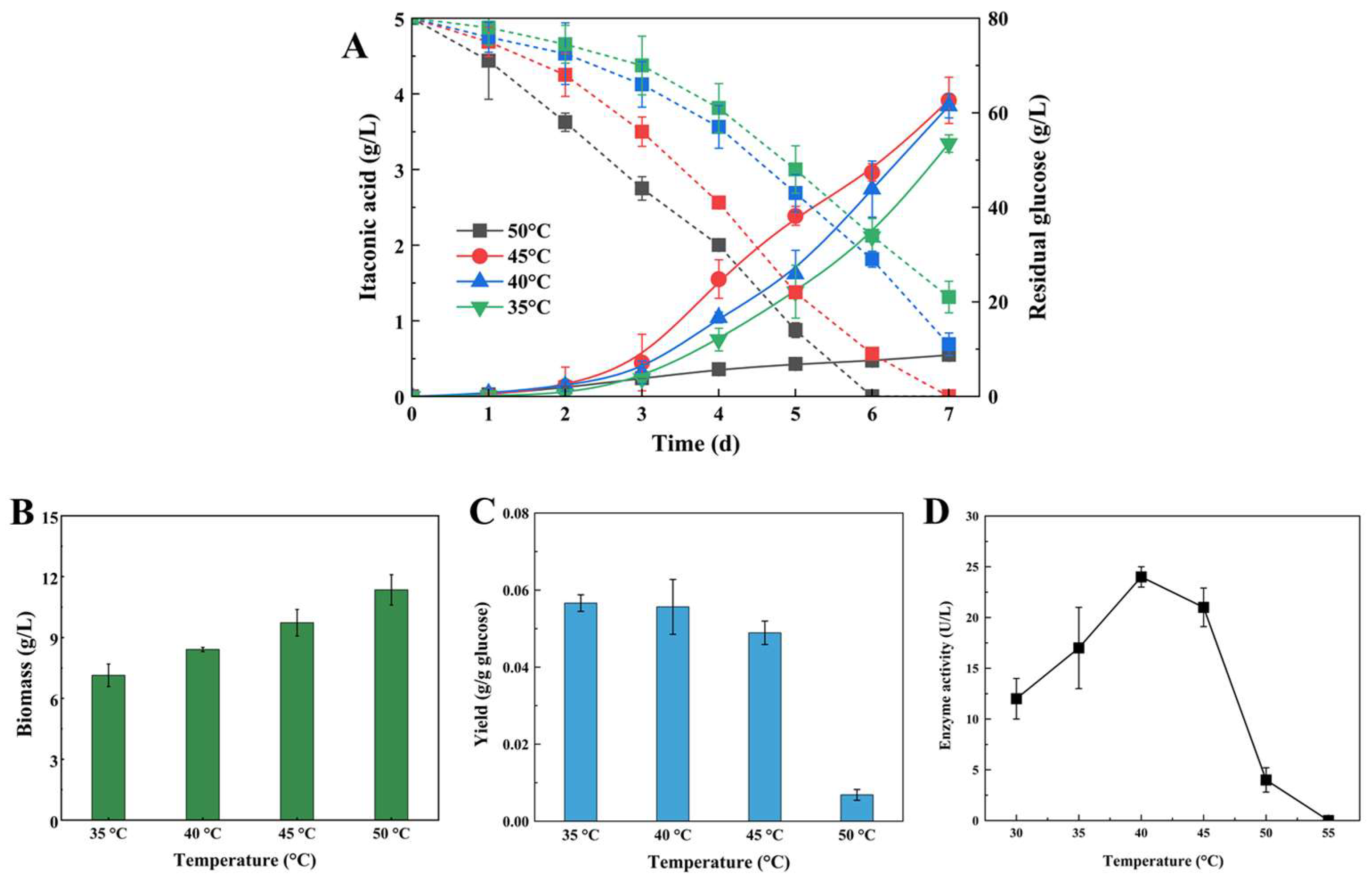
As a thermophilic microorganism, M. thermophila grows optimally at 40–55 °C [32]. However, it has been reported that CADA tends to become inactive above 40 °C [47]. This creates a potential conflict between the optimal temperature for microbial growth and that for IA production in the engineered M. thermophila. To verify the hypothesis, the engineered strain M. thermophila IA32 was cultured under different temperature conditions to observe the effects on cell growth and IA synthesis. The results showed that at 45 °C, carbon consumption and biomass accumulation were relatively rapid, but IA yield was low (48.9 mg/g). In contrast, at 40 °C, the highest IA yield was observed (55 mg/g), whereas carbon utilization and growth were slower. At 50 °C, although both carbon consumption and growth were the fastest, IA yield was the lowest (Figure 4). Meanwhile, the enzyme activity and thermostability of CADA were also explored under different temperatures. Our results showed that the enzyme activity of CADA was highest at 40 °C. Additionally, CADA exhibited better stability at temperatures below 40 °C with rapid inactivation occurring above this temperature, which indicated that 40 °C was the optimal temperature for CADA catalysis (Figure 4D and Supplementary data, Figure S6).
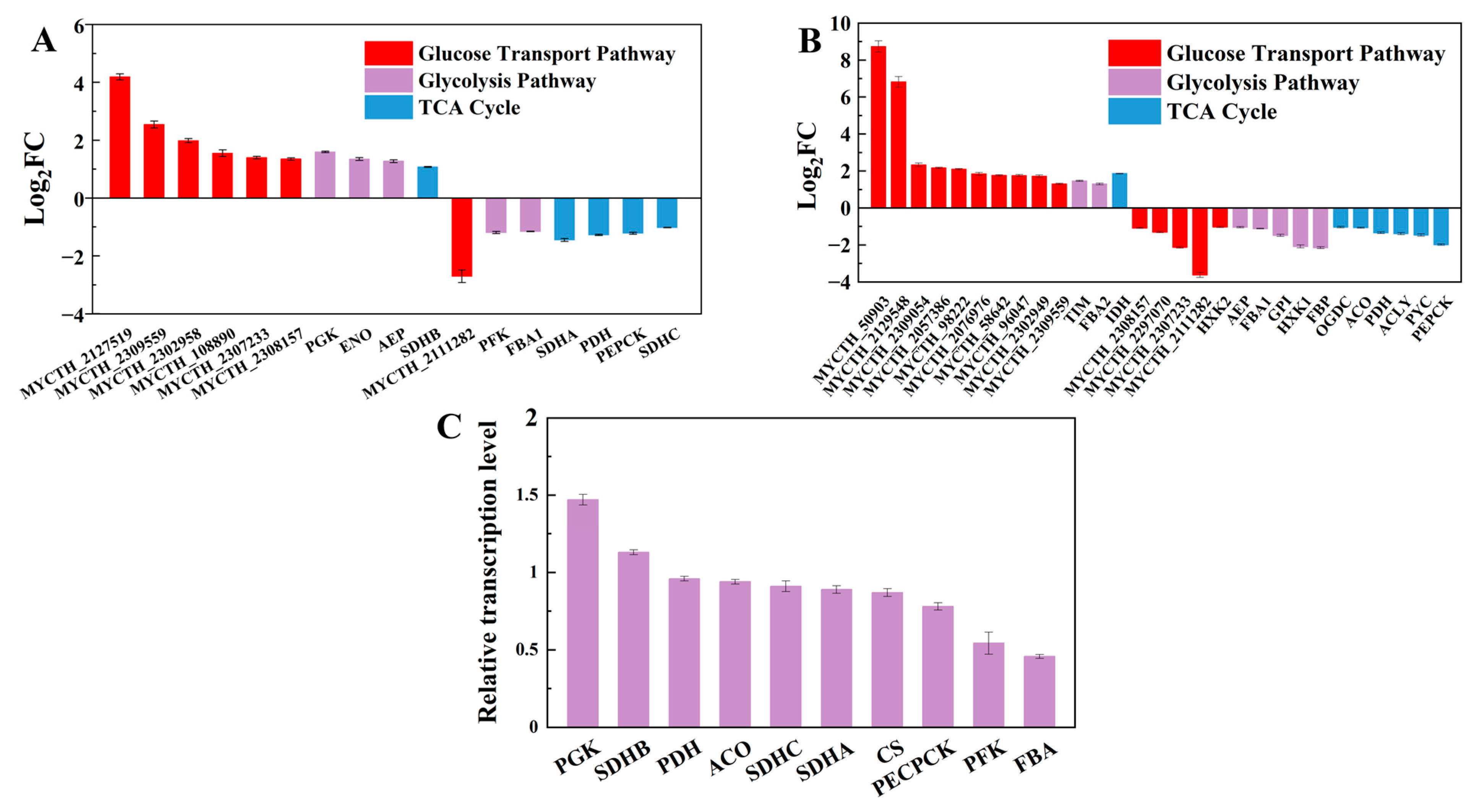
Collectively, 40 °C was more favorable for IA synthesis, whereas 45 °C was optimal for strain growth. The difference in temperature requirements between cell growth and IA product synthesis affected the efficiency of engineered M. thermophila in synthesizing IA. Therefore, to further understand the impact of temperature on cellular metabolism, transcriptomic analysis was performed on M. thermophila cells cultured at 35 °C, 45 °C, and 55 °C in glucose-based medium to explore the key metabolic nodes. It was shown that 1517 genes were significantly upregulated with 1135 genes downregulated when the temperature was decreased from 45 °C to 35 °C, while 1497 genes were significantly upregulated with 1531 genes downregulated when the temperature was increased from 45 °C to 55 °C (Supplementary data, Figure S7A,B). KEGG pathway enrichment analysis indicated that the differentially expressed genes (DEGs) were primarily associated with carbon metabolism, amino acid metabolism, and biosynthesis of secondary metabolism (Supplementary data, Figure S7C,D). In particular, the influence of carbon metabolic pathways on the allocation efficiency of central carbon flux was considered a key factor affecting IA synthesis by the engineered M. thermophila. We further mapped DEGs to three core modules of carbon metabolism: glucose transport, glycolysis, and TCA cycle (Figure 5A,B). For the glycolysis module (the primary route for carbon flux toward IA precursor synthesis), 12 DEGs were identified with rate-limiting enzymes phosphofructokinase (PFK) and fructose-bisphosphate aldolase (FBA), which showed the most pronounced temperature dependence: their expression levels peaked at 45 °C, and decreased significantly at temperatures above (50 °C) or below (35 °C/40 °C) this optimum. Quantitative PCR (qPCR) validation confirmed this trend that compared with 45 °C, the relative expression levels of pfk and fba at 40 °C were reduced to 32.7% and 35.1%, respectively (Figure 5C). It consisted of the transcriptomic data and confirmed that PFK/FBA were temperature-sensitive key nodes in glycolysis. Notably, PFK has been widely recognized as a rate-limiting enzyme in glycolysis, and its expression level directly determines the overall glycolytic flux efficiency [48]. Similarly, FBA-mediated fructose-bisphosphate cleavage is also a critical step for maintaining carbon flow toward downstream metabolite synthesis [49]. The downregulation of PFK/FBA directly translated to altered carbon metabolic phenotypes. At 40 °C (the optimal temperature for CADA catalytic activity, Figure 4D), the reduced expression of PFK/FBA led to a 53.2% decrease in glucose consumption rate (from 0.80 g/L h at 45 °C to 0.62 g/L h at 40 °C, Figure 6E), indicating impaired glycolytic flux. Consequently, even though CADA activity was maximized at 40 °C, the limited carbon supply restricted IA synthesis efficiency and resulted in an IA yield of 55.0 mg/g glucose at 40 °C, which was only marginally higher than that at 45 °C (48.9 mg/g glucose, Figure 4C). These results collectively established a clear regulatory chain that temperature changes modulate the expression of glycolytic rate-limiting enzymes (PFK/FBA), and then altered the glycolytic carbon flux efficiency which ultimately affected the supply of precursors for IA synthesis. The insight explained the earlier observation of “temperature mismatch” between cell growth and IA synthesis, and provided a target for subsequent metabolic engineering to balance carbon flux and CADA activity.
To validate the results above, qPCR was performed to assess the expression of temperature-regulated genes (Figure 5C). The results showed that the changing trends of differentially expressed genes in qPCR analysis were consistent with that in transcriptome analysis, which further demonstrated that they were key nodes in the carbon metabolic pathways affected by temperature and provided potential targets for subsequent metabolic engineering modifications.

2.5. Development of a Two-Stage Temperature Control Strategy to Promote the Synthesis of IA

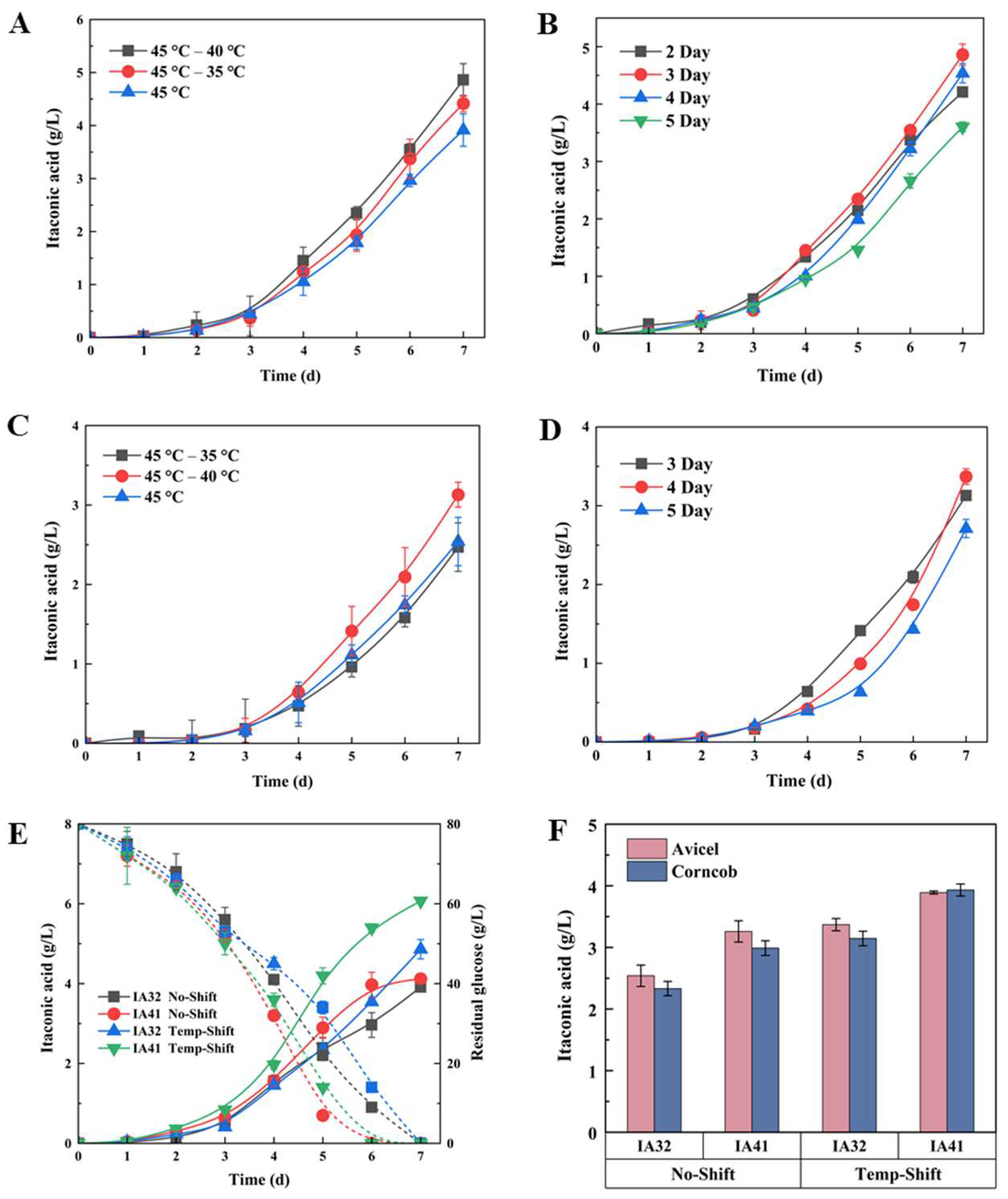
According to the results above, temperature played an important role in the production of IA by M. thermophila [50]. However, the incompatibility between optimal temperatures for microbial growth and the key enzyme CADA had a negative impact on IA synthesis. To resolve the issue, we proposed to divide the fermentation process into two stages, namely cell growth stage and IA synthesis stage. And a two-stage temperature control strategy was developed to promote the synthesis of IA by the engineered M. thermophila IA32, in which the temperature was controlled at 45 °C in the first stage for cell growth, while it was controlled at 40 °C in the second stage for IA synthesis. It was shown that shifting the cultivation temperature to 40 °C at 72 h favored IA accumulation by the engineered M. thermophila IA32, resulting in a titer of 4.86 g/L in glucose-based medium, which was 24% higher than that under a constant-temperature fermentation process (Figure 6A,B). Subsequently, the two-stage temperature control strategy was further optimized using Avicel as the carbon source. It was found that controlling the cultivation temperature to 40 °C at 96 h resulted in the highest IA titer of 3.38 g/L, representing a 33.10% improvement compared to that under a constant-temperature fermentation process (Figure 6C,D). It demonstrated that the two-stage temperature control strategy indeed had a significant promoting effect on IA synthesis in M. thermophila IA32 using both glucose and lignocellulose materials as the carbon sources.
Based on understanding the mechanism of temperature regulation on IA synthesis in M. thermophila, it was found that lowering the temperature led to a decrease in the expression levels of key enzymes in the carbon metabolic pathway, especially enzymes PFK and FBA, which have been reported as rate-limiting enzymes in the glycolytic pathway. When the temperature decreased from 45 °C to 40 °C, their expression levels declined significantly (Figure 5C), which would severely reduce the flux of carbon flow and inhibit IA synthesis.
To address the issue, we amplified endogenous pfk and fba from the genome of M. thermophila and constructed overexpression cassettes for PFK and FBA, which were randomly integrated into M. thermophila IA32 to generate strain IA41. The qPCR analysis showed that the expression levels of pfk and fba in IA41 were 3.1-fold and 2.8-fold higher than those in IA32, respectively (Figure S8). To confirm that the improved IA production in IA41 was specifically driven by pfk/fba overexpression, we analyzed the correlation between gene expression and phenotypic changes. It was indicated that the 3.1/2.8-fold upregulation of pfk/fba in IA41 (Supplementary Figure S8) was accompanied by a 53.2% increase in glucose consumption rate (from 0.62 to 0.95 g/L h and a 55.24% increase in IA titer (from 3.91 to 6.07 g/L, Figure 6E). Notably, other key genes in the IA pathway including cadA, mttA, and mfsA showed no significant expression changes between IA32 and IA41 (Supplementary Figure S8). The overexpression of fba and pfk significantly improved glucose utilization efficiency and the carbon source was completely depleted by the engineered strain M. thermophila IA41 at 144 h, whereas the parental strain M. thermophila IA32 required 168 h to fully consume the glucose (Figure 6C). Specifically, IA41 exhibited a glucose consumption rate of 0.95 g/L h, 53.2% higher than IA32’s 0.62 g/L h. And it depleted the initial 80 g/L glucose at 144 h, compared to 168 h for IA32 (Figure 6E). Meanwhile, the yield of IA from glucose in IA41 increased from 0.049 g/g (IA32) to 0.076 g/g. These results confirmed that PFK/FBA overexpression enhanced glycolytic carbon flux. The accelerated glucose utilization indicated faster glycolytic activity, and the higher IA yield demonstrated that the increased flux was preferentially redirected to IA synthesis rather than other metabolic branches. When combined with the two-stage temperature control strategy, the engineered strain M. thermophila IA41 showed a significant improvement in IA production: the IA titer from glucose reached 6.07 g/L, which was a 55.24% increase compared to that of M. thermophila IA32 (Figure 6E). The IA production capacity was also evaluated using lignocellulose materials as the carbon source by the strain M. thermophila IA41. The IA titer was also increased by 53.15% and 68.67% compared with that of M. thermophila IA32, reaching 3.89 g/L and 3.93 g/L using Avicel and corncob as carbon sources, respectively (Figure 6F). These results indicated that the combination of the enhancement of the key enzymes expression with the application of the two-stage temperature control strategy facilitated the metabolic flux toward the IA synthetic pathway and ultimately improved IA production.
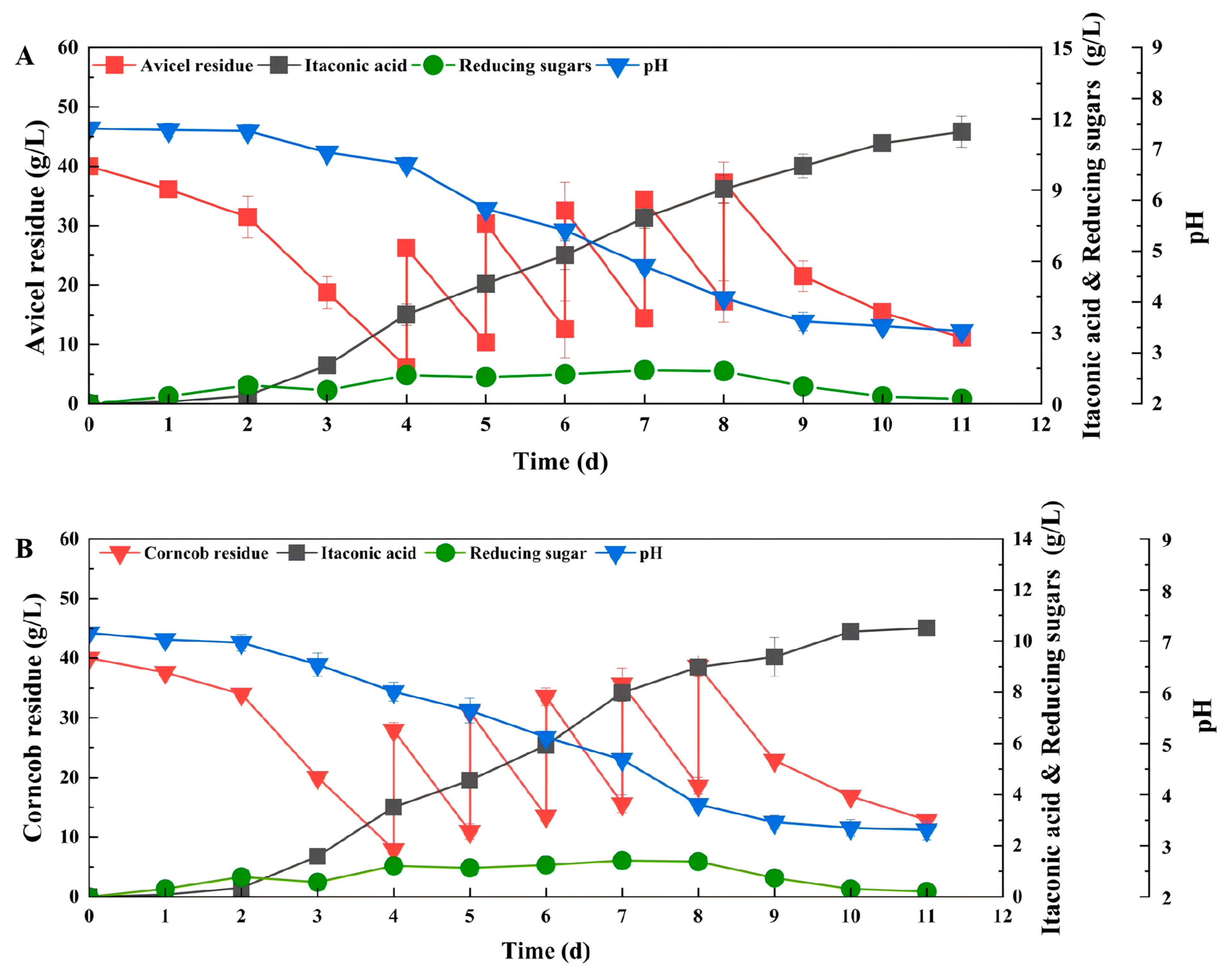
To further improve the simultaneous saccharification and conversion of lignocellulose materials to produce IA, a fed-batch fermentation was conducted by the engineered strain M. thermophila IA41 in a 5 L bioreactor using Avicel and corncob as carbon sources. The titer of IA reached 11.46 g/L and 10.51 g/L with the fed-batch fermentation strategy (Figure 7A,B). It demonstrated that IA was efficiently produced by the engineered strain M. thermophila IA41 in a 5-L bioreactor. As far as we know, this was the highest titer of IA directly produced from lignocellulose by microbial fermentation. It laid the foundation for constructing an M. thermophila platform for the simultaneous saccharification and conversion of lignocellulose materials to synthesize itaconic acid and other high-value chemicals.
To further improve the simultaneous saccharification and conversion of lignocellulose for IA production, fed-batch fermentation with M. thermophila IA41 was conducted in a 5-L bioreactor (Avicel and corncob as substrates), achieving IA titers of 11.46 g/L and 10.51 g/L, respectively (Figure 7A,B). When corncob was used as the substate, the two-stage temperature-shift strategy was applied that the temperature was controlled at 45 °C 0–3 days for cell growth with a daily corncob consumption of 8.3 g/L d (from initial 80 g/L) and a low reducing sugar release. During 3–7 days, the temperature was shifted to 40 °C for IA synthesis and the titer rapidly increased to 10.51 g/L (contributing 92% of final yield) with corncob consumption accelerating to 17.5 g/L d and sugars maintained < 1.5 g/L, which reflected synchronized lignocellulose saccharification and IA accumulation driven by optimal CADA activity. After 7 days, the titer of IA stabilized at 10.6 g/L and the corncob consumption slowed to 1.3 g/L d. Compositional analysis of residual corncob showed that the content of cellulose (11.57%), hemicellulose (31.47%), and lignin (70.07%) exhibited significant changes compared to the fresh corncob (40.41% cellulose, 41.79% hemicellulose, 15.38% lignin), which demonstrated the effective degradation of fermentable cellulose and hemicellulose by the engineered M. thermophila. The average volumetric productivity of IA was 1.17 g/L d with 1.93 g/L d in the 40 °C synthesis stage, which consistented with the results observed in shake-flask cultures and verified the robustness of the process under bioreactor conditions.
Notably, the residual reducing sugar remained < 1.5 g/L throughout fermentation (Figure 7B), indicating the saccharification-derived sugar release was nearly balanced with microbial consumption. This carbon limitation exacerbated the TCA cycle-IA flux competition. M. thermophila prioritizes the TCA cycle over IA synthesis under carbon scarcity. It aligned with previous findings in engineered N. crassa that the slow saccharification limited IA synthesis to 0.87 g/L in corn stover CBP process [25]. The optimization of cellulase expression boosted sugar release by 42% and IA yield by 38% [27]. These cross-host results confirmed saccharification was a universal CBP bottleneck and our higher IA titer (10.51 g/L) benefited from M. thermophila’s native lignocellulolytic capacity [28], but persistent low sugars still identified saccharification as a rate-limiting step, and restricted carbon flux to IA synthesis, which needed to further optimized.
Therefore, future work needs to focus on three key issues. Firstly, it is necessary to improve the activity and yield of cellulolytic enzymes in M. thermophila to further enhance lignocellulose saccharification efficiency. This will alleviate the flux competition between the carbon limitation-driven tricarboxylic acid (TCA) cycle and IA synthesis pathway, thereby ultimately increasing IA production. Secondly, the pH tolerance of M. thermophila should be enhance. IA synthesis leads to a decrease in medium pH, which may be a crucial factor affecting product synthesis efficiency. Therefore, establishing effective pH regulation strategies, screening M. thermophila mutant with higher pH tolerance via laboratory adaptive evolution or developing efficient in-situ product separation technologies can further promote product synthesis. Finally, given the complexity of the fermentation process of filamentous fungi in bioreactors, it is necessary to solve the mass transfer problem in filamentous fungal fermentation and reduce energy consumption by optimizing parameters such as stirring speed and aeration rate. The solution to these issues will provide important support for the efficient conversion of lignocellulosic raw materials by M. thermophila.

3. Materials and Methods

3.1. Strains and Culture Conditions

The parent strain M. thermophila ATCC 42464 (provided by Tianjin Institute of Industrial Biotechnology) and engineered strains were cultivated on PDA agar slant medium (Solarbio, P8931; composition: 6.0 g/L potato extract, 20.0 g/L dextrose, 20.0 g/L agar), followed by incubation at 45 °C for 8 days. Spores were collected from 8-day cultures grown on PDA slants. The spores were washed with sterilized water and then transferred to a shaking flask containing glass beads. After being shaken at 200 rpm for 40 min, the spore suspension was filtered using sterile lens paper to obtain the spore inoculum. A microscope equipped with a hemacytometer was used to count the number of spores and the spore inoculum containing 105–106 per mL was prepared. 1 mL spore inoculum was inoculated into 50 mL Vogel’s minimal medium (Table S1) in a 250 mL flask. The medium was supplemented with 20 g/L glucose, 5 mL/L trace element solution, 2.5 mL/L biotin solution, and 2 mL/L chloroform. The culture was incubated at 200 rpm and 45 °C for 36 h to obtain mycelial pellets. And then 10% (v/v) of the seed medium containing M. thermophila mycelial pellets was transferred to a 250 mL flask containing 50 mL of fermentation medium (composed of glucose 80.0 g/L, 8 g/L peptone, 0.15 g/L K2HPO4, 0.15 g/L KH2PO4, 0.1 g/L MgSO4·7H2O, 0.1 g/L CaCl2, 10 g/L NaHCO3, 20 mL/L biotin (5 g/L), and 20 mL/L of Vogel’s salts) and was cultivated at 200 rpm and 45 °C for 168 h. Moreover, glucose in the fermentation medium was replaced with Avicel or corncob as the carbon source to evaluate the ability of the engineered M. thermophila to synthesize itaconic acid using lignocellulose raw materials. The Avicel was purchased from Sigma-Aldrich (Saint Louis, MO, USA), with a cellulose content of ≥98% and no hemicellulose or lignin. The corncob was purchased from Yihai Kerry Co., Ltd. (Lianyungang, Jiangsu Province, China) with a compositional profile of 40.41% cellulose, 41.79% hemicellulose, and 15.38% lignin. It was crushed and sieved to 100 mesh for the preparation of medium. E. coli JM109 was employed for the construction and amplification of plasmids, which were cultivated in LB medium (composed of 10 g/L tryptone, 5 g/L yeast extract, 5 g/L NaCl) supplemented with 0.1% ampicillin at 200 rpm and 37 °C for 12 h.

3.2. Plasmid and Strain Construction

To facilitate subsequent genetic construction, the pAN52-1N plasmid was modified by introducing multiple restriction sites (SnaBI, AflII, AvrII, XhoI, EcoRV, BamHI, NheI, NotI, BsiWI). Additionally, to enhance heterologous gene expression, the original gpdA promoter was replaced with the strong endogenous promoter Ptef (MYCTH_2298136), generating the modified plasmid pAN52-Ptef. The marker gene hph synthesized by Genewiz was ligated into pAN52-Ptef plasmid at the XbaI and Hind III sites to obtain the plasmid pAN52-Ptef-hph. Some other marker genes were used in our work, including zeo, neo, bar, which were also synthesized by Genewiz (Suzhou, Jiangsu Province, China) and used to replace the hph cassette in plasmid pAN52-Ptef-hph to get plasmids pAN52-Ptef-zeo, pAN52-Ptef-neo, and pAN52-Ptef-bar. The cadA, mttA, and mfsA genes were synthesized by Genewiz, while the aco, pfk and fba genes were amplified from the genome of M. thermophila ATCC 42464, which were inserted into the plasmids using the restriction sites above. All the primers used in this work are listed in Supplementary data (Table S1). All constructed plasmids were linearized and then integrated into the genome of M. thermophila ATCC 42464 to obtain engineered strains with different genetic types. The plasmids and engineered strains constructed in this work are listed in Supplementary data (Table S2).

3.3. Downregulation of IDH Using the CRISPR/dCas9 System

In order to downregulate the expression of IDH, the CRISPR/dCas9 system was applied in our work. The specific target sites in the idh sequence were identified using CRISPR RGEN Tools (http://www.rgenome.net/), and the corresponding gRNA(idh) sequence was designed. The U6 promoter was amplified from M. thermophila genome and was assembled with gRNA(idh) synthesized by Genewiz to obtain the fragment U6-gRNA(idh). Furthermore, the Ptef-dCas9 fragment saved in our lab was assembled with the fragment U6-gRNA(idh), which was inserted into the backbone plasmid pAN52-Ptef-neo via Gibson Assembly to generate plasmid pAN52-Ptef-neo-Ptef-dCas9-U6-gRNA(idh). Finally, the linearized plasmid was transformed into the host to obtain the engineered M. thermophila with the IDH down-regulated.

3.4. Transformation of Myceliophthora Protoplasts

Protoplast transformation of M. thermophila was performed following the method described by Yang et al. [51]. Briefly, 20 μg of linearized plasmid DNA was introduced into M. thermophila protoplasts with a PEG-mediated transformation method. Transformants were selected on agar plates containing the antibiotic according to the selection marker. Positive transformants were subsequently verified by colony PCR.

3.5. Fed-Batch Fermentation

Fed-batch fermentation was carried out in a 5-L bioreactor (Bailun BioTechnology Co., Ltd., Shanghai, China) containing 3 L of fermentation medium. 10% (v/v) seed broth was inoculated into the bioreactor. The agitation speed was set at 200 rpm, and the inlet air flow was maintained at 3 vvm. According to the temperature-shift strategy, the first stage was performed at 45 °C for 3–4 days, followed by a second stage at 40 °C until the end of fermentation.

3.6. Analysis Methods

3.6.1. Assay of Enzyme Activity

Cellulase and xylanase activities were determined using the 3,5-dinitrosalicylic acid (DNS) kit (purchased from Solarbio, Beijing, China). Fermentation supernatants of M. thermophila were reacted with filter paper or xylan at pH 4.8 and 50 °C for a defined period. The concentration of reducing sugars produced in the reaction was determined by measuring the absorbance at 540 nm using the DNS method. One unit of cellulase activity was defined as the amount of enzyme releasing 1 μmol of glucose per minute, and one unit of xylanase activity as that releasing 1 μmol of xylose per minute.
CADA activity was determined according to the methods described by Gu and Bentley [18,30]. Mycelia from 50 mL cultures were filtered, washed, frozen in liquid nitrogen, ground, and stored at −80 °C. 100 mg mycelial powder was suspended in 1 mL PBS (pH 7.4) and centrifuged at 4 °C for 10 min. The supernatant was collected as the crude enzyme for subsequent assays. The reaction mixture contained 0.1 mL crude extract, 0.4 mL cis-aconitic acid (8.0 mM), and 2.5 mL 0.2 M sodium phosphate buffer (pH 6.2), incubated at various temperatures for 10 min. The reaction was stopped with 0.1 mL 12 M HCl, and itaconic acid was quantified by HPLC using a Bio-Rad Aminex HPX-87H column (Bio-Rad Laboratories, Inc., Hercules, CA, USA) (300 × 7.8 mm) at 55 °C with 5 mM H2SO4 as mobile phase.

3.6.2. Transcriptome and Quantitative PCR (qPCR) Analysis

M. thermophila cells were collected after 72 h cultivation in fermentation medium, which was then immediately frozen in liquid nitrogen, and stored at −80 °C. The mRNA extraction, cDNA library construction, and transcriptome sequencing were completed using Novogene (Novogene, Beijing, China). The Gene Ontology database (GO, http://geneontology.org/) classified the differentially expressed genes and the Kyoto Encyclopedia of Genes and Genomes (KEGG, http://www.genome.jp/kegg/ (accessed on 10 October 2025)) classified differentially expressed genes to pathways.
To determine the expression levels of target genes, total RNA of M. thermophila was extracted using the E.Z.N.A.® Fungal RNA Kit (OMEGA, Norcross, GA, USA). cDNA was synthesized from the total RNA using the HiScript® II 1st Strand cDNA Synthesis Kit (Vazyme, Nanjing, Jiangsu Province, China). The qPCR analysis was performed using NovoStart® SYBR qPCR SuperMix Plus Kit (Novoprotein, Shanghai, China) with β-actin serving as the housekeeping gene. The expression levels of the key genes were detected by the qPCR instrument RealPlex2 (Eppendorf, Hamburg, Germany) and the relative expression levels were calculated using the ΔΔCt method. The primer sequences for qPCR analysis are listed in Supplementary data (Table S3).

3.6.3. Analysis of Carbon Sources Consumption, Metabolites and Dry Cell Weight

To determine extracellular metabolites, fermentation supernatants were centrifuged and filtered through a 0.22 μm membrane to obtain samples for metabolite analysis. For intracellular metabolites, mycelia were collected by qualitative filter paper, washed three times with deionized water, and ground in liquid nitrogen. The resulting powder was suspended in deionized water and thoroughly mixed, and then centrifuged to obtain the supernatant for metabolite analysis.
Organic acids, sugars, and ethanol were analyzed by high-performance liquid chromatography (HPLC) using a Shimadzu LC-20 system. Organic acids were detected with a UV detector (SPD-20A, Shimadzu, Kyoto, Japan), while sugars and ethanol were quantified with a refractive index detector (RID-20A, Shimadzu, Kyoto, Japan). Separation was performed on a Bio-Rad Aminex HPX-87H column (300 × 7.8 mm) at 55 °C, with 5 mM H2SO4 as the mobile phase at a flow rate of 0.6 mL/min.
Reducing sugars was determined using the 3,5-dinitrosalicylic acid (DNS) method. Briefly, appropriately diluted sample was mixed with DNS reagent (Solarbio) and heated in a boiling water bath for 5 min, then immediately cooled to room temperature in an ice bath. 8 mL distilled water was added to dilute the mixture, and the absorbance was measured at 540 nm using a spectrophotometer (Shimadzu UV-2600, Kyoto, Japan). A standard curve was generated using glucose solutions (0–10 g/L) to quantify the reducing sugar content, and all measurements were performed in triplicate.
When glucose was used as the carbon source, the M. thermophila cells were rinsed with deionized water and dried to a constant weight to determine the dry cell weight (DCW). When Avicel or corncob was used as the carbon source, the fermentation broth was centrifuged to remove the supernatant. The mycelia were washed with deionized water and dried to a constant weight to obtain the total weight (W1). The mycelia were then treated with an acetic acid-water-nitric acid solution (volume ratio 8:2:1) and boiled for 1 h. The remaining insoluble material (residual Avicel/corncob) was washed three times with deionized water and dried to a constant weight (W2). The residual Avicel/corncob content was calculated as W2, and the mycelium dry weight was calculated by subtracting W2 from W1.

3.6.4. Determination of Lignocellulosic Composition

The compositional analysis of corncob and residual corncob (cellulose, hemicellulose, and lignin contents) was performed following National Renewable Energy Laboratory (NREL) methods [52]. Briefly, treat dry corncob or residual corncob with 72% H2SO4 at 30 °C for 1 h, then dilute to 4% H2SO4 and autoclave at 121 °C for 1 h. Filter to collect the insoluble residue, which was dried to constant weight and quantified as acid-insoluble lignin. Acid-soluble lignin in the filtrate was determined via UV spectroscopy at 205 nm. The filtrate was further analyzed using HPLC equipped with a refractive index detector to identify and quantify glucose (hydrolyzed from cellulose) and pentoses (xylose/arabinose, hydrolyzed from hemicellulose). Cellulose and hemicellulose contents were calculated using the corresponding sugar concentrations and standard conversion factors (glucose to cellulose: 0.9; pentoses to hemicellulose: 0.88).
All the data were obtained from at least three independent experiments. Error bars represent the standard deviation (SD) of three independent experiments. Statistical analyses were performed using SPSS Statistics 27.0.01.

4. Conclusions

In this study, M. thermophila ATCC 42464 was engineered for IA production. As a promising chassis microorganism for the simultaneous saccharification and conversion of lignocellulose materials, we first evaluated its capacity for lignocellulose degradation and tolerance to by-products from lignocellulose, which confirmed that M. thermophila ATCC 42464 had great potential for simultaneous saccharification and conversion of lignocellulose for IA production. Secondly, IA synthesis pathway was heterologously introduced into M. thermophila to achieve IA synthesis. Combined with the optimization of the IA synthesis pathway and the downregulation of the central carbon flux branch, IA production was improved, resulting in titers of 3.91 g/L, 2.54 g/L, and 2.35 g/L from glucose, Avicel, and corncob, respectively. Thirdly, the effect of cultivation temperature on the enzyme activity of CADA and the expression of the enzymes in the basal metabolic pathway was analyzed, which revealed that temperature significantly influenced CADA activity and the expression of some enzymes in central carbon metabolism, especially as PFK and FBA in the glycolytic pathway and PDH and PEPCK in the TCA cycle. On this basis, a two-stage temperature control strategy was developed by controlling the temperature at 45 °C in the first stage for cell growth, and decreasing to 40 °C in the second stage for IA synthesis, which significantly improved the production of IA. Coupled with the overexpression of rate-limiting enzymes, the titers of IA reached 6.07 g/L, 3.89 g/L and 3.93 g/L using glucose, Avicel and corncob as the carbon sources, respectively. Finally, fed-batch fermentation was carried out in a 5 L bioreactor using Avicel and corncob as carbon sources, and IA titers were improved to 11.46 g/L and 10.51 g/L. These data represented the highest reported IA titers via simultaneous saccharification and conversion of lignocellulose substrates to date, which laid a foundation for the industrial production of IA from low-cost lignocellulose raw materials.

Supplementary Materials

The following supporting information can be downloaded at: https://www.mdpi.com/article/10.3390/catal15111066/s1, Table S1: Primers used in this study; Table S2: Plasmids and engineered strains used in this study; Table S3: Primer sequences used for qPCR analysis in this study; Figure S1 Evaluation of the WT M. thermophila as a starting strain for IA production from lignocellulose. (A) Biomass accumulation, (B) residual carbon source concentration, (C) cellulase activity, and (D) xylanase activity of the WT strain after 7-day fermentation under different carbon sources; Figure S2: Effect of inhibitors on the growth of M. thermophila. Growth of WT strain in media containing different concentrations of (A) Furfural and HMF; (B) Mixed phenolics; and (C) Itaconic acid; Figure S3: IA titer and the expression levels of the exogenous genes in the IA13 strain transformant cultured in glucose medium; Figure S4: Expression levels of heterologous genes in IA21 and IA13; Figure S5: Expression levels of heterologous genes in IA22 and IA32; Figure S6: Thermostability of CADA. Crude enzyme extracts were pre-incubated at 30–55 °C for 30 min, Residual enzyme activity was measured at 40 °C and expressed as a percentage relative to the non-incubated control; Figure S7: Analysis of differential gene expression in M. thermophila strains under different temperature conditions. Volcano plots of differential gene expression between (A) 35 °C vs. 45 °C and (B) 45 °C vs. 55 °C. Red points represent significantly upregulated genes, blue points represent significantly downregulated genes, and gray points indicate genes with no significant change. KEGG enrichment analysis of differentially expressed genes between (C) 35 °C vs. 45 °C and (D) 45 °C vs. 55 °C; Figure S8: Expression levels of heterologous genes in IA32 and IA41.

Author Contributions

Conceptualization, H.L. and L.D.; methodology, H.L., R.Z. and C.Z.; software, R.Z., C.Z. and J.D.; validation, C.Z. and Y.N.; formal analysis, R.Z. and J.D.; investigation, R.Z.; resources, C.Z.; data curation, R.Z. and C.Z.; writing—original draft preparation, H.L., R.Z. and C.Z.; writing—review and editing, H.L., L.D. and F.W.; supervision, L.D. and F.W.; project administration, L.D. and F.W.; funding acquisition, L.D. All authors have read and agreed to the published version of the manuscript.

Funding

This work was funded by the National Key Research and Development Program of China (2022YFC2106100), and the National Natural Science Foundation of China (22208011).

Data Availability Statement

The data presented in this study are available in this paper.

Conflicts of Interest

The authors declared that they have no conflicts of interest in this work.

References

  1. Midilli, A.; Dincer, I.; Ay, M. Green energy strategies for sustainable development. Energy Policy 2006, 34, 3623–3633. [Google Scholar] [CrossRef]
  2. Ezeako, E.C.; Nwiloh, B.I.; Odo, M.C.; Ozougwu, V.E. Harnessing synthetic biology for sustainable industrial innovation: Advances, challenges, and future direction. Biochem. Eng. J. 2025, 221, 109777. [Google Scholar] [CrossRef]
  3. Nascimento, M.F.; Marques, N.; Correia, J.; Faria, N.T.; Mira, N.P.; Ferreira, F.C. Integrated perspective on microbe-based production of itaconic acid: From metabolic and strain engineering to upstream and downstream strategies. Process. Biochem. 2022, 117, 53–67. [Google Scholar] [CrossRef]
  4. Robert, T.; Friebel, S. Itaconic acid—A versatile building block for renewable polyesters with enhanced functionality. Green Chem. 2016, 18, 2922–2934. [Google Scholar] [CrossRef]
  5. Sano, M.; Tanaka, T.; Ohara, H.; Aso, Y. Itaconic acid derivatives: Structure, function, biosynthesis, and perspectives. Appl. Microbiol. Biotechnol. 2020, 104, 9041–9051. [Google Scholar] [CrossRef]
  6. Zhang, R.; Liu, H.; Ning, Y.; Yu, Y.; Deng, L.; Wang, F. Recent Advances on the Production of Itaconic Acid via the Fermentation and Metabolic Engineering. Fermentation 2023, 9, 71. [Google Scholar] [CrossRef]
  7. Cunha da Cruz, J.; Machado de Castro, A.; Camporese Sérvulo, E.F. World market and biotechnological production of itaconic acid. 3 Biotech 2018, 8, 138. [Google Scholar] [CrossRef]
  8. Wierckx, N.; Agrimi, G.; Lübeck, P.S.; Steiger, M.G.; Mira, N.P.; Punt, P.J. Metabolic specialization in itaconic acid production: A tale of two fungi. Curr. Opin. Biotechnol. 2020, 62, 153–159. [Google Scholar] [CrossRef]
  9. Wenger, J.; Stern, T. Reflection on the research on and implementation of biorefinery systems—A systematic literature review with a focus on feedstock. Biofuels Bioprod. Biorefining 2019, 13, 1347–1364. [Google Scholar] [CrossRef]
  10. Haq, I.U.; Qaisar, K.; Nawaz, A.; Akram, F.; Mukhtar, H.; Zohu, X.; Xu, Y.; Mumtaz, M.W.; Rashid, U.; Ghani, W.A.W.A.K.; et al. Advances in Valorization of Lignocellulosic Biomass towards Energy Generation. Catalysts 2021, 11, 309. [Google Scholar] [CrossRef]
  11. Singh, N.; Singhania, R.R.; Nigam, P.S.; Dong, C.-D.; Patel, A.K.; Puri, M. Global status of lignocellulosic biorefinery: Challenges and perspectives. Bioresour. Technol. 2022, 344, 126415. [Google Scholar] [CrossRef]
  12. Tramontina, R.; Galman, J.L.; Parmeggiani, F.; Derrington, S.R.; Bugg, T.D.H.; Turner, N.J.; Squina, F.M.; Dixon, N. Consolidated production of coniferol and other high-value aromatic alcohols directly from lignocellulosic biomass. Green Chem. 2020, 22, 144–152. [Google Scholar] [CrossRef]
  13. K.N, Y.; T.M, M.U.; S, K.; Sachdeva, S.; Thakur, S.; S, A.K.; J, R.B. Lignocellulosic Biorefinery Technologies: A Perception into Recent Advances in Biomass Fractionation, Biorefineries, Economic Hurdles and Market Outlook. Fermentation 2023, 9, 238. [Google Scholar] [CrossRef]
  14. Xu, C.; Zhang, X.; Hussein, Z.; Wang, P.; Chen, R.; Yuan, Q.; Gao, Y.; Song, N.; Gouda, S.G. Influence of the structure and properties of lignocellulose on the physicochemical characteristics of lignocellulose-based residues used as an environmentally friendly substrate. Sci. Total. Environ. 2021, 790, 148089. [Google Scholar] [CrossRef]
  15. Li, J.; Chen, B.; Gu, S.; Zhao, Z.; Liu, Q.; Sun, T.; Zhang, Y.; Wu, T.; Liu, D.; Sun, W.; et al. Coordination of consolidated bioprocessing technology and carbon dioxide fixation to produce malic acid directly from plant biomass in Myceliophthora thermophila. Biotechnol. Biofuels 2021, 14, 186. [Google Scholar] [CrossRef]
  16. Li, J.; Lin, L.; Sun, T.; Xu, J.; Ji, J.; Liu, Q.; Tian, C. Direct production of commodity chemicals from lignocellulose using Myceliophthora thermophila. Metab. Eng. 2020, 61, 416–426. [Google Scholar] [CrossRef]
  17. Jiang, Y.; Liu, Y.; Yang, X.; Pan, R.; Mou, L.; Jiang, W.; Zhang, W.; Xin, F.; Jiang, M. Compartmentalization of a synergistic fungal-bacterial consortium to boost lactic acid conversion from lignocellulose via consolidated bioprocessing. Green Chem. 2023, 25, 2011–2020. [Google Scholar] [CrossRef]
  18. Bentley, R.; Thiessen, C.P. Biosynthesis of itaconic acid in Aspergillus terreus: I. Tracer studies with C14-labeled substrates. J. Biol. Chem. 1957, 226, 673–687. [Google Scholar] [CrossRef]
  19. Jaklitsch, W.M.; Kubicek, C.P.; Scrutton, M.C. The subcellular organization of itaconate biosynthesis in Aspergillus terreus. J. Gen. Microbiol. 1991, 137, 533–539. [Google Scholar] [CrossRef][Green Version]
  20. Li, A.; van Luijk, N.; ter Beek, M.; Caspers, M.; Punt, P.; van der Werf, M. A clone-based transcriptomics approach for the identification of genes relevant for itaconic acid production in Aspergillus. Fungal Genet. Biol. 2011, 48, 602–611. [Google Scholar] [CrossRef]
  21. Tevž, G.; Benčina, M.; Legiša, M. Enhancing itaconic acid production by Aspergillus terreus. Appl. Microbiol. Biotechnol. 2010, 87, 1657–1664. [Google Scholar] [CrossRef] [PubMed]
  22. Fu, J.; Zaghen, S.; Lu, H.; Konzock, O.; Poorinmohammad, N.; Kornberg, A.; Ledesma-Amaro, R.; Koseto, D.; Wentzel, A.; Di Bartolomeo, F.; et al. Reprogramming Yarrowia lipolytica metabolism for efficient synthesis of itaconic acid from flask to semipilot scale. Sci. Adv. 2024, 10, eadn0414. [Google Scholar] [CrossRef]
  23. Xie, H.; Ma, Q.; Wei, D.; Wang, F. Metabolic engineering of an industrial Aspergillus niger strain for itaconic acid production. 3 Biotech 2020, 10, 113. [Google Scholar] [CrossRef]
  24. Chen, Y.; Wang, Z.; Chen, C.; Xiao, S.; Lv, J.; Lin, L.; Liu, J.; Li, X.; Wang, W.; Wei, D. Metabolic Engineering of Filamentous Fungus Trichoderma reesei for Itaconic Acid Production. J. Agric. Food Chem. 2025, 73, 4716–4724. [Google Scholar] [CrossRef]
  25. Zhao, C.; Chen, S.; Fang, H. Consolidated bioprocessing of lignocellulosic biomass to itaconic acid by metabolically engineering Neurospora crassa. Appl. Microbiol. Biotechnol. 2018, 102, 9577–9584. [Google Scholar] [CrossRef]
  26. Zhao, J.; Ma, C.; Mei, Y.; Han, J.; Zhao, C. Effect of itaconic acid production on Neurospora crassa in consolidated bioprocessing of cellulose. Microb. Cell Factories 2023, 22, 28. [Google Scholar] [CrossRef]
  27. Zhao, C.; Zhao, J.; Han, J.; Mei, Y.; Fang, H. Improved consolidated bioprocessing for itaconic acid production by simultaneous optimization of cellulase and metabolic pathway of Neurospora crassa. Biotechnol. Biofuels Bioprod. 2024, 17, 57. [Google Scholar] [CrossRef]
  28. Berka, R.M.; Grigoriev, I.V.; Otillar, R.; Salamov, A.; Grimwood, J.; Reid, I.; Ishmael, N.; John, T.; Darmond, C.; Moisan, M.-C.; et al. Comparative genomic analysis of the thermophilic biomass-degrading fungi Myceliophthora thermophila and Thielavia terrestris. Nat. Biotechnol. 2011, 29, 922–927. [Google Scholar] [CrossRef]
  29. Karnaouri, A.; Topakas, E.; Antonopoulou, I.; Christakopoulos, P. Genomic insights into the fungal lignocellulolytic system of Myceliophthora thermophila. Front. Microbiol. 2014, 5, 281. [Google Scholar] [CrossRef]
  30. Gu, S.; Li, J.; Chen, B.; Sun, T.; Liu, Q.; Xiao, D.; Tian, C. Metabolic engineering of the thermophilic filamentous fungus Myceliophthora thermophila to produce fumaric acid. Biotechnol. Biofuels 2018, 11, 323. [Google Scholar] [CrossRef]
  31. Gu, S.; Zhao, Z.; Yao, Y.; Li, J.; Tian, C. Designing and Constructing a Novel Artificial Pathway for Malonic Acid Production Biologically. Front. Bioeng. Biotechnol. 2022, 9, 820507. [Google Scholar] [CrossRef] [PubMed]
  32. Luo, Z.; Gao, Y.; Guo, X.; Chen, Y.; Rao, Y. Myceliophthora thermophila as promising fungal cell factories for industrial bioproduction: From rational design to industrial applications. Bioresour. Technol. 2025, 419, 132051. [Google Scholar] [CrossRef]
  33. Guo, T.; Li, X.; Liu, X.; Guo, Y.; Wang, Y. Catalytic Transformation of Lignocellulosic Biomass into Arenes, 5-Hydroxymethylfurfural, and Furfural. ChemSusChem 2018, 11, 2758–2765. [Google Scholar] [CrossRef]
  34. Xie, L.Y.; Xu, Y.B.; Ding, X.Q.; Liang, S.; Li, D.L.; Fu, A.K.; Zhan, X.A. Itaconic acid and dimethyl itaconate exert antibacterial activity in carbon-enriched environments through the TCA cycle. Biomed. Pharmacother. 2023, 167, 115487. [Google Scholar] [CrossRef]
  35. Huang, X.; Lu, X.; Li, Y.; Li, X.; Li, J.-J. Improving itaconic acid production through genetic engineering of an industrial Aspergillus terreus strain. Microb. Cell Factories 2014, 13, 119. [Google Scholar] [CrossRef]
  36. Hossain, A.H.; van Gerven, R.; Overkamp, K.M.; Lübeck, P.S.; Taşpınar, H.; Türker, M.; Punt, P.J. Metabolic engineering with ATP-citrate lyase and nitrogen source supplementation improves itaconic acid production in Aspergillus niger. Biotechnol. Biofuels 2019, 12, 233. [Google Scholar] [CrossRef]
  37. Zhao, C.; Cui, Z.; Zhao, X.; Zhang, J.; Zhang, L.; Tian, Y.; Qi, Q.; Liu, J. Enhanced itaconic acid production in Yarrowia lipolytica via heterologous expression of a mitochondrial transporter MTT. Appl. Microbiol. Biotechnol. 2019, 103, 2181–2192. [Google Scholar] [CrossRef]
  38. Chen, M.; Huang, X.; Zhong, C.; Li, J.; Lu, X. Identification of an itaconic acid degrading pathway in itaconic acid producing Aspergillus terreus. Appl. Microbiol. Biotechnol. 2016, 100, 7541–7548. [Google Scholar] [CrossRef]
  39. Li, A.; Caspers, M.; Punt, P. A systems biology approach for the identification of target genes for the improvement of itaconic acid production in Aspergillus species. BMC Res. Notes 2013, 6, 505. [Google Scholar] [CrossRef]
  40. Kim, J.; Seo, H.-M.; Bhatia, S.K.; Song, H.-S.; Kim, J.-H.; Jeon, J.-M.; Choi, K.-Y.; Kim, W.; Yoon, J.-J.; Kim, Y.-G.; et al. Production of itaconate by whole-cell bioconversion of citrate mediated by expression of multiple cis-aconitate decarboxylase (cadA) genes in Escherichia coli. Sci. Rep. 2017, 7, 39768. [Google Scholar] [CrossRef]
  41. Qi, H.; Du, Y.; Zhou, X.; Zheng, W.; Zhang, L.; Wen, J.; Liu, L. Engineering a new metabolic pathway for itaconate production in Pichia stipitis from xylose. Biochem. Eng. J. 2017, 126, 101–108. [Google Scholar] [CrossRef]
  42. Yang, Z.; Wang, H.; Wang, Y.; Ren, Y.; Wei, D.-Z. Manufacturing Multienzymatic Complex Reactors In Vivo by Self-Assembly To Improve the Biosynthesis of Itaconic Acid in Escherichia coli. ACS Synth. Biol. 2018, 7, 1244–1250. [Google Scholar] [CrossRef]
  43. Zhao, M.; Li, Y.; Wang, F.; Ren, Y.; Wei, D. A CRISPRi mediated self-inducible system for dynamic regulation of TCA cycle and improvement of itaconic acid production in Escherichia coli. Synth. Syst. Biotechnol. 2022, 7, 982–988. [Google Scholar] [CrossRef]
  44. Wang, Y.; Guo, Y.; Cao, W.; Liu, H. Synergistic effects on itaconic acid production in engineered Aspergillus niger expressing the two distinct biosynthesis clusters from Aspergillus terreus and Ustilago maydis. Microb. Cell Factories 2022, 21, 158. [Google Scholar] [CrossRef] [PubMed]
  45. Tsuge, Y.; Yamamoto, S.; Kato, N.; Suda, M.; Vertès, A.A.; Yukawa, H.; Inui, M. Overexpression of the phosphofructokinase encoding gene is crucial for achieving high production of D-lactate in Corynebacterium glutamicum under oxygen deprivation. Appl. Microbiol. Biotechnol. 2015, 99, 4679–4689. [Google Scholar] [CrossRef] [PubMed]
  46. Singh, A.; Soh, K.C.; Hatzimanikatis, V.; Gill, R.T. Manipulating redox and ATP balancing for improved production of succinate in E. coli. Metab. Eng. 2011, 13, 76–81. [Google Scholar] [CrossRef]
  47. Molnár, Á.P.; Németh, Z.; Kolláth, I.S.; Fekete, E.; Flipphi, M.; Ág, N.; Soós, Á.; Kovács, B.; Sándor, E.; Kubicek, C.P.; et al. High oxygen tension increases itaconic acid accumulation, glucose consumption, and the expression and activity of alternative oxidase in Aspergillus terreus. Appl. Microbiol. Biotechnol. 2018, 102, 8799–8808. [Google Scholar] [CrossRef]
  48. Sharma, B.D.; Hon, S.; Thusoo, E.; Stevenson, D.M.; Amador-Noguez, D.; Guss, A.M.; Lynd, L.R.; Olson, D.G. Pyrophosphate-free glycolysis in Clostridium thermocellum increases both thermodynamic driving force and ethanol titers. Biotechnol. Biofuels Bioprod. 2024, 17, 146. [Google Scholar] [CrossRef]
  49. Zhou, L.; Zhu, Y.; Yuan, Z.; Liu, G.; Sun, Z.; Du, S.; Liu, H.; Li, Y.; Liu, H.; Zhou, Z. Evaluation of Metabolic Engineering Strategies on 2-Ketoisovalerate Production by Escherichia coli. Appl. Environ. Microbiol. 2022, 88, e00976-22. [Google Scholar] [CrossRef]
  50. Wang, Z.; Ning, P.; Hu, L.; Nie, Q.; Liu, Y.; Zhou, Y.; Yang, J. Efficient ethanol production from paper mulberry pretreated at high solid loading in Fed-nonisothermal-simultaneous saccharification and fermentation. Renew. Energy 2020, 160, 211–219. [Google Scholar] [CrossRef]
  51. Yang, F.; Gong, Y.; Liu, G.; Zhao, S.; Wang, J. Enhancing Cellulase Production in Thermophilic Fungus Myceliophthora thermophila ATCC42464 by RNA Interference of cre1 Gene Expression. J. Microbiol. Biotechnol. 2015, 25, 1101–1107. [Google Scholar] [CrossRef]
  52. Sluiter, J.B.; Ruiz, R.O.; Scarlata, C.J.; Sluiter, A.D.; Templeton, D.W. Compositional Analysis of Lignocellulosic Feedstocks. Review and Description of Methods. J. Agric. Food Chem. 2010, 58, 9043–9053. [Google Scholar] [CrossRef]
Figure 1. Construction of the IA synthetic pathway in M. thermophila. (A) Metabolic pathway for IA synthesis in M. thermophila. GLT, glucose transporter; PFK, Phosphofructokinase; FBA, fructose-bisphosphate aldolase; CADA, cis-aconitic acid decarboxylase; MTTA, mitochondrial tricarboxylic transporter; MFSA, a major facilitator superfamily transporter; ACO, aconitase; IDH, isocitrate dehydrogenase. (B) Comparison of IA accumulation profile of the engineered strains IA11, IA12, and IA13.
Catalysts 15 01066 g001
Figure 2. Titers and cadA expression levels of the IA-producing strains IA13, IA21, IA22, and IA23, harboring one, two, three, and four copies of cadA, respectively.
Catalysts 15 01066 g002
Figure 3. IA production enhanced by increasing precursor supply. (A) Comparison of metabolites accumulation in engineered strains IA13, IA31, and IA32. (B) Comparison of IA titers and biomass accumulation in engineered strains IA13, IA22, IA31, and IA32. (C) Comparison of IA production using lignocellulose as the carbon source.
Catalysts 15 01066 g003
Figure 4. Effects of temperature on cell growth, IA production, and CADA enzyme performance of engineered M. thermophila strain IA32. (A) The fermentation profile of glucose consumption (dashed line) and IA accumulation (solid line) for the engineered strain M. thermophila IA32 cultivated at 35 °C, 40 °C, 45 °C, and 50 °C in glucose-based medium. (B) Biomass accumulation of strain M. thermophila IA32 at different temperatures. (C) Comparison of IA yield (g/g glucose) of strain M. thermophila IA32 at different temperatures. (D) Effect of temperature on CADA activity.
Catalysts 15 01066 g004
Figure 5. Analysis of relative expression levels of key genes affected by temperature in the central carbon metabolic pathway of M. thermophila. (A) Comparison of relative expression levels of key genes in the central carbon metabolic pathway of M. thermophila when the cultivation temperature was decreased from 45 °C to 35 °C. (B) Comparison of relative expression levels of key genes in the central carbon metabolic pathway of M. thermophila when the cultivation temperature was increased from 45 °C to 55 °C. (C) Verification of the relative expression levels of the screened key genes by qPCR when the cultivation temperature of M. thermophila was decreased from 45 °C to 35 °C.
Catalysts 15 01066 g005
Figure 6. Development of a two-stage fermentation strategy to enhance IA production. (A) Optimization of the temperature to promote IA production using the temperature-shift strategy in glucose-based medium. (B) Optimization of the temperature-shift stage to promote IA production in glucose-based medium. (C) Optimization of the temperature to promote IA production using the temperature-shift strategy in Avicel-based medium. (D) Optimization of the temperature-shift stage to promote IA production in Avicel-based medium. (E) Comparison of IA production (solid line) and glucose consumption (dashed line) by IA32 and IA41 engineered strains under different fermentation strategies. (F) Comparison of IA production from lignocellulose as the carbon source in different engineered strains.
Catalysts 15 01066 g006
Figure 7. Production of IA by engineered strain IA41 in a 5-L bioreactor. (A) The fermentation profile of IA production, Avicel residue pH variation and residual reducing sugar in fed-batch fermentation using Avicel as the carbon source. (B) The fermentation profile of IA production, corncob residue, pH variation and residual reducing sugar in fed-batch fermentation using corncob as the carbon source.
Catalysts 15 01066 g007
Disclaimer/Publisher’s Note: The statements, opinions and data contained in all publications are solely those of the individual author(s) and contributor(s) and not of MDPI and/or the editor(s). MDPI and/or the editor(s) disclaim responsibility for any injury to people or property resulting from any ideas, methods, instructions or products referred to in the content.