Article

Research on the Game Dynamics of Optional Public Goods

1
School of Physics, Nankai University, Tianjin 300071, China
2
School of Mathematical Sciences, Nankai University, Tianjin 300071, China
3
Institute for Interdisciplinary Quantum Information Technology, Jilin Engineering Normal University, Changchun 130052, China
4
Jilin Engineering Laboratory for Quantum Information Technology, Changchun 130052, China
5
Institute of Quantum Science and Technology, Yanbian University, Yanji 133002, China
*
Authors to whom correspondence should be addressed.
Games 2026, 17(5), 48; https://doi.org/10.3390/g17050048
Submission received: 18 May 2026 / Revised: 3 July 2026 / Accepted: 10 July 2026 / Published: 7 September 2026
(This article belongs to the Section Behavioral and Experimental Game Theory)

Abstract

The public goods game (PGG) serves as a powerful framework for investigating human cooperative behavior. While prevailing theories emphasize imitation as the primary driver of strategy updating, evidence from an empirical study on voluntary spatial PGG revealed that human decision adjustments correlate more closely with historical payoffs than with imitative behavior. The objective of this study is to validate this conclusion and to quantify the optimal strategy-updating parameters through computational modeling. We develop an agent-based model on a s q u a r e lattice with periodic boundary conditions, integrating prospect theory with a mixed-strategy evolutionary framework. The model systematically examines the effects of the proportion of self-adjustment (POS), mutation rate (MIS), and sensitivity coefficient (SEN) on the stationary distribution of cooperators, defectors, and loners. Our main findings demonstrate that individuals update strategies primarily through self-adjustment based on historical payoffs, with imitation playing merely an auxiliary role. The optimal self-adjustment proportion is approximately 0.9, and low sensitivity coefficients and mutation rates favor the emergence of cooperation. These results provide quantitative support for the memory-based self-regulation mechanism and offer managerial insights into promoting cooperation in social dilemma situations.

1. Introduction

1.1. The Evolution of Cooperation and the Public Goods Game

Cooperation is ubiquitous in both animal and human societies, yet the rational mechanisms underlying such behavior remain incompletely understood. From the cellular level, where mitochondria cooperate within eukaryotic cells, to the societal level, where individuals pay taxes or contribute to public infrastructure, cooperative acts abound despite the immediate fitness costs they impose on the cooperator (Nowak, 2006). The evolution of cooperation continues to be one of the most intensively discussed topics at the intersection of economics, sociology, biology, and mathematics (Hauert, 2010; Sigmund, 2010).
To investigate behavioral mechanisms during strategic interactions, scholars have developed numerous theoretical models. Among these, the public goods game (PGG) provides a classic experimental paradigm for analyzing the tension between individual rationality and collective welfare (Szabó & Hauert, 2002; Hauert et al., 2002; Z. Wang et al., 2010). The PGG is essentially a multi-player, continuous-strategy generalization of the Prisoner’s Dilemma, with intellectual roots tracing back to Hardin’s (1968) “tragedy of the commons.” In the standard model, n participants simultaneously decide how much to contribute to a common pool. The total contribution is multiplied by a factor r and then divided equally among all participants regardless of individual contributions. This design creates a classic free-rider incentive: a rational, self-interested individual always prefers to withhold contributions because defection yields a higher personal payoff irrespective of others’ choices. However, universal defection leads to zero collective benefit, illustrating the sharp conflict between individual and collective rationality that lies at the heart of modern social challenges, including climate change mitigation, open-source software development, and public health compliance (Doebeli & Hauert, 2005; Ostrom, 1990; Xu, 2024).

1.2. Strategy Updating: Imitation Versus Self-Regulation

To overcome the limitations of the “fully rational agent” assumption in classical game theory, evolutionary game theory has gained increasing attention. Unlike the static Nash equilibrium, evolutionary game theory focuses on dynamic processes in which participants update strategies through imitation, learning, and natural selection without requiring complete information or unlimited computational capacity (Nowak, 2006; Sigmund, 2010; Szolnoki & Chen, 2020). Within this framework, spatial public goods games introduce network structures that restrict interactions to local neighbors and allow for strategy updating based on historical payoffs, offering new perspectives on the emergence of cooperation in real-world systems (Szabó & Hauert, 2002; R. Lv et al., 2023). More recently, Shen et al. (2026) proposed a dynamic reward pool mechanism grounded in historical memory, demonstrating that delayed gratification and resource accumulation can significantly enhance cooperative evolution in spatial PGGs.
Conventional theoretical models generally posit that imitation is the primary basis for human strategy adjustment, i.e., individuals tend to copy the behavioral patterns of high-payoff neighbors (J. Wang et al., 2022). This assumption, often instantiated through the Fermi function or proportional imitation rules, underlies the majority of agent-based models in the literature (Blume, 1993; Szabó & Tőke, 1998). However, accumulating evidence from behavioral economics suggests that human decision-making deviates systematically from pure payoff maximization. Kahneman and Tversky’s (1979) prospect theory demonstrated that individuals evaluate outcomes relative to a reference point rather than in absolute terms, exhibit loss aversion (losses loom larger than equivalent gains), and display diminishing sensitivity to marginal changes as outcomes move away from the reference point. These psychological regularities have profound implications for strategic behavior: if individuals care more about avoiding losses relative to their own historical benchmark than about outperforming their neighbors, then self-adjustment based on memory may dominate social imitation.

1.3. Experimental Motivation and Research Objectives

An empirical study on voluntary spatial PGG revealed that human decisions deviate significantly from the imitation-dominant view. In a spatial voluntary PGG with 150 participants, we found that human decision adjustments are more closely correlated with historical payoffs than with the current performance of neighbors (Xu et al., 2019). Specifically, participants chose strategies with the highest historical average payoff significantly above random levels, and high-frequency mutations occurred even when surrounded by loners, which indicated active exploration independent of local social information.
The present study builds upon this experimental foundation, using computational simulations to reproduce and extend these findings. Our objectives are threefold:
(i)
To validate the dominance of memory-based self-adjustment over imitation through large-scale numerical simulation by comparing with empirical research data;
(ii)
To quantify the optimal proportion of self-adjustment and to characterize how mutation rates and sensitivity coefficients modulate the evolutionary dynamics;
(iii)
To explain the computational results from the perspectives of cognitive psychology and behavioral economics, and discusses the significant role of interdisciplinary research approaches in investigating human cooperative behavior.
Notably, the novelty of this study lies in the following aspects. First, while Xu et al. (2010a, EPL) proposed the self-adjusting rule in spatial PGGs, our work provides the first quantitative calibration of the optimal proportion of self-adjustment versus imitation (POS ≈ 0.9) based on experimental data from human subjects. Second, our mixed-strategy framework captures the probabilistic nature of human decision-making, which is often overlooked in pure-strategy models.

2. Materials and Methods

2.1. Experimental Background

To investigate the decision-making mechanisms of humans in PGGs, our team previously conducted a laboratory experiment at the Selten Laboratory of Nankai University, the details of which were published in Chaos (Xu et al., 2019). A total of 150 university students were recruited and randomly divided into six independent sessions of 25 participants each. Participants interacted via z-Tree software (Fischbacher, 2007) in isolated cubicles. Each participant was mapped to a node on a 5 × 5 square lattice with periodic boundary conditions, giving each player exactly four neighbors. The experiment lasted 40 rounds, with the total number of rounds undisclosed to participants to avoid end-game effects.
The game followed a voluntary PGG protocol with three strategy options:
Cooperator (C): contributes ω = 0.2 tokens to the public pool.
Defector (D): participates but contributes nothing.
Loner (L): opts out and receives a fixed payoff σ = 0.2 tokens.
The public pool was multiplied by r = 3 and distributed equally among all participants who chose either C or D. For example, in a group with two cooperators and two defectors, the total contribution is 0.4 tokens, which becomes 1.2 tokens after multiplication, yielding 0.3 tokens per participant. The net payoff is 0.3 0.2 = 0.1 for cooperators and 0.3 0 = 0.3 for defectors. Loners receive the fixed payoff 0.2 regardless of the group composition.
After each round, participants were shown their own and their four neighbors’ strategies and payoffs, providing ample information for imitation. Nevertheless, the results revealed two key findings:
(i)
High-frequency mutations occurred even when surrounded by loners, indicating active exploration independent of social cues;
(ii)
Participants chose strategies with the highest historical average payoff significantly above random levels, establishing the dominance of memory-based self-adjustment over imitation (Xu et al., 2019).

2.2. Computational Model Overview

The simulation was implemented in C++ to exploit efficient memory management and computational speed for large-scale grid calculations. The system reads configuration parameters, initializes the lattice state, and enters an evolutionary loop. In each round, the system executes payoff calculation, strategy updating, and state statistics. After 60,000 rounds, the system reaches a quasi-stationary state and writes the final data to text files for subsequent analysis.
Each participant is represented as a lattice site on a 100 × 100 lattice with periodic boundary conditions. To reduce finite-size effects and ensure numerical stability, the simulation scales up from the experimental 5 × 5 grid while preserving the toroidal topology. Three pure strategies are encoded as integers: LON = 0, COP = 1, and DEF = 2. In contrast to models that restrict agents to pure strategies, our model allows for mixed strategies: each participant maintains a probability vector p = ( P C ,   P D ,   P L ) , where P C + P D + P L = 1 , representing the frequencies of strategies COP, DEF and LON. At each decision point, the participant samples a strategy from this distribution.
To capture human behavior under complex strategic environments, the model decomposes behavior into three components: random exploration, self-adjustment, and learning (imitation). Each participant is assigned to one of these behavioral regimes according to specified probabilities, constituting the core of the mixed-strategy dynamics model (Xu et al., 2010a, EPL). To emulate the memory mechanism observed in the experiment, the model maintains a memory array of length M = 5 for each agent, storing the payoffs obtained from the previous five rounds. The memory length is fixed at 5 in this study, consistent with the experimental design (Xu et al., 2019).

2.3. Payoff Calculation

Payoffs are calculated within a von Neumann neighborhood consisting of a focal player and its four nearest neighbors (north, south, east, west). The system first counts the number of each strategy in the five-player group. If all participants are loners, everyone receives the loner’s fixed payoff σ . Otherwise, cooperators incur a cost c, defectors pay no cost, and the public pool is divided equally among cooperators and defectors. The payoffs are given by the following:
π s = σ ,   s = L O N ω · ( r · n C n C + n D 1 ) ,   s = C O P ω · ( r · n C n C + n D ) ,   s = D E F ,
where ω denotes the cost parameter (0.2 tokens), σ is the loner’s fixed payoff, r is the multiplication factor, and n C and n D are the numbers of cooperators and defectors in the neighborhood, respectively. The term n C + n D represents the number of active participants (excluding loners). If n C + n D = 0 , all agents in the group receive σ.
Although the experiment fixed r = 3 , the simulation scans r over the range [2.5, 4.0] to study the influence of return rates on behavioral outcomes. This range is chosen because r = 2.5 represents a marginally profitable public good (where full cooperation yields less than the loner payoff), while r = 4.0 represents a highly profitable regime.

2.4. Self-Adjustment Dynamics

To operationalize the experimentally observed self-adjustment mechanism, we define two benchmark models. In both models, the participant compares the current payoff to an internal reference benchmark and adjusts the strategy probability vector accordingly.
Model A: Loner payoff benchmark. The participant uses the loner’s fixed payoff σ as the reference point. The probability vector is updated as follows:
s x ( p l , p c , p d ) s x ( p l , p c , p d ) ,   i f   c u r r e n t   s t r a t e g y   i s   C s x ( p l , p c , p d ) ,   i f   c u r r e n t   s t r a t e g y   i s   D ,
where:
p l = max 0 , m i n 1 p j , p l S E N · ( P i σ ) p i = 1 p l p j ,
with i denoting the current strategy, j the alternative non-loner strategy, and SEN the sensitivity coefficient. If the current payoff P i exceeds the loner benchmark σ, the probability of switching to loner decreases; otherwise, it increases.
The theoretical basis for the two-branch formulation in Equation (2) originates from the self-adjusting rule introduced in our previous study (Xu et al., 2010a, EPL; Xu et al., 2010b, JTB). In this framework, an individual adjusts its strategy not by imitating neighbors or comparing their payoffs, but solely by comparing its own historical payoff against a fixed benchmark, namely, the loner’s payoff σ . For an individual whose current strategy is not Loner (L), the essential decision criterion is whether its current payoff surpasses the payoff attainable by abstaining from the game. Consequently, the updating process involves adjustments to both the probability of the current strategy and that of the loner strategy. Such a design guarantees logical coherence and symmetry in the self-adjusting rule across different strategic states, ensuring that cooperators and defectors are treated equivalently throughout the evolutionary dynamics, without any inherent algorithmic bias in favor of either type.
Model B: Memory-average benchmark. The participant uses the average payoff over the previous M = 5 rounds as the reference point PIM. The update follows
p i ¯ = m i n { 1 ,   m a x { 0 ,   p i + } } p j ¯ = m i n { 1 ,   m a x { 0 ,   p j / 2 } } p s = m a x { 0 ,   p s ¯ } t m a x { 0 ,   p t ¯ } ,   s = C ,   D ,   L = m i n { 1 p i ,   m a x { p i ,   S E N · ( P i P I M ) } } ,
where i indexes the strategy that yielded the highest average payoff in memory, j indexes the other two strategies, and PIM denotes the memory-average payoff. The factor of 1/2 in the second and third lines ensures that probability mass is transferred symmetrically from suboptimal strategies to the historically best strategy.
We adopt Model A as the primary simulation framework for the following reasons. Model A employs the loner’s fixed payoff σ as the reference benchmark, which corresponds directly to the experimental condition reported in Xu et al. (2010a, EPL), where participants were explicitly informed of the loner’s outside option. This benchmark provides a stable and externally anchored reference point that is independent of an individual’s own fluctuating historical performance. In contrast, Model B adopts the individual’s memory-average payoff as the reference point, which captures a more internally driven, experience-based adjustment mechanism (Danku et al., 2019). While Model B is psychologically plausible and offers an interesting direction for future research (Danku et al., 2019), Model A is better suited for direct comparison with our experimental data, as the experimental design explicitly provided participants with the loner payoff information as a salient outside option. Moreover, the fixed benchmark in Model A allows for a cleaner isolation of the effects of POS, MIS, and SEN without the additional complexity introduced by dynamically evolving reference points. Therefore, we adopt Model A as the primary simulation framework, while acknowledging Model B as a valuable alternative for investigating purely experience-based self-adjustment in future studies.

2.5. Learning (Imitation) Dynamics

For the learning component, participants identify the highest-payoff neighbor and increase the probability of adopting that neighbor’s strategy. Analogous to Equation (4), we employ the payoff of the neighbor’s optimal strategy as the reference point, and in line with the formulation Equation (4), we obtain the following dynamical updating scheme. The probability update is as follows:
p i ¯ = m i n { 1 ,   m a x 0 ,   p i + } p j ¯ = m i n { 1 ,   m a x 0 ,   p j / 2 } p s = m a x { 0 ,   p s ¯ } t m a x { 0 ,   p t ¯ } ,   s = C , D ,   L = m i n { 1 p i ,   m a x { p i ,   S E N · ( m a x { P I N } P i ) } } ,
where m a x { P I N } represents the highest payoff among the four neighbors, and i denotes the strategy adopted by that highest-earning neighbor. In fact, Equation (5) is structurally analogous to Equation (4), as both are formulated within the dynamical framework previously established by our group (Xu et al., 2010a, EPL). However, in contrast to Equation (3), Equations (4) and (5) simultaneously adjust the probabilities of the two inferior strategies in the same direction during the update process, whereas Equation (3) only governs the bidirectional probability transfer between the loner strategy and the currently adopted superior strategy.

2.6. Mixed-Strategy Dynamics

The parameter POS (proportion of self-adjustment) governs the behavioral regime. At the beginning of each round, a random number ξ∼U(0, 1) is drawn independently for each participant:
Exploration: If ξ < M I S (mutation rate), the participant randomly resets all strategy probabilities to 1/3.
Self-adjustment: If M I S ξ < M I S + P O S , the participant engages in self-adjustment according to either Model A or Model B.
Learning: Otherwise, the participant engages in learning with probability 1 M I S P O S .
POS is the focal parameter of this study, as it allows us to quantify the relative tendency toward self-regulation versus social learning. The mutation rate MIS is fixed at 10 4 unless otherwise stated, reflecting the rarity of purely random behavioral switches in laboratory settings.

2.7. Simulation Protocol and Data Collection

Each simulation run begins with a random initial configuration in which each of the three strategies occupies approximately one-third of the lattice. The system is evolved for T = 60,000 rounds, with the first 10,000 rounds discarded as transient. Stationary statistics are computed over the remaining 50,000 rounds. For each parameter combination, we perform 50 independent runs and report the mean and standard error of the mean for the strategy proportions.
The simulation records the following quantities at regular intervals:
(i)
The global proportion of cooperators, defectors, and loners;
(ii)
The spatial correlation length of each strategy;
(iii)
The average payoff per strategy;
(iv)
The frequency of regime usage (self-adjustment vs. learning vs. exploration).
All data are exported in CSV format for visualization and statistical analysis.

3. Results and Discussion

3.1. Effect of Proportion of Self-Adjustment (POS)

Figure 1a–d show the stationary strategy proportions as functions of POS for four values of the multiplication factor: r ∈ {2.5, 3.0, 3.5, 4.0}. The shaded bands represent the 95% confidence intervals of the experimental steady-state data reported in Xu et al. (2019).
Figure 1 shows the stationary strategy proportions versus the proportion of self-adjustment (POS) for different return factors r. Error bands indicate 95% confidence intervals from the experimental data. Each simulation point represents the mean of 50 independent runs.
The least-squares fit between simulation and experimental data attains its minimum at POS ≈ 0.9 across all values of r under the experimental condition (r = 3.0). This constitutes the central finding of the present study: in voluntary spatial PGGs, individuals exhibit a roughly 9:1 ratio favoring self-adjustment over imitation. Excluding random mutations, participants update strategies through self-regulation approximately 90% of the time and imitate the best-performing neighbor only about 10% of the time. In the parameter settings of the actual experimental process, the optimal POS value of approximately 0.9 was found to be robust across the examined range of r   [ 2.5 , 4.0 ] , with MIS fixed at 10 4 and S E N = 0.002 . Preliminary sensitivity analysis suggests that this value is also insensitive to variations in network size ( L 50 ) and initial conditions; however, its universality under more extreme parameter regimes remains to be investigated.
Several patterns merit discussion. First, when POS approaches zero (pure imitation), defection dominates the population, with defector proportions exceeding 60% for all r values. This aligns with classical theoretical predictions: in the absence of self-regulation, the short-term advantage of defection spreads rapidly through the network via social learning (Szabó & Hauert, 2002). Second, a small but non-zero learning proportion (POS ≈ 0.1) produces a local maximum in cooperation, suggesting that a limited amount of social learning can transiently sustain cooperation by allowing successful cooperative clusters to expand (Szolnoki & Chen, 2020). However, this regime is unstable: as imitation increases further, the system loses stability and cooperation declines. Third, when POS approaches 1.0 (nearly pure self-adjustment), the simulation closely reproduces the experimental observations, with cooperation and defection coexisting at moderate levels and loners occupying a substantial niche.
Interestingly, the proportion of loners increases monotonically with POS. This indicates that as participants rely more on internal payoff benchmarks, they increasingly opt out of the game to avoid exploitation by defectors, and this pattern is consistent with the “exit option” literature in social dilemmas (Hirschman, 1970; Orbell & Dawes, 1993). The availability of the loner strategy thus acts as a crucial safety valve that prevents the system from collapsing into universal defection when self-adjustment dominates.

3.2. Effect of Mutation Rate (MIS)

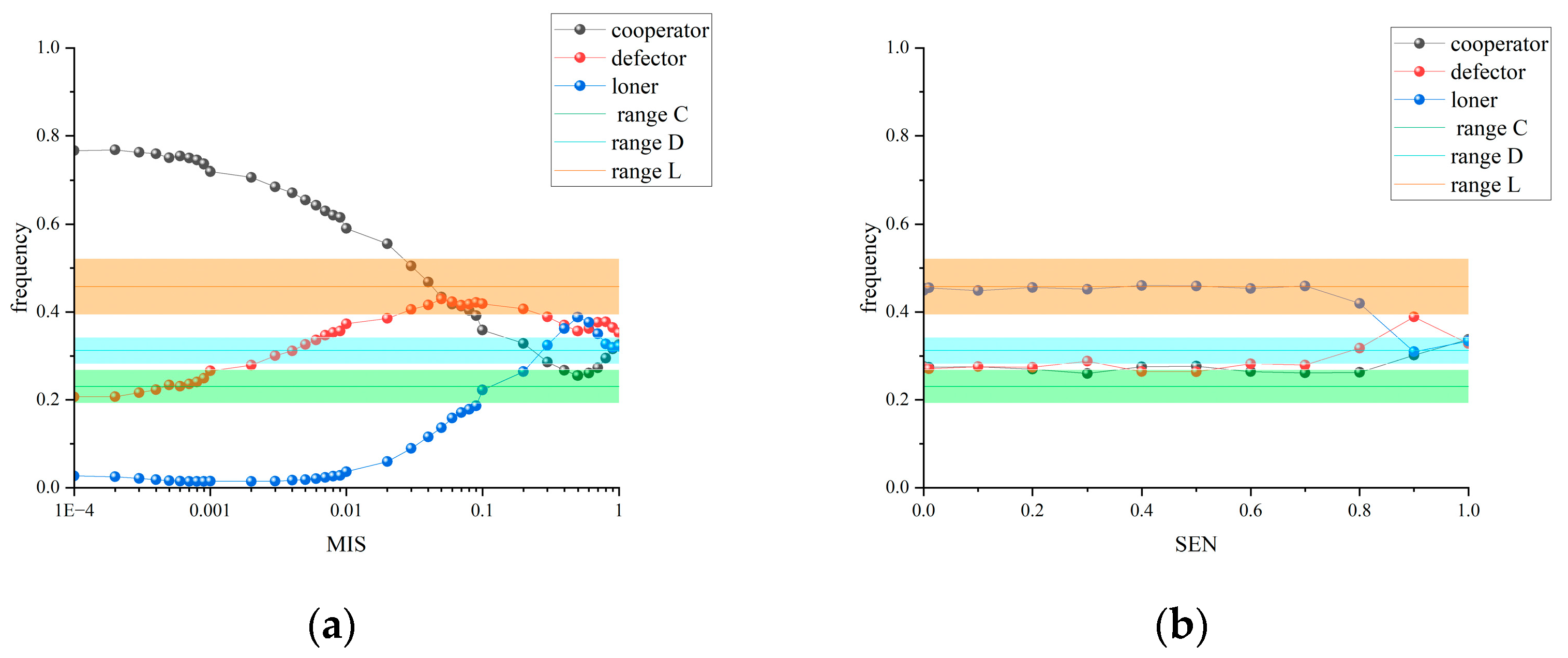
Figure 2a,b display the stationary distributions as functions of MIS.
At low mutation rates ( M I S [ 10 4 , 10 3 ] ), the strategy distribution is robust and consistent with experimental data, validating our default choice of MIS = 0.0001. In this regime, the system exhibits quasi-stable spatial clusters of cooperators and defectors, with loners occupying the boundaries. As MIS increases toward 10 2 , cooperation declines monotonically while defection and loner proportions rise, particularly when POS is small (Figure 2a). The decline is more gradual when POS is large (Figure 2b), indicating that self-adjustment buffers the destabilizing effect of behavioral noise.
Once MIS exceeds POS (i.e., M I S > 0.9 in Figure 2b), self-adjustment is effectively eliminated because the probability of exploration dominates the probability of self-regulation. In fact, it is a straightforward proposition that when MIS exceeds POS, the only behavioral regimes available to participants are exploration and imitation. This is because exploration arises essentially from spontaneous actions of the participants, and its probability is drawn from the pool allocated to self-adjustment rather than to learning. Consequently, discussing mutations in the context of learning is meaningless, since imitation by definition precludes switching to a strategy that is not adopted by any neighbor. The system then converges to a nearly uniform mixture of the three strategies, as excessive randomness destroys any spatial correlation or historical memory. These results suggest that maintaining a low level of behavioral noise is essential for preserving cooperative regimes, but that the precise threshold depends critically on the relative strength of self-adjustment.

3.3. Effect of Sensitivity Coefficient (SEN)

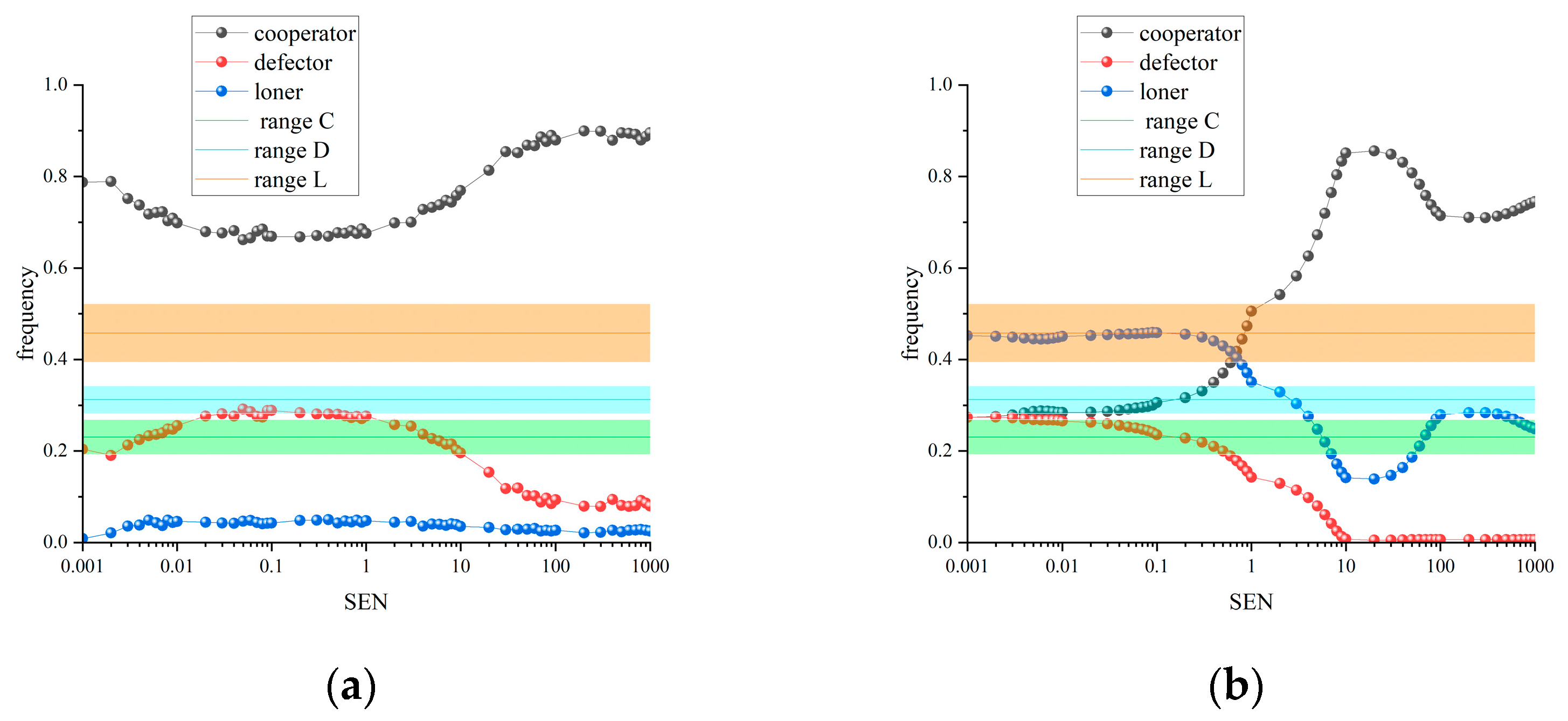
Figure 3a,b illustrate the influence of SEN.
The sensitivity coefficient SEN captures the intensity of reaction to payoff differences and is conceptually linked to the value function of prospect theory (Kahneman & Tversky, 1979). Under prospect theory, individuals exhibit loss aversion and diminishing sensitivity: the psychological impact of losses outweighs equivalent gains, and marginal sensitivity decreases as outcomes move away from the reference point. In our model, a low SEN corresponds to a flat value function near the reference point, implying that participants are “numb” to small payoff fluctuations and update strategies conservatively. A high SEN, by contrast, produces sharp reactions that amplify small payoff differences into large probability shifts.
Our simulations show that low SEN values yield the best fit to experimental data. In this regime, participants update their mixed strategies gradually, preventing rapid oscillations and allowing cooperative clusters to persist. When SEN is large, the system enters a chaotic regime in which participants switch strategies frequently, destroying spatial coherence.
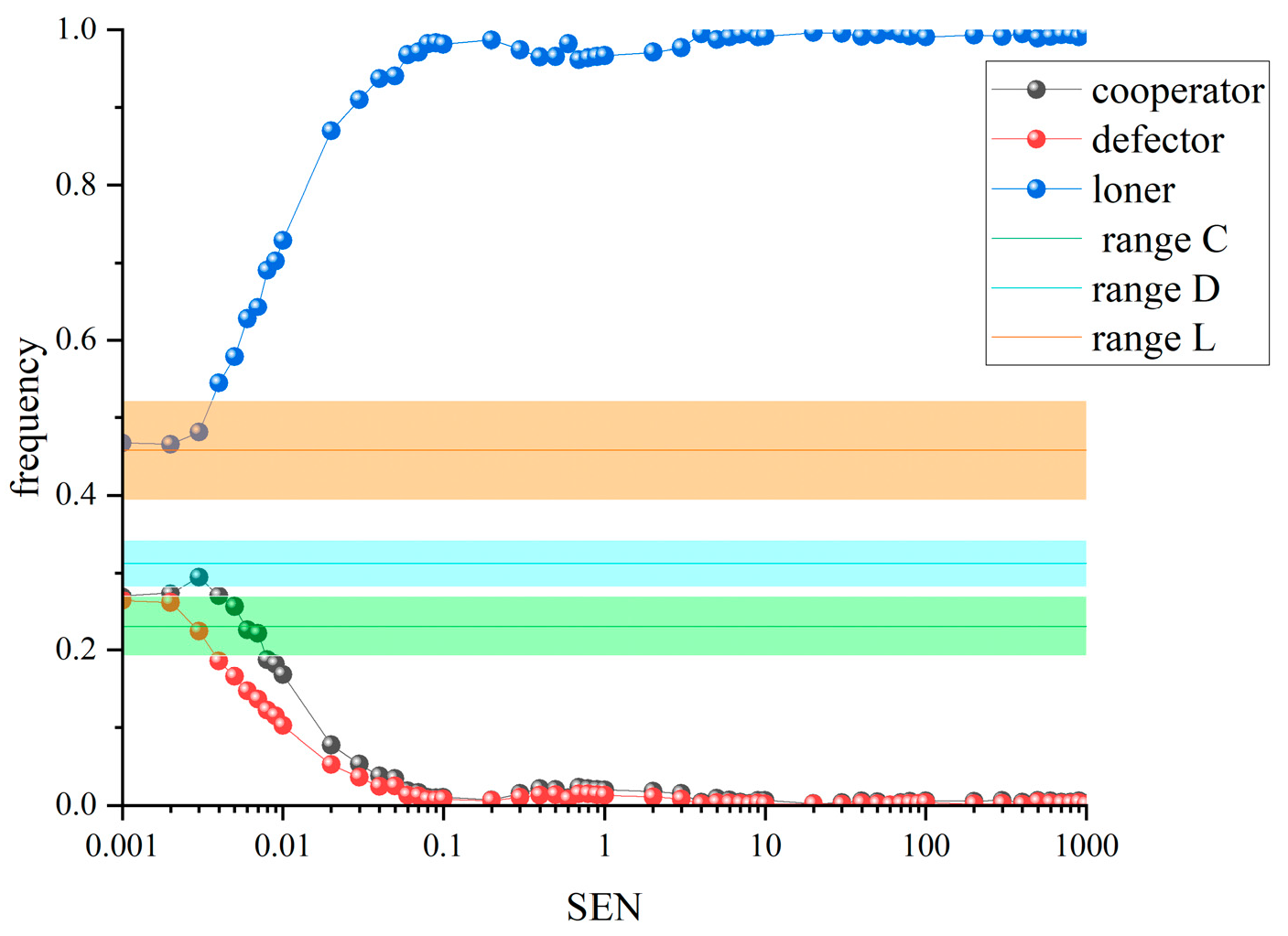
To further investigate the extreme case, Figure 4 presents the results for pure self-adjustment (POS = 1.0) across a wide range of SEN values.
When S E N exceeds 0.1 under pure self-adjustment, the system collapses into a loner-dominated state within a few thousand rounds. This occurs because high sensitivity causes participants to overreact to temporary payoff shortfalls: a single round of bad luck as a cooperator triggers an immediate switch to loner, and the resulting absence of cooperators makes defection unprofitable, driving the entire population toward exit. This finding underscores the importance of the moderate resistance to changing strategies in sustaining cooperative engagement.

3.4. Comparison with the Related Literature

Our findings contribute to an emerging literature that questions the universality of imitation-based updating in evolutionary game theory. J. Wang et al. (2022) demonstrated that persistent imitation can pave the way for cooperation under certain conditions, but their model assumes pure strategies and does not incorporate memory or reference-dependent preferences. By contrast, our results suggest that when individuals possess even a short memory window ( M = 5 ) and evaluate payoffs relative to their own historical performance, imitation becomes secondary.
Xu et al. (2010a, EPL) introduced a self-adjusting rule for spatial voluntary PGGs and showed that it could sustain cooperation without imitation. Our study extends this work by quantifying the optimal mixture of self-adjustment and imitation ( P O S   0.9 ) and by linking the sensitivity parameter to prospect theory. Furthermore, whereas Xu et al. (2010a, EPL) focused on pure strategies, our mixed-strategy framework captures the probabilistic nature of human choice observed in the laboratory.
The monotonic increase in loner proportion with POS also resonates with the literature on voluntary participation (Hauert et al., 2002). In classical models without self-adjustment, loners act as a catalyst for cooperation by providing a “rock–paper–scissors” cyclic dynamics among C, D, and L. Our simulations show that this catalytic effect persists even when self-adjustment dominates, but the mechanism shifts from cyclic dominance to risk avoidance: participants choose loner not to trigger cooperation cycles, but to escape the volatility generated by defectors.

3.5. Discussion and Future Directions

Our simulation results demonstrate that the sensitivity coefficient SEN exerts a significant and asymmetric influence on the evolution of cooperation: a low SEN stabilizes cooperative clusters, while a high SEN triggers systemic collapse into loner dominance. These observations are qualitatively consistent with the psychological regularities described by prospect theory (Kahneman & Tversky, 1979), particularly loss aversion and diminishing sensitivity, suggesting that the SEN parameter may capture individual differences in how payoff deviations are psychologically weighted relative to a reference point. Notably, Yang et al. (2022) established a quantitative bridge between prospect theory and evolutionary game theory by incorporating the asymmetric utility value function of prospect theory into the aspiration-driven dynamics of spatial public goods games. In their framework, the probability that an individual maintains its current strategy is governed by a Fermi-like function, where the noise amplitude K characterizes the individual’s sensitivity to the discrepancy between actual payoff and aspiration level. This provides a formal foundation for modeling how psychological reference points and loss aversion translate into strategy updating probabilities. Our parameter SEN plays a role analogous to the sensitivity parameter in their Fermi dynamics, and our observation that a low SEN promotes cooperation is qualitatively consistent with their finding that lower sensitivity to payoff deviations favors the maintenance of cooperative states. However, while Yang et al. (2022) focused on the asymmetry between gains and losses (distinguishing K+ and K), our current model adopts a simplified symmetric treatment of SEN to isolate the pure effect of sensitivity magnitude. A natural extension of our work would be to incorporate the asymmetric Fermi dynamics of Yang et al. (2022) into the self-adjusting framework, thereby capturing both loss aversion and reference-point dependence in a unified micro-dynamic model.
However, in the present study, the prospect theory framework is used only as an interpretive lens for understanding the simulation outcomes; it is not directly incorporated into the agents’ updating rules. A formal integration of prospect theory into the micro-dynamics, for example, by allowing for asymmetric responses to gains and losses, remains a promising direction for future research. Such an extension could further enhance the behavioral realism of the model and provide deeper insights into the cognitive underpinnings of cooperation in social dilemmas. For example, future work could refine SEN by incorporating trait-specific responses such as greediness and self-confidence (C. Wang et al., 2023).

4. Conclusions

4.1. Theoretical Significance of Simulation

This paper investigates the evolutionary dynamics of strategy updating in spatial public goods games, building upon a prior behavioral experiment and employing computational simulations to explore human decision-making under complex social dilemmas. By constructing an agent-based model that incorporates memory-based self-adjustment, imitation, and random exploration, we numerically validate the dominant role of self-regulation in sustaining cooperation. Our systematic analysis of the proportion of self-adjustment (POS), mutation rate (MIS), and sensitivity coefficient (SEN) reveals their nonlinear influences on the stationary distributions of cooperators, defectors, and loners, and provides quantitative estimates of these key behavioral parameters.
Theoretically, our results challenge the conventional imitation-centric view that dominates much of the evolutionary game theory literature (J. Wang et al., 2022; Szabó & Hauert, 2002). While classical models often assume that individuals copy the strategies of successful neighbors, our simulations demonstrate that human strategy updates are primarily driven by internal payoff comparisons rather than social imitation. In fact, the optimal POS value of approximately 0.9 indicates that, excluding random mutations, participants rely on self-adjustment about 90% of the time, with imitation playing only a minor auxiliary role. This finding aligns with the experimental evidence reported in Xu et al. (2019) and reinforces the argument that memory-based historical performance, rather than peer success, constitutes the primary anchor for strategic change.
Furthermore, the analysis of mutation rate and sensitivity coefficient sheds light on the psychological thresholds underlying cooperative behavior. A low mutation rate preserves the stability of the system and allows rational decision-making to prevail, which tends to drive the population toward cooperative outcomes. Meanwhile, the sensitivity coefficient, which governs the intensity of reaction to payoff discrepancies, exhibits a nontrivial influence: excessively high sensitivity leads to frequent and erratic strategy switching, thereby destroying spatial coherence and eventually driving the population into a loner-dominated state. Conversely, moderate or low sensitivity promotes the persistence of cooperative clusters. These results are consistent with the predictions of prospect theory (Kahneman & Tversky, 1979), wherein individuals display loss aversion and diminishing sensitivity to marginal changes, which together act as stabilizing forces against the temptation to defect.

4.2. Managerial Implications and Policy Applications

The findings of this study offer practical insights for the management of public resources and the design of social norms. Our simulation suggests that in closed-group settings, participants tend to “mind their own business” at a high rate, and excessive social comparison or imitation can actually undermine cooperative order. For public resource management, rather than publicly ranking individual contributions, which may inadvertently stimulate counterproductive imitation of defectors, it is more effective to implement individualized feedback mechanisms that encourage participants to evaluate their strategies against their own historical performance. This approach reduces the risk of cascading defection and enhances long-term collective welfare.
In the context of global challenges such as climate change, which can be framed as a public goods dilemma at the international level, our results imply that each country should set emission reduction targets based on its own historical trajectory and economic capacity, rather than simply mimicking the commitments of others. Such self-referential goal-setting not only improves credibility and enforceability but also resonates with the loss aversion bias highlighted by prospect theory: emphasizing the potential losses from inaction may be more effective in stimulating self-regulatory motivation than highlighting the gains from action.

4.3. Limitations and Future Directions

Despite the successful replication of experimental findings, our model has several limitations. First, the lattice structure is fixed throughout the simulations, whereas real social networks are dynamic and allow individuals to rewire connections, for example, by severing ties with defectors and linking to cooperators. Extending the model to co-evolutionary frameworks may further amplify the advantage of self-adjustment, as self-regulating individuals are less dependent on the continued presence of specific neighbors. Beyond imitation and self-regulation, recent studies have also explored how fairness preferences and dynamic resource allocation shape cooperative outcomes in voluntary PGGs (Huang et al., 2023), which could serve as a promising subject for further investigation. Second, we restrict our analysis to the standard voluntary PGG with three pure strategies and their mixed-strategy combinations, without considering continuous contribution levels, conditional cooperation, reputation effects, or external shocks. Exploring richer strategy spaces could reveal how self-adjustment performs under more complex scenarios. Third, the parameter space explored in this study is limited by computational constraints. Although our C++ implementation is efficient, future work could employ surrogate models, adaptive sampling techniques, or reinforcement learning algorithms (e.g., Q-learning or experience-weighted attraction) to enable agents with more sophisticated cognitive capabilities, thereby achieving a closer approximation to real human behavior (Xie & Szolnoki, 2026; S. Lv et al., 2025; X. Wang et al., 2024). With advances in simulation tools, a more granular quantification of “rational behavior” in evolutionary games becomes feasible, allowing for finer calibration of parameters such as SEN and POS under diverse social contexts.
Another limitation concerns the generalizability of the sensitivity threshold identified in this study. Our simulations were conducted on a 100 × 100 square lattice with the von Neumann neighborhood (group size G = 5), and the observed threshold effects of SEN may depend on these specific structural parameters. In larger groups, the marginal impact of an individual’s strategy on the collective payoff diminishes, which may alter the effective sensitivity threshold required to trigger cooperative or defector responses. Similarly, different network topologies, such as random regular graphs, scale-free networks, or small-world networks, could modulate the spatial propagation of strategy updates and thus affect the critical SEN values at which cooperation collapses or thrives. For instance, in scale-free networks where hubs exert disproportionate influence, the sensitivity threshold for cooperation might be lower due to the enhanced spread of successful strategies through highly connected nodes. Future work should systematically investigate how group size and network structure interact with SEN to determine the robustness of our findings. Such investigations would help establish whether the optimal SEN range identified here is universal or context-dependent, and would provide more nuanced guidance for designing cooperation-promoting interventions in diverse social settings.
In summary, this study not only corroborates the experimental finding that memory-based self-adjustment dominates imitation in human strategy updating, but also provides a quantitative and theoretically grounded framework rooted in prospect theory for understanding and promoting cooperation in social dilemmas. The results underscore the importance of designing institutions that encourage individual reflection on historical performance, reduce environmental noise, and avoid amplifying short-term payoff differences, thereby fostering sustainable collective action.

Author Contributions

Conceptualization, H.W., L.Y. and L.Z.; Methodology, H.W., L.Y. and L.Z.; Software, H.W. and L.Y.; Validation, H.W., M.S. and L.Y.; Formal analysis, H.W. and L.Y.; Investigation, H.W. and L.Y.; Resources, H.W., L.Y. and Y.X.; Data curation, H.W. and L.Y.; Writing—original draft, H.W. and L.Y.; Writing—review & editing, H.W. and L.Y.; Visualization, H.W. and L.Y.; Supervision, L.Y., Y.X. and L.Z.; Project administration, L.Y. and L.Z.; Funding acquisition, L.Z. All authors have read and agreed to the published version of the manuscript.

Funding

This research was funded by Jilin Province Science and Technology Department grant number YDZJ202401635ZYTS. National Natural Science Foundation of China grant number 12305042. Natural Science Foundation of Tianjin Municipality grant number 20JCYBJC01020.

Data Availability Statement

The original contributions presented in this study are included in the article. Further inquiries can be directed to the corresponding author.

Conflicts of Interest

We declare that we have no financial and personal relationships with other people or organizations that can inappropriately influence our work, there is no professional or other personal interest of any nature or kind in any product, service and/or company that could be construed as influencing the position presented in, or the review of, the manuscript entitled.

References

  1. Blume, L. E. (1993). The statistical mechanics of strategic interaction. Games and Economic Behavior, 5(3), 387–424. [Google Scholar] [CrossRef] [Scilit]
  2. Danku, Z., Perc, M., & Szolnoki, A. (2019). Knowing the past improves cooperation in the future. Scientific Reports, 9, 262. [Google Scholar] [CrossRef] [Scilit] [PubMed]
  3. Doebeli, M., & Hauert, C. (2005). Models of cooperation based on the Prisoner’s Dilemma and the Snowdrift game. Ecology Letters, 8(7), 748–766. [Google Scholar] [CrossRef] [Scilit]
  4. Fischbacher, U. (2007). z-Tree: Zurich toolbox for ready-made economic experiments. Experimental Economics, 10(2), 171–178. [Google Scholar] [CrossRef] [Scilit]
  5. Hardin, G. (1968). The tragedy of the commons. Science, 162(3859), 1243–1248. [Google Scholar] [CrossRef] [Scilit] [PubMed]
  6. Hauert, C. (2010). Replicator dynamics of reward & reputation in public goods games. Journal of Theoretical Biology, 267(1), 22–28. [Google Scholar] [CrossRef] [Scilit] [PubMed]
  7. Hauert, C., De Monte, S., Hofbauer, J., & Sigmund, K. (2002). Volunteering as Red Queen mechanism for cooperation in public goods games. Science, 296(5570), 1129–1132. [Google Scholar] [CrossRef] [Scilit] [PubMed]
  8. Hirschman, A. O. (1970). Exit, voice, and loyalty: Responses to decline in firms, organizations, and states. Harvard University Press. [Google Scholar]
  9. Huang, Y., Ren, T., Zheng, J., Liu, W., & Zhang, M. (2023). Evolution of cooperation in public goods games with dynamic resource allocation: A fairness preference perspective. Applied Mathematics and Computation, 445, 127844. [Google Scholar] [CrossRef] [Scilit]
  10. Kahneman, D., & Tversky, A. (1979). Prospect theory: An analysis of decision under risk. Econometrica, 47(2), 263–291. [Google Scholar] [CrossRef] [Scilit]
  11. Lv, R., Qian, J.-L., Hao, Q.-Y., Wu, C.-Y., Guo, N., & Ling, X. (2023). The impact of current and historical reputation with non-uniform change on cooperation in spatial public goods game. Chaos, Solitons & Fractals, 175, 113968. [Google Scholar] [CrossRef] [Scilit]
  12. Lv, S., Li, J., & Zhao, C. (2025). Reinforcement learning in spatial public goods games with environmental feedbacks. Chaos, Solitons & Fractals, 195, 116296. [Google Scholar] [CrossRef] [Scilit]
  13. Nowak, M. A. (2006). Five rules for the evolution of cooperation. Science, 314(5805), 1560–1563. [Google Scholar] [CrossRef] [Scilit] [PubMed]
  14. Orbell, J. M., & Dawes, R. M. (1993). Social welfare, cooperators’ advantage, and the option of not playing the game. American Sociological Review, 58(6), 787–800. [Google Scholar] [CrossRef] [Scilit]
  15. Ostrom, E. (1990). Governing the commons: The evolution of institutions for collective action. Cambridge University Press. [Google Scholar]
  16. Shen, Y., Zeng, L., Kang, H., Sun, X., Chen, Q., & Feng, C. (2026). The impact of a dynamic reward pool mechanism based on historical memory on the cooperative evolution of spatial public goods games. Chaos, Solitons & Fractals, 206, 117990. [Google Scholar] [CrossRef] [Scilit]
  17. Sigmund, K. (2010). The calculus of selfishness. Princeton University Press. [Google Scholar]
  18. Szabó, G., & Hauert, C. (2002). Phase transitions and volunteering in spatial public goods games. Physical Review Letters, 89(11), 118101. [Google Scholar] [CrossRef] [Scilit] [PubMed]
  19. Szabó, G., & Tőke, C. (1998). Evolutionary prisoner’s dilemma game on a square lattice. Physical Review E, 58(1), 69. [Google Scholar] [CrossRef] [Scilit]
  20. Szolnoki, A., & Chen, X. (2020). Strategy dependent learning activity in cyclic dominant systems. Chaos, Solitons & Fractals, 138, 109935. [Google Scholar] [CrossRef] [Scilit]
  21. Wang, C., Zhu, W., & Szolnoki, A. (2023). When greediness and self-confidence meet in a social dilemma. Applied Mathematics and Computation, 625, 129033. [Google Scholar] [CrossRef] [Scilit]
  22. Wang, J., Dai, W., He, J., Yu, F., & Shen, X. (2022). Persistent imitation paves the way for cooperation in public goods game. Physics Letters A, 447, 128302. [Google Scholar] [CrossRef] [Scilit]
  23. Wang, X., Yang, Z., Chen, G., & Liu, Y. (2024). Enhancing cooperative evolution in spatial public goods game by particle swarm optimization based on exploration and Q-learning. Applied Mathematics and Computation, 469, 128534. [Google Scholar] [CrossRef] [Scilit]
  24. Wang, Z., Xu, Z., & Zhang, L. (2010). Punishment in optional public goods games. Chinese Physics B, 19, 110201. [Google Scholar] [CrossRef] [Scilit]
  25. Xie, K., & Szolnoki, A. (2026). Reinforcement learning in evolutionary game theory: A brief review of recent developments. Applied Mathematics and Computation, 510, 129685. [Google Scholar] [CrossRef] [Scilit]
  26. Xu, Z. (2024). Free-rider or contributor: A dilemma in spatial threshold public goods games. Chaos, Solitons & Fractals, 187, 115455. [Google Scholar] [CrossRef] [Scilit]
  27. Xu, Z., Li, R., & Zhang, L. (2019). The role of memory in human strategy updating in optional public goods game. Chaos, 29(4), 043128. [Google Scholar] [CrossRef] [Scilit] [PubMed]
  28. Xu, Z., Wang, Z., Song, H., & Zhang, L. (2010a). Self-adjusting rule in spatial voluntary public goods games. EPL (Europhysics Letters), 89(4), 40009. [Google Scholar]
  29. Xu, Z., Wang, Z., & Zhang, L. (2010b). Bounded rationality in volunteering public goods games. Journal of Theoretical Biology, 264(1), 19–23. [Google Scholar] [CrossRef] [Scilit] [PubMed]
  30. Yang, L., Zhang, L., & Yang, D. (2022). Asymmetric micro-dynamics in spatial anonymous public goods game. Applied Mathematics and Computation, 415, 126737. [Google Scholar] [CrossRef] [Scilit]
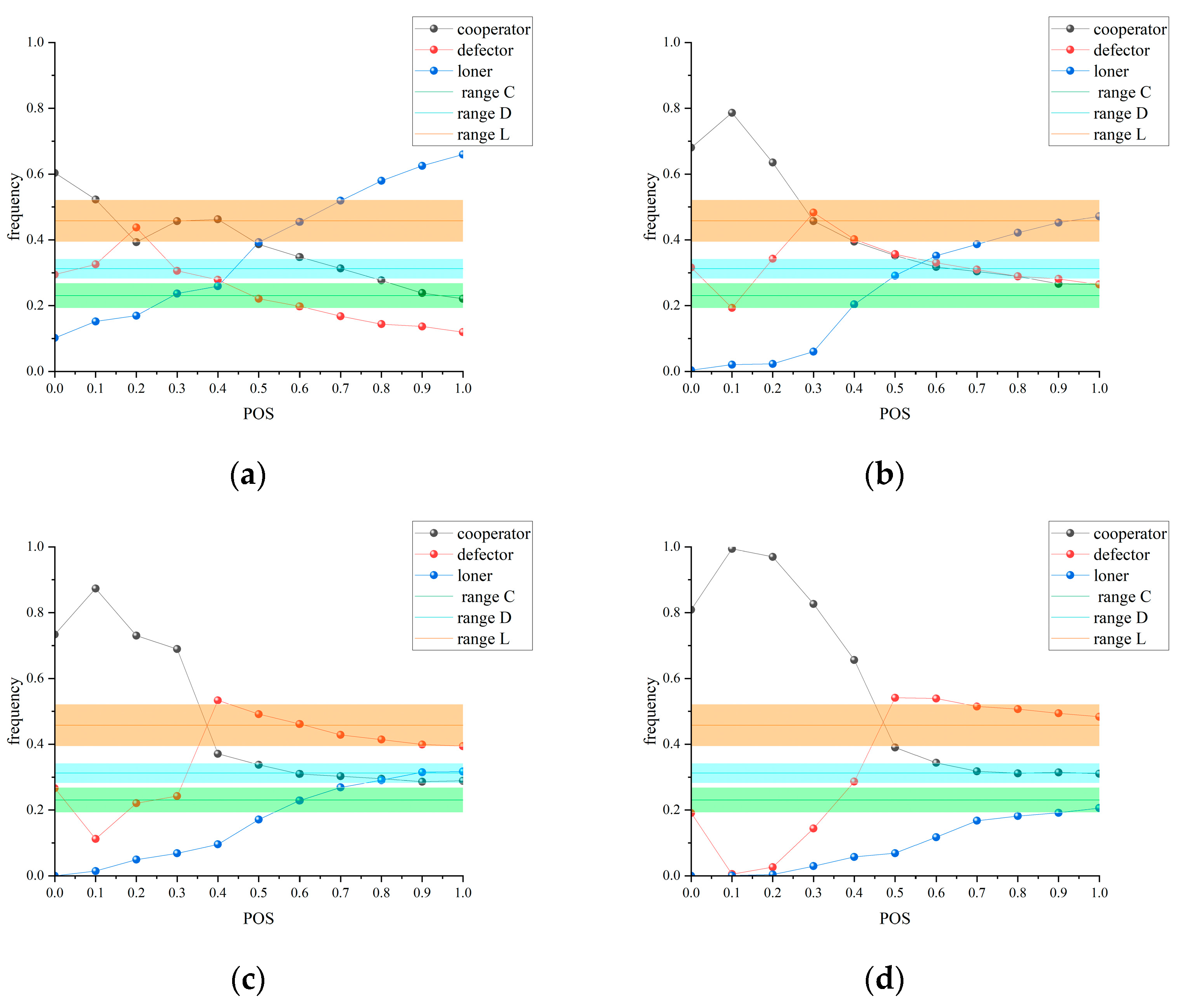
Figure 1. The graph of the frequency of strategies under different yield rates as the position changes. POS ≈ 0.9 yields the best fit with experimental data across all r values. (a) r = 2.5; (b) r = 3; (c) r = 3.5; (d) r = 4. MIS = 0.0001; SEN = 0.002.
Games 17 00048 g001
Figure 2. The graph of the strategy frequency with respect to MIS as the POS and SEN conditions remain constant. Low MIS sustains cooperation; MIS > POS eliminates self-adjustment effects. (a) POS = 0.1; (b) POS = 0.9. r = 3.0; SEN = 0.002.
Games 17 00048 g002
Figure 3. The graph of the strategy frequency with respect to SEN as the POS and MIS conditions remain constant. A low SEN promotes cooperation; a high SEN induces defection and loner dominance. (a) POS = 0.1; (b) POS = 0.9. r = 3.0; MIS = 0.0001.
Games 17 00048 g003
Figure 4. The graph of the strategy frequency with respect to SEN in extreme cases. Under pure self-adjustment, SEN > 0.1 causes systemic collapse to loners. POS = 1.0; r = 3.0; MIS = 0.0001.
Games 17 00048 g004
Disclaimer/Publisher’s Note: The statements, opinions and data contained in all publications are solely those of the individual author(s) and contributor(s) and not of MDPI and/or the editor(s). MDPI and/or the editor(s) disclaim responsibility for any injury to people or property resulting from any ideas, methods, instructions or products referred to in the content.