
Nonlinear Dynamics of Evolutionary Public Goods Games with Consistent- and Inconsistent-Moral-Standard Exclusive Sanctions


Abstract
1. Introduction
2. Model
3. Results
3.1. Evolutionary Outcomes on the Edges of the Simplex
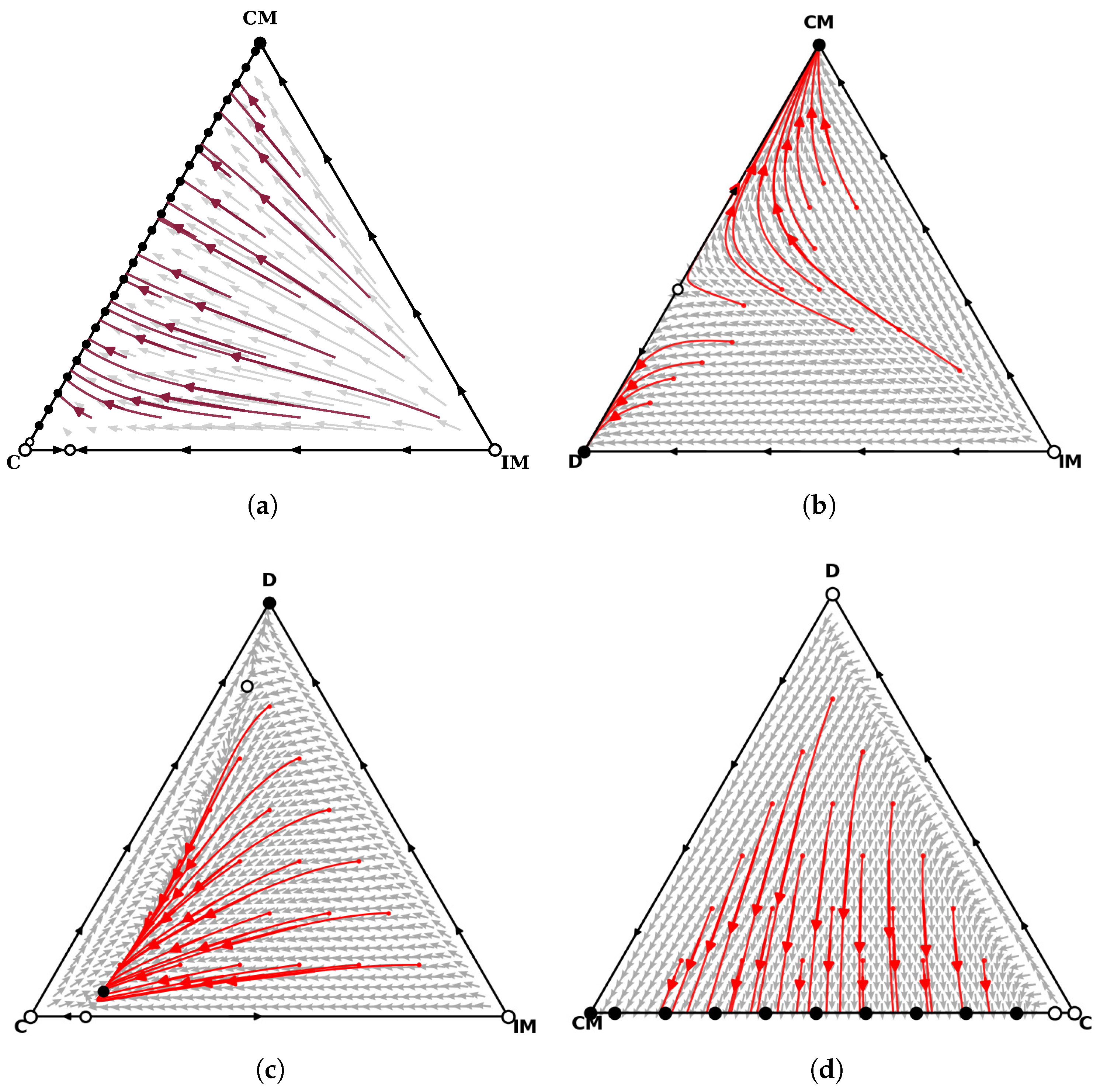
3.2. Evolutionary Dynamics on the Faces of the Simplex
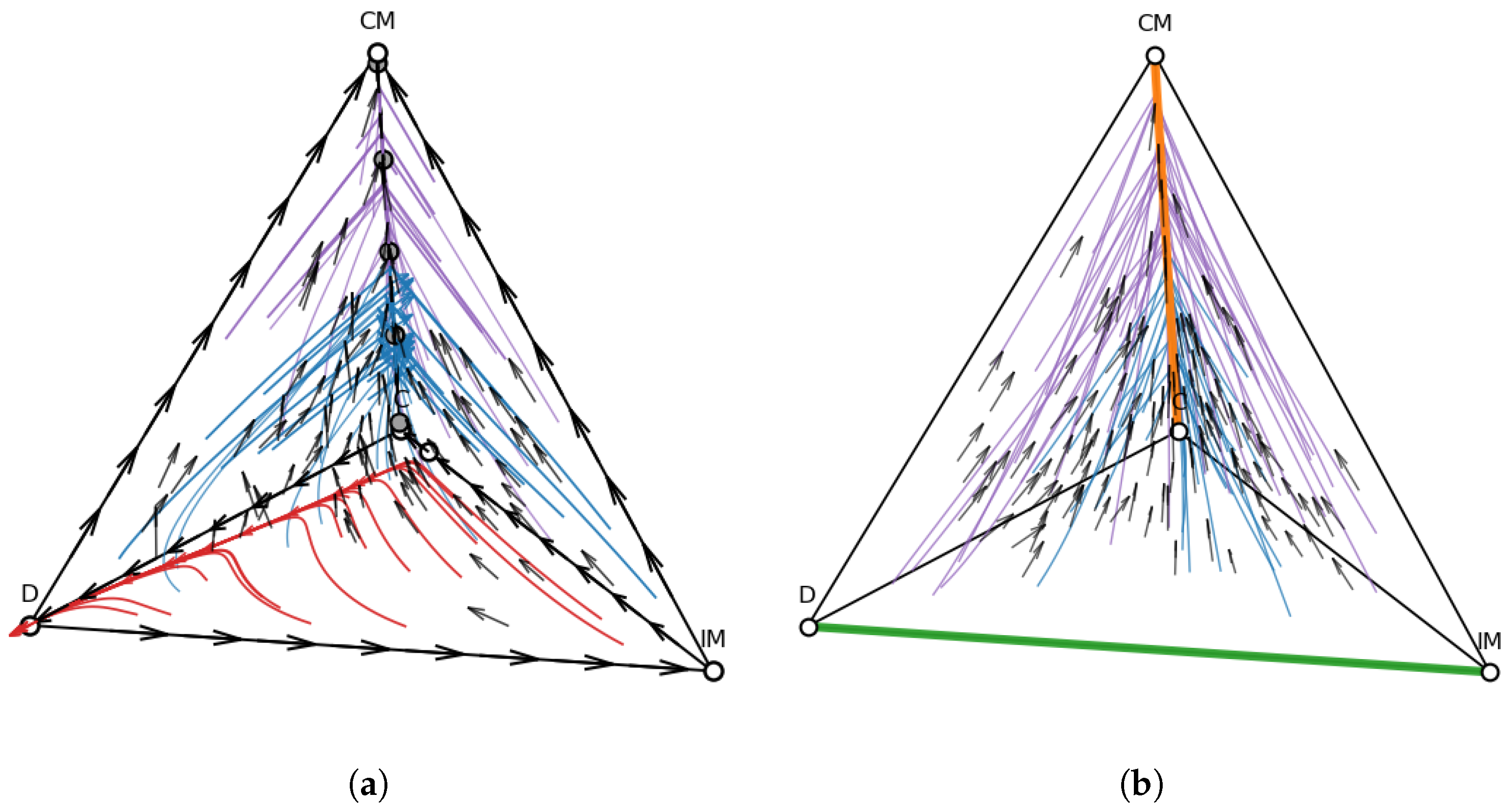
3.3. Evolutionary Competition in the Full Strategy Set
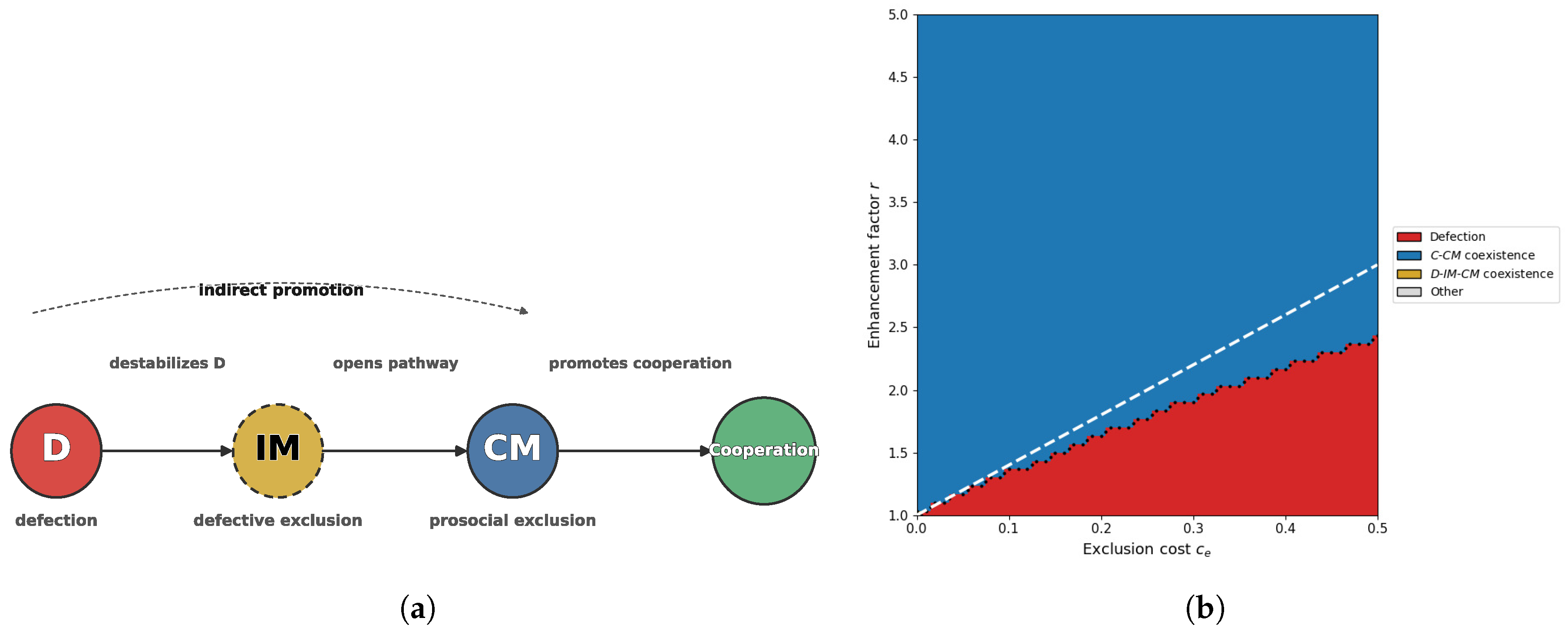
3.4. Effects of Prosocial Exclusion on Public Cooperation
4. Discussion and Conclusions
Author Contributions
Funding
Data Availability Statement
Conflicts of Interest
Appendix A. Detailed Calculation of the Expected Payoffs
Appendix B. Equilibrium on the C–IM Edge
Appendix C. Interior Equilibria on the C–IM–CM Face
Appendix D. Nonexistence of Interior Equilibria in the Full System
References
- Allen, B., Lippner, G., Chen, Y.-T., Fotouhi, B., Momeni, N., Yau, S.-T., & Nowak, M. A. (2017). Evolutionary dynamics on any population structure. Nature, 544(7649), 227–230. [Google Scholar] [CrossRef]
- Cinyabuguma, M., Page, T., & Putterman, L. (2005). Cooperation under the threat of expulsion in a public goods experiment. Journal of Public Economics, 89(8), 1421–1435. [Google Scholar] [CrossRef]
- Du, J., Wu, B., & Wang, L. (2012). Evolution of global cooperation driven by risks. Physical Review E, 85, 056117. [Google Scholar] [CrossRef]
- Forsyth, P. A. I., & Hauert, C. (2011). Public goods games with reward in finite populations. Journal of Mathematical Biology, 63(1), 109–123. [Google Scholar] [CrossRef]
- Fu, F., Hauert, C., Nowak, M. A., & Wang, L. (2008). Reputation-based partner choice promotes cooperation in social networks. Physical Review E, 78, 026117. [Google Scholar] [CrossRef] [PubMed]
- Fu, F., Wang, L., Nowak, M. A., & Hauert, C. (2009). Evolutionary dynamics on graphs: Efficient method for weak selection. Physical Review E, 79, 046707. [Google Scholar] [CrossRef]
- Hardin, G. (1968). The tragedy of the commons. Science, 162(3859), 1243–1248. [Google Scholar] [CrossRef]
- Hauert, C., De Monte, S., Hofbauer, J., & Sigmund, K. (2002). Replicator dynamics for optional public good games. Journal of Theoretical Biology, 218(2), 187–194. [Google Scholar] [CrossRef] [PubMed]
- Hauert, C., Traulsen, A., Brandt, H., Nowak, M. A., & Sigmund, K. (2007). Via freedom to coercion: The emergence of costly punishment. Science, 316(5833), 1905–1907. [Google Scholar] [CrossRef] [PubMed]
- Hilbe, C., Chatterjee, K., & Nowak, M. A. (2018). Partners and rivals in direct reciprocity. Nature Human Behaviour, 2(7), 469–477. [Google Scholar] [CrossRef]
- Jusup, M., Holme, P., Kanazawa, K., Takayasu, M., Romić, I., Wang, Z., Geček, S., Lipić, T., Podobnik, B., & Wang, L. (2022). Social physics. Physics Reports, 948, 1–148. [Google Scholar] [CrossRef]
- Li, A., Zhou, L., Su, Q., Cornelius, S. P., Liu, Y.-Y., Wang, L., & Levin, S. A. (2020). Evolution of cooperation on temporal networks. Nature Communications, 11(1), 2259. [Google Scholar] [CrossRef]
- Li, K., Cong, R., Wu, T., & Wang, L. (2015). Social exclusion in finite populations. Physical Review E, 91, 042810. [Google Scholar] [CrossRef]
- Liu, L., Chen, X., & Perc, M. (2019). Evolutionary dynamics of cooperation in the public goods game with pool exclusion strategies. Nonlinear Dynamics, 97(1), 749–766. [Google Scholar] [CrossRef]
- Nowak, M. A. (2006). Five rules for the evolution of cooperation. Science, 314(5805), 1560–1563. [Google Scholar] [CrossRef] [PubMed]
- Nowak, M. A. (2012). Evolving cooperation. Journal of Theoretical Biology, 299, 1–8. [Google Scholar] [CrossRef] [PubMed]
- Nowak, M. A., & Highfield, R. (2011). Supercooperators. Canongate Books. [Google Scholar]
- Nowak, M. A., & Sigmund, K. (1992). Tit for tat in heterogeneous populations. Nature, 355(6357), 250–253. [Google Scholar] [CrossRef]
- Nowak, M. A., & Sigmund, K. (2005). Evolution of indirect reciprocity. Nature, 437(7063), 1291–1298. [Google Scholar] [CrossRef]
- Ohtsuki, H., Hauert, C., Lieberman, E., & Nowak, M. A. (2006). A simple rule for the evolution of cooperation on graphs and social networks. Nature, 441(7092), 502–505. [Google Scholar] [CrossRef]
- Özkaya, Ö., Xavier, K. B., Dionisio, F., & Balbontín, R. (2017). Maintenance of microbial cooperation mediated by public goods in single- and multiple-trait scenarios. Journal of Bacteriology, 199(22), e00297-17. [Google Scholar] [CrossRef]
- Pacheco, J. M., & Santos, F. C. (2024). Co-evolution of risk and cooperation in climate policies under wealth inequality. PNAS Nexus, 3(12), 550. [Google Scholar] [CrossRef]
- Perc, M., Gómez-Gardeñes, J., Szolnoki, A., Floría, L. M., & Moreno, Y. (2013). Evolutionary dynamics of group interactions on structured populations: A review. Journal of the Royal Society Interface, 10(80), 20120997. [Google Scholar] [CrossRef]
- Perc, M., Jordan, J. J., Rand, D. G., Wang, Z., Boccaletti, S., & Szolnoki, A. (2017). Statistical physics of human cooperation. Physics Reports, 687, 1–51. [Google Scholar] [CrossRef]
- Quan, J., Zheng, J., Wang, X., & Yang, X. (2019). Benefits of asynchronous exclusion for the evolution of cooperation in stochastic evolutionary optional public goods games. Scientific Reports, 9(1), 8208. [Google Scholar] [CrossRef] [PubMed]
- Rand, D. G., & Nowak, M. A. (2013). Human cooperation. Trends in Cognitive Sciences, 17(8), 413–425. [Google Scholar] [CrossRef]
- Rossetti, C. S. L., & Hilbe, C. (2024). Direct reciprocity among humans. Ethology, 130(4), e13407. [Google Scholar]
- Salop, S. C., & Scheffman, D. T. (1983). Raising rivals’ costs. The American Economic Review, 73(2), 267–271. [Google Scholar]
- Santos, F. C., & Pacheco, J. M. (2011). Risk of collective failure provides an escape from the tragedy of the commons. Proceedings of the National Academy of Sciences of the United States of America, 108(26), 10421–10425. [Google Scholar]
- Santos, F. C., Santos, M. D., & Pacheco, J. M. (2008). Social diversity promotes the emergence of cooperation in public goods games. Nature, 454(7201), 213–216. [Google Scholar] [CrossRef] [PubMed]
- Sasaki, T., & Uchida, S. (2013). The evolution of cooperation by social exclusion. Proceedings of the Royal Society B: Biological Sciences, 280(1752), 20122498. [Google Scholar] [CrossRef]
- Sasaki, T., & Uchida, S. (2014). Rewards and the evolution of cooperation in public good games. Biology Letters, 10(1), 20130903. [Google Scholar] [CrossRef] [PubMed]
- Sheng, A., Su, Q., Wang, L., & Plotkin, J. B. (2024). Strategy evolution on higher-order networks. Nature Computational Science, 4(4), 274–284. [Google Scholar] [CrossRef]
- Sigmund, K. (2007). Punish or perish? Retaliation and collaboration among humans. Trends in Ecology & Evolution, 22(11), 593–600. [Google Scholar] [CrossRef]
- Sigmund, K. (2010). The calculus of selfishness. Princeton University Press. [Google Scholar]
- Sigmund, K., De Silva, H., Traulsen, A., & Hauert, C. (2010). Social learning promotes institutions for governing the commons. Nature, 466(7308), 861–863. [Google Scholar] [CrossRef]
- Sigmund, K., Hauert, C., & Nowak, M. A. (2001). Reward and punishment. Proceedings of the National Academy of Sciences of the United States of America, 98(19), 10757–10762. [Google Scholar] [CrossRef] [PubMed]
- Stewart, A. J., & Plotkin, J. B. (2014). Collapse of cooperation in evolving games. Proceedings of the National Academy of Sciences of the United States of America, 111(49), 17558–17563. [Google Scholar] [CrossRef]
- Su, Q., McAvoy, A., Mori, Y., & Plotkin, J. B. (2022). Evolution of prosocial behaviours in multilayer populations. Nature Human Behaviour, 6(3), 338–348. [Google Scholar] [CrossRef] [PubMed]
- Sun, X., Han, L., Wang, M., Liu, S., & Shen, Y. (2023). Social exclusion with antisocial punishment in spatial public goods game. Physics Letters A, 474, 128837. [Google Scholar] [CrossRef]
- Szabó, G., & Fath, G. (2007). Evolutionary games on graphs. Physics Reports, 446(4–6), 97–216. [Google Scholar] [CrossRef]
- Szolnoki, A., & Perc, M. (2010). Reward and cooperation in the spatial public goods game. Europhysics Letters, 92(3), 38003. [Google Scholar] [CrossRef]
- Szolnoki, A., & Perc, M. (2017). Second-order free-riding on antisocial punishment restores the effectiveness of prosocial punishment. Physical Review X, 7, 041027. [Google Scholar]
- Taylor, P. D., & Jonker, L. B. (1978). Evolutionary stable strategies and game dynamics. Mathematical Biosciences, 40(1–2), 145–156. [Google Scholar] [CrossRef]
- Tkadlec, J., Hilbe, C., & Nowak, M. A. (2023). Mutation enhances cooperation in direct reciprocity. Proceedings of the National Academy of Sciences of the United States of America, 120(20), e2221080120. [Google Scholar] [CrossRef]
- Wang, J., Fu, F., Wu, T., & Wang, L. (2009). Emergence of social cooperation in threshold public goods games with collective risk. Physical Review E, 80, 016101. [Google Scholar] [CrossRef]
- Wang, J., & Xia, C. (2023). Reputation evaluation and its impact on human cooperation: A recent survey. Europhysics Letters, 141(2), 21001. [Google Scholar] [CrossRef]
- Wang, X., & Perc, M. (2022). Replicator dynamics of public goods games with global exclusion. Chaos: An Interdisciplinary Journal of Nonlinear Science, 32(7), 073129. [Google Scholar] [CrossRef] [PubMed]
- Williams, K. D. (2007). Ostracism. Annual Review of Psychology, 58(1), 425–452. [Google Scholar] [CrossRef]
- Wu, J., Luan, S., & Raihani, N. (2022). Reward, punishment, and prosocial behavior: Recent developments and implications. Current Opinion in Psychology, 44, 117–123. [Google Scholar] [CrossRef]
- Wu, T., Fu, F., Zhang, Y., & Wang, L. (2013). The increased risk of joint venture promotes social cooperation. PLoS ONE, 8(6), e63801. [Google Scholar] [CrossRef]
- Yang, C.-L., Zhang, B., Charness, G., Li, C., & Lien, J. W. (2018). Endogenous rewards promote cooperation. Proceedings of the National Academy of Sciences of the United States of America, 115(40), 9968–9973. [Google Scholar] [CrossRef]
- Yang, H.-X., Wu, Z.-X., Rong, Z., & Lai, Y.-C. (2015). Peer pressure: Enhancement of cooperation through mutual punishment. Physical Review E, 91, 022121. [Google Scholar] [CrossRef] [PubMed]
- Zhang, C., Zhu, Y., Chen, Z., & Zhang, J. (2017). Punishment in the form of shared cost promotes altruism in the cooperative dilemma games. Journal of Theoretical Biology, 420, 128–134. [Google Scholar] [CrossRef] [PubMed]


Disclaimer/Publisher’s Note: The statements, opinions and data contained in all publications are solely those of the individual author(s) and contributor(s) and not of MDPI and/or the editor(s). MDPI and/or the editor(s) disclaim responsibility for any injury to people or property resulting from any ideas, methods, instructions or products referred to in the content. |
© 2026 by the authors. Licensee MDPI, Basel, Switzerland. This article is an open access article distributed under the terms and conditions of the Creative Commons Attribution (CC BY) license.
Share and Cite
Chen, Y.; Wang, X. Nonlinear Dynamics of Evolutionary Public Goods Games with Consistent- and Inconsistent-Moral-Standard Exclusive Sanctions. Games 2026, 17, 24. https://doi.org/10.3390/g17030024
Chen Y, Wang X. Nonlinear Dynamics of Evolutionary Public Goods Games with Consistent- and Inconsistent-Moral-Standard Exclusive Sanctions. Games. 2026; 17(3):24. https://doi.org/10.3390/g17030024
Chicago/Turabian StyleChen, Yang, and Xiaofeng Wang. 2026. "Nonlinear Dynamics of Evolutionary Public Goods Games with Consistent- and Inconsistent-Moral-Standard Exclusive Sanctions" Games 17, no. 3: 24. https://doi.org/10.3390/g17030024
APA StyleChen, Y., & Wang, X. (2026). Nonlinear Dynamics of Evolutionary Public Goods Games with Consistent- and Inconsistent-Moral-Standard Exclusive Sanctions. Games, 17(3), 24. https://doi.org/10.3390/g17030024