
How to Sell Debt (But Not Money)

Birkbeck Business School, Birkbeck, University of London, London WC1E 7HX, UK
Games 2026, 17(2), 13; https://doi.org/10.3390/g17020013
Submission received: 2 October 2025
/
Revised: 14 February 2026
/
Accepted: 3 March 2026
/
Published: 9 March 2026
Abstract
Multi-unit common value auctions in which bidders submit demand functions are used for a variety of purposes, including selling government debt (Treasury auctions) and allocating liquidity (repo auctions). Typically, either a discriminatory or a uniform-price format is used. In this paper, we consider the incentive for participation by relatively uninformed bidders in the presence of more informed bidders under these formats. We characterize the equilibrium under a discriminatory auction and show that discriminatory pricing inhibits uninformed participation. In contrast, the equilibria we construct under a uniform pricing rule show that profitable uninformed participation can occur. The usefulness of widening participation in Treasury auctions makes the latter format a natural choice in these auctions, providing an explanation for the switch to the uniform-price format in US Treasury auctions. We also apply our results to repo auctions and show that a uniform-price format can reduce the ability of a central bank to steer interest rates. This sheds light on the reason for the switch away from the uniform-price format by several central banks in conducting repo auctions. We also consider the question of information aggregation and show that uniform-price auctions might fail to do so. The results also offer an explanation for the fact that the ECB, as well as several other central banks, prefer to allocate liquidity through a fixed-rate tender rather than either uniform-price or discriminatory auctions.
1. Introduction
Multi-unit auctions of various degrees of complexity are regularly used in a variety of settings, including sales of government debt (Treasury auctions), allocation of telecom licences and sports broadcasting rights, as well as arrangements for liquidity provision by central banks (repo auctions). The two main formats are discriminatory auctions and uniform-price auctions. The literature on the design of such auctions has mostly focused on revenue and efficiency in private-value settings. In a well-known paper, Ausubel et al. (2014) show that in settings with private value elements, the uniform-price format allows scope for strategic demand reduction, resulting in an inefficient outcome. They show that discriminatory auctions might fare better in terms of revenue.1
The literature on common-value multi-unit auctions is relatively thin, though several papers discuss information aggregation using such models, focusing on asymptotic outcomes. We discuss this aspect later. Our primary objective here is to analyze common-value multi-unit auctions to understand their use in Treasury auctions (selling debt) and repo auctions2 (used for liquidity provision, or “selling money”). In a common-value framework, there is no efficiency issue. Any allocation of the objects is efficient since the realised common value for any unit is the same irrespective of the winner of that unit. Further, revenue is at best a secondary issue in these auctions. The principal concerns are about whether participation should be wider and include relatively uninformed participants, and—for repo auctions—whether the central bank can steer interest rates effectively through these auctions.
Friedman (1960, 1964) argued strongly in favor of the uniform-price format for Treasury auctions since discriminatory auctions “reduce participation.” He argues that a uniform-price auction is superior since it allows non-specialists to participate. In 1998, the US Treasury switched from using discriminatory auctions for most categories of government securities to uniform-price auctions for selling all securities. While the US now uses only the uniform-price format, Treasury auctions in countries such as the UK and Germany have always used discriminatory auctions. In these countries, only members of a specific group3 are allowed to bid in Treasury auctions.
An interesting contrast to Treasury auctions is presented by repo auctions used by central banks for open market operations. These are also multi-unit common value auctions with demand function bids. As Bindseil (2004) reports, many central banks explicitly aim to steer short-term interest rates. Since many central banks conduct monetary policy primarily through repo auctions, this makes repo auctions an important policy tool.4 The Bundesbank used uniform-price auctions until 1988, but then abandoned the format. In 2001, the Reserve Bank of India introduced uniform-price repo auctions for its liquidity adjustment facility. Within a year, however, they were substituted by discriminatory auctions.
Can we use auction theory to shed any light on the rationale for these choices? This is the question addressed in the paper. To the best of our knowledge, this set of issues has not been addressed elsewhere. Specifically, we consider a multi-unit common value auction in which all bidders submit demand functions, and some bidders are better informed than others. The setting is relevant for both Treasury auctions and repo auctions.5 Almost all Treasury and repo auctions use either a discriminatory or a uniform-price format. Under these formats, we consider the incentive for participation by relatively uninformed bidders alongside their more informed counterparts, and explore the consequences for both Treasury auctions and repo auctions. Further, we explore the issue of the ability of central banks to steer rates.
Under a uniform pricing rule, all winners pay the market-clearing price, defined as the highest bid at which aggregate demand equals or exceeds supply (i.e., the lowest price at which some positive quantity is won by some bidder).6 In a discriminatory auction, on the other hand, winners pay their own bids.
We analyze the equilibrium in a discriminatory auction and show that this format precludes uninformed participation. This is consistent with the evidence presented by Ausubel and Romeu (2005), who studied discriminatory currency auctions conducted by the Central Bank of Venezuela and concluded that better-informed bidders outperform less-informed bidders whenever information matters.
Further, we show that uninformed bidders can successfully participate under uniform-price auctions by placing high bids on several units. This confirms Friedman’s informal argument about higher participation in uniform-price auctions by bidders who do not need to be specialists. However, we show that such participation could reduce the ability of a central bank to steer interest rates in a repo auction. The results offer an explanation for the switch to the uniform-price format in US Treasury auctions and the contrasting switch away from this format in repo auctions conducted by the Bundesbank as well as other central banks. Indeed, when switching away from uniform-price repo auctions in 2002, the governor of the Reserve Bank of India expressed concerns about the fact that many bids were placed at very high rates. In March 1999, the European Central Bank (henceforth ECB) switched the auction format for longer-term repos from uniform-price to discriminatory, responding to concerns that uniform-price auctions give an undue advantage to less-informed bidders.7 These observations provide support for the type of equilibria we explore in uniform-price auctions. In 2008, the ECB changed its liquidity-provision procedure again to a fixed-rate tender. This is a scheme in which the rate is fixed by the central bank; bidders bid only quantities. Our results also clarify why several central banks prefer to allocate liquidity via this method rather than use an auction.8
We consider a model with both informed and uninformed bidders. To analyze equilibria with uninformed participation, one possibility is to look for mixed strategy equilibria with each uninformed bidder entering the auction with a positive probability. The problem is that in such equilibria, the payoff must be zero (staying out gives a zero payoff, and therefore participating must do so too). Such equilibria are not robust to any perturbation of the payoff arising from an entry cost. Instead, we consider asymmetric pure strategy equilibria, in which some uninformed bidders participate, and others stay out. We show that such equilibria exist under a uniform-price format. In any such equilibrium, participating uninformed bidders earn a positive payoff by making use of the information of the informed bidders, making the equilibrium robust to an entry cost.
Klemperer (2002) notes that sealed bid auctions have greater entry incentives for weaker bidders. However, in the common value environment considered here, less-informed entrants face a severe winner’s curse in a sealed bid auction, inhibiting uninformed participation alongside informed bidders. In a multi-unit context, a uniform-price auction gives rise to an additional possibility. While less-informed bidders face a winner’s curse, there is a contrasting effect. The less-informed bidders can submit demand functions that determine the winning quantity, but pay a winning price that makes use also of bids by informed bidders, reflecting the information possessed by the latter. This ability to profit from the information of the informed makes it easier for uninformed bidders to participate alongside informed bidders. The paper considers these effects formally.
Finally, it is interesting to note that Treasury auctions have an institutionalized facility to help less-informed bidders. Treasury auctions allow non-competitive bids, which are quantity-only bids, to be filled at the auction price (average auction price in case of discriminatory auctions). Such bids are exactly like bids of the associated quantities at the highest possible price, and thus allow the uninformed bidders to profit from the information of the informed bidders.
Central banks such as the Fed deal with a small group of primary dealers. Other central banks have a wider potential bidder base and might want to have a democratic and open process of liquidity provision, which does not put relatively less-informed bidders at a disadvantage. Further, as mentioned before, many central banks also want to steer interest rates. Given the twin objectives, our results clarify why neither discriminatory nor uniform-price auctions might be satisfactory as a policy tool. The former discourages uninformed participation, while the latter makes it difficult to steer rates. This provides an explanation for the fact that the ECB and several other central banks prefer to allocate liquidity through a fixed-rate tender rather than an auction. By fixing a rate, the central bank can steer rates transparently. Further, since bidders only submit quantities, uninformed participants face no disadvantage, allowing the central bank to provide wider access.
Auction Theory and Information Aggregation
Finally, we relate our results to the literature on auctions and information aggregation. Since a fixed-rate tender procedure fixes the rate exogenously, it does not aggregate any information. Auctions, however, leave scope for information aggregation to various degrees since the rate paid by bidders is endogenous.
In a uniform-price auction, all bidders pay the market-clearing price, which is the highest price at which the demand equals or exceeds supply. In a single-unit auction, the market-clearing price coincides with the highest bid. Thus, with a single unit, the analysis of a uniform-price auction coincides with the analysis of a single-unit first-price common-value auction. Engelbrecht-Wiggans et al. (1983) (EMW) analyze a single-unit common-value first-price auction with a single informed bidder and several uninformed bidders and derive the unique equilibrium. In this equilibrium, uninformed bidders earn a zero profit.
The results here show that going from one unit to even two changes the flavor of the results substantially when a uniform-price rule is used. With more than one unit, it is possible for the uninformed bidders to make use of the information of the informed, and therefore, uninformed bidders can earn a positive profit. Further, the equilibrium derived in EMW is not robust to any cost of entry or bidding. Any such positive cost implies that a deviation to non-participation is better for an uninformed bidder. Here, on the other hand, equilibria are required to be robust to entry/bidding costs. This gives rise to the no-uninformed-participation result under discriminatory auctions.
A result on the advantage of uninformed bidders in uniform-price auctions was derived by Daripa (1997) as well as Hernando-Veciana (2004). However, the former paper restricts attention to a single informed bidder. The second paper, on the other hand, restricts bidders to single-unit demands (rather than demand functions considered here) and defines the market-clearing price as the highest losing bid. The nature of the analysis under this alternative definition is substantially different. The definition of market-clearing price used here (lowest winning bid) is the same as that used in Treasury and repo auctions, as well as all other practical applications of uniform-price auctions. Our contribution in this regard is to provide an analysis of discriminatory auctions and show that uninformed bidders cannot participate, to show that under general demand-function bidding, uninformed bidders can participate in uniform-price auctions, and show how this affects the market-clearing price, revenue, and variance of equilibrium price (with implications for the ability to steer rates) relative to a discriminatory auction. As far as we are aware, these aspects have not been explored elsewhere.
Milgrom (1979, 1981) considers the conditions for price to reflect expected value in a common value auction as the number of bidders rises. As Jackson and Kremer (2007) note, these are strong conditions unlikely to be met. We show that in our simple setting, discriminatory auctions aggregate information. However, as the results of Jackson and Kremer (2007) imply, this is not a general result. They establish asymptotic equilibria in discriminatory auctions where price does not converge to value. On the other hand, Pesendorfer and Swinkels (1997) show that the unique symmetric equilibrium in uniform-price auctions aggregates information when the number of objects as well as the number of bidders who do not win become large.
We show, however, that these auctions also admit equilibria where some bidders effectively corner the market by bidding very high prices, while competition over the remaining units might aggregate information—but in the presence of some entry cost, the lack of competition over the remaining units might fail to aggregate information. Thus, in contrast to Pesendorfer and Swinkels (1997), our results suggest that uniform-price auctions are not reliable as information aggregators, and the equilibrium price is uncertain as it depends on factors such as entry costs.
2. The Model
units are offered for sale.
We assume a simple common value model as follows. There are informed bidders. Each informed bidder receives a signal. This represents the private information of the bidder. Let denote the vector of signals where has a uniform distribution on .
The common value is the average of signals: . This specification helps us explicitly solve for cases in which the market-clearing price is the m-th highest bid, with .9 Note that informed bidder i gets information about , which is a component of the common value. Thus, each informed bidder has partial information of the value of each unit being sold.
Let be the highest to lowest among signals of bidders other than 1. Let denote the conditional density of the m-th ranked signal among bidders other than 1 given the signal of bidder 1. Similarly, let denote probability that given . Since the market-clearing price is the m-th highest bid, and bidder 1 knows the value of , these are the distributions used by bidder 1 to calculate the expected price in an auction.
Note that V has an Irwin–Hall distribution (uniform-sum distribution) scaled by , which is a continuous distribution on with a well-defined density function over the support. This distribution is public information. There are several uninformed bidders who have access to only public information.
Let I denote the set of n informed bidders and U denote the set of uninformed bidders. Let denote the number of uninformed bidders.
Each bidder demands a maximum of units. could result from some exogenous cost of holding units, or from restrictions imposed by the seller. An upper limit on the number of units a bidder is allowed to bid on is common in Treasury auctions (35% of the total supply in the US). Let m be the smallest integer such that .
For simplicity, we assume that there is an integer m such that . Further, we assume , which simply says that the number of both informed and uninformed bidders is high enough so that either set of bidders can demand the entire supply.
Finally, we assume that uninformed bidders face a small entry cost of .10
2.1. Bids and Strategies
A bid is any decreasing function mapping the set of prices11 to the set of quantities . Since there are S discrete units, a bid function is a step function:
The following representation of a bid function is very useful. Note that the inverse of a bid function can be derived as follows:
The resulting function is the inverse demand function, and thus a bid can be written as a vector , such that
where
Let be the set of vectors that satisfy (1). Then is the set of bid functions. Note that this is compact and convex.
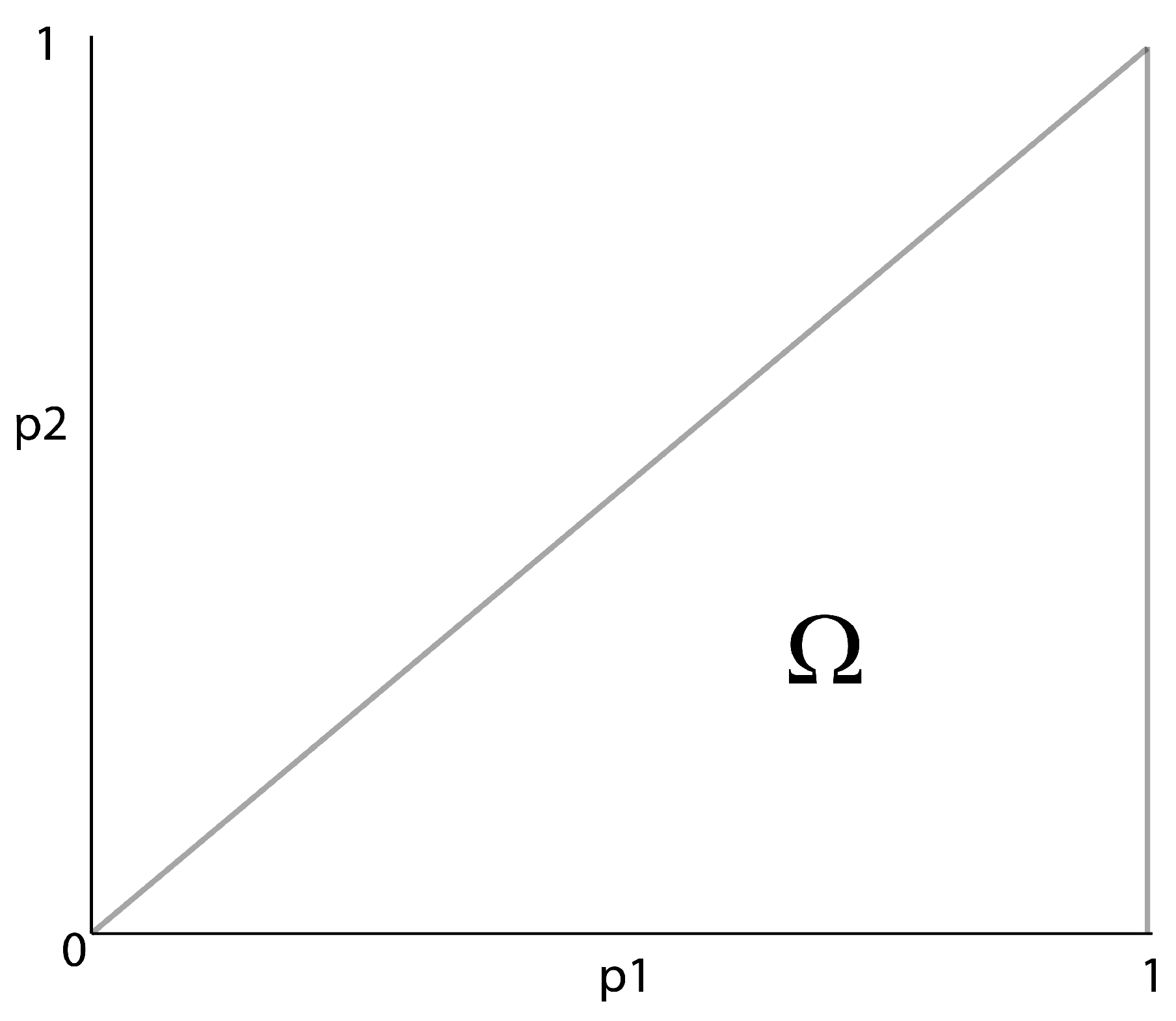
Figure 1 shows the set of bids for .
Without loss of generality, we restrict attention to pure strategies for the informed bidders.12 A pure strategy for informed bidder i is written as . A pure strategy for uninformed bidder j, is simply a bid . A mixed strategy for uninformed bidder j is given by a probability distribution over .
2.2. Market-Clearing Price and Allocation Rule
The market-clearing price is defined as follows.
Definition 1.
For any , the market-clearing price is given by the highest price at which demand exceeds or equals K units. Thus
This is the standard definition used in the auctions relevant here. (See, for example, Garbade & Ingber, 2005).
Finally, the quantity won by a particular bid needs to be specified. Suppose bidder submits a demand function specifying positive prices for k units, . Also, let be the highest integer below k such that . The winning function is specified below.
where13
Each winning bidder pays the market-clearing price for each unit won.
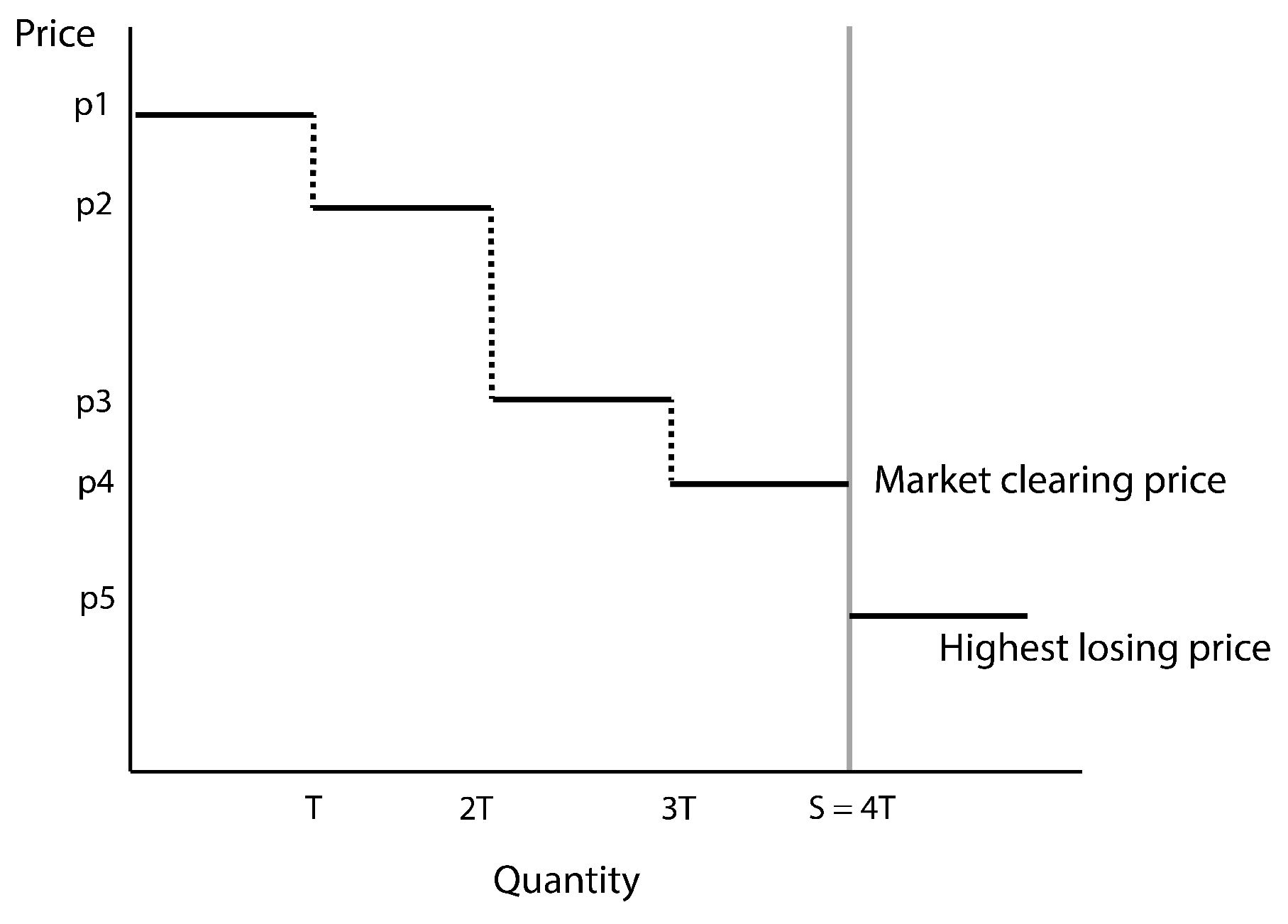
Figure 2 shows the market-clearing price in the case (that is, the market-clearing price is the 4th ranked bid starting from the highest ranked) and . The literature defines the price in a uniform-price auction as the highest losing price, while we define it as the market-clearing price (the lowest winning price). Our definition reflects actual practice in Treasury auctions relevant for the application here.
In this setting, an equilibrium is a standard (Bayesian) Nash equilibrium.
Definition 2.
A profile of strategies of participating bidders is an equilibrium if they constitute a mutual best response, so that they form a (Bayesian) Nash equilibrium and the resulting payoffs are such that all participation constraints hold, which requires that uninformed bidders earn a strictly positive profit.
The rest of the paper is organized as follows. The next section analyzes discriminatory auctions and shows that uninformed participation is not possible, and discusses the issue of information aggregation. Section 4 considers these questions under uniform-price auctions. Section 5 compares the outcomes of the two auction formats. Section 6 discusses applications to repo auctions, explains the usefulness of fixed-rate tenders and provides some background information on these auctions to justify the use of the common-value model in analyzing such auctions. Finally, Section 7 concludes.
3. Discriminatory Auctions
3.1. Derivation of Equilibrium Bids in a Discriminatory Auction
Consider a demand function submitted by a bidder (informed or uninformed). Let denote the probability that wins. The payoff from the bid is . The bidder maximizes this with respect to . However, for any , enters only the k-th term in the sum, and the maximization problem is identical across the terms. Thus, for each k, the maximized value of is the same: . Let be the common maximized value. Thus, the optimal bid function is a flat demand function at a price .
Given this, we consider only flat demand functions, i.e., a pure strategy specifies a single price at which the entire quantity is demanded. Thus, we can meaningfully refer to this price as the “bid” of a bidder. We will implicitly assume that the quantity demanded at any such bid price is T.
We first assume that only the informed bidders participate in the auction and solve for the optimal bidding strategy in a discriminatory auction. Throughout, we consider, without loss of generality, the problem of bidder 1, receiving .
As noted previously, we assume there is an integer m such that . This implies that the market clears at the m-th highest price. Clearly, . Further, even the m-th highest bid wins all T units rather than a fraction. This assumption allows us to simply consider the price bid and simplifies the analysis.
Since the m-th highest bid is the lowest winning bid, bidder 1’s bid wins if it exceeds the bid of the bidder with signal .
Recall that denote the highest to lowest among signals of bidders other than 1. Let denote the conditional density of the m-th ranked signal among bidders other than 1 given the signal of bidder 1. Similarly, let denote the distribution of given .
Let and .
We assume an increasing, differentiable and symmetric equilibrium bid function . To derive this function, assume bidders follow this while bidder 1 bids b. The expected payoff of bidder 1 is given by
The first-order condition for a maximum is
For to be an equilibrium bid function, we need the first-order condition to hold at , which implies the first-order differential equation
with the boundary condition that . Note that, unlike a standard first-price auction, need not be zero here. This is because a bidder drawing a value 0 and placing the m-th value at 0 would know that values exceed 0; therefore, the expected value of any unit being auctioned need not be zero. This will become clear in our simple model as noted below.
The solution to this for the general affiliated signals is a straightforward extension of Milgrom and Weber (1982). Under our simple model, we can solve this using the distributions14
and
Further,
Note that
which is 0 if the market clears at the top bid (that is ), but positive in other cases.
For (implying that the highest bid wins, that is, we have a standard first price auction over units), Equation (2) reduces to
with the boundary condition . Using Equation (3), this can be solved directly as
While we can derive solutions beyond , they become fairly complex. Plotting solutions for specified numerical values of n and m is more informative.
Note that given any fixed T, rising m is equivalent to a larger total supply. This helps us discuss rising supply as a rise in m. We come back to this later when discussing information aggregation across auctions.
3.2. An Example with
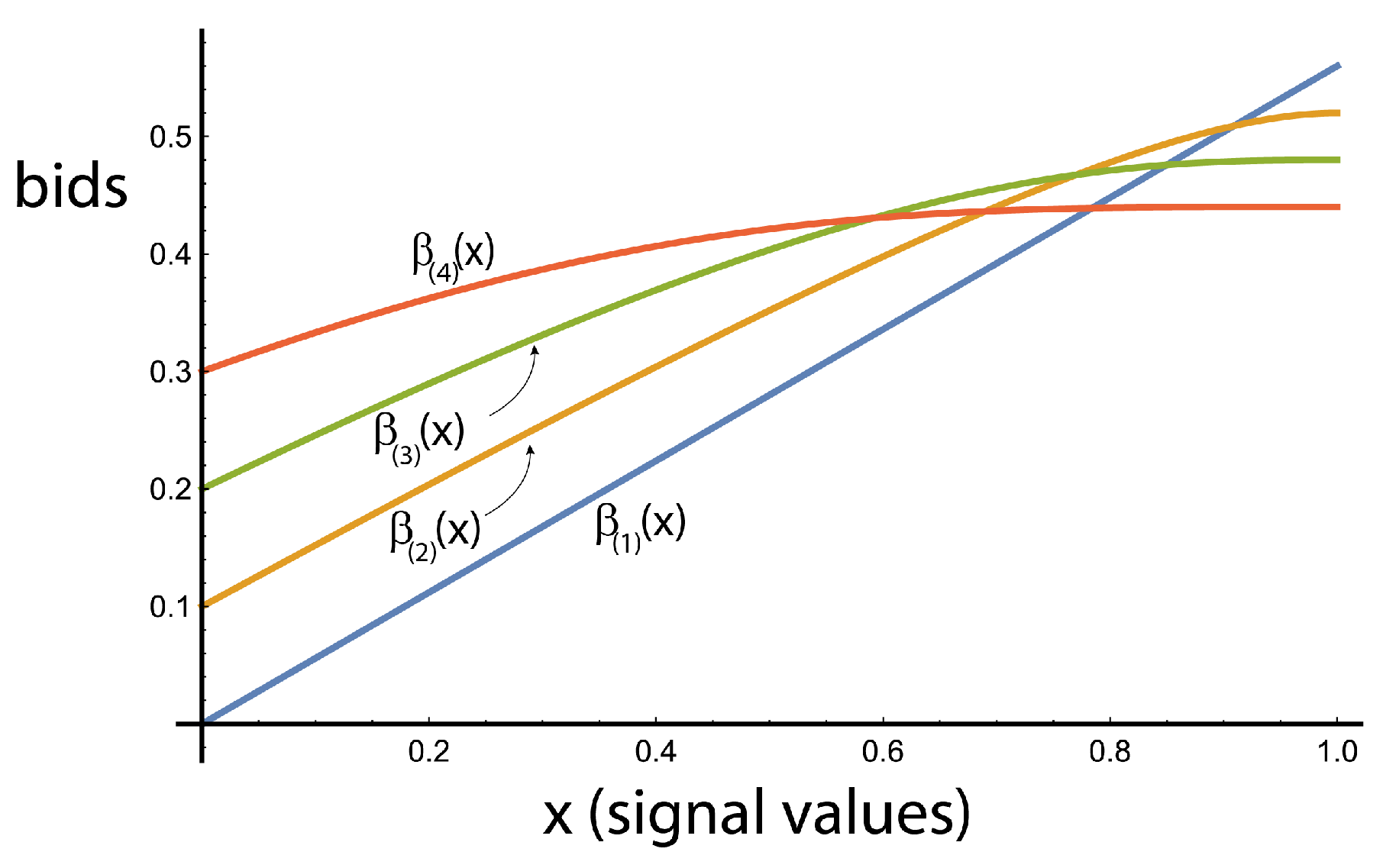
To fix ideas, we provide an example below for and for . Let denote the solution for any given value of m. Solving Equation (2), with the boundary condition given by (4), the solutions for and are as follows.
Figure 3 shows the solutions. Note the role of boundary conditions: for ; hence, even at a signal 0, bids are positive. Essentially, even a bidder drawing a value of 0 and given expects positive signals from others, and therefore the expected value for each unit is strictly positive. Further, for higher values of m, there is a lower incentive to increase bids as the signal rises since winning only requires beating .
3.3. Impossibility of Uninformed Participation
Proposition 1.
In a discriminatory auction, it is not possible to have participation by uninformed bidders in equilibrium.
Proof.
Suppose not. Suppose there is an equilibrium in which each uninformed bidder plays a mixed strategy that induces some distribution of bids over where . Note that this is a general specification that can also accommodate pure strategies (a degenerate distribution over prices). If any such mixed strategy can be employed profitably by an uninformed bidder, this means the uninformed bidder would bid such prices over T units. This also means that all other uninformed bidders would bid similarly, so that all uninformed bidders would play such a mixed strategy. Since the number of uninformed bidders is where , the market-clearing price is always above .
Now, the minimum price at which informed bidders demand any units is . If , the probability that wins is zero since the probability that at least m informed bidders get signals above is 1. This implies that uninformed bidders cannot earn a positive profit, and therefore, given a small entry cost , no uninformed bidder would enter.
Next, suppose . Since bids at prices below do not win, plays a role similar to a reserve price. In any equilibrium with , the best response of informed bidders would involve the following.
Let be such that
For (), bidder 1 bids higher (lower) than . The latter bids get a zero payoff since they do not win. In other words, whenever the expected value given the signal is higher than , each bidder bids above . Then the boundary condition becomes .
Now, let . If , the market clears at a price strictly above . That is, the payoff of an uninformed bidder bidding some quantity at price is positive only if . Also, let denote the public information, which is the distribution of signals. Uninformed bidders observe only . Since bidder 1 also has access to public information and receives signal in addition, adds no further information to signal , implying that .
The expected payoff of an uninformed bidder from a bid at price is given by
where the last step follows from Equation (6).
Thus, the payoff of an uninformed bidder from a bid at price is non-positive. It follows that for any price in the support of the mixed strategy, the payoff is non-positive. Therefore, given any small entry cost, there is no equilibrium in which uninformed bidders participate in the auction. □
3.4. Extension: Information Aggregation
Finally, if we extend our model so that the number of informed bidders, as well as supply, becomes large, the price in the auction for every unit of the object converges to the expected value of the object. In this sense, the discriminatory auction that we analyze aggregates information. Formally, a rise in n implies a rise in the number of bidders, and m rising close to n captures the supply rising. To see the latter, recall that each bidder can demand at most T units and . With a fixed T, a rise in m implies an increase in S.
We know that . To capture the simultaneous increase in the number of bidders and supply, put . That is, for any n, the supply expands so that all but the lowest bid wins. In this case,
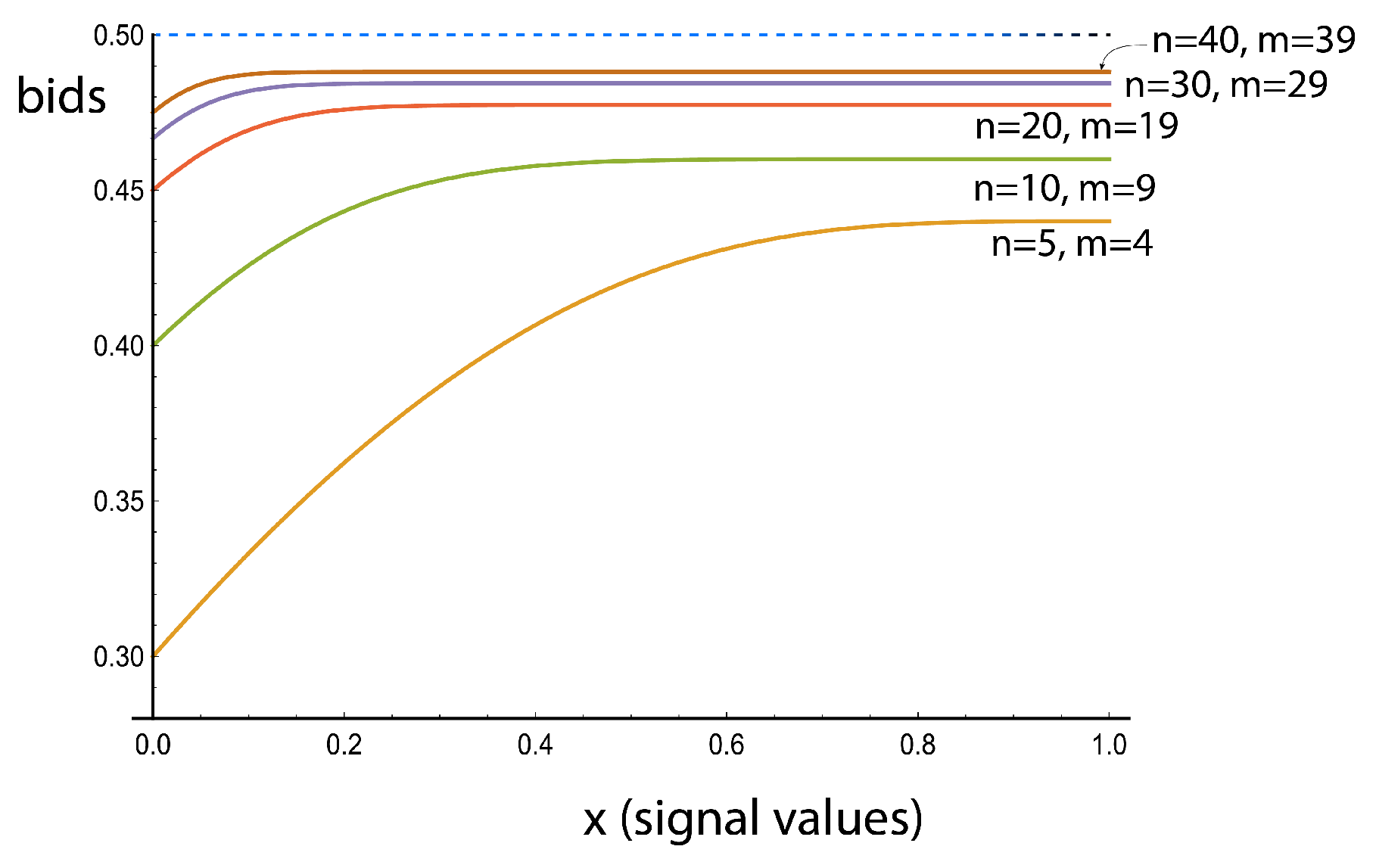
We also know that the bid function flattens out for high values of m since almost all bids win, so that beyond an initial rise in bids when the signal rises from zero (which already raises the probability of winning to close to 1), there is no incentive to raise bids further. Figure 4 shows this effect.
Further, with , as n goes to infinity, . Further, the expected value of each unit is
And as , the actual value converges to 1/2. Thus, in the limit, bids cannot exceed 1/2. Therefore, and remains flat at the limiting value for . Thus, in the limit, the auction price reflects the value per unit, so that the auction aggregates information.
However, as noted in the introduction, this is not always true in a discriminatory auction. Jackson and Kremer (2007) show that discriminatory auctions may not aggregate information. Thus, our result of aggregation is not general. However, our result on this issue for a uniform-price auction is more interesting and makes a case against the literature. We discuss this further in the next section.
4. Uniform-Price Auctions
In a uniform-price auction, all bidders pay the same market-clearing price. This price and associated quantities have been defined in Section 2.2.
Note that this definition of a uniform-price auction is different from the usual definition in the literature. The latter defines the uniform price as the highest losing bid, rather than the lowest winning bid, as here. However, in the relevant real-life auctions, the definition is the lowest winning bid. To see the difference starkly, suppose S goes to 1. Then our uniform-price auction approaches a first-price auction, whereas the one defined in the literature approaches a second-price auction. The analysis of these differs considerably. Our analysis is of a uniform-price auction as actually implemented in practice. We are not aware of any other analysis of this auction.
4.1. An Equilibrium with Uninformed Participation
In this section, we construct an equilibrium with successful uninformed participation.
Proposition 2.
The following strategies form an equilibrium.
- 1.
- Uninformed bidder j submits the following demand function:where .
- 2.
- Informed bidder i receiving signal submits the following demand function:demand units at price , where and where
In this equilibrium the uninformed bidders win all but 1 unit, and informed bidders win only 1 unit. Note that uninformed bidders submit their quantity demand of units at the highest possible price. Thus, effectively, there is a single unit remaining that any other bidder can win. The result says that informed bidders compete over this unit. Therefore, informed bidders face a single-unit first-price auction (which is the same as a discriminatory auction with ), and bid accordingly. The market clears at the winning bid in this auction, which is the lowest winning bid. Since the market only clears at prices bid by informed bidders, the uninformed bidders earn a positive payoff and therefore participate successfully.
We now show that the strategies above form an equilibrium.
Proof.
First, given the strategy profile of uninformed bidders, each informed bidder can win at most 1 unit. The informed bidder with the highest price bid wins 1 unit, and their bid is also the market-clearing bid. Thus, informed bidders face a single-unit first-price auction, that is, a discriminatory auction with n bidders and .
Since only the price bid over the first unit matters for informed bidders, we refer to this as their “bid.” The solution for this has been derived in the previous section, and given by Equation (5), which is as stated in the Proposition. This proves that the stated strategy for each informed bidder is indeed a best response given the strategies of the uninformed bidders.
Next, we need to show that the strategies of the uninformed bidders are best responses. First, if an uninformed bidder demands a further unit at any positive price p, the market now clears at the maximum of p and the highest price on the first unit submitted by informed bidders, rather than only the latter. Thus, there is a loss of payoff over the infra-marginal units. On the marginal unit, the extra payoff is
Let denote the highest to lowest ranked signals.
where .
The conditional mean of uniform order statistic of order k is . Therefore
Using this,
and strictly negative for . Therefore, a deviation by an uninformed bidder to demand a further unit at any positive price p is unprofitable.
Second, if an uninformed bidder demands a unit less, that does not lower the market-clearing price, and thus lowers the payoff. Thus, there is no profitable deviation in terms of quantity demanded. Finally, the market does not clear at uninformed price bids, and by deviating to any price below the market-clearing price, an uninformed bidder would win no units. These two facts imply that there is no profitable deviation from the price at which uninformed bidders demand their units. These arguments prove that the strategies of the uninformed bidders are indeed best responses.
Finally, the equilibrium can accommodate a small entry cost for each uninformed bidder as every bidder earns a strictly positive payoff. Indeed, the total payoff of the uninformed bidders is simply times the payoff of the winning informed bidder. This completes the proof. □
We can also generate other equilibria with the same basic structure: suppose informed bidders bid T units at price 1 and uninformed bidders bid some positive quantity q at price 1 such that units. Suppose bidder i from the remaining informed bidders submits over T units, where
Note that the informed bidders cannot bid on further units, and thus cannot compete over the last unit. Using the same reasoning as in the proof of Proposition 2, we can rule out uninformed bidders competing over the last unit. Finally, the informed bidders who compete over the last unit are simply submitting optimal single-unit bids given remaining informed bidders. Therefore, the strategies form an equilibrium. Note that here we still have successful uninformed participation, though not as extreme as the previous equilibrium.
4.2. Extension: Information Aggregation
While we constructed equilibria with uninformed participation above, these equilibria still aggregate information as the number of bidders becomes large. To see this, consider the equilibrium in Proposition 2. Note that for large n, the value of each unit is almost certainly 1/2. The expected uniform price paid for each unit is
where is the highest ranked signal. We know that
Therefore, the expected revenue per unit is
which clearly rises to 1/2 as n becomes large.
Similar reasoning applied to the other equilibrium shows that it also aggregates information.
However, the equilibrium described above depends quite delicately on our assumptions. For example, informed bidders can only win a single unit. The fact that informed bidders still enter the auction rests on assuming there are no entry costs. However, given some administrative costs of bidding, it might well be that it is not worth participating unless at least some units might be won. That is, for an auction with a large number of units, each unit might be thought of as very small compared to the market. However, the equilibrium with information aggregation depends on competition over this single unit, driving the result.
If we then assume that informed bidders also face an entry cost and that bidders must have scope for winning at least units in order to participate in the auction, we can have equilibria with no information aggregation. The following result constructs such an equilibrium.
Specifically, we assume that informed bidders face an entry cost , and the following holds. Consider the problem of informed bidder 1 with signal . There is a t where such that
Assumption 1.
.
Consider the set of all bidders (informed and uninformed). This is the set with cardinality . Let us attach a number k to each bidder, . Recall that . Suppose n is large.
Proposition 3
(Uninformative equilibrium for large n). For large values of n, the following strategies form an equilibrium.
- 1.
- Bidder submits the following demand function: demand T units at all prices .
- 2.
- Bidder m submits the following demand function:
- Demand units at all prices ,
- Demand T units at price 0,
- 3.
- Bidders do not participate.
Note that in this equilibrium, the aggregate demand at price 1 is , and the market-clearing price is zero. Even though n is large, no information is aggregated and while the value of each unit converges to 1/2, the price remains much below. Note that m being large or small plays no role—in all cases, price remains below the value of each unit.
Proof.
Bidders participate and win T units each at price 0. It is not possible to have a better payoff than this for any of these bidders. Therefore, the strategies for these bidders are the best responses. It only remains to consider the bidders who do not participate. Consider any such bidder j. By participating and placing any bid over t units or more, j wins units and gets a payoff of where the last equality follows from Assumption 1. Therefore, such a deviation is not profitable, and not participating is the best response. This completes the proof. □
As noted in the introduction, Pesendorfer and Swinkels (1997) show that the unique symmetric equilibrium in uniform-price auctions aggregates information when the number of objects, as well as the number of bidders who do not win, becomes large. Here, we show that these auctions also admit equilibria where some bidders effectively corner the market by bidding very high prices, while competition over the remaining units might aggregate information—but in the presence of some entry cost, the lack of competition over the remaining units might fail to aggregate information. Our results suggest that uniform-price auctions are not reliable as information aggregators, and the equilibrium price is uncertain as it depends on factors such as entry costs.
5. Comparing Auction Formats
Let us compare the results across auction formats.
- First, it is clear that while discriminatory auctions do not allow scope for uninformed participation, uniform-price auctions do. Such uninformed participation can reduce the payoff of informed bidders severely.
- Second, the latter might involve bid functions that bid quantities at very high prices—so that it is the marginal units that determine the price paid per unit. Competition by informed bidders over the marginal unit implies that the auction price is determined in a single-unit first-price auction over the unit, that is, in a discriminatory auction with . On the other hand, a discriminatory auction is typically one with , and large auctions can have high m.
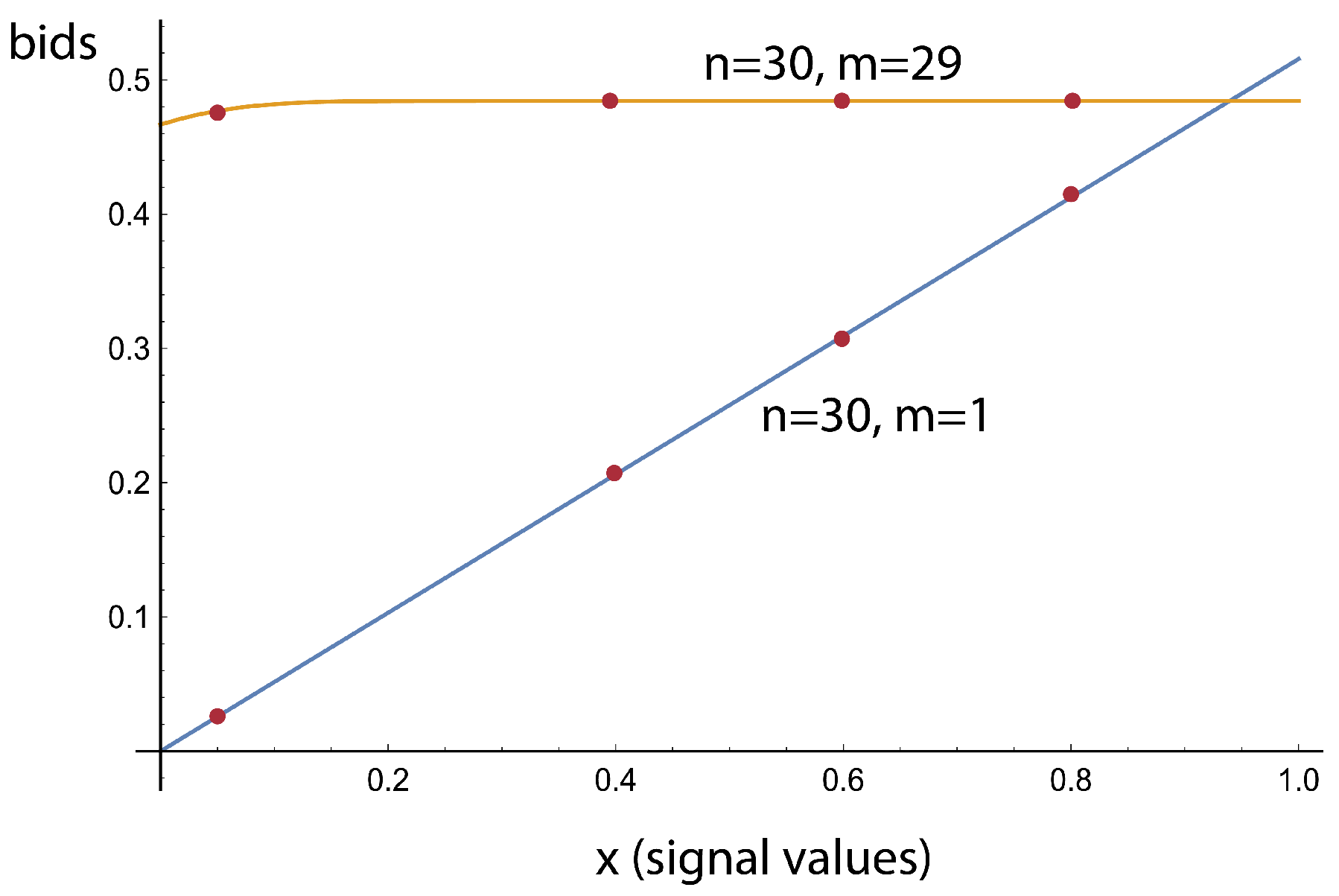
- From the analysis of discriminatory auctions, we know that for a given signal x, equilibrium bids with higher values of m are higher. Further, for high values of m, bid functions start at then rise only slightly before flattening out. This suggests that the average price received in the auction is very close to .As an example, Figure 5 below compares the bid functions in a discriminatory auction with (the one applicable in determining the price in a uniform-price auction) and a high value of m (). For both auctions, . In a discriminatory auction, the 29 highest bids would win. Suppose the lowest of the 29 signals is 0.05, and the highest is 0.8. The dots show the equilibrium bid amounts for these and two other signals, 0.4 and 0.6, under each value of m. Note that the market-clearing price in the uniform-price auction is the highest bid given , implying a per-unit revenue of approximately 0.42. The average per-unit revenue under a discriminatory auction is the average of the 29 bids. The highest and lowest bids are both approximately 0.48, as are the bids for all values in between. Therefore, the average is also approximately 0.48. Revenue is clearly higher under a discriminatory auction in this case. Of course, if the highest value is close to 1, so that it is above the crossing point of the two bid functions in Figure 5, revenue would be higher under the uniform-price auction. These differences vanish asymptotically, as shown in the discussion on information aggregation.
- Figure 5 also points to a comparison of the variability of prices. Under a uniform-price auction, the line determines the uniform price. This clearly varies with x. However, the price under a discriminatory auction with high m is stable around . That is, different configurations of realised values lead to the same per unit average revenue, and the variance of the auction price is very low. Thus, discriminatory auctions with relatively high m lead to very stable auction outcomes.
- Considering the extensions to information aggregation, we see that a uniform-price auction allows scope for different equilibria, including ones that are entirely uninformative. Variations in entry costs or the extent of uninformed bidding might affect the equilibrium. Thus, the outcome is uncertain. In our simple model, the discriminatory auction aggregates information, though this is not a general result. However, even if a discriminatory auction equilibrium does not aggregate information fully, it never allows for an uninformative equilibrium. Again, discriminatory auctions produce a more stable result.
Let us now make use of these differences to understand auction-format choices in applications.
6. Application to Repo Auctions
The results above establish that uninformed bidders can successfully participate in a uniform-price auction. They also show that participation by uninformed bidders reduces the information rent of informed bidders. Indeed, anecdotal evidence suggests that in the Bundesbank repo auctions before 1988, bigger and better-informed banks were unhappy with the use of a uniform-price format.
The results also show that a discriminatory format hinders uninformed participation. In a repo auction, this suggests that a group of informed bidders participates regularly. As shown above, given a relatively high value of m (number of bidders who win positive quantities), the per-unit price would not change very much. This allows the seller to anticipate the average auction price under different values of m (that is, under different values of S, since a rise in S is the same as a rise in m given a fixed T). In a uniform-price auction, on the other hand, it is harder to predict the market-clearing price as it depends on the extent of uninformed participation and also on factors such as entry costs. This reduces the ability of the central bank to steer interest rates by adjusting supply.
Participation by uninformed bidders can also affect the way the money market interprets the repo rate from the auction (the market-clearing rate). The market does not observe the extent of uninformed bidding or the prices at which uninformed bidders demand quantities. If the auction rate is low, this implies all signals are low, which is informative. However, a high repo rate could be caused by even a single high signal if the uninformed bidders bid high rates15 on a large number of units. This is relatively less informative. This indicates that a low repo rate should have a greater impact on the money market compared to a high repo rate. As Nautz (1997) reports, this is what happened under the Bundesbank uniform-price repo auctions. He shows that when the Bundesbank used uniform-price repo auctions, the money market adjusted almost completely to low repo rates, while very little adjustment occurred when repo rates were high16. This suggests a further problem in steering interest rates. Even if the central bank were able to vary supply and affect the average rate inversely, it would be difficult to raise the rate.
Thus, there is a conflict between uninformed participation and the ability of the central bank to steer the interest rate under a uniform-price auction. Our results offer an explanation for the Bundesbank experience with uniform-price repo auctions and explain the policy choice of central banks to move away from the uniform-price format in conducting monetary policy through repo auctions.
6.1. Fixed-Rate Tender
Central banks such as the Fed and the Bank of England deal with a small group of counterparties (e.g., primary dealers in the US). For other central banks, such as the ECB, it can be important to have a democratic and open process of liquidity provision, which does not put smaller, less-informed banks at a disadvantage. However, as our results show, discriminatory auctions hinder participation by uninformed bidders. Under a uniform-price auction, on the other hand, participation by relatively uninformed bidders is possible, but such participation reduces the ability of the central bank to steer interest rates. One solution to this problem is to move away from auctions and have a fixed-rate tender. Since the 2008 global financial crisis, the ECB has primarily a “fixed-rate full allotment” policy. Under this regime, the ECB satisfies the full quantity of liquidity submitted by banks, provided they post adequate collateral. As noted by Bindseil (2004), by fixing a rate, the central bank can steer rates transparently. Further, since bidders only submit quantities, uninformed participants face no disadvantage. This proves the following corollary.
Corollary 1
(Fixed-Rate Tender). Unlike discriminatory or uniform-price auctions, a fixed-rate tender allows a central bank to steer interest rates effectively, and achieve wide participation from bidders at the same time.
However, a fixed-rate scheme has its own problems. Not all central banks want to give an equal advantage to uninformed bidders. Further, fixed-rate tenders do not aggregate any information that participating bidders might have since they simply submit quantities. As our results suggest, a discriminatory auction would aggregate at least partial information and prevent uninformed participation. Further, as we showed, such auctions can also be effective at steering rates. Therefore, a central bank that wishes to engage with a small group of bidders and aggregate at least partial information would prefer a discriminatory auction to a fixed-rate tender.17
6.2. Repo Auctions: Justifying the Use of a Common Values Model
In this section, we provide some background information about repo auctions and clarify that these are multi-unit common value auctions with demand function bids and heterogeneously informed bidders, and therefore fit our model well.
Since the early 1980s, many European central banks have used securities repurchase operations (repo) to manage the money market. In a repo, a central bank provides liquidity to banks by buying securities that the banks agree to buy back at a forward date (say two weeks). In other words, a central bank repo provides reserves to banks for a specified period against securities that act as collateral.
In a fixed-rate tender, the interest rate is set by the central bank and banks bid only quantities. In other cases, the interest rate at which liquidity is provided is decided through an auction. A variable rate repo auction is a multi-unit auction in which the bidders submit multiple price-quantity pair bids (demand functions), and the pricing rule is either discriminatory or uniform-price.18 In a discriminatory auction, bidders pay their own bids for units they win in an auction. In a uniform-price auction, in contrast, all winners pay the market-clearing price, which is defined as the highest bid at which aggregate demand equals or exceeds supply (i.e., the lowest price at which some positive quantity is won by some bidder).19
Let us now clarify why a common value model best captures a repo auction. The demand for reserves by banks depends partly on the requirement for settlement balances arising out of the institutional characteristics of payment and settlement arrangements. This part of the demand (which is the private value component) is very insensitive to interest rates (See Borio, 1997). Thus, the private value component of the demand is of little importance in the analysis. The other part of the demand for reserves depends entirely on expectations about future interest rates. Since repo rates determine future refinancing conditions for a bank, such expectations matter a great deal.20 Thus, signalling of policy stance is an important aspect of monetary policy implementation. Further, if a bank expects, say, the policy rate to rise during the reserve period, it could borrow from the central bank early in the period and, if the expectation turns out correct, would make a profit simply by holding those funds as required reserves. This motive for acquiring reserves is, of course, driven purely by a common value.
The importance of expectations implies that a common value auction model in which the quality of a bidder’s guess about the future plays a key role is the natural setting for analyzing repo auctions. Bidders are allowed to bid demand functions in these auctions. Further, a few bigger banks participate regularly and are typically better informed about the future rates than others. Therefore, repo auctions fit our model well.
7. Conclusions
Discriminatory auctions preclude uninformed participation. Under a uniform-price format, on the other hand, successful uninformed participation is possible. This confirms the informal conjectures by Friedman and shows that the latter format is appropriate for encouraging greater participation. However, uninformed participation in a repo auction can reduce the ability of the central bank to steer interest rates. The results provide an explanation for the contrasting policy choices observed in repo auctions and Treasury auctions. The Bundesbank in the 80s abandoned the uniform-price format for repo auctions. The US Treasury, on the other hand, switched to using only the uniform-price format in selling government bonds. The results also suggest that neither auction format is appropriate in achieving wide participation, along with the ability to steer interest rates. This sheds light on the fact that the ECB, as well as several other central banks, prefer to allocate liquidity through a fixed-rate tender rather than an auction. Our results also relate to the question of information aggregation. A fixed-rate tender does not aggregate information by its very construction. Among auctions, discriminatory auctions are never uninformative, while uniform-price auctions might have uninformative equilibria in the presence of small entry costs.
Funding
This research received no external funding.
Data Availability Statement
The original contributions presented in this study are included in the article. Further inquiries can be directed to the corresponding author.
Conflicts of Interest
The author declares no conflicts of interest.
| 1 | Klemperer (2002, 2003) has emphasized several practical aspects of auction design that impact revenue, efficiency and incentive for bidders to collude. As Klemperer points out, an important concern is to ensure entry by relatively weaker bidders. This is important from the perspective of revenue raising, especially if there are few bidders. The importance of attracting entry is further clarified by Bulow and Klemperer (1996). |
| 2 | Repo auctions are auctions used by many central banks to “sell” money to the banking sector. Eligible banks bid demand functions and obtain liquidity at the auction-determined price. (The bids specify interest rates rather than prices, but since interest rates map one-for-one into prices, the formal analysis is conducted in terms of demand functions.) Since these auctions are not very well known, we have included a description in Section 6.2 which also provides a justification for the use of a common-values model in analyzing these auctions. |
| 3 | In the UK, these are the GEMMs (Gilt-Edged Market Makers), and in Germany these are members of the “Bund Issues Auction Group”. |
| 4 | An exception is the Fed, which conducts open market operations through discriminatory repo auctions with a few primary dealers as bidders. However, since it directly announces the target Fed funds rate, the repo auctions have no role in steering rates. |
| 5 | US Treasury auctions are multi-unit common value auctions (the securities obtained in the auction are resold in the secondary market) in which bidders submit demand functions, and in which small, uninformed bidders compete with a few large, informed bidders. There are primary dealers who participate regularly. They receive orders from customers (hence get a signal of aggregate demand) and bid on their behalf. There are also uninformed institutional bidders bidding on their own account occasionally, mostly for exogenous liquidity-demand-driven reasons. Therefore, the setting fits Treasury auctions well. The relevance of the setting for repo auctions is clarified in Section 6.2. |
| 6 | The literature on multi-unit auctions typically defines the market-clearing price as the highest losing bid. However, the definition used here is the definition used in all known practical applications, including Treasury auctions and repo auctions. The results derived in any analysis of such auctions do depend on this definition, and any analysis under the alternative definition would not be useful for applications. |
| 7 | In a press conference, the governor said: “The single rate method was chosen in order to encourage less experienced counterparties to participate in the tender. The Governing Council takes the view that all interested counterparties should by now be sufficiently accustomed to the longer-term refinancing operation also to be in a position to participate in this type of operation under the more market-oriented multiple rate (American) method of allotment.” (The President’s Introductory Statement, Press Conference, 4 March 1999, ECB). |
| 8 | See (Bindseil, 2004) for a detailed exposition of these issues. |
| 9 | However, the main results do not depend on this simple specification, and can be extended to the general symmetric model with affiliated signals as in (Milgrom & Weber, 1982). |
| 10 | We could assume informed bidders have the same entry cost—this would simply change the minimum signal for which the informed traders make a bid (see, for example, Section 7 in Milgrom and Weber (1982)), but otherwise not affect the analysis. The only result for which this matters is about information aggregation in uniform-price auctions. We introduce an extra assumption there. For the rest, we assume the simpler setting where only uninformed bidders face the entry cost. |
| 11 | As explained in Note 2, bidders in a repo auction bid interest rates, but the use of the term “price” is without loss of generality. In particular, a higher price corresponds to a higher interest rate in a repo auction. In a Treasury auction, on the other hand, the interest is paid by the Treasury to the bidders—so a higher price corresponds to a lower interest rate. |
| 12 | This is without loss of generality because the signal received by informed bidder i is random, which induces mixing. Further mixing by informed bidders does not achieve anything new. |
| 13 | If is not an integer, the bidder is allocated the greatest positive integer (including 0) less than this. The remainder is allocated randomly according to proportional probabilities. |
| 14 | These are order statistic distributions standard in the probability literature. |
| 15 | Note that prices in our model directly translate to interest rates—a higher price paid by a bidder corresponds to a higher interest rate paid by a bidder. |
| 16 | Repo rate is low when the difference between the repo rate and the money market rate before the auction is below the median. A high repo rate is defined analogously. Also note that a higher auction “price” corresponds to a higher repo rate. |
| 17 | There could also be factors that have not been modeled here that affect the choice between an auction and a fixed-rate tender. In the former, the central bank sets the extent of liquidity, while the auction sets the rate of interest. In the latter, it is the opposite. Under a fixed-rate tender, access to as much liquidity as banks can justify with their assets might make them less careful in lending since the threat of fund withdrawal by market lenders concerned about the quality of a bank’s assets is diluted. In other words, fixed-rate tenders might create moral-hazard problems and market discipline might not be effective. However, as noted, such concerns are not part of our model and would require a different theoretical framework to explore fully. |
| 18 | The banking industry often refers to discriminatory auctions as “American” auctions and to uniform-price auctions as “Dutch” auctions. However, the literature on auctions refers to descending-price auctions (which are very different from uniform-price auctions) as Dutch auctions. To avoid confusion, we simply use the name uniform-price auction. |
| 19 | An alternative definition of market-clearing price is the highest losing bid. However, the definition used here is the definition used in practice in all practical applications including repo auctions as well as other multi-unit auctions such as Treasury auctions, index-linked bonds sales, IPO auctions, and corporate bond auctions. |
| 20 | See (Nautz, 1998) for a formal model showing that the influence of uncertainty, and the consequent importance of expectations about the future course of monetary policy, is characteristic of a flexible monetary policy design based on repo auctions. |
References
- Ausubel, L., Cramton, P., Pycia, M., Rostek, M., & Weretka, M. (2014). Demand reduction and inefficiency in multi-unit auctions. Review of Economic Studies, 81(4), 1366–1400. [Google Scholar] [CrossRef]
- Ausubel, L., & Romeu, R. (2005). Bidder participation and information in currency auctions (IMF Working Paper No. 2005/157). International Monetary Fund. [CrossRef]
- Bindseil, U. (2004). Monetary policy implementation: Theory, past, and present. Oxford University Press. [Google Scholar]
- Borio, C. E. (1997). The implementation of monetary policy in industrial countries: A survey (BIS Economic Papers, No. 47). Bank for International Settlements. [Google Scholar]
- Bulow, J. I., & Klemperer, P. D. (1996). Auctions versus negotiations. American Economic Review, 86, 180–194. [Google Scholar] [CrossRef]
- Daripa, A. (1997). Quantities rather than prices: Market allocation, informational free-rides, and the value of inside information (Institute of Financial Research Working Paper, IFR 31. This Work Presents Early Results on Uninformed Participation in Uniform-Price Auctions). Birkbeck, University of London. [Google Scholar]
- Engelbrecht-Wiggans, R., Milgrom, P., & Weber, R. (1983). Competitive bidding and proprietary information. Journal of Mathematical Economics, 11(2), 161–169. [Google Scholar] [CrossRef]
- Friedman, M. (1960). A program for monetary stability. Fordham University Press. [Google Scholar]
- Friedman, M. (1964). Comment on ‘Collusion in the auction market for treasury bills’. Journal of Political Economy, 72, 513–514. [Google Scholar] [CrossRef]
- Garbade, K. D., & Ingber, J. F. (2005). The treasury auction process: Objectives, structure, and recent adaptations. Current Issues in Economics and Finance, Federal Reserve Bank of New York, 11(2), 1–11. [Google Scholar]
- Hernando-Veciana, A. (2004). Successful uninformed bidding. Games and Economic Behavior, 48(1), 29–53. [Google Scholar] [CrossRef][Green Version]
- Jackson, M. O., & Kremer, I. (2007). On the informational inefficiency of discriminatory price auctions. Journal of Economic Theory, 132, 507–517. [Google Scholar] [CrossRef][Green Version]
- Klemperer, P. (2002). What really matters in auction design. Journal of Economic Perspectives, 16(1), 169–189. [Google Scholar] [CrossRef]
- Klemperer, P. (2003). Alfred marshall lecture: Using and abusing economic theory. Journal of the European Economic Association, 1(2–3), 272–300. [Google Scholar] [CrossRef][Green Version]
- Milgrom, P. (1979). A convergence theorem for competitive bidding with differential information. Econometrica, 47(3), 679–688. [Google Scholar] [CrossRef]
- Milgrom, P. (1981). Rational expectations, information acquisition and competitive bidding. Econometrica, 49, 921–943. [Google Scholar] [CrossRef]
- Milgrom, P., & Weber, R. (1982). A theory of auctions and competitive bidding. Econometrica, 50(5), 1089–1122. [Google Scholar] [CrossRef]
- Nautz, D. (1997). How auctions reveal information: A case study on German REPO rates. Journal of Money, Credit, and Banking, 29(1), 17–25. [Google Scholar] [CrossRef]
- Nautz, D. (1998). Banks’ demand for reserves when future monetary policy is uncertain. Journal of Monetary Economics, 42, 161–183. [Google Scholar] [CrossRef]
- Pesendorfer, W., & Swinkels, J. (1997). The loser’s curse and information aggregation in common value auctions. Econometrica, 65(6), 1247–1281. [Google Scholar] [CrossRef]
Figure 1.
The set of bids for is the triangle given by .

Figure 2.
The market-clearing price and highest losing price for , .

Figure 3.
Equilibrium bid functions for a discriminatory auction with and .

Figure 4.
Equilibrium bid functions for with . For larger n and with , bids increase a little as x rises from zero, but thereafter remain flat. Given that all but the lowest bid wins, the initial rise already takes the probability of winning close to 1. Therefore, there is no incentive to raise bids further for higher values of the signal.
Figure 4.
Equilibrium bid functions for with . For larger n and with , bids increase a little as x rises from zero, but thereafter remain flat. Given that all but the lowest bid wins, the initial rise already takes the probability of winning close to 1. Therefore, there is no incentive to raise bids further for higher values of the signal.

Figure 5.
Comparing revenue and price variance across auctions. Equilibrium bid functions for a discriminatory auction with and (representing the outcome under a uniform-price auction) and (a discriminatory auction with high m). The dots show the equilibrium bid amounts for signals 0.05, 0.4, 0.6, 0.8 for each value of m.
Figure 5.
Comparing revenue and price variance across auctions. Equilibrium bid functions for a discriminatory auction with and (representing the outcome under a uniform-price auction) and (a discriminatory auction with high m). The dots show the equilibrium bid amounts for signals 0.05, 0.4, 0.6, 0.8 for each value of m.

Disclaimer/Publisher’s Note: The statements, opinions and data contained in all publications are solely those of the individual author(s) and contributor(s) and not of MDPI and/or the editor(s). MDPI and/or the editor(s) disclaim responsibility for any injury to people or property resulting from any ideas, methods, instructions or products referred to in the content. |
© 2026 by the author. Licensee MDPI, Basel, Switzerland. This article is an open access article distributed under the terms and conditions of the Creative Commons Attribution (CC BY) license.
Share and Cite
MDPI and ACS Style
Daripa, A. How to Sell Debt (But Not Money). Games 2026, 17, 13. https://doi.org/10.3390/g17020013
AMA Style
Daripa A. How to Sell Debt (But Not Money). Games. 2026; 17(2):13. https://doi.org/10.3390/g17020013
Chicago/Turabian StyleDaripa, Arup. 2026. "How to Sell Debt (But Not Money)" Games 17, no. 2: 13. https://doi.org/10.3390/g17020013
APA StyleDaripa, A. (2026). How to Sell Debt (But Not Money). Games, 17(2), 13. https://doi.org/10.3390/g17020013
Note that from the first issue of 2016, this journal uses article numbers instead of page numbers. See further details here.