
Feature-Centric Approaches to Android Malware Analysis: A Survey


Abstract
1. Introduction
2. Related Work
Differences with Previous Related Surveys
- Providing a detailed evaluation of feature extraction techniques across four analysis paradigms, with a focus on their applicability to Android devices.
- Offering a structured comparison of feature extraction methods based on accuracy, computational efficiency, and scalability.
3. Background
3.1. Program Representation
3.1.1. Bytecode
3.1.2. Intermediate Representation
3.1.3. Source Code
3.2. Static Analysis Techniques
3.2.1. Call-Graph Analysis
3.2.2. Pattern Match
3.2.3. Software Composition Analysis
3.3. Dynamic Analysis Techniques
3.3.1. System Call Tracing
3.3.2. Network Traffic Analysis
3.3.3. Behavioral Profiling
3.3.4. Dynamic Symbolic Execution
3.4. Hybrid Analysis Techniques
3.5. Graph Learning Representation Techniques
3.5.1. Graph Convolutional Network (GCN)
3.5.2. Heterogeneous Graph Neural Network (HetGNN)
3.5.3. Variational Graph Autoencoder (VGAE)
4. A Summary of the Reviewed Papers
4.1. Selection Rules
4.2. Classification Criteria
4.3. Benchmark Datasets
4.4. Meta-Analysis of Performance
5. Malware Analysis Across Features
5.1. Static Analysis Features
Comparison Among Different Static Analysis Features
5.2. Dynamic Analysis Features
Comparison Among Different Dynamic Analysis Features
5.3. Hybrid Analysis Features
Comparison Among Different Hybrid Analysis Features
5.4. Graph Learning Representation Features
Comparison Among Different Graph Learning Representation Features

| Analysis Type | Feature | Description | Datasets (APK-Only) | Normalized F1 (%) | Strengths/Limitations |
|---|---|---|---|---|---|
| Static | Image-based (DEX to images) | Converts bytecode to grayscale/RGB/ Markov images, used with CNN/ViT models | Drebin, VirusShare, IMG_DS | 94–97% (avg.; 10% drop cross- AndroZoo) |
|
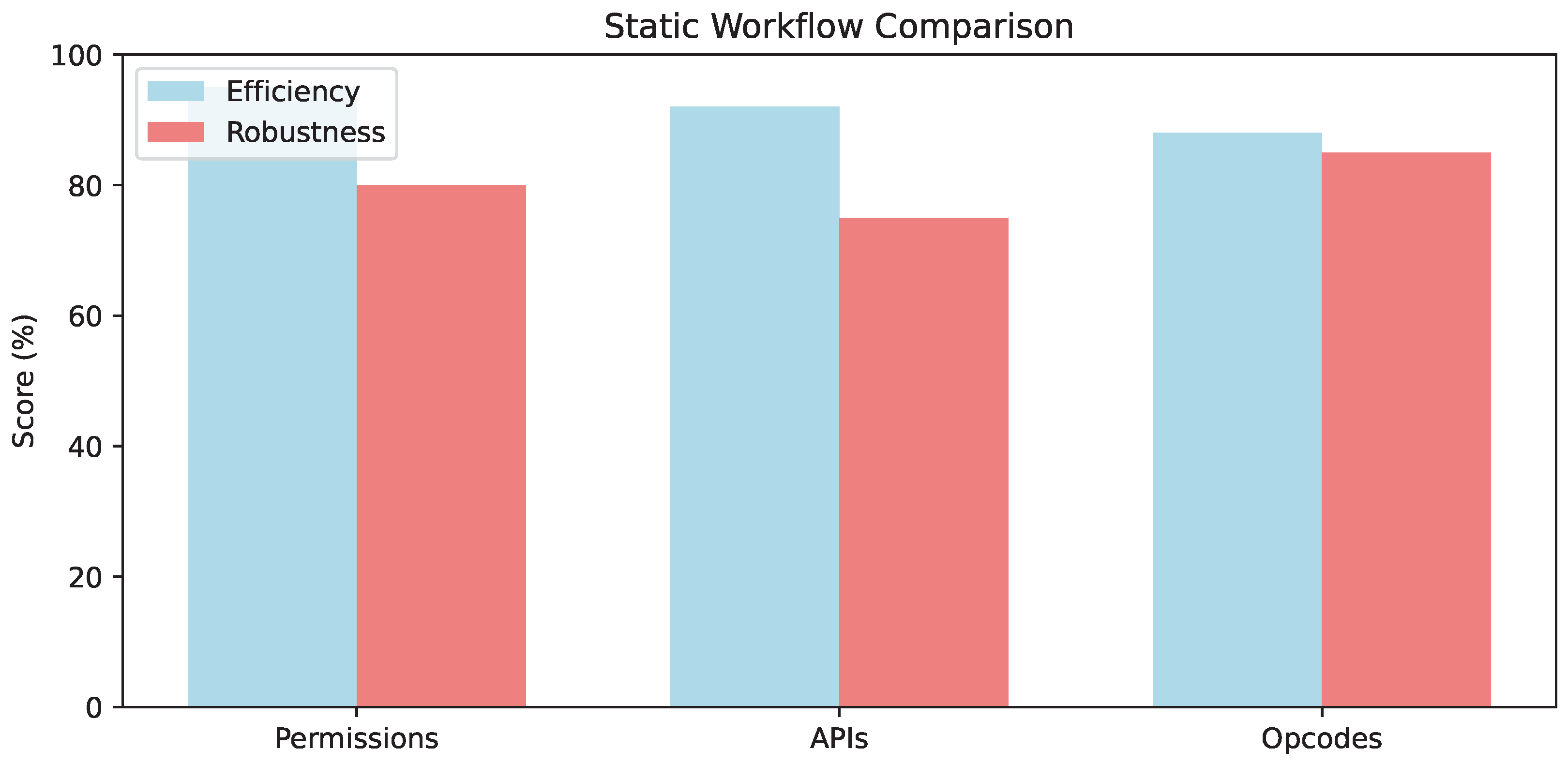
| API calls and Function Call Graphs (FCG) | Extracts sensitive APIs and structural relations; applied with GCN | Drebin, AndroZoo, MalDroid | 89–96% (avg.; 8% drop cross- CICMalDroid) |
| |
| Permissions | Lightweight feature vectors from manifest permissions | CICMalDroid, Drebin | 90–95% (avg.; 12% drop cross- AndroZoo) |
| |
| Opcodes and N-grams | Opcode sequences or Markov images from bytecode | Drebin, AndroZoo | 81–93% (avg.; 14% drop cross- VirusShare) |
| |
| Entropy-based | Entropy histograms of DEX binaries | Drebin, VirusShare | 92–94% (avg.; 9% drop cross- CICMalDroid) |
| |
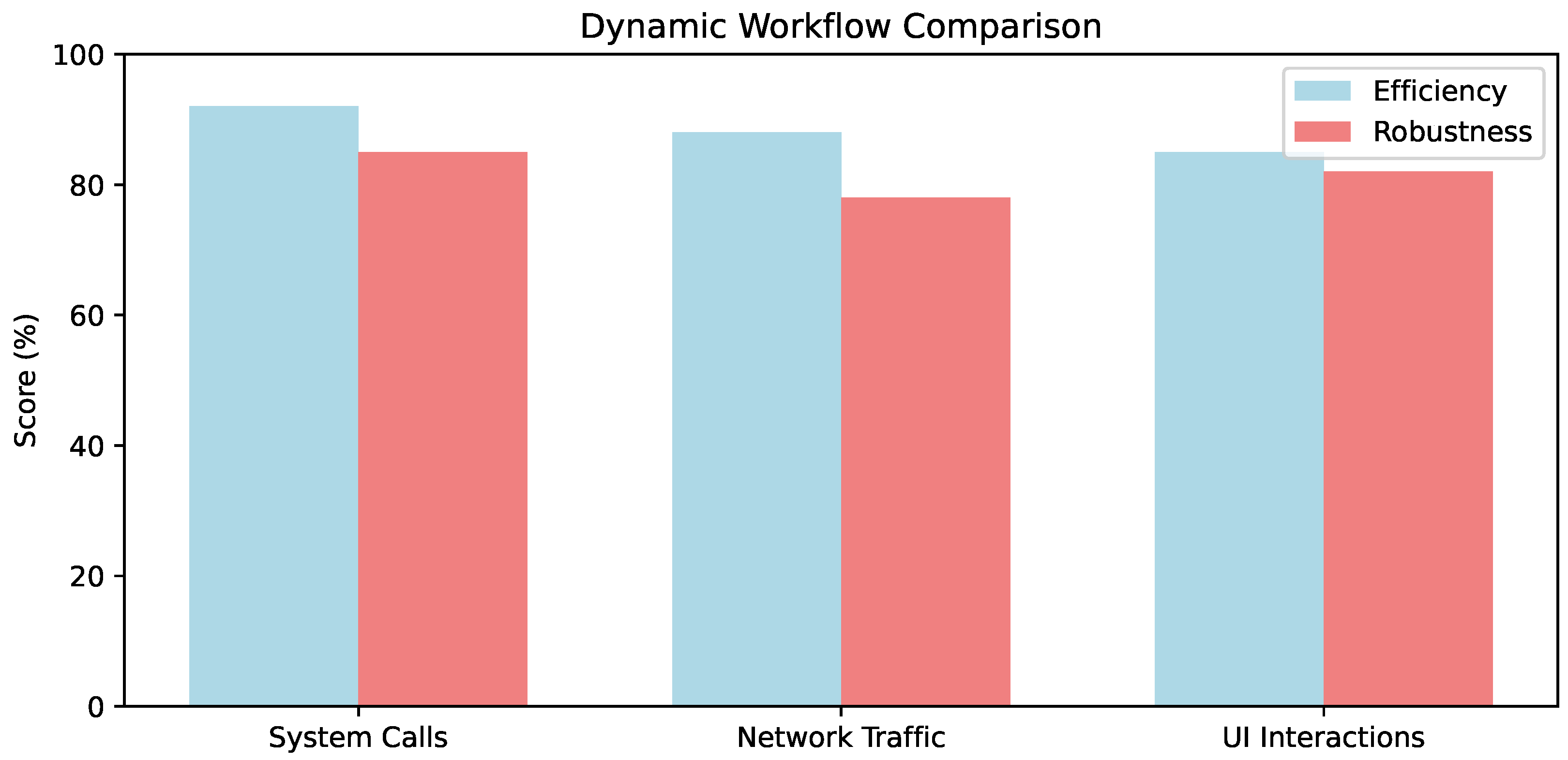
| Dynamic | System Call Tracing | Runtime system/ kernel calls, n-grams, abstractions | Drebin, TwinDroid | 94–96% (avg.; 7% drop cross- AndroZoo) |
|
| Network Traffic Analysis | PCAP flows, HTTP requests from APK runtime | CICAndMal2017, CICInvesAndMal2019 (APK traces) | 80–92% (avg.; 11% drop cross- Drebin) |
| |
| Behavioral Profiling | Captures UI/API/ permission behaviors at runtime | Custom traces, Drebin+benign | 94–96% (avg.; 6% drop cross- CICMalDroid) |
| |
| Dynamic Symbolic Execution (Concolic) | Hybrid concrete + symbolic execution | Lumus, testbeds (APK-focused) | 91–95% (avg.; 9% drop cross- AndroZoo) |
| |
| RL-Adapted Behavioral (APK Traces) and RL-driven APK runtime profiling (e.g., MalBoT-DRL adapted) | APK behavioral traces with RL adaptation | Drebin, VirusShare (APK subsets) | 95–98% (avg.; 5% drop cross- CICMalDroid) |
| |
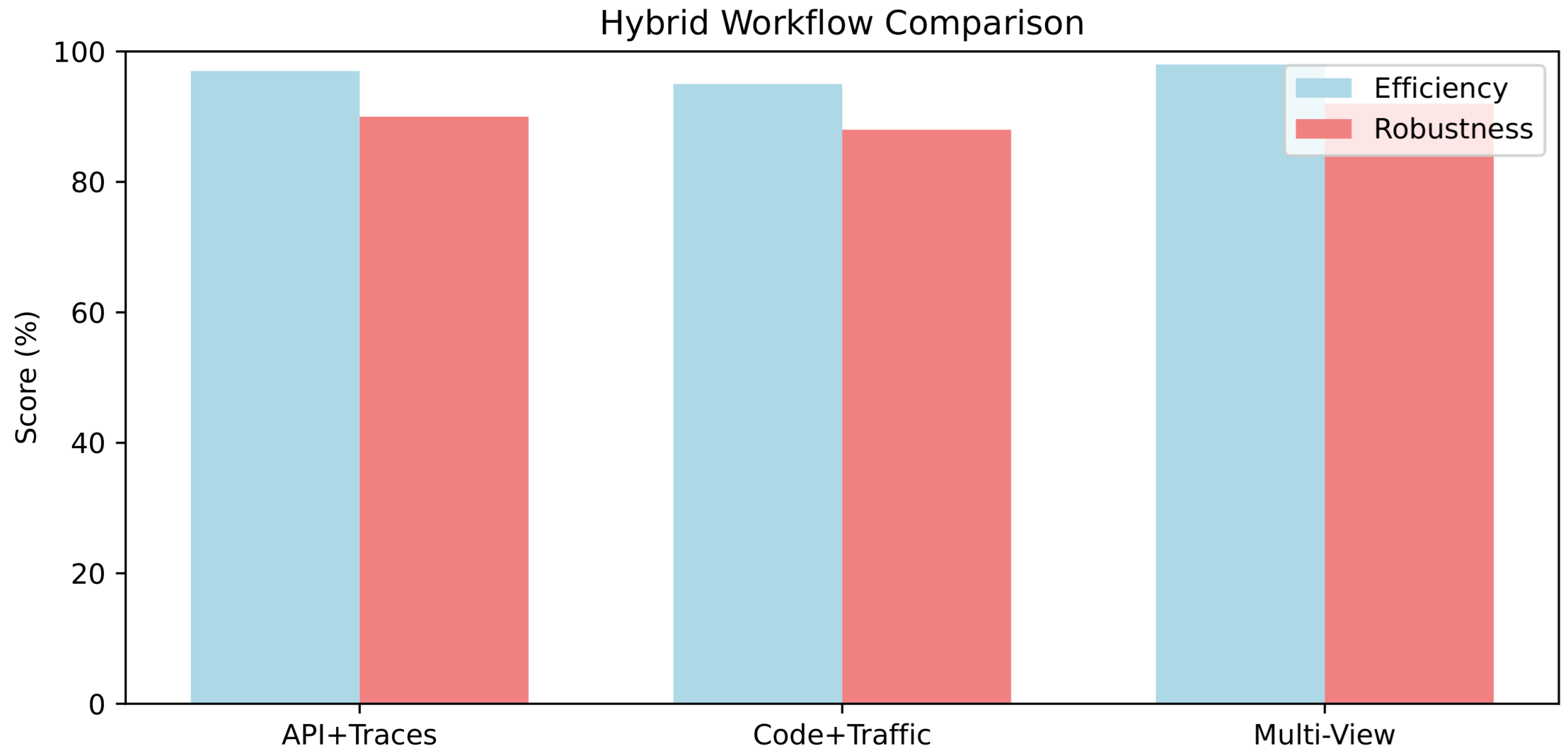
| Hybrid | Static + Dynamic Fusion | Combines API/opcode with runtime traces | Drebin, CICMalDroid | 97–98% (avg.; 4% drop cross- AndroZoo) |
|
| Code + Network Traffic | CFG/structural + traffic features (APK runtime) | Drebin, CICAndMal2017 (APK traces) | 95–97% (avg.; 7% drop cross- VirusShare) |
| |
| C2 Traffic Detection (C2Miner) | Sandbox activation + grammar-based C2 disambiguation | MalwareBazaar, VirusTotal traces (APK) | 90–92% (avg.; 6% drop cross- Drebin) |
| |
| OCR/Text + Static Features | OCR on screenshots/logs combined with permission features | RansomProber, APKPure | 92–94% (avg.; 8% drop cross- CICMalDroid) |
| |
| Graph Learning | Sensitive Function Call Graphs (SFCG) + GCN | Graphs of sensitive APIs with semantic/triadic features | Drebin | 96–98% (avg.; 3% drop cross- AndroZoo) |
|
| Semantic Data Flow Chains + GCN | Control/data flow chains with embeddings | Drebin, custom (APK) | 94–96% (avg.; 5% drop cross- CICMalDroid) |
| |
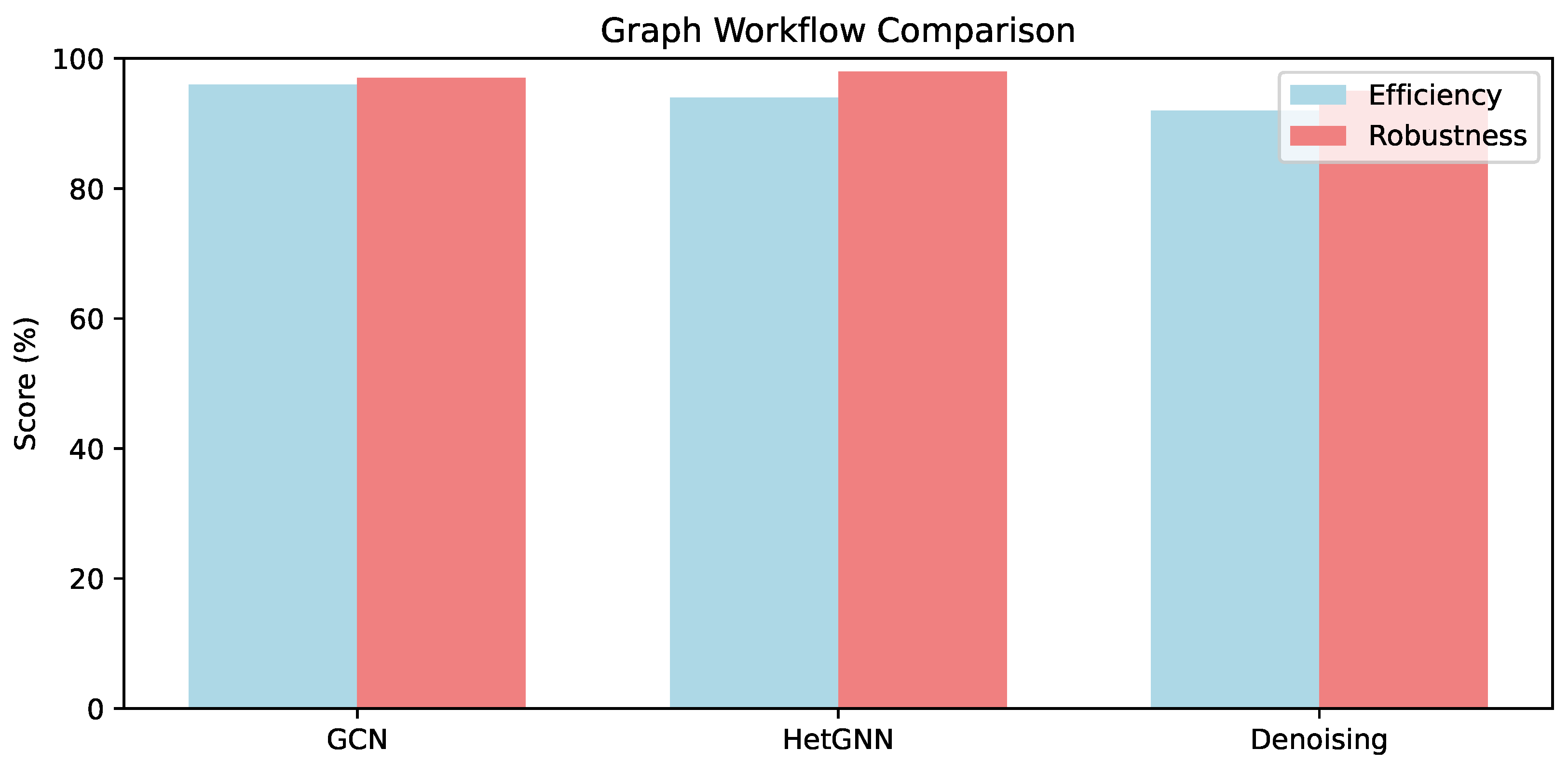
| Denoising GCN (SGN) | Subgraph networks resilient to adversarial perturbations | CICMalDroid, Drebin | 95–97% (avg.; 4% drop cross- VirusShare) |
| |
| Weighted Heterogeneous Graphs + HetGNN | Multi-type graph with relation-aware embeddings | AndroZoo, Tencent HG (APK) | 96–98% (avg.; 6% drop cross- Drebin) |
| |
| VGAE-MalGAN (Adversarial) | GAN generates adversarial API graphs for retraining | Drebin, CICMalDroid | 94–97% (avg.; 2% drop post- defense) |
|
6. Opportunities and Challenges
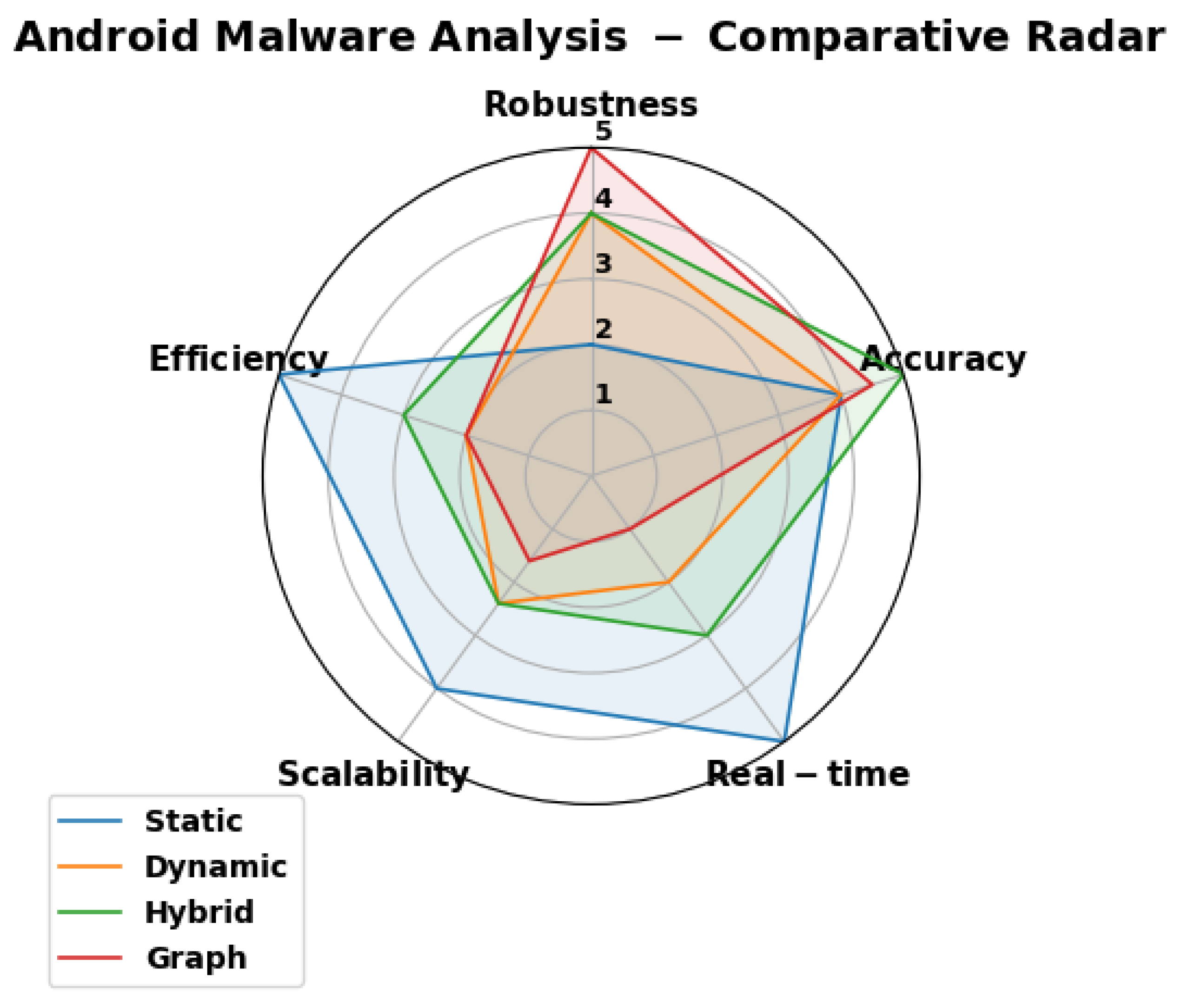
6.1. Comparison Among Different Analysis Techniques
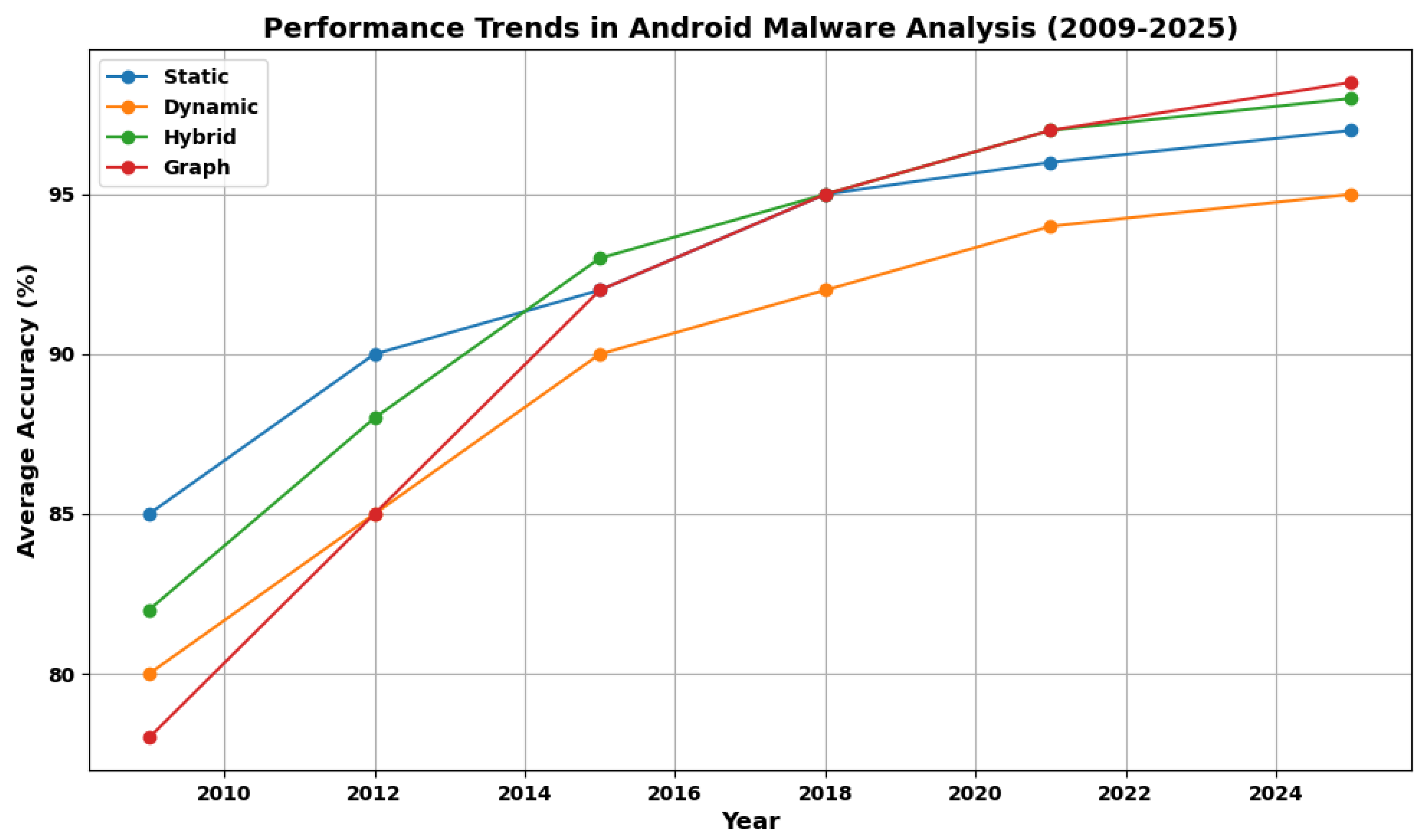
6.2. Performance Trends over Time

6.3. Future Research
6.3.1. Integrate Dynamic with Static Features to Counter Integrated Threats
6.3.2. Extend Graph-Based Techniques to Inter-Procedural Flows or Runtime Data
6.3.3. Enhance Adversarial Robustness via Probability-Based Risks or Integrated Defenses
7. Conclusions and Discussion
Author Contributions
Funding
Data Availability Statement
Conflicts of Interest
References
- Qiu, J.; Nepal, S.; Luo, W.; Pan, L.; Tai, Y.; Zhang, J.; Xiang, Y. Data-Driven Android Malware Intelligence: A Survey. In Machine Learning for Cyber Security, Proceedings of the Second International Conference, ML4CS 2019, Xi’an, China, 19–21 September 2019; Springer: Cham, Switzerland, 2019; pp. 183–202. [Google Scholar] [CrossRef]
- Iqbal, M.J.; Aurangzeb, S.; Aleem, M.; Srivastava, G.; Lin, J.C.W. RThreatDroid: A Ransomware Detection Approach to Secure IoT Based Healthcare Systems. IEEE Trans. Netw. Sci. Eng. 2023, 10, 2574–2583. [Google Scholar] [CrossRef]
- DeLoach, J.; Caragea, D. Twitter-enhanced Android malware detection. In Proceedings of the 2017 IEEE International Conference on Big Data (Big Data), Boston, MA, USA, 11–14 December 2017; pp. 4648–4657. [Google Scholar] [CrossRef]
- Hou, S.; Fan, Y.; Zhang, Y.; Ye, Y.; Lei, J.; Wan, W.; Wang, J.; Xiong, Q.; Shao, F. αCyber: Enhancing Robustness of Android Malware Detection System against Adversarial Attacks on Heterogeneous Graph based Model. In Proceedings of the 28th ACM International Conference on Information and Knowledge Management, Beijing, China, 3–7 November 2019; pp. 609–618. [Google Scholar] [CrossRef]
- Rastogi, V.; Chen, Y.; Jiang, X. Catch Me If You Can: Evaluating Android Anti-Malware Against Transformation Attacks. IEEE Trans. Inf. Forensics Secur. 2014, 9, 99–108. [Google Scholar] [CrossRef]
- Abaid, Z.; Kaafar, M.A.; Jha, S. Quantifying the impact of adversarial evasion attacks on machine learning based android malware classifiers. In Proceedings of the 2017 IEEE 16th International Symposium on Network Computing and Applications (NCA), Cambridge, MA, USA, 30 October–1 November 2017; pp. 1–10. [Google Scholar] [CrossRef]
- Zheng, C.; Dellarocca, N.; Andronio, N.; Zanero, S.; Maggi, F. GreatEatlon: Fast, Static Detection of Mobile Ransomware. In Security and Privacy in Communication Networks, Proceedings of the 12th International Conference, SecureComm 2016, Guangzhou, China, 10–12 October 2016; Springer: Cham, Switzerland, 2017; pp. 617–636. [Google Scholar] [CrossRef]
- Lab, K. Android Malware and Unwanted Software Statistics for Q1 2024. 2024. Available online: https://securelist.com/it-threat-evolution-q1-2024-mobile-statistics/112750/ (accessed on 27 September 2025).
- Team, C. Inside the Infamous Mirai IoT Botnet: A Retrospective Analysis. 2017. Available online: https://blog.cloudflare.com/inside-mirai-the-infamous-iot-botnet-a-retrospective-analysis/ (accessed on 27 September 2025).
- Forensic Methodology Report: How to Catch NSO Group’s Pegasus. Technical Report, Amnesty International. 2021. Available online: https://www.amnesty.org/en/latest/research/2021/07/forensic-methodology-report-how-to-catch-nso-groups-pegasus/ (accessed on 27 September 2025).
- News, T.H. Anatsa Android Banking Trojan Hits 90,000 Users with Fake PDF Readers. 2025. Available online: https://thehackernews.com/2025/07/anatsa-android-banking-trojan-hits.html (accessed on 27 September 2025).
- Ma, R.; Yin, S.; Feng, X.; Zhu, H.; Sheng, V.S. A lightweight deep learning-based android malware detection framework. Expert Syst. Appl. 2024, 255, 124633. [Google Scholar] [CrossRef]
- Dash, S.K.; Suarez-Tangil, G.; Khan, S.; Tam, K.; Ahmadi, M.; Kinder, J.; Cavallaro, L. DroidScribe: Classifying Android Malware Based on Runtime Behavior. In Proceedings of the 2016 IEEE Security and Privacy Workshops (SPW), San Jose, CA, USA, 22–26 May 2016; pp. 252–261. [Google Scholar] [CrossRef]
- Tong, F.; Yan, Z. A hybrid approach of mobile malware detection in Android. J. Parallel Distrib. Comput. 2017, 103, 22–31. [Google Scholar] [CrossRef]
- Lu, X.; Zhao, J.; Zhu, S.; Lio, P. SNDGCN: Robust Android malware detection based on subgraph network and denoising GCN network. Expert Syst. Appl. 2024, 250, 123922. [Google Scholar] [CrossRef]
- Huang, L.; Xue, J.; Wang, Y.; Liu, Z.; Chen, J.; Kong, Z. WHGDroid: Effective android malware detection based on weighted heterogeneous graph. J. Inf. Secur. Appl. 2023, 77, 103556. [Google Scholar] [CrossRef]
- Ojo, D.; Siddique, N.M.; Leung, C.K.; Hryhoruk, C.C. Machine Learning-Based Android Malware Detection. In Proceedings of the 2023 IEEE 10th International Conference on Data Science and Advanced Analytics (DSAA), Thessaloniki, Greece, 9–13 October 2023; pp. 1–10. [Google Scholar] [CrossRef]
- Razgallah, A.; Khoury, R. Behavioral classification of Android applications using system calls. In Proceedings of the 2021 28th Asia-Pacific Software Engineering Conference (APSEC), Taipei, Taiwan, 6–9 December 2021; pp. 43–52. [Google Scholar] [CrossRef]
- Arora, A.; Peddoju, S.K. Minimizing Network Traffic Features for Android Mobile Malware Detection. In Proceedings of the 18th International Conference on Distributed Computing and Networking, Hyderabad, India, 5–7 January 2017. [Google Scholar] [CrossRef]
- Afonso, V.; Kalysch, A.; Müller, T.; Oliveira, D.; Grégio, A.; de Geus, P.L. Lumus: Dynamically uncovering evasive android applications. In Information Security, Proceedings of the 21st International Conference, ISC 2018, Guildford, UK, 9–12 September 2018; Springer: Cham, Switzerland, 2018; pp. 47–66. [Google Scholar]
- Norouzian, M.R.; Xu, P.; Eckert, C.; Zarras, A. Hybroid: Toward Android Malware Detection and Categorization with Program Code and Network Traffic. In Information Security, Proceedings of the 24th International Conference, ISC 2021, Virtual Event, 10–12 November 2021; Springer: Cham, Switzerland, 2021; pp. 259–278. [Google Scholar] [CrossRef]
- Gascon, H.; Yamaguchi, F.; Arp, D.; Rieck, K. Structural detection of android malware using embedded call graphs. In Proceedings of the 2013 ACM SIGSAC Conference on Computer and Communications Security, Berlin, Germany, 4 November 2013; pp. 45–54. [Google Scholar] [CrossRef]
- Fasano, F.; Martinelli, F.; Mercaldo, F.; Santone, A. Cascade Learning for Mobile Malware Families Detection through Quality and Android Metrics. In Proceedings of the 2019 International Joint Conference on Neural Networks (IJCNN), Budapest, Hungary, 14–19 July 2019; pp. 1–10. [Google Scholar] [CrossRef]
- Zhu, D.; Xi, T.; Jing, P.; Wu, D.; Xia, Q.; Zhang, Y. A Transparent and Multimodal Malware Detection Method for Android Apps. In Proceedings of the 22nd Int’l ACM Conference on Modeling, Analysis and Simulation of Wireless and Mobile Systems, Miami Beach, FL, USA, 25–29 November 2019; pp. 51–60. [Google Scholar] [CrossRef]
- Li, H.; Zhou, S.; Yuan, W.; Luo, X.; Gao, C.; Chen, S. Robust Android Malware Detection against Adversarial Example Attacks. In Proceedings of the Web Conference 2021, Ljubljana, Slovenia, 19–23 April 2021; pp. 3603–3612. [Google Scholar] [CrossRef]
- Rathore, H.; Bandwala, T.; Sahay, S.; Sewak, M. Adversarial Robustness of Image Based Android Malware Detection Models. In Secure Knowledge Management in the Artificial Intelligence Era, Proceedings of the 9th International Conference, SKM 2021, San Antonio, TX, USA, 8–9 October 2021; Springer: Cham, Switzerland, 2021; pp. 3–22. [Google Scholar] [CrossRef]
- Xi, N.; He, Y.; Zhang, Y.; Wang, Z.; Feng, P. ACDroid: Detecting Collusion Applications on Smart Devices. In Science of Cyber Security, Proceedings of the 5th International Conference, SciSec 2023, Melbourne, VIC, Australia, 11–14 July 2023; Springer: Cham, Switzerland, 2023; pp. 3–22. [Google Scholar] [CrossRef]
- Meijin, L.; Zhiyang, F.; Junfeng, W. A Systematic Overview of Android Malware Detection. Appl. Artif. Intell. 2021, 36, 1–33. [Google Scholar] [CrossRef]
- Qiu, J.; Zhang, J.; Luo, W.; Pan, L.; Nepal, S.; Xiang, Y.; Zhu, B.B. A Survey of Android Malware Detection with Deep Neural Models. ACM Comput. Surv. 2020, 53, 1–36. [Google Scholar] [CrossRef]
- Alam, M.T.; Bhusal, D.; Rastogi, N. Revisiting Static Feature-Based Android Malware Detection. arXiv 2024, arXiv:2409.07397. [Google Scholar] [CrossRef]
- Shi, S.; Tian, S.; Wang, B.; Zhou, T.; Chen, G. SFCGDroid: Android malware detection based on sensitive function call graph. Int. J. Inf. Secur. 2023, 22, 1115–1124. [Google Scholar] [CrossRef]
- Ma, D.; Bai, Y.; Xing, Z.; Sun, L.; Li, X. A Knowledge Graph-based Sensitive Feature Selection for Android Malware Classification. In Proceedings of the 2020 27th Asia-Pacific Software Engineering Conference (APSEC), Singapore, 1–4 December 2020; pp. 188–197. [Google Scholar] [CrossRef]
- Allix, K.; Jerome, Q.; Bissyandé, T.F.; Klein, J.; State, R.; Traon, Y.L. A Forensic Analysis of Android Malware–How is Malware Written and How it Could Be Detected? In Proceedings of the 2014 IEEE 38th Annual Computer Software and Applications Conference, Vasteras, Sweden, 21–25 July 2014; pp. 384–393. [Google Scholar] [CrossRef]
- Parker, C.; McDonald, J.T.; Johnsten, T.; Benton, R.G. Android Malware Detection Using Step-Size Based Multi-layered Vector Space Models. In Proceedings of the 2018 13th International Conference on Malicious and Unwanted Software (MALWARE), Nantucket, MA, USA, 22–24 October 2018; pp. 1–10. [Google Scholar] [CrossRef]
- Riad, K.; Ke, L.; Qi, L. RoughDroid: Operative Scheme for Functional Android Malware Detection. Secur. Commun. Netw. 2018, 2018, 8087303. [Google Scholar] [CrossRef]
- Dong, S.; Shu, L.; Nie, S. Android Malware Detection Method Based on CNN and DNN Bybrid Mechanism. IEEE Trans. Ind. Inform. 2024, 20, 7744–7753. [Google Scholar] [CrossRef]
- Lam, P.; Hendren, R.L.; Lhoták, O. The Soot Framework for Java Program Analysis: A Retrospective. In Proceedings of the 2019 IEEE/ACM International Symposium on Code Generation and Optimization (CGO), Washington, DC, USA, 16–20 February 2019. [Google Scholar]
- Mariconti, E.; Onwuzurike, L.; Andriotis, P.; De Cristofaro, E.; Ross, G.; Stringhini, G. Impact of Code Obfuscation on Android Malware Detection based on Static and Dynamic Analysis. In Proceedings of the 2018 International Conference on Information Systems Security and Privacy, Funchal, Portugal, 22–24 January 2018; pp. 17–27. [Google Scholar]
- Suarez-Tangil, G.; Dash, S.K.; Ahmadi, M.; Tam, K.; Cavallaro, L. On the Evaluation of Android Malware Detectors Against Code Obfuscation. PeerJ Comput. Sci. 2022, 8, e1002. [Google Scholar] [CrossRef]
- Jung, H.; Kim, K.B.; Cho, H.J. A study of android malware detection techniques in virtual environment. Clust. Comput. 2016, 19, 2295–2304. [Google Scholar] [CrossRef]
- Wang, W.; Gao, Z.; Zhao, M.; Li, Y.; Liu, J.; Zhang, X. DroidEnsemble: Detecting Android Malicious Applications With Ensemble of String and Structural Static Features. IEEE Access 2018, 6, 31798–31807. [Google Scholar] [CrossRef]
- Zhang, Y.; Li, B. Malicious Code Detection Based on Code Semantic Features. IEEE Access 2020, 8, 176728–176737. [Google Scholar] [CrossRef]
- Alam, S.; Alharbi, S.; Yildirim, S. Mining Nested Flow of Dominant APIs for Detecting Android Malware. Comput. Netw. 2019, 167, 107026. [Google Scholar] [CrossRef]
- Skovoroda, A.; Gamayunov, D. Automated Static Analysis and Classification of Android Malware using Permission and API Calls Models. In Proceedings of the 2017 15th Annual Conference on Privacy, Security and Trust (PST), Calgary, AB, Canada, 28–30 August 2017; pp. 243–24309. [Google Scholar] [CrossRef]
- Varma P, R.K.; Mallidi, S.K.R.; Jhansi K, S.; Latha D, P. Bat optimization algorithm for wrapper-based feature selection and performance improvement of android malware detection. IET Netw. 2021, 10, 131–140. [Google Scholar] [CrossRef]
- Enck, W.; Gilbert, P.; Han, S.; Tendulkar, V.; Chun, B.G.; Cox, L.P.; Jung, J.; McDaniel, P.; Sheth, A.N. TaintDroid: An Information-Flow Tracking System for Realtime Privacy Monitoring on Smartphones. ACM Trans. Comput. Syst. 2014, 32, 1–29. [Google Scholar] [CrossRef]
- Ferrante, A.; Medvet, E.; Mercaldo, F.; Milosevic, J.; Visaggio, C.A. Spotting the Malicious Moment: Characterizing Malware Behavior Using Dynamic Features. In Proceedings of the 2016 11th International Conference on Availability, Reliability and Security (ARES), Salzburg, Austria, 31 August–2 September 2016; pp. 372–381. [Google Scholar] [CrossRef]
- Arp, D.; Spreitzenbarth, M.; Hübner, M.; Gascon, H.; Rieck, K. DREBIN: Effective and Explainable Detection of Android Malware in Your Pocket. In Proceedings of the Symposium on Network and Distributed System Security (NDSS), San Diego, CA, USA, 23–26 February 2014. [Google Scholar] [CrossRef]
- Li, W.; Zhang, X.Y.; Bao, H.; Wang, Q.; Shi, H.; Li, Z. A Glimpse of the Whole: Detecting Few-shot Android Malware Encrypted Network Traffic. In Proceedings of the 2022 IEEE 24th Int Conf on High Performance Computing & Communications; 8th Int Conf on Data Science & Systems; 20th Int Conf on Smart City; 8th Int Conf on Dependability in Sensor, Cloud & Big Data Systems & Application (HPCC/DSS/SmartCity/DependSys), Hainan, China, 18–20 December 2022; pp. 635–644. [Google Scholar] [CrossRef]
- Hossain, M.S.; Hasan, N.; Samad, M.A.; Shakhawat, H.M.; Karmoker, J.; Ahmed, F.; Fuad, K.F.M.N.; Choi, K. Android Ransomware Detection From Traffic Analysis Using Metaheuristic Feature Selection. IEEE Access 2022, 10, 128754–128763. [Google Scholar] [CrossRef]
- Li, Z.; Sun, L.; Yan, Q.; Srisa-an, W.; Chen, Z. DroidClassifier: Efficient Adaptive Mining of Application-Layer Header for Classifying Android Malware. In Security and Privacy in Communication Networks, Proceedings of the 12th International Conference, SecureComm 2016, Guangzhou, China, 10–12 October 2016; Springer: Cham, Switzerland, 2017; pp. 597–616. [Google Scholar] [CrossRef]
- Białczak, P.; Mazurczyk, W. Malware Classification Using Open Set Recognition and HTTP Protocol Requests. In Computer Security–ESORICS 2023, Proceedings of the 28th European Symposium on Research in Computer Security, The Hague, The Netherlands, 25–29 September 2023; Springer: Cham, Switzerland, 2024; pp. 235–254. [Google Scholar] [CrossRef]
- Chew, C.J.W.; Kumar, V.; Patros, P.; Malik, R. ESCAPADE: Encryption-Type-Ransomware: System Call Based Pattern Detection. In Network and System Security, Proceedings of the 14th International Conference, NSS 2020, Melbourne, VIC, Australia, 25–27 November 2020; Springer: Cham, Switzerland, 2020; pp. 388–407. [Google Scholar] [CrossRef]
- Yan, P.; Yan, Z. A survey on dynamic mobile malware detection. Softw. Qual. J. 2018, 26, 891–919. [Google Scholar] [CrossRef]
- Sun, M.; Li, X.; Lui, J.C.S.; Ma, R.T.B.; Liang, Z. Monet: A User-Oriented Behavior-Based Malware Variants Detection System for Android. IEEE Trans. Inf. Forensics Secur. 2017, 12, 1103–1112. [Google Scholar] [CrossRef]
- Sen, K.; Marinov, D.; Agha, G. CUTE: A concolic unit testing engine for C. In Proceedings of the 10th European Software Engineering Conference Held Jointly with 13th ACM SIGSOFT International Symposium on Foundations of Software Engineering, ESEC/FSE-13, Lisbon, Portugal, 5–9 September 2005; Association for Computing Machinery: New York, NY, USA, 2005; pp. 263–272. [Google Scholar] [CrossRef]
- Atedjio, F.S.; Lienou, J.P.; Nelson, F.F.; Shetty, S.S.; Kamhoua, C.A. A Defensive Strategy Against Android Adversarial Malware Attacks. IEEE Access 2024, 12, 169432–169441. [Google Scholar] [CrossRef]
- Zhu, H.; Wei, H.; Wang, L.; Xu, Z.; Sheng, V.S. An effective end-to-end android malware detection method. Expert Syst. Appl. 2023, 218, 119593. [Google Scholar] [CrossRef]
- Seraj, S.; Khodambashi, S.; Pavlidis, M.; Polatidis, N. HamDroid: Permission-based harmful android anti-malware detection using neural networks. Neural Comput. Appl. 2022, 34, 15165–15174. [Google Scholar] [CrossRef]
- Khan, F.; Ncube, C.; Ramasamy, L.K.; Kadry, S.; Nam, Y. A Digital DNA Sequencing Engine for Ransomware Detection Using Machine Learning. IEEE Access 2020, 8, 119710–119719. [Google Scholar] [CrossRef]
- Tossou, S.; Kacem, T. Mobile Threat Detection System: A Deep Learning Approach. In Proceedings of the 2023 13th International Conference on Information Science and Technology (ICIST), Cairo, Egypt, 8–14 December 2023; pp. 323–332. [Google Scholar] [CrossRef]
- Ring, J.; Nguyen Quang Do, L.; Pradel, M. Analyzing Android Taint Analysis Tools: FlowDroid, Amandroid, and DidFail. IEEE Trans. Softw. Eng. 2021, 48, 2401–2423. Available online: https://people.ece.ubc.ca/mjulia/publications/Analyzing_Android_Taint_Analysis_Tools_TSE_2021.pdf (accessed on 27 September 2025).
- Kipf, T.; Welling, M. Semi-Supervised Classification with Graph Convolutional Networks. arXiv 2016. [Google Scholar] [CrossRef]
- Zhang, C.; Song, D.; Huang, C.; Swami, A.; Chawla, N.V. Heterogeneous Graph Neural Network. In Proceedings of the 25th ACM SIGKDD Conference on Knowledge Discovery and Data Mining, Anchorage, AK, USA, 4–8 August 2019; pp. 793–803. [Google Scholar] [CrossRef]
- Kipf, T.N.; Welling, M. Variational Graph Auto-Encoders. arXiv 2016, arXiv:1611.07308. [Google Scholar] [CrossRef]
- Pasdar, A.; Lee, Y.C.; Hong, S.H. Catch the Intruder: Collaborative and Personalized Malware Detection By On-Device Application Fingerprinting. In Proceedings of the 2023 IEEE International Conference on Web Services (ICWS), Chicago, IL, USA, 2–8 July 2023; pp. 595–604. [Google Scholar] [CrossRef]
- Jiang, C.; Xia, C.; Chen, C.; Li, H.; Wang, T.; Li, X. FedDLM: A Fine-Grained Assessment Scheme for Risk of Sensitive Information Leakage in Federated Learning-based Android Malware Classifier. In Proceedings of the 2023 IEEE 22nd International Conference on Trust, Security and Privacy in Computing and Communications (TrustCom), Exeter, UK, 1–3 November 2023; pp. 231–240. [Google Scholar] [CrossRef]
- Huang, L.; Xue, J.; Wang, Y.; Qu, D.; Chen, J.; Zhang, N.; Zhang, L. EAODroid: Android Malware Detection Based on Enhanced API Order. Chin. J. Electron. 2023, 32, 1169–1178. [Google Scholar] [CrossRef]
- Chau, N.T.; Jung, S. An Entropy-Based Solution for Identifying Android Packers. IEEE Access 2019, 7, 28412–28421. [Google Scholar] [CrossRef]
- Alotaibi, A. Identifying Malicious Software Using Deep Residual Long-Short Term Memory. IEEE Access 2019, 7, 163128–163137. [Google Scholar] [CrossRef]
- Aonzo, S.; Merlo, A.; Migliardi, M.; Oneto, L.; Palmieri, F. Low-Resource Footprint, Data-Driven Malware Detection on Android. IEEE Trans. Sustain. Comput. 2020, 5, 213–222. [Google Scholar] [CrossRef]
- Cilleruelo, C.; Enrique-Larriba.; De-Marcos, L.; Martinez-Herráiz, J.J. Malware Detection Inside App Stores Based on Lifespan Measurements. IEEE Access 2021, 9, 119967–119976. [Google Scholar] [CrossRef]
- Nguyen-Vu, L.; Ahn, J.; Jung, S. Android Fragmentation in Malware Detection. Comput. Secur. 2019, 87, 101573. [Google Scholar] [CrossRef]
- Li, J.; Sun, L.; Yan, Q.; Li, Z.; Srisa-an, W.; Ye, H. Significant Permission Identification for Machine-Learning-Based Android Malware Detection. IEEE Trans. Ind. Inform. 2018, 14, 3216–3225. [Google Scholar] [CrossRef]
- Wu, Q.; Li, M.; Zhu, X.; Liu, B. MVIIDroid: A Multiple View Information Integration Approach for Android Malware Detection and Family Identification. IEEE MultiMedia 2020, 27, 48–57. [Google Scholar] [CrossRef]
- Tang, J.; Xu, W.; Peng, T.; Zhou, S.; Pi, Q.; He, R.; Hu, X. Android malware detection based on a novel mixed bytecode image combined with attention mechanism. J. Inf. Secur. Appl. 2024, 82, 103721. [Google Scholar] [CrossRef]
- Ma, Z.-h.; Chen, Z.-h.; Wang, X.-m.; Nie, R.-h.; Zhao, G.-s.; Wu, J.-c.; Ren, X.-q. Shikra: A Behavior-Based Android Malware Detection Framework. In Proceedings of the 2017 International Conference on Green Informatics (ICGI), Fuzhou, China, 15–17 August 2017; pp. 175–184. [Google Scholar] [CrossRef]
- Tian, K.; Yao, D.; Ryder, B.G.; Tan, G. Analysis of Code Heterogeneity for High-Precision Classification of Repackaged Malware. In Proceedings of the 2016 IEEE Security and Privacy Workshops (SPW), San Jose, CA, USA, 22–26 May 2016; pp. 262–271. [Google Scholar] [CrossRef]
- Mohaisen, D. Empirical Evaluation of Concept Drift in ML-Based Android Malware Detection. arXiv 2025, arXiv:2507.22772. [Google Scholar] [CrossRef]
- Rahman, M.S. A Longitudinal Android Malware Benchmark for Concept Drift Analysis. arXiv 2025, arXiv:2505.18551. [Google Scholar] [CrossRef]
- Makkawy, S.J.; De, M.J. MalVis: A Large-Scale Image-Based Framework and Dataset for Advancing Android Malware Classification. arXiv 2025, arXiv:2505.12106. [Google Scholar] [CrossRef]
- Aljohani, N.; Almomani, I.; Almashat, T.; El-Shafai, W. Maloid-DS: Labeled Dataset for Android Malware Forensics. IEEE Access 2024, 12, 68945–68962. [Google Scholar] [CrossRef]
- Aggarwal, K. An Effectual Analytics and Approach for Avoidance of Malware in Android using Deep Neural Networks. NeuroQuantology 2021, 19, 470–478. [Google Scholar]
- B’alik, D.; Jureček, M.; Stamp, M. RawMal-TF: Raw Malware Dataset Labeled by Type and Family. arXiv 2025, arXiv:2506.23909. [Google Scholar] [CrossRef]
- Joyce, R.J.; Miller, G.; Roth, P.; Zak, R.; Zaresky-Williams, E.; Anderson, H.; Raff, E.; Holt, J. EMBER2024—A Benchmark Dataset for Holistic Evaluation of Malware Classifiers. arXiv 2025, arXiv:2506.05074. [Google Scholar] [CrossRef]
- Rathore, H.; Sahay, S.; Thukral, S.; Sewak, M. Detection of Malicious Android Applications: Classical Machine Learning vs. Deep Neural Network Integrated with Clustering. In Broadband Communications, Networks, and Systems, Proceedings of the 11th EAI International Conference, BROADNETS 2020, Qingdao, China, 11–12 December 2020; Springer: Cham, Switzerland, 2021; pp. 109–128. [Google Scholar] [CrossRef]
- Singh, N.; Tripathy, S.; Bezawada, B. SHIELD: A Multimodal Deep Learning Framework for Android Malware Detection. In Information Systems Security, Proceedings of the 18th International Conference, ICISS 2022, Tirupati, India, 16–20 December 2022; Springer: Cham, Switzerland, 2022; pp. 64–83. [Google Scholar] [CrossRef]
- Rathore, H.; Sahay, S.; Rajvanshi, R.; Sewak, M. Identification of Significant Permissions for Efficient Android Malware Detection. In Broadband Communications, Networks, and Systems, Proceedings of the 11th EAI International Conference, BROADNETS 2020, Qingdao, China, 11–12 December 2020; Springer: Cham, Switzerland, 2021; pp. 33–52. [Google Scholar] [CrossRef]
- Zhang, Y.; Peng, G.; Yang, L.; Wang, Y.; Tian, M.; Hu, J.; Wang, L.; Song, C. Visual Analysis of Android Malware Behavior Profile Based on PMCGdroid: A Pruned Lightweight APP Call Graph. In Security and Privacy in Communication Networks, Proceedings of the 13th International Conference, SecureComm 2017, Niagara Falls, ON, Canada, 22–25 October 2017; Springer: Cham, Switzerland, 2018; pp. 449–468. [Google Scholar] [CrossRef]
- Ravi, A.; Chaturvedi, V.; Shafique, M. ViT4Mal: Lightweight Vision Transformer for Malware Detection on Edge Devices. ACM Trans. Embed. Comput. Syst. 2023, 22, 1–26. [Google Scholar] [CrossRef]
- Al-Fawa’reh, M.; Abu-Khalaf, J.; Szewczyk, P.; Kang, J.J. MalBoT-DRL: Malware Botnet Detection Using Deep Reinforcement Learning in IoT Networks. IEEE Internet Things J. 2024, 11, 9610–9629. [Google Scholar] [CrossRef]
- Hasselt, H.v.; Guez, A.; Silver, D. Deep reinforcement learning with double Q-Learning. In Proceedings of the Thirtieth AAAI Conference on Artificial Intelligence, AAAI’16, Phoenix, AZ, USA, 12–17 February 2016; AAAI Press: Washington, DC, USA, 2016; pp. 2094–2100. [Google Scholar]
- Ali, S.; Abusabha, O.; Ali, F.; Imran, M.; Abuhmed, T. Effective Multitask Deep Learning for IoT Malware Detection and Identification Using Behavioral Traffic Analysis. IEEE Trans. Netw. Serv. Manag. 2023, 20, 1199–1209. [Google Scholar] [CrossRef]
- Davanian, A.; Faloutsos, M.; Lindorfer, M. C2Miner: Tricking IoT Malware into Revealing Live Command & Control Servers. In Proceedings of the 19th ACM Asia Conference on Computer and Communications Security, ASIA CCS ’24, Singapore, 1–5 July 2024; Association for Computing Machinery: New York, NY, USA, 2024; pp. 112–127. [Google Scholar] [CrossRef]
- Yumlembam, R.; Issac, B.; Jacob, S.M.; Yang, L. IoT-Based Android Malware Detection Using Graph Neural Network With Adversarial Defense. IEEE Internet Things J. 2023, 10, 8432–8444. [Google Scholar] [CrossRef]
- Xu, P.; Wang, L.-P. Multi-key Homomorphic Secret Sharing from LWE Without Multi-key HE. In Information Security and Privacy, Proceedings of the 28th Australasian Conference, ACISP 2023, Brisbane, QLD, Australia, 5–7 July 2023; Springer: Cham, Switzerland, 2023; pp. 248–269. [Google Scholar] [CrossRef]
- Mariconti, E.; Onwuzurike, L.; Andriotis, P.; Cristofaro, E.D.; Ross, G.; Stringhini, G. MaMaDroid: Detecting Android Malware by Building Markov Chains of Behavioral Models. In Proceedings of the Network and Distributed System Security Symposium (NDSS), San Diego, CA, USA, 26 February–1 March 2017. [Google Scholar] [CrossRef]
- Rastogi, N.; Dutta, S. A Survey on ML Techniques for Multi-Platform Malware Detection. Sensors 2025, 25, 1153. [Google Scholar] [CrossRef]


| Paradigm/ Subtype | Key Features (Ex.) [Ref.] | Compute/ Latency Overhead | Evasion Resistance (% Drop) | Reproducibility (% Success) | Deployment Readiness (IoT) | Best For (Task/Context) |
|---|---|---|---|---|---|---|
| Static: Flow Analysis | API call flows, dominance trees [45] | L (0.1 s/ sample) | L (25–30%) | M (75%) | H (on-device) | Early filtering; low-resource C2 detection in adware |
| Static: Call-Graph | FCGs with opcodes [18,23] | M (0.5 s/ sample) | M (15–20%) | H (85%) | M (edge devices) | Structural pattern mining; trojan family classification |
| Static: Pattern Match | API chains, code motifs [41,66] | L (0.05 s/ sample) | L (20–25%) | M (70%) | H (lightweight) | Signature-based heuristics; ransomware packaging checks |
| Dynamic: System-Call Tracing | ioctl/ sub-traces [57,58,67,68] | H (5–10 s/ sample) | H (5–10%) | M (65%) | L (sandbox-only) | Runtime evasion capture; spyware behavior profiling |
| Dynamic: Network Traffic | HTTP flows, PCAP stats [19,42,59,69,70,71,72] | M (2 s/ sample) | H (8–12%) | H (80%) | M (networked IoT) | Data exfiltration detection; botnet C2 in Mirai variants |
| Dynamic: Behavioral Profiling | UI/API logs [43,60,61] | H (3–7 s/ sample) | M (10–15%) | L (60%) | L (emulator-heavy) | User-oriented traces; hybrid fusion for zero-day trojans |
| Hybrid: Multi-View Fusion | Static+dynamic (e.g., Hybroid) [60,73,74] | M (1–3 s/ sample) | H (5–8%) | H (90%) | M (scalable) | Balanced accuracy; IoT adaptability in polymorphic threats |
| Graph: GCN | Neighborhood aggregation on FCGs [5,23,75] | M (1 s/ sample) | H (3–7%) | H (95%) | H (embeddable) | Semantic modeling; adversarial robustness in obfuscated apps |
| Graph: HetGNN | Type-specific edges [6,33,76] | H (2–4 s/ sample) | H (4–9%) | M (80%) | M (heterogeneous IoT) | Relational capture; multi-family classification (e.g., banking trojans) |
| Graph: VGAE | Latent reconstructions [25,49] | L (0.3 s/ sample) | M (10%) | H (85%) | H (unsupervised) | Anomaly detection; unsupervised IoT zero-day exploration |
| Paradigm | Papers | Mean Acc (%) | Range Acc (%) | Mean F1 (%) | Key Context/Why Better/Worse |
|---|---|---|---|---|---|
| Static | 25 | 95.5 (std 2.8) | 85–98 | 94.2 | Drebin setups; fails obfuscation (20–30% drops [17]) due to brittle features |
| Dynamic | 15 | 94.8 (std 3.5) | 80–97 | 93.5 | VirusShare; better on runtime evasions but high overhead/coverage gaps [78] |
| Hybrid | 18 | 97.2 (std 1.8) | 92–99 | 96.5 | CICMalDroid; excels polymorphic threats via fusion, but integration complex [60] |
| Graph-based | 10 | 96.8 (std 1.2) | 90–98 | 95.8 | AndroZoo; superior robustness (97% recovery [33]) from relations, but scalability issues [13] |
| Overall | 68 | 96.1 | 80–99 | 95.0 | Higher on balanced datasets; drops 5–10% cross-dataset [23,24] due to biases |
Disclaimer/Publisher’s Note: The statements, opinions and data contained in all publications are solely those of the individual author(s) and contributor(s) and not of MDPI and/or the editor(s). MDPI and/or the editor(s) disclaim responsibility for any injury to people or property resulting from any ideas, methods, instructions or products referred to in the content. |
© 2025 by the authors. Licensee MDPI, Basel, Switzerland. This article is an open access article distributed under the terms and conditions of the Creative Commons Attribution (CC BY) license (https://creativecommons.org/licenses/by/4.0/).
Share and Cite
Maganur, S.; Jiang, Y.; Huang, J.; Zhong, F. Feature-Centric Approaches to Android Malware Analysis: A Survey. Computers 2025, 14, 482. https://doi.org/10.3390/computers14110482
Maganur S, Jiang Y, Huang J, Zhong F. Feature-Centric Approaches to Android Malware Analysis: A Survey. Computers. 2025; 14(11):482. https://doi.org/10.3390/computers14110482
Chicago/Turabian StyleMaganur, Shama, Yili Jiang, Jiaqi Huang, and Fangtian Zhong. 2025. "Feature-Centric Approaches to Android Malware Analysis: A Survey" Computers 14, no. 11: 482. https://doi.org/10.3390/computers14110482
APA StyleMaganur, S., Jiang, Y., Huang, J., & Zhong, F. (2025). Feature-Centric Approaches to Android Malware Analysis: A Survey. Computers, 14(11), 482. https://doi.org/10.3390/computers14110482