Article

A Lightweight Edge-AI System for Disease Detection and Three-Level Leaf Spot Severity Assessment in Strawberry Using YOLOv10n and MobileViT-S

by
Raikhan Amanova
1,
Baurzhan Belgibayev
1,
Madina Mansurova
1,
Madina Suleimenova
2,*,
Gulshat Amirkhanova
1 and
Gulnur Tyulepberdinova
1
1
Department of Big Data and Artificial Intelligence, Faculty of Information Technology and Artificial Intelligence, Al-Farabi Kazakh National University, Almaty 050040, Kazakhstan
2
Department of Information Systems, International Information Technologies University, Almaty 050040, Kazakhstan
*
Author to whom correspondence should be addressed.
Computers 2026, 15(1), 63; https://doi.org/10.3390/computers15010063
Submission received: 11 December 2025 / Revised: 7 January 2026 / Accepted: 13 January 2026 / Published: 16 January 2026

Abstract

Mobile edge-AI plant monitoring systems enable automated disease control in greenhouses and open fields, reducing dependence on manual inspection and the variability of visual diagnostics. This paper proposes a lightweight two-stage edge-AI system for strawberries, in which a YOLOv10n detector on board a mobile agricultural robot locates leaves affected by seven common diseases (including Leaf Spot) with real-time capability on an embedded platform. Patches are then automatically extracted for leaves classified as Leaf Spot and transmitted to the second module—a compact MobileViT-S-based classifier with ordinal output that assesses the severity of Leaf Spot on three levels (S1—mild, S2—moderate, S3—severe) on a specialised set of 373 manually labelled leaf patches. In a comparative experiment with lightweight architectures ResNet-18, EfficientNet-B0, MobileNetV3-Small and Swin-Tiny, the proposed Ordinal MobileViT-S demonstrated the highest accuracy in assessing the severity of Leaf Spot (accuracy ≈ 0.97 with 4.9 million parameters), surpassing both the baseline models and the standard MobileViT-S with a cross-entropy loss function. On the original image set, the YOLOv10n detector achieves an mAP@0.5 of 0.960, an F1 score of 0.93 and a recall of 0.917, ensuring reliable detection of affected leaves for subsequent Leaf Spot severity assessment. The results show that the “YOLOv10n + Ordinal MobileViT-S” cascade provides practical severity-aware Leaf Spot diagnosis on a mobile agricultural robot and can serve as the basis for real-time strawberry crop health monitoring systems.

1. Introduction

Commercial strawberry production has high economic and nutritional value, and demand for fresh berries continues to grow in many countries around the world [1]. However, strawberry plants are susceptible to a wide range of fungal and bacterial diseases, among which leaf diseases are particularly common [2,3]. These diseases significantly reduce yield and product quality and can lead to substantial economic losses for producers if not controlled in a timely manner [3]. In commercial practice, not only the presence but also the severity of foliar diseases determines pesticide dosage, plant removal decisions and yield forecasting. For this reason, we treat three-level Leaf Spot severity assessment as the central task of this work, rather than a secondary add-on to disease detection. Due to the wide variety of pathogens and the complex dynamics of their development, early diagnosis has traditionally relied on visual inspection of plantings by farmers and agronomists [4]. However, many leaf diseases of strawberries have similar visual symptoms, which makes it difficult to reliably distinguish between classes and often leads to incorrect identification or underestimation of the severity of the damage [4].
With the development of computing technology and image processing methods, more and more research is devoted to the intelligent diagnosis of agricultural crop diseases based on computer vision [4,5,6]. Such approaches allow for the automatic extraction of informative features from images of leaves, reduce the time required to examine plantings and labour costs, and provide higher reproducibility and accuracy compared to traditional manual diagnosis [6,7]. In particular, deep learning methods and YOLO family object detectors have demonstrated high efficiency in detecting strawberry diseases in field conditions, making them a promising basis for edge-AI monitoring systems and agricultural robots. In addition to architectural modifications, several studies also improve YOLO-based plant disease detectors by introducing specialised activation functions, such as the αSiLU activation proposed for smart agriculture scenarios in [8].
Recent studies have shown that lightweight YOLO variants can be successfully deployed in smart-agriculture applications; for example, for fruit detection under day- and night-time lighting conditions on mobile devices [9], for nutritional monitoring of lettuce using point-cloud analysis and YOLO-based object detection [10], and for livestock monitoring and counting from UAV imagery using Mask-YOLO architectures [11]. Web-based plant disease classification systems using deep learning have also been proposed [12], while comprehensive surveys on computer-vision and deep-learning approaches for nutrient-deficiency detection in crops further highlight the importance of non-invasive plant-health monitoring [13]. Our work follows this line of research but focuses specifically on strawberry leaf diseases and, importantly, on integrating ordinal severity estimation into an edge-AI detection pipeline. In recent years, the YOLO family has evolved from early versions such as YOLOv3 and YOLOv4 to more accurate and lightweight variants including YOLOv5–YOLOv10, many of which are specifically optimised for embedded and edge deployment.
In addition to classifying diseases based on leaf images, more and more work is being carried out on real-time robotic systems for strawberry cultivation. One example is the integration of a YOLO-based detector into the AgriEco self-propelled robot to recognise strawberry bushes when spraying greenhouses. In this setup, an optimised YOLOv3 model running on Jetson TX2 achieves an mAP above 97% with a processing time of approximately 15 ms per frame, demonstrating the feasibility of Edge-AI solutions in greenhouse conditions [14]. Regarding strawberry leaf diseases, Chen et al. [15] developed an improved segmentation approach based on YOLOv8 that simultaneously detects strawberry leaves and powdery mildew lesions in natural background conditions, achieving high accuracy and reliability in field scenarios. Taken together, these studies show that YOLO family detectors are well suited for use on mobile agricultural robots, although most existing systems still focus on the localization of plants and fruits rather than on detailed characterisation of leaf condition.
At the same time, lightweight convolutional networks are being developed for recognising strawberry diseases in leaf images. Light-MobileBerryNet is an interpretable model inspired by MobileNetV3-Small that uses inverted residual blocks, depth-wise convolutions, and squeeze-and-excitation modules. The model achieves 96.6% accuracy with < 1 million parameters and a weight volume of about 2 MB, outperforming heavier CNNs (VGG16, EfficientNet, MobileNetV2) in terms of accuracy/complexity ratio [3]. In addition, the BerryNet-Lite architecture achieves 99.45% accuracy with only 2.87 million parameters, further demonstrating that lightweight convolutional networks can outperform heavier models in strawberry disease identification [16]. These results demonstrate that lightweight architectures (MobileNet family, EfficientNet-B0, ResNet-18, Swin-Tiny, etc.) are the most promising candidates for deployment on mobile and embedded devices in phytosanitary monitoring tasks.
A separate class of works is devoted not only to the presence of disease, but also to assessing its severity. For example, ref. [17] investigates eight deep learning models for the simultaneous detection and assessment of the severity of Cercospora leaf spot in chilli peppers under real field conditions. It is shown that segmentation models based on YOLOv8 provide more accurate and faster classification of severity levels compared to Mask R-CNN, achieving 91.4% accuracy for the maximum level of damage with an output time of 27 ms. Reviews emphasise that disease severity assessment tasks require consideration of the ordered nature of classes, special annotation schemes, and often a task formulation that differs from “normal” classification (ordinal classification, assessment of the area of damage, etc.) [18]. In addition, lightweight frameworks such as PDSE-Lite demonstrate that severity estimation can be implemented efficiently using compact architectures and few-shot learning [19].
Nevertheless, for strawberries, most studies are limited to binary or multi-class classification according to the “disease type/healthy leaf” scheme without explicit assessment of the degree of damage. Even in modern lightweight models for strawberries, such as Light-MobileBerryNet [3], the main target metric remains the accuracy of disease type recognition, rather than its severity [18]. Similarly, work on robotic spraying and harvesting using YOLO architectures focuses on the detection of plants, fruits, or stages of maturity [14], without offering a quantitative assessment of leaf disease progression at the individual plant level. For strawberry Leaf Spot, there are virtually no public datasets labelled by severity levels, nor are there any studies linking such an assessment to the work of mobile edge-AI platforms. In this study we deliberately focus the severity module on a single disease, Leaf Spot, rather than attempting to model many pathologies at once. Binary or multi-class disease detection (diseased vs. healthy, or different disease types) is already a relatively mature problem in computer vision for agriculture, whereas reliable severity assessment remains a key frontier in precision crop protection. Leaf Spot offers a particularly suitable case study because its visual symptoms develop in a relatively clear and monotonic way, from isolated small lesions to large coalescing necrotic areas, which aligns well with a three-level severity scale.
Unlike previous severity-estimation studies conducted on other crops such as rice and chilli pepper, our work focuses specifically on strawberry leaves, whose morphology and visual symptoms of Leaf Spot differ markedly from those of cereal and vegetable crops. Moreover, we design a two-stage edge-AI pipeline that first performs multiclass detection of seven strawberry leaf diseases using YOLOv10n and then applies an Ordinal MobileViT-S classifier to assign one of three Leaf Spot severity levels (S1–S3). To the best of our knowledge, no prior work has explored such a detection + ordinal severity cascade for strawberry leaves on an embedded platform such as NVIDIA Jetson Nano.
In summary, the main contributions of this work are as follows: (a) we develop StrawberrySeverityNet, a lightweight two-stage edge-AI system that combines YOLOv10n-based multiclass detection of seven strawberry leaf diseases with ordinal three-level severity assessment of Leaf Spot; (b) we construct and describe a custom dataset that includes both disease-level annotations and expert-labelled severity levels linked to the proportion of infected leaf area; (c) we propose an Ordinal MobileViT-S architecture that adds a lightweight cumulative-threshold ordinal head and loss on top of the standard MobileViT-S backbone, explicitly exploiting the ordered nature of the severity levels while keeping the model compact and suitable for edge deployment; and (d) we demonstrate the effectiveness of the proposed framework on an NVIDIA Jetson Nano mobile platform and discuss its potential role within smart-agriculture scenarios for precision irrigation and plant-health monitoring.
From an industrial perspective, StrawberrySeverityNet can also be regarded as a raw-material quality monitoring module within the digital twin of a strawberry-processing enterprise, where leaf disease and three-level Leaf Spot severity estimates serve as upstream quality indicators for subsequent processing stages.

2. Materials and Methods

2.1. Datasets and Exploratory Data Analysis

2.1.1. Strawberry Disease Detection Dataset

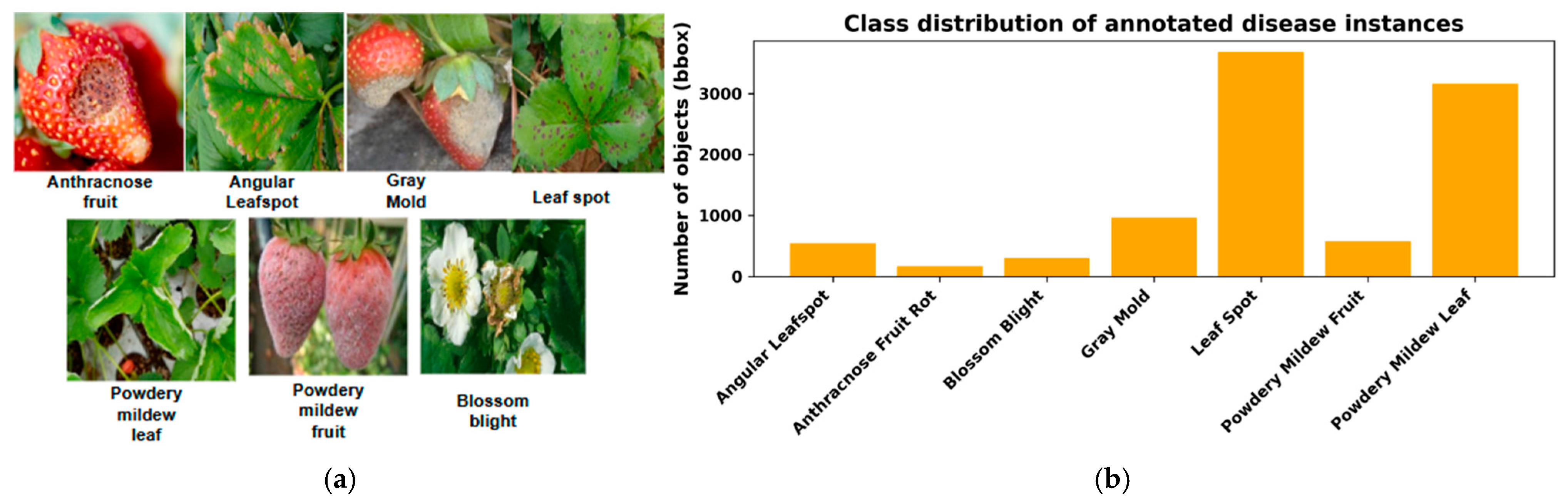
An open YOLO-compatible dataset on strawberry diseases was used to train the detector. The images were obtained in greenhouses and in open fields, under natural and artificial lighting. The dataset shows noticeable variability in leaf pose, background (soil, mulch, greenhouse structures), occlusions and illumination, which motivates the use of robust object-detection models. Annotations are provided in YOLO format (normalised coordinates of the centre, width and height of each bounding box, and class identifier). Seven disease classes are considered; example images for each class are shown in Figure 1a.
The images and corresponding YOLO labels are organised in the standard images/and labels/folders. In total, the detection dataset contains 9386 annotated disease instances, with 544 Angular Leafspot, 167 Anthracnose Fruit Rot, 300 Blossom Blight, 963 Grey Mould, 3679 Leaf Spot, 572 Powdery Mildew Fruit and 3161 Powdery Mildew Leaf bounding boxes (Figure 1b). Leaf Spot and Powdery Mildew Leaf are therefore the dominant classes, whereas Anthracnose Fruit Rot and Blossom Blight are clearly under-represented, which highlights the class imbalance and further motivates the use of robust and properly regularised detection models. The images are split into training, validation and test subsets following the original dataset organisation. In our experiments, this corresponds to 2707, 769 and 387 images in the training, validation and test subsets, respectively (approximately 70%, 20% and 10% of the total number of images). This split is created once before training, and the default YOLOv10 data augmentation pipeline is applied on-the-fly only to the training images, while validation and test images are used without augmentation.

2.1.2. Leaf Spot Severity Dataset and Exploratory Analysis

To build a three-level Leaf Spot severity assessment module, a separate set of strawberry leaf images was formed. A total of about 500 photographs of leaves with signs of Leaf Spot were collected from open Internet resources, as well as from images taken in fields, greenhouses, and private farms.
All images were converted to a single format: a fragment with one dominant leaf affected by Leaf Spot was selected from the original frame; sufficient resolution and the absence of severe blurring and overexposure were ensured. Duplicates and images of unsatisfactory quality were deleted.
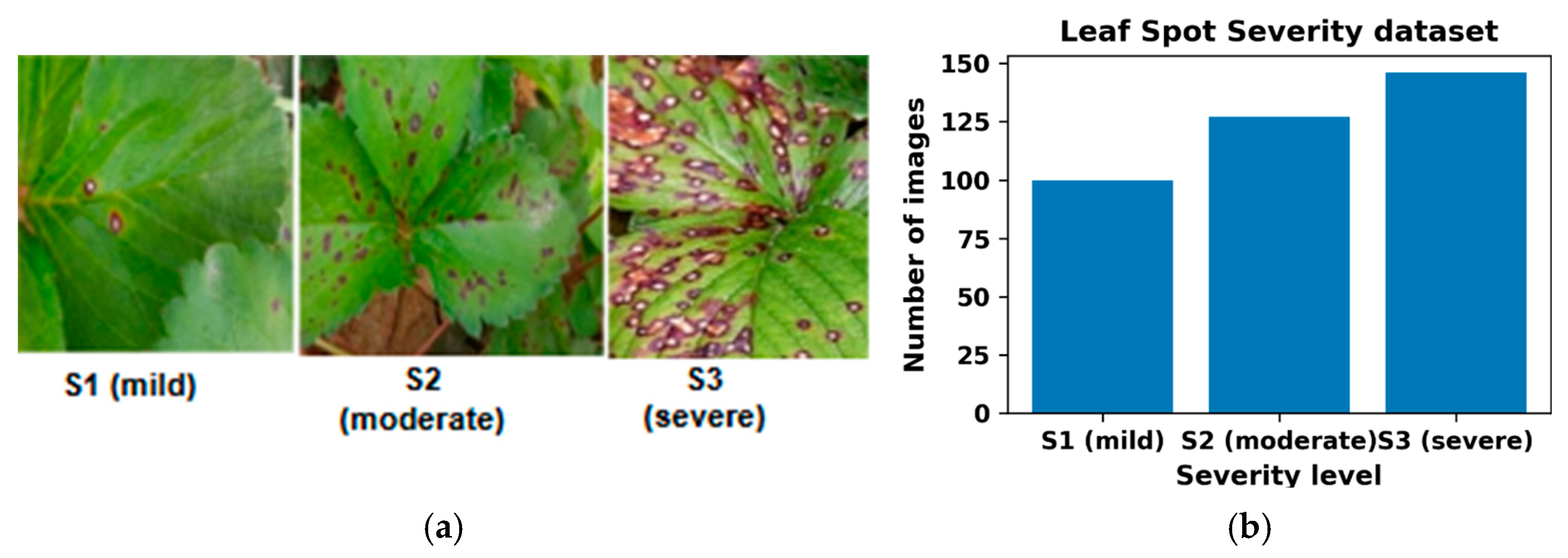
Each photo was manually assigned one of three levels of Leaf Spot severity; Figure 2a shows example images for S1, S2 and S3, while Figure 2b illustrates the distribution of samples across the three severity levels:
S1 (mild)—a few small spots, less than ~10–15% of the leaf area affected;
S2 (moderate)—larger number and size of spots, partial merging of foci, approximately 15–40% of the area affected;
S3 (severe)—large merging necrotic areas, more than 40% of the leaf area affected, leaf blade noticeably damaged.
Formally, the severity can be described by the proportion of the affected leaf area. Let Aleaf denote the leaf blade area and Alesion denote the total area of Leaf Spot spots. Then the indicator is introduced as s = Alesion/Aleaf.
Within the framework of this study, severity levels can be linked to ranges of s values as follows:
S1 (mild), if s < α1;
S2 (moderate), if α1 ≤ s < α2;
S3 (severe), if s ≥ α2, where α1 ≈ 0.10–0.15, α2 ≈ 0.40
In practice, the severity labels were assigned visually by agronomy experts, who estimated the proportion of the affected area on each leaf. The thresholds α1 and α2 were chosen in consultation with these experts as approximate boundaries between “mild”, “moderate” and “severe” damage, rather than being adopted from a specific previous work. This conceptual scale is consistent with general recommendations for constructing and interpreting visual plant disease severity estimates summarised by Bock et al. [20].
To train and evaluate the severity-assessment module, we constructed a dedicated Leaf Spot Severity dataset by cropping leaf patches from images where Leaf Spot was detected. Each patch was independently labelled by two agronomy experts with one of three severity levels (S1–S3), based on the visually estimated proportion of the leaf area affected by lesions. In cases of disagreement, the annotators discussed the image and reached a consensus label. The resulting dataset contains 74 validation patches and the remaining images in the training set with a stratified 80/20 split by severity level, namely 23, 20 and 31 samples for S1, S2 and S3, respectively, in the validation set. An exploratory analysis reveals that the three levels are reasonably balanced, while the visual appearance of lesions varies in size, colour and spatial distribution across images. Overall, the final Leaf Spot Severity dataset used for training and evaluation contains 373 labelled patches, with 100, 127 and 146 images for S1, S2 and S3, respectively (Figure 2b).
This Leaf Spot Severity dataset is organised into three folders (S1_mild, S2_moderate, S3_severe) according to the visually assessed severity level.

2.2. Architecture of the Proposed StrawberrySeverityNet System

2.2.1. General Diagram of the Two-Stage Pipeline

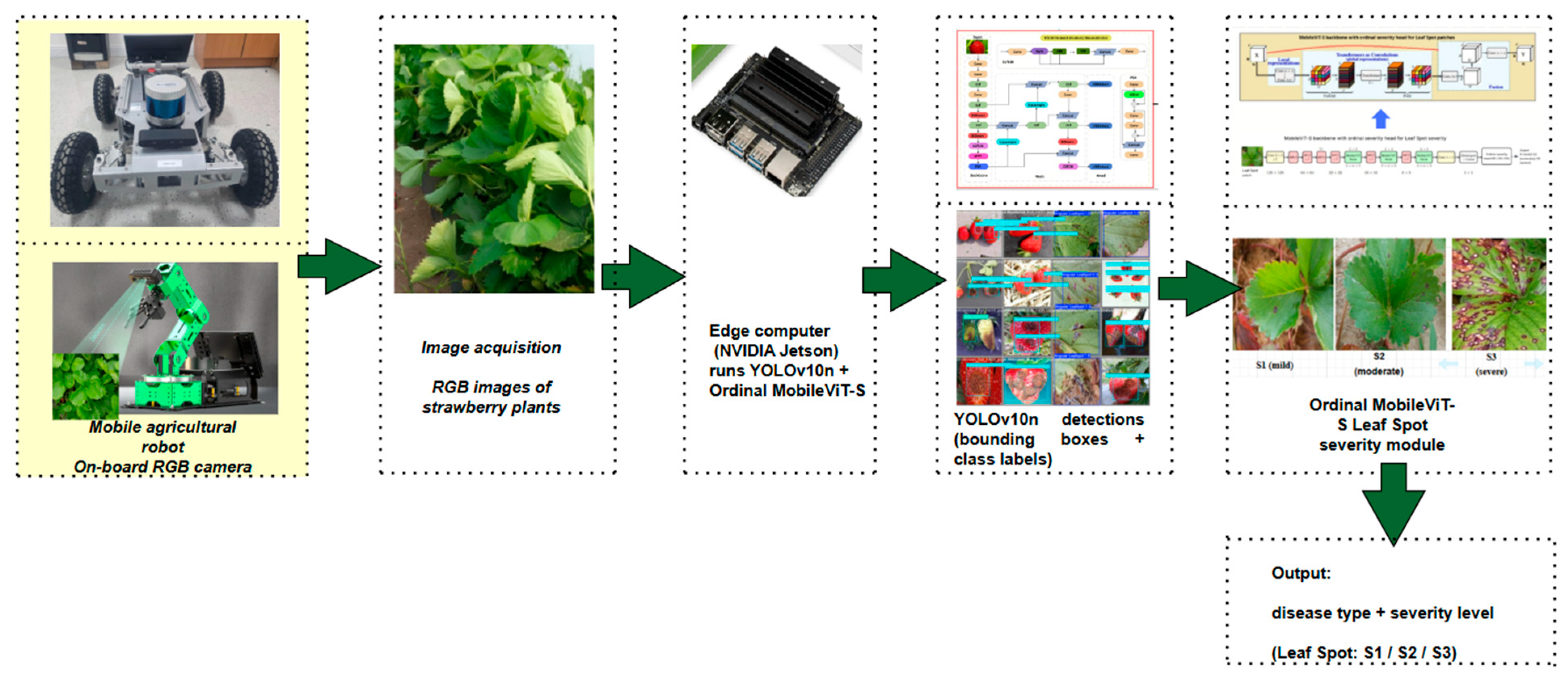
The proposed StrawberrySeverityNet system implements a two-stage image processing pipeline designed to run on a peripheral edge device. The first stage involves the detection of leaf diseases, while the second stage involves a three-level assessment of the severity of Leaf Spot.
Stage 1—disease detection (YOLOv10n). The input RGB image of strawberry bushes is scaled to 640 × 640 pixels and fed into the YOLOv10n detector. The model simultaneously localises objects of seven disease classes (Angular Leafspot, Anthracnose Fruit Rot, Blossom Blight, Grey Mould, Leaf Spot, Powdery Mildew Leaf, Powdery Mildew Fruit) and outputs the coordinates of the bounding box, class ID, and confidence score for each object.
Stage 2—Leaf Spot severity assessment. All Leaf Spot class frames are selected from the detector results. For each frame, a leaf patch is cut out from the original image, resized to 224 × 224 pixels, and fed into the severity assessment module. At this stage, lightweight classification models (ResNet-18, EfficientNet-B0, MobileNetV3-Small, Swin-Tiny, MobileViT-S, and the proposed Ordinal MobileViT-S) are used to assign one of three severity levels to each leaf: S1 (mild), S2 (moderate), or S3 (severe).
As a result of two-stage processing, the system forms a “disease type—severity level” pair for each detected leaf and, for the Leaf Spot class, additionally provides a three-level assessment of the degree of damage, suitable for subsequent agrotechnological interpretation. A schematic representation of the pipeline is shown in Figure 3.

2.2.2. YOLOv10n-Based Disease Detector

Currently, YOLO family networks are widely used for object detection tasks in agriculture. Among them, YOLOv10 stands out for its improved compromise between accuracy and speed [21], and its smallest version, YOLOv10n, is specifically designed to run on devices with limited resources. YOLOv10 uses a typical “backbone–neck–head” structure with C2f/C2fCIB blocks for efficient feature extraction and a PSA spatial attention module that increases sensitivity to small details on leaves.
This work uses the standard YOLOv10n architecture without structural changes. RGB images of strawberry bushes are resized to 640 × 640 pixels and fed into YOLOv10n, which localises leaves affected by the same seven disease classes described in Section 2.1.1 (see Figure 1a) and outputs the coordinates of the bounding boxes, class identifiers, and confidence scores for each detection. A small number of parameters and high inference speed make YOLOv10n a suitable choice for deployment on an NVIDIA Jetson Nano onboard computing module as part of a mobile agricultural robot.
During training, we followed the standard YOLOv10n training settings of the official implementation with an input resolution of 640 × 640 pixels. We used the default data augmentation and regularisation pipeline of the official YOLOv10 implementation (which includes random scaling, translations and horizontal flips) and did not introduce any additional class-rebalancing techniques such as over-sampling, under-sampling or class weighting. The dataset was split into training, validation and test subsets as described in Section 2.1, and the final model was selected based on the best mAP at 0.5 intersection-over-union on the validation set. For deployment on the embedded device, the detector was run in its PyTorch (version 2.2.0) implementation on the NVIDIA Jetson Nano without additional TensorRT optimisation.

2.2.3. Lightweight Models for Leaf Spot Severity Assessment

For a three-level assessment of Leaf Spot severity (S1—mild, S2—moderate, S3—severe), several common lightweight architectures suitable for deployment on edge devices were selected: ResNet-18, EfficientNet-B0, MobileNetV3-Small, Swin-Tiny, and MobileViT-S.
These backbones were chosen because ResNet-18 and EfficientNet-B0 are compact and widely used CNN models, MobileNetV3-Small represents mobile networks specifically optimised for embedded deployment, Swin-Tiny is a representative lightweight vision transformer, and MobileViT-S provides a compact hybrid CNN–Transformer design. Together, they form a representative set of lightweight CNN/Transformer baselines for a fair comparison with the proposed Ordinal MobileViT-S.
In all cases, the input is a 224 × 224 × 3 leaf patch from the Leaf Spot Severity dataset. Simple augmentations (horizontal reflection, rotation up to ±10°, small changes in brightness and contrast) were applied to the training set, and only scaling and normalisation were applied to the validation set. These augmentations were applied uniformly to all three severity levels and were intended to reduce overfitting given the small size of the dataset, rather than to explicitly re-balance the class distribution.
All models were initialised with weights pre-trained on ImageNet, and the final fully connected layer was replaced with a layer with three outputs (S1, S2, S3). Apart from replacing the final classification layer with three outputs, all baseline architectures, including Swin-Tiny, are used in their standard form without structural modifications. All base models were trained under the same conditions (same number of epochs, batch size, and learning rate) using a standard cross-entropy loss function, which ensures a fair comparison of architectures in terms of accuracy and number of parameters. This transfer-learning setup, together with data augmentation, is particularly important here to mitigate overfitting, because the Leaf Spot Severity dataset used for training and validation contains only 373 labelled patches.
Recent work has also shown that MobileViT-based architectures can be successfully adapted for plant disease recognition in field conditions, for example, using a dual-attention MobileViT network for rice disease identification [22].

2.2.4. Proposed Ordinal MobileViT-S for Leaf Spot Severity Assessment

The main model proposed for severity assessment is a modification of MobileViT-S. As shown in Figure 4, feature extraction uses the standard MobileViT-S backbone, consisting of an initial convolutional layer, several MV2 blocks, and three MobileViT blocks, followed by global averaging and a fully connected layer.
Unlike the base version, where the output layer directly predicts one of three severity classes using a conventional cross-entropy loss function, the proposed model uses an ordinal formulation. Instead of three independent classes, the model is trained to answer two binary questions:
(1) is the severity of the lesion at least average (S2 or S3);
(2) is the severity at least severe (S3).
In our implementation, each sample with severity level 1, 2 or 3 is represented by two binary targets. The first target is equal to 1 if the severity is at least level 2 and 0 otherwise. The second target is equal to 1 if the severity is at least level 3 and 0 otherwise. The ordinal head of MobileViT-S outputs two probabilities, one for each threshold. The loss for a batch is computed as the sum of two standard binary cross-entropy losses between the predicted probabilities and the corresponding binary targets, averaged over all samples. The final severity level is obtained by counting how many thresholds the model predicts as satisfied; for example, if both threshold probabilities are above 0.5, the sample is assigned to level S3. This formulation respects the ordered structure of the labels and penalises large deviations in severity more strongly than confusions between neighbouring levels.
Formally, for each sample with a true severity class yi ∈ {1, 2, 3}, two binary target labels are introduced:
t i 1 = 1 y i 2 , t i 2 = 1 y i   3 ,
corresponding to thresholds “not lower than S2” and “not lower than S3.” The model predicts two logits, zi1 and zi2, from which the probabilities are calculated p i 1 = σ z i 1 , p i 2 = σ ( z i 2 ) , where σ(⋅) is a sigmoid function. The ordinal loss function is defined as the sum of binary cross-entropies for both thresholds:
L o r d = 1 N ( K 1 ) i = 1 N k = 1 K 1 t i k log p i k + 1 t i k log ( 1 p i k ) .
where K = 3 is the number of severity levels, tik ∈{0,1} are binary target labels for thresholds “S ≥ S2” and “S ≥ S3,” and pik are the corresponding predicted probabilities.
Conceptually, the ordinal formulation reflects the biological nature of Leaf Spot progression. The three labels S1, S2 and S3 correspond to successive stages of the same underlying disease process (S1 → S2 → S3), rather than to three unrelated categories. By learning two cumulative probability thresholds (“severity is at least S2” and “severity is at least S3”), the model effectively estimates where each leaf lies along this progression. In contrast, a conventional categorical classifier treats S1, S2 and S3 as independent classes and cannot exploit the fact that confusing S1 with S2 is less severe than confusing S1 with S3. The ordinal MobileViT-S head therefore provides a better conceptual match to severity assessment than a standard softmax classifier.
In all experiments, uniform training settings were used for the severity assessment module. Input images of leaf patches were scaled to a size of 224 × 224 pixels. All CNN-based severity models were trained for 10 epochs with a batch size of 32 using the Adam optimizer with an initial learning rate of 1 × 10⁻⁴ and a weight decay of 1 × 10⁻⁵. We applied the same data augmentations to all architectures, including random horizontal flipping, small rotations and mild changes in brightness and contrast, to ensure a fair comparison. For the base models, standard cross-entropy was used as the loss function, and for the proposed MobileViT-S modification, the ordinal loss function was used. Classification quality was evaluated by overall accuracy, precision, recall, and F1-score for each of the three severity classes, as well as by the confusion matrix.
All models were implemented in Python 3 (version 3.12) using the PyTorch deep-learning framework. The YOLOv10n detector was trained with its official PyTorch-based implementation, while the severity classifiers (ResNet-18, EfficientNet-B0, MobileNetV3-Small, Swin-Tiny, MobileViT-S and Ordinal MobileViT-S) were implemented using PyTorch and the timm library. Training was carried out in a CUDA-enabled GPU environment, which facilitates reproduction of the experiments using widely available hardware and software tools.

3. Results

3.1. YOLOv10n Disease Detection Results

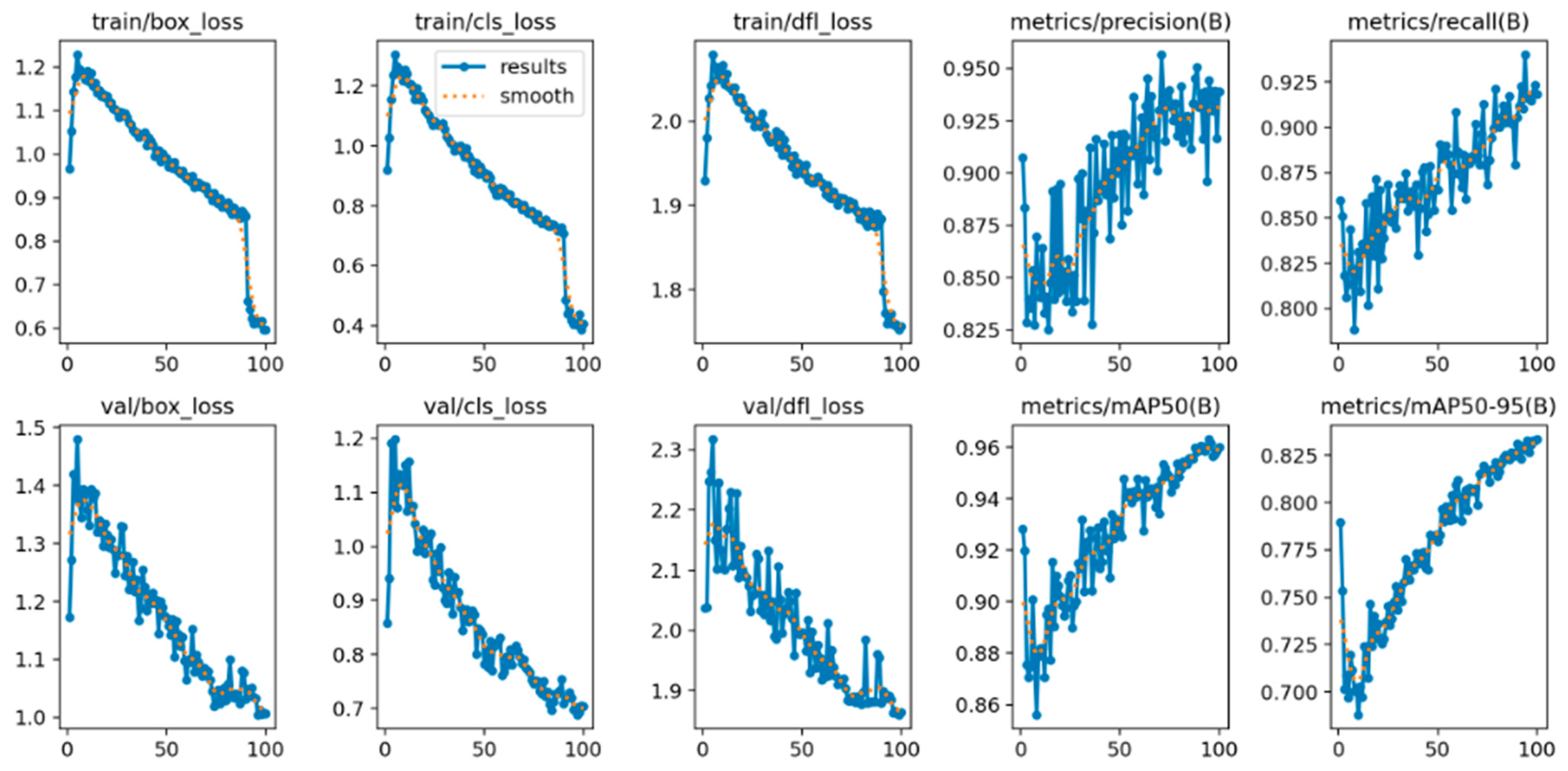
Training YOLOv10n on a set of strawberry leaf diseases showed stable convergence: the loss functions for bounding boxes and classification decreased monotonically, while precision, recall, and mAP on the validation set increased steadily without signs of overfitting (Figure 5).
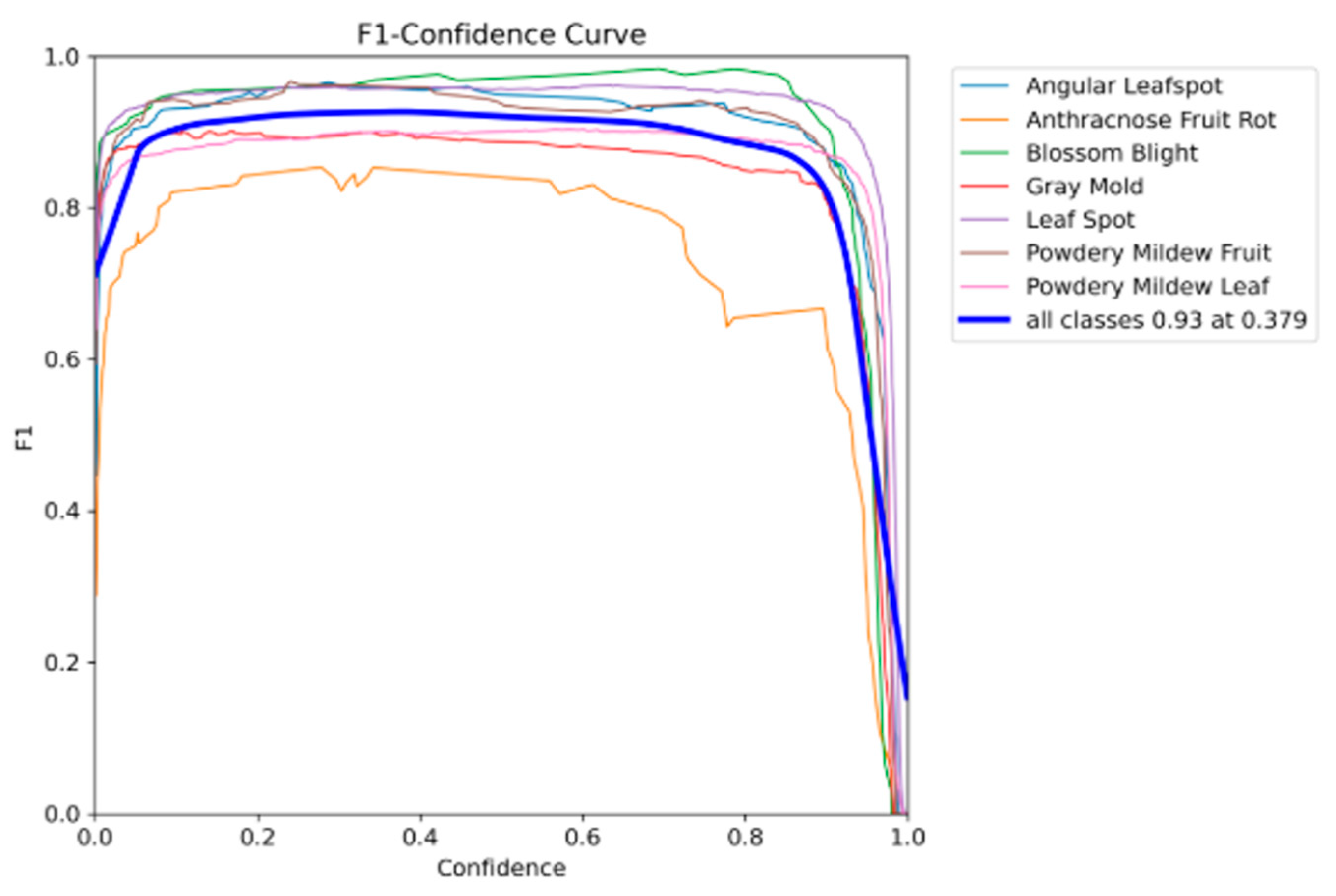
As shown in Figure 6, the F1-score curve peaks at around 0.93 when the confidence threshold is set to approximately 0.38. Under these conditions, the YOLOv10n detector achieves an mAP@0.5 of 0.960, a recall of 0.917, and a precision close to 0.94 on the test set, which demonstrates its reliability within the proposed two-stage pipeline for Leaf Spot severity assessment.
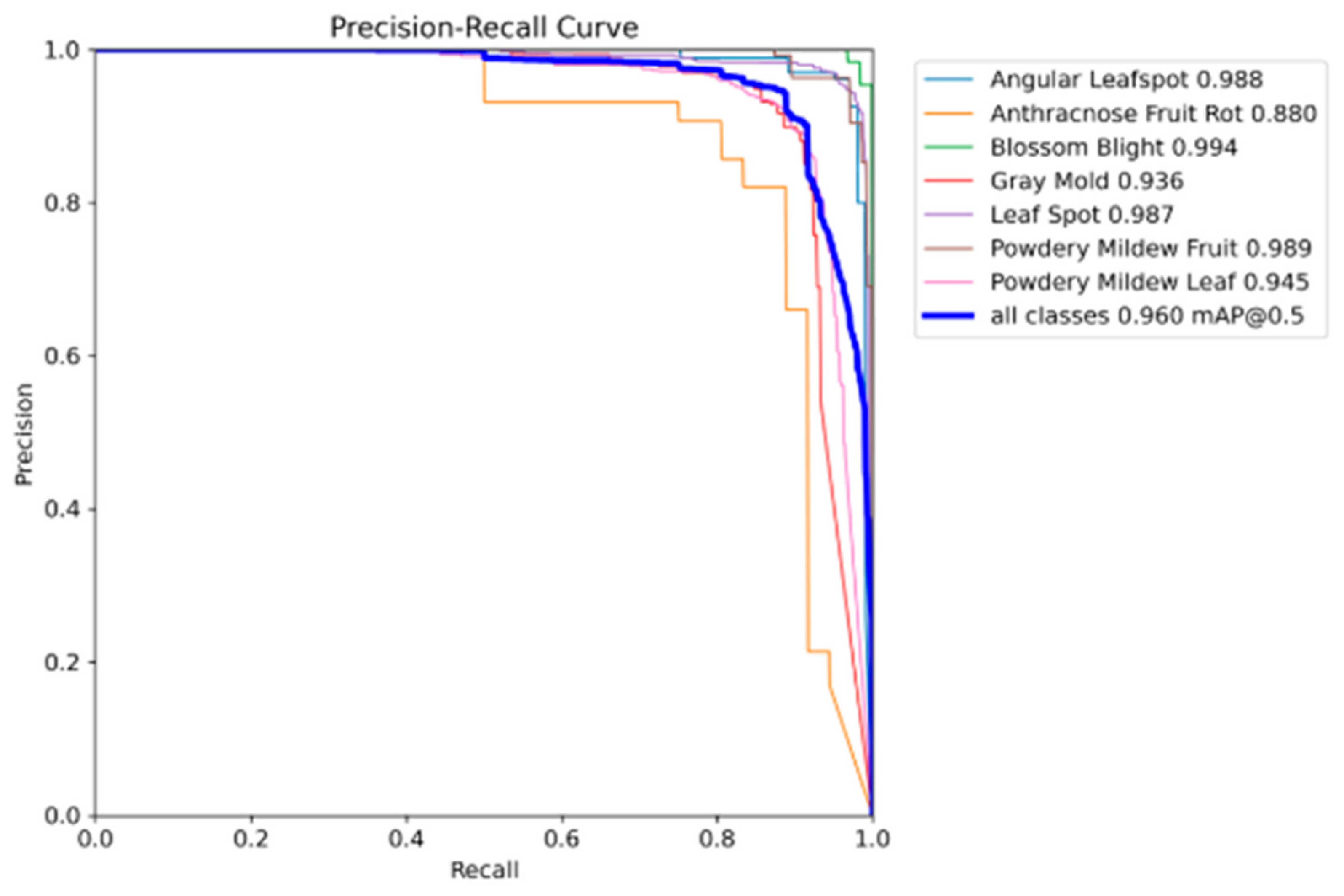
In addition to the F1-score curve, precision–recall (PR) curves were plotted for all seven disease classes (Figure 7). The curves confirm that YOLOv10n achieves high average precision across the classes, with per-class AP values ranging from 0.88 to 0.99 and an overall mAP@0.5 of 0.960 on the test set.
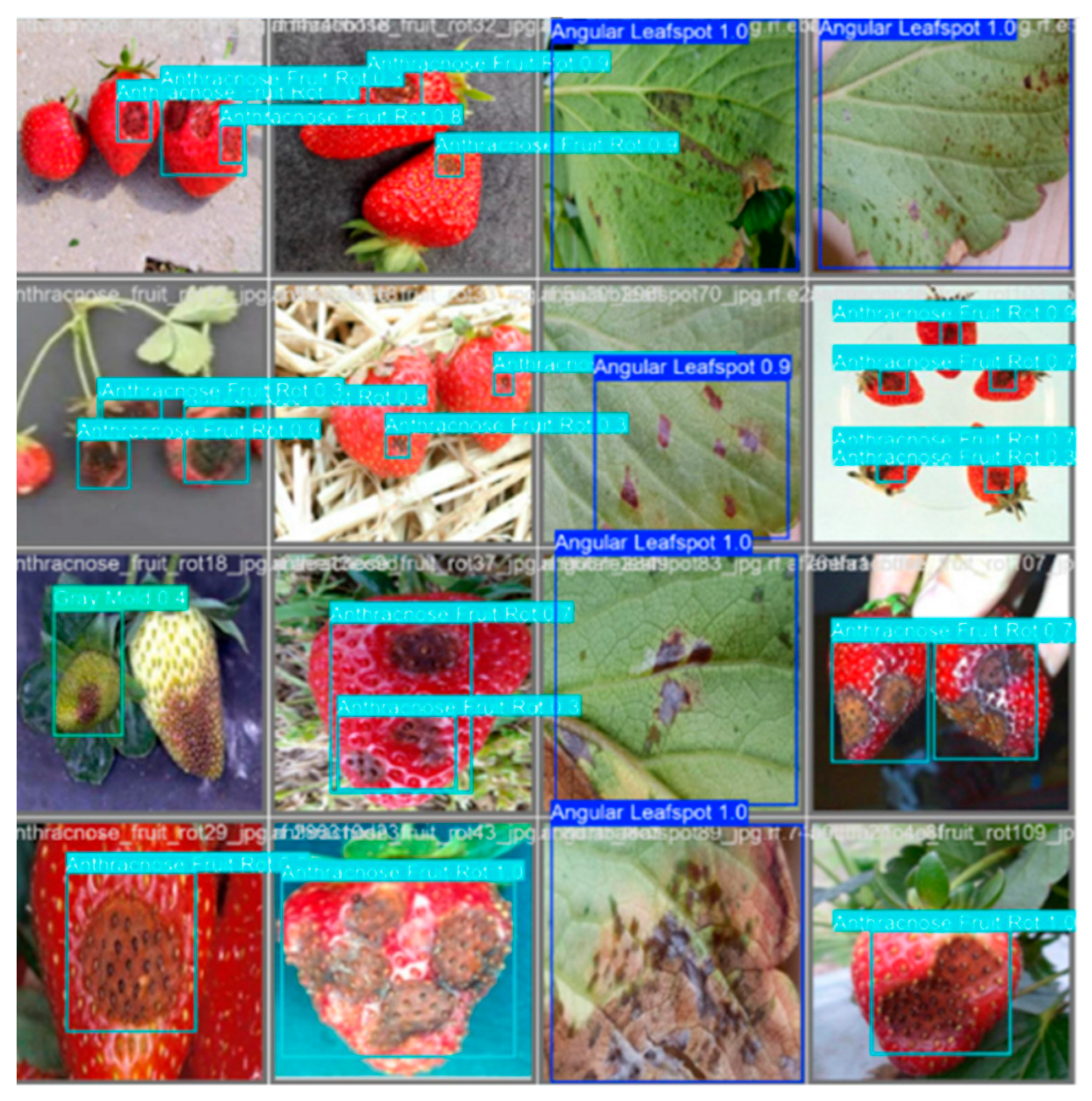
Finally, Figure 8 presents qualitative examples of YOLOv10n detections on test images. The results illustrate correct localization of diseased leaves and fruits under partial occlusions and varying illumination, as well as representative failure cases such as missed small lesions or occasional false positives. These visual examples complement the quantitative evaluation based on mAP, F1-score and precision–recall curves and confirm the suitability of YOLOv10n as the first stage of the StrawberrySeverityNet pipeline.

3.2. Results of the Three-Level Leaf Spot Severity Assessment

For the Leaf Spot Severity dataset, a series of experiments was conducted with several compact architectures suitable for deployment on edge devices. Table 1 compares the number of parameters and accuracy for ResNet-18, EfficientNet-B0, MobileNetV3-Small, Swin-Tiny, the baseline MobileViT-S, and the proposed ordinal modification of MobileViT-S.
ResNet-18 with 11.18 million parameters achieves an accuracy of 0.838, EfficientNet-B0 (4.01 million) reaches 0.865, and the lighter MobileNetV3-Small (1.52 million) achieves 0.932. The Swin-Tiny transformer model shows the highest accuracy among the base models (0.946), but it is also the heaviest (27.52 million parameters). The standard MobileViT-S with a cross-entropy loss function achieves an accuracy of 0.932 with 4.94 million parameters. The proposed Ordinal MobileViT-S retains the same number of parameters (4.94 million) but increases accuracy to 0.973, providing a better compromise between quality and complexity compared to both CNN models and the heavier Swin-Tiny.
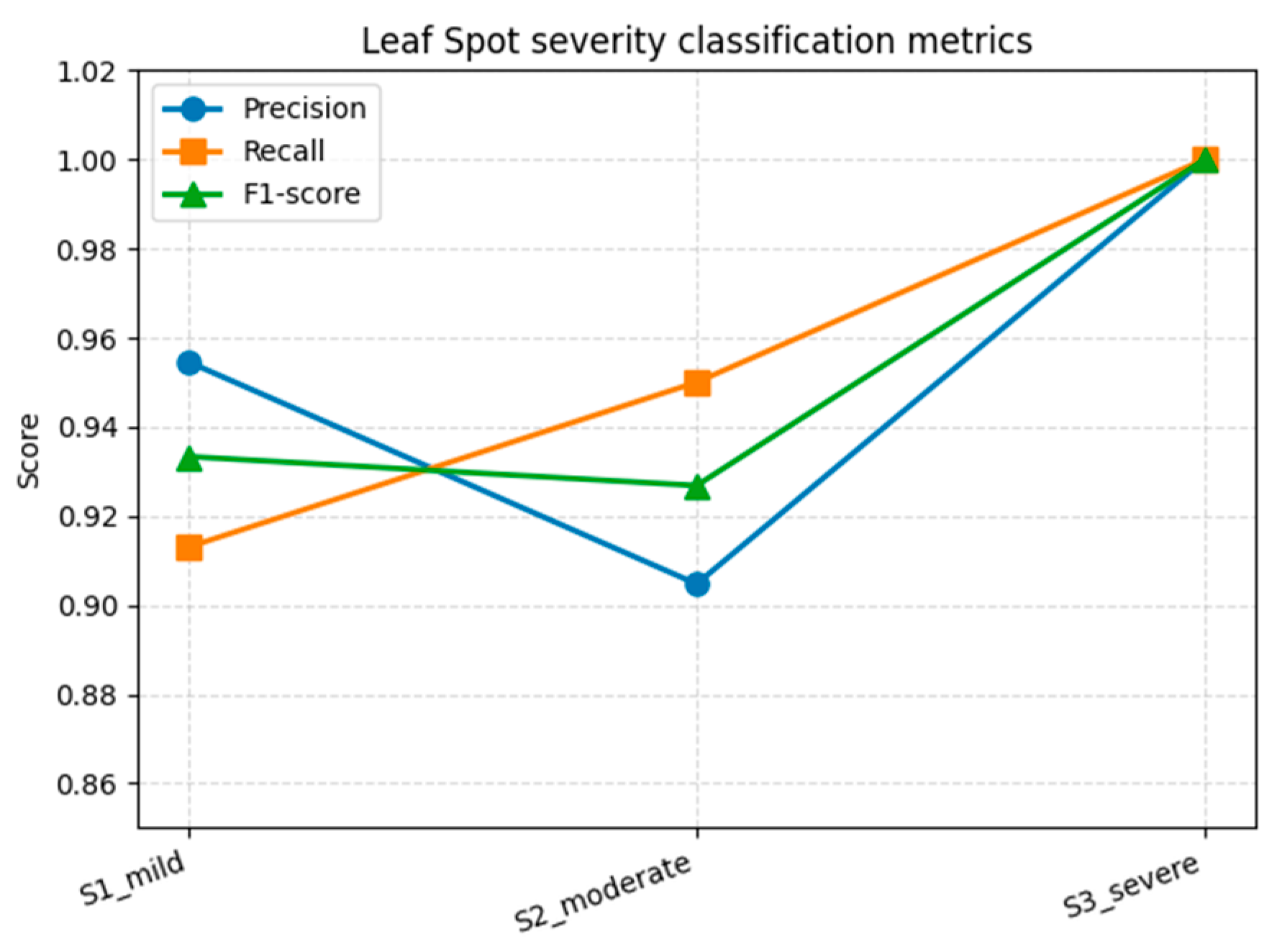
Figure 9 shows the precision, recall, and F1-measure values for three severity levels for the Ordinal MobileViT-S model. For class S1 (mild), precision is about 0.95, recall is 0.91, and F1 is 0.93; for S2 (moderate), precision is approximately 0.91, recall is approximately 0.95, and F1 is approximately 0.93. For S3 (severe), all three metrics are close to 1.0. Thus, the model is particularly reliable in recognising severely affected leaves, and most errors are related to the distinction between neighbouring states S1 and S2.
Table 2 and Figure 10 provide a more detailed view of the classifier’s behaviour on the validation set. Table 2 reports per-class precision, recall, F1-score and support for the three severity levels.
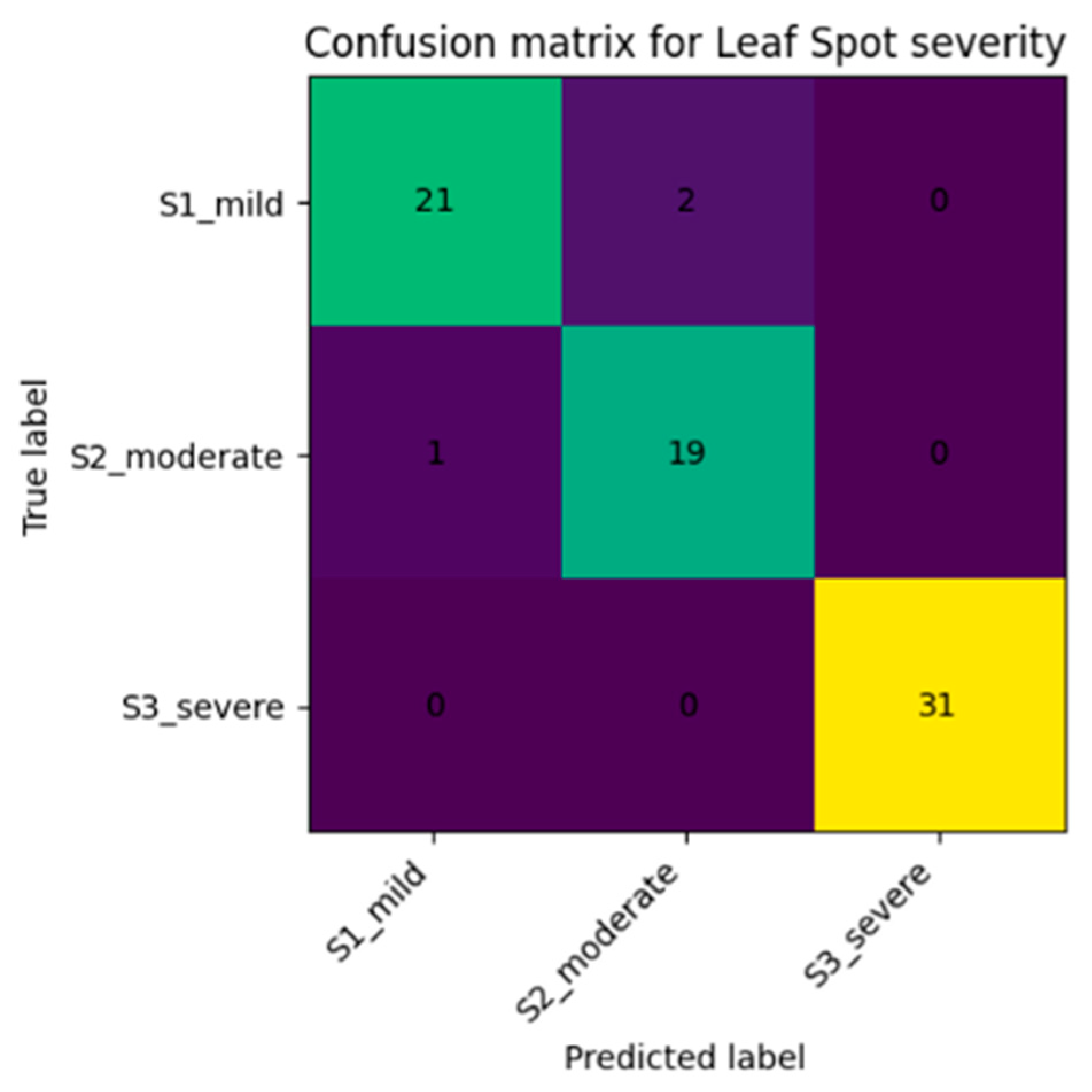
As summarised in Table 2, Ordinal MobileViT-S achieves balanced performance across the three severity levels, with macro-averaged precision, recall and F1-score of 0.95 and an overall accuracy of 0.96 on the validation set. The confusion matrix in Figure 10 further illustrates that 21 of the 23 S1 class leaves were correctly classified as S1, while two cases were incorrectly classified as S2. For S2, 19 of the 20 samples were correctly recognised, while one was classified as S1. All 31 leaves of class S3 (severe) are classified correctly. There are no direct errors between S1 and S3, which confirms the ability of the ordinal model to reliably distinguish between mild and severe degrees of damage, allowing for rare errors only between adjacent severity levels.

4. Discussion

The results show that the proposed two-stage StrawberrySeverityNet system can serve as a practical solution for monitoring strawberry leaf diseases on peripheral devices. Similar edge-AI architectures for in-field plant disease monitoring have also been reported in recent studies [23,24]. The lightweight YOLOv10n detector provides reliable detection of seven disease classes with limited computing resources: on the test sample, it achieves an mAP@0.5 of 0.960, a recall of 0.917, and an F1 score of 0.93. The Ordinal MobileViT-S module allows for additional assessment of Leaf Spot severity on three levels. This design sets the system apart from most existing solutions, which focus only on disease classification or plant and fruit detection without quantitative assessment of the degree of damage.
A comparison of lightweight architectures for the task of three-level severity assessment shows that simply increasing the number of parameters (e.g., using Swin-Tiny) is not always justified in terms of deployment on mobile platforms. Ordinal MobileViT-S achieves the highest accuracy (0.973) with a moderate model size (4.94 million parameters), outperforming both more compact CNNs (MobileNetV3-Small, EfficientNet-B0) and the significantly heavier Swin-Tiny. This confirms that taking into account the ordinal structure of classes and a specialised severity head provide a more significant increase in quality than further complicating the architecture.
Analysis of the error matrix shows that the model practically does not allow gross errors between S1 (mild) and S3 (severe): all severely affected leaves are recognised correctly, and errors occur only at the border between neighbouring levels S1/S2. This is critical for practical precision farming scenarios: the system reliably identifies plants with severe damage that require immediate intervention (removal or targeted treatment), while minor discrepancies between “mild” and “moderate” damage are less critical. This focus on avoiding large misclassifications between mild and severe damage is consistent with general recommendations for designing and interpreting visual disease severity scales in plant pathology [20].
In practical agronomic terms, confusion between S1 and S2 is usually less critical than confusion involving S3. For example, leaves classified as S1 or S2 may lead to similar recommendations such as closer visual monitoring and, if necessary, localised low-dose fungicide application, whereas S3 plants are candidates for immediate removal or intensive treatment to prevent further spread of the pathogen. By explicitly separating S3 from the two lower levels, the proposed system supports targeted interventions and can help reduce unnecessary blanket spraying.
While a detailed economic analysis is beyond the scope of this study, we expect that severity-aware monitoring could contribute to more cost-effective crop protection. Concentrating fungicide applications and manual labour on S2–S3 plants, and removing severely affected leaves or plants at an early stage, has the potential to lower chemical input, minimise unnecessary treatments on lightly affected plants and reduce yield losses due to late detection.
In a broader systems-engineering context, the edge-deployed StrawberrySeverityNet can be viewed as an IIoT node within the digital twin of a vertically integrated strawberry-processing enterprise, whose field layout can be aligned with CAD-based maps of the production area. Disease type and three-level severity outputs (S1–S3) can be transmitted from the mobile robot to the enterprise information system via standard protocols such as MQTT or OPC UA, visualised on a central dashboard as field- or block-level severity maps and linked to key performance indicators (e.g., expected yield of marketable product, fraction of low-quality batches). In this way, early severity-aware monitoring at the raw-material stage supports lean manufacturing principles by reducing waste associated with poor-quality input and unnecessary treatments.
However, the work has a number of limitations. First, the severity assessment module is trained on a relatively small and manually labelled set of 373 Leaf Spot patches, which may limit the model’s generalizability to other strawberry varieties and to truly uncontrolled open-field illumination (e.g., strong shadows, backlighting and specular reflections). Although using ImageNet-pretrained backbones and data augmentation reduces the risk of overfitting, collecting a larger and more diverse severity dataset remains an important direction for future work. Second, the system evaluates only one disease (Leaf Spot), whereas in real plantings, a combination of several pathologies and physiological stresses is often observed. Finally, the current version does not take into account the temporal dynamics of disease development and relies only on single images of leaves.
Another limitation is that we do not perform a dedicated robustness study with respect to synthetic noise, blur or strong changes in illumination and background. The current evaluation reflects only the natural variability present in the training and test datasets, which already includes different lighting conditions, backgrounds and occlusions. While the use of ImageNet pre-training and mild geometric and photometric augmentations is expected to improve generalisation to moderate appearance changes, we did not carry out an ablation study to isolate their effect, and robustness to severe noise or domain shifts (e.g., different cameras, cultivars or acquisition conditions) remains to be investigated. A systematic robustness analysis of both the detection and severity modules is therefore an important direction for future work.
A further limitation of the present study is that we did not perform a dedicated profiling of inference latency, throughput and energy consumption for the Ordinal MobileViT-S module on the NVIDIA Jetson Nano device. While the small number of parameters and modest input resolution suggest that the severity module is suitable for near real-time operation when combined with YOLOv10n, a systematic latency analysis under different deployment configurations is left as future work. Such a study will be important for further optimising StrawberrySeverityNet for continuous on-board monitoring in commercial greenhouse and open-field environments.
In the future, we plan to expand the Leaf Spot severity dataset to include other common strawberry leaf diseases, as well as conduct full-scale testing on a mobile platform with a closed-loop control system (detection → severity assessment → treatment decision). A separate area of focus is the integration of time series observations and environmental sensor data (humidity, temperature, leaf moisture) to predict disease progression and develop recommendations for targeted fungicide application. In addition, we plan to enlarge the dataset with images from additional strawberry cultivars and growing regions and to explore domain-adaptation techniques to improve cross-site generalisation.

5. Conclusions

This paper presents StrawberrySeverityNet, a lightweight two-stage edge-AI system for monitoring the health of strawberry leaves. In the first stage, the YOLOv10n detector, deployed on an onboard computing module, detects seven major leaf diseases with real-time capability on an embedded module. Experiments have shown that the YOLOv10n detector achieves an mAP@0.5 of 0.960, a recall of 0.917, and an F1 score of 0.93, which corresponds to high-quality localization of affected leaves while maintaining the lightness of the model. In the second stage, patches are formed from the detected Leaf Spot class leaves, for which a three-level severity assessment module based on a modified Ordinal MobileViT-S model is proposed. This combination not only identifies the type of disease but also quantitatively assesses the degree of damage, which is important for making agrotechnological decisions and can be directly linked to actions such as adjusting fungicide dosage, prioritising removal of severely affected plants, and planning site-specific treatments. Overall, the results emphasise that moving from pure disease detection to severity-aware diagnosis can have a direct practical impact on decision making in strawberry production.
A comparison with a number of compact architectures (ResNet-18, EfficientNet-B0, MobileNetV3-Small, Swin-Tiny, basic MobileViT-S) showed that Ordinal MobileViT-S achieves the highest accuracy (0.973) with a moderate number of parameters (4.94 million), providing the best balance between classification quality and computational complexity. Class-wise analysis and error matrix demonstrated high reliability in recognising severely affected leaves and no gross errors between mild and severe degrees of severity.
The practical significance of the system lies in its ability to be deployed on mobile agricultural robots and edge platforms for real-time monitoring of strawberry crops in greenhouses and open fields. The output data in the form of a “disease type—severity level” pair can be directly used to plan spot spraying, remove severely affected plants, and evaluate the effectiveness of the measures taken.
When integrated into the dashboard of a food-enterprise digital twin, these outputs can be used by operators to visualise spatial patterns of disease severity and to adjust harvesting and processing strategies, and the same cascade architecture could be adapted to monitor visible defects on conveyor belts within the processing plant.
In the future, we plan to expand the Leaf Spot severity dataset to include other strawberry leaf diseases, as well as conduct field tests of the system as part of a robotic platform with a closed control loop. Additional areas of development include the use of time series observations to predict disease progression and the integration of multimodal data (images + environmental sensors) for more accurate and robust diagnostics.


Author Contributions

Conceptualization: R.A.; methodology: M.S.; software: R.A.; investigation: R.A., M.M. and G.A.; validation: R.A.; formal analysis: M.S.; resources: M.S., M.M. and G.T.; data curation: R.A. and G.T.; writing—original draft: R.A.; writing—review and editing: B.B., M.M., M.S., G.A. and G.T.; visualization: B.B.; supervision: M.S. project administration: R.A. All authors have read and agreed to the published version of the manuscript.

Funding

This research was funded by the Science Committee of the Ministry of Science and Higher Education of the Republic of Kazakhstan, Grant No. BR24992975, “Development of a digital twin of a food processing enterprise using artificial intelligence and IIoT technologies” (2024–2026).

Data Availability Statement

The original contributions presented in this study are included in the article. Further inquiries can be directed to the corresponding author.

Conflicts of Interest

The authors declare no conflicts of interest.

References

  1. Giampieri, F.; Tulipani, S.; Alvarez-Suarez, J.M.; Quiles, J.L.; Mezzetti, B.; Battino, M. The strawberry: Composition, nutritional quality, and impact on human health. Nutrition 2012, 28, 9–19. [Google Scholar] [CrossRef]
  2. Maas, J.L. Strawberry disease management. In Diseases of Fruits and Vegetables, Volume II: Diagnosis and Management; Springer: Dordrecht, The Netherlands, 2004; pp. 441–483. [Google Scholar]
  3. Gudiño-Ochoa, A. Light-MobileBerryNet: A lightweight and interpretable model for strawberry disease classification. AgriEngineering 2025, 7, 355. [Google Scholar]
  4. He, Y.; Peng, Y.; Wei, C.; Zheng, Y.; Yang, C.; Zou, T. Automatic Disease Detection from Strawberry Leaf Based on Improved YOLOv8. Plants 2024, 13, 2556. [Google Scholar] [CrossRef]
  5. Sarkar, C.; Gupta, D.; Gupta, U.; Hazarika, B.B. Leaf disease detection using machine learning and deep learning: Review and challenges. Appl. Soft Comput. 2023, 145, 110534. [Google Scholar] [CrossRef]
  6. Thakur, P.S.; Khanna, P.; Sheorey, T.; Ojha, A. Trends in vision-based machine learning techniques for plant disease identification: A systematic review. Expert Syst. Appl. 2022, 208, 118117. [Google Scholar] [CrossRef]
  7. Bharate, A.A.; Shirdhonkar, M. A review on plant disease detection using image processing. In Proceedings of the 2017 International Conference on Intelligent Sustainable Systems (ICISS), Palladam, India, 7–8 December 2017; pp. 103–109. [Google Scholar]
  8. Nguyen, D.T.; Bui, T.D.; Ngo, T.M.; Ngo, U.Q. Improving YOLO-Based Plant Disease Detection Using αSILU: A Novel Activation Function for Smart Agriculture. AgriEngineering 2025, 7, 271. [Google Scholar] [CrossRef]
  9. Li, H.; Gu, Z.; He, D.; Wang, X.; Huang, J.; Mo, Y.; Li, P.; Huang, Z.; Wu, F. A lightweight improved YOLOv5s model and its deployment for detecting pitaya fruits in daytime and nighttime light-supplement environments. Comput. Electron. Agric. 2024, 220, 108914. [Google Scholar] [CrossRef]
  10. Ramírez-Pedraza, A.; Salazar-Colores, S.; Terven, J.; Romero-González, J.-A.; González-Barbosa, J.-J.; Córdova-Esparza, D.-M. Nutritional Monitoring of Rhodena Lettuce via Neural Networks and Point Cloud Analysis. AgriEngineering 2024, 6, 3474–3493. [Google Scholar] [CrossRef]
  11. Bello, R.-W.; Oladipo, M.A. Mask YOLOv7-Based Drone Vision System for Automated Cattle Detection and Counting. Artif. Intell. Appl. 2024, 2, 115–125. [Google Scholar] [CrossRef]
  12. Pandey, P.; Patra, R. A Real-time Web-based Application for Automated Plant Disease Classification Using Deep Learning. In Proceedings of the 2023 IEEE International Symposium on Smart Electronic Systems (iSES), Ahmedabad, India, 18–20 December 2023; pp. 230–235. [Google Scholar]
  13. Sudhakar, M.; Swarna Priya, R.M. Computer Vision Based Machine Learning and Deep Learning Approaches for Identification of Nutrient Deficiency in Crops: A Survey. Nat. Environ. Pollut. Technol. 2023, 22, 1387–1399. [Google Scholar] [CrossRef]
  14. El Amraoui, K.; El Ansari, M.; Lghoul, M.; El Alaoui, M.; Abanay, A.; Jabri, B.; Masmoudi, L.; de Oliveira, J.V. Embedding a Real-Time Strawberry Detection Model into a Pesticide-Spraying Mobile Robot for Greenhouse Operation. Appl. Sci. 2024, 14, 7195. [Google Scholar] [CrossRef]
  15. Chen, M.; Zou, W.; Niu, X.; Fan, P.; Liu, H.; Li, C.; Zhai, C. Improved YOLOv8-Based Segmentation Method for Strawberry Leaf and Powdery Mildew Lesions in Natural Backgrounds. Agronomy 2025, 15, 525. [Google Scholar] [CrossRef]
  16. Wang, J.; Li, Z.; Gao, G.; Wang, Y.; Zhao, C.; Bai, H.; Lv, Y.; Zhang, X.; Li, Q. BerryNet-Lite: A Lightweight Convolutional Neural Network for Strawberry Disease Identification. Agriculture 2024, 14, 665. [Google Scholar] [CrossRef]
  17. Leite, D.V.; de Brito, A.V.; Faccioli, G.G.; Vieira, G.H.S. Deep Learning Models for Detection and Severity Assessment of Cercospora Leaf Spot (Cercospora capsici) in Chili Peppers under Natural Conditions. Plants 2025, 14, 2011. [Google Scholar] [CrossRef]
  18. Faye, D.; Diop, I.; Mbaye, N.; Dione, D.; Diedhiou, M.M. Plant Disease Severity Assessment Based on Machine Learning and Deep Learning: A Survey. J. Comput. Commun. 2023, 11, 57–75. [Google Scholar] [CrossRef]
  19. Bedi, P.; Gole, P.; Marwaha, S. PDSE-Lite: Lightweight Framework for Plant Disease Severity Estimation Based on Convolutional Autoencoder and Few-Shot Learning. Front. Plant Sci. 2024, 14, 1319894. [Google Scholar] [CrossRef] [PubMed]
  20. Bock, C.H.; Chiang, K.-S.; Del Ponte, E.M. Plant Disease Severity Estimated Visually: A Century of Research, Best Practices, and Opportunities for Improving Methods and Practices to Maximize Accuracy. Trop. Plant Pathol. 2022, 47, 25–42. [Google Scholar] [CrossRef]
  21. Wang, A.; Chen, H.; Liu, L.; Chen, K.; Lin, Z.; Han, J.; Ding, G. YOLOv10: Real-Time End-to-End Object Detection. arXiv 2024, arXiv:2405.14458. [Google Scholar]
  22. Zhang, M.; Wang, H.; Li, J.; Yang, X. Dual-Attention-Enhanced MobileViT Network: A Lightweight Model for Rice Disease Identification in Field-Captured Images. Agriculture 2025, 15, 571. [Google Scholar] [CrossRef]
  23. da Silva, J.C.F.; Silva, M.C.; Luz, E.J.S.; Delabrida, S.; Oliveira, R.A.R. Using Mobile Edge AI to Detect and Map Diseases in Citrus Orchards. Sensors 2023, 23, 2165. [Google Scholar] [CrossRef]
  24. Khan, A.T.; Sarker, I.H.; Alqahtani, H.; Li, S. Plant Disease Detection Model for Edge Computing Devices. Front. Plant Sci. 2023, 14, 1308528. [Google Scholar] [CrossRef] [PubMed]
Figure 1. Examples and distribution of strawberry disease classes in the detection dataset: (a) example images for the seven disease classes; (b) class distribution of annotated disease instances.
Computers 15 00063 g001
Figure 2. Leaf Spot severity levels in the severity dataset: (a) examples of strawberry leaves for three severity levels S1 (mild), S2 (moderate), S3 (severe); (b) class distribution of samples across S1, S2 and S3.
Computers 15 00063 g002
Figure 3. Overview of the StrawberrySeverityNet pipeline from RGB image acquisition on a mobile robot to YOLOv10n disease detection and three-level Leaf Spot severity estimation with Ordinal MobileViT-S.
Computers 15 00063 g003
Figure 4. Architecture of the Leaf Spot severity assessment module based on the MobileViT-S backbone with an ordinal severity head (S1/S2/S3).
Computers 15 00063 g004
Figure 5. Training and validation curves of the YOLOv10n model.
Computers 15 00063 g005
Figure 6. F1-estimation curve as a function of confidence threshold.
Computers 15 00063 g006
Figure 7. Precision–Recall curves for the seven strawberry disease classes and the overall mAP@0.5 obtained with the YOLOv10n detector.
Computers 15 00063 g007
Figure 8. Example YOLOv10n detection results on strawberry images, showing predicted bounding boxes and class labels for multiple disease types.
Computers 15 00063 g008
Figure 9. Precision, recall and F1 score for classes S1, S2 and S3 for the Ordinal MobileViT-S model.
Computers 15 00063 g009
Figure 10. Confusion matrix for three-level assessment of Leaf Spot severity (S1—mild, S2—moderate, S3—severe).
Computers 15 00063 g010
Table 1. Comparison of lightweight architectures for three-level Leaf Spot severity assessment.
ModelParameters (M)Accuracy
ResNet-1811.180.838
EfficientNet-B04.010.865
MobileNetV3-Small1.520.932
Swin-Tiny27.520.946
MobileViT-S (baseline)4.940.932
Ordinal MobileViT-S4.940.973
Table 2. Per-class precision (P), recall (R) and F1-score for the Ordinal MobileViT-S Leaf Spot severity classifier on the validation set.
Severity LevelPrecisionRecallF1-ScoreSupport
S1 (mild)0.950.910.9323
S2 (moderate)0.900.950.9320
S3 (severe)1.001.001.0031
Macro avg0.950.950.9574
Weighted avg0.960.960.9674
Disclaimer/Publisher’s Note: The statements, opinions and data contained in all publications are solely those of the individual author(s) and contributor(s) and not of MDPI and/or the editor(s). MDPI and/or the editor(s) disclaim responsibility for any injury to people or property resulting from any ideas, methods, instructions or products referred to in the content.