1. Introduction
Agility is a critical determinant of athletic performance, particularly in racket sports such as table tennis, where athletes must continuously adjust their positioning, respond to highly variable ball trajectories, and execute complex technical movements with precision. Conventional agility assessment methods, including manual stopwatch timing and video-based post hoc analysis, provide only limited dynamic information and often suffer from insufficient objectivity, measurement accuracy, and real-time responsiveness. Although image-based motion tracking systems are widely adopted in both research and training contexts, their performance remains highly sensitive to lighting conditions, camera occlusion, and computational latency, which restricts their reliability in high-intensity or multi-athlete scenarios. These limitations underscore the need for a robust, real-time, and accurate agility assessment framework capable of operating reliably under diverse training conditions [
1].
Recent advances in sensing and immersive visualization technologies have expanded the scope of sports performance analysis. Millimeter-wave (MMW) radar enables fine-grained motion tracking with strong robustness to low-light environments and partial occlusion, making it well suited for dynamic and crowded scenarios [
2]. Ultra-wideband (UWB) positioning provides high-precision localization and reliable identity differentiation, which is particularly advantageous in dual-player or multi-target agility assessments where individual trajectory separation is required [
3]. Meanwhile, mixed reality (MR) visualization offers intuitive, real-time representations of movement data, enhancing situational awareness and facilitating interactive feedback between athletes and coaches. The convergence of these complementary technologies provides a promising foundation for the development of objective, adaptive, and feedback-driven agility assessment systems [
4].
Building on these technological developments, this study proposes an integrated agility assessment framework that combines millimeter-wave (MMW) radar sensing, ultra-wideband (UWB)-based positioning, and mixed reality (MR)-assisted visualization to achieve high-precision, real-time performance quantification [
5]. The proposed system addresses the limitations of conventional timing- and vision-based methods by accurately capturing displacement trajectories, movement velocity, and reaction time without reliance on optical tracking [
6]. In particular, the incorporation of MR technology serves as an intuitive human–machine interface that enables real-time visualization of athlete motion states and agility metrics within a spatially registered three-dimensional environment. By overlaying radar- and UWB-derived motion data onto the physical training space [
7]. MR enhances situational awareness for coaches and athletes, facilitating immediate performance feedback and more effective training intervention [
8].
To validate the effectiveness of the proposed framework, three sport-specific agility tests were conducted with 80 table tennis athletes representing a range of technical skill levels. Experimental results demonstrate high measurement precision and reliable performance classification across all testing scenarios. Collectively, these findings indicate that the proposed system has strong potential as an advanced tool for professional training, technical diagnosis, and tactical optimization, providing objective, timely, and actionable performance insights that contribute to the advancement of data-driven sports science and athlete development.
2. Materials and Methods
2.1. Millimeter-Wave Radar
Millimeter-wave (MMW) radar systems typically operate based on the principles of Frequency-Modulated Continuous Wave (FMCW) sensing, in which the radar transmits a linearly frequency-modulated chirp signal while simultaneously receiving echoes reflected from surrounding targets. By mixing the transmitted and received signals, a beat frequency is generated that preserves information related to both propagation delay and Doppler shift. Through frequency-domain signal processing, this information enables the estimation of target range, radial velocity, and angle of motion. Standard FMCW processing pipelines—including range fast Fourier transform (FFT), Doppler FFT, angle-of-arrival estimation, and constant false alarm rate (CFAR) detection—further enhance the radar’s capability to detect and distinguish multiple dynamic objects within the sensing field.
The utilization of high-frequency millimeter-wave bands, typically ranging from 60 to 77 GHz, offers several intrinsic advantages, such as fine range resolution, high angular accuracy, and strong robustness against illumination variations, partial occlusion, and adverse environmental conditions. These characteristics make MMW radar particularly suitable for applications requiring reliable and continuous motion monitoring. Moreover, its resilience to background clutter and electromagnetic interference enables stable operation in complex indoor environments, where optical sensing systems often suffer from noise, reflections, and line-of-sight constraints.
Owing to these advantages, MMW radar has been widely adopted in a variety of application domains, including autonomous driving and advanced driver-assistance systems (ADASs), indoor human motion tracking, sports performance assessment, gesture recognition, health and physiological monitoring, industrial automation, and real-time safety systems. In the context of sports analytics, MMW radar is especially effective for capturing micro-movements, rapid directional changes, and high-speed motion trajectories, making it a powerful sensing modality for quantifying athlete performance in dynamic and fast-paced training environments.
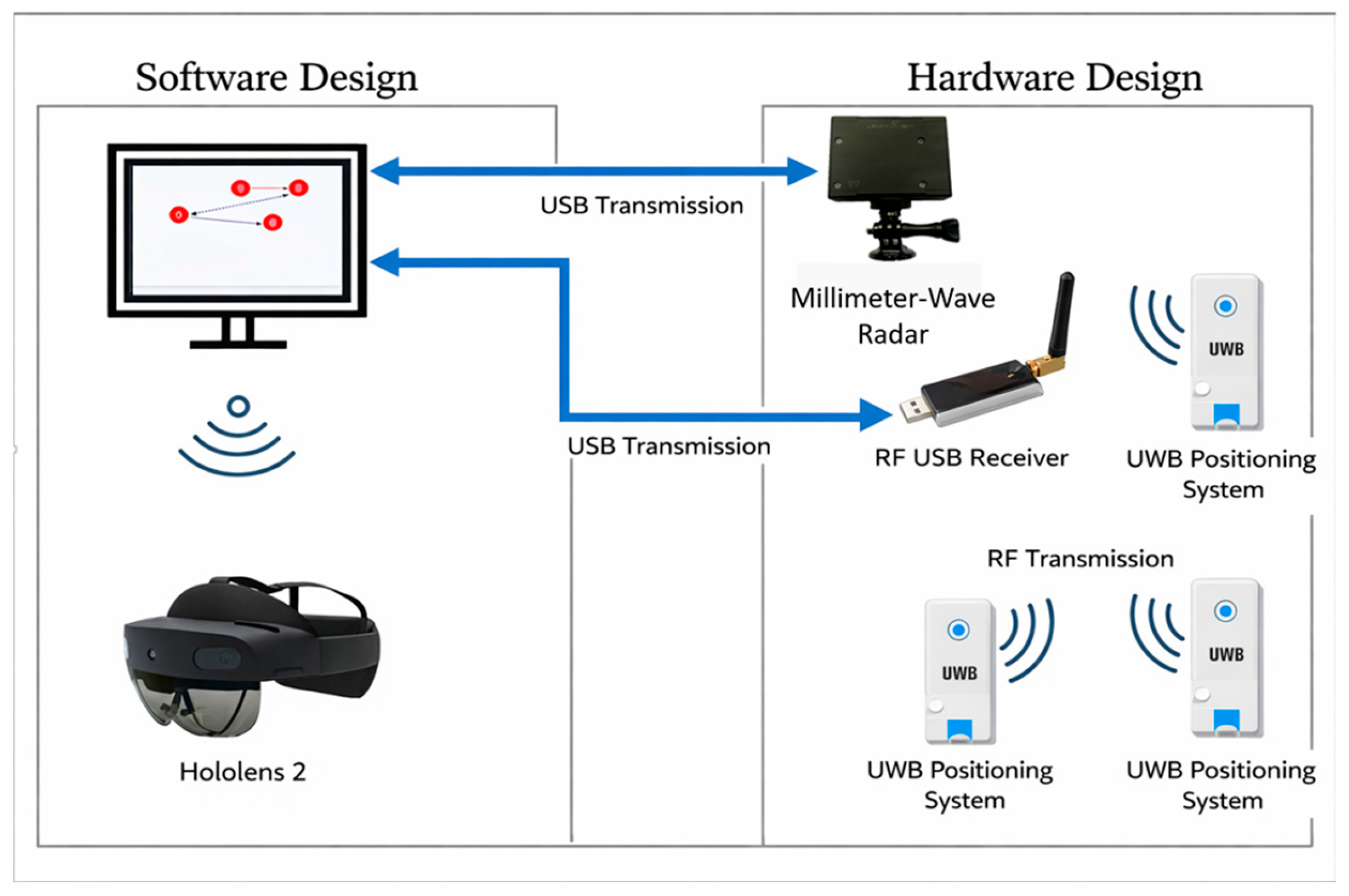
As illustrated in
Figure 1, a schematic overview of the proposed millimeter-wave radar-based sensing framework is presented to depict the overall system architecture and data transmission workflow. The diagram illustrates the interactions among the sensing components—including the millimeter-wave radar, auxiliary positioning modules, and wireless communication units—as well as the associated data processing and visualization platforms. Raw sensing data acquired by the radar and positioning systems are transmitted to a host computer for real-time signal processing, feature extraction, and motion analysis. The processed results are subsequently visualized through both a monitoring interface and a mixed reality display. This schematic clarifies the relationships between hardware components and software modules, and highlights the real-time data flow throughout the experimental process, thereby improving the readability of the system design and providing a comprehensive overview of the proposed architecture.
2.2. Mixed Reality Head-Mounted Display (HoloLens 2)
The proposed system employs the HoloLens 2 mixed reality (MR) head-mounted display (HMD) as the primary visualization platform. The HoloLens 2 is powered by a Qualcomm Snapdragon 850 processor and integrates multiple interactive modalities, including eye tracking, voice commands, and hand gesture recognition, enabling natural and immersive user interaction within the mixed reality environment.
In this system, gesture-based interaction is specifically utilized to support intuitive and real-time visualization of agility assessment data. By allowing users to interact directly with virtual content through hand gestures, the system enhances user engagement and improves the efficiency of feedback during testing and training sessions.
Application development is carried out using Microsoft Visual Studio in conjunction with the Unity engine. In addition, the Mixed Reality Toolkit (MRTK) is incorporated to provide essential functionalities such as spatial mapping, gesture tracking, and user interface design. The integration of MRTK ensures the efficient implementation of MR-based visualization and interaction components, facilitating stable system performance and seamless human–computer interaction.
3. Systems
3.1. Millimeter-Wave Radar Sensing System
The millimeter-wave (MMW) radar subsystem adopts a dual-port communication architecture comprising (1) a configuration port and (2) a dedicated data transmission port. The configuration port is responsible for radar initialization, FMCW chirp parameter configuration, frame structure definition, and sensing mode activation. Through this channel, users can flexibly adjust key radar parameters—including start frequency, bandwidth, chirp duration, sampling rate, and antenna configuration—to optimize sensing performance for indoor sports and agility assessment scenarios.
The data transmission port independently manages the continuous high-throughput stream of reflected signal measurements, including raw ADC samples, range–Doppler maps, point-cloud representations, and cluster-level outputs, depending on the selected signal processing pipeline. By separating control and data communication, the proposed architecture prevents command interference, reduces system latency, and improves synchronization reliability during real-time motion tracking.
Moreover, the dual-port design mitigates packet loss under high sampling rates and dense data transmission conditions, ensuring stable acquisition of rapid and complex movement trajectories commonly observed in table tennis agility tests. This communication architecture enhances overall system robustness, enabling consistent multi-target detection under occlusion, abrupt direction changes, and variable indoor environmental conditions.
3.2. Graphical User Interface (GUI)
A MATLAB (R2023b, The MathWorks, Inc, Natick, MA, USA)-based graphical user interface (GUI) was developed to integrate, visualize, and manage data streams from both the MMW radar and the ultra-wideband (UWB) positioning subsystems. The GUI supports real-time dual-player motion visualization during table tennis agility assessments, enabling synchronized monitoring of movement trajectories, reaction times, and spatial displacement patterns.
To ensure reliable identity differentiation during dual-player tests, the UWB subsystem assigns unique color-coded identifiers to each athlete. This mechanism maintains robust identity tracking even when physical trajectories intersect or overlap. Radar-derived point-cloud data and track-centric outputs are plotted concurrently, generating continuous movement paths that reflect instantaneous velocity variations and directional transitions throughout the assessment process.
3.3. Mixed Reality Visualization Interface
The mixed reality (MR) visualization interface was implemented on the Microsoft HoloLens 2 platform (Microsoft Corporation, Redmond, WA, USA) using the Unity3D engine (6000.2.6f2, Unity Technologies, San Francisco, CA, USA) and the Mixed Reality Toolkit (MRTK, mrtkv2.7, Microsoft Corporation, Redmond, WA, USA). This component transforms processed radar and UWB-derived metrics into immersive, spatially anchored visual elements, thereby enhancing interpretability and situational awareness during agility performance evaluation.
A Python (3.8.10)-based TCP socket server transmits real-time analytical results—including movement duration, instantaneous and average velocity, directional changes, and classification outcomes—to the HoloLens client application. Upon receiving the streamed data, the MR interface renders dynamic holographic panels, trajectory visualizations, and performance metric dashboards within the user’s field of view.
MRTK enables advanced interaction functionalities, including gesture-based panel manipulation, hand-tracking interaction, spatial anchoring, and user-defined layout adjustment. These features allow coaches and athletes to reposition and customize visual elements within three-dimensional space, facilitating personalized instruction and collaborative performance analysis. Environmental understanding capabilities—such as spatial mapping and occlusion handling—ensure that holographic content remains accurately aligned with the physical surroundings.
Furthermore, Microsoft Holographic Remoting is employed to mirror the MR visualization to a connected personal computer in real time. This functionality enables multiple observers, including coaches, analysts, and researchers, to simultaneously monitor ongoing agility assessments, thereby supporting training sessions, demonstrations, and group-based feedback discussions.
4. Results
4.1. Dual-Player Table Tennis Agility Test
To evaluate the applicability and robustness of the proposed system under realistic training conditions, a dual-player table tennis agility test protocol defined by the National Taiwan University of Sport was adopted as the experimental framework. This protocol integrates ultra-wideband (UWB) positioning, millimeter-wave (MMW) radar motion tracking, and automated movement segmentation to enable accurate, objective, and real-time agility assessment.
A total of 80 trained table tennis athletes participated in the experiment, covering a wide range of competitive skill levels. Each participant completed two repeated trials to assess measurement consistency and repeatability. Sensor-derived performance metrics—including movement duration, trajectory length, and reaction time—were automatically recorded by the proposed system and cross-validated against manual stopwatch measurements to ensure data reliability and temporal accuracy.
The experimental results demonstrate stable system operation and consistent performance measurements across different participants and testing conditions. These findings confirm the feasibility of deploying the proposed sensing and visualization framework in real-world training environments and support the establishment of quantitative agility performance indicators for dual-player scenarios.
Test Configuration
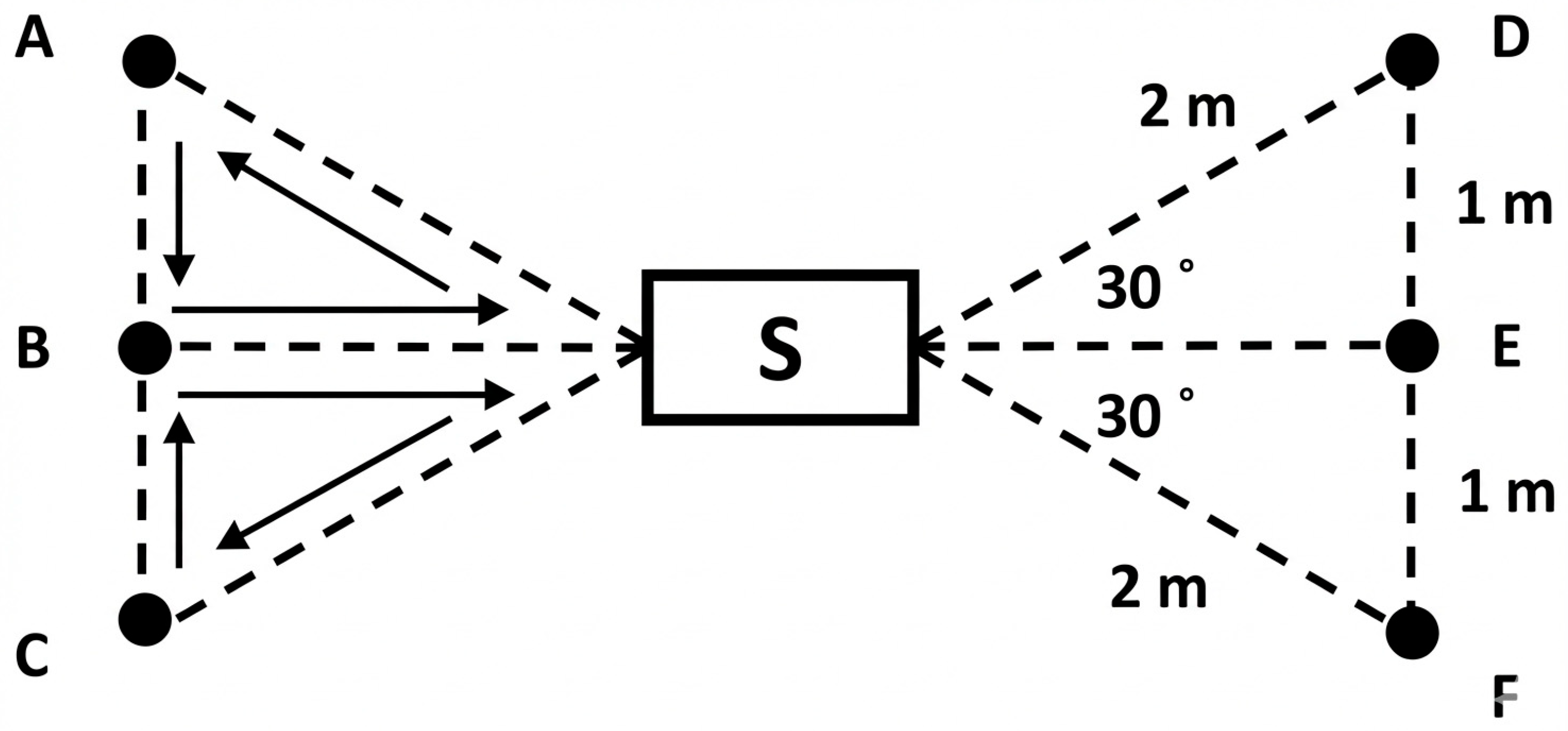
Figure 2 illustrates the schematic layout of the agility test field, centered around a reference point labeled ‘S’. The setup includes six cone-marked target points labeled A–F. As shown on the right side of the diagram, the targets are arranged with specific spatial constraints: the vertical distance between adjacent points (D-E and E-F) is 1 m. Points D and F are located at a distance of 2 m from the center ‘S’, positioned at a 30° angle relative to the direct line connecting S and E. The solid arrows on the left indicate directional movement paths during specific test sequences. The actual field also includes a rectangular start zone measuring 0.8 m × 0.5 m ‘S’. Participants initiated each trial from this start zone and were instructed to move rapidly toward designated target points according to the predefined agility test sequence.
The MMW radar sensor was positioned approximately 4 m in front of the start area to ensure comprehensive coverage of player movement trajectories within the sensing region. This placement allowed continuous tracking of displacement, velocity variation, and directional changes throughout the test.
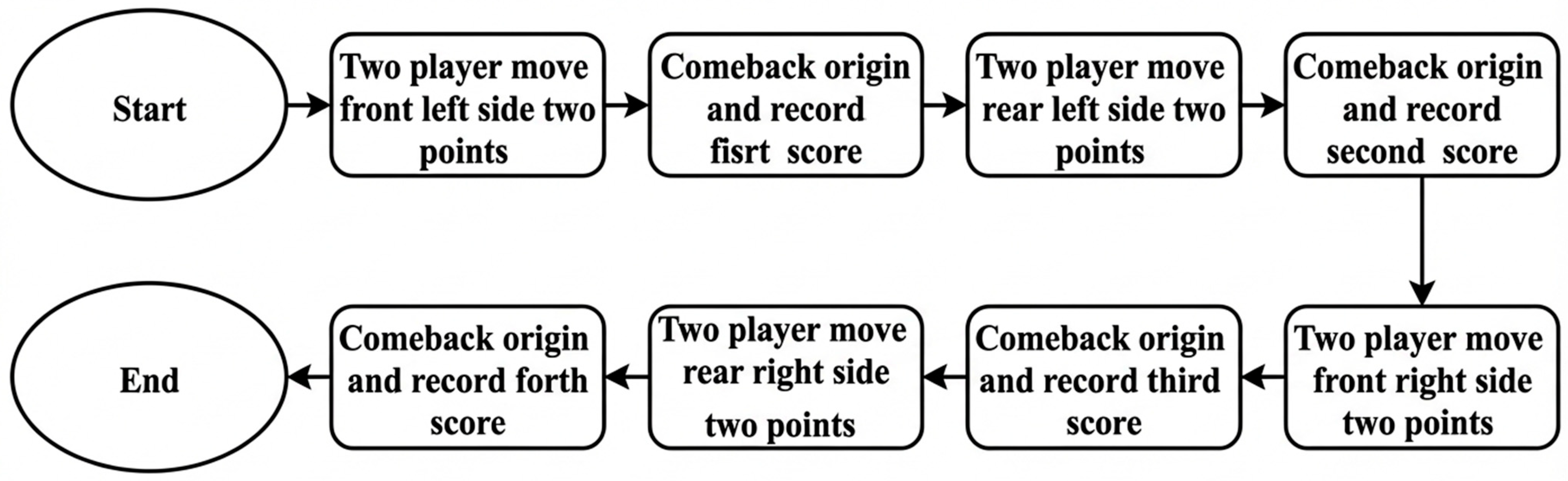
The proposed analysis system automatically identifies distinct movement phases and segments based on radar and UWB data fusion, enabling real-time detection, recording, and visualization of agility-related performance metrics, as shown in
Figure 3. By eliminating manual annotation and post hoc segmentation, the automated processing pipeline significantly improves testing efficiency while enhancing the objectivity, temporal precision, and repeatability of agility assessment.
4.2. Data Analysis
The reliability of the proposed motion analysis framework was rigorously evaluated through the assessment of temporal measurement accuracy.
Table 1 presents the time measurements obtained for individual movement segments across both Player 1 (Segments 1–4) and Player 2 (Segments 5–8). The millimeter-wave (MMW) radar system demonstrated strong capability in accurately capturing the duration of segmented actions, yielding an overall average percentage error of 3.5%.
To further examine the robustness and consistency of the proposed system,
Table 2 summarizes the error statistics across all participant groups. The results indicate a high level of measurement stability, with percentage errors confined within a narrow range, from a minimum of 1.9% to a maximum of 4.8%. The aggregated mean percentage error across the entire cohort was 3.01%. When referenced against the average segmented movement duration of 4.875 s, this corresponds to a mean absolute time difference of only 0.16 s. These results confirm the high temporal fidelity and reliability of the MMW radar-based sensing framework for precise kinematic segmentation in dynamic sports environments.
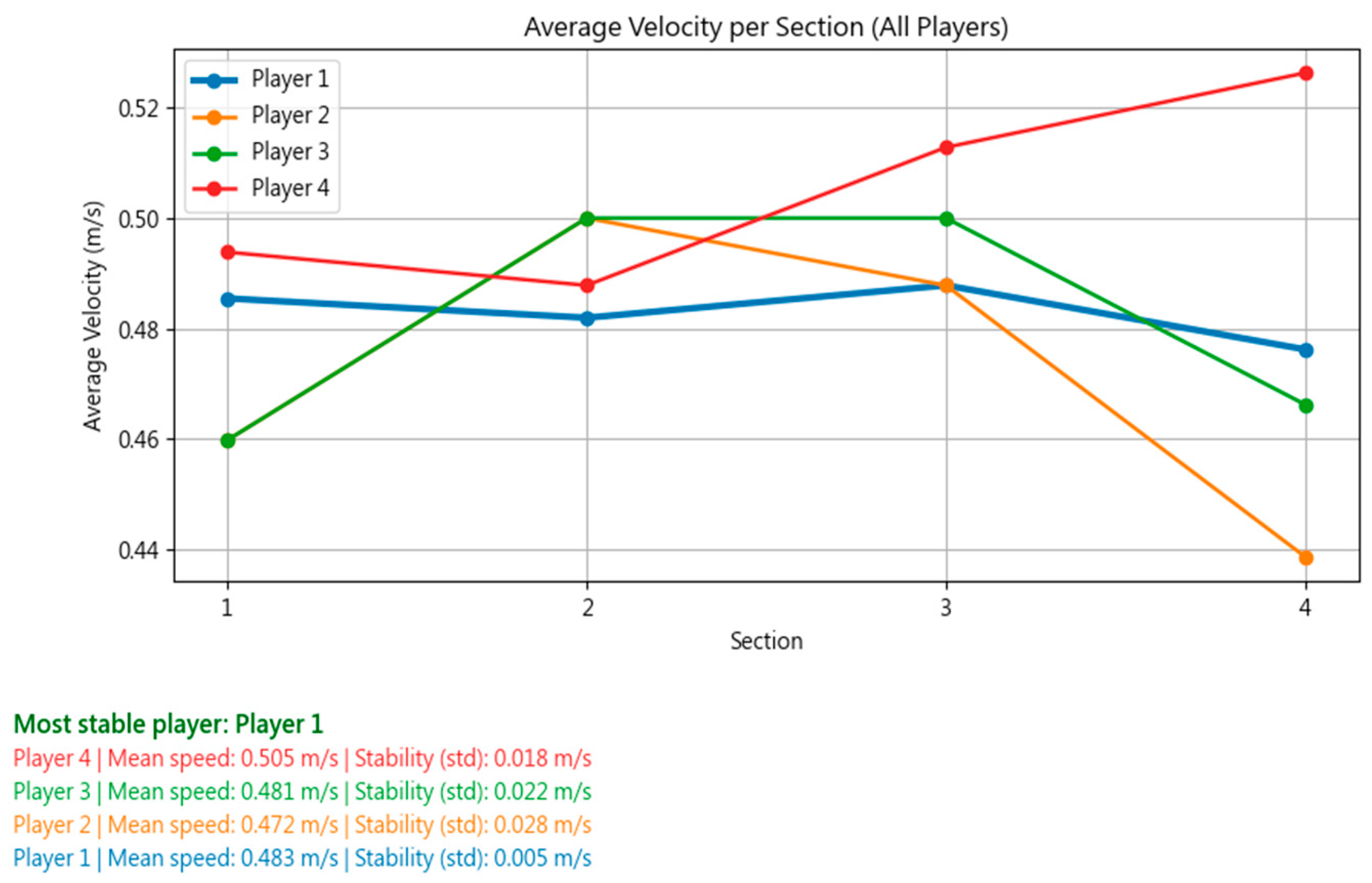
Furthermore, as illustrated in
Figure 4, the distribution of average movement speeds reveals clear performance differences between individual players. Variations in speed profiles provide a quantitative indicator of key athletic attributes, including movement coordination efficiency, reaction responsiveness, and overall agility. In synchronized and high-tempo scenarios, such as dual-player table tennis drills, higher average movement speeds are generally associated with superior coordination and more effective movement execution.
Accordingly, the objective performance metrics derived from the proposed MMW radar system offer valuable reference information for professional coaching and performance analysis. These quantitative insights support the evaluation of inter-player synchronization, the identification of performance disparities, and the refinement of training strategies, thereby facilitating the translation of raw sensing data into actionable, data-driven decision support.
4.3. Mixed Reality Visualization Synchronization Test
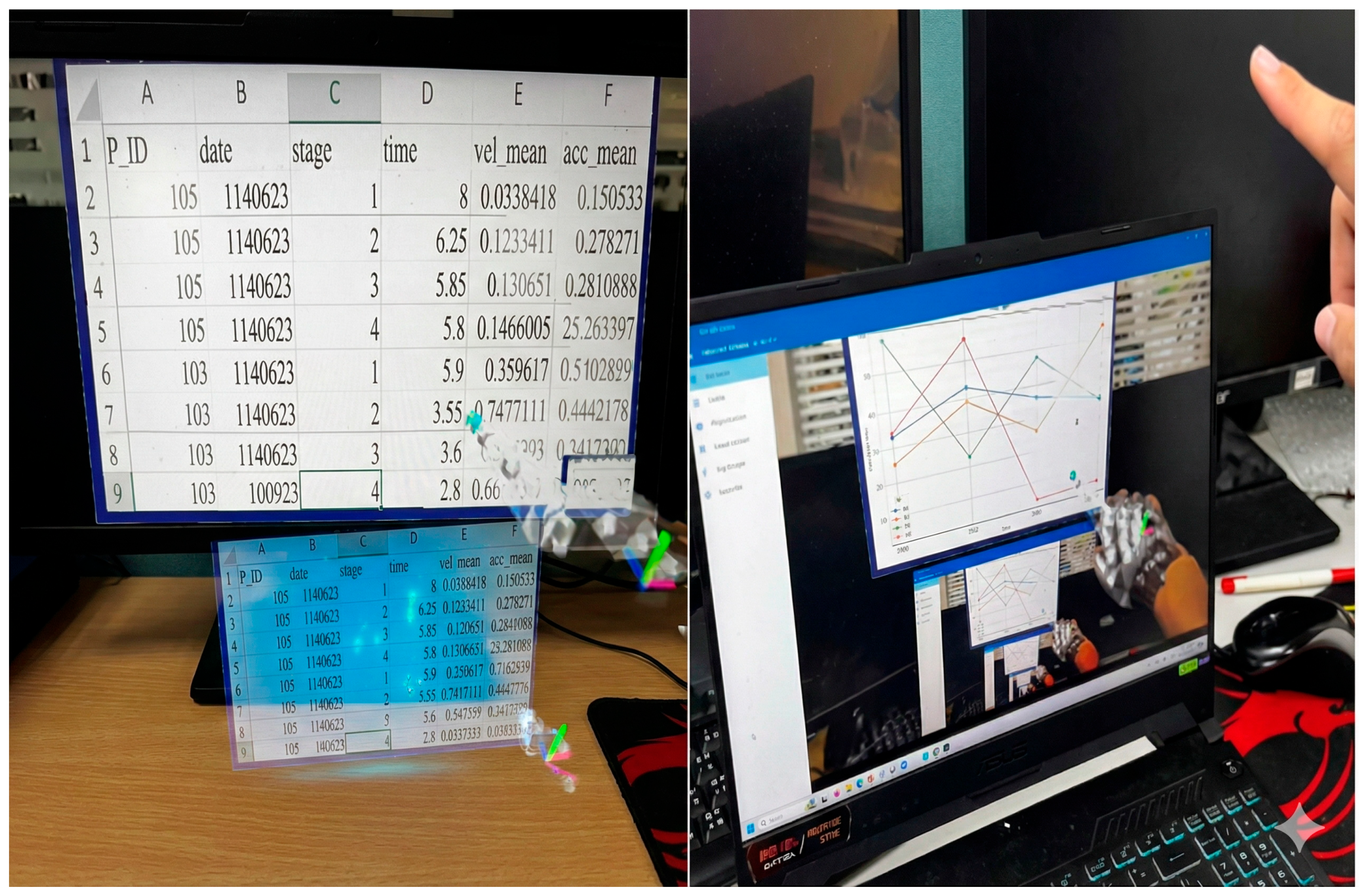
System integration was further validated through a mixed reality (MR)-based visualization workflow implemented on the Microsoft HoloLens 2 platform. During each agility assessment, the proposed system continuously computes key performance metrics, including time consumption and average movement speed for each predefined test segment. These metrics are processed in real time and visualized as analytical charts, which are simultaneously rendered on a desktop interface and within the MR environment.
As illustrated in
Figure 5, both the left and right panels present real-time visual outputs captured during the execution of the agility test. The left panel displays live performance analysis charts on a conventional desktop interface, reflecting segment-level timing and speed metrics as they are generated. The right panel presents the same analytical information within the MR environment using the HoloLens 2, demonstrating synchronized and consistent data representation across heterogeneous visualization platforms.
The pointing hand gesture shown in the right panel is included to demonstrate the gesture-based interaction capability of the MR interface. This interaction allows users to intuitively manipulate the visualization in real time through hand gestures, such as selecting, highlighting, or switching between displayed performance charts. The successful operation of these interaction mechanisms confirms the feasibility of hands-free, immersive visualization for on-site performance analysis and coaching support during agility training sessions.
4.4. Web-Based Visualization
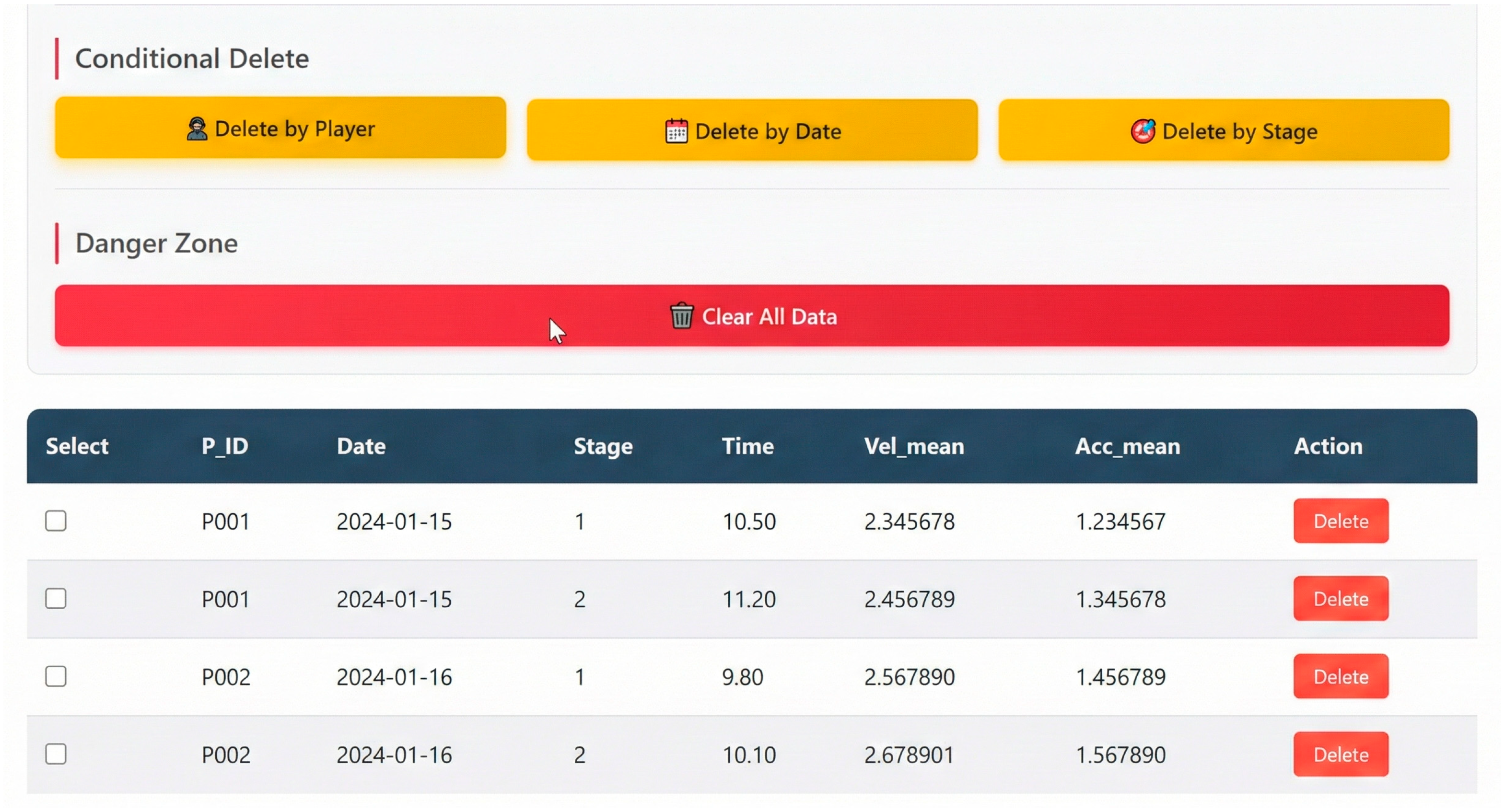
The proposed system further supports cloud-based data synchronization and web-based result visualization. As illustrated in
Figure 6, performance data collected during agility assessments can be securely uploaded to a cloud platform, where users are able to access, organize, and manage test results through a browser-based interface. This functionality enhances analytical accessibility, facilitates longitudinal performance tracking, and streamlines data management across multiple training sessions and evaluation periods.
4.5. Reliability and Validity Evaluation of the Proposed System
To ensure the reliability and validity of the experimental data collected in this study, additional reliability and validity analyses were conducted. In quantitative research, reliability and validity are two essential indicators for evaluating the quality of measurement instruments and the credibility of research outcomes. Reliability reflects the consistency and stability of repeated measurements under identical conditions, whereas validity indicates whether the measurement accurately captures the intended construct.
The reliability assessment in this study was further divided into test–retest reliability and absolute reliability. Test–retest reliability evaluates the consistency of measurement results obtained from the same participants under identical testing conditions at different time points. In this study, each participant completed two identical explosive swing tests and a dual-player table tennis agility test (Test II) with a one-week interval between sessions to examine the temporal stability and reproducibility of the proposed system.
Absolute reliability was assessed to evaluate the degree of variation across repeated measurements. The standard error of measurement (SEM) and the coefficient of variation (CV) were adopted as evaluation indices. SEM reflects the magnitude of measurement error where σ denotes the standard deviation of the measurement error. According to the literature, a CV value lower than 5% indicates good absolute reliability.
Regarding validity assessment, this study focused on ecological validity, which emphasizes the consistency between the testing environment and real-world application scenarios. All experiments were conducted on a standard table tennis court, and the testing procedures were designed to closely replicate actual match conditions, including realistic movement patterns and swing actions. Therefore, the collected data are considered representative of players’ real-world performance.
For the dual-player table tennis agility test (Test II), two identical testing sessions were conducted under the same device configurations and standardized environmental conditions, with a one-week interval between sessions, resulting in a total testing duration of two weeks. The comparison of average completion times between the two sessions (
Table 3) showed minimal SEM values, indicating good test–retest reliability. Moreover, the CV value was 4.70%, which is below the 5% threshold recommended in the literature. These findings demonstrate that the proposed dual-player agility assessment system exhibits satisfactory stability, repeatability, and measurement reliability, supporting its suitability for the objective evaluation of players’ agility performance and subsequent data analysis.
5. Discussion
5.1. Operational Cost and Deployment Feasibility
From a practical deployment perspective, the proposed agility assessment system is designed to achieve a balanced trade-off between sensing accuracy and operational feasibility. The framework primarily relies on commercially available hardware components, including a millimeter-wave (MMW) radar module, ultra-wideband (UWB) positioning devices, and an optional mixed reality (MR) head-mounted display. Compared with conventional optical motion capture systems—which typically require multiple high-speed cameras, controlled lighting conditions, marker placement, and frequent recalibration—the proposed system substantially reduces infrastructure complexity and installation constraints.
The operational cost of the system is largely associated with the initial acquisition of sensing and visualization hardware. Among these components, the MR headset functions as an enhanced visualization and interaction interface rather than a mandatory sensing element. All core motion analysis, segmentation, and agility evaluation tasks can be fully executed using the desktop-based graphical user interface (GUI). This modular system design allows flexible deployment configurations depending on training objectives, available resources, and budget considerations.
Furthermore, the radar-based sensing approach eliminates the need for specialized lighting environments and exhibits strong robustness to illumination variability, thereby reducing long-term maintenance overhead. These characteristics support stable, repeated usage in daily training routines and facilitate deployment in real-world sports environments such as training halls, gymnasiums, and smart sports facilities.
5.2. Calibration Requirements
A key practical advantage of the proposed framework is its minimal calibration requirement. Unlike vision-based motion capture systems, which often demand subject-specific calibration, camera alignment, and repeated marker placement, the proposed system adopts a lightweight and user-friendly calibration strategy that emphasizes operational efficiency.
For the MMW radar subsystem, calibration is limited to an initial spatial alignment procedure that defines the sensing coordinate system relative to the testing area. This process is performed once during system installation and does not require recalibration for individual athletes or repeated testing sessions. Similarly, the UWB subsystem requires only a one-time configuration of anchor positions, while wearable tags are employed exclusively for identity differentiation in dual-player scenarios rather than for detailed biomechanical reconstruction.
The MR visualization module leverages spatial mapping and anchoring mechanisms provided by the Mixed Reality Toolkit (MRTK), which automatically adapts to the physical environment without influencing motion measurement accuracy. As a result, the overall system avoids per-session or per-subject calibration, significantly reducing preparation time and improving usability in practical training environments.
5.3. Assumptions and System Limitations
Despite the promising performance demonstrated through experimental validation, several assumptions and limitations should be acknowledged. First, the current experiments were conducted primarily in controlled indoor environments with flat flooring and predefined testing zones. Although MMW radar exhibits strong robustness to lighting variation and partial occlusion, extreme environmental clutter or irregular spatial layouts may affect tracking stability and segmentation accuracy.
Second, the proposed framework focuses on single-player and dual-player agility assessments. While the UWB-assisted identity differentiation strategy effectively resolves trajectory ambiguity in two-player scenarios, system scalability to multi-player environments (i.e., more than two athletes simultaneously) has not yet been fully investigated. Future work will explore extended identity management strategies and multi-target association mechanisms to address this limitation.
Third, agility evaluation and classification are currently based on predefined sport-specific protocols, including TTAT I, TTAT II, and the Agility T-Test. Although these tests are well established and suitable for table tennis training, adapting the framework to other sports may require adjustments to motion segmentation logic, feature extraction strategies, and performance metrics.
These limitations do not diminish the validity of the proposed system but instead define the current scope of investigation and provide clear directions for future extension and optimization.
5.4. Technical Innovation Beyond Basic System Integration
Although the proposed framework does not introduce a novel FMCW radar signal processing algorithm, its primary contribution lies in system-level and application-driven innovation rather than algorithmic novelty alone. The technical advances extend beyond a straightforward integration of commercial sensing and visualization devices in several key aspects.
First, this study presents an identity-aware, real-time dual-player agility assessment framework that tightly integrates MMW radar motion tracking with UWB-based identity differentiation. This fusion strategy enables continuous trajectory tracking and precise temporal segmentation in scenarios involving overlapping motion paths—capabilities that are difficult to achieve using radar-only or vision-based systems.
Second, a radar-centric motion segmentation and agility metric extraction pipeline is developed to automatically quantify reaction time, movement duration, average speed, and displacement without reliance on optical markers or camera-based tracking. This pipeline is specifically tailored to high-speed, short-range agility movements commonly observed in table tennis training and supports real-time computation and visualization.
Third, the integration of mixed reality visualization introduces an interactive human–system interface for agility assessment. By transforming processed sensing outputs into spatially anchored holographic representations, the system enables intuitive, real-time feedback for athletes and coaches. The synchronized visualization across MR and desktop platforms further establishes a complete training workflow that bridges sensing, analytics, and decision support.
Collectively, these contributions demonstrate that the proposed framework advances the state of sports performance assessment not through isolated algorithmic enhancements, but through a cohesive sensing, analysis, and visualization architecture that enables new capabilities in real-time, multi-athlete agility evaluation.
6. Conclusions
This study presented an integrated agility assessment system that combines millimeter-wave radar, ultra-wideband positioning, and Mixed Reality visualization to deliver precise, real-time, and objective measurements of athletic performance. By leveraging the robust motion-tracking capability of millimeter-wave radar under low-light and multi-target conditions, the high-accuracy identity recognition of UWB for dual-player evaluations, and the immersive real-time visualization enabled by Mixed Reality, the proposed system effectively addresses the limitations of conventional agility testing approaches.
Experimental results collected from 80 table tennis athletes demonstrated an average measurement error below 10% and a classification accuracy of 91%, confirming the reliability and adaptability of the proposed framework. With additional support for cloud-based data management and Mixed Reality mirroring, the system provides immediate performance feedback and facilitates efficient training supervision.
Despite the successful validation in table tennis applications, the system exhibits strong potential for further optimization and expansion. Future work will focus on extending the proposed framework to other sports involving rapid and complex movements, such as badminton and tennis, in order to evaluate its generalizability and adaptability across different athletic contexts. This extension will involve adjusting system parameters and evaluation metrics to accommodate sport-specific movement characteristics. Moreover, the system is well suited for deployment in smart sports venues through integration with edge computing and cloud platforms, enabling real-time training monitoring, remote coaching assistance, and comprehensive performance analytics. Overall, this research lays a solid foundation for technology-assisted sports training and embedded artificial intelligence applications, demonstrating significant potential for high-value deployment and future advancement in sports science.