Review

Quantum Neural Networks in Magnetic Resonance Imaging: Advancing Diagnostic Precision Through Emerging Computational Paradigms


1
Department of Imaging Diagnostics, Oncological Radiotherapy and Hematology, Fondazione Policlinico Universitario Agostino Gemelli IRCSS, 00168 Rome, Italy
2
Department of Diagnostic and Interventional Radiology, Bambino Gesù Children’s Hospital IRCSS, 00165 Rome, Italy
3
Department of Medical Physics, Bambino Gesù Children’s Hospital IRCSS, 00165 Rome, Italy
4
Advanced Cardiothoracic Imaging Unit, Bambino Gesù Children’s Hospital IRCSS, 00165 Rome, Italy
*
Author to whom correspondence should be addressed.
Computers 2025, 14(12), 529; https://doi.org/10.3390/computers14120529
Submission received: 22 September 2025 / Revised: 26 November 2025 / Accepted: 28 November 2025 / Published: 2 December 2025

Abstract

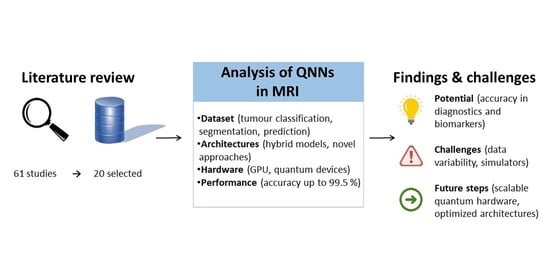
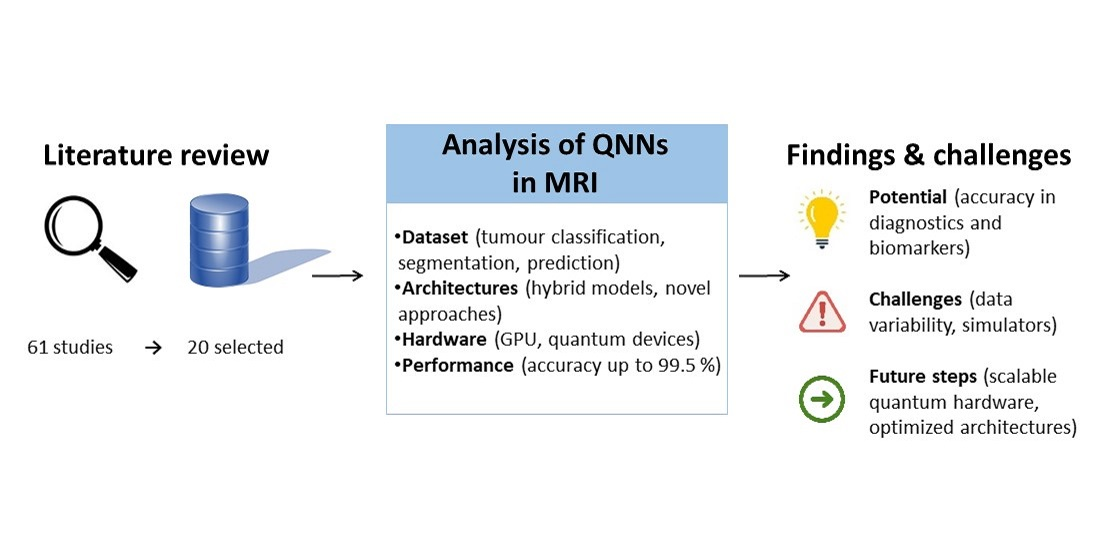
Background: Quantum Neural Networks (QNNs) combine quantum computing and artificial intelligence to provide powerful solutions for high-dimensional data analysis. In magnetic resonance imaging (MRI), they address the challenges of advanced imaging sequences and data complexity, enabling faster optimization, enhanced feature extraction, and real-time clinical applications. Methods: A literature review using Scopus, PubMed, IEEE Xplore, ACM Digital Library and arXiv identified 84 studies on QNNs in MRI. After filtering for peer-reviewed original research, 20 studies were analyzed. Key parameters such as datasets, architectures, hardware, tasks, and performance metrics were summarized to highlight trends and gaps. Results: The analysis identified datasets supporting tasks like tumor classification, segmentation, and disease prediction. Architectures included hybrid models (e.g., ResNet34 with quantum circuits) and novel approaches (e.g., Quantum Chebyshev Polynomials). Hardware ranged from high-performance GPUs to quantum-specific devices. Performance varied, with accuracy up to 99.5% in some configurations but lower results for complex or limited datasets. Conclusions: The findings provide the first glimpse into the potential of QNNs in MRI, demonstrating accuracy and specificity in diagnostic tasks and biomarker detection. However, challenges such as dataset variability, limited quantum hardware access, and reliance on simulators remain. Future research should focus on scalable quantum hardware, standardized datasets, and optimized architectures to support clinical applications and precision medicine.

Graphical Abstract

1. Introduction

Quantum Neural Networks (QNNs) represent an emerging paradigm at the intersection of quantum computing and artificial intelligence, offering unprecedented computational capabilities for complex data processing. By leveraging principles of quantum mechanics, QNNs can perform computations that are infeasible for classical systems, particularly in tasks involving high-dimensional data analysis and pattern recognition [1,2].
One area where these capabilities might bring significant potential is medical imaging, particularly magnetic resonance imaging (MRI), which involves processing large volumes of complex data to extract clinically valuable information. Although traditional neural networks have led to important advances in this field [3], their ability to scale is often limited by the growing data demands and the computational cost of complex models.
QNNs present an alternative approach, encoding information into quantum states and leveraging quantum parallelism. These capabilities allow for more efficient optimization and deeper feature analysis. Such advantages are especially relevant to MRI, where detecting subtle differences in tissue properties requires highly sensitive and advanced modeling techniques [4].
Over the years, significant advancements in scalable quantum hardware [5,6], hybrid quantum–classical [7,8], and standardized evaluation methodologies [9] have contributed to a growing interest in QNNs, although their practical implementation in clinical MRI still remains an open challenge.
The integration of QNNs in MRI research also holds the potential to uncover novel biomarkers and enhance predictive modelling in complex diseases. For example, neurodegenerative disorders, which often involve subtle and widespread changes in brain structure and function, require advanced computational tools to analyze large-scale imaging data [10]. Similarly, cancer diagnostics and treatment planning could benefit from QNN-based systems capable of identifying highly specific imaging features, contributing to the development of personalized diagnostic and therapeutic strategies in alignment with the principles of precision medicine [11,12].
Despite their promise, the application of QNNs in clinical settings remains in its early stage. Key challenges include the limited availability of quantum hardware, the need for algorithmic innovations tailored to medical imaging, and the integration of QNN systems within existing healthcare infrastructures [13,14].
This review aims to provide a comprehensive analysis of the current progress and limitations of QNNs in MRI, exploring their potential to redefine computational paradigms in medical imaging. By critically assessing state-of-the-art quantum algorithms, hybrid integration strategies, and domain-specific applications, we seek to illuminate the realistic pathways toward quantum-accelerated MRI analysis. Furthermore, we discuss the fundamental constraints imposed by near-term quantum devices and the feasibility of achieving quantum advantage in clinically relevant imaging tasks. Ultimately, understanding these aspects will help delineate the true transformative potential of QNNs in radiology, paving the way for a paradigm shift toward quantum-driven diagnostic intelligence.

1.1. Quantum Computers

Quantum computers (QCs) are a novel class of computational devices whose operation is based on the principles of quantum mechanics and allows them to process information in ways fundamentally distinct from classical systems. Qubits are the basic units of information in quantum computing, similar to bits in classical computing. However, unlike bits that can only be in a state of 0 or 1, qubits can exist in a superposition of both states simultaneously. This allows quantum systems to process more information in parallel. Another key property is entanglement, where qubits become correlated such that the state of one instantaneously influences the state of another, regardless of physical distance. Entanglement is essential for many quantum algorithms, as it enables complex relationships between qubits that can increase computational power exponentially for certain tasks. These quantum phenomena, combined with interference, form the basis of quantum algorithms that can outperform classical counterparts for specific problems [15].
Quantum computers are hosted on specialized hardware platforms developed by companies such as IBM®, IonQ®, Honeywell®, Google®, Rigetti®, and Xanadu®. These platforms rely on different technologies to implement qubits, including superconducting circuits (IBM®, Google®, Rigetti®), trapped ions (IonQ®, Honeywell®), and photonic systems (Xanadu®). For instance, trapped-ion architectures provide long coherence times and high-fidelity quantum gates, while superconducting systems offer scalability and faster gate operations [16].
Each provider offers a dedicated programming framework to access and control quantum hardware. IBM® supports Qiskit, an open-source SDK compatible with gates such as U3, CX, and CRZ. Google® offers Cirq, based on Controlled-Z and FSim gates, while Rigetti® provides Forest and Quil/Quil-T for programming its Aspen processors. IonQ® allows access through Amazon Braket or its own API, and uses native Mølmer–Sørensen XX gates. Xanadu® uses PennyLane, particularly suited for variational hybrid quantum–classical models and compatible with photonic gates such as beamsplitters and squeezing operations.
Beyond theoretical computation, quantum computing is emerging as a transformative tool for medical imaging. MRI and CT techniques generate enormous datasets and require complex reconstruction algorithms to produce high-resolution images suitable for clinical diagnosis. Classical computing approaches often face limitations in processing speed, noise suppression and image quality, particularly in clinical settings or scenarios requiring fast decision-making. Quantum algorithms and quantum-enhanced sensing can address these challenges through the acceleration of image reconstruction, the improvement of signal-to-noise ratio, the enhancement of contrast and the optimization of acquisition parameters. These capabilities could enable faster and more precise diagnostics but also reduce patient exposure to radiation (in the case of CT) and provide more accurate monitoring of the disease. Furthermore, the integration of quantum computing in clinical workflows has the potential to improve imaging workflows, reduce computational inefficiencies and facilitate the development of personalized imaging protocols. Since hospitals are beginning to adopt advanced machine learning and hybrid quantum–classical approaches, these technologies could significantly improve both diagnostic reliability and operational efficiency [17,18].
Despite this potential, quantum computing still faces major engineering hurdles. Qubits are highly sensitive to noise and decoherence, issues that can rapidly degrade the quantum state. To address this, researchers are developing codes for quantum error correction, such as the surface code, which encode information redundantly across multiple entangled qubits [19].
However, achieving fault-tolerant, large-scale quantum computing will require both increasing the number of stable qubits and maintaining error rates below critical thresholds, which remains an active area of research.

1.2. Quantum Neural Networks

In the field of quantum computing, Quantum Neural Networks (QNNs) are an emerging type of artificial intelligence model that use the special features of quantum mechanics, like superposition and entanglement, to process information in new and potentially more powerful ways [20].
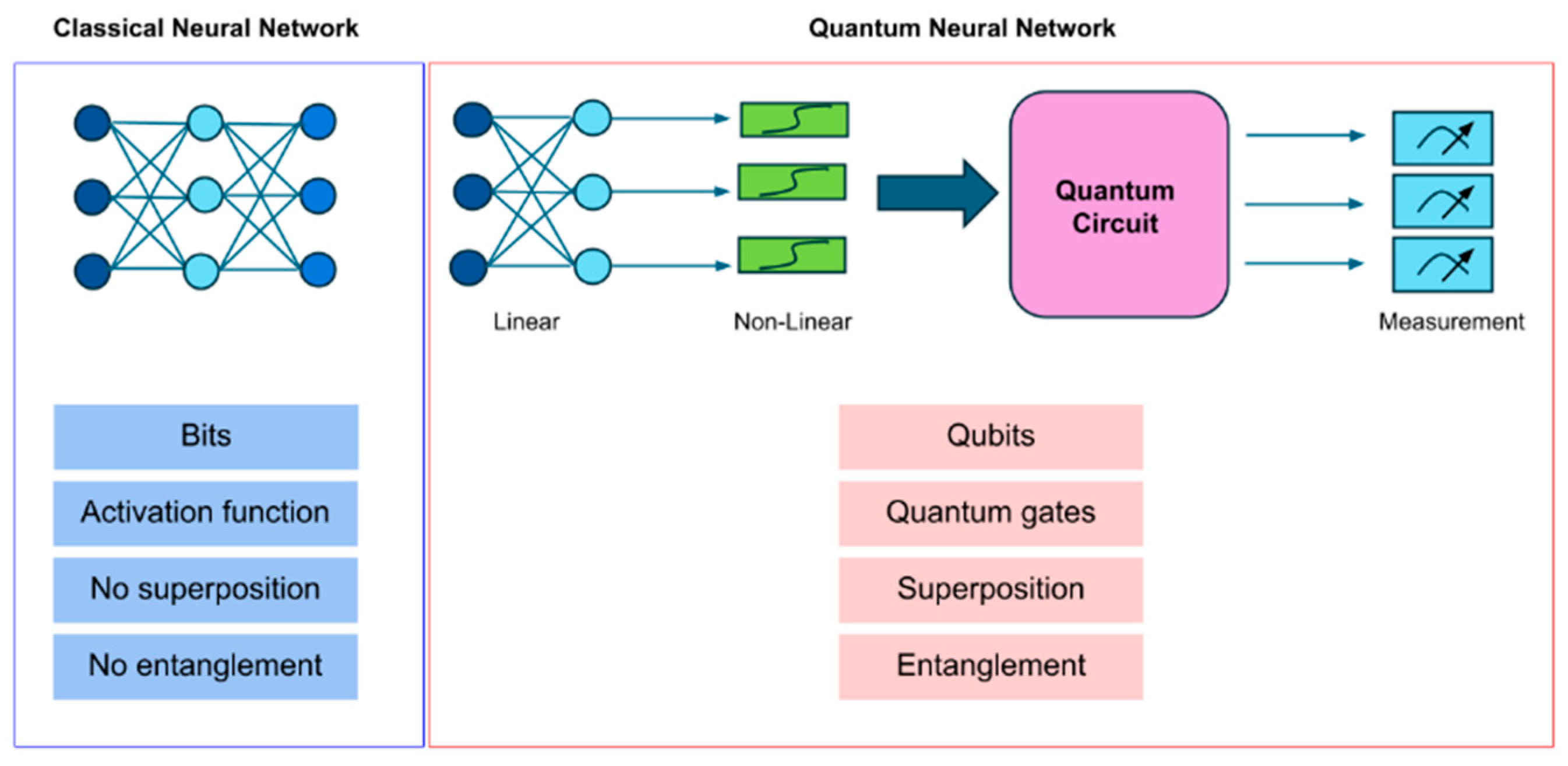
While classical neural networks work with bits (0 or 1), QNNs work with qubits, which can be in multiple states at once. In this way, QNNs can handle large and complex data more efficiently [21]. The differences between QNNs and classical neural networks are summarized in Figure 1.
A QNN typically includes three steps: first, the input data is converted into quantum states (encoding); then, a series of quantum operations are applied (quantum circuit); and finally, the result is measured and turned back into classical data [22]. The model is trained using a combination of quantum and classical computing, where quantum hardware performs specific operations and classical computers guide the learning process through algorithms such as the Variational Quantum Eigensolver (VQE) or quantum natural gradient descent [9].
QNNs have shown promising applications in medical imaging, particularly in MRI, where they can enhance feature extraction, pattern recognition and classification of complex brain images. Hybrid quantum–classical architectures, such as Quantum Convolutional Neural Networks (QCNNs), combine the power of convolutional layers with variational quantum circuits to reduce feature dimensionality and improve classification accuracy. For instance, recent studies report that QCNNs achieved 95–98% accuracy in distinguishing normal and demented brain MRIs, outperforming classical CNNs (89–91%) [17]. These results highlight the potential of QNNs to improve diagnostic precision, facilitate early disease detection and support personalized treatment planning [23]. Additionally, QNNs may reduce computational resource requirements by efficiently encoding complex imaging data, thus accelerating analysis and enabling integration into clinical workflows [24].
Some QNNs are designed to mimic traditional neural networks, like quantum perceptrons, which are similar to classical neurons [25], and Quantum Convolutional Neural Networks (QCNNs), which are used to recognize patterns, for example, in medical images or complex datasets [26,27].
To build and test these models, researchers use special software frameworks that simulate quantum systems. Some of the most widely used include Qiskit (IBM®, version 2.1), Cirq (Google®, version 1.6.1.), PennyLane (Xanadu®, version 0.43), and Quil/Forest (Rigetti®, version 4.17) [16].
Although QNNs are still in the early stages, and noise and the small number of available qubits limit current quantum computers, they nonetheless demonstrate substantial promise. Researchers are actively exploring ways to combine quantum and classical approaches to get the best of both worlds, with the goal of applying QNNs to real-world challenges like medical diagnostics, financial modeling, and data security [28,29].

1.3. Work Selection Criteria

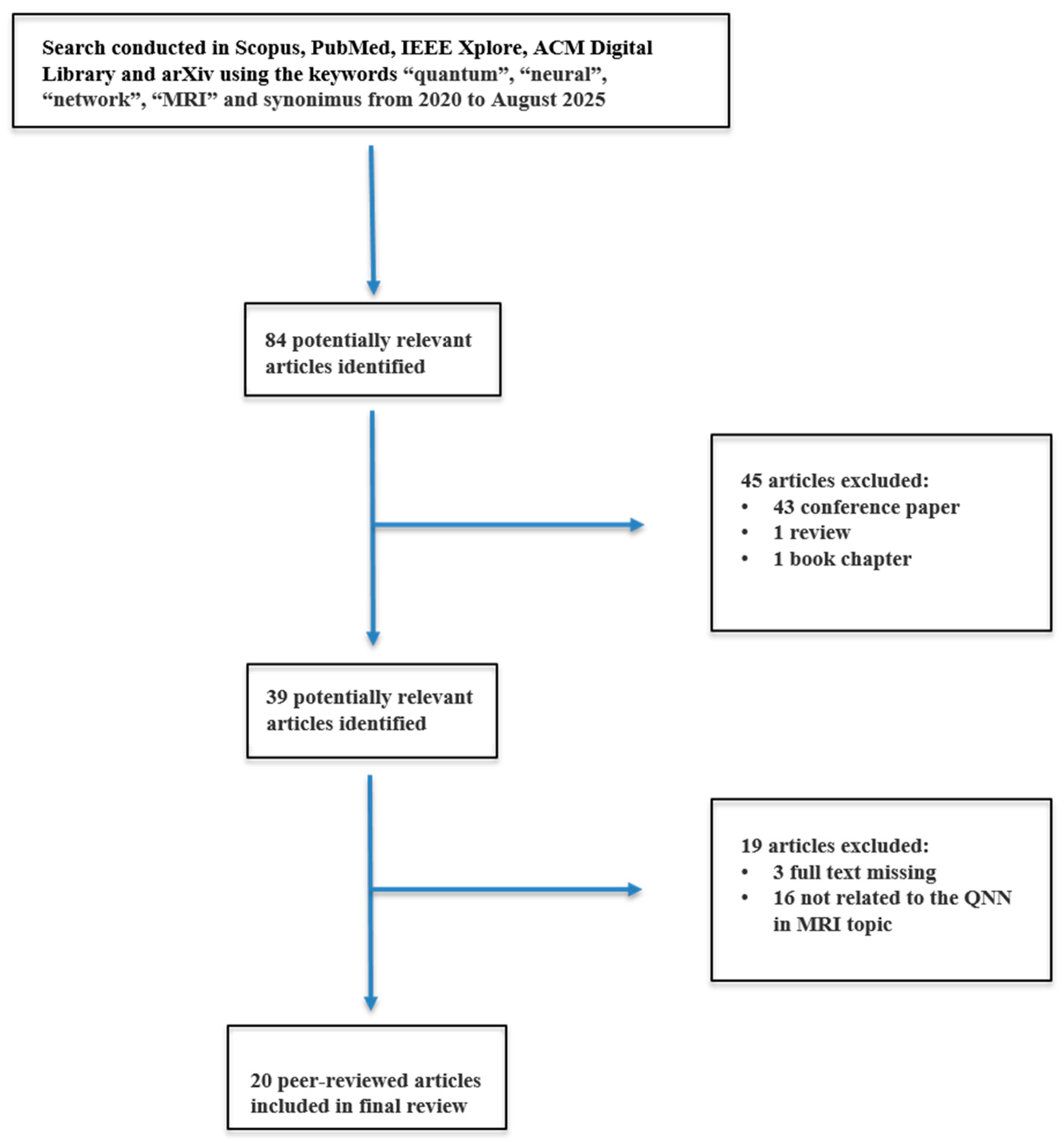
A review of the literature was conducted to identify studies related to the application of QNNs in MRI. The sources used for the search were Scopus, PubMed, IEEE Xplore, ACM Digital Library and arXiv chosen for their comprehensive coverage of peer-reviewed biomedical and technical literature. The search was conducted adopting an advanced search considering only Journal papers published from 2020 to August 2025 and was based on the following strings: “quantum neural networks” AND “MRI”, “quantum network” AND “MRI”, “quantum machine learning” AND “MRI”, “parametrized quantum circuit” AND “MRI”, “quanvolutional” AND “MRI”, “quantum convolutional neural network” AND “MRI”, “quantum kernel” AND “MRI”, “variational quantum circuit” AND “MRI”. The initial search yielded a total of 84 research products, including journal articles, conference papers, and book chapters. To ensure the focus remained on peer-reviewed primary research, conference papers and book chapters were excluded from further consideration. This filtering process resulted in a dataset of 39 journal articles deemed relevant to the topic.
Among these, 19 articles were removed at full-text screening: 3 because the full text was not accessible and 16 because they were not relevant to the QNN-MRI topic.
After these exclusions, 20 articles remained and were included in the final qualitative analysis.
The PRISMA flow diagram in Figure 2 summarizes the study selection process.
To assess the methodological quality of the included studies, we conducted a structured qualitative evaluation inspired by established reporting and benchmarking frameworks for AI in medical imaging, including METRICS, CLAIM, and MI-CLAIM [30,31]. Given that these guidelines do not fully capture the specific challenges associated with QNNs, we developed a customized scoring system that integrates core principles from each framework while addressing the distinct features of QNN-based research.
Each study was independently evaluated across nine key criteria: (1) availability of source code, (2) type and rigor of validation (e.g., internal vs. external), (3) reproducibility of the experimental setup, (4) accessibility and specification of quantum or classical hardware used, (5) use of publicly available or benchmark datasets, (6) clinical relevance of the study objectives, (7) clear justification for the adoption of quantum approaches, (8) robustness and completeness of the reported performance metrics, and (9) overall methodological contribution to the field. Each criterion was rated on a three-point scale: 0 (not addressed), 1 (partially addressed), or 2 (fully addressed), for a maximum total score of 18 points. Detailed scoring anchors defining what was considered 0, 1, or 2 for each criterion are reported in Supplementary Table S1. Based on the total score, studies were categorized into three levels of methodological quality: low (<8), medium (8–13), and high (≥14). Two independent reviewers performed the scoring. Inter-rater agreement was quantified using the Intraclass Correlation Coefficient (ICC 2,1), which showed good reliability (ICC = 0.875). Disagreements were resolved through consensus. This adapted metric provided a transparent and context-specific means to assess the rigor, reproducibility, and translational potential of QNN applications in MRI.
The analysis of the selected literature works focused on the following aspects for each article:
  • Dataset: Description of the adopted dataset, including its origin and characteristics (e.g., publicly available MRI datasets or proprietary datasets).
  • Simulator: Identification of the simulator or platform on which QNN simulations were run.
  • Architecture: Details of the QNN architecture, including layers, quantum gates, or hybrid quantum–classical approaches.
  • Hardware: Specification of the hardware employed for running the QNN, including quantum processors or classical computers simulating quantum operations.
  • Task: Type of task addressed by the QNN, such as classification, segmentation, or other imaging-related objectives.
  • Performance Metrics: Metrics used to evaluate the QNN’s performance, including accuracy, area under the receiver operating characteristic curve (AUC), precision, recall, or other relevant indicators.
The analysis was performed using Excel for data collection and Python (v. 3.13) for the graphical elaboration.

2. Results

The methodological quality assessment of the twenty studies revealed a heterogeneous distribution of rigor, with total scores ranging from 8 to 18 out of a maximum of 18. Based on our adapted evaluation metric, 13 studies were classified as having high methodological quality (≥14 points), six as medium quality (8–13 points), and one as low quality (<8 points).
Among the nine evaluation criteria, justification for quantum approaches and clinical relevance were the most consistently addressed across studies. Thirteen studies provided a clear rationale for adopting QNNs in medical imaging, and twelve articulated a clinically relevant goal or translational intent.
Only eight studies provided access to source code. Four studies introduced original QNN architectures or training frameworks, while the remaining sixteen applied existing methods. Seven studies used publicly available benchmark datasets (e.g., BraTS, ADNI, Kaggle), while the others relied on proprietary or unspecified data sources. Regarding reporting completeness, ten studies included detailed performance metrics beyond accuracy, such as sensitivity, specificity, or error analysis.
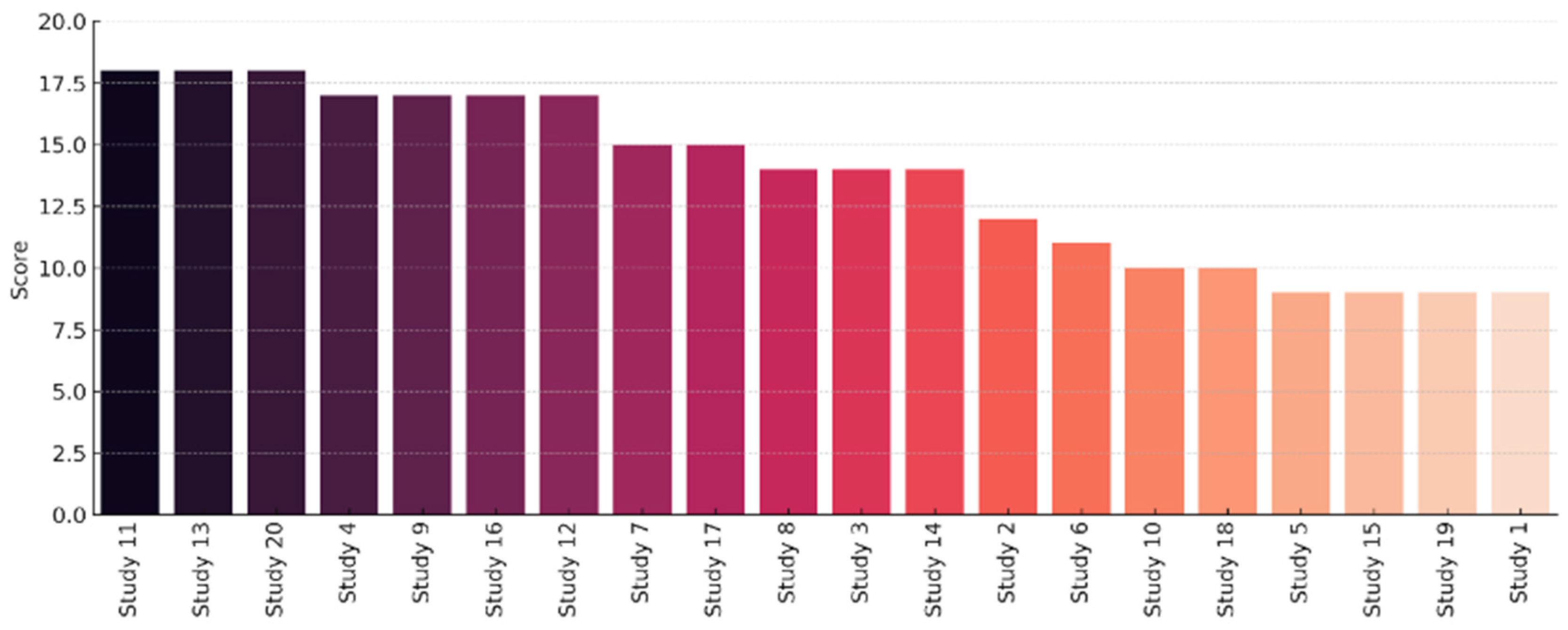
Figure 3 presents the distribution of METRICS scores across all studies, highlighting the heterogeneity in methodological quality. Table 1 summarizes the scoring across individual criteria. Key limitations were the lack of code availability, external validation, and detailed reporting of training procedures and hardware configuration.
The analysis of QNN applications in MRI revealed significant diversity in datasets, architectures, hardware, and tasks (Table S2). Various datasets were employed, including BraTS datasets (e.g., BraTS 2018, 2019, 2020, 2021) in studies 4, 7, 10, 11, 15, 16, Kaggle platform datasets [33,36,48], PPMI-ADNI [43], and local datasets [34,45,46]. Additional datasets included specialized repositories like breast DCE-MRI [39], IXI and CAU datasets [46], Figshare datasets [40,46], and BT-large datasets [51]. The studies focused on diverse tasks such as brain tumor segmentation [35,37,48], brain tumor classification (studies 1, 2, 3, 7, 10, 11, 15, 16, 17, 20), brain disorder classification [40,43], breast cancer classification [39], volumetric segmentation of medical images [44], and brain age prediction and gender classification [46].
Commonly used simulators included MATLAB (version 2024b) [35,40,44], PennyLane [34,36,38,42,43,45,48,50], TensorFlow Quantum and CirQ [47], and Python [41,46]. Quantum network architectures ranged from QAIS-DSNN [35] and ResNet34 with quantum transfer learning [36] to hybrid quantum convolutional neural networks (HQCNN) [33,48], AlexNet with quantum transfer learning [43], and Quantum Classical Convolutional Neural Networks (QCCNN) [47]. Other architectures included the Quanvolutional Neural Network (J.Qnet) [38], Quantum Chebyshev Polynomials (QCHPs) [39], MRI-radiomics variational QNN [34], and Quantum Dilated Convolutional Neural Networks (QDCNN and QDCNN-DMN) [41,46].
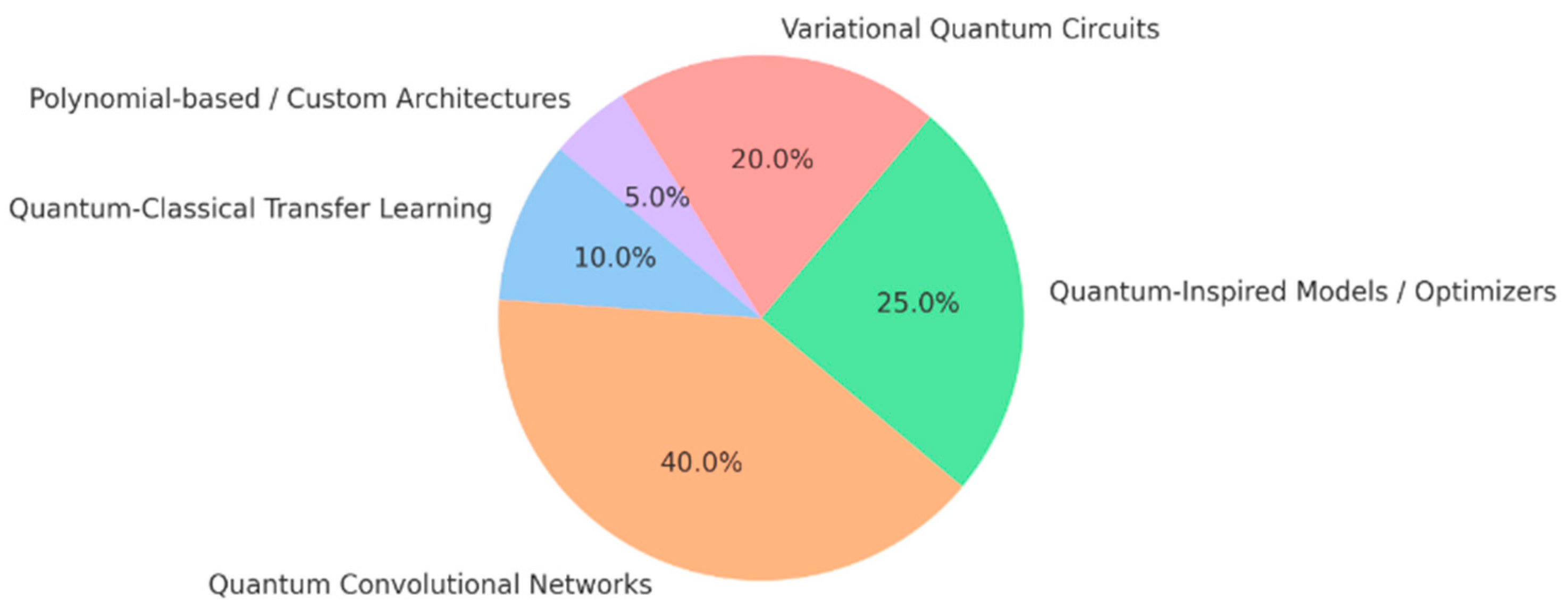
Figure 4 categorizes the QNN architectures used in the studies into five major groups: Quantum Convolutional Networks, Transfer Learning models, Variational Quantum Circuits, Quantum-Inspired Optimizers, and Polynomial-based designs. This classification emphasizes a predominance of hybrid convolutional approaches.
Hardware specifications demonstrated reliance on high-performance systems (Table 1), including GPUs such as NVIDIA RTX 2070 [37,42], Tesla T4 [47], Tesla V100 [44], and A100 [45], along with CPU-based systems like Intel Core i7 and Xeon processors [35,40,42,47]. Some studies also employed quantum-specific hardware, such as the D-Wave quantum annealer [34,48], for feature selection and optimization tasks.
The analysis of QNN applications in MRI-related tasks, summarized in Table 2, revealed considerable variability in performance metrics across studies, emphasizing both the potential and the challenges of these emerging methods. Accuracy values ranged widely, from 58.1% [50] to a remarkable 99.5% [39]. Sensitivity, a key metric for identifying true positive cases, exceeded 99% in several instances, such as brain tumor classification using the BT-large-2c dataset [51] and segmentation tasks with the Figshare dataset [40]. Specificity, which measures the model’s ability to minimize false positives, also achieved outstanding results, with the Cheng Dataset reaching 99.43% [51]. Only one study (Study 7) does not report standard clinical performance metrics such as accuracy, sensitivity, specificity, or precision, relying instead on PSNR and SSIM to evaluate model quality [38].
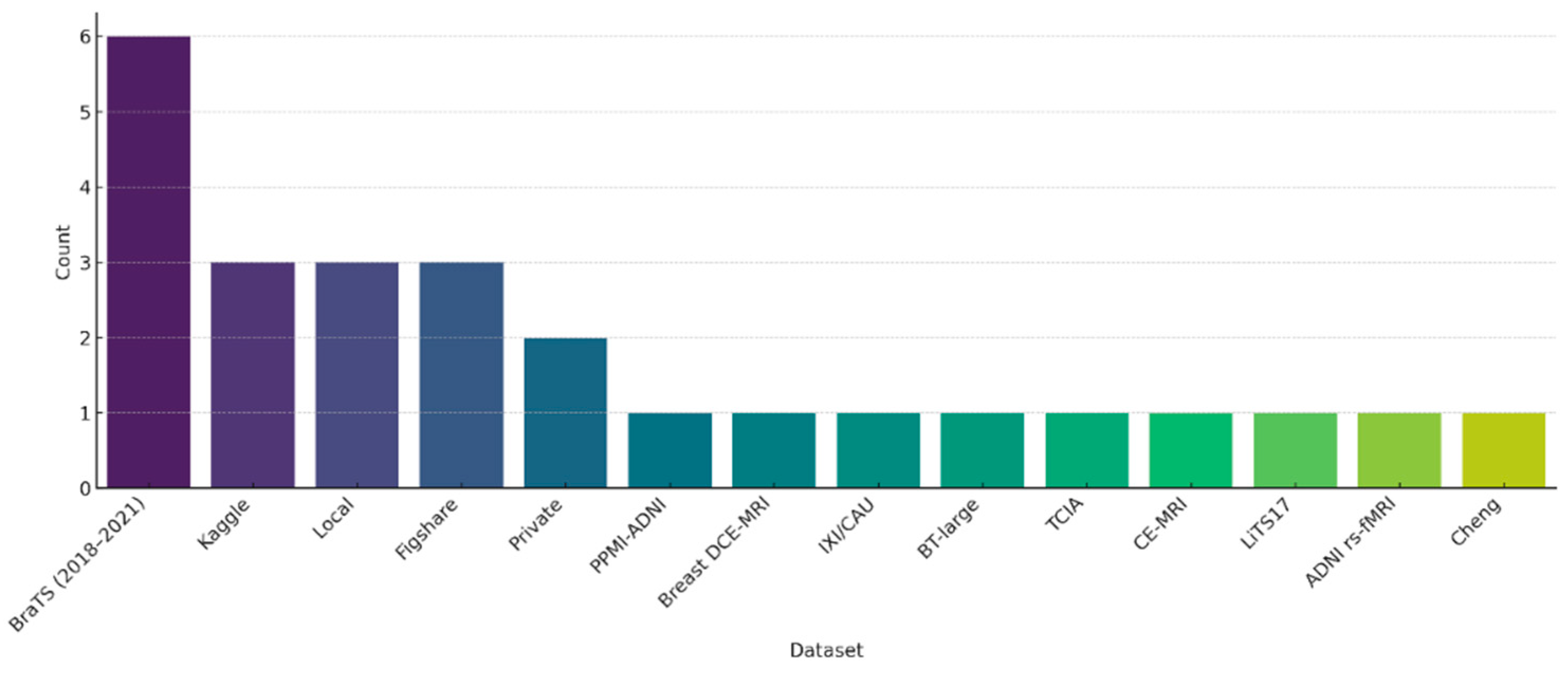
Figure 5 illustrates the frequency of datasets used across the reviewed studies. BraTS datasets were the most represented, followed by Kaggle and PPMI-ADNI, highlighting a preference for publicly available, structured imaging datasets. However, several studies also employed local or institution-specific datasets, often limiting reproducibility and external benchmarking.
Precision metrics further highlighted the models’ effectiveness in the accurate identification of specific conditions, peaking at 99.4% for the Quantum Theory-based Marine Predator Algorithm (QTbMPA) [40]. In classification tasks of breast cancer, combined post-contrast features consistently outperformed pre-contrast methods, achieving up to 99.5% accuracy [39]. However, the performance varied significantly for more complex tasks, such as patient disability status classification, where accuracy ranged between 70% and 81% [45].
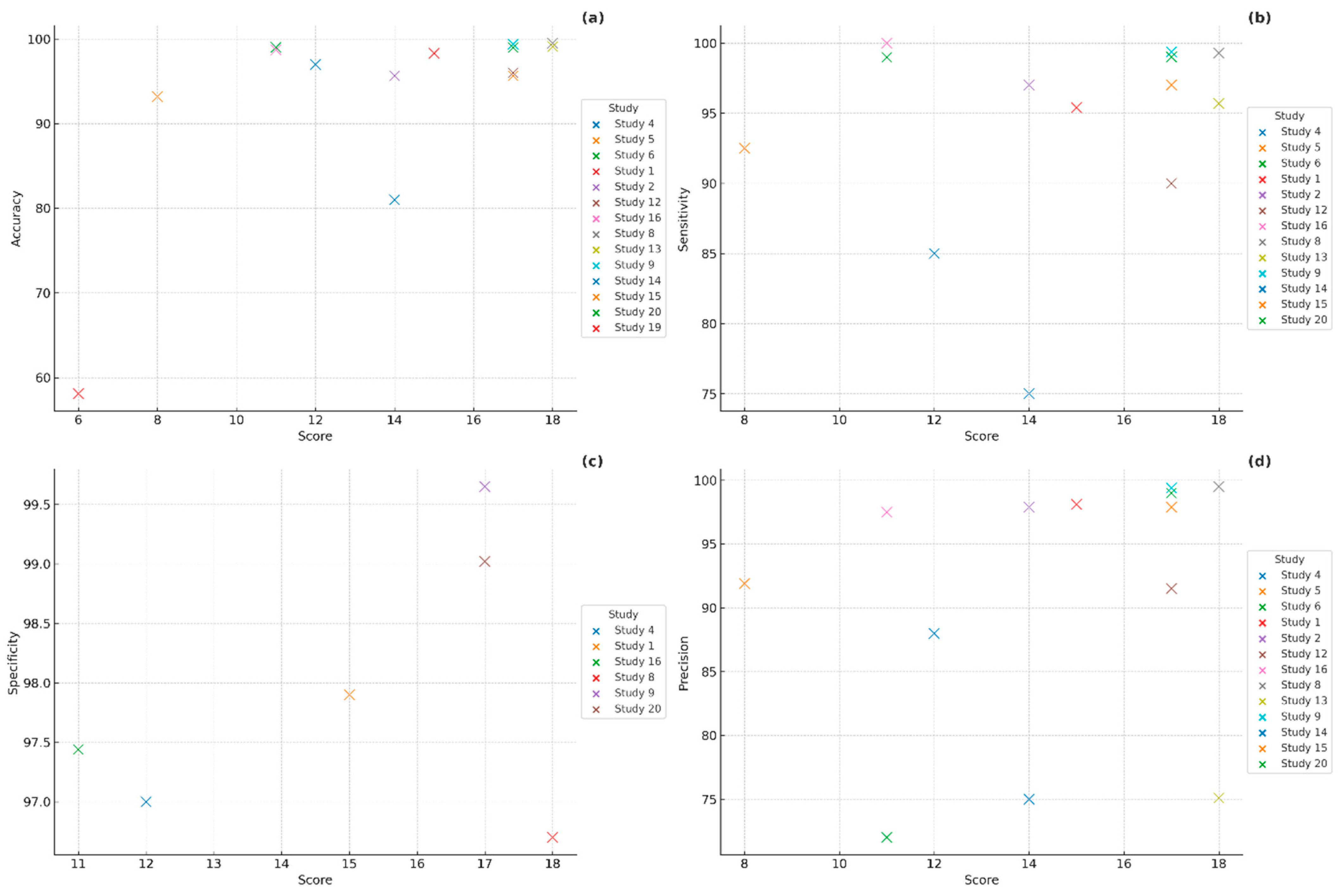
Figure 6 explores the relationship between key performance metrics (accuracy, sensitivity, specificity, and precision) and METRICS scores. We assessed their association using Spearman’s rank correlation. Among these, we report in the main text the results for accuracy, as it was the most consistently documented and representative metric across studies. The correlation between the overall methodological score (0–18) and accuracy yielded ρ = 0.082 and p = 0.737, indicating no significant association between higher accuracy and stronger methodological rigor. Similarly, no significant correlations were observed for the remaining performance metrics.

3. Discussion

To the best of our knowledge, this is the first structured review of quantum methods applied to MRI. Although QNNs represent a relatively recent development in the machine learning landscape, they are rapidly attracting interest for their potential applicability to medical imaging.
The structured methodological assessment presented in this study aims to lay the foundation for highlighting and evaluating the scientific rigor and transparency of research involving QNNs in MRI. As QNNs represent a novel and rapidly evolving field at the intersection of quantum computing and artificial intelligence, ensuring that published studies adhere to a minimum standard of methodological quality is essential to foster reproducibility, comparability, and clinical credibility. Our findings reveal considerable variability in how QNN studies report key aspects, such as code availability, validation strategies, and reproducibility, which are central to the scientific robustness of machine learning research. The limited availability of source code and detailed implementation parameters restricts independent verification and hinders the replication of results. Without open and transparent practices, the field risks being driven by proof-of-concept demonstrations that lack clinical generalizability. Moreover, the inconsistent use of benchmark datasets and limited access to quantum hardware raise concerns about the current maturity of the field. While simulators are valuable for development, their use should be explicitly acknowledged and contextualized, particularly when drawing conclusions about performance in clinical scenarios. Similarly, the absence of standardized datasets limits the capacity to evaluate and compare models across studies, thereby slowing progress toward consensus on effective QNN architectures.
From a translational perspective, assessing the clinical relevance and justification of quantum approaches is essential. Quantum advantage is often assumed yet rarely demonstrated in clinically meaningful terms. Our analysis shows that, although most studies attempt to link their work to real-world medical applications, few provide compelling evidence that QNNs outperform classical methods in MRI tasks or effectively address specific clinical needs. As such, this type of structured methodological review is crucial for identifying studies with genuine translational potential and those that require further validation.
The findings, summarized in Table 1, underscore the need for more transparent reporting and open practices, to enhance the reproducibility and clinical relevance of QNN-based approaches in medical imaging. By applying a harmonized and domain adapted metric, we provide a clear framework for assessing QNN research in MRI. This approach promotes methodological transparency, supports critical appraisal by the research community, and may guide future efforts toward the development of clinically applicable QNN models. As quantum hardware continues to evolve, the integration of rigorous methodological standards will be key to transitioning from conceptual models to deployable tools in clinical imaging.
The results in Table S2 highlight the growing interest in applying QNNs to MRI diagnostics, leveraging quantum computing’s potential to enhance diagnostic accuracy and efficiency. The use of diverse datasets, including well-established repositories like BraTS and Kaggle, demonstrates the robustness and generalizability of these approaches across different imaging modalities and pathologies. Meanwhile, the inclusion of local datasets reflects efforts to address specific clinical challenges, indicating the adaptability of QNNs to various contexts.
Architectural diversity further underscores the innovative nature of this field. The combination of classical deep learning models, such as ResNet34 and AlexNet, with quantum components illustrates the trend of integrating complementary strengths from both paradigms. Novel quantum-inspired techniques, including Quantum Chebyshev Polynomials (QCHPs) and Quantum Dilated Convolutional Neural Networks (QDCNNs), expand the methodological toolkit for medical image analysis, offering new pathways for tackling complex tasks.
However, hardware requirements remain a significant challenge. The reliance on high-performance GPUs and CPUs for hybrid setups emphasizes the computational demands of these methods. The adoption of quantum-specific hardware, such as the D-Wave quantum annealer, is a promising step, but its limited use indicates that the field is still in the early stages of practical quantum hardware integration. This reliance on simulators rather than full quantum systems could constrain real-world applicability until quantum hardware becomes more accessible and scalable.
The dominance of Quantum Convolutional and hybrid models (Figure 4), alongside reliance on BraTS and Kaggle datasets (Figure 5), points to a concentration of research on brain tumor classification tasks. While this facilitates benchmarking, it also limits generalizability to other imaging domains. Future studies should explore underrepresented architectures and diverse clinical datasets to broaden applicability.
The results in Table 2 underscore the importance of dataset quality and alignment with task requirements for achieving optimal outcomes. Interestingly, datasets and imaging modalities played a critical role in model performance. Tasks utilizing highly structured and annotated datasets like BraTS and BT-large consistently reported higher performance metrics compared to those involving less homogeneous or local datasets.
Despite these successes, variability in performance across tasks and datasets highlights critical areas for improvement. Lower accuracy in tasks like patient disability status classification [45] reveals the challenges associated with limited datasets and complex applications. Additionally, disparities in results between highly structured datasets like BraTS and less structured or local datasets point to the need for improved dataset standardization. Variability also arises from differences in task complexity, dataset quality, and the integration of quantum computing frameworks with classical paradigms, all of which underscore the necessity for standardized evaluation protocols.
Scalability and accessibility are also critical aspects of QNNs requiring attention. Advanced computational infrastructures, including GPUs such as the NVIDIA RTX 2070 [37] and specialized quantum hardware like the D-Wave annealer [34,48], are not universally available, raising concerns about the broader applicability of these methods in clinical settings. Standardized benchmarking practices and the development of publicly available, high-quality datasets tailored for quantum neural networks could mitigate some of these challenges.
The relationship between methodological quality and model performance, as shown in Figure 6, highlights the need for standardized evaluation practices. Several studies with high accuracy lacked methodological transparency, suggesting that reported performance metrics should be interpreted cautiously in the absence of reproducible pipelines.
Building on these findings, more operational recommendations are required to guide the development of reproducible and clinically meaningful QNN–MRI pipelines. Future studies should explicitly report whether models are executed on simulators or on quantum processing units (QPUs), specifying details such as the number of shots, backend configuration, and the adopted noise model. Clear reporting on these aspects would substantially improve transparency, especially since QNN performance can differ markedly between simulated and real quantum environments. In parallel, the adoption of code and data availability badges, supported by public repositories, would enhance reproducibility and allow independent verification of proposed architectures. Benchmarking QNN models on at least one widely used MRI dataset, such as BraTS, complemented by external validation on an independent cohort, would also facilitate more consistent comparisons across studies and help distinguish genuine advances from results that are overly dependent on specific datasets or limited validation schemes. Establishing harmonized reporting guidelines tailored to quantum medical imaging would contribute to consolidating methodological standards and promoting more rigorous evaluation practices.
Looking forward, several open challenges and future directions can be identified. A key unsolved problem is the scalability and noise resilience of QNNs on current NISQ hardware: present-day quantum processors impose strict limits on circuit depth and qubit count, making it difficult to design sufficiently expressive models for complex MRI tasks. Closely related to this is the challenge of data encoding, since mapping high-dimensional medical images into quantum states in an efficient and minimally lossy way remains an open research question and strongly constrains what can be learned in practice. Another fundamental issue concerns the limited interpretability and explainability of QNN outputs. Most existing models behave essentially as black boxes, whereas clinical workflows require transparent, traceable decision processes that can be reconciled with radiological and diagnostic standards. Future work should therefore focus on hybrid quantum–classical frameworks that exploit quantum feature extraction while preserving the interpretability of classical deep learning, on the development of uncertainty quantification and error-mitigation strategies to counteract noise on NISQ devices, and on the creation of standardized MRI benchmark datasets specifically designed for quantum methods. In parallel, improving practical access to quantum hardware and fostering closer collaboration between quantum computing experts, clinicians, and medical imaging scientists will be essential to move from proof-of-concept demonstrations toward QNN solutions that can be realistically integrated into clinical MRI practice.

4. Conclusions

QNNs represent a promising yet still maturing approach in the field of MRI analysis. The reviewed studies demonstrate encouraging results in classification and segmentation tasks, with some reporting high accuracy and reliability. However, variability in methodological rigor, limited reproducibility, and scarce use of real quantum hardware suggest that the field is still in an exploratory phase. Despite these limitations, QNNs offer a novel computational framework with potential benefits for medical imaging. Continued efforts in improving methodological transparency, promoting open science, and developing scalable, hybrid quantum–classical models will be crucial for advancing their clinical applicability.

Supplementary Materials

The following supporting information can be downloaded at: https://www.mdpi.com/article/10.3390/computers14120529/s1, Table S1: Detailed scoring anchors (0–1–2) for the nine methodological criteria used to assess the included QNN–MRI studies. Table S2: Summary table of studies applying Quantum Neural Networks (QNN) in Magnetic Resonance Imaging (MRI). The table outlines the datasets used, simulation environments, network architectures, hardware specifications, and the tasks addressed in each study. In the table “Not Reported” indicates that the information was not provided in the original publication.

Author Contributions

Conceptualization, E.R., M.V., A.S. and A.N.; methodology, E.R., M.V., A.S. and A.N.; formal analysis, E.R., M.V., A.S. and A.N.; investigation, E.R., M.V., A.S. and A.N.; data curation, E.R., M.V., A.S. and A.N.; writing—original draft preparation, E.P., G.L.N. and M.L.D.; writing—review and editing, E.R., M.V., M.L.D., F.L., G.L.N., A.S. and A.N. E.R. and M.V. contributed equally to this work. All authors have read and agreed to the published version of the manuscript.

Funding

This research received no external funding.

Data Availability Statement

All data and scripts supporting this article are publicly available in a repository associated with the following DOI: https://doi.org/10.5281/zenodo.17713514.

Conflicts of Interest

The authors declare no conflicts of interest.

References

  1. Nielsen, M.A.; Chuang, I.L. Quantum Computation and Quantum Information, 10th ed.; Cambridge University Press: Cambridge, UK, 2010. [Google Scholar]
  2. Preskill, J. Quantum Computing in the NISQ era and beyond. Quantum 2018, 2, 79. [Google Scholar] [CrossRef]
  3. Litjens, G.; Kooi, T.; Bejnordi, B.E.; Setio, A.A.A.; Ciompi, F.; Ghafoorian, M.; van der Laak, J.A.W.M.; van Ginneken, B.; Sánchez, C.I. A survey on deep learning in medical image analysis. Med. Image Anal. 2017, 42, 60–88. [Google Scholar] [CrossRef]
  4. Schuld, M.; Petruccione, F. Supervised Learning with Quantum Computers; Springer: Berlin/Heidelberg, Germany, 2018. [Google Scholar]
  5. Arute, F.; Arya, K.; Babbush, R.; Bacon, D.; Bardin, J.C.; Barends, R.; Biswas, R.; Boixo, S.; Brandao, F.G.S.L.; Buell, D.A.; et al. Quantum supremacy using a programmable superconducting processor. Nature 2019, 574, 505–510. [Google Scholar] [CrossRef] [PubMed]
  6. Zhong, H.-S.; Wang, H.; Deng, Y.-H.; Chen, M.-C.; Peng, L.-C.; Luo, Y.-H.; Qin, J.; Wu, D.; Ding, X.; Hu, Y.; et al. Quantum computational advantage using photons. Science 2020, 370, 1460–1463. [Google Scholar] [CrossRef] [PubMed]
  7. Biamonte, J.; Wittek, P.; Pancotti, N.; Rebentrost, P.; Wiebe, N.; Lloyd, S. Quantum machine learning. Nature 2017, 549, 195–202. [Google Scholar] [CrossRef] [PubMed]
  8. Schuld, M.; Bocharov, A.; Svore, K.M.; Wiebe, N. Circuit-centric quantum classifiers. Phys. Rev. A 2020, 101, 032308. [Google Scholar] [CrossRef]
  9. Cerezo, M.; Arrasmith, A.; Babbush, R.; Benjamin, S.C.; Endo, S.; Fujii, K.; McClean, J.R.; Mitarai, K.; Yuan, X.; Cincio, L.; et al. Variational quantum algorithms. Nat. Rev. Phys. 2021, 3, 625–644. [Google Scholar] [CrossRef]
  10. Frisoni, G.B.; Fox, N.C.; Jack, C.R.; Scheltens, P.; Thompson, P.M. The clinical use of structural MRI in Alzheimer disease. Nat. Rev. Neurol. 2010, 6, 67–77. [Google Scholar] [CrossRef]
  11. Aerts, H.J.W.L.; Velazquez, E.R.; Leijenaar, R.T.H.; Parmar, C.; Grossmann, P.; Carvalho, S.; Bussink, J.; Monshouwer, R.; Haibe-Kains, B.; Rietveld, D.; et al. Decoding tumour phenotype by noninvasive imaging using a quantitative radiomics approach. Nat. Commun. 2014, 5, 4006. [Google Scholar] [CrossRef]
  12. Lambin, P.; Rios-Velazquez, E.; Leijenaar, R.; Carvalho, S.; van Stiphout, R.G.P.M.; Granton, P.; Zegers, C.M.L.; Gillies, R.; Boellard, R.; Dekker, A.; et al. Radiomics: Extracting more information from medical images using advanced feature analysis. Eur. J. Cancer 2012, 48, 441–446. [Google Scholar] [CrossRef]
  13. Mohseni, M.; Read, P.; Neven, H.; Boixo, S.; Denchev, V.; Babbush, R.; Fowler, A.; Smelyanskiy, V.; Martinis, J. Commercialize quantum technologies in five years. Nature 2017, 543, 171–174. [Google Scholar] [CrossRef] [PubMed]
  14. Schuld, M.; Sinayskiy, I.; Petruccione, F. The quest for a Quantum Neural Network. Quantum Inf. Process. 2014, 13, 2567–2586. [Google Scholar] [CrossRef]
  15. Humble, T.S.; McCaskey, A.; Lyakh, D.I.; Gowrishankar, M.; Frisch, A.; Monz, T. Quantum Computers for High-Performance Computing. IEEE Micro 2021, 41, 15–23. [Google Scholar] [CrossRef]
  16. Pan, Y.; Zhang, J.; Cohen, E.; Wu, C.; Chen, P.-X.; Davidson, N. Weak-to-strong transition of quantum measurement in a trapped-ion system. Nat. Phys. 2020, 16, 1206–1210. [Google Scholar] [CrossRef]
  17. Kim, R. Implementing a Hybrid Quantum-Classical Neural Network by Utilizing a Variational Quantum Circuit for Detection of Dementia. In Proceedings of the 2023 IEEE International Conference on Quantum Computing and Engineering (QCE), Bellevue, WA, USA, 17–22 September 2023; IEEE: New York, NY, USA, 2023; pp. 256–257. [Google Scholar] [CrossRef]
  18. Khalaf, M.H.; Adel, E.A.; Mohammed, R.H.; Emaduldeen, A.A.; Jasim, B.L. Application of Quantum Computing in Medical Imaging: Revolutionizing MRI and CT Scan Technology. Am. J. Bot. Bioeng. 2025, 2, 14–28. [Google Scholar]
  19. Nguyen, N.H.; Behrman, E.C.; Steck, J.E. Quantum learning with noise and decoherence: A robust quantum neural network. Quantum Mach. Intell. 2020, 2, 1. [Google Scholar] [CrossRef]
  20. Kwak, Y.; Yun, W.J.; Jung, S.; Kim, J. Quantum Neural Networks: Concepts, Applications, and Challenges. In Proceedings of the 2021 Twelfth International Conference on Ubiquitous and Future Networks (ICUFN), Jeju Island, Republic of Korea, 17–20 August 2021. [Google Scholar]
  21. Mitarai, K.; Negoro, M.; Kitagawa, M.; Fujii, K. Quantum circuit learning. Phys. Rev. A 2018, 98, 032309. [Google Scholar] [CrossRef]
  22. Benedetti, M.; Lloyd, E.; Sack, S.; Fiorentini, M. Parameterized quantum circuits as machine learning models. Quantum Sci. Technol. 2019, 4, 043001. [Google Scholar] [CrossRef]
  23. Kaphika, W.S.; Mahato, R.K.; Makhenjera, M.; Phiri, E.; Olajide, T.E. Quantum Neural Networks for Predictive Modelling in Personalized Medicine: Advancing Treatment Response Analysis and Precision Healthcare. Preprints 2025. [Google Scholar] [CrossRef]
  24. Fatunmbi, T.O. Integrating quantum neural networks with machine learning algorithms for optimizing healthcare diagnostics and treatment outcomes. World J. Adv. Res. Rev. 2023, 17, 1059–1077. [Google Scholar] [CrossRef]
  25. Peral-García, D.; Cruz-Benito, J.; García-Peñalvo, F.J. Systematic literature review: Quantum machine learning and its applications. Comput. Sci. Rev. 2024, 51, 100619. [Google Scholar] [CrossRef]
  26. Cong, I.; Choi, S.; Lukin, M.D. Quantum convolutional neural networks. Nat. Phys. 2019, 15, 1273–1278. [Google Scholar] [CrossRef]
  27. Sierra-Sosa, D.; Telahun, M.; Elmaghraby, A. TensorFlow Quantum: Impacts of Quantum State Preparation on Quantum Machine Learning Performance. IEEE Access 2020, 8, 215246–215255. [Google Scholar] [CrossRef]
  28. Liu, J.; Lim, K.H.; Wood, K.L.; Huang, W.; Guo, C.; Huang, H.-L. Hybrid quantum-classical convolutional neural networks. Sci. China Phys. Mech. Astron. 2021, 64, 290311. [Google Scholar] [CrossRef]
  29. Huang, H.-Y.; Broughton, M.; Mohseni, M.; Babbush, R.; Boixo, S.; Neven, H.; McClean, J.R. Power of data in quantum machine learning. Nat. Commun. 2021, 12, 2631. [Google Scholar] [CrossRef]
  30. Sallam, M.; Barakat, M.; Sallam, M. A Preliminary Checklist (METRICS) to Standardize the Design and Reporting of Studies on Generative Artificial Intelligence–Based Models in Health Care Education and Practice: Development Study Involving a Literature Review. Interact. J. Med. Res. 2024, 13, e54704. [Google Scholar] [CrossRef]
  31. Dhawan, A. MI-CLAIM Checklist Modelling for Clinical Artificial Intelligence. In Proceedings of the 2023 7th International Conference on I-SMAC (IoT in Social, Mobile, Analytics and Cloud) (I-SMAC), Kirtipur, Nepal, 11–13 October 2023; IEEE: New York, NY, USA, 2023; pp. 584–590. [Google Scholar] [CrossRef]
  32. Nijaguna, G.S.; Kumar, D.P.M.; Manjunath, B.N.; Jain, T.J.S.; Lal, N.D. Quantum squirrel search algorithm based support vector machine algorithm for brain tumor classification. Internet Technol. Lett. 2024, 7, e484. [Google Scholar] [CrossRef]
  33. Dong, Y.; Che, X.; Fu, Y.; Liu, H.; Zhang, Y.; Tu, Y. Classification of knee osteoarthritis based on quantum-to-classical transfer learning. Front. Phys. 2023, 11, 1212373. [Google Scholar] [CrossRef]
  34. Felefly, T.; Roukoz, C.; Fares, G.; Achkar, S.; Yazbeck, S.; Meyer, P.; Kordahi, M.; Azoury, F.; Nasr, D.N.; Nasr, E.; et al. An explainable MRI-radiomic quantum neural network to differentiate between large brain metastases and high-grade glioma using quantum annealing for feature selection. J. Digit. Imaging 2023, 36, 2335–2346. [Google Scholar] [CrossRef]
  35. Ahmadi, M.; Sharifi, A.; Hassantabar, S.; Enayati, S. QAIS-DSNN: Tumor area segmentation of MRI image with optimized quantum matched-filter technique and deep spiking neural network. Biomed. Res. Int. 2021, 2021, 6653879. [Google Scholar] [CrossRef]
  36. Shahwar, T.; Zafar, J.; Almogren, A.; Zafar, H.; Rehman, A.U.; Shafiq, M.; Hamam, H. Automated detection of Alzheimer’s via hybrid classical quantum neural networks. Electronics 2022, 11, 721. [Google Scholar] [CrossRef]
  37. Konar, D.; Bhattacharyya, S.; Panigrahi, B.K.; Behrman, E.C. Qutrit-Inspired Fully Self-Supervised Shallow Quantum Learning Network for Brain Tumor Segmentation. IEEE Trans. Neural Netw. Learn. Syst. 2022, 33, 6331–6345. [Google Scholar] [CrossRef]
  38. Amin, J.; Anjum, M.A.; Gul, N.; Sharif, M. Detection of brain space-occupying lesions using quantum machine learning. Neural Comput. Appl. 2023, 35, 19279–19295. [Google Scholar] [CrossRef]
  39. Hasan, A.M.; Aljobouri, H.K.; Al-Waely, N.K.N.; Ibrahim, R.W.; Jalab, H.A.; Meziane, F. Diagnosis of breast cancer based on hybrid features extraction in dynamic contrast enhanced magnetic resonance imaging. Neural Comput. Appl. 2023, 35, 23199–23212. [Google Scholar] [CrossRef]
  40. Ullah, M.S.; Khan, M.A.; Masood, A.; Mzoughi, O.; Saidani, O.; Alturki, N. Brain tumor classification from MRI scans: A framework of hybrid deep learning model with Bayesian optimization and quantum theory-based marine predator algorithm. Front. Oncol. 2024, 14, 1335740. [Google Scholar] [CrossRef]
  41. Pendela, K.; Vijayakumar, K.; Gunasekaran, G. QDCNN-DMN: A hybrid deep learning approach for brain tumor classification using MRI images. Biomed. Signal Process. Control 2025, 101, 107199. [Google Scholar] [CrossRef]
  42. Amin, J.; Anjum, M.A.; Gul, N.; Sharif, M. A secure two-qubit quantum model for segmentation and classification of brain tumor using MRI images based on blockchain. Neural Comput. Appl. 2022, 34, 17315–17328. [Google Scholar] [CrossRef]
  43. Alsharabi, N.; Shahwar, T.; Rehman, A.U.; Alharbi, Y. Implementing magnetic resonance imaging brain disorder classification via AlexNet–quantum learning. Mathematics 2023, 11, 376. [Google Scholar] [CrossRef]
  44. Konar, D.; Bhattacharyya, S.; Gandhi, T.K.; Panigrahi, B.K.; Jiang, R. 3-D Quantum-Inspired Self-Supervised Tensor Network for Volumetric Segmentation of Medical Images. IEEE Trans. Neural Netw. Learn. Syst. 2024, 35, 10312–10325. [Google Scholar] [CrossRef]
  45. Mayfield, J.; Naqa, I.E. Evaluation of VQC-LSTM for disability forecasting in multiple sclerosis using sequential multisequence MRI. Quantum Mach. Intell. 2024, 6, 41. [Google Scholar] [CrossRef]
  46. CJetlin, P.; Sherly, P.A.L. PyQDCNN: Pyramid QDCNNet for multi-level brain tumor classification using MRI image. Biomed. Signal Process. Control 2025, 100 Pt A, 107042. [Google Scholar] [CrossRef]
  47. Choudhuri, R.; Halder, A. Brain MRI tumour classification using quantum classical convolutional neural net architecture. Neural Comput. Appl. 2023, 35, 4467–4478. [Google Scholar] [CrossRef]
  48. Roy, S.; Rudra, B. Quantum-inspired hybrid algorithm for image classification and segmentation: Q-Means++ max-cut method. Int. J. Imaging Syst. Technol. 2024, 34, e23015. [Google Scholar] [CrossRef]
  49. Jeon, Y.-J.; Park, S.-E.; Baek, H.-M. Predicting Brain Age and Gender from Brain Volume Data Using Variational Quantum Circuits. Brain Sci. 2024, 14, 401. [Google Scholar] [CrossRef]
  50. Choi, J.; Hur, T.; Park, D.K.; Shin, N.-Y.; Lee, S.-K.; Lee, H.; Han, S. Early-stage detection of cognitive impairment by hybrid quantum-classical algorithm using resting-state functional MRI time-series. Knowl.-Based Syst. 2025, 310, 112922. [Google Scholar] [CrossRef]
  51. Wang, A.; Mao, D.; Li, X.; Li, T.; Li, L. HQNet: A hybrid quantum network for multi-class MRI brain classification via quantum computing. Expert Syst. Appl. 2025, 261, 125537. [Google Scholar] [CrossRef]
Figure 1. Visual comparison between Quantum Neural Networks (QNNs) and Classical Neural Networks (CNNs), highlighting key conceptual differences.
Computers 14 00529 g001
Figure 2. PRISMA flow diagram.
Computers 14 00529 g002
Figure 3. METRICS methodological quality score for each included study, ranging from low to high (max score: 18).
Computers 14 00529 g003
Figure 4. Pie chart of QNN architectures grouped by methodological category: Quantum Convolutional Networks, Transfer Learning, Variational Circuits, Quantum-Inspired Optimizers, and Polynomial-based models.
Computers 14 00529 g004
Figure 5. Bar chart showing the frequency of MRI datasets used across the reviewed studies.
Computers 14 00529 g005
Figure 6. Multipanel visualization showing the correlation between METRICS quality scores and four performance metrics (a) Accuracy (%), (b) Sensitivity (%), (c) Specificity (%), and (d) Precision (%) for selected QNN-MRI studies.
Computers 14 00529 g006
Table 1. Performance scores and total scores of each QNN study.
ID StudyCode AvailabilityValidation TypeReproducibilityHardware AccessibilityBenchmark DatasetClinical RelevanceJustification for QNNRobust MetricsMethodological ContributionTotal ScoreRef.
112211222215[32]
222112112214[33]
312211222215[34]
401112212212[35]
521222222217[36]
611111212111[37]
722222212217[38]
822222222218[39]
922222212217[40]
101111111119[41]
1101112202110[42]
1222212222217[43]
1322222222218[44]
1411112222214[45]
151110111118[46]
1611111112211[47]
1711101212110[48]
1812112222215[49]
1911212221214[50]
2021222222217[51]
Table 2. Summary table presenting the performance metrics (Accuracy, Sensitivity, Specificity, and Precision) of QNN applications in MRI-related tasks. * Duplicated parameters for the same study with several datasets.
ID StudyAccuracy (%)Sensitivity (%)Specificity (%)Precision (%)Validation Type/Data SplitNote
198.395.497.998.1Internal validation (train/test 75/25)
295.6597.02 97.89Internal validation (train/test 90/10)
37477 77Not reported
498.21 5-fold cross-validation (train/test 80/20)
59785 8810-fold-cross-validation (train/test 90/10)
69999 72Not reported
7 10-fold-cross-validation (train/test 50/50)
8 *84.285.982.5 QCHPs-Pre-contrast
88.387.189.6 QCHPs-Post-contrast 1
93.292.593.9 QCHPs-Post-contrast 2
92.791.893.5 Not reportedQCHPs-Post-contrast 3
89.289.888.5 Combined Features-Pre-contrast
96.795.796.6 Combined Features-Post-contrast 1
99.599.396.7 Combined Features-post-contrast 2
97.596.798.3 Combined Features-Post-contrast 3
999.3899.3899.6599.4Internal validation (train/test 70/30)
10 *92.392.891.8 BRATS 2018 dataset varying training data
9393.592.9 10-fold-cross-validationFigshare dataset
92.79392.8 Brain Tumor Classification Database
1185 Internal validation (train/test 80/20)
12 *9792 93Internal validation (train/test 50/50)Parkinson
9690 91.5 Azheimer
13 *98.996.5 73.6 MRI T1
98.995.7 74 MRI T1-CE
99.195.7 75.1 FLAIR
9996 73.6Not reportedT2
98.795.9 67.8 MRI T1
98.795.8 67.8 MRI T1-CE
98.995.6 69.7 FLAIR
98.895.7 69.6 T2
14 *7070 70 MPS-LSTM
7676 78Not reportedMERA-LSTM
8175 75 TTN-LSTM
15 *93.893.6 92.6 Figshare dataset 1 level
93.793.5 92.5 BRATS 2018 dataset 1 level
93.292.5 91.9 BRATS 2020 dataset 1 level
94.193.3 92.6Not reportedFigshare dataset 2 level
9493.8 92.1 BRATS 2018 dataset 2 level
93.592.6 91.7 BRATS 2020 dataset 2 level
16 *98.7210097.4497.5 BRATS 2013 Dataset
98.4697.62100100Internal validation (train/test 70/30–80/20)–90/10)Harvard Dataset
98.1797.6998.6598.67 Private Dataset
1798.497.7 99Not reportedClassification
1881.879.4 88.5Not reportedGender prediction
1958.1 Not reported
20 *97.5597.7399.1997.31 BT-large-4c
9999.0299.0298.995-fold and 10-fold cross-validationBT-large-2c
98.8698.5799.4398.65 Cheng Dataset
Disclaimer/Publisher’s Note: The statements, opinions and data contained in all publications are solely those of the individual author(s) and contributor(s) and not of MDPI and/or the editor(s). MDPI and/or the editor(s) disclaim responsibility for any injury to people or property resulting from any ideas, methods, instructions or products referred to in the content.