Total Neoadjuvant Therapy Outcomes and Watch-and-Wait Feasibility in Locally Advanced Rectal Cancer: A Single-Institution Retrospective Cohort Study

 ,
,
Simple Summary
Abstract
1. Introduction
2. Materials and Methods
2.1. Study Design and Patient Population
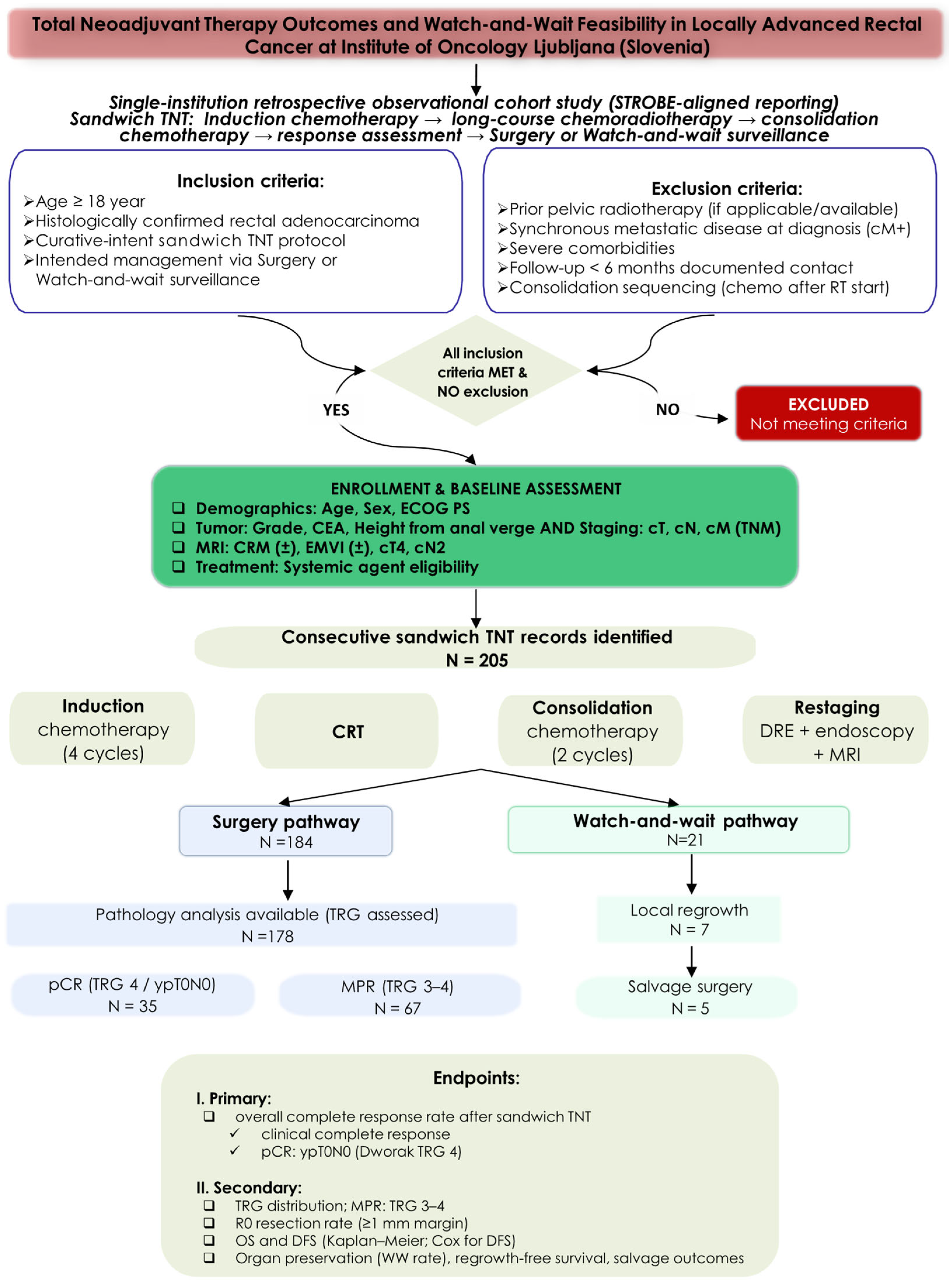
2.2. Eligibility Criteria
2.2.1. Inclusion Criteria
- •
- Histologically confirmed primary adenocarcinoma of the rectum
- •
- Clinical staging: cT3–4 and/or cN+ disease, cM0 (no distant metastases)
- •
- Performance status: Eastern Cooperative Oncology Group (ECOG) 0–2
- •
- Fitness for TNT: Adequate organ function to tolerate chemotherapy and radiotherapy
- •
- Minimum of 6 months of follow-up available (unless death occurred earlier)
2.2.2. Exclusion Criteria
- •
- Distant metastatic disease (cM1)
- •
- Prior pelvic radiotherapy or systemic therapy for rectal cancer
- •
- Pregnancy or nursing status
- •
- Severe comorbidities precluding neoadjuvant therapy
- •
- Non-evaluable/inadequate quality preoperative imaging
- •
- Substantial missing key baseline staging data (defined as missingness in ≥1 key MRI staging domain or >20% missing among prespecified variables)
2.3. Sandwich TNT Protocol and W&W Entry Criteria
2.4. Data Collection and Variables
2.5. Outcome Definitions
2.5.1. Primary Endpoint
2.5.2. Key Secondary Endpoints
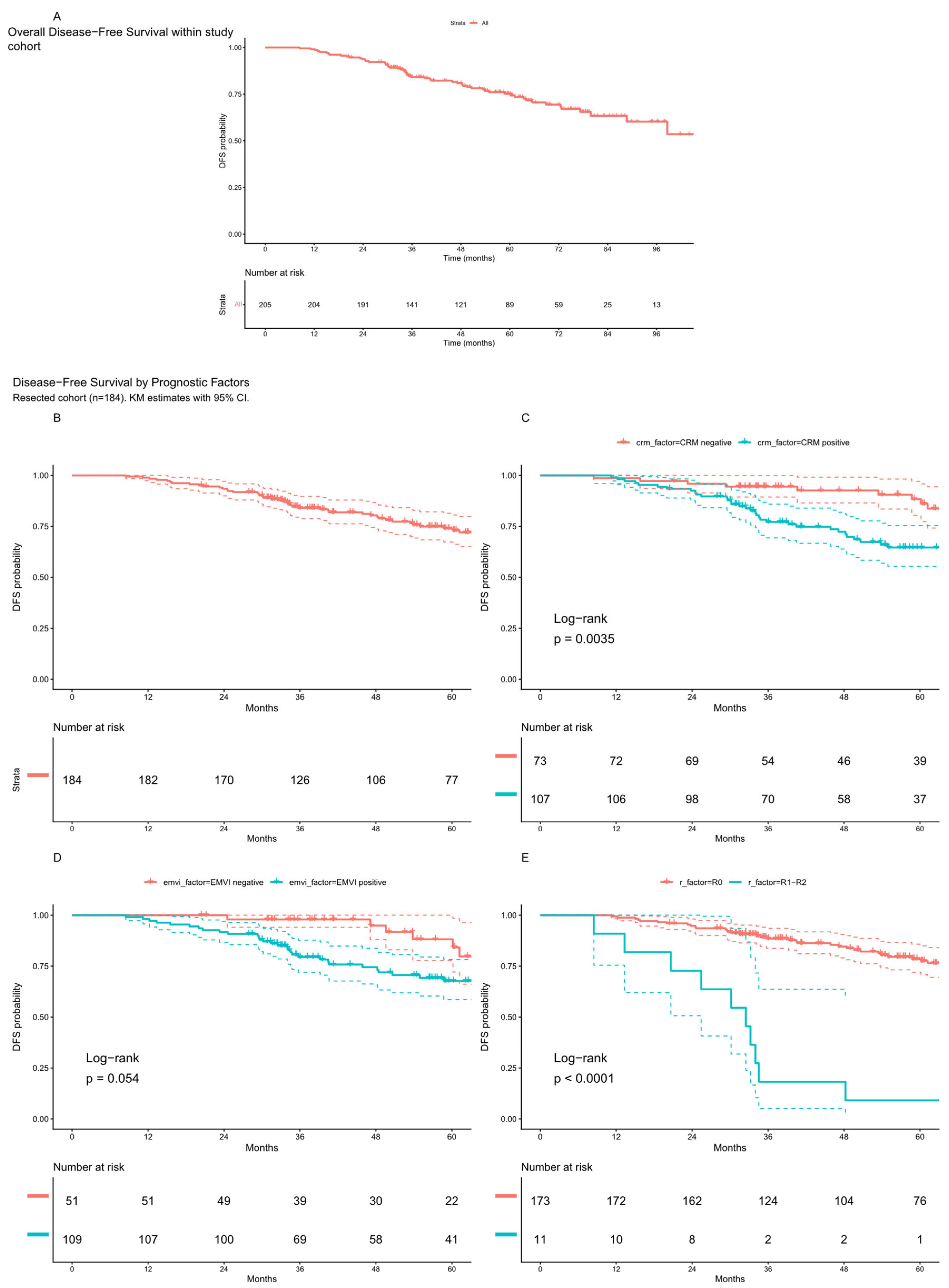
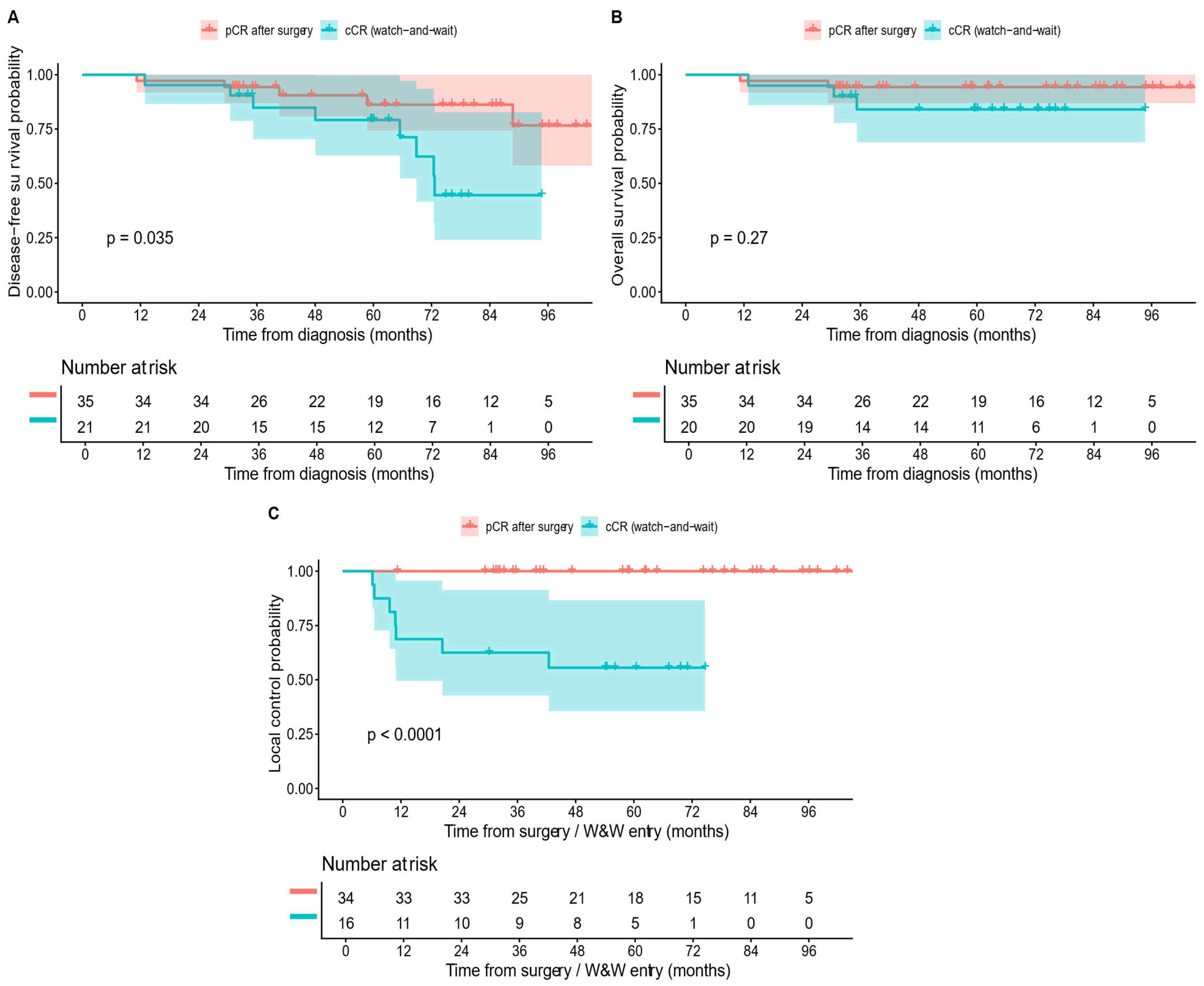
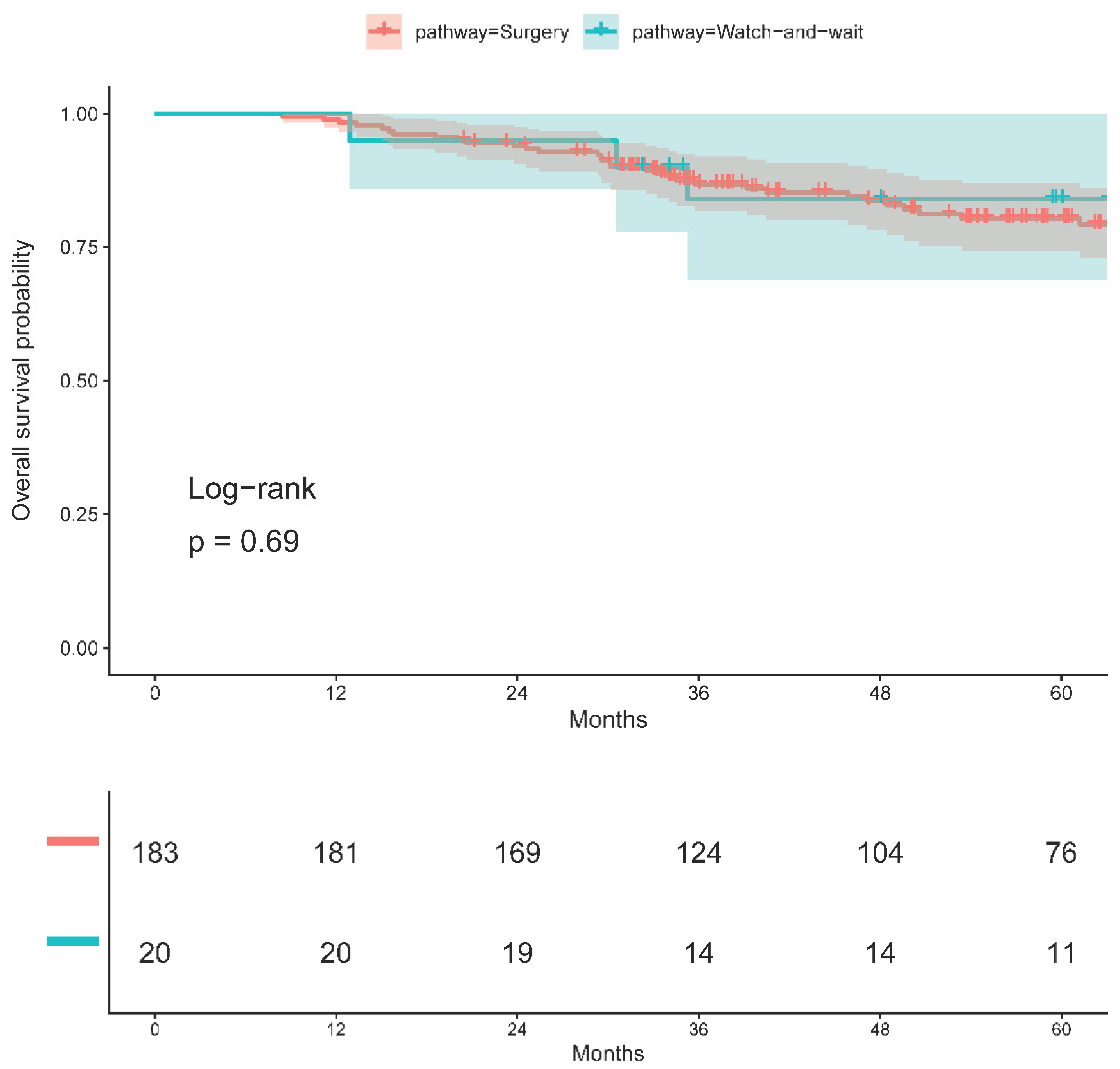
- OS: time from diagnosis to death from any cause, with patients alive censored at last follow-up.
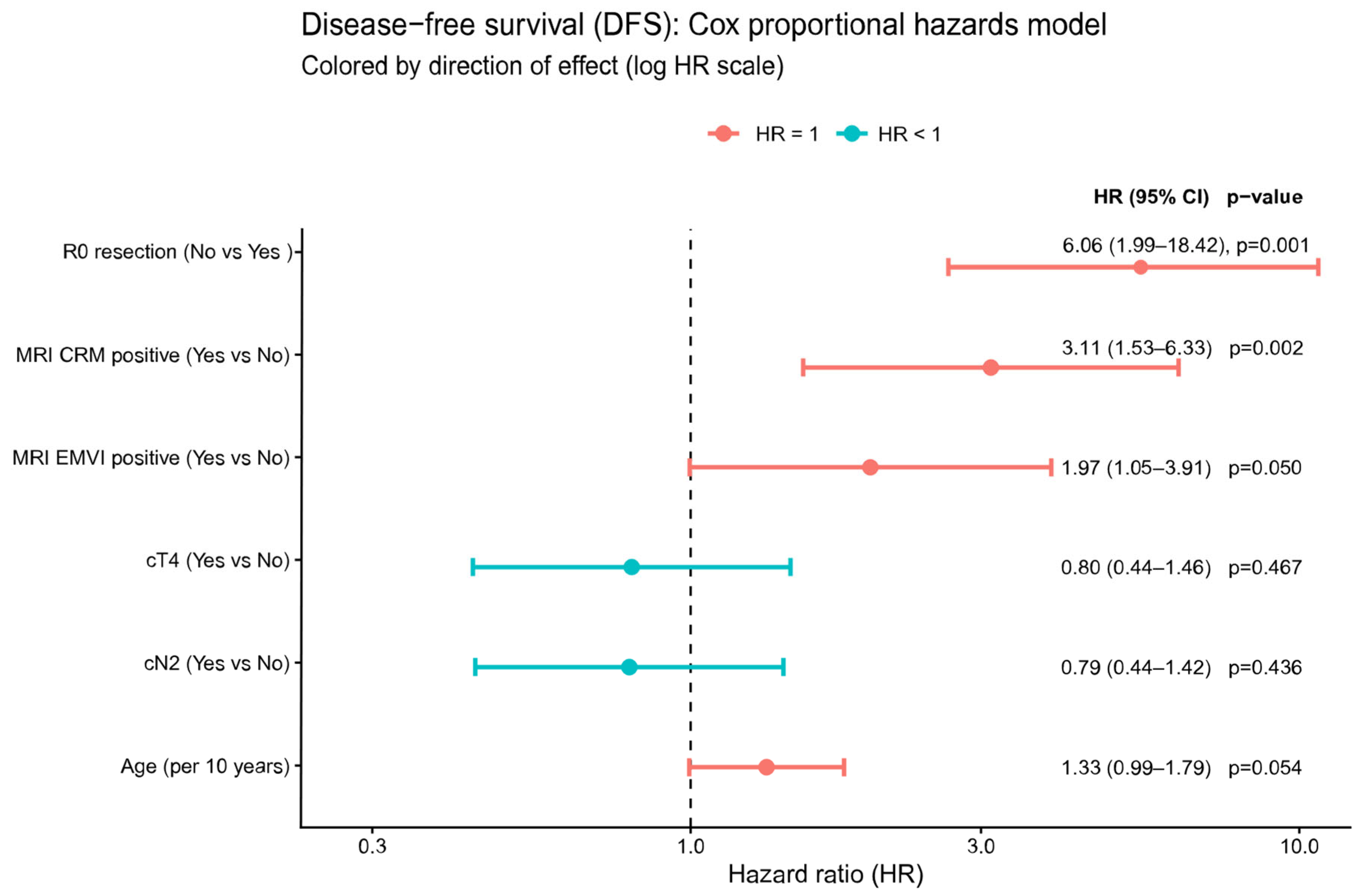
- DFS: time from diagnosis to first documented disease recurrence (local, regional, or distant) or death from any cause, whichever occurred first, censored at last follow-up.
- Major pathological response (MPR): Dworak TRG 3–4 (good or complete regression) [28].
- R0 resection rate: proportion of resections with all margins negative, defined as a minimum clearance ≥ 1 mm.
- Organ preservation: W&W enrollment rate among the TNT cohort and durability of rectal preservation over time.
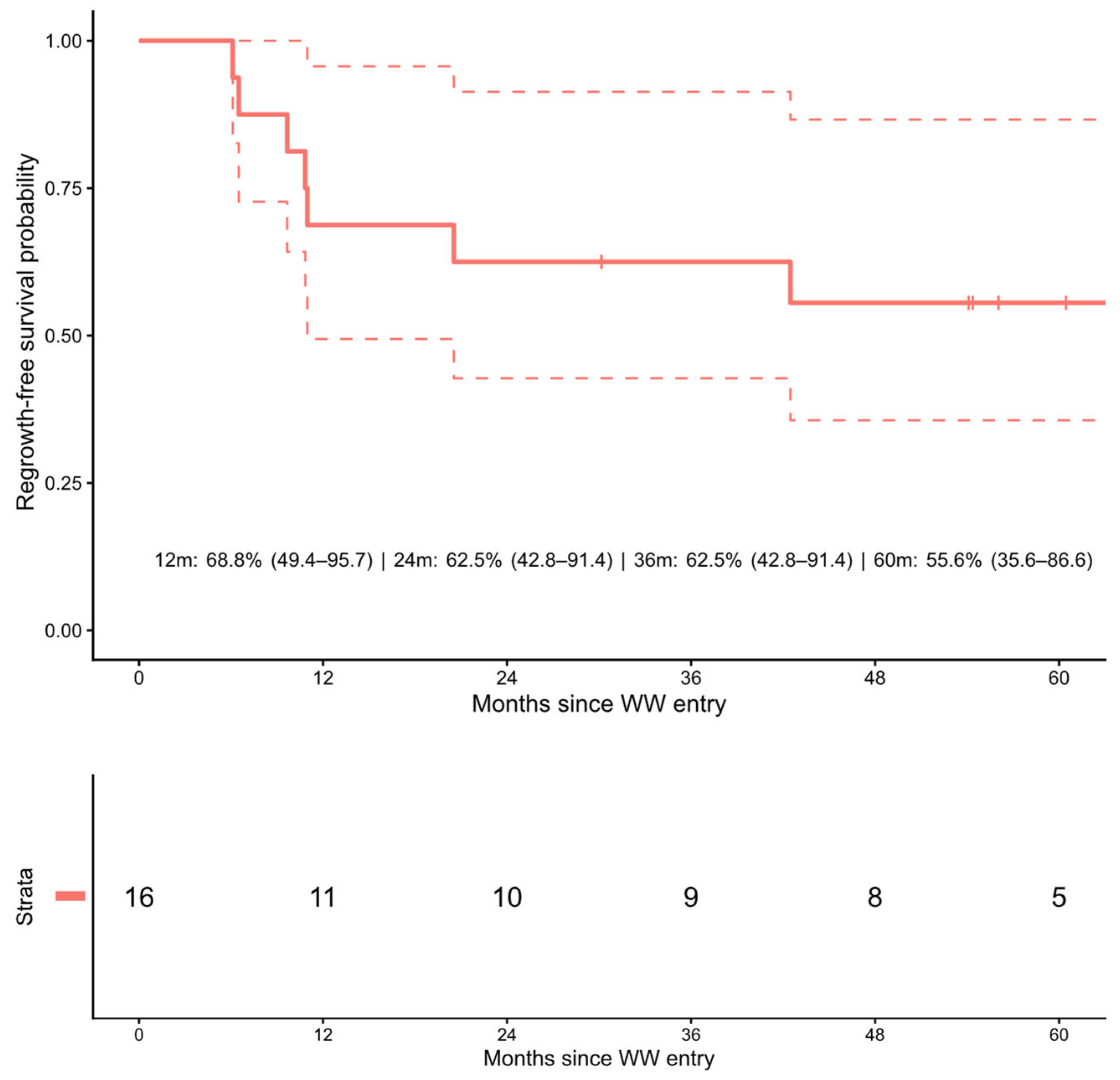
- W&W regrowth: incidence, timing, and clinical/radiological characteristics of local regrowth in patients managed non-operatively after initial cCR. Local regrowth was defined as tumor reappearance at the primary site after cCR during non-operative management, distinct from post-resection local recurrence. Regrowth-free survival was calculated from entry into W&W protocol to first regrowth or censoring at last follow-up.
- Salvage surgery outcomes: feasibility of salvage TME for regrowth, R0 resection rate after salvage, and DFS following salvage surgery.
- Post-resection local recurrence: crude incidence and landmark local pelvic recurrence rates among surgically treated patients. Because the exact date of local recurrence was not consistently documented in all cases, post-resection local control was evaluated using incidence proportions and landmark recurrence rates rather than formal local recurrence-free survival curves.
2.6. Statistical Analysis
2.7. Ethics
3. Results
3.1. Study Cohort and Baseline Characteristics
3.2. Pathologic Response and Surgical Outcomes
3.3. Organ Preservation and Watch-and-Wait Outcomes
3.4. Survival Outcomes
3.4.1. Overall Survival
3.4.2. Disease-Free Survival
3.4.3. Local Recurrence
3.4.4. Exploratory Comparison of Complete Responders—Surgical pCR Versus cCR Under Watch-and-Wait
4. Discussion
4.1. Tumor Response, Stage Migration and Survival in a High-Risk Cohort
4.2. Persistent Prognostic Impact of MRI-Defined Anatomy and Margins
4.3. Sandwich TNT Protocol in Contemporary Sequencing Debates
4.4. Watch-and-Wait Outcomes and Salvageability
4.5. Limitations and Strengths
4.6. Clinical Implications and Future Directions
5. Conclusions
Author Contributions
Funding
Institutional Review Board Statement
Informed Consent Statement
Data Availability Statement
Conflicts of Interest
Abbreviations
| AJCC | American Joint Committee on Cancer |
| CAO-ARO-AIO | German Rectal Cancer Study Group acronym used in trial name (CAO/ARO/AIO-12) |
| CAPOX | Capecitabine plus oxaliplatin |
| CEA | Carcinoembryonic antigen |
| CI | Confidence interval |
| cCR | Clinical complete response |
| cM/cM+ | Clinical M stage/clinical M1 (synchronous metastatic disease) |
| cN | Clinical nodal stage (TNM) |
| cT | Clinical tumor stage (TNM) |
| CR | Complete response |
| CRM | Circumferential resection margin |
| CRT | Chemoradiotherapy |
| DFS | Disease-free survival |
| DRE | Digital rectal examination |
| ECOG PS | Eastern Cooperative Oncology Group performance status |
| EMVI | Extramural vascular/venous invasion |
| EORTC | European Organisation for Research and Treatment of Cancer |
| ERID-KSOPKR | Institutional Review Board identifier (as written) |
| ERIDEK | Institutional Ethical Committee identifier (as written) |
| ESMO | European Society for Medical Oncology |
| FOLFIRINOX | Fluorouracil, leucovorin, irinotecan, and oxaliplatin combination regimen |
| FOLFOX6/mFOLFOX6 | (Modified) FOLFOX6 regimen (as cited) |
| HR | Hazard ratio |
| ICRU | International Commission on Radiation Units and Measurements |
| IMRT | Intensity-modulated radiation therapy |
| IMRT-SIB | Intensity-modulated radiation therapy with simultaneous integrated boost |
| IQR | Interquartile range |
| IWWD | International Watch & Wait Database |
| LARC | Locally advanced rectal cancer |
| LN | Lymph node |
| LR | Local recurrence |
| LVI | Lymphovascular invasion |
| mFOLFIRINOX | Modified FOLFIRINOX |
| MPR | Major pathological response |
| MRI | Magnetic resonance imaging |
| mrEMVI | MRI-detected extramural vascular invasion |
| MSI | Microsatellite instability |
| OPRA | Organ Preservation in Rectal Adenocarcinoma trial acronym |
| OR | Odds ratio |
| OS | Overall survival |
| pCR | Pathological complete response |
| PNI | Perineural invasion |
| PRODIGE | French cooperative group acronym in trial name (PRODIGE-23) |
| R0/R1/R2 | Resection margin status: negative/microscopic positive/macroscopic positive |
| RAPIDO | RAPIDO trial acronym |
| RDI | Relative dose intensity |
| RS | Radical surgery |
| SCRT | Short-course radiotherapy |
| SIB | Simultaneous integrated boost |
| STROBE | Strengthening the Reporting of Observational Studies in Epidemiology |
| TD | Tumor deposits |
| TME | Total mesorectal excision |
| TNM | Tumor, nodes, and metastases classification system |
| TNT | Total neoadjuvant therapy |
| TRG | Tumor regression grade |
| W&W | Watch-and-wait |
| ypT0N0 | Pathological stage T0N0 after neoadjuvant therapy |
| 95% CI | 95% Confidence Interval |
References
- Heald, R.J.; Ryall, R.D. Recurrence and survival after total mesorectal excision for rectal cancer. Lancet 1986, 1, 1479–1482. [Google Scholar] [CrossRef]
- Swedish Rectal Cancer Trial. Improved Survival with Preoperative Radiotherapy in Resectable Rectal Cancer. N. Engl. J. Med. 1997, 336, 980–987. [CrossRef]
- Kapiteijn, E.; Marijnen, C.A.; Nagtegaal, I.D.; Putter, H.; Steup, W.H.; Wiggers, T.; Rutten, H.J.; Pahlman, L.; Glimelius, B.; van Krieken, J.H.; et al. Preoperative radiotherapy combined with total mesorectal excision for resectable rectal cancer. N. Engl. J. Med. 2001, 345, 638–646. [Google Scholar] [CrossRef]
- Bosset, J.F.; Calais, G.; Mineur, L.; Maingon, P.; Stojanovic-Rundic, S.; Bensadoun, R.J.; Bardet, E.; Beny, A.; Ollier, J.C.; Bolla, M.; et al. Fluorouracil-based adjuvant chemotherapy after preoperative chemoradiotherapy in rectal cancer: Long-term results of the EORTC 22921 randomised study. Lancet Oncol. 2014, 15, 184–190. [Google Scholar] [CrossRef]
- Gérard, J.P.; Conroy, T.; Bonnetain, F. Preoperative radiotherapy with or without concurrent fluorouracil and leucovorin in T3-4 rectal cancers: Results of FFCD 9203. J. Clin. Oncol. 2006, 24, 4620–4625. [Google Scholar] [CrossRef] [PubMed]
- Sauer, R.; Becker, H.; Hohenberger, W.; Rodel, C.; Wittekind, C.; Fietkau, R.; Martus, P.; Tschmelitsch, J.; Hager, E.; Hess, C.F.; et al. Preoperative versus postoperative chemoradiotherapy for rectal cancer. N. Engl. J. Med. 2004, 351, 1731–1740. [Google Scholar] [CrossRef] [PubMed]
- Conroy, T.; Bosset, J.F.; Etienne, P.L.; Rio, E.; François, É.; Mesgouez-Nebout, N.; Vendrely, V.; Artignan, X.; Bouché, O.; Gargot, D.; et al. Neoadjuvant chemotherapy with FOLFIRINOX and preoperative chemoradiotherapy for patients with locally advanced rectal cancer (UNICANCER-PRODIGE 23): A multicentre, randomised, open-label, phase 3 trial. Lancet Oncol. 2021, 22, 702–715. [Google Scholar] [CrossRef] [PubMed]
- Jin, J.; Tang, Y.; Hu, C.; Jiang, L.M.; Jiang, J.; Li, N.; Liu, W.Y.; Chen, S.L.; Li, S.; Lu, N.N.; et al. Multicenter, Randomized, Phase III Trial of Short-Term Radiotherapy Plus Chemotherapy Versus Long-Term Chemoradiotherapy in Locally Advanced Rectal Cancer (STELLAR). J. Clin. Oncol. 2022, 40, 1681–1692. [Google Scholar] [CrossRef]
- Bahadoer, R.B.; Dijkstra, E.A.; van Etten, B. Short-course radiotherapy followed by chemotherapy before total mesorectal excision versus preoperative chemoradiotherapy, TME, and optional adjuvant chemotherapy in locally advanced rectal cancer (RAPIDO): A randomised, open-label, phase 3 trial. Lancet Oncol. 2021, 22, 29–42. [Google Scholar] [CrossRef]
- Garcia-Aguilar, J.; Patil, S.; Gollub, M.J.; Kim, J.K.; Yuval, J.B.; Thompson, H.M.; Verheij, F.S.; Omer, D.M.; Lee, M.; Dunne, R.F.; et al. Organ Preservation in Patients with Rectal Adenocarcinoma Treated with Total Neoadjuvant Therapy. J. Clin. Oncol. 2022, 40, 2546–2556. [Google Scholar] [CrossRef]
- Conroy, T.; Etienne, P.L.; Rio, E. Total neoadjuvant therapy with mFOLFIRINOX versus preoperative chemoradiation in patients with locally advanced rectal cancer: 7-year results of PRODIGE 23 phase III trial, a UNICANCER GI trial. J. Clin. Oncol. 2023, 41, LBA3504. [Google Scholar] [CrossRef]
- Conroy, T.; Castan, F.; Etienne, P.L.; Rio, E.; Mesgouez-Nebout, N.; Evesque, L.; Vendrely, V.; Artignan, X.; Bouche, O.; Gargot, D.; et al. Total neoadjuvant therapy with mFOLFIRINOX versus preoperative chemoradiotherapy in patients with locally advanced rectal cancer: Long-term results of the UNICANCER-PRODIGE 23 trial. Ann. Oncol. 2024, 35, 873–881. [Google Scholar] [CrossRef]
- Mercury Study Group. Diagnostic accuracy of preoperative magnetic resonance imaging in predicting curative resection of rectal cancer: Prospective observational study. BMJ 2006, 333, 779. [Google Scholar] [CrossRef]
- Taylor, F.G.; Quirke, P.; Heald, R.J.; Moran, B.J.; Blomqvist, L.; Swift, I.R.; Sebag-Montefiore, D.; Tekkis, P.; Brown, G. Preoperative magnetic resonance imaging assessment of circumferential resection margin predicts disease-free survival and local recurrence: 5-year follow-up results of the MERCURY study. J. Clin. Oncol. 2014, 32, 34–43. [Google Scholar] [CrossRef]
- Fokas, E.; Allgäuer, M.; Polat, B. Randomized Phase II Trial of Chemoradiotherapy Plus Induction or Consolidation Chemotherapy as Total Neoadjuvant Therapy for Locally Advanced Rectal Cancer: CAO/ARO/AIO-12. J. Clin. Oncol. 2019, 37, 3212–3222. [Google Scholar] [CrossRef] [PubMed]
- Lord, A.C.; D’Souza, N.; Shaw, A. MRI-Diagnosed Tumor Deposits and EMVI Status Have Superior Prognostic Accuracy to Current Clinical TNM Staging in Rectal Cancer. Ann. Surg. 2022, 276, 334–344. [Google Scholar] [CrossRef] [PubMed]
- Verheij, F.S.; Omer, D.M.; Williams, H.; Lin, S.T.; Qin, L.X.; Buckley, J.T.; Thompson, H.M.; Yuval, J.B.; Kim, J.K.; Dunne, R.F.; et al. Long-Term Results of Organ Preservation in Patients with Rectal Adenocarcinoma Treated with Total Neoadjuvant Therapy: The Randomized Phase II OPRA Trial. J. Clin. Oncol. 2024, 42, 500–506. [Google Scholar] [CrossRef] [PubMed]
- van der Valk, M.J.M.; Hilling, D.E.; Bastiaannet, E.; Meershoek-Klein Kranenbarg, E.; Beets, G.L.; Figueiredo, N.L.; Habr-Gama, A.; Perez, R.O.; Renehan, A.G.; van de Velde, C.J.H.; et al. Long-term outcomes of clinical complete responders after neoadjuvant treatment for rectal cancer in the International Watch & Wait Database (IWWD): An international multicentre registry study. Lancet 2018, 391, 2537–2545. [Google Scholar] [CrossRef]
- Gaetani, R.S.; Sharma, S.; Rizvi, T.Z.; Abelson, J.S. Quality of Life and Functional Outcomes After Watch-and-Wait for Locally Advanced Rectal Cancer: A Meta-analysis. J. Surg. Res. 2025, 315, 362–375. [Google Scholar] [CrossRef]
- Vandenbroucke, J.P.; von Elm, E.; Altman, D.G. Strengthening the Reporting of Observational Studies in Epidemiology (STROBE): Explanation and elaboration. PLoS Med. 2007, 4, e297. [Google Scholar]
- But-Hadzic, J.; Anderluh, F.; Brecelj, E.; Edhemovic, I.; Secerov-Ermenc, A.; Hudej, R.; Jeromen, A.; Kozelj, M.; Krebs, B.; Oblak, I.; et al. Acute Toxicity and Tumor Response in Locally Advanced Rectal Cancer After Preoperative Chemoradiation Therapy with Shortening of the Overall Treatment Time Using Intensity-Modulated Radiation Therapy with Simultaneous Integrated Boost: A Phase 2 Trial. Int. J. Radiat. Oncol. Biol. Phys. 2016, 96, 1003–1010. [Google Scholar] [CrossRef]
- ICRU. ICRU Report 50-Prescribing, Recording, and Reporting Photon Beam Therapy; International Commission on Radiation Units & Measurements: Bethesda, MD, USA, 1993. [Google Scholar]
- Couch, D.G.; Hemingway, D.M. Complete radiotherapy response in rectal cancer: A review of the evidence. World J. Gastroenterol. 2016, 22, 467–470. [Google Scholar] [CrossRef] [PubMed]
- Perez, R.O.; Habr-Gama, A.; Pereira, G.V.; Lynn, P.B.; Alves, P.A.; Proscurshim, I.; Rawet, V.; Gama-Rodrigues, J. Role of biopsies in patients with residual rectal cancer following neoadjuvant chemoradiation after downsizing: Can they rule out persisting cancer? Color. Dis. 2012, 14, 714–720. [Google Scholar] [CrossRef] [PubMed]
- Maas, M.; Lambregts, D.M.; Nelemans, P.J.; Heijnen, L.A.; Martens, M.H.; Leijtens, J.W.; Sosef, M.; Hulsewé, K.W.; Hoff, C.; Breukink, S.O.; et al. Assessment of Clinical Complete Response After Chemoradiation for Rectal Cancer with Digital Rectal Examination, Endoscopy, and MRI: Selection for Organ-Saving Treatment. Ann. Surg. Oncol. 2015, 22, 3873–3880. [Google Scholar] [CrossRef] [PubMed]
- Nagtegaal, I.D.; Quirke, P. What is the role for the circumferential margin in modern rectal cancer practice? J. Clin. Oncol. 2008, 26, 303–312. [Google Scholar]
- Ding, W.; Zhang, J.; Xu, G.H. Diagnostic Accuracy of MRI for Assessment of T Category and Circumferential Resection Margin Involvement in Patients with Rectal Cancer: A Meta-Analysis. Dis. Colon Rectum 2016, 59, 789–799. [Google Scholar]
- Dworak, O.; Keilholz, L.; Hoffmann, A. Pathological features of rectal cancer after preoperative radiochemotherapy. Int. J. Color. Dis. 1997, 12, 19–23. [Google Scholar] [CrossRef]
- Uno, H.; Cai, T.; Pencina, M.J.; D’Agostino, R.B.; Wei, L.J. On the C-statistics for evaluating overall adequacy of risk prediction procedures with censored survival data. Stat. Med. 2011, 30, 1105–1117. [Google Scholar]
- Schoenfeld, D. Partial residuals for the proportional hazards regression model. Biometrika 1982, 69, 239–241. [Google Scholar] [CrossRef]
- Audisio, A.; Gallio, C.; Velenik, V.; Meillat, H.; Ruiz-Garcia, E.; Riesco, M.C.; Alecha, J.S.; Rasschaert, G.; Carvalho, C.; Randrian, V.; et al. Total Neoadjuvant Therapy for Locally Advanced Rectal Cancer. JAMA Oncol. 2025, 11, 1045–1054. [Google Scholar] [CrossRef]
- Thompson, H.M.; Omer, D.M.; Lin, S.; Kim, J.K.; Yuval, J.B.; Verheij, F.S.; Qin, L.-X.; Gollub, M.J.; Wu, A.J.-C.; Lee, M.; et al. Organ Preservation and Survival by Clinical Response Grade in Patients with Rectal Cancer Treated with Total Neoadjuvant Therapy: A Secondary Analysis of the OPRA Randomized Clinical Trial. JAMA Netw. Open 2024, 7, e2350903. [Google Scholar]
- Prata, I.; Tanaka, M.D.; Glimelius, B.; Nagtegaal, I.D.; Beets-Tan, R.G.H.; Blomqvist, L.K.; Couwenberg, A.M.; van Etten, B.; Hospers, G.A.P.; Meershoek-Klein Kranenbarg, E.; et al. Factors influencing locoregional recurrence rates in locally advanced rectal cancer after total neoadjuvant treatment versus chemoradiotherapy in the RAPIDO trial. Br. J. Surg. 2025, 112, znaf190. [Google Scholar] [CrossRef]
- Hofheinz, R.D.; Fokas, E.; Benhaim, L.; Price, T.J.; Arnold, D.; Beets-Tan, R.; Guren, M.G.; Hospers, G.A.P.; Lonardi, S.; Nagtegaal, I.D.; et al. Localised rectal cancer: ESMO Clinical Practice Guideline for diagnosis, treatment and follow-up. Ann. Oncol. 2025, 36, 1007–1024. [Google Scholar] [CrossRef] [PubMed]
- Fan, A.; Zhao, B.; Vu, P.; Abbadessa, B.; Lopez, N.; Eisenstein, S.; Ramamoorthy, S.; Liu, S. Increased Pathologic Downstaging with Induction versus Consolidation Chemotherapy in Patients with Locally Advanced Rectal Cancer Treated with Total Neoadjuvant Therapy—A National Cancer Database Analysis. J. Clin. Med. 2024, 13, 781. [Google Scholar] [CrossRef]
- Golo, D.; But-Hadzic, J.; Anderluh, F.; Brecelj, E.; Edhemovic, I.; Jeromen, A.; Omejc, M.; Oblak, I.; Secerov-Ermenc, A.; Velenik, V. Induction chemotherapy, chemoradiotherapy and consolidation chemotherapy in preoperative treatment of rectal cancer—long-term results of phase II OIGIT-01 Trial. Radiol. Oncol. 2018, 52, 267–274. [Google Scholar] [CrossRef] [PubMed]
- Hu, Y.H.; Wei, J.W.; Chang, H.; Xiao, W.W.; Lin, J.Z.; Cai, M.Y.; Cai, P.Q.; Kong, L.H.; Chen, G.; Pan, Z.Z.; et al. The high pCR rate of sandwich neoadjuvant treatment in locally advanced rectal cancer may translate into a better long-term survival benefit: 5-year outcome of a Phase II clinical trial. Cancer Manag. Res. 2018, 10, 4363–4369. [Google Scholar] [PubMed]
- Dossa, F.; Chesney, T.R.; Acuna, S.A.; Baxter, N.N. A watch-and-wait approach for locally advanced rectal cancer after a clinical complete response following neoadjuvant chemoradiation: A systematic review and meta-analysis. Lancet Gastroenterol. Hepatol. 2017, 2, 501–513. [Google Scholar] [CrossRef]
- Quirke, P.; Steele, R.; Monson, J.; Grieve, R.; Khanna, S.; Couture, J.; O’Callaghan, C.; Myint, A.S.; Bessell, E.; Thompson, L.C.; et al. Effect of the plane of surgery achieved on local recurrence in patients with operably fixed rectal cancer: A prospective study using data from the MRC CR07 and NSABP R07 randomised trials. Lancet 2009, 373, 821–828. [Google Scholar] [CrossRef]
- Davies, R.J. A systematic review of the impact of volume of surgery and specialization on patient outcome. Br. J. Surg. 2007, 94, 145–161. [Google Scholar] [CrossRef]
- Chau, I.; Brown, G.; Cunningham, D.; Tait, D.; Wotherspoon, A.; Norman, A.R.; Tebbutt, N.; Hill, M.; Ross, P.J.; Massey, A.; et al. Neoadjuvant capecitabine and oxaliplatin followed by synchronous chemoradiation and total mesorectal excision in magnetic resonance imaging-defined poor-risk rectal cancer. J. Clin. Oncol. 2006, 24, 668–674. [Google Scholar]
- Wonders, K.Y.; Schmitz, K.; Harness, J. Dose Delays, Dose Reductions, and Relative Total Dose Intensity in Patients with Advanced Cancer Who Exercised During Neoadjuvant Chemotherapy Treatment. Integr. Cancer Ther. 2023, 22, 15347354231168368. [Google Scholar] [CrossRef] [PubMed]
- Chu, X.; Xue, P.; Zhu, S. Management of chemotherapy dose intensity for metastatic colorectal cancer. Oncol. Lett. 2022, 23, 141. [Google Scholar] [CrossRef] [PubMed]




| Characteristic | Overall (n = 205) 1 | Surgery (n = 184) 1 | Watch-and-Wait (n = 21) 1 |
|---|---|---|---|
| Sex | |||
| Male | 133 (65%) | 121 (66%) | 12 (57%) |
| Female | 72 (35%) | 63 (34%) | 9 (43%) |
| Age at diagnosis (years) | |||
| Median (IQR) | 61 (52, 67) | 61 (52, 67) | 63 (55, 68) |
| Min–Max | 32–80 | 32–80 | 33–77 |
| ECOG performance status | |||
| 0 | 151 (74%) | 135 (73%) | 16 (76%) |
| 1 | 53 (26%) | 48 (26%) | 5 (24%) |
| ≥2 | 1 (0.5%) | 1 (0.5%) | 0 (0%) |
| Baseline CEA (ng/mL) | |||
| Median (IQR) | 4 (2, 11) | 4 (2, 11) | 4 (2, 8) |
| Min–Max | 0–375 | 0–375 | 1–23 |
| Tumor grade | |||
| G1 (Well) | 26 (15%) | 26 (17%) | 0 (0%) |
| G2 (Moderate) | 126 (73%) | 106 (69%) | 20 (100%) |
| G3 (Poor) | 13 (7.5%) | 13 (8.5%) | 0 (0%) |
| Mucinous/Undifferentiated | 8 (4.6%) | 8 (5.2%) | 0 (0%) |
| Unknown | 32 | 31 | 1 |
| Distance from anal verge | |||
| 0–5 cm | 84 (41%) | 75 (41%) | 9 (43%) |
| 5.1–10 cm | 94 (46%) | 84 (46%) | 10 (48%) |
| 10.1–15 cm | 27 (13%) | 25 (14%) | 2 (9.5%) |
| Clinical T stage (cT) | |||
| 2 | 5 (2.4%) | 5 (2.7%) | 0 (0%) |
| 3 | 116 (57%) | 98 (53%) | 18 (86%) |
| 4 | 84 (41%) | 81 (44%) | 3 (14%) |
| Clinical N stage (cN) | |||
| 0 | 14 (6.8%) | 10 (5.4%) | 4 (19%) |
| 1 | 67 (33%) | 58 (32%) | 9 (43%) |
| 2 | 124 (60%) | 116 (63%) | 8 (38%) |
| MRI CRM threatened/involved | 122 (61%) | 107 (59%) | 15 (71%) |
| Missing | 4 | 4 | 0 |
| MRI EMVI positive | 120 (66%) | 110 (68%) | 10 (48%) |
| Missing | 23 | 23 | 0 |
| Descriptive | Logistic Regression | ||||||
|---|---|---|---|---|---|---|---|
| Characteristic | Overall n = 178 1 | TRG 1–2 n = 111 1 | TRG 3–4 n = 67 1 | n | OR | 95% CI | p-Value |
| Sex | 178 | ||||||
| Male | 117 (66%) | 72 (65%) | 45 (67%) | - | - | ||
| Female | 61 (34%) | 39 (35%) | 22 (33%) | 0.90 | 0.47–1.71 | 0.8 | |
| ECOG PS | 178 | ||||||
| 0 | 131 (74%) | 79 (71%) | 52 (78%) | - | - | ||
| 1 | 46 (26%) | 31 (28%) | 15 (22%) | 0.74 | 0.35–1.48 | 0.4 | |
| ≥2 | 1 (0.6%) | 1 (0.9%) | 0 (0%) | NE | >0.9 | ||
| Histologic grade | 147 | ||||||
| G1 (Well) | 24 (16%) | 12 (13%) | 12 (24%) | - | - | ||
| G2 (Moderate) | 103 (70%) | 69 (72%) | 34 (67%) | 0.49 | 0.20–1.22 | 0.12 | |
| G3 (Poor) | 12 (8.2%) | 8 (8.3%) | 4 (7.8%) | 0.50 | 0.11–2.05 | 0.3 | |
| Mucinous/Undifferentiated | 8 (5.4%) | 7 (7.3%) | 1 (2.0%) | 0.14 | 0.01–0.98 | 0.089 | |
| CEA (pre) | 4 (2–11) | 5 (2–11) | 4 (2–9) | 178 | 1.00 | 0.99–1.01 | > 0.9 |
| Tumor height | 178 | ||||||
| 0–5 cm | 74 (42%) | 47 (42%) | 27 (40%) | - | - | ||
| 5.1–10 cm | 80 (45%) | 47 (42%) | 33 (49%) | 1.22 | 0.64–2.35 | 0.5 | |
| 10.1–15 cm | 24 (13%) | 17 (15%) | 7 (10%) | 0.72 | 0.25–1.89 | 0.5 | |
| cT stage | 178 | ||||||
| 2 | 4 (2.2%) | 2 (1.8%) | 2 (3.0%) | - | - | ||
| 3 | 97 (54%) | 59 (53%) | 38 (57%) | 0.64 | 0.07–5.55 | 0.7 | |
| 4 | 77 (43%) | 50 (45%) | 27 (40%) | 0.54 | 0.06–4.70 | 0.5 | |
| cN stage | 178 | ||||||
| 0 | 9 (5.1%) | 6 (5.4%) | 3 (4.5%) | - | - | ||
| 1 | 55 (31%) | 41 (37%) | 14 (21%) | 0.68 | 0.16–3.57 | 0.6 | |
| 2 | 114 (64%) | 64 (58%) | 50 (75%) | 1.56 | 0.39–7.69 | 0.5 | |
| CRM+ | 178 | ||||||
| No | 71 (39%) | 42 (39%) | 28 (42%) | - | - | ||
| Yes | 104 (58%) | 66 (59%) | 38 (57%) | 0.89 | 0.48–1.66 | 0.7 | |
| EMVI+ | 178 | ||||||
| No | 50 (28%) | 31 (31%) | 19 (34%) | - | - | ||
| Yes | 105 (59%) | 68 (61%) | 37 (55%) | 0.78 | 0.42–1.44 | 0.4 | |
| Dose reduction | 178 | ||||||
| No reduction | 165 (93%) | 102 (92%) | 63 (94%) | - | - | ||
| Oxaliplatin reduced | 6 (3.4%) | 3 (2.7%) | 3 (4.5%) | 1.62 | 0.29–8.98 | 0.6 | |
| Capecitabine reduced | 3 (1.7%) | 3 (2.7%) | 0 (0%) | NE | >0.9 | ||
| Both reduced | 4 (2.2%) | 3 (2.7%) | 1 (1.5%) | 0.54 | 0.03–4.32 | 0.6 | |
| Metric | Value |
|---|---|
| W&W cohort size | 21 |
| Median age (IQR), years | 63 (55–68) |
| Male sex, n (%) | 12/21 (57.1%) |
| Median follow-up from W&W entry (IQR), years | 4.96 (2.50–5.57) |
| Local regrowth, n/N (%) | 7/21 (33.3%) |
| Local regrowth, 95% CI | 14.6–57.0% |
| Median time to regrowth (range), months | 10.8 (6.1–42.5) |
| Regrowth-free survival at 1/2/3/5 years (95% CI) | 1-year: 68.8% (49.4–95.7); 2-year: 62.5% (42.8–91.4); 3-year: 62.5% (42.8–91.4); 5-year: 55.6% (35.6–86.6) |
| Salvage (TME) surgery among regrowth, n/N (%) | 5/7 (71.4%) |
| R0 among salvage resections, n/N (%) | 5/5 (100.0%) |
| TME-free survival at 5 years (95% CI) | 73.1% (55.0–97.2) |
| Overall Survival Estimation at Prespecified Time Points (%, 95% CI) | |||
|---|---|---|---|
| Month 24 | Month 36 | Month 60 | |
| Whole cohort | 94.2% (91.0–97.4) | 86.7% (82.0–91.6) | 81.1% (75.5–87.2) |
| Surgery | 94.0% (90.6–97.5) | 86.8% (81.8–92.0) | 80.3% (74.2–87.0) |
| W&W | 95.0% (85.9–100.0) | 84.0% (68.8–100.0) | 84.0% (68.8–100.0) |
Disclaimer/Publisher’s Note: The statements, opinions and data contained in all publications are solely those of the individual author(s) and contributor(s) and not of MDPI and/or the editor(s). MDPI and/or the editor(s) disclaim responsibility for any injury to people or property resulting from any ideas, methods, instructions or products referred to in the content. |
© 2026 by the authors. Licensee MDPI, Basel, Switzerland. This article is an open access article distributed under the terms and conditions of the Creative Commons Attribution (CC BY) license.
Share and Cite
Ramanović, M.; Anderluh, F.; Peressutti, A.J.; Korošec, P.; Oblak, I.; Šečerov Ermenc, A.; Velenik, V. Total Neoadjuvant Therapy Outcomes and Watch-and-Wait Feasibility in Locally Advanced Rectal Cancer: A Single-Institution Retrospective Cohort Study. Cancers 2026, 18, 1200. https://doi.org/10.3390/cancers18081200
Ramanović M, Anderluh F, Peressutti AJ, Korošec P, Oblak I, Šečerov Ermenc A, Velenik V. Total Neoadjuvant Therapy Outcomes and Watch-and-Wait Feasibility in Locally Advanced Rectal Cancer: A Single-Institution Retrospective Cohort Study. Cancers. 2026; 18(8):1200. https://doi.org/10.3390/cancers18081200
Chicago/Turabian StyleRamanović, Manuel, Franc Anderluh, Ana Jeromen Peressutti, Petar Korošec, Irena Oblak, Ajra Šečerov Ermenc, and Vaneja Velenik. 2026. "Total Neoadjuvant Therapy Outcomes and Watch-and-Wait Feasibility in Locally Advanced Rectal Cancer: A Single-Institution Retrospective Cohort Study" Cancers 18, no. 8: 1200. https://doi.org/10.3390/cancers18081200
APA StyleRamanović, M., Anderluh, F., Peressutti, A. J., Korošec, P., Oblak, I., Šečerov Ermenc, A., & Velenik, V. (2026). Total Neoadjuvant Therapy Outcomes and Watch-and-Wait Feasibility in Locally Advanced Rectal Cancer: A Single-Institution Retrospective Cohort Study. Cancers, 18(8), 1200. https://doi.org/10.3390/cancers18081200