Article

Clinical Impact of Nivolumab in Sinonasal Mucosal Melanoma: A 14-Year Single-Center Retrospective Study and Comprehensive Literature Review

1
Department of Otolaryngology-Head and Neck Surgery, Graduate School of Medicine, Gifu University, Gifu 501-1194, Japan
2
Department of Otorhinolaryngology-Head and Neck Surgery, Graduate School of Medicine, Mie University, Tsu 514-8507, Japan
3
Department of Clinical Oncology, Graduate School of Medicine, Tohoku University, Sendai 980-8575, Japan
*
Author to whom correspondence should be addressed.
These authors contributed equally to this work.
Cancers 2026, 18(7), 1174; https://doi.org/10.3390/cancers18071174
Submission received: 25 January 2026 / Revised: 30 March 2026 / Accepted: 3 April 2026 / Published: 6 April 2026

Simple Summary

Sinonasal mucosal melanoma (SNMM) is a rare aggressive malignancy with limited treatment options. Although checkpoint inhibitors are often used for SNMM, proof of efficacy is hampered by the small size of studies. In this study, we reviewed our single-institution data to evaluate the impact of nivolumab. Our findings suggest that nivolumab may be associated with longer overall survival (OS) and slower disease progression compared to alternatives. Some patients developed immune-related adverse events that required stopping treatment; several showed long-durable response. Our data supports recent meta-analyses.

Abstract

Background: Sinonasal mucosal melanoma (SNMM) is a rare aggressive malignancy often resected with postoperative irradiation, with some evidence supporting the use of immune checkpoint inhibitors (ICIs). This study explores the potential efficacy and safety of nivolumab in 16 patients with SNMM, and reviews the literature of ICI use in it. Methods: We retrospectively analyzed 16 patients who had pathologically confirmed SNMM treated at Gifu University Hospital over a 14-year period between 2010 and 2024, of whom 11 received nivolumab. Clinical characteristics, treatment modalities, immune-related adverse events (irAEs), progression-free survival (PFS), and overall survival (OS) were examined. Kaplan–Meier and log-rank tests were used for survival analysis. A comprehensive literature review was done regarding ICI in SNMM. Results: Among the 16 patients, 11 received nivolumab and five did not. The nivolumab group showed longer median survival (median OS 26 mo vs. 8 mo; p = 0.00056) and a median PFS of 13 mo vs. 3 mo, p = 0.00175. In recurrent cases, nivolumab was associated with longer median OS (23 mo vs. 9 mo, p = 0.015) and PFS (11 mo vs. 3 mo, p = 0.019). irAEs occurred in four out of eleven of these cases, leading to nivolumab discontinuation; however, three of these four patients maintained durable disease control. A literature review identified generally favorable outcomes for ICIs in SNMM, although results were varied due to small sample sizes and heterogeneous treatment settings. Conclusions: Nivolumab was associated with longer survival in this small cohort in patients with SNMM, including those who discontinued therapy due to irAEs. Our data supports recent meta-analyses demonstrating a benefit of ICIs in SNMM.

1. Introduction

Sinonasal mucosal melanoma (SNMM) accounts for 0.7–1% of all melanomas and 4–8% of sinonasal malignant tumors [1], impacting 1 in 1.5 million people, usually >65 yo [2]. Among those affected, 94% are pN0 [3], and prognosis is worsened by involvement of the orbit and skull base [4]. The rarity of SNMM precludes clinical trials. A 2024 meta-analysis of 459 SNMM patients reported 28-month median OS, with 1-year, 3-year, and 5-year survival rates of 70%, 40%, and 30% [5]. A National Cancer Database analysis of 1874 patients reported similar 5-year overall survival of 24% [6]. SNMM is resected (if possible), and postoperative radiation therapy (RT) is given. The standard treatment for resectable SNMM is surgery followed by postoperative radiation therapy (PORT). Achieving negative margins is challenging if the tumor invades the orbit and skull base [7]. RT improves local controls by ~50% but has limited OS impact [8]. Chemotherapy regimens for SNMM have frequently included multiple cytotoxic drugs [9]. Regimens such as DAV (DTIC, ACNU, VCR) and high-dose interferon therapy have been used, but response rates have generally been low, and toxicity significant [10]. ICIs have markedly impacted melanoma treatment, showing good responses in advanced or metastatic disease [11].
Nivolumab was approved for insurance coverage for melanoma in 2014 [12]. Later, a second anti-PD-1 antibody (pembrolizumab) was approved, as has the anti-CTLA-4 antibody ipilimumab [13,14]. SNMM has a molecular profile and clinical characteristics which are slightly different from other melanomas. BRAF mutations, common in cutaneous melanoma, are found in only 4–8% of SNMM cases, while KIT is found in 5–22%. NRAS mutations are observed in 14–42% of SNMM cases [15,16], at codon 12–13 (not codon 61 as in cutaneous melanoma) [17]. Another characteristic feature is loss of PTEN expression, which is rarely seen in other melanomas [18].
In this study, we contribute by adding to earlier reports regarding the efficacy and safety of ICI for SNMM, and by reviewing the literature of ICI use in SNMM supplement recent meta-analyses.

2. Materials and Methods

2.1. Patients

This study included patients with SNMM treated at Gifu University Hospital between October 2010 and October 2024. All patients underwent clinical evaluation, including endoscopy and imaging studies, to determine tumor extent and eligibility for surgery or systemic therapy. All patients were pathologically diagnosed based on histological examination of specimens obtained via biopsy or surgery. Nivolumab (Ono Pharmaceutical Co., Ltd., Osaka, Japan) was administered as adjuvant treatment after surgery, or to patients with unresectable disease or distant metastasis at initial diagnosis. Nivolumab was administered at 240 mg every 2 weeks and 480 mg every 4 weeks for stable patients. All relevant clinical data were obtained from patient medical records. This study was conducted in accordance with the Declaration of Helsinki and was approved by the Ethics Committee of the Graduate School of Medicine, Gifu University (Approval No. 2023-253).

2.2. Data Collection and Endpoints

Data on sex, age, performance status (PS), alcohol and tobacco use, clinical stage, treatment modalities, occurrence of adverse events, recurrence, and survival were extracted from medical records. Performance status was assessed using the Eastern Cooperative Oncology Group (ECOG) scale. Tumor staging was determined according to the Union for International Cancer Control (UICC) TNM classification for sinonasal carcinoma. Immune-related Adverse Events (irAEs) were assessed according to the Common Terminology Criteria for Adverse Events, v5.0 (CTCAE v5.0). For prognostic assessment, overall survival (OS) and progression-free survival (PFS) were analyzed. OS was defined as the duration from initiation of first-line treatment to the date of death or last follow-up. PFS was defined as the duration from initiation of first-line treatment to the date of disease progression, death, or last follow-up. Comparisons were performed between the nivolumab-treated group and the other treatment group.

2.3. Statistical Analysis

We recognize the issue of statistically comparing a group of 11 patients receiving nivolumab (at some point in their treatment, with only 4 receiving it as adjuvant chemotherapy after both surgery and PORT) with a 2nd group of 5 that did not. The two groups are small and not similar. Survival time analysis was performed using the Kaplan–Meier method, and differences between groups were analyzed using the log-rank test. Multivariate analysis with Cox proportional hazards regression was not performed due to the small sample size, but descriptive statistics were used to summarize patient characteristics and treatment outcomes. Continuous variables were summarized as medians and ranges, while categorical variables were reported as frequencies and percentages. All statistical analyses were performed using EZR (version 3.6.3). A p-value < 0.05 was considered significant in all analyses.

3. Results

3.1. Patient Characteristics

This study included 16 patients with SNMM. The median age was 69 years (range: 33–82 years), and six patients had a history of smoking and drinking. Among the 11 patients that received nivolumab, there were five men and six women. Five were stage 1, five were stage 2, and one was stage 3. Among the five who received other treatments, there were two men and three women, and the average stage was slightly more advanced, with one being stage 1, three stage 2, and one stage 4.

3.2. Details of Treatment

Details of all 16 patients are shown in Table 1. Nivolumab was used in six patients for recurrent disease: in one as initial definitive treatment, in four as adjuvant therapy after surgery and RT, and in one as adjuvant after RT without surgery. Before nivolumab became eligible for insurance coverage, perioperative chemotherapy mainly consisted of the DAV regimen (DTIC, ACNU, VCR). Eleven recurred. Three patients received best supportive care (BSC), while eight underwent further treatment, with seven receiving ICI including nivolumab. In Case 8, myasthenia gravis had occurred with nivolumab, and pembrolizumab was used for recurrence. Case 14 received a combination of nivolumab and ipilimumab. Of the 16 patients, five are still alive. Four patients who received nivolumab experienced immune-related adverse events (irAEs) and discontinued nivolumab. Adverse events included skin issues in two patients, myasthenia gravis in one patient, and both colitis and hypothyroidism in one patient. All four of these patients received systemic steroids according to established guidelines, and no treatment-related deaths occurred. Among the four patients who discontinued nivolumab, only one experienced disease progression. These results suggest that some patients may maintain durable responses after discontinuation of ICI, as has been reported in other cancers.

3.3. Prognosis of SNMM Cases Treated with Nivolumab

We recognize that a limitation of this report is that the two groups are not otherwise similar, and we caution the reader not to overinterpret any apparently statistically significant finding that may be due to factors other than just nivolumab use.
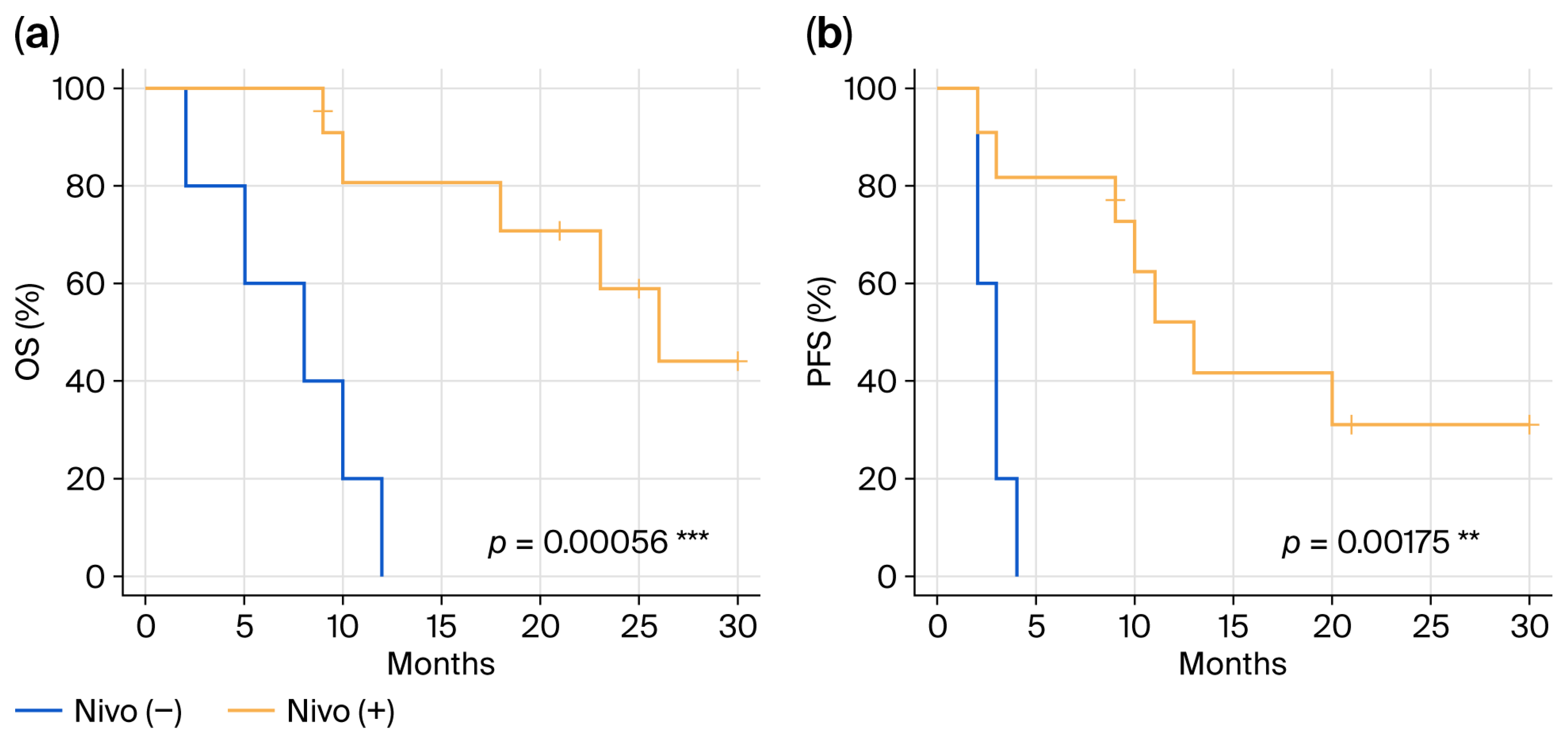
First, we compared prognosis (OS, PFS) based solely on nivolumab use. Median OS was 8 months in the five cases without nivolumab (n = 5) compared to 26 months in the 11 with nivolumab (p = 0.00056) (Figure 1a). Similarly, median PFS was 3 months in the group without nivolumab, compared to 13 months in the group with nivolumab (p = 0.00175) (Figure 1b). An additional analysis excluding Case 7, who received BSC without initial treatment, and similarly observed significant prolongation of both OS and PFS (median OS; 9 mo vs. 26 mo, p = 0.00184, median PFS; 3 mo vs. 13 mo, p = 0.00475).
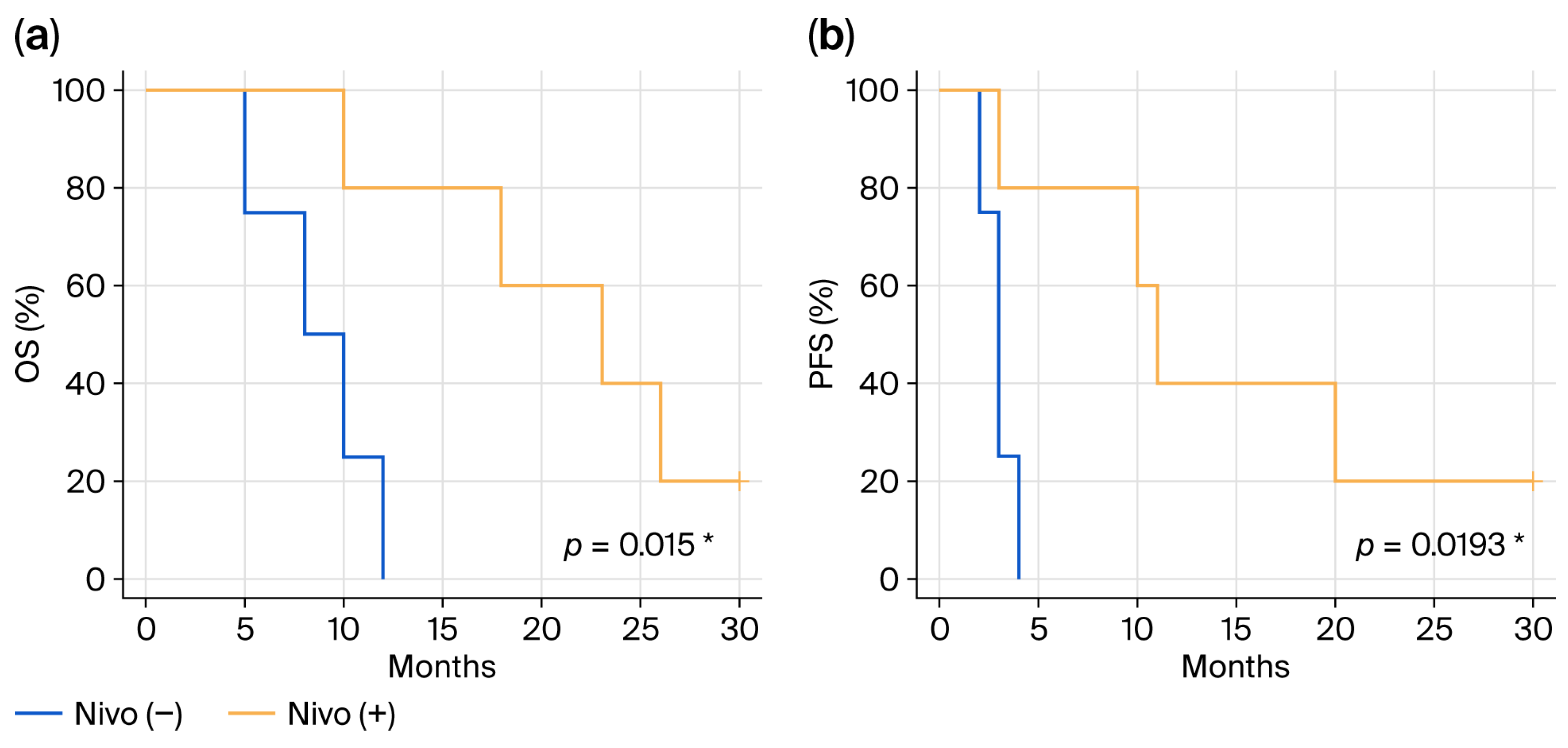
Next, we compared outcomes in recurrent and metastatic cases between the group with nivolumab (n = 5) and the group without nivolumab (n = 4). The median OS was 9 months in the group without nivolumab, and 23 months in the group with nivolumab (p = 0.015) (Figure 2a). Similarly, the median PFS was 3 months in the group without nivolumab, compared with 11 months in the group with nivolumab (p = 0.0193) (Figure 2b). These results suggest that ICIs may be potentially useful as treatment for recurrent and metastatic SNMM, where effective treatments are limited.

4. Discussion

In this study, we examined the safety and efficacy of nivolumab in the management of SNNM, adding 11 patients to those reported in recent meta-analyses. As BRAF mutation is harbored in only 8% of SNMM cases, BRAF inhibitors are rarely indicated for treatment [19].
SNMM is a rare malignancy, and most evidence regarding ICI comes from studies on mucosal melanoma as a broader category. Therefore, it is important to consider data from mucosal melanoma when interpreting results for SNMM. Several analyses and systematic reviews have also evaluated the efficacy of ICI in mucosal melanoma. A pooled analysis reported an ORR of 23.3% with nivolumab and 37.1% with nivolumab plus ipilimumab, with median FPS of 3.0 and 5.9 months, respectively [20]. Similarly, an international retrospective cohort study involving more than 500 patients with mucosal melanoma demonstrated clinically meaningful activity of anti-PD-1–based therapy [21].
There are no prospective analyses of therapeutic effects of ICI in SNMM because of their rarity; retrospective studies like this paper typically involve only a few patients. A systematic review of retrospective studies in SNMM reported favorable outcomes with ICI therapy in SNMM [19]. In an international multicenter retrospective study of 505 SNMM patients, ICIs for the management of recurrent or persistent disease were associated with a better prognosis (HR = 0.25, 95% CI: 0.09–0.74, p = 0.004) [22]. Among the 11 studies that compared outcomes based on the use of ICI, seven reported improved survival with ICI therapy [23]. However, in one study analyzing the prognosis of 100 patients with SNMM, comparing periods before and after using ICI, no significant difference in survival was observed [24]. A 2023 single-arm trial evaluating combined nivolumab and ipilimumab postoperatively was reported, in which SNMM accounting for ~30% of cases demonstrated favorable outcomes, with a 1-year OS of 87% and a 2-year OS of 68% [25]. Grade ≥3 irAEs included diarrhea (14%), hypertension (14%), and hyponatremia (11%), suggesting a potentially high frequency of irAEs.
Although ICIs have been used primarily as adjuvant therapies, several reports suggest a role in first-line treatment [26,27]. ICI as neoadjuvant therapy in 36 patients with mucosal melanoma, including head and neck sites, had an ORR of 47% and a 3-year OS rate of 55% [26], with 8% achieving a complete response and avoided surgery. In our study, Case 10 received nivolumab prior to RT and remains without progression.
The occurrence of irAE is known to be associated with a favorable prognosis, as has been reported for various cancer types [28,29,30]. In our study, irAE occurred in four of 11 patients who received nivolumab, necessitating its discontinuation. However, three of the four patients maintained their response without recurrence after nivolumab was discontinued. Previous reports have shown an incidence of irAE of 60–61%, with 30–43% of cases necessitating the suspension or discontinuation of ICI therapy [23,24]. In several cancer types, including cutaneous melanoma, it is known that a subset of patients maintain a sustained therapeutic response even after permanent discontinuation of ICIs, and similar cases were identified in the present study [31,32].
This study has several limitations. First, this was a retrospective study, with only 11 patients receiving nivolumab. In addition, it included a mixture of cases in which nivolumab was administered as postoperative adjuvant therapy and cases in which nivolumab was administered for unresectable recurrence. Furthermore, various treatment modalities such as surgery, radiotherapy, and chemotherapy were used in combination or sequentially. In many ways, then, the two groups are far from comparable. Therefore, it is not possible to isolate clearly the specific contribution of immunotherapy to the observed outcomes, and the “statistically significant” findings we report should be interpreted with considerable caution. The finding that nivolumab was helpful in recurrent disease is noteworthy, and suggests that our earlier report suggesting its utility may be sound. Given the rarity of SNMM, prospective studies with clearly defined patient selection criteria are likely not plausible for it. Hence, continued accumulation of reported cases, with meta-analyses from time to time, should gradually build support for a role for ICIs in SNMM.

5. Conclusions

Nivolumab demonstrated favorable survival outcomes in patients with SNMM, and some patients maintained durable responses even after treatment discontinuation due to irAE. Although the total number of cases reported in meta-analyses is small, and data (including ours) is heterogeneous, our findings support and add to the literature supporting the use of ICIs in SNMM.

Author Contributions

Conceptualization, R.U., K.T., R.I. (Ryota Iinuma), M.K. and T.O.; methodology, R.U., K.T., R.I. (Ryota Iinuma) and M.K.; software, R.U., K.T., R.I. (Ryota Iinuma) and M.K.; validation, R.U., K.T., R.I. (Ryoukichi Ikeda) and M.K.; investigation, R.U., K.T. and R.I. (Ryota Iinuma); resources, R.U., K.T., R.I. (Ryota Iinuma) and M.K.; data curation, R.U., K.T., R.I. (Ryota Iinuma) and M.K.; writing—original draft preparation, R.U., K.T., R.I. (Ryota Iinuma) and M.K.; writing—review and editing, R.U., K.T., R.I. (Ryoukichi Ikeda), M.K., T.Y., H.I., R.K., H.O., K.M., H.S., N.O., M.U., R.I. (Ryota Iinuma), K.S. and T.O.; visualization, R.U., K.T., R.I. (Ryoukichi Ikeda) and M.K.; supervision, K.S. and T.O.; project administration, R.U., K.T., R.I. (Ryoukichi Ikeda), M.K. and T.O. All authors have read and agreed to the published version of the manuscript.

Funding

This research received no external funding.

Institutional Review Board Statement

This study was conducted in accordance with the Declaration of Helsinki and approved by the Institutional Review Board of the Gifu University Graduate School of Medicine (approval No.: 2023-253; approval date: 26 January 2024).

Informed Consent Statement

Informed consent was not sought for this study because a waiver of consent was approved by the institutional review board due to the opt-out approach used.

Data Availability Statement

The data supporting the findings of this study are not publicly available due to ethical and privacy restrictions, but are available from the corresponding author upon reasonable request.

Conflicts of Interest

The authors declare no conflicts of interest.

References

  1. Gilain, L.; Houette, A.; Montalban, A.; Mom, T.; Saroul, N. Mucosal melanoma of the nasal cavity and paranasal sinuses. Eur. Ann. Otorhinolaryngol. Head Neck Dis. 2014, 131, 365–369. [Google Scholar] [CrossRef] [PubMed]
  2. Ascierto, P.A.; Accorona, R.; Botti, G.; Farina, D.; Fossati, P.; Gatta, G.; Gogas, H.; Lombardi, D.; Maroldi, R.; Nicolai, P.; et al. Mucosal melanoma of the head and neck. Crit. Rev. Oncol. Hematol. 2017, 112, 136–152. [Google Scholar] [CrossRef] [PubMed]
  3. Moreno, M.A.; Roberts, D.B.; Kupferman, M.E.; DeMonte, F.; El-Naggar, A.K.; Williams, M.; Rosenthal, D.S.; Hanna, E.Y. Mucosal melanoma of the nose and paranasal sinuses, a contemporary experience from the M.D. Anderson Cancer Center. Cancer 2010, 116, 2215–2223. [Google Scholar] [CrossRef] [PubMed]
  4. Yang, F.; Ruiz Cifuentes, M.; Horvatovich, P.; Guryev, V.; Baltás, E.; Diercks, G.F.H.; van Pijkeren, A.; Wegner, I.; Halmos, G.B. The Effect of Tumor Location and Extension on Survival in Patients with Sinonasal Mucosal Melanoma: A Systematic Review and Meta-Analysis. Cancers 2025, 17, 3757. [Google Scholar] [CrossRef]
  5. Zhu, Z.; Wang, W.; Zha, Y.; Wang, X.; Aodeng, S.; Wang, L.; Liu, Y.; Lv, W. Development and validation of a nomogram for predicting overall survival in patients with sinonasal mucosal melanoma. BMC Cancer 2024, 24, 184. [Google Scholar] [CrossRef]
  6. Ganti, A.; Raman, A.; Shay, A.; Kuhar, H.N.; Auger, S.R.; Patel, T.; Kuan, E.C.; Diaz, A.Z.; Batra, P.S.; Tajudeen, B.A. Treatment modalities in sinonasal mucosal melanoma: A national cancer database analysis. Laryngoscope 2020, 130, 275–282. [Google Scholar] [CrossRef]
  7. Seetharamu, N.; Ott, P.A.; Pavlick, A.C. Mucosal melanomas: A case-based review of the literature. Oncologist 2010, 15, 772–781. [Google Scholar] [CrossRef]
  8. Kim, D.; Hong, S.N. Sinonasal Mucosal Melanoma: A Comprehensive Review and Clinical Experience. J. Rhinol. 2025, 32, 123–132. [Google Scholar] [CrossRef]
  9. Takayasu, Y.; Kubo, N.; Shino, M.; Nikkuni, O.; Ida, S.; Musha, A.; Takahashi, K.; Hirato, J.; Shirai, K.; Saitoh, J.I.; et al. Carbon-ion radiotherapy combined with chemotherapy for head and neck mucosal melanoma: Prospective observational study. Cancer Med. 2019, 8, 7227–7235. [Google Scholar] [CrossRef]
  10. Seth, R.; Agarwala, S.S.; Messersmith, H.; Alluri, K.C.; Ascierto, P.A.; Atkins, M.B.; Bollin, K.; Chacon, M.; Davis, N.; Faries, M.B.; et al. Systemic Therapy for Melanoma: ASCO Guideline Update. J. Clin. Oncol. 2023, 41, 4794–4820. [Google Scholar] [CrossRef]
  11. Hsieh, M.Y.; Hsu, S.K.; Liu, T.Y.; Wu, C.Y.; Chiu, C.C. Melanoma biology and treatment: A review of novel regulated cell death-based approaches. Cancer Cell Int. 2024, 24, 63. [Google Scholar] [CrossRef] [PubMed]
  12. Robert, C.; Long, G.V.; Brady, B.; Dutriaux, C.; Maio, M.; Mortier, L.; Hassel, J.C.; Rutkowski, P.; McNeil, C.; Kalinka-Warzocha, E.; et al. Nivolumab in previously untreated melanoma without BRAF mutation. N. Engl. J. Med. 2015, 372, 320–330. [Google Scholar] [CrossRef] [PubMed]
  13. Robert, C.; Schachter, J.; Long, G.V.; Arance, A.; Grob, J.J.; Mortier, L.; Daud, A.; Carlino, M.S.; McNeil, C.; Lotem, M.; et al. Pembrolizumab versus Ipilimumab in Advanced Melanoma. N. Engl. J. Med. 2015, 372, 2521–2532. [Google Scholar] [CrossRef] [PubMed]
  14. Hodi, F.S.; Chiarion-Sileni, V.; Gonzalez, R.; Grob, J.J.; Rutkowski, P.; Cowey, C.L.; Lao, C.D.; Schadendorf, D.; Wagstaff, J.; Dummer, R.; et al. Nivolumab plus ipilimumab or nivolumab alone versus ipilimumab alone in advanced melanoma (CheckMate 067): 4-year outcomes of a multicentre, randomised, phase 3 trial. Lancet Oncol. 2018, 19, 1480–1492. [Google Scholar] [CrossRef]
  15. Zebary, A.; Jangard, M.; Omholt, K.; Ragnarsson-Olding, B.; Hansson, J. KIT, NRAS and BRAF mutations in sinonasal mucosal melanoma: A study of 56 cases. Br. J. Cancer 2013, 109, 559–564. [Google Scholar] [CrossRef]
  16. Chłopek, M.; Lasota, J.; Thompson, L.D.R.; Szczepaniak, M.; Kuźniacka, A.; Hińcza, K.; Kubicka, K.; Kaczorowski, M.; Newford, M.; Liu, Y.; et al. Alterations in key signaling pathways in sinonasal tract melanoma. A molecular genetics and immunohistochemical study of 90 cases and comprehensive review of the literature. Mod. Pathol. 2022, 35, 1609–1617. [Google Scholar] [CrossRef]
  17. Chatziioannou, E.; Lallas, K.; Sinnberg, T.; Niessner, H.; Stratigos, A.J.; Flatz, L.; Amaral, T. Insights into RAS-driven melanoma and its therapeutic implications. Cancer Treat. Rev. 2026, 143, 103090. [Google Scholar] [CrossRef]
  18. Jurmeister, P.; Wrede, N.; Hoffmann, I.; Vollbrecht, C.; Heim, D.; Hummel, M.; Wolkenstein, P.; Koch, I.; Heynol, V.; Schmitt, W.D.; et al. Mucosal melanomas of different anatomic sites share a common global DNA methylation profile with cutaneous melanoma but show location-dependent patterns of genetic and epigenetic alterations. J. Pathol. 2022, 256, 61–70. [Google Scholar] [CrossRef]
  19. Tang, A.; Taori, S.; Dang, S.; Gardner, P.A.; Zenonos, G.A.; Davar, D.; Kuan, E.C.; Snyderman, C.H.; Wang, E.W.; Choby, G. Immunotherapy in the Management of Sinonasal Mucosal Melanoma: A Systematic Review. Otolaryngol. Head Neck Surg. 2024, 171, 368–380. [Google Scholar] [CrossRef]
  20. D’Angelo, S.P.; Larkin, J.; Sosman, J.A.; Lebbé, C.; Brady, B.; Neyns, B.; Schmidt, H.; Hassel, J.C.; Hodi, F.S.; Lorigan, P.; et al. Efficacy and Safety of Nivolumab Alone or in Combination with Ipilimumab in Patients with Mucosal Melanoma: A Pooled Analysis. J. Clin. Oncol. 2017, 35, 226–235. [Google Scholar] [CrossRef]
  21. Dimitriou, F.; Namikawa, K.; Reijers, I.L.M.; Buchbinder, E.I.; Soon, J.A.; Zaremba, A.; Teterycz, P.; Mooradian, M.J.; Armstrong, E.; Nakamura, Y.; et al. Single-agent anti-PD-1 or combined with ipilimumab in patients with mucosal melanoma: An international, retrospective, cohort study. Ann. Oncol. 2022, 33, 968–980. [Google Scholar] [CrossRef]
  22. Lechner, M.; Takahashi, Y.; Turri-Zanoni, M.; Ferrari, M.; Liu, J.; Counsell, N.; Mattavelli, D.; Rampinelli, V.; Vermi, W.; Lombardi, D.; et al. International Multicenter Study of Clinical Outcomes of Sinonasal Melanoma Shows Survival Benefit for Patients Treated with Immune Checkpoint Inhibitors and Potential Improvements to the Current TNM Staging System. J. Neurol. Surg. Part B Skull Base 2022, 84, 307–319. [Google Scholar] [CrossRef] [PubMed]
  23. Wolchok, J.D.; Chiarion-Sileni, V.; Gonzalez, R.; Rutkowski, P.; Grob, J.J.; Cowey, C.L.; Lao, C.D.; Wagstaff, J.; Schadendorf, D.; Ferrucci, P.F.; et al. Overall Survival with Combined Nivolumab and Ipilimumab in Advanced Melanoma. N. Engl. J. Med. 2017, 377, 1345–1356. [Google Scholar] [CrossRef] [PubMed]
  24. Flukes, S.; Lohia, S.; Barker, C.A.; Cracchiolo, J.R.; Ganly, I.; Patel, S.G.; Roman, B.R.; Shah, J.P.; Shoushtari, A.N.; Tabar, V.; et al. Are our patients doing better? A single institution experience of an evolving management paradigm for sinonasal mucosal melanoma. Oral Oncol. 2021, 112, 105006. [Google Scholar] [CrossRef] [PubMed]
  25. Kottschade, L.A.; Pond, G.R.; Olszanski, A.J.; Zakharia, Y.; Domingo-Musibay, E.; Hauke, R.J.; Curti, B.D.; Schober, S.; Milhem, M.M.; Block, M.S.; et al. SALVO: Single-Arm Trial of Ipilimumab and Nivolumab as Adjuvant Therapy for Resected Mucosal Melanoma. Clin. Cancer Res. 2023, 29, 2220–2225. [Google Scholar] [CrossRef]
  26. Ho, J.; Mattei, J.; Tetzlaff, M.; Williams, M.D.; Davies, M.A.; Diab, A.; Oliva, I.C.G.; McQuade, J.; Patel, S.P.; Tawbi, H.; et al. Neoadjuvant checkpoint inhibitor immunotherapy for resectable mucosal melanoma. Front. Oncol. 2022, 12, 1001150. [Google Scholar] [CrossRef]
  27. Lian, B.; Li, Z.; Wu, N.; Li, M.; Chen, X.; Zheng, H.; Gao, M.; Wang, D.; Sheng, X.; Tian, H.; et al. Phase II clinical trial of neoadjuvant anti-PD-1 (toripalimab) combined with axitinib in resectable mucosal melanoma. Ann. Oncol. 2024, 35, 211–220. [Google Scholar] [CrossRef]
  28. Olsson Ladjevardi, C.; Koliadi, A.; Rydén, V.; El-Naggar, A.I.; Digkas, E.; Valachis, A.; Ullenhag, G.J. Multiple immune-related adverse events secondary to checkpoint inhibitor therapy in patients with advanced cancer: Association with treatment effectiveness. Front. Oncol. 2024, 14, 1399171. [Google Scholar] [CrossRef]
  29. Hamai, Y.; Ibuki, Y.; Kurokawa, T.; Hirohata, R.; Ohsawa, M.; Kitasaki, N.; Emi, M.; Okada, M. Relationship of Immune-Related Adverse Events with Tumor Response and Prognosis in Esophageal Squamous Cell Carcinoma Following Nivolumab Monotherapy. Cancers 2024, 16, 3529. [Google Scholar] [CrossRef]
  30. Zhang, T.; Lv, H.; Li, J.; Zhang, S.; Zhang, J.; Wang, S.; Wang, Y.; Guo, Z. The impact of immune-related adverse events on the outcome of advanced gastric cancer patients with immune checkpoint inhibitor treatment. Front. Immunol. 2024, 15, 1503316. [Google Scholar] [CrossRef]
  31. Hamid, O.; Robert, C.; Daud, A.; Hodi, F.S.; Hwu, W.J.; Kefford, R.; Wolchok, J.D.; Hersey, P.; Joseph, R.; Weber, J.S.; et al. Five-year survival outcomes for patients with advanced melanoma treated with pembrolizumab in KEYNOTE-001. Ann. Oncol. 2019, 30, 582–588. [Google Scholar] [CrossRef]
  32. Ishihara, H.; Asahi, Y.; Kuroki, M.; Saijo, K.; Kawaura, R.; Kato, R.; Matsubara, M.; Akita, S.; Yamada, T.; Iinuma, R.; et al. Prognosis After Discontinued Treatment due to Immune-Related Adverse Events in Recurrent and Metastatic Head and Neck Squamous Cell Carcinoma. Head Neck 2025, 48, 449–456. [Google Scholar] [CrossRef]
Figure 1. Prognosis of all cases. In all cases, prognosis ((a) OS, (b) PFS) was compared between the group with nivolumab (n = 11) and the group without nivolumab (n = 5). Cases receiving nivolumab had significantly longer OS and PFS. OS—overall survival; PFS—progression-free survival. ***; p < 0.001, **; p < 0.01. These two groups are not otherwise necessarily similar and the reader is cautioned not to overinterpret any “statistical significance”.
Cancers 18 01174 g001
Figure 2. Prognosis of recurrent and metastatic cases. In recurrent and metastatic cases, prognosis ((a) OS, (b) PFS) was compared between the group with nivolumab (n = 5) and the group without nivolumab (n = 4). As with the overall cases population, recurrent and metastatic cases treated with nivolumab showed significantly longer OS and PFS. OS—overall survival; PFS—progression-free survival. *; p < 0.05.
Cancers 18 01174 g002
Table 1. Details of treatment in all cases.
CaseSexAgeStageNATTreatmentPostoperative
Treatment
ATirAERecurrenceTreatment for
Recurrence
Outcome
1F54IIDAVRT   +(lung, liver)BSCdeath
2F82II SRT  +(unknown)BSCdeath
3F61IIDAVRT   +(bone)BSCdeath
4F51IIDAVRT   +(lung)Nivodeath
5M57IDAVS   +(lung)DAVdeath
6F68IIDAVRT   +(lung, bone, liver)Nivodeath
7F79IV BSC   - death
8F33I Nivo  Myasthenia gravis+(lung, bone)Pembrodeath
9F69I S   +(local)S → Nivodeath
10M80IINivoRTNivo  - alive
11M67III SRT  +(lung)Nivodeath
12M78I SRT  +(lung)Nivodeath
13F71II SRTNivoColitis
Hypothyroidism
- alive
14M73II SRTNivo +(lung)Nivo + Ipialive
15M82I SRTNivoSkin disorders- alive
16M78I SRTNivoSkin disorders- alive
NAT—neoadjuvant therapy; DAV—dacarbazine and nimustine and vincristine; RT—radiation therapy; S—surgery; BSC—best supportive care; AT—adjuvant chemotherapy; irAE—immune-related adverse event.
Disclaimer/Publisher’s Note: The statements, opinions and data contained in all publications are solely those of the individual author(s) and contributor(s) and not of MDPI and/or the editor(s). MDPI and/or the editor(s) disclaim responsibility for any injury to people or property resulting from any ideas, methods, instructions or products referred to in the content.