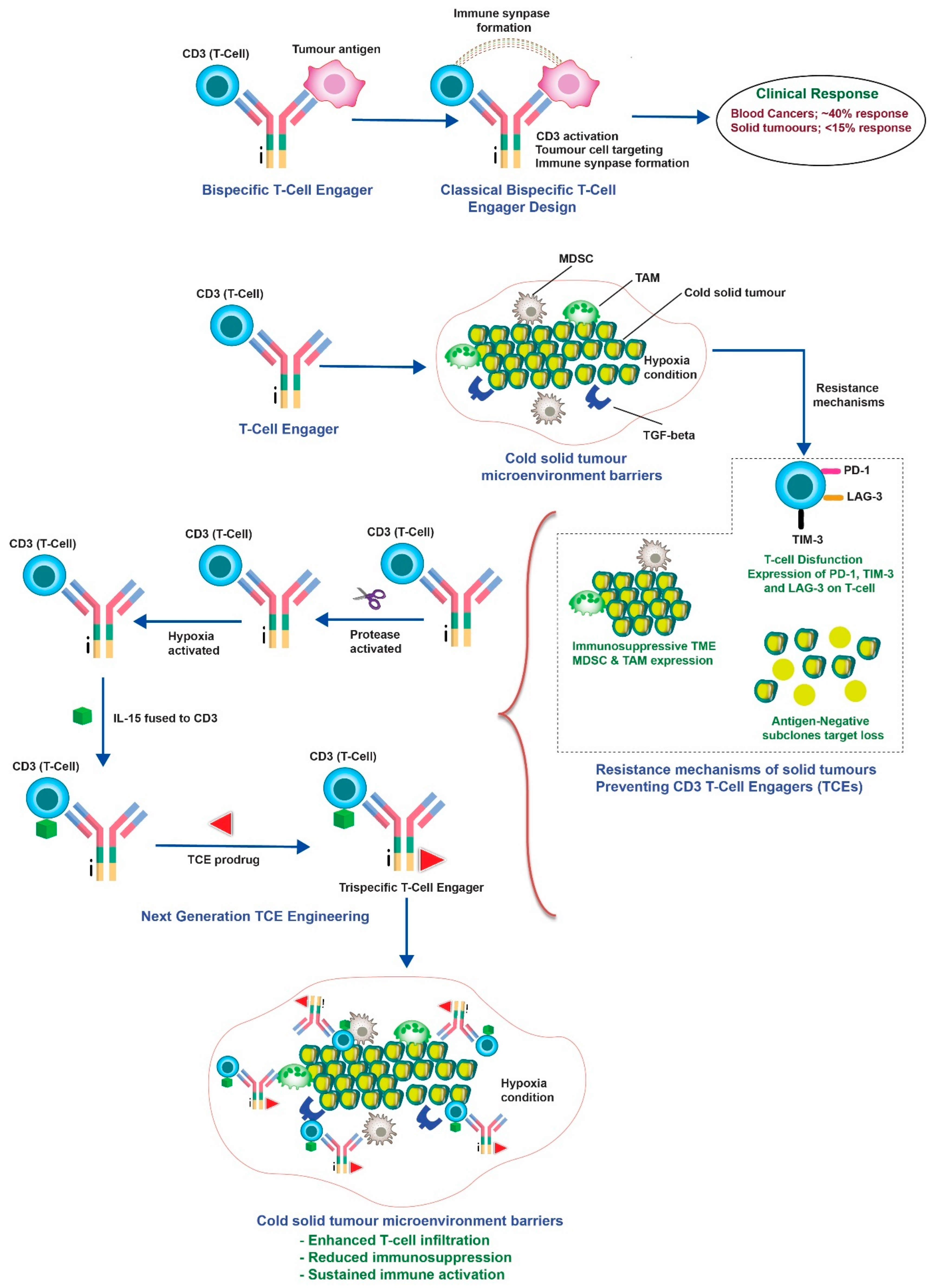
Precision-Engineered CD3 T-Cell Engagers for Solid Tumours: Conditional Activation, Microenvironment Modulation, and Clinical Translation

 , , ,
, , ,  , , and
Simple Summary
Abstract
1. Introduction
2. Methodology
3. Molecular Engineering: From BiTE® to Conditionally Activated Prodrugs
3.1. From BiTE® to Conditionally Activated Prodrug
3.2. Half-Life Extension Strategies
3.3. Trispecific and Multispecific Formats
3.4. Affinity and Avidity Tuning
3.5. Payload-Armed TCEs
3.6. Manufacturing and Developability
4. Clinical Efficacy of CD3 T-Cell Engagers Across Solid Tumours
4.1. Search Strategy and Trial Landscape
4.2. Lung Cancers
4.3. Genitourinary Cancers
4.4. Gastrointestinal Malignancies
- ❖
- Cibisatamab (RG7802) Monotherapy: The objective response rate (ORR) was 4% in patients with advanced CEA-positive solid tumours [11].
- ❖
4.5. Breast and Gynaecological Cancers
4.6. Central Nervous System and Other Solid Tumours
4.7. Cytokine Release Syndrome and Neurotoxicity
4.8. Response Correlates and Emerging Biomarkers
5. Resistance Mechanisms and Microenvironment Modulation
5.1. Resistance Mechanisms Revisited
5.2. TME-Targeted Combination Strategies
5.2.1. Boosting Antigens with γ-Secretase Inhibitors
5.2.2. STING Agonists–Innate Immune Ignition
5.2.3. Oncolytic Viruses–Stromal Remodelling
5.2.4. CD40 Agonists–Macrophage Repolarisation
5.2.5. Anti-VEGF/Angiogenesis Normalisation
5.2.6. TGF-β Blockade–ECM and T-Cell Exclusion
5.2.7. Metabolic Modulators–Lactate and Hypoxia
5.2.8. Combination Sequencing and Biomarker-Guided Scheduling
5.3. Biomarker-Guided Patient Selection
5.3.1. Antigen Density Cut-Offs
5.3.2. T-Cell Infiltration and Spatial Immunophenotyping
5.3.3. Soluble Immune Profiles and Dynamic Monitoring
5.4. Resistance Mechanisms and Adaptive Strategies
5.4.1. Primary Resistance: When Tumours Fail to Engage
5.4.2. Acquired Resistance: Evolution Under Pressure
5.4.3. The Microenvironment Strikes Back
5.4.4. Rational Counter-Strategies
6. Discussion
6.1. From Proof-of-Concept to Platform Therapy in Solid Tumours
6.2. Resistance as the Central Determinant of Durability
6.3. Rational Combinations and Next-Generation Engineering
6.4. TCEs as Combinatorial Partners with CAR-T and CAR-NK Cell Therapies
6.4.1. TCE–CAR-T Combinations: Three Principles
6.4.2. CAR-NK Cells: A Mechanistically Orthogonal Partner
6.4.3. Scheduling Architectures
6.5. Advantages and Disadvantages of CD3-Based TCEs: A Balanced Appraisal
6.5.1. What TCEs Do Well
6.5.2. Where TCEs Fall Short
6.5.3. Where TCEs Fit
6.6. TCEs in the Context of Standard of Care
6.6.1. Small-Cell Lung Cancer
6.6.2. Metastatic Castration-Resistant Prostate Cancer
6.6.3. Microsatellite Stable Colorectal Cancer
6.6.4. Uveal Melanoma
6.6.5. A Unifying Theme
6.7. Limitations and Evidence Gaps
6.8. Regulatory, Commercial, and Access Considerations
6.9. Outlook: Toward 2030
7. Conclusions
Author Contributions
Funding
Data Availability Statement
Conflicts of Interest
References
- Köhler, G.; Milstein, C. Continuous cultures of fused cells secreting antibody of predefined specificity. Nature 1975, 256, 495–497. [Google Scholar] [CrossRef]
- Staerz, U.D.; Kanagawa, O.; Bevan, M.J. Hybrid antibodies can target sites for attack by T cells. Nature 1985, 314, 628–631. [Google Scholar] [CrossRef]
- Baeuerle, P.A.; Reinhardt, C. Bispecific T-cell engager (BiTE) antibodies for cancer therapy. Cancer Res. 2009, 69, 4941–4944. [Google Scholar] [CrossRef]
- Topp, M.S.; Gökbuget, N.; Stein, A.S.; Zugmaier, G.; O’BRien, S.; Bargou, R.C.; Dombret, H.; Fielding, A.K.; Heffner, L.; Larson, R.A.; et al. Safety and activity of blinatumomab for adult patients with relapsed or refractory B-precursor acute lymphoblastic leukaemia. Lancet Oncol. 2015, 16, 57–66. [Google Scholar] [CrossRef]
- U.S. Food and Drug Administration. FDA Approves Blincyto (Blinatumomab) for Precursor B-Cell Acute Lymphoblastic Leukemia; FDA: Silver Spring, MD, USA, 2014.
- Evitria. FDA-Approved Bispecific Antibodies: Comprehensive List & Insights. Available online: https://www.evitria.com/journal/bispecific-antibodies/fda-approved-bispecific-antibodies (accessed on 1 March 2025).
- Dustin, M.L.; Choudhuri, K. Signaling and polarized communication across the T cell immunological synapse. Annu. Rev. Cell Dev. Biol. 2016, 32, 303–325. [Google Scholar] [CrossRef]
- Labrijn, A.F.; Janmaat, M.L.; Reichert, J.M.; Parren, P.W.H. Bispecific antibodies: A mechanistic review of the pipeline. Nat. Rev. Drug Discov. 2019, 18, 585–608. [Google Scholar] [CrossRef]
- Ahn, M.J.; Cho, B.C.; Felip, E.; Korantzis, I.; Ohashi, K.; Majem, M.; Juan-Vidal, O.; Handzhiev, S.; Izumi, H.; Lee, J.-S.; et al. Tarlatamab for patients with previously treated small-cell lung cancer. N. Engl. J. Med. 2023, 389, 2063–2075. [Google Scholar] [CrossRef]
- Hernberg, M.; Pyrhönen, S.; Muhonen, T. Regimens with or without interferon-α as treatment for metastatic melanoma and renal cell carcinoma: An overview of randomized trials. J. Immunother. 1999, 22, 145–154. [Google Scholar] [CrossRef]
- Segal, N.H.; Melero, I.; Moreno, V.; Steeghs, N.; Marabelle, A.; Rohrberg, K.; Rodriguez-Ruiz, M.E.; Eder, J.P.; Eng, C.; Manji, G.A.; et al. CEA-CD3 bispecific antibody cibisatamab with or without atezolizumab in patients with CEA-positive solid tumours: Results of two multi-institutional Phase 1 trials. Nat. Commun. 2024, 15, 4091. [Google Scholar] [CrossRef]
- Naing, A.; Mantia, C.; Morgensztern, D.; Kim, T.Y.; Li, D.; Kang, Y.K.; Marron, T.U.; Tripathi, A.; George, S.; Rini, B.I.; et al. First-in-human study of SRF388, a first-in-class IL-27 targeting antibody, as monotherapy and in combination with pembrolizumab in patients with advanced solid tumors. J. Clin. Oncol. 2022, 40, 2501. [Google Scholar] [CrossRef]
- McGranahan, N.; Swanton, C. Clonal heterogeneity and tumor evolution. Cell 2017, 168, 613–628. [Google Scholar] [CrossRef]
- Jain, R.K. Normalizing tumor microenvironment to treat cancer: Bench to bedside to biomarkers. J. Clin. Oncol. 2013, 31, 2205–2218. [Google Scholar] [CrossRef]
- Thurber, G.M.; Schmidt, M.M.; Wittrup, K.D. Antibody tumor penetration: Transport opposed by systemic and antigen-mediated clearance. Adv. Drug Deliv. Rev. 2008, 60, 1421–1434. [Google Scholar] [CrossRef]
- Marvel, D.; Gabrilovich, D.I. Myeloid-derived suppressor cells in the tumor microenvironment: Expect the unexpected. J. Clin. Investig. 2015, 125, 3356–3364. [Google Scholar] [CrossRef]
- Facciabene, A.; Peng, X.; Hagemann, I.S.; Balint, K.; Barchetti, A.; Wang, L.-P.; Gimotty, P.A.; Gilks, C.B.; Lal, P.; Zhang, L.; et al. Tumour hypoxia promotes tolerance and angiogenesis via CCL28 and Treg cells. Nature 2011, 475, 226–230. [Google Scholar] [CrossRef]
- Routy, B.; Le Chatelier, E.; Derosa, L.; Duong, C.P.M.; Alou, M.T.; Daillère, R.; Fluckiger, A.; Messaoudene, M.; Rauber, C.; Roberti, M.P.; et al. Gut microbiome influences efficacy of PD-1-based immunotherapy against epithelial tumors. Science 2018, 359, 91–97. [Google Scholar] [CrossRef]
- Cattaruzza, F.; Nazeer, A.; To, M.; Hammond, M.; Koski, C.; Liu, L.Y.; Pete Yeung, V.; Rennerfeldt, D.A.; Henkensiefken, A.; Fox, M.; et al. Precision-activated T-cell engagers targeting HER2 or EGFR and CD3 mitigate on-target, off-tumor toxicity for immunotherapy in solid tumors. Nat. Cancer 2023, 4, 485–501. [Google Scholar] [CrossRef]
- Wu, L.; Seung, E.; Xu, L.; Rao, E.; Lord, D.M.; Wei, R.R.; Cortez-Retamozo, V.; Ospina, B.; Posternak, V.; Ulinski, G.; et al. Trispecific antibodies enhance the therapeutic efficacy of tumor-directed T cells through T cell receptor co-stimulation. Nat. Cancer 2020, 1, 86–98. [Google Scholar] [CrossRef]
- Kloss, C.C.; Lee, J.; Zhang, A.; Chen, F.; Melenhorst, J.J.; Lacey, S.F.; Maus, M.V.; Fraietta, J.A.; Zhao, Y.; June, C.H. Dominant-Negative TGF-β Receptor Enhances PSMA-Targeted Human CAR T Cell Proliferation And Augments Prostate Cancer Eradication. Mol. Ther. 2018, 26, 1855–1866. [Google Scholar] [CrossRef]
- Tanaka, A.; Sakaguchi, S. Targeting Foxp3+ regulatory T cells in cancer immunotherapy. Nat. Rev. Immunol. 2017, 17, 477–488. [Google Scholar] [CrossRef]
- Philip, M.; Schietinger, A. CD8+ T cell differentiation and dysfunction in cancer. Nat. Rev. Immunol. 2022, 22, 209–223. [Google Scholar] [CrossRef]
- Brahmer, J.R.; Lacchetti, C.; Schneider, B.J.; Atkins, M.B.; Brassil, K.J.; Caterino, J.M.; Chau, I.; Ernstoff, M.S.; Gardner, J.M.; Ginex, P.; et al. Management of Immune-Related Adverse Events in Patients Treated With Immune Checkpoint Inhibitor Therapy: American Society of Clinical Oncology Clinical Practice Guideline. J. Clin. Oncol. 2018, 36, 1714–1768. [Google Scholar] [CrossRef]
- Demšar, A.; Geršak, K.; Gazić, B.; Blagus, T.; Goričar, K.; Jezernik, G.; Dolžan, V.; Grašič Kuhar, C. Immune Infiltration, Effector T-Cell Enrichment, and Functional Context for Prediction of Pathologic Complete Response to Neoadjuvant Chemotherapy in Breast Cancer. Int. J. Mol. Sci. 2026, 27, 2431. [Google Scholar] [CrossRef] [PubMed]
- Sergeeva, O.A.; Jin, G.; Sarkar, M.; Zeiger, J.; Dhindwal, S.; Chin, S.S.; Abulizi, A.; Lai, Z.; Brown, C.; DeMaria, W.G.; et al. EVOLVE platform, a trispecific T cell engager with integrated CD2 costimulation, for the treatment of solid and hematologic tumors. Proc. Natl. Acad. Sci. USA 2025, 122, e2510829122. [Google Scholar] [CrossRef] [PubMed]
- Dewaele, L.; Fernandes, R.A. Bispecific T-cell engagers for the recruitment of T cells in solid tumors: A literature review. Immunother. Adv. 2025, 5, ltae005. [Google Scholar] [CrossRef] [PubMed]
- Rodriguez-Otero, P.; Usmani, S.Z.; Cohen, A.D.; van de Donk, N.W.C.J.; Leleu, X.; Pérez-Larraya, J.G.; Manier, S.; Nooka, A.K.; Mateos, M.V.; Einsele, H.; et al. International Myeloma Working Group immunotherapy committee consensus guidelines and recommendations for optimal use of T-cell-engaging bispecific antibodies in multiple myeloma. Hematol. Oncol. 2024, 42, e3078. [Google Scholar] [CrossRef]
- Spinazzola, A.; Iannantuono, G.M.; Gulley, J.L.; Giudice, E.; Filetti, M.; Sganga, S.; Bianco, F.L.; Floudas, C.S.; Daniele, G. Current landscape of T-cell engagers in early-phase clinical development in solid cancers. Front. Immunol. 2025, 16, 1665838. [Google Scholar] [CrossRef]
- Liu, M.; Etherington, M.S.; Hanna, A.; Medina, B.D.; Vitiello, G.A.; Bowler, T.G.; Param, N.J.; Levin, L.; Rossi, F.; DeMatteo, R.P. Oncogenic KIT modulates type I IFN–mediated antitumor immunity in GIST. Cancer Immunol. Res. 2021, 9, 542–553. [Google Scholar] [CrossRef]
- Frederickson, R.M.; Herzog, R.W. An annis mirabilis for the molecular therapy journal family. Mol. Ther. 2021, 29, 1. [Google Scholar] [CrossRef]
- Desnoyers, L.R.; Vasiljeva, O.; Richardson, J.H.; Yang, A.; Menendez, E.E.M.; Liang, T.W.; Wong, C.; Bessette, P.H.; Kamath, K.; Moore, S.J.; et al. Tumor-specific activation of an EGFR-targeting Probody enhances therapeutic index. Sci. Transl. Med. 2013, 5, 207ra144. [Google Scholar] [CrossRef]
- Topp, M.S.; Gökbuget, N.; Zugmaier, G.; Klappers, P.; Stelljes, M.; Neumann, S.; Viardot, A.; Marks, R.; Diedrich, H.; Faul, C.; et al. Phase II trial of the anti-CD19 bispecific T cell-engager blinatumomab shows hematologic and molecular remissions in patients with relapsed or refractory B-precursor acute lymphoblastic leukemia. J. Clin. Oncol. 2014, 32, 4134–4140. [Google Scholar] [CrossRef] [PubMed]
- Müller, D.; Karle, A.; Meissburger, B.; Höfig, I.; Stork, R.; Kontermann, R.E. Improved pharmacokinetics of recombinant bispecific antibody molecules by fusion to human serum albumin. J. Biol. Chem. 2007, 282, 12650–12660. [Google Scholar] [CrossRef]
- Moore, G.L.; Bautista, C.; Pong, E.; Nguyen, D.-H.T.; Jacinto, J.; Eivazi, A.; Muchhal, U.S.; Karki, S.; Chu, S.Y.; Lazar, G.A. A novel bispecific antibody format enables simultaneous bivalent and monovalent co-engagement of distinct target antigens. mAbs 2011, 3, 546–557. [Google Scholar] [CrossRef]
- Janux Therapeutics. JANX007 Phase 1 Data in Metastatic Castration-Resistant Prostate Cancer; Press Release; Janux Therapeutics: San Diego, CA, USA, 2025. [Google Scholar]
- Janux Therapeutics. Program Update on Ongoing Phase 1 JANX008 Study; Press Release; Janux Therapeutics: San Diego, CA, USA, 2025. [Google Scholar]
- Vir Biotechnology. First Patient Dosed in Phase 1 Trial of VIR-5525; Press Release; Vir Biotechnology: San Francisco, CA, USA, 2025. [Google Scholar]
- Amgen. Xaluritamig (AMG 509) Investigator’s Brochure; Amgen: Thousand Oaks, CA, USA, 2024. [Google Scholar]
- Mountzios, G.; Sun, L.; Cho, B.C.; Demirci, U.; Baka, S.; Gümüş, M.; Lugini, A.; Zhu, B.; Yu, Y.; Korantzis, I.; et al. Tarlatamab in small-cell lung cancer after platinum-based chemotherapy. N. Engl. J. Med. 2025, 393, 349–361. [Google Scholar] [CrossRef]
- Kontermann, R.E. Strategies for extended serum half-life of protein therapeutics. Curr. Opin. Biotechnol. 2011, 22, 868–876. [Google Scholar] [CrossRef]
- Kontermann, R.E. Half-life extended biotherapeutics. Expert Opin. Biol. Ther. 2016, 16, 903–915. [Google Scholar] [CrossRef]
- Bar, N.; Martin, T.; Hofmeister, C.C.; Mateos, M.-V.; Hansson, M.; Paris, L.; Namburi, S.; Ribas, P.; Santoro, A.; Rodriguez-Otero, P.; et al. Alnuctamab, a bivalent B-cell maturation antigen-targeting T cell engager for patients with relapsed or refractory multiple myeloma: Results from a phase 1, first-in-human study. Leukemia 2026, 40, 481–490. [Google Scholar] [CrossRef] [PubMed]
- Kelly, W.K.; Danila, D.C.; Lin, C.C.; Lee, J.-L.; Matsubara, N.; Ward, P.J.; Armstrong, A.J.; Pook, D.; Kim, M.; Dorff, T.B.; et al. Xaluritamig, a STEAP1 × CD3 XmAb 2+1 immune therapy for metastatic castration-resistant prostate cancer: Results from dose exploration in a first-in-human study. Cancer Discov. 2024, 14, 76–89. [Google Scholar] [CrossRef]
- Haber, L.; Olson, K.; Kelly, M.P.; Crawford, A.; DiLillo, D.J.; Tavaré, R.; Ullman, E.; Mao, S.; Canova, L.; Sineshchekova, O.; et al. CD3 affinity tuning differentiates cytokine release. Sci. Rep. 2021, 11, 14397. [Google Scholar]
- National Library of Medicine. Affinity-Tuned T-Cell Engager Trial. ClinicalTrials.gov Identifier NCT05987204. Available online: https://clinicaltrials.gov/study/NCT05987204 (accessed on 1 March 2026).
- Wong, H.C.; Jeng, E.K.; Rhode, P.R. The IL-15-based superagonist ALT-803 promotes the antigen-independent conversion of memory CD8+ T cells into innate-like effector cells with antitumor activity. Oncoimmunology 2013, 2, e26442. [Google Scholar] [CrossRef]
- Schmiechen, Z.C.; Nanda, H.A.; Burrack, A.L.; Hickok, G.H.; Butler, J.Z.; Cruz-Hinojoza, E.; Maurice, N.J.; Geuenich, M.J.; Yu, C.; Tsai, A.K.; et al. IL-15 complex enhances agonistic anti-CD40 + anti-PDL1 by correcting the T-bet to Tox ratio in CD8+ T cells infiltrating pancreatic ductal adenocarcinoma. Cancer Immunol. Res. 2025, 13, 847–866. [Google Scholar] [CrossRef]
- Waldmann, T.A.; Dubois, S. IL-15: From discovery to FDA approval. J. Hematol. Oncol. 2025, 18, 64. [Google Scholar] [CrossRef]
- Von Kreudenstein, T.S.; Escobar-Carbrera, E.; Lario, P.I.; D’Angelo, I.; Brault, K.; Kelly, J.; Durocher, Y.; Baardsnes, J.; Woods, R.J.; Xie, M.H.; et al. Improving biophysical properties of a bispecific antibody scaffold to aid developability: Quality by molecular design. MAbs 2013, 5, 646–654. [Google Scholar] [CrossRef]
- Aromataris, E.; Lockwood, C.; Porritt, K.; Pilla, B.; Jordan, Z. (Eds.) Systematic review methodology. In JBI Manual for Evidence Synthesis; JBI: Adelaide, Australia, 2024. [Google Scholar]
- Jiao, Y.; Bai, L.; Wang, J.; Yan, V.K.C.; Chan, E.W.; Na, R.; Bishai, D.M.; Guan, X.; Li, X. Analysis of drug consumption and expenditure of WHO essential medicines for cancer in 40 countries and regions between 2012 and 2022: A multinational drug use study. Lancet Oncol. 2025, 26, 877–886. [Google Scholar] [CrossRef] [PubMed]
- Leighl, N.B.; Akamatsu, H.; Lim, S.M.; Cheng, Y.; Minchom, A.R.; Marmarelis, M.E.; Sanborn, R.E.; Yang, J.C.H.; Liu, B.; John, T. Subcutaneous amivantamab vs intravenous amivantamab, both in combination with lazertinib, in refractory EGFR-mutated, advanced non-small cell lung cancer (NSCLC): Primary results, including overall survival (OS), from the global, phase 3, randomized controlled PALOMA-3 trial. J. Clin. Oncol. 2024, 42, LBA8505. [Google Scholar] [CrossRef]
- Pruis, M.A.; Krebs, M.G.; Plummer, R.; De Vos, F.; Angevin, E.; Prenen, H.; Forster, M.D.; Clack, G.; Van der Aa, A.; Tjwa, M.; et al. A Phase I Trial of the Dual MET Kinase/OCT-2 Inhibitor OMO-1 in Metastatic Solid Malignancies Including MET Exon 14 Mutated Lung Cancer. Oncologist 2023, 28, e1248–e1258. [Google Scholar] [CrossRef] [PubMed]
- Page, M.J.; McKenzie, J.E.; Bossuyt, P.M.; Boutron, I.; Hoffmann, T.C.; Mulrow, C.D.; Shamseer, L.; Tetzlaff, J.M.; Akl, E.A.; Brennan, S.E.; et al. The PRISMA 2020 statement: An updated guideline for reporting systematic reviews. BMJ 2021, 372, n71. [Google Scholar] [CrossRef]
- Molloy, M.E.; Aaron, W.H.; Barath, M.; Bush, M.C.; Callihan, E.C.; Carlin, K.; Cremin, M.; Evans, T.; Guerrero, M.G.; Hemmati, G.; et al. HPN328, a trispecific T cell-activating protein construct targeting DLL3-expressing solid tumors. Mol. Cancer Ther. 2024, 23, 1294–1304. [Google Scholar] [CrossRef]
- Meric-Bernstam, F.; Beeram, M.; Hamilton, E.; Oh, D.-Y.; Hanna, D.L.; Kang, Y.-K.; Elimova, E.; Chaves, J.; Goodwin, R.; Lee, J.; et al. Zanidatamab, a novel bispecific antibody, for the treatment of locally advanced or metastatic HER2-expressing or HER2-amplified cancers: A phase 1, dose-escalation and expansion study. Lancet Oncol. 2022, 23, 1558–1570. [Google Scholar] [CrossRef]
- Yu, S.; Zhang, J.; Yan, Y.; Yao, X.; Fang, L.; Xiong, H.; Liu, Y.; Chu, Q.; Zhou, P.; Wu, K. A novel asymmetrical anti-HER2/CD3 bispecific antibody exhibits potent cytotoxicity for HER2-positive tumor cells. J. Exp. Clin. Cancer Res. 2019, 38, 355. [Google Scholar] [CrossRef]
- Lee, E.K.; Yeku, O.; Winer, I.; Hamilton, E.; Richardson, D.; Zhang, J.; Konecny, G.; Anderson, I.; Wu, X.; Orr, D.; et al. A phase I/II study of rinatabart sesutecan (Rina-S) in patients with advanced ovarian or endometrial cancer. Ann. Oncol. 2024, 35, S550. [Google Scholar] [CrossRef]
- Vitanza, N.A.; Ronsley, R.; Choe, M.; Seidel, K.; Huang, W.; Rawlings-Rhea, S.D.; Beam, M.; Steinmetzer, L.; Wilson, A.L.; Brown, C.; et al. Intracerebroventricular B7-H3-targeting CAR T cells for diffuse intrinsic pontine glioma: A phase 1 trial. Nat. Med. 2025, 31, 861–868. [Google Scholar] [CrossRef]
- Goto, H. CRS and ICANS in CAR T-cell therapy for large B-cell lymphoma. J. Clin. Exp. Hematop. 2025, 65, 268–275. [Google Scholar] [CrossRef]
- Maddalena, G.; van der Pol, Y.; Rivers, Z.; Dasari, A.; Rogers, J.E.; Guinney, J.; Kopetz, S.; Raghav, K.P.S. Impact of KRAS codon-specific mutations on survival of patients with metastatic CRC (mCRC) treated with trifluridine-tipiracil (TAS) plus bevacizumab (Bev): A real-world analysis. J. Clin. Oncol. 2024, 42, 201. [Google Scholar] [CrossRef]
- Lee, D.W.; Santomasso, B.D.; Locatelli, F.; Ghobadi, A.; Turtle, C.J.; Brudno, J.N.; Maus, M.V.; Park, J.H.; Mead, E.; Pavletic, S.; et al. ASTCT consensus grading for cytokine release syndrome and neurologic toxicity associated with immune effector cells. Biol. Blood Marrow Transplant. 2019, 25, 625–638. [Google Scholar] [CrossRef] [PubMed]
- Majzner, R.G.; Mackall, C.L. Tumor antigen escape from CAR T-cell therapy. Cancer Discov. 2018, 8, 1219–1226. [Google Scholar] [CrossRef] [PubMed]
- Cowan, A.J.; Pont, M.J.; Sather, B.D.; Turtle, C.J.; Till, B.G.; Libby, E.N.; Coffey, D.G.; Tuazon, S.A.; Wood, B.; Gooley, T.; et al. γ-Secretase inhibitor in combination with BCMA chimeric antigen receptor T-cell immunotherapy for individuals with relapsed or refractory multiple myeloma: A phase 1, first-in-human trial. Lancet Oncol. 2023, 24, 811–822. [Google Scholar] [CrossRef]
- Paz-Ares, L.; Champiat, S.; Lai, W.V.; Izumi, H.; Govindan, R.; Boyer, M.; Hummel, H.-D.; Borghaei, H.; Johnson, M.L.; Steeghs, N.; et al. Tarlatamab, a first-in-class DLL3-targeted bispecific T-cell engager, in recurrent small-cell lung cancer: An open-label, phase I study. J. Clin. Oncol. 2023, 41, 2893–2903. [Google Scholar] [CrossRef]
- Joshi, G.N.; Yang, M.T.; Yoshioka, J.; Yanagawa, F. 102 Multimodal spatial imaging and analysis in NSCLC tissue shows anticorrelation between IDO-1 and VISTA. J. Immunother. Cancer 2024, 12, A102. [Google Scholar] [CrossRef]
- Bose, S.; Ge, L.; Lee, S.M.; Van Tine, B.A.; Agulnik, M.; Weiss, M.C.; Lacuna, K.P.; Sender, N.; Ana, S.S.; Hsu, F.J.; et al. A phase II trial with safety lead-in to evaluate the addition of sotigalimab, a CD40 agonistic monoclonal antibody, to standard-of-care doxorubicin for the treatment of advanced sarcoma. J. Clin. Oncol. 2023, 41, 664. [Google Scholar] [CrossRef]
- Shen, F.; Kelly, W.K.; Pandit-Taskar, N.; McDevitt, T.; Smith, R.; Menard, K.; Packman, K.; Chaudhary, R.; Rupnow, B.; Yu, M.K. Preclinical characterization of human Kallikrein 2 (hK2) as a novel target for the treatment of prostate cancer. J. Clin. Oncol. 2024, 42, 202. [Google Scholar] [CrossRef]
- Jiang, S.; Coombs, A.; Finch, W.; Thomas, M.; Morris, T.; Forster, M.; Tuthill, M. 153 Turning the tumour-associated antigen survivin into a neoantigen-like cancer therapeutic vaccine. J. Immunother. Cancer 2024, 12, A153. [Google Scholar] [CrossRef]
- Curtius, K. Abstract SY02-03: Stochastic modeling of clonal evolution in carcinogenesis. Cancer Res. 2024, 84, SY02-03. [Google Scholar] [CrossRef]
- O’Hara, M.H.; O’Reilly, E.M.; Varadhachary, G.; Wolff, R.A.; Wainberg, Z.A.; Ko, A.H.; Fisher, G.; Rahma, O.; Lyman, J.P.; Cabanski, C.R.; et al. CD40 agonistic monoclonal antibody APX005M (sotigalimab) and chemotherapy, with or without nivolumab, for the treatment of metastatic pancreatic adenocarcinoma: An open-label, multicentre, phase 1b study. Lancet Oncol. 2021, 22, 118–131. [Google Scholar] [CrossRef]
- Dancsok, A.R.; Gao, D.; Lee, A.F.; Steigen, S.E.; Blay, J.-Y.; Thomas, D.M.; Maki, R.G.; Nielsen, T.O.; Demicco, E.G. Tumor-associated macrophages and macrophage-related immune checkpoint expression in sarcomas. OncoImmunology 2020, 9, 1747340. [Google Scholar] [CrossRef]
- Mariathasan, S.; Turley, S.J.; Nickles, D.; Castiglioni, A.; Yuen, K.; Wang, Y.; Kadel, E.E., III; Koeppen, H.; Astarita, J.L.; Cubas, R.; et al. TGFβ attenuates tumour response to PD-L1 blockade by contributing to exclusion of T cells. Nature 2018, 554, 544–548. [Google Scholar] [CrossRef] [PubMed]
- Trachtman, H.; Fervenza, F.C.; Gipson, D.S.; Heering, P.; Jayne, D.R.; Peters, H.; Rota, S.; Remuzzi, G.; Rump, L.C.; Sellin, L.K.; et al. A phase 1, single-dose study of fresolimumab, an anti-TGF-β antibody, in treatment-resistant primary focal segmental glomerulosclerosis. Kidney Int. 2011, 79, 1236–1243. [Google Scholar] [CrossRef]
- Loftus, T.J.; Rupji, M.; Jalal, S.I.; Dhippayom, T.; Bock, A.M.; Wagner, C.B.; Thavorn, K.; Chaiyakunapruk, N. Cost-effectiveness of chimeric antigen receptor T-cell therapy for relapsed or refractory large B-cell lymphoma: A systematic review and meta-analysis. J. Med. Econ. 2025, 28, 2216–2235. [Google Scholar] [CrossRef]
- Formenti, S.C.; Lee, P.; Adams, S.; Goldberg, J.D.; Li, X.; Xie, M.W.; Ratikan, J.A.; Felix, C.; Hwang, L.; Faull, K.F.; et al. Focal irradiation and systemic TGFβ blockade in metastatic breast cancer. Clin. Cancer Res. 2018, 24, 2493–2504. [Google Scholar] [CrossRef]
- Teijeira, A.; Arribas, B.; Marre, D.; Karanikas, V.; Luri, C.; Cirella, A.; Olivera, I.; Cañamero, M.; Alvarez, M.; Ochoa, M.C.; et al. Three-dimensional colon cancer organoids model the response to CEA-CD3 T-cell engagers. Theranostics 2022, 12, 1373–1387. [Google Scholar] [CrossRef]
- Giannella, L.; Delli Carpini, G.; Di Giuseppe, J.; Bogani, G.; Sopracordevole, F.; Clemente, N.; Giorda, G.; De Vincenzo, R.P.; Evangelista, M.T.; Gardella, B. In Situ/Microinvasive Adenocarcinoma of the Uterine Cervix and HPV-Type Impact: Pathologic Features, Treatment Options, and Follow-Up Outcomes—Cervical Adenocarcinoma Study Group (CAS-Group). Cancers 2023, 15, 2876. [Google Scholar] [CrossRef]
- Sureshbabu, S.K.; Chaukar, D.; Chiplunkar, S.V. Hypoxia regulates the differentiation and anti-tumor effector functions of γδT cells in oral cancer. Clin. Exp. Immunol. 2020, 201, 40–57. [Google Scholar] [CrossRef] [PubMed]
- Stuparu, A.D.; Capri, J.R.; Meyer, C.A.L.; Le, T.M.; Evans-Axelsson, S.L.; Current, K.; Lennox, M.; Mona, C.E.; Fendler, W.P.; Calais, J.; et al. Mechanisms of Resistance to Prostate-Specific Membrane Antigen-Targeted Radioligand Therapy in a Mouse Model of Prostate Cancer. J. Nucl. Med. 2021, 62, 989–995. [Google Scholar] [CrossRef]
- Ball, K.; Dovedi, S.J.; Vajjah, P.; Phipps, A. Strategies for clinical dose optimization of T cell-engaging therapies in oncology. mAbs 2023, 15, 2181016. [Google Scholar] [CrossRef] [PubMed]
- Chan, J.M.; Quintanal-Villalonga, Á.; Gao, V.R.; Xie, Y.; Allaj, V.; Chaudhary, O.; Masilionis, I.; Egger, J.; Chow, A.; Walle, T.; et al. Signatures of plasticity, metastasis, and immunosuppression in an atlas of human small cell lung cancer. Cancer Cell 2021, 39, 1479–1496. [Google Scholar] [CrossRef] [PubMed]
- ClinicalTrials.gov. NCT05243797: A Study to Compare Teclistamab Plus Lenalidomide and Dexamethasone Versus Lenalidomide and Dexamethasone in Participants with Newly Diagnosed Multiple Myeloma. Available online: https://clinicaltrials.gov/ct2/show/NCT05243797 (accessed on 15 January 2026).
- Nathan, P.; Hassel, J.C.; Rutkowski, P.; Baurain, J.-F.; Butler, M.O.; Schlaak, M.; Sullivan, R.J.; Ochsenreither, S.; Dummer, R.; Kirkwood, J.M.; et al. Overall survival benefit with tebentafusp in metastatic uveal melanoma. N. Engl. J. Med. 2021, 385, 1196–1206. [Google Scholar] [CrossRef]
- U.S. Food and Drug Administration. Multi-Discipline Review: Kimmtrak (Tebentafusp-tebn). BLA 761228; FDA: Silver Spring, MD, USA, 2022.
- U.S. Food and Drug Administration. FDA Approves Tebentafusp-tebn for Unresectable or Metastatic Uveal Melanoma; FDA: Silver Spring, MD, USA, 2022.
- ClinicalTrials.gov. NCT04471727: Spatial Multi-Omics Analysis of T-Cell Engager Tumor Microenvironment Remodeling. Available online: https://clinicaltrials.gov/study/NCT04471727 (accessed on 1 February 2026).
- Wang, Y.; Sun, W.; Wang, B. Evaluating the efficacy and safety of tebentafusp in metastatic uveal melanoma: A 2025 update systematic review and meta-analysis. Front. Oncol. 2025, 15, 1667282. [Google Scholar] [CrossRef]
- Howlett, S.; Carter, T.J.; Shaw, H.M.; Nathan, P.D. Tebentafusp: A first-in-class treatment for metastatic uveal melanoma. Ther. Adv. Med. Oncol. 2023, 15, 17588359231160140. [Google Scholar] [CrossRef]
- Marcoux, N.; Gettinger, S.N.; O’Kane, G.; Arbour, K.C.; Neal, J.W.; Husain, H.; Evans, T.L.; Brahmer, J.R.; Muzikansky, A.; Bonomi, P.D.; et al. EGFR-mutant adenocarcinomas that transform to small-cell lung cancer and other neuroendocrine carcinomas: Clinical outcomes. J. Clin. Oncol. 2019, 37, 278–285. [Google Scholar] [CrossRef]
- Cooper, A.J.; Herzberg, B.; Parma, M.; Wang, K.; Alder, L.; Weber, U.M.; Patil, T.; Joshi, U.; Puri, S.; Saqi, A.; et al. Multi-institution analysis of tarlatamab for the treatment of EGFR-mutant transformed small cell lung cancer. J. Clin. Oncol. 2024, 42, 8505. [Google Scholar] [CrossRef]
- Arenas, E.J.; Martínez-Sabadell, A.; Rius Ruiz, I.; Román Alonso, M.; Escorihuela, M.; Luque, A.; Fajardo, C.A.; Gros, A.; Klein, C.; Arribas, J. Acquired cancer cell resistance to T cell bispecific antibodies and CAR T targeting HER2 through JAK2 down-modulation. Nat. Commun. 2021, 12, 1237. [Google Scholar] [CrossRef]
- Shin, D.S.; Zaretsky, J.M.; Escuin-Ordinas, H.; Garcia-Diaz, A.; Hu-Lieskovan, S.; Kalbasi, A.; Grasso, C.S.; Hugo, W.; Sandoval, S.; Torrejon, D.Y.; et al. Primary resistance to PD-1 blockade mediated by JAK1/2 mutations. Cancer Discov. 2017, 7, 188–201. [Google Scholar] [CrossRef]
- Letouzé, E.; Moreau, P.; Munshi, N.; Samur, M.K.; Minvielle, S.; Touzeau, C. Mechanisms of resistance to bispecific T-cell engagers in multiple myeloma and their clinical implications. Blood Adv. 2024, 8, 2952–2959. [Google Scholar] [CrossRef]
- Zhang, Y.; Feng, Y.; Zhou, S.; Gao, S.; Xiong, B.; Gao, X.; Song, Y.; Liu, L.; Wang, C.; Yang, Y. Establishment of a model of LPS-induced inflammatory injury in human aortic endothelial cells. Biomed. Pharmacother. 2024, 174, 116576. [Google Scholar] [CrossRef]
- Philipp, N.; Kazerani, M.; Nicholls, A.; Vick, B.; Wulf, J.; Straub, T.; Scheurer, M.; Muth, A.; Hänel, G.; Nixdorf, D.; et al. T-cell exhaustion induced by continuous bispecific molecule exposure is ameliorated by treatment-free intervals. Blood 2022, 140, 1104–1118. [Google Scholar] [CrossRef]
- Ding, J.; Yeong, C. Advances in DLL3-targeted therapies for small cell lung cancer: Challenges, opportunities, and future directions. Front. Oncol. 2024, 14, 1504139. [Google Scholar] [CrossRef] [PubMed]
- Majzner, R.; Ramakrishna, S.; Mochizuki, A.; Patel, S.; Chinnasamy, H.; Yeom, K.; Schultz, L.; Richards, R.; Campen, C.; Reschke, A.; et al. EPCT-14. GD2 CAR T-CELLS MEDIATE CLINICAL ACTIVITY AND MANAGEABLE TOXICITY IN CHILDREN AND YOUNG ADULTS WITH H3K27M-MUTATED DIPG AND SPINAL CORD DMG. Neuro Oncol. 2021, 23, i49–i50. [Google Scholar] [CrossRef]
- Nolan-Stevaux, O.; Smith, J. Double-conditional T-cell engagers: Precision activation in the tumor microenvironment. J. Exp. Med. 2025, 223, e20251652. [Google Scholar] [CrossRef]
- Graf, K.C.; Davis, J.A.; Cendagorta, A.; Granger, K.; Gaffney, K.J.; Green, K.; Hess, B.T.; Hashmi, H. ‘Fast but not so furious’: A condensed step-up dosing schedule of teclistamab for relapsed/refractory multiple myeloma. eJHaem 2024, 5, 793–797. [Google Scholar] [CrossRef]
- Khandare, J.; Ramesh, A.; Aland, G.; Patil, P.; Deshpande, T.; Khutale, G.; Jayant, S.; Joshi, A.; Joshi, K.C.; Chugh, B.; et al. Effect of circulating tumor cells in clinically stable patients on the conundrum of recurrence with cellular residual disease. J. Clin. Oncol. 2024, 42, e15040. [Google Scholar] [CrossRef]
- Qiu, Y.; Han, Y.; Guo, B. A Biomarker-Based Dose-Schedule Optimization Design for Immunotherapy Trials. Stat. Med. 2026, 45, e70357. [Google Scholar] [CrossRef] [PubMed]
- National Institute for Health and Care Excellence. Final Appraisal Document: Tebentafusp for Treating Unresectable or Metastatic Uveal Melanoma (TA925); NICE: London, UK, 2023.
- Seo, H.; Chen, J.; González-Avalos, E.; Samaniego-Castruita, D.; Das, A.; Wang, Y.H.; López-Moyado, I.F.; Georges, R.O.; Zhang, W.; Onodera, A.; et al. TOX and TOX2 transcription factors cooperate with NR4A transcription factors to impose CD8+ T cell exhaustion. Proc. Natl. Acad. Sci. USA 2019, 116, 12410–12415. [Google Scholar] [CrossRef] [PubMed]
- Lee, H.; Durante, M.; Skerget, S.; Vishwamitra, D.; Benaoudia, S.; Ahn, S.; Poorebrahim, M.; Barakat, E.; Jung, D.; Leblay, N.; et al. Impact of soluble BCMA and non–T-cell factors on refractoriness to BCMA-targeting T-cell engagers in multiple myeloma. Blood 2024, 144, 2637–2651. [Google Scholar] [CrossRef]
- Ros, J.; Balconi, F.; Baraibar, I.; Gonzalez, N.S.; Salva, F.; Tabernero, J.; Elez, E. Advances in immune checkpoint inhibitor combination strategies for microsatellite stable colorectal cancer. Front. Oncol. 2023, 13, 1112276. [Google Scholar] [CrossRef]


| Agent | Molecular Architecture | Tumour-Associated Antigen | Lead Indication | Representative Clinical Activity * | Development Status |
|---|---|---|---|---|---|
| Tarlatamab | Half-life-extended bispecific antibody | DLL3 | Extensive-stage SCLC | ORR ~ 40%; mOS ~ 13.6 months | FDA approved |
| Xaluritamig (AMG 509) | IgG-like bispecific antibody | STEAP1 | Metastatic CRPC | ORR ~ 41–43%; high PSA response rates | Phase II |
| JANX007 | Conditionally activated (masked) bispecific | PSMA | Metastatic CRPC | PSA50 ~ 70%; confirmed radiographic responses | Phase I |
| Cibisatamab | IgG-based bispecific antibody | CEA | MSS colorectal cancer | ORR 4–14% across dose levels | Phase I/II |
| Modulatory Strategy | Primary Biological Effect | Key Supporting Evidence | Translational Rationale | References |
|---|---|---|---|---|
| γ-Secretase inhibition | Increased surface antigen density | 2–3-fold DLL3 upregulation | Improves target engagement and synapse stabilisation | [65,66] |
| STING pathway activation | Innate immune priming and DC activation | Increased intratumoural CD8+ T-cell infiltration | Converts immune-cold tumours to permissive states | |
| Oncolytic virotherapy | Stromal remodelling and antigen release | Enhanced immune infiltration in fibrotic tumours | Facilitates TCE penetration | [67] |
| Anti-angiogenic therapy | Vascular normalisation | Improved immune trafficking and drug delivery | Synergizes with T-cell-dependent therapies | [71,72] |
| Biomarker Category | Measurement Modality | Observed/Proposed Threshold | Clinical Utility | Reference |
|---|---|---|---|---|
| Target antigen expression | Quantitative IHC/Flow cytometry | ≥10,000 copies per cell or H-score ≥ 150 | Predicts likelihood of objective response | [72] |
| Baseline T-cell infiltration | CD3+ cells per mm2 | ≥250 cells/mm2 | Associated with 2-fold higher ORR | [73] |
| Early immune activation | Soluble IL-2 receptor α | Transient post-dose elevation (cycle 1, day 2) | Pharmacodynamic marker and grade ≥ 2 CRS risk predictor | [71] |
| Myeloid cell burden | CD68+ macrophage density | ≥30% of immune infiltrate | Negative predictor of efficacy (8% vs. 31% ORR) | [85] |
| Biological Dimension | Limiting Factor in Solid Tumours | Supporting Clinical/Translational Evidence | Consequence for Clinical Outcomes | Rational Design Strategy |
|---|---|---|---|---|
| Target antigen biology | Low, heterogeneous, or adaptive antigen expression | Antigen downregulation in 28–60% of progressing tumours | Incomplete synapse formation; early relapse | Multispecific targeting; pharmacologic antigen upregulation |
| Tumour microenvironment architecture | Stromal density and immune exclusion | Reduced activity in desmoplastic tumours | Limited T-cell and drug penetration | Sequential TME priming strategies |
| Myeloid-driven suppression | Expansion of MDSCs and TAMs | High CD68+/CD163+ infiltrates correlate with resistance | Attenuated cytotoxic function | Myeloid-modulating combinations |
| T-cell functional state | Exhaustion following sustained CD3 signalling | PD-1, LAG-3, TOX induction despite initial response | Short response durability | Costimulatory enhancement; cytokine support |
| Systemic immune activation | Rapid cytokine release on first exposure | Early soluble IL-2Rα elevation predicts CRS | Dose-limiting toxicity | Step-up dosing; conditional activation |
| Agent/Strategy | Molecular Target/Design | Disease Setting | Clinical Stage | Key Clinical Signals | Interpretive Commentary | Ref. |
|---|---|---|---|---|---|---|
| Tarlatamab | DLL3 × CD3 | 2nd-line ES-SCLC | Phase III (DeLLphi-304) | OS 13.6 vs. 8.3 mo; HR 0.60 (95% CI 0.47–0.77); p < 0.001 | First T-cell engager to demonstrate a statistically significant OS benefit in a solid tumour; FDA approved in 2025 | [53] |
| Tarlatamab + Atezolizumab | DLL3 × CD3 + PD-L1 blockade | 1st-line ES-SCLC maintenance | Phase Ib/II (DeLLphi-303); Phase III ongoing (DeLLphi-305) | Early survival trend; mPFS 5.6 mo; DCR 62.5% | Checkpoint inhibition may sustain T-cell function during prolonged engager therapy | [52] |
| Xaluritamig (AMG 509) | STEAP1 × CD3 | Post-taxane mCRPC | Phase III (XALute; NCT06691984) | rPFS/OS pending | First registrational TCE trial in prostate cancer versus standard chemotherapy | [44] |
| JANX007 | PSMA × CD3 (conditionally masked) | Metastatic CRPC | Phase I/II (ENGAGER-PSMA-01) | PSA50 ~ 70%; radiographic responses; low-grade CRS | Conditional activation improves therapeutic index in solid tumours | [36] |
| Cibisatamab + Atezolizumab | CEA × CD3 + PD-L1 blockade | MSS colorectal cancer | Phase I/II (CO40939; NCT03866239) | ORR ~ 14% (flat-dose cohort) | Modest activity supports checkpoint–TCE combination strategy | [11] |
| RO7122290 + Cibisatamab | FAP-4-1BBL costimulation + CEA × CD3 | MSS colorectal cancer | Phase I/II (NCT04826003) | Safety; immune infiltration | Stromal-targeted costimulation may enhance intratumoral T-cell activation | [102] |
| Combination Model | Cellular Partner | Mechanistic Basis | Optimal Clinical Scenario | Key Practical Consideration | References |
|---|---|---|---|---|---|
| Prime-then-Engage | CAR-T | Short TCE course expands tumour-infiltrating T-cells, upregulates inflammatory chemokines, and reduces suppressive myeloid burden before adoptive cell infusion | Cold tumours; baseline CD3+ infiltration < 250 cells/mm2; desmoplastic stroma restricting CAR-T trafficking | Optimal TCE duration and washout interval undefined; risk of depleting TCF1+ progenitor T-cell pool prior to infusion | [64,82] |
| Parallel Co-Administration | CAR-T or CAR-NK | TCE redirects endogenous polyclonal T-cells; cellular product delivers independent cytotoxicity via a separate antigen arm | Antigen-heterogeneous tumours with ≥2 co-expressed targetable epitopes; post-first-line relapsed or refractory settings | Overlapping cytokine release requires enhanced monitoring; CAR-NK orthogonality (no CD3ε) substantially reduces CRS amplification risk | [64] |
| Sequential Antigen-Switching | CAR-T → TCE | CAR-T (antigen A) eliminates primary clone; TCE (antigen B) re-engages antigen-loss escape variants or biallelic deletion subclones after CAR-T failure | Post–CAR-T progression with confirmed antigen loss or biallelic deletion (e.g., BCMA or GPRC5D in multiple myeloma) | Requires prospective dual-antigen tumour profiling at baseline; optimal switch timing governed by real-time pharmacodynamic monitoring | [64,93] |
| Pharmacological Priming + Cellular Therapy | CAR-T or CAR-NK | γ-Secretase inhibition or analogous agents upregulate surface antigen density before TCE or cellular therapy, lowering the recognition threshold | Low or heterogeneous surface antigen expression limiting TCE synapse formation or CAR-T engagement efficiency | 33-fold BCMA upregulation established in myeloma [90]; translational evaluation of DLL3/STEAP1 upregulation in solid tumours required | [65,93] |
Disclaimer/Publisher’s Note: The statements, opinions and data contained in all publications are solely those of the individual author(s) and contributor(s) and not of MDPI and/or the editor(s). MDPI and/or the editor(s) disclaim responsibility for any injury to people or property resulting from any ideas, methods, instructions or products referred to in the content. |
© 2026 by the authors. Licensee MDPI, Basel, Switzerland. This article is an open access article distributed under the terms and conditions of the Creative Commons Attribution (CC BY) license.
Share and Cite
Zeyaullah, M.; AlShahrani, A.M.; Khan, M.S.; Ahmad, M.F.; Altijani, A.A.G.; Mohamed, A.O.A.; Hummad, H.; Mohieldin, A.; Ahmad, S.R. Precision-Engineered CD3 T-Cell Engagers for Solid Tumours: Conditional Activation, Microenvironment Modulation, and Clinical Translation. Cancers 2026, 18, 1088. https://doi.org/10.3390/cancers18071088
Zeyaullah M, AlShahrani AM, Khan MS, Ahmad MF, Altijani AAG, Mohamed AOA, Hummad H, Mohieldin A, Ahmad SR. Precision-Engineered CD3 T-Cell Engagers for Solid Tumours: Conditional Activation, Microenvironment Modulation, and Clinical Translation. Cancers. 2026; 18(7):1088. https://doi.org/10.3390/cancers18071088
Chicago/Turabian StyleZeyaullah, Md., Abdullah M. AlShahrani, Mohammad Suhail Khan, Md Faruque Ahmad, Abdelrhman A. G. Altijani, Awad Osman Abdalla Mohamed, Hytham Hummad, Ali Mohieldin, and S. Rehan Ahmad. 2026. "Precision-Engineered CD3 T-Cell Engagers for Solid Tumours: Conditional Activation, Microenvironment Modulation, and Clinical Translation" Cancers 18, no. 7: 1088. https://doi.org/10.3390/cancers18071088
APA StyleZeyaullah, M., AlShahrani, A. M., Khan, M. S., Ahmad, M. F., Altijani, A. A. G., Mohamed, A. O. A., Hummad, H., Mohieldin, A., & Ahmad, S. R. (2026). Precision-Engineered CD3 T-Cell Engagers for Solid Tumours: Conditional Activation, Microenvironment Modulation, and Clinical Translation. Cancers, 18(7), 1088. https://doi.org/10.3390/cancers18071088