Artificial Intelligence in ALK-Rearranged NSCLC: Forecasting Response and Resistance

 ,
,  , and
, and 
Simple Summary
Abstract
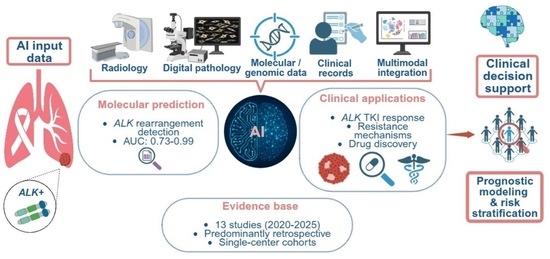
1. Introduction
2. Materials and Methods
2.1. Literature Search Strategy
2.2. Eligibility Criteria
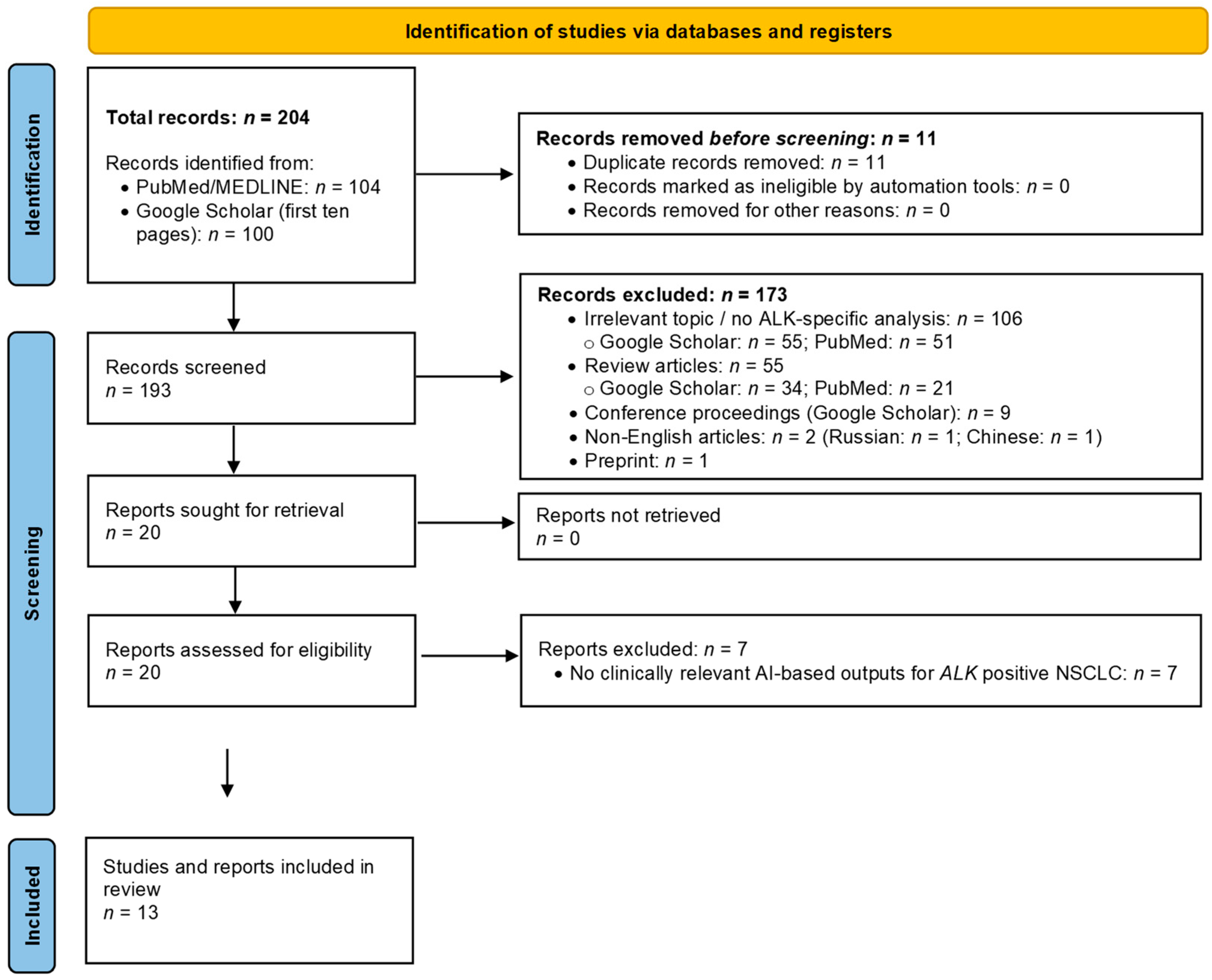
2.3. Study Selection and Data Extraction
2.4. Risk of Bias Assessment
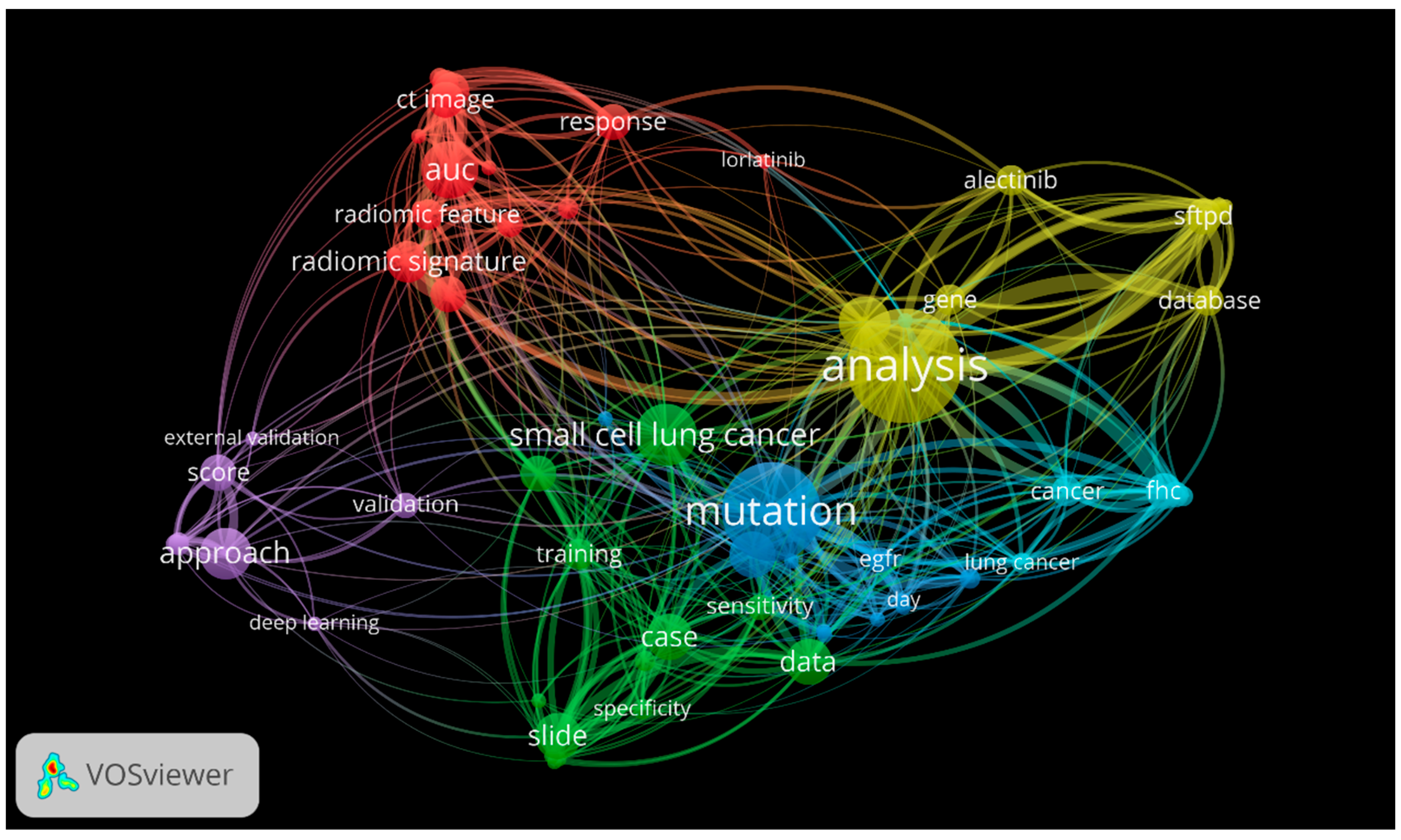
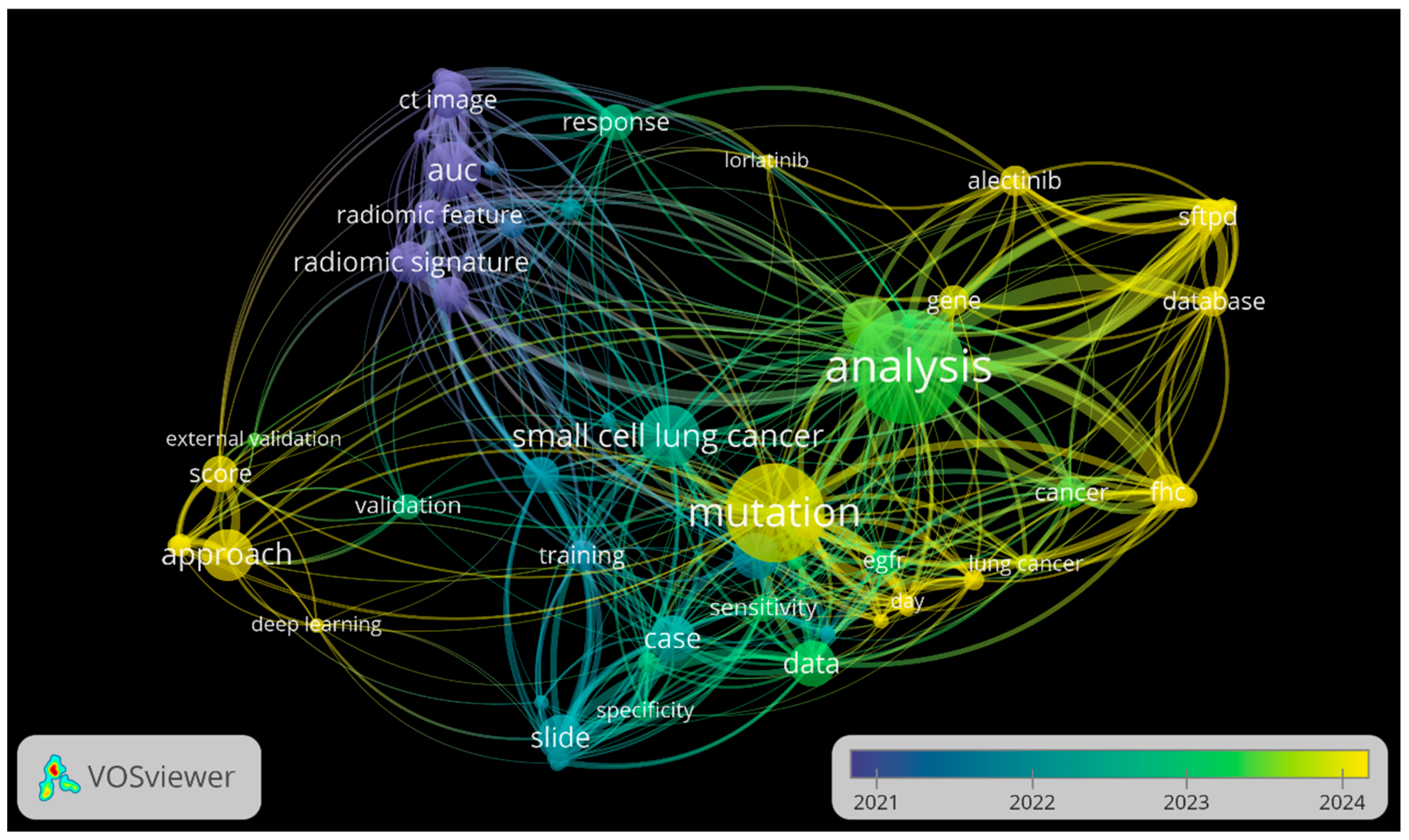
2.5. Bibliometric and Thematic Analysis
2.6. AI-Assisted Language Editing
3. Results
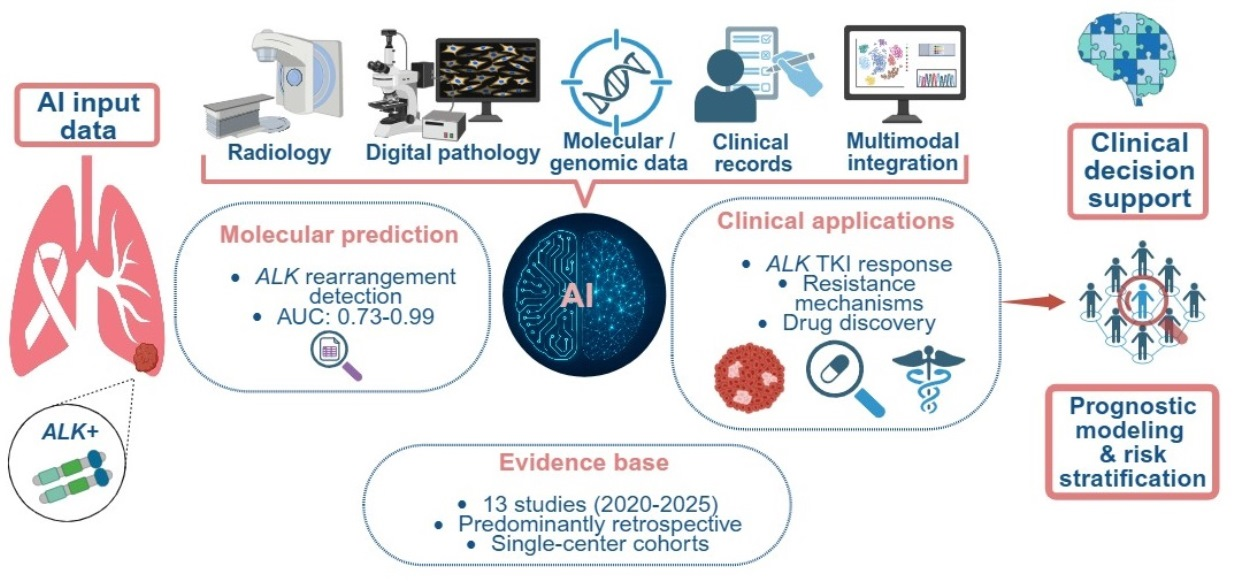
3.1. Overview
3.1.1. Geographic Distribution
3.1.2. Focus Areas, Data, and Analytical Approaches
3.1.3. Prediction Goals and Clinical Objectives
3.1.4. Outcome and AI Performance Metrics
3.1.5. Risk of Bias Assessment
3.2. Bibliometry
4. Discussion
5. Conclusions
Supplementary Materials
Author Contributions
Funding
Data Availability Statement
Conflicts of Interest
Abbreviations
| NSCLC | Non-small-cell lung cancer |
| ALK | Anaplastic lymphoma kinase |
| TKIs | Tyrosine kinase inhibitors |
| AI | Artificial intelligence |
| ML | Machine learning |
| DL | Deep learning |
| CT | Computed tomography |
| PET-CT | Positron emission tomography/computed tomography |
| IHC | Immunohistochemistry |
| AUC | Area under the curve |
| Vs. | versus |
| EV | External validation |
| ANN | Artificial neural network |
| DAVID | Database for annotation, visualization, and integrated discovery |
| MUC5B | Mucin 5B |
| SFTPD | Surfactant protein D |
| DMBT1 | Deleted in malignant brain tumors 1 |
| SFTPA2 | Surfactant protein A2 |
| TFF3 | Trefoil factor 3 |
| CNN | Convolutional neural network |
| mRMR | Maximum relevance minimum redundancy |
| LASSO | Least absolute shrinkage and selection operator |
| HR | Hazard ratio |
| PFS | Progression-free survival |
| RSF | Random survival forest |
| CPH | Cox proportional hazard |
References
- Planchard, D.; Popat, S.; Kerr, K.; Novello, S.; Smit, E.F.; Faivre-Finn, C.; Mok, T.S.; Reck, M.; Van Schil, P.E.; Hellmann, M.D.; et al. Metastatic non-small cell lung cancer: ESMO Clinical Practice Guidelines for diagnosis, treatment and follow-up. Ann. Oncol. 2018, 29, iv192–iv237. [Google Scholar] [CrossRef] [PubMed]
- Hendriks, L.E.; Kerr, K.M.; Menis, J.; Mok, T.S.; Nestle, U.; Passaro, A.; Peters, S.; Planchard, D.; Smit, E.F.; Solomon, B.J.; et al. Oncogene-addicted metastatic non-small-cell lung cancer: ESMO Clinical Practice Guideline for diagnosis, treatment and follow-up. Ann. Oncol. 2023, 34, 339–357. [Google Scholar] [CrossRef] [PubMed]
- Gibson, A.J.W.; Box, A.; Dean, M.L.; Elegbede, A.A.; Hao, D.; Sangha, R.; Bebb, D.G. Retrospective Real-World Outcomes for Patients With ALK-Rearranged Lung Cancer Receiving ALK Receptor Tyrosine Kinase Inhibitors. JTO Clin. Res. Rep. 2021, 2, 100157. [Google Scholar] [CrossRef] [PubMed]
- Chazan, G.; Franchini, F.; Shah, R.; Alexander, M.; John, A.; IJzerman, M.; Solomon, B. Real-World Treatment and Outcomes in ALK-Rearranged NSCLC: Results From a Large U.S.-Based Database. JTO Clin. Res. Rep. 2024, 5, 100662. [Google Scholar] [CrossRef]
- Solomon, B.J.; Mok, T.; Kim, D.W.; Wu, Y.L.; Nakagawa, K.; Mekhail, T.; Felip, E.; Cappuzzo, F.; Paolini, J.; Usari, T.; et al. First-line crizotinib versus chemotherapy in ALK-positive lung cancer. N. Engl. J. Med. 2014, 371, 2167–2177. [Google Scholar] [CrossRef]
- Shaw, A.T.; Kim, T.M.; Crino, L.; Gridelli, C.; Kiura, K.; Liu, G.; Novello, S.; Bearz, A.; Gautschi, O.; Mok, T.; et al. Ceritinib versus chemotherapy in patients with ALK-rearranged non-small-cell lung cancer previously given chemotherapy and crizotinib (ASCEND-5): A randomised, controlled, open-label, phase 3 trial. Lancet Oncol. 2017, 18, 874–886. [Google Scholar] [CrossRef]
- Peters, S.; Camidge, R.; Dziadziuszko, R.; Gadgeel, S.; Shaw, A.T.; Kim, D.W.; Perol, M.; Rosell, D.R.; Cheema, P.; Wan-Teck Lim, D.; et al. Alectinib versus crizotinib in previously untreated ALK-positive advanced non-small cell lung cancer: Final overall survival analysis of the phase III ALEX study. Ann. Oncol. 2026, 37, 92–103. [Google Scholar] [CrossRef]
- Ahn, M.J.; Kim, H.R.; Yang, J.C.H.; Han, J.Y.; Li, J.Y.; Hochmair, M.J.; Chang, G.C.; Delmonte, A.; Lee, K.H.; Campelo, R.G.; et al. Efficacy and Safety of Brigatinib Compared With Crizotinib in Asian vs. Non-Asian Patients With Locally Advanced or Metastatic ALK-Inhibitor-Naive ALK+ Non-Small Cell Lung Cancer: Final Results From the Phase III ALTA-1L Study. Clin. Lung Cancer 2022, 23, 720–730. [Google Scholar] [CrossRef]
- Solomon, B.J.; Liu, G.; Felip, E.; Mok, T.S.K.; Soo, R.A.; Mazieres, J.; Shaw, A.T.; de Marinis, F.; Goto, Y.; Wu, Y.L.; et al. Lorlatinib Versus Crizotinib in Patients With Advanced ALK-Positive Non-Small Cell Lung Cancer: 5-Year Outcomes From the Phase III CROWN Study. J. Clin. Oncol. 2024, 42, 3400–3409. [Google Scholar] [CrossRef]
- Barberis, M.; Rappa, A.; de Marinis, F.; Pelosi, G.; Guerini Rocco, E.; Zhan, Y.; Tiana, G. A rationale for the poor response to alectinib in a patient with adenocarcinoma of the lung harbouring a STRN-ALK fusion by artificial intelligence and molecular modelling: A case report. Transl. Lung Cancer Res. 2024, 13, 3807–3814. [Google Scholar] [CrossRef]
- Tan, X.; Li, Y.; Wang, S.; Xia, H.; Meng, R.; Xu, J.; Duan, Y.; Li, Y.; Yang, G.; Ma, Y.; et al. Predicting EGFR mutation, ALK rearrangement, and uncommon EGFR mutation in NSCLC patients by driverless artificial intelligence: A cohort study. Respir. Res. 2022, 23, 132. [Google Scholar] [CrossRef]
- Song, Z.; Liu, T.; Shi, L.; Yu, Z.; Shen, Q.; Xu, M.; Huang, Z.; Cai, Z.; Wang, W.; Xu, C.; et al. The deep learning model combining CT image and clinicopathological information for predicting ALK fusion status and response to ALK-TKI therapy in non-small cell lung cancer patients. Eur. J. Nucl. Med. Mol. Imaging 2021, 48, 361–371. [Google Scholar] [CrossRef]
- Chen, J.; Liu, J.; Qi, L.; Li, F.; Cui, S.; Wang, J. Influencing factors and prediction of growth heterogeneity in solid nodule non-small cell lung cancer based on artificial intelligence: A prospective study. Transl. Lung Cancer Res. 2025, 14, 4285–4300. [Google Scholar] [CrossRef]
- Mayer, C.; Ofek, E.; Fridrich, D.E.; Molchanov, Y.; Yacobi, R.; Gazy, I.; Hayun, I.; Zalach, J.; Paz-Yaacov, N.; Barshack, I. Direct identification of ALK and ROS1 fusions in non-small cell lung cancer from hematoxylin and eosin-stained slides using deep learning algorithms. Mod. Pathol. 2022, 35, 1882–1887. [Google Scholar] [CrossRef]
- Ninatti, G.; Kirienko, M.; Neri, E.; Sollini, M.; Chiti, A. Imaging-Based Prediction of Molecular Therapy Targets in NSCLC by Radiogenomics and AI Approaches: A Systematic Review. Diagn 2020, 10, 359. [Google Scholar] [CrossRef]
- Howard, H.R.; Hasanova, M.; Tiwari, A.; Ghose, A.; Winayak, R.; Nahar, T.; Chauhan, V.; Arun, S.; Palmer, K.; Houston, A.; et al. The landscape of conventional and artificial intelligence-based clinical prediction models in non-small-cell lung cancer: From development to real-world validation. ESMO Open 2025, 10, 105557. [Google Scholar] [CrossRef] [PubMed]
- Parra-Medina, R.; Guerron-Gomez, G.; Mendivelso-Gonzalez, D.; Gil-Gomez, J.H.; Alzate, J.P.; Gomez-Suarez, M.; Polo, J.F.; Sprockel, J.J.; Mosquera-Zamudio, A. Deep learning in histopathology images for prediction of oncogenic driver molecular alterations in lung cancer: A systematic review and meta-analysis. Transl. Lung Cancer Res. 2025, 14, 1756–1769. [Google Scholar] [CrossRef] [PubMed]
- Fuster-Matanzo, A.; Pico-Peris, A.; Bellvis-Bataller, F.; Jimenez-Pastor, A.; Weiss, G.J.; Marti-Bonmati, L.; Lazaro Sanchez, A.; Bazaga, D.; Banna, G.L.; Addeo, A.; et al. Prediction of oncogene mutation status in non-small cell lung cancer: A systematic review and meta-analysis with a special focus on artificial intelligence-based methods. Eur. Radiol. 2025, 36, 2157–2185. [Google Scholar] [CrossRef] [PubMed]
- Ishii, S.; Takamatsu, M.; Ninomiya, H.; Inamura, K.; Horai, T.; Iyoda, A.; Honma, N.; Hoshi, R.; Sugiyama, Y.; Yanagitani, N.; et al. Machine learning-based gene alteration prediction model for primary lung cancer using cytologic images. Cancer Cytopathol. 2022, 130, 812–823. [Google Scholar] [CrossRef]
- Trinh, T.C.; Phan, T.L.; To, V.T.; Pham, T.A.; Truong, G.B.; Le, L.H.S.; Tran, X.D.; Truong, T.N. Synergy of advanced machine learning and deep neural networks with consensus molecular docking for virtual screening of anaplastic lymphoma kinase inhibitors. J. Comput. Aided Mol. Des. 2025, 39, 79. [Google Scholar] [CrossRef]
- Calvo, V.; Niazmand, E.; Carcereny, E.; Rodriguez-Abreu, D.; Cobo, M.; Lopez-Castro, R.; Guirado, M.; Camps, C.; Laura Ortega, A.; Bernabe, R.; et al. Family history of cancer and lung cancer: Utility of big data and artificial intelligence for exploring the role of genetic risk. Lung Cancer 2024, 195, 107920. [Google Scholar] [CrossRef] [PubMed]
- Li, Z.; Fan, Y.; Ma, Y.; Meng, N.; Li, D.; Wang, D.; Lian, J.; Hu, C. Identification of Crucial Genes and Signaling Pathways in Alectinib-Resistant Lung Adenocarcinoma Using Bioinformatic Analysis. Mol. Biotechnol. 2024, 66, 3655–3673. [Google Scholar] [CrossRef] [PubMed]
- Chang, C.; Sun, X.; Wang, G.; Yu, H.; Zhao, W.; Ge, Y.; Duan, S.; Qian, X.; Wang, R.; Lei, B.; et al. A Machine Learning Model Based on PET/CT Radiomics and Clinical Characteristics Predicts ALK Rearrangement Status in Lung Adenocarcinoma. Front. Oncol. 2021, 11, 603882. [Google Scholar] [CrossRef]
- Terada, Y.; Takahashi, T.; Hayakawa, T.; Ono, A.; Kawata, T.; Isaka, M.; Muramatsu, K.; Tone, K.; Kodama, H.; Imai, T.; et al. Artificial Intelligence-Powered Prediction of ALK Gene Rearrangement in Patients With Non-Small-Cell Lung Cancer. JCO Clin. Cancer Inform. 2022, 6, e2200070. [Google Scholar] [CrossRef] [PubMed]
- Page, M.J.; McKenzie, J.E.; Bossuyt, P.M.; Boutron, I.; Hoffmann, T.C.; Mulrow, C.D.; Shamseer, L.; Tetzlaff, J.M.; Akl, E.A.; Brennan, S.E.; et al. The PRISMA 2020 statement: An updated guideline for reporting systematic reviews. BMJ 2021, 372, n71. [Google Scholar] [CrossRef] [PubMed]
- Arruda, H.; Silva, E.R.; Lessa, M.; Proenca, D., Jr.; Bartholo, R. VOSviewer and Bibliometrix. J. Med. Libr. Assoc. 2022, 110, 392–395. [Google Scholar] [CrossRef]
- Whiting, P.F.; Rutjes, A.W.; Westwood, M.E.; Mallett, S.; Deeks, J.J.; Reitsma, J.B.; Leeflang, M.M.; Sterne, J.A.; Bossuyt, P.M.; QUADAS-2 Group. QUADAS-2: A revised tool for the quality assessment of diagnostic accuracy studies. Ann. Intern. Med. 2011, 155, 529–536. [Google Scholar] [CrossRef]
- Wolff, R.F.; Moons, K.G.M.; Riley, R.D.; Whiting, P.F.; Westwood, M.; Collins, G.S.; Reitsma, J.B.; Kleijnen, J.; Mallett, S.; Groupdagger, P. PROBAST: A Tool to Assess the Risk of Bias and Applicability of Prediction Model Studies. Ann. Intern. Med. 2019, 170, 51–58. [Google Scholar] [CrossRef]
- Moons, K.G.M.; Damen, J.A.A.; Kaul, T.; Hooft, L.; Andaur Navarro, C.; Dhiman, P.; Beam, A.L.; Van Calster, B.; Celi, L.A.; Denaxas, S.; et al. PROBAST+AI: An updated quality, risk of bias, and applicability assessment tool for prediction models using regression or artificial intelligence methods. BMJ 2025, 388, e082505. [Google Scholar] [CrossRef]
- Li, H.; Zhang, R.; Wang, S.; Fang, M.; Zhu, Y.; Hu, Z.; Dong, D.; Shi, J.; Tian, J. CT-Based Radiomic Signature as a Prognostic Factor in Stage IV ALK-Positive Non-small-cell Lung Cancer Treated With TKI Crizotinib: A Proof-of-Concept Study. Front. Oncol. 2020, 10, 57. [Google Scholar] [CrossRef]
- Koyama, J.; Morise, M.; Furukawa, T.; Oyama, S.; Matsuzawa, R.; Tanaka, I.; Wakahara, K.; Yokota, H.; Kimura, T.; Shiratori, Y.; et al. Artificial intelligence-based personalized survival prediction using clinical and radiomics features in patients with advanced non-small cell lung cancer. BMC Cancer 2024, 24, 1417. [Google Scholar] [CrossRef]
- Pourakbar, N.; Motamedi, A.; Pashapour, M.; Sharifi, M.E.; Sharabiani, S.S.; Fazlollahi, A.; Abdollahi, H.; Rahmim, A.; Rezaei, S. Effectiveness of Artificial Intelligence Models in Predicting Lung Cancer Recurrence: A Gene Biomarker-Driven Review. Cancers 2025, 17, 1892. [Google Scholar] [CrossRef] [PubMed]
- She, Y.; Jin, Z.; Wu, J.; Deng, J.; Zhang, L.; Su, H.; Jiang, G.; Liu, H.; Xie, D.; Cao, N.; et al. Development and Validation of a Deep Learning Model for Non-Small Cell Lung Cancer Survival. JAMA Netw. Open 2020, 3, e205842. [Google Scholar] [CrossRef] [PubMed]
- Torrente, M.; Sousa, P.A.; Hernandez, R.; Blanco, M.; Calvo, V.; Collazo, A.; Guerreiro, G.R.; Nunez, B.; Pimentao, J.; Sanchez, J.C.; et al. An Artificial Intelligence-Based Tool for Data Analysis and Prognosis in Cancer Patients: Results from the Clarify Study. Cancers 2022, 14, 4041. [Google Scholar] [CrossRef]
- Song, J.; Wang, L.; Ng, N.N.; Zhao, M.; Shi, J.; Wu, N.; Li, W.; Liu, Z.; Yeom, K.W.; Tian, J. Development and Validation of a Machine Learning Model to Explore Tyrosine Kinase Inhibitor Response in Patients With Stage IV EGFR Variant-Positive Non-Small Cell Lung Cancer. JAMA Netw. Open 2020, 3, e2030442. [Google Scholar] [CrossRef] [PubMed]
- Lu, C.; Bera, K.; Wang, X.; Prasanna, P.; Xu, J.; Janowczyk, A.; Beig, N.; Yang, M.; Fu, P.; Lewis, J.; et al. A prognostic model for overall survival of patients with early-stage non-small cell lung cancer: A multicentre, retrospective study. Lancet Digit. Health 2020, 2, e594–e606. [Google Scholar] [CrossRef]
- Janik, A.; Torrente, M.; Costabello, L.; Calvo, V.; Walsh, B.; Camps, C.; Mohamed, S.K.; Ortega, A.L.; Novacek, V.; Massuti, B.; et al. Machine Learning-Assisted Recurrence Prediction for Patients With Early-Stage Non-Small-Cell Lung Cancer. JCO Clin. Cancer Inform. 2023, 7, e2200062. [Google Scholar] [CrossRef]
- Ankolekar, A.; Boie, S.; Abdollahyan, M.; Gadaleta, E.; Hasheminasab, S.A.; Yang, G.; Beauville, C.; Dikaios, N.; Kastis, G.A.; Bussmann, M.; et al. Advancing breast, lung and prostate cancer research with federated learning. A systematic review. NPJ Digit. Med. 2025, 8, 314. [Google Scholar] [CrossRef]
- Naykwadi, H.; Alavala, R.R. Overcoming Resistance in EGFR-Mutant Cancers: A Comprehensive Review of Inhibitor Evolution and SAR-Based Design. Drug Dev. Res. 2026, 87, e70220. [Google Scholar] [CrossRef]
- Sperduto, P.W.; Yang, T.J.; Beal, K.; Pan, H.; Brown, P.D.; Bangdiwala, A.; Shanley, R.; Yeh, N.; Gaspar, L.E.; Braunstein, S.; et al. Estimating Survival in Patients With Lung Cancer and Brain Metastases: An Update of the Graded Prognostic Assessment for Lung Cancer Using Molecular Markers (Lung-molGPA). JAMA Oncol. 2017, 3, 827–831. [Google Scholar] [CrossRef]
- Crouzen, J.A.; Mast, M.E.; Hakstege, M.; Broekman, M.L.D.; Baladi, C.; Mertens, B.J.A.; Nandoe Tewarie, R.D.S.; Kerkhof, M.; Vos, M.J.; Maas, K.W.; et al. External validation of the lung-molGPA to predict survival in patients treated with stereotactic radiotherapy for brain metastases of non-small cell lung cancer. Radiother. Oncol. 2024, 198, 110405. [Google Scholar] [CrossRef] [PubMed]
- Zerdes, I.; Kamali, C.; Koulouris, A.; Elsayed, M.; Schnorbach, J.; Christopoulos, P.; Tsakonas, G. Validation of the ALK-Brain Prognostic Index for patients with ALK-rearranged lung cancer and brain metastases. ESMO Open 2023, 8, 102069. [Google Scholar] [CrossRef] [PubMed]
- Thalambedu, N.; Balla, M.; Sivasubramanian, B.P.; Sadaram, P.; Malla, K.P.; Vasipalli, K.P.; Kakadia, S. Integrating artificial intelligence with circulating tumor DNA for non-small cell lung cancer: Opportunities, challenges, and future directions. Front. Med. 2025, 12, 1612376. [Google Scholar] [CrossRef] [PubMed]
- Cherukuri, S.P.; Kaur, A.; Goyal, B.; Kukunoor, H.R.; Sahito, A.F.; Sachdeva, P.; Yerrapragada, G.; Elangovan, P.; Shariff, M.N.; Natarajan, T.; et al. Artificial Intelligence-Enhanced Liquid Biopsy and Radiomics in Early-Stage Lung Cancer Detection: A Precision Oncology Paradigm. Cancers 2025, 17, 3165. [Google Scholar] [CrossRef]
- Zhu, E.; Muneer, A.; Zhang, J.; Xia, Y.; Li, X.; Zhou, C.; Heymach, J.V.; Wu, J.; Le, X. Progress and challenges of artificial intelligence in lung cancer clinical translation. NPJ Precis. Oncol. 2025, 9, 210. [Google Scholar] [CrossRef]
- Basety, S.; Gudepu, R.; Velidandi, A. Artificial Intelligence in Lung Cancer: A Narrative Review of Recent Advances in Diagnosis, Biomarker Discovery, and Drug Development. Pharmaceutics 2026, 18, 201. [Google Scholar] [CrossRef]



| Author, Year | Country | Study Type | Data Modality | Sample Size | AI Method | Clinical Aim | ALK-Specific Output |
|---|---|---|---|---|---|---|---|
| Terada et al., 2022 [24] | Japan | Retrospective | Pathology/ IHC | n = 208 | DL (HALO AI, Dense Net) | ALK rearrangement prediction | AUC = 0.73; 73% sensitivity and specificity vs. 13% and 94% human specificity and sensitivity. |
| Chen et al., 2025 [13] | China | Retrospective | Imaging/ CT | n = 250 | Deep Wise AI workstation | Prediction of growth rate and heterogeneity in solid NSCLC nodules | AUC = 0.704; sensitivity: 65.5%, specificity: 70.5%; ALK rearrangements enriched in high-grade adenocarcinomas, no significant correlation between ALK and growth rate. |
| Trinh et al., 2025 [20] | France | In silico | Pharmacology/Drug Design | n= 120,571 compounds | ML (XGBoost algorithm), DL (ANN) | Screening of novel ALK inhibitors | EV-f1 score of 0.921, EV-average precision of 0.961, cross-validation-f1 score; 3 promising ALK inhibitors identified. |
| Barberis et al., 2024 [10] | Italy | In silico/ in Vivo | Molecular/Digital Pathology | n = 1 | AlphaFold2, 3 | Molecular modeling to investigate poor clinical response to alectinib | Rare striatin STRN-ALK fusion distorting alectinib’s binding pocket. |
| Calvo et al., 2024 [21] | Spain | Retrospective | AI-assisted statistical analysis of multimodal records (clinical, imaging, genetics) | n= 5788 patients, 939 with family history of cancer, 552 with EGFR or HER2 mutation or ALK translocation | Knowledge Graph and Unified Schema | Cancer risk estimation | At least one relative with cancer among 9.53% of patients with ALK translocation or EGFR or HER2 mutations; ALK translocation: the most common among young female non-smokers. |
| Li et al., 2024 [22] | China | Retrospective | In Silico/Bioinformatics | Not applicable (Gene Encyclopedias/ Databases) | DAVID | Gene and signaling pathways identification in alectinib-resistant NSCLC | Five hub genes identified (MUC5B, SFTPD, DMBT1, SFTPA2, TFF3). |
| Mayer et al., 2022 [14] | Israel | Retrospective | Pathology | n = 234 | Computer vision, CNN | Identification of ALK and ROS1 fusions in NSCLC | AUC: 1 for ALK fusion, 0.93 for ROS1 fusion, Sensitivity and specificity 100% and 100% for ALK fusion, 100% and 98.48% for ROS1 fusion, respectively. |
| Ishii et al., 2022 [19] | Japan | Retrospective | Cytology | n = 138 (106 with cancer, 32 controls) | ML, MobileNet-V2 | Gene alteration prediction model | Accuracy: 0.945; Precision: 0.991. |
| Tan et al., 2022 [11] | China | Retrospective | Pathology | n = 1089 | DL, ML, stacked ensemble model | Prediction of EGFR mutations (including uncommon mutations) and ALK rearrangement | AUC of 0.995 and 0.921 in the training and testing cohorts for ALK rearrangement, overall AUC of 0.93 and 0.83 in the training and testing cohorts. |
| Chang et al., 2021 [23] | China | Retrospective | Radiology (PET/CT) and clinical data | n = 526 (109 with and 417 without ALK rearrangements) | AI Kit (mRMR and LASSO logistic regression) | ALK rearrangement Status | AUC = 0.87 in the training group; AUC = 0.88 in the testing group; Specificity = 0.94, Sensitivity = 0.58. |
| Song et al., 2021 [12] | China | Retrospective | Radiology, Pathology, Clinical data | n= 937 | ML, 3 blocks model (CT, clinicopathological classifier) | Predict ALK status and response to ALK-TKI therapy | AUC = 0.8540 in the primary cohort, AUC 0.8481 in the validation cohort; PFS of 16.8 vs. 7.5 months (p = 0.010) for patients predicted as ALK (+) and ALK (−), respectively. |
| Li et al., 2020 [30] | China | Retrospective | Radiomics | n = 63 | ML | Prognosis of stage IV ALK (+) NSCLC with CT-Based radiomic signature | C-index: 0.744; time-dependent AUC: 0.895 in the training cohort; C-index: 0.717; time-dependent AUC: 0.824 in the validation cohort; Effective risk-stratification prognosis with HR: 2.181 (p < 0.001). |
| Koyama et al., 2024 [31] | Japan | Retrospective | Radiology, Clinical data | n= 459 (training group, n = 299; testing group, n = 160) | RSF algorithm vs. CPH estimation | Personalized survival prediction in patients with advanced NSCLC | C-index 0.841, superior to CPH model (0.775, p < 0.001) |
| Study | Patient Selection & Representativeness | Overfitting | Validation Strategy | Clinical Applicability |
|---|---|---|---|---|
| Terada et al., 2022 [24] | Moderate (retrospective single-center cohort, n = 208) | Moderate | Internal | Moderate |
| Chen et al., 2025 [13] | Moderate (retrospective cohort, n = 250) | Moderate | Internal | Limited |
| Trinh et al., 2025 [20] | N/A (compound dataset) | Low | Internal (Cross-validation) | Preclinical |
| Barberis et al., 2024 [10] | High (single-patient case report) | N/A | None | Hypothesis- generating |
| Calvo et al., 2024 [21] | Moderate (retrospective registry dataset). 5788 patients with lung cancer in the AI-assisted analysis; n = 116 (2%) with ALK translocation | Moderate | Internal | Moderate |
| Li et al., 2024 [22] | N/A (bioinformatic database analysis) | Low | None | Exploratory |
| Mayer et al., 2022 [14] | Moderate (retrospective pathology cohort, n = 234) | Moderate | Internal | Moderate |
| Ishii et al., 2022 [19] | Moderate (small retrospective cohort, n = 138) | Moderate–High | Internal | Limited |
| Tan et al., 2022 [11] | Moderate (retrospective cohort, n = 1089) | Moderate | Internal | Moderate |
| Chang et al., 2021 [23] | Moderate (retrospective cohort, n = 526) | Moderate | Internal | Moderate |
| Song et al., 2021 [12] | Moderate (retrospective cohort, n = 937) | Moderate | Internal | Moderate |
| Li et al., 2020 [30] | Retrospective High (small cohort, n = 63) | High | Internal | Limited |
| Koyama et al., 2024 [31] | Moderate (retrospective cohort, n = 459) | Moderate | Internal | Moderate |
Disclaimer/Publisher’s Note: The statements, opinions and data contained in all publications are solely those of the individual author(s) and contributor(s) and not of MDPI and/or the editor(s). MDPI and/or the editor(s) disclaim responsibility for any injury to people or property resulting from any ideas, methods, instructions or products referred to in the content. |
© 2026 by the authors. Licensee MDPI, Basel, Switzerland. This article is an open access article distributed under the terms and conditions of the Creative Commons Attribution (CC BY) license.
Share and Cite
Koulouris, A.; Tsagkaris, C.; Kalaitzidis, K.; Tsakonas, G.; Mountzios, G. Artificial Intelligence in ALK-Rearranged NSCLC: Forecasting Response and Resistance. Cancers 2026, 18, 973. https://doi.org/10.3390/cancers18060973
Koulouris A, Tsagkaris C, Kalaitzidis K, Tsakonas G, Mountzios G. Artificial Intelligence in ALK-Rearranged NSCLC: Forecasting Response and Resistance. Cancers. 2026; 18(6):973. https://doi.org/10.3390/cancers18060973
Chicago/Turabian StyleKoulouris, Andreas, Christos Tsagkaris, Konstantinos Kalaitzidis, Georgios Tsakonas, and Giannis Mountzios. 2026. "Artificial Intelligence in ALK-Rearranged NSCLC: Forecasting Response and Resistance" Cancers 18, no. 6: 973. https://doi.org/10.3390/cancers18060973
APA StyleKoulouris, A., Tsagkaris, C., Kalaitzidis, K., Tsakonas, G., & Mountzios, G. (2026). Artificial Intelligence in ALK-Rearranged NSCLC: Forecasting Response and Resistance. Cancers, 18(6), 973. https://doi.org/10.3390/cancers18060973