


Simple Summary
ALK-positive non-small-cell lung cancer is a distinct molecular subtype for which targeted therapies have significantly enhanced patient outcomes. However, prediction of treatment response and understanding of resistance mechanisms remain clinically challenging. Artificial intelligence has been increasingly investigated as a tool to support these tasks by analyzing clinical data, imaging, pathology, and molecular features. In this systematic review, we summarize and critically appraise studies applying artificial intelligence to ALK-rearranged lung cancer, with a focus on diagnostic, prognostic, and treatment-related applications. We further explore methodological trends and research focus within the field. While many studies report promising predictive performance, most rely on retrospective, single-center data and lack external validation. This review highlights both the potential and current limitations of artificial intelligence in this setting and outlines key requirements for future clinically translatable research.
Abstract
Background/Objectives: The management and prognosis of ALK-rearranged non-small-cell lung cancer have substantially improved over the past decade. However, challenges remain in timely molecular identification, prediction of treatment response, and understanding resistance mechanisms. This systematic review evaluates and synthesizes the evidence on artificial intelligence (AI) approaches leveraging imaging, pathology, molecular, and clinical data in this setting. Methods: A systematic search was conducted for peer-reviewed studies published between 2020 and 2025. Eligible studies involved human subjects and applied AI, machine learning, or deep learning methods to predict ALK status or treatment-related outcomes using imaging, pathology, molecular, or multimodal data. Study selection followed the PRISMA 2020 guidelines. Data were extracted on study design, data modality, AI methodology, clinical objectives, and performance metrics. Bibliometric co-occurrence analysis was performed to characterize thematic patterns and temporal trends. Results: Thirteen studies met the inclusion criteria, most of which were retrospective and single-center. AI approaches were applied to radiologic, pathologic, molecular, or multimodal data. Models predicting ALK status reported area under the curve values ranging from 0.73 to 0.99, while prognostic and treatment-response models reported moderate to high discriminative performance. Bibliometric analysis identified two dominant research themes focused on molecular characterization and computational methodology, with a recent shift toward treatment-specific and integrative analyses. External validation and clinical implementation remained limited across studies. Conclusions: AI shows promising potential to support diagnosis, prognostication, and treatment assessment in ALK-rearranged lung cancer. However, methodological heterogeneity, limited external validation, and a lack of prospective studies currently constrain clinical translation.
1. Introduction
Lung cancer remains the leading cause of cancer-related mortality worldwide, with non-small-cell lung cancer (NSCLC) accounting for 80–90% of all cases [1]. Advances in molecular profiling have reshaped the management of NSCLC by enabling biomarker-driven treatment strategies. Among actionable oncogenic drivers, rearrangements of the anaplastic lymphoma kinase (ALK) gene define a distinct molecular subtype, typically associated with younger age, adenocarcinoma histology, and limited smoking exposure [2]. The development of first-, second-, and third-generation ALK tyrosine kinase inhibitors (TKIs) has substantially improved clinical outcomes, transforming ALK-rearranged NSCLC into a paradigm of precision oncology [3,4,5,6,7,8,9].
Despite these therapeutic advances, several clinically relevant challenges persist. Accurate and timely identification of ALK rearrangements remains essential but can be limited by tissue availability, cost, and turnaround time of molecular testing. Furthermore, heterogeneity in treatment response and the development of both primary and acquired resistance complicate long-term disease control [10,11,12]. These challenges have driven interest in complementary approaches that can enhance molecular characterization, predict therapeutic outcomes, and provide insights into resistance mechanisms beyond conventional diagnostics.
In parallel, artificial intelligence (AI), encompassing machine learning (ML) and deep learning (DL) methodologies, has emerged as a powerful analytical framework in oncology. AI-based models are increasingly applied to complex, high-dimensional datasets derived from radiologic imaging, digital pathology, cytology, molecular profiling, and electronic health records. In NSCLC, such approaches have been explored for nodule characterization, mutation prediction, prognostication, and treatment-response assessment [13,14,15,16]. Recent studies have reported a rapid expansion of clinical prediction models incorporating AI, particularly those leveraging multimodal data to support individualized decision-making across early and metastatic disease settings [15,16,17,18,19].
Within this broader landscape, AI applications targeting molecularly defined subgroups of NSCLC are of particular interest. Several original studies have demonstrated the feasibility of predicting ALK status directly from computed tomography (CT), positron emission tomography/computed tomography (PET-CT), histopathology slides, or cytologic specimens using ML and DL techniques [14,20,21,22]. Beyond molecular classification, AI-driven models have been developed to estimate prognosis, predict response to ALK TKIs, and explore treatment resistance through radiomics, bioinformatic analyses, and molecular modeling [10,11,12,17,23]. These approaches offer the potential to complement standard molecular testing, support treatment selection, and enhance understanding of disease biology in ALK-rearranged NSCLC.
However, despite growing interest and promising performance metrics, the current evidence base remains fragmented. Existing reviews addressing AI in NSCLC often focus on heterogeneous patient populations, broad biomarker groups, or general clinical prediction models, limiting ALK-specific insights [11,16,19]. Moreover, concerns regarding methodological heterogeneity, limited external validation, and the predominance of retrospective, single-center studies continue to restrict clinical translation of AI-based tools [11,12,16,19,24].
Consequently, a focused synthesis of AI applications specifically applied to ALK-rearranged NSCLC is warranted. The present systematic review aims to evaluate and synthesize the published evidence on AI-based approaches for molecular prediction, prognostication, treatment-response assessment, and mechanistic exploration in ALK-rearranged NSCLC. By integrating a systematic literature review conducted in accordance with PRISMA 2020 guidelines with bibliometric co-occurrence analysis, this study seeks to characterize research trends, dominant thematic areas, and existing gaps, thereby informing future research priorities and supporting the development of clinically meaningful AI-driven strategies in this molecularly defined subset of lung cancer [25,26].
2. Materials and Methods
2.1. Literature Search Strategy
A systematic search of peer-reviewed literature was conducted in PubMed/MEDLINE and Google Scholar to synthesize and critically appraise AI-based approaches applied to ALK-rearranged NSCLC. The search covered articles published in English between 1 January 2020 and 1 January 2026, and the final search was performed on 1 January 2026. Search terms combined keywords related to ALK-rearranged NSCLC with AI methodologies and clinically relevant outcomes, including molecular diagnosis, treatment response, resistance, prognosis, and survival. The following Boolean search strategy was applied: (“ALK” OR “anaplastic lymphoma kinase”) AND (“non-small cell lung cancer” OR “NSCLC”) AND (“artificial intelligence” OR “machine learning” OR “deep learning” OR “radiomics” OR “pathomics” OR “multiomics”). Google Scholar yielded approximately 15,700 results using the same search terms during the same time period. Due to the large number of results retrieved, screening was limited to the first ten pages of results (100 records) sorted by relevance, following commonly used approaches in systematic reviews. No field restrictions (e.g., title/abstract filters) were applied to maximize search sensitivity. Reference lists of eligible articles were also screened to identify additional relevant studies.
2.2. Eligibility Criteria
Studies were eligible for inclusion if they (a) involved human subjects or computational/translational analyses relevant to ALK-rearranged NSCLC; (b) reported original research; (c) applied AI, ML, or DL techniques to imaging, pathology, molecular, clinical, or multimodal data; and (d) addressed ALK rearrangement detection or treatment-related outcomes in ALK-positive NSCLC. Exclusion criteria included review articles, editorials, conference abstracts, studies without ALK-specific analyses, absence of reported performance metrics—e.g., area under the curve (AUC), sensitivity, specificity, C-index—and unavailability of full-text articles in English. Given the exploratory nature of AI applications in ALK-rearranged NSCLC, translational studies employing in silico modeling or AI-driven drug discovery approaches were also considered eligible when they directly addressed ALK biology, therapeutic response, or resistance mechanisms.
2.3. Study Selection and Data Extraction
Study selection was performed in accordance with the Preferred Reporting Items for Systematic Reviews and Meta-Analyses (PRISMA) guidelines [25]. Titles and abstracts were screened for relevance, followed by full-text assessment of potentially eligible studies. Screening and data extraction were conducted independently by two reviewers, with discrepancies resolved by consensus. Data extracted from included studies comprised publication year, geographic origin, study design, sample size, data modality, artificial intelligence methodology, clinical objectives, validation strategy, and reported performance metrics. When study-level variables were missing or unclearly reported, no assumptions were made and the information was recorded as not available. Outcomes of interest included diagnostic performance for ALK rearrangement detection, prognostic outcomes, such as progression-free survival (PFS) and overall survival (OS), treatment-response measures to ALK TKIs, and mechanistic or resistance-related molecular findings. All reported results relevant to these outcome domains were collected. The completed PRISMA 2020 checklist is provided in Supplementary Material. This review was not prospectively registered, because it was conceived as an exploratory synthesis of a rapidly evolving and methodologically heterogeneous field. Consequently, no formal review protocol was publicly deposited prior to study initiation.
2.4. Risk of Bias Assessment
A formal risk-of-bias assessment using a standardized tool could not be uniformly applied across all study types, as no validated instrument currently exists that adequately captures the methodological heterogeneity of AI-based prediction studies spanning imaging, pathology, molecular, multimodal analyses, and in silico designs. Instead, a structured qualitative risk-of-bias assessment was performed based on methodological domains commonly considered in AI prediction research and inspired by established frameworks such as QUADAS-2 and PROBAST [27,28,29]. The assessment focused on four domains: (a) patient selection and dataset representativeness, (b) risk of data leakage and model overfitting, (c) validation strategy (internal versus external), and (d) model calibration and clinical applicability. Each included study was qualitatively evaluated across these domains based on the information reported in the original publications. The outcomes of this assessment are further discussed in Section 3 and Section 4.
2.5. Bibliometric and Thematic Analysis
To explore thematic patterns within the included literature, a bibliometric co-occurrence analysis was performed using VOSviewer, version 1.6.20 (Leiden University, Leiden, The Netherlands) [26]. Terms were extracted from titles and abstracts, and those occurring at least three times were retained using the default relevance threshold of 80%. Manual screening was undertaken to remove syntactic or non-contextual terms. Network and temporal overlay visualizations were subsequently generated to characterize conceptual clustering, thematic relationships, and temporal evolution in research focus across the included studies.
2.6. AI-Assisted Language Editing
ChatGPT (version 5.2, OpenAI) was used solely for language editing and proofreading. The authors reviewed and verified all AI-assisted modifications and take full responsibility for the content of the manuscript.
3. Results
3.1. Overview
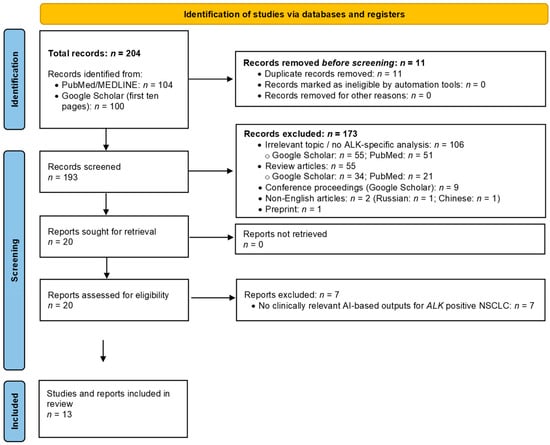
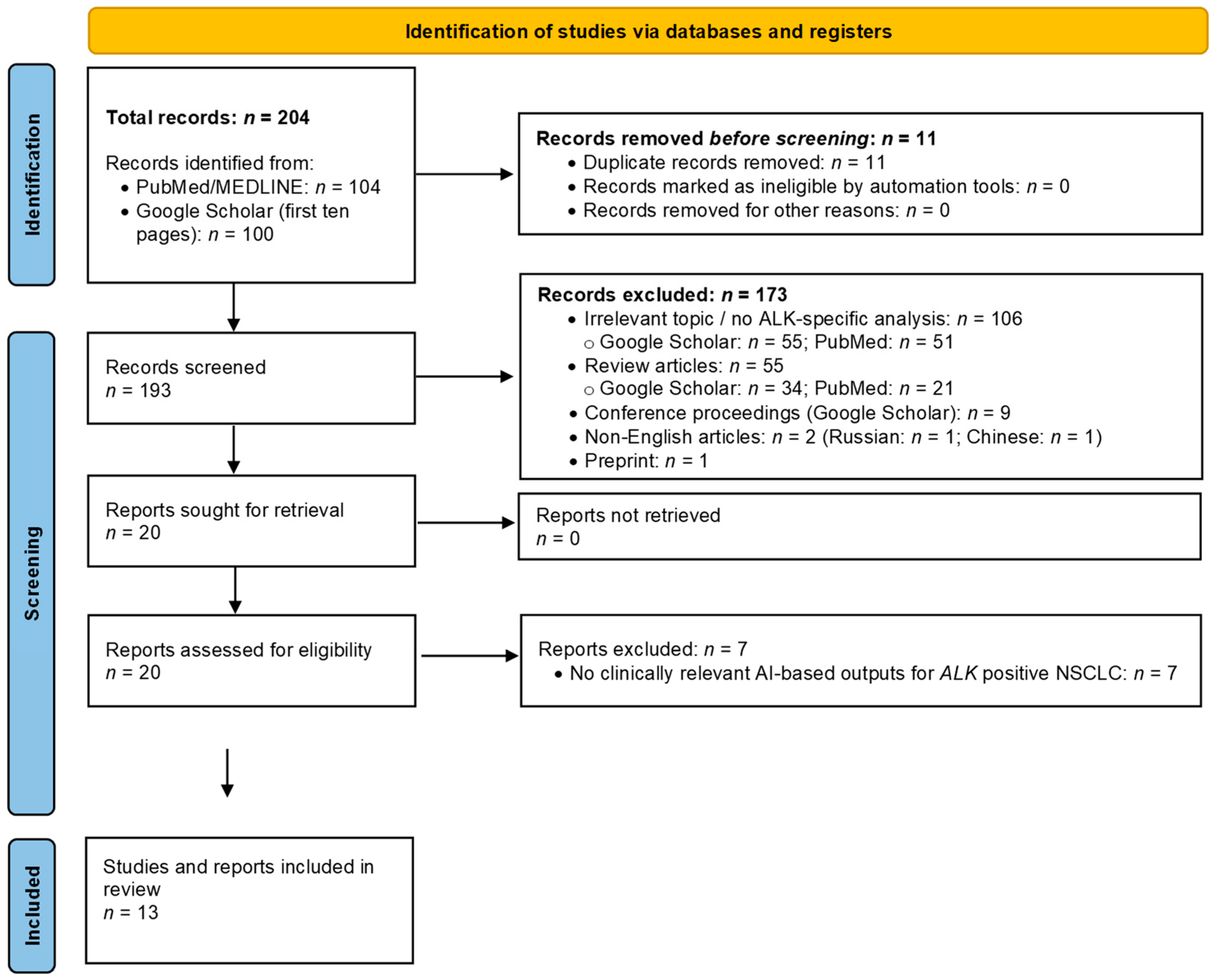
A total of 204 records were identified through database and search engine screening, of which 11 duplicates were removed prior to screening. Following title and abstract screening, 20 studies were deemed eligible for full-text assessment, of which 13 met the predefined inclusion criteria and were included in the final analysis (Figure 1 and Table 1). The excluded studies were primarily reviews, conference proceedings, methodological papers without ALK-specific analyses, or investigations lacking clinically relevant AI outputs. The included studies were published between 2020 and 2025 and were predominantly retrospective in design.
Figure 1.
PRISMA 2020 flow diagram of study identification, screening, eligibility, and inclusion.
Table 1.
Overview of the included studies, their methodologies, and outcomes.
3.1.1. Geographic Distribution
The majority of studies originated from East Asia, particularly China and Japan, with additional contributions from Europe and Israel. Sample sizes varied widely, ranging from small exploratory cohorts to large population-based datasets exceeding 5000 individuals. Most investigations were single-center studies.
3.1.2. Focus Areas, Data, and Analytical Approaches
The included studies retrieved data from imaging, pathology, and clinical records and used a wealth of AI modalities to analyze them. Imaging-based approaches constituted the largest group, predominantly using CT or PET/CT data to extract radiomic features for model training and prediction of ALK rearrangement or clinical outcomes [12,22,23,31]. The second largest group relied on pathology or cytology, applying convolutional neural networks to whole-slide images or cytological specimens for the prediction of genetic alterations, including ALK and ROS1 fusions [11,14,19,24]. A smaller number of investigations incorporated multimodal data, combining radiologic, pathological, and clinical records [12,21,23]. Finally, a case report used post hoc molecular modeling and an in silico study harnessed mutation database analyses to identify molecular traits associated with resistance to TKIs [10,22].
AI methodologies ranged from conventional ML approaches, including logistic regression, random forest models, and least absolute shrinkage and selection operator (LASSO) regression, to DL architectures, such as convolutional neural networks and ensemble learning models [11,14,23]. In silico studies applying AI to molecular modeling and drug discovery formed a distinct subgroup, focusing on the identification of candidate ALK inhibitors or the mechanistic characterization of resistance-associated alterations, including rare fusion variants with a potential to alter molecular docking and subsequent outcomes associated with TKI administration [10,20,30].
3.1.3. Prediction Goals and Clinical Objectives
Clinical objectives identified in the included studies can be grouped under three categories: (a) ALK status, (b) prognostic or predictive modeling in ALK-positive NSCLC, and (c) molecular/genetic characterization. ALK status was predicted from imaging or pathological data. These studies primarily used radiomics or DL-based approaches reporting AUC values ranging from approximately 0.73 to 0.99 depending on data modality and model architecture [11,14,23,24].
Prognostic or predictive modeling in ALK-positive NSCLC was designed to estimate PFS, OS, or response to ALK TKIs. Radiomics-based and multimodal approaches reported moderate-to-high discriminative performance, with reported concordance indices ranging from 0.72 to 0.89 and significant associations with clinical outcomes [12,30,31].
Studies exploring mechanistic or translational applications of AI focused on the identification of resistance-associated molecular signatures and in silico screening of candidate ALK inhibitors. Insights were provided into structure–function relationships and resistance mechanisms in the context of either identifying genes to be targeted in the frame of drug discovery or post hoc identifying genes or molecular folding traits associated with resistance to TKIs [10,20,22].
3.1.4. Outcome and AI Performance Metrics
Model performance was reported using AUC, sensitivity, specificity, and C-index values. For studies addressing ALK rearrangement detection, AUC values typically ranged between 0.73 and 0.99, with higher discriminative performance generally observed in pathology-based and multimodal models, although these estimates should be interpreted cautiously given differences in dataset composition, validation strategies, and disease prevalence [11,14,24]. Prognostic models demonstrated moderate discriminative ability, with C-index values slightly over 0.70 in both training and validation cohorts [30,31]. External validation was reported in only a minority of studies, while most models were evaluated using internal cross-validation or single-cohort testing. Finally, although one study employed a prospective observational design, none of the included investigations assessed AI models in a prospective clinical decision-making or implementation setting [13].
3.1.5. Risk of Bias Assessment
A structured qualitative risk-of-bias assessment was conducted across four methodological domains, and the results are summarized in Table 2. Most included studies were retrospective and single-center, which may limit dataset representativeness and generalizability. Sample sizes varied substantially across studies, ranging from small exploratory cohorts to large registry-based datasets. The risk of model overfitting was considered moderate in most studies, but it was more pronounced in smaller cohorts. The majority of studies relied on internal validation approaches, and calibration metrics were infrequently reported. Moreover, clinical applicability varied across study types. Diagnostic and prognostic prediction models demonstrated potential translational relevance, whereas in silico modeling studies and the single-patient case report were considered exploratory and hypothesis-generating.
Table 2.
Qualitative risk-of-bias assessment of included studies.
3.2. Bibliometry
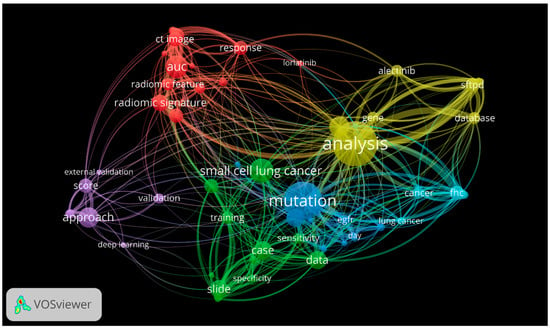
An overview of thematic networks based on frequency and co-occurrence is presented in Figure 2. The visualization demonstrated two dominant conceptual groups, “mutation” and “analysis”, indicating a molecular characterization and computational methodology anchor over clinical decision-making. Radiomics-related terms (e.g., AUC, CT image, radiomic signature) formed a key analysis cluster, reflecting the focus on imaging-based AI models and their performance evaluation. A second major cluster was centered on mutation, gene, and targeted therapies (including alectinib and lorlatinib), representing biologically informed and treatment-relevant analyses. Digital-pathology-related terms (e.g., slide, data) constituted a smaller but distinct cluster, indicating transversal use of methodologies across studies in the field.
Figure 2.
Network visualization showing keyword frequency and co-occurrence across the included studies. Generated using VOSviewer, version 1.6.20 (Leiden University, The Netherlands).
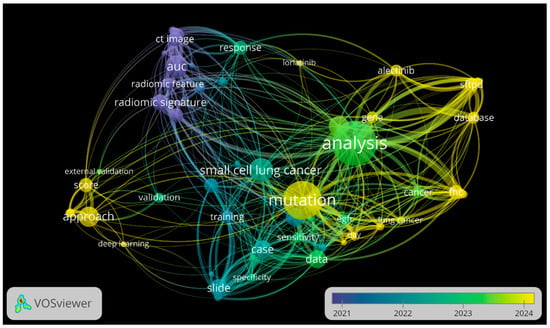
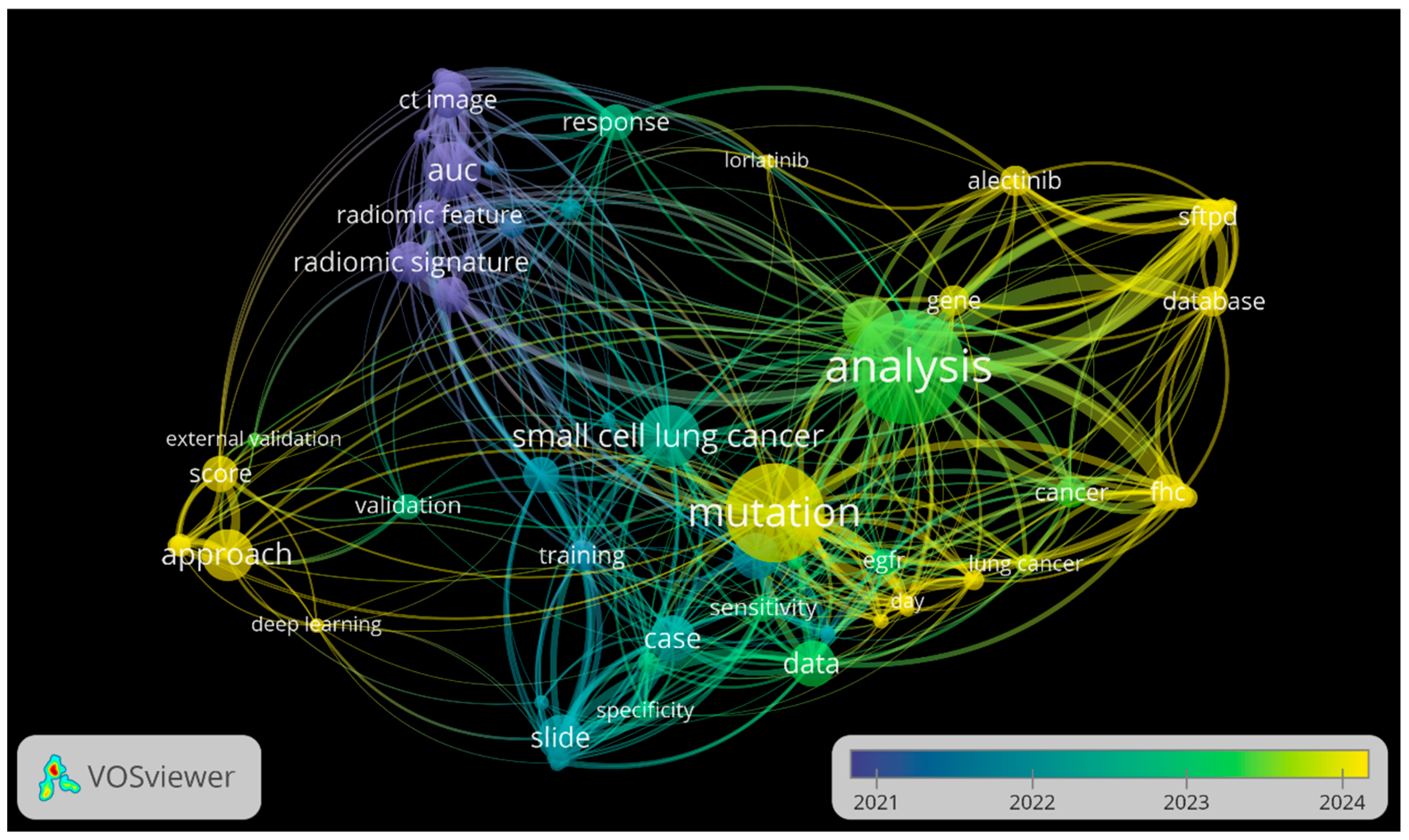
Temporal overlay analysis demonstrated an evolution pattern in research questions, as presented in Figure 3. Studies published between 2021 and 2022 were predominantly centered on radiomic performance metrics and feasibility assessments. In contrast, publications from 2023–2024 increasingly emphasized molecular analysis, treatment-specific contexts, and integrative modeling approaches, suggesting a gradual transition from methodological proof-of-concept toward clinically oriented applications. Notably, terms related to validation and clinical implementation remained peripheral throughout the network.
Figure 3.
Temporal overlay visualization of keyword frequency and co-occurrence. Generated using VOSviewer, version 1.6.20 (Leiden University, The Netherlands).
4. Discussion
This systematic review synthesizes current evidence on AI-based applications in NSCLC with ALK rearrangement, highlighting both the promise and the limitations of this rapidly evolving landscape. Across thirteen eligible studies published between 2020 and 2025, AI was applied to imaging, pathology, molecular datasets, and multimodal clinical data to support molecular identification, prognostication, treatment-response assessment, and mechanistic exploration. Collectively, the findings suggest that AI-based approaches can achieve moderate-to-high discriminative performance in selected tasks, particularly for ALK rearrangement detection, while underscoring substantial gaps in validation, clinical integration, and prospective evaluation.
A major finding of this review is the relatively consistent performance of AI models designed to predict ALK status directly from imaging or histopathological data. Reported AUC values ranging from 0.73 to 0.99 indicate that both radiomics-based and digital pathology approaches can capture phenotypic correlates of ALK-driven disease. Pathology-based DL models, particularly those applied to hematoxylin-eosin-stained slides or cytologic specimens, demonstrated the highest discriminative performance, in some cases approaching near-perfect classification accuracy. These findings align with broader observations in NSCLC that digital pathology-based AI models outperform imaging-only approaches for the prediction of genetic alterations [12,16,19].
Despite promising performance metrics, these models were predominantly developed and tested in retrospective, single-center cohorts. As illustrated in other recent reviews regarding clinical prediction models in NSCLC, favorable internal performance does not necessarily translate into real-world clinical utility, particularly in the absence of external validation and standardized workflows [16]. In the ALK-specific context, this limitation is of particular importance, as even modest reductions in specificity could have significant clinical implications given the low prevalence of ALK rearrangements in unselected NSCLC populations [1,2].
Beyond molecular classification, a subset of included studies focused on prognostic modeling and treatment-response prediction in ALK-positive NSCLC. Radiomics-based and multimodal models demonstrated moderate-to-high discriminative ability for PFS and OS, with C-index values generally exceeding 0.70. These findings align with broader NSCLC AI literature, indicating that radiomics and clinical–radiologic models can provide complementary prognostic information, while multimodal approaches integrating imaging with pathology and clinical variables are increasingly emphasized for risk stratification and treatment outcome prediction [15,18,32].
Remarkably, the inclusion of ALK-positive cohorts in prognostic AI studies remains limited, and most models were not specifically designed to guide therapeutic strategies among different ALK TKIs. This contrasts with emerging AI-based clinical prediction models in unselected NSCLC populations, which increasingly incorporate treatment-specific variables and attempt to predict outcomes under distinct therapeutic strategies [16]. In unselected NSCLC, DL survival models incorporating tumor stage, clinical features, and treatment modalities have demonstrated superior prognostic performance in comparison with conventional staging systems, and have even been explored as tools to support individualized treatment recommendations [33,34].
In EGFR-mutant NSCLC, AI-driven prognostic models have progressed beyond risk stratification to treatment-response prediction. DL frameworks integrating imaging-derived semantic features have been shown to identify patients unlikely to benefit from EGFR-TKIs, with external validation across multiple cohorts and direct implications for therapeutic selection [35]. These developments highlight how AI can be leveraged not only for prognosis but also to inform precision treatment strategies in oncogene-driven NSCLC.
In early-stage NSCLC, multiple ML-based prognostic models have been developed using radiomics, digital pathology, and clinicopathological variables to predict OS or recurrence risk, often with multicenter validation. These models aim to identify patients who may benefit from adjuvant therapy beyond standard staging criteria [36,37]. However, none of these approaches have focused specifically on ALK-rearranged tumors, despite their distinct biology and therapeutic trajectories.
The relative scarcity of ALK-specific prognostic and predictive AI models, therefore, represents a critical gap. Given the evolving landscape of ALK inhibitors and the heterogeneous patterns of resistance, AI tools tailored to ALK-rearranged NSCLC could play a crucial role in optimizing treatment sequencing, anticipating resistance, and refining long-term disease management. The contrast between the maturity of AI-based prognostic modeling in EGFR-mutant or unselected NSCLC and its limited application in ALK-positive disease underscores an unmet need for ALK-focused predictive frameworks.
An important, albeit smaller, body of work has explored the application of AI to the investigation of resistance mechanisms to ALK TKIs. In silico studies leveraging molecular modeling, mutation databases, and bioinformatic analyses identified candidate resistance-associated genes, signaling pathways, and structural alterations affecting ALK inhibitor binding. These studies provide biologically plausible insights into resistance mechanisms, including rare fusion variants and conformational changes that may underlie poor responses to specific ALK inhibitors [14,31]. Nevertheless, the biological relevance of these computational predictions ultimately requires validation through functional assays and genomic analyses in experimental and clinical datasets. While such approaches align with broader trends in AI-driven molecular oncology, their clinical relevance remains largely hypothetical, as most mechanistic AI studies often lack direct linkage to patient-level outcomes or prospective validation [32]. As a result, their contribution currently lies more in hypothesis generation and drug discovery than in immediate clinical decision support.
The bibliometric mapping performed in this review revealed two key tendencies in the current literature on AI in ALK-rearranged NSCLC. The body of research is primarily organized around methodology rather than clinical decision-making pathways. Temporal overlay analysis demonstrated a shift from feasibility studies focused on imaging-derived performance metrics in 2021–2022 toward more recent studies integrating clinical, imaging, pathological, and molecular features for prediction and prognostication, reflecting a gradual maturation of the field. However, aspects concerning validation, clinical implementation, and real-world applicability remained peripheral, underscoring a persistent gap between model development and translational utility [16]. In the ALK-specific context, this gap may be further exacerbated by small cohort sizes, molecular heterogeneity, and rapidly evolving treatment paradigms. Accordingly, the bibliometric patterns identified in this review should be interpreted as exploratory, reinforcing the need for future research to move beyond performance benchmarking toward prospectively validated, clinically integrated AI frameworks.
Several limitations should be considered when interpreting the findings of this review. The number of eligible studies focusing specifically on ALK-rearranged NSCLC remains small, which restricts the generalizability of conclusions. Most included studies were retrospective and single-center, with heterogeneous datasets, feature selection strategies, AI methodologies, and reported performance metrics, precluding quantitative synthesis or meta-analysis. Only one study employed a prospective observational design; however, even this investigation did not assess AI models in prospective clinical deployment or real-time decision-support integration. External validation was reported infrequently, with most models relying on internal cross-validation or single-cohort testing, raising concerns regarding overfitting and real-world applicability.
Furthermore, performance metrics, such as AUC and C-index, should be interpreted with caution. In the context of ALK-rearranged NSCLC, the relatively low prevalence of ALK alterations in unselected NSCLC populations may substantially affect the positive predictive value of AI-based prediction models, even when discrimination metrics appear favorable [2]. Consequently, models demonstrating high AUC values in retrospective datasets may yield limited clinical utility when applied to broader patient populations. Notably, most studies did not report threshold selection strategies, calibration metrics, or decision-curve analyses, which are essential for evaluating the clinical usefulness of prediction models and their impact on real-world decision-making. Without these assessments, it remains difficult to determine how model predictions would translate into clinically actionable thresholds or treatment decisions. A formal risk-of-bias assessment using a standardized tool was not feasible due to the methodological heterogeneity of AI-based studies. Instead, a structured qualitative assessment across key methodological domains was performed, although differences in study design and their inherent limitations still constrain the strength of comparative inferences. Finally, publication bias and selective reporting of high-performing models may have contributed to the overestimation of real-world performance.
Future research in this field should prioritize methodological rigor and clinical relevance. Multi-center prospective studies with standardized data acquisition, transparent reporting, and robust external validation are essential to establish the generalizability of AI models across imaging, pathology, and molecular platforms. Emerging collaborative approaches, such as federated learning, which enable model training across multiple institutions without direct data sharing, may help overcome data privacy constraints and mitigate single-center biases while facilitating the development of more generalizable AI models [38].
In ALK-rearranged NSCLC, there remains a clear unmet need for AI frameworks capable of integrating longitudinal clinical and molecular data to predict response and resistance to successive ALK inhibitors. In clinical practice, AI-based models may function as triage tools, identifying patients with a high probability of ALK rearrangements in tissue-limited cases, thereby potentially optimizing diagnostic workflows, guiding the need for re-biopsy, and reducing delays in targeted therapy initiation. AI may also contribute to rational drug development and resistance mitigation. In EGFR-mutated NSCLC, computational modeling and high-throughput structure–activity relationship (SAR) analyses, enhanced by AI, may inform next-generation inhibitor design and accelerate precision drug discovery [39]. Similar AI-assisted SAR-driven strategies could be extended to ALK biology, particularly to address resistance-conferring variants and conformational alterations identified through in silico modeling studies.
Another promising avenue lies in the integration of AI with established prognostic frameworks for brain metastases, a major clinical challenge in ALK-rearranged NSCLC. Prognostic tools, such as the Lung-molGPA and the ALK-Brain Prognostic Index (ALK-BPI), have demonstrated clinical utility and external validation in stratifying survival risk [40,41,42]. AI-driven augmentation of these prognostic scores could enable more individualized prognostication and treatment planning for these patients.
In addition, AI-enhanced liquid biopsy approaches represent a rapidly evolving frontier with particular relevance for ALK-positive disease. Integration of ML with circulating tumor DNA (ctDNA) analysis has shown potential to improve mutation detection sensitivity, identify minimal residual disease, and detect relapse earlier than conventional imaging [43,44]. In the context of ALK-rearranged NSCLC, such approaches could support non-invasive monitoring of resistance mutations, guide treatment switching, and complement radiologic and tissue-based assessments within multimodal AI frameworks.
Finally, future multimodal AI systems may benefit from emerging DL architectures capable of integrating heterogeneous clinical data streams, including imaging, pathology, genomic profiles, and electronic health records within unified analytical frameworks. Such models could function as clinical decision-support systems embedded in routine workflows, assisting physicians in interpreting complex multimodal datasets and guiding individualized treatment strategies [45,46]. Adaptive AI systems incorporating longitudinal data, such as serial imaging, biomarker dynamics, or ctDNA levels, may enable real-time monitoring of treatment response and earlier detection of therapeutic resistance, thereby paving the way for more responsive and personalized disease management [43,45].
5. Conclusions
AI applications in ALK-rearranged NSCLC show promising potential across molecular prediction, prognostication, treatment-response assessment, and exploratory analysis of resistance mechanisms using imaging, pathology, molecular, and multimodal data. However, their evidence is constrained by small study numbers, methodological heterogeneity, limited external validation, and a lack of prospective clinical implementation. Future advances will depend not only on improved model performance but also on the thoughtful integration of AI into clinically meaningful pathways. Bridging the gap between algorithmic innovation and real-world clinical impact will require rigorous prospective validation and close multidisciplinary collaboration between clinicians, data scientists, and regulatory stakeholders to ensure safe and effective clinical translation in ALK-rearranged NSCLC.
Supplementary Materials
The following supporting information can be downloaded at: https://www.mdpi.com/article/10.3390/cancers18060973/s1. Table S1: PRISMA checklist.
Author Contributions
Conceptualization: A.K. and C.T.; writing—original draft preparation: A.K., C.T., and K.K.; writing—review and editing: A.K., C.T., K.K., G.T., and G.M.; revision and proofreading: G.M. All authors have read and agreed to the published version of the manuscript.
Funding
A.K. received research grants from the European Society for Medical Oncology (ESMO), the Hellenic Society of Medical Oncology (HeSMO), Scholarship—Legacy “M. M. Manassaki” by the University of Crete, Radiumhemmet Research Funds, Stiftelsen Tage Olssons Stipendiefond, Onassis Foundation Scholarship 2025–2026, and Elena Iliopoulou Giama (EIG) Cancer Research & Scholarship Foundation. The funders had no role in the collection, the interpretation of data, or the writing of the manuscript. Any views, opinions, findings, conclusions, or recommendations expressed in this material are those solely of the authors and do not necessarily reflect those of the funders.
Data Availability Statement
No new datasets were generated in this study. All data analyzed are derived from published studies included in the review and cited in the reference list.
Conflicts of Interest
The authors declare no conflicts of interest.
Abbreviations
The following abbreviations are used in this manuscript:
| NSCLC | Non-small-cell lung cancer |
| ALK | Anaplastic lymphoma kinase |
| TKIs | Tyrosine kinase inhibitors |
| AI | Artificial intelligence |
| ML | Machine learning |
| DL | Deep learning |
| CT | Computed tomography |
| PET-CT | Positron emission tomography/computed tomography |
| IHC | Immunohistochemistry |
| AUC | Area under the curve |
| Vs. | versus |
| EV | External validation |
| ANN | Artificial neural network |
| DAVID | Database for annotation, visualization, and integrated discovery |
| MUC5B | Mucin 5B |
| SFTPD | Surfactant protein D |
| DMBT1 | Deleted in malignant brain tumors 1 |
| SFTPA2 | Surfactant protein A2 |
| TFF3 | Trefoil factor 3 |
| CNN | Convolutional neural network |
| mRMR | Maximum relevance minimum redundancy |
| LASSO | Least absolute shrinkage and selection operator |
| HR | Hazard ratio |
| PFS | Progression-free survival |
| RSF | Random survival forest |
| CPH | Cox proportional hazard |
References
- Planchard, D.; Popat, S.; Kerr, K.; Novello, S.; Smit, E.F.; Faivre-Finn, C.; Mok, T.S.; Reck, M.; Van Schil, P.E.; Hellmann, M.D.; et al. Metastatic non-small cell lung cancer: ESMO Clinical Practice Guidelines for diagnosis, treatment and follow-up. Ann. Oncol. 2018, 29, iv192–iv237. [Google Scholar] [CrossRef] [Scilit] [PubMed]
- Hendriks, L.E.; Kerr, K.M.; Menis, J.; Mok, T.S.; Nestle, U.; Passaro, A.; Peters, S.; Planchard, D.; Smit, E.F.; Solomon, B.J.; et al. Oncogene-addicted metastatic non-small-cell lung cancer: ESMO Clinical Practice Guideline for diagnosis, treatment and follow-up. Ann. Oncol. 2023, 34, 339–357. [Google Scholar] [CrossRef] [Scilit] [PubMed]
- Gibson, A.J.W.; Box, A.; Dean, M.L.; Elegbede, A.A.; Hao, D.; Sangha, R.; Bebb, D.G. Retrospective Real-World Outcomes for Patients With ALK-Rearranged Lung Cancer Receiving ALK Receptor Tyrosine Kinase Inhibitors. JTO Clin. Res. Rep. 2021, 2, 100157. [Google Scholar] [CrossRef] [Scilit] [PubMed]
- Chazan, G.; Franchini, F.; Shah, R.; Alexander, M.; John, A.; IJzerman, M.; Solomon, B. Real-World Treatment and Outcomes in ALK-Rearranged NSCLC: Results From a Large U.S.-Based Database. JTO Clin. Res. Rep. 2024, 5, 100662. [Google Scholar] [CrossRef] [Scilit]
- Solomon, B.J.; Mok, T.; Kim, D.W.; Wu, Y.L.; Nakagawa, K.; Mekhail, T.; Felip, E.; Cappuzzo, F.; Paolini, J.; Usari, T.; et al. First-line crizotinib versus chemotherapy in ALK-positive lung cancer. N. Engl. J. Med. 2014, 371, 2167–2177. [Google Scholar] [CrossRef] [Scilit]
- Shaw, A.T.; Kim, T.M.; Crino, L.; Gridelli, C.; Kiura, K.; Liu, G.; Novello, S.; Bearz, A.; Gautschi, O.; Mok, T.; et al. Ceritinib versus chemotherapy in patients with ALK-rearranged non-small-cell lung cancer previously given chemotherapy and crizotinib (ASCEND-5): A randomised, controlled, open-label, phase 3 trial. Lancet Oncol. 2017, 18, 874–886. [Google Scholar] [CrossRef] [Scilit]
- Peters, S.; Camidge, R.; Dziadziuszko, R.; Gadgeel, S.; Shaw, A.T.; Kim, D.W.; Perol, M.; Rosell, D.R.; Cheema, P.; Wan-Teck Lim, D.; et al. Alectinib versus crizotinib in previously untreated ALK-positive advanced non-small cell lung cancer: Final overall survival analysis of the phase III ALEX study. Ann. Oncol. 2026, 37, 92–103. [Google Scholar] [CrossRef] [Scilit]
- Ahn, M.J.; Kim, H.R.; Yang, J.C.H.; Han, J.Y.; Li, J.Y.; Hochmair, M.J.; Chang, G.C.; Delmonte, A.; Lee, K.H.; Campelo, R.G.; et al. Efficacy and Safety of Brigatinib Compared With Crizotinib in Asian vs. Non-Asian Patients With Locally Advanced or Metastatic ALK-Inhibitor-Naive ALK+ Non-Small Cell Lung Cancer: Final Results From the Phase III ALTA-1L Study. Clin. Lung Cancer 2022, 23, 720–730. [Google Scholar] [CrossRef] [Scilit]
- Solomon, B.J.; Liu, G.; Felip, E.; Mok, T.S.K.; Soo, R.A.; Mazieres, J.; Shaw, A.T.; de Marinis, F.; Goto, Y.; Wu, Y.L.; et al. Lorlatinib Versus Crizotinib in Patients With Advanced ALK-Positive Non-Small Cell Lung Cancer: 5-Year Outcomes From the Phase III CROWN Study. J. Clin. Oncol. 2024, 42, 3400–3409. [Google Scholar] [CrossRef] [Scilit]
- Barberis, M.; Rappa, A.; de Marinis, F.; Pelosi, G.; Guerini Rocco, E.; Zhan, Y.; Tiana, G. A rationale for the poor response to alectinib in a patient with adenocarcinoma of the lung harbouring a STRN-ALK fusion by artificial intelligence and molecular modelling: A case report. Transl. Lung Cancer Res. 2024, 13, 3807–3814. [Google Scholar] [CrossRef] [Scilit]
- Tan, X.; Li, Y.; Wang, S.; Xia, H.; Meng, R.; Xu, J.; Duan, Y.; Li, Y.; Yang, G.; Ma, Y.; et al. Predicting EGFR mutation, ALK rearrangement, and uncommon EGFR mutation in NSCLC patients by driverless artificial intelligence: A cohort study. Respir. Res. 2022, 23, 132. [Google Scholar] [CrossRef] [Scilit]
- Song, Z.; Liu, T.; Shi, L.; Yu, Z.; Shen, Q.; Xu, M.; Huang, Z.; Cai, Z.; Wang, W.; Xu, C.; et al. The deep learning model combining CT image and clinicopathological information for predicting ALK fusion status and response to ALK-TKI therapy in non-small cell lung cancer patients. Eur. J. Nucl. Med. Mol. Imaging 2021, 48, 361–371. [Google Scholar] [CrossRef] [Scilit]
- Chen, J.; Liu, J.; Qi, L.; Li, F.; Cui, S.; Wang, J. Influencing factors and prediction of growth heterogeneity in solid nodule non-small cell lung cancer based on artificial intelligence: A prospective study. Transl. Lung Cancer Res. 2025, 14, 4285–4300. [Google Scholar] [CrossRef] [Scilit]
- Mayer, C.; Ofek, E.; Fridrich, D.E.; Molchanov, Y.; Yacobi, R.; Gazy, I.; Hayun, I.; Zalach, J.; Paz-Yaacov, N.; Barshack, I. Direct identification of ALK and ROS1 fusions in non-small cell lung cancer from hematoxylin and eosin-stained slides using deep learning algorithms. Mod. Pathol. 2022, 35, 1882–1887. [Google Scholar] [CrossRef] [Scilit]
- Ninatti, G.; Kirienko, M.; Neri, E.; Sollini, M.; Chiti, A. Imaging-Based Prediction of Molecular Therapy Targets in NSCLC by Radiogenomics and AI Approaches: A Systematic Review. Diagn 2020, 10, 359. [Google Scholar] [CrossRef] [Scilit]
- Howard, H.R.; Hasanova, M.; Tiwari, A.; Ghose, A.; Winayak, R.; Nahar, T.; Chauhan, V.; Arun, S.; Palmer, K.; Houston, A.; et al. The landscape of conventional and artificial intelligence-based clinical prediction models in non-small-cell lung cancer: From development to real-world validation. ESMO Open 2025, 10, 105557. [Google Scholar] [CrossRef] [Scilit] [PubMed]
- Parra-Medina, R.; Guerron-Gomez, G.; Mendivelso-Gonzalez, D.; Gil-Gomez, J.H.; Alzate, J.P.; Gomez-Suarez, M.; Polo, J.F.; Sprockel, J.J.; Mosquera-Zamudio, A. Deep learning in histopathology images for prediction of oncogenic driver molecular alterations in lung cancer: A systematic review and meta-analysis. Transl. Lung Cancer Res. 2025, 14, 1756–1769. [Google Scholar] [CrossRef] [Scilit] [PubMed]
- Fuster-Matanzo, A.; Pico-Peris, A.; Bellvis-Bataller, F.; Jimenez-Pastor, A.; Weiss, G.J.; Marti-Bonmati, L.; Lazaro Sanchez, A.; Bazaga, D.; Banna, G.L.; Addeo, A.; et al. Prediction of oncogene mutation status in non-small cell lung cancer: A systematic review and meta-analysis with a special focus on artificial intelligence-based methods. Eur. Radiol. 2025, 36, 2157–2185. [Google Scholar] [CrossRef] [Scilit] [PubMed]
- Ishii, S.; Takamatsu, M.; Ninomiya, H.; Inamura, K.; Horai, T.; Iyoda, A.; Honma, N.; Hoshi, R.; Sugiyama, Y.; Yanagitani, N.; et al. Machine learning-based gene alteration prediction model for primary lung cancer using cytologic images. Cancer Cytopathol. 2022, 130, 812–823. [Google Scholar] [CrossRef] [Scilit]
- Trinh, T.C.; Phan, T.L.; To, V.T.; Pham, T.A.; Truong, G.B.; Le, L.H.S.; Tran, X.D.; Truong, T.N. Synergy of advanced machine learning and deep neural networks with consensus molecular docking for virtual screening of anaplastic lymphoma kinase inhibitors. J. Comput. Aided Mol. Des. 2025, 39, 79. [Google Scholar] [CrossRef] [Scilit]
- Calvo, V.; Niazmand, E.; Carcereny, E.; Rodriguez-Abreu, D.; Cobo, M.; Lopez-Castro, R.; Guirado, M.; Camps, C.; Laura Ortega, A.; Bernabe, R.; et al. Family history of cancer and lung cancer: Utility of big data and artificial intelligence for exploring the role of genetic risk. Lung Cancer 2024, 195, 107920. [Google Scholar] [CrossRef] [Scilit] [PubMed]
- Li, Z.; Fan, Y.; Ma, Y.; Meng, N.; Li, D.; Wang, D.; Lian, J.; Hu, C. Identification of Crucial Genes and Signaling Pathways in Alectinib-Resistant Lung Adenocarcinoma Using Bioinformatic Analysis. Mol. Biotechnol. 2024, 66, 3655–3673. [Google Scholar] [CrossRef] [Scilit] [PubMed]
- Chang, C.; Sun, X.; Wang, G.; Yu, H.; Zhao, W.; Ge, Y.; Duan, S.; Qian, X.; Wang, R.; Lei, B.; et al. A Machine Learning Model Based on PET/CT Radiomics and Clinical Characteristics Predicts ALK Rearrangement Status in Lung Adenocarcinoma. Front. Oncol. 2021, 11, 603882. [Google Scholar] [CrossRef] [Scilit]
- Terada, Y.; Takahashi, T.; Hayakawa, T.; Ono, A.; Kawata, T.; Isaka, M.; Muramatsu, K.; Tone, K.; Kodama, H.; Imai, T.; et al. Artificial Intelligence-Powered Prediction of ALK Gene Rearrangement in Patients With Non-Small-Cell Lung Cancer. JCO Clin. Cancer Inform. 2022, 6, e2200070. [Google Scholar] [CrossRef] [Scilit] [PubMed]
- Page, M.J.; McKenzie, J.E.; Bossuyt, P.M.; Boutron, I.; Hoffmann, T.C.; Mulrow, C.D.; Shamseer, L.; Tetzlaff, J.M.; Akl, E.A.; Brennan, S.E.; et al. The PRISMA 2020 statement: An updated guideline for reporting systematic reviews. BMJ 2021, 372, n71. [Google Scholar] [CrossRef] [Scilit] [PubMed]
- Arruda, H.; Silva, E.R.; Lessa, M.; Proenca, D., Jr.; Bartholo, R. VOSviewer and Bibliometrix. J. Med. Libr. Assoc. 2022, 110, 392–395. [Google Scholar] [CrossRef] [Scilit]
- Whiting, P.F.; Rutjes, A.W.; Westwood, M.E.; Mallett, S.; Deeks, J.J.; Reitsma, J.B.; Leeflang, M.M.; Sterne, J.A.; Bossuyt, P.M.; QUADAS-2 Group. QUADAS-2: A revised tool for the quality assessment of diagnostic accuracy studies. Ann. Intern. Med. 2011, 155, 529–536. [Google Scholar] [CrossRef] [Scilit]
- Wolff, R.F.; Moons, K.G.M.; Riley, R.D.; Whiting, P.F.; Westwood, M.; Collins, G.S.; Reitsma, J.B.; Kleijnen, J.; Mallett, S.; Groupdagger, P. PROBAST: A Tool to Assess the Risk of Bias and Applicability of Prediction Model Studies. Ann. Intern. Med. 2019, 170, 51–58. [Google Scholar] [CrossRef] [Scilit]
- Moons, K.G.M.; Damen, J.A.A.; Kaul, T.; Hooft, L.; Andaur Navarro, C.; Dhiman, P.; Beam, A.L.; Van Calster, B.; Celi, L.A.; Denaxas, S.; et al. PROBAST+AI: An updated quality, risk of bias, and applicability assessment tool for prediction models using regression or artificial intelligence methods. BMJ 2025, 388, e082505. [Google Scholar] [CrossRef] [Scilit]
- Li, H.; Zhang, R.; Wang, S.; Fang, M.; Zhu, Y.; Hu, Z.; Dong, D.; Shi, J.; Tian, J. CT-Based Radiomic Signature as a Prognostic Factor in Stage IV ALK-Positive Non-small-cell Lung Cancer Treated With TKI Crizotinib: A Proof-of-Concept Study. Front. Oncol. 2020, 10, 57. [Google Scholar] [CrossRef] [Scilit]
- Koyama, J.; Morise, M.; Furukawa, T.; Oyama, S.; Matsuzawa, R.; Tanaka, I.; Wakahara, K.; Yokota, H.; Kimura, T.; Shiratori, Y.; et al. Artificial intelligence-based personalized survival prediction using clinical and radiomics features in patients with advanced non-small cell lung cancer. BMC Cancer 2024, 24, 1417. [Google Scholar] [CrossRef] [Scilit]
- Pourakbar, N.; Motamedi, A.; Pashapour, M.; Sharifi, M.E.; Sharabiani, S.S.; Fazlollahi, A.; Abdollahi, H.; Rahmim, A.; Rezaei, S. Effectiveness of Artificial Intelligence Models in Predicting Lung Cancer Recurrence: A Gene Biomarker-Driven Review. Cancers 2025, 17, 1892. [Google Scholar] [CrossRef] [Scilit] [PubMed]
- She, Y.; Jin, Z.; Wu, J.; Deng, J.; Zhang, L.; Su, H.; Jiang, G.; Liu, H.; Xie, D.; Cao, N.; et al. Development and Validation of a Deep Learning Model for Non-Small Cell Lung Cancer Survival. JAMA Netw. Open 2020, 3, e205842. [Google Scholar] [CrossRef] [Scilit] [PubMed]
- Torrente, M.; Sousa, P.A.; Hernandez, R.; Blanco, M.; Calvo, V.; Collazo, A.; Guerreiro, G.R.; Nunez, B.; Pimentao, J.; Sanchez, J.C.; et al. An Artificial Intelligence-Based Tool for Data Analysis and Prognosis in Cancer Patients: Results from the Clarify Study. Cancers 2022, 14, 4041. [Google Scholar] [CrossRef] [Scilit]
- Song, J.; Wang, L.; Ng, N.N.; Zhao, M.; Shi, J.; Wu, N.; Li, W.; Liu, Z.; Yeom, K.W.; Tian, J. Development and Validation of a Machine Learning Model to Explore Tyrosine Kinase Inhibitor Response in Patients With Stage IV EGFR Variant-Positive Non-Small Cell Lung Cancer. JAMA Netw. Open 2020, 3, e2030442. [Google Scholar] [CrossRef] [Scilit] [PubMed]
- Lu, C.; Bera, K.; Wang, X.; Prasanna, P.; Xu, J.; Janowczyk, A.; Beig, N.; Yang, M.; Fu, P.; Lewis, J.; et al. A prognostic model for overall survival of patients with early-stage non-small cell lung cancer: A multicentre, retrospective study. Lancet Digit. Health 2020, 2, e594–e606. [Google Scholar] [CrossRef] [Scilit]
- Janik, A.; Torrente, M.; Costabello, L.; Calvo, V.; Walsh, B.; Camps, C.; Mohamed, S.K.; Ortega, A.L.; Novacek, V.; Massuti, B.; et al. Machine Learning-Assisted Recurrence Prediction for Patients With Early-Stage Non-Small-Cell Lung Cancer. JCO Clin. Cancer Inform. 2023, 7, e2200062. [Google Scholar] [CrossRef] [Scilit]
- Ankolekar, A.; Boie, S.; Abdollahyan, M.; Gadaleta, E.; Hasheminasab, S.A.; Yang, G.; Beauville, C.; Dikaios, N.; Kastis, G.A.; Bussmann, M.; et al. Advancing breast, lung and prostate cancer research with federated learning. A systematic review. NPJ Digit. Med. 2025, 8, 314. [Google Scholar] [CrossRef] [Scilit]
- Naykwadi, H.; Alavala, R.R. Overcoming Resistance in EGFR-Mutant Cancers: A Comprehensive Review of Inhibitor Evolution and SAR-Based Design. Drug Dev. Res. 2026, 87, e70220. [Google Scholar] [CrossRef] [Scilit]
- Sperduto, P.W.; Yang, T.J.; Beal, K.; Pan, H.; Brown, P.D.; Bangdiwala, A.; Shanley, R.; Yeh, N.; Gaspar, L.E.; Braunstein, S.; et al. Estimating Survival in Patients With Lung Cancer and Brain Metastases: An Update of the Graded Prognostic Assessment for Lung Cancer Using Molecular Markers (Lung-molGPA). JAMA Oncol. 2017, 3, 827–831. [Google Scholar] [CrossRef] [Scilit]
- Crouzen, J.A.; Mast, M.E.; Hakstege, M.; Broekman, M.L.D.; Baladi, C.; Mertens, B.J.A.; Nandoe Tewarie, R.D.S.; Kerkhof, M.; Vos, M.J.; Maas, K.W.; et al. External validation of the lung-molGPA to predict survival in patients treated with stereotactic radiotherapy for brain metastases of non-small cell lung cancer. Radiother. Oncol. 2024, 198, 110405. [Google Scholar] [CrossRef] [Scilit] [PubMed]
- Zerdes, I.; Kamali, C.; Koulouris, A.; Elsayed, M.; Schnorbach, J.; Christopoulos, P.; Tsakonas, G. Validation of the ALK-Brain Prognostic Index for patients with ALK-rearranged lung cancer and brain metastases. ESMO Open 2023, 8, 102069. [Google Scholar] [CrossRef] [Scilit] [PubMed]
- Thalambedu, N.; Balla, M.; Sivasubramanian, B.P.; Sadaram, P.; Malla, K.P.; Vasipalli, K.P.; Kakadia, S. Integrating artificial intelligence with circulating tumor DNA for non-small cell lung cancer: Opportunities, challenges, and future directions. Front. Med. 2025, 12, 1612376. [Google Scholar] [CrossRef] [Scilit] [PubMed]
- Cherukuri, S.P.; Kaur, A.; Goyal, B.; Kukunoor, H.R.; Sahito, A.F.; Sachdeva, P.; Yerrapragada, G.; Elangovan, P.; Shariff, M.N.; Natarajan, T.; et al. Artificial Intelligence-Enhanced Liquid Biopsy and Radiomics in Early-Stage Lung Cancer Detection: A Precision Oncology Paradigm. Cancers 2025, 17, 3165. [Google Scholar] [CrossRef] [Scilit]
- Zhu, E.; Muneer, A.; Zhang, J.; Xia, Y.; Li, X.; Zhou, C.; Heymach, J.V.; Wu, J.; Le, X. Progress and challenges of artificial intelligence in lung cancer clinical translation. NPJ Precis. Oncol. 2025, 9, 210. [Google Scholar] [CrossRef] [Scilit]
- Basety, S.; Gudepu, R.; Velidandi, A. Artificial Intelligence in Lung Cancer: A Narrative Review of Recent Advances in Diagnosis, Biomarker Discovery, and Drug Development. Pharmaceutics 2026, 18, 201. [Google Scholar] [CrossRef] [Scilit]

Disclaimer/Publisher’s Note: The statements, opinions and data contained in all publications are solely those of the individual author(s) and contributor(s) and not of MDPI and/or the editor(s). MDPI and/or the editor(s) disclaim responsibility for any injury to people or property resulting from any ideas, methods, instructions or products referred to in the content. |
© 2026 by the authors. Licensee MDPI, Basel, Switzerland. This article is an open access article distributed under the terms and conditions of the Creative Commons Attribution (CC BY) license.