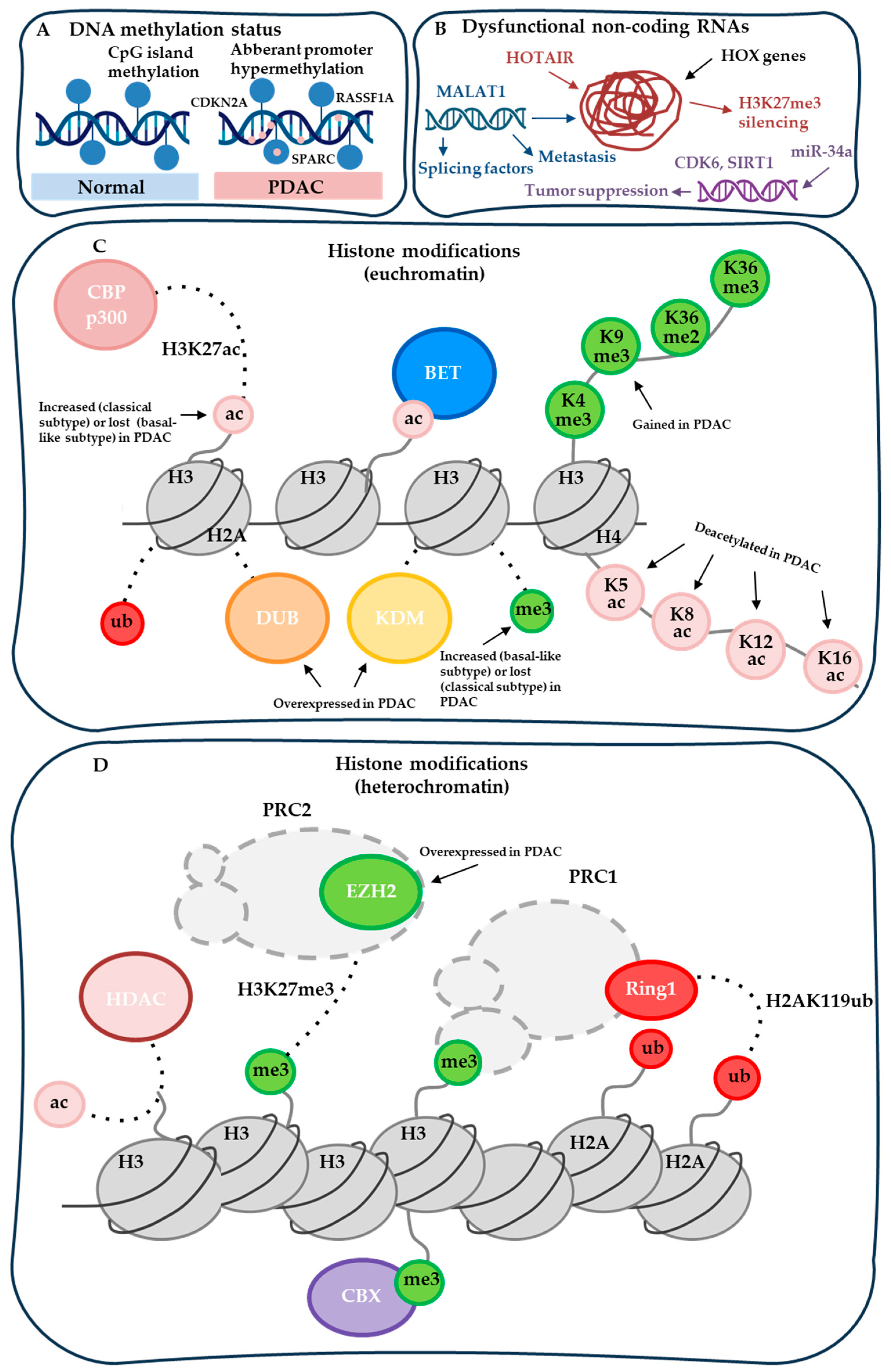
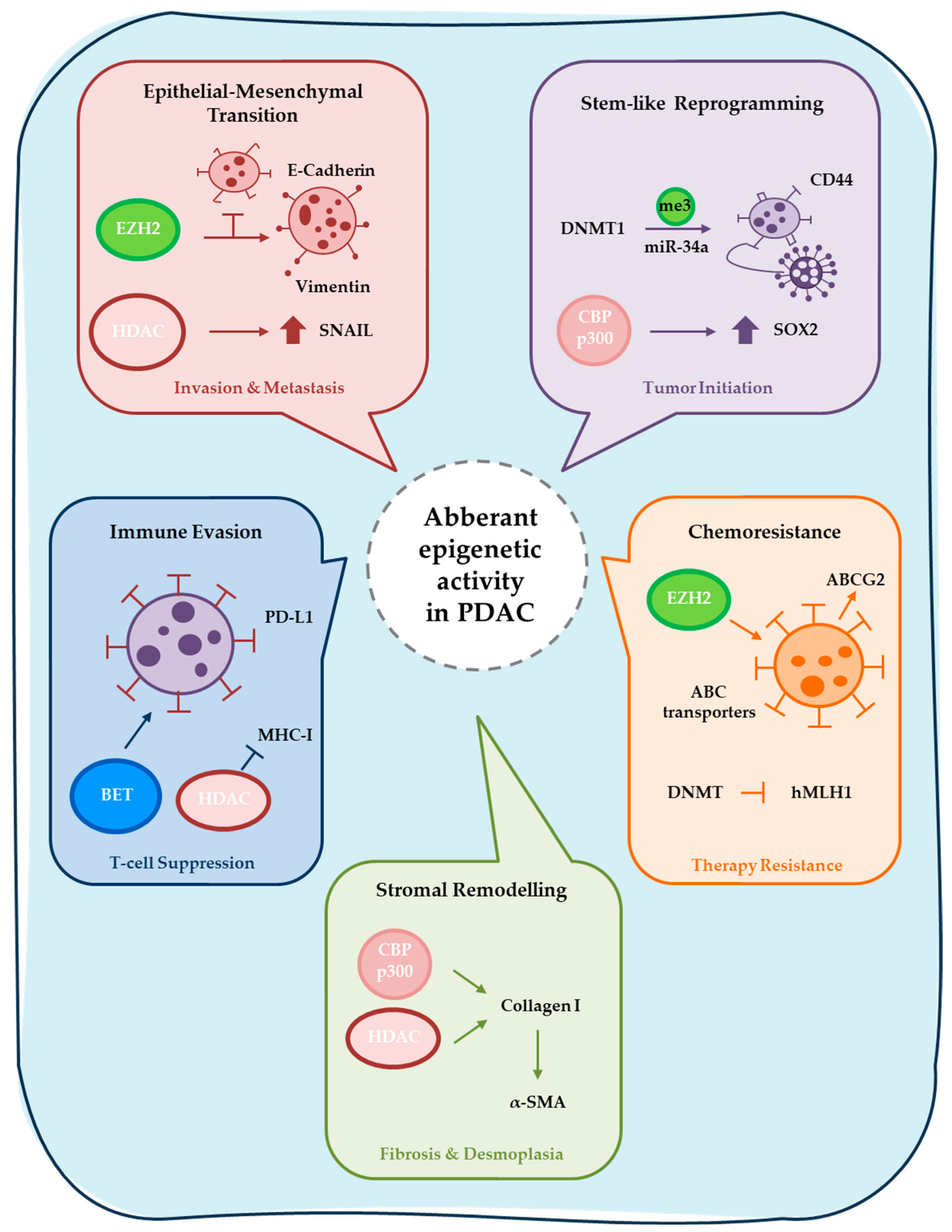
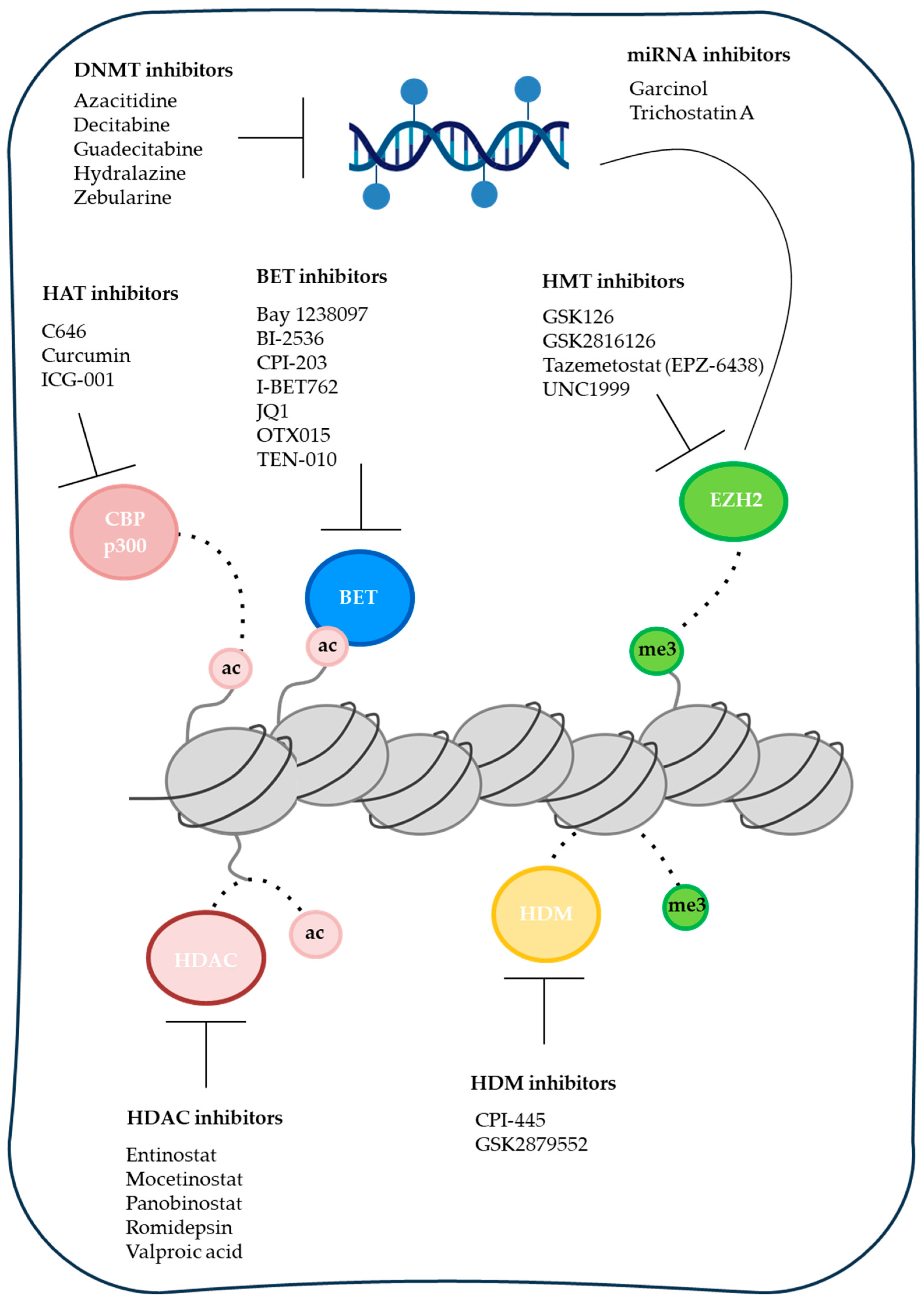
Epigenetic Regulators as Therapeutic Targets in Pancreatic Ductal Adenocarcinoma

Simple Summary
Abstract
1. Introduction
2. DNA Methylation
2.1. Aberrant Methylation in PDAC
2.2. Diagnostic and Circulating Biomarkers
2.3. Therapeutic Targeting of DNA Methylation
3. Histone Modifications
3.1. Epigenetic Writers
3.1.1. EZH2 and the Polycomb Repressive Complex 2 (PRC2)
3.1.2. CBP/p300 Acetyltransferases
- (i)
- Catalytic (HAT domain) inhibitors target the acetyltransferase active site, blocking substrate acetylation and enhancer activation. The most advanced is A-485, a potent, selective HAT inhibitor with nanomolar potency that suppresses proliferation in KRAS-driven cancer models, including preclinical PDAC lines, by reducing H3K27ac at oncogenic enhancers and downregulating stemness/EMT programs. Related compounds like CCS1477 (inobrodib) inhibit CBP/p300 HAT activity indirectly via bromodomain engagement but show broader effects. Preclinical PDAC data are limited but supportive in KRAS-mutant contexts (synergy with BETi or chemo). CCS1477 is in Phase I/II trials (NCT04068597, NCT03564132) for advanced solid tumors and hematologic malignancies, with early signals in prostate and other cancers, but no PDAC-specific cohorts have been reported yet [30,87,88].
- (ii)
- Bromodomain inhibitors antagonize the acetyl-lysine reader module, displacing CBP/p300 from chromatin and disrupting enhancer recruitment of BRD4/MYC. Key probes include SGC-CBP30 and I-CBP112, which selectively bind CBP/p300 bromodomains over other BRDs, reducing super-enhancer activity and oncogene transcription (MYC, BCL2). In PDAC models, these show emerging anti-proliferative effects, often in combination with BETi to block compensatory pathways. Activity is documented in hematologic malignancies and solid tumors (prostate, lung), with PDAC-specific evaluation preclinical and promising in organoid/xenograft models of enhancer-addicted subtypes. No bromodomain-only CBP/p300 inhibitors are in PDAC trials; CCS1477 (bromodomain-focused) advances clinical development [88,89,90].
- (iii)
- Dual CBP/p300 inhibitors coordinate HAT and bromodomain blockade for more complete disruption of enhancer activation. These include dual BET/CBP/p300 bromodomain compounds like NEO2734 (EP31670) and XP-524, which potently suppress KRAS-driven transcriptional programs, reduce H3K27ac, and inhibit PDAC growth in vitro/ex vivo/in vivo (patient-derived xenografts, organoids). NEO2734 shows superior efficacy over single-target inhibitors in PDAC models, overcoming BET resistance and synergizing with immune checkpoint blockade. Preclinical PDAC data are robust, with strong antitumor activity in KRAS-mutant contexts. NEO2734 has entered early clinical trials in solid tumors/prostate cancer, with PDAC relevance inferred [88,91,92].
- (iv)
- PROTACs and degraders recruit E3 ligases (CRBN/VHL) for ubiquitin-mediated proteasomal degradation of CBP/p300, achieving durable suppression beyond catalytic inhibition. Examples include QC-182 (based on CCS1477) and others (CBPD-409, MJP6412), which potently deplete CBP/p300 in solid tumor models (HCC, prostate), downregulate oncogenic transcription, and show superior antiproliferative effects. In PDAC, degradation strategies hold promise for overcoming redundancy/resistance in enhancer-driven subtypes, though data remain preclinical (KRAS-context synergy inferred). No CBP/p300 PROTACs are in clinical trials yet, but rapid progress in related degraders suggests potential [93,94,95,96].
3.2. Epigenetic Readers
3.2.1. BET Proteins Family
3.2.2. PRC1 Components: CBX Proteins and BMI1
3.2.3. Emerging Epigenetic Readers in PDAC
- (i)
- PHD finger proteins recognize methylated lysines (H3K4me3) to regulate transcription and DNA repair. ING2 (Inhibitor of Growth 2) binds H3K4me3 via its PHD domain, recruiting HDAC complexes to repress genes and promote apoptosis/DNA damage responses; its downregulation in PDAC may contribute to survival and chemoresistance. BPTF (Bromodomain PHD Finger Transcription Factor), the largest NURF subunit, reads H3K4me3 and facilitates chromatin remodeling; BPTF depletion sensitizes PDAC cells to chemotherapy by repressing ABC transporters and multidrug resistance (MDR) pathways in preclinical models. PHD readers thus support oncogenic transcription and therapy evasion, with emerging inhibitors (fragment-based ligands for BPTF PHD) showing promise [113,114].
- (ii)
- Tudor domain proteins bind methylated arginines/lysines to modulate splicing, transcription, and stress responses. TDRD3 recognizes asymmetric dimethylarginine (H4R3me2a) via its Tudor domain, recruiting TOP3B to resolve R-loops and promote proliferation; its overexpression correlates with poor outcomes in some cancers, with inferred PDAC relevance via arginine methylation pathways (PRMT1-driven). SMN (Survival Motor Neuron) Tudor domain binds symmetric dimethylarginine on spliceosomal proteins (Sm proteins), ensuring splicing fidelity; dysregulation may contribute to RNA metabolism alterations in PDAC. Tudor readers link arginine methylation to RNA processing and genome stability, offering potential in PRMT-inhibitor combinations [115,116]
- (iii)
- Chromodomain proteins (beyond CBX) recognize methylated lysines/arginines for remodeling. CDY1 binds H3K9me3/H3K27me3 to repress transcription; limited PDAC data suggest roles in heterochromatin maintenance. CHD family helicases (CHD1, CHD4) contain chromodomains and ATPase activity for nucleosome sliding; CHD1 loss or mutation disrupts enhancer integrity and cooperates with KRAS in PDAC subtypes, promoting dedifferentiation/EMT. CHD readers/remodelers thus influence chromatin accessibility and subtype plasticity [117,118]
- (iv)
- WD40 repeat proteins include EED (Embryonic Ectoderm Development) in PRC2, which binds H3K27me3 via its β-propeller domain to allosterically activate EZH2 and propagate repressive marks. EED stabilizes PRC2 spreading in PDAC, sustaining silencing of tumor suppressors; targeting EED (allosteric inhibitors like MAK683) disrupts this feedback, offering synergy with EZH2i to overcome redundancy [119,120]
- (v)
- HMGA1 (High Mobility Group AT-hook 1), a non-histone chromatin-binding protein that functions as an epigenetic modulator and reader-like factor. HMGA1 binds preferentially to AT-rich sequences in the minor groove of DNA, inducing conformational changes that alter nucleosome positioning, enhance chromatin accessibility, and facilitate recruitment of transcriptional regulators, co-activators, and epigenetic complexes [121]. In PDAC, HMGA1 is strongly overexpressed in tumor cells compared to normal pancreatic tissue, with high levels correlating with advanced tumor grade, dedifferentiation, lymph node metastasis, and poor overall survival [122]. Overexpression activates oncogenic transcriptional programs, including upregulation of genes involved in proliferation (via COX-2 axis), survival, and chemoresistance (to gemcitabine via Akt-dependent mechanisms) [123]. Critically, HMGA1 promotes key hallmarks of PDAC progression: it drives epithelial–mesenchymal transition (EMT) through repression of epithelial markers (E-cadherin) and activation of mesenchymal programs; enhances stem-like reprogramming by sustaining cancer stem cell properties; and contributes to aggressive biology in molecular subclasses, such as the HMGA1/FGF19-overexpressing subset associated with extremely poor outcomes and enhanced stroma formation [124]. Targeting HMGA1—via direct inhibitors, siRNA, or disruption of its interactions with epigenetic partners—represents an emerging strategy to attenuate PDAC aggressiveness, particularly in high-HMGA1 subsets [125]. Future studies should explore HMGA1 as a biomarker and therapeutic vulnerability in combination with epigenetic regimens.
3.3. Epigenetic Erasers
3.3.1. Histone Deacetylases (HDACs)
3.3.2. Histone Demethylases: KDM6A/B and LSD1
3.3.3. Histone Deubiquitinases (BAP1, USP7)
3.4. Evolution of Epigenetic Inhibitors

| Regulator | Mechanistic Role | Functional Consequence in PDAC | Therapeutic Implication |
|---|---|---|---|
| DNMT1 (writer) | Maintenance DNA methyltransferase; adds methyl groups to hemimethylated CpG sites during replication; overexpressed | Hypermethylation of tumor suppressors (CDKN2A, SPARC, RASSF1A); promotes proliferation, chemoresistance, genomic instability [145,146] | DNMT inhibitors (azacitidine, decitabine) under investigation; potential combination with chemotherapy or immunotherapy |
| TET1 (eraser) | Oxidizes 5mC to 5hmC for active demethylation; frequently downregulated/loss of 5hmC | Reduced demethylation; activates EMT/Wnt/β-catenin/Hedgehog; increases invasion/metastasis/chemoresistance [147] | Restoration of TET activity or epigenetic reprogramming strategies may suppress metastasis |
| MeCP2 (reader) | Binds methylated CpG; recruits HDACs/Sin3A repressive complexes; context-dependent dysregulation | Aberrant repression/chromatin compaction; gene silencing/altered splicing; contributes to progression [148] | Targeting MeCP2-associated chromatin complexes; indirect targeting via HDAC inhibitors |
| MBD1 (reader) | Binds methylated CpG; recruits repressive machinery; overexpressed | Represses KEAP1 → NRF2 activation; antioxidant survival/resistance to oxidative stress [149] | Targeting NRF2 axis; potential vulnerability to oxidative stress–inducing therapies |
| MBD4 (reader) | Methyl-CpG-binding endonuclease; mismatch repair at methylated sites; reduced/mutated | Defective repair of deaminated 5mC; genomic instability/mutation burden increase [150] | Potential biomarker for DNA damage response–targeted therapies |
| SUV39H2 (KMT1B) | Overexpression | H3K9 trimethylation; repression of tumor suppressor genes; enhanced homologous recombination [151] | Targetable via histone methyltransferase inhibitors (emerging class) |
| PRMT1 (writer) | Arginine methyltransferases; methylate H3R2/H4R3 or non-histone; variable/prognostic | Regulate p14ARF/transcription/RNA processing; promote survival/proliferation; emerging in PDAC [152] | PRMT inhibitors (in development); context-dependent targeting strategies |
| LSD2 (KDM1B) | Upregulated | Demethylation of H3K4; promotion of proliferation and survival [153] | LSD inhibitors (e.g., tranylcypromine derivatives) as potential therapeutic approach |
| JMJD1A (KDM3A) | Overexpression | Activation of cell cycle genes; enhanced tumor growth [154] | Targeting Jumonji-domain demethylases (emerging small-molecule inhibitors) |
| UX (KDM6A) (eraser) | Demethylates repressive H3K27me3; frequently mutated/lost in PDAC | Loss impairs enhancer activation; cooperates with KRAS for squamous differentiation/progression [134] | Sensitivity to BET inhibitors; synthetic lethal strategies under exploration |
| HAT1 (KAT1) | Overexpression | Increased histone acetylation; upregulation of PD-L1; immune evasion [155] | Combination with immune checkpoint blockade |
| HDAC1/2 (eraser) | Remove acetyl groups from histones; deacetylate promoters; overexpressed | Repress TSGs (p27, p53, E-cadherin); chromatin condensation; EMT/invasion/metastasis; immune evasion [156] | HDAC inhibitors (vorinostat, panobinostat) in combination regimens |
| BRD4 (reader) | Bromodomain readers; bind acetylated histones; drive super-enhancers; overexpressed | Activate oncogenes (c-MYC, BCL2); PD-L1 upregulation; survival/immune evasion; stromal support [157] | BET inhibitors (JQ1, OTX015); dual BET-CBP; combinations with HDAC/EZH2i; reduce fibrosis/immune suppression |
| CBP/p300 (writer/reader) | HATs; acetylate H3K27/H3K18; activate enhancers; dysregulated/overexpressed in contexts | Activates stemness genes (SOX9); stromal collagen; repair genes; contributes to desmoplasia/TME remodeling [158] | Catalytic inhibitors (A-485, CCS1477); bromodomain inhibitors (SGC-CBP30); PROTACs; dual HAT/BD blockade; emerging in KRAS-driven PDAC |
| SIRT1 (SIR2L1) | Overexpression | Maintenance of cancer stem cell phenotype; metabolic adaptation; tumor progression [159] | Sirtuin inhibitors; targeting CSC populations |
| SIRT4 (SIR2L4) | Downregulated via UHRF1-mediated repression | Increased glycolysis and proliferation [160] | Targeting UHRF1–SIRT4 axis; metabolic vulnerabilities |
| SIRT5 (SIR2L5) | Frequently downregulated | Metabolic rewiring; promotion of KRAS-driven tumorigenesis [161] | Targeting metabolic dependencies; synthetic lethal metabolic strategies |
4. Non-Coding RNAs and Epigenetic Crosstalk
4.1. MicroRNAs
4.2. Long Non-Coding RNAs
4.3. Circular RNAs
4.4. ncRNAs as Therapeutic Targets in PDAC
- (i)
- Therapeutic targeting of oncogenic ncRNAs using antisense oligonucleotides (ASOs)—Locked nucleic acid (LNA)-modified GapmeRs or ASOs degrade specific lncRNAs via RNase H recruitment. GapmeRs targeting oncogenic HOTAIR or MALAT1 reduce PDAC invasion, migration, and chemoresistance in preclinical models (xenografts, organoids) by disrupting epigenetic silencing of tumor suppressors or EMT programs. These approaches reverse lncRNA-mediated TME remodeling and enhance gemcitabine sensitivity, highlighting their potential in overcoming resistance [179,180].
- (ii)
- miRNA replacement therapy and anti-miR approaches—Tumor-suppressive miRNAs are replaced via synthetic mimics, while oncomiRs are inhibited. The miR-34a mimic MRX34 (liposomal formulation) entered Phase I trials for advanced solid tumors (including limited PDAC cases), showing manageable toxicity and some activity via p53 pathway restoration, though development halted due to immune-related adverse events. Preclinical miR-34a mimics inhibit PDAC stemness and metastasis. Conversely, anti-miR-21 oligonucleotides suppress CAF activation, stromal remodeling, and gemcitabine resistance in PDAC models (xenografts, organoids) by derepressing targets like PDCD4/PTEN, reducing fibrosis and enhancing drug penetration [179,181,182].
- (iii)
- CRISPR-based ncRNA targeting—RNA-targeting CRISPR systems (e.g., Cas13/CasRx) enable precise degradation of oncogenic lncRNAs without DNA editing. Cas13 screens have identified essential lncRNAs in PDAC cells, and targeted Cas13a/CasRx delivery depletes KRAS transcripts or oncogenic lncRNAs in preclinical models, modulating growth/metastasis. These approaches overcome limitations of DNA-targeting CRISPR in non-coding regions and hold promise for transient, reversible modulation [183].
- (iv)
- ncRNA-based delivery platforms—Exosomes and nanoparticles overcome PDAC’s stromal/hypovascular barriers for targeted ncRNA delivery. MSC-derived exosomes load and deliver chemotherapeutics (paclitaxel) or ncRNAs (anti-miRs, siRNAs) to tumor sites, enhancing efficacy and reducing toxicity in PDAC models. Nanoparticle-formulated mimics/inhibitors (lipid nanoparticles) improve stability and tumor accumulation. Exosome-mediated ncRNA transfer modulates TME (CAF reprogramming, immune sensitization), with preclinical data showing reduced metastasis and improved survival [184].
- (v)
- Clinical status, key challenges, and ongoing trials—No ncRNA-targeted therapy is approved for PDAC, but early-phase trials in gastrointestinal/solid tumors explore miRNA mimics (MRX34 legacy), ASOs, and nanoparticle delivery. Challenges include poor delivery efficiency across desmoplastic stroma, off-target effects/immunogenicity (cytokine storms with liposomal mimics), tissue specificity, and rapid clearance. Future strategies emphasize engineered exosomes/nanoparticles for homing, combination with immunotherapy/chemo, and biomarker-guided selection (high-oncomiR tumors).
5. Epigenetic Reprogramming of the Tumor Microenvironment
5.1. Cancer-Associated Fibroblasts and Stromal Remodeling
5.2. Epigenetic Control of Tumor Immunogenicity
5.3. Epigenetic Strategies to Overcome Immune Evasion
- (i)
- DNMTi-mediated viral mimicry—Low-dose DNMTi (azacitidine, decitabine) induces global demethylation, reactivating endogenous retroelements (EREs) and transposable elements. This generates double-stranded RNA (dsRNA) species sensed by cytosolic innate immune pathways (MDA5/RIG-I), triggering type I interferon (IFN) responses, upregulation of MHC class I machinery, and expression of cancer-testis antigens. In PDAC models, DNMTi sensitize tumors to anti-PD-1/PD-L1 by converting “cold” to “hot” states, increasing CD8+ T-cell infiltration and reducing immune exclusion [30,43,190].
- (ii)
- HDACi-mediated immune sensitization —HDACi (vorinostat, entinostat) upregulate MHC class II, co-stimulatory molecules (CD80/CD86), and immunogenic cell death markers (calreticulin, HMGB1), enhancing antigen presentation and T-cell priming. HDACi also reprogram TAMs toward pro-inflammatory M1 phenotypes, reduce Treg accumulation, and disrupt CAF-mediated immunosuppression. In PDAC, combining HDACi with MEK inhibitors stabilizes GATA6-dependent MHC-I expression, preserving epithelial phenotypes, boosting CD8+ infiltration, and improving survival in preclinical models [191].
- (iii)
- BET inhibition in the TME—BETi (JQ1, ZEN003694) suppresses PD-L1 expression on tumor cells and CAFs, reduces secretion of immunosuppressive cytokines (IL-6, IL-10), and decreases CAF activation/fibrosis. This promotes CD8+ T-cell infiltration and disrupts the immunosuppressive niche. Preclinical PDAC data show BETi synergizes with ICIs by remodeling enhancers and reversing exhaustion [76].
- (iv)
- Epigenetic priming strategies—Low-dose combinations (DNMTi + HDACi) or sequential regimens prime PDAC for ICIs. Preclinical orthotopic models demonstrate synergistic immune activation, prolonged survival, and TME remodeling (e.g., reduced MDSCs/Tregs, increased IFN signatures). Ongoing/early trials evaluate azacitidine + pembrolizumab (NCT03264404, Phase II in advanced PDAC) and similar combinations, with signals of safety and modest activity in chemo-refractory cases.
- (v)
- lncRNA-mediated immune regulation—Oncogenic lncRNAs like HOTAIR and MALAT1 suppress IFN signaling, promote CAF activation, and drive immune exclusion via epigenetic silencing of chemokines/antigens. Targeting these (e.g., ASOs/GapmeRs) derepresses immune pathways and augments ICI responsiveness in preclinical PDAC models [180].
- (vi)
- Key challenges—Patient selection (e.g., subtype-specific dependencies), optimal sequencing (priming before ICI), dosing to avoid toxicity/resistance, and biomarkers (e.g., IFN signatures, MHC-I expression, ERE reactivation) remain hurdles. Heterogeneity and stromal barriers limit responses.
6. Limitations and Challenges of Epigenetic Inhibitor Therapies in PDAC
6.1. Resistance Mechanisms
6.2. Toxicity Profiles
6.3. Pharmacokinetic and Delivery Barriers Specific to PDAC
6.4. Challenges in Identifying Predictive Biomarkers for Patient Stratification
6.5. Emerging Strategies to Overcome Limitations
7. Future Directions and Clinical Perspective
| Target | Drug Name | Preclinical Evidence | Clinical Trials | Combination Strategies |
|---|---|---|---|---|
| DNMT | Azacitidine | Epigenetic priming; restores tumor suppressor expression [206] | Phase I/II (combination) [207] | Gemcitabine; immune checkpoint inhibitors [208] |
| DNMT | Decitabine | Viral mimicry induction; chemosensitization [209,210] | Early-phase trials [211] | Platinum agents; PARP inhibitors (HRD) |
| HDAC | Vorinostat (SAHA) | Synergistic with gemcitabine/radiation; induces CDKN1A [212] | Early-phase solid tumor trials [213] | Chemotherapy; PI3K/AKT inhibitors [214] |
| HDAC | Panobinostat | Pro-apoptotic; stromal modulation [53] | Basket trials [215] | Chemotherapy; immunotherapy |
| HDAC | Entinostat | Reverses EMT; immune activation [216] | Early-phase GI trials | PD-1/PD-L1 blockade [217] |
| BET | JQ1 | Suppresses MYC/KRAS-driven transcription [218] | Preclinical | MEK inhibitors; chemotherapy [76] |
| BET | OTX015 | Antiproliferative in xenografts [219] | Early-phase trials [102,220,221,222] | Targeted agents |
| BET/CBP | NEO2734 | Super-enhancer disruption [102,221,222] | Preclinical | HDAC inhibitors; chemotherapy |
| EZH2 | Tazemetostat | Reactivates tumor suppressors; reduces invasion [223] | Approved in other cancers; exploratory trials [224] | Gemcitabine; BET/HDAC inhibitors |
| HDAC/others | Mocetinostat, Romidepsin | Induce apoptosis; chemosensitization [225] | Early-phase trials [226] | Chemotherapy; immunotherapy |
- (i)
- Subtype-specific targeting
- (ii)
- Epigenetic priming strategies
- (iii)
- Targeted and signaling combinations
- (iv)
- Integration with immunotherapy
8. Conclusions
Author Contributions
Funding
Data Availability Statement
Conflicts of Interest
Abbreviations
| ADAMTS1 | A disintegrin and metalloproteinase with thrombospondin motifs 1 |
| ADP | Adenosine diphosphate |
| ARID1A | AT-rich interaction domain 1A |
| ASCO | American society of clinical oncology |
| ATAC | Assay for transposase-accessible chromatin |
| ATP | Adenosine triphosphate |
| BAP1 | BRCA1-associated protein 1 |
| BCL2L1 | BCL2-like 1BAP1—BRCA1 associated protein 1 |
| BCL2 | B-Cell lymphoma 2 |
| BCL2L1 | BCL2-like 1 |
| BET | Bromodomain and extra-terminal |
| BMI1 | B lymphoma Mo-MLV insertion region 1 homolog |
| BNC1 | Basonuclin 1 |
| BRCA1/2 | Breast cancer gene 1/2 |
| BRD2/3/4 | Bromodomain containing protein 2/3/4 |
| CAF | Cancer-associated fibroblast |
| CAM | Chorioallantoic membrane |
| CBP | CREB-binding protein |
| CBX | Chromobox protein |
| CDH1 | Cadherin 1 |
| CDKN1A | Cyclin-dependent kinase inhibitor 1A |
| CDKN2A | Cyclin-dependent kinase inhibitor 2A |
| CREBBP | CREB binding protein |
| cfDNA | Cell-free DNA |
| CRISPR | Clustered regularly interspaced short palindromic repeats |
| CXCL12 | C-X-C motif chemokine ligand 12 |
| DMR | Differentially methylated region |
| DNA | Deoxyribonucleic acid |
| DNMT | DNA methyltransferase |
| DUB | Deubiquitinase |
| ECM | Extracellular matrix |
| EMT | Epithelial–mesenchymal transition |
| EP300 | E1A-binding protein p300 |
| EZH2 | Enhancer of zeste homolog 2 |
| FOLFIRINOX | 5-fluorouracil, leucovorin, irinotecan, oxaliplatin |
| GATA6 | GATA-binding protein 6 |
| H3K27ac | Histone H3 lysine 27 acetylation |
| H3K27me3 | Histone H3 lysine 27 trimethylation |
| H3K4me3 | Histone H3 lysine 4 trimethylation |
| H3K36me2/3 | Histone H3 lysine 36 di-/trimethylation |
| HAT | Histone acetyltransferase |
| HDAC | Histone deacetylase |
| HMT | Histone methyltransferase |
| HR | Homologous recombination (repair) |
| JMJD3 | Jumonji domain-containing protein 3 |
| KDM | Lysine demethylase |
| KDM1A (LSD1) | Lysine-specific demethylase 1 |
| KDM6A/B | Lysine demethylase 6A/6B |
| KRAS | Kirsten rat sarcoma viral oncogene homolog |
| lncRNA | Long non-coding RNA |
| LSD1 | Lysine-specific demethylase 1 |
| miRNA | MicroRNA |
| ncRNA | Non-coding RNA |
| PARP | Poly(ADP-ribose) polymerase |
| PD-1 | Programmed cell death protein 1 |
| PD-L1 | Programmed death-ligand 1 |
| PDAC | Pancreatic ductal adenocarcinoma |
| PRC1/PRC2 | Polycomb repressive complex 1/2 |
| PTM | Post-translational modification |
| TME | Tumor microenvironment |
| TP53 | Tumor protein p53 |
| USP7 | Ubiquitin-specific-processing protease 7 |
| WGBS | Whole-genome bisulfite sequencing |
References
- Siegel, R.L.; Kratzer, T.B.; Giaquinto, A.N.; Sung, H.; Jemal, A. Cancer Statistics, 2025. CA Cancer J. Clin. 2025, 75, 10–45. [Google Scholar] [CrossRef]
- Rahib, L.; Wehner, M.R.; Matrisian, L.M.; Nead, K.T. Estimated Projection of US Cancer Incidence and Death to 2040. JAMA Netw. Open 2021, 4, e214708. [Google Scholar] [CrossRef]
- American Cancer Society. Cancer Facts & Figures. Available online: https://www.cancer.org/research/cancer-facts-statistics/all-cancer-facts-figures/2025-cancer-facts-figures.html (accessed on 16 February 2026).
- Khorana, A.A.; Mckernin, S.E.; Berlin, J.; Hong, T.S.; Maitra, A.; Moravek, C.; Mumber, M.; Schulick, R.; Zeh, J.H.; Katz, M.H.G. Potentially Curable Pancreatic Adenocarcinoma: ASCO Clinical Practice Guideline Update. J. Clin. Oncol. 2019, 37, 2082–2088. [Google Scholar] [CrossRef] [PubMed]
- Balaban, E.P.; Mangu, P.B.; Yee, N.S. Locally Advanced Unresectable Pancreatic Cancer: American Society of Clinical Oncology Clinical Practice Guideline Summary. J. Oncol. Pract. 2017, 13, 265–269. [Google Scholar] [CrossRef] [PubMed]
- Sohal, D.P.S.; Kennedy, E.B.; Cinar, P.; Conroy, T.; Copur, S.M.; Crane, H.C.; Garrido-Laguna, I.; Lau, M.W.; Tyler, J.; Krishnamurthi, S.; et al. Metastatic Pancreatic Cancer: ASCO Guideline Update. J. Clin. Oncol. 2020, 38, 3217–3230. [Google Scholar] [CrossRef]
- Ducreux, M.; Cuhna, A.S.; Caramella, C.; Hollebecque, A.; Burtin, P.; Goéré, D.; Seufferlein, T.; Haustermans, K.; Van Laethem, J.L.; Conroy, T.; et al. Cancer of the Pancreas: ESMO Clinical Practice Guidelines for Diagnosis, Treatment and Follow-Up. Ann. Oncol. 2015, 26, v56–v68. [Google Scholar] [CrossRef]
- Rose, M.; Burgess, J.T.; O’Byrne, K.; Richard, D.J.; Bolderson, E. PARP Inhibitors: Clinical Relevance, Mechanisms of Action and Tumor Resistance. Front. Cell Dev. Biol. 2020, 8, 564601. [Google Scholar] [CrossRef] [PubMed]
- Kindler, H.L.; Hammel, P.; Reni, M.; Van Cutsem, E.; Macarulla, T.; Hall, M.J.; Park, J.O.; Hochhauser, D.; Arnold, D.; Oh, D.-Y.; et al. Overall Survival Results From the POLO Trial: A Phase III Study of Active Maintenance Olaparib Versus Placebo for Germline BRCA-Mutated Metastatic Pancreatic Cancer. J. Clin. Oncol. 2022, 40, 3929–3939. [Google Scholar] [CrossRef]
- Marcus, L.; Lemery, S.J.; Keegan, P.; Pazdur, R. FDA Approval Summary: Pembrolizumab for the Treatment of Microsatellite Instability-High Solid Tumors. Clin. Cancer Res. 2019, 25, 3753–3758. [Google Scholar] [CrossRef]
- Taïeb, J.; Sayah, L.; Heinrich, K.; Kunzmann, V.; Boileve, A.; Cirkel, G.; Lonardi, S.; Chibaudel, B.; Turpin, A.; Beller, T.; et al. Efficacy of Immune Checkpoint Inhibitors in Microsatellite Unstable/Mismatch Repair-Deficient Advanced Pancreatic Adenocarcinoma: An AGEO European Cohort. Eur. J. Cancer 2023, 188, 90–97. [Google Scholar] [CrossRef]
- Marabelle, A.; Le, D.T.; Ascierto, P.A.; Giacomo, M.D.A.; De Jesus-Acosta, A.; Delord, J.-P.; Geva, R.; Gottfried, M.; Penel, N.; Hansen, A.R.; et al. Efficacy of Pembrolizumab in Patients with Noncolorectal High Microsatellite Instability/Mismatch Repair-Deficient Cancer: Results from the Phase II KEYNOTE-158 Study. J. Clin. Oncol. 2019, 38, 1–10. [Google Scholar] [CrossRef] [PubMed]
- Strickler, J.H.; Satake, H.; George, T.J.; Yaeger, R.; Hollebecque, A.; Garrido-Laguna, I.; Schuler, M.; Burns, T.F.; Coveler, A.L.; Falchook, G.S.; et al. Sotorasib in KRAS p.G12C–Mutated Advanced Pancreatic Cancer. N. Engl. J. Med. 2023, 388, 33–43. [Google Scholar] [CrossRef]
- Cowzer, D.; Zameer, M.; Conroy, M.; Kolch, W.; Duffy, A.G. Targeting KRAS in Pancreatic Cancer. J. Pers. Med. 2022, 12, 1870. [Google Scholar] [CrossRef] [PubMed]
- Lanman, B.A.; Allen, J.R.; Allen, J.G.; Amegadzie, A.K.; Ashton, K.S.; Booker, S.K.; Chen, J.J.; Chen, N.; Frohn, M.J.; Goodman, G.; et al. Discovery of a Covalent Inhibitor of KRASG12C (AMG 510) for the Treatment of Solid Tumors. J. Med. Chem. 2020, 63, 52–65. [Google Scholar] [CrossRef]
- Krishnan, K.M.; Kathleen, M.M.; Valerie, S.L.; Sujuan, Y.; Hengyu, L.; Bingrui, L.; Sockwell, A.M.; Kirtley, M.L.; Morse, S.J.; Diaz, B.A.M.; et al. Oncogenic Kras G12D Specific Non-Covalent Inhibitor Reprograms Tumor Microenvironment to Prevent and Reverse Early Pre-Neoplastic Pancreatic Lesions and in Combination with Immunotherapy Regresses Advanced PDAC in a CD8 + T Cells Dependent Manner. BiorXiv 2023. [Google Scholar] [CrossRef]
- Kemp, S.B.; Cheng, N.; Markosyan, N.; Sor, R.; Kim, I.K.; Hallin, J.; Shoush, J.; Quinones, L.; Brown, N.V.; Bassett, J.B.; et al. Efficacy of a Small-Molecule Inhibitor of KrasG12D in Immunocompetent Models of Pancreatic Cancer. Cancer Discov. 2023, 13, 298–311. [Google Scholar] [CrossRef]
- Waters, A.M.; Der, C.J. KRAS: The Critical Driver and Therapeutic Target for Pancreatic Cancer. Cold Spring Harb. Perspect. Med. 2018, 8, a031435. [Google Scholar] [CrossRef]
- Raphael, B.J.; Hruban, R.H.; Aguirre, A.J.; Moffitt, R.A.; Yeh, J.J.; Stewart, C.; Robertson, A.G.; Cherniack, A.D.; Gupta, M.; Getz, G.; et al. Integrated Genomic Characterization of Pancreatic Ductal Adenocarcinoma. Cancer Cell 2017, 32, 185–203.e13. [Google Scholar] [CrossRef]
- Bailey, P.; Chang, D.K.; Nones, K.; Johns, A.L.; Patch, A.M.; Gingras, M.C.; Miller, D.K.; Christ, A.N.; Bruxner, T.J.C.; Quinn, M.C.; et al. Genomic Analyses Identify Molecular Subtypes of Pancreatic Cancer. Nature 2016, 531, 47–52. [Google Scholar] [CrossRef]
- Maurer, C.; Holmstrom, S.R.; He, J.; Laise, P.; Su, T.; Ahmed, A.; Hibshoosh, H.; Chabot, J.A.; Oberstein, P.E.; Sepulveda, A.R.; et al. Experimental Microdissection Enables Functional Harmonisation of Pancreatic Cancer Subtypes. Gut 2019, 68, 1034–1043. [Google Scholar] [CrossRef]
- Puleo, F.; Nicolle, R.; Blum, Y.; Cros, J.; Marisa, L.; Demetter, P.; Quertinmont, E.; Svrcek, M.; Elarouci, N.; Iovanna, J.; et al. Stratification of Pancreatic Ductal Adenocarcinomas Based on Tumor and Microenvironment Features. Gastroenterology 2018, 155, 1999–2013.e3. [Google Scholar] [CrossRef] [PubMed]
- Dai, W.; Qiao, X.; Fang, Y.; Guo, R.; Bai, P.; Liu, S.; Li, T.; Jiang, Y.; Wei, S.; Na, Z.; et al. Epigenetics-Targeted Drugs: Current Paradigms and Future Challenges. Signal Transduct Target. Ther. 2024, 9, 332. [Google Scholar] [CrossRef]
- Wang, S.S.; Hall, M.L.; Lee, E.J.; Kim, S.C.; Ramesh, N.; Lee, S.H.; Jang, J.Y.; Bold, R.J.; Ku, J.L.; Hwang, C.I. Whole-Genome Bisulfite Sequencing Identifies Stage- and Subtype-Specific DNA Methylation Signatures in Pancreatic Cancer. iScience 2024, 27, 109414. [Google Scholar] [CrossRef]
- Chan-Seng-Yue, M.; Kim, J.C.; Wilson, G.W.; Ng, K.; Figueroa, E.F.; O’Kane, G.M.; Connor, A.A.; Denroche, R.E.; Grant, R.C.; McLeod, J. Transcription Phenotypes of Pancreatic Cancer Are Driven by Genomic Events during Tumor Evolution. Nat. Genet. 2020, 52, 231–240. [Google Scholar] [CrossRef]
- Sultana, H.; Kunar, R.; Matera, A.G. Chromatin Insulators in Gene Regulation and 3D Genome Organization. Biochem. Soc. Trans. 2025, 53, 1387–1399. [Google Scholar] [CrossRef]
- Elrakaybi, A.; Ruess, D.A.; Lübbert, M.; Quante, M.; Becker, H. Epigenetics in Pancreatic Ductal Adenocarcinoma: Impact on Biology and Utilization in Diagnostics and Treatment. Cancers 2022, 14, 5926. [Google Scholar] [CrossRef]
- Pandey, A.; Linxweiler, M.; Kuo, F.; Marti, J.L.; Roman, B.; Ehdaie, B.; Vos, J.L.; Morris, L.G.T. Patterns of Immune Equilibrium and Escape in Indolent and Progressing Tumors. Cancer Cell 2023, 41, 1389–1391. [Google Scholar] [CrossRef]
- Drndakova, L.; Juhasikova, L.; Hlavenova, I.; Buocikova, V.; Durdiakova, S.; Mego, M.; Buc, M.; Smolkova, B. Epigenetic Modulation to Overcome Immune Suppression in Pancreatic Cancer. Clin. Epigenet. 2026. [Google Scholar] [CrossRef]
- Maietta, I.; González-Fernández, Á.; Simón-Vázquez, R. Harnessing Epigenetic Inhibitors: A Promising Approach for Overcoming Challenges in Pancreatic Ductal Adenocarcinoma Treatment. Adv. Drug Deliv. Rev. 2025, 224, 115638. [Google Scholar] [CrossRef]
- Tost, J.; Ak-Aksoy, S.; Campa, D.; Corradi, C.; Farinella, R.; Ibáñez-Costa, A.; Dubrot, J.; Earl, J.; Melian, E.B.; Kataki, A.; et al. Leveraging Epigenetic Alterations in Pancreatic Ductal Adenocarcinoma for Clinical Applications. In Seminars in Cancer Biology; Academic Press: Cambridge, MA, USA, 2025; pp. 101–124. [Google Scholar] [CrossRef]
- Lomberk, G.; Blum, Y.; Nicolle, R.; Nair, A.; Gaonkar, K.S.; Marisa, L.; Mathison, A.; Sun, Z.; Yan, H.; Elarouci, N.; et al. Distinct Epigenetic Landscapes Underlie the Pathobiology of Pancreatic Cancer Subtypes. Nat. Commun. 2018, 9, 1978. [Google Scholar] [CrossRef]
- Nones, K.; Waddell, N.; Wayte, N.; Patch, A.M.; Bailey, P.; Newell, F.; Holmes, O.; Fink, J.L.; Quinn, M.C.J.; Tang, Y.H.; et al. Genomic Catastrophes Frequently Arise in Esophageal Adenocarcinoma and Drive Tumorigenesis. Nat. Commun. 2014, 5, 5224. [Google Scholar] [CrossRef]
- Schneider, G.; Wirth, M.; Keller, U.; Saur, D. Rationale for MYC Imaging and Targeting in Pancreatic Cancer. EJNMMI Res. 2021, 11, 104. [Google Scholar] [CrossRef]
- Moffitt, R.A.; Marayati, R.; Flate, E.L.; Volmar, K.E.; Loeza, S.G.H.; Hoadley, K.A.; Rashid, N.U.; Williams, L.A.; Eaton, S.C.; Chung, A.H.; et al. Virtual Microdissection Identifies Distinct Tumor—and Stroma-Specific Subtypes of Pancreatic Ductal Adenocarcinoma. Nat. Genet. 2015, 47, 1168–1178. [Google Scholar] [CrossRef]
- Collisson, E.A.; Sadanandam, A.; Olson, P.; Gibb, W.J.; Truitt, M.; Gu, S.; Cooc, J.; Weinkle, J.; Kim, G.E.; Jakkula, L.; et al. Subtypes of Pancreatic Ductal Adenocarcinoma and Their Differing Responses to Therapy. Nat. Med. 2011, 17, 500–503. [Google Scholar] [CrossRef] [PubMed]
- Chen, T.; Mahdadi, S.; Vidal, M.; Desbène-Finck, S. Non-Nucleoside Inhibitors of DNMT1 and DNMT3 for Targeted Cancer Therapy. Pharmacol. Res. 2024, 207, 107328. [Google Scholar] [CrossRef] [PubMed]
- Li, H.J. TET1 Downregulates Epithelial-Mesenchymal Transition and Chemoresistance in PDAC by Demethylating CHL1 to Inhibit the Hedgehog Signaling Pathway. Oncogene 2020, 39, 5825–5838. [Google Scholar] [CrossRef]
- Urrutia, G.; de Assuncao, T.M.; Mathison, A.J.; Salmonson, A.; Kerketta, R.; Zeighami, A.; Stodola, T.J.; Adsay, V.; Pehlivanoglu, B.; Dwinell, M.B.; et al. Inactivation of the Euchromatic Histone-Lysine N-Methyltransferase 2 Pathway in Pancreatic Epithelial Cells Antagonizes Cancer Initiation and Pancreatitis-Associated Promotion by Altering Growth and Immune Gene Expression Networks. Front. Cell Dev. Biol. 2021, 9, 681153. [Google Scholar] [CrossRef] [PubMed]
- Wang, H.; Li, J.; He, J.; Liu, Y.; Feng, W.; Zhou, H.; Zhou, M.; Wei, H.; Lu, Y.; Peng, W.; et al. Methyl-CpG-Binding Protein 2 Drives the Furin/TGF-Β1/Smad Axis to Promote Epithelial–Mesenchymal Transition in Pancreatic Cancer Cells. Oncogenesis 2020, 9, 76. [Google Scholar] [CrossRef]
- Pierre, C.C.; Hercules, S.M.; Yates, C.; Daniel, J.M. Dancing from Bottoms up—Roles of the POZ-ZF Transcription Factor Kaiso in Cancer. Biochim. Biophys. Acta-Rev. Cancer 2019, 1871, 64–74. [Google Scholar] [CrossRef]
- Weichenhan, D.; Wang, Q.; Adey, A.; Wolf, S.; Shendure, J.; Eils, R.; Plass, C. Tagmentation-Based Library Preparation for Low DNA Input Whole Genome Bisulfite Sequencing. Methods Mol. Biol. 2018, 1708, 105–122. [Google Scholar]
- Sultana, T.; Islam, M.S.; Salam, S.M.A.; Jahan, E.; Rahman, M.K.; Sabuj, M.S.S.; Park, B.-Y.; Ahmed, T.; Rahman, M.J.; Akanda, M.R. KDM2A Demethylase: A Versatile Epigenetic Regulator in Development, Cancer, and Therapeutic Horizons. Pathol. Res. Pract. 2026, 278, 156336. [Google Scholar] [CrossRef]
- Grafenhorst, E.; Calina, T.G.; Dragomir, M.P. DNA Methylation Profile to Aid in the Diagnosis of Pancreatic Ductal Adenocarcinoma and Its Role in Disease Progression. Epigenomics 2025, 17, 1179–1188. [Google Scholar] [CrossRef]
- Liu, P.; Jacques, J.; Hwang, C.I. Epigenetic Landscape of DNA Methylation in Pancreatic Ductal Adenocarcinoma. Epigenomes 2024, 8, 41. [Google Scholar] [CrossRef]
- Eissa, M.A.L.; Lerner, L.; Abdelfatah, E.; Shankar, N.; Canner, J.K.; Hasan, N.M.; Yaghoobi, V.; Huang, B.; Kerner, Z.; Takaesu, F.; et al. Promoter Methylation of ADAMTS1 and BNC1 as Potential Biomarkers for Early Detection of Pancreatic Cancer in Blood. Clin. Epigenet. 2019, 11, 59. [Google Scholar] [CrossRef]
- García-Ortiz, M.V.; Cano-Ramírez, P.; Toledano-Fonseca, M.; Aranda, E.; Rodríguez-Ariza, A. Diagnosing and Monitoring Pancreatic Cancer through Cell-Free DNA Methylation: Progress and Prospects. Biomark. Res. 2023, 11, 88. [Google Scholar] [CrossRef]
- Wu, J.; Xu, X.; Zhang, Q.; Li, P.; Wu, T.; Guo, S.; Du, L.; Xue, D.; Shen, S.; Sun, F.; et al. Cell-Free DNA Testing for the Detection and Prognosis Prediction of Pancreatic Cancer. Nat. Commun. 2025, 16, 6645. [Google Scholar] [CrossRef] [PubMed]
- Engels, M.M.; Berger, C.K.; Mahoney, D.W.; Hoogenboom, S.A.; Sarwal, D.; Klatte, D.C.; De La Fuente, J.; Gandhi, S.; Taylor, W.R.; Foote, P.H.; et al. Multimodal Pancreatic Cancer Detection Using Methylated DNA Biomarkers in Pancreatic Juice and Plasma CA 19-9: A Prospective Multicenter Study. Clin. Gastroenterol. Hepatol. 2025, 23, 766–775. [Google Scholar]
- Ben-Ami, R.; Wang, Q.L.; Zhang, J.; Supplee, J.G.; Fahrmann, J.F.; Lehmann-Werman, R.; Brais, L.K.; Nowak, J.; Yuan, C.; Loftus, M.; et al. Protein Biomarkers and Alternatively Methylated Cell-Free DNA Detect Early Stage Pancreatic Cancer. Gut 2023, 73, 639–648. [Google Scholar] [CrossRef] [PubMed]
- Li, F.; Si, W.; Xia, L.; Yin, D.; Wei, T.; Tao, M.; Cui, X.; Yang, J.; Hong, T.; Wei, R. Positive Feedback Regulation between Glycolysis and Histone Lactylation Drives Oncogenesis in Pancreatic Ductal Adenocarcinoma. Mol. Cancer 2024, 23, 54. [Google Scholar] [CrossRef]
- Jo, J.H.; Jung, D.E.; Lee, H.S.; Park, S.B.; Chung, M.J.; Park, J.Y.; Bang, S.; Park, S.W.; Cho, S.; Song, S.Y. A Phase I/II Study of Ivaltinostat Combined with Gemcitabine and Erlotinib in Patients with Untreated Locally Advanced or Metastatic Pancreatic Adenocarcinoma. Int. J. Cancer 2022, 151, 1565–1577. [Google Scholar] [CrossRef] [PubMed]
- Moertl, S.; Payer, S.; Kell, R.; Winkler, K.; Anastasov, N.; Atkinson, M.J. Comparison of Radiosensitization by HDAC Inhibitors CUDC-101 and SAHA in Pancreatic Cancer Cells. Int. J. Mol. Sci. 2019, 20, 3259. [Google Scholar] [CrossRef]
- Zhang, Q.; Chen, Y.; Ni, D.; Huang, Z.; Wei, J.; Feng, L.; Su, J.C.; Wei, Y.; Ning, S.; Yang, X.; et al. Targeting a Cryptic Allosteric Site of SIRT6 with Small-Molecule Inhibitors That Inhibit the Migration of Pancreatic Cancer Cells. Acta Pharm. Sin. B 2022, 12, 876–889. [Google Scholar] [CrossRef]
- Song, N.; Guan, X.; Zhang, S.; Wang, Y.; Wang, X.; Lu, Z.; Chong, D.; Wang, J.Y.; Yu, R.; Yu, W.; et al. Discovery of a Pyrrole-Pyridinimidazole Derivative as Novel SIRT6 Inhibitor for Sensitizing Pancreatic Cancer to Gemcitabine. Cell Death Dis. 2023, 14, 499. [Google Scholar] [CrossRef]
- Azacitidine and Pembrolizumab in Pancreatic Cancer. Available online: https://clinicaltrials.gov/study/NCT03264404?cond=NCT03264404&rank=1 (accessed on 16 February 2026).
- Richards, D.A.; Boehm, K.A.; Waterhouse, D.M.; Wagener, D.J.; Krishnamurthi, S.S.; Rosemurgy, A.; Grove, W.; Macdonald, K.; Gulyas, S.; Clark, M.; et al. Gemcitabine plus CI-994 Offers No Advantage over Gemcitabine Alone in the Treatment of Patients with Advanced Pancreatic Cancer: Results of a Phase II Randomized, Double-Blind, Placebo-Controlled, Multicenter Study. Ann. Oncol. 2006, 17, 1096–1102. [Google Scholar] [CrossRef] [PubMed]
- Strahl, B.D.; Allis, C.D. The Language of Covalent Histone Modifications. Nature 2000, 409, 41–45. [Google Scholar] [CrossRef] [PubMed]
- Kouzarides, T. Chromatin Modifications and Their Function. Cell 2007, 128, 693–705. [Google Scholar] [CrossRef] [PubMed]
- Shen, Z.; Yang, S.; Zhang, Q.; Liu, Q.; Wang, H.; Tao, J.; Li, Z.; Wang, C.; Nie, Y.; Xu, X.; et al. Research Advances in Epigenetic Modifications and Post-Translational Modifications in Endothelial-Mesenchymal Transition. Epigenet. Chromatin 2025, 18, 80. [Google Scholar] [CrossRef]
- Bernstein, B.E.; Mikkelsen, T.S.; Xie, X.; Kamal, M.; Huebert, D.J.; Cuff, J.; Fry, B.; Meissner, A.; Wernig, M.; Plath, K.; et al. A Bivalent Chromatin Structure Marks Key Developmental Genes in Embryonic Stem Cells. Cell 2006, 125, 315–326. [Google Scholar] [CrossRef]
- Chin, S.P.; Dickinson, J.L.; Holloway, A.F. Epigenetic Regulation of Prostate Cancer. Clin. Epigenet. 2011, 2, 151–169. [Google Scholar] [CrossRef]
- Cedar, H.; Bergman, Y. Linking DNA Methylation and Histone Modification: Patterns and Paradigms. Nat. Rev. Genet. 2009, 10, 295–304. [Google Scholar] [CrossRef]
- Roe, J.S.; Hwang, C.I.; Somerville, T.D.D.; Milazzo, J.P.; Lee, E.J.; Da Silva, B.; Maiorino, L.; Tiriac, H.; Young, C.M.; Miyabayashi, K.; et al. Enhancer Reprogramming Promotes Pancreatic Cancer Metastasis. Cell 2017, 170, 875–888.e20. [Google Scholar] [CrossRef]
- Diaferia, G.R.; Balestrieri, C.; Prosperini, E.; Nicoli, P.; Spaggiari, P.; Zerbi, A.; Natoli, G. Dissection of Transcriptional and Cis—Regulatory Control of Differentiation in Human Pancreatic Cancer. EMBO J. 2016, 35, 595–617. [Google Scholar] [CrossRef]
- Alonso-Curbelo, D.; Ho, Y.J.; Burdziak, C.; Maag, J.L.V.; Morris, J.P.; Chandwani, R.; Chen, H.A.; Tsanov, K.M.; Barriga, F.M.; Luan, W.; et al. A Gene–Environment-Induced Epigenetic Program Initiates Tumorigenesis. Nature 2021, 590, 642–648. [Google Scholar] [CrossRef]
- Cao, R.; Zhang, Y. The Functions of E(Z)/EZH2-Mediated Methylation of Lysine 27 in Histone H3. Curr. Opin. Genet. Dev. 2004, 14, 155–164. [Google Scholar] [CrossRef]
- Guo, W.; Chen, Y.; Gao, J.; Zhong, K.; Wei, H.; Li, K.; Tang, M.; Zhao, X.; Liu, X.; Nie, C.; et al. Diosgenin Exhibits Tumor Suppressive Function via Down-Regulation of EZH2 in Pancreatic Cancer Cells. Cell Cycle 2019, 18, 1745–1758. [Google Scholar] [CrossRef]
- Bao, B.; Ali, S.; Ahmad, A.; Azmi, A.S.; Li, Y.; Banerjee, S.; Kong, D.; Sethi, S.; Aboukameel, A.; Padhye, S.B.; et al. Hypoxia-Induced Aggressiveness of Pancreatic Cancer Cells Is Due to Increased Expression of VEGF, IL-6 and MiR-21, Which Can Be Attenuated by CDF Treatment. PLoS ONE 2012, 7, e50165. [Google Scholar] [CrossRef]
- Wei, Y.; Xia, W.; Zhang, Z.; Liu, J.; Wang, H.; Adsay, N.V.; Albarracin, C.; Yu, D.; Abbruzzese, J.L.; Mills, G.B.; et al. Loss of Trimethylation at Lysine 27 of Histone H3 Is a Predictor of Poor Outcome in Breast, Ovarian, and Pancreatic Cancers. Mol. Carcinog. 2008, 47, 701–706. [Google Scholar] [CrossRef] [PubMed]
- Wang, H.; Wang, L.; Erdjument-Bromage, H.; Vidal, M.; Tempst, P.; Jones, R.S.; Zhang, Y. Role of Histone H2A Ubiquitination in Polycomb Silencing. Nature 2004, 431, 873–878. [Google Scholar] [CrossRef] [PubMed]
- Bracken, A.P.; Pasini, D.; Capra, M.; Prosperini, E.; Colli, E.; Helin, K. EZH2 Is Downstream of the PRB-E2F Pathway, Essential for Proliferation and Amplified in Cancer. EMBO J. 2003, 22, 5323–5335. [Google Scholar] [CrossRef] [PubMed]
- Huang, T.; Lin, C.; Zhong, L.L.D.; Zhao, L.; Zhang, G.; Lu, A.; Wu, J.; Bian, Z. Targeting Histone Methylation for Colorectal Cancer. Ther. Adv. Gastroenterol. 2017, 10, 114–131. [Google Scholar] [CrossRef]
- Yoshida, K.; Toden, S.; Ravindranathan, P.; Han, H.; Goel, A. Curcumin Sensitizes Pancreatic Cancer Cells to Gemcitabine by Attenuating PRC2 Subunit EZH2, and the LncRNA PVT1 Expression. Carcinogenesis 2017, 38, 1036–1046. [Google Scholar] [CrossRef]
- Sun, Y.; Fan, J.; Wang, B.; Meng, Z.; Ren, D.; Zhao, J.; Liu, Z.; Li, D.; Jin, X.; Wu, H. The Aberrant Expression of ADAR1 Promotes Resistance to BET Inhibitors in Pancreatic Cancer by Stabilizing C-Myc. Am. J. Cancer Res. 2020, 10, 148–163. [Google Scholar] [PubMed]
- Mazur, P.K.; Herner, A.; Mello, S.S.; Wirth, M.; Hausmann, S.; Sánchez-Rivera, F.J.; Lofgren, S.M.; Kuschma, T.; Hahn, S.A.; Vangala, D.; et al. Combined Inhibition of BET Family Proteins and Histone Deacetylases as a Potential Epigenetics-Based Therapy for Pancreatic Ductal Adenocarcinoma. Nat. Med. 2015, 21, 1163–1171. [Google Scholar] [CrossRef] [PubMed]
- Festekdjian, T.; Bonavida, B. The Dysregulated YY1-EZH2-RKIP Axis in Cancer Cells and Immune Evasion. Biochim. Biophys. Acta-Rev. Cancer 2025, 1880, 189424. [Google Scholar] [CrossRef]
- Yamagishi, M.; Hori, M.; Fujikawa, D.; Ohsugi, T.; Honma, D.; Adachi, N.; Katano, H.; Hishima, T.; Kobayashi, S.; Nakano, K.; et al. Targeting Excessive EZH1 and EZH2 Activities for Abnormal Histone Methylation and Transcription Network in Malignant Lymphomas. Cell Rep. 2019, 29, 2321–2337.e7. [Google Scholar] [CrossRef] [PubMed]
- Peng, S.; Huang, H.; Zhu, X.; Chen, J.; Ding, X.; Wang, F.; Chen, L.; Lu, Z. Anlotinib plus Tislelizumab for Recurrent Metastatic Pancreas Ductal Adenocarcinoma with Germline BRCA2 Mutation: A Case Report. Exp. Ther. Med. 2024, 27, 178. [Google Scholar] [CrossRef]
- Vatapalli, R.; Rossi, A.P.; Chan, H.M.; Zhang, J. Cancer Epigenetic Therapy: Recent Advances, Challenges, and Emerging Opportunities. Epigenomics 2025, 17, 59–74. [Google Scholar] [CrossRef]
- Tie, F.; Banerjee, R.; Stratton, C.A.; Prasad-Sinha, J.; Stepanik, V.; Zlobin, A.; Diaz, M.O.; Scacheri, P.C.; Harte, P.J. CBP-Mediated Acetylation of Histone H3 Lysine 27 Antagonizes Drosophila Polycomb Silencing. Development 2009, 136, 3131–3141. [Google Scholar] [CrossRef]
- Li, J.; Wu, R.; Jin, X.; Yang, Y.; Jiang, K.; Wang, Y.; Huang, S.; Tondi, S.; Lai, C.H.; Dong, S.; et al. FNDC4 Drives Metastasis and Immune Evasion in Pancreatic Cancer. Cancer Res. 2026, 86, 349–366. [Google Scholar] [CrossRef]
- Lovén, J.; Hoke, H.A.; Lin, C.Y.; Lau, A.; Orlando, D.A.; Vakoc, C.R.; Bradner, J.E.; Lee, T.I.; Young, R.A. Selective Inhibition of Tumor Oncogenes by Disruption of Super-Enhancers. Cell 2013, 153, 320–334. [Google Scholar] [CrossRef]
- Lasko, L.M.; Jakob, C.G.; Edalji, R.P.; Qiu, W.; Montgomery, D.; Digiammarino, E.L.; Hansen, T.M.; Risi, R.M.; Frey, R.; Manaves, V.; et al. Discovery of a Selective Catalytic P300/CBP Inhibitor That Targets Lineage-Specific Tumours. Nature 2017, 550, 128–132. [Google Scholar] [CrossRef]
- Raisner, R.; Kharbanda, S.; Jin, L.; Jeng, E.; Chan, E.; Merchant, M.; Haverty, P.M.; Bainer, R.; Cheung, T.; Arnott, D.; et al. Enhancer Activity Requires CBP/P300 Bromodomain-Dependent Histone H3K27 Acetylation. Cell Rep. 2018, 24, 1722–1729. [Google Scholar] [CrossRef]
- Principe, D.R.; Xiong, R.; Li, Y.; Pham, T.N.D.; Kamath, S.D.; Dubrovskyi, O.; Ratia, K.; Huang, F.; Zhao, J.; Shen, Z.; et al. XP-524 Is a Dual-BET/EP300 Inhibitor That Represses Oncogenic KRAS and Potentiates Immune Checkpoint Inhibition in Pancreatic Cancer. Proc. Natl. Acad. Sci. USA 2022, 119, e2116764119. [Google Scholar] [CrossRef]
- Wang, L.; Dong, P.; Wang, W.; Huang, M.; Tian, B. Gemcitabine Treatment Causes Resistance and Malignancy of Pancreatic Cancer Stem-like Cells via Induction of LncRNA HOTAIR. Exp. Ther. Med. 2017, 14, 4773–4780. [Google Scholar] [CrossRef]
- Strachowska, M.; Robaszkiewicz, A. Characteristics of Anticancer Activity of CBP/P300 Inhibitors—Features of Their Classes, Intracellular Targets and Future Perspectives of Their Application in Cancer Treatment. Pharmacol. Ther. 2024, 257, 108636. [Google Scholar] [CrossRef]
- Principe, D.R.; Becker, J.H.; Metropulos, A.E.; Marinelarena, A.M.; Pham, T.D.; Aissa, A.F.; Munshi, H.G. Resistance to the KRASG12D Inhibitor MRTX1133 Is Associated with Increased Sensitivity to BET Inhibition. Mol. Cancer Ther. 2026, OF1–OF15. [Google Scholar] [CrossRef] [PubMed]
- Conery, A.R.; Centore, R.C.; Spillane, K.L.; Follmer, N.E.; Bommi-Reddy, A.; Hatton, C.; Bryant, B.M.; Greninger, P.; Amzallag, A.; Benes, C.H.; et al. Preclinical Anticancer Efficacy of BET Bromodomain Inhibitors Is Determined by the Apoptotic Response. Cancer Res. 2016, 76, 1313–1319. [Google Scholar] [CrossRef] [PubMed]
- Miao, R.; Kim, D.W.; Yu, J.; Malafa, M.; Mehta, R.; Strosberg, J.; Imanirad, I.; Iyer, S.; Uhlik, M.; Benjamin, L.; et al. RNA Expression-Based Analysis to Predict Response in Patients with Metastatic Mismatch Repair Proficient Colorectal Cancer Treated with Regorafenib and Nivolumab. Oncology 2024, 102, 549–555. [Google Scholar] [CrossRef] [PubMed]
- He, H.; Dumesny, C.; Ang, C.S.; Dong, L.; Ma, Y.; Zeng, J.; Nikfarjam, M. A Novel PAK4 Inhibitor Suppresses Pancreatic Cancer Growth and Enhances the Inhibitory Effect of Gemcitabine. Transl. Oncol. 2022, 16, 101329. [Google Scholar] [CrossRef]
- Yan, Z.; Ohuchida, K.; Fei, S.; Zheng, B.; Guan, W.; Feng, H.; Kibe, S.; Ando, Y.; Koikawa, K.; Abe, T.; et al. Inhibition of ERK1/2 in Cancer-Associated Pancreatic Stellate Cells Suppresses Cancer-Stromal Interaction and Metastasis. J. Exp. Clin. Cancer Res. 2019, 38, 221. [Google Scholar] [CrossRef]
- Chang, Q.; Li, J.; Deng, Y.; Zhou, R.; Wang, B.; Wang, Y.; Zhang, M.; Huang, X.; Li, Y. Discovery of Novel PROTAC Degraders of P300/CBP as Potential Therapeutics for Hepatocellular Carcinoma. J. Med. Chem. 2024, 67, 2466–2486. [Google Scholar] [CrossRef]
- Xu, H.; Hou, Y.; Zhao, Z.; Zhang, J.; Li, P.; Cao, Y.; Nie, X.; Hou, J. CBP/P300, a Promising Therapeutic Target for Prostate Cancer. J. Transl. Med. 2025, 23, 1045. [Google Scholar] [CrossRef]
- Hussain, M.S.; Babu, M.A.; Afzal, M.; Roopashree, R.; Lal, M.; Rekha, A.; Oliver, B.G.; MacLoughlin, R.; Chakraborty, A.; Dua, K.; et al. Targeted Protein Degradation in Lung Cancer: The Emerging Role of PROTAC Technology and E3 Ligases. Curr. Med. Chem. 2025, 33, 1151–1177. [Google Scholar] [CrossRef]
- Filippakopoulos, P.; Qi, J.; Picaud, S.; Shen, Y.; Smith, W.B.; Fedorov, O.; Morse, E.M.; Keates, T.; Hickman, T.T.; Felletar, I.; et al. Selective Inhibition of BET Bromodomains. Nature 2010, 468, 1067–1073. [Google Scholar] [CrossRef]
- Ghanwatkar, Y.; Mahto, S.; Chittipolu, A.; Ramanathan, R.; Shrestha, P.; Mahato, R.I. Dual Inhibition of KRAS G12D and PI3K/BRD4 Signaling Overcomes Therapeutic Resistance in Pancreatic Cancer. Acta Biomater. 2026, 212, 637–654. [Google Scholar] [CrossRef]
- Archasappawat, S.; Jacques, J.; Lee, E.; Hwang, C. BRD2 Upregulation as a Pan-Cancer Adaptive Resistance Mechanism to BET Inhibition. BiorXiv 2025. [Google Scholar] [CrossRef]
- Sahai, V.; Kumar, K.; Knab, L.M.; Chow, C.R.; Raza, S.S.; Bentrem, D.J.; Ebine, K.; Munshi, H.G. BET Bromodomain Inhibitors Block Growth of Pancreatic Cancer Cells in Three-Dimensional Collagen. Mol. Cancer Ther. 2014, 13, 1907–1917. [Google Scholar] [CrossRef]
- Huang, Y.; Nahar, S.; Nakagawa, A.; Fernandez-Barrena, M.G.; Mertz, J.A.; Bryant, B.M.; Adams, C.E.; Mino-Kenudson, M.; Von Alt, K.N.; Chang, K.; et al. Regulation of GLI Underlies a Role for BET Bromodomains in Pancreatic Cancer Growth and the Tumor Microenvironment. Clin. Cancer Res. 2016, 22, 4259–4270. [Google Scholar] [CrossRef]
- Yan, Y.; Ma, J.; Wang, D.; Lin, D.; Pang, X.; Wang, S.; Zhao, Y.; Shi, L.; Xue, H.; Pan, Y.; et al. The Novel BET-CBP/P300 Dual Inhibitor NEO2734 Is Active in SPOP Mutant and Wild-type Prostate Cancer. EMBO Mol. Med. 2019, 11, e10659. [Google Scholar] [CrossRef]
- Delmore, J.E.; Issa, G.C.; Lemieux, M.E.; Rahl, P.B.; Shi, J.; Jacobs, H.M.; Kastritis, E.; Gilpatrick, T.; Paranal, R.M.; Qi, J.; et al. BET Bromodomain Inhibition as a Therapeutic Strategy to Target C-Myc. Cell 2011, 146, 904–917. [Google Scholar] [CrossRef]
- Fischle, W.; Wang, Y.; Jacobs, S.A.; Kim, Y.; Allis, C.D.; Khorasanizadeh, S. Molecular Basis for the Discrimination of Repressive Methyl-Lysine Marks in Histone H3 by Polycomb and HP1 Chromodomains. Genes Dev. 2003, 17, 1870–1881. [Google Scholar] [CrossRef]
- O’Loghlen, A.; Martin, N.; Krusche, B.; Pemberton, H.; Alonso, M.M.; Chandler, H.; Brookes, S.; Parrinello, S.; Peters, G.; Gil, J. The Nuclear Receptor NR2E1/TLX Controls Senescence. Oncogene 2015, 34, 4069–4077. [Google Scholar] [CrossRef]
- Jiao, H.K.; Xu, Y.; Li, J.; Wang, W.; Mei, Z.; Long, X.D.; Chen, G.Q. Prognostic Significance of Cbx4 Expression and Its Beneficial Effect for Transarterial Chemoembolization in Hepatocellular Carcinoma. Cell Death Dis. 2015, 6, e1689. [Google Scholar] [CrossRef]
- Stuckey, J.I.; Dickson, B.M.; Cheng, N.; Liu, Y.; Norris, J.L.; Cholensky, S.H.; Tempel, W.; Qin, S.; Huber, K.G.; Sagum, C.; et al. A Cellular Chemical Probe Targeting the Chromodomains of Polycomb Repressive Complex 1. Nat. Chem. Biol. 2016, 12, 180–187. [Google Scholar] [CrossRef]
- Park, I.-K.; Qian, D.; Kiel, M.; Becker, M.W.; Pihalja, M.; Weissman, I.L.; Morrison, S.J.; Clarke, M.F. Bmi-1 Is Required for Maintenance of Adult Self-Renewing Haematopoietic Stem Cells. Nature 2003, 423, 302–305. [Google Scholar] [CrossRef]
- Cai, X.; Lv, Y.; Pan, J.; Cao, Z.; Zhang, J.; Li, Y.; Zheng, H. CBX8 Promotes Epithelial-Mesenchymal Transition, Migration, and Invasion of Lung Cancer through Wnt/β-Catenin Signaling Pathway. Curr. Protein. Pept. Sci. 2024, 25, 386–393. [Google Scholar] [CrossRef]
- Wen, Z.; Feng, S.; Wei, L.; Wang, Z.; Hong, D.; Wang, Q. Evodiamine, a Novel Inhibitor of the Wnt Pathway, Inhibits the Self-Renewal of Gastric Cancer Stem Cells. Int. J. Mol. Med. 2015, 36, 1657–1663. [Google Scholar] [CrossRef]
- Yin, T.; Wei, H.; Leng, Z.; Yang, Z.; Gou, S.; Wu, H.; Zhao, G.; Hu, X.; Wang, C. Bmi-1 Promotes the Chemoresistance, Invasion and Tumorigenesis of Pancreatic Cancer Cells. Chemotherapy 2011, 57, 488–496. [Google Scholar] [CrossRef]
- Srinivasan, M.; Bharali, D.J.; Sudha, T.; Khedr, M.; Guest, I.; Sell, S.; Glinsky, G.V.; Mousa, S.A. Downregulation of Bmi1 in Breast Cancer Stem Cells Suppresses Tumor Growth and Proliferation. Oncotarget 2017, 8, 38731–38742. [Google Scholar] [CrossRef]
- Buchholz, C.R.; Sneddon, M.S.; McPherson, J.E.; Das, S.; Gee, C.T.; Grillo, M.J.; Chai, S.C.; Lee, R.E.; Chen, T.; Harki, D.A.; et al. Fragment-Based NMR Screening of the BPTF PHD Finger Methyl Lysine Reader Leads to the First Small-Molecule Inhibitors. ACS Med. Chem. Lett. 2023, 14, 1441–1447. [Google Scholar] [CrossRef]
- Velasco-Aviles, S.; Patel, N.; Casillas-Bajo, A.; Frutos-Rincón, L.; Velasco, E.; Gallar, J.; Arthur-Farraj, P.; Gomez-Sanchez, J.A.; Cabedo, H. A Genetic Compensatory Mechanism Regulated by Jun and Mef2d Modulates the Expression of Distinct Class IIa Hdacs to Ensure Peripheral Nerve Myelination and Repair. Elife 2022, 11, e72917. [Google Scholar] [CrossRef]
- Huang, T.; Yang, Y.; Song, X.; Wan, X.; Wu, B.; Sastry, N.; Horbinski, C.M.; Zeng, C.; Tiek, D.; Goenka, A.; et al. PRMT6 Methylation of RCC1 Regulates Mitosis, Tumorigenicity, and Radiation Response of Glioblastoma Stem Cells. Mol. Cell 2021, 81, 1276–1291.e9. [Google Scholar] [CrossRef]
- Xu, J.; Richard, S. Cellular Pathways Influenced by Protein Arginine Methylation: Implications for Cancer. Mol. Cell 2021, 81, 4357–4368. [Google Scholar] [CrossRef]
- Lu, Y.; Jiang, J.; He, Z.; Bao, Z.; Chen, X.; Cheng, J. Molecular Characteristics and Oncogenic Role of CHD Family Genes: A Pan-Cancer Analysis Based on Bioinformatic and Biological Analysis. Sci. Rep. 2024, 14, 18923. [Google Scholar] [CrossRef]
- Mills, A.A. The Chromodomain Helicase DNA-Binding Chromatin Remodelers: Family Traits That Protect from and Promote Cancer. Cold Spring Harb. Perspect. Med. 2017, 7, a026450. [Google Scholar] [CrossRef]
- Hong, W.; Ma, H.; Li, Z.; Du, Y.; Xia, W.; Yin, H.; Huang, H.; Sun, Z.; Gai, R.; Tong, L.; et al. Inhibition of EED-Mediated Histone Methylation Alleviates Neuroinflammation by Suppressing WNT-Mediated Dendritic Cell Migration. J. Neuroinflamm. 2025, 22, 97. [Google Scholar] [CrossRef]
- Bao, Q.; Kumar, A.; Wu, D.; Zhou, J. Targeting EED as a Key PRC2 Complex Mediator toward Novel Epigenetic Therapeutics. Drug Discov. Today 2024, 29, 103986. [Google Scholar] [CrossRef]
- Resar, L.M.S.; Luo, L.Z. High Mobility Group A1 Chromatin Keys: Unlocking the Genome During MPN Progression. Int. J. Mol. Sci. 2025, 26, 2125. [Google Scholar] [CrossRef]
- Hristov, A.C.; Cope, L.; Di Cello, F.; Reyes, M.D.; Singh, M.; Hillion, J.A.; Belton, A.; Joseph, B.; Schuldenfrei, A.; Iacobuzio-Donahue, C.A.; et al. HMGA1 Correlates with Advanced Tumor Grade and Decreased Survival in Pancreatic Ductal Adenocarcinoma. Mod. Pathol. 2010, 23, 98–104. [Google Scholar] [CrossRef]
- De Martino, M.; Lampitto, M.; Fusco, A.; Barchi, M.; Esposito, F.; Chieffi, P. Inhibition of HMGA2 Leads to Reduced Cell Proliferation and Increased Apoptosis in Human Embryonal Carcinoma Cell Lines. Andrology 2026, e70177. [Google Scholar] [CrossRef]
- Chia, L.; Wang, B.; Kim, J.H.; Luo, L.Z.; Shuai, S.; Herrera, I.; Chen, S.Y.; Li, L.; Xian, L.; Huso, T.; et al. HMGA1 Induces FGF19 to Drive Pancreatic Carcinogenesis and Stroma Formation. J. Clin. Investig. 2023, 133. [Google Scholar] [CrossRef]
- Danzi, F.; Butera, G.; Sutton, D.; Perricone, M.D.; Hu, Y.; Celesia, A.; Manfredi, M.; Brandi, J.; Pourmandi, N.; Nelson, N.S.; et al. Chemotherapy Enhances HMGA1 Secretion through the Mutant P53-CK2 Axis in Pancreatic Ductal Adenocarcinoma Cells. Cell Death Dis. 2025, 16, 766. [Google Scholar] [CrossRef]
- De Ruijter, A.J.M.; Van Gennip, A.H.; Caron, H.N.; Kemp, S.; Van Kuilenburg, A.B.P. Histone Deacetylases (HDACs): Characterization of the Classical HDAC Family. Biochem. J. 2003, 370, 737–749. [Google Scholar] [CrossRef]
- Yang, Y.; Sun, Y.; Wang, H.; Li, H.; Zhang, M.; Zhou, L.; Meng, X.; Wu, Y.; Liu, P.; Liu, X.; et al. MicroRNA-221 Induces Autophagy through Suppressing Hdac6 Expression and Promoting Apoptosis in Pancreatic Cancer. Oncol. Lett. 2018, 16, 7295–7301. [Google Scholar] [CrossRef]
- Ouaïssi, M.; Cabral, S.; Tavares, J.; Cordeiro Da Silva, A.; Mathieu Daude, F.; Mas, E.; Bernard, J.P.; Sastre, B.; Lombardo, D.; Ouaissi, A. Histone Deacetylase (HDAC) Encoding Gene Expression in Pancreatic Cancer Cell Lines and Cell Sensitivity to HDAC Inhibitors. Cancer Biol. Ther. 2008, 7, 523–531. [Google Scholar] [CrossRef]
- Gilardini, M.S.; Granato, M.; Santoni, C.; Del Porto, P.; Merendino, N.; D’Orazi, G.; Faggioni, A.; Cirone, M. Histone Deacetylase Inhibitors VPA and TSA Induce Apoptosis and Autophagy in Pancreatic Cancer Cells. Cell Oncol. 2017, 40, 167–180. [Google Scholar] [CrossRef]
- Hu, G.; He, N.; Cai, C.; Cai, F.; Fan, P.; Zheng, Z.; Jin, X. HDAC3 Modulates Cancer Immunity via Increasing PD-L1 Expression in Pancreatic Cancer. Pancreatology 2019, 19, 383–389. [Google Scholar] [CrossRef]
- Maietta, I.; Martínez-Pérez, A.; Álvarez, R.; de Lera, Á.R.; González-Fernández, Á.; Simón-Vázquez, R. Synergistic Antitumoral Effect of Epigenetic Inhibitors and Gemcitabine in Pancreatic Cancer Cells. Pharmaceuticals 2022, 15, 824. [Google Scholar] [CrossRef]
- Bhutkar, S.; Yadav, A.; Patel, H.; Barot, S.; Patel, K.; Dukhande, V.V. Synergistic Efficacy of CDK4/6 Inhibitor Abemaciclib and HDAC Inhibitor Panobinostat in Pancreatic Cancer Cells. Cancers 2024, 16, 2713. [Google Scholar] [CrossRef]
- Abu-Hanna, J.; Patel, J.A.; Anastasakis, E.; Cohen, R.; Clapp, L.H.; Loizidou, M.; Eddama, M.M.R. Therapeutic Potential of Inhibiting Histone 3 Lysine 27 Demethylases: A Review of the Literature. Clin. Epigenet. 2022, 14, 98. [Google Scholar] [CrossRef]
- Andricovich, J.; Perkail, S.; Kai, Y.; Casasanta, N.; Peng, W.; Tzatsos, A. Loss of KDM6A Activates Super-Enhancers to Induce Gender-Specific Squamous-like Pancreatic Cancer and Confers Sensitivity to BET Inhibitors. Cancer Cell 2018, 33, 512–526.e8. [Google Scholar] [CrossRef]
- Perrigue, P.M.; Silva, M.E.; Warden, C.D.; Feng, N.L.; Reid, M.A.; Mota, D.J.; Joseph, L.P.; Tian, Y.I.; Glackin, C.A.; Gutova, M.; et al. The Histone Demethylase Jumonji Coordinates Cellular Senescence Including Secretion of Neural Stem Cell-Attracting Cytokines. Mol. Cancer Res. 2015, 13, 636–650. [Google Scholar] [CrossRef]
- Huang, R.; Cai, Y.; Chen, Q.; Sun, Y.; Lian, M.; Lian, M.; Cai, L. KDM1A Acts as an Oncogene and Facilitates the Epithelial Mesenchymal Transition Process in Gastric Cancer. J. Biochem. Mol. Toxicol. 2025, 39, e70120. [Google Scholar] [CrossRef]
- Hou, X.; Li, Q.; Yang, L.; Yang, Z.; He, J.; Li, Q.; Li, D. KDM1A and KDM3A Promote Tumor Growth by Upregulating Cell Cycle-Associated Genes in Pancreatic Cancer. Exp. Biol. Med. 2021, 246, 1869–1883. [Google Scholar] [CrossRef]
- Wang, Y.; Sun, L.; Luo, Y.; He, S. Knockdown of KDM1B Inhibits Cell Proliferation and Induces Apoptosis of Pancreatic Cancer Cells. Pathol. Res. Pract. 2019, 215, 1054–1060. [Google Scholar] [CrossRef]
- Lee, B.; Lee, J.; Kwon, J. PARP1 Cooperates with ASXL1 to Stimulate BAP1 Deubiquitinase Activity through Its DNA-Binding Domain. Biochem. Biophys. Res. Commun. 2025, 792, 152982. [Google Scholar] [CrossRef]
- Lee, H.J.; Pham, T.; Chang, M.T.; Barnes, D.; Cai, A.G.; Noubade, R.; Totpal, K.; Chen, X.; Tran, C.; Hagenbeek, T.; et al. The Tumor Suppressor BAP1 Regulates the Hippo Pathway in Pancreatic Ductal Adenocarcinoma. Cancer Res. 2020, 80, 1656–1668. [Google Scholar] [CrossRef]
- Lee, G.; Oh, T.I.; Um, K.B.; Yoon, H.; Son, J.; Kim, B.M.; Kim, H.I.; Kim, H.; Kim, Y.J.; Lee, C.S.; et al. Small-Molecule Inhibitors of USP7 Induce Apoptosis through Oxidative and Endoplasmic Reticulum Stress in Cancer Cells. Biochem. Biophys. Res. Commun. 2016, 470, 181–186. [Google Scholar] [CrossRef]
- Rossi, R.E.; Masoni, B.; Poletti, V.; Maselli, R.; Carrara, S.; Bertuzzi, A.F.; Uccella, S.; Lania, A.G.A.; Zerbi, A.; Hassan, C.; et al. Management of Type I Gastric-Neuroendocrine Tumors: The Less the Better? Front. Endocrinol. 2025, 16, 1666699. [Google Scholar] [CrossRef]
- Himaja, A.; Halder, D.; Banerjee, S.; Biswas, S.; Adhikari, N.; Ghosh, B. PROTAC-Based HDAC Degradation: A Paradigm Shift in Targeted Epigenetic Therapies. ChemMedChem 2025, 20, e202500203. [Google Scholar]
- Xie, H.; Xu, W.; Liang, J.; Liu, Y.; Zhuo, C.; Zou, X.; Luo, W.; Xiao, J.; Lin, Y.; Chen, L.; et al. Design, Synthesis and Evaluation of EZH2-Based PROTACs Targeting PRC2 Complex in Lymphoma. Bioorg. Chem. 2023, 140, 106762. [Google Scholar] [CrossRef]
- Li, A.; Omura, N.; Hong, S.M.; Goggins, M. Pancreatic Cancer DNMT1 Expression and Sensitivity to DNMT1 Inhibitors. Cancer Biol. Ther. 2010, 9, 321–329. [Google Scholar] [CrossRef]
- Wong, K.K. DNMT1 as a Therapeutic Target in Pancreatic Cancer: Mechanisms and Clinical Implications. Cell. Oncol. 2020, 43, 779–792. [Google Scholar] [CrossRef] [PubMed]
- Wu, J.; Li, H.; Shi, M.; Zhu, Y.; Ma, Y.; Zhong, Y.; Xiong, C.; Chen, H.; Peng, C. TET1-Mediated DNA Hydroxymethylation Activates Inhibitors of the Wnt/β-Catenin Signaling Pathway to Suppress EMT in Pancreatic Tumor Cells. J. Exp. Clin. Cancer Res. 2019, 38, 348. [Google Scholar] [CrossRef]
- Nejati-Koshki, K.; Roberts, C.T.; Babaei, G.; Rastegar, M. The Epigenetic Reader Methyl-CpG-Binding Protein 2 (MeCP2) Is an Emerging Oncogene in Cancer Biology. Cancers 2023, 15, 2683. [Google Scholar] [CrossRef]
- Qin, J.J.; Cheng, X.D.; Zhang, J.; Zhang, W.D. Dual Roles and Therapeutic Potential of Keap1-Nrf2 Pathway in Pancreatic Cancer: A Systematic Review. Cell Commun. Signal. 2019, 17, 121. [Google Scholar] [CrossRef]
- Chabot, T.; Nemati, F.; Herbette, A.; Demeyer, A.; Dayot, S.; Ganier, O.; Alsafadi, S.; Gardrat, S.; Mariani, P.; Luporsi, M.; et al. Cytidine Analogs Are Synthetic Lethal with Base Excision Repair Default Due to MBD4 Deficiency. NPJ Precis. Oncol. 2022, 6, 81. [Google Scholar] [CrossRef]
- Li, B.; Zheng, Y.; Yang, L. The Oncogenic Potential of SuV39H2: A Comprehensive and Perspective View. J. Cancer 2019, 10, 721–729. [Google Scholar] [CrossRef]
- Repenning, A.; Happel, D.; Bouchard, C.; Meixner, M.; Verel-Yilmaz, Y.; Raifer, H.; Holembowski, L.; Krause, E.; Kremmer, E.; Feederle, R.; et al. PRMT1 Promotes the Tumor Suppressor Function of P14 ARF and Is Indicative for Pancreatic Cancer Prognosis. EMBO J. 2021, 40, e106777. [Google Scholar] [CrossRef]
- Kim, H.M.; Liu, Z. LSD2 Is an Epigenetic Player in Multiple Types of Cancer and Beyond. Biomolecules 2024, 14, 553. [Google Scholar] [CrossRef]
- Dandawate, P.; Ghosh, C.; Palaniyandi, K.; Paul, S.; Rawal, S.; Pradhan, R.; Sayed, A.A.A.; Choudhury, S.; Standing, D.; Subramaniam, D.; et al. The Histone Demethylase KDM3A, Increased in Human Pancreatic Tumors, Regulates Expression of DCLK1 and Promotes Tumorigenesis in Mice. Gastroenterology 2019, 157, 1646–1659.e11. [Google Scholar] [CrossRef]
- Wu, H.; Fan, P.; Zhao, J.; Meng, Z.; Wu, H.; Wang, B.; Jin, X. Overexpressed Histone Acetyltransferase 1 Regulates Cancer Immunity by Increasing Programmed Death-Ligand 1 Expression in Pancreatic Cancer. J. Exp. Clin. Cancer Res. 2019, 38, 47. [Google Scholar] [CrossRef]
- Krauß, L.; Urban, B.C.; Hastreiter, S.; Schneider, C.; Wenzel, P.; Hassan, Z.; Wirth, M.; Lankes, K.; Terrasi, A.; Klement, C.; et al. HDAC2 Facilitates Pancreatic Cancer Metastasis. Cancer Res. 2022, 82, 695–707. [Google Scholar] [CrossRef]
- Miao, T.; Symonds, A.; Hickman, O.J.; Wu, D.; Wang, P.; Lemoine, N.; Wang, Y.; Linardopoulos, S.; Halldén, G. Inhibition of Bromodomain Proteins Enhances Oncolytic HAdVC5 Replication and Efficacy in Pancreatic Ductal Adenocarcinoma (PDAC) Models. Int. J. Mol. Sci. 2024, 25, 1265. [Google Scholar] [CrossRef]
- Manegold, P.; Lai, K.K.Y.; Wu, Y.; Teo, J.L.; Lenz, H.J.; Genyk, Y.S.; Pandol, S.J.; Wu, K.; Lin, D.P.; Chen, Y.; et al. Differentiation Therapy Targeting the β-Catenin/CBP Interaction in Pancreatic Cancer. Cancers 2018, 10, 95. [Google Scholar] [CrossRef]
- Stenzinger, A.; Endris, V.; Klauschen, F.; Sinn, B.; Lorenz, K.; Warth, A.; Goeppert, B.; Ehemann, V.; Muckenhuber, A.; Kamphues, C.; et al. High SIRT1 Expression Is a Negative Prognosticator in Pancreatic Ductal Adenocarcinoma. BMC Cancer 2013, 13, 450. [Google Scholar] [CrossRef]
- Hu, Q.; Qin, Y.; Ji, S.; Xu, W.; Liu, W.; Sun, Q.; Zhang, Z.; Liu, M.; Ni, Q.; Yu, X.; et al. UHRF1 Promotes Aerobic Glycolysis and Proliferation via Suppression of SIRT4 in Pancreatic Cancer. Cancer Lett. 2019, 452, 226–236. [Google Scholar] [CrossRef]
- Hu, T.; Shukla, S.K.; Vernucci, E.; He, C.; Wang, D.; King, R.J.; Jha, K.; Siddhanta, K.; Mullen, N.J.; Attri, K.S.; et al. Metabolic Rewiring by Loss of Sirt5 Promotes Kras-Induced Pancreatic Cancer Progression. Gastroenterology 2021, 161, 1584–1600. [Google Scholar] [CrossRef]
- Dehghani, H. Regulation of Chromatin Organization in Cell Stemness: The Emerging Role of Long Non-Coding RNAs. Stem Cell Rev. Rep. 2021, 17, 2042–2053. [Google Scholar] [CrossRef]
- Lodygin, D.; Tarasov, V.; Epanchintsev, A.; Berking, C.; Knyazeva, T.; Körner, H.; Knyazev, P.; Diebold, J.; Hermeking, H. Inactivation of MiR-34a by Aberrant CpG Methylation in Multiple Types of Cancer. Cell Cycle 2008, 7, 2591–2600. [Google Scholar] [CrossRef] [PubMed]
- Mortoglou, M.; Miralles, F.; Arisan, E.D.; Dart, A.; Jurcevic, S.; Lange, S.; Uysal-Onganer, P. MicroRNA-21 Regulates Stemness in Pancreatic Ductal Adenocarcinoma Cells. Int. J. Mol. Sci. 2022, 23, 1275. [Google Scholar] [CrossRef]
- Nalls, D.; Tang, S.N.; Rodova, M.; Srivastava, R.K.; Shankar, S. Targeting Epigenetic Regulation of Mir-34a for Treatment of Pancreatic Cancer by Inhibition of Pancreatic Cancer Stem Cells. PLoS ONE 2011, 6, e24099. [Google Scholar] [CrossRef]
- Tang, Y.; Tang, Y.; Cheng, Y.S. MiR-34a Inhibits Pancreatic Cancer Progression through Snail1-Mediated Epithelial-Mesenchymal Transition and the Notch Signaling Pathway. Sci. Rep. 2017, 7, 38232. [Google Scholar] [CrossRef]
- Liu, R.; Wang, W.; Wang, S.; Xie, W.; Li, H.; Ning, B. microRNA-21 regulates astrocytic reaction post-acute phase of spinal cord injury through modulating TGF-β signaling. Aging 2018, 10, 1474–1488. [Google Scholar] [CrossRef]
- Xu, L.; Ma, X.; Zhang, X.; Zhang, C.; Zhang, Y.; Gong, S.; Wu, N.; Zhang, P.; Feng, X.; Guo, J.; et al. Hsa_circ_0007919 Induces LIG1 Transcription by Binding to FOXA1/TET1 to Enhance the DNA Damage Response and Promote Gemcitabine Resistance in Pancreatic Ductal Adenocarcinoma. Mol. Cancer 2023, 22, 195. [Google Scholar] [CrossRef]
- Rinn, J.L.; Kertesz, M.; Wang, J.K.; Squazzo, S.L.; Xu, X.; Brugmann, S.A.; Goodnough, H.; Helms, J.A.; Farnham, P.J.; Segal, E.; et al. Functional Demarcation of Active and Silent Chromatin Domains in Human HOX Loci by Non-Coding RNAs. Cell 2007, 129, 1311–1323. [Google Scholar] [CrossRef]
- Gupta, R.A.; Shah, N.; Wang, K.C.; Kim, J.; Horlings, H.M.; Wong, D.J.; Tsai, M.C.; Hung, T.; Argani, P.; Rinn, J.L.; et al. Long Non-Coding RNA HOTAIR Reprograms Chromatin State to Promote Cancer Metastasis. Nature 2010, 464, 1071–1076. [Google Scholar] [CrossRef]
- Xu, J.; Xu, W.; Xuan, Y.; Liu, Z.; Sun, Q.; Lan, C. Pancreatic Cancer Progression Is Regulated by IPO7/P53/LncRNA MALAT1/MiR-129-5p Positive Feedback Loop. Front. Cell Dev. Biol. 2021, 9, 630262. [Google Scholar] [CrossRef]
- Tripathi, V.; Ellis, J.D.; Shen, Z.; Song, D.Y.; Pan, Q.; Watt, A.T.; Freier, S.M.; Bennett, C.F.; Sharma, A.; Bubulya, P. The Nuclear-Retained Noncoding RNA MALAT1 Regulates Alternative Splicing by Modulating SR Splicing Factor Phosphorylation. Mol. Cell 2010, 39, 925–938. [Google Scholar] [CrossRef] [PubMed]
- Wang, K.C.; Yang, Y.W.; Liu, B.; Sanyal, A.; Corces-Zimmerman, R.; Chen, Y.; Lajoie, B.R.; Protacio, A.; Flynn, R.A.; Gupta, R.A.; et al. A Long Noncoding RNA Maintains Active Chromatin to Coordinate Homeotic Gene Expression. Nature 2011, 472, 120–126. [Google Scholar] [CrossRef]
- Wong, C.H.; Li, C.H.; He, Q.; Chan, S.L.; Tong, J.H.-M.; To, K.F.; Lin, L.Z.; Chen, Y. Ectopic HOTTIP Expression Induces Noncanonical Transactivation Pathways to Promote Growth and Invasiveness in Pancreatic Ductal Adenocarcinoma. Cancer Lett. 2020, 477, 1–9. [Google Scholar] [CrossRef] [PubMed]
- Li, Z.; Zhao, X.; Zhou, Y.; Liu, Y.; Zhou, Q.; Ye, H.; Wang, Y.X.; Zeng, J.; Song, Y.; Gao, W.; et al. The Long Non-Coding RNA HOTTIP Promotes Progression and Gemcitabine Resistance by Regulating HOXA13 in Pancreatic Cancer. J. Transl. Med. 2015, 13, 84. [Google Scholar] [CrossRef] [PubMed]
- Wong, C.H.; Lou, U.K.; Li, Y.; Chan, S.L.; Tong, J.H.; To, K.F.; Chen, Y. CircFOXK2 Promotes Growth and Metastasis of Pancreatic Ductal Adenocarcinoma by Complexing with RNA-Binding Proteins and Sponging MiR-942. Cancer Res. 2020, 80, 2138–2149. [Google Scholar] [CrossRef]
- Hansen, T.B.; Jensen, T.I.; Clausen, B.H.; Bramsen, J.B.; Finsen, B.; Damgaard, C.K.; Kjems, J. Natural RNA Circles Function as Efficient MicroRNA Sponges. Nature 2013, 495, 384–388. [Google Scholar] [CrossRef]
- Sherman, M.H.; Yu, R.T.; Engle, D.D.; Ding, N.; Atkins, A.R.; Tiriac, H.; Collisson, E.A.; Connor, F.; Van Dyke, T.; Kozlov, S.; et al. Vitamin D Receptor-Mediated Stromal Reprogramming Suppresses Pancreatitis and Enhances Pancreatic Cancer Therapy. Cell 2014, 159, 80–93. [Google Scholar] [CrossRef]
- Vahabi, M.; Dehni, B.; Antomás, I.; Giovannetti, E.; Peters, G.J. Targeting MiRNA and Using MiRNA as Potential Therapeutic Options to Bypass Resistance in Pancreatic Ductal Adenocarcinoma. Cancer Metastasis Rev. 2023, 42, 725–740. [Google Scholar] [CrossRef]
- Cui, X.T.; Li, C.L.; Zhong, X.; Liu, Y.K.; Liu, S.G.; Wang, Z.S. Emerging Roles of Non-Coding RNAs in the Tumor Microenvironment of Pancreatic Cancer: Focusing on Current Challenges and Future Directions. Gene 2026, 988, 150063. [Google Scholar] [CrossRef]
- Chen, J.; Li, L.; Feng, Y.; Zhao, Y.; Sun, F.; Zhou, X.; Yiqi, D.; Li, Z.; Kong, F.; Kong, X. MKLN1-AS Promotes Pancreatic Cancer Progression as a Crucial Downstream Mediator of HIF-1α through MiR-185-5p/TEAD1 Pathway. Cell Biol. Toxicol. 2024, 40, 30. [Google Scholar] [CrossRef] [PubMed]
- Franses, J.W.; Philipp, J.; Missios, P.; Bhan, I.; Liu, A.; Yashaswini, C.; Tai, E.; Zhu, H.; Ligorio, M.; Nicholson, B.; et al. Pancreatic Circulating Tumor Cell Profiling Identifies LIN28B as a Metastasis Driver and Drug Target. Nat. Commun. 2020, 11, 3303. [Google Scholar] [CrossRef]
- Montero, J.J.; Trozzo, R.; Sugden, M.; Öllinger, R.; Belka, A.; Zhigalova, E.; Waetzig, P.; Engleitner, T.; Schmidt-Supprian, M.; Saur, D.; et al. Genome-Scale Pan-Cancer Interrogation of LncRNA Dependencies Using CasRx. Nat. Methods 2024, 21, 584–596. [Google Scholar] [CrossRef]
- Banerjee, A.; Ghosal, A.; Giri, P.M.; Tani, S.; Choi, Y.; Layek, B. Mesenchymal Stem Cell Exosome-Mediated Delivery of Paclitaxel for Pancreatic Cancer Therapy. Biomolecules 2026, 16, 69. [Google Scholar] [CrossRef] [PubMed]
- Burr, M.L.; Sparbier, C.E.; Chan, K.L.; Chan, Y.C.; Kersbergen, A.; Lam, E.Y.N.; Azidis-Yates, E.; Vassiliadis, D.; Bell, C.C.; Gilan, O.; et al. An Evolutionarily Conserved Function of Polycomb Silences the MHC Class I Antigen Presentation Pathway and Enables Immune Evasion in Cancer. Cancer Cell 2019, 36, 385–401.e8. [Google Scholar] [CrossRef]
- Yamamoto, K.; Tateishi, K.; Kudo, Y.; Hoshikawa, M.; Tanaka, M.; Nakatsuka, T.; Fujiwara, H.; Miyabayashi, K.; Takahashi, R.; Tanaka, Y.; et al. Stromal Remodeling by the BET Bromodomain Inhibitor JQ1 Suppresses the Progression of Human Pancreatic Cancer. Oncotarget 2016, 7, 61469–61484. [Google Scholar] [CrossRef]
- Lee, A.V.; Nestler, K.A.; Chiappinelli, K.B. Therapeutic Targeting of DNA Methylation Alterations in Cancer. Pharmacol. Ther. 2024, 258, 108640. [Google Scholar] [CrossRef]
- Zhao, L.-M.; Zhang, J.-H. Histone Deacetylase Inhibitors in Tumor Immunotherapy. Curr. Med. Chem. 2019, 26, 2990–3008. [Google Scholar] [CrossRef] [PubMed]
- Ajgaonkar, S.; Hirst, J.J.; Norris, M.; Zakar, T. Regulation of Inflammatory Genes in Decidual Cells: Involvement of the Bromodomain and Extra-Terminal Family Proteins. PLoS ONE 2023, 18, e0280645. [Google Scholar] [CrossRef] [PubMed]
- Gailhouste, L.; Liew, L.C.; Hatada, I.; Nakagama, H.; Ochiya, T. Epigenetic Reprogramming Using 5-Azacytidine Promotes an Anti-Cancer Response in Pancreatic Adenocarcinoma Cells. Cell Death Dis. 2018, 9, 468. [Google Scholar] [CrossRef] [PubMed]
- Peng, J.F.; Yang, J.J.; Antonopoulou, G.; Fang, R.; Adhikari, B.; Vogt, M.; Wolf, E.; Sun, C.; Du, S.; Godfrey, L.; et al. Combined Targeted and Epigenetic-Based Therapy Enhances Antitumor Immunity by Stabilizing GATA6-Dependent MHCI Expression in Pancreatic Ductal Adenocarcinoma. Nat. Commun. 2026, 17, 1476. [Google Scholar] [CrossRef]
- Boj, S.F.; Hwang, C.I.; Baker, L.A.; Chio, I.I.C.; Engle, D.D.; Corbo, V.; Jager, M.; Ponz-Sarvise, M.; Tiriac, H.; Spector, M.S.; et al. Organoid Models of Human and Mouse Ductal Pancreatic Cancer. Cell 2015, 160, 324–338. [Google Scholar] [CrossRef]
- Tiriac, H.; Belleau, P.; Engle, D.D.; Plenker, D.; Deschênes, A.; Somerville, T.D.D.; Froeling, F.E.M.; Burkhart, R.A.; Denroche, R.E.; Jang, G.H.; et al. Organoid Profiling Identifies Common Responders to Chemotherapy in Pancreatic Cancer. Cancer Discov. 2018, 8, 1112–1129. [Google Scholar] [CrossRef]
- Ribatti, D. The Chick Embryo Chorioallantoic Membrane (CAM) Assay. Reprod. Toxicol. 2017, 70, 97–101. [Google Scholar] [CrossRef]
- Hidalgo, M.; Amant, F.; Biankin, A.V.; Budinská, E.; Byrne, A.T.; Caldas, C.; Clarke, R.B.; de Jong, S.; Jonkers, J.; Mælandsmo, G.M.; et al. Patient-Derived Xenograft Models: An Emerging Platform for Translational Cancer Research. Cancer Discov. 2014, 4, 998–1013. [Google Scholar] [CrossRef]
- Versemann, L.; Hessmann, E.; Ulisse, M. Epigenetic Therapeutic Strategies to Target Molecular and Cellular Heterogeneity in Pancreatic Cancer. Visc. Med. 2022, 38, 11–18. [Google Scholar] [CrossRef]
- Buenrostro, J.D.; Wu, B.; Chang, H.Y.; Greenleaf, W.J. ATAC-Seq: A Method for Assaying Chromatin Accessibility Genome-Wide. Curr. Protoc. Mol. Biol. 2015, 2015, 21.29.1–21.29.9. [Google Scholar] [CrossRef]
- Kuenzi, B.M.; Park, J.; Fong, S.H.; Sanchez, K.S.; Lee, J.; Kreisberg, J.F.; Ma, J.; Ideker, T. Predicting Drug Response and Synergy Using a Deep Learning Model of Human Cancer Cells. Cancer Cell 2020, 38, 672–684.e6. [Google Scholar] [CrossRef]
- Iorio, F.; Knijnenburg, T.A.; Vis, D.J.; Bignell, G.R.; Menden, M.P.; Schubert, M.; Aben, N.; Gonçalves, E.; Barthorpe, S.; Lightfoot, H.; et al. A Landscape of Pharmacogenomic Interactions in Cancer. Cell 2016, 166, 740–754. [Google Scholar] [CrossRef]
- Cheng, F.; Kovács, I.A.; Barabási, A.L. Network-Based Prediction of Drug Combinations. Nat. Commun. 2019, 10, 1197. [Google Scholar] [CrossRef] [PubMed]
- Li, X.; Liu, Z.; Xia, C.; Yan, K.; Fang, Z.; Fan, Y. SETD8 Stabilized by USP17 Epigenetically Activates SREBP1 Pathway to Drive Lipogenesis and Oncogenesis of CcRCC. Cancer Lett. 2022, 527, 150–163. [Google Scholar] [CrossRef] [PubMed]
- Wrangle, J.; Wang, W.; Koch, A.; Easwaran, H.; Mohammad, H.P.; Vendetti, F.; Vancriekinge, W.; Demeyer, T.; Du, Z.; Parsana, P.; et al. Alterations of Immune Response of Non-Small Cell Lung Cancer with Azacytidine. Oncotarget 2013, 4, 2067–2079. [Google Scholar] [CrossRef]
- Juergens, R.A.; Wrangle, J.; Vendetti, F.P.; Murphy, S.C.; Zhao, M.; Coleman, B.; Sebree, R.; Rodgers, K.; Hooker, C.M.; Franco, N.M.; et al. Combination Epigenetic Therapy Has Efficacy in Patients with Refractory Advanced Non-Small Cell Lung Cancer. Cancer Discov. 2011, 1, 598–607. [Google Scholar] [CrossRef]
- Topper, M.J.; Vaz, M.; Marrone, K.A.; Brahmer, J.R.; Baylin, S.B. The Emerging Role of Epigenetic Therapeutics in Immuno-Oncology. Nat. Rev. Clin. Oncol. 2020, 17, 75–90. [Google Scholar] [CrossRef]
- Jones, P.A.; Issa, J.P.; Baylin, S. Targeting the Cancer Epigenome for Therapy. Nat. Rev. Genet. 2016, 17, 630–641. [Google Scholar] [CrossRef]
- Li, Y.; Seto, E. HDACs and HDAC Inhibitors in Cancer Development and Therapy. Cold Spring Harb. Perspect. Med. 2016, 6, a026831. [Google Scholar] [CrossRef] [PubMed]
- Luke, J.J.; Fakih, M.; Schneider, C.; Chiorean, E.G.; Bendell, J.; Kristeleit, R.; Kurzrock, R.; Blagden, S.P.; Brana, I.; Goff, L.W. Phase I/II Sequencing Study of Azacitidine, Epacadostat, and Pembrolizumab in Advanced Solid Tumors. Br. J. Cancer 2023, 128, 2227–2235. [Google Scholar] [CrossRef] [PubMed]
- Crabb, S.; Danson, S.J.; Catto, J.W.F.; McDowell, C.; Lowder, J.N.; Caddy, J.; Dunkley, D.; Rajaram, J.; Ellis, D.; Hill, S.; et al. SPIRE—Combining SGI-110 with Cisplatin and Gemcitabine Chemotherapy for Solid Malignancies Including Bladder Cancer: Study Protocol for a Phase Ib/Randomised IIa Open Label Clinical Trial. Trials 2018, 19, 216. [Google Scholar] [CrossRef]
- Roulois, D.; Loo Yau, H.; Singhania, R.; Wang, Y.; Danesh, A.; Shen, S.Y.; Han, H.; Liang, G.; Jones, P.A.; Pugh, T.J.; et al. DNA-Demethylating Agents Target Colorectal Cancer Cells by Inducing Viral Mimicry by Endogenous Transcripts. Cell 2015, 162, 961–973. [Google Scholar] [CrossRef]
- Chiappinelli, K.B.; Strissel, P.L.; Desrichard, A.; Li, H.; Henke, C.; Akman, B.; Hein, A.; Rote, N.S.; Cope, L.M.; Snyder, A.; et al. Inhibiting DNA Methylation Causes an Interferon Response in Cancer via DsRNA Including Endogenous Retroviruses. Cell 2015, 162, 974–986. [Google Scholar] [CrossRef]
- Stathis, A.; Hotte, S.J.; Chen, E.X.; Hirte, H.W.; Oza, A.M.; Moretto, P.; Webster, S.; Laughlin, A.; Stayner, L.A.; McGill, S.; et al. Phase I Study of Decitabine in Combination with Vorinostat in Patients with Advanced Solid Tumors and Non-Hodgkin’s Lymphomas. Clin. Cancer Res. 2011, 17, 1582–1590. [Google Scholar] [CrossRef]
- Sung, V.; Richard, N.; Brady, H.; Maier, A.; Kelter, G.; Heise, C. Histone Deacetylase Inhibitor MGCD0103 Synergizes with Gemcitabine in Human Pancreatic Cells. Cancer Sci. 2011, 102, 1201–1207. [Google Scholar] [CrossRef]
- Schelman, W.R.; Traynor, A.M.; Holen, K.D.; Kolesar, J.M.; Attia, S.; Hoang, T.; Eickhoff, J.; Jiang, Z.; Alberti, D.; Marnocha, R.; et al. A Phase i Study of Vorinostat in Combination with Bortezomib in Patients with Advanced Malignancies. Investig. New Drugs 2013, 31, 1539–1546. [Google Scholar] [CrossRef] [PubMed]
- Booth, L.; Poklepovic, A.; Dent, P. Neratinib Decreases Pro-Survival Responses of [Sorafenib + Vorinostat] in Pancreatic Cancer. Biochem. Pharmacol. 2020, 178, 114067. [Google Scholar] [CrossRef]
- Shi, M.Q.; Xu, Y.; Fu, X.; Pan, D.S.; Lu, X.P.; Xiao, Y.; Jiang, Y.Z. Advances in Targeting Histone Deacetylase for Treatment of Solid Tumors. J. Hematol. Oncol. 2024, 17, 37. [Google Scholar] [CrossRef]
- Wu, S.M.; Jan, Y.J.; Tsai, S.C.; Pan, H.C.; Shen, C.C.; Yang, C.N.; Lee, S.H.; Liu, S.H.; Shen, L.W.; Chiu, C.S.; et al. Targeting Histone Deacetylase-3 Blocked Epithelial-Mesenchymal Plasticity and Metastatic Dissemination in Gastric Cancer. Cell Biol. Toxicol. 2023, 39, 1873–1896. [Google Scholar] [CrossRef]
- Tu, K.; Yu, Y.; Wang, Y.; Yang, T.; Hu, Q.; Qin, X.; Tu, J.; Yang, C.; Kong, L.; Zhang, Z. Combination of Chidamide-Mediated Epigenetic Modulation with Immunotherapy: Boosting Tumor Immunogenicity and Response to PD-1/PD-L1 Blockade. ACS Appl. Mater. Interfaces 2021, 13, 39003–39017. [Google Scholar] [CrossRef]
- Kumar, K.; DeCant, B.T.; Grippo, P.J.; Hwang, R.F.; Bentrem, D.J.; Ebine, K.; Munshi, H.G. BET Inhibitors Block Pancreatic Stellate Cell Collagen I Production and Attenuate Fibrosis in Vivo. J. Clin. Investig. 2017, 2, e88032. [Google Scholar] [CrossRef]
- Boi, M.; Gaudio, E.; Bonetti, P.; Kwee, I.; Bernasconi, E.; Tarantelli, C.; Rinaldi, A.; Testoni, M.; Cascione, L.; Ponzoni, M.; et al. The BET Bromodomain Inhibitor OTX015 Affects Pathogenetic Pathways in Preclinical B-Cell Tumor Models and Synergizes with Targeted Drugs. Clin. Cancer Res. 2015, 21, 1628–1638. [Google Scholar] [CrossRef] [PubMed]
- Lewin, J.; Soria, J.-C.; Stathis, A.; Delord, J.-P.; Peters, S.; Awada, A.; Aftimos, P.G.; Bekradda, M.; Rezai, K.; Zeng, Z.; et al. Phase Ib Trial with Birabresib, a Small-Molecule Inhibitor of Bromodomain and Extraterminal Proteins, in Patients with Selected Advanced Solid Tumors. J. Clin. Oncol. 2018, 36, 3007–3014. [Google Scholar] [CrossRef]
- Ryan, K.R.; Giles, F.; Morgan, G.J. Targeting Both BET and CBP/EP300 Proteins with the Novel Dual Inhibitors NEO2734 and NEO1132 Leads to Anti-Tumor Activity in Multiple Myeloma. Eur. J. Haematol. 2021, 106, 90–99. [Google Scholar] [CrossRef]
- Morrison-Smith, C.D.; Knox, T.M.; Filic, I.; Soroko, K.M.; Eschle, B.K.; Wilkens, M.K.; Gokhale, P.C.; Giles, F.; Griffin, A.; Brown, B.; et al. Combined Targeting of the BRD4-NUT-P300 Axis in NUT Midline Carcinoma by Dual Selective Bromodomain Inhibitor, NEO2734. Mol. Cancer Ther. 2020, 19, 1406–1414. [Google Scholar] [CrossRef] [PubMed]
- April-Monn, S.L.; Andreasi, V.; Lena, M.S.; Sadowski, M.C.; Kim-Fuchs, C.; Buri, M.C.; Ketkar, A.; Maire, R.; Di Domenico, A.; Schrader, J.; et al. Ezh2 Inhibition as New Epigenetic Treatment Option for Pancreatic Neuroendocrine Neoplasms (Pannens). Cancers 2021, 13, 5014. [Google Scholar] [CrossRef]
- Gounder, M.; Schöffski, P.; Jones, R.L.; Agulnik, M.; Cote, G.M.; Villalobos, V.M.; Attia, S.; Chugh, R.; Chen, T.W.W.; Jahan, T.; et al. Tazemetostat in Advanced Epithelioid Sarcoma with Loss of INI1/SMARCB1: An International, Open-Label, Phase 2 Basket Study. Lancet Oncol. 2020, 21, 1423–1432. [Google Scholar] [CrossRef] [PubMed]
- Zhang, Q.; Sun, M.; Zhou, S.; Guo, B. Class I HDAC Inhibitor Mocetinostat Induces Apoptosis by Activation of MiR-31 Expression and Suppression of E2F6. Cell Death Discov. 2016, 2, 16036. [Google Scholar] [CrossRef] [PubMed]
- Horwitz, S.M.; Nirmal, A.J.; Rahman, J.; Xu, R.; Drill, E.; Galasso, N.; Ganesan, N.; Davey, T.; Hancock, H.; Perez, L.; et al. Duvelisib plus Romidepsin in Relapsed/Refractory T Cell Lymphomas: A Phase 1b/2a Trial. Nat. Med. 2024, 30, 2517–2527. [Google Scholar] [CrossRef] [PubMed]


Disclaimer/Publisher’s Note: The statements, opinions and data contained in all publications are solely those of the individual author(s) and contributor(s) and not of MDPI and/or the editor(s). MDPI and/or the editor(s) disclaim responsibility for any injury to people or property resulting from any ideas, methods, instructions or products referred to in the content. |
© 2026 by the authors. Licensee MDPI, Basel, Switzerland. This article is an open access article distributed under the terms and conditions of the Creative Commons Attribution (CC BY) license.
Share and Cite
Kubiak, K.; Inkielewicz-Stępniak, I. Epigenetic Regulators as Therapeutic Targets in Pancreatic Ductal Adenocarcinoma. Cancers 2026, 18, 1001. https://doi.org/10.3390/cancers18061001
Kubiak K, Inkielewicz-Stępniak I. Epigenetic Regulators as Therapeutic Targets in Pancreatic Ductal Adenocarcinoma. Cancers. 2026; 18(6):1001. https://doi.org/10.3390/cancers18061001
Chicago/Turabian StyleKubiak, Klaudia, and Iwona Inkielewicz-Stępniak. 2026. "Epigenetic Regulators as Therapeutic Targets in Pancreatic Ductal Adenocarcinoma" Cancers 18, no. 6: 1001. https://doi.org/10.3390/cancers18061001
APA StyleKubiak, K., & Inkielewicz-Stępniak, I. (2026). Epigenetic Regulators as Therapeutic Targets in Pancreatic Ductal Adenocarcinoma. Cancers, 18(6), 1001. https://doi.org/10.3390/cancers18061001