The Development of Novel Treatment Strategies for Rhabdomyosarcoma


Simple Summary
Abstract
1. Introduction
2. The Traditional Risk Classification of RMS
2.1. Pathological Subtypes
2.2. Patient Ages
2.3. Primary Lesion
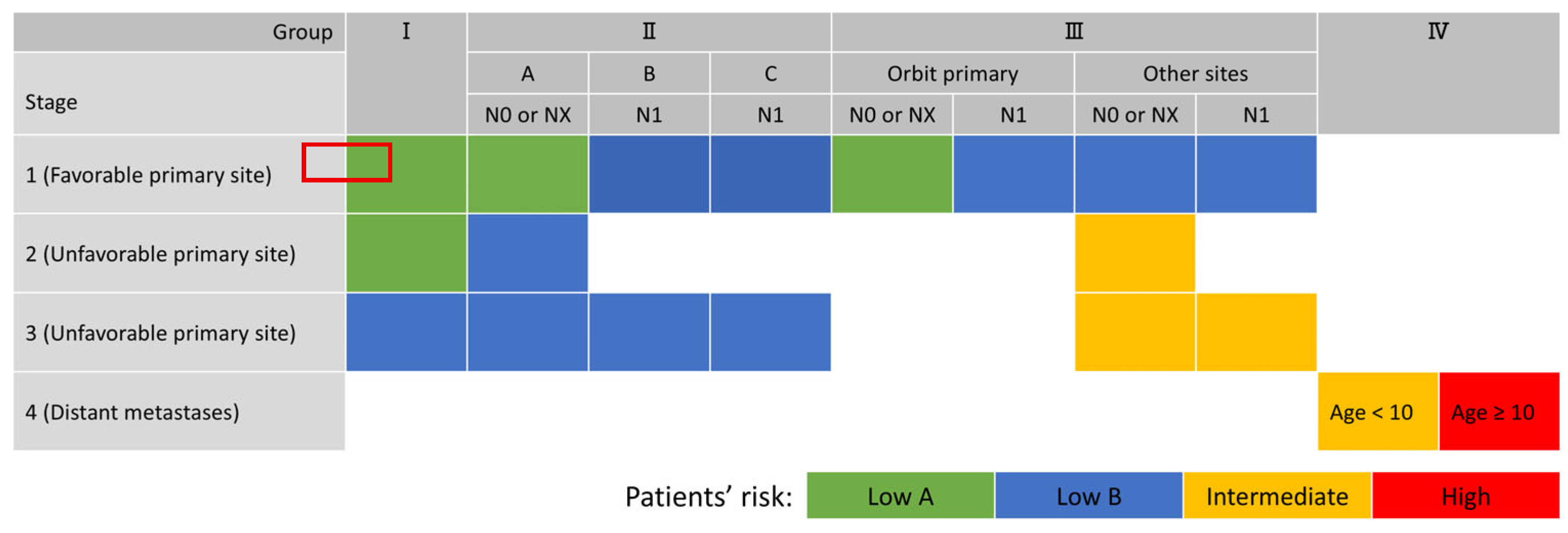
2.4. Risk Stratification
3. Current Risk-Based Treatment Strategies and Investigations
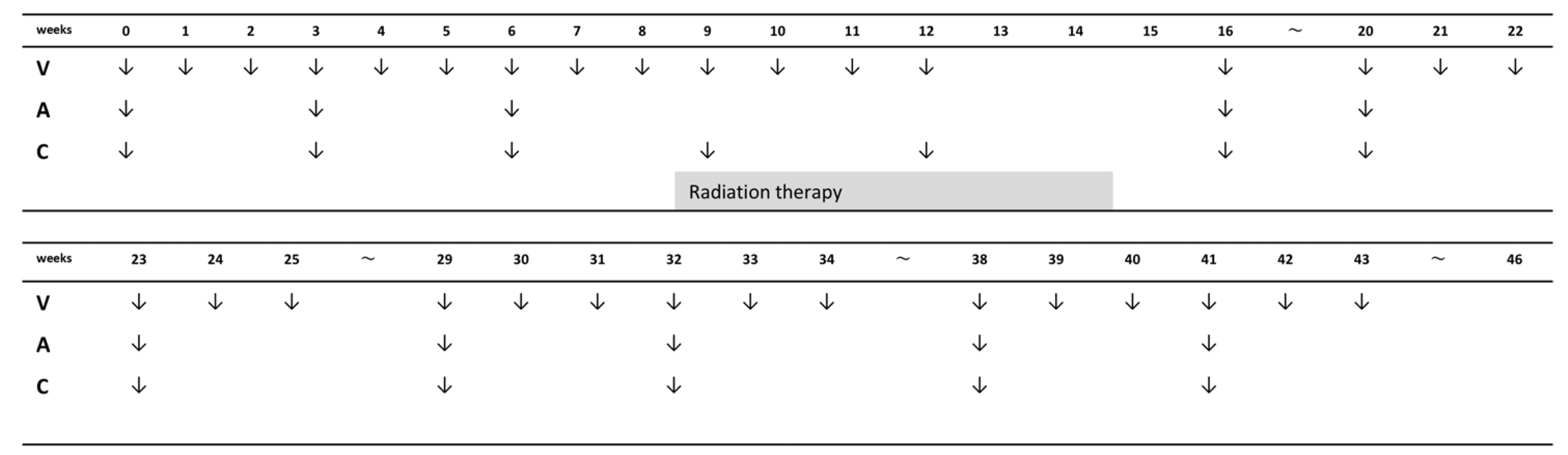
3.1. Low-Risk Patients
3.2. Intermediate-Risk Patients
3.3. High-Risk/Metastatic, Recurrent Cases
4. The Need for Novel Treatment Strategies and Drugs Based on the Current Risk-Based Treatment Strategies
4.1. Novel Risk Factors: MYOD1 Mutation
4.2. Molecular Testing/Comprehensive Genome Profiling (CGP)
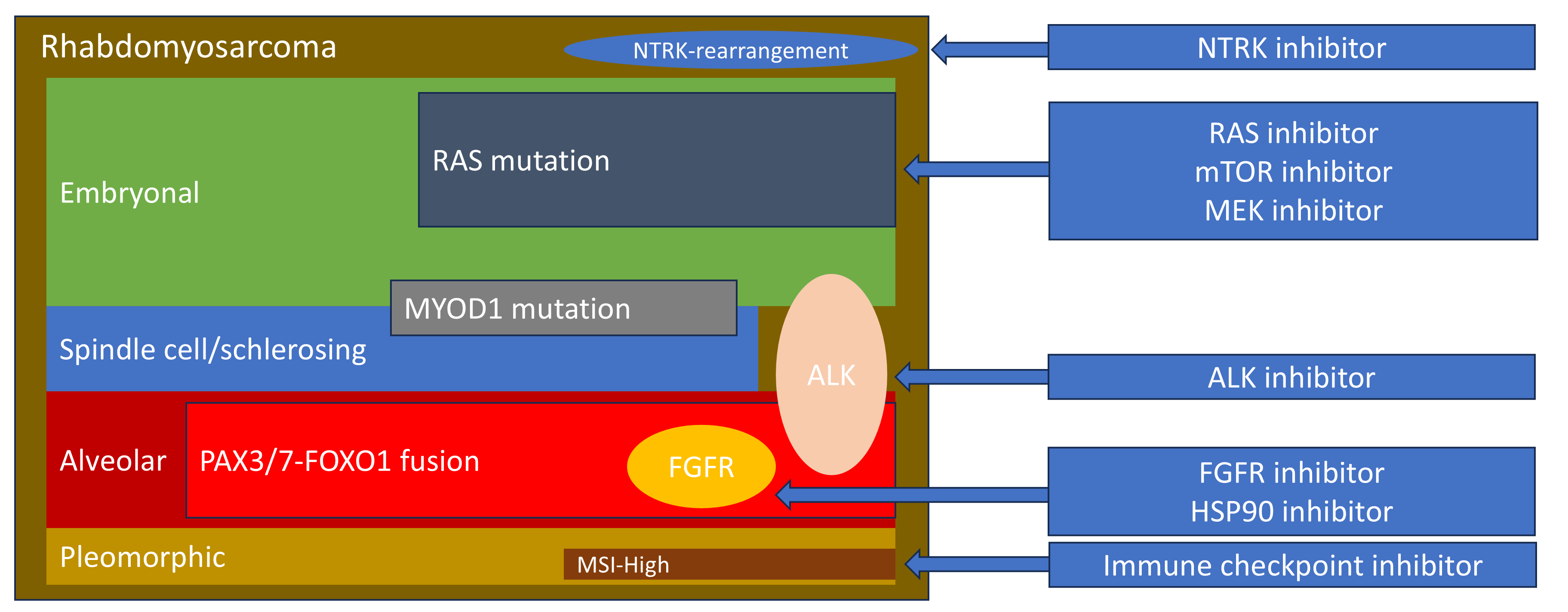
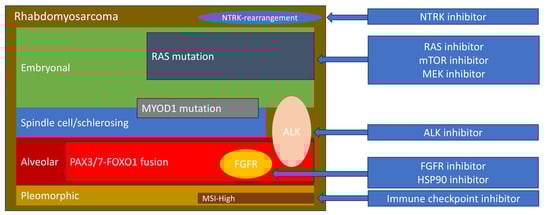
4.3. Candidates for Novel Targeted Therapies for RMS
4.3.1. The MAPK Pathway
4.3.2. ALK
4.3.3. NTRK Fusion
4.3.4. FGFR
4.3.5. MSI-High Status
4.3.6. CDK4
4.3.7. Epigenetic Therapeutic Targets
5. Conclusions
Funding
Data Availability Statement
Conflicts of Interest
Abbreviations
| ACD | actinomycin-D |
| ADC | antibody–drug conjugate |
| ALK | anaplastic lymphoma kinase |
| AYA | adolescent and young adult |
| CAR-T | chimeric antigen receptor T cell |
| CGP | comprehensive genome profiling |
| COG | Children’s Oncology Group |
| CPA | cyclophosphamide |
| CRC | colorectal cancer |
| EFS | event-free survival |
| EpSSG | European Paediatric Soft Tissue Sarcoma Study Group |
| FFS | failure-free survival |
| EZH2 | enhancer of zeste homolog 2 |
| FGF | fibroblast growth factor |
| FGFR | fibroblast growth factor receptor |
| GIST | gastrointestinal stromal tumor |
| HSP90 | heat shock protein 90 |
| IMT | inflammatory myofibroblastic tumor |
| IRS | Intergroup Rhabdomyosarcoma Study |
| MAPK | mitogen-activated protein kinase |
| MSI | microsatellite instability |
| mTOR | mammalian target of rapamycin |
| NSCLC | non-small-cell lung cancer |
| NTRK | neurotrophic receptor tyrosine kinase |
| OS | overall survival |
| RAS | renin–angiotensin system |
| RMS | rhabdomyosarcoma |
| SEER | Surveillance, Epidemiology, and End Results |
| STS | soft tissue sarcoma |
| UPS | undifferentiated pleomorphic sarcoma |
| VCR | vincristine |
| VNL | vinorelbine |
References
- WHO Classification of Tumours Editorial Board. WHO Classification of Tumours. Soft Tissue and Bone Tumors, 5th ed.; International Agency for Research on Cancer: Lyon, France, 2020; Volume 3, Available online: https://publications.iarc.fr/588 (accessed on 1 October 2025).
- Ferrari, A.; Sultan, I.; Huang, T.T.; Rodriguez-Galindo, C.; Shehadeh, A.; Meazza, C.; Ness, K.K.; Casanova, M.; Spunt, S.L. Soft tissue sarcoma across the age spectrum: A population-based study from the Surveillance Epidemiology and End Results database. Pediatr. Blood Cancer 2011, 57, 943–949. [Google Scholar] [CrossRef] [PubMed] [PubMed Central]
- Ognjanovic, S.; Linabery, A.M.; Charbonneau, B.; Ross, J.A. Trends in childhood rhabdomyosarcoma incidence and survival in the United States, 1975–2005. Cancer 2009, 115, 4218–4226. [Google Scholar] [CrossRef] [PubMed] [PubMed Central]
- Kollár, A.; Rothermundt, C.; Klenke, F.; Bode, B.; Baumhoer, D.; Arndt, V.; Feller, A.; NICER Working Group. Incidence, mortality, and survival trends of soft tissue and bone sarcoma in Switzerland between 1996 and 2015. Cancer Epidemiol. 2019, 63, 101596. [Google Scholar] [CrossRef] [PubMed]
- Trama, A.; Lasalvia, P.; Stark, D.; McCabe, M.G.; van der Graaf, W.; Gaspar, N.; Metayer, L.; Strauss, S.J.; Ragusa, R.; Guevara, M.; et al. Incidence and survival of European adolescents and young adults diagnosed with sarcomas: EUROCARE-6 results. Eur. J. Cancer 2025, 217, 115212. [Google Scholar] [CrossRef] [PubMed]
- Stiller, C.A.; Parkin, D.M. International variations in the incidence of childhood soft-tissue sarcomas. Paediatr. Perinat. Epidemiol. 1994, 1, 107–119. [Google Scholar] [CrossRef] [PubMed]
- Ogura, K.; Morizane, C.; Satake, T.; Iwata, S.; Toda, Y.; Muramatsu, S.; Takemori, T.; Kondo, H.; Kobayashi, E.; Katoh, Y.; et al. Soft-tissue sarcoma in Japan: National Cancer Registry-based analysis from 2016 to 2019. Jpn. J. Clin. Oncol. 2024, 54, 1150–1157. [Google Scholar] [CrossRef] [PubMed]
- Raney, R.B.; Maurer, H.M.; Anderson, J.R.; Andrassy, R.J.; Donaldson, S.S.; Qualman, S.J.; Wharam, M.D.; Wiener, E.S.; Crist, W.M. The Intergroup Rhabdomyosarcoma Study Group (IRSG): Major Lessons From the IRS-I Through IRS-IV Studies as Background for the Current IRS-V Treatment Protocols. Sarcoma 2001, 5, 9–15. [Google Scholar] [CrossRef] [PubMed] [PubMed Central]
- Ray-Coquard, I.; Montesco, M.C.; Coindre, J.M.; Dei Tos, A.P.; Lurkin, A.; Ranchère-Vince, D.; Vecchiato, A.; Decouvelaere, A.V.; Mathoulin-Pélissier, S.; Albert, S.; et al. Sarcoma: Concordance between initial diagnosis and centralized expert review in a population-based study within three European regions. Ann. Oncol. 2012, 9, 2442–2449. [Google Scholar] [CrossRef] [PubMed] [PubMed Central]
- Milewski, D.; Jung, H.; Brown, G.T.; Liu, Y.; Somerville, B.; Lisle, C.; Ladanyi, M.; Rudzinski, E.R.; Choo-Wosoba, H.; Barkauskas, D.A.; et al. Predicting Molecular Subtype and Survival of Rhabdomyosarcoma Patients Using Deep Learning of H&E Images: A Report from the Children’s Oncology Group. Clin. Cancer Res. 2023, 29, 364–378. [Google Scholar] [CrossRef] [PubMed] [PubMed Central]
- Sorensen, P.H.; Lynch, J.C.; Qualman, S.J.; Tirabosco, R.; Lim, J.F.; Maurer, H.M.; Bridge, J.A.; Crist, W.M.; Triche, T.J.; Barr, F.G. PAX3-FKHR and PAX7-FKHR gene fusions are prognostic indicators in alveolar rhabdomyosarcoma: A report from the children’s oncology group. J. Clin. Oncol. 2002, 20, 2672–2679. [Google Scholar] [CrossRef] [PubMed]
- Marshall, A.D.; Grosveld, G.C. Alveolar rhabdomyosarcoma—The molecular drivers of PAX3/7-FOXO1-induced tumorigenesis. Skelet. Muscle 2012, 2, 25. [Google Scholar] [CrossRef] [PubMed] [PubMed Central]
- Collins, M.H.; Zhao, H.; Womer, R.B.; Barr, F.G. Proliferative and apoptotic differences between alveolar rhabdomyosarcoma subtypes: A comparative study of tumors containing PAX3-FKHR or PAX7-FKHR gene fusions. Med. Pediatr. Oncol. 2001, 2, 83–89. [Google Scholar] [CrossRef] [PubMed]
- Missiaglia, E.; Williamson, D.; Chisholm, J.; Wirapati, P.; Pierron, G.; Petel, F.; Concordet, J.P.; Thway, K.; Oberlin, O.; Pritchard-Jones, K.; et al. PAX3/FOXO1 fusion gene status is the key prognostic molecular marker in rhabdomyosarcoma and significantly improves current risk stratification. J. Clin. Oncol. 2012, 30, 1670–1677. [Google Scholar] [CrossRef] [PubMed]
- Koscielniak, E.; Stegmaier, S.; Ljungman, G.; Kazanowska, B.; Niggli, F.; Ladenstein, R.; Blank, B.; Hallmen, E.; Vokuhl, C.; Blattmann, C.; et al. Prognostic factors in patients with localized and metastatic alveolar rhabdomyosarcoma. A report from two studies and two registries of the Cooperative Weichteilsarkom Studiengruppe CWS. Cancer Med. 2025, 1, e70215. [Google Scholar] [CrossRef] [PubMed] [PubMed Central]
- Williamson, D.; Missiaglia, E.; de Reyniès, A.; Pierron, G.; Thuille, B.; Palenzuela, G.; Thway, K.; Orbach, D.; Laé, M.; Fréneaux, P.; et al. Fusion gene-negative alveolar rhabdomyosarcoma is clinically and molecularly indistinguishable from embryonal rhabdomyosarcoma. J. Clin. Oncol. 2010, 28, 2151–2158. [Google Scholar] [CrossRef] [PubMed]
- Sultan, I.; Qaddoumi, I.; Yaser, S.; Rodriguez-Galindo, C.; Ferrari, A. Comparing adult and pediatric rhabdomyosarcoma in the surveillance, epidemiology and end results program, 1973 to 2005: An analysis of 2600 patients. J. Clin. Oncol. 2009, 27, 3391–3397. [Google Scholar] [CrossRef] [PubMed]
- Kobayashi, H.; Okajima, K.; Zhang, L.; Hirai, T.; Ishibashi, Y.; Tsuda, Y.; Ikegami, M.; Kawai, A.; Tanaka, S. Embryonal and alveolar rhabdomyosarcoma in adolescents/young adults, adults and older adults: A population-based cohort study. Jpn. J. Clin. Oncol. 2024, 54, 903–910. [Google Scholar] [CrossRef] [PubMed]
- Malempati, S.; Rodeberg, D.A.; Donaldson, S.S.; Lyden, E.R.; Anderson, J.R.; Hawkins, D.S.; Arndt, C.A. Rhabdomyosarcoma in infants younger than 1 year: A report from the Children’s Oncology Group. Cancer 2011, 117, 3493–3501. [Google Scholar] [CrossRef] [PubMed] [PubMed Central]
- Walterhouse, D.O.; Barkauskas, D.A.; Hall, D.; Ferrari, A.; De Salvo, G.L.; Koscielniak, E.; Stevens, M.C.G.; Martelli, H.; Seitz, G.; Rodeberg, D.A.; et al. Demographic and Treatment Variables Influencing Outcome for Localized Paratesticular Rhabdomyosarcoma: Results From a Pooled Analysis of North American and European Cooperative Groups. J. Clin. Oncol. 2018, 36, JCO2018789388. [Google Scholar] [CrossRef] [PubMed] [PubMed Central]
- Kobayashi, H.; Okajima, K.; Zhang, L.; Hirai, T.; Ishibashi, Y.; Tsuda, Y.; Ikegami, M.; Kawai, A.; Tanaka, S. Prognostic factors and treatment outcomes in patients with pleomorphic rhabdomyosarcoma: A population-based cohort study. Jpn. J. Clin. Oncol. 2024, 54, 471–478. [Google Scholar] [CrossRef] [PubMed]
- Peng, K.A.; Grogan, T.; Wang, M.B. Head and neck sarcomas: Analysis of the SEER database. Otolaryngol. Head Neck Surg. 2014, 4, 627–633. [Google Scholar] [CrossRef] [PubMed] [PubMed Central]
- Rikitake, R.; Mizushima, Y.; Yoshimoto, S.; Higashi, T.; Satake, T.; Morizane, C.; Kawai, A. Current status of head and neck sarcomas in Japan in 2016–2019: An analysis using the national cancer registry. Int J Clin Oncol. 2024, 5, 564–570. [Google Scholar] [CrossRef] [PubMed] [PubMed Central]
- Karahan, I.H.; Kutluk, T.; Yalcin, B.; Aydin, B.; Kurucu, N.; Gultekin, M.; Yildiz, F.; Orhan, D.; Gedikoglu, G.; Varan, A. Clinical Features and Treatment Results in Children With Head and Neck Rhabdomyosarcoma. J. Pediatr. Hematol. Oncol. 2025, 47, e241–e246. [Google Scholar] [CrossRef] [PubMed]
- Merks, J.H.; De Salvo, G.L.; Bergeron, C.; Bisogno, G.; De Paoli, A.; Ferrari, A.; Rey, A.; Oberlin, O.; Stevens, M.C.; Kelsey, A.; et al. Parameningeal rhabdomyosarcoma in pediatric age: Results of a pooled analysis from North American and European cooperative groups. Ann. Oncol. 2014, 1, 231–236, Erratum in Ann. Oncol. 2014, 3, 756. https://doi.org/10.1093/annonc/mdu001. [Google Scholar] [CrossRef] [PubMed] [PubMed Central]
- Yang, J.C.; Wexler, L.H.; Meyers, P.A.; Wolden, S.L. Parameningeal rhabdomyosarcoma: Outcomes and opportunities. Int. J. Radiat. Oncol. Biol. Phys. 2013, 85, e61–e66. [Google Scholar] [CrossRef] [PubMed]
- Spalding, A.C.; Hawkins, D.S.; Donaldson, S.S.; Anderson, J.R.; Lyden, E.; Laurie, F.; Wolden, S.L.; Arndt, C.A.; Michalski, J.M. The effect of radiation timing on patients with high-risk features of parameningeal rhabdomyosarcoma: An analysis of IRS-IV and D9803. Int. J. Radiat. Oncol. Biol. Phys. 2013, 87, 512–516. [Google Scholar] [CrossRef] [PubMed] [PubMed Central]
- Patel, S.R.; Hensel, C.P.; He, J.; Alcalá, N.E.; Kearns, J.T.; Gaston, K.E.; Clark, P.E.; Riggs, S.B. Epidemiology and survival outcome of adult kidney, bladder, and prostate rhabdomyosarcoma: A SEER database analysis. Rare Tumors 2020, 12, 2036361320977401. [Google Scholar] [CrossRef] [PubMed] [PubMed Central]
- Gao, X.; Kong, Y.; Ning, Y.; Cui, Z.; Lei, K.; Tian, T. Clinical characteristics and prognosis of rhabdomyosarcoma in the female reproductive system: A population-based analysis using SEER data. Int. J. Gynecol. Cancer 2025, 9, 101989. [Google Scholar] [CrossRef] [PubMed]
- Oberoi, S.; Xue, W.; Qumseya, A.; Scharschmidt, T.; Binitie, O.; Sorger, J.I.; Kumar, K.A.; Wong, K.; Donaldson, S.S.; Teot, L.; et al. Extremity rhabdomyosarcoma in children, adolescents and young adults: A report from Children’s Oncology Group trials. Cancer 2025, 131, e35929. [Google Scholar] [CrossRef] [PubMed] [PubMed Central]
- Aye, J.M.; Xue, W.; Palmer, J.D.; Walterhouse, D.O.; Arnold, M.A.; Heaton, T.E.; Venkatramani, R. Suboptimal outcome for patients with biliary rhabdomyosarcoma treated on low-risk clinical trials: A report from the Children’s Oncology Group. Pediatr. Blood Cancer 2021, 4, e28914. [Google Scholar] [CrossRef] [PubMed] [PubMed Central]
- Meza, J.L.; Anderson, J.; Pappo, A.S.; Meyer, W.H.; Children’s Oncology Group. Analysis of prognostic factors in patients with nonmetastatic rhabdomyosarcoma treated on intergroup rhabdomyosarcoma studies III and IV: The Children’s Oncology Group. J. Clin. Oncol. 2006, 24, 3844–3851. [Google Scholar] [CrossRef] [PubMed]
- Crane, J.N.; Xue, W.; Qumseya, A.; Gao, Z.; Arndt, C.A.S.; Donaldson, S.S.; Harrison, D.J.; Hawkins, D.S.; Linardic, C.M.; Mascarenhas, L.; et al. Clinical group and modified TNM stage for rhabdomyosarcoma: A review from the Children’s Oncology Group. Pediatr. Blood Cancer 2022, 6, e29644. [Google Scholar] [CrossRef] [PubMed] [PubMed Central]
- Oberlin, O.; Rey, A.; Lyden, E.; Bisogno, G.; Stevens, M.C.; Meyer, W.H.; Carli, M.; Anderson, J.R. Prognostic factors in metastatic rhabdomyosarcomas: Results of a pooled analysis from United States and European cooperative groups. J. Clin. Oncol. 2008, 26, 2384–2389. [Google Scholar] [CrossRef] [PubMed] [PubMed Central]
- Schoot, R.A.; Chisholm, J.C.; Casanova, M.; Minard-Colin, V.; Geoerger, B.; Cameron, A.L.; Coppadoro, B.; Zanetti, I.; Orbach, D.; Kelsey, A.; et al. Metastatic Rhabdomyosarcoma: Results of the European Paediatric Soft Tissue Sarcoma Study Group MTS 2008 Study and Pooled Analysis With the Concurrent BERNIE Study. J. Clin. Oncol. 2022, 40, 3730–3740. [Google Scholar] [CrossRef] [PubMed] [PubMed Central]
- Heinz, A.T.; Schönstein, A.; Ebinger, M.; Fuchs, J.; Timmermann, B.; Seitz, G.; Vokuhl, C.; Münter, M.; Pajtler, K.W.; Stegmaier, S.; et al. Significance of fusion status Oberlin risk factors local maintenance treatment in pediatric adolescent patients with metastatic rhabdomyosarcoma: Data of the European Soft Tissue Sarcoma Registry, SoTiSaR. Pediatr. Blood Cancer 2024, 1, e30707. [Google Scholar] [CrossRef] [PubMed]
- Rudzinski, E.R.; Anderson, J.R.; Chi, Y.Y.; Gastier-Foster, J.M.; Astbury, C.; Barr, F.G.; Skapek, S.X.; Hawkins, D.S.; Weigel, B.J.; Pappo, A.; et al. Histology, fusion status, and outcome in metastatic rhabdomyosarcoma: A report from the Children’s Oncology Group. Pediatr. Blood Cancer 2017, 12, e26645. [Google Scholar] [CrossRef] [PubMed] [PubMed Central]
- Chisholm, J.; Mandeville, H.; Adams, M.; Minard-Collin, V.; Rogers, T.; Kelsey, A.; Shipley, J.; van Rijn, R.R.; de Vries, I.; van Ewijk, R.; et al. Frontline and Relapsed Rhabdomyosarcoma (FaR-RMS) Clinical Trial: A Report from the European Paediatric Soft Tissue Sarcoma Study Group (EpSSG). Cancers 2024, 16, 998, Erratum in Cancers 2024, 16, 3427. https://doi.org/10.3390/cancers16193427. [Google Scholar] [CrossRef] [PubMed] [PubMed Central]
- Crist, W.M.; Anderson, J.R.; Meza, J.L.; Fryer, C.; Raney, R.B.; Ruymann, F.B.; Breneman, J.; Qualman, S.J.; Wiener, E.; Wharam, M.; et al. Intergroup rhabdomyosarcoma study-IV: Results for patients with nonmetastatic disease. J. Clin. Oncol. 2001, 19, 3091–3102. [Google Scholar] [CrossRef] [PubMed]
- Green, D.M.; Liu, W.; Kutteh, W.H.; Ke, R.W.; Shelton, K.C.; Sklar, C.A.; Chemaitilly, W.; Pui, C.H.; Klosky, J.L.; Spunt, S.L.; et al. Cumulative alkylating agent exposure and semen parameters in adult survivors of childhood cancer: A report from the St Jude Lifetime Cohort Study. Lancet Oncol. 2014, 11, 1215–1223. [Google Scholar] [CrossRef] [PubMed] [PubMed Central]
- Reynolds, A.C.; McKenzie, L.J. Cancer Treatment-Related Ovarian Dysfunction in Women of Childbearing Potential: Management and Fertility Preservation Options. J. Clin. Oncol. 2023, 41, 2281–2292. [Google Scholar] [CrossRef] [PubMed] [PubMed Central]
- Turcotte, L.M.; Liu, Q.; Yasui, Y.; Henderson, T.O.; Gibson, T.M.; Leisenring, W.; Arnold, M.A.; Howell, R.M.; Green, D.M.; Armstrong, G.T.; et al. Chemotherapy and Risk of Subsequent Malignant Neoplasms in the Childhood Cancer Survivor Study Cohort. J. Clin. Oncol. 2019, 37, 3310–3319. [Google Scholar] [CrossRef] [PubMed] [PubMed Central]
- Devine, K.A.; Christen, S.; Mulder, R.L.; Brown, M.C.; Ingerski, L.M.; Mader, L.; Potter, E.J.; Sleurs, C.; Viola, A.S.; Waern, S.; et al. Recommendations for the surveillance of education and employment outcomes in survivors of childhood, adolescent, and young adult cancer: A report from the International Late Effects of Childhood Cancer Guideline Harmonization Group. Cancer 2022, 128, 2405–2419. [Google Scholar] [CrossRef] [PubMed] [PubMed Central]
- Walterhouse, D.O.; Pappo, A.S.; Meza, J.L.; Breneman, J.C.; Hayes-Jordan, A.A.; Parham, D.M.; Cripe, T.P.; Anderson, J.R.; Meyer, W.H.; Hawkins, D.S. Shorter-duration therapy using vincristine, dactinomycin, and lower-dose cyclophosphamide with or without radiotherapy for patients with newly diagnosed low-risk rhabdomyosarcoma: A report from the Soft Tissue Sarcoma Committee of the Children’s Oncology Group. J. Clin. Oncol. 2014, 32, 3547–3552, Erratum in J. Clin. Oncol. 2018, 36, 1459. https://doi.org/10.1200/JCO.2018.78.2367. [Google Scholar] [CrossRef] [PubMed] [PubMed Central]
- Hosoi, H.; Miyachi, M.; Teramukai, S.; Sakabayashi, S.; Tsuchiya, K.; Kuwahara, Y.; Onodera, R.; Matsuyama, K.; Yokota, I.; Hojo, H.; et al. Results of the JRS-I LRA0401 and LRB0402 Japan Rhabdomyosarcoma Study Group trials for low-risk embryonal rhabdomyosarcoma. Int. J. Clin. Oncol. 2024, 11, 1746–1755. [Google Scholar] [CrossRef] [PubMed]
- Raney, R.B.; Walterhouse, D.O.; Meza, J.L.; Andrassy, R.J.; Breneman, J.C.; Crist, W.M.; Maurer, H.M.; Meyer, W.H.; Parham, D.M.; Anderson, J.R. Results of the Intergroup Rhabdomyosarcoma Study Group D9602 protocol, using vincristine and dactinomycin with or without cyclophosphamide and radiation therapy, for newly diagnosed patients with low-risk embryonal rhabdomyosarcoma: A report from the Soft Tissue Sarcoma Committee of the Children’s Oncology Group. J. Clin. Oncol. 2011, 29, 1312–1318. [Google Scholar] [CrossRef] [PubMed] [PubMed Central]
- Walterhouse, D.O.; Pappo, A.S.; Meza, J.L.; Breneman, J.C.; Hayes-Jordan, A.; Parham, D.M.; Cripe, T.P.; Anderson, J.R.; Meyer, W.H.; Hawkins, D.S. Reduction of cyclophosphamide dose for patients with subset 2 low-risk rhabdomyosarcoma is associated with an increased risk of recurrence: A report from the Soft Tissue Sarcoma Committee of the Children’s Oncology Group. Cancer 2017, 123, 2368–2375. [Google Scholar] [CrossRef] [PubMed] [PubMed Central]
- Miyachi, M.; Tsuchiya, K.; Hosono, A.; Ogawa, A.; Koh, K.; Kikuta, A.; Hara, J.; Teramukai, S.; Hosoi, H. Phase II study of vincristine, actinomycin-D, cyclophosphamide and irinotecan for patients with newly diagnosed low-risk subset B rhabdomyosarcoma: A study protocol. Medicine 2019, 52, e18344. [Google Scholar] [CrossRef] [PubMed] [PubMed Central]
- Bisogno, G.; Jenney, M.; Bergeron, C.; Gallego Melcón, S.; Ferrari, A.; Oberlin, O.; Carli, M.; Stevens, M.; Kelsey, A.; De Paoli, A.; et al. Addition of dose-intensified doxorubicin to standard chemotherapy for rhabdomyosarcoma (EpSSG RMS 2005): A multicentre, open-label, randomised controlled, phase 3 trial. Lancet Oncol. 2018, 8, 1061–1071. [Google Scholar] [CrossRef] [PubMed]
- Bisogno, G.; De Salvo, G.L.; Bergeron, C.; Gallego Melcón, S.; Merks, J.H.; Kelsey, A.; Martelli, H.; Minard-Colin, V.; Orbach, D.; Glosli, H.; et al. Vinorelbine and continuous low-dose cyclophosphamide as maintenance chemotherapy in patients with high-risk rhabdomyosarcoma (RMS 2005): A multicentre, open-label, randomised, phase 3 trial. Lancet Oncol. 2019, 11, 1566–1575. [Google Scholar] [CrossRef] [PubMed]
- Walterhouse, D.O.; Lyden, E.R.; Breitfeld, P.P.; Qualman, S.J.; Wharam, M.D.; Meyer, W.H. Efficacy of topotecan and cyclophosphamide given in a phase II window trial in children with newly diagnosed metastatic rhabdomyosarcoma: A Children’s Oncology Group study. J. Clin. Oncol. 2004, 22, 1398–1403, Erratum in J. Clin. Oncol. 2004, 22, 3205. [Google Scholar] [CrossRef] [PubMed]
- Pappo, A.S.; Lyden, E.; Breitfeld, P.; Donaldson, S.S.; Wiener, E.; Parham, D.; Crews, K.R.; Houghton, P.; Meyer, W.H.; Children’s Oncology Group. Two consecutive phase II window trials of irinotecan alone or in combination with vincristine for the treatment of metastatic rhabdomyosarcoma: The Children’s Oncology Group. J. Clin. Oncol. 2007, 25, 362–369. [Google Scholar] [CrossRef] [PubMed]
- Weigel, B.J.; Lyden, E.; Anderson, J.R.; Meyer, W.H.; Parham, D.M.; Rodeberg, D.A.; Michalski, J.M.; Hawkins, D.S.; Arndt, C.A. Intensive Multiagent Therapy, Including Dose-Compressed Cycles of Ifosfamide/Etoposide and Vincristine/Doxorubicin/Cyclophosphamide, Irinotecan, and Radiation, in Patients With High-Risk Rhabdomyosarcoma: A Report From the Children’s Oncology Group. J. Clin. Oncol. 2016, 34, 117–122. [Google Scholar] [CrossRef] [PubMed] [PubMed Central]
- Weigel, B.J.; Breitfeld, P.P.; Hawkins, D.; Crist, W.M.; Baker, K.S. Role of high-dose chemotherapy with hematopoietic stem cell rescue in the treatment of metastatic or recurrent rhabdomyosarcoma. J Pediatr Hematol Oncol. 2001, 23, 272–276. [Google Scholar] [CrossRef] [PubMed]
- Kohsaka, S.; Shukla, N.; Ameur, N.; Ito, T.; Ng, C.K.; Wang, L.; Lim, D.; Marchetti, A.; Viale, A.; Pirun, M.; et al. A recurrent neomorphic mutation in MYOD1 defines a clinically aggressive subset of embryonal rhabdomyosarcoma associated with PI3K-AKT pathway mutations. Nat. Genet. 2014, 6, 595–600. [Google Scholar] [CrossRef] [PubMed] [PubMed Central]
- Tsai, J.W.; ChangChien, Y.C.; Lee, J.C.; Kao, Y.C.; Li, W.S.; Liang, C.W.; Liao, I.C.; Chang, Y.M.; Wang, J.C.; Tsao, C.F.; et al. The expanding morphological and genetic spectrum of MYOD1-mutant spindle cell/sclerosing rhabdomyosarcomas: A clinicopathological and molecular comparison of mutated and non-mutated cases. Histopathology 2019, 6, 933–943. [Google Scholar] [CrossRef] [PubMed]
- Ahmed, A.A.; Habeebu, S.; Farooqi, M.S.; Gamis, A.S.; Gonzalez, E.; Flatt, T.; Sherman, A.; Surrey, L.; Arnold, M.A.; Conces, M.; et al. MYOD1 as a prognostic indicator in rhabdomyosarcoma. Pediatr. Blood Cancer 2021, 9, e29085. [Google Scholar] [CrossRef] [PubMed] [PubMed Central]
- Chisholm, J.C.; Selfe, J.L.; Alaggio, R.; Cheesman, E.; Zin, A.; Tombolan, L.; Parafioriti, A.; Milano, G.M.; Adams, M.; Popov, S.; et al. Clinicopathological Analysis of a European Cohort of MYOD1 Mutant Rhabdomyosarcomas in Children and Young Adults. Pediatr. Blood Cancer 2025, 1, e31428. [Google Scholar] [CrossRef] [PubMed]
- Rekhi, B.; Upadhyay, P.; Ramteke, M.P.; Dutt, A. MYOD1 (L122R) mutations are associated with spindle cell and sclerosing rhabdomyosarcomas with aggressive clinical outcomes. Mod. Pathol. 2016, 12, 1532–1540. [Google Scholar] [CrossRef] [PubMed] [PubMed Central]
- Agaram, N.P.; LaQuaglia, M.P.; Alaggio, R.; Zhang, L.; Fujisawa, Y.; Ladanyi, M.; Wexler, L.H.; Antonescu, C.R. MYOD1-mutant spindle cell and sclerosing rhabdomyosarcoma: An aggressive subtype irrespective of age. A reappraisal for molecular classification and risk stratification. Mod. Pathol. 2019, 1, 27–36. [Google Scholar] [CrossRef] [PubMed] [PubMed Central]
- Ting, M.A.; Reuther, J.; Chandramohan, R.; Voicu, H.; Gandhi, I.; Liu, M.; Cortes-Santiago, N.; Foster, J.H.; Hicks, J.; Nuchtern, J.; et al. Genomic analysis and preclinical xenograft model development identify potential therapeutic targets for MYOD1-mutant soft-tissue sarcoma of childhood. J. Pathol. 2021, 1, 52–61. [Google Scholar] [CrossRef] [PubMed]
- Montoya-Cerrillo, D.M.; Diaz-Perez, J.A.; Velez-Torres, J.M.; Montgomery, E.A.; Rosenberg, A.E. Novel fusion genes in spindle cell rhabdomyosarcoma: The spectrum broadens. Genes. Chromosomes Cancer 2021, 10, 687–694. [Google Scholar] [CrossRef] [PubMed]
- De Vita, A.; Ferrari, A.; Miserocchi, G.; Vanni, S.; Domizio, C.; Fonzi, E.; Fausti, V.; Recine, F.; Bassi, M.; Campobassi, A.; et al. Identification of a novel RAB3IP-HMGA2 fusion transcript in an adult head and neck rhabdomyosarcoma. Oral Dis. 2022, 7, 2052–2054. [Google Scholar] [CrossRef] [PubMed]
- Bisogno, G.; Sparber-Sauer, M.; Rodeberg, D.; Merks, J.H.M.; Koscielniak, E.; Wolden, S.L.; De Salvo, G.L.; Del Bianco, P.; Xue, W.; Ebinger, M.; et al. The International Soft Tissue Sarcoma Consortium: The baseline analysis of rhabdomyosarcoma data. Cancer 2025, 131, e35974. [Google Scholar] [CrossRef] [PubMed] [PubMed Central]
- Shern, J.F.; Selfe, J.; Izquierdo, E.; Patidar, R.; Chou, H.C.; Song, Y.K.; Yohe, M.E.; Sindiri, S.; Wei, J.; Wen, X.; et al. Genomic Classification and Clinical Outcome in Rhabdomyosarcoma: A Report From an International Consortium. J. Clin. Oncol. 2021, 39, 2859–2871. [Google Scholar] [CrossRef] [PubMed] [PubMed Central]
- Hettmer, S.; Linardic, C.M.; Kelsey, A.; Rudzinski, E.R.; Vokuhl, C.; Selfe, J.; Ruhen, O.; Shern, J.F.; Khan, J.; Kovach, A.R.; et al. Molecular testing of rhabdomyosarcoma in clinical trials to improve risk stratification and outcome: A consensus view from European paediatric Soft tissue sarcoma Study Group, Children’s Oncology Group and Cooperative Weichteilsarkom-Studiengruppe. Eur. J. Cancer 2022, 172, 367–386. [Google Scholar] [CrossRef] [PubMed]
- de Traux de Wardin, H.; Dermawan, J.K.; Merlin, M.S.; Wexler, L.H.; Orbach, D.; Vanoli, F.; Schleiermacher, G.; Geoerger, B.; Ballet, S.; Guillemot, D.; et al. Sequential genomic analysis using a multisample/multiplatform approach to better define rhabdomyosarcoma progression and relapse. NPJ Precis. Oncol. 2023, 7, 96. [Google Scholar] [CrossRef] [PubMed] [PubMed Central]
- Danielli, S.G.; Wei, Y.; Dyer, M.A.; Stewart, E.; Sheppard, H.; Wachtel, M.; Schäfer, B.W.; Patel, A.G.; Langenau, D.M. Single cell transcriptomic profiling identifies tumor-acquired and therapy-resistant cell states in pediatric rhabdomyosarcoma. Nat. Commun. 2024, 15, 6307. [Google Scholar] [CrossRef] [PubMed] [PubMed Central]
- Papke, B.; Der, C.J. Drugging RAS: Know the enemy. Science 2017, 355, 1158–1163. [Google Scholar] [CrossRef] [PubMed]
- Martinelli, S.; McDowell, H.P.; Vigne, S.D.; Kokai, G.; Uccini, S.; Tartaglia, M.; Dominici, C. RAS signaling dysregulation in human embryonal Rhabdomyosarcoma. Genes Chromosomes Cancer 2009, 11, 975–982. [Google Scholar] [CrossRef] [PubMed]
- Shern, J.F.; Chen, L.; Chmielecki, J.; Wei, J.S.; Patidar, R.; Rosenberg, M.; Ambrogio, L.; Auclair, D.; Wang, J.; Song, Y.K.; et al. Comprehensive genomic analysis of rhabdomyosarcoma reveals a landscape of alterations affecting a common genetic axis in fusion-positive and fusion-negative tumors. Cancer Discov. 2014, 2, 216–231. [Google Scholar] [CrossRef] [PubMed] [PubMed Central]
- Baselga, J.; Campone, M.; Piccart, M.; Burris HA3rd Rugo, H.S.; Sahmoud, T.; Noguchi, S.; Gnant, M.; Pritchard, K.I.; Lebrun, F.; Beck, J.T.; et al. Everolimus in postmenopausal hormone-receptor-positive advanced breast cancer. N. Engl. J. Med. 2012, 366, 520–529. [Google Scholar] [CrossRef] [PubMed] [PubMed Central]
- Hudes, G.; Carducci, M.; Tomczak, P.; Dutcher, J.; Figlin, R.; Kapoor, A.; Staroslawska, E.; Sosman, J.; McDermott, D.; Bodrogi, I.; et al. Temsirolimus, interferon alfa, or both for advanced renal-cell carcinoma. N. Engl. J. Med. 2007, 356, 2271–2281. [Google Scholar] [CrossRef] [PubMed]
- Motzer, R.J.; Escudier, B.; Oudard, S.; Hutson, T.E.; Porta, C.; Bracarda, S.; Grünwald, V.; Thompson, J.A.; Figlin, R.A.; Hollaender, N.; et al. Efficacy of everolimus in advanced renal cell carcinoma: A double-blind, randomised, placebo-controlled phase III trial. Lancet 2008, 372, 449–456. [Google Scholar] [CrossRef] [PubMed]
- Pavel, M.E.; Hainsworth, J.D.; Baudin, E.; Peeters, M.; Hörsch, D.; Winkler, R.E.; Klimovsky, J.; Lebwohl, D.; Jehl, V.; Wolin, E.M.; et al. Everolimus plus octreotide long-acting repeatable for the treatment of advanced neuroendocrine tumours associated with carcinoid syndrome (RADIANT-2): A randomised placebo-controlled phase 3 study. Lancet 2011, 378, 2005–2012. [Google Scholar] [CrossRef] [PubMed]
- Mascarenhas, L.; Chi, Y.Y.; Hingorani, P.; Anderson, J.R.; Lyden, E.R.; Rodeberg, D.A.; Indelicato, D.J.; Kao, S.C.; Dasgupta, R.; Spunt, S.L.; et al. Randomized Phase II Trial of Bevacizumab or Temsirolimus in Combination With Chemotherapy for First Relapse Rhabdomyosarcoma: A Report From the Children’s Oncology Group. J. Clin. Oncol. 2019, 37, 2866–2874. [Google Scholar] [CrossRef] [PubMed] [PubMed Central]
- Gupta, A.A.; Xue, W.; Harrison, D.J.; Hawkins, D.S.; Dasgupta, R.; Wolden, S.; Shulkin, B.; Qumseya, A.; Routh, J.C.; MacDonald, T.; et al. Addition of temsirolimus to chemotherapy in children, adolescents, and young adults with intermediate-risk rhabdomyosarcoma (ARST1431): A randomised, open-label, phase 3 trial from the Children’s Oncology Group. Lancet Oncol. 2024, 7, 912–921. [Google Scholar] [CrossRef] [PubMed] [PubMed Central]
- Danielli, S.G.; Porpiglia, E.; De Micheli, A.J.; Navarro, N.; Zellinger, M.J.; Bechtold, I.; Kisele, S.; Volken, L.; Marques, J.G.; Kasper, S.; et al. Single-cell profiling of alveolar rhabdomyosarcoma reveals RAS pathway inhibitors as cell-fate hijackers with therapeutic relevance. Sci. Adv. 2023, 9, eade9238. [Google Scholar] [CrossRef] [PubMed] [PubMed Central]
- Hebron, K.E.; Wan, X.; Roth, J.S.; Liewehr, D.J.; Sealover, N.E.; Frye, W.J.E.; Kim, A.; Stauffer, S.; Perkins, O.L.; Sun, W.; et al. The Combination of Trametinib and Ganitumab is Effective in RAS-Mutated PAX-Fusion Negative Rhabdomyosarcoma Models. Clin. Cancer Res. 2023, 29, 472–487. [Google Scholar] [CrossRef] [PubMed] [PubMed Central]
- Garcia, N.; Del Pozo, V.; Yohe, M.E.; Goodwin, C.M.; Shackleford, T.J.; Wang, L.; Baxi, K.; Chen, Y.; Rogojina, A.T.; Zimmerman, S.M.; et al. Vertical Inhibition of the RAF-MEK-ERK Cascade Induces Myogenic Differentiation, Apoptosis, and Tumor Regression in H/NRASQ61X Mutant Rhabdomyosarcoma. Mol. Cancer Ther. 2022, 1, 170–183. [Google Scholar] [CrossRef] [PubMed] [PubMed Central]
- Skoulidis, F.; Li, B.T.; Dy, G.K.; Price, T.J.; Falchook, G.S.; Wolf, J.; Italiano, A.; Schuler, M.; Borghaei, H.; Barlesi, F.; et al. Sotorasib for Lung Cancers with KRAS p.G12C Mutation. N. Engl. J. Med. 2021, 384, 2371–2381. [Google Scholar] [CrossRef] [PubMed] [PubMed Central]
- Smit, E.F.; Dingemans, A.C. Adagrasib for KRASG12C mutated advanced non-small-cell lung cancer. Lancet 2025, 406, 576–577. [Google Scholar] [CrossRef] [PubMed]
- Fakih, M.G.; Salvatore, L.; Esaki, T.; Modest, D.P.; Lopez-Bravo, D.P.; Taieb, J.; Karamouzis, M.V.; Ruiz-Garcia, E.; Kim, T.W.; Kuboki, Y.; et al. Sotorasib plus Panitumumab in Refractory Colorectal Cancer with Mutated KRAS G12C. N. Engl. J. Med. 2023, 389, 2125–2139, Erratum in N. Engl. J Med. 2025, 392, 728. https://doi.org/10.1056/NEJMx240006. [Google Scholar] [CrossRef] [PubMed]
- Yaeger, R.; Weiss, J.; Pelster, M.S.; Spira, A.I.; Barve, M.; Ou, S.I.; Leal, T.A.; Bekaii-Saab, T.S.; Paweletz, C.P.; Heavey, G.A.; et al. Adagrasib with or without Cetuximab in Colorectal Cancer with Mutated KRAS G12C. N. Engl. J. Med. 2023, 388, 44–54. [Google Scholar] [CrossRef] [PubMed] [PubMed Central]
- Strickler, J.H.; Satake, H.; George, T.J.; Yaeger, R.; Hollebecque, A.; Garrido-Laguna, I.; Schuler, M.; Burns, T.F.; Coveler, A.L.; Falchook, G.S.; et al. Sotorasib in KRAS p.G12C-Mutated Advanced Pancreatic Cancer. N. Engl. J. Med. 2023, 388, 33–43. [Google Scholar] [CrossRef] [PubMed] [PubMed Central]
- Hong, D.S.; Fakih, M.G.; Strickler, J.H.; Desai, J.; Durm, G.A.; Shapiro, G.I.; Falchook, G.S.; Price, T.J.; Sacher, A.; Denlinger, C.S.; et al. KRASG12C Inhibition with Sotorasib in Advanced Solid Tumors. N. Engl. J. Med. 2020, 383, 1207–1217. [Google Scholar] [CrossRef] [PubMed] [PubMed Central]
- Sacher, A.; LoRusso, P.; Patel, M.R.; Miller, W.H., Jr.; Garralda, E.; Forster, M.D.; Santoro, A.; Falcon, A.; Kim, T.W.; Paz-Ares, L.; et al. Single-Agent Divarasib (GDC-6036) in Solid Tumors with a KRAS G12C Mutation. N. Engl. J. Med. 2023, 389, 710–721. [Google Scholar] [CrossRef] [PubMed]
- Voena, C.; Ambrogio, C.; Iannelli, F.; Chiarle, R. ALK in cancer: From function to therapeutic targeting. Nat. Rev. Cancer 2025, 5, 359–378. [Google Scholar] [CrossRef] [PubMed] [PubMed Central]
- Reuss, J.E.; Kuruvilla, S.; Ismaila, N.; Azar, I.H.; Feldman, J.; Furuya, N.; Wheatley-Price, P.; Roof, L.; Velazquez, A.I.; Wang, Y.; et al. Therapy for Stage IV Non-Small Cell Lung Cancer With Driver Alterations: ASCO Living Guideline, Version 2025.1. J. Clin. Oncol. 2025, 43, e31–e44. [Google Scholar] [CrossRef] [PubMed]
- Butrynski, J.E.; D’Adamo, D.R.; Hornick, J.L.; Dal Cin, P.; Antonescu, C.R.; Jhanwar, S.C.; Ladanyi, M.; Capelletti, M.; Rodig, S.J.; Ramaiya, N.; et al. Crizotinib in ALK-rearranged inflammatory myofibroblastic tumor. N. Engl. J. Med. 2010, 363, 1727–1733. [Google Scholar] [CrossRef] [PubMed] [PubMed Central]
- Schöffski, P.; Kubickova, M.; Wozniak, A.; Blay, J.Y.; Strauss, S.J.; Stacchiotti, S.; Switaj, T.; Bücklein, V.; Leahy, M.G.; Italiano, A.; et al. Long-term efficacy update of crizotinib in patients with advanced, inoperable inflammatory myofibroblastic tumour from EORTC trial 90101 CREATE. Eur. J. Cancer 2021, 156, 12–23. [Google Scholar] [CrossRef] [PubMed]
- Mossé, Y.P.; Voss, S.D.; Lim, M.S.; Rolland, D.; Minard, C.G.; Fox, E.; Adamson, P.; Wilner, K.; Blaney, S.M.; Weigel, B.J. Targeting ALK With Crizotinib in Pediatric Anaplastic Large Cell Lymphoma and Inflammatory Myofibroblastic Tumor: A Children’s Oncology Group Study. J. Clin. Oncol. 2017, 35, 3215–3221. [Google Scholar] [CrossRef] [PubMed] [PubMed Central]
- Okuma, H.S.; Arakawa, A.; Hirakawa, A.; Kohsaka, S.; Yamada, T.; Anjo, K.; Kurishita, K.; Nakamura, K.; Matsumoto, S.; Tsuchihashi, K.; et al. Efficacy and safety of alectinib in pediatric and adult patients with ALK altered advanced solid tumors: Results from the TACKLE phase II trial, a MASTER KEY substudy (NCCH1712/MK003). JCO 2025, 43, 3105. [Google Scholar] [CrossRef]
- van Gaal, J.C.; Flucke, U.E.; Roeffen, M.H.; de Bont, E.S.; Sleijfer, S.; Mavinkurve-Groothuis, A.M.; Suurmeijer, A.J.; van der Graaf, W.T.; Versleijen-Jonkers, Y.M. Anaplastic lymphoma kinase aberrations in rhabdomyosarcoma: Clinical and prognostic implications. J. Clin. Oncol. 2012, 30, 308–315. [Google Scholar] [CrossRef] [PubMed]
- Schöffski, P.; Wozniak, A.; Leahy, M.G.; Aamdal, S.; Rutkowski, P.; Bauer, S.; Richter, S.; Grünwald, V.; Debiec-Rychter, M.; Sciot, R.; et al. The tyrosine kinase inhibitor crizotinib does not have clinically meaningful activity in heavily pre-treated patients with advanced alveolar rhabdomyosarcoma with FOXO rearrangement: European Organisation for Research and Treatment of Cancer phase 2 trial 90101 ‘CREATE’. Eur. J. Cancer 2018, 94, 156–167. [Google Scholar] [CrossRef]
- Fischer, M.; Moreno, L.; Ziegler, D.S.; Marshall, L.V.; Zwaan, C.M.; Irwin, M.S.; Casanova, M.; Sabado, C.; Wulff, B.; Stegert, M.; et al. Ceritinib in paediatric patients with anaplastic lymphoma kinase-positive malignancies: An open-label, multicentre, phase 1, dose-escalation and dose-expansion study. Lancet Oncol. 2021, 12, 1764–1776. [Google Scholar] [CrossRef] [PubMed]
- Akane, Y.; Yamamoto, M.; Takebayashi, A.; Hamada, R.; Igarashi, K.; Emori, M.; Sugita, S.; Takada, K.; Hasegawa, T.; Tsugawa, T. Crizotinib therapy for congenital embryonal rhabdomyosarcoma associated with an ATIC-ALK gene fusion. Pediatr. Blood Cancer 2024, 9, e31148. [Google Scholar] [CrossRef] [PubMed]
- Fung, C.K.; Chow, C.; Chan, W.K.; Choi, E.W.K.; To, K.F.; Chan, J.K.C.; Cheuk, W. Spindle cell/sclerosing rhabdomyosarcoma with DCTN1::ALK fusion: Broadening the molecular spectrum with potential therapeutic implications. Virchows Arch. 2022, 4, 927–932. [Google Scholar] [CrossRef] [PubMed]
- Csizmok, V.; Grisdale, C.J.; Williamson, L.M.; Lim, H.J.; Lee, L.; Renouf, D.J.; Jones, S.J.M.; Marra, M.A.; Laskin, J.; Smrke, A. Diagnostic and Therapeutic Implications of a FUS::TFCP2 Fusion and ALK Activation in a Metastatic Rhabdomyosarcoma. Genes. Chromosomes Cancer 2024, 9, e23259. [Google Scholar] [CrossRef] [PubMed]
- Tsuji, K.; Fujimoto, M.; Togashi, Y.; Baba, S.; Dobashi, A.; Takeuchi, K.; Sakiyama, T.; Hirano-Lotman, Y.; Irie, H.; Endo, Y.; et al. Cutaneous Rhabdomyosarcoma With FUS::TFCP2 Fusion: An Emerging Entity That Expands the Differential Diagnosis of ALK-Positive Spindle Cell Neoplasm of the Skin. Am. J. Dermatopathol. 2025, 47, 703–708. [Google Scholar] [CrossRef] [PubMed]
- Guerra, A.D.; Matkar, S.; Acholla, C.; Casey, C.; Li, G.; Mazzeschi, M.; Patel, K.; Krytska, K.; Chen, C.; Balyasny, S.; et al. A humanized anaplastic lymphoma kinase (ALK)-directed antibody-drug conjugate with pyrrolobenzodiazepine payload demonstrates efficacy in ALK-expressing cancers. Nat. Commun. 2025, 16, 7578. [Google Scholar] [CrossRef] [PubMed] [PubMed Central]
- Naito, Y.; Mishima, S.; Akagi, K.; Hayashi, N.; Hirasawa, A.; Hishiki, T.; Igarashi, A.; Ikeda, M.; Kadowaki, S.; Kajiyama, H.; et al. Japanese Society of Medical Oncology/Japan Society of Clinical Oncology/Japanese Society of Pediatric Hematology/Oncology-led clinical recommendations on the diagnosis and use of tropomyosin receptor kinase inhibitors in adult and pediatric patients with neurotrophic receptor tyrosine kinase fusion-positive advanced solid tumors. Int. J. Clin. Oncol. 2023, 7, 827–840. [Google Scholar] [CrossRef] [PubMed] [PubMed Central]
- Doebele, R.C.; Drilon, A.; Paz-Ares, L.; Siena, S.; Shaw, A.T.; Farago, A.F.; Blakely, C.M.; Seto, T.; Cho, B.C.; Tosi, D.; et al. Trial investigators Entrectinib in patients with advanced or metastatic NTRKfusion-positive solid tumours: Integrated analysis of three phase 1–2 trials. Lancet Oncol. 2020, 21, 271–282, Erratum in Lancet Oncol. 2020, 21, e70. https://doi.org/10.1016/S1470-2045(20)30029-2 Erratum in Lancet Oncol. 2020, 21, e341. https://doi.org/10.1016/S1470-2045(20)30345-4 Erratum in Lancet Oncol. 2020, 21, e372. https://doi.org/10.1016/S1470-2045(20)30379-X Erratum in Lancet Oncol. 2021, 10, e428. https://doi.org/10.1016/S1470-2045(21)00538-6. [Google Scholar] [CrossRef] [PubMed] [PubMed Central]
- Drilon, A.; Laetsch, T.W.; Kummar, S.; DuBois, S.G.; Lassen, U.N.; Demetri, G.D.; Nathenson, M.; Doebele, R.C.; Farago, A.F.; Pappo, A.S.; et al. Efficacy of Larotrectinib in TRK Fusion-Positive Cancers in Adults and Children. N. Engl. J. Med. 2018, 378, 731–739. [Google Scholar] [CrossRef] [PubMed] [PubMed Central]
- Nakata, E.; Osone, T.; Ogawa, T.; Taguchi, T.; Hattori, K.; Kohsaka, S. Prevalence of neurotrophic tropomyosin receptor kinase (NTRK) fusion gene positivity in patients with solid tumors in Japan. Cancer Med. 2024, 12, e7351. [Google Scholar] [CrossRef] [PubMed] [PubMed Central]
- Demetri, G.D.; Antonescu, C.R.; Bjerkehagen, B.; Bovée, J.V.M.G.; Boye, K.; Chacón, M.; Dei Tos, A.P.; Desai, J.; Fletcher, J.A.; Gelderblom, H.; et al. Diagnosis and management of tropomyosin receptor kinase (TRK) fusion sarcomas: Expert recommendations from the World Sarcoma Network. Ann. Oncol. 2020, 11, 1506–1517. [Google Scholar] [CrossRef] [PubMed] [PubMed Central]
- Kubota, Y.; Kawano, M.; Iwasaki, T.; Itonaga, I.; Kaku, N.; Ozaki, T.; Tanaka, K. Current management of neurotrophic receptor tyrosine kinase fusion-positive sarcoma: An updated review. Jpn. J. Clin. Oncol. 2025, 55, 313–326. [Google Scholar] [CrossRef] [PubMed] [PubMed Central]
- Li, N.M.; Jiang, S.H.; Zhou, P.; Li, X.H. Case Report: An NTRK1 fusion-positive embryonal rhabdomyosarcoma: Clinical presentations, pathological characteristics and genotypic analyses. Front. Oncol. 2023, 13, 1178945. [Google Scholar] [CrossRef] [PubMed] [PubMed Central]
- Katoh, M.; Loriot, Y.; Brandi, G.; Tavolari, S.; Wainberg, Z.A.; Katoh, M. FGFR-targeted therapeutics: Clinical activity, mechanisms of resistance and new directions. Nat. Rev. Clin. Oncol. 2024, 4, 312–329. [Google Scholar] [CrossRef] [PubMed]
- Abou-Alfa, G.K.; Sahai, V.; Hollebecque, A.; Vaccaro, G.; Melisi, D.; Al-Rajabi, R.; Paulson, A.S.; Borad, M.J.; Gallinson, D.; Murphy, A.G.; et al. Pemigatinib for previously treated, locally advanced or metastatic cholangiocarcinoma: A multicentre, open-label, phase 2 study. Lancet Oncol. 2020, 5, 671–684, Erratum in Lancet Oncol. 2024, 1, e3. https://doi.org/10.1016/S1470-2045(23)00642-3. [Google Scholar] [CrossRef] [PubMed] [PubMed Central]
- Goyal, L.; Meric-Bernstam, F.; Hollebecque, A.; Valle, J.W.; Morizane, C.; Karasic, T.B.; Abrams, T.A.; Furuse, J.; Kelley, R.K.; Cassier, P.A.; et al. Futibatinib for FGFR2-Rearranged Intrahepatic Cholangiocarcinoma. N. Engl. J. Med. 2023, 388, 228–239. [Google Scholar] [CrossRef] [PubMed]
- Loriot, Y.; Matsubara, N.; Park, S.H.; Huddart, R.A.; Burgess, E.F.; Houede, N.; Banek, S.; Guadalupi, V.; Ku, J.H.; Valderrama, B.P.; et al. Erdafitinib or Chemotherapy in Advanced or Metastatic Urothelial Carcinoma. N. Engl. J. Med. 2023, 389, 1961–1971. [Google Scholar] [CrossRef] [PubMed]
- Pant, S.; Schuler, M.; Iyer, G.; Witt, O.; Doi, T.; Qin, S.; Tabernero, J.; Reardon, D.A.; Massard, C.; Minchom, A.; et al. Erdafitinib in patients with advanced solid tumours with FGFR alterations (RAGNAR): An international, single-arm, phase 2 study. Lancet Oncol. 2023, 8, 925–935. [Google Scholar] [CrossRef] [PubMed] [PubMed Central]
- Gong, J.; Mita, A.C.; Wei, Z.; Cheng, H.H.; Mitchell, E.P.; Wright, J.J.; Ivy, S.P.; Wang, V.; Gray, R.C.; McShane, L.M.; et al. Phase II Study of Erdafitinib in Patients With Tumors With Fibroblast Growth Factor Receptor Mutations or Fusions: Results From the NCI-MATCH ECOG-ACRIN Trial (EAY131) Subprotocol K2. JCO Precis. Oncol. 2024, 8, e2300407. [Google Scholar] [CrossRef] [PubMed] [PubMed Central]
- Crose, L.E.; Etheridge, K.T.; Chen, C.; Belyea, B.; Talbot, L.J.; Bentley, R.C.; Linardic, C.M. FGFR4 blockade exerts distinct antitumorigenic effects in human embryonal versus alveolar rhabdomyosarcoma. Clin. Cancer Res. 2012, 18, 3780–3790. [Google Scholar] [CrossRef] [PubMed] [PubMed Central]
- de Traux De Wardin, H.; Cyrta, J.; Dermawan, J.K.; Guillemot, D.; Orbach, D.; Aerts, I.; Pierron, G.; Antonescu, C.R. FGFR1 fusions as a novel molecular driver in rhabdomyosarcoma. Genes Chromosomes Cancer 2024, 4, e23232. [Google Scholar] [CrossRef] [PubMed] [PubMed Central]
- Fiorito, E.; Szybowska, P.; Haugsten, E.M.; Kostas, M.; Øy, G.F.; Wiedlocha, A.; Singh, S.; Nakken, S.; Mælandsmo, G.M.; Fletcher, J.A.; et al. Strategies to inhibit FGFR4 V550L-driven rhabdomyosarcoma. Br. J. Cancer 2022, 11, 1939–1953. [Google Scholar] [CrossRef] [PubMed] [PubMed Central]
- Wu, J.T.; Cheuk, A.; Isanogle, K.; Robinson, C.; Zhang, X.; Ceribelli, M.; Beck, E.; Shinn, P.; Klumpp-Thomas, C.; Wilson, K.M.; et al. Preclinical Evaluation of the FGFR-Family Inhibitor Futibatinib for Pediatric Rhabdomyosarcoma. Cancers 2023, 15, 4034. [Google Scholar] [CrossRef] [PubMed] [PubMed Central]
- Thakur, M.K.; Heilbrun, L.K.; Sheng, S.; Stein, M.; Liu, G.; Antonarakis, E.S.; Vaishampayan, U.; Dzinic, S.H.; Li, X.; Freeman, S.; et al. A phase II trial of ganetespib, a heat shock protein 90 Hsp90) inhibitor, in patients with docetaxel-pretreated metastatic castrate-resistant prostate cancer (CRPC)-a prostate cancer clinical trials consortium (PCCTC) study. Investig. New Drugs 2016, 1, 112–118. [Google Scholar] [CrossRef] [PubMed] [PubMed Central]
- Kurokawa, Y.; Honma, Y.; Sawaki, A.; Naito, Y.; Iwagami, S.; Komatsu, Y.; Takahashi, T.; Nishida, T.; Doi, T. Pimitespib in patients with advanced gastrointestinal stromal tumor (CHAPTER-GIST-301): A randomized, double-blind, placebo-controlled phase III trial. Ann. Oncol. 2022, 9, 959–967. [Google Scholar] [CrossRef] [PubMed]
- Tian, M.; Wei, J.S.; Cheuk, A.T.; Milewski, D.; Zhang, Z.; Kim, Y.Y.; Chou, H.C.; Liu, C.; Badr, S.; Pope, E.G.; et al. CAR T-cells targeting FGFR4 and CD276 simultaneously show potent antitumor effect against childhood rhabdomyosarcoma. Nat. Commun. 2024, 15, 6222. [Google Scholar] [CrossRef] [PubMed] [PubMed Central]
- Timpanaro, A.; Piccand, C.; Dzhumashev, D.; Anton-Joseph, S.; Robbi, A.; Moser, J.; Rössler, J.; Bernasconi, M. CD276-CAR T cells and Dual-CAR T cells targeting CD276/FGFR4 promote rhabdomyosarcoma clearance in orthotopic mouse models. J. Exp. Clin. Cancer Res. 2023, 42, 293. [Google Scholar] [CrossRef] [PubMed] [PubMed Central]
- Xiao, W.; Xu, L.; Wang, J.; Yu, K.; Xu, B.; Que, Y.; Zhao, J.; Pan, Q.; Gao, C.; Zhou, P.; et al. FGFR4-specific CAR-T cells with inducible caspase-9 suicide gene as an approach to treat rhabdomyosarcoma. Cancer Gene Ther. 2024, 10, 1571–1584. [Google Scholar] [CrossRef] [PubMed] [PubMed Central]
- Poumeaud, F.; Valentin, T.; Vande Perre, P.; Jaffrelot, M.; Bonnet, D.; Chibon, F.; Chevreau, C.; Selves, J.; Guimbaud, R.; Fares, N. Special features of sarcomas developed in patients with Lynch syndrome: A systematic review. Crit. Rev. Oncol. Hematol. 2023, 188, 104055. [Google Scholar] [CrossRef] [PubMed]
- Saoud, C.; Dermawan, J.K.; Sharma, A.E.; Tap, W.; Wexler, L.H.; Antonescu, C.R. Genomic profiling of pleomorphic rhabdomyosarcoma reveals a genomic signature distinct from that of embryonal rhabdomyosarcoma. Genes Chromosomes Cancer 2024, 5, e23238. [Google Scholar] [CrossRef] [PubMed] [PubMed Central]
- Marabelle, A.; Le, D.T.; Ascierto, P.A.; Di Giacomo, A.M.; De Jesus-Acosta, A.; Delord, J.P.; Geva, R.; Gottfried, M.; Penel, N.; Hansen, A.R.; et al. Efficacy of Pembrolizumab in Patients With Noncolorectal High Microsatellite Instability/Mismatch Repair-Deficient Cancer: Results From the Phase II KEYNOTE-158 Study. J. Clin. Oncol. 2020, 38, 1–10. [Google Scholar] [CrossRef] [PubMed] [PubMed Central]
- Poumeaud, F.; Valentin, T.; Fares, N.; Segier, B.; Watson, S.; Verret, B.; Tlemsani, C.; Penel, N.; Lejeune, S.; Firmin, N.; et al. Sarcomas developed in patients with Lynch Syndrome are enriched in pleomorphic soft-tissue sarcomas and are sensitive to immunotherapy. Eur. J. Cancer 2025, 216, 115196. [Google Scholar] [CrossRef] [PubMed]
- Sun, X.; Wang, X.; Zhou, J.; Xu, Y.; Zhang, H.; Xu, M.; Shen, J.; Shi, X.; Song, W.; Li, J. Next generation sequencing predicting clinical effect of immunotherapy on adult rhabdomyosarcoma patient: A case report. Medicine 2023, 102, e33858. [Google Scholar] [CrossRef] [PubMed] [PubMed Central]
- Kournoutas, I.; Monga, V.; Davick, J.; Rieth, J. Objective Responses in Metastatic Pleomorphic Rhabdomyosarcoma Treated with Combination of Doxorubicin and Pembrolizumab: A Case Series. Case Rep. Oncol. 2024, 17, 344–351. [Google Scholar] [CrossRef] [PubMed] [PubMed Central]
- Olanich, M.E.; Sun, W.; Hewitt, S.M.; Abdullaev, Z.; Pack, S.D.; Barr, F.G. CDK4 Amplification Reduces Sensitivity to CDK4/6 Inhibition in Fusion-Positive Rhabdomyosarcoma. Clin. Cancer Res. 2015, 21, 4947–4959. [Google Scholar] [CrossRef] [PubMed] [PubMed Central]
- Iolascon, A.; Faienza, M.F.; Coppola, B.; Rosolen, A.; Basso, G.; Della Ragione, F.; Schettini, F. Analysis of cyclin-dependent kinase inhibitor genes (CDKN2A, CDKN2B, and CDKN2C) in childhood rhabdomyosarcoma. Genes Chromosomes Cancer 1996, 4, 217–222. [Google Scholar] [CrossRef] [PubMed]
- Ding, W.; Li, Z.; Wang, C.; Ruan, G.; Chen, L.; Tu, C. The CDK4/6 inhibitor in HR-positive advanced breast cancer: A systematic review and meta-analysis. Medicine 2018, 20, e10746. [Google Scholar] [CrossRef] [PubMed] [PubMed Central]
- Dickson, M.A.; Schwartz, G.K.; Keohan, M.L.; D’Angelo, S.P.; Gounder, M.M.; Chi, P.; Antonescu, C.R.; Landa, J.; Qin, L.X.; Crago, A.M.; et al. Progression-Free Survival Among Patients With Well-Differentiated or Dedifferentiated Liposarcoma Treated With CDK4 Inhibitor Palbociclib: A Phase 2 Clinical Trial. JAMA Oncol. 2016, 2, 937–940. [Google Scholar] [CrossRef] [PubMed] [PubMed Central]
- Marchesi, I.; Giordano, A.; Bagella, L. Roles of enhancer of zeste homolog 2: From skeletal muscle differentiation to rhabdomyosarcoma carcinogenesis. Cell Cycle 2014, 13, 516–527. [Google Scholar] [CrossRef] [PubMed]
- Schmidt, A.; Behrendt, L.; Eybe, J.; Warmann, S.W.; Schleicher, S.; Fuchs, J.; Schmid, E. The Effect of Direct and Indirect EZH2 Inhibition in Rhabdomyosarcoma Cell Lines. Cancers 2021, 14, 41. [Google Scholar] [CrossRef] [PubMed] [PubMed Central]
- Rota, R.; Ciarapica, R.; Giordano, A.; Miele, L.; Locatelli, F. MicroRNAs in rhabdomyosarcoma: Pathogenetic implications and translational potentiality. Mol. Cancer 2011, 10, 120. [Google Scholar] [CrossRef] [PubMed] [PubMed Central]
- Wang, Y.; Zhang, L.; Pang, Y.; Song, L.; Shang, H.; Li, Z.; Liu, Q.; Zhang, Y.; Wang, X.; Li, Q.; et al. MicroRNA-29 family inhibits rhabdomyosarcoma formation and progression by regulating GEFT function. Am. J. Transl. Res. 2020, 12, 1136–1154. [Google Scholar] [PubMed] [PubMed Central]
- Martos, M.; George, N.; Arreguín-González, F.E.; Baassiri, M.; Benito-Reséndiz, A.E.; Bhakta, N.; Bhatt, N.S.; Bradford, N.; Ehrhardt, M.J.; Fajardo, D.; et al. Childhood Cancer Survivorship Globally: A Systematic Review. JAMA Oncol. 2025, 11, 1231–1238. [Google Scholar] [CrossRef] [PubMed]



| Group | Definition |
|---|---|
| I | Localized tumor, completely removed with pathologically clear margin and no regional lymph node involvement |
| II | Localized tumor, grossly removed with (a) microscopically involved margins, (b) involved, grossly resected regional lymph nodes, or (c) both |
| III | Localized tumor, with gross residual disease after grossly incomplete removal, or biopsy only |
| IV | Distant metastases present at diagnosis |
| Stage | Sites of Primary Tumor | Tumor Size, cm | Regional Lymph Nodes | Distant Metastases |
|---|---|---|---|---|
| 1 | Orbit, non-parameningeal head/neck; genito-urinary non-bladder/prostate; biliary tract | Any size | N0, N1 | M0 |
| 2 | All other sites | ≤5 | N0 | M0 |
| 3 | All other sites | ≤5 | N1 | M0 |
| ≥5 | N0 or N1 | |||
| 4 | Any site | Any size | N0 or N1 | M1 |
| Parameter | Unfavorable Factor |
|---|---|
| Patient age | ≤1 or ≥10 |
| Primary tumor site | Limb and other-than-favorable sites 1 |
| Bone or bone marrow involvement | Present |
| No. of metastatic sites | ≥3 |
| Risk Group | Subgroup | Fusion Status | IRS Group | Site | Nodal Status | Size or Age |
|---|---|---|---|---|---|---|
| Low risk | A | Negative | I | Any | N0 | Both favorable |
| Standard risk | B | Negative | I | Any | N0 | One or both favorable |
| C | Negative | II, III | Favorable | N0 | Any | |
| High risk | D | Negative | II, III | Unfavorable | N0 | Any |
| E | Negative | II, III | Any | N1 | Any | |
| F | Positive | I, II, III | Any | N0 | Any | |
| Very high risk | G | Positive | II, III | Any | N1 | Any |
| H | Any | IV | Any | Any | Any |
Disclaimer/Publisher’s Note: The statements, opinions and data contained in all publications are solely those of the individual author(s) and contributor(s) and not of MDPI and/or the editor(s). MDPI and/or the editor(s) disclaim responsibility for any injury to people or property resulting from any ideas, methods, instructions or products referred to in the content. |
© 2026 by the author. Licensee MDPI, Basel, Switzerland. This article is an open access article distributed under the terms and conditions of the Creative Commons Attribution (CC BY) license.
Share and Cite
Nakano, K. The Development of Novel Treatment Strategies for Rhabdomyosarcoma. Cancers 2026, 18, 690. https://doi.org/10.3390/cancers18040690
Nakano K. The Development of Novel Treatment Strategies for Rhabdomyosarcoma. Cancers. 2026; 18(4):690. https://doi.org/10.3390/cancers18040690
Chicago/Turabian StyleNakano, Kenji. 2026. "The Development of Novel Treatment Strategies for Rhabdomyosarcoma" Cancers 18, no. 4: 690. https://doi.org/10.3390/cancers18040690
APA StyleNakano, K. (2026). The Development of Novel Treatment Strategies for Rhabdomyosarcoma. Cancers, 18(4), 690. https://doi.org/10.3390/cancers18040690