1. Introduction
Breast, prostate and colorectal cancers remain among the most pressing global health challenges, with substantial morbidity. The former is the most common cancer among women worldwide, with about 2.3 million new cases and over 685,000 deaths in 2020 [
1]. Its development is influenced by a wide spectrum of risk factors spanning reproductive history, endogenous hormone metabolism, exogenous hormone use, environmental, lifestyle factors specifically BMI and smoking, and medical domains [
2,
3,
4]; however, environmental factors have been less extensively studied [
5,
6,
7]. Of particular concern are endocrine-disrupting chemicals (EDCs), which can interfere with hormone signaling pathways vital for breast tissue development and tumor growth [
8]. Studies indicate that arsenic exposure may play a role in the development of breast cancer [
9,
10].
Prostate cancer is currently the second most frequently diagnosed cancer in men worldwide [
1]. Despite advances in diagnosis and treatment, the etiology of prostate cancer remains only partially understood. A growing body of evidence suggests that disease development reflects a multifaceted interaction between age, genetics, family history, smoking, diet, physical activity, occupational factors, and certain medications like corticosteroids [
11]. Increasing attention has focused on the role of potentially toxic elements (PTEs), which may disrupt prostate cell function leading to cancer [
12]. Colorectal cancer represents the third most common global cancer diagnosis [
1]. Established modifiable risk factors include smoking, unhealthy diet, low fruit and vegetable intake, high alcohol intake, overweight, and physical inactivity [
13]. Emerging evidence implicates arsenic exposure as a contributor to prostate and colorectal cancer development [
14,
15].
Long-term exposure to inorganic arsenic is a significant public health concern in regions with frequent arsenic contamination of drinking water, including parts of South Asia, Latin America, and certain United States areas [
16]. The International Agency for Research on Cancer [
17] classified arsenic as a Group 1 carcinogen in 2012, with strong evidence linking it to skin, lung, bladder, and liver cancers among individuals in highly contaminated or occupational settings [
17]. Despite these known connections, its link to breast, prostate and colorectal cancers have been less explored and even less so in lowly contaminated settings, leaving a significant gap in understanding low-dose exposure scenarios. Arsenic exposure in humans can be assessed through multiple pathways, including urine, blood, hair, nails and Food Frequency Questionnaire (FFQ). Blood arsenic levels are a promising biomarker for recent, integrated exposure to arsenic from both diet and environment. Unlike urine, which reflects short-term arsenic intake mainly influenced by seafood consumption (containing non-toxic organic arsenicals), blood measurements better represent the internal dose relevant for toxicity and are less confounded [
18].
Few epidemiological studies have directly examined the association between blood arsenic and breast, prostate or colorectal cancer risk. To date, only one prospective epidemiological study has investigated the relationship between blood arsenic levels and breast cancer risk, conducted in Poland. It reported that baseline blood arsenic exposure was associated with a 13-fold increase in breast cancer risk among women with a family history of the disease [
10]. However, whether high blood arsenic levels similarly increase the risk of primary breast cancer in women without family history of breast cancer remains unclear, underscoring the need for population-based research to clarify arsenic’s potential role in breast cancer development. Existing epidemiological studies investigating the associations of blood arsenic concentrations with risks of prostate and colorectal cancers are also limited, as they primarily focus on arsenic concentrations in drinking water and dietary intake which are unreliable indicators due to their inability to estimate internal dose levels. Although arsenic exposure can be measured through various methods, most previous studies have relied on FFQ to estimate dietary arsenic exposure and examine its association with these cancers. This approach is unreliable, highlighting the need for more reliable assessments. This study aims to investigate the relationship between blood arsenic levels and breast, prostate and colorectal cancers in the European Prospective Investigation into Cancer and Nutrition (EPIC) Heidelberg cohort.
2. Materials and Methods
2.1. Study Characteristics
This research used a case–cohort design within the EPIC-Heidelberg cohort. EPIC-Heidelberg serves as one of the study centers for the European Prospective Investigation into Cancer and Nutrition, a large-scale cohort study that enrolled over 520,000 participants across ten European countries. Participants have been followed for up to 20 years to examine the relationships between dietary, metabolic, and lifestyle factors and the risk of cancer as well as other chronic diseases [
19]. The EPIC Heidelberg cohort comprises 25,546 participants (53% women;
n = 13,617), aged 35–65 years, recruited between 1994 and 1998 from Heidelberg and surrounding regions. At baseline, information was collected on health, diet, lifestyle, socioeconomic status, and reproductive history via questionnaires and interviews using standardized and validated instruments [
20,
21,
22]. Anthropometric measurements, including height, weight, waist, and hip circumference, were measured. Anthropometric examinations were undertaken by trained observers using standardized methods, and calipers, anthropometers and digital scales were controlled for measurement accuracy and technical correctness on a regular basis [
23]. Blood samples were taken on the day of baseline recruitment, regardless of fasting, and stored at +4 °C to +10 °C for up to 24 h before processing. Samples were centrifuged and fractionated into plasma, serum, erythrocytes, and buffy coat, then stored in liquid nitrogen at −196 °C. Serum samples were used for the measurement of blood arsenic levels. Written informed consent was obtained from all participants at baseline [
19].
The study endpoints were breast, prostate and colorectal cancers. Incident cases were identified through active follow-up of participants (directly or via next of kin) with systematic verification of self-reported cancer using clinical records, and via linkage to cancer and pathology registries. For this case–cohort analysis, we included all verified incident cases of breast (International Classification of Disease (ICD)-10: C50; n = 685), prostate (ICD-10: C61; n = 597), and colorectal cancer (ICD-10: C18–20; n = 284) diagnosed up to December 2014. For breast cancer, tumor estrogen receptor (ER) and progesterone receptor (PR) status was available. Participants with unavailable blood sample were excluded and those with previous other malignant tumors, except non-melanoma skin cancer, were censored at date of the previous tumor diagnosis. The comparison group is a representative subset of the full cohort, referred to as the sub-cohort.
The procedures for laboratory measurements are described in
Appendix A.1 and in reference [
19]. Measurement accuracy and precision were validated with a certified reference material (CRM), Clincheck Plasmonorm Serum Trace Elements Level 1. Cancer cases and sub-cohort non-cases were randomly measured, with laboratory personnel blinded to group allocation. The coefficient of variation (CV%) for intrabatch Quality Control (QC) 1 and interbatch QC2 was 4.23% and 5.05%, respectively, indicating good precision.
2.2. Sub-Cohort Sampling
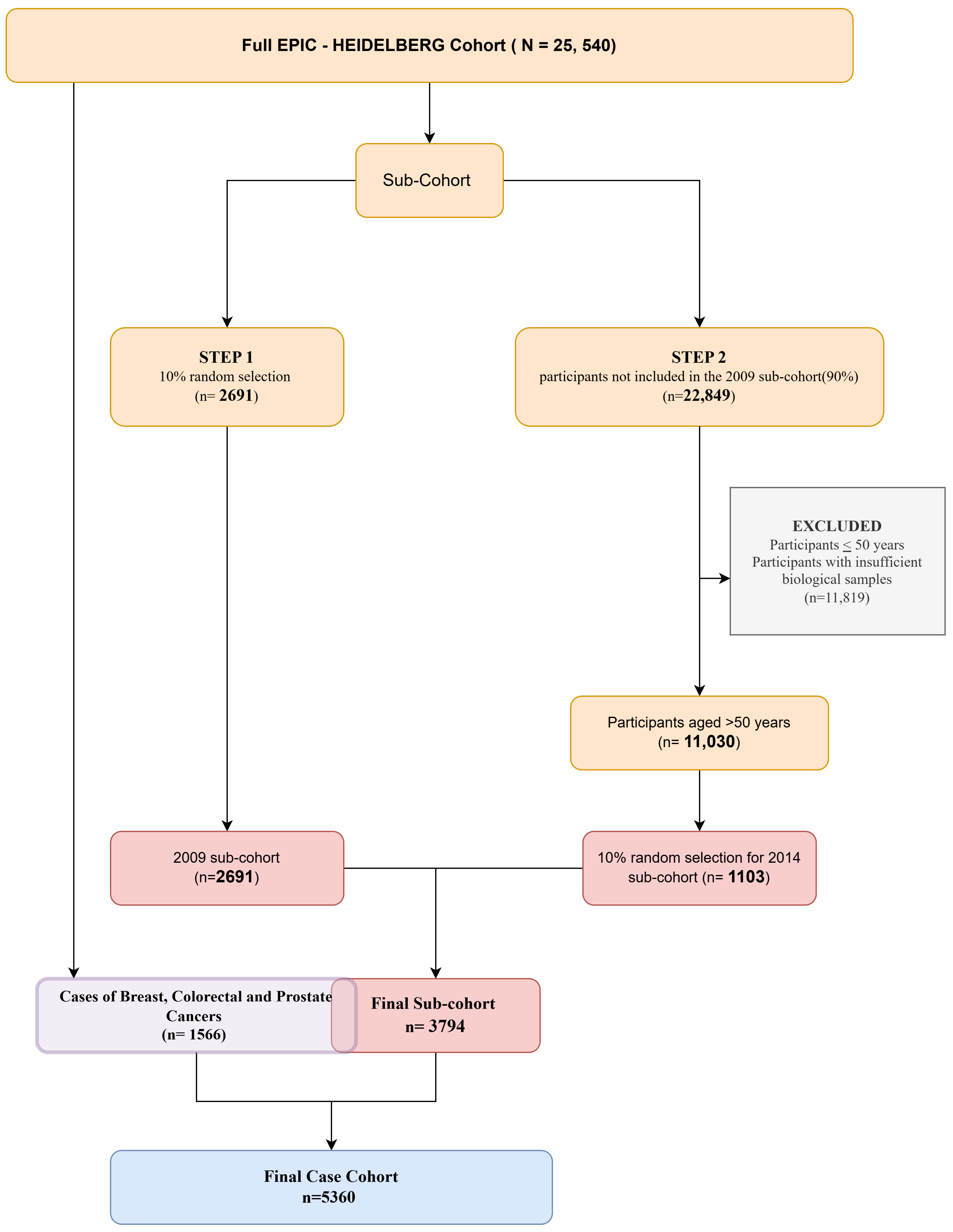
As illustrated in
Appendix A Figure A1, a two-stage, age-stratified case–cohort sampling strategy was applied within the EPIC-Heidelberg cohort to optimize efficiency in specimen use and enable robust investigation of age-related outcomes. Case–cohort designs minimize unnecessary use of biological specimens and financial costs for laboratory analysis while allowing the study of multiple outcomes [
24]. To enhance statistical power for analyses of age-related effects, the design intentionally oversampled older participants in the sub-cohort, in accordance with higher cancer occurrences among older individuals. In the first sampling stage (2009), a 10% random selection of the entire baseline cohort was undertaken. These participants were included in the initial case–cohort analyses of chronic disease cases diagnosed up to December 2009 [
25,
26]. In the second stage (2014), an additional 10% sample was drawn from participants who were aged >50 years at baseline and had not been included in the first stage. The two samples were combined to form the final sub-cohort of 3794 randomly selected participants. In addition to the sub-cohort, 1566 incident cases of breast, prostate, and colorectal cancer diagnosed and verified through the end of December 2014 were included in this analysis. For the current analyses, 3794 sub-cohort study participants and 1566 incident cases were included.
2.3. Statistical Analysis
Baseline characteristics of cases and the non-case sub-cohort were summarized as median (interquartile range, IQR) for continuous covariates, and as frequencies and percentages for categorical covariates, and were further stratified by serum arsenic levels. We first assessed the association between serum arsenic concentrations and potential main factors of breast, prostate and colorectal cancers using a survey-weighted generalized linear model (GLM) with 95% confidence intervals (CI). For the main analyses of serum arsenic and the incidence of breast, prostate, and colorectal cancers, we used Prentice-weighted Cox proportional hazards regression models with age as the underlying time scale to estimate hazard ratios (HRs) and 95% Cls. Both crude and multivariable-adjusted HRs were calculated. All sub-cohort observations were left-truncated at age at recruitment and right-censored at the earliest of end of follow-up, death, or loss to follow-up. Cancer cases were included at the time of diagnosis, following the Prentice weighting scheme, with deaths from other causes accounted for.
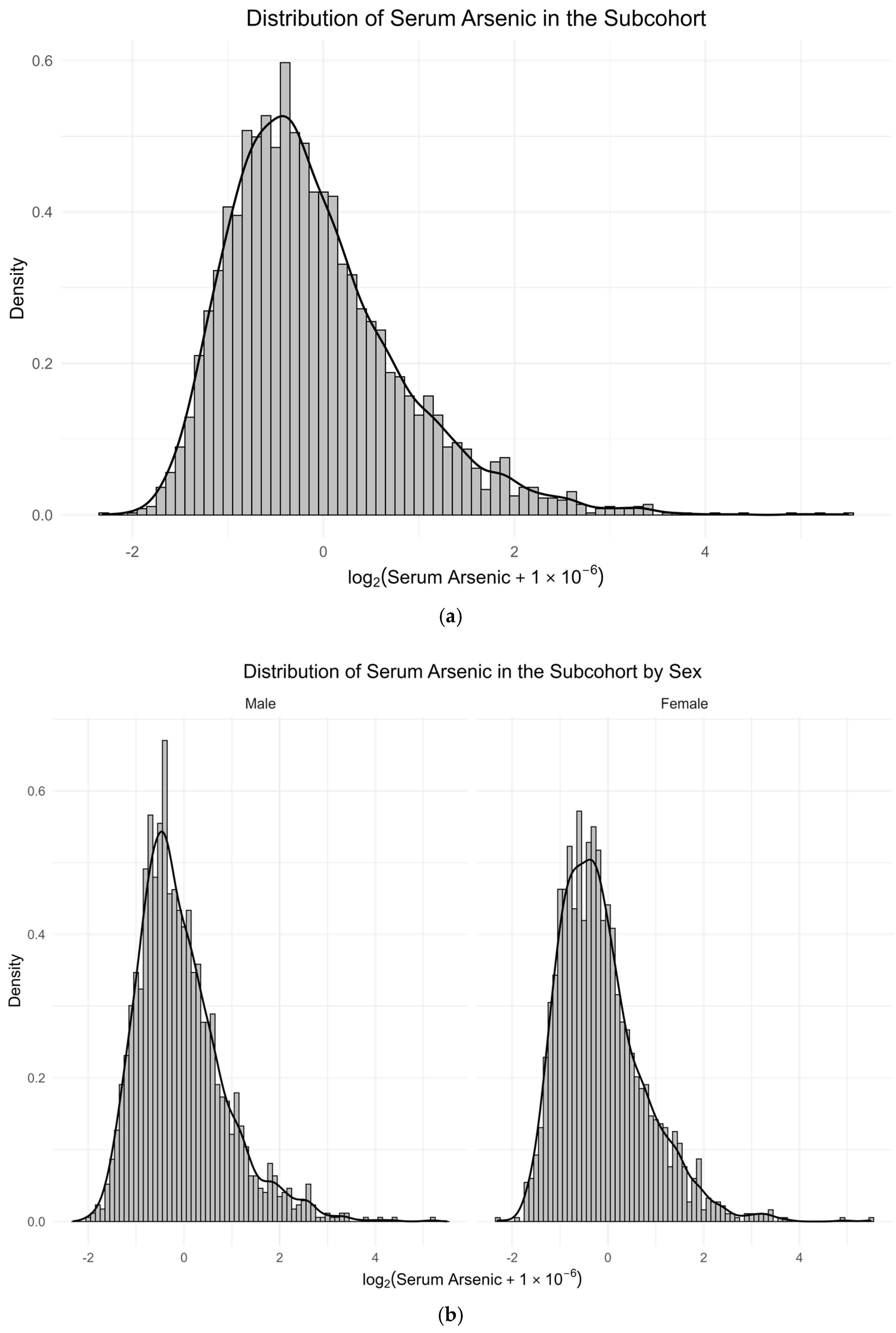
Serum arsenic concentration was modeled in quartiles, with the lowest category as the reference group, because arsenic values did not follow a normal distribution. Covariates were retained in the multivariable models if they altered the HRs by more than 10%, were significantly associated with either the exposure or the outcome, or were considered important based on biological plausibility. The adjusted model for prostate and colorectal cancers included level of education (primary, secondary, technical/professional, tertiary), smoking status (never, former, current, unknown), alcohol use (never, former, current at recruitment, lifetime), body-mass index (BMI, continuous), and physical activity (inactive, moderately inactive, moderately active, active) as the covariates. In the breast cancer model, adjustments were made for additional covariates such as parity status (nulliparous, primiparous, multiparous), use of oral contraceptives or hormone replacement therapy (HRT), breastfeeding history (yes, no), age at menarche (<12 years, 12–14, >14 years), and family history of breast cancer (yes, no). Subgroup analyses were per formed to assess associations between serum arsenic and breast cancer stratified by menopausal status at baseline and at diagnosis, by tumor receptor status (ER/PR-positive vs. ER/PR-negative), and by BMI. Values below the limit of detection (LOD ≤ 0.022 µg/L) were retained in the main analysis to avoid inflating blood serum arsenic estimates. Sensitivity analysis was further performed using LOD/2 for values below the detection limit to confirm the robustness of our findings. An additional analysis was equally conducted to adjust for arsenic dietary proxies and verify the accuracy of the results. All statistical analyses were conducted in R (version 4.5.1, R Project for Statistical Computing, RRID:SCR_001905, Posit Software (R version 4.5.1), PBC, Boston, MA, USA). The software is available under the GNU Affero General Public License version 3 (AGPL v3).
4. Discussion
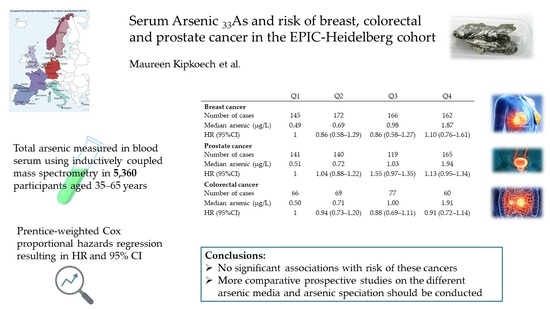
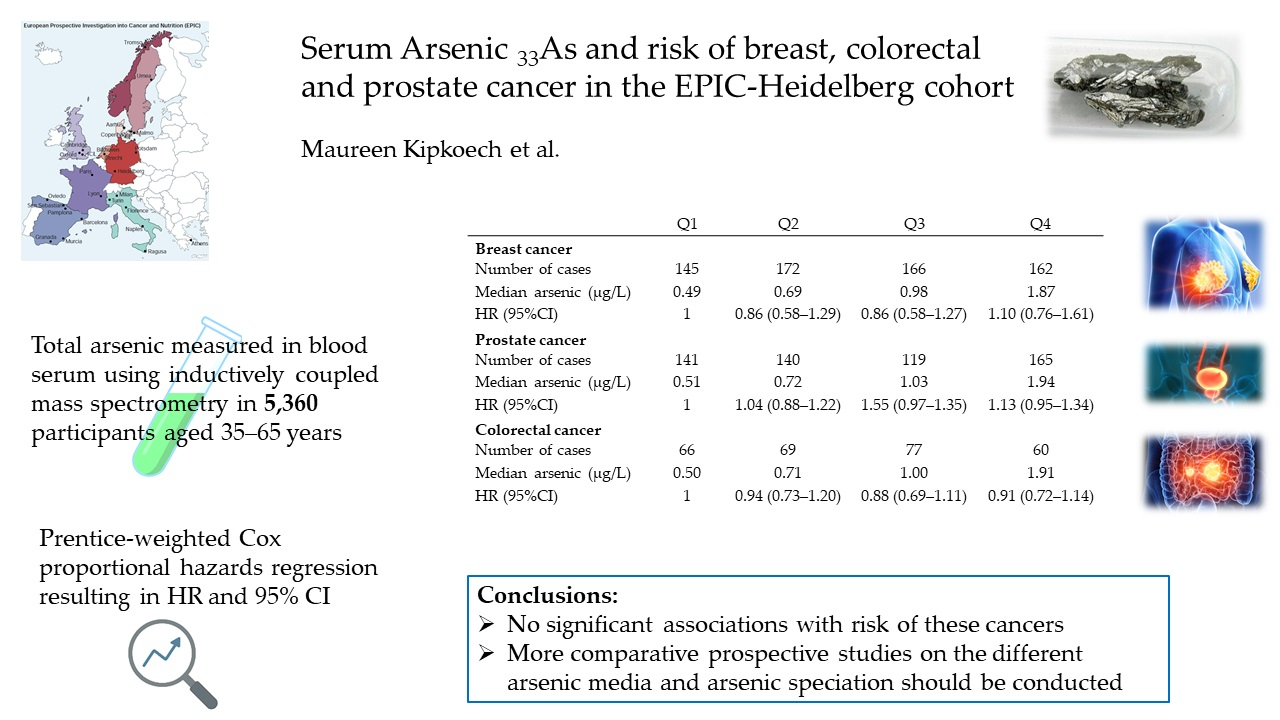
In our population-based prospective study, serum arsenic levels were not statistically significantly associated with the risks of breast, prostate, or colorectal cancers after adjusting for potential confounders.
In the current study, we were unable to establish a statistically significant association between serum arsenic exposure and breast cancer, which is paradoxical to previous findings. A comparative Polish prospective cohort found that elevated whole blood arsenic levels increased breast cancer risk (HR: 13.2; 95% Cl 4.78–37) in women with a family history of the disease [
10]. Arsenic exposure has been shown to aggravate DNA double-strand break (DSB) repair deficiencies, particularly in cells deficient in BRCA1 and BRCA2 [
27,
28]. This suggests that individuals harboring mutations in BRCA1 or BRCA2 may be more susceptible to arsenic-induced impairments in DNA repair. The Polish study proposed that a likely mechanistic explanation for their observed association is that arsenic mimics estrogen-induced effects, contributing to breast cancer [
29]. If this mechanism applied broadly, similar results would have been expected in our study. We therefore hypothesized that arsenic exposure may be more hazardous in DNA-deficient or compromised individuals, which could explain why our population-based study did not identify a significant association, in contrast to the Polish study, which focused specifically on women with a family history of the disease. Consistently, the mean serum arsenic concentration in our cohort was 1.27 µg/L, substantially lower than the mean level of 1.62 µg/L reported in whole blood in the Polish cohort [
10]. Similarly, findings from other perspective studies, which employed various exposure media such as airborne, FFQ, and drinking water also demonstrated a positive association between arsenic exposure and breast cancer [
30,
31,
32,
33]. However, there have been previous prospective studies using airborne or toenail-derived arsenic that reported null findings, which align with the results of the present study on blood levels [
34,
35]. The observed inconsistencies may be attributed to differences in population characteristics, sample size, exposure pathways, arsenic species, and laboratory techniques employed.
Our study did not find a statistically significant association between serum arsenic exposure and prostate cancer risk, in contrast to a meta-analysis that reported a significant association, with a pooled relative risk of 1.18 (1.06–1.30) [
36]. Notably, none of the included studies employed blood samples; rather, the investigations relied on urine, drinking water, estimated intake from diet, and soil as the exposure materials. However, studies conducted in Denmark and North Carolina reported a non-significant association between arsenic exposure and prostate cancer risk, which is consistent with our findings [
37,
38]. Variations in arsenic assessment may account for the differing results, as most previous studies employed exogenous source of exposure, whereas the present study utilized endogenous arsenic.
Evidence regarding colorectal cancer remains limited and inconclusive. Overall, no statistically significant association was observed between blood arsenic levels and colorectal cancer in our study. However, subgroup analysis by colorectal site revealed that higher blood arsenic levels were statistically protective against colon cancer in the second and third quantiles relative to the first. Arsenic metabolites may remain longer in contact with the colonocytes, since colon has a longer absorption transit time compared to rectum which could explain these findings. A Danish prospective cohort found no clear association between drinking water arsenic exposure and colorectal cancer, consistent with our general results [
37]. In contrast, evidence from Argentina demonstrated sex-specific effects, with elevated arsenic in drinking water associated with increased colorectal cancer risk in women but a protective effect in men [
39]. The limited available evidence has primarily used drinking water as the exposure biomarker, which may explain the discrepancies in results. Moreover, the limited evidence suggesting a lack of association between arsenic exposure and colorectal cancer indicates that arsenic exposure is unlikely to be a major driver of the disease, particularly in areas with low-to-moderate exposure.
Arsenic, a naturally occurring metalloid, exists in organic and inorganic forms in the environment [
40]. Human exposure to arsenic can occur through various sources, including drinking water, food, industrial processes, and tobacco smoke [
41]. The more toxic inorganic arsenic is often found in contaminated groundwater, industrial emissions, and foods like rice and seafood [
42]. The influence of these exposures on blood arsenic levels remains unclear, as no published guidelines have been established for permissible arsenic concentrations in the blood. Even so, evidence from clinical and epidemiological studies suggests a recommended threshold of 1 µg/L [
43]. In vitro studies indicate that arsenic toxicity is influenced by the cells used in the treatment, the type of the animal model utilized, and the uptake rate of the arsenic compounds under investigation [
44]. The total estimated arsenic intake from food and beverages generally ranges between 20 and 300 µg/day. However, it remains unclear whether elevated dietary intake directly correlates with increased arsenic levels in blood. Ambient inhalation of arsenic from air is typically a minor route of exposure for the general population, with estimated daily intakes of 20–200 ng for individuals in rural areas, 400–600 ng for residents of cities with arsenic-industrial emission activities, and 1 µg to over 10 µg for non-smokers and smokers, respectively, assuming a daily inhalation rate of 20 m
3 [
45,
46].
Arsenic has been suggested to promote breast cancer carcinogenesis through mechanisms such as genotoxicity and DNA damage, chromosomal instability, and epigenetic changes [
47,
48,
49]. Furthermore, laboratory studies suggest arsenic mimics estrogen and may act as an endocrine disruptor, particularly for hormone receptor-positive breast cancers and especially in tumor initiation and progression [
50]. In prostate cancer, arsenic has been implicated in carcinogenesis through its ability to disrupt DNA repair mechanisms [
15]. In colorectal cancer, in vitro studies have demonstrated that arsenic trivalent form and its metabolites may promote the disease through mechanisms involving oxidative stress, and proinflammatory response [
51].
The absence of detectable association in this study may be attributable to serum arsenic levels in our cohort being insufficient (≤0.022 µg/L) to elicit measurable effects. Some samples of low volume were excluded, which could have influenced the overall sample composition. Specific concentrations of arsenic species, including inorganic arsenic, monomethyarsonic, dimethylarsinic or pentavalent arsenic, were not measured, as the inductively coupled mass spectrometer used did not allow for arsenic speciation despite the known differential effects of these species. Hence, results should be addressed with caution. Furthermore, the findings reflect short-term arsenic exposure, as arsenic has a short half-life and is cleared from blood within 3 to 6 h. Thus, serum arsenic levels rather reflect short- to mid-term rather than long-term exposure. An exception is continuous high-level exposure to inorganic arsenic from sources such as drinking water or food like fish, which can contribute to elevated arsenic blood levels, thereby reflecting the actual tissue burden. To better determine the influence of individual arsenic species on cancer risk, future studies should incorporate arsenic speciation. Repeated blood sample collection and measurement of arsenic levels around the time of diagnosis were not available but would allow further investigations into, so far, unknown areas. Despite these limitations, this study is the first large-scale prospective study to assess the effects of serum arsenic and risks of main cancers in a healthy population.




 ,
,