Guidelines for Diagnosis, Treatment, and Follow-Up of Patients with Follicular Lymphoma-Spanish Lymphoma Group (GELTAMO) 2025

 ,
,
Simple Summary
Abstract
1. Introduction
2. Diagnosis
2.1. Histological Classification: WHO (5th Ed) and ICC (2022)
2.2. Immunohistochemistry and Immunophenotype
2.3. Cytogenetics and Molecular Biology
- Recommendations
- •
- Excisional biopsy of a lymph node or affected tissue is the preferred option for diagnosing FL, provided it is surgically accessible (1A).
3. Staging and Prognostic Evaluation
3.1. Staging
3.2. Prognostic Evaluation
- Recommendations
- •
- In addition to standard tests, it is recommended to perform PET-CT for both FL staging and response evaluation (1A).
- •
- Bone marrow biopsy is mandatory to confirm localized FL (1B).
- •
- While prognostic indices (FLIPI, FLIPI2, etc.) can predict outcomes for FL patients, they are not typically useful to guide treatment decisions (1A).
- •
- Patients with FL treated with immunochemotherapy who experience early relapse (e.g., POD24) have an unfavorable prognosis (1A).
4. Treatment
4.1. First-Line Treatment
4.1.1. Treatment of Localized Stages (Contiguous, Non-Bulky Stages I and II)
4.1.2. Treatment of Advanced Stages [Stages III and IV or Bulky Localized Disease]
Patients with Low Tumor Burden
Patients with High Tumor Burden
- Induction Therapy
- Maintenance Therapy
- Recommendations
- •
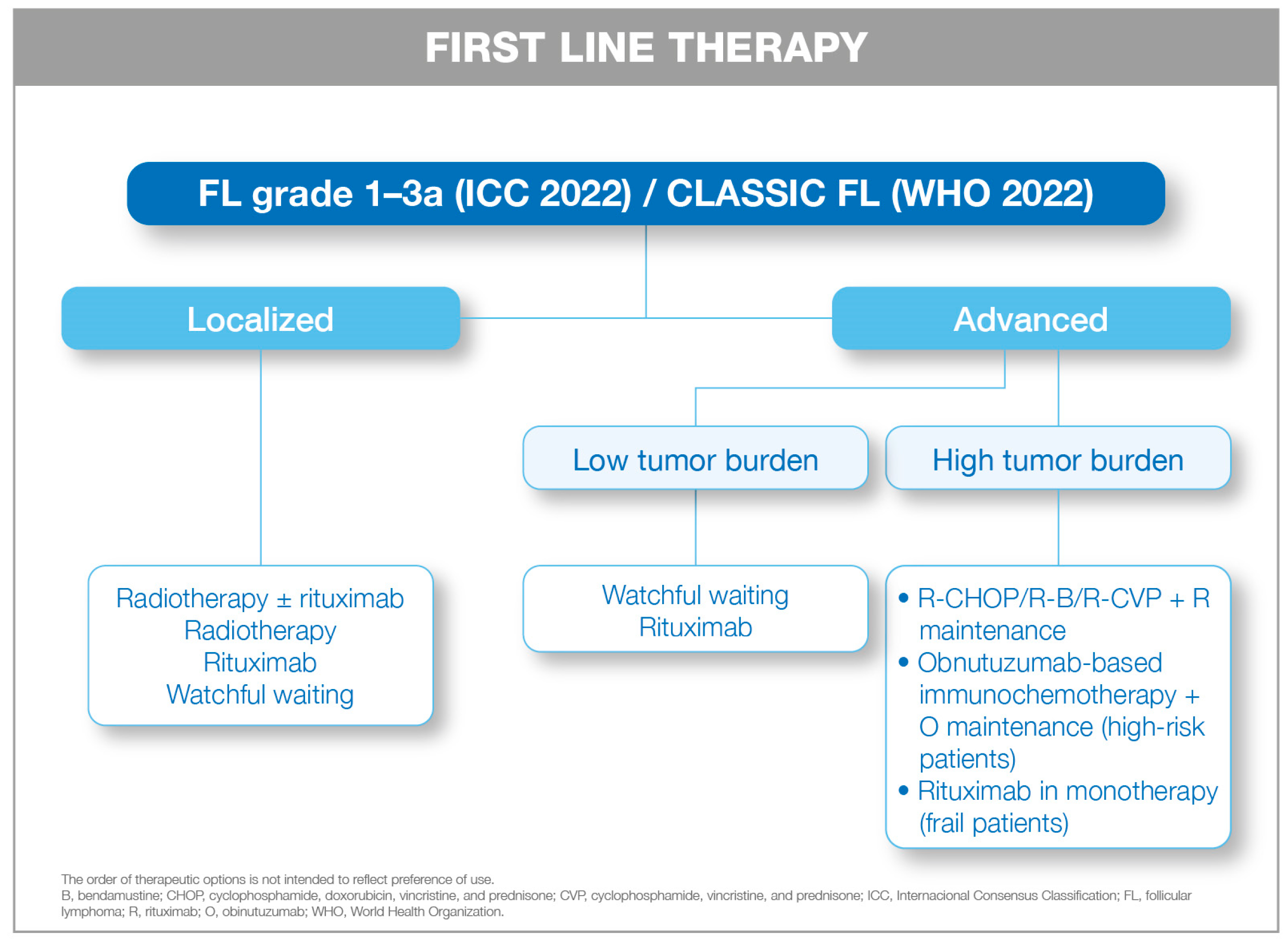
- In patients with localized FL (contiguous, non-bulky stage I or II), local radiotherapy with curative potential is recommended (1A).
- •
- The addition of rituximab to radiotherapy in patients with localized FL may be considered as a strategy to prolong PFS (2B).
- •
- For advanced stages with low tumor burden, observation is recommended (1A); however, rituximab monotherapy is also a valid option (1A).
- •
- For advanced stages with high tumor burden, immunochemotherapy (R-CHOP, R-CVP, or R-bendamustine) is recommended (1A). Obinutuzumab-based immunochemotherapy may be considered for high-risk patients (1B). Rituximab monotherapy should be reserved for selected cases, such as elderly patients or those with comorbidities (2B).
- •
- In patients who achieve complete response (CR) or partial response (PR) after induction, maintenance with an anti-CD20 antibody (every 2 months for a maximum of 2 years) is recommended (1A), provided that treatment is adequately tolerated.
4.2. Treatment of Relapse
4.2.1. Treatment of Relapse with Low Tumor Burden
4.2.2. Treatment of Relapse with High Tumor Burden
4.2.3. Treatment of Early Relapse (POD24)
- Recommendations
- •
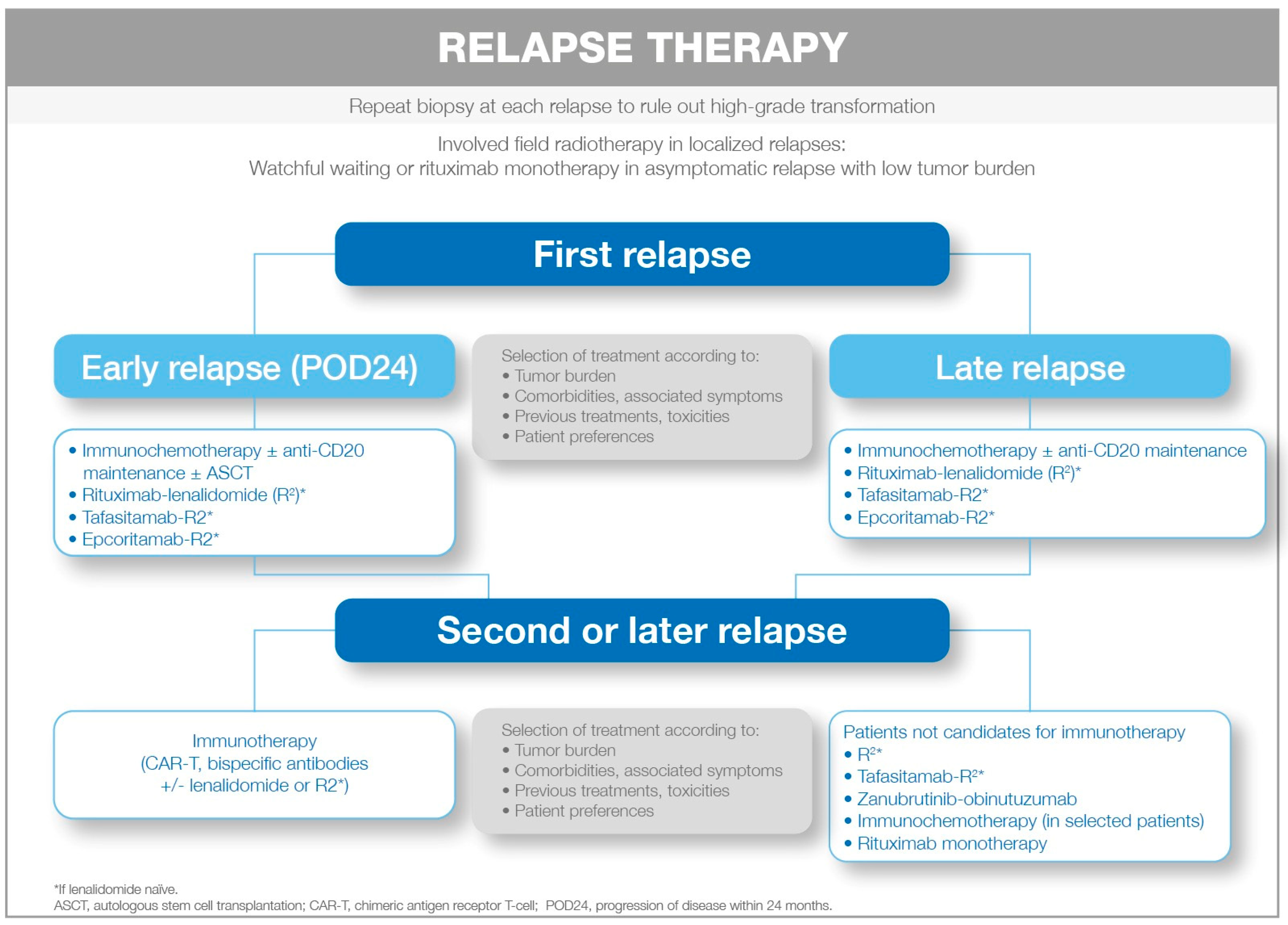
- Patients with early relapse (POD24) should be treated if they have a high tumor burden (1B).
- •
- A different immunochemotherapy regimen from that used in the first line is recommended (1C) such as R-CHOP, R-B, platinum-based regimens for ASCT candidates, or the combination of rituximab with lenalidomide (R2) (1B).
- •
- Obinutuzumab may be considered as an alternative in patients refractory to rituximab (1B).
- •
- Whenever possible, these patients should be considered for inclusion in clinical trials (1C).
- •
- POD24 patients who respond to rescue therapy (achieving at least PR) may benefit from intensification with ASCT, if eligible based on age and general health status (1B).
- •
- For patients not eligible for transplantation, maintenance treatment with rituximab every 3 months for 2 years may be considered (if not previously refractory) (1B).
4.2.4. Treatment of Late First Relapse
4.2.5. Treatment of Second or Subsequent Relapses
- Recommendations
- •
- In cases of suspected relapse or progression, obtaining a new biopsy is recommended to rule out histological transformation (1A).
- •
- Treatment selection for relapse requires an assessment of the risks and benefits of the available options, taking into account age, comorbidities, tumor burden, associated symptoms, duration of response to previous treatment, previous treatments, toxicity to previous treatment and expected toxicity, therapeutic objectives, and patient preferences (1A).
- •
- Localized relapses, without other risk factors, can be treated with involved-site radiotherapy (ISRT) even at low doses (2B).
- •
- Asymptomatic patients with non-localized relapse and low tumor burden can be managed with observation (1B) or rituximab monotherapy (1B).
- •
- For patients treated with induction immunochemotherapy who experience a first relapse/late progression requiring treatment (high tumor burden), the following are recommended:
- ○
- Treatment with immunochemotherapy, preferably using a regimen different from that used in the first line (1C), or the combination of rituximab with lenalidomide (R2) (1B).
- ○
- Rituximab monotherapy (2A).
- ○
- Maintenance with rituximab (every 3 months for a maximum 2 years) if at least a partial response is achieved with rescue treatment (1B).
- •
- Second or subsequent relapses can be treated with the following options (preferably if not previously used):
- ○
- Immunochemotherapy (1B).
- ○
- Rituximab/lenalidomide (R2) in lenalidomide naïve-patients (1B).
- ○
- Tafasitamab-R2 in lenalidomide naïve-patients (2B).
- ○
- Zanubrutinib-obinutuzumab (2B).
- ○
- Bispecific antibodies: epcoritamab or mosenutuzumab (1B).
- ○
- CAR T-cell therapy (tisagenlecleucel in ≥ third line; axicabtagene ciloleucel in ≥ fourth line) (1B).
- •
- Allogeneic transplantation can be considered in young patients with good functional status and without relevant comorbidities, who have relapsed after ASCT, CAR T-cell therapy, and bispecific antibodies, and who have achieved at least a partial response (PR) after rescue treatment (2C).
4.3. Management of Transformed Follicular Lymphoma in the Clinical Setting
- Recommendations
- •
- R-CHOP is recommended for anthracycline-naïve tFL patients, largely based on extrapolation from de novo DLBCL data (1B).
- •
- Platinum-based regimens would be preferred in patients with prior anthracycline exposure, although evidence is limited to retrospective series (2C).
4.4. Special Considerations
- Recommendations
- •
- Patients with chronic hepatitis B (HBsAg-positive and viral-DNA-negative) as well as carriers (HBcAb-positive, HBsAg-negative and viral-DNA-negative) should receive antiviral prophylaxis and load monitoring. Patients with HBsAg-positive and viral-DNA-positive should undergo specific antiviral treatment (1A).
- •
- Following bendamustine administration, anti-infective prophylaxis against Pneumocystis jirovecii is recommended according to local guidelines throughout immunosuppressive treatment and until a CD4 count >200 cells/µL is achieved on two occasions (1B).
- •
- Vaccination is recommended for patients diagnosed with FL (1A).
5. Future Directions
6. Conclusions
Author Contributions
Funding
Institutional Review Board Statement
Informed Consent Statement
Data Availability Statement
Conflicts of Interest
References
- Swerdlow, S.H.; Campo, E.; Harris, N.L.; Jaffe, E.S.; Pileri, S.A.; Stein, H.; Thiele, J. (Eds.) World Health Organization Classification of Tumours of Haematopoietic and Lymphoid Tissues, 4th ed.; IARC: Lyon, France, 2017.
- Campo, E.; Jaffe, E.S.; Cook, J.R.; Quintanilla-Martinez, L.; Swerdlow, S.H.; Anderson, K.C.; Brousset, P.; Cerroni, L.; de Leval, L.; Dirnhofer, S.; et al. The International Consensus Classification of Mature Lymphoid Neoplasms: A report from the Clinical Advisory Committee. Blood 2022, 140, 1229–1253. [Google Scholar] [CrossRef] [PubMed]
- Alaggio, R.; Amador, C.; Anagnostopoulos, I.; Attygalle, A.D.; Araujo, I.B.O.; Berti, E.; Bhagat, G.; Borges, A.M.; Boyer, D.; Calaminici, M.; et al. The 5th edition of the World Health Organization Classification of Haematolymphoid Tumours: Lymphoid Neoplasms. Leukemia 2022, 36, 1720–1748. [Google Scholar] [CrossRef]
- Bastos-Oreiro, M.; Muntañola, A.; Panizo, C.; Gonzalez-Barca, E. RELINF: Prospective epidemiological registry of lymphoid neoplasms in Spain. A project from the GELTAMO group. Ann. Hematol. 2020, 99, 799–808. [Google Scholar] [CrossRef]
- Batlevi, C.L.; Sha, F.; Alperovich, A.; Ni, A.; Smith, K.; Ying, Z.; Soumerai, J.D.; Caron, P.C.; Falchi, L.; Hamilton, A.; et al. Follicular lymphoma in the modern era: Survival, treatment outcomes, and identification of high-risk subgroups. Blood Cancer J. 2020, 10, 74. [Google Scholar] [CrossRef]
- Guyatt, G.H.; Oxman, A.D.; Vist, G.E.; Kunz, R.; Falck-Ytter, Y.; Alonso-Coello, P.; Schünemann, H.J.; GRADE Working Group. GRADE: An emerging consensus on rating quality of evidence and strength of recommendations. BMJ 2008, 336, 924–926. [Google Scholar] [CrossRef]
- Frederiksen, J.K.; Sharma, M.; Casulo, C.; Burack, W.R. Systematic review of the effectiveness of fine-needle aspiration and/or core needle biopsy for subclassifying lymphoma. Arch. Pathol. Lab. Med. 2015, 139, 245–251. [Google Scholar] [CrossRef]
- Johl, A.; Lengfelder, E.; Hiddemann, W.; Klapper, W.; German Low-Grade Lymphoma Study Group (GLSG). Core needle biopsies and surgical excision biopsies in the diagnosis of lymphoma-experience at the Lymph Node Registry Kiel. Ann. Hematol. 2016, 95, 1281–1286. [Google Scholar] [CrossRef]
- Novelli, S.; Briones, J.; Flotats, A.; Sierra, J. PET/CT Assessment of Follicular Lymphoma and High Grade B Cell Lymphoma—Good Correlation with Clinical and Histological Features at Diagnosis. Adv. Clin. Exp. Med. 2015, 24, 325–330. [Google Scholar] [CrossRef] [PubMed]
- Horsman, D.E.; Gascoyne, R.D.; Coupland, R.W.; Coldman, A.J.; Adomat, S.A. Comparison of cytogenetic analysis, southern analysis, and polymerase chain reaction for the detection of t(14; 18) in follicular lymphoma. Am. J. Clin. Pathol. 1995, 103, 472–478. [Google Scholar] [CrossRef] [PubMed]
- Ott, G.; Katzenberger, T.; Lohr, A.; Kindelberger, S.; Rüdiger, T.; Wilhelm, M.; Kalla, J.; Rosenwald, A.; Müller, J.G.; Ott, M.M.; et al. Cytomorphologic, immunohistochemical, and cytogenetic profiles of follicular lymphoma: 2 types of follicular lymphoma grade 3. Blood 2002, 99, 3806–3812. [Google Scholar] [CrossRef]
- Launay, E.; Pangault, C.; Bertrand, P.; Jardin, F.; Lamy, T.; Tilly, H.; Tarte, K.; Bastard, C.; Fest, T. High rate of TNFRSF14 gene alterations related to 1p36 region in de novo follicular lymphoma and impact on prognosis. Leukemia 2012, 26, 559–562. [Google Scholar] [CrossRef] [PubMed]
- Okosun, J.; Bödör, C.; Wang, J.; Araf, S.; Yang, C.Y.; Pan, C.; Boller, S.; Cittaro, D.; Bozek, M.; Iqbal, S.; et al. Integrated genomic analysis identifies recurrent mutations and evolution patterns driving the initiation and progression of follicular lymphoma. Nat. Genet. 2014, 46, 176–181. [Google Scholar] [CrossRef] [PubMed]
- Green, M.R.; Gentles, A.J.; Nair, R.V.; Irish, J.M.; Kihira, S.; Long, L.C.; Kela, I.; Hopmas, E.S.; Myklebust, J.H.; Ji, H.; et al. Hierarchy in somatic mutations arising during genomic evolution and progression of follicular lymphoma. Blood 2013, 121, 1604–1611. [Google Scholar] [CrossRef]
- Pasqualucci, L.; Khiabanian, H.; Fangazio, M.; Vasishtha, M.; Messina, M.; Holmes, A.B.; Ouillette, P.; Trifonov, V.; Rossi, D.; Tabbò, F.; et al. Genetics of follicular lymphoma transformation. Cell Rep. 2014, 6, 130–140. [Google Scholar] [CrossRef]
- Brice, P.; Bastion, Y.; Lepage, E.; Brousse, N.; Haïoun, C.; Moreau, P.; Straetmans, N.; Tilly, H.; Tabah, I.; Solal-Céligny, P. Comparison in low-tumor-burden follicular lymphomas between an initial no-treatment policy, prednimustine, or interferon alfa: A randomized study from the Groupe d’Etude des Lymphomes Folliculaires. Groupe d’Etude des Lymphomes de l’Adulte. J. Clin. Oncol. 1997, 15, 1110–1117. [Google Scholar] [CrossRef]
- McNamara, C.; Davies, J.; Dyer, M.; Hoskin, P.; Illidge, T.; Lyttelton, M.; Marcus, R.; Montoto, S.; Ramsay, A.; Wong, W.L.; et al. Guidelines on the investigation and management of follicular lymphoma. Br. J. Haematol. 2012, 156, 446–467. [Google Scholar] [CrossRef]
- Martinelli, G.; Schmitz, S.F.; Utiger, U.; Cerny, T.; Hess, U.; Bassi, S.; Okkinga, E.; Stupp, R.; Stahel, R.; Heizmann, M.; et al. Long-term follow-up of patients with follicular lymphoma receiving single-agent rituximab at two different schedules in trial SAKK 35/98. J. Clin. Oncol. 2010, 28, 4480–4484. [Google Scholar] [CrossRef]
- Cheson, B.D.; Fisher, R.I.; Barrington, S.F.; Cavalli, F.; Schwartz, L.H.; Zucca, E.; Lister, T.A.; Alliance, Australasian Leukaemia and Lymphoma Group; Eastern Cooperative Oncology Group; European Mantle Cell Lymphoma Consortium; et al. Recommendations for initial evaluation, staging, and response assessment of Hodgkin and non-Hodgkin lymphoma: The Lugano classification. J. Clin. Oncol. 2014, 32, 3059–3068. [Google Scholar] [CrossRef]
- Rutherford, S.C.; Li, V.; Ghione, P.; Chen, Z.; Martin, P.; Leonard, J.P. Bone marrow biopsies do not impact response assessment for follicular lymphoma patients treated on clinical trials. Br. J. Haematol. 2017, 179, 242–245. [Google Scholar] [CrossRef] [PubMed]
- Rutherford, S.C.; Herold, M.; Hiddemann, W.; Kostakoglu, L.; Marcus, R.; Martelli, M.; Sehn, L.H.; Trněný, M.; Trotman, J.; Vitolo, U.; et al. Impact of bone marrow biopsy on response assessment in immunochemotherapy-treated lymphoma patients in GALLIUM and GOYA. Blood Adv. 2020, 4, 1589–1593. [Google Scholar] [CrossRef]
- Goldman, M.L.; Mao, J.J.; Strouse, C.S.; Chen, W.; Rupji, M.; Chen, Z.; Maurer, M.J.; Calzada, O.; Churnetski, M.; Flowers, C.R.; et al. Surveillance imaging during first remission in follicular lymphoma does not impact overall survival. Cancer 2021, 127, 3390–3402, Erratum in Cancer 2025, 131, e35934. https://doi.org/10.1002/cncr.35934. [Google Scholar] [CrossRef]
- Sorigue, M.; Sancho, J.M. Routine surveillance imaging in follicular lymphoma. Ann. Hematol. 2018, 97, 2263–2264. [Google Scholar] [CrossRef]
- Jiménez-Ubieto, A.; Poza, M.; Martin-Muñoz, A.; Ruiz-Heredia, Y.; Dorado, S.; Figaredo, G.; Rosa-Rosa, J.M.; Rodríguez, A.; Barcena, C.; Navamuel, L.P.; et al. Real-life disease monitoring in follicular lymphoma patients using liquid biopsy ultra-deep sequencing and PET/CT. Leukemia 2023, 37, 659–669. [Google Scholar] [CrossRef]
- Claudel, A.; Cottereau, A.S.; Bachy, E.; Itti, E.; Feugier, P.; Rossi, C.; Lemmonier, F.; Camus, V.; Daguindau, N.; Cartron, G.; et al. Combined PET and ctDNA response as a predictor of POD24 for follicular lymphoma after first-line induction treatment. Blood 2025, 146, 913–925. [Google Scholar] [CrossRef] [PubMed]
- Pastore, A.; Jurinovic, V.; Kridel, R.; Hoster, E.; Staiger, A.M.; Szczepanowski, M.; Pott, C.; Kopp, N.; Murakami, M.; Horn, H.; et al. Integration of gene mutations in risk prognostication for patients receiving first-line immunochemotherapy for follicular lymphoma: A retrospective analysis of a prospective clinical trial and validation in a population-based registry. Lancet Oncol. 2015, 16, 1111–1122. [Google Scholar] [CrossRef]
- Jurinovic, V.; Kridel, R.; Staiger, A.M.; Szczepanowski, M.; Horn, H.; Dreyling, M.H.; Rosenwald, A.; Ott, G.; Klapper, W.; Zelenetz, A.D.; et al. Clinicogenetic risk models predict early progression of follicular lymphoma after first-line immunochemotherapy. Blood 2016, 128, 1112–1120. [Google Scholar] [CrossRef]
- Huet, S.; Tesson, B.; Jais, J.P.; Feldman, A.L.; Magnano, L.; Thomas, E.; Traverse-Glehen, A.; Albaud, B.; Carrère, M.; Xerri, L.; et al. A gene-expression profiling score for prediction of outcome in patients with follicular lymphoma: A retrospective training and validation analysis in three international cohorts. Lancet Oncol. 2018, 19, 549–561. [Google Scholar] [CrossRef] [PubMed]
- Meignan, M.; Cottereau, A.S.; Versari, A.; Chartier, L.; Dupuis, J.; Boussetta, S.; Grassi, I.; Casasnovas, R.O.; Haioun, C.; Tilly, H.; et al. Baseline Metabolic Tumor Volume Predicts Outcome in High-Tumor-Burden Follicular Lymphoma: A Pooled Analysis of Three Multicenter Studies. J. Clin. Oncol. 2016, 34, 3618–3626. [Google Scholar] [CrossRef]
- Cottereau, A.S.; Versari, A.; Luminari, S.; Dupuis, J.; Chartier, L.; Casasnovas, R.O.; Berriolo-Riedinger, A.; Menga, M.; Haioun, C.; Tilly, H.; et al. Prognostic model for high-tumor-burden follicular lymphoma integrating baseline and end-induction PET: A LYSA/FIL study. Blood 2018, 131, 2449–2453. [Google Scholar] [CrossRef] [PubMed]
- Mozas, P.; Rivero, A.; López-Guillermo, A. Past, present and future of prognostic scores in follicular lymhoma. Blood Rev. 2021, 50, 100865. [Google Scholar] [CrossRef]
- Rodríguez-Sevilla, J.J.; Fernández-Rodríguez, C.; Bento, L.; Diez-Feijóo, R.; Pinzón, S.; Gibert, J.; Fernández-Ibarrondo, L.; Lafuente, M.; Ferrer, A.; Sánchez-González, B.; et al. Evaluation of 4 prognostic indices in follicular lymphoma treated in first line with immunochemotherapy. Blood Adv. 2023, 7, 1606–1614. [Google Scholar] [CrossRef]
- Federico, M.; Vitolo, U.; Zinzani, P.L.; Chisesi, T.; Clò, V.; Bellesi, G.; Magagnoli, M.; Liberati, M.; Boccomini, C.; Niscola, P.; et al. Prognosis of follicular lymphoma: A predictive model based on a retrospective analysis of 987 cases. Intergruppo Italiano Linfomi. Blood 2005, 95, 783–789. [Google Scholar]
- Solal-Céligny, P.; Roy, P.; Colombat, P.; White, J.; Armitage, J.O.; Arranz-Saez, R.; Au, W.Y.; Bellei, M.; Brice, P.; Caballero, D.; et al. Follicular Lymphoma International Prognostic Index. Blood 2004, 104, 1258–1265. [Google Scholar] [CrossRef]
- Federico, M.; Bellei, M.; Marcheselli, L.; Luminari, S.; Lopez-Guillermo, A.; Vitolo, U.; Pro, B.; Pileri, S.; Pulsoni, A.; Soubeyran, P.; et al. Follicular lymphoma international prognostic index 2: A new prognostic index for follicular lymphoma developed by the international follicular lymphoma prognostic factor project. J. Clin. Oncol. 2009, 27, 4555–4562. [Google Scholar] [CrossRef]
- Bachy, E.; Maurer, M.J.; Habermann, T.M.; Gelas Dore, B.; Maucort-Boulch, D.; Estell, J.A.; Van de Neste, E.; Bouabdallah, R.; Gyan, E.; Feldman, A.L.; et al. A simplified scoring system in de novo follicular lymphoma treated initially with immunochemotherapy. Blood 2018, 132, 49–58. [Google Scholar] [CrossRef] [PubMed]
- Mir, F.; Mattiello, F.; Grigg, A.; Herold, M.; Hiddemann, W.; Marcus, R.; Seymour, J.F.; Bolen, C.R.; Knapp, A.; Nielsen, T.; et al. Follicular Lymphoma Evaluation Index (FLEX): A new clinical prognostic model that is superior to existing risk scores for predicting progression-free survival and early treatment failure after frontline immunochemotherapy. Am. J. Hematol. 2020, 95, 1503–1510. [Google Scholar] [CrossRef]
- Trotman, J.; Fournier, M.; Lamy, T.; Seymour, J.F.; Sonet, A.; Janikova, A.; Shpilberg, O.; Gyan, E.; Tilly, H.; Estell, J.; et al. Positron emission tomography-computed tomography (PET-CT) after induction therapy is highly predictive of patient outcome in follicular lymphoma: Analysis of PET-CT in a subset of PRIMA trial participants. J. Clin. Oncol. 2011, 29, 3194–3200. [Google Scholar] [CrossRef]
- Luminari, S.; Biasoli, I.; Versari, A.; Rattotti, S.; Bottelli, C.; Rusconi, C.; Merli, F.; Spina, M.; Ferreri, A.J.; Zinzani, P.L.; et al. The prognostic role of post-induction FDG-PET in patients with follicular lymphoma: A subset analysis from the FOLL05 trial of the Fondazione Italiana Linfomi (FIL). Ann. Oncol. 2014, 25, 442–447. [Google Scholar] [CrossRef]
- Luminari, S.; Manni, M.; Galimberti, S.; Versari, A.; Tucci, A.; Boccomini, C.; Farina, L.; Olivieri, J.; Marschelli, L.; Guerra, L.; et al. Response-Adapted Postinduction Strategy in Patients with Advanced-Stage Follicular Lymphoma: The FOLL12 Study. J. Clin. Oncol. 2022, 40, 729–739. [Google Scholar] [CrossRef] [PubMed]
- Hoskin, P.; Popova, B.; Schofield, O.; Brammer, C.; Robinson, M.; Brunt, A.M.; Madhavan, K.; Illidge, T.; Gallop-Evans, E.; Syndikus, I.; et al. 4 Gy versus 24 Gy radiotherapy for follicular and marginal zone lymphoma (FoRT): Long-term follow-up of a multicentre, randomised, phase 3, non-inferiority trial. Lancet Oncol. 2021, 22, 332–340. [Google Scholar] [CrossRef] [PubMed]
- Lowry, L.; Smith, P.; Qian, W.; Falk, S.; Benstead, K.; Illidge, T.; Linch, D.; Robinson, M.; Jack, A.; Hoskin, P. Reduced dose radiotherapy for local control in non-Hodgkin lymphoma: A randomised phase III trial. Radiother. Oncol. 2011, 100, 86–92. [Google Scholar] [CrossRef]
- Hoskin, P.J.; Kirkwood, A.A.; Popova, B.; Smith, P.; Robinson, M.; Gallop-Evans, E.; Coltart, S.; Illidge, T.; Madhavan, K.; Brammer, C.; et al. 4 Gy versus 24 Gy radiotherapy for patients with indolent lymphoma (FORT): A randomised phase 3 non-inferiority trial. Lancet Oncol. 2014, 15, 457–463. [Google Scholar] [CrossRef] [PubMed]
- Imber, B.S.; Chau, K.W.; Lee, J.; Lee, J.; Casey, D.L.; Yang, J.C.; Wijentunga, N.A.; Shepherd, A.; Hajj, C.; Qi, S.; et al. Excellent response to very-low-dose radiation (4 Gy) for indolent B-cell lymphomas: Is 4 Gy suitable for curable patients? Blood Adv. 2021, 5, 4185–4197. [Google Scholar] [CrossRef]
- MacManus, M.; Fisher, R.; Roos, D.; O’Brien, P.; Macann, A.; Davis, S.; Tsang, R.; Christie, D.; McClure, B.; Joseph, D.; et al. Randomized Trial of Systemic Therapy After Involved-Field Radiotherapy in Patients with Early-Stage Follicular Lymphoma: TROG 99.03. J. Clin. Oncol. 2018, 36, 2918–2925. [Google Scholar] [CrossRef] [PubMed]
- Herfarth, K.; Borchmann, P.; Schnaidt, S.; Hohloch, K.; Budach, V.; Engelhard, M.; Viardot, A.; Engenhart-Cabillic, R.; Keller, U.; Reinartz, G.; et al. Rituximab With Involved Field Irradiation for Early-stage Nodal Follicular Lymphoma: Results of the MIR Study. Hemasphere 2018, 2, e160. [Google Scholar] [CrossRef]
- Rodier, C.; Kanagaratnam, L.; Morland, D.; Herbin, A.; Durand, A.; Chauchet, A.; Choquet, S.; Colin, P.; Casasnovas, R.O.; Deconinck, E.; et al. Risk Factors of Progression in Low-tumor Burden Follicular Lymphoma Initially Managed by Watch and Wait in the Era of PET and Rituximab. Hemasphere 2023, 7, e861. [Google Scholar] [CrossRef] [PubMed]
- Portlock, C.S.; Rosenberg, S.A. No initial therapy for stage III and IV non-Hodgkin’s lymphomas of favorable histologic types. Ann. Intern. Med. 1979, 90, 10–13. [Google Scholar] [CrossRef]
- Young, R.C.; Longo, D.L.; Glatstein, E.; Ihde, D.C.; Jaffe, E.S.; DeVita, V.T., Jr. The treatment of indolent lymphomas: Watchful waiting v aggressive combined modality treatment. Semin. Hematol. 1988, 25, 11–16. [Google Scholar]
- Ardeshna, K.M.; Smith, P.; Norton, A.; Hancock, B.W.; Hoskin, P.J.; MacLennan, K.A.; Marcus, R.E.; Jelliffe, A.; Vaughan, G.; Hudson; et al. Long-term effect of a watch and wait policy versus immediate systemic treatment for asymptomatic advanced-stage non-Hodgkin lymphoma: A randomised controlled trial. Lancet 2003, 362, 516–522. [Google Scholar] [CrossRef]
- Northend, M.; Wilson, W.; Ediriwickrema, K.; Clifton-Hadley, L.; Qian, W.; Rana, Z.; Martin, T.L.; Townsend, W.; Young, M.; Miall, F.; et al. Early rituximab monotherapy versus watchful waiting for advanced stage, asymptomatic, low tumour burden follicular lymphoma: Long-term results of a randomised, phase 3 trial. Lancet Haematol. 2025, 12, e335–e345. [Google Scholar] [CrossRef] [PubMed]
- Ghielmini, M.; Schmitz, S.F.; Cogliatti, S.B.; Pichert, G.; Hummerjohann, J.; Waltzer, U.; Fey, M.F.; Betticher, D.C.; Martinelli, G.; Peccatori, F.; et al. Prolonged treatment with rituximab in patients with follicular lymphoma significantly increases event-free survival and response duration compared with the standard weekly x 4 schedule. Blood 2004, 103, 4416–4423. [Google Scholar] [CrossRef] [PubMed]
- Rummel, M.J.; Niederle, N.; Maschmeyer, G.; Banat, G.A.; von Grünhagen, U.; Losem, C.; Kofahl-Krause, D.; Heil, G.; Welslau, M.; Balser, C.; et al. Bendamustine plus rituximab versus CHOP plus rituximab as first-line treatment for patients with indolent and mantle-cell lymphomas: An open-label, multicentre, randomised, phase 3 non-inferiority trial. Lancet 2013, 381, 1203–1210. [Google Scholar] [CrossRef] [PubMed]
- Federico, M.; Luminari, S.; Dondi, A.; Tucci, A.; Vitolo, U.; Rigacci, L.; Di Raimondo, F.; Carella, A.M.; Pulsoni, A.; Merli, F.; et al. R-CVP versus R-CHOP versus R-FM for the initial treatment of patients with advanced-stage follicular lymphoma: Results of the FOLL05 trial conducted by the Fondazione Italiana Linfomi. J. Clin. Oncol. 2013, 31, 1506–1513, Erratum in J. Clin. Oncol. 2014, 32, 1095. [Google Scholar] [CrossRef]
- Luminari, S.; Ferrari, A.; Manni, M.; Dondi, A.; Chiarenza, A.; Merli, F.; Rusconi, C.; Tarantino, V.; Tucci, A.; Vitolo, U.; et al. Long-Term Results of the FOLL05 Trial Comparing R-CVP Versus R-CHOP Versus R-FM for the Initial Treatment of Patients With Advanced-Stage Symptomatic Follicular Lymphoma. J. Clin. Oncol. 2018, 36, 689–696. [Google Scholar] [CrossRef] [PubMed]
- Marcus, R.; Imrie, H.; Solal-Celigny, P.; Catalano, J.V.; Dmoszynska, A.; Raposo, J.C.; Offner, F.C.; Gómez-Codina, J.; Belch, A.; Cunningham, D.; et al. Phase III study of R-CVP compared with cyclophosphamide, vincristine, and prednisone alone in patients with previously untreated advanced follicular lymphoma. J. Clin. Oncol. 2008, 26, 4579–4586. [Google Scholar] [CrossRef]
- Hiddemann, W.; Kneba, M.; Dreyling, M.; Schmitz, N.; Lengfelder, E.; Schmits, R.; Reiser, M.; Metzner, B.; Harder, H.; Hegewish-Becker, S.; et al. Frontline therapy with rituximab added to the combination of cyclophosphamide, doxorubicin, vincristine, and prednisone (CHOP) significantly improves the outcome for patients with advanced-stage follicular lymphoma compared with therapy with CHOP alone: Results of a prospective randomized study of the German Low-Grade Lymphoma Study Group. Blood 2005, 106, 3725–3732. [Google Scholar] [CrossRef]
- Herold, M.; Haas, A.; Srock, S.; Neser, S.; Al-Ali, K.H.; Neubauer, A.; Dölken, G.; Naumann, R.; Knauf, W.; Freund, M.; et al. Rituximab added to first-line mitoxantrone, chlorambucil, and prednisolone chemotherapy followed by interferon maintenance prolongs survival in patients with advanced follicular lymphoma: An East German Study Group Hematology and Oncology Study. J. Clin. Oncol. 2007, 25, 1986–1992. [Google Scholar] [CrossRef] [PubMed]
- Bachy, E.; Houot, R.; Morschhauser, F.; Sonet, A.; Brice, P.; Belhadj, K.; Cartron, G.; Audhuy, B.; Fermé, C.; Feugier, P.; et al. Long-term follow up of the FL2000 study comparing CHVP-interferon to CHVP-interferon plus rituximab in follicular lymphoma. Haematologica 2013, 98, 1107–1114. [Google Scholar] [CrossRef] [PubMed]
- Rummel, M.; Kaiser, U.; Balser, C.; Stauch, M.; Brugger, W.; Welslau, M.; Niederle, N.; Losem, C.; Boeck, H.P.; Weidmann, E.; et al. Bendamustine plus rituximab versus fludarabine plus rituximab for patients with relapsed indolent and mantle-cell lymphomas: A multicentre, randomised, open-label, non-inferiority phase 3 trial. Lancet Oncol. 2016, 17, 57–66. [Google Scholar] [CrossRef]
- Flinn, I.W.; van der Jagt, R.M.; Kahl, B.S.; Wood, P.; Hawkins, T.E.; Macdonald, D.; Hertzberg, M.; Kwam, Y.L.; Simpson, D.; Craig, M.; et al. Randomized trial of bendamustine-rituximab or R-CHOP/R-CVP in first-line treatment of indolent NHL or MCL: The BRIGHT study. Blood 2014, 123, 2944–2952. [Google Scholar] [CrossRef] [PubMed]
- Flinn, I.W.; van der Jagt, R.M.; Kahl, B.; Wood, P.; Hawkins, T.; MacDonald, D.; Simpson, D.; Kolibaba, K.; Issa, S.; Chang, J.; et al. First-Line Treatment of Patients with Indolent Non-Hodgkin Lymphoma or Mantle-Cell Lymphoma with Bendamustine Plus Rituximab Versus R-CHOP or R-CVP: Results of the BRIGHT 5-Year Follow-Up Study. J. Clin. Oncol. 2019, 37, 984–991. [Google Scholar] [CrossRef]
- Bachy, E.; Seymour, J.F.; Feugier, P.; Offner, F.; López-Guillermo, A.; Belada, D.; Xerri, L.; Catalano, J.V.; Brice, P.; Lemonnier, F.; et al. Sustained Progression-Free Survival Benefit of Rituximab Maintenance in Patients with Follicular Lymphoma: Long-Term Results of the PRIMA Study. J. Clin. Oncol. 2019, 37, 2815–2824. [Google Scholar] [CrossRef]
- Marcus, R.; Davies, A.; Ando, K.; Klapper, W.; Opat, S.; Owen, C.; Phillips, E.; Hiddemann, W. Obinutuzumab for the First-Line Treatment of Follicular Lymphoma. N. Engl. J. Med. 2017, 377, 1331–1344. [Google Scholar] [CrossRef]
- Morschhauser, F.; Fowler, N.; Feugier, P.; Bouabdallah, R.; Tilly, H.; Palomba, M.L.; Fruchart, C.; Libby, E.N.; Casasnovas, R.O.; Flinn, I.W.; et al. Rituximab plus Lenalidomide in Advanced Untreated Follicular Lymphoma. N. Engl. J. Med. 2018, 379, 934–947. [Google Scholar] [CrossRef]
- Witzig, T.E.; Vukov, A.M.; Habermann, T.M.; Geyer, S.; Kurtin, P.J.; Friedenberg, W.R.; White, W.L.; Chalchal, H.I.; Flynn, P.J.; Fitch, T.R.; et al. Rituximab therapy for patients with newly diagnosed, advanced-stage, follicular grade I non-Hodgkin’s lymphoma: A phase II trial in the North Central Cancer Treatment Group. J. Clin. Oncol. 2005, 23, 1103–1108. [Google Scholar] [CrossRef]
- Hiddemann, W.; Barbui, A.M.; Canales, M.A.; Cannell, P.K.; Collins, G.P.; Dürig, J.; Forstpointner, R.; Herold, M.; Hertzberg, M.; Klanova, M.; et al. Immunochemotherapy with Obinutuzumab or Rituximab for Previously Untreated Follicular Lymphoma in the GALLIUM Study: Influence of Chemotherapy on Efficacy and Safety. J. Clin. Oncol. 2018, 36, 2395–2404. [Google Scholar] [CrossRef] [PubMed]
- Thielen, F.W.; Büyükkaramikli, N.C.; Riemsma, R.; Fayter, D.; Armstrong, N.; Wei, C.Y.; Huertas Carrera, V.; Misso, K.; Worthy, G.; Kleijnen, J.; et al. Obinutuzumab in Combination with Chemotherapy for the First-Line Treatment of Patients with Advanced Follicular Lymphoma: An Evidence Review Group Evaluation of the NICE Single Technology Appraisal. Pharmacoeconomics 2019, 37, 975–984. [Google Scholar] [CrossRef] [PubMed]
- Morschhauser, F.; Nastoupil, L.; Feugier, P.; Schiano de Colella, J.M.; Tilly, H.; Palomba, M.L.; Bachy, E.; Fruchart, C.; Libby, E.N.; Casasnovas, R.O.; et al. Six-Year Results From RELEVANCE: Lenalidomide Plus Rituximab (R2) Versus Rituximab-Chemotherapy Followed by Rituximab Maintenance in Untreated Advanced Follicular Lymphoma. J. Clin. Oncol. 2022, 40, 3239–3245. [Google Scholar] [CrossRef] [PubMed]
- Hill, B.T.; Nastoupil, L.; Winter, A.M.; Becnel, M.R.; Cerhan, J.R.; Habermann, T.M.; Link, B.K.; Maurer, M.J.; Fakhri, B.; Reddy, P.; et al. Maintenance rituximab or observation after frontline treatment with bendamustine-rituximab for follicular lymphoma. Br. J. Haematol. 2019, 184, 524–535. [Google Scholar] [CrossRef]
- Bastos-Oreiro, M.; Gutierrez, A.; Cabero, A.; López, J.; Villafuerte, P.; Jiménez-Ubieto, A.; de Oña, R.; De la Fuente, A.; Navarro, B.; Peñalver, J.; et al. Comparing R-Bendamustine vs. R-CHOP Plus Maintenance Therapy as First-Line Systemic Treatment in Follicular Lymphoma: A Multicenter Retrospective GELTAMO Study. Cancers 2024, 16, 1285. [Google Scholar] [CrossRef]
- Schaaf, M.; Reiser, M.; Borchmann, P.; Engert, A.; Skoetz, N. High-dose therapy with autologous stem cell transplantation versus chemotherapy or immuno-chemotherapy for follicular lymphoma in adults. Cochrane Database Syst. Rev. 2012, 1, CD007678. [Google Scholar] [CrossRef] [PubMed]
- Grignano, É.; Deau-Fischer, B.; Loganadane, G.; Breton, M.; Burroni, B.; Bouscary, D.; Kirova, Y.M. Radiotherapy of relapse-refractory follicular lymphoma. Cancer Radiother. 2018, 22, 126–130. [Google Scholar] [CrossRef] [PubMed]
- Leonard, J.P.; Trneny, M.; Izutsu, K.; Fowler, N.H.; Hong, X.; Zhu, J.; Zhang, H.; Offner, F.; Scheliga, A.; Nowakowski, G.S.; et al. AUGMENT: A Phase III Study of Lenalidomide Plus Rituximab Versus Placebo Plus Rituximab in Relapsed or Refractory Indolent Lymphoma. J. Clin. Oncol. 2019, 37, 1188–1199. [Google Scholar] [CrossRef] [PubMed]
- Van Oers, M.H.J.; Klasa, R.; Marcus, R.E.; Wolf, M.; Kimby, E.; Gascoyne, R.D.; Jack, A.; Van’t Veer, M.; Vranovsky, A.; Holte, H.; et al. Rituximab maintenance improves clinical outcome of relapsed/resistant follicular non-Hodgkin lymphoma in patients both with and without rituximab during induction: Results of a prospective randomized phase 3 intergroup trial. Blood 2006, 108, 3295–3301. [Google Scholar] [CrossRef]
- Sehn, L.H.; Chua, N.; Mayer, J.; Dueck, G.; Trněný, M.; Bouabdallah, K.; Fowler, N.; Delwail, V.; Press, O.; Salles, G.; et al. Obinutuzumab plus bendamustine versus bendamustine monotherapy in patients with rituximab-refractory indolent non-Hodgkin lymphoma (GADOLIN): A randomised, controlled, open-label, multicentre, phase 3 trial. Lancet Oncol. 2016, 17, 1081–1093. [Google Scholar] [CrossRef]
- Leonard, J.P.; Trneny, M.; Offner, F.; Mayer, J.; Zhang, H.; Nowakowski, G.S.; Scheinberg, P.; Gkasiamis, A.; Mikita-Geoffroy, J.; Rowe, E.; et al. Five-year results and overall survival update from the phase 3 randomized study AUGMENT: Lenalidomide plus rituximab (R-2) vs rituximab plus placebo in patients with relapsed/refractory indolent Non-Hodgkin lymphoma. Blood 2022, 140, 561–563. [Google Scholar] [CrossRef]
- Morschhauser, F.; Le Gouill, S.; Feugier, P.; Bailly, S.; Nicolas-Virelizier, E.; Bijou, F.; Salles, G.A.; Tilly, H.; Fruchart, C.; Van Eygen, K.; et al. Obinutuzumab combined with lenalidomide for relapsed or refractory follicular B-cell lymphoma (GALEN): A multicentre, single-arm, phase 2 study. Lancet Haematol. 2019, 6, e429–e437. [Google Scholar] [CrossRef]
- Zinzani, P.L.; Mayer, J.; Flowers, C.R.; Bijou, F.; De Oliveira, A.C.; Song, Y.; Zhang, Q.; Merli, M.; Bouabdallah, K.; Ganly, P.; et al. ROSEWOOD: A Phase II Randomized Study of Zanubrutinib Plus Obinutuzumab Versus Obinutuzumab Monotherapy in Patients with Relapsed or Refractory Follicular Lymphoma. J. Clin. Oncol. 2023, 41, 5107–5117. [Google Scholar] [CrossRef]
- Strati, P.; Agajanian, R.; Lossos, I.S.; Coleman, M.; Kridel, R.; Wood, A.; Lesley, R.; Wun, C.C.; Stephens, D.M. Acalabrutinib in combination with rituximab and lenalidomide in patients with relapsed or refractory follicular lymphoma: Results of the phase 1b open-label study (ACE-LY-003). Br. J. Haematol. 2025, 206, 887–898. [Google Scholar] [CrossRef]
- Sehn, L.H.; Luminari, S.; Scholz, C.W.; Hübel, K.; Salar, A.; Paneesha, S.; Wahlin, B.E.; Panayiotidis, P.; Lee, H.P.; Jiménez-Ubieto, A.; et al. Tafasitamab Plus Lenalidomide and Rituximab for Relapsed or Refractory Follicular Lymphoma: Results from a Phase 3 Study (inMIND). Blood 2024, 144, LBA-1. [Google Scholar] [CrossRef]
- Alderuccio, J.P.; Alencar, A.J.; Schatz, J.H.; Kuker, R.A.; Pongas, G.; Reis, I.M.; Lekakis, L.J.; Spiegel, J.Y.; Sandoval-Sus, J.; Beitinjaneh, A.; et al. Loncastuximab tesirine with rituximab in patients with relapsed or refractory follicular lymphoma: A single-centre, single-arm, phase 2 trial. Lancet Haematol. 2025, 12, e23–e34. [Google Scholar] [CrossRef]
- Flowers, C.R.; Matasar, M.J.; Herrera, A.F.; Hertzberg, M.; Assouline, S.; Demeter, J.; McMillan, A.; Mehta, A.; Opat, S.; Trnňný, M.; et al. Polatuzumab vedotin plus bendamustine and rituximab or obinutuzumab in relapsed/refractory follicular lymphoma: A phase Ib/II study. Haematologica 2024, 109, 1194–1205. [Google Scholar] [CrossRef]
- Morschhauser, F.; Tilly, H.; Chaidos, A.; McKay, P.; Phillips, T.; Assouline, S.; Batlevi, C.L.; Campbell, P.; Ribrag, V.; Damaj, G.L.; et al. Tazemetostat for patients with relapsed or refractory follicular lymphoma: An open-label, single-arm, multicentre, phase 2 trial. Lancet Oncol. 2020, 21, 1433–1442. [Google Scholar] [CrossRef]
- Batlevi, C.L. A closer look at tazemetostat. Clin. Adv. Hematol. Oncol. 2020, 18, 820–822. [Google Scholar]
- Jacobson, C.A.; Locke, F.L.; Ma, L.; Asubonteng, J.; Hu, Z.H.; Siddiqi, T.; Ahmed, S.; Ghobadi, A.; Miklos, D.B.; Lin, Y.; et al. Real-World Evidence of Axicabtagene Ciloleucel for the Treatment of Large B Cell Lymphoma in the United States. Transplant. Cell Ther. 2022, 28, e1–e581. [Google Scholar] [CrossRef] [PubMed]
- Neelapu, S.S.; Chavez, J.C.; Sehgal, A.R.; Epperla, N.; Ulrickson, M.; Bachy, E.; Munshi, P.N.; Casulo, C.; Maloney, D.G.; de Vos, S.; et al. Three-year follow-up analysis of axicabtagene ciloleucel in relapsed/refractory indolent non-Hodgkin lymphoma (ZUMA-5). Blood 2024, 143, 496–506. [Google Scholar] [CrossRef]
- Fowler, N.H.; Dickinson, M.; Dreyling, M.; Martínez-López, J.; Kolstad, A.; Butler, J.; Ghosh, M.; Popplewell, L.; Chavez, J.C.; Bachy, E.; et al. Tisagenlecleucel in adult relapsed or refractory follicular lymphoma: The phase 2 ELARA trial. Nat. Med. 2022, 28, 325–332. [Google Scholar] [CrossRef] [PubMed]
- Dreyling, M.; Fowler, N.H.; Dickison, M.; Martínez-López, J.; Kolstad, A.; Butler, J.; Ghosh, M.; Popplewell, L.; Chavez, J.C.; Bachy, E.; et al. Durable response after tisagenlecleucel in adults with relapsed/refractory follicular lymphoma: ELARA trial update. Blood 2024, 143, 1713–1725. [Google Scholar] [CrossRef]
- Morshchhauser, F.; Dahiya, S.; Palomba, M.L.; Martin Garcia-Sancho, A.; Reguera Ortega, J.L.; Kuruvilla, J.; Jäger, U.; Cartron, G.; Izutsu, K.; Dreyling, M.; et al. Lisocabtagene maraleucel in follicular lymphoma: The phase 2 TRANSCEND FL study. Nat. Med. 2024, 30, 2199–2207. [Google Scholar] [CrossRef] [PubMed]
- Budde, L.E.; Sehn, L.H.; Matasar, M.; Schuster, S.J.; Assouline, S.; Giri, P.; Kuruvilla, J.; Canales, M.; Dietrich, S.; Fay, K.; et al. Safety and efficacy of mosunetuzumab, a bispecific antibody, in patients with relapsed or refractory follicular lymphoma: A single-arm, multicentre, phase 2 study. Lancet Oncol. 2022, 23, 1055–1065. [Google Scholar] [CrossRef]
- Sehn, L.H.; Barlett, N.C.; Matasar, M.J.; Schuster, S.J.; Assouline, S.E.; Giri, P.; Kuruvilla, J.; Shadman, M.; Cheah, C.Y.; Dietrich, S.; et al. Long-term 3-year follow-up of mosunetuzumab in relapsed or refractory follicular lymphoma after ≥2 prior therapies. Blood 2025, 145, 708–719. [Google Scholar] [CrossRef]
- Linton, K.M.; Vitolo, U.; Jurczak, W.; Lugtenburg, P.J.; Gyan, E.; Sureda, A.; Christensen, J.H.; Hess, B.; Tilly, H.; Cordoba, R.; et al. Epcoritamab monotherapy in patients with relapsed or refractory follicular lymphoma (EPCORE NHL-1): A phase 2 cohort of a single-arm, multicentre study. Lancet Haematol. 2024, 11, e593–e605. [Google Scholar] [CrossRef]
- Kim, T.M.; Taszner, M.; Novelli, S.; Cho, S.G.; Villasboas, J.C.; Merli, M.; Jiménez-Ubieto, A.; Tessoulin, B.; Poon, L.M.; Tucker, D.; et al. Safety and efficacy of odronextamab in patients with relapsed or refractory follicular lymphoma. Ann. Oncol. 2024, 35, 1039–1047, Erratum in Ann. Oncol. 2025, 36, 352. https://doi.org/10.1016/j.annonc.2024.11.009. [Google Scholar] [CrossRef]
- van Oers, M.H.; Van Glabbeke, M.; Giurgea, L.; Klasa, R.; Marcus, R.E.; Wolf, M.; Kimby, E.; van t Veer, M.; Vranovsky, A.; Holte, H.; et al. Rituximab maintenance treatment of relapsed/resistant follicular non-Hodgkin’s lymphoma: Long-term outcome of the EORTC 20981 phase III randomized intergroup study. J. Clin. Oncol. 2010, 28, 2853–2858. [Google Scholar] [CrossRef]
- Peñalver, F.J.; Márquez, J.A.; Durán, S.; Giraldo, P.; Martín, A.; Montalbán, C.; Sancho, J.M.; Ramírez, M.J.; Terol, M.J.; Capote, F.J.; et al. Response-adapted treatment with rituximab, bendamustine, mitoxantrone, and dexamethasone followed by rituximab maintenance in patients with relapsed or refractory follicular lymphoma after first-line immunochemotherapy: Results of the RBMDGELTAMO08 phase II trial. Cancer Med. 2019, 8, 6955–6966. [Google Scholar] [CrossRef]
- Jurinovic, V.; Metzner, B.; Pfreundschuh, M.; Schmitz, N.; Wandt, H.; Keller, U.; Dreger, P.; Dreyling, M.; Hiddemann, W.; Unterhalt, M.; et al. Autologous Stem Cell Transplantation for Patients with Early Progression of Follicular Lymphoma: A Follow-Up Study of 2 Randomized Trials from the German Low Grade Lymphoma Study Group. Biol. Blood Marrow Transplant. 2018, 24, 1172–1179. [Google Scholar] [CrossRef]
- Casulo, C.; Friedberg, J.W.; Ahn, K.W.; Flowers, C.; DiGilio, A.; Smith, S.M.; Ahmed, S.; Inwards, D.; Aljurf, M.; Chen, A.I.; et al. Autologous Transplantation in Follicular Lymphoma with Early Therapy Failure: A National LymphoCare Study and Center for International Blood and Marrow Transplant Research Analysis. Biol. Blood Marrow Transplant. 2018, 24, 1163–1171. [Google Scholar] [CrossRef] [PubMed]
- Jiménez-Ubieto, A.; Grande, C.; Caballero, D.; Yáñez, L.; Novelli, S.; Hernández-Garcia, M.T.; Manzanares, M.; Arranz, R.; Ferreiro, J.J.; Bobillo, S.; et al. Autologous Stem Cell Transplantation for Follicular Lymphoma: Favorable Long-Term Survival Irrespective of Pretransplantation Rituximab Exposure. Biol Blood Marrow Transplant. 2017, 23, 1631–1640. [Google Scholar] [CrossRef] [PubMed]
- Jiménez-Ubieto, A.; Grande, C.; Caballero, D.; Yáñez, L.; Novelli, S.; Hernández-Garcia, M.T.; Manzanares, M.; Arranz, R.; Ferreiro, J.J.; Bobillo, S.; et al. Autologous stem cell transplantation may be curative for patients with follicular lymphoma with early therapy failure who reach complete response after rescue treatment. Hematol. Oncol. 2018, 36, 765–772. [Google Scholar] [CrossRef]
- Iacoboni, G.; Navarro, V.; Martín-López, A.Á.; Rejeski, K.; Kwon, M.; Jalowiec, K.A.; Amat, P.; Reguera-Ortega, J.L.; Gallur, L.; Blumenberg, V.; et al. Recent Bendamustine Treatment Before Apheresis Has a Negative Impact on Outcomes in Patients with Large B-Cell Lymphoma Receiving Chimeric Antigen Receptor T-Cell Therapy. J. Clin. Oncol. 2024, 42, 205–217. [Google Scholar] [CrossRef] [PubMed]
- Lansigan, F.; Andorsky, D.J.; Coleman, M.; Yacoub, A.; Melear, J.M.; Fanning, S.R.; Kolibaba, K.S.; Reynolds, C.; Nowakowski, G.S.; Gharibo, M.; et al. P1156: MAGNIFY phase 3B study of lenalidomide + rituximab (R2) followed by maintenance in relapsed/refractory indolent non-Hodgkin lymphoma: Complete induction phase analysis. Hemasphere 2022, 6, 1043–1044. [Google Scholar] [CrossRef]
- Budde, L.E.; Assouline, S.; Sehn, L.H.; Schuster, S.J.; Yoon, S.S.; Yoon, D.H.; Matasar, M.J.; Bosch, F.; Kim, W.S.; Nastoupil, L.J.; et al. Durable Responses with Mosunetuzumab in Relapsed/Refractory Indolent and Aggressive B-Cell Non-Hodgkin Lymphomas: Extended Follow-Up of a Phase I/II Study. J. Clin. Oncol. 2024, 42, 2250–2256. [Google Scholar] [CrossRef] [PubMed]
- Schuster, S.J.; Sehn, L.H.; Bartlett, N.L.; Matasar, M.; Assouline, S.; Giri, P.; Kuruvilla, J.; Shadman, M.; Cheah, C.; Dietrich, S.; et al. Mosunetuzumab Monotherapy Continues to Demonstrate Durable Responses in Patients with Relapsed and/or Refractory Follicular Lymphoma after ≥2 Prior Therapies: 3-Year Follow-up from a Pivotal Phase II Study. Blood 2023, 142, 603. [Google Scholar] [CrossRef]
- Iacoboni, G.; Morschhauser, F. Building the future management of follicular lymphoma with T-cell-redirecting strategies. Blood 2025, 145, 170–175. [Google Scholar] [CrossRef] [PubMed]
- Proudman, D.G.; Gupta, D.; Nellesen, D.; Yang, J.; Kamp, B.A.; Mamlouk, K.; Cheson, B.D. Tazemetostat in relapsed/refractory follicular lymphoma: A propensity score-matched analysis of E7438-G000-101 trial outcomes. Oncotarget 2022, 13, 677–683. [Google Scholar] [CrossRef]
- Batlevi, C.; Salles, G.; Park, S.; Phillips, T.J.; Amengual, J.E.; Andorsky, D.; Campbell, P.; McKay, P.; Leonard, J.P.; Sondhi, M.; et al. Tazemetostat in Combination with Lenalidomide and Rituximab in Patients with Relapsed/Refractory Follicular Lymphoma: Phase 1b Results of Symphony-1. Blood 2022, 140, 2296–2298. [Google Scholar] [CrossRef]
- Martínez-Laperche, C.C.; Sanz-Villanueva, L.; Díaz Crespo, F.J.; Muñiz, P.; Martín Rojas, R.; Carbonell, D.; Chicano, M.; Suárez-González, J.; Menárguez, J.; Kwon, M.; et al. EZH2 mutations at diagnosis in follicular lymphoma: A promising biomarker to guide frontline treatment. BMC Cancer. 2022, 22, 982. [Google Scholar] [CrossRef]
- Smith, S.M.; Godfrey, J.; Ahn, K.W.; DiGilio, A.; Ahmed, S.; Agrawal, V.; Bachanova, V.; Bacher, U.; Bashey, A.; Bolaños-Meade, J.; et al. Autologous transplantation versus allogeneic transplantation in patients with follicular lymphoma experiencing early treatment failure. Cancer 2018, 124, 2541–2551. [Google Scholar] [CrossRef] [PubMed]
- Parry, E.M.; Okosun, J. An updated understanding of follicular lymphoma transformation. Blood 2025, 146, 1812–1823. [Google Scholar] [CrossRef] [PubMed]
- Tilly, H.; Morschhauser, F.; Sehn, L.H.; Friedberg, J.W.; Trněný, M.; Sharman, J.P.; Herbaux, C.; Burke, J.M.; Matasar, M.; Rai, S.; et al. Polatuzumab vedotin in previously untreated diffuse large B-cell lymphoma. N. Engl. J. Med. 2022, 386, 351–363. [Google Scholar] [CrossRef]
- Rodriguez, M.; Buti, M.; Esteban, R.; Lens, S.; Prieto, M.; Suárez, E.; García-Samaniego, J. Consensus document of the Spanish Association for Study of the Liver on the treatment of hepatitis B virus infection. Gastroenterol. Hepatol. 2020, 43, 559–587. [Google Scholar] [CrossRef] [PubMed]



| GELF Criteria | BLNI Criteria | SAKK Criteria |
|---|---|---|
|
|
|
| Stage | Involvement | Extranodal (E) Status |
|---|---|---|
| Limited | ||
| I | One node or a group of adjacent nodes | Single extranodal lesions without nodal involvement |
| II | Two or more nodal groups on the same side of the diaphragm | Stage I or II by nodal extent with limited contiguous extranodal involvement |
| II bulky ** | II as above with “bulky” disease | Not applicable |
| Advanced | ||
| III | Nodes on both sides of the diaphragm; nodes above the diaphragm with spleen involvement | Not applicable |
| IV | Additional noncontiguous extralymphatic involvement | Not applicable |
| Recommended |
|
| Optional |
|
| Index | Prognostic Factors | Risk Category (Number of Prognostic Factors) | Percentage of Patients | 5-Year PFS | 5-Year OS |
|---|---|---|---|---|---|
| ILI [33] |
| Low (0–1) | 64 | NR | 90% |
| Intermediate (2) | 23 | NR | 75% | ||
| High (≥3) | 13 | NR | 38% | ||
| FLIPI [34] |
| Low (0) | 36 | NR | 90.6% |
| Intermediate (1–2) | 37 | NR | 77.6% | ||
| High (3–5) | 27 | NR | 52.5% | ||
| FLIPI2 [35] |
| Low 0 | 20 | 80% | 98% |
| Intermediate (1–2) | 53 | 51% | 88% | ||
| High (3–5) | 27 | 19% | 77% | ||
| PRIMA-PI [36] |
| Low–intermediate | 65 | 69–55% | 93–93% |
| High + | 34 | 37% | 81% | ||
| m7-FLIPI [26] |
| Low (<0.8) ++ | 72 | NR | 90% |
| High (>0.8) ++ | 28 | NR | 65% | ||
| POD24-PI [27] |
| Low (<0.71) | 58 | NR | 91% |
| High (>0.71) | 42 | NR | 71% | ||
| 23-Gene-expression profiling score [28] |
| Low (<1.075) | 65 | 73% | NR |
| High (>1.075) | 35 | 26% | NR | ||
| FLEX [37] |
| Low (0–2) | 64 | 86% (3-year PFS) | 97% (3-year OS) |
| High (3–9) | 36 | 68% (3-year PFS) | 87% (3-year OS) |
| Treatment | Reference | Trial (Phase) | N Patients | CR/ORR (%) | PFS | AE |
|---|---|---|---|---|---|---|
| R-CVP | Marcus et al. 2008 [56] | 3 | 159 | 41/81 | Median of 2.3 years | Neutropenia G. 3–4 (24%) |
| R-CHOP | Hiddemann et al. 2005 [57] | 2 | 223 | 20/96 | Median NA at 5 years | Neutropenia G. 3–4 (63%) |
| R-MCP | Herold et al. 2007 [58] | 3 | 105 | 50/92 | Median NA at 4 years | Neutropenia G. 3–4 (72%) Infections (7%) |
| R-CHVP + IFN | Bachy et al. 2013 [59] | - | 175 | 67/81 | Median of 5.5 years | Neutropenia G. 3–4 (59%) |
| R-B | Rummel et al. 2013 [53] | 3 | 261 | 40/93 | Median of 6.5 years | - |
| R-B + maintenance | Rummel et al. 2017 [60] | 3 | 555 | 33/90 | Median NA at 2.8 years | Infections (11%) |
| R-B | Flinn et al. 2014 and 2019 [61,62] | 3 | 224 | 31/97 | Median NA at 5.4 years | Second neoplasms (19%) |
| R-CHOP/R-CVP | 223 | 25/91 | Median NA at 5.4 years | Second neoplasms (11%) | ||
| R-COP | Federico et al. 2013 [54] Luminari et al. 2018. [55] | 3 | 178 | 67/88 | 38% at 8 years | Neutropenia G. 3–4 (28%) |
| R-CHOP | 178 | 73/93 | 45% at 8 years | Neutropenia G. 3–4 (50%) | ||
| R-FCM + R maintenance | 178 | 72/91 | 39% at 8 years | Neutropenia G. 3–4 (64%) | ||
| R-CHOP/R-CVP/R-FM | Bachy et al. 2019 [63] | 3 | 513 | ND | 35% at 10 years | Neutropenia G. 3–4 (1.6%) Infections (1%) |
| R-CHOP/R-CVP/R-FM + R maintenance | 505 | 51% at 10 years | Neutropenia G. 3–4 (5.2%) Infections (4.1%) | |||
| R-CHOP/R-CVP/R-B + R maintenance | Marcus et al. 2017 [64] | 3 | 601 | -/87 | 73% at 3 years | Neutropenia G. 3–4 (16%) |
| O-CHOP/O-CVP/O-B + O maintenance | 601 | -/89 | 80% at 3 years | Neutropenia G. 3–4 (11%) | ||
| R-CHOP/R-B + R maintenance | Morschhauser, et al. 2018 [65] | 3 | 517 | 53/84 | 78% at 3 years | Neutropenia G. 3–4 (50%) Cutaneous reaction (7%) |
| R-lenalidomide + R maintenance | 513 | 48/89 | 77% at 3 years | Neutropenia G. 3–4 (32%) Cutaneous reaction (1%) |
| Treatment | Reference | Trial (Phase) | No. of Patients | No. of Previous Lines | CR/ORR (%) | mPFS (Months) | AE (G.3–4) |
|---|---|---|---|---|---|---|---|
| R-CHOP | Van Oers, 2006 [75] | 3 | 234 | 1 (1–2) | 29.5/85.1 | 31.1 | Neutropenia G. 3–4 (54.7%) |
| R-B | Rummel, 2016 [60] | 3 | 58 | 1 (1–2) | 40/82 | 54.5 | Neutropenia G. 3–4 (9%) |
| GADOLIN (OB) | Sehn 2016 [76] | 3 | 155 | 1 (1–≥5) | 17/70 | 25.3 | Neutropenia G. 3–4 (37.3%) |
| R2 (AUGMENT) | Leonard, 2022 [77] | 3b | 147 | 1 (1–≥4) | 34/78 | 27.6 | Neutropenia G. 3–4 (50%) |
| GALEN (O-Lenalidomide) | Morschhauser, 2019 [78] | 2 | 89 | 1 | 38/79 | 65% (2 y) | Neutropenia G. 3–4 (47%) |
| ROSEWOOD (Zanubrutinib-O) | Zinzani, 2023 [79] | 2 | 145 | ≥2 | 39/69 | 28 | Neutropenia G.3–4 (27.4%) Thrombopenia G.3–4 (14%) |
| Acalabrutinib-R2 | Strati, 2025 [80] | 1b | 21 | 42.9/76.2 | 70% (1 y) | Neutropenia G.3–4 (37.9%) | |
| Tafasitamab-R2 | Sehn, 2024 [81] | 3 | 273 | 1 (1–≥4) | 52/83.5 | 22.4 | Neutropenia G.3–4 (39.8%) |
| Loncastuximab-R | Alderuccio, 2025 [82] | 2 | 36 | 75/97 | Neutropenia G.3–4 (13%) | ||
| PolaBR | Flowers, 2024 [83] | 2 | 39 | 2 (1–5) | 69.2/76.9 | 18.5 | Infections G. 3–4 (36.8%) Neutropenia G. 3–4 (31.6%) |
| PolaBO | Flowers, 2024 [83] | 1b/2 | 26 | 2 (1–7) | 65.4/88.5 | 40.5 | Neutropenia G. 3–4 (30.8%) Infections G. 3–4 (23.7%) |
| Tazemetostat | Morschhauser, 2020 [84] | 2 | 99 | 2 (2–43) wt 3 (2–5) mt | 50 (wt)/70 (mt) | 14.3 (wt) 14.8 (mt) | Neutropenia G. 3–4 (3%) |
| Tazemetostat-R2 | Batlevi, 2020 [85] | 1b | 41 | 51.2/97.6 | 84.8 (1 y) | Neutropenia G. 3–4 (34.1%) | |
| Axicel | Jacobson, 2022 [86] Neelapu, 2024 [87] | 2 | 127 | 3 (1–10) | 92/74 | 40.2 | CRS 78% (G3 ≥ 6%) ICANS 56% (G3 ≥ 15%) Hypogamma (15%) Neutropenia G3 ≥ 25% |
| Tisacel | Fowler, 2022 [88] Dreyling, 2024 [89] | 2 | 98 | 4 (2–13) | 86/68 | 57.4% (2 y) | CRS 49% (G3 ≥ 0%) ICANS 4% (G3 ≥ 1%) Hypogamma (9%) Neutropenia G3 ≥ 32% |
| Lisocel | Morschhauser, 2024 [90] | 2 | 107 | 3 (2–10) | 97/94 | 81% (1 y) | CRS 59% (G3 ≥ 1%) ICANS 15% (G3 ≥ 2%) Hypogamma (5%) Neutropenia G3 ≥ 15% |
| Mosunetuzumab | Budde, 2022 [91] Sehn, 2025 [92] | 2 | 90 | 3 (2–4) | 80/60 | 24 | CRS 44% (G3 ≥ 2%) ICANS 6% (G3 ≥ 0%) Neutropenia G3 ≥ 26% |
| Epcoritamab | Linton, 2024 [93] | 2 | 128 | 3 (2–4) | 82/63 | 15.4 | CRS 66% (G3 ≥ 2%) ICANS 6% (G3 ≥ 0%) Neutropenia G3 ≥ 26% |
| Odronextamab | Kim, 2024 [94] | 2 | 128 | 3 (12–13) | 81/73 | 20.7 | CRS 57% (G3 ≥ 2%) ICANS 2% (G3 ≥0%) Neutropenia G3 ≥ 39.1% |
Disclaimer/Publisher’s Note: The statements, opinions and data contained in all publications are solely those of the individual author(s) and contributor(s) and not of MDPI and/or the editor(s). MDPI and/or the editor(s) disclaim responsibility for any injury to people or property resulting from any ideas, methods, instructions or products referred to in the content. |
© 2026 by the authors. Licensee MDPI, Basel, Switzerland. This article is an open access article distributed under the terms and conditions of the Creative Commons Attribution (CC BY) license.
Share and Cite
Peñalver, F.-J.; Magnano, L.; Alonso-Álvarez, S.; Jiménez-Ubieto, A.; López-Guillermo, A.; Sancho, J.-M. Guidelines for Diagnosis, Treatment, and Follow-Up of Patients with Follicular Lymphoma-Spanish Lymphoma Group (GELTAMO) 2025. Cancers 2026, 18, 395. https://doi.org/10.3390/cancers18030395
Peñalver F-J, Magnano L, Alonso-Álvarez S, Jiménez-Ubieto A, López-Guillermo A, Sancho J-M. Guidelines for Diagnosis, Treatment, and Follow-Up of Patients with Follicular Lymphoma-Spanish Lymphoma Group (GELTAMO) 2025. Cancers. 2026; 18(3):395. https://doi.org/10.3390/cancers18030395
Chicago/Turabian StylePeñalver, Francisco-Javier, Laura Magnano, Sara Alonso-Álvarez, Ana Jiménez-Ubieto, Armando López-Guillermo, and Juan-Manuel Sancho. 2026. "Guidelines for Diagnosis, Treatment, and Follow-Up of Patients with Follicular Lymphoma-Spanish Lymphoma Group (GELTAMO) 2025" Cancers 18, no. 3: 395. https://doi.org/10.3390/cancers18030395
APA StylePeñalver, F.-J., Magnano, L., Alonso-Álvarez, S., Jiménez-Ubieto, A., López-Guillermo, A., & Sancho, J.-M. (2026). Guidelines for Diagnosis, Treatment, and Follow-Up of Patients with Follicular Lymphoma-Spanish Lymphoma Group (GELTAMO) 2025. Cancers, 18(3), 395. https://doi.org/10.3390/cancers18030395