Article

Genomic and Molecular Associations with Preoperative Immune Checkpoint Inhibition in Patients with Stage III Clear Cell Renal Cell Carcinoma

1
Department of Urology, Oregon Health & Science University, Portland, OR 97239, USA
2
Department of Cell, Developmental and Cancer Biology, Oregon Health & Science University, Portland, OR 97239, USA
3
Knight Cancer Institute, Oregon Health & Science University, Portland, OR 97239, USA
4
Department of Laboratory Medicine and Pathology, University of Washington, Seattle, WA 98195, USA
5
Department of Pathology and Laboratory Medicine, Oregon Health & Science University, Portland, OR 97239, USA
6
Department of Urology, Portland VA Medical Center, Portland, OR 97239, USA
*
Author to whom correspondence should be addressed.
Cancers 2026, 18(2), 312; https://doi.org/10.3390/cancers18020312
Submission received: 13 December 2025 / Revised: 14 January 2026 / Accepted: 15 January 2026 / Published: 20 January 2026
(This article belongs to the Special Issue Metabolism and Precision Oncology)

Simple Summary

Existing clinical data regarding immune checkpoint inhibition around the time of surgery in patients with stage III clear cell RCC are conflicting. To better understand the effects of immune checkpoint inhibition on the tumor microenvironment, we performed differential expression analysis of proteins and RNA in surgical specimens from patients with stage III clear cell RCCs. We found that while preoperative immune checkpoint inhibition altered the tumor microenvironment to resemble that of treatment-naïve patients without recurrence, these changes did not necessarily translate to improved oncologic outcomes. Specifically, prevalence of CD8+ T effector and central memory cells appeared lower in the treatment-naïve patients who had recurrence. Upon external validation, we identified the genes GZMK, GZMA, ITGAL, and IL7R as being associated with both exposure to immune checkpoint inhibition and improved survival. When expression of these four genes was assessed in cohorts from The Cancer Genome Atlas (TCGA), higher expression levels were associated with better overall survival. These genes should be further investigated as potential predictors for benefit from immune checkpoint blockade.

Abstract

Background and Objective: Patients with stage III clear cell renal cell carcinoma (ccRCC) have a high risk for disease recurrence post-nephrectomy. To mitigate overtreatment, there is a pressing need to determine who benefits from immune checkpoint inhibition (ICI) around the time of surgical resection. We performed digital spatial analysis of both gene and protein expression in stage III ccRCC tumors, some of which had preoperative ICI exposure. Methods: Nephrectomy specimens from stage III ccRCC patients were analyzed using the Nanostring GeoMx Digital Spatial Profiler. Differential expression analysis was performed and validated using NCT02210117 trial data to identify genes associated with both ICI and clinical response. A gene score was then generated to predict overall survival in patients from The Cancer Genome Atlas (TCGA). Key Findings and Limitations: In a small cohort of 19 patients, RNA expression significantly differed based on preoperative ICI exposure and recurrence status—CD8+ effector and central-memory T-cell signatures were less prevalent in the treatment-naïve with recurrence group. Three out of four patients with preoperative immune checkpoint inhibition recurred. External validation yielded a four-gene set (GZMK, GZMA, ITGAL, and IL7R), where higher expression levels predicted better overall survival in the TCGA cohort (p = 0.005). Conclusions and Clinical Implications: Preoperative ICI favorably altered the tumor microenvironment to resemble that of treatment-naïve patients without recurrence but did not translate to improved survival. Upon external validation, the genes GZMK, GZMA, ITGAL, and IL7R were modifiable with ICI and associated with improved overall survival. Further investigation is needed to assess if patients with low baseline expression of these genes may benefit from ICI around the time of surgery.

1. Introduction

Patients with stage III clear cell renal cell carcinoma (ccRCC) are at a high risk of recurrence after surgical resection—historically, this has varied between 30 and 50% [1]. There have been substantial efforts to develop new treatment strategies incorporating immune checkpoint inhibitors (ICIs) to minimize the risk of recurrence after surgery [2]. The sole positive study in this domain has been KEYNOTE-564, a randomized controlled trial that found that adjuvant pembrolizumab improved disease-free survival versus placebo in ccRCC patients at increased risk for recurrence (hazard ratio [HR]: 0.72, 95% confidence interval [CI]: 0.59–0.87) [3]. Based on these results, the current National Comprehensive Cancer Network (NCCN) kidney cancer guidelines recommend adjuvant pembrolizumab versus surveillance for surgically resected stage III ccRCCs [4]. In contrast, results from the PROSPER trial failed to show clinical benefit when preoperative nivolumab was used in a similar cohort (HR: 0.94, 95% CI: 0.74–1.21) [5].
There remains a pressing need to determine which stage III ccRCC patients benefit from ICI therapy around the time of surgery. A better understanding of this would avoid treatment for patients who can be cured with surgery alone and reserve treatment for patients who stand to derive the most benefit. Additionally, there is still much to be described regarding the effect of ICIs on the tumor immune microenvironment of stage III ccRCC cancers and how these changes may be associated with clinical outcomes. We performed a multimodal digital spatial analysis of gene and protein expression in tumors from patients with stage III ccRCC, some of whom had been exposed to preoperative ICI—with additional refinement and validation using several independent cohorts.

2. Methods

2.1. Tumor Samples

Stage III ccRCC patients who had undergone nephrectomy for primary tumors between 2016 and 2021 were identified from our institution’s prospective biorepository (n = 19). All patients consented to data and specimen collection and subsequent analysis. Approval was obtained from our institution’s local institutional review board (IRB). The approval number for this protocol was Oregon Health & Science University- (OHSU) IRB #4918.
Patients had ≥48 months of recurrence-free postoperative follow-up or biopsy-proven clinical recurrence within that timeframe. Three groups were analyzed: patients treated with preoperative PD-1 inhibiting ICI as monotherapy or in concert with a VEGF tyrosine kinase inhibitor, as clinically indicated for downstaging (preoperative ICI); patients without preoperative ICI with clinical recurrence (treatment-naïve with recurrence); and patients without preoperative ICI without clinical recurrence (treatment-naïve without recurrence). No patients in this cohort received adjuvant therapy.

2.2. Gene and Protein Expression Analysis

Tumor microarrays (TMAs) were constructed from multiple 1 mm-diameter cores from formalin-fixed and paraffin-embedded tumor samples for a total of 41 cores (2–3 per tumor). Within each TMA, 400–660 µm-diameter regions of interest (ROIs) were analyzed using Nanostring GeoMx Digital Spatial Profiler (DSP) protein analysis (an 87-protein oncology-specific panel) and Nanostring GeoMx DSP Human Whole-Transcriptome Atlas RNA analysis (>18,000 genes) [6,7]. Selected ROIs for analysis were concentrated areas of tumor cells without significant intratumoral necrosis, major vasculature, or processing-related artifact. The ROIs were processed and analyzed per manufacturer protocols [8].
Reagents consisted of a suspension of DSP oligonucleotide barcodes attached via a photocleavable linker to either target-specific antibodies or complementary nucleotide sequences for respective protein and RNA analyses. TMAs were then stained with imaging and assay probes, using respective protein or RNA reagents. Barcodes from the ROIs were released via ultraviolet light and quantified via the nCounter analysis system [9]. For protein analysis, raw counts were normalized using the geometric mean of housekeeping proteins and immunoglobulin controls. For RNA analysis, proprietary positive and negative controls were introduced to ensure quality control, and then Q3 normalization was performed, resulting in similar gene expression ranges for samples.
Normalized counts were analyzed individually for heterogeneity and averaged on a per-patient level. DSP protein data were filtered for 15 proteins relevant to immune cell phenotype and function. After quality control, DSP RNA data included 16,173 genes. RNA data were normalized using voom (version 3.66.0) to estimate the mean–variance relationship and generate precision weights for subsequent differential expression analysis with limma (version 3.66.0) [10,11]. Enrichment analysis using the Reactome 2024 gene set (version v91) was applied to clinically relevant sets of differentially expressed genes [12]. xCell immune cell deconvolution was applied to normalized RNA data to estimate relative immune cell content between samples [13].
Heatmaps were generated for the protein, RNA, and xCell (version 2017) data using pheatmap (version 1.0.13) and then stratified by the preoperative ICI, treatment-naïve without recurrence, and treatment-naïve with recurrence groups [14]. Jittered plots were generated for protein, RNA, and xCell results with false discovery rate (FDR)-adjusted non-parametric p-values to determine statistical significance between treatment groups. Spearman’s correlations were determined for matched pairs of genes and protein products.

2.3. External Validation and Generation of Gene Score for Prognostication

We validated our differential expression analysis using NCT02210117 data [15]. In that trial, patients with metastatic ccRCC without prior exposure to anti-CTLA-4, anti-PD1, or bevacizumab agents were randomized to various ICI-containing regimens before undergoing cytoreductive nephrectomy or biopsy. The primary endpoint of that study was safety; secondary endpoints included best overall response, progression-free survival, overall survival (OS), and correlative immunologic changes.
To identify genes that were (1) associated with favorable clinical outcomes and (2) modifiable with ICI, differentially expressed genes associated with nonrecurrence and ICI exposure from our initial experiment were utilized as an initial set. These genes were matched with those of patients in the trial who had RNA analysis both from pretreatment and post-ICI tissue, which reported 737 genes from the Nanostring Pan-cancer Immune Profiling assay. The resulting matched genes were then further filtered by selecting genes with significantly increased expression after ICI exposure, as well as objective treatment response per RECIST criteria [16].
To determine which cell types expressed these genes, the gene set after validation and refinement with NCT02210117 data (GZMA, GZMK, IL7R, and ITGAL) was assessed using a meta-analysis of scRNA-seq data derived from 14 experiments on ccRCC tumors, facilitated by UncoVer [17]. Uniform manifold approximation and projection (UMAP) was applied to scRNA-seq data; then, broadly generalizable clusters of immune, stromal, and tumoral cells were identified using canonical gene markers. Expression levels of each gene in our final set were plotted to determine cell types expressing these genes.
The final gene set after validation/refinement with NCT02210117 data was used to create a gene score using the geometric means of gene expression levels. This score was applied to treatment-naïve stage III patients in The Cancer Genome Atlas clear cell RCC cohort (TCGA KIRC, n = 123) to determine associations with OS. The TCGA was accessed using the TCGAbiolinks package. Patients were stratified by the median gene score into high and low scores; then, Kaplan–Meier survival curves were generated.

2.4. Statistical Analysis

Computational and statistical analyses were conducted using R version 4.4.2 (R Foundation for Statistical Computing). Statistical significance was determined using non-parametric FDR-adjusted p < 0.05. Kruskal–Wallis rank sum testing was utilized to test statistical differences between the three groups. When appropriate, Wilcoxon signed-rank or rank sum testing was used to test statistical differences when two groups were present. Survival analysis was conducted using the survival (version 3.8-6) and survminer (version 0.5.1) packages.

3. Results

Nineteen patients with stage III ccRCC were identified; basic characteristics of the cohort are described in Table S1. Four patients received preoperative PD-1 ICI therapy, of whom three had clinical recurrence. Among the fifteen patients without preoperative ICI, eight experienced a recurrence, and seven were disease-free at ≥48 months follow-up.
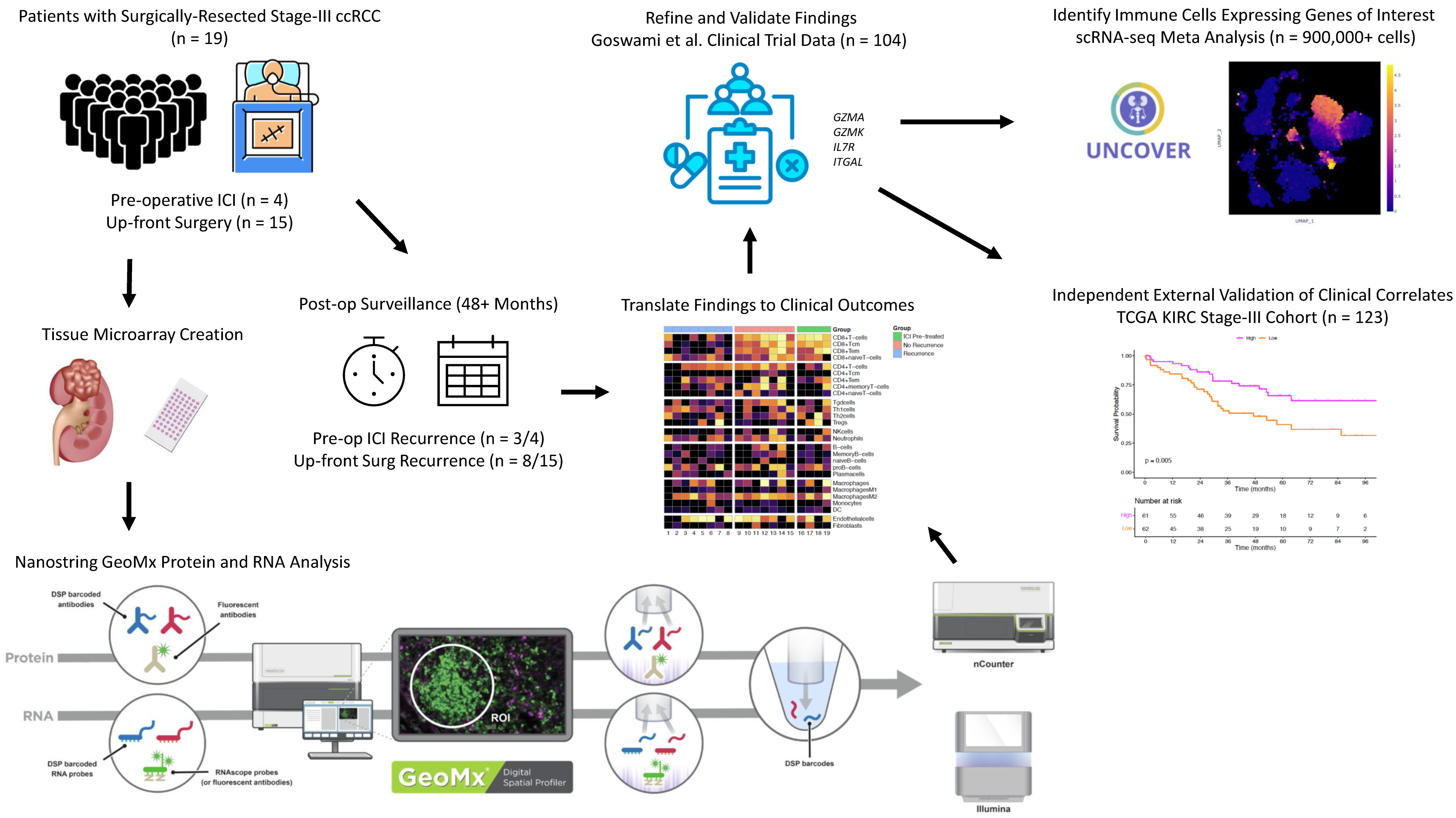
Among 19 specimens, 41 cores were obtained to create TMAs (2–3 cores per specimen); 41 RNA (1 per core) and 54 protein ROIs (1–3 per core) were selected for analysis. Our workflow is depicted in Figure 1. Representative examples of how DSP was leveraged to select tumor ROIs are shown in Figure 2A.

3.1. Protein Marker Analysis

Protein expression of CD3, CD4, CD8, GZMA, and CD11c significantly differed between the three groups (Figure 2B). Higher expression of these proteins was seen in the preoperative ICI and treatment-naïve without recurrence groups than in the treatment-naïve with recurrence group (Figure 2C). Notably, the immune checkpoints PD-1, PD-L1, and CTLA-4 did not significantly differ.

3.2. Gene Expression Analysis

RNA data was filtered for the most variably expressed genes between groups (Figure 3A). Normalized RNA expression significantly differed for CD3D, CD8A, GZMA, GZMK, ITGAL, IL7R, MIDN, TMEM9, and MYOCOS (Figure 3B), as well as several other genes reported in Table S2.
Spearman’s correlations were determined between paired RNA and protein product expression in matched tissues. There were strong correlations for CD8 (r = 0.81, p < 0.001) and CD3 (r = 0.77, p < 0.001); moderate correlations for GZMA (r = 0.58, p = 0.01), CD11c (r = 0.54, p = 0.02), and S100B (r = 0.32, p = 0.18); and poor correlations for the remainder of the RNA–protein pairs (Figure 3C). Notably, immune checkpoints demonstrated weak negative correlations between gene expression and protein product (PD-L1: r = −0.15, p = 0.53; PD-1: r = −0.22, p = 0.36; CTLA-4: r = −0.29, p = 0.21).
Reactome 2024 gene expression pathway analysis was conducted using the between-groups differential expression analysis (Figure 3D). Tumors from treatment-naïve patients with recurrence had “MTOR Signaling” (p < 0.001) and “Regulation of TP53 Activity Through Phosphorylation” (p = 0.002) pathway enrichment, among others. Preoperative ICI tumors had enrichment of “Immunoregulatory Interactions Between a Lymphoid and a non-Lymphoid Cell” (p < 0.001) and “Adaptive Immune System” (p = 0.003) pathways, among other ones.
Gene expression data from the RNA analysis was utilized for immune cell deconvolution analysis using the xCell algorithm [13]. Gene expression signatures significantly differed between groups for CD8+ T-cell, CD8+ Tcm-cell, and CD8+ Tem-cell subtypes (Figure 4A). These immune cell subtype signatures were significantly higher in the preoperative ICI and treatment-naïve without recurrence groups and lower in treatment-naïve patients with recurrence (Figure 4B). Although the CD11c protein, a marker for dendritic cells, had significantly higher expression in the ICI pretreatment group, there were no significant differences in the prevalence of dendritic cells noted with xCell.

3.3. Validation of Gene Expression Results

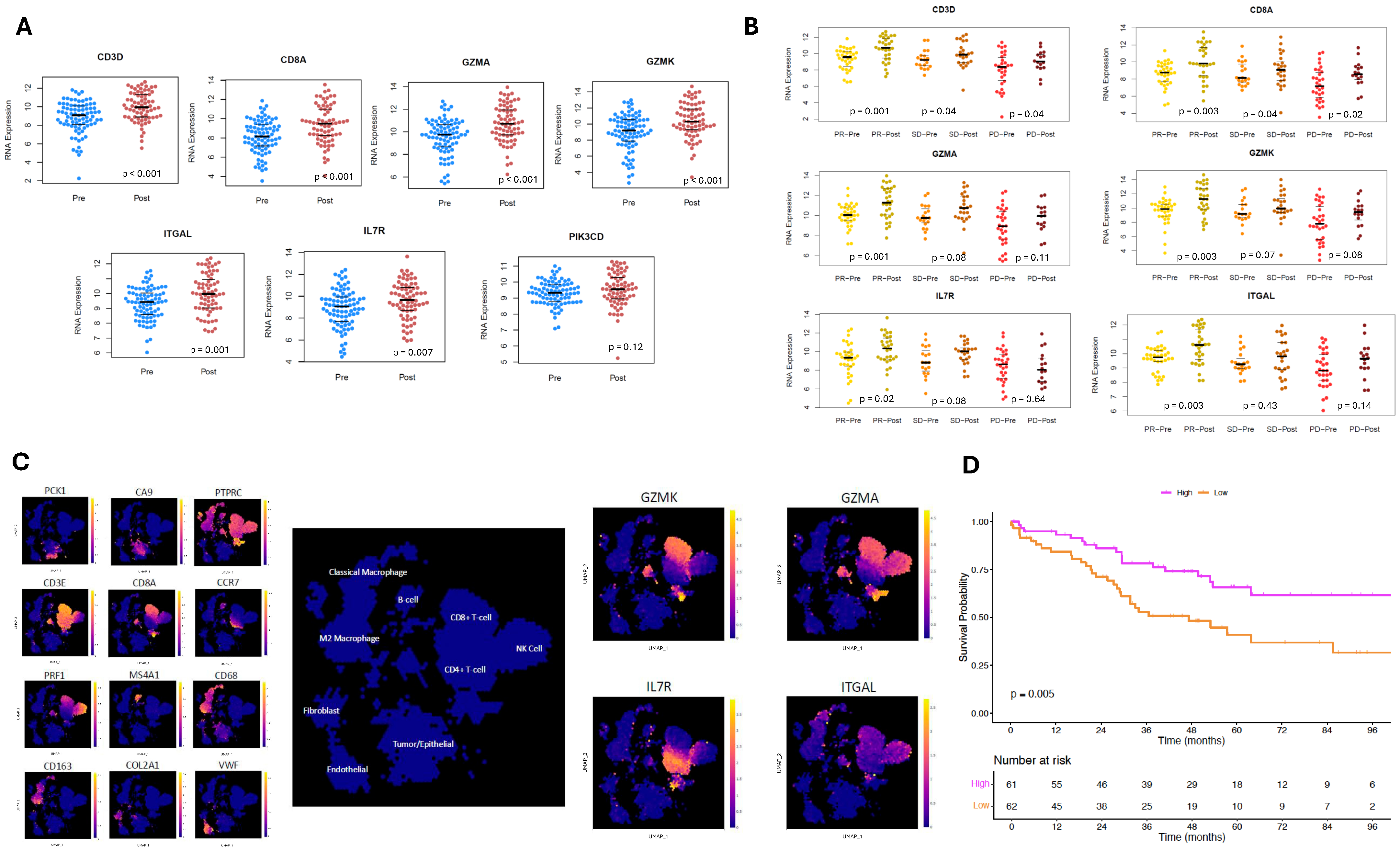
We ultimately matched seven genes from our gene expression analysis associated with the preoperative ICI and treatment-naïve without recurrence groups to RNA data from the NCT02210117 trial (Figure 5A). Further limiting this set of genes to only those that were significantly increased after ICI exposure yielded six genes (Figure 5B). Finally, limiting this set to genes that had significantly increased expression in patients with objective treatment response yielded four genes: GZMK, GZMA, ITGAL, and IL7R.

3.4. External Analysis of Immune Cell Phenotype

On scRNA-seq meta-analysis of ccRCC tumors, there were distinct expression patterns based on different cell types noted (Figure 5C). GZMK is primarily expressed in CD8+ T-cells, GZMA in CD8+ T-cells and NK cells, IL7R in CD4+ T-cells, and ITGAL in CD8+ T-cells, NK cells, and classical macrophages.

3.5. Stratification of Survival Outcomes Based on Gene Scores

The final gene set (GZMK, GZMA, IL7R, and ITGAL) was adapted into a gene score and then applied to an independent cohort of treatment-naïve patients with stage III ccRCC from the TCGA-KIRC cohort (n = 123). Kaplan–Meier estimates demonstrated significantly improved OS for patients with higher gene scores (log-rank p = 0.005, Figure 5D).

4. Discussion

Multimodal DSP of stage III ccRCC tumors found that protein and RNA expression indicative of increased CD8+ Tcm and Tem cells was associated with a durable cancer-free state postoperatively. Interestingly, patients with preoperative ICI had similarly favorable findings but without corresponding improved outcomes; three out of four of these patients experienced recurrence.
We further investigated, validated, and refined our findings using several independent external cohorts. In doing so, we identified GZMK, GZMA, IL7R, and ITGAL as genes that are potentially both modifiable with ICI therapy and associated with favorable clinical outcomes. As such, patients whose tumors have low baseline expression of these genes may benefit most from ICI around the time of surgery—a hypothesis that we intend to directly test in future experiments.
Dysfunction in CD8+ T cells has been shown to be associated with more advanced ccRCCs in prior single-cell transcriptomic data [18]. This T-cell exhaustion may contribute to non-durable responses to immune checkpoint inhibition. Thus, identifying biomarkers that can predict potential T-cell activity with immune checkpoint inhibition in this high-risk population is key. More traditional biomarkers, such as PD-L1 positivity and tumor mutational burden (TMB), have shown a limited or mixed ability in predicting response to immune checkpoint inhibitors [19]. Responses to immune checkpoint inhibition have been demonstrated regardless of PD-L1 expression levels, and RCCs are typically associated with low TMB.
Research assessing biomarkers for response is ongoing along multiple fronts, including somatic alterations, transcriptional signatures, and circulating DNA, among other modalities [20]. Within the context of metastatic ccRCC, unsupervised transcriptomic analysis has been used to identify ccRCC subtypes based on a 35-gene signature to predict response to tyrosine kinase inhibitors [21], which in turn has been prospectively evaluated to select different treatment regimens in this population [22].
In our study, four genes that were validated in external cohorts emerged as potential predictors for response to ICI. We reviewed the literature regarding these genes in relation to RCC and malignancy more broadly.
GZMK encodes serine protease granzyme K, which is normally expressed by CD8+ T cells, NK cells, and innate-like T cells [23]. Granzyme K facilitates apoptosis of target cells through single-stranded DNA nicks and damage to mitochondrial membranes [24,25]. In the context of RCC, clinical trials assessing PD-1 ICI in patients with advanced RCC found that CD8+ T cells expressing GZMK were significantly more prevalent in responders [26,27]. Outside of RCC, analysis of TCGA cohorts has also noted improved OS among breast cancer patients with higher GZMK expression, and higher levels of GZMK have been noted in melanomas responsive to nivolumab, a disease setting noted for its immunogenicity [28].
GZMA encodes granzyme A and is also a serine protease with tryptase activity prevalent in CD8+ T cells and NK cells [29]. Within the context of RCC, tumors with higher levels of NK cells had higher granzyme A expression, although this was not correlated with oncologic outcomes [30]. GZMA expression was also associated with higher lymphocytic infiltration and T cell gene expression in patients with localized RCC [31]. Regarding prognosis, GZMA expression was not associated with OS among patients with ccRCC, though that particular cohort was primarily composed of stage I-II tumors [32].
IL7R encodes the alpha chain of IL-7R, a cell-surface receptor that promotes lymphocyte development and cell survival through the JAK/STAT signaling pathway [33]. In a mouse model with a chronic viral infection, PD-1 blockade led to increased IL7R expression and IL-7 signaling, which was associated with transient reinvigoration of exhausted CD8+ T cells [34]. The literature for IL7R within RCC is sparse, with increased proliferation of tumor-infiltrating lymphocytes having been observed after IL-7 treatment [35]. In our meta-analysis of single-cell transcriptomic data in ccRCC tumors, IL7R was predominantly expressed in CD4+ T cells. Interestingly, in a separate study of patients with advanced or metastatic RCC, high expression of CD4+ T cells was associated with a lower likelihood of ICI response [36]. It must be noted, however, that this does not account for the various subtypes of CD4+ T cells, such as regulatory T cells that have been more often associated with poor treatment response. In that same study, the presence of CD68+ macrophages that infiltrated into tumors was also a significant predictor of ICI response [36]; our study did not show significant differences in macrophage prevalence across the three groups.
ITGAL codes for the integrin alpha L chain, which is a subunit of the lymphocyte function-associated antigen-1 (LFA-1) critical for leukocyte migration. RCCs overexpress ITGAL compared to normal tissue; additionally, greater expression is associated with higher tumor grade. That same study also found that within a 10-gene expression signature, greater ITGAL expression predicted poorer survival using data from TCGA [37]. The study did not stratify ITGAL expression within stages in relation to survival, though. Outside of RCC, lower ITGAL expression in non-small-cell lung cancer is predictive of poorer prognosis, with higher immune infiltration in malignant tissues [38].
Of note, the assumption is often made that the expression of a gene and its downstream protein are highly correlated. However, our data did not demonstrate this. Of fourteen matched gene–protein pairings, only two strongly correlated (CD8 and CD3), and three moderately correlated (GZMA, CD11c, and S100B). Notably, the immune checkpoint proteins PD-L1, PD-1, and CTLA-4 all demonstrated weak negative correlations, which have previously been noted [39,40,41,42]. These data underscore the point that protein and RNA expression levels are not interchangeable, especially for immune checkpoint proteins. Although our study was not designed to assess the reasons for these discrepancies, regulatory mechanisms at different levels could account for this. Translational efficiency of mRNA transcripts may vary based on transcript modifications and the presence of RNA silencing. At the protein level, the stability of these products may be variable and affected by post-translational modifications. Together, this does underscore the importance of continuing to assess the correlation of RNA and protein expression levels in future studies.

Limitations

Our cohort was small (n = 19 patients), which limited power; we did however validate these findings using larger independent studies. This experiment was designed to favor a deep and comprehensive molecular analysis of fewer specimens, as opposed to a superficial analysis of many specimens. Future studies validating these findings will be more targeted and feature a larger sample size.
Our validation set from the NCT02210117 trial was limited by its recruitment of patients with metastatic ccRCC, unlike patients in KEYNOTE-564 and PROSPER. The patients enrolled were naïve to various ICIs and bevacizumab, though, thereby reducing the risk of confounding from heavy preoperative exposure to these agents. Transcriptional and proteomic data from large clinical trials that precisely match our patient cohort would be valuable in the further validation of our findings, but these are lacking.
Additionally, the lack of single-cell resolution limits immune cell phenotyping to relatively broad subtypes, thereby limiting the analysis of granular subtypes of exhausted T-cells and anti-inflammatory macrophages, whose importance has been previously described [18,43,44]. Interestingly, expression levels in the nonrecurrence group were lowest for LAG3 and HAVCR2, which are markers that have been associated with T-cell exhaustion [45,46]. However, the differences in RNA expression across the groups did not meet statistical significance.
Lack of spatially resolved protein or RNA expression data at the single-cell level also did not allow for the description of CD8+ clustering patterns to better describe immune infiltration [40] or the presence of tertiary lymphoid structures that have been shown to play an important role in anti-tumor responses [47]. Ultimately, the described findings absolutely require further validation before practical application to clinical practice.

5. Conclusions

Our analysis found that stage III ccRCC patients with preoperative ICI had increased intratumoral gene expression indicative of CD8+ T-cell effector and central-memory phenotypes. Similar findings were seen in untreated patients without recurrence. Despite this favorable immune composition, though, our ICI-pretreated patients recurred at similar rates to untreated patients. Overall, receipt of preoperative ICI appeared to favorably alter the tumor immune microenvironment. However, this did not result in convincingly better clinical outcomes.
Further refinement using NCT02210117 trial data suggested that increased gene expression of GZMK, GZMA, ITGAL, and IL7R is inducible with ICI and associated with favorable outcomes. Patients whose tumors have low initial expression of these genes may derive the most benefit from ICI around the time of surgery. Once published, data from the PROSPER and KEYNOTE-564 trials will be critical to test this hypothesis.

Supplementary Materials

The following supporting information can be downloaded at: https://www.mdpi.com/article/10.3390/cancers18020312/s1, Table S1: baseline characteristics of patients included in the study; Table S2: genes with significantly variable expression based on study group, as well as genes matched to data from the NCT02210117 trial based on upregulation with immune checkpoint blockade and objective response.

Author Contributions

Conceptualization and design, N.H.C. and G.V.T.; acquisition of data, E.N., S.A., A.E.M., C.L.C., L.L. (Lisa Langmesser), B.C., K.E., J.-J.L., S.I., C.L.A., M.C.S., N.H.C., and G.V.T.; analysis and interpretation of data, W.H.C., L.L. (Lucy Lawrence), E.N., N.H.C., and G.V.T.; drafting of manuscript, W.H.C., L.L. (Lucy Lawrence), N.H.C., and G.V.T.; critical revision of manuscript, W.H.C., L.L. (Lucy Lawrence), E.N., M.C.S., N.H.C., and G.V.T.; statistical analysis, W.H.C., N.H.C., and G.V.T.; funding, G.V.T.; administrative, technical, and financial support, S.A., A.E.M., C.L.C., and G.V.T.; supervision, W.H.C., S.A., A.E.M., C.L.C., N.H.C., and G.V.T. All authors have read and agreed to the published version of the manuscript.

Funding

This study was supported by NIH grants R01 CA250378, R21 CA259440, P30 CA069533, and P30 CA069533 13S5 through the OHSU-Knight Cancer Institute, the Hope Foundation (SWOG), and the OHSU Department of Pathology and Laboratory faculty support (GVT). The pathology was performed at the Histopathology Shared Resource supported by the OHSU Knight Cancer Institute (NIH P30 CA069533). The University of Washington’s Spatial Biology Core Facility is supported in part by the Department of Laboratory Medicine and Pathology.

Institutional Review Board Statement

Approval of this study was obtained from the Oregon Health & Science University Institutional Review Board (OHSU-IRB #4918). This protocol was last approved on 27 May 2025.

Informed Consent Statement

Informed consent was obtained from all subjects involved in the study.

Data Availability Statement

The data that support this study’s findings are available from the authors upon reasonable request.

Acknowledgments

We thank the patients and families who participated in this research, the OHSU Knight Cancer Center Bio-library for specimen management, and the Nanostring Technologies team for technical support with digital spatial profiling.

Conflicts of Interest

The authors assert that there are no conflicts of interest, including specific financial interests and relationships or affiliations relevant to the subject matter or materials discussed in the manuscript.

References

  1. Levy, D.A.; Slaton, J.W.; Swanson, D.A.; Dinney, C.P.N. Stage specific guidelines for surveillance after radical nephrectomy for local renal cell carcinoma. J. Urol. 1998, 159, 1163–1167. [Google Scholar] [CrossRef]
  2. Monteiro, F.S.M.; Soares, A.; Rizzo, A.; Santoni, M.; Mollica, V.; Grande, E.; Massari, F. The role of immune checkpoint inhibitors (ICI) as adjuvant treatment in renal cell carcinoma (RCC): A systematic review and meta-analysis. Clin. Genitourin. Cancer 2023, 21, 324–333. [Google Scholar] [CrossRef]
  3. Choueiri, T.K.; Tomczak, P.; Park, S.H.; Venugopal, B.; Ferguson, T.; Symeonides, S.N.; Hajek, J.; Chang, Y.; L, J.; Sarwar, N.; et al. Overall Survival with Adjuvant Pembrolizumab in Renal-Cell Carcinoma. N. Engl. J. Med. 2024, 390, 1359–1371. [Google Scholar] [CrossRef]
  4. National Comprehensive Cancer Network. Kidney Cancer, Version 1.2026. NCCN Clinical Practice Guidelines in Oncology. 2025. Available online: https://www.nccn.org/professionals/physician_gls/pdf/kidney.pdf (accessed on 1 October 2025).
  5. Allaf, M.E.; Kim, S.; Master, V.; McDermott, D.F.; Harshman, L.C.; Cole, S.M.; Drake, C.G.; Signoretti, S.; Akgul, M.; Baniak, N.; et al. Perioperative nivolumab versus observation in patients with renal cell carcinoma undergoing nephrectomy (PROSPER ECOG-ACRIN EA8143): An open-label, randomised, phase 3 study. Lancet Oncol. 2024, 25, 1038–1052. [Google Scholar] [CrossRef]
  6. Fropf, R.; Griswold, M.; Zimmerman, S.; Nguyen, K.; Reeves, J.; Fuhrman, K.; Rhodes, M. The GeoMx® Human Whole Transcriptome Atlas for the Digital Spatial Profiler. Available online: https://nanostring.com/wp-content/uploads/WP_MK3209_GMX-WTA_Des-Perf-Exp-Guidelines_R10.pdf (accessed on 10 June 2025).
  7. Hernandez, S.; Lazcano, R.; Serrano, A.; Powell, S.; Kostousov, L.; Mehta, J.; Khan, K.; Lu, W.; Solis, L.M. Challenges and Opportunities for Immunoprofiling Using a Spatial High-Plex Technology: The NanoString GeoMx® Digital Spatial Profiler. Front. Oncol. 2022, 12, 890410. [Google Scholar] [CrossRef]
  8. Whitepaper Archives. NanoString. Available online: https://nanostring.com/em_resources_type/whitepaper/ (accessed on 10 June 2025).
  9. nCounter® Analysis System. Available online: https://nanostring.com/wp-content/uploads/FL_MK2295_nCounter_Grant_Support_R5.pdf (accessed on 2 May 2025).
  10. Law, C.W.; Chen, Y.; Shi, W.; Smyth, G.K. voom: Precision weights unlock linear model analysis tools for RNA-seq read counts. Genome Biol. 2014, 15, R29. [Google Scholar] [CrossRef]
  11. Ritchie, M.E.; Phipson, B.; Wu, D.; Hu, Y.; Law, C.W.; Shi, W.; Smyth, G.K. limma powers differential expression analyses for RNA-sequencing and microarray studies. Nucleic Acids Res. 2015, 43, e47. [Google Scholar] [CrossRef]
  12. Milacic, M.; Beavers, D.; Conley, P.; Gong, C.; Gillespie, M.; Griss, J.; Haw, R.; Jassal, B.; Matthews, L.; May, B.; et al. The Reactome Pathway Knowledgebase 2024. Nucleic Acids Res. 2024, 52, D672–D678. [Google Scholar] [CrossRef]
  13. Aran, D.; Hu, Z.; Butte, A.J. xCell: Digitally portraying the tissue cellular heterogeneity landscape. Genome Biol. 2017, 18, 220. [Google Scholar] [CrossRef]
  14. Kolde, R. raivokolde/pheatmap. R. Available online: https://github.com/raivokolde/pheatmap (accessed on 10 June 2025).
  15. Goswami, S.; Gao, J.; Basu, S.; Shapiro, D.D.; Karam, J.A.; Tidwell, R.S.; Ahrar, K.; Campbell, M.T.; Shen, Y.; Trevino, A.E.; et al. Immune checkpoint inhibitors plus debulking surgery for patients with metastatic renal cell carcinoma: Clinical outcomes and immunological correlates of a prospective pilot trial. Nat. Commun. 2025, 16, 1846. [Google Scholar] [CrossRef]
  16. Eisenhauer, E.A.; Therasse, P.; Bogaerts, J.; Schwartz, L.H.; Sargent, D.; Ford, R.; Dancey, J.; Arbuck, S.; Gwyther, S.; Mooney, M.; et al. New response evaluation criteria in solid tumours: Revised RECIST guideline (version 1.1). Eur. J. Cancer 2009, 45, 228–247. [Google Scholar] [CrossRef]
  17. Lecuyer, G.C.V.; Lardenois, A.; Chalmel, F. UncoVer: A Web-based Resource for Single-cell and Spatially Resolved Omics Data in Uro-oncology. Eur. Urol. Oncol. 2024, 7, 1545–1547. [Google Scholar] [CrossRef]
  18. Braun, D.A.; Street, K.; Burke, K.P.; Cookmeyer, D.L.; Denize, T.; Pedersen, C.B.; Gohil, S.H.; Schindler, N.; Pomerance, L.; Hirsch, L.; et al. Progressive immune dysfunction with advancing disease stage in renal cell carcinoma. Cancer Cell 2021, 39, 632–648.e8. [Google Scholar] [CrossRef] [PubMed]
  19. Darzi, A.; Shokouhfar, M.; Farajee, N.; Ghafari, A.; Deldar, F.; Eini, P.; Vanan, A.G.; Bahrami, N. Immune checkpoint inhibition in renal cell carcinoma: Mechanisms of resistance and emerging therapeutic strategies. Biomed. Pharmacother. 2025, 193, 118875. [Google Scholar] [CrossRef]
  20. Saliby, R.M.; Saad, E.; Kashima, S.; Schoenfeld, D.A.; Braun, D.A. Update on Biomarkers in Renal Cell Carcinoma. Am. Soc. Clin. Oncol. Educ. Book 2024, 44, e430734. [Google Scholar] [CrossRef]
  21. Beuselinck, B.; Job, S.; Becht, E.; Karadimou, A.; Verkarre, V.; Giraldo, N.; Rioux-Leclercq, N.; Molinié, V.; Sibony, M.; Elaidi, R.; et al. Molecular Subtypes of Clear Cell Renal Cell Carcinoma Are Associated with Sunitinib Response in the Metastatic Setting. Clin. Cancer Res. 2015, 21, 1329–1339. [Google Scholar] [CrossRef]
  22. Vano, Y.; Elaidi, R.; Bennamoun, M.; Chevreau, C.; Borchiellini, D.; Pannier, D.; Maillet, D.; Gross-Goupil, M.; Tournigand, C.; Laguerre, B.; et al. Nivolumab, nivolumab-ipilimumab, and VEGFR-tyrosine kinase inhibitors as first-line treatment for metastatic clear-cell renal cell carcinoma (BIONIKK): A biomarker-driven, open-label, non-comparative, randomised, phase 2 trial. Lancet Oncol. 2022, 23, 612–624. [Google Scholar] [CrossRef]
  23. Donado, C.A.; Theisen, E.; Zhang, F.; Nathan, A.; Fairfield, M.L.; Rupani, K.V.; Jones, D.; Johannes, K.P.; Raychaudhuri, S.; Dwyer, D.F.; et al. Granzyme K activates the entire complement cascade. Nature 2025, 641, 211–221. [Google Scholar] [CrossRef]
  24. Zhao, T.; Zhang, H.; Guo, Y.; Zhang, Q.; Hua, G.; Lu, H.; Hou, Q.; Liu, H.; Fan, Z. Granzyme K cleaves the nucleosome assembly protein SET to induce single-stranded DNA nicks of target cells. Cell Death Differ. 2007, 14, 489–499. [Google Scholar] [CrossRef]
  25. Zhao, T.; Zhang, H.; Guo, Y.; Fan, Z. Granzyme K Directly Processes Bid to Release Cytochrome c and Endonuclease G Leading to Mitochondria-dependent Cell Death. J. Biol. Chem. 2007, 282, 12104–12111. [Google Scholar] [CrossRef]
  26. Au, L.; Hatipoglu, E.; Robert de Massy, M.; Litchfield, K.; Beattie, G.; Rowan, A.; Schnidrig, D.; Thompson, R.; Byrne, F.; Horswell, S.; et al. Determinants of anti-PD-1 response and resistance in clear cell renal cell carcinoma. Cancer Cell 2021, 39, 1497–1518.e11. [Google Scholar] [CrossRef]
  27. Gu, L.; Peng, C.; Liang, Q.; Huang, Q.; Lv, D.; Zhao, H.; Zhang, Q.; Zhang, Y.; Zhang, P.; Li, S.; et al. Neoadjuvant toripalimab plus axitinib for clear cell renal cell carcinoma with inferior vena cava tumor thrombus: NEOTAX, a phase 2 study. Signal Transduct. Target. Ther. 2024, 9, 264. [Google Scholar] [CrossRef]
  28. Li, Z.; Xie, Q.; Zhao, F.; Huo, X.; Ren, D.; Liu, Z.; Zhou, X.; Shen, G.; Zhao, J. Exploring GZMK as a prognostic marker and predictor of immunotherapy response in breast cancer: Unveiling novel insights into treatment outcomes. J. Cancer Res. Clin. Oncol. 2024, 150, 1–21. [Google Scholar] [CrossRef]
  29. Martinvalet, D.; Zhu, P.; Lieberman, J. Granzyme A Induces Caspase-Independent Mitochondrial Damage, a Required First Step for Apoptosis. Immunity 2005, 22, 355–370. [Google Scholar] [CrossRef]
  30. Schleypen, J.S.; Baur, N.; Kammerer, R.; Nelson, P.J.; Rohrmann, K.; Gröne, E.F.; Hohenfellner, M.; Haferkamp, A.; Pohla, H.; Schendel, D.J.; et al. Cytotoxic Markers and Frequency Predict Functional Capacity of Natural Killer Cells Infiltrating Renal Cell Carcinoma. Clin. Cancer Res. 2006, 12, 718–725. [Google Scholar] [CrossRef]
  31. Ghatalia, P.; Gordetsky, J.; Kuo, F.; Dulaimi, E.; Cai, K.Q.; Devarajan, K.; Bae, S.; Naik, G.; Chan, T.A.; Uzzo, R.; et al. Prognostic impact of immune gene expression signature and tumor infiltrating immune cells in localized clear cell renal cell carcinoma. J. Immunother. Cancer 2019, 7, 139. [Google Scholar] [CrossRef]
  32. Matsushita, H.; Sato, Y.; Karasaki, T.; Nakagawa, T.; Kume, H.; Ogawa, S.; Homma, Y.; Kakimi, K. Neoantigen Load, Antigen Presentation Machinery, and Immune Signatures Determine Prognosis in Clear Cell Renal Cell Carcinoma. Cancer Immunol. Res. 2016, 4, 463–471. [Google Scholar] [CrossRef]
  33. Mazzucchelli, R.; Durum, S.K. Interleukin-7 receptor expression: Intelligent design. Nat. Rev. Immunol. 2007, 7, 144–154. [Google Scholar] [CrossRef]
  34. Pauken, K.E.; Sammons, M.A.; Odorizzi, P.M.; Manne, S.; Godec, J.; Khan, O.; Drake, A.M.; Chen, Z.; Sen, D.R.; Kurachi, M.; et al. Epigenetic stability of exhausted T cells limits durability of reinvigoration by PD-1 blockade. Science 2016, 354, 1160–1165. [Google Scholar] [CrossRef] [PubMed]
  35. Ditonno, P.; Tso, C.L.; Sakata, T.; deKernion, J.B.; Belldegrun, A. Regulatory effects of interleukin-7 on renal tumor infiltrating lymphocytes. Urol. Res. 1992, 20, 205–210. [Google Scholar] [CrossRef] [PubMed]
  36. Kazama, A.; Bilim, V.; Tasaki, M.; Anraku, T.; Kuroki, H.; Shirono, Y.; Murata, M.; Hiruma, K.; Tomita, Y. Tumor-infiltrating immune cell status predicts successful response to immune checkpoint inhibitors in renal cell carcinoma. Sci. Rep. 2022, 12, 20386. [Google Scholar] [CrossRef]
  37. Boguslawska, J.; Kedzierska, H.; Poplawski, P.; Rybicka, B.; Tanski, Z.; Piekielko-Witkowska, A. Expression of Genes Involved in Cellular Adhesion and Extracellular Matrix Remodeling Correlates with Poor Survival of Patients with Renal Cancer. J. Urol. 2016, 195, 1892–1902. [Google Scholar] [CrossRef]
  38. Zhang, R.; Zhu, G.; Li, Z.; Meng, Z.; Huang, H.; Ding, C.; Wang, Y.; Chen, C.; Li, Y.; Liu, H.; et al. ITGAL expression in non-small-cell lung cancer tissue and its association with immune infiltrates. Front. Immunol. 2024, 15, 1382231. [Google Scholar] [CrossRef]
  39. Chakiryan, N.H.; Hajiran, A.; Kim, Y.; Aydin, A.M.; Zemp, L.; Katende, E.; Nguyen, J.; Fan, W.; Cheng, C.; Lopez-Blanco, N.; et al. Correlating Immune Cell Infiltration Patterns with Recurrent Somatic Mutations in Advanced Clear Cell Renal Cell Carcinoma. Eur. Urol. Focus 2022, 8, 784–793. [Google Scholar] [CrossRef]
  40. Chakiryan, N.H.; Kim, Y.; Berglund, A.; Chang, A.; Kimmel, G.J.; Hajiran, A.; Nguyen, J.; Moran-Segura, C.; Saeed-Vafa, D.; Katende, E.N.; et al. Geospatial characterization of immune cell distributions and dynamics across the microenvironment in clear cell renal cell carcinoma. J. Immunother. Cancer 2023, 11, e006195. [Google Scholar] [CrossRef]
  41. Zerdes, I.; Karafousia, V.; Mezheyeuski, A.; Stogiannitsi, M.; Kuiper, R.; Moreno Ruiz, P.; Rassidakis, G.; Bergh, J.; Hatschek, T.; Foukakis, T.; et al. Discordance of PD-L1 Expression at the Protein and RNA Levels in Early Breast Cancer. Cancers 2021, 13, 4655. [Google Scholar] [CrossRef]
  42. Nicolet, B.P.; Wolkers, M.C. The relationship of mRNA with protein expression in CD8+ T cells associates with gene class and gene characteristics. PLoS ONE 2022, 17, e0276294. [Google Scholar] [CrossRef] [PubMed]
  43. Bi, K.; He, M.X.; Bakouny, Z.; Kanodia, A.; Napolitano, S.; Wu, J.; Grimaldi, G.; Braun, D.A.; Cuoco, M.S.; Mayorga, A.; et al. Tumor and immune reprogramming during immunotherapy in advanced renal cell carcinoma. Cancer Cell 2021, 39, 649–661.e5. [Google Scholar] [CrossRef]
  44. Krishna, C.; DiNatale, R.G.; Kuo, F.; Srivastava, R.M.; Vuong, L.; Chowell, D.; Gupta, S.; Vanderbilt, C.; Purohit, T.A.; Liu, M.; et al. Single-cell sequencing links multiregional immune landscapes and tissue-resident T cells in ccRCC to tumor topology and therapy efficacy. Cancer Cell 2021, 39, 662–677.e6. [Google Scholar] [CrossRef]
  45. Menard, L.C.; Fischer, P.; Kakrecha, B.; Linsley, P.S.; Wambre, E.; Liu, M.C.; Rust, B.J.; Lee, D.; Penhallow, B.; Manjarrez Orduno, N.; et al. Renal Cell Carcinoma (RCC) Tumors Display Large Expansion of Double Positive (DP) CD4+CD8+ T Cells With Expression of Exhaustion Markers. Front. Immunol. 2018, 9, 2728. [Google Scholar] [CrossRef]
  46. Takamatsu, K.; Tanaka, N.; Hakozaki, K.; Takahashi, R.; Teranishi, Y.; Murakami, T.; Kufukihara, R.; Niwa, N.; Mikami, S.; Shinojima, T.; et al. Profiling the inhibitory receptors LAG-3, TIM-3, and TIGIT in renal cell carcinoma reveals malignancy. Nat. Commun. 2021, 12, 5547. [Google Scholar] [CrossRef] [PubMed]
  47. Yang, L.; Shangguan, W.; Li, W.; Huang, W.; Li, Z.; Sun, B.; Ma, C.; Yang, X.; Cheng, B.; Wu, P. Role of tertiary lymphoid structures in the tumour microenvironment and immunotherapy response of renal cell carcinoma. Clin. Transl. Med. 2025, 15, e70455. [Google Scholar] [CrossRef]
Figure 1. Schematic of study design and workflow [15].
Cancers 18 00312 g001
Figure 2. (A) Examples of region of interest (ROI) selection using Nanostring GeoMx Digital Spatial Profiler post-staining and pre-cleaving, which enables precise sampling of concentrated tumoral regions. Areas of necrosis, major vasculature, tissue artifact, and normal adjacent kidney were avoided. (B) Heatmap for expression of 15 proteins relevant to immune cell function for patients who were treatment-naïve with recurrence (blue), treatment-naïve without recurrence (pink), or with preoperative ICI exposure (green). (C) Jittered plots for protein expression where protein expression significantly differed between the three groups, which included CD3, CD4, CD8, CD11c, and GZMA. The bold line represents the median, and thin lines represent the interquartile range.
Cancers 18 00312 g002
Figure 3. (A) Heatmap for RNA expression of genes that were most variably expressed between patients who were treatment-naïve with recurrence (blue), treatment-naïve without recurrence (pink), and with preoperative ICI exposure (green). (B) Normalized log2 RNA expression for selected genes that significantly differed across the three groups. (C) Plot of Spearman’s correlation coefficients for RNA and corresponding protein expression. (D) Reactome 2024 gene expression pathway comparing patients who were treatment-naïve with recurrence versus treatment-naïve without recurrence, as well as patients with preoperative ICI exposure versus treatment-naïve with recurrence.
Cancers 18 00312 g003
Figure 4. (A) Heatmaps for relative prevalence of immune cell subtypes based on xCell immune cell deconvolution applied to RNA expression data. (B) Jittered plots for relative prevalence of CD8+ T cells, CD8+ Tcm cells, and CD8+ Tem cells that show significant differences across the three groups (preoperative ICI, treatment-naïve without recurrence, and treatment-naïve with recurrence).
Cancers 18 00312 g004
Figure 5. (A) Jittered plots of the 7 genes with significant differential expression in our study that overlapped with RNA-seq data in the NCT02210117 clinical trial, based on pre- (blue) and post-ICI (red) exposure. (B) Jittered plots stratified by treatment response (partial response [PR], stable disease [SD], and progression of disease [PD]) for the 6 genes that showed significant pre- versus post-ICI differences. (C) Meta-analysis of single-cell RNA-seq data from ccRCC tumor tissue using the UncoVer platform; cell identities in the UMAP were determined using canonical gene markers, and then, expression of GZMA, GZMK, IL7R, and ITGAL was mapped to these clusters. (D). Kaplan–Meier curves for overall survival based on clinical stage III ccRCC patients from the TCGA KIRC cohort stratified by high (magenta) and low (orange) gene scores based on expression levels of GZMA, GZMK, IL7R, and ITGAL.
Cancers 18 00312 g005
Disclaimer/Publisher’s Note: The statements, opinions and data contained in all publications are solely those of the individual author(s) and contributor(s) and not of MDPI and/or the editor(s). MDPI and/or the editor(s) disclaim responsibility for any injury to people or property resulting from any ideas, methods, instructions or products referred to in the content.