Stress Granule-Driven Resistance in Cancer: Mechanisms and Emerging Strategies


Simple Summary
Abstract
1. Introduction
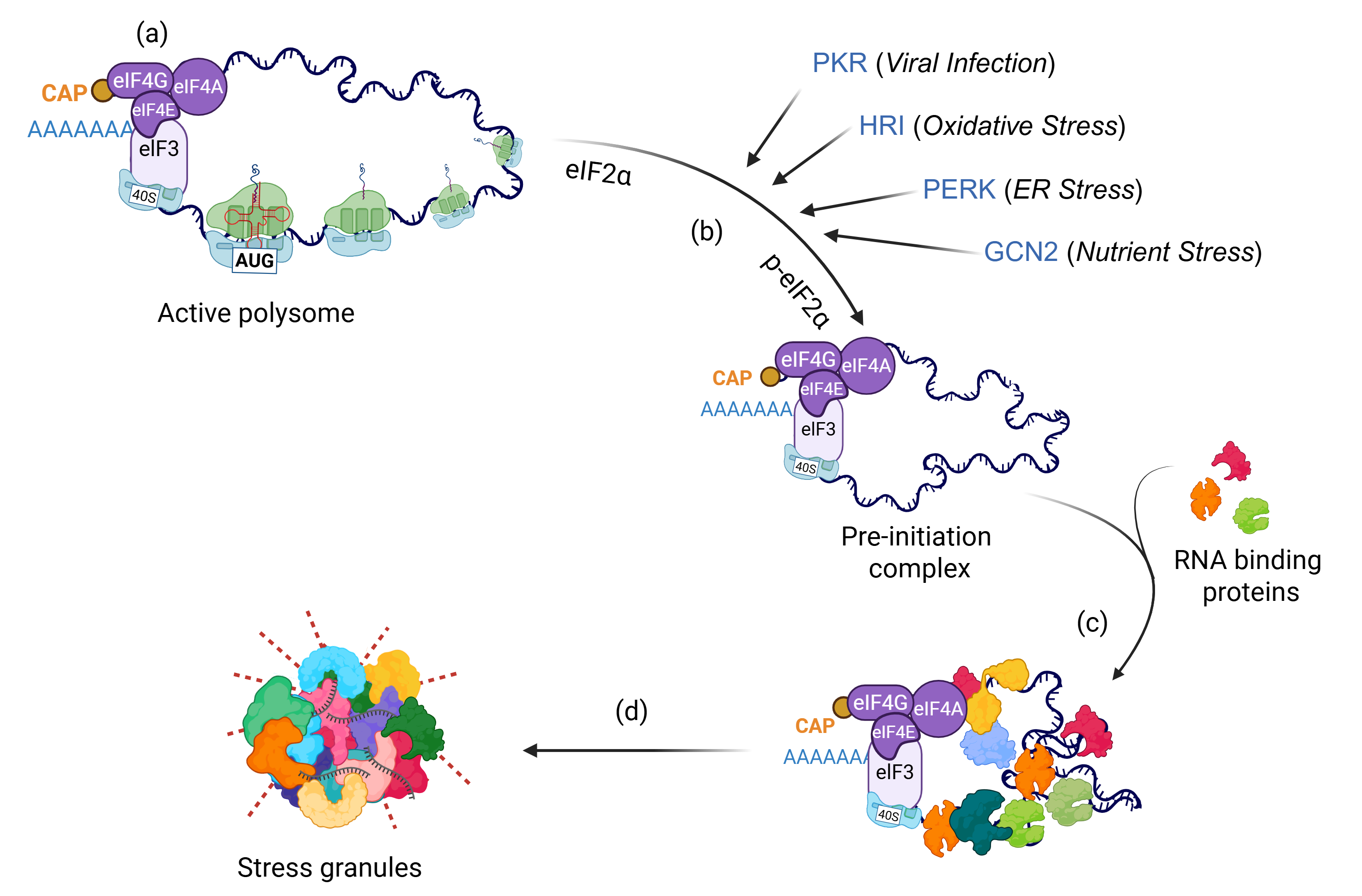
2. Biogenesis, Functions, and Characterization of SGs
3. SG Kinetics in Cancer Cells
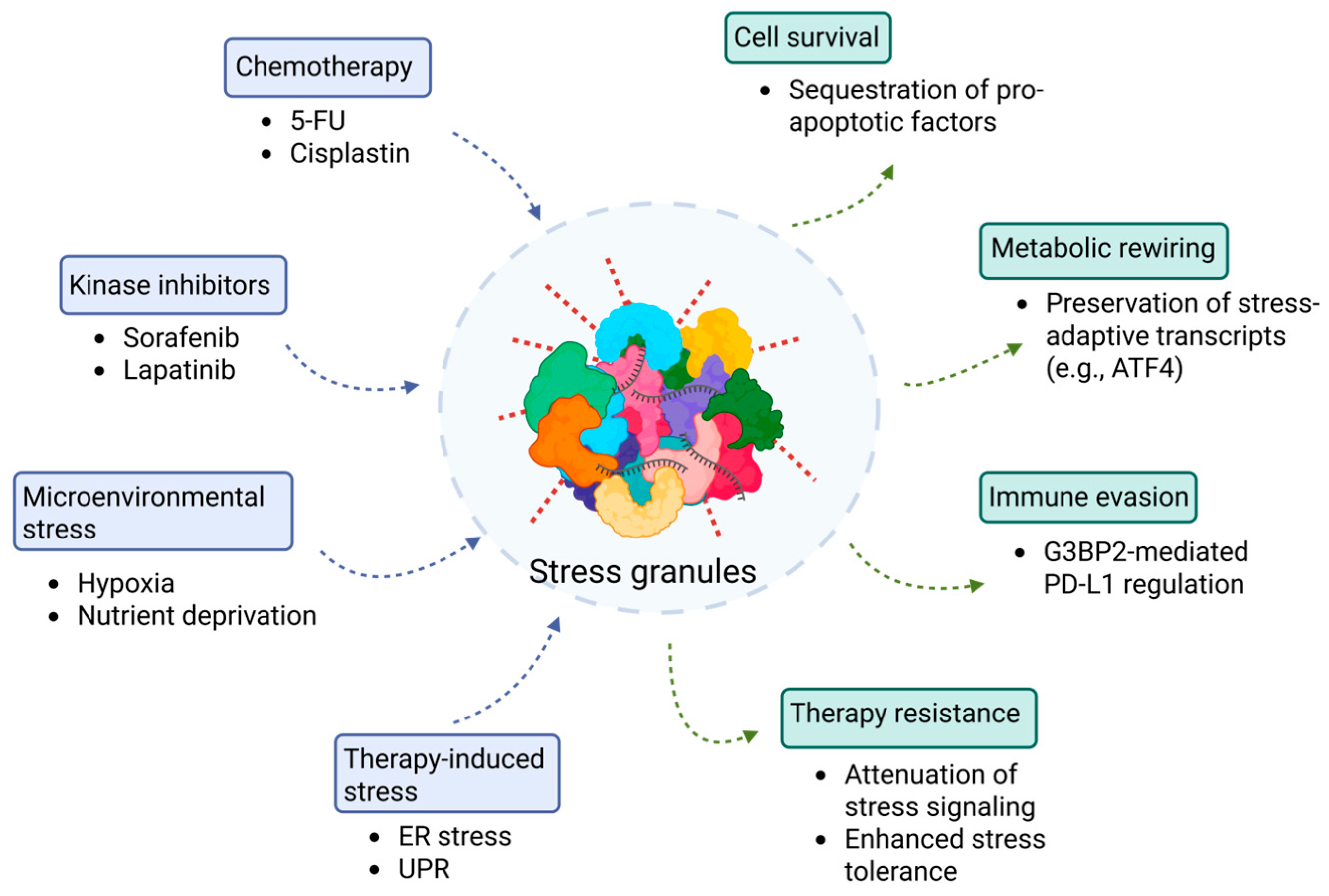
4. SG-Mediated Drug Resistance in Cancer Cells
4.1. Induction of SGs by Anticancer Drugs

| Drug Class/Agent | Cancer Cell Line/Model(s) | Mechanism of SG Formation | Functional Consequence(s) | Ref. |
|---|---|---|---|---|
| Multikinase inhibitor: Sorafenib | Hepatocarcinoma cells | PERK-mediated eIF2α phosphorylation | Formation of canonical SGs | [74] |
| EGFR/HER2 TKI: Lapatinib | Breast cancer cells | PERK-mediated eIF2α phosphorylation | Formation of canonical SGs | [75] |
| Vinca alkaloids (Vinblastine/ Vincristine/ Vinorelbine) | Multiple human cancer lines | Dual: PERK-mediated eIF2α phosphorylation and 4E-BP1 activation; cortisone co-treatment activates GCN2 | VA-induced SGs lack some signaling components such as RACK1, RSK, TRAF2 | [78] |
| Proteasome inhibitors: (Bortezomib, UPS inhibitors) | Multiple human cancer lines | HRI-mediated eIF2α phosphorylation; GCN2 is implicated with general UPS blockade with MG132 | Recruit ARE-rich mRNA into SGs | [71,80] |
| Antimetabolite: 5-Fluorouracil | Multiple human cancer lines | RNA-incorporation of metabolites lead to eIF2α phosphorylation | Inhibits apoptosis by sequestering RACK1 | [68] |
| DNA-alkylating agent: Lomustine | Human cancer lines | HRI-mediated eIF2α phosphorylation | Selective mRNA partitioning, e.g., EGR1 mRNA | [69] |
| Platinum-based alkylating agent: Cisplatin | Cochlear cells, Neuroglioma, HeLa | Not entirely on eIF2α phosphorylation; rather by RNA/ribosome damage | Compositionally distinct, small, and persistent SGs | [31,76] |
| Translation initiation via 4EBP1: Selenite | Cancer- relevant cell lines | Primarily eIF4F suppression via 4E-BP1, with concurrent eIF2α-P | Non-canonical SGs: Altered composition and lack some pro-survival components | [28] |
| Phytochemical: Morusin | Human cancer cells | PKR-mediated eIF2α phosphorylation | RACK1 sequestration into SGs attenuates caspase-3 activation | [44] |
4.2. Upregulation of SG-Related Protein Expression in Cancer Patients
4.3. Influence of the Tumor Microenvironment on SG Dynamics
4.4. SGs in Radiotherapy and Immunotherapy
4.5. Crosstalk Between SGs and Phase-Seperated Compartments
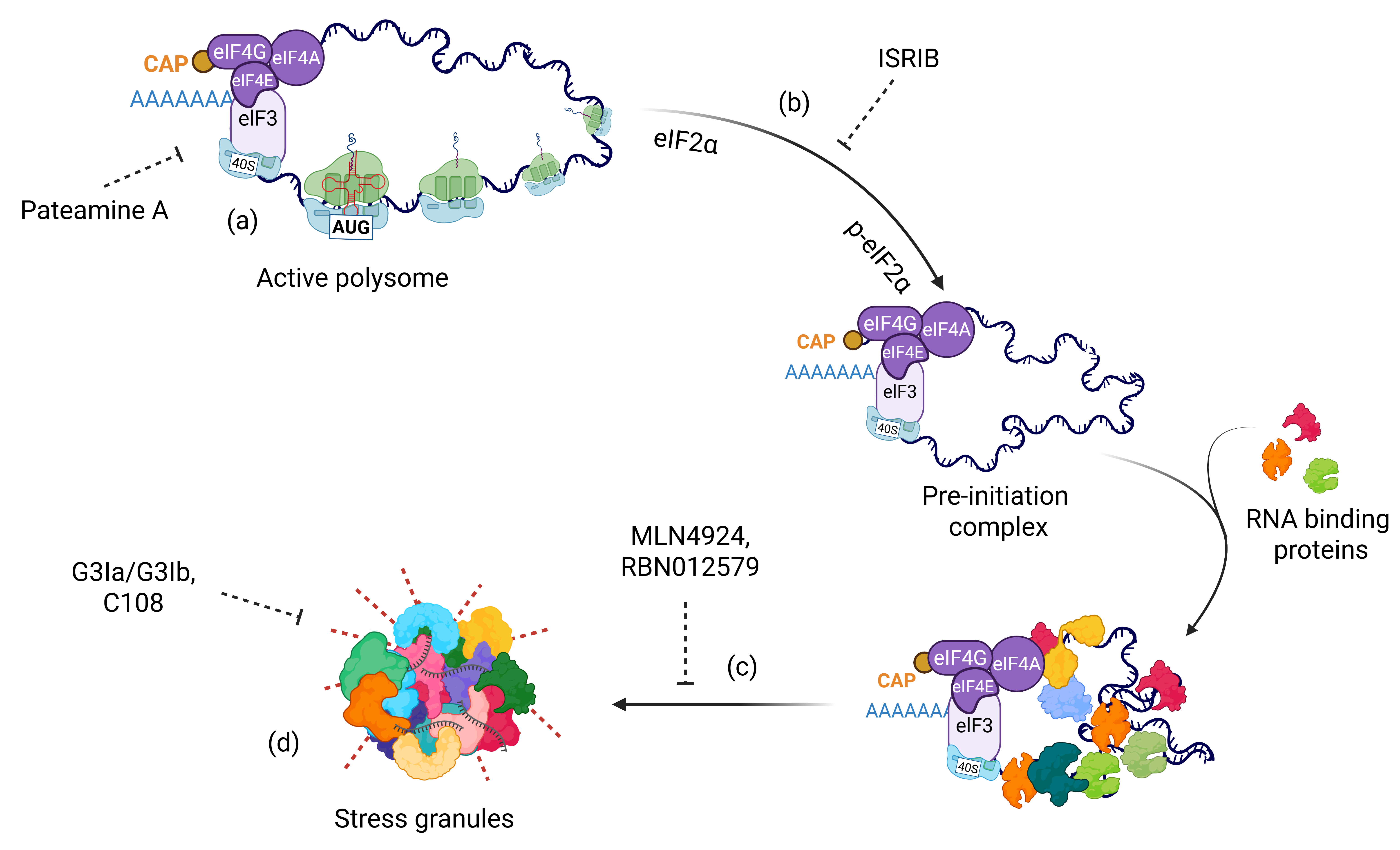
5. Therapeutic Options Targeting SGs
5.1. Post-Translational Modifications
5.2. Biomolecular Condensate Modulators
5.3. Blocking Activation of Stress Kinases
5.4. Indirect Modulators of SG Dynamics
6. G3BP1 and G3BP2: Beyond SG Formation
7. Challenges/Outstanding Questions
8. Discussion
9. Conclusions
Author Contributions
Funding
Institutional Review Board Statement
Informed Consent Statement
Data Availability Statement
Acknowledgments
Conflicts of Interest
References
- Costa-Mattioli, M.; Walter, P. The Integrated Stress Response: From Mechanism to Disease. Science 2020, 368, eaat5314. [Google Scholar] [CrossRef]
- Pakos-Zebrucka, K.; Koryga, I.; Mnich, K.; Ljujic, M.; Samali, A.; Gorman, A.M. The Integrated Stress Response. EMBO Rep. 2016, 17, 1374–1395. [Google Scholar] [CrossRef]
- Lines, C.L.; McGrath, M.J.; Dorwart, T.; Conn, C.S. The Integrated Stress Response in Cancer Progression: A Force for Plasticity and Resistance. Front. Oncol. 2023, 13, 1206561. [Google Scholar] [CrossRef] [PubMed]
- Licari, E.; Sánchez-Del-Campo, L.; Falletta, P. The Two Faces of the Integrated Stress Response in Cancer Progression and Therapeutic Strategies. Int. J. Biochem. Cell Biol. 2021, 139, 106059. [Google Scholar] [CrossRef] [PubMed]
- Sonenberg, N.; Hinnebusch, A.G. Regulation of Translation Initiation in Eukaryotes: Mechanisms and Biological Targets. Cell 2009, 136, 731–745. [Google Scholar] [CrossRef] [PubMed]
- Harding, H.P.; Novoa, I.; Zhang, Y.; Zeng, H.; Wek, R.; Schapira, M.; Ron, D. Regulated Translation Initiation Controls Stress-Induced Gene Expression in Mammalian Cells. Mol. Cell 2000, 6, 1099–1108. [Google Scholar] [CrossRef]
- Wheeler, J.R.; Matheny, T.; Jain, S.; Abrisch, R.; Parker, R. Distinct Stages in Stress Granule Assembly and Disassembly. eLife 2016, 5, e18413. [Google Scholar] [CrossRef]
- Arimoto, K.; Fukuda, H.; Imajoh-Ohmi, S.; Saito, H.; Takekawa, M. Formation of Stress Granules Inhibits Apoptosis by Suppressing Stress-Responsive MAPK Pathways. Nat. Cell Biol. 2008, 10, 1324–1332. [Google Scholar] [CrossRef]
- Markmiller, S.; Soltanieh, S.; Server, K.L.; Mak, R.; Jin, W.; Fang, M.Y.; Luo, E.-C.; Krach, F.; Yang, D.; Sen, A.; et al. Context-Dependent and Disease-Specific Diversity in Protein Interactions within Stress Granules. Cell 2018, 172, 590–604.e13. [Google Scholar] [CrossRef]
- Grabocka, E.; Bar-Sagi, D. Mutant KRAS Enhances Tumor Cell Fitness by Upregulating Stress Granules. Cell 2016, 167, 1803–1813.e12. [Google Scholar] [CrossRef]
- Takahashi, M.; Higuchi, M.; Matsuki, H.; Yoshita, M.; Ohsawa, T.; Oie, M.; Fujii, M. Stress Granules Inhibit Apoptosis by Reducing Reactive Oxygen Species Production. Mol. Cell. Biol. 2013, 33, 815–829. [Google Scholar] [CrossRef] [PubMed]
- Tang, J.; Liu, J.; Nie, J.; Pei, H.; Zhou, G. YBX1 Underwent Phase Separation into Stress Granules Stimulated by Ionizing Radiation. Radiat. Res. 2024, 201, 215–223. [Google Scholar] [CrossRef]
- Cho, E.; Than, T.T.; Kim, S.H.; Park, E.R.; Kim, M.Y.; Lee, K.H.; Shin, H.J. G3BP1 Depletion Increases Radiosensitisation by Inducing Oxidative Stress in Response to DNA Damage. Anticancer Res. 2019, 39, 6087–6095. [Google Scholar] [CrossRef]
- Riggs, C.L.; Kedersha, N.; Ivanov, P.; Anderson, P. Mammalian Stress Granules and P Bodies at a Glance. J. Cell Sci. 2020, 133, jcs242487. [Google Scholar] [CrossRef]
- Jayabalan, A.K.; Ayeni, A.; Jia, J. Calcium Release from Damaged Lysosomes Triggers Stress Granule Formation for Cell Survival. Autophagy 2025, 21, 1390–1392. [Google Scholar] [CrossRef] [PubMed]
- Leung, A.K.L.; Vyas, S.; Rood, J.E.; Bhutkar, A.; Sharp, P.A.; Chang, P. Poly(ADP-Ribose) Regulates Stress Responses and MicroRNA Activity in the Cytoplasm. Mol. Cell 2011, 42, 489–499. [Google Scholar] [CrossRef] [PubMed]
- Ohn, T.; Kedersha, N.; Hickman, T.; Tisdale, S.; Anderson, P. A Functional RNAi Screen Links O-GlcNAc Modification of Ribosomal Proteins to Stress Granule and Processing Body Assembly. Nat. Cell Biol. 2008, 10, 1224–1231. [Google Scholar] [CrossRef]
- Jayabalan, A.K.; Sanchez, A.; Park, R.Y.; Yoon, S.P.; Kang, G.Y.; Baek, J.H.; Anderson, P.; Kee, Y.; Ohn, T. NEDDylation Promotes Stress Granule Assembly. Nat. Commun. 2016, 7, 12125. [Google Scholar] [CrossRef]
- Marmor-Kollet, H.; Siany, A.; Kedersha, N.; Knafo, N.; Rivkin, N.; Danino, Y.M.; Moens, T.G.; Olender, T.; Sheban, D.; Cohen, N.; et al. Spatiotemporal Proteomic Analysis of Stress Granule Disassembly Using APEX Reveals Regulation by SUMOylation and Links to ALS Pathogenesis. Mol. Cell 2020, 80, 876–891.e6. [Google Scholar] [CrossRef]
- Gwon, Y.; Maxwell, B.A.; Kolaitis, R.-M.; Zhang, P.; Kim, H.J.; Paul Taylor, J. Ubiquitination of G3BP1 Mediates Stress Granule Disassembly in a Context-Specific Manner. Science 2021, 372, eabf6548. [Google Scholar] [CrossRef]
- Parker, D.M.; Tauber, D.; Parker, R. G3BP1 Promotes Intermolecular RNA-RNA Interactions during RNA Condensation. Mol. Cell 2024, 85, 571–584.e7. [Google Scholar] [CrossRef]
- Van Treeck, B.; Parker, R. Emerging Roles for Intermolecular RNA-RNA Interactions in RNP Assemblies. Cell 2018, 174, 791–802. [Google Scholar] [CrossRef]
- Yang, P.; Mathieu, C.; Kolaitis, R.M.; Zhang, P.; Messing, J.; Yurtsever, U.; Yang, Z.; Wu, J.; Li, Y.; Pan, Q.; et al. G3BP1 Is a Tunable Switch That Triggers Phase Separation to Assemble Stress Granules. Cell 2020, 181, 325–345.e28. [Google Scholar] [CrossRef]
- Kedersha, N.; Panas, M.D.; Achorn, C.A.; Lyons, S.; Tisdale, S.; Hickman, T.; Thomas, M.; Lieberman, J.; McInerney, G.M.; Ivanov, P.; et al. G3BP–Caprin1–USP10 Complexes Mediate Stress Granule Condensation and Associate with 40S Subunits. J. Cell Biol. 2016, 212, e201508028. [Google Scholar] [CrossRef]
- Cirillo, L.; Cieren, A.; Barbieri, S.; Khong, A.; Schwager, F.; Parker, R.; Gotta, M. UBAP2L Forms Distinct Cores That Act in Nucleating Stress Granules Upstream of G3BP1. Curr. Biol. 2020, 30, 698–707.e6. [Google Scholar] [CrossRef] [PubMed]
- Hu, S.; Zhang, Y.; Yi, Q.; Yang, C.; Liu, Y.; Bai, Y. Time-Resolved Proteomic Profiling Reveals Compositional and Functional Transitions across the Stress Granule Life Cycle. Nat. Commun. 2023, 14, 7782. [Google Scholar] [CrossRef]
- Aulas, A.; Fay, M.M.; Lyons, S.M.; Achorn, C.A.; Kedersha, N.; Anderson, P.; Ivanov, P. Stress-Specific Differences in Assembly and Composition of Stress Granules and Related Foci. J. Cell. Sci. 2017, 130, 927–937. [Google Scholar] [CrossRef]
- Fujimura, K.; Sasaki, A.T.; Anderson, P. Selenite Targets EIF4E-Binding Protein-1 to Inhibit Translation Initiation and Induce the Assembly of Non-Canonical Stress Granules. Nucleic Acids Res. 2012, 40, 8099–8110. [Google Scholar] [CrossRef] [PubMed]
- Reineke, L.C.; Cheema, S.A.; Dubrulle, J.; Neilson, J.R. Chronic Starvation Induces Noncanonical Pro-Death Stress Granules. J. Cell Sci. 2018, 131, jcs220244. [Google Scholar] [CrossRef]
- Ivanov, P.; Kedersha, N.; Anderson, P. Stress Granules and Processing Bodies in Translational Control. Cold Spring Harb. Perspect. Biol. 2019, 11, a032813. [Google Scholar] [CrossRef] [PubMed]
- Pietras, P.; Aulas, A.; Fay, M.M.; Leśniczak-Staszak, M.; Sowiński, M.; Lyons, S.M.; Szaflarski, W.; Ivanov, P. Translation Inhibition and Suppression of Stress Granules Formation by Cisplatin. Biomed. Pharmacother. 2022, 145, 112382. [Google Scholar] [CrossRef]
- Kassouf, T.; Shrivastava, R.; Meszka, I.; Bailly, A.; Polanowska, J.; Trauchessec, H.; Mandrioli, J.; Carra, S.; Xirodimas, D.P. Targeting the NEDP1 Enzyme to Ameliorate ALS Phenotypes through Stress Granule Disassembly. Sci. Adv. 2023, 9, eabq7585. [Google Scholar] [CrossRef] [PubMed]
- Youn, J.Y.; Dunham, W.H.; Hong, S.J.; Knight, J.D.R.; Bashkurov, M.; Chen, G.I.; Bagci, H.; Rathod, B.; MacLeod, G.; Eng, S.W.M.; et al. High-Density Proximity Mapping Reveals the Subcellular Organization of MRNA-Associated Granules and Bodies. Mol. Cell 2018, 69, 517–532.e11. [Google Scholar] [CrossRef] [PubMed]
- Hofmann, S.; Kedersha, N.; Anderson, P.; Ivanov, P. Molecular Mechanisms of Stress Granule Assembly and Disassembly. Biochim. Biophys. Acta Mol. Cell Res. 2021, 1868, 118876. [Google Scholar] [CrossRef]
- Buchan, J.R. Stress Granule and P-Body Clearance: Seeking Coherence in Acts of Disappearance. Semin. Cell Dev. Biol. 2024, 159–160, 10–26. [Google Scholar] [CrossRef]
- Buchan, J.R.; Kolaitis, R.-M.; Taylor, J.P.; Parker, R. Eukaryotic Stress Granules Are Cleared by Autophagy and Cdc48/VCP Function. Cell 2013, 153, 1461–1474. [Google Scholar] [CrossRef]
- Glauninger, H.; Wong Hickernell, C.J.; Bard, J.A.M.; Drummond, D.A. Stressful Steps: Progress and Challenges in Understanding Stress-Induced MRNA Condensation and Accumulation in Stress Granules. Mol. Cell 2022, 82, 2544–2556. [Google Scholar] [CrossRef]
- Millar, S.R.; Huang, J.Q.; Schreiber, K.J.; Tsai, Y.-C.; Won, J.; Zhang, J.; Moses, A.M.; Youn, J.-Y. A New Phase of Networking: The Molecular Composition and Regulatory Dynamics of Mammalian Stress Granules. Chem. Rev. 2023, 123, 9036–9064. [Google Scholar] [CrossRef]
- Anderson, P.; Kedersha, N. Stress Granules: The Tao of RNA Triage. Trends Biochem. Sci. 2008, 33, 141–150. [Google Scholar] [CrossRef] [PubMed]
- Moon, S.L.; Morisaki, T.; Khong, A.; Lyon, K.; Parker, R.; Stasevich, T.J. Multicolour Single-Molecule Tracking of MRNA Interactions with RNP Granules. Nat. Cell Biol. 2019, 21, 162–168. [Google Scholar] [CrossRef]
- Bussi, C.; Mangiarotti, A.; Vanhille-Campos, C.; Aylan, B.; Pellegrino, E.; Athanasiadi, N.; Fearns, A.; Rodgers, A.; Franzmann, T.M.; Šarić, A.; et al. Stress Granules Plug and Stabilize Damaged Endolysosomal Membranes. Nature 2023, 623, 1062–1069. [Google Scholar] [CrossRef] [PubMed]
- Wippich, F.; Bodenmiller, B.; Trajkovska, M.G.; Wanka, S.; Aebersold, R.; Pelkmans, L. Dual Specificity Kinase DYRK3 Couples Stress Granule Condensation/Dissolution to MTORC1 Signaling. Cell 2013, 152, 791–805. [Google Scholar] [CrossRef]
- Wu, Y.; Wang, X.; Meng, L.; Liao, Z.; Ji, W.; Zhang, P.; Lin, J.; Guo, Q. Translation Landscape of Stress Granules. Sci. Adv. 2025, 11, eady6859. [Google Scholar] [CrossRef] [PubMed]
- Park, Y.-J.; Choi, D.W.; Cho, S.W.; Han, J.; Yang, S.; Choi, C.Y. Stress Granule Formation Attenuates RACK1-Mediated Apoptotic Cell Death Induced by Morusin. Int. J. Mol. Sci. 2020, 21, 5360. [Google Scholar] [CrossRef]
- Kim, W.J.; Back, S.H.; Kim, V.; Ryu, I.; Jang, S.K. Sequestration of TRAF2 into Stress Granules Interrupts Tumor Necrosis Factor Signaling under Stress Conditions. Mol. Cell. Biol. 2005, 25, 2450–2462. [Google Scholar] [CrossRef] [PubMed]
- Fujikawa, D.; Nakamura, T.; Yoshioka, D.; Li, Z.; Moriizumi, H.; Taguchi, M.; Tokai-Nishizumi, N.; Kozuka-Hata, H.; Oyama, M.; Takekawa, M. Stress Granule Formation Inhibits Stress-Induced Apoptosis by Selectively Sequestering Executioner Caspases. Curr. Biol. 2023, 33, 1967–1981.e8. [Google Scholar] [CrossRef]
- Mediani, L.; Antoniani, F.; Galli, V.; Vinet, J.; Carrà, A.D.; Bigi, I.; Tripathy, V.; Tiago, T.; Cimino, M.; Leo, G.; et al. Hsp90-Mediated Regulation of DYRK3 Couples Stress Granule Disassembly and Growth via MTORC1 Signaling. EMBO Rep. 2021, 22, e51740. [Google Scholar] [CrossRef]
- Buchan, J.R. MRNP Granules. Assembly, Function, and Connections with Disease: Assembly, Function, and Connections with Disease. RNA Biol. 2014, 11, 1019–1030. [Google Scholar] [CrossRef]
- McCormick, C.; Khaperskyy, D.A. Translation Inhibition and Stress Granules in the Antiviral Immune Response. Nat. Rev. Immunol. 2017, 17, 647–660. [Google Scholar] [CrossRef]
- Duan, Y.; Du, A.; Gu, J.; Duan, G.; Wang, C.; Gui, X.; Ma, Z.; Qian, B.; Deng, X.; Zhang, K.; et al. PARylation Regulates Stress Granule Dynamics, Phase Separation, and Neurotoxicity of Disease-Related RNA-Binding Proteins. Cell Res. 2019, 29, 233–247. [Google Scholar] [CrossRef]
- Mackenzie, I.R.; Nicholson, A.M.; Sarkar, M.; Messing, J.; Purice, M.D.; Pottier, C.; Annu, K.; Baker, M.; Perkerson, R.B.; Kurti, A.; et al. TIA1 Mutations in Amyotrophic Lateral Sclerosis and Frontotemporal Dementia Promote Phase Separation and Alter Stress Granule Dynamics. Neuron 2017, 95, 808–816.e9. [Google Scholar] [CrossRef]
- Seguin, S.J.; Morelli, F.F.; Vinet, J.; Amore, D.; De Biasi, S.; Poletti, A.; Rubinsztein, D.C.; Carra, S. Inhibition of Autophagy, Lysosome and VCP Function Impairs Stress Granule Assembly. Cell Death Differ. 2014, 21, 1838–1851. [Google Scholar] [CrossRef]
- Alberti, S.; Arosio, P.; Best, R.B.; Boeynaems, S.; Cai, D.; Collepardo-Guevara, R.; Dignon, G.L.; Dimova, R.; Elbaum-Garfinkle, S.; Fawzi, N.L.; et al. Current Practices in the Study of Biomolecular Condensates: A Community Comment. Nat. Commun. 2025, 16, 7730. [Google Scholar] [CrossRef]
- Wheeler, J.R.; Jain, S.; Khong, A.; Parker, R. Isolation of Yeast and Mammalian Stress Granule Cores. Methods 2017, 126, 12–17. [Google Scholar] [CrossRef] [PubMed]
- Tartier, S.; Basbous, J.; Boulon, S.; Verheggen, C.; Bertrand, E. The Purification of Biomolecular Condensates: Bottlenecks and Strategies. J. Cell Biol. 2025, 224, e202504081. [Google Scholar] [CrossRef] [PubMed]
- Jia, J.; Wang, F.; Bhujabal, Z.; Peters, R.; Mudd, M.; Duque, T.; Allers, L.; Javed, R.; Salemi, M.; Behrends, C.; et al. Membrane Atg8ylation, Stress Granule Formation, and MTOR Regulation during Lysosomal Damage. Autophagy 2022, 19, 1893–1895. [Google Scholar] [CrossRef]
- Kedersha, N.; Anderson, P. Mammalian Stress Granules and Processing Bodies. Methods Enzymol. 2007, 431, 61–81. [Google Scholar] [PubMed]
- Libert, M.; Quiquempoix, S.; Fain, J.S.; Pyr Dit Ruys, S.; Haidar, M.; Wulleman, M.; Herinckx, G.; Vertommen, D.; Bouchart, C.; Arsenijevic, T.; et al. Stress Granules Are Not Present in Kras Mutant Cancers and Do Not Control Tumor Growth. EMBO Rep. 2024, 25, 4693–4707. [Google Scholar] [CrossRef]
- Fonteneau, G.; Redding, A.; Hoag-Lee, H.; Sim, E.S.; Heinrich, S.; Gaida, M.M.; Grabocka, E. Stress Granules Determine the Development of Obesity-Associated Pancreatic Cancer. Cancer Discov. 2022, 12, 1984–2005. [Google Scholar] [CrossRef]
- Zhou, H.; Luo, J.; Mou, K.; Peng, L.; Li, X.; Lei, Y.; Wang, J.; Lin, S.; Luo, Y.; Xiang, L. Stress Granules: Functions and Mechanisms in Cancer. Cell Biosci. 2023, 13, 86. [Google Scholar] [CrossRef]
- Faber, G.P.; Gross, G.; Mualem, O.; Avivi, M.Y.; Waldman Ben-Asher, H.; Yaron, O.; Kinor, N.; Shefi, O.; Ben-Yishay, R.; Ishay-Ronen, D.; et al. Glutamine Modulates Stress Granule Formation in Cancer Cells through Core RNA-Binding Proteins. J. Cell Sci. 2025, 138, jcs263679. [Google Scholar] [CrossRef]
- Meng, F.; Li, H.; Huang, Y.; Wang, C.; Liu, Y.; Zhang, C.; Chen, D.; Zeng, T.; Zhang, S.; Li, Y.; et al. RIOK1 Phase Separation Restricts PTEN Translation via Stress Granules Activating Tumor Growth in Hepatocellular Carcinoma. Nat. Cancer 2025, 6, 1223–1241. [Google Scholar] [CrossRef]
- Wei, S.C.; Fattet, L.; Tsai, J.H.; Guo, Y.; Pai, V.H.; Majeski, H.E.; Chen, A.C.; Sah, R.L.; Taylor, S.S.; Engler, A.J.; et al. Matrix Stiffness Drives Epithelial-Mesenchymal Transition and Tumour Metastasis through a TWIST1-G3BP2 Mechanotransduction Pathway. Nat. Cell Biol. 2015, 17, 678–688. [Google Scholar] [CrossRef]
- Khong, A.; Ripin, N.; de Vasconcelos, L.M.; Passanisi, V.; Spencer, S.; Parker, R. Stress Granules Promote Quiescence by Enhancing P21 Levels and Reducing Phospho-Rb. RNA 2025, 31, 1472–1487. [Google Scholar] [CrossRef]
- Shi, Q.; Zhu, Y.; Ma, J.; Chang, K.; Ding, D.; Bai, Y.; Gao, K.; Zhang, P.; Mo, R.; Feng, K.; et al. Prostate Cancer-Associated SPOP Mutations Enhance Cancer Cell Survival and Docetaxel Resistance by Upregulating Caprin1-Dependent Stress Granule Assembly. Mol. Cancer 2019, 18, 170. [Google Scholar] [CrossRef] [PubMed]
- Redding, A.; Fonteneau, G.; Heinrich, S.; Gaida, M.M.; Grabocka, E. Cytosolic Phospholipase A2 Determines Intercellular Heterogeneity of Stress Granules and Chemotherapy Response. Cancer Discov. 2025, 15, 1437–1457. [Google Scholar] [CrossRef]
- Mateju, D.; Eichenberger, B.; Voigt, F.; Eglinger, J.; Roth, G.; Chao, J.A. Single-Molecule Imaging Reveals Translation of MRNAs Localized to Stress Granules. Cell 2020, 183, 1801–1812.e13. [Google Scholar] [CrossRef]
- Kaehler, C.; Isensee, J.; Hucho, T.; Lehrach, H.; Krobitsch, S. 5-Fluorouracil Affects Assembly of Stress Granules Based on RNA Incorporation. Nucleic Acids Res. 2014, 42, 6436–6447. [Google Scholar] [CrossRef] [PubMed]
- Leśniczak-Staszak, M.; Pietras, P.; Ruciński, M.; Johnston, R.; Sowiński, M.; Andrzejewska, M.; Nowicki, M.; Gowin, E.; Lyons, S.M.; Ivanov, P.; et al. Stress Granule-Mediated Sequestration of EGR1 MRNAs Correlates with Lomustine-Induced Cell Death Prevention. J. Cell Sci. 2024, 137. [Google Scholar] [CrossRef]
- Gareau, C.; Fournier, M.-J.; Filion, C.; Coudert, L.; Martel, D.; Labelle, Y.; Mazroui, R. P21(WAF1/CIP1) Upregulation through the Stress Granule-Associated Protein CUGBP1 Confers Resistance to Bortezomib-Mediated Apoptosis. PLoS ONE 2011, 6, e20254. [Google Scholar] [CrossRef] [PubMed]
- Fournier, M.-J.; Gareau, C.; Mazroui, R. The Chemotherapeutic Agent Bortezomib Induces the Formation of Stress Granules. Cancer Cell Int. 2010, 10, 12. [Google Scholar] [CrossRef] [PubMed]
- Matsuki, H.; Takahashi, M.; Higuchi, M.; Makokha, G.N.; Oie, M.; Fujii, M. Both G3BP1 and G3BP2 Contribute to Stress Granule Formation. Genes Cells 2013, 18, 135–146. [Google Scholar] [CrossRef]
- Redding, A.; Grabocka, E. Stress Granules and Hormetic Adaptation of Cancer. Trends Cancer Res. 2023, 9, 995–1005. [Google Scholar] [CrossRef] [PubMed]
- Adjibade, P.; St-Sauveur, V.G.; Quevillon Huberdeau, M.; Fournier, M.-J.; Savard, A.; Coudert, L.; Khandjian, E.W.; Mazroui, R. Sorafenib, a Multikinase Inhibitor, Induces Formation of Stress Granules in Hepatocarcinoma Cells. Oncotarget 2015, 6, 43927–43943. [Google Scholar] [CrossRef] [PubMed]
- Adjibade, P.; Simoneau, B.; Ledoux, N.; Gauthier, W.N.; Nkurunziza, M.; Khandjian, E.W.; Mazroui, R. Treatment of Cancer Cells with Lapatinib Negatively Regulates General Translation and Induces Stress Granules Formation. PLoS ONE 2020, 15, e0231894. [Google Scholar] [CrossRef] [PubMed]
- Martin, J.L.; Terry, S.J.; Gale, J.E.; Dawson, S.J. The Ototoxic Drug Cisplatin Localises to Stress Granules Altering Their Dynamics and Composition. J. Cell Sci. 2023, 136, jcs260590. [Google Scholar] [CrossRef]
- Ries, R.J.; Pickering, B.F.; Poh, H.X.; Namkoong, S.; Jaffrey, S.R. M6A Governs Length-Dependent Enrichment of MRNAs in Stress Granules. Nat. Struct. Mol. Biol. 2023, 30, 1525–1535. [Google Scholar] [CrossRef]
- Szaflarski, W.; Fay, M.M.; Kedersha, N.; Zabel, M.; Anderson, P.; Ivanov, P. Vinca Alkaloid Drugs Promote Stress-Induced Translational Repression and Stress Granule Formation. Oncotarget 2016, 7, 30307–30322. [Google Scholar] [CrossRef]
- Dang, Y.; Kedersha, N.; Low, W.-K.; Romo, D.; Gorospe, M.; Kaufman, R.; Anderson, P.; Liu, J.O. Eukaryotic Initiation Factor 2α-Independent Pathway of Stress Granule Induction by the Natural Product Pateamine A. J. Biol. Chem. 2006, 281, 32870–32878. [Google Scholar] [CrossRef]
- Bittencourt, L.F.F.; Negreiros-Lima, G.L.; Sousa, L.P.; Silva, A.G.; Souza, I.B.S.; Ribeiro, R.I.M.A.; Dutra, M.F.; Silva, R.F.; Dias, A.C.F.; Soriani, F.M.; et al. G3BP1 Knockdown Sensitizes U87 Glioblastoma Cell Line to Bortezomib by Inhibiting Stress Granules Assembly and Potentializing Apoptosis. J. Neurooncol. 2019, 144, 463–473. [Google Scholar] [CrossRef]
- Somasekharan, S.P.; El-Naggar, A.; Leprivier, G.; Cheng, H.; Hajee, S.; Grunewald, T.G.P.; Zhang, F.; Ng, T.; Delattre, O.; Evdokimova, V.; et al. YB-1 Regulates Stress Granule Formation and Tumor Progression by Translationally Activating G3BP1. J. Cell Biol. 2015, 208, 913–929. [Google Scholar] [CrossRef]
- Jangid, V.; Rahul, C.N.; Rashmi B, A.; Sekar, K. Computational Analysis to Identify Novel Drug Targets for Esophageal Cancer. Medinformatics 2024, 1–12. [Google Scholar] [CrossRef]
- Zhu, D.-S.; Dong, J.-Y.; Xu, Y.-Y.; Zhang, X.-T.; Fu, S.-B.; Liu, W. Omipalisib Inhibits Esophageal Squamous Cell Carcinoma Growth through Inactivation of Phosphoinositide 3-Kinase (PI3K)/AKT/Mammalian Target of Rapamycin (MTOR) and ERK Signaling. Med. Sci. Monit. 2020, 26, e927106. [Google Scholar] [CrossRef]
- Devanand, P.; Sundaramoorthy, S.; Ryu, M.S.; Jayabalan, A.K.; Ohn, T.; Lim, I.K. Translational Downregulation of Twist1 Expression by Antiproliferative Gene, B-Cell Translocation Gene 2, in the Triple Negative Breast Cancer Cells. Cell Death Dis. 2019, 10, 410. [Google Scholar] [CrossRef]
- Somasekharan, S.P.; Zhang, F.; Saxena, N.; Huang, J.N.; Kuo, I.C.; Low, C.; Bell, R.; Adomat, H.; Stoynov, N.; Foster, L.; et al. G3BP1-Linked MRNA Partitioning Supports Selective Protein Synthesis in Response to Oxidative Stress. Nucleic Acids Res. 2020, 48, 6855–6873. [Google Scholar] [CrossRef]
- Liboy-Lugo, J.M.; Espinoza, C.A.; Sheu-Gruttadauria, J.; Park, J.E.; Xu, A.; Jowhar, Z.; Gao, A.L.; Carmona-Negrón, J.A.; Wittmann, T.; Jura, N.; et al. G3BP Isoforms Differentially Affect Stress Granule Assembly and Gene Expression during Cellular Stress. Mol. Biol. Cell 2024, 35, ar140. [Google Scholar] [CrossRef]
- Zheng, H.; Zhan, Y.; Zhang, Y.; Liu, S.; Lu, J.; Yang, Y.; Wen, Q.; Fan, S. Elevated Expression of G3BP1 Associates with YB1 and P-AKT and Predicts Poor Prognosis in Nonsmall Cell Lung Cancer Patients after Surgical Resection. Cancer Med. 2019, 8, 6894–6903. [Google Scholar] [CrossRef]
- Li, H.; Lin, P.-H.; Gupta, P.; Li, X.; Zhao, S.L.; Zhou, X.; Li, Z.; Wei, S.; Xu, L.; Han, R.; et al. MG53 Suppresses Tumor Progression and Stress Granule Formation by Modulating G3BP2 Activity in Non-Small Cell Lung Cancer. Mol. Cancer 2021, 20, 118. [Google Scholar] [CrossRef] [PubMed]
- Seebacher, N.A.; Krchniakova, M.; Stacy, A.E.; Skoda, J.; Jansson, P.J. Tumour Microenvironment Stress Promotes the Development of Drug Resistance. Antioxidants 2021, 10, 1801. [Google Scholar] [CrossRef]
- Mukhopadhyay, S.; Goswami, D.; Adiseshaiah, P.P.; Burgan, W.; Yi, M.; Guerin, T.M.; Kozlov, S.V.; Nissley, D.V.; McCormick, F. Undermining Glutaminolysis Bolsters Chemotherapy While NRF2 Promotes Chemoresistance in KRAS-Driven Pancreatic Cancers. Cancer Res. 2020, 80, 1630–1643. [Google Scholar] [CrossRef] [PubMed]
- Zhang, Y.; Yue, C.; Krichevsky, A.M.; Garkavtsev, I. Repression of the Stress Granule Protein G3BP2 Inhibits Immune Checkpoint Molecule PD-L1. Mol. Oncol. 2021. [Google Scholar] [CrossRef] [PubMed]
- Paget, M.; Cadena, C.; Ahmad, S.; Wang, H.-T.; Jordan, T.X.; Kim, E.; Koo, B.; Lyons, S.M.; Ivanov, P.; tenOever, B.; et al. Stress Granules Are Shock Absorbers That Prevent Excessive Innate Immune Responses to DsRNA. Mol. Cell 2023, 83, 1180–1196.e8. [Google Scholar] [CrossRef] [PubMed]
- Kodali, S.; Proietti, L.; Valcarcel, G.; López-Rubio, A.V.; Pessina, P.; Eder, T.; Shi, J.; Jen, A.; Lupión-Garcia, N.; Starner, A.C.; et al. RNA Sequestration in P-Bodies Sustains Myeloid Leukaemia. Nat. Cell Biol. 2024, 26, 1745–1758. [Google Scholar] [CrossRef]
- Shen, X.; Peng, X.; Guo, Y.; Dai, Z.; Cui, L.; Yu, W.; Liu, Y.; Liu, C.-Y. YAP/TAZ Enhances P-Body Formation to Promote Tumorigenesis. eLife 2024, 12, RP88573. [Google Scholar] [CrossRef] [PubMed]
- An, H.; Tan, J.T.; Shelkovnikova, T.A. Stress Granules Regulate Stress-Induced Paraspeckle Assembly. J. Cell Biol. 2019, 218, 4127–4140. [Google Scholar] [CrossRef]
- Pisani, G.; Baron, B. NEAT1 and Paraspeckles in Cancer Development and Chemoresistance. Noncoding RNA 2020, 6, 43. [Google Scholar] [CrossRef]
- Mahboubi, H.; Stochaj, U. Nucleoli and Stress Granules: Connecting Distant Relatives. Traffic 2014, 15, 1179–1193. [Google Scholar] [CrossRef]
- Wu, C.; Wang, X.; Li, Y.; Zhen, W.; Wang, C.; Wang, X.; Xie, Z.; Xu, X.; Guo, S.; Botella, J.R.; et al. Sequestration of DBR1 to Stress Granules Promotes Lariat Intronic RNAs Accumulation for Heat-Stress Tolerance. Nat. Commun. 2024, 15, 7696. [Google Scholar] [CrossRef]
- Child, J.R.; Chen, Q.; Reid, D.W.; Jagannathan, S.; Nicchitta, C.V. Recruitment of Endoplasmic Reticulum-Targeted and Cytosolic MRNAs into Membrane-Associated Stress Granules. RNA 2021, 27, 1241–1256. [Google Scholar] [CrossRef]
- Yang, C.; Wang, Z.; Kang, Y.; Yi, Q.; Wang, T.; Bai, Y.; Liu, Y. Stress Granule Homeostasis Is Modulated by TRIM21-Mediated Ubiquitination of G3BP1 and Autophagy-Dependent Elimination of Stress Granules. Autophagy 2023, 19, 1934–1951. [Google Scholar] [CrossRef]
- Wang, B.; Maxwell, B.A.; Joo, J.H.; Gwon, Y.; Messing, J.; Mishra, A.; Shaw, T.I.; Ward, A.L.; Quan, H.; Sakurada, S.M.; et al. ULK1 and ULK2 Regulate Stress Granule Disassembly Through Phosphorylation and Activation of VCP/P97. Mol. Cell 2019, 74, 742–757.e8. [Google Scholar] [CrossRef]
- Ma, L.; Singh, J.; Schekman, R. Two RNA-Binding Proteins Mediate the Sorting of MiR223 from Mitochondria into Exosomes. eLife 2023, 12, e85878. [Google Scholar] [CrossRef]
- Klein, P.; Kallenberger, S.M.; Roth, H.; Roth, K.; Ly-Hartig, T.B.N.; Magg, V.; Aleš, J.; Talemi, S.R.; Qiang, Y.; Wolf, S.; et al. Temporal Control of the Integrated Stress Response by a Stochastic Molecular Switch. Sci. Adv. 2022, 8, eabk2022. [Google Scholar] [CrossRef]
- Sfakianos, A.P.; Mellor, L.E.; Pang, Y.F.; Kritsiligkou, P.; Needs, H.; Abou-Hamdan, H.; Désaubry, L.; Poulin, G.B.; Ashe, M.P.; Whitmarsh, A.J. The MTOR-S6 Kinase Pathway Promotes Stress Granule Assembly. Cell Death Differ. 2018, 25, 1766–1780. [Google Scholar] [CrossRef]
- Kedersha, N.; Ivanov, P.; Anderson, P. Stress Granules and Cell Signaling: More than Just a Passing Phase? Trends Biochem. Sci. 2013, 38, 494–506. [Google Scholar] [CrossRef]
- Papapetrou, E.P. Patient-Derived Induced Pluripotent Stem Cells in Cancer Research and Precision Oncology. Nat. Med. 2016, 22, 1392–1401. [Google Scholar] [CrossRef] [PubMed]
- Tsai, W.C.; Gayatri, S.; Reineke, L.C.; Sbardella, G.; Bedford, M.T.; Lloyd, R.E. Arginine Demethylation of G3BP1 Promotes Stress Granule Assembly. J. Biol. Chem. 2016, 291, 22671–22685. [Google Scholar] [CrossRef]
- Jongjitwimol, J.; Baldock, R.A.; Morley, S.J.; Watts, F.Z. Sumoylation of EIF4A2 Affects Stress Granule Formation. J. Cell Sci. 2016, 129, 2407–2415. [Google Scholar] [CrossRef] [PubMed]
- Jayabalan, A.; Bhambhani, K.; Leung, A.K.L. PARP10 Is Critical for Stress Granule Initiation. Life Sci. Alliance 2025, 8, e202403026. [Google Scholar] [CrossRef] [PubMed]
- Soucy, T.A.; Smith, P.G.; Milhollen, M.A.; Berger, A.J.; Gavin, J.M.; Adhikari, S.; Brownell, J.E.; Burke, K.E.; Cardin, D.P.; Critchley, S.; et al. An Inhibitor of NEDD8-Activating Enzyme as a New Approach to Treat Cancer. Nature 2009, 458, 732–736. [Google Scholar] [CrossRef]
- Rabut, G.; Peter, M. Function and Regulation of Protein Neddylation. “Protein Modifications: Beyond the Usual Suspects” Review Series. EMBO Rep. 2008, 9, 969–976. [Google Scholar] [CrossRef]
- Leung, A.K.L. Poly(ADP-Ribose): A Dynamic Trigger for Biomolecular Condensate Formation. Trends Cell Biol. 2020, 30, 370–383. [Google Scholar] [CrossRef]
- Jayabalan, A.K.; Adivarahan, S.; Koppula, A.; Abraham, R.; Batish, M.; Zenklusen, D.; Griffin, D.E.; Leung, A.K.L. Stress Granule Formation, Disassembly, and Composition Are Regulated by Alphavirus ADP-Ribosylhydrolase Activity. Proc. Natl. Acad. Sci. USA 2021, 118, e2021719118. [Google Scholar] [CrossRef]
- Suskiewicz, M.J.; Prokhorova, E.; Rack, J.G.M.; Ahel, I. ADP-Ribosylation from Molecular Mechanisms to Therapeutic Implications. Cell 2023, 186, 4475–4495. [Google Scholar] [CrossRef]
- Ragupathi, A.; Singh, M.; Perez, A.M.; Zhang, D. Targeting the BRCA1/2 Deficient Cancer with PARP Inhibitors: Clinical Outcomes and Mechanistic Insights. Front. Cell Dev. Biol. 2023, 11, 1133472. [Google Scholar] [CrossRef]
- Challa, S.; Nandu, T.; Kim, H.B.; Gong, X.; Renshaw, C.W.; Li, W.-C.; Tan, X.; Aljardali, M.W.; Camacho, C.V.; Chen, J.; et al. RACK1 MARylation Regulates Translation and Stress Granules in Ovarian Cancer Cells. J. Cell Biol. 2025, 224, e202401101. [Google Scholar] [CrossRef] [PubMed]
- Cheng, S.-J.; Gafaar, T.; Kuttiyatveetil, J.R.A.; Sverzhinsky, A.; Chen, C.; Xu, M.; Lilley, A.; Pascal, J.M.; Leung, A.K.L. Regulation of Stress Granule Maturation and Dynamics by Poly(ADP-Ribose) Interaction with PARP13. Nat. Commun. 2025, 16, 621. [Google Scholar] [CrossRef] [PubMed]
- McGurk, L.; Gomes, E.; Guo, L.; Mojsilovic-Petrovic, J.; Tran, V.; Kalb, R.G.; Shorter, J.; Bonini, N.M. Poly(ADP-Ribose) Prevents Pathological Phase Separation of TDP-43 by Promoting Liquid Demixing and Stress Granule Localization. Mol. Cell 2018, 71, 703–717.e9. [Google Scholar] [CrossRef] [PubMed]
- Schenkel, L.B.; Molina, J.R.; Swinger, K.K.; Abo, R.; Blackwell, D.J.; Lu, A.Z.; Cheung, A.E.; Church, W.D.; Kunii, K.; Kuplast-Barr, K.G.; et al. A Potent and Selective PARP14 Inhibitor Decreases Protumor Macrophage Gene Expression and Elicits Inflammatory Responses in Tumor Explants. Cell Chem. Biol. 2021, 28, 1158–1168.e13. [Google Scholar] [CrossRef]
- Kirby, I.T.; Cohen, M.S. Small-Molecule Inhibitors of PARPs: From Tools for Investigating ADP-Ribosylation to Therapeutics. Curr. Top. Microbiol. Immunol. 2019, 420, 211–231. [Google Scholar]
- Mitrea, D.M.; Mittasch, M.; Gomes, B.F.; Klein, I.A.; Murcko, M.A. Modulating Biomolecular Condensates: A Novel Approach to Drug Discovery. Nat. Rev. Drug Discov. 2022, 21, 841–862. [Google Scholar] [CrossRef]
- Freibaum, B.D.; Messing, J.; Nakamura, H.; Yurtsever, U.; Wu, J.; Kim, H.J.; Hixon, J.; Lemieux, R.M.; Duffner, J.; Huynh, W.; et al. Identification of Small Molecule Inhibitors of G3BP-Driven Stress Granule Formation. J. Cell Biol. 2024, 223. [Google Scholar] [CrossRef]
- Uechi, H.; Sridharan, S.; Nijssen, J.; Bilstein, J.; Iglesias-Artola, J.M.; Kishigami, S.; Casablancas-Antras, V.; Poser, I.; Martinez, E.J.; Boczek, E.; et al. Small-Molecule Dissolution of Stress Granules by Redox Modulation Benefits ALS Models. Nat. Chem. Biol. 2025, 21, 1577–1588. [Google Scholar] [CrossRef]
- Li, J.; Zhang, Y.; Gu, J.; Zhou, Y.; Liu, J.; Cui, H.; Zhao, T.; Jin, Z. Stress Granule Core Protein-Derived Peptides Inhibit Assembly of Stress Granules and Improve Sorafenib Sensitivity in Cancer Cells. Molecules 2024, 29, 2134. [Google Scholar] [CrossRef] [PubMed]
- Dong, T.; Zhao, F.; Wang, M.; Lyu, K.; Zhu, J.; Zhang, W.; Li, W.; An, Y.; Liu, N.; Singh, A.P.; et al. G3BP1/2-Targeting PROTAC Disrupts Stress Granules Dependent ATF4 Migracytosis as Cancer Therapy. J. Am. Chem. Soc. 2025, 147, 446–461. [Google Scholar] [CrossRef]
- Jewer, M.; Lee, L.; Leibovitch, M.; Zhang, G.; Liu, J.; Findlay, S.D.; Vincent, K.M.; Tandoc, K.; Dieters-Castator, D.; Quail, D.F.; et al. Translational Control of Breast Cancer Plasticity. Nat. Commun. 2020, 11, 2498. [Google Scholar] [CrossRef] [PubMed]
- Timalsina, S.; Arimoto-Matsuzaki, K.; Kitamura, M.; Xu, X.; Wenzhe, Q.; Ishigami-Yuasa, M.; Kagechika, H.; Hata, Y. Chemical Compounds That Suppress Hypoxia-Induced Stress Granule Formation Enhance Cancer Drug Sensitivity of Human Cervical Cancer HeLa Cells. J. Biochem. 2018, 164, 381–391. [Google Scholar] [CrossRef] [PubMed]
- Alam, U.; Kennedy, D. Rasputin a Decade on and More Promiscuous than Ever? A Review of G3BPs. Biochim. Biophys. Acta Mol. Cell Res. 2019, 1866, 360–370. [Google Scholar] [CrossRef]
- Prentzell, M.T.; Rehbein, U.; Cadena Sandoval, M.; De Meulemeester, A.-S.; Baumeister, R.; Brohée, L.; Berdel, B.; Bockwoldt, M.; Carroll, B.; Chowdhury, S.R.; et al. G3BPs Tether the TSC Complex to Lysosomes and Suppress MTORC1 Signaling. Cell 2021, 184, 655–674.e27. [Google Scholar] [CrossRef]
- Li, S.; Liao, Z.; Yin, H.; Liu, O.; Hua, W.; Wu, X.; Zhang, Y.; Gao, Y.; Yang, C. G3BP1 Coordinates Lysophagy Activity to Protect against Compression-Induced Cell Ferroptosis during Intervertebral Disc Degeneration. Cell Prolif. 2023, 56, e13368. [Google Scholar] [CrossRef]
- Pla-Martín, D.; Schatton, D.; Wiederstein, J.L.; Marx, M.-C.; Khiati, S.; Krüger, M.; Rugarli, E.I. CLUH Granules Coordinate Translation of Mitochondrial Proteins with MTORC1 Signaling and Mitophagy. EMBO J. 2020, 39, e102731. [Google Scholar] [CrossRef]
- Quezada, E.; Knoch, K.-P.; Vasiljevic, J.; Seiler, A.; Pal, A.; Gunasekaran, A.; Münster, C.; Friedland, D.; Schöniger, E.; Sönmez, A.; et al. Aldolase-Regulated G3BP1/2+ Condensates Control Insulin MRNA Storage in Beta Cells. EMBO J. 2025, 44, 3669–3696. [Google Scholar] [CrossRef]
- Bikkavilli, R.K.; Malbon, C.C. Wnt3a-Stimulated LRP6 Phosphorylation Is Dependent upon Arginine Methylation of G3BP2. J. Cell Sci. 2012, 125, 2446–2456. [Google Scholar]
- Jayabalan, A.K.; Griffin, D.E.; Leung, A.K.L. Pro-Viral and Anti-Viral Roles of the RNA-Binding Protein G3BP1. Viruses 2023, 15, 449. [Google Scholar] [CrossRef] [PubMed]
- Laver, J.D.; Ly, J.; Winn, A.K.; Karaiskakis, A.; Lin, S.; Nie, K.; Benic, G.; Jaberi-Lashkari, N.; Cao, W.X.; Khademi, A.; et al. The RNA-Binding Protein Rasputin/G3BP Enhances the Stability and Translation of Its Target MRNAs. Cell Rep. 2020, 30, 3353–3367.e7. [Google Scholar] [CrossRef] [PubMed]
- Fischer, J.W.; Busa, V.F.; Shao, Y.; Leung, A.K.L. Structure-Mediated RNA Decay by UPF1 and G3BP1. Mol. Cell 2020, 78, 70–84.e6. [Google Scholar] [CrossRef] [PubMed]
- Buchan, J.R.; Yoon, J.-H.; Parker, R. Stress-Specific Composition, Assembly and Kinetics of Stress Granules in Saccharomyces Cerevisiae. J. Cell Sci. 2011, 124, 228–239. [Google Scholar] [CrossRef]


| Signaling Pathway | Primary Trigger | Mechanism of SG Formation | Functional Consequence(s) in Cancer | Ref. |
|---|---|---|---|---|
| Oncogenic KRAS signaling | KRAS mutations, paracrine 15d-PGJ2 secretion | Lipid-mediated stress signaling enhances SG nucleation | Rapid SG assembly, chemoresistance, paracrine SG induction | [10,60] |
| MYC-driven metabolic rewiring | Glutamine addiction, nutrient stress | MYC upregulation promotes SG formation; MYC mRNA recruited into SGs | Selective protection of oncogenic transcripts; apoptosis resistance | [61] |
| RIOK1–IDR–LLPS pathway | RIOK1 overexpression in HCC | IDR-mediated phase separation with G3BP1/IGF2BP1; PTEN mRNA sequestration | PPP activation, resistance to TKIs | [62] |
| UPR–ER–mitochondrial stress crosstalk | Hypoxia, ROS, ER stress | SGs form adjacent to the ER; modulate mitochondrial apoptotic signaling | Prevents MOMP; enhances survival | [60] |
| Tumor microenvironmental stress | Hypoxia, acidity, mechanical stress, and nutrient deprivation | Multimodal ISR activation resulted in altered SG kinetics | EMT, immune evasion, quiescence, drug tolerance | [63,64] |
| Inhibitors/ Modulator | Targeting Mechanism | Effect on SGs | In Vivo/ Tumor Study | Clinical Implications | Ref. |
|---|---|---|---|---|---|
| G3Ia/G3Ib | Interacts with NTF2-like domain and disrupts condensation | Prevents/dissolves pre-formed SGs | None reported | [122] | |
| C108 | Binds with G3BP2 | Suppresses SG formation | In tumor bearing mice, C108 improves survival and promotes CD8 T-cell infiltration | Preclinical | [91] |
| PROTAC | Degrades G3BP1 | Prevents/dissolves pre-formed SGs | Reduces tumor growth in vivo, suppresses fibroblast-mediated cancer growth | Preclinical | [125] |
| Lipoamide | Redox modulation of IDPs which shift the balance away from condensation | Prevents/dissolves Pre-formed SGs | None reported | Phase II | [123] |
| ISRIB | Enhances eIF2B activity and counteracts the effect of p-eIF2α | Prevents/dissolves Pre-formed SGs | Improve paclitaxel- resistant tumors (PDX574) treatment | Preclinical | [126] |
Disclaimer/Publisher’s Note: The statements, opinions and data contained in all publications are solely those of the individual author(s) and contributor(s) and not of MDPI and/or the editor(s). MDPI and/or the editor(s) disclaim responsibility for any injury to people or property resulting from any ideas, methods, instructions or products referred to in the content. |
© 2026 by the authors. Licensee MDPI, Basel, Switzerland. This article is an open access article distributed under the terms and conditions of the Creative Commons Attribution (CC BY) license.
Share and Cite
Rajendiran, A.; Ramakrishnan, G.; Ohn, T.; Jayabalan, A.K. Stress Granule-Driven Resistance in Cancer: Mechanisms and Emerging Strategies. Cancers 2026, 18, 260. https://doi.org/10.3390/cancers18020260
Rajendiran A, Ramakrishnan G, Ohn T, Jayabalan AK. Stress Granule-Driven Resistance in Cancer: Mechanisms and Emerging Strategies. Cancers. 2026; 18(2):260. https://doi.org/10.3390/cancers18020260
Chicago/Turabian StyleRajendiran, Abirami, Gayathri Ramakrishnan, Takbum Ohn, and Aravinth Kumar Jayabalan. 2026. "Stress Granule-Driven Resistance in Cancer: Mechanisms and Emerging Strategies" Cancers 18, no. 2: 260. https://doi.org/10.3390/cancers18020260
APA StyleRajendiran, A., Ramakrishnan, G., Ohn, T., & Jayabalan, A. K. (2026). Stress Granule-Driven Resistance in Cancer: Mechanisms and Emerging Strategies. Cancers, 18(2), 260. https://doi.org/10.3390/cancers18020260