
Refining Outcomes in Technically Resectable Colorectal Liver Metastases: A Simplified Risk Model and the Role of Preoperative Chemotherapy

 , , , and
Simple Summary
Abstract
1. Introduction
2. Materials and Methods
2.1. Patient Data
2.2. Variables Evaluated for Univariate Analysis
2.3. Statistical Analysis
3. Results
3.1. Subsection Patient Background
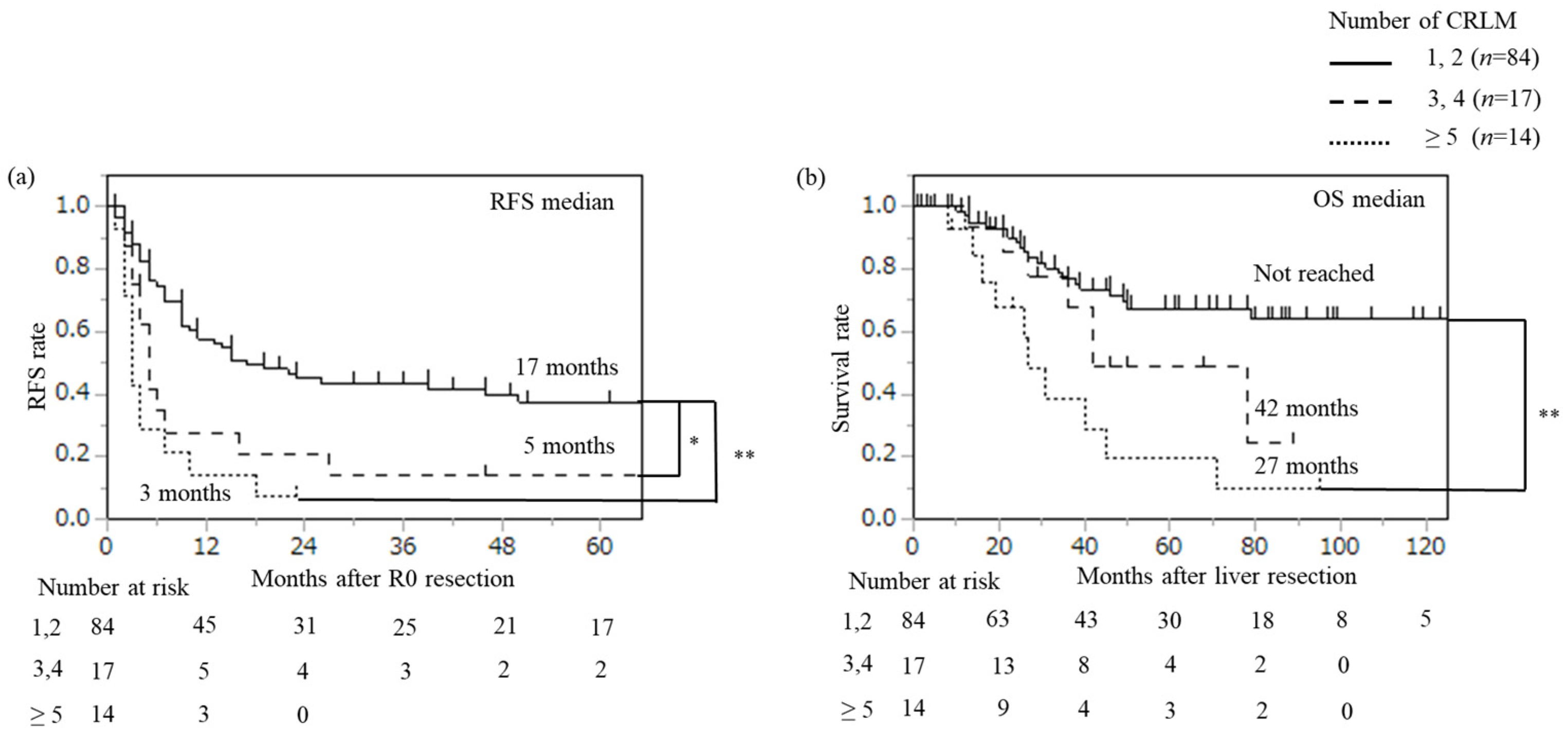
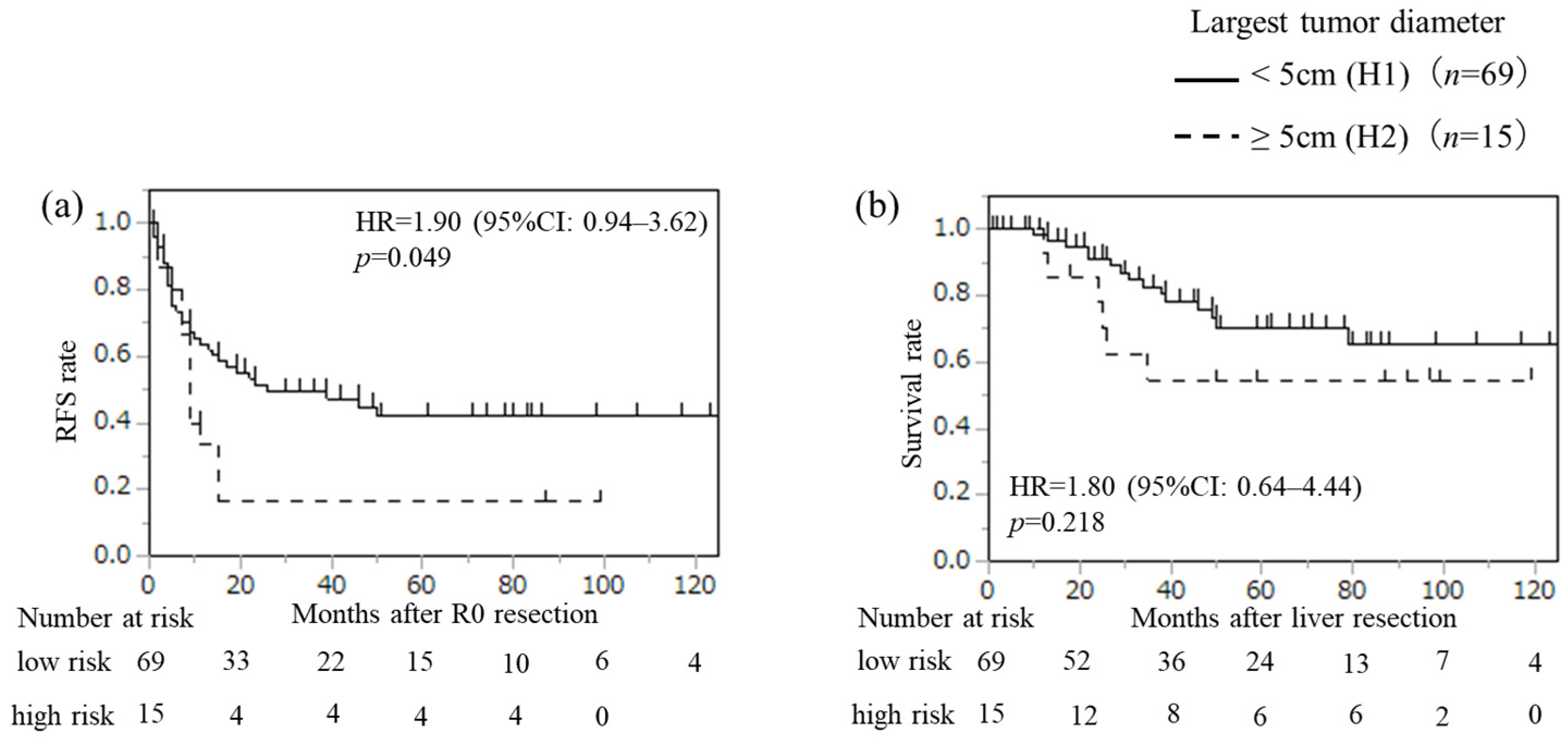
3.2. Recurrence-Free Survival and Overall Survival
3.3. Univariate and Multivariate Analysis of Risk Factors Associated with Recurrence After R0 Resection and Survival After Liver Resection
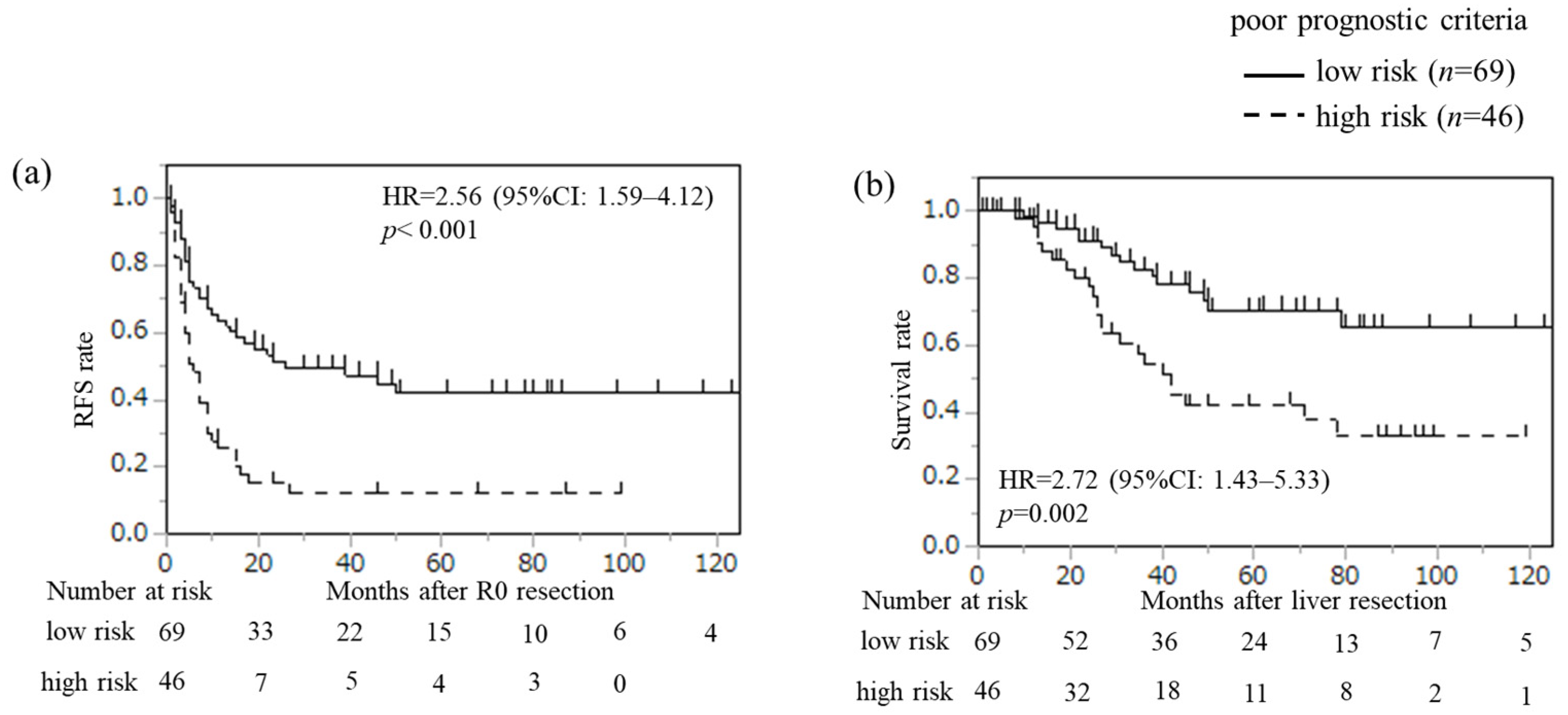
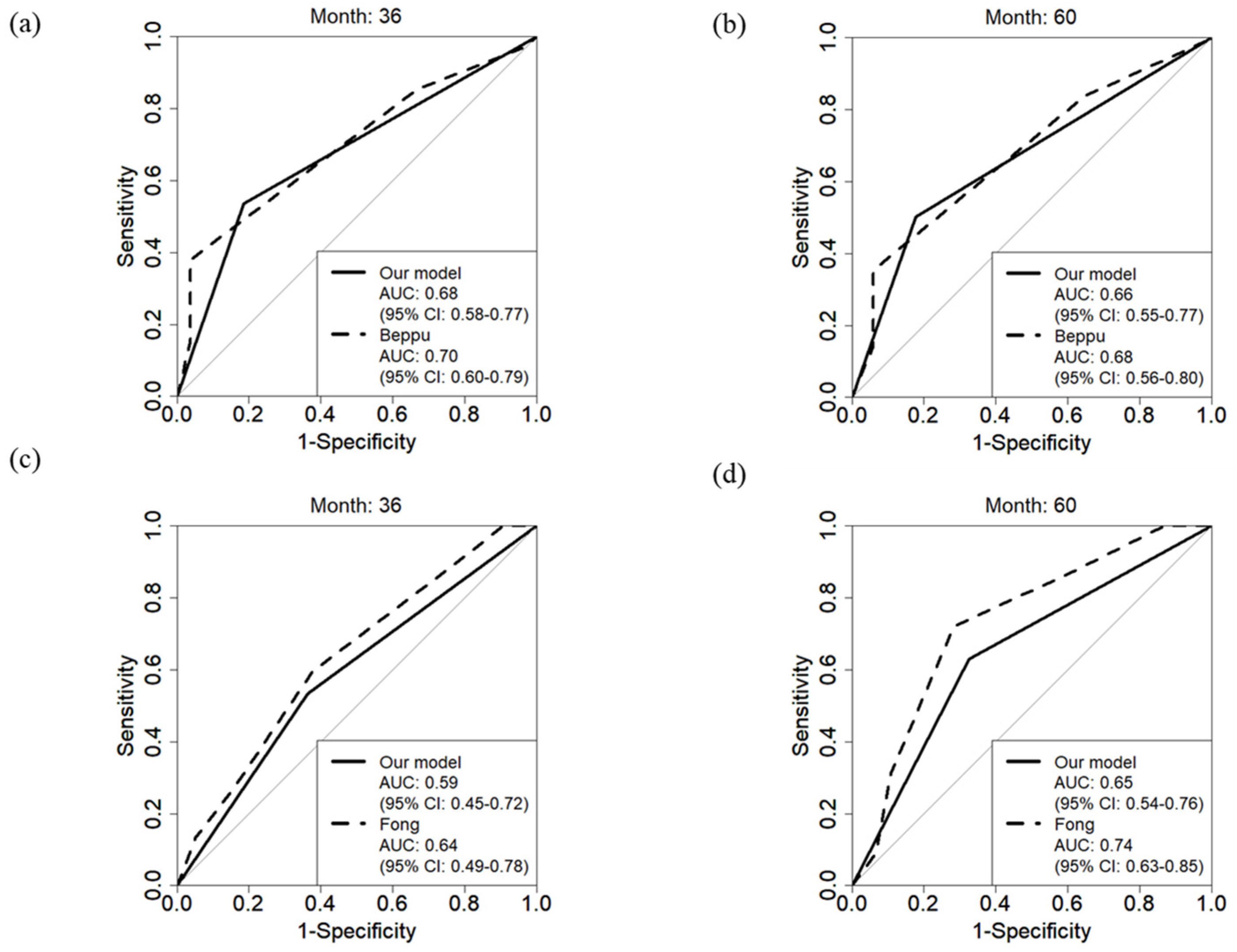
3.4. Novel Prognostic Criteria of CRLM After Curative Resection
3.5. RFS and OS Related to Therapeutic Effects of Preoperative Chemotherapy
4. Discussion
5. Conclusions
Supplementary Materials
Author Contributions
Funding
Institutional Review Board Statement
Informed Consent Statement
Data Availability Statement
Conflicts of Interest
Abbreviations
| AUC | Area under the curve |
| CRLM | Colorectal liver metastasis |
| CEA | Carcinoembryonic antigen |
| CA19-9 | Carbohydrate antigen 19-9 |
| CI | Confidence interval |
| CR | Complete response |
| EORTC | European Organization for Research and Treatment of Cancer |
| HR | Hazard ratio |
| MSI | Microsatellite Instability |
| NLR | Neutrophil–lymphocyte ratio |
| RFS | Recurrence-free survival |
| OS | Overall survival |
| PD | Progressive disease |
| PR | Partial response |
| ROC | Receiver operating characteristic |
| SD | Stable disease |
References
- Siegel, R.L.; Miller, K.D.; Fuchs, H.E.; Jemal, A. Cancer Statistics, 2021. CA Cancer J. Clin. 2021, 71, 7–33. [Google Scholar] [CrossRef]
- Arnold, M.; Sierra, M.S.; Laversanne, M.; Soerjomataram, I.; Jemal, A.; Bray, F. Global patterns and trends in colorectal cancer incidence and mortality. Gut 2017, 66, 683–691. [Google Scholar] [CrossRef]
- Zarour, L.R.; Anand, S.; Billingsley, K.G.; Bisson, W.H.; Cercek, A.; Clarke, M.F.; Coussens, L.M.; Gast, C.E.; Geltzeiler, C.B.; Hansen, L.; et al. Colorectal Cancer Liver Metastasis: Evolving Paradigms and Future Directions. Cell. Mol. Gastroenterol. Hepatol. 2017, 3, 163–173. [Google Scholar] [CrossRef]
- Saltz, L.B.; Clarke, S.; Díaz-Rubio, E.; Scheithauer, W.; Figer, A.; Wong, R.; Koski, S.; Lichinitser, M.; Yang, T.S.; Rivera, F.; et al. Bevacizumab in combination with oxaliplatin-based chemotherapy as first-line therapy in metastatic colorectal cancer: A randomized phase III study. J. Clin. Oncol. 2008, 26, 2013–2019. [Google Scholar] [CrossRef] [PubMed]
- Saltz, L.B.; Cox, J.V.; Blanke, C.; Rosen, L.S.; Fehrenbacher, L.; Moore, M.J.; Maroun, J.A.; Ackland, S.P.; Locker, P.K.; Pirotta, N.; et al. Irinotecan plus fluorouracil and leucovorin for metastatic colorectal cancer. Irinotecan Study Group. N. Engl. J. Med. 2000, 343, 905–914. [Google Scholar] [CrossRef]
- Douillard, J.Y.; Siena, S.; Cassidy, J.; Tabernero, J.; Burkes, R.; Barugel, M.; Humblet, Y.; Bodoky, G.; Cunningham, D.; Jassem, J.; et al. Randomized, phase III trial of panitumumab with infusional fluorouracil, leucovorin, and oxaliplatin (FOLFOX4) versus FOLFOX4 alone as first-line treatment in patients with previously untreated metastatic colorectal cancer: The PRIME study. J. Clin. Oncol. 2010, 28, 4697–4705. [Google Scholar] [CrossRef]
- Fong, Y.; Fortner, J.; Sun, R.L.; Brennan, M.F.; Blumgart, L.H. Clinical score for predicting recurrence after hepatic resection for metastatic colorectal cancer: Analysis of 1001 consecutive cases. Ann. Surg. 1999, 230, 309–318; discussion 318–321. [Google Scholar] [CrossRef]
- Adam, R.; Pascal, G.; Azoulay, D.; Tanaka, K.; Castaing, D.; Bismuth, H. Liver resection for colorectal metastases: The third hepatectomy. Ann. Surg. 2003, 238, 871–883; discussion 883–884. [Google Scholar] [CrossRef]
- de Jong, M.C.; Pulitano, C.; Ribero, D.; Strub, J.; Mentha, G.; Schulick, R.D.; Choti, M.A.; Aldrighetti, L.; Capussotti, L.; Pawlik, T.M. Rates and patterns of recurrence following curative intent surgery for colorectal liver metastasis: An international multi-institutional analysis of 1669 patients. Ann. Surg. 2009, 250, 440–448. [Google Scholar] [CrossRef] [PubMed]
- Rees, M.; Tekkis, P.P.; Welsh, F.K.; O’Rourke, T.; John, T.G. Evaluation of long-term survival after hepatic resection for metastatic colorectal cancer: A multifactorial model of 929 patients. Ann. Surg. 2008, 247, 125–135. [Google Scholar] [CrossRef]
- Kanemitsu, Y.; Kato, T. Prognostic models for predicting death after hepatectomy in individuals with hepatic metastases from colorectal cancer. World J. Surg. 2008, 32, 1097–1107. [Google Scholar] [CrossRef]
- Beppu, T.; Sakamoto, Y.; Hasegawa, K.; Honda, G.; Tanaka, K.; Kotera, Y.; Nitta, H.; Yoshidome, H.; Hatano, E.; Ueno, M.; et al. A nomogram predicting disease-free survival in patients with colorectal liver metastases treated with hepatic resection: Multicenter data collection as a Project Study for Hepatic Surgery of the Japanese Society of Hepato-Biliary-Pancreatic Surgery. J. Hepato-Biliary Pancreat. Sci. 2012, 19, 72–84. [Google Scholar] [CrossRef]
- Saiura, A.; Yamamoto, J.; Hasegawa, K.; Koga, R.; Sakamoto, Y.; Hata, S.; Makuuchi, M.; Kokkudo, N. Liver resection for multiple colorectal liver metastases with surgery up-front approach: Bi-institutional analysis of 736 consecutive cases. World J. Surg. 2012, 36, 2171–2178. [Google Scholar] [CrossRef]
- Hokuto, D.; Nomi, T.; Yamato, I.; Yasuda, S.; Obara, S.; Yoshikawa, T.; Kawaguchi, C.; Yamada, T.; Kanehiro, H.; Nakajima, Y. The prognosis of liver resection for patients with four or more colorectal liver metastases has not improved in the era of modern chemotherapy. J. Surg. Oncol. 2016, 114, 959–965. [Google Scholar] [CrossRef] [PubMed]
- Beppu, T.; Yamamura, K.; Sakamoto, K.; Honda, G.; Kobayashi, S.; Endo, I.; Hasegawa, K.; Kotake, K.; Itabashi, M.; Hashiguchi, Y.; et al. Validation study of the JSHBPS nomogram for patients with colorectal liver metastases who underwent hepatic resection in the recent era—A nationwide survey in Japan. J. Hepato-Biliary Pancreat. Sci. 2023, 30, 591–601. [Google Scholar] [CrossRef]
- Amygdalos, I.; Müller-Franzes, G.; Bednarsch, J.; Czigany, Z.; Ulmer, T.F.; Bruners, P.; Kuhl, C.; Neumann, U.P.; Truhn, D.; Lang, S.A. Novel machine learning algorithm can identify patients at risk of poor overall survival following curative resection for colorectal liver metastases. J. Hepato-Biliary Pancreat. Sci. 2023, 30, 602–614. [Google Scholar] [CrossRef]
- Conticchio, M.; Uldry, E.; Hübner, M.; Digklia, A.; Fraga, M.; Sempoux, C.; Raisaro, J.L.; Fuks, D. Prognostic Factors in Colorectal Liver Metastases: An Exhaustive Review of the Literature and Future Prospectives. Cancers 2025, 17, 2539–2573. [Google Scholar] [CrossRef] [PubMed]
- Li, Y.; Xu, T.; Wang, X.; Jia, X.; Ren, M.; Wang, X. The prognostic utility of preoperative neutrophil-to-lymphocyte ratio (NLR) in patients with colorectal liver metastasis: A systematic review and meta-analysis. Cancer Cell Int. 2023, 23, 39. [Google Scholar] [CrossRef] [PubMed]
- Margonis, G.A.; Vauthey, J.N. Precision surgery for colorectal liver metastases: Current knowledge and future perspectives. Ann. Gastroenterol. Surg. 2022, 6, 606–615. [Google Scholar] [CrossRef]
- Maki, H.; Jain, A.J.; Haddad, A.; Lendoire, M.; Chun, Y.S.; Vauthey, J.N. Locoregional treatment for colorectal liver metastases aiming for precision medicine. Ann. Gastroenterol. Surg. 2023, 7, 543–552. [Google Scholar] [CrossRef]
- Takematsu, T.; Mima, K.; Hayashi, H.; Kitano, Y.; Nakagawa, S.; Hiyoshi, Y.; Okabe, H.; Imai, K.; Miyamoto, Y.; Baba, H. RAS mutation status in combination with the JSHBPS nomogram may be useful for preoperative identification of colorectal liver metastases with high risk of recurrence and mortality after hepatectomy. J. Hepato-Biliary Pancreat. Sci. 2024, 31, 69–79. [Google Scholar] [CrossRef] [PubMed]
- Adam, R.; Haller, D.G.; Poston, G.; Raoul, J.L.; Spano, J.P.; Tabernero, J.; Van Custem, E. Toward optimized front-line therapeutic strategies in patients with metastatic colorectal cancer–An expert review from the International Congress on Anti-Cancer Treatment (ICACT) 2009. Ann. Oncol. 2010, 21, 1579–1584. [Google Scholar] [CrossRef]
- Noda, T.; Takahashi, H.; Tei, M.; Nishida, N.; Hata, T.; Takeda, Y.; Ohue, M.; Wada, H.; Mizushima, T.; Asaoka, T.; et al. Clinical outcomes of neoadjuvant chemotherapy for resectable colorectal liver metastasis with intermediate risk of postoperative recurrence: A multi-institutional retrospective study. Ann. Gastroenterol. Surg. 2023, 7, 479–490. [Google Scholar] [CrossRef]
- Nordlinger, B.; Sorbye, H.; Glimelius, B.; Poston, G.J.; Schlag, P.M.; Rougier, P.; Bechstein, W.O.; Primrose, J.N.; Walpole, E.T.; Finch-Jones, M.; et al. Perioperative chemotherapy with FOLFOX4 and surgery versus surgery alone for resectable liver metastases from colorectal cancer (EORTC Intergroup trial 40983): A randomised controlled trial. Lancet 2008, 371, 1007–1016. [Google Scholar] [CrossRef]
- Nordlinger, B.; Sorbye, H.; Glimelius, B.; Poston, G.J.; Schlag, P.M.; Rougier, P.; Bechstein, W.O.; Primrose, J.N.; Walpole, E.T.; Finch-Jones, M.; et al. Perioperative FOLFOX4 chemotherapy and surgery versus surgery alone for resectable liver metastases from colorectal cancer (EORTC 40983): Long-term results of a randomised, controlled, phase 3 trial. Lancet Oncol. 2013, 14, 1208–1215.25. [Google Scholar] [CrossRef]
- Eisenhauer, E.A.; Therasse, P.; Bogaerts, J.; Schwartz, L.H.; Sargent, D.; Ford, R.; Dancey, J.; Arbuck, S.; Gwyther, S.; Mooney, M.; et al. New response evaluation criteria in solid tumours: Revised RECIST guideline (version 1.1). Eur. J. Cancer 2009, 45, 228–247. [Google Scholar] [CrossRef]
- Igami, T.; Hayashi, Y.; Yokyama, Y.; Mori, K.; Ebata, T. Development of real-time navigation system for laparoscopic hepatectomy using magnetic micro sensor. Minim. Invasive Ther. Allied Technol. 2024, 33, 129–139. [Google Scholar] [CrossRef]
- Boretto, L.; Pelanis, E.; Regensburger, A.; Fretland, Å.A.; Edwin, B.; Elle, O.J. Hybrid optical-vision tracking in laparoscopy: Accuracy of navigation and ultrasound reconstruction. Minim. Invasive Ther. Allied Technol. 2024, 33, 176–183. [Google Scholar] [CrossRef] [PubMed]
- Grivennikov, S.I.; Greten, F.R.; Karin, M. Immunity, inflammation, and cancer. Cell 2010, 140, 883–899. [Google Scholar] [CrossRef] [PubMed]
- Ichida, H.; Mise, Y.; Ito, H.; Ishizawa, T.; Inoue, Y.; Takahashi, Y.; Shinozaki, E.; Yamaguchi, K.; Saiura, A. Optimal indication criteria for neoadjuvant chemotherapy in patients with resectable colorectal liver metastases. World J. Surg. Oncol. 2019, 17, 100. [Google Scholar] [CrossRef]
- Loupakis, F.; Cremolini, C.; Masi, G.; Lonardi, S.; Zagonel, V.; Salvatore, L.; Cortesi, E.; Tomasello, G.; Ronzoni, M.; Spadi, R.; et al. Initial therapy with FOLFOXIRI and bevacizumab for metastatic colorectal cancer. N. Engl. J. Med. 2014, 371, 1609–1618. [Google Scholar] [CrossRef]
- Cremolini, C.; Loupakis, F.; Antoniotti, C.; Lupi, C.; Sensi, E.; Lonardi, S.; Mezi, S.; Tomasello, G.; Ronzoni, M.; Zaniboni, A.; et al. FOLFOXIRI plus bevacizumab versus FOLFIRI plus bevacizumab as first-line treatment of patients with metastatic colorectal cancer: Updated overall survival and molecular subgroup analyses of the open-label, phase 3 TRIBE study. Lancet Oncol. 2015, 16, 1306–1315. [Google Scholar] [CrossRef] [PubMed]
- Gruenberger, T.; Bridgewater, J.; Chau, I.; García Alfonso, P.; Rivoire, M.; Mudan, S.; Lasserre, S.; Hermann, F.; Waterkamp, D.; Adam, R. Bevacizumab plus mFOLFOX-6 or FOLFOXIRI in patients with initially unresectable liver metastases from colorectal cancer: The OLIVIA multinational randomised phase II trial. Ann. Oncol. 2015, 26, 702–708. [Google Scholar] [CrossRef] [PubMed]
- Shindoh, J.; Tzeng, C.W.; Aloia, T.A.; Curley, S.A.; Zimmitti, G.; Wei, S.H.; Huang, S.Y.; Mahvash, A.; Gupta, S.; Wallace, M.J.; et al. Optimal future liver remnant in patients treated with extensive preoperative chemotherapy for colorectal liver metastases. Ann. Surg. Oncol. 2013, 20, 2493–2500. [Google Scholar] [CrossRef] [PubMed]
- Kanesada, K.; Tsunedomi, R.; Hazama, S.; Ogihara, H.; Hamamoto, Y.; Shindo, Y.; Matsui, H.; Tokumitsu, Y.; Yoshida, S.; Iida, M.; et al. Association between a single nucleotide polymorphism in the R3HCC1 gene and irinotecan toxicity. Cancer Med. 2023, 12, 4294–4305. [Google Scholar] [CrossRef]
- Peng, Z.; Zhu, Z.R.; He, C.Y.; Huang, H. A meta-analysis: Laparoscopic versus open liver resection for large hepatocellular carcinoma. Minim. Invasive Ther. Allied Technol. 2025, 34, 24–34. [Google Scholar] [CrossRef]



| n = 115 | % | |
|---|---|---|
| Age (years-old) * | 68 (34–84) | |
| Gender | ||
| Male | 71 | 61.7 |
| Female | 44 | 38.3 |
| Primary site | ||
| Right | 38 | 33.0 |
| Left | 77 | 67.0 |
| Primary tumor T status | ||
| pT1-3 | 91 | 79.1 |
| pT4 | 23 | 20.0 |
| Unknown | 1 | 0.9 |
| Primary tumor LN status | ||
| Negative | 36 | 31.3 |
| Positive | 76 | 66.1 |
| Unknown | 3 | 2.6 |
| ly (primary tumor) | ||
| Negative | 13 | 11.3 |
| Positive | 95 | 82.6 |
| Unknown | 7 | 6.1 |
| v (primary tumor) | ||
| Negative | 27 | 23.5 |
| Positive | 82 | 71.3 |
| Unknown | 6 | 5.2 |
| CEA level ** | ||
| ≤5.0 ng/mL | 30 | 26.1 |
| >5.0 ng/mL | 85 | 73.9 |
| CA19-9 level ** | ||
| ≤37.0 U/mL | 76 | 66.1 |
| >37.0 U/mL | 39 | 33.9 |
| Number of CRLM ** | ||
| 1, 2 | 84 | 73.0 |
| 3, 4 | 17 | 14.8 |
| ≥5 | 14 | 12.2 |
| Largest tumor diameter ** | ||
| <5 cm | 93 | 80.9 |
| ≥5 cm | 22 | 19.1 |
| Timing of diagnosis of CRLM *** | ||
| Synchronous | 95 | 82.6 |
| Metachronous | 20 | 17.4 |
| Extrahepatic metastatic disease ** | ||
| Yes | 14 | 12.2 |
| No | 101 | 87.8 |
| NLR ratio **** | ||
| <2.9 | 89 | 77.4 |
| ≥2.9 | 26 | 22.6 |
| Preoperative chemotherapy | ||
| Yes | 72 | 62.6 |
| No | 43 | 37.4 |
| Postoperative chemotherapy | ||
| Yes | 26 | 22.6 |
| No | 89 | 77.4 |
| RAS status | ||
| Tested | 85 | 73.9 |
| Missing | 30 | 26.1 |
| BRAF status | ||
| Tested | 47 | 40.9 |
| Missing | 68 | 59.1 |
| MSI status | ||
| Tested | 21 | 18.3 |
| Missing | 94 | 81.7 |
| Risk Factors | n (%) | Univariate | Multivariate | |||||||
|---|---|---|---|---|---|---|---|---|---|---|
| HR | 95%CI | p Value | HR | 95%CI | p Value | |||||
| Age (years-old) | <65 | 44 (38.3) | 1 | - | - | - | ||||
| ≥65 | 71 (61.7) | 1.10 | 0.69 | 1.78 | 0.701 | |||||
| Gender | Male | 71 (61.7) | 1 | - | - | - | ||||
| Female | 44 (38.3) | 1.07 | 0.66 | 1.71 | 0.768 | |||||
| Primary site | Right | 38 (33.0) | 1 | - | - | - | ||||
| Left | 77 (67.0) | 0.90 | 0.56 | 1.48 | 0.679 | |||||
| Primary tumor T status | pT1-3 | 91 (79.1) | 1 | - | - | - | ||||
| pT4 | 23 (20.0) | 0.98 | 0.55 | 1.68 | 0.954 | |||||
| Primary tumor LN status | Negative | 36 (31.3) | 1 | - | - | - | ||||
| Positive | 76 (66.1) | 1.28 | 0.77 | 2.19 | 0.348 | |||||
| ly (primary tumor) | Negative | 13 (11.3) | 1 | - | - | - | 1 | - | - | - |
| Positive | 95 (82.6) | 1.92 | 0.90 | 4.98 | 0.096 | 1.69 | 0.78 | 4.45 | 0.198 | |
| v (primary tumor) | Negative | 27 (23.5) | 1 | - | - | - | ||||
| Positive | 82 (71.3) | 0.89 | 0.53 | 1.59 | 0.683 | |||||
| CEA level * | ≤5.0 ng/mL | 30 (26.1) | 1 | - | - | - | 1 | - | - | - |
| >5.0 ng/mL | 85 (73.9) | 1.83 | 1.06 | 3.36 | 0.029 | 1.31 | 0.71 | 2.56 | 0.396 | |
| CA19-9 level * | ≤37.0 U/mL | 76 (66.1) | 1 | - | - | - | 1 | - | - | - |
| >37.0 U/mL | 39 (33.9) | 1.66 | 1.03 | 2.66 | 0.039 | 1.13 | 0.66 | 1.93 | 0.654 | |
| Number of CRLM * | 1, 2 | 84 (73.0) | 1 | - | - | - | 1 | - | - | - |
| ≥3 | 31 (27.0) | 2.69 | 1.63 | 4.37 | <0.001 | 2.54 | 1.51 | 4.19 | <0.001 | |
| Largest tumor diameter * | <5 cm | 93 (80.9) | 1 | - | - | - | 1 | - | - | - |
| ≥5 cm | 22 (19.1) | 1.80 | 1.03 | 3.01 | 0.039 | 1.26 | 0.69 | 2.24 | 0.439 | |
| Timing of diagnosis of CRLM ** | Metachronous | 20 (17.4) | 1 | - | - | - | ||||
| Synchronous | 95 (82.6) | 1.67 | 0.90 | 4.37 | 0.110 | |||||
| Extrahepatic metastatic disease * | No | 101 (87.8) | 1 | - | - | - | ||||
| Yes | 14 (12.2) | 1.29 | 0.62 | 2.40 | 0.472 | |||||
| NLR *** | <2.9 | 89 (77.4) | 1 | - | - | - | 1 | - | - | - |
| ≥2.9 | 26 (22.6) | 2.18 | 1.26 | 3.62 | 0.006 | 2.16 | 1.20 | 3.76 | 0.012 | |
| Risk Factors | n (%) | Univariate | Multivariate | |||||||
|---|---|---|---|---|---|---|---|---|---|---|
| HR | 95%CI | p Value | HR | 95%CI | p Value | |||||
| Age (years-old) | <65 | 44 (38.3) | 1 | - | - | - | ||||
| ≥65 | 71 (61.7) | 1.59 | 0.83 | 3.22 | 0.166 | |||||
| Gender | Male | 71 (61.7) | 1 | - | - | - | ||||
| Female | 44 (38.3) | 1.25 | 0.65 | 2.38 | 0.494 | |||||
| Primary site | Right | 38 (33.0) | 1 | - | - | - | ||||
| Left | 77 (67.0) | 1.46 | 0.73 | 3.15 | 0.294 | |||||
| Primary tumor T status | pT1-3 | 91 (79.1) | 1 | - | - | - | ||||
| pT4 | 23 (20.0) | 0.60 | 0.23 | 1.35 | 0.232 | |||||
| Primary tumor LN status | Negative | 36 (31.3) | 1 | - | - | - | ||||
| Positive | 76 (66.1) | 1.73 | 0.83 | 4.06 | 0.147 | |||||
| ly (primary tumor) | Negative | 13 (11.3) | 1 | - | - | - | ||||
| Positive | 95 (82.6) | 1.37 | 0.55 | 4.59 | 0.535 | |||||
| v (primary tumor) | Negative | 27 (23.5) | 1 | - | - | - | ||||
| Positive | 82 (71.3) | 0.73 | 0.37 | 1.54 | 0.397 | |||||
| CEA level * | ≤5.0 ng/mL | 30 (26.1) | 1 | - | - | - | 1 | - | - | - |
| >5.0 ng/mL | 85 (73.9) | 2.98 | 1.27 | 8.72 | 0.010 | 2.41 | 1.00 | 7.15 | 0.049 | |
| CA19-9 level * | ≤37.0 U/mL | 76 (66.1) | 1 | - | - | |||||
| >37.0 U/mL | 39 (33.9) | 1.18 | 0.60 | 2.24 | 0.622 | |||||
| Number of CRLM * | 1, 2 | 84 (73.0) | 1 | - | - | - | 1 | - | - | - |
| ≥3 | 31 (27.0) | 2.92 | 1.51 | 5.57 | 0.002 | 2.60 | 1.34 | 4.97 | 0.005 | |
| Largest tumor diameter * | <5 cm | 93 (80.9) | 1 | - | - | - | ||||
| ≥5 cm | 22 (19.1) | 1.76 | 0.83 | 3.45 | 0.132 | |||||
| Timing of diagnosis of CRLM ** | Metachronous | 20 (17.4) | 1 | - | - | - | ||||
| Synchronous | 95 (82.6) | 1.40 | 0.60 | 4.10 | 0.462 | |||||
| Extrahepatic metastatic disease * | No | 101 (87.8) | 1 | - | - | - | ||||
| Yes | 14 (12.2) | 1.14 | 0.39 | 2.68 | 0.786 | |||||
| NLR *** | <2.9 | 89 (77.4) | 1 | - | - | - | 1 | - | - | - |
| ≥2.9 | 26 (22.6) | 2.23 | 0.94 | 4.71 | 0.068 | 1.70 | 0.71 | 3.65 | 0.216 | |
Disclaimer/Publisher’s Note: The statements, opinions and data contained in all publications are solely those of the individual author(s) and contributor(s) and not of MDPI and/or the editor(s). MDPI and/or the editor(s) disclaim responsibility for any injury to people or property resulting from any ideas, methods, instructions or products referred to in the content. |
© 2026 by the authors. Licensee MDPI, Basel, Switzerland. This article is an open access article distributed under the terms and conditions of the Creative Commons Attribution (CC BY) license.
Share and Cite
Kanesada, K.; Nakajima, M.; Ioka, T.; Tomochika, S.; Shindo, Y.; Tokumitsu, Y.; Matsui, H.; Tanaka, H.; Nakagami, Y.; Tsunedomi, R.; et al. Refining Outcomes in Technically Resectable Colorectal Liver Metastases: A Simplified Risk Model and the Role of Preoperative Chemotherapy. Cancers 2026, 18, 227. https://doi.org/10.3390/cancers18020227
Kanesada K, Nakajima M, Ioka T, Tomochika S, Shindo Y, Tokumitsu Y, Matsui H, Tanaka H, Nakagami Y, Tsunedomi R, et al. Refining Outcomes in Technically Resectable Colorectal Liver Metastases: A Simplified Risk Model and the Role of Preoperative Chemotherapy. Cancers. 2026; 18(2):227. https://doi.org/10.3390/cancers18020227
Chicago/Turabian StyleKanesada, Kou, Masao Nakajima, Tatsuya Ioka, Shinobu Tomochika, Yoshitaro Shindo, Yukio Tokumitsu, Hiroto Matsui, Hironori Tanaka, Yuki Nakagami, Ryouichi Tsunedomi, and et al. 2026. "Refining Outcomes in Technically Resectable Colorectal Liver Metastases: A Simplified Risk Model and the Role of Preoperative Chemotherapy" Cancers 18, no. 2: 227. https://doi.org/10.3390/cancers18020227
APA StyleKanesada, K., Nakajima, M., Ioka, T., Tomochika, S., Shindo, Y., Tokumitsu, Y., Matsui, H., Tanaka, H., Nakagami, Y., Tsunedomi, R., Iida, M., Takahashi, H., & Nagano, H. (2026). Refining Outcomes in Technically Resectable Colorectal Liver Metastases: A Simplified Risk Model and the Role of Preoperative Chemotherapy. Cancers, 18(2), 227. https://doi.org/10.3390/cancers18020227