Stool- and Blood-Associated Colorectal Cancer Biomarkers: A Systematic Review

 ,
,
Simple Summary
Abstract
1. Introduction
2. Materials and Methods
2.1. Literature Search Strategy
2.2. Study Selection, Quality of Studies, and Data Extraction
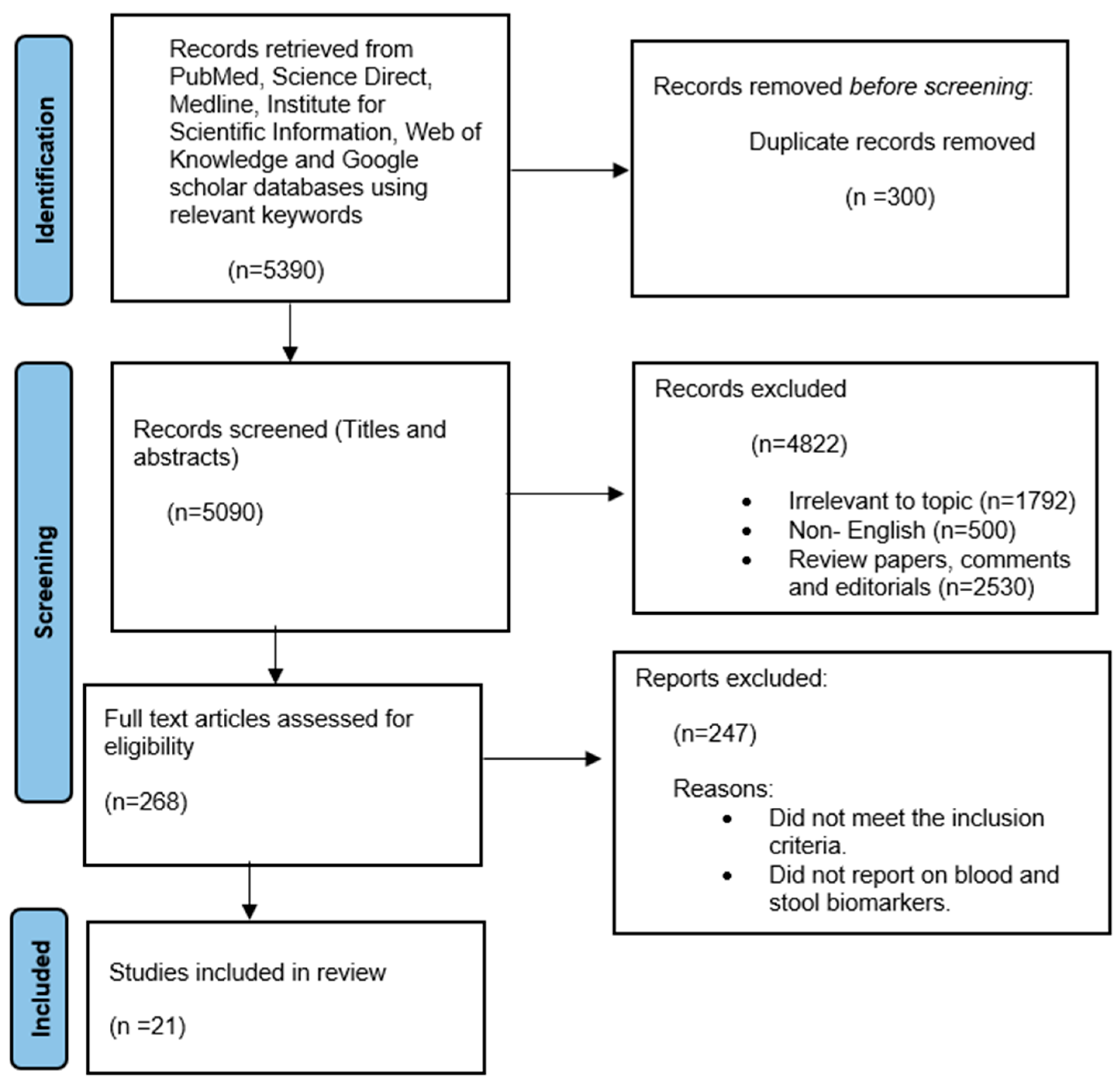
2.3. Inclusion Criteria
- Literature reporting on stool and blood biomarkers for CRC.
- Literature published in English in all countries from January 2000 to September 2025.
- Cross-sectional studies, case–control studies, and cohort-appropriate studies.
- Literature published in the five databases mentioned above.
2.4. Exclusion Criteria
- Literature published before January 2000.
- Articles not published in English.
- Comments, editorials, and Reviews. Articles not relevant to stool and blood biomarkers for diagnosis of CRC.
3. Results
4. Discussion
4.1. DNA Methylation Biomarkers
4.2. MicroRNAs (miRNAs)
4.3. Protein Biomarkers
4.4. Microbial Biomarkers
4.5. Multi-Marker and Combination Panels
4.6. Limitations and Future Directions
5. Conclusions
Author Contributions
Funding
Institutional Review Board Statement
Informed Consent Statement
Data Availability Statement
Acknowledgments
Conflicts of Interest
Abbreviations
| AA | Advanced Adenoma |
| ADHFE1 | Alcohol Dehydrogenase, Iron-Containing 1 |
| ALX4 | ALX Homeobox 4 |
| AUC | Area Under the Curve |
| BCAT1 | Branched-Chain Amino Acid Transaminase 1 |
| BMP3 | Bone Morphogenetic Protein 3 |
| CRC | Colorectal Cancer |
| ctDNA | Circulating Tumor DNA |
| DKK3 | Dickkopf-Related Protein 3 |
| DNA | Deoxyribonucleic Acid |
| DYNC1LI1 | Dynein Cytoplasmic 1 Light Intermediate Chain 1 |
| FIT | Fecal Immunochemical Test |
| FOXE1 | Forkhead Box Protein E1 |
| F. nucleatum | Fusobacterium nucleatum |
| GATA5 | GATA Binding Protein 5 |
| gFOBT | Guaiac-based Fecal Occult Blood Test |
| HRASLS2 | Phospholipase A and Acyltransferase 2 |
| IGFBP2 | Insulin-like Growth Factor Binding Protein 2 |
| IL-6 | Interleukin 6 |
| IMPDH1 | Inosine Monophosphate Dehydrogenase 1 |
| LTE-qMSP | Linear Target Enrichment Quantitative Methylation-Specific Polymerase Chain Reaction |
| MAPK | Mitogen-Activated Protein Kinase |
| miRNA/miR | MicroRNA |
| MMPMatrix | Metalloproteinase |
| mRNA | Messenger Ribonucleic Acid |
| NDRG4 | N-Myc Downstream-Regulated Gene 4 |
| NPTX2 | Neuronal Pentraxin 2 |
| PCR | Polymerase Chain Reaction |
| PKM2 | Pyruvate Kinase M2 |
| PPP2R5C | Protein Phosphatase 2 Regulatory Subunit B′γ |
| qMSP | Quantitative Methylation-Specific Polymerase Chain Reaction |
| RARB | Retinoic Acid Receptor Beta |
| RNA | Ribonucleic Acid |
| SDC2 | Syndecan 2 |
| SEPT9/Septin9 | Septin 9 |
| SFRP2 | Secreted Frizzled-Related Protein 2 |
| SHOX2 | Short Stature Homeobox 2 |
| SYNE1 | Spectrin Repeat Containing Nuclear Envelope Protein 1 |
| TNF-α | Tumor Necrosis Factor Alpha |
| UBE2N | Ubiquitin-Conjugating Enzyme E2 N |
| VIM | Vimentin |
| WIF-1 | Wnt Inhibitory Factor 1 |
References
- Bray, F.; Ferlay, J.; Soerjomataram, I.; Siegel, R.L.; Torre, L.A.; Jemal, A. Global cancer statistics 2018: GLOBOCAN estimates of incidence and mortality worldwide for 36 cancers in 185 countries. CA Cancer J. Clin. 2018, 68, 394–424. [Google Scholar] [CrossRef]
- Brenner, H.; Kloor, M. Pox cP. colorectal cancer. Lancet 2014, 383, 1490–1502. [Google Scholar] [CrossRef] [PubMed]
- Miller, K.D.; Nogueira, L.; Devasia, T.; Mariotto, A.B.; Yabroff, K.R.; Jemal, A.; Kramer, J.; Siegel, R.L. Cancer treatment and survivorship statistics, 2022. CA Cancer J. Clin. 2022, 72, 409–436. [Google Scholar] [CrossRef] [PubMed]
- Kuipers, E.J.; Rösch, T.; Bretthauer, M. Colorectal cancer screening—Optimizing current strategies and new directions. Nat. Rev. Clin. Oncol. 2013, 10, 130–142. [Google Scholar] [CrossRef] [PubMed]
- Simon, K. Colorectal cancer development and advances in screening. Clin. Interv. Aging 2016, 11, 967–976. [Google Scholar] [CrossRef]
- Loktionov, A. Biomarkers for detecting colorectal cancer non-invasively: DNA, RNA or proteins? World J. Gastrointest. Oncol. 2020, 12, 124. [Google Scholar] [CrossRef]
- Morikawa, T.; Kato, J.; Yamaji, Y.; Wada, R.; Mitsushima, T.; Shiratori, Y. A comparison of the immunochemical fecal occult blood test and total colonoscopy in the asymptomatic population. Gastroenterology 2005, 129, 422–428. [Google Scholar] [CrossRef]
- de Wijkerslooth, T.R.; Stoop, E.M.; Bossuyt, P.M.; A Meijer, G.; van Ballegooijen, M.; van Roon, A.H.C.; Stegeman, I.; A Kraaijenhagen, R.; Fockens, P.; E van Leerdam, M.; et al. Immunochemical fecal occult blood testing is equally sensitive for proximal and distal advanced neoplasia. Off. J. Am. Coll. Gastroenterol. ACG 2012, 107, 1570–1578. [Google Scholar] [CrossRef]
- Imperiale, T.F.; Ransohoff, D.F.; Itzkowitz, S.H.; Levin, T.R.; Lavin, P.; Lidgard, G.P.; Ahlquist, D.A.; Berger, B.M. Multitarget stool DNA testing for colorectal-cancer screening. New Engl. J. Med. 2014, 370, 1287–1297. [Google Scholar] [CrossRef]
- Lee, J.K.; Liles, E.G.; Bent, S.; Levin, T.R.; Corley, D.A. Accuracy of fecal immunochemical tests for colorectal cancer: Systematic review and meta-analysis. Ann. Intern. Med. 2014, 160, 171–181. [Google Scholar] [CrossRef]
- Whitlock, E.P.; Lin, J.S.; Liles, E.; Beil, T.L.; Fu, R. Screening for colorectal cancer: A targeted, updated systematic review for the US Preventive Services Task Force. Ann. Intern. Med. 2008, 149, 638–658. [Google Scholar] [CrossRef]
- Brenner, H.; Niedermaier, T.; Chen, H. Strong subsite-specific variation in detecting advanced adenomas by fecal immunochemical testing for hemoglobin. Int. J. Cancer 2017, 140, 2015–2022. [Google Scholar] [CrossRef] [PubMed]
- Ausch, C.; Kim, Y.-H.; Tsuchiya, K.D.; Dzieciatkowski, S.; Washington, M.K.; Paraskeva, C.; Radich, J.; Grady, W.M. Comparative analysis of PCR-based biomarker assay methods for colorectal polyp detection from fecal DNA. Clin. Chem. 2009, 55, 1559–1563. [Google Scholar] [CrossRef] [PubMed]
- BDW Group; Atkinson, A.J., Jr.; Colburn, W.A.; DeGruttola, V.G.; DeMets, D.L.; Downing, G.J.; Hoth, D.F.; Oates, J.A.; Peck, C.C.; Schooley, R.T. Biomarkers and surrogate endpoints: Preferred definitions and conceptual framework. Clin. Pharmacol. Ther. 2001, 69, 89–95. [Google Scholar] [CrossRef] [PubMed]
- Tf, I. Fecal DNA versus fecal occult blood for colorectal-cancer screening in an average-risk population. N. Engl. J. Med. 2004, 351, 2704–2714. [Google Scholar]
- Inamura, K. Colorectal cancers: An update on their molecular pathology. Cancers 2018, 10, 26. [Google Scholar] [CrossRef]
- Goel, A.; Boland, C.R.; Link, A.; Balaguer, F. Identification of MicroRNAs (miRNAs) in Fecal Samples as Biomarkers for Gastroenterological Cancers. U.S. Patent US 8,956,817 B2, 17 February 2015. [Google Scholar]
- Phua, L.C.; Chue, X.P.; Koh, P.K.; Cheah, P.Y.; Chan, E.C.Y.; Ho, H.K. Global fecal microRNA profiling in the identification of biomarkers for colorectal cancer screening among Asians. Oncol. Rep. 2014, 32, 97–104. [Google Scholar] [CrossRef]
- Chen, W.-D.; Han, Z.J.; Skoletsky, J.; Olson, J.; Sah, J.; Myeroff, L.; Platzer, P.; Lu, S.; Dawson, D.; Willis, J.; et al. Detection in fecal DNA of colon cancer–specific methylation of the nonexpressed vimentin gene. J. Natl. Cancer Inst. 2005, 97, 1124–1132. [Google Scholar] [CrossRef]
- GlöcKner, S.C.; Dhir, M.; Yi, J.M.; McGarvey, K.E.; Van Neste, L.; Louwagie, J.; Chan, T.A.; Kleeberger, W.; de BruïnE, A.P.; Smits, K.M.; et al. Methylation of TFPI2 in stool DNA: A potential novel biomarker for the detection of colorectal cancer. Cancer Res. 2009, 69, 4691–4699. [Google Scholar] [CrossRef]
- Wang, D.-R.; Tang, D. Hypermethylated SFRP2 gene in fecal DNA is a high potential biomarker for colorectal cancer noninvasive screening. World J. Gastroenterol. WJG 2008, 14, 524. [Google Scholar] [CrossRef]
- Chen, X.; Ba, Y.; Ma, L.; Cai, X.; Yin, Y.; Wang, K.; Guo, J.; Zhang, Y.; Chen, J.; Guo, X.; et al. Characterization of microRNAs in serum: A novel class of biomarkers for diagnosis of cancer and other diseases. Cell Res. 2008, 18, 997–1006. [Google Scholar] [CrossRef] [PubMed]
- Ng, E.K.O.; Chong, W.W.S.; Jin, H.; Lam, E.K.Y.; Shin, V.Y.; Yu, J.; Poon, T.C.W.; Ng, S.S.M.; Sung, J.J.Y. Differential expression of microRNAs in plasma of patients with colorectal cancer: A potential marker for colorectal cancer screening. Gut 2009, 58, 1375–1381. [Google Scholar] [CrossRef] [PubMed]
- Nikolouzakis, T.K.; Vassilopoulou, L.; Fragkiadaki, P.; Sapsakos, T.M.; Papadakis, G.Z.; Spandidos, D.A.; Tsatsakis, A.M.; Tsiaoussis, J. Improving diagnosis, prognosis and prediction by using biomarkers in CRC patients. Oncol. Rep. 2018, 39, 2455–2472. [Google Scholar] [CrossRef] [PubMed]
- Oh, H.-H.; Joo, Y.-E. Novel biomarkers for the diagnosis and prognosis of colorectal cancer. Intest. Res. 2020, 18, 168. [Google Scholar] [CrossRef] [PubMed]
- Balshem, H.; Helfand, M.; Schünemann, H.J.; Oxman, A.D.; Kunz, R.; Brozek, J.; Vist, G.E.; Falck-Ytter, Y.; Meerpohl, J.; Norris, S.; et al. GRADE guidelines: 3. Rating the quality of evidence. J. Clin. Epidemiol. 2011, 64, 401–406. [Google Scholar] [CrossRef]
- Guyatt, G.; Oxman, A.D.; Akl, E.A.; Kunz, R.; Vist, G.; Brozek, J.; Norris, S.; Falck-Ytter, Y.; Glasziou, P.; DeBeer, H.; et al. GRADE guidelines: 1. Introduction—GRADE evidence profiles and summary of findings tables. J. Clin. Epidemiol. 2011, 64, 383–394. [Google Scholar] [CrossRef]
- Shen, Y.; Wang, D.; Yuan, T.; Fang, H.; Zhu, C.; Qin, J.; Xu, X.; Zhang, C.; Liu, J.; Zhang, Y.; et al. Novel DNA methylation biomarkers in stool and blood for early detection of colorectal cancer and precancerous lesions. Clin. Epigenetics 2023, 15, 26. [Google Scholar] [CrossRef]
- Oh, T.J.; Oh, H.I.; Seo, Y.Y.; Jeong, D.; Kim, C.; Kang, H.W.; Han, Y.D.; Chung, H.C.; Kim, N.K.; An, S. Feasibility of quantifying SDC2 methylation in stool DNA for early detection of colorectal cancer. Clin. Epigenetics 2017, 9, 126. [Google Scholar] [CrossRef]
- Ji, X.; Sha, J.; Qian, H.; Zhang, G.; He, T.; Dang, Y. Highly sensitive fecal DNA testing of NDRG4 12b methylation is a promising marker for detection of colorectal precancerosis. Off. J. Balk. Union Oncol. 2021, 26, 1239–1245. [Google Scholar]
- Zhang, H. Detection of promoter hypermethylation of Wnt antagonist genes in fecal samples for diagnosis of early colorectal cancer. World J. Gastroenterol. WJG 2014, 20, 6329. [Google Scholar] [CrossRef]
- Xiao, W.; Zhao, H.; Dong, W.; Li, Q.; Zhu, J.; Li, G.; Zhang, S.; Ye, M. Quantitative detection of methylated NDRG4 gene as a candidate biomarker for diagnosis of colorectal cancer. Oncol. Lett. 2015, 9, 1383–1387. [Google Scholar] [CrossRef] [PubMed]
- Xu, F.; Yu, S.; Han, J.; Zong, M.; Tan, Q.; Zeng, X.; Fan, L. Detection of circulating tumor DNA methylation in diagnosis of colorectal cancer. Clin. Transl. Gastroenterol. 2021, 12, e00386. [Google Scholar] [CrossRef] [PubMed]
- Oh, T.; Kim, N.; Moon, Y.; Kim, M.S.; Hoehn, B.D.; Park, C.H.; Kim, T.S.; Kim, N.K.; Chung, H.C.; An, S. Genome-wide identification and validation of a novel methylation biomarker, SDC2, for blood-based detection of colorectal cancer. J. Mol. Diagn. 2013, 15, 498–507. [Google Scholar] [CrossRef] [PubMed]
- Chang, P.-Y.; Chen, C.-C.; Chang, Y.-S.; Tsai, W.-S.; You, J.-F.; Lin, G.-P.; Chen, T.-W.; Chen, J.-S.; Chan, E.-C. MicroRNA-223 and microRNA-92a in stool and plasma samples act as complementary biomarkers to increase colorectal cancer detection. Oncotarget 2016, 7, 10663. [Google Scholar] [CrossRef]
- Bastaminejad, S.; Taherikalani, M.; Ghanbari, R.; Akbari, A.; Shabab, N.; Saidijam, M. Investigation of microRNA-21 expression levels in serum and stool as a potential non-invasive biomarker for diagnosis of colorectal cancer. Iran. Biomed. J. 2017, 21, 106. [Google Scholar] [CrossRef]
- Link, A.; Balaguer, F.; Shen, Y.; Nagasaka, T.; Lozano, J.J.; Boland, C.R.; Goel, A. Fecal MicroRNAs as novel biomarkers for colon cancer screening. Cancer Epidemiol. Biomark. Prev. 2010, 19, 1766–1774. [Google Scholar] [CrossRef]
- Mahmoud, H.A.; El Amin, H.A.; Ahmed, E.S.M.; Kenawy, A.G.; El-Ebidi, A.M.; ElNakeeb, I.; Kholef, E.F.M.; Elsewify, W.A.E. Role of MicroRNA-223 and MicroRNA-182 as novel biomarkers in early detection of colorectal cancer. Int. J. Gen. Med. 2022, 15, 3281–3291. [Google Scholar] [CrossRef]
- Shiosaki, J.; Tiirikainen, M.; Peplowska, K.; Shaeffer, D.; Machida, M.; Sakamoto, K.; Takahashi, M.; Kojima, K.; Machi, J.; Bryant-Greenwood, P.; et al. Serum micro-RNA identifies early stage colorectal cancer in a multi-ethnic population. Asian Pac. J. Cancer Prev. APJCP 2020, 21, 3019. [Google Scholar] [CrossRef]
- Pawelka, D.; Laczmanska, I.; Karpinski, P.; Supplitt, S.; Witkiewicz, W.; Knychalski, B.; Pelak, J.; Zebrowska, P.; Laczmanski, L. Machine-learning-based analysis identifies miRNA expression profile for diagnosis and prediction of colorectal cancer: A preliminary study. Cancer Genom. Proteom. 2022, 19, 503–511. [Google Scholar] [CrossRef]
- Fung, K.Y.; Tabor, B.; Buckley, M.J.; Priebe, I.K.; Purins, L.; Pompeia, C.; Brierley, G.V.; Lockett, T.; Gibbs, P.; Tie, J.; et al. Blood-based protein biomarker panel for the detection of colorectal cancer. PLoS ONE 2015, 10, e0120425. [Google Scholar] [CrossRef]
- Cruz, A.; Carvalho, C.M.; Cunha, A.; Crespo, A.; Iglesias, Á.; García-Nimo, L.; Freitas, P.P.; Cubiella, J. Faecal diagnostic biomarkers for colorectal cancer. Cancers 2021, 13, 5568. [Google Scholar] [CrossRef]
- Alhadi, S.C.; Zain, W.Z.W.; Zahari, Z.; Hashim, M.N.M.; Aziz, S.H.S.A.; Zakaria, Z.; Wong, M.P.-K.; Zakaria, A.D. The use of M2-pyruvate kinase as a stool biomarker for detection of colorectal cancer in tertiary teaching hospital: A comparative study. Ann. Coloproctology 2020, 36, 409. [Google Scholar] [CrossRef] [PubMed]
- Chen, Y.-N.; Shih, C.-Y.; Guo, S.-L.; Liu, C.-Y.; Shen, M.-H.; Chang, S.-C.; Ku, W.-C.; Huang, C.-C. Potential prognostic and predictive value of UBE2N, IMPDH1, DYNC1LI1 and HRASLS2 in colorectal cancer stool specimens. Biomed. Rep. 2023, 18, 22. [Google Scholar] [CrossRef] [PubMed]
- Zhao, R.; Xia, D.; Chen, Y.; Kai, Z.; Ruan, F.; Xia, C.; Gong, J.; Wu, J.; Wang, X. Improved diagnosis of colorectal cancer using combined biomarkers including Fusobacterium nucleatum, fecal occult blood, transferrin, CEA, CA19-9, gender, and age. Cancer Med. 2023, 12, 14636–14645. [Google Scholar] [CrossRef] [PubMed]
- Rasmussen, S.L.; Krarup, H.B.; Sunesen, K.G.; Johansen, M.B.; Stender, M.T.; Pedersen, I.S.; Madsen, P.H.; Thorlacius-Ussing, O. Hypermethylated DNA, a circulating biomarker for colorectal cancer detection. PLoS ONE 2017, 12, e0180809. [Google Scholar] [CrossRef]
- Melotte, V.; Yi, J.M.; Lentjes, M.H.; Smits, K.M.; Van Neste, L.; Niessen, H.E.; Wouters, K.A.; Louwagie, J.; Schuebel, K.E.; Herman, J.G.; et al. Spectrin repeat containing nuclear envelope 1 and forkhead box protein E1 are promising markers for the detection of colorectal cancer in blood. Cancer Prev. Res. 2015, 8, 157–164. [Google Scholar] [CrossRef]
- Tunsjø, H.S.; Gundersen, G.; Rangnes, F.; Noone, J.C.; Endres, A.; Bemanian, V. Detection of Fusobacterium nucleatum in stool and colonic tissues from Norwegian colorectal cancer patients. Eur. J. Clin. Microbiol. Infect. Dis. 2019, 38, 1367–1376. [Google Scholar] [CrossRef]
- Lofton-Day, C.; Model, F.; DeVos, T.; Tetzner, R.; Distler, J.; Schuster, M.; Song, X.; Lesche, R.; Liebenberg, V.; Ebert, M.; et al. DNA methylation biomarkers for blood-based colorectal cancer screening. Clin. Chem. 2008, 54, 414–423. [Google Scholar] [CrossRef]
- Hellebrekers, D.M.; Lentjes, M.H.; Bosch, S.M.v.D.; Melotte, V.; Wouters, K.A.; Daenen, K.L.; Smits, K.M.; Akiyama, Y.; Yuasa, Y.; Sanduleanu, S.; et al. GATA4 and GATA5 are potential tumor suppressors and biomarkers in colorectal cancer. Clin. Cancer Res. 2009, 15, 3990–3997. [Google Scholar] [CrossRef]
- Schetter, A.J.; Leung, S.Y.; Sohn, J.J.; Zanetti, K.A.; Bowman, E.D.; Yanaihara, N.; Yuen, S.T.; Chan, T.L.; Kwong, D.L.W.; Au, G.K.H.; et al. MicroRNA expression profiles associated with prognosis and therapeutic outcome in colon adenocarcinoma. JAMA 2008, 299, 425–436. [Google Scholar] [CrossRef]
- Pinatel, E.M.; Orso, F.; Penna, E.; Cimino, D.; Elia, A.R.; Circosta, P.; Dentelli, P.; Brizzi, M.F.; Provero, P.; Taverna, D. miR-223 is a coordinator of breast cancer progression as revealed by bioinformatics predictions. PLoS ONE 2014, 9, e84859. [Google Scholar] [CrossRef]
- Rutka, M.; Bor, R.; Bálint, A.; Fábián, A.; Milassin, Á.; Nagy, F.; Szepes, Z.; Szűcs, M.; Tiszlavicz, L.; Farkas, K.; et al. Diagnostic accuracy of five different fecal markers for the detection of precancerous and cancerous lesions of the colorectum. Mediat. Inflamm. 2016, 2016, 2492081. [Google Scholar] [CrossRef]
- Chan, C.; Menges, M.; Orzechowski, H.-D.; Orendain, N.; Pistorius, G.; Feifel, G.; Zeitz, M.; Stallmach, A. Increased matrix metalloproteinase 2 concentration and transcript expression in advanced colorectal carcinomas. Int. J. Color. Dis. 2001, 16, 133–140. [Google Scholar] [CrossRef]
- Baker, E.; Leaper, D. Measuring gelatinase activity in colorectal cancer. Eur. J. Surg. Oncol. (EJSO) 2002, 28, 24–29. [Google Scholar] [CrossRef]
- Liang, Q.; Chiu, J.; Chen, Y.; Huang, Y.; Higashimori, A.; Fang, J.; Brim, H.; Ashktorab, H.; Ng, S.C.; Ng, S.S.M.; et al. Fecal bacteria act as novel biomarkers for noninvasive diagnosis of colorectal cancer. Clin. Cancer Res. 2017, 23, 2061–2070. [Google Scholar] [CrossRef]


| Author (Subgroup) | Title | Study Population | Sample Type | |
|---|---|---|---|---|
| DNA Methylation | ||||
| [28] | “Novel DNA methylation biomarkers in stool and blood for early detection of colorectal cancer and precancerous lesions” | Samples were collected from hospitalized patients in the Department of Gastrointestinal Surgery of Renji Hospital, Shanghai Jiaotong University School of Medicine. Of 515 participants, 422 were analyzed; exclusions included incomplete data (12), collection issues (25), and insufficient genes (32). An additional 24 patients with interfering diseases had DNA methylation tests. | Stool Blood Tissue | |
| [29] | “Feasibility of quantifying SDC2 methylation in stool DNA for early detection of colorectal cancer” | Stool samples were collected from participants at the Cancer Center of Yonsei University College of Medicine and Dongguk University Ilsan Hospital in South Korea. CRC confirmed (50), adenomatous polyps (21) and healthy patients (22). | Stool | |
| [30] | “Highly sensitive fecal DNA testing of NDRG4 12b methylation is a promising marker for detection of colorectal precancerosis” | Patients enrolled at the First Affiliated Hospital of Nanjing Medical University, a total of 238 individuals; 199 had fully evaluable results. | Stool | |
| [31] | “Detection of promoter hypermethylation of Wnt antagonist genes in fecal samples for diagnosis of early colorectal cancer” | Samples collected from patients with sporadic CRC, benign colorectal diseases, and 30 endoscopically normal patients undergoing surgery and endoscopy at the Zhongnan Hospital in Wuhan. | Stool | |
| [32] | “Quantitative detection of methylated NDRG4 gene as a candidate biomarker for diagnosis of colorectal cancer” | A total of 87 CRC patients were recruited from the General Hospital of PLA in Beijing, China. A control group of 16 age-matched healthy subjects was included. Colon cancer (56) and rectal cancer (31) | Stool Blood Urine Tissue | |
| [33] | “Detection of Circulating Tumor DNA Methylation in Diagnosis of Colorectal Cancer” | Patients diagnosed with CRC and colorectal polyps through colonoscopy at Shanghai East Hospital from March to August 2019. CRC confirmed (104), colorectal polyps (130) and healthy patients (130). | Blood | |
| [34] | “Genome-Wide Identification and Validation of a Novel Methylation Biomarker, SDC2, for Blood-Based Detection of Colorectal Cancer” | Samples collected from CRC patients during surgery (all stages) at Yonsei University College of Medicine Cancer Center. Normal controls from healthy participants and European stage I–II CRC patients. | Blood Tissue | |
| miRNA | ||||
| [35] | “MicroRNA-223 and microRNA-92a in stool and plasma samples act as complementary biomarkers to increase colorectal cancer detection” | 291 CRC patients diagnosed at Chang Gung Memorial Hospital, Taiwan; 62 patients in training group, 229 in test group; 452 healthy controls recruited. | Stool Plasma | |
| [36] | “Investigation of MicroRNA-21 Expression Levels in Serum and Stool as a Potential Non-Invasive Biomarker for Diagnosis of Colorectal Cancer” | 40 CRC patients and 40 healthy controls, blood and stool samples from Shariati Hospital, Tehran, Iran. | Stool Serum | |
| [37] | “Fecal microRNAs as novel biomarkers for colon cancer screening” | Samples included 10 individuals with normal colonoscopy, 9 patients with adenomas, 10 CRC patients; selected from 303 fecal samples collected at Okayama University Hospital, Japan. | Stool | |
| [38] | “Role of MicroRNA-223 and microRNA-182 as Novel Biomarkers in Early Detection of Colorectal Cancer” | Case–control study at Aswan University Hospital; 65 participants (35 CRC cases, 30 controls) | Serum | |
| [39] | “Serum micro-RNA Identifies Early-Stage Colorectal Cancer in a Multi-Ethnic Population” | Sera collected from 18 healthy controls and 73 CRC cases at 4 sites in Hawaii and Japan. | Serum | |
| [40] | “Machine-learning-based Analysis Identifies miRNA Expression Profile for Diagnosis and Prediction of Colorectal Cancer: A Preliminary Study” | Serum samples collected from 8 CRC patients and 10 age- and sex-matched control patients | Serum | |
| Proteins | ||||
| [41] | “Blood-Based Protein Biomarker Panel for the Detection of Colorectal Cancer” | Patients with newly diagnosed CRC recruited from Victorian Cancer Biobank, Australia (2005–2011). | Blood | |
| [42] | “Faecal Diagnostic Biomarkers for Colorectal Cancer” | 216 patients from Complexo Hospitalario Universitario de Ourense underwent colonoscopy and categorized into 4 groups. | Stool | |
| [43] | “The Use of M2-Pyruvate Kinase as a Stool Biomarker for Detection of Colorectal Cancer in Tertiary Teaching Hospital: A Comparative Study” | Prospective study at Hospital Universiti Sains Malaysia (HUSM) from September 2014 to January 2016; patients undergoing colonoscopy. | Stool | |
| Gene Panels/Multi-gene Assays | ||||
| [44] | “Potential prognostic and predictive value of UBE2N, IMPDH1, DYNC1LI1 and HRASLS2 in colorectal cancer stool specimens” | Stool samples from 58 CRC patients and 29 healthy individuals at Sijhih Cathay General Hospital | Stool | |
| [45] | “Improved diagnosis of colorectal cancer using combined biomarkers including Fusobacterium nucleatum, fecal occult blood, transferrin, CEA, CA19-9, gender, and age” | Samples were collected from 130 patients from Shanghai General Hospital (59 CRC patients and 71 healthy controls). | -Stool -Serum | |
| [46] | “Hypermethylated DNA, a circulating biomarker for colorectal cancer detection” | Patients at Aalborg University Hospital: 193 CRC patients and 102 controls | Blood | |
| [47] | “Spectrin Repeat Containing Nuclear Envelope 1 and Forkhead Box Protein E1 Are Promising Markers for the Detection of Colorectal Cancer in Blood” | 220 plasma samples from CRC patients across multiple centers in Germany; 664 controls | Blood, Plasma |
| Author | Aim of Study | Sample Type | Molecular Methods | Major Findings | Clinical Stage | |
|---|---|---|---|---|---|---|
| DNA Methylation | ||||||
| [28] | To explore novel and valuable DNA methylation biomarkers for CRC and precancerous lesions | Stool Blood Tissue |
| In stool samples, cg13096260 and cg12993163 showed high diagnostic performance for CRC. Overall sensitivity was 91.35% for cg13096260 and 89.5% for cg12993163, with specificities of 93.33% and 85.83%. For early-stage CRC, sensitivities reached 93.62% for cg13096260 and 92.55% for cg12993163, while for advanced adenomas, they were 63.04% and 82.6%. The combined diagnostic model achieved 93.83% overall sensitivity, 96.81% for early-stage CRC, 71.74% for advanced adenomas, and 92.5% specificity. In blood, both markers showed moderate performance around 70–80%. Stool detection of these markers is a promising strategy for early CRC and precancerous lesion screening. | Early-stage CRC: 93–96%; Advanced adenomas: 63–82% | |
| [29] | To investigate the feasibility of quantifying SDC2 methylation in stool DNA for the early detection of CRC | Stool |
| A stool DNA test for SDC2 methylation showed increasing positivity with lesion severity: 0% in normal tissue, 90.6% in adenomatous polyps, 94.1% in hyperplastic polyps, and 100% in primary CRC tumors. Methylation levels rose significantly with lesion progression (p < 0.01). The test achieved 90.0% sensitivity for CRC, 33.3% for small polyps, and 90.9% specificity, based on LTE-qMSP analysis of 50 CRC patients, 21 precancerous lesions, and 22 healthy controls. | CRC stages I–IV | |
| [33] | To evaluate the effectiveness of a novel DNA methylation panel comprising Septin9, SDC2, and BCAT1 for the detection of CRC and colorectal polyps in patient plasma samples. | Blood |
| CRC patients showed elevated ctDNA methylation of three genes compared with polyps and healthy controls. The composite methylation score correlated with tumor stage but not location. BCAT1 and Septin9 distinguished CRC from polyps with 83.7% sensitivity and 93.9% specificity. Combining the methylation score with CEA and fecal hemoglobin testing further improved diagnostic accuracy. | Early- & late-stage | |
| [32] | To analyze the sensitivity and specificity of methylated NDRG4 gene expression for use as a biomarker in CRC | Tissue Blood, Urine Stool |
| NDRG4 methylation showed higher diagnostic accuracy in fecal (76.2% sensitivity, 89.1% specificity) and urine samples (72.6% sensitivity, 85% specificity) than in blood (54.8% sensitivity, 78.1% specificity). Detecting NDRG4 methylation in feces and urine is more effective for CRC diagnosis, and combining both sample types may further improve detection. | Stage not fully detailed | |
| [31] | To investigate the feasibility of detecting aberrantly hypermethylated Wnt-antagonist gene promoters (SFRP2 and WIF-1) in fecal DNA as non-invasive biomarkers for early CRC | Stool |
| Fecal hypermethylation of SFRP2 and WIF-1 was detected in CRC (56.3% and 60.4%) and adenoma patients (51.4% and 45.7%). Screening for both genes together improved detection, achieving sensitivity of 81.3% for CRC, 80.0% for advanced adenomas, and 25.0% for hyperplastic polyps, with 96.7% specificity for distinguishing CRC from benign colorectal conditions. | Early adenomas: 80% | |
| [30] | To research and validate techniques for extracting DNA from human genomes, assess the sensitivity and specificity of known nucleic acid markers associated with intestinal malignancy in Chinese patients with early colorectal cancer and identify adenoma-specific biomarkers in human DNA extracted from fecal samples. | Stool |
| NDRG4 12b methylation detected advanced adenomatous polyps with 85.7% sensitivity and 70.8% specificity, and non-advanced polyps with 62.6% sensitivity. Compared to FOBT, it showed significantly better detection of advanced polyps (85.7% vs. 42.9%). The ROC curve for adenoma detection had an AUC of 0.807, indicating good diagnostic performance. | Early adenomas | |
| [34] | To investigate a specific subset of genes aberrantly methylated in primary tumor of CRC | Tissue Blood |
| SDC2 methylation was identified as a potential biomarker for early CRC detection. In 139 CRC tissue samples, 97.8% showed aberrant SDC2 methylation. In serum, quantitative methylation-specific PCR detected CRC with 87.0% sensitivity and 95.2% specificity, including 92.3% sensitivity for stage I, supporting its use as a blood-based test for early CRC detection. | Stages I–IV | |
| MicroRNA | ||||||
| [35] | To establish a 46-miRNA multiplex RT-qPCR method, and efficiently examine two clinically accessible samples: stool from a fecal occult blood test and EDTA plasma. | Stool Plasma |
| A study of 62 tissue, 447 stool, and 398 plasma samples from CRC patients and healthy controls found strong correlations in miRNA expression across paired tumor, stool, and plasma specimens. Five stool miRNAs and eleven plasma miRNAs showed good discriminatory ability (AUC > 0.7) and were validated in an independent cohort. The combination of miR-223 and miR-92a, detectable in both stool and plasma, provided the best diagnostic performance, achieving 96.8% sensitivity, 75% specificity, and an AUC of 0.907. This resulted in a two-miRNA biosignature with high sensitivity for CRC detection. | Early- & late-stage CRC | |
| [38] | To determine the role of miR-223 and miR-182 as novel biomarkers for early detection and prognosis of CRC | Serum |
| Significant differences in biomarker levels were observed between CRC patients and controls, with ROC analysis showing strong diagnostic performance. miR-223 achieved 97.1% sensitivity and 96.7% specificity, while miR-182 showed 98% sensitivity and 96% specificity. Both miR-223 and miR-182 were identified as reliable biomarkers for early CRC diagnosis and prognosis, with higher expression levels associated with increased risk of disease progression and earlier detectability. | Early-stage detection feasible | |
| [36] | To evaluate the miR-21 expression level using real-time quantitative RT-PCR (qRT-PCR), to elucidate the clinical significance and potential efficiency of miR-21 as a valuable biomarker | Stool Serum |
| miR-21 was upregulated in both blood and stool of CRC patients. Using qRT-PCR, blood miR-21 showed 86.1% sensitivity and 73.0% specificity for CRC detection. Stool miR-21 achieved 88.1% sensitivity and 81.6% specificity and could effectively distinguish advanced CRC (stages III–IV) from early-stage disease (stages I–II), highlighting its potential as a non-invasive biomarker. | CRC stages I–IV | |
| [37] | To evaluate the feasibility of fecal miRNAs as biomarkers for colorectal neoplasia screening | Stool | RNA extraction from fresh stool specimens and FOBT samples
| Stool miRNA extraction and expression were highly reproducible over time in healthy individuals. In 29 patients, miR-21 and miR-106a levels were elevated in those with CRC or adenomas compared with controls, suggesting these miRNAs could serve as non-invasive biomarkers for colorectal neoplasia detection. | Stage not reported | |
| [39] | To examine the utility of miRNAs for colon cancer screening in multiethnic populations | Serum |
| When compared to controls, the ratios of miRs-21, miR-29a, and miR-92a’s non-vesicular to extracellular vesicular levels were statistically and quantitatively associated with the stage of CRC. | Stage I–IV | |
| [40] | To evaluate the level of expression of a miRNA panel in the serum of patients diagnosed with CRC in comparison to the serum of healthy patients, and to find potential and applicable biomarkers | Serum | Total RNA isolation from serum samples
| Several miRNAs were differentially expressed in colorectal tumor tissue. Specifically, miR-324-3p, miR-125b-5p, miR-199a-5p, miR-29c-3p, and miR-30e-5p were significantly downregulated in tumors compared with normal tissue. Most other analyzed miRNAs showed no significant changes. The study highlights these tissue-based miRNAs as potential biomarkers, but serum or exosome levels were not reliably predictive, indicating further validation is needed for non-invasive CRC detection. | Not reported by stage | |
| Proteins | ||||||
| [41] | To identify and validate a panel of protein-based biomarkers in independent cohorts that could be translated to a reliable, non-invasive blood-based screening test. | Blood |
| In two independent cohorts (n = 145 and n = 197), seven serum biomarkers showed significant differences between CRC patients and controls, but were individually insufficient for diagnosis. Logistic regression identified a three-biomarker panel—IGFBP2, DKK3, and PKM—that achieved 73% sensitivity and 95% specificity. This panel outperformed fecal occult blood testing in detecting early-stage (Stage I–II) CRC, highlighting its potential as a non-invasive blood-based screening tool. | Stage I–II higher sensitivity | |
| [42] | To analyze the diagnostic value of a panel of biomarkers, namely Hb, M2-PK, MMP-2, MMP-9, IL-6, and TNF-α for CRC detection in stool samples from patients with CRC, advanced adenoma, and other lesions, as well as healthy patients as controls. | Stool |
| MMP-2, MMP-9, IL-6, and TNF-α were not useful for CRC diagnosis. Combining FIT-Hb with stool M2-PK improved screening performance: fecal Hb alone showed 92% sensitivity compared to 55% for M2-PK. Considering either fecal Hb ≥ 10 µg/g or M2-PK ≥ 8 U/mL as positive increased sensitivity to 97%, while requiring both markers to be positive increased specificity to 94%. | Advanced adenoma and CRC included | |
| [43] | To evaluate the use of fecal tumor M2-PK in detection of colorectal cancer in symptomatic adult subjects who underwent colonoscopy | Stool |
| In 85 participants, the stool M2-PK test detected CRC with 100% sensitivity and 72.5% specificity, outperforming gFOBT in sensitivity (64.7%) but with lower specificity (88.2%). Positive and negative predictive values were 47.2% and 100% for M2-PK, compared with 57.9% and 90.9% for gFOBT. The study shows M2-PK is a highly sensitive stool biomarker for CRC detection, though specificity is slightly lower than gFOBT. | Symptomatic adults: stage not specified | |
| Gene Panels/Multi-gene Assays | ||||||
| [47] | To examine promoter methylation of two previously identified stool markers (NDRG4 and GATA5 v and two novel markers, namely FOXE1 and SYNE1, as potential biomarkers for the early detection of colorectal cancer in blood DNA | Blood Plasma |
| Plasma DNA methylation of NDRG4, GATA5, FOXE1, and SYNE1 showed sensitivities of 27%, 18%, 46%, and 47% and specificities of 95%, 99%, 93%, and 96%, respectively, in CRC patients versus controls. Combining FOXE1 and SYNE1 increased sensitivity to 56% with 90% specificity in the training set and 58% sensitivity with 91% specificity in the test set. Functional assays showed FOXE1 overexpression reduced colony formation, while SYNE1 had no significant effect. These results suggest FOXE1 and SYNE1 are potential biomarkers for CRC detection. | All CRC stages | |
| [46] | To evaluate the performance of proven hypermethylated DNA promoter regions as plasma-based biomarkers for CRC detection | Blood |
| Individual DNA promoter regions had low sensitivity (<30%) for CRC detection. Combining seven hypermethylated promoters (ALX4, BMP3, NPTX2, RARB, SDC2, SEPT9, VIM) with age and sex increased sensitivity to 90.7% and specificity to 72.5%, demonstrating the potential of a multitarget methylation panel for colorectal cancer screening. | Early- & late-stage | |
| [44] | To demonstrate that screening for CRC or cancer detection in stool specimens collected non-invasively does not require the inclusion of an excessive number of genes, and colonic defects can be identified via the detection of an aberrant protein in the mucosa or submucosa | Stool |
| In CRC tissues, UBE2N, IMPDH1, and DYNC1LI1 were upregulated, while HRASLS2 was downregulated. Using a four-gene stool panel, the study achieved 96.6% sensitivity and 89.7% specificity, indicating that this panel can accurately detect colorectal cancer from stool samples. | Early- & late-stage |
| Biomarker/Panel | Sample Type | Sensitivity (%) | Specificity (%) | Reference |
|---|---|---|---|---|
| DNA Methylation | ||||
| Hypermethylated promoter regions (ALX4, NPTX2, BMP3, SDC2, RARB, VIM, SEPT9) | Blood | 90.7 | 72.5 | [46] |
| NDRG4 methylation | Stool | 85.7 | 70.8 | [30] |
| Composite ctDNA methylation (SEPT9 + SDC2 + BCAT1) | Blood | 83.7 | 93.9 | [33] |
| NDRG4 methylation | Stool | 76.2 | 89.1 | [32] |
| NDRG4 | Blood | 54.8 | 78.1 | [32] |
| miRNA | ||||
| miR-182 | Serum | 98.0 | 96.0 | [38] |
| miR-223 | Serum | 97.1 | 96.7 | [38] |
| miR-21 | Stool | 88.1 | 81.6 | [40] |
| miR-21 | Blood | 86.05 | 72.97 | [40] |
| Protein | ||||
| MMP-9 | Stool | 72.2 | 95.0 | [42] |
| MMP-9 | ||||
| Protein biomarker panel (IGFBP2 + DKK3 + PKM2) | Serum | 73.0 | 95.0 | [41] |
Disclaimer/Publisher’s Note: The statements, opinions and data contained in all publications are solely those of the individual author(s) and contributor(s) and not of MDPI and/or the editor(s). MDPI and/or the editor(s) disclaim responsibility for any injury to people or property resulting from any ideas, methods, instructions or products referred to in the content. |
© 2025 by the authors. Licensee MDPI, Basel, Switzerland. This article is an open access article distributed under the terms and conditions of the Creative Commons Attribution (CC BY) license.
Share and Cite
Hallom, P.; Naidoo, P.; Senzani, S.; Kader, S.S.; Mkhize-Kwitshana, Z.L. Stool- and Blood-Associated Colorectal Cancer Biomarkers: A Systematic Review. Cancers 2026, 18, 96. https://doi.org/10.3390/cancers18010096
Hallom P, Naidoo P, Senzani S, Kader SS, Mkhize-Kwitshana ZL. Stool- and Blood-Associated Colorectal Cancer Biomarkers: A Systematic Review. Cancers. 2026; 18(1):96. https://doi.org/10.3390/cancers18010096
Chicago/Turabian StyleHallom, Pumelela, Pragalathan Naidoo, Sibusiso Senzani, Sayed S. Kader, and Zilungile L. Mkhize-Kwitshana. 2026. "Stool- and Blood-Associated Colorectal Cancer Biomarkers: A Systematic Review" Cancers 18, no. 1: 96. https://doi.org/10.3390/cancers18010096
APA StyleHallom, P., Naidoo, P., Senzani, S., Kader, S. S., & Mkhize-Kwitshana, Z. L. (2026). Stool- and Blood-Associated Colorectal Cancer Biomarkers: A Systematic Review. Cancers, 18(1), 96. https://doi.org/10.3390/cancers18010096