Genomic Profiling of Highly Aggressive Musculoskeletal Sarcomas Identifies Potential Therapeutic Targets: A Single-Center Experience


 , , , , , , , , , ,
  ,
,  , and
, and
Simple Summary
Abstract
1. Introduction
2. Materials and Methods
2.1. Patients and Samples
2.2. Targeted Next Generation Sequencing
2.3. Data Extraction and Plot Generation
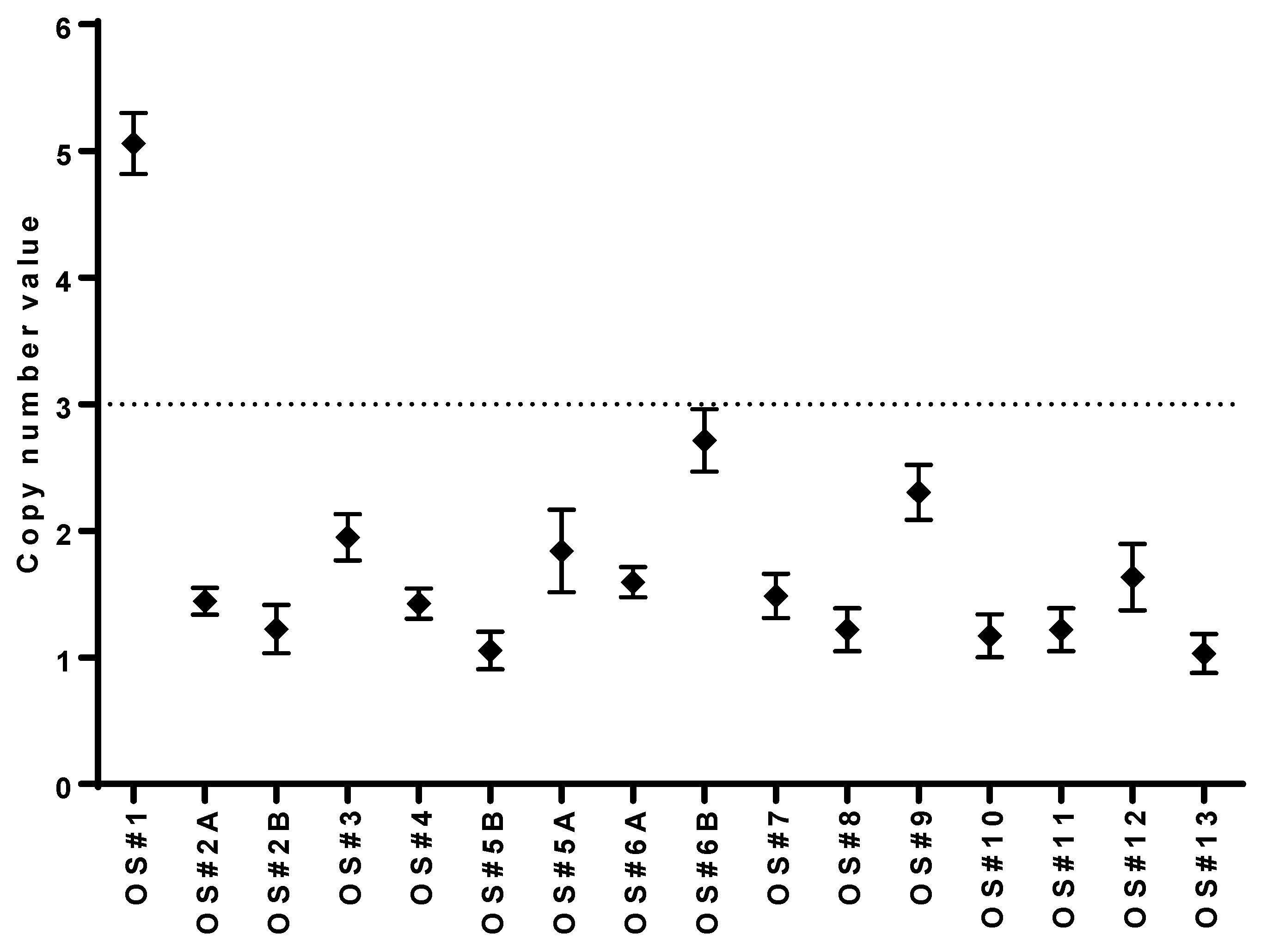
2.4. Droplet Digital PCR (ddPCR)
2.5. Identification of Potentially Actionable Alterations
3. Results
3.1. Clinical–Pathological Data
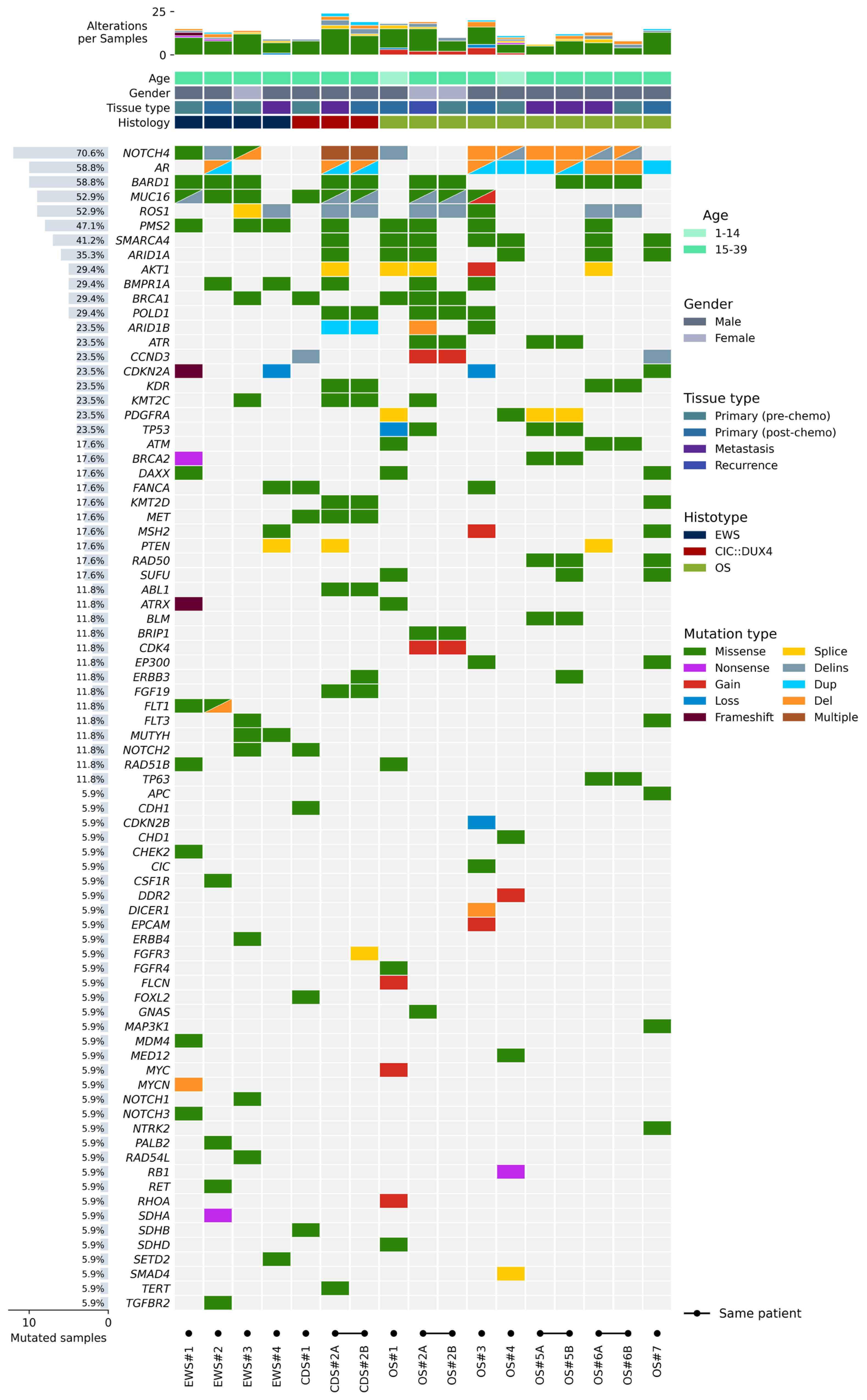
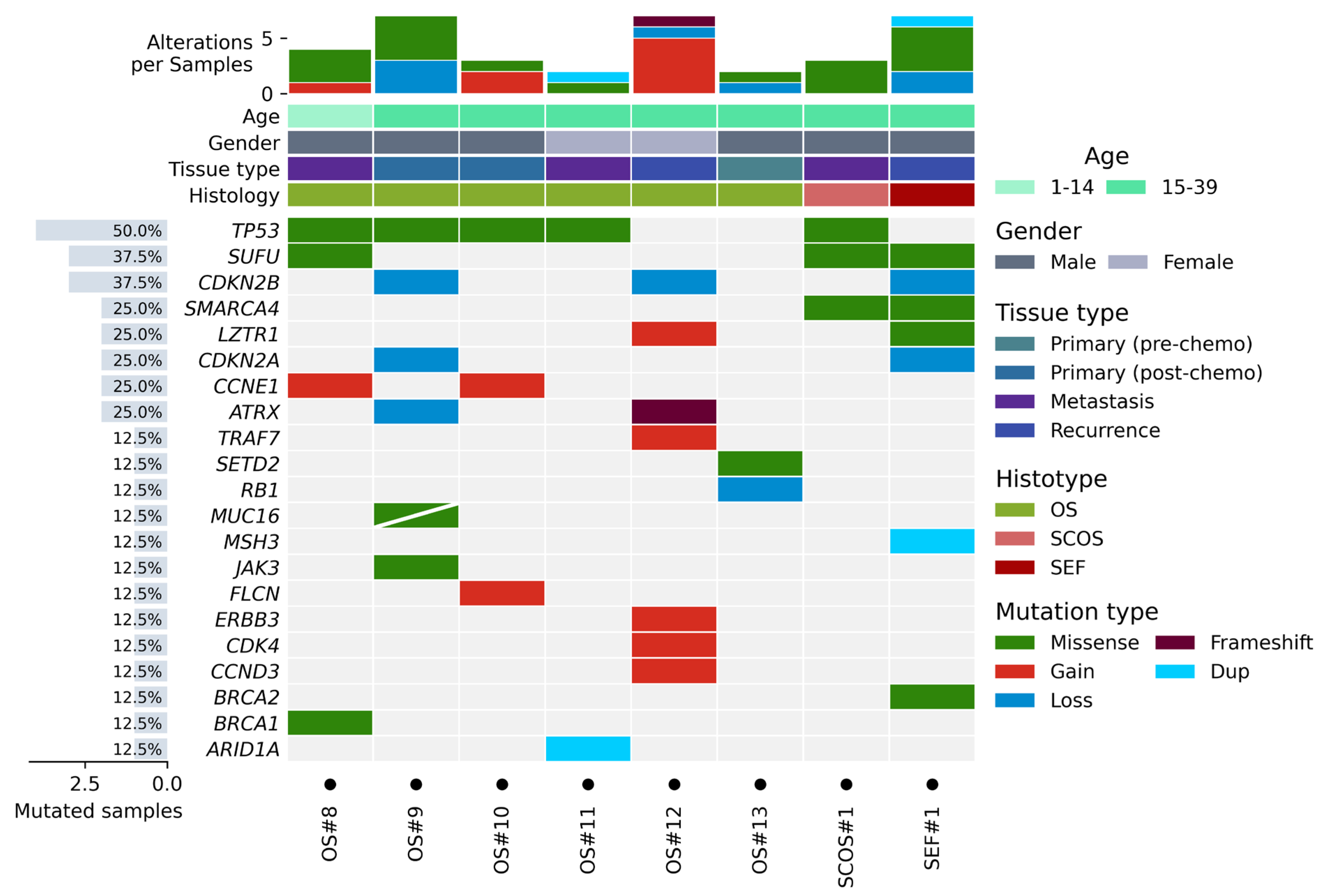
3.2. Targeted Sequencing Detected Relevant Genomic Alterations
3.3. Longitudinal Analyses of Subsequent Samples from the Same Patient Allowed for Evaluation of Tumor Evolution
3.4. Matched Normal Samples Can Be Used to Accurately Identify Tumor-Specific Somatic Mutations
3.5. Potential Actionable Targets
4. Discussion
5. Conclusions
- The AMP chemistry and the 185-gene panel were adequate. Tissues from different sarcoma histotypes have different yields in terms of quantity and quality of the nucleic acids, and the AMP chemistry has proven to be robust and reliable in all situations, even if the DNA was extracted from FFPE tissues.
- Gene primer mixes able to detect almost every variant (SNVs or CNVs) connected to a therapeutic targeted solution can reduce the finding of Variant of Unknown Significance (VUS) and therefore simplify the process of interpretation of the molecular results. This is also true if we consider the inclusion of HDR proficiency evaluation with the definition of genomic instability score (GIS), which could be of great help in defining the eligibility of selected patients to PARP inhibitor treatment.
- A larger panel is highly recommended due to the fast pace of new drug–gene variant connections implemented every time the databases are updated to the latest releases and recommendations of the FDA, EMA, and other regulatory agencies. The possibility to offer genetic screening (both germinal and somatic) with larger panels (>400/500 genes) in an early stage of tumor progression will give the opportunity to deeply know the evolving traits of the tumor, and if there are familial syndromes linked to specific gene conditions, covering two analytical needs in one single step. The possibility of efficiently stratifying the patients will grant the appropriate enrolment in multiple trials aimed at assessing the efficacy of targeted drugs.
- We have been able to trace evolutionary processes along different samples, such as the accumulation of variants in different time points during tumor progression. This data highlights the importance of analyzing tumor samples representative of the latest disease stage of the patient and raises the issue of considering the utility of a second biopsy.
Supplementary Materials
Author Contributions
Funding
Institutional Review Board Statement
Informed Consent Statement
Data Availability Statement
Acknowledgments
Conflicts of Interest
References
- Pankiw, M.; Brezden-Masley, C.; Charames, G.S. Comprehensive genomic profiling for oncological advancements by precision medicine. Med. Oncol. 2023, 41, 1. [Google Scholar] [CrossRef] [Scilit]
- Schmid, S.; Jochum, W.; Padberg, B.; Demmer, I.; Mertz, K.D.; Joerger, M.; Britschgi, C.; Matter, M.S.; Rothschild, S.I.; Omlin, A. How to read a next-generation sequencing report-what oncologists need to know. ESMO Open 2022, 7, 100570. [Google Scholar] [CrossRef] [Scilit] [PubMed]
- Mosele, M.F.; Westphalen, C.B.; Stenzinger, A.; Barlesi, F.; Bayle, A.; Bièche, I.; Bonastre, J.; Castro, E.; Dienstmann, R.; Krämer, A.; et al. Recommendations for the use of next-generation sequencing (NGS) for patients with advanced cancer in 2024: A report from the ESMO Precision Medicine Working Group. Ann. Oncol. 2024, 35, 588–606. [Google Scholar] [CrossRef] [Scilit]
- Mardis, E.R. The Impact of Next-Generation Sequencing on Cancer Genomics: From Discovery to Clinic. Cold Spring Harb. Perspect. Med. 2019, 9, a036269. [Google Scholar] [CrossRef] [Scilit]
- Suehara, Y.; Alex, D.; Bowman, A.; Middha, S.; Zehir, A.; Chakravarty, D.; Wang, L.; Jour, G.; Nafa, K.; Hayashi, T.; et al. Clinical Genomic Sequencing of Pediatric and Adult Osteosarcoma Reveals Distinct Molecular Subsets with Potentially Targetable Alterations. Clin. Cancer Res. 2019, 25, 6346–6356. [Google Scholar] [CrossRef] [Scilit]
- Kovac, M.; Ameline, B.; Ribi, S.; Kovacova, M.; Cross, W.; Barenboim, M.; Witt, O.; Bielack, S.; Krieg, A.; Hartmann, W.; et al. The early evolutionary landscape of osteosarcoma provides clues for targeted treatment strategies. J. Pathol. 2021, 254, 556–566. [Google Scholar] [CrossRef] [Scilit]
- Nacev, B.A.; Sanchez-Vega, F.; Smith, S.A.; Antonescu, C.R.; Rosenbaum, E.; Shi, H.; Tang, C.; Socci, N.D.; Rana, S.; Gularte-Mérida, R.; et al. Clinical sequencing of soft tissue and bone sarcomas delineates diverse genomic landscapes and potential therapeutic targets. Nat. Commun. 2022, 13, 3405. [Google Scholar] [CrossRef] [Scilit] [PubMed]
- Gounder, M.M.; Agaram, N.P.; Trabucco, S.E.; Robinson, V.; Ferraro, R.A.; Millis, S.Z.; Krishnan, A.; Lee, J.; Attia, S.; Abida, W.; et al. Clinical genomic profiling in the management of patients with soft tissue and bone sarcoma. Nat. Commun. 2022, 13, 3406. [Google Scholar] [CrossRef] [Scilit]
- Lopes-Brás, R.; Lopez-Presa, D.; Esperança-Martins, M.; Melo-Alvim, C.; Gallego, L.; Costa, L.; Fernandes, I. Genomic Profiling of Sarcomas: A Promising Weapon in the Therapeutic Arsenal. Int. J. Mol. Sci. 2022, 23, 14227. [Google Scholar] [CrossRef] [Scilit] [PubMed]
- Schipper, L.J.; Monkhorst, K.; Samsom, K.G.; Bosch, L.J.W.; Snaebjornsson, P.; van Boven, H.; Roepman, P.; van der Kolk, L.E.; van Houdt, W.J.; van der Graaf, W.T.A.; et al. Clinical Impact of Prospective Whole Genome Sequencing in Sarcoma Patients. Cancers 2022, 14, 436. [Google Scholar] [CrossRef] [Scilit]
- Watkins, J.A.; Trotman, J.; Tadross, J.A.; Harrington, J.; Hatcher, H.; Horan, G.; Prewett, S.; Wong, H.H.; McDonald, S.; Tarpey, P.; et al. Introduction and impact of routine whole genome sequencing in the diagnosis and management of sarcoma. Br. J. Cancer 2024, 131, 860–869. [Google Scholar] [CrossRef] [Scilit] [PubMed]
- Sayles, L.C.; Breese, M.R.; Koehne, A.L.; Leung, S.G.; Lee, A.G.; Liu, H.Y.; Spillinger, A.; Shah, A.T.; Tanasa, B.; Straessler, K.; et al. Genome-Informed Targeted Therapy for Osteosarcoma. Cancer Discov. 2019, 9, 46–63. [Google Scholar] [CrossRef] [Scilit]
- Yu, S.; Yao, X. Advances on immunotherapy for osteosarcoma. Mol. Cancer 2024, 23, 192. [Google Scholar] [CrossRef] [Scilit]
- Palmerini, E.; Lopez Pousa, A.; Grignani, G.; Redondo, A.; Hindi, N.; Provenzano, S.; Sebio, A.; Lopez Martin, J.A.; Valverde, C.; Martinez Trufero, J.; et al. Nivolumab and sunitinib in patients with advanced bone sarcomas: A multicenter, single-arm, phase 2 trial. Cancer 2025, 131, e35628. [Google Scholar] [CrossRef] [Scilit] [PubMed]
- Worst, B.C.; van Tilburg, C.M.; Balasubramanian, G.P.; Fiesel, P.; Witt, R.; Freitag, A.; Boudalil, M.; Previti, C.; Wolf, S.; Schmidt, S.; et al. Next-generation personalised medicine for high-risk paediatric cancer patients—The INFORM pilot study. Eur. J. Cancer 2016, 65, 91–101. [Google Scholar] [CrossRef] [Scilit] [PubMed]
- Berlanga, P.; Pierron, G.; Lacroix, L.; Chicard, M.; Adam de Beaumais, T.; Marchais, A.; Harttrampf, A.C.; Iddir, Y.; Larive, A.; Soriano Fernandez, A.; et al. The European MAPPYACTS Trial: Precision Medicine Program in Pediatric and Adolescent Patients with Recurrent Malignancies. Cancer Discov. 2022, 12, 1266–1281. [Google Scholar] [CrossRef] [Scilit]
- Tjota, M.Y.; Segal, J.P.; Wang, P. Clinical Utility and Benefits of Comprehensive Genomic Profiling in Cancer. J. Appl. Lab. Med. 2024, 9, 76–91. [Google Scholar] [CrossRef] [Scilit]
- Zheng, Z.; Liebers, M.; Zhelyazkova, B.; Cao, Y.; Panditi, D.; Lynch, K.D.; Chen, J.; Robinson, H.E.; Shim, H.S.; Chmielecki, J.; et al. Anchored multiplex PCR for targeted next-generation sequencing. Nat. Med. 2014, 20, 1479–1484. [Google Scholar] [CrossRef] [Scilit]
- den Dunnen, J.T.; Dalgleish, R.; Maglott, D.R.; Hart, R.K.; Greenblatt, M.S.; McGowan-Jordan, J.; Roux, A.F.; Smith, T.; Antonarakis, S.E.; Taschner, P.E. HGVS Recommendations for the Description of Sequence Variants: 2016 Update. Hum. Mutat. 2016, 37, 564–569. [Google Scholar] [CrossRef] [Scilit]
- Crowdis, J.; He, M.X.; Reardon, B.; Van Allen, E.M. CoMut: Visualizing integrated molecular information with comutation plots. Bioinformatics 2020, 36, 4348–4349. [Google Scholar] [CrossRef] [Scilit]
- Muiños, F.; Martínez-Jiménez, F.; Pich, O.; Gonzalez-Perez, A.; Lopez-Bigas, N. In silico saturation mutagenesis of cancer genes. Nature 2021, 596, 428–432. [Google Scholar] [CrossRef] [Scilit]
- Chakravarty, D.; Gao, J.; Phillips, S.M.; Kundra, R.; Zhang, H.; Wang, J.; Rudolph, J.E.; Yaeger, R.; Soumerai, T.; Nissan, M.H.; et al. OncoKB: A Precision Oncology Knowledge Base. JCO Precis. Oncol. 2017, 1, 1–16. [Google Scholar] [CrossRef] [Scilit]
- Suehnholz, S.P.; Nissan, M.H.; Zhang, H.; Kundra, R.; Nandakumar, S.; Lu, C.; Carrero, S.; Dhaneshwar, A.; Fernandez, N.; Xu, B.W.; et al. Quantifying the Expanding Landscape of Clinical Actionability for Patients with Cancer. Cancer Discov. 2024, 14, 49–65. [Google Scholar] [CrossRef] [Scilit]
- Mateo, J.; Chakravarty, D.; Dienstmann, R.; Jezdic, S.; Gonzalez-Perez, A.; Lopez-Bigas, N.; Ng, C.K.Y.; Bedard, P.L.; Tortora, G.; Douillard, J.Y.; et al. A framework to rank genomic alterations as targets for cancer precision medicine: The ESMO Scale for Clinical Actionability of molecular Targets (ESCAT). Ann. Oncol. 2018, 29, 1895–1902. [Google Scholar] [CrossRef] [Scilit]
- WHO Classification of Tumours Editorial Board. Soft tissue and bone tumours. In WHO Classification of Tumours Series, 5th ed.; International Agency for Research on Cancer: Lyon, France, 2020; Volume 3. [Google Scholar]
- Heim, T.E.; Hankins, M.L.; Belayneh, R.; Douglas, N.; Dinh, V.; Kovvur, M.; Boone, D.N.; Ukani, V.; Bhogal, S.; Patel, V.; et al. RNA-sequencing predicts a role of androgen receptor and aldehyde dehydrogenase 1A1 in osteosarcoma lung metastases. Oncogene 2024, 43, 1007–1018. [Google Scholar] [CrossRef] [Scilit] [PubMed]
- Engin, F.; Bertin, T.; Ma, O.; Jiang, M.M.; Wang, L.; Sutton, R.E.; Donehower, L.A.; Lee, B. Notch signaling contributes to the pathogenesis of human osteosarcomas. Hum. Mol. Genet. 2009, 18, 1464–1470. [Google Scholar] [CrossRef] [Scilit]
- Martins-Neves, S.A.-O.; Sampaio-Ribeiro, G.A.-O.; Gomes, C.A.-O. Self-Renewal and Pluripotency in Osteosarcoma Stem Cells’ Chemoresistance: Notch, Hedgehog, and Wnt/β-Catenin Interplay with Embryonic Markers. Int. J. Mol. Sci. 2023, 24, 8401. [Google Scholar] [CrossRef] [Scilit] [PubMed]
- Pires, S.F.; de Barros, J.S.; da Costa, S.S.; de Oliveira Scliar, M.; Van Helvoort Lengert, A.; Boldrini, É.; da Silva, S.R.M.; Tasic, L.; Vidal, D.O.; Krepischi, A.C.V.; et al. DNA methylation patterns suggest the involvement of DNMT3B and TET1 in osteosarcoma development. Mol. Genet. Genom. 2023, 298, 721–733. [Google Scholar] [CrossRef] [Scilit]
- Roberts, C.W.; Orkin, S.H. The SWI/SNF complex--chromatin and cancer. Nat. Rev. Cancer 2004, 4, 133–142. [Google Scholar] [CrossRef] [Scilit]
- Heeke, A.L.; Pishvaian, M.J.; Lynce, F.; Xiu, J.; Brody, J.R.; Chen, W.J.; Baker, T.M.; Marshall, J.L.; Isaacs, C. Prevalence of Homologous Recombination-Related Gene Mutations Across Multiple Cancer Types. JCO Precis. Oncol. 2018, 2, 1–13. [Google Scholar] [CrossRef] [Scilit] [PubMed]
- Shen, J.; Peng, Y.; Wei, L.; Zhang, W.; Yang, L.; Lan, L.; Kapoor, P.; Ju, Z.; Mo, Q.; Shih Ie, M.; et al. ARID1A Deficiency Impairs the DNA Damage Checkpoint and Sensitizes Cells to PARP Inhibitors. Cancer Discov. 2015, 5, 752–767. [Google Scholar] [CrossRef] [Scilit] [PubMed]
- Maurer, L.M.; Daley, J.D.; Mukherjee, E.; Venier, R.E.; Julian, C.M.; Bailey, N.G.; Jacobs, M.F.; Kumar-Sinha, C.; Raphael, H.; Periyapatna, N.; et al. BRCA1-associated RING domain-1 (BARD1) loss and GBP1 expression enhance sensitivity to DNA damage in Ewing sarcoma. Cancer Res. Commun. 2022, 2, 220–232. [Google Scholar] [CrossRef] [Scilit]
- Lagerstedt-Robinson, K.; Rohlin, A.; Aravidis, C.; Melin, B.; Nordling, M.; Stenmark-Askmalm, M.; Lindblom, A.; Nilbert, M. Mismatch repair gene mutation spectrum in the Swedish Lynch syndrome population. Oncol. Rep. 2016, 36, 2823–2835. [Google Scholar] [CrossRef] [Scilit]
- Brohl, A.S.; Patidar, R.; Turner, C.E.; Wen, X.; Song, Y.K.; Wei, J.S.; Calzone, K.A.; Khan, J. Frequent inactivating germline mutations in DNA repair genes in patients with Ewing sarcoma. Genet. Med. 2017, 19, 955–958. [Google Scholar] [CrossRef] [Scilit]
- Gulhan, D.C.; Lee, J.J.; Melloni, G.E.M.; Cortés-Ciriano, I.; Park, P.J. Detecting the mutational signature of homologous recombination deficiency in clinical samples. Nat. Genet. 2019, 51, 912–919. [Google Scholar] [CrossRef] [Scilit]
- Rose, M.; Burgess, J.T.; O’Byrne, K.; Richard, D.J.; Bolderson, E. PARP Inhibitors: Clinical Relevance, Mechanisms of Action and Tumor Resistance. Front. Cell Dev. Biol. 2020, 8, 564601. [Google Scholar] [CrossRef] [Scilit]
- Schneider, D.; Gluski, J.; Brown, E.D.L.; Mishra, A.; Sciubba, D.M.; Lo, S.L. MOSAIC: A Multi-Feature Genomic Instability Score Independently Predicts Sarcoma Survival in 2138 Patients. Am. J. Clin. Oncol. 2025, 48, 465–469. [Google Scholar] [CrossRef] [Scilit] [PubMed]
- Planas-Paz, L.; Pliego-Mendieta, A.; Hagedorn, C.; Aguilera-Garcia, D.; Haberecker, M.; Arnold, F.; Herzog, M.; Bankel, L.; Guggenberger, R.; Steiner, S.; et al. Unravelling homologous recombination repair deficiency and therapeutic opportunities in soft tissue and bone sarcoma. EMBO Mol. Med. 2023, 15, e16863. [Google Scholar] [CrossRef] [Scilit]
- Jiang, Y.; Wang, J.; Sun, M.; Zuo, D.; Wang, H.; Shen, J.; Jiang, W.; Mu, H.; Ma, X.; Yin, F.; et al. Multi-omics analysis identifies osteosarcoma subtypes with distinct prognosis indicating stratified treatment. Nat. Commun. 2022, 13, 7207. [Google Scholar] [CrossRef] [Scilit] [PubMed]
- Schafer, E.S.; Rau, R.E.; Berg, S.L.; Liu, X.; Minard, C.G.; Bishop, A.J.R.; Romero, J.C.; Hicks, M.J.; Nelson, M.D., Jr.; Voss, S.; et al. Phase 1/2 trial of talazoparib in combination with temozolomide in children and adolescents with refractory/recurrent solid tumors including Ewing sarcoma: A Children’s Oncology Group Phase 1 Consortium study (ADVL1411). Pediatr. Blood Cancer 2020, 67, e28073. [Google Scholar] [CrossRef] [Scilit]
- Juan Ribelles, A.; Felix, A.; Benavent, N.; Escrivá-Fernández, J.; Brahmi, M.; Gaspar, N.; Gatz, S.A.; Grünewald, T.; Linder-Stragliotto, C.; Palmerini, E.; et al. Recurrent and Refractory Ewing Sarcoma Phase I/II Trials: Current Perspective From the Euro-Ewing Consortium. JCO Precis. Oncol. 2025, 9, e2500377. [Google Scholar] [CrossRef] [Scilit]
- Sugawara, W.; Arai, Y.; Kasai, F.; Fujiwara, Y.; Haruta, M.; Hosaka, R.; Nishida, K.; Kurosumi, M.; Kobayashi, Y.; Akagi, K.; et al. Association of germline or somatic TP53 missense mutation with oncogene amplification in tumors developed in patients with Li-Fraumeni or Li-Fraumeni-like syndrome. Genes Chromosomes Cancer 2011, 50, 535–545. [Google Scholar] [CrossRef] [Scilit] [PubMed]
- Guney, S.; Bertrand, P.; Jardin, F.; Ruminy, P.; Kerckaert, J.P.; Tilly, H.; Bastard, C. Molecular characterization of 9p21 deletions shows a minimal common deleted region removing CDKN2A exon 1 and CDKN2B exon 2 in diffuse large B-cell lymphomas. Genes Chromosomes Cancer 2011, 50, 715–725. [Google Scholar] [CrossRef] [Scilit]
- van Ewijk, R.; Hiemcke-Jiwa, L.S.; Hehir-Kwa, J.Y.; Gaspar, N.; Haveman, L.M.; Flucke, U.E.; Dandis, R.; van Tuil, M.; Janda, C.Y.; van de Sande, M.A.J.; et al. Prognostic Value of the G2 Expression Signature and MYC Overexpression in Childhood High-Grade Osteosarcoma. JCO Precis. Oncol. 2025, 9, e2400855. [Google Scholar] [CrossRef] [Scilit]
- Samstein, R.M.; Lee, C.H.; Shoushtari, A.N.; Hellmann, M.D.; Shen, R.; Janjigian, Y.Y.; Barron, D.A.; Zehir, A.; Jordan, E.J.; Omuro, A.; et al. Tumor mutational load predicts survival after immunotherapy across multiple cancer types. Nat. Genet. 2019, 51, 202–206. [Google Scholar] [CrossRef] [Scilit]
- Luchini, C.; Lawlor, R.T.; Milella, M.; Scarpa, A. Molecular Tumor Boards in Clinical Practice. Trends Cancer 2020, 6, 738–744. [Google Scholar] [CrossRef] [Scilit]
- Schubert, N.A.; Chen, C.Y.; Rodríguez, A.; Koster, J.; Dowless, M.; Pfister, S.M.; Shields, D.J.; Stancato, L.F.; Vassal, G.; Caron, H.N.; et al. Target actionability review to evaluate CDK4/6 as a therapeutic target in paediatric solid and brain tumours. Eur. J. Cancer 2022, 170, 196–208. [Google Scholar] [CrossRef] [Scilit]
- Macy, M.E.; Mody, R.; Reid, J.M.; Piao, J.; Saguilig, L.; Alonzo, T.A.; Berg, S.L.; Fox, E.; Weigel, B.J.; Hawkins, D.S.; et al. Palbociclib in Solid Tumor Patients With Genomic Alterations in the cyclinD-cdk4/6-INK4a-Rb Pathway: Results From National Cancer Institute-Children’s Oncology Group Pediatric Molecular Analysis for Therapy Choice Trial Arm I (APEC1621I). JCO Precis. Oncol. 2024, 8, e2400418. [Google Scholar] [CrossRef] [Scilit]
- Larson, K.L.; Huang, B.; Weiss, H.L.; Hull, P.; Westgate, P.M.; Miller, R.W.; Arnold, S.M.; Kolesar, J.M. Clinical Outcomes of Molecular Tumor Boards: A Systematic Review. JCO Precis. Oncol. 2021, 5, 1122–1132. [Google Scholar] [CrossRef] [Scilit] [PubMed]
- Marchetti, P.; Curigliano, G.; Biffoni, M.; Lonardi, S.; Scagnoli, S.; Fornaro, L.; Guarneri, V.; De Giorgi, U.; Ascierto, P.A.; Blandino, G.; et al. Genomically matched therapy in advanced solid tumors: The randomized phase 2 ROME trial. Nat. Med. 2025, 31, 3514–3523. [Google Scholar] [CrossRef] [Scilit] [PubMed]
- Kazmi, F.; Shrestha, N.; Liu, T.F.D.; Foord, T.; Heesen, P.; Booth, S.; Dodwell, D.; Lord, S.; Yeoh, K.W.; Blagden, S.P. Next-generation sequencing for guiding matched targeted therapies in people with relapsed or metastatic cancer. Cochrane Database Syst. Rev. 2025, 3, CD014872. [Google Scholar] [CrossRef] [Scilit] [PubMed]
- Serrano, C.; Bauer, S.; Blay, J.Y.; Casali, P.G.; Cicala, C.M.; Dei Tos, A.P.; Digklia, A.; Gelderblom, H.; Italiano, A.; Jones, R.L.; et al. Guidelines for Next-Generation Sequencing in Sarcoma Diagnosis and Treatment: A Consensus Review. JAMA Oncol. 2025, 11, 1527. [Google Scholar] [CrossRef] [Scilit] [PubMed]



| Patient and Sample Features | 185 Genes Pan Solid Tumor Kit (Tumor) | 185 Genes Pan Solid Tumor Kit (Tumor and Saliva) | Total (%) |
|---|---|---|---|
| Age | |||
| 0–14 years | 2 | 1 | 3 (14%) |
| 15–39 years | 11 | 8 | 19 (86%) |
| Gender | |||
| Female | 3 | 3 | 6 (27%) |
| Male | 10 | 6 | 16 (73%) |
| Histology | |||
| Osteosarcoma (all high grade conventional OS) | 7 | 6 | 13 (59%) |
| Ewing sarcoma | 4 | 1 | 5 (23%) |
| CIC::DUX4 sarcoma | 2 | 2 (9%) | |
| Other sarcomas * | 2 | 2 (9%) | |
| Tissue type | |||
| Primary (pre-chemo) | 6 | 2 | 8 (36%) |
| Primary (post-chemo) | 5 | 2 | 7 (32%) |
| Metastasis | 2 | 3 | 5 (23%) |
| Recurrences | 2 | 2 (9%) |
| Patient | Actionable Molecular Alterations | Drugs | ESCAT Score # |
|---|---|---|---|
| OS#8 | CCNE1:amp * | CDK2 inhibitors | IV-A |
| TP53 (D281H) * | MDM2 inhibitors ^; Abemaciclib (CDK4/CDK6 inhibitor) ^; Cisplatin (Chemotherapy) ^; Doxorubicin (Anthracycline antitumor antibiotic); Gemcitabine; Mitomycin C; WEE1 inhibitors; AZD6738 (ATR inhibitor); Decitabine; Pramlintide (Amylin analog); | IV-A | |
| TP53 (D281H) § | HSP90 inhibitors | IV-A | |
| OS#9 | CDKN2A:del * | CDK4/6 inhibitors; Ilorasertib (AURKA-VEGF inhibitor) | IV-A |
| CDKN2B:del * | CDK4/6 inhibitors | IV-A | |
| TP53 (C275Y) * | MDM2 inhibitors ^; Abemaciclib (CDK4/CDK6 inhibitor) ^; Cisplatin (Chemotherapy) ^; Doxorubicin; Gemcitabine; Mitomycin C;WEE1 inhibitors; AZD6738 (ATR inhibitors); Decitabine;Pramlintide (Amylin analog). | IV-A | |
| JAK3 (T8M) § | JAK inhibitors | X | |
| TP53 (C275Y) § | HSP90 inhibitors | IV-A | |
| OS#10 | CCNE1:amp * | CDK2 inhibitors; Lunresertib AND/OR Camonsertib; | IIIA |
| TP53 (D281H) * | MDM2 inhibitors ^; Abemaciclib (CDK4/CDK6 inhibitor) ^; Cisplatin (Chemotherapy) ^; Doxorubicin; Gemcitabine; Mitomycin C;WEE1 inhibitors; AZD6738 (ATR inhibitor); Decitabine; Pramlintide (Amylin analog) | IV-A | |
| TP53 (D281H) § | HSP90 inhibitors | IV-A | |
| OS#11 | ARID1A(G84GGGGAGS) * | ATR, EZH2, PARP inhibitors | X |
| TP53 (R282W) * | MDM2 inhibitors ^; Abemaciclib (CDK4/CDK6 inhibitor) ^; Cisplatin (Chemotherapy) ^;Doxorubicin; Gemcitabine; Mitomycin C; WEE1 inhibitors; AZD6738 (ATR inhibitors); Decitabine; Pramlintide (Amylin analog) | IV-A | |
| TP53 (R282H) § | HSP90 inhibitors | IV-A | |
| OS#12 | CCND3:amp * | CDK4/6 inhibitors | X |
| CDK4:amp * | LEE011, Abemaciclib + Palbociclib (CDK4/6 inhibitors); Palbociclib (CDK4/6 inhibitor) ^ | III-A | |
| CDKN2B:del * | CDK4/6 inhibitors | IV-A | |
| ERBB3:amp * | EGFR mAb inhibitors ^ | X | |
| OS#13 | RB1:DEL * | HDAC inhibitors; MDM2/MDMX inhibitors; Cisplatin; | IV-A |
| SETD2 (D1166Y) * | WEE1 inhibitors | X | |
| SCOS#1 | TP53 (E258K) * | Cisplatin (Chemotherapy) ^; Abemaciclib (CDK4/CDK6 inhibitor) ^; MDM2 inhibitors ^; Doxorubicin (Anthracycline antitumor antibiotic); Gemcitabine; Mitomycin C; WEE1 inhibitors; AZD6738 (ATR inhibitor); Decitabine; Pramlintide (Amylin analog); | IV-A |
| SMARCA4 (A321P) § | EZH2 inhibitors | X | |
| TP53 (E258K) § | HSP90 inhibitors | IV-A | |
| SEF#1 | CDKN2B:DEL * | CDK4/6 inhibitors | III-A |
| CDKN2A:DEL * | CDK4/6 inhibitors; Ilorasertib (AURKA-VEGF inhibitor) | III-A | |
| BRCA2 (R2034C) § | Olaparib; Rucaparib; Talazoparib; Niraparib (PARP inhibitors); Olaparib (PARP inhibitor) + Bevacizumab (VEGF mAb inhibitor); Talazoparib (PARP inhibitor); Enzalutamide (AR inhibitor); PD1 Ab inhibitors; Platinum Agent (Chemotherapy); Veliparib + Cisplatin (PARP inhibitor + Chemotherapy) | X | |
| MSH3 (A61APAAP) § | DNA-PKc inhibitors | X | |
| SMARCA4 (A314P) § | EZH2 inhibitors | X |
Disclaimer/Publisher’s Note: The statements, opinions and data contained in all publications are solely those of the individual author(s) and contributor(s) and not of MDPI and/or the editor(s). MDPI and/or the editor(s) disclaim responsibility for any injury to people or property resulting from any ideas, methods, instructions or products referred to in the content. |
© 2025 by the authors. Licensee MDPI, Basel, Switzerland. This article is an open access article distributed under the terms and conditions of the Creative Commons Attribution (CC BY) license.
Share and Cite
Parra, A.; Palmerini, E.; Laginestra, M.A.; Ferrari, C.; Cocchi, S.; Simonetti, E.; Pellegrini, E.; De Feo, A.; Magagnoli, G.; Frega, G.; et al. Genomic Profiling of Highly Aggressive Musculoskeletal Sarcomas Identifies Potential Therapeutic Targets: A Single-Center Experience. Cancers 2026, 18, 139. https://doi.org/10.3390/cancers18010139
Parra A, Palmerini E, Laginestra MA, Ferrari C, Cocchi S, Simonetti E, Pellegrini E, De Feo A, Magagnoli G, Frega G, et al. Genomic Profiling of Highly Aggressive Musculoskeletal Sarcomas Identifies Potential Therapeutic Targets: A Single-Center Experience. Cancers. 2026; 18(1):139. https://doi.org/10.3390/cancers18010139
Chicago/Turabian StyleParra, Alessandro, Emanuela Palmerini, Maria Antonella Laginestra, Cristina Ferrari, Stefania Cocchi, Elisa Simonetti, Evelin Pellegrini, Alessandra De Feo, Giovanna Magagnoli, Giorgio Frega, and et al. 2026. "Genomic Profiling of Highly Aggressive Musculoskeletal Sarcomas Identifies Potential Therapeutic Targets: A Single-Center Experience" Cancers 18, no. 1: 139. https://doi.org/10.3390/cancers18010139
APA StyleParra, A., Palmerini, E., Laginestra, M. A., Ferrari, C., Cocchi, S., Simonetti, E., Pellegrini, E., De Feo, A., Magagnoli, G., Frega, G., Donati, D. M., Gambarotti, M., Ibrahim, T., Scotlandi, K., Landuzzi, L., & Pazzaglia, L. (2026). Genomic Profiling of Highly Aggressive Musculoskeletal Sarcomas Identifies Potential Therapeutic Targets: A Single-Center Experience. Cancers, 18(1), 139. https://doi.org/10.3390/cancers18010139