Next Article in Journal
Wide Acoustic Bandgap Solid Disk-Shaped Phononic Crystal Anchoring Boundaries for Enhancing Quality Factor in AlN-on-Si MEMS Resonators
Next Article in Special Issue
Liquid Crystal Elastomer-Based Microelectrode Array for In Vitro Neuronal Recordings
Previous Article in Journal
Design of Ensemble Stacked Auto-Encoder for Classification of Horse Gaits with MEMS Inertial Sensor Technology
 
 
Correction published on 10 September 2018, see Micromachines 2018, 9(9), 451.
Article

Demonstration of a Robust All-Silicon-Carbide Intracortical Neural Interface


by
Evans K. Bernardin
1,
Christopher L. Frewin
2,
Richard Everly
3,
Jawad Ul Hassan
4 and
Stephen E. Saddow
5,*
1
Department of Biomedical Engineering, University of South Florida, Tampa, FL 33620, USA
2
Department of Bioengineering, University of Texas at Dallas, Dallas, TX 75080, USA
3
Nanotechnology Research and Education Center @ USF, Tampa, FL 33617, USA
4
Department of Physics, Chemistry and Biology (IFM), Linköping University, SE-581 83 Linköping, Sweden
5
Department of Electrical Engineering, University of South Florida, Tampa, FL 33620, USA
*
Author to whom correspondence should be addressed.
Micromachines 2018, 9(8), 412; https://doi.org/10.3390/mi9080412
Submission received: 31 July 2018 / Revised: 11 August 2018 / Accepted: 12 August 2018 / Published: 18 August 2018
(This article belongs to the Special Issue Neural Microelectrodes: Design and Applications)

Abstract

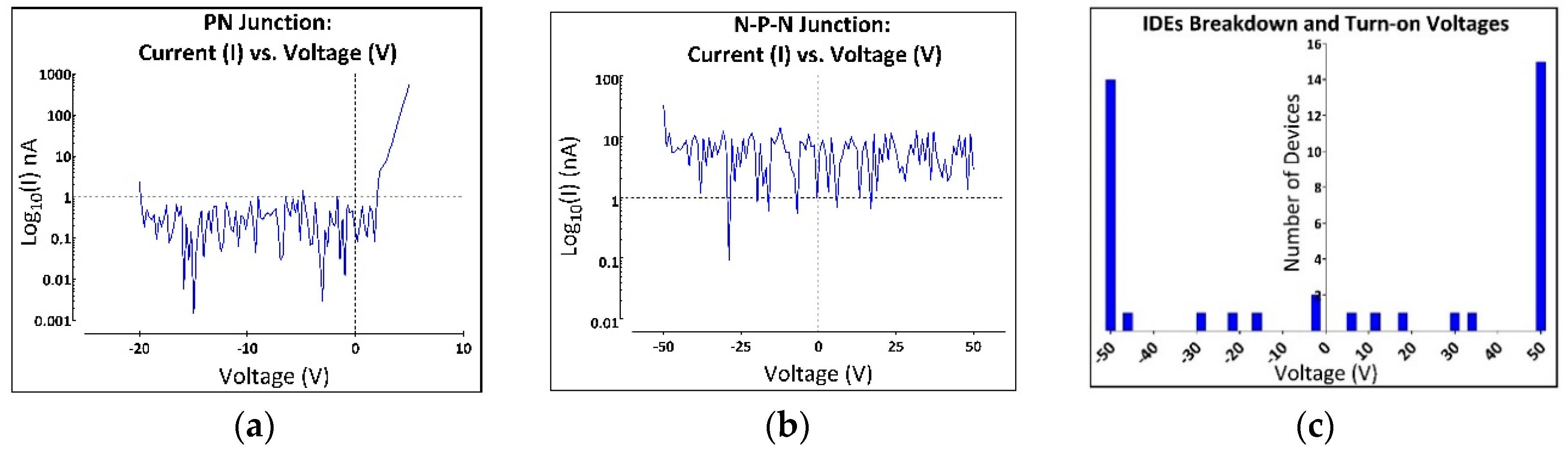
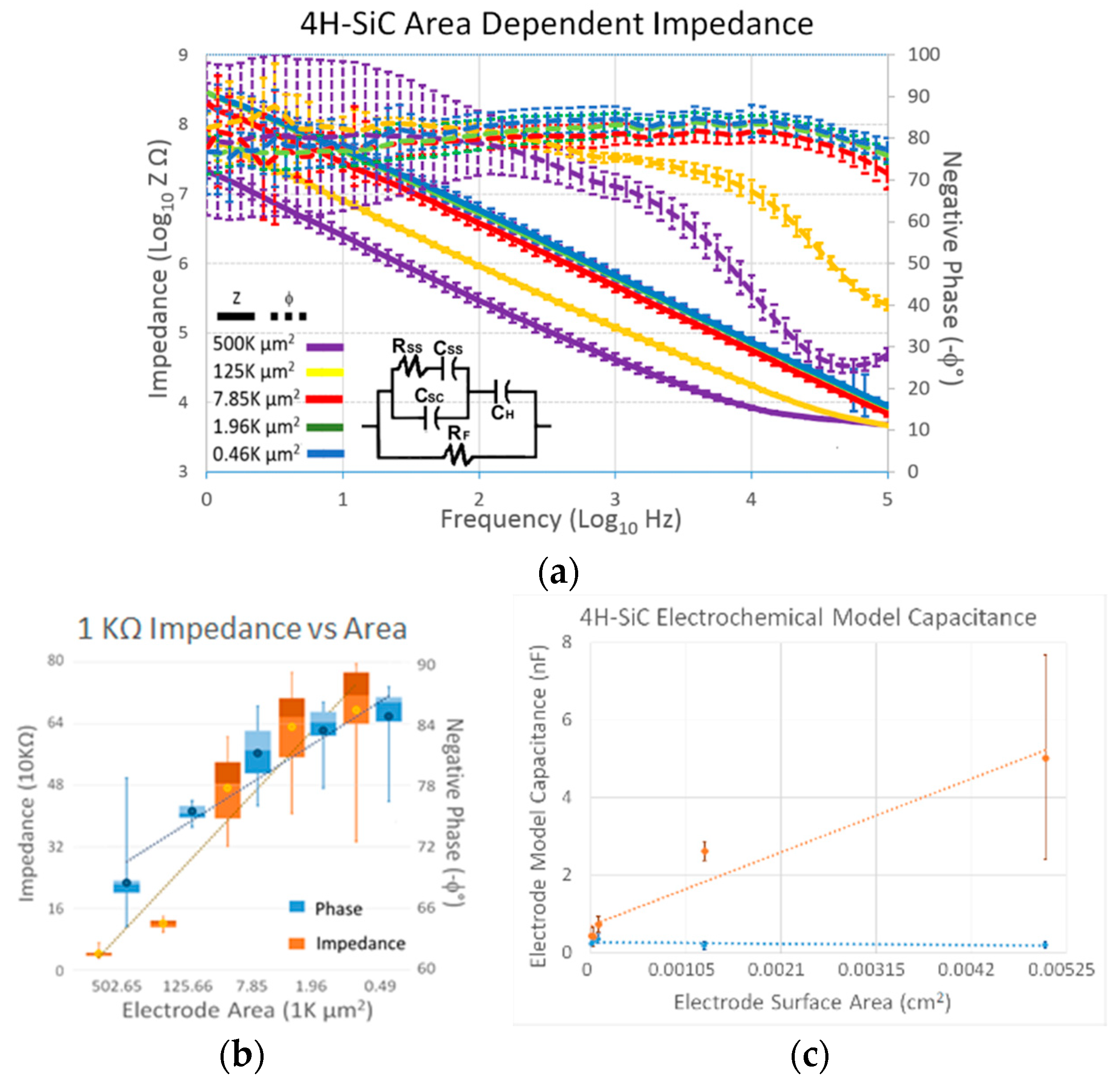
Intracortical neural interfaces (INI) have made impressive progress in recent years but still display questionable long-term reliability. Here, we report on the development and characterization of highly resilient monolithic silicon carbide (SiC) neural devices. SiC is a physically robust, biocompatible, and chemically inert semiconductor. The device support was micromachined from p-type SiC with conductors created from n-type SiC, simultaneously providing electrical isolation through the resulting p-n junction. Electrodes possessed geometric surface area (GSA) varying from 496 to 500 K μm2. Electrical characterization showed high-performance p-n diode behavior, with typical turn-on voltages of ~2.3 V and reverse bias leakage below 1 nArms. Current leakage between adjacent electrodes was ~7.5 nArms over a voltage range of −50 V to 50 V. The devices interacted electrochemically with a purely capacitive relationship at frequencies less than 10 kHz. Electrode impedance ranged from 675 ± 130 kΩ (GSA = 496 µm2) to 46.5 ± 4.80 kΩ (GSA = 500 K µm2). Since the all-SiC devices rely on the integration of only robust and highly compatible SiC material, they offer a promising solution to probe delamination and biological rejection associated with the use of multiple materials used in many current INI devices.
Keywords: neural interface; silicon carbide; robust microelectrode neural interface; silicon carbide; robust microelectrode