You are currently viewing a new version of our website. To view the old version click .
Micromachines
  • Review
  • Open Access

14 July 2018

Progress in Circulating Tumor Cell Research Using Microfluidic Devices

,
,
,
,
and
1
School of Mechanical Engineering, Yonsei University, 50 Yonsei-ro, Seodaemun-gu, Seoul 03722, Korea
2
Daegu Research Center for Medical Devices and Rehab., Korea Institute of Machinery and Materials. Engineering, 330 Techno Sunhwan-ro, Yuga-myeon, Dalsung-gun, Daegu 42994, Korea
*
Authors to whom correspondence should be addressed.
This article belongs to the Special Issue Microfluidics for Circulating Biomarkers

Abstract

Circulating tumor cells (CTCs) are a popular topic in cancer research because they can be obtained by liquid biopsy, a minimally invasive procedure with more sample accessibility than tissue biopsy, to monitor a patient’s condition. Over the past decades, CTC research has covered a wide variety of topics such as enumeration, profiling, and correlation between CTC number and patient overall survival. It is important to isolate and enrich CTCs before performing CTC analysis because CTCs in the blood stream are very rare (0–10 CTCs/mL of blood). Among the various approaches to separating CTCs, here, we review the research trends in the isolation and analysis of CTCs using microfluidics. Microfluidics provides many attractive advantages for CTC studies such as continuous sample processing to reduce target cell loss and easy integration of various functions into a chip, making “do-everything-on-a-chip” possible. However, tumor cells obtained from different sites within a tumor exhibit heterogenetic features. Thus, heterogeneous CTC profiling should be conducted at a single-cell level after isolation to guide the optimal therapeutic path. We describe the studies on single-CTC analysis based on microfluidic devices. Additionally, as a critical concern in CTC studies, we explain the use of CTCs in cancer research, despite their rarity and heterogeneity, compared with other currently emerging circulating biomarkers, including exosomes and cell-free DNA (cfDNA). Finally, the commercialization of products for CTC separation and analysis is discussed.

1. Introduction

Tumor cells form a three-dimensional shape and send signals to the nearby blood vessel network to form new blood networks near themselves in a process known as angiogenesis. Because of angiogenesis, the blood vessel network near a tumor is extremely developed, and high levels of nutrient delivery and gas/waste exchange occur. Despite the well-developed blood network in the tumor microenvironment, the tumor cells experience starvation and suffocation because of their fast metabolic activity, very high cell packing density, and infinite proliferation. The tumor cells begin to experience stress and separate as individual cells from the main tumor body. These individualized tumor cells move toward the blood cell network and digest the extracellular matrix using a collagenase such as matrix metalloproteinase. The individualized tumor cells reach the pericyte and make a small hole for intravasation. A tumor cell floating in the blood vessel network is known as a circulating tumor cell (CTC) [1].
CTCs in human blood vessels represent one of the main causes of recurrent or metastatic cancer. However, a very small number of CTCs (1–1000/mL) are found in human blood, which also contains large numbers of erythrocytes (~5 × 10⁹/mL), leukocytes (~4 × 10⁶/mL), and platelets (~3 × 10⁸/mL). Moreover, not all the CTCs are in a ready state for recurrence or metastasis. The tumor cells are continuously changing their characteristics through epithelial-mesenchymal transition (EMT) or mesenchymal-epithelial transition (MET) [2]. Because of the rarity and heterogeneity of CTCs, the detection of CTCs is not easy and remains a formidable challenge for clinical use.
Currently, the CellSearch® system (Menarini Silicon Biosystems, Inc., Bologna, Italy) is the only US Food and Drug Administration (FDA) approved CTC detecting system, and it is an epithelial cell adhesion molecule-based detecting system. The CellSearch® system can be used for patients with metastatic breast, prostate, or colorectal cancer to make a prognosis of tumor recurrence or metastasis. Since the introduction of the CellSearch system in 2004, many researchers have studied the relationship between the number of CTCs and the survival rate [3]. This is a powerful system for clinical application, but it has a comparably low detecting accuracy and is not able to distinguish between heterogenic tumor cell types.
The microfluidic approaches are usually more cost-effective than batch approaches. This is because they can handle a very low volume of reagent (such as an antibody and magnetic nanoparticles) and because they can deal with the considerable volume of samples obtained in a continuous manner as needed [4]. In addition, because of the ease of multi-disciplinary and intelligent integration, which is one of the advantages of microfluidics, many experimental steps performed on a laboratory scale can be implemented using a single chip. This not only avoids the loss of rare CTCs caused by replacing tubes or tips during multiple experimental steps but also makes the process of the experiment more convenient to the user through automation. Thus, many researchers have tried to develop microfluidic system-based CTC-detecting methods using the unique properties of CTCs such as density [5], size [6], deformability [7], and differences in membrane protein expression [8] in the past decades.
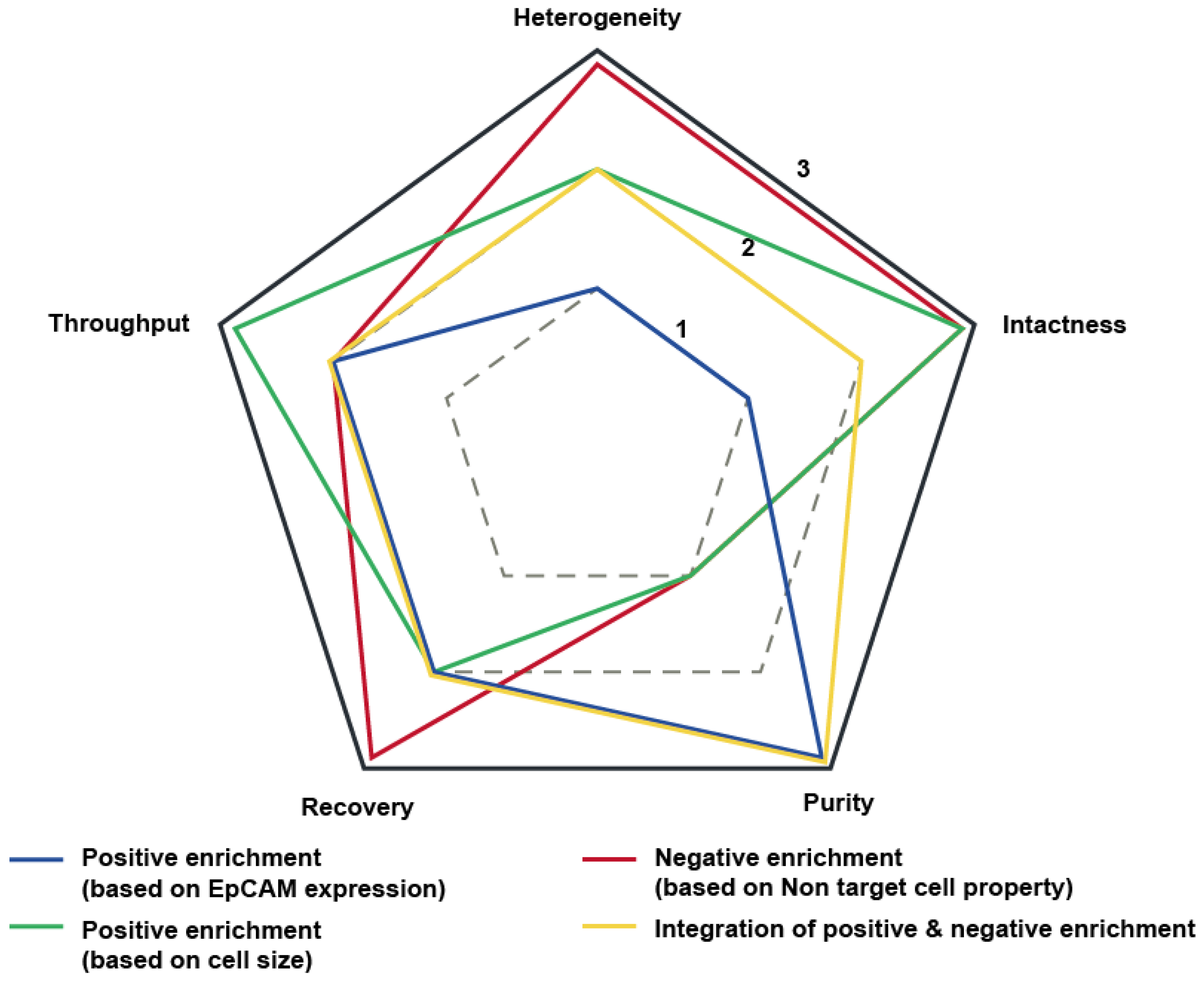
In this paper, we review the trends in CTC research focused on microfluidic approaches. We classify CTC enrichment methods into four types and compare these methods with five performance categories. In addition, the results of CTC analysis for the next steps in cancer research after CTC isolation are investigated. The critical concerns regarding CTCs are discussed in terms of the importance of studying CTCs compared to other circulating biomarkers and the commercialization of CTC separation and analysis equipment.

3. Single CTC Analysis Using Microfluidic Devices

Cancer is not a simple disease for which the outcome of treatment can be predicted or confirmed for each patient, because it is a collection of various diseases and is heterogenic in terms of genetic abnormalities and protein expression. Identifying the CTC phenotype is important in designing customized treatments for patients with cancer. However, the molecular analysis of each CTC is limited because of the heterogeneity of CTCs. In order to overcome these limitations, single cell analysis has been studied in a variety of ways such as microscopic imaging, patch clamp, flow cytometry, tweezing, patterned substrates, and microfluidic devices. Among them, the advantage of a microfluidic-based single-cell analysis system is that it can reduce experimental steps by integrating all processes from isolation to analysis continuously.
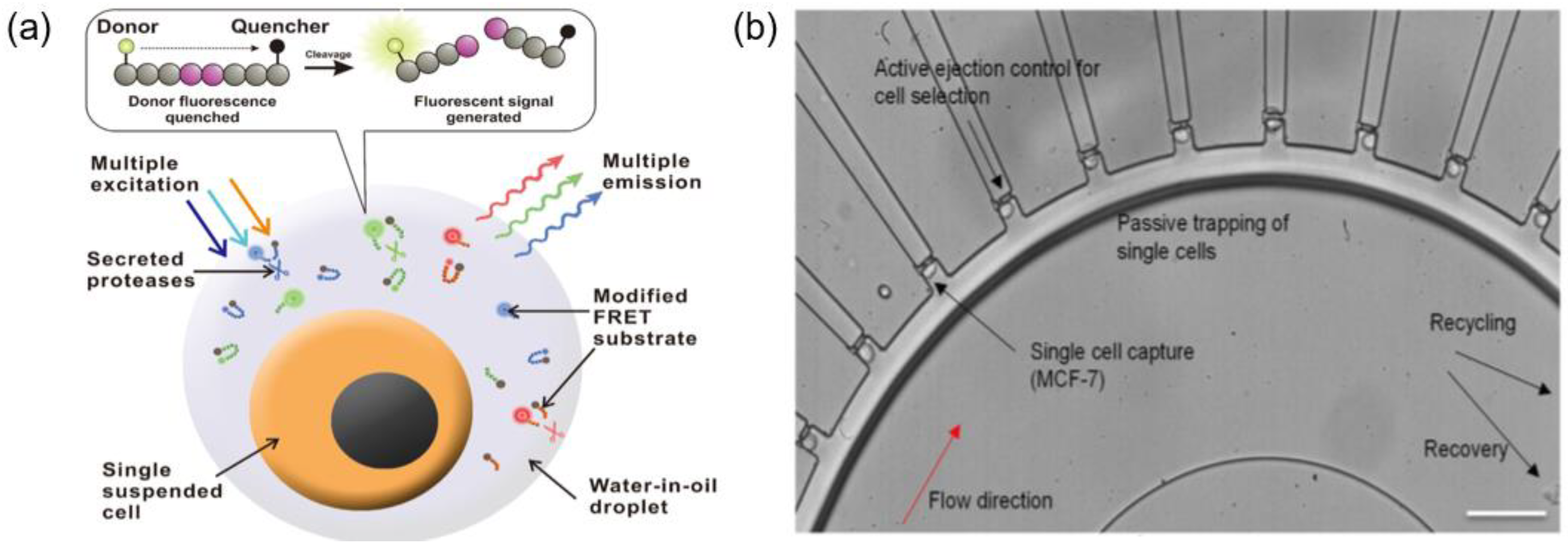
Droplet microfluidics is one of the most widely used methods for single cell isolation. These microfluidic devices can produce femto-liter- and pico-liter-sized aqueous droplets with high throughput on immiscible substrates such as oil. It is also one of the most promising methods to capture and analyze thousands of individual cells for whole transcriptome or genomic analysis. Cells are isolated by forming droplets in a single cell unit through microfluidic devices, and droplets containing individual cells can be used for investigating the properties of each cell, assessing cell viability, and so on. In addition, the ability to extract each target cell with high throughput can be a great advantage for single-cell screening applications, such as mutant library screening. Ben et al. generated 35 pL droplets (water in oil) using microfluidic technology, and a mixture of tumor cells from a cancer cell line (lung A549 cells) and WBCs were encapsulated according to a Poisson distribution in the presence of culture medium and a lactic acid assay mixture. Because of the differences in lactate secretion rates, there were intensity differences between droplets with a cancer cell, with a WBC, and that were empty. Each droplet can be analyzed and sorted using a laser induced fluorescence and inverted microscope with ratiometric dye (Snarf-5F). When A549 tumor cells were mixed with WBCs in ratios ranging from as few as 10:200,000 to 130:200,000 (A549 cells:WBCs), the average detection rate of A549 cells was around 60%. This system not only provides initial evidence of cancer cell metabolism but also allows the counting of CTCs in blood [41]. Ng et al. developed a droplet-based microfluidics platform to measure multiple specific protease activities from water-in-oil droplets that contained single cells (Figure 6a). By integrating the microfluidic platform with a computational analytical method, they successfully characterized six essential protease activities (MMP-2, MMP-3, MMP-9, ADAM-8, ADAM-10, and ADAM-17) in a high-throughput manner. Moreover, protease activity profiles were analyzed at single-cell level with three types of cancer cells (PC-9 lung cancer cell line, MDA-MB-231 breast cancer cell line, and K-562 leukemia cell line) [42]. The continuous isolation and identification of single CTCs from blood using droplet microfluidics have been successful, but gene analysis of individual CTCs and customized treatment through drug screening are still being developed.
Figure 6. Single CTC isolation using microfluidic chip. (a) Generation of water-in-oil droplets in a high throughput manner (~100 cells/experimental run) that contain a single cell with Multi-color Forster Resonance Energy Transfer (FRET)-based enzymatic substrates to measure multiple protease activities specifically; (b) Selective picking and isolation of single CTC in each chamber could be performed by hydrodynamic focusing, thereby tracking variation after drug treatment using a model PC9 cell line. The scale bar represents 100 μm. Reproduced from ref. [42,43] with permission from 2016 ELSEVIER and 2016 Nature Publishing Group.
On the other hand, several groups have developed novel microfluidic devices without droplets to isolate and analyze each CTC to determine the appropriate treatment for cancers. Yeo et al. developed a circular-shaped microfluidic device capable of separating a single CTC from a large population of other cells through fluid-mechanical focusing with the help of a viscous sheath flow buffer (Figure 6b). Because the cell chambers are located along the outer curvature of the circular channel, single cells are captured in each chamber due to the inherent differential pressure and centrifugal force. They successfully separated target cells using selection mechanisms such as tagging antibody markers by immunofluorescence staining, and positive pressure was exerted through a particular chamber for cell recovery. After isolating pure tumor cells from mixed populations, they tracked T790M mutations before and after drug treatment using PC9 cell lines. They enriched CTCs from 5.9 mL to 7.5 mL of blood, and 26 potential single cells were isolated from patients with late stage NSCLC (non-small cell lung cancer), and multiplex polymerase chain reaction (PCR) was performed to enrich for two sites within the EGFR gene, namely T790M and L858R [43]. Using a pancreatic cancer mouse model, Ting et al. compared the genomic expression profiles of individual CTCs isolated using an epitope-independent microfluidic device system and performed single-cell RNA sequencing. Isolation of mouse pancreatic CTCs was performed using hydrodynamic sorting and inertial focusing with magnetic separation. They obtained high-quality transcriptomes for 93 single mouse pancreatic CTCs and presented a detailed analysis of CTC composition and diversity in pancreatic cancer [44].

4. Critical Concerns

4.1. Advantages of CTC Research Compared with That Using Various Circulating Biomarkers

Circulating biomarkers obtained through liquid biopsy are an important research topic that will lead to changes in the paradigm of disease diagnosis and prognosis because of the ability to obtain patient information in real time in a less-invasive manner [45]. In addition to CTCs, as mentioned in the above sections, various circulating biomarkers have been studied regarding cancer. In particular, exosomes and cell-free DNA (cfDNA) have attracted attention as potential circulating biomarkers and are able to complement the technical hurdles in CTC studies such as rarity and heterogeneity.
Exosomes are small extracellular vesicles (30–150 nm in diameter) of endocytic origin [46]. They contain not only genetic material (double-stranded DNA (dsDNA), single-stranded DNA (ssDNA), functional messenger RNA (mRNA), microRNA (miRNA), and other small noncoding RNA molecules) and proteins (enzymes, signal transduction proteins, and cytoskeletal proteins) from their origin cell but also various proteins (tetraspanins, membrane proteins, cytokines, and cell adhesion molecules) that are present in their encapsulated lipid bilayer. With this cargo, exosomes act as intercellular communicators [47]. Currently, exosomes are also known to play an important role in the communication of cancer cells in the tumor microenvironment [48]. In this regard, exosomes can be a powerful tool for cancer diagnosis, prognosis, and personalized medicine research by analyzing the exosome cargo as well as the level of exosomes in the blood. Over the last several years, numerous studies have been published that used microfluidic technology to isolate, detect, quantify, and analyze exosomes [49]. However, the microfluidic technology has limits in dealing with exosomes because of their nanometer size. For example, inertial microfluidics, a representative microfluidic technology, is not suitable for application in studies on exosomes because the physical characteristics of particles such as size and density are of prevailing importance. In addition, whole cells in the body release exosomes during their normal metabolism. The level of exosomes in patients with cancer is known to be higher than normal because the abnormal metabolism of cancer cells. However, in order to identify the correlation between exosomes and cancer characteristics, it is necessary to determine whether exosomes are derived from cancer cells or normal cells. It has been reported that only a small fraction of exosomes out of the total exosomes per mL of blood from patients with cancer are released from cancer cells [50]. Even if the exosomes are successfully isolated from blood, the information obtained from exosome cargo is more limited than the information obtained from CTCs by the nature of their formation.
Cell-free DNA (cfDNA) is DNA that is released into the bloodstream from apoptotic, necrotic, and viable cells. When the cfDNA originates from cancer cells, it is called circulating tumor DNA (ctDNA). Up to 3.3% of tumor DNA per 100 g tumor weight is expected to enter the bloodstream daily [51]. cfDNA has various forms such as unbound DNA fragments, nucleosomes, and virtosomes, which are complexes of newly synthesized DNA, RNA, and lipoproteins [52]. This highly fragmented cfDNA consists of 150–200 base pairs and is 49.5–66 nm in length [53]. In general, cfDNA is digested by DNases in the bloodstream, but the concentration of cfDNA in patients with cancer is known to be higher than normal because cfDNA in patients with cancer is digested less because of low DNase levels and the presence of DNase inhibitors [54]. Moreover, when patients with cancer receive treatment that causes tissue damage such as surgery, chemotherapy, and radiotherapy, the concentration of cfDNA increases because of cell death and destruction. However, increased cfDNA levels are observed in patients with inflammatory diseases, tissue injuries, and benign tumors. Thus, the cfDNA level is not able to fully reflect the status of cancer. Genometastasis, in which ctDNA with an oncogenic gene is able to transform the cells of distant organs, was proposed by Garia-Olmo et al. in 1999 [55]. Several studies have reported that the transfer of DNA can occur via the uptake ctDNA by host cells, and these host cells are transformed into cancer cells. In addition, the transformation to cancer cells does not occur in the absence of ctDNA in normal plasma/serum [56]. These studies support the role of ctDNA in cancer metastasis. Thus, cfDNA should be genetically analyzed for use as a more informative biomarker. In order to avoid analysis errors in DNA sequencing, purification steps or a highly sensitive sensing system is needed because ctDNA is diluted by cfDNAs derived from normal cells. There are many commercial kits and microfluidic devices for the purification of genomic DNA. However, most of them focus on DNA purification rather than cfDNA. Because cfDNA is much shorter than genomic DNA, the experimental set-up such as the composition of the buffer to specifically purify cfDNA should be precisely controlled.
While exosomes and cfDNA can only be used in limited applications because they provide fragmented analytical information, CTCs can be used to meet a variety of research objectives. This is the main reason why CTC studies should be continued despite the rarity and heterogeneity of CTCs (Table 1). In particular, recent progress in the in vivo (patient derived tumor xenograft, PDTX) and in vitro culture of CTCs has improved the understanding of the molecular mechanisms underpinning cancer progression, depending on the conditions of an individual patient [57].
Table 1. Comparison of circulating tumor cells (CTCs) and other circulating biomarkers.

4.2. Commercialization of Microfluidic-Based CTC Research

The growing prevalence of cancer has raised the need for effective tools for early cancer diagnosis and application of precision medicine. CTCs are an attractive option to satisfy these needs because of their relevance to the primary tumor and the availability of liquid biopsy. Microfluidic-based products for CTC isolation and analysis based on technically mature CTC isolation methods, such as size-based filtration and immunomagnetic separation, have been commercialized (Table 2). For commercialization, the performance of the microfluidic chip is also crucial, but it is very important to develop a machine that automates the related product so that it can be used by non-experts. Unlike general purpose microfluidic chip automation machines, because of the nature of CTCs, sophisticated tubing to avoid CTC loss and complex programming to meet the needs of various users are the main factors to consider in designing automation equipment. However, these make the cost of the equipment higher, which increases the barrier for entry into the market. The market for CTC detection is expected to reach an estimated value of several billion US dollars within a few years. However, indeed, the average revenue of most microfluidic device-based companies, according to a search on D&B Hoovers (an American business research company that provides information on companies), is just 2.76 million US dollars. In order to increase the demand for products and enter into a larger market, a standard operating procedure should be established for efficient acquisition of CTCs in blood and clinical validity must be verified. Thus, extensive correlational studies and clinical trials should be conducted with CTCs and patients with cancer.
Table 2. List of companies working on microfluidic-based CTC analysis.
In addition, as the CTC studies continue, there are limitations due to the various features of CTCs, such as MET, in most commercialized techniques. The products based on cutting-edge technologies such as nanomaterials and multifunctional antibody are expected to overcome this issue. However, there remains realistic problems like reliability and stability to reach mass production. Also, most of the products are optimized with their own experimental conditions like working buffer for antibody conjugation and for CTC separation device. So, companies are asked to launch the related products to run their techniques. Although selling consumptive experimental materials seems to be good for profit, it takes a lot of time and money to build a manufacturing facility. Therefore, it is necessary to start the research with the aim of commercialization from the development stage. As a promising business model, some companies offer down-stream analysis after CTC enrichment and corporate with hospitals to provide clinical finding to the patients. Certifications from proven institutions may be challenging, but they will be very attractive in smaller laboratories or hospitals where it is difficult to purchase expensive devices and equipment for CTC research.

5. Conclusions

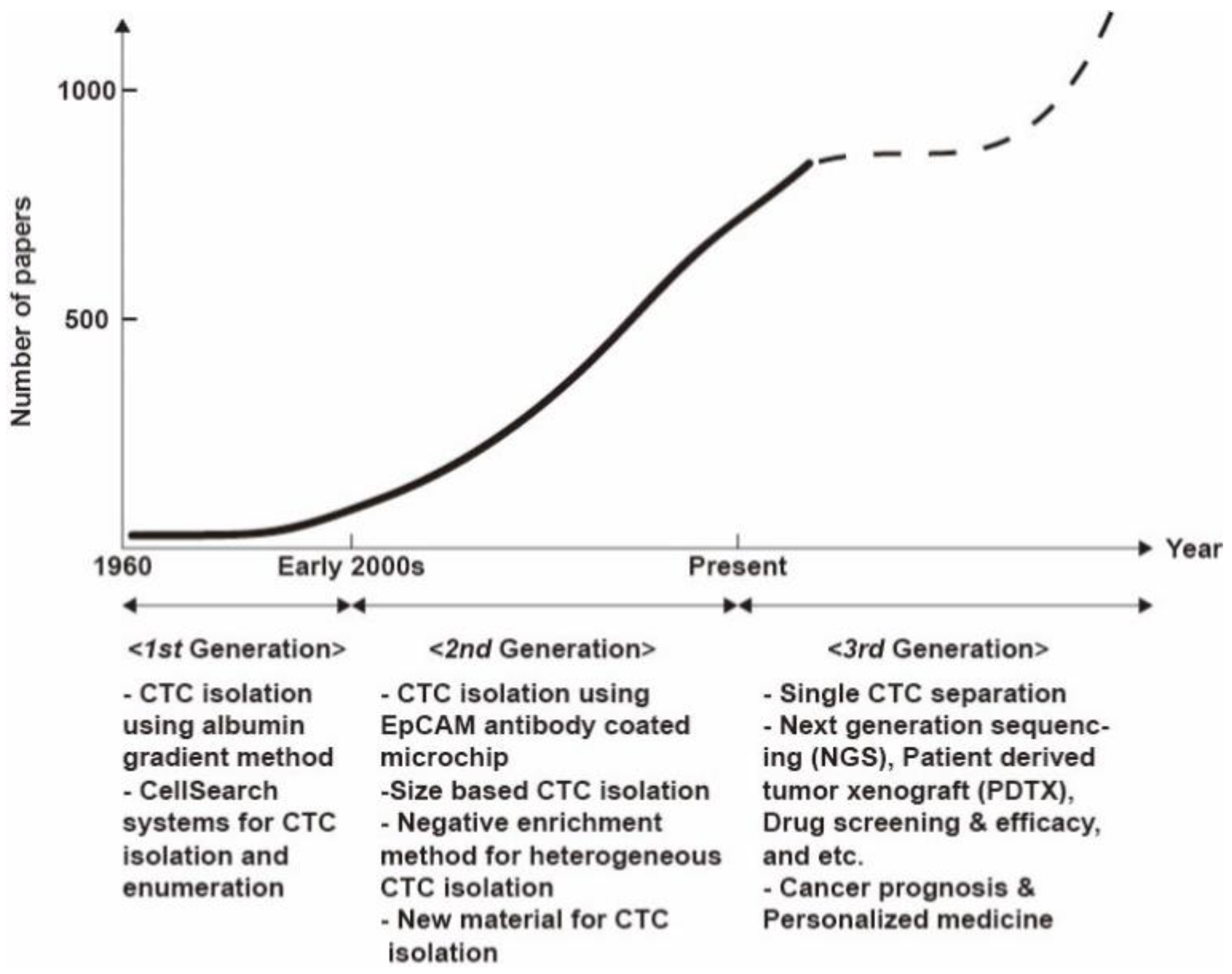
In this review, we described the trends in CTC research and have divided the CTC study into three generations. Before using microfluidics, the CTC isolations were processed with batch systems, but it was difficult to access a sufficient number of purified CTCs for analysis (1st generation). The various advantages of microfluidics make isolation and analysis of CTCs very efficient (2nd generation). Microfluidic based CTC isolation approaches are classified as four types: (1) Positive enrichment using antigen-antibody reaction, (2) Positive enrichment based on size, (3) Negative enrichment, and (4) Integration of enrichment methods. One of these four types of isolation methods cannot be said to be superior, but can be selected or appropriately integrated according to the purpose of each study. Also, we summarized the microfluidic based single CTC analysis after isolation. Of the various single CTC analysis approaches, the droplet based approach seems to be a very promising approach to be implemented on a one chip, from single CTC separation to analysis such as digital PCR. As the third generation of CTC research, using a microfluidic technique, it is anticipated that research on an integrated chip that isolate CTC by high-purity from the blood and then analyzes it by a single cell is expected to be active in the future. Separated CTCs can be used to study mechanisms of cancer and metastasis or to influence drug development by acquiring genetic information through CTC analysis, such as next generation sequencing (NGS). Also, the development of CTC-based PDTX with individual patient information can be an effective alternative clinical trial. These future studies on CTC will be useful for cancer prognosis and personalized medicines.

Author Contributions

Conceptualization, K.-A.H. and H.-I.J.; Data Curation, H.G., J.K., L.K.-K., and K.-A.H.; Writing-Original Draft Preparation, H.G., J.K., L.K.-K., B.K., and K.-A.H.; Writing-Review & Editing, K.-A.H. and H.-I.J.; Supervision, K.-A.H. and H.-I.J.

Acknowledgments

This research was supported by the National Research Foundation of Korea (NRF) grant funded by the Korea government (MSIP) (No. NRF-2018R1A2A2A15019814 and No. NRF-2018R1C1B6002499) and the “Robotic point-of-care clinic technologies for neglected class of people” project of Korea Institute of Machinery and Materials under the auspices of the Ministry of Science, ICT, and Future Planning, Korea (SC1290).

Conflicts of Interest

The authors declare no conflict of interest.

References

  1. Vilsmaier, T.; Rack, B.; Janni, W.; Jeschke, U.; Weissenbacher, T.; SUCCESS Study Group. Angiogenic cytokines and their influence on circulating tumour cells in sera of patients with the primary diagnosis of breast cancer before treatment. BMC Cancer 2016, 16, 547. [Google Scholar] [CrossRef] [PubMed]
  2. Yu, M.; Bardia, A.; Wittner, B.; Stott, S.L.; Smas, M.E.; Ting, D.T.; Isakoff, S.J.; Ciciliano, J.C.; Wells, M.N.; Shah, A.M.; et al. Circulating breast tumor cells exhibit dynamic changes in epithelial and mesenchymal composition. Science 2013, 339, 580–584. [Google Scholar] [CrossRef] [PubMed]
  3. Miller, M.C.; Doyle, G.V.; Terstappen, L.W.M.M. Significance of circulating tumor cells detected by the CellSearch system in patients with metastatic breast colorectal and prostate cancer. J. Oncol. 2010. [Google Scholar] [CrossRef] [PubMed]
  4. Chen, Y.; Li, P.; Huang, P.H.; Xie, Y.; Mai, J.D.; Wang, L.; Nguyen, N.T.; Huang, T.J. Rare cell isolation and analysis in microfluidics. Lab Chip 2014, 14, 626–645. [Google Scholar] [CrossRef] [PubMed]
  5. Gertler, R.; Rosenberg, R.; Fuehrer, K.; Dahm, M.; Nekarda, H.; Siewert, J.R. Detection of circulating tumor cells in blood using an optimized density gradient centrifugation. In Molecular Staging of Cancer; Springer: Berlin, Heidelberg, 2003; pp. 149–155. [Google Scholar]
  6. Vona, G.; Sabile, A.; Louha, M.; Sitruk, V.; Romana, S.; Schütze, K.; Capron, F.; Franco, D.; Pazzagli, M.; Vekemans, M. Isolation by size of epithelial tumor cells: A new method for the immunomorphological and molecular characterization of circulating tumor cells. Am. J. Pathol. 2000, 156, 57–63. [Google Scholar] [CrossRef]
  7. Tan, S.J.; Lakshmi, R.L.; Chen, P.; Lim, W.-T.; Yobas, L.; Lim, C.T. Versatile label free biochip for the detection of circulating tumor cells from peripheral blood in cancer patients. Biosens. Bioelectron. 2010, 26, 1701–1705. [Google Scholar] [CrossRef] [PubMed]
  8. Thege, F.I.; Lannin, T.B.; Saha, T.N.; Tsai, S.; Kochman, M.L.; Hollingsworth, M.A.; Rhim, A.D.; Kirby, B.J. Microfluidic immunocapture of circulating pancreatic cells using parallel EpCAM and MUC1 capture: Characterization, optimization and downstream analysis. Lab Chip 2014, 14, 1175–1784. [Google Scholar] [CrossRef] [PubMed]
  9. Ashworth, T.R. A case of cancer in which cells similar to those in the tumours were seen in the blood after death. Aust. Med. J. 1869, 14, 146–147. [Google Scholar]
  10. Ma, X.; Xiao, Z.; Li, X.; Wang, F.; Zhang, J.; Zhou, R.; Wang, J.; Liu, L. Prognostic role of circulating tumor cells and disseminated tumor cells in patients with prostate cancer: A systematic review and meta-analysis. Tumor Biol. 2014, 35, 5551–5560. [Google Scholar] [CrossRef] [PubMed]
  11. Gorges, T.M.; Tinhofer, I.; Drosch, M.; Röse, L.; Zollner, T.M.; Krahn, T.; von Ahsen, O. Circulating tumour cells escape from EpCAM-based detection due to epithelial-to-mesenchymal transition. BMC Cancer 2012, 12, 178. [Google Scholar] [CrossRef] [PubMed]
  12. Chambers, A.F.; Groom, A.C.; MacDonald, I.C. Metastasis: Dissemination and growth of cancer cells in metastatic sites. Nat. Rev. Cancer 2002, 2, 563–572. [Google Scholar] [CrossRef] [PubMed]
  13. Hyun, K.A.; Jung, H.I. Advances and critical concerns with the microfluidic enrichments of circulating tumor cells. Lab Chip 2014, 14, 45–56. [Google Scholar] [CrossRef] [PubMed]
  14. Marrinucci, D.; Bethel, K.; Lazar, D.; Fisher, J.; Huynh, E.; Clark, P.; Bruce, R.; Nieva, J.; Kuhn, P. Cytomorphology of circulating colorectal tumor cells: A small case series. J. Oncol. 2010. [Google Scholar] [CrossRef] [PubMed]
  15. Li, X.; Lewis, M.T.; Huang, J.; Gutierrez, C.; Osborne, C.K.; Wu, M.-F.; Hilsenbeck, S.G.; Pavlick, A.; Zhang, X.; Chamness, G.C.; et al. Intrinsic resistance of tumorigenic breast cancer cells to chemotherapy. J. Natl. Cancer Inst. 2008, 100, 672–679. [Google Scholar] [CrossRef] [PubMed]
  16. Hyun, K.A.; Lee, T.Y.; Jung, H.I. Negative enrichment of circulating tumor cells using a geometrically activated surface interaction chip. Anal. Chem. 2013, 85, 4439–4445. [Google Scholar] [CrossRef] [PubMed]
  17. Lee, T.Y.; Hyun, K.A.; Jung, H.I. An integrated microfluidic chip for one-step isolation of circulatingtumor cells. Sens. Actuators B Chem. 2017, 238, 1144–1150. [Google Scholar] [CrossRef]
  18. Bu, J.; Kim, Y.J.; Kang, Y.T.; Lee, T.H.; Kim, J.; Cho, Y.-H.; Han, S.W. Polyester fabric sheet layers functionalized with graphene oxide for sensitive isolation of circulating tumor cells. Biomaterials 2017, 125, 1–11. [Google Scholar] [CrossRef] [PubMed]
  19. Aceto, N.; Bardia, A.; Miyamoto, D.T.; Donaldson, M.C.; Wittner, B.S.; Spencer, J.A.; Yu, M.; Pely, A.; Engstrom, A.; Zhu, H.; et al. Circulating tumor cell clusters are oligoclonal precursors of breast cancer metastasis. Cell 2014, 158, 1110–1122. [Google Scholar] [CrossRef] [PubMed]
  20. Jiang, X.; Wong, K.H.; Khankhel, A.H.; Zeinali, M.; Reategui, E.; Phillips, M.J.; Luo, X.; Aceto, N.; Fachin, F.; Hoang, A.N.; et al. Microfluidic isolation of platelet-covered circulating tumor cells. Lab Chip 2017, 17, 3498–3503. [Google Scholar] [CrossRef] [PubMed]
  21. Lin, E.; Rivera-Báez, L.; Fouladdel, S.; Yoon, H.J.; Guthrie, S.; Wieger, J.; Deol, Y.; Keller, E.; Sahai, V.; Simeone, D.M.; et al. High-throughput microfluidic labyrinth for the label-free isolation of circulating tumor cells. Cell Syst. 2017, 5, 295–304. [Google Scholar] [CrossRef] [PubMed]
  22. Ahmed, M.G.; Abate, M.F.; Song, Y.; Zhu, Z.; Yan, F.; Xu, Y.; Wang, X.; Li, Q.; Yang, C.J. Isolation, detection and antigen based profiling of circulating tumor cells using a size dictated immunocapture chip. Angew. Chem. Int. Ed. 2017, 56, 10681–10685. [Google Scholar] [CrossRef] [PubMed]
  23. Chang, C.L.; Huang, W.; Jalal, S.I.; Chan, B.D.; Mahmood, A.; Shahda, S.; O’Neil, B.H.; Matei, D.E.; Savran, C.A. Circulating tumor cell detection using a parallel flow micro-aperture chip system. Lab Chip 2015, 15, 1677–1688. [Google Scholar] [CrossRef] [PubMed]
  24. Kwak, B.; Lee, J.; Lee, D.; Lee, K.; Kwon, O.; Kang, S.; Kim, Y. Selective isolation of magnetic nanoparticle-mediated heterogeneity subpopulation of circulating tumor cells using magnetic gradient based microfluidic system. Biosens. Bioelectron. 2017, 88, 153–158. [Google Scholar] [CrossRef] [PubMed]
  25. Kwak, B.; Lee, J.; Lee, J.; Kim, H.S.; Kang, S.; Lee, Y. Spiral shape microfluidic channel for selective isolating of heterogenic circulating tumor cells. Biosens. Bioelectron. 2018, 101, 311–316. [Google Scholar] [CrossRef] [PubMed]
  26. Qin, X.; Park, S.; Duffy, S.P.; Matthews, K.; Ang, R.R.; Todenhöfer, T.; Abdi, H.; Azad, A.; Bazov, J.; Chi, K.N.; et al. Size and deformability based separation of circulating tumor cells from castrate resistant prostate cancer patients using resettable cell traps. Lab Chip 2015, 15, 2278–2286. [Google Scholar] [CrossRef] [PubMed]
  27. Hyun, K.A.; Koo, G.B.; Han, H.; Sohn, J.; Choi, W.; Kim, S.I.; Jung, H.I.; Kim, Y.S. Epithelial-to-mesenchymal transition leads to loss of EpCAM and different physical properties in circulating tumor cells from metastatic breast cancer. Oncotarget 2016, 7, 24677–24687. [Google Scholar] [CrossRef] [PubMed]
  28. Renier, C.; Pao, E.; Che, J.; Liu, H.E.; Lemaire, C.A.; Matsumoto, M.; Tribouler, M.; Srivinas, S.; Jeffrey, S.S.; Rettig, M.; et al. Label-free isolation of prostate circulating tumor cells using Vortex microfluidic technology. NPJ Precis. Oncol. 2017, 1, 15. [Google Scholar] [CrossRef] [PubMed]
  29. Gao, W.; Yuan, H.; Jing, F.; Wu, S.; Zhou, H.; Mao, H.; Jin, Q.; Zhao, J.; Cong, H.; Jia, C. Analysis of circulating tumor cells from lung cancer patients with multiple biomarkers using high-performance size-based microfluidic chip. Oncotarget 2017, 8, 12917–12928. [Google Scholar] [CrossRef] [PubMed]
  30. Au, S.H.; Edd, J.; Haber, D.A.; Maheswaran, S.; Stott, S.L.; Toner, M. Clusters of circulating tumor cells: A biophysical and technological perspective. Curr. Opin. Biomed. Eng. 2017, 3, 13–19. [Google Scholar] [CrossRef] [PubMed]
  31. Sarioglu, A.F.; Aceto, N.; Kojic, N.; Donaldson, M.C.; Zeinali, M.; Hamza, B.; Engstrom, A.; Zhu, H.; Sundaresan, T.K.; Miyamoto, D.T.; et al. A microfluidic device for label-free, physical capture of circulating tumor cell clusters. Nat. Methods 2015, 12, 685–691. [Google Scholar] [CrossRef] [PubMed]
  32. Jin, C.; McFaul, S.M.; Duffy, S.P.; Deng, X.; Tavassoli, P.; Black, P.C.; Ma, H. Technologies for label-free separation of circulating tumor cells: From historical foundations to recent developments. Lab Chip 2014, 14, 32–44. [Google Scholar] [CrossRef] [PubMed]
  33. Sollier, E.; Go, D.E.; Che, J.; Gossett, D.R.; O’Byrne, S.; Weaver, W.M.; Kummer, N.; Rettig, M.; Goldman, J.; Nickols, N.; et al. Size-selective collection of circulating tumor cells using Vortex technology. Lab Chip 2014, 14, 63–77. [Google Scholar] [CrossRef] [PubMed]
  34. Di Carlo, D. Inertial microfluidics. Lab Chip 2009, 9, 3038–3046. [Google Scholar] [CrossRef] [PubMed]
  35. Shen, S.; Tian, C.; Li, T.; Xu, J.; Chen, S.W.; Tu, Q.; Yuan, M.S.; Liu, W.; Wang, J. Spiral microchannel with ordered micro-obstacles for continuous and highly-efficient particle separation. Lab Chip 2017, 17, 3578–3591. [Google Scholar] [CrossRef] [PubMed]
  36. Hyun, K.-A.; Lee, T.Y.; Lee, S.H.; Jung, H.-I. Two-stage microfluidic chip for selective isolation of circulating tumor cells (CTCs). Biosens. Bioelectron. 2015, 67, 86–92. [Google Scholar] [CrossRef] [PubMed]
  37. Bu, J.; Kang, Y.T.; Kim, Y.J.; Cho, Y.H.; Chang, H.J.; Kim, H.; Moon, B.I.; Kim, H.G. Dual-patterned immunofiltration (DIF) device for the rapid efficient negative selection of heterogeneous circulating tumor cells. Lab Chip 2016, 24, 4759–4769. [Google Scholar] [CrossRef] [PubMed]
  38. Cushing, K.; Undvall, E.; Ceder, Y.; Lilja, H.; Laurell, T. Reducing WBC background in cancer cell separation products by negative acoustic contrast particle immuno-acoustophoresis. Anal. Chim. Acta 2018, 1000, 256–264. [Google Scholar] [CrossRef] [PubMed]
  39. Fachin, F.; Spuhler, P.; Martel-Foley, J.M.; Edd, J.F.; Barber, T.A.; Walsh, J.; Karabacak, M.; Pai, V.; Yu, M.; Smith, K.; et al. Monolithic chip for high-throughput blood cell depletion to sort rare circulating tumor cells. Sci. Rep. 2017, 7, 10936. [Google Scholar] [CrossRef] [PubMed]
  40. Jiang, J.; Zhao, H.; Shu, W.; Tian, J.; Huang, Y.; Song, Y.; Wang, R.; Li, E.; Slamon, D.; Hou, D.; et al. An integrated microfluidic device for rapid and high-sensitivity analysis of circulating tumor cells. Sci. Rep. 2017, 7, 42612. [Google Scholar] [CrossRef] [PubMed]
  41. Ben, F.D.; Turetta, M.; Celetti, G.; Piruska, A.; Bulfoni, M.; Piruska, A.; Bulfoni, M.; Cesselli, D.; Huck, W.T.S.; Scoles, G. A method for detecting circulating tumor cells based on the measurement of single-cell metabolism in droplet-based microfluidics. Angew. Chem. 2016, 55, 8581–8584. [Google Scholar]
  42. Ng, E.X.; Miller, M.A.; Jing, T.; Chen, C. Single cell multiplexed assay for proteolytic activity using droplet microfluidics. Biosens. Bioelectron. 2016, 81, 408–414. [Google Scholar] [CrossRef] [PubMed]
  43. Yeo, T.; Tan, S.J.; Lim, C.L.; Lau, D.P.X.; Chua, Y.W.; Kirsna, S.S.; Lyer, G.; Tan, G.S.; Lim, T.K.H.; Tan, D.S.W.; et al. Microfluidic enrichment for the single cell analysis of circulating tumor cells. Sci. Rep. 2016, 6, 22076. [Google Scholar] [CrossRef] [PubMed]
  44. Ting, D.T.; Wittner, B.S.; Ligorio, M.; Jordan, N.V.; Shah, A.M.; Miyamoto, D.T.; Aceto, N.; Bersani, F.; Brannigan, B.W.; Xega, K.; et al. Single-Cell RNA sequencing identifies extracellular matrix gene expression by Pancreatic circulating tumor cells. Cell Rep. 2014, 8, 1905–1918. [Google Scholar] [CrossRef] [PubMed]
  45. Pantel, K.; Alix-Panabières, C. Real-time liquid biopsy in cancer patients: Fact or fiction? Cancer Res. 2013, 73, 6384–6388. [Google Scholar] [CrossRef] [PubMed]
  46. Pisitkun, T.; Shen, R.F.; Knepper, M.A. Identification and proteomic profiling of exosomes in human urine. Proc. Natl. Acad. Sci. USA 2004, 101, 13368–13373. [Google Scholar] [CrossRef] [PubMed]
  47. Panagiotara, A.; Markou, A.; Lianidou, E.S.; Patrinos, G.P.; Katsila, T. Exosomes: A cancer theranostics road map. Public Health Genom. 2017, 20, 116–125. [Google Scholar] [CrossRef] [PubMed]
  48. Kharaziha, P.; Ceder, S.; Li, Q.; Panaretakis, T. Tumor cell-derived exosomes: A message in a bottle. Biochim. Biophys. Acta 2012, 1826, 103–111. [Google Scholar] [CrossRef] [PubMed]
  49. Contreras-Naranjo, J.C.; Wu, H.J.; Ugaz, V.M. Microfluidics for exosome isolation and analysis: Enabling liquid biopsy for personalized medicine. Lab Chip 2017, 17, 3558–3577. [Google Scholar] [CrossRef] [PubMed]
  50. Whiteside, T.L. Tumor-derived exosomes and their role in cancer progression. Adv. Clin. Chem. 2016, 74, 103–141. [Google Scholar] [PubMed]
  51. Schwarzenbach, H.; Hoon, D.S.; Pantel, K. Cell-free nucleic acids as biomarkers in cancer patients. Nat. Rev. Cancer 2011, 11, 426–437. [Google Scholar] [CrossRef] [PubMed]
  52. Alix-Panabières, C.; Pantel, K. Clinical applications of circulating tumor cells and circulating tumor DNA as liquid biopsy. Cancer Discov. 2016, 6, 479–491. [Google Scholar] [CrossRef] [PubMed]
  53. Dickerson, R.E.; Drew, H.R.; Conner, B.N.; Wing, R.M.; Fratini, A.V.; Kopka, M.L. The anatomy of A-, B-, and Z-DNA. Science 1982, 216, 475–485. [Google Scholar] [CrossRef] [PubMed]
  54. Ershova, E.; Sergeeva, V.; Klimenko, M.; Avetisova, K.; Klimenko, P.; Kostyuk, E.; Veiko, N.; Veiko, R.; Izevskaya, V.; Kutsev, S.; et al. Circulating cell-free DNA concentration and DNase I activity of peripheral blood plasma change in case of pregnancy with intrauterine growth restriction compared to normal pregnancy. Biomed. Rep. 2017, 7, 319–324. [Google Scholar] [CrossRef] [PubMed]
  55. García Olmo, D.; García Olmo, D.C.; Ontañon, J.; Martínez, E.; Vallejo, M. Tumor DNA circulating in the plasma might play a role in metastasis. The hypothesis of the genometastasis. Histol. Histopathol. 1999, 14, 1159–1164. [Google Scholar] [PubMed]
  56. Spindler, K.L.G. Methodological, biological and clinical aspects of circulating free DNA in metastatic colorectal cancer. Acta Oncol. 2017, 56, 7–16. [Google Scholar] [CrossRef] [PubMed]
  57. Hidalgo, M.; Amant, F.; Biankin, A.V.; Budinská, E.; Byrne, A.T.; Caldas, C.; Clarke, R.B.; de Jong, S.; Jonkers, J.; Mælandsmo, G.M.; et al. Patient-derived Xenograft models: An emerging platform for translational cancer research. Cancer Discov. 2014, 4, 998–1013. [Google Scholar] [CrossRef] [PubMed]
Article Metrics

Citations

Article Access Statistics

Multiple requests from the same IP address are counted as one view.