


Abstract
The precise in-circuit impedance extraction in a switched-mode power supply (SMPS) is essential for the optimal design of electromagnetic interference (EMI) filters. The design of EMI filter parameters based on in-circuit impedance has already been widely investigated in the literature, but the variation characteristics of the in-circuit impedance for an SMPS is still a research gap and needs further study. In this article, based on the concept of the inductive coupling approach, a novel method for in-circuit impedance modeling is proposed. Subsequently, an accurate in-circuit impedance modeling is derived, which indicates that the in-circuit impedance for the SMPS is related to the external impedance, the modal impedance under different switching modes, and the proportion of each switching mode. Based on the derived model, the variation characteristics of the in-circuit impedance are revealed, which can provide valuable guidance for the design of EMI suppression measures. Finally, the simulation results show good agreement with the calculated results. Experimental verification further indicates that the model accurately characterizes the impedance of the switching power supply across the range of 10 kHz to 30 MHz, with amplitude deviation within 3 dB and phase deviation below 6 degrees. This work provides a quantitative foundation for designing electromagnetic interference suppression strategies, enabling more precise filter optimization over a broad frequency range.
1. Introduction
EMI filters are the most commonly used components to effectively suppress EMI [1,2,3,4]. In-circuit impedance is one of the key parameters for EMI filter design and has a significant impact on its filtering performance. Extracting the in-circuit impedance is helpful for the targeted selection of EMI filter type, topology, and component parameters, enables accurate prediction of the insertion loss of EMI filters, and provides a reliable basis for the precise forward design of EMI filters [5,6].
There are three existing approaches for measuring the in-circuit impedance of an SMPS: the voltage-current approach [7,8], the capacitance coupling approach [9,10], and the inductive coupling approach. The inductive coupling approach, which has no direct electrical interconnection between the measurement equipment and SMPS, has proven to be more secure and convenient, and is widely used. In Ref. [11], the inductive coupling approach was first proposed and applied for extracting the in-circuit impedance of an SMPS for designing EMI filters. A signal generator injects a small signal into the SMPS using an injection inductive probe (IIP), and a spectrum analyzer receives the response signal using a receiving inductive probe (RIP). In Ref. [12], a vector network analyzer (VNA) was used for injecting and receiving signals into an SMPS. The S-parameters measured by the VNA can be used to calculate the in-circuit impedance. In the actual measurement process, two inductive probes used in this approach may be very close to each other, and the probe-to-probe coupling between inductive probes cannot be ignored. In Ref. [13], an open-short-load calibration technique was proposed to eliminate potential errors contributed by the probe-to-probe coupling. As the switching frequency of the SMPS increases, the power noise of the SMPS becomes nonnegligible relative to the VNA-injected signals. An in-circuit impedance measurement model and an accurate measurement technique were proposed in Ref. [14] to reduce the measurement error of the in-circuit impedance caused by stationary power noise of the SMPS. The authors of Ref. [15] proposed a two-port, inductively coupled in-circuit impedance method, which can provide accurate measurement of admittance parameters, including mutual terms, both for active and passive two-port devices. In Ref. [16], time-variant in-circuit impedance monitoring based on the inductive coupling approach was proposed, which can measure the real-time in-circuit impedance of an SMPS. On this basis, Ref. [17] proposed a single-probe setup based on the inductive coupling approach, which can perform multifrequency simultaneous measurement. The experimental results of Refs. [16,17] reveal that the in-circuit impedance varies notably when an SMPS operates in different switching modes.
The inductive coupling approach and its application in EMI filter design have been extensively studied in the literature, but the variation characteristics of the in-circuit impedance have not been analyzed. Wang et al. modeled the switches as noise voltage or current sources to derive the equivalent EMI model for an SMPS and proposed EMI suppression techniques [18,19,20]. However, in these articles, the in-circuit impedance is derived based on the noise source substitution approach, revealing differences in the derived impedance under different substitution methods. Therefore, a novel method for the in-circuit impedance modeling is proposed for an SMPS, and its variation characteristics are elaborately analyzed. The main contributions of the paper can be concluded as follows:
- (1)
- Based on the concept of the inductive coupling approach, a novel method for in-circuit impedance modeling is proposed.
- (2)
- Based on the proposed method, the in-circuit impedance modeling for a buck converter and any SMPS with n switching modes is derived.
- (3)
- Based on the derived model, the influencing factors of the in-circuit impedance for the SMPS are analyzed, and the variation characteristics are revealed.
The organization of this article is as follows: Section 2 analyzes the differences in in-circuit impedances after different substitution methods. In Section 3, a novel in-circuit impedance modeling method is proposed based on the concept of the inductive coupling approach, and an in-circuit impedance modeling for an SMPS is derived. In Section 4, the variation characteristics of in-circuit impedance for an SMPS are analyzed and verified by simulation. In Section 5, experiments are conducted to verify the proposed model. Section 6 concludes the article.
2. The Differences in In-Circuit Impedances After Different Substitution Methods
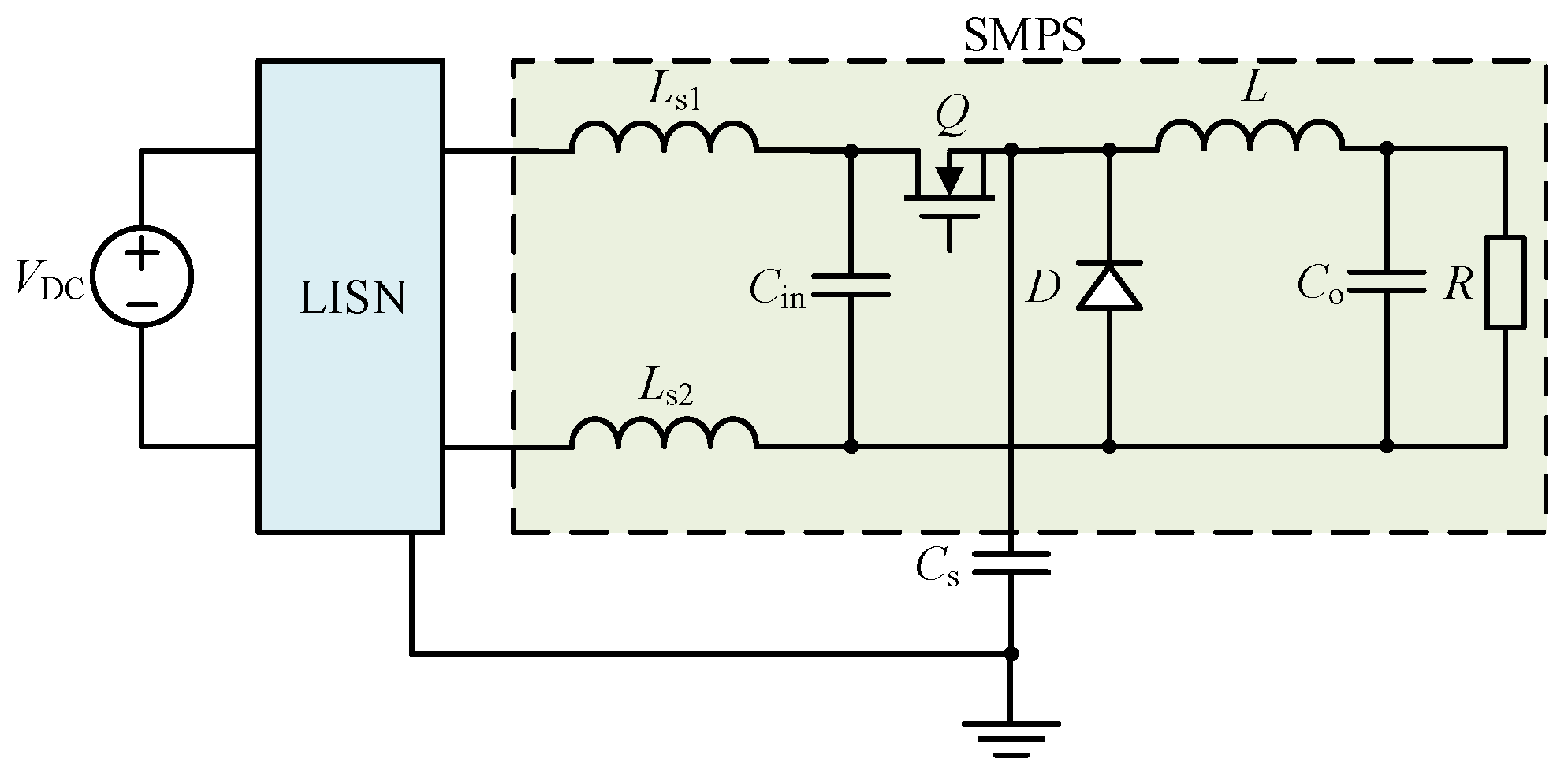
The noise source substitution approach is widely used to derive the equivalent EMI model for an SMPS. In Section 2, the DM impedance of the buck converter shown in Figure 1 is selected to analyze the differences in in-circuit impedances after different substitution methods. It is assumed that the buck converter operates in discontinuous conduction mode (DCM) with a switching period of Ts. During one switching cycle, the conduction time of the switch Q is D1Ts, and the conduction time of the diode D is D2Ts, while the time during which both Q and D are OFF is D3Ts, with D1 + D2 + D3 = 1. VDC is the input DC voltage. Ls1 and Ls2 are the equivalent inductances of the input cables. L is the filter inductance. Cin is the input capacitor. Co is the output capacitor. Cs is the parasitic capacitance between the source terminal of Q and the ground. R is the load, LISN is the line impedance stabilization network.
Figure 1.
The buck converter selected to analyze the differences in in-circuit impedances after different substitution methods.
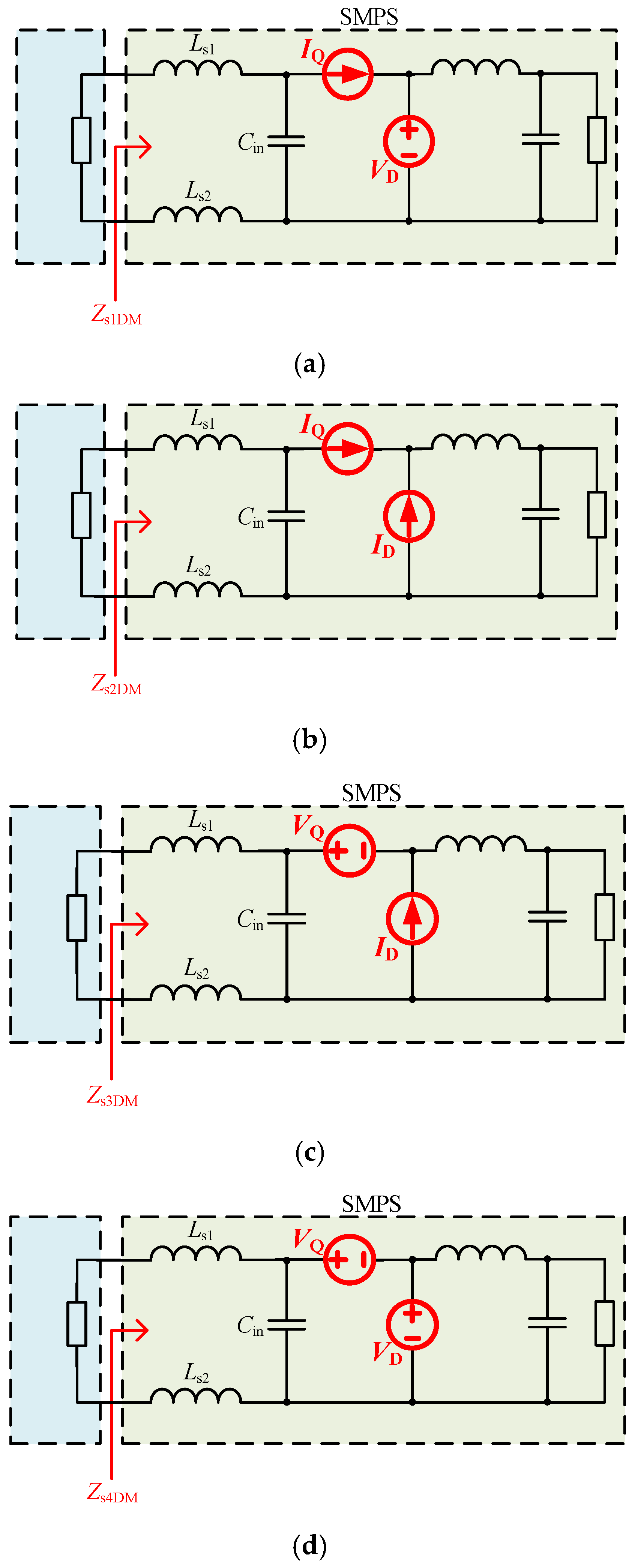
The switch Q and diode D could be replaced by noise voltage sources or current sources, resulting in four possible substitution methods: (1) Q is replaced by a noise current source IQ, and D is replaced by a noise voltage source VD; (2) Q is replaced by a noise current source IQ, and D is replaced by a noise current source ID; (3) Q is replaced by a noise voltage source VQ, and D is replaced by a noise current source ID; and (4) Q is replaced by a noise voltage source VQ, and D is replaced by a noise voltage source VD. The equivalent differential-mode (DM) circuits after the four substitution methods are shown in Figure 2. ZLISN is the impedance of LISN. It is assumed that ZLs1, ZLs2, ZL, ZCin, ZCo, and ZR are the impedances of Ls1, Ls2, L, Cin, Co, and R. Based on Thevenin’s theorem, by short-circuiting the voltage sources and open-circuiting the current sources, the expressions for the DM impedances Zs1DM, Zs2DM, Zs3DM, and Zs4DM after four substitution methods are given by
As shown in (1), (2), and (3), the in-circuit impedance varies when different noise source substitution methods are employed.
Therefore, the correct expression for the in-circuit impedance cannot be obtained by simply using the noise source substitution approach.
Figure 2.
The equivalent DM circuits after four substitution methods. (a) Substitution method 1. (b) Substitution method 2. (c) Substitution method 3. (d) Substitution method 4.
3. A Novel In-Circuit Impedance Modeling Method
To address the limitations of the traditional noise source substitution method, this paper proposes a novel in-circuit impedance modeling approach. This method is based on the general principle of weighted combination of switching modes and linearization, and its modeling process does not rely on specific voltage/current relationships of any particular topology. Therefore, as long as a system can be described by piecewise linear time-varying equations, the model is theoretically applicable to any switched-mode power supply topology with an arbitrary number of switching modes (e.g., boost, buck–boost, multilevel converters, etc.).
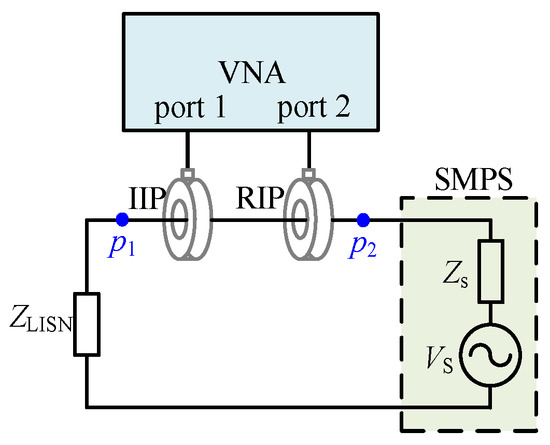
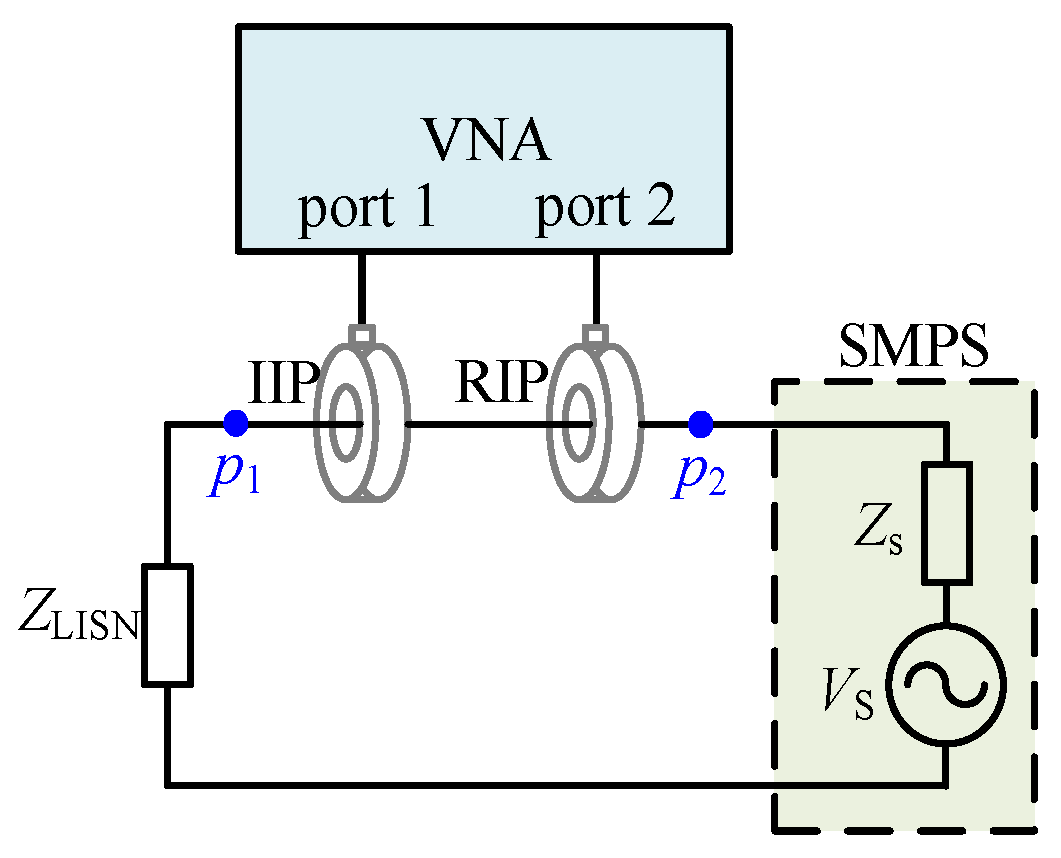
The schematic of the inductive coupling approach for the in-circuit impedance of an SMPS is shown in Figure 3. The VNA injects and receives signals through the IIP and RIP, respectively. Both ports of the VNA (port 1 and port 2) are set to 50 Ω impedance. The in-circuit impedance is calculated from the S-parameters measured by the VNA.
Figure 3.
The schematic of the inductive coupling approach for the in-circuit impedance of an SMPS.
In addition, the single-probe setup based on the inductive coupling approach has also been extensively studied. Both approaches involve injecting a small signal into the circuit, using the VNA to receive the response signal and calculating the in-circuit impedance. Based on the above concept, by injecting an ideal small signal into the SMPS model, the in-circuit impedance can be calculated, thereby establishing an in-circuit model for the SMPS.
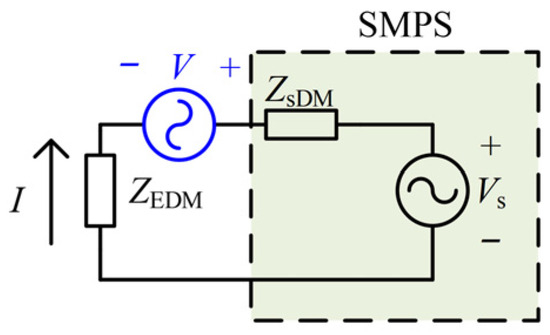
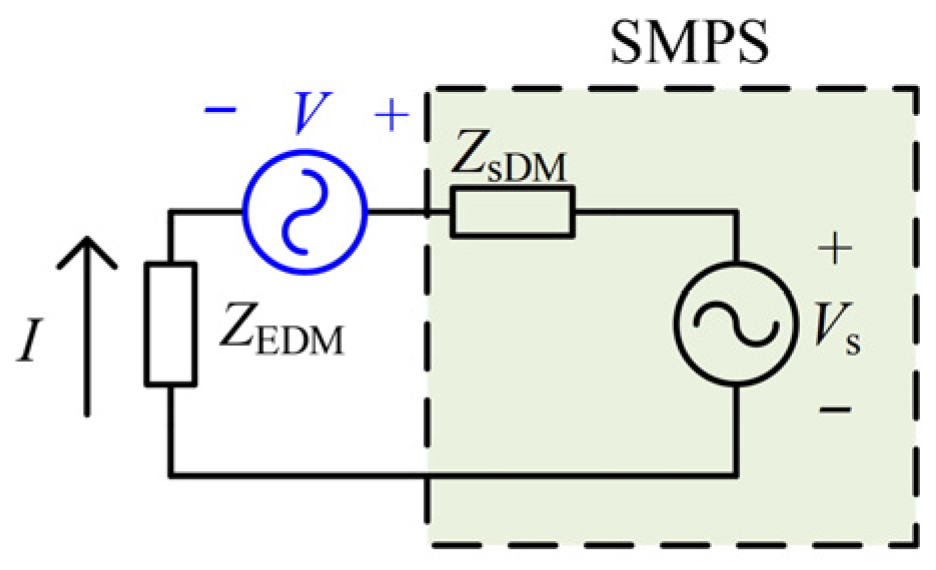
Based on the concept of the inductive coupling approach, an ideal small-signal voltage source v(t) is connected in series in the circuit to simulate the injected signal, which is a sinusoidal wave with a frequency of f and an amplitude of V. The frequency f is equal to neither the switching frequency of the SMPS nor its multiples. The equivalent DM circuit with the injected signal source in series is shown in Figure 4. ZsDM and ZEDM represent the DM impedance and the external impedance of the SMPS, respectively, and ZEDM is equal to ZLISN in Figure 1. Vs represents the equivalent power noise voltage of the SMPS. I represents the equivalent current flowing through the external impedance ZEDM. At the frequency of f, I is equivalent to the current resulting from the sole effect of the injected signal source, which is given by
Figure 4.
The equivalent DM circuit with the injected signal source in series.
Because the buck converter features a simple structure and clear switching modes, the modeling process of the equivalent noise source impedance is analyzed in detail based on the three switching modes of the power switch under the discontinuous conduction mode (DCM). Once the buck converter operates under DCM, it can be divided into three switching modes. Mode 1 corresponds to Q being on and D being off, Mode 2 corresponds to D being on and Q being off, while Mode 3 corresponds to both D and Q being off. The proportions of Mode 1, Mode 2, and Mode 3 are D1, D2, and D3, respectively.
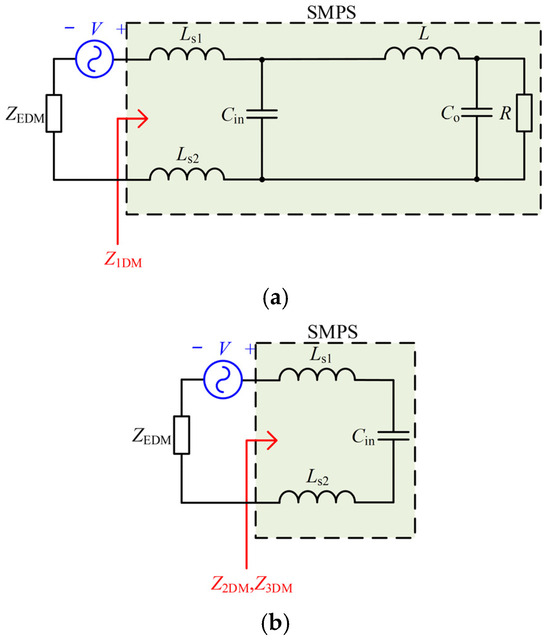
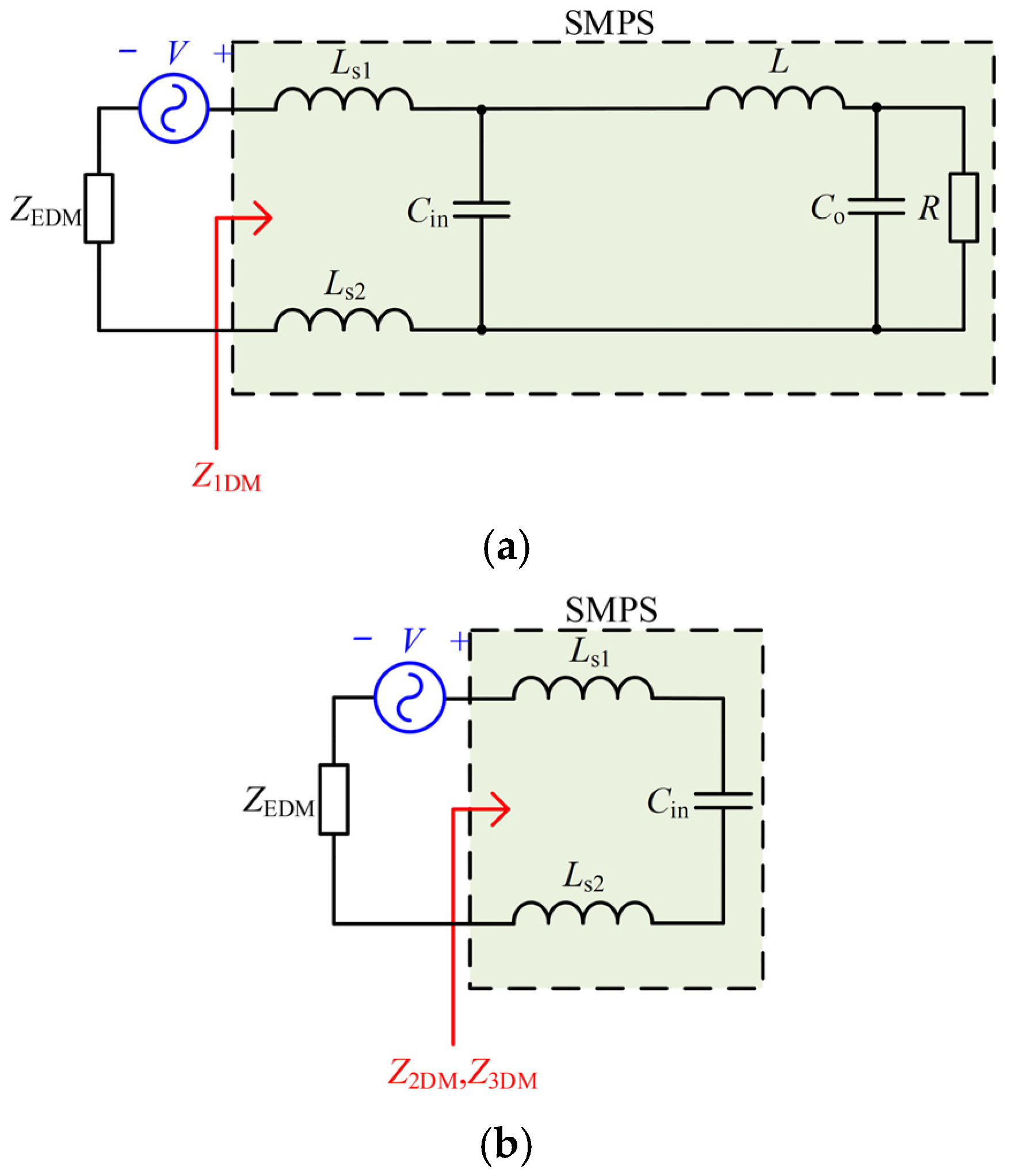
The modal impedances correspond to the input impedances of the Thevenin equivalent circuits under different switching modes. The equivalent DM circuits under Mode 1, Mode 2, and Mode 3 with the injected signal source in series are shown in Figure 5. The DM modal impedances under Mode 1, Mode 2, and Mode 3, denoted as Z1DM, Z2DM, and Z3DM, can be expressed as
Figure 5.
The equivalent DM circuits under Mode 1, Mode 2, and Mode 3 with the injected signal source in series. (a) Mode 1. (b) Mode 2 and Mode 3.
Assuming that the sampling function, denoted as s1(t), can be given by
when the buck converter operates in Mode 1, s1(t) = 1. As the impedances in Mode 2 and Mode 3 are identical, and assuming that the sampling function, denoted as s2(t), can be given by
when the Buck converter operates in Mode 2 and Mode 3, s2(t) = 1.
The equivalent current flowing through ZEDM in Mode 1, denoted as i1(t), can be expressed as follows:
The equivalent current flowing through ZEDM in Mode 2 and Mode 3, denoted as i2(t), can be expressed as follows:
The equivalent current flowing through ZEDM, denoted as i(t), can be expressed as follows:
By using the convolution property in the frequency domain, (11) can be transformed as follows:
Assuming that the fundamental angular frequency ωs = 2π/Ts, the Fourier coefficients of s1(t) can be expressed as
Therefore, the frequency spectrum function of s1(t), denoted as S1(jω), can be expressed as
Based on (14), I1(jω) can be determined as follows:
Because V[j(ω − nωs)] ≠ 0 only when n = 0, when jω equals f, (15) can be transformed as follows:
Similarly, I2(f) can be given by
Substituting (16) and (17) into (18), I(f) can be determined as follows:
Substituting (18) into (4), ZsDM(f) can be determined as follows:
Extending (19) to the entire frequency range, ZsDM of the buck converter can be determined as follows:
Based on the above method for in-circuit impedance analysis, the in-circuit impedance modeling for any SMPS with n switching modes can be proposed. Assuming that the proportions of each switching mode are D1, D2, …, Dn and the DM modal impedances in each switching mode are Z1DM, Z2DM, …, ZnDM, ZsDM can be given by
In existing studies, the impedance of the input capacitor is commonly treated as the DM impedance due to the noise source substitution approach. Although this simplification has little impact in the frequency range below 10 MHz, it can lead to significant inaccuracies in EMI modeling at higher frequencies.
In contrast, the model proposed in this section is not a single equivalent impedance. Instead, it is analytically expressed as a time-weighted combination of the corresponding impedances (modal impedances) under each switching mode over one switching cycle. This approach not only provides port characteristic prediction accuracy comparable to that of classical methods, but, more importantly, it directly relates the dynamics of online impedance to the physical process of switching modes. This enables quantitative analysis of the contribution of different switching states to the overall impedance. Thereby, by using the proposed in-circuit impedance modeling, the accuracy of the equivalent EMI model for the SMPS can be further improved, which is helpful for the optimization of EMI suppression techniques.
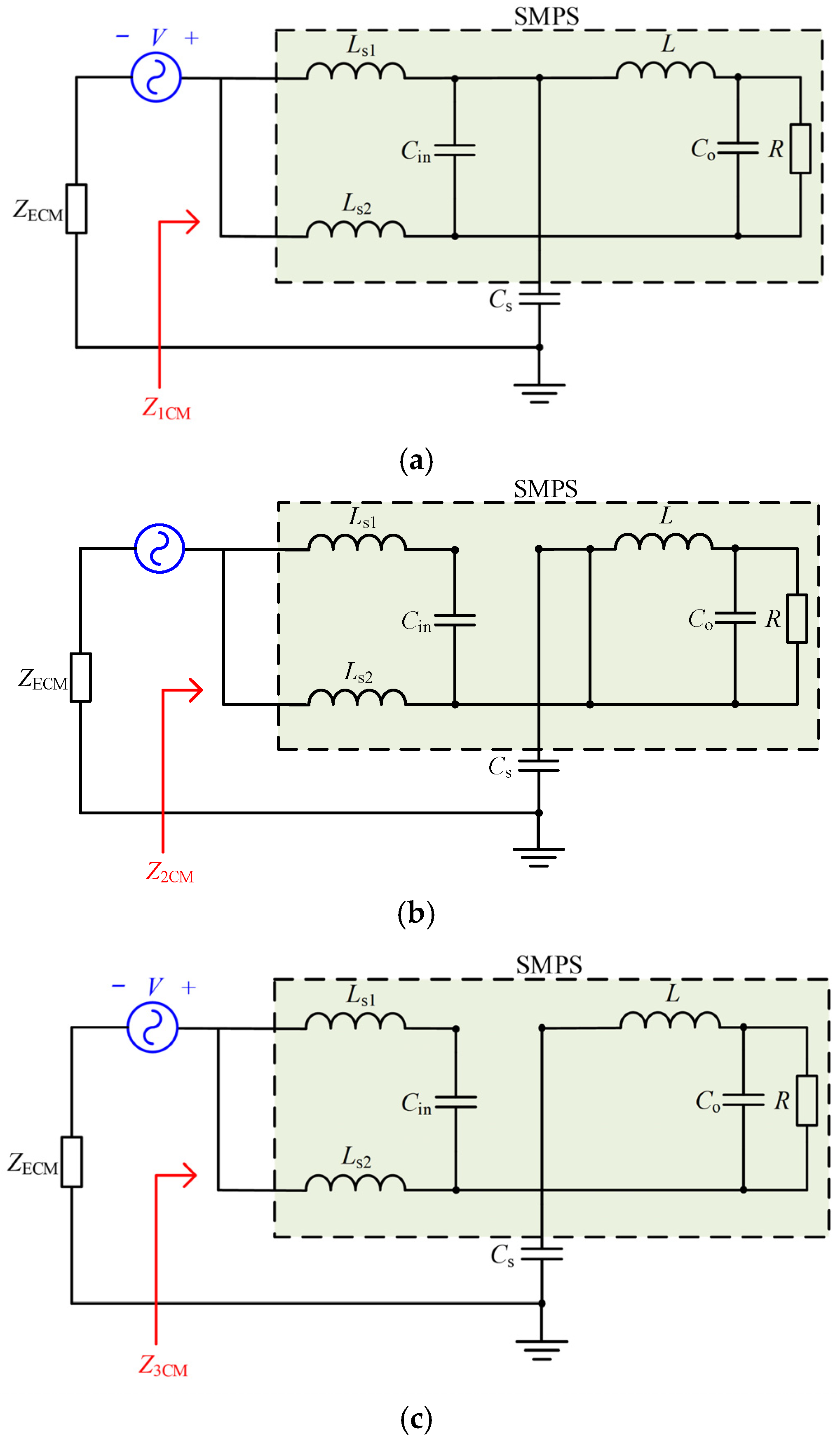
The equivalent CM circuits under Mode 1, Mode 2, and Mode 3 with the injected signal source in series are shown in Figure 6. It is assumed that ZCs is the impedance of Cs. The CM modal impedances under Mode 1, Mode 2, and Mode 3, denoted as Z1CM, Z2CM, and Z3CM, can be expressed as
ZsCM of the buck converter can be determined as follows:
Assuming that the proportions of each switching mode are D1, D2, …, Dn and that the CM modal impedances in each switching mode are Z1CM, Z2CM, …, ZnCM, ZsCM can be given by
Figure 6.
The equivalent CM circuits under Mode 1, Mode 2, and Mode 3 with the injected signal source in series. (a) Mode 1. (b) Mode 2. (c) Mode 3.
4. Variation Characteristics Analysis of the In-Circuit Impedance for the SMPS
4.1. Variation Characteristics Analysis
As shown in (21) and (26), the in-circuit impedance for the SMPS is related to the external impedance, the modal impedance under different switching modes, and the proportion of each switching mode.
Taking an SMPS with two switching modes as an example, the in-circuit impedance Zs can be simplified as
Substituting D2 = 1 − D1 into (27), Zs can be expressed as follows:
Substituting D1 = 1 − D2 into (27), Zs can be expressed as follows:
When |ZE| > |Z1|, |ZE| > |Z2|, |ZE| > |Z1Z2|, Zs expressed in (27) can be approximated by
On the contrary, when |ZE| < |Z1|, |ZE| < |Z2|, Zs can be approximated by
Based on (28)–(31), the following conclusions can be obtained:
- (1)
- The greater D1 is, the longer the SMPS operates in Mode 1, and the closer Zs approaches the modal impedance under Mode 1 Z1. Similarly, the greater D2 is, the longer the SMPS operates in Mode 2, and the closer Zs approaches the modal impedance under Mode 2 Z2;
- (2)
- When ZE is much greater than Z1 and Z2, Zs approaches Z1D1 + Z2D2; when ZE is much smaller than Z1 and Z2, Zs approaches (Z1/D1)//(Z2/D2).
The DM impedance of the buck converter operating in continuous conduction mode (CCM) shown in Figure 1 is selected for the following analysis. The parameters of the circuit are listed in Table 1. ESL is the series parasitic inductance of Cin. ESR is the series parasitic resistance of Cin. EPC is the parallel parasitic capacitance of L.
Table 1.
The Parameters of the circuit.
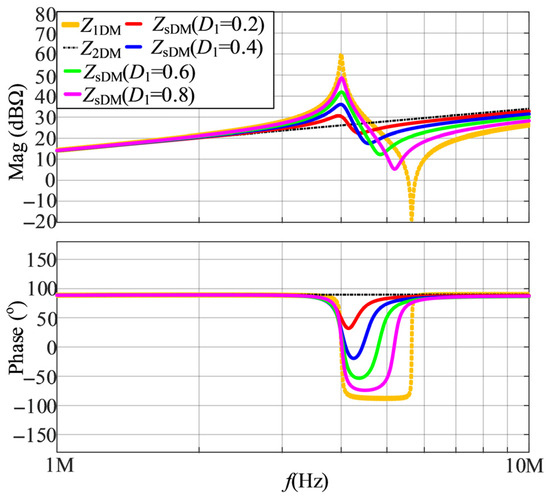
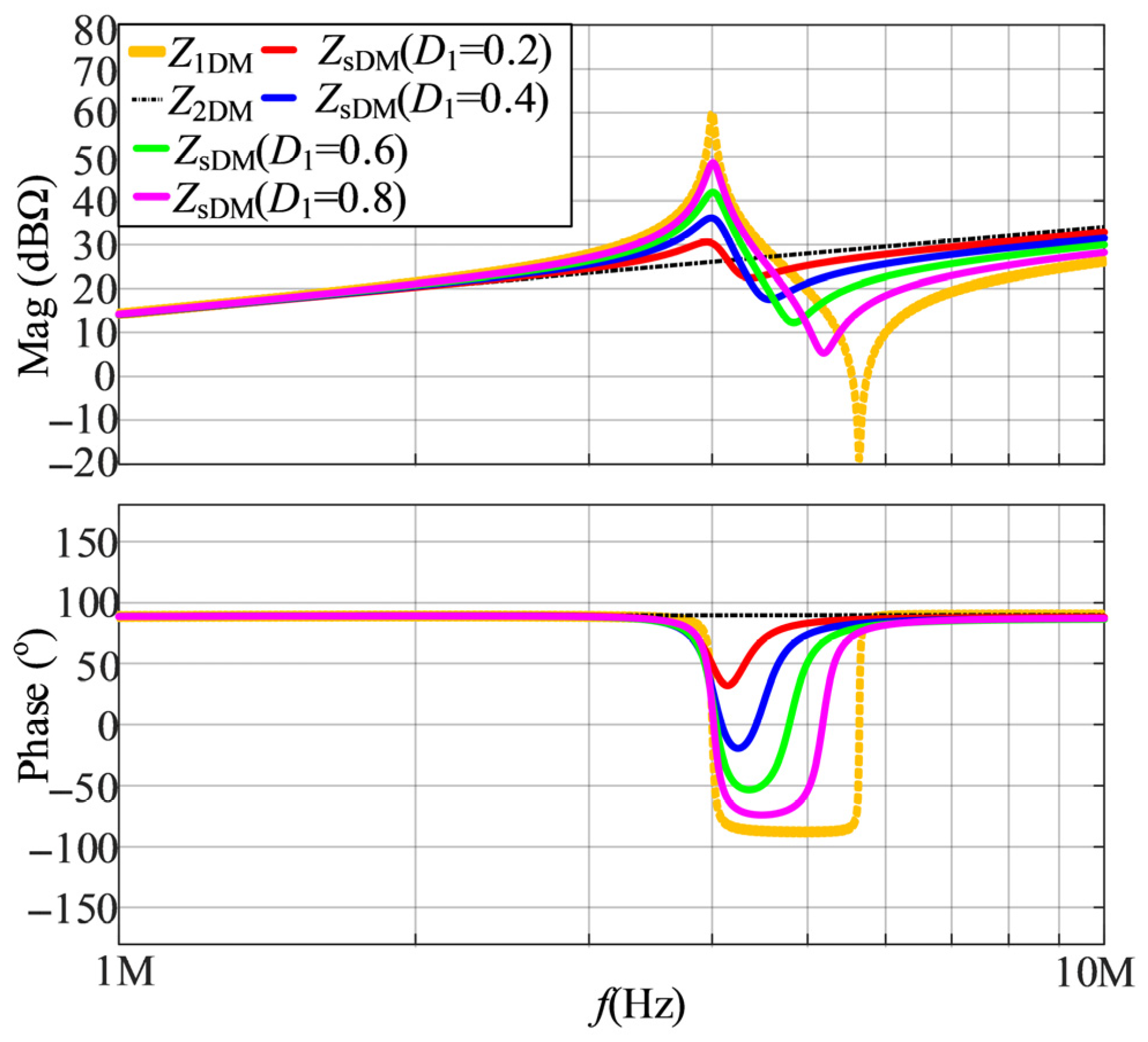
Based on (20), when ZEDM is equal to ZLISN and the values of D1 are 0.2, 0.4, 0.6, and 0.8, the calculated results of DM impedances are shown in Figure 7. It is shown that as D1 increases, the second resonant frequency of ZsDM increases and the first resonant frequency remains nearly constant, while the phase variation of ZsDM becomes more significant.
Figure 7.
The calculated results of DM impedances when ZEDM is equal to ZLISN and the values of D1 are 0.2, 0.4, 0.6, and 0.8.
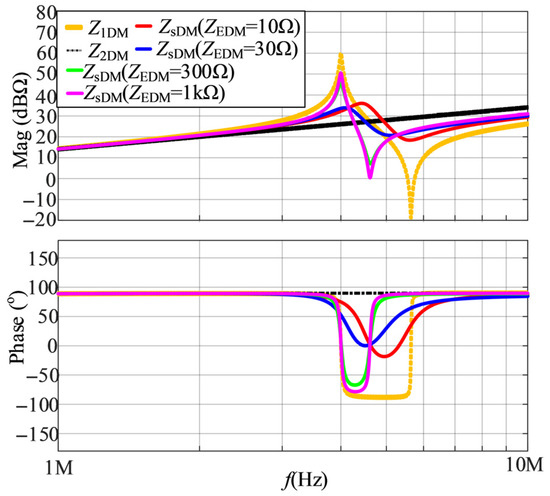
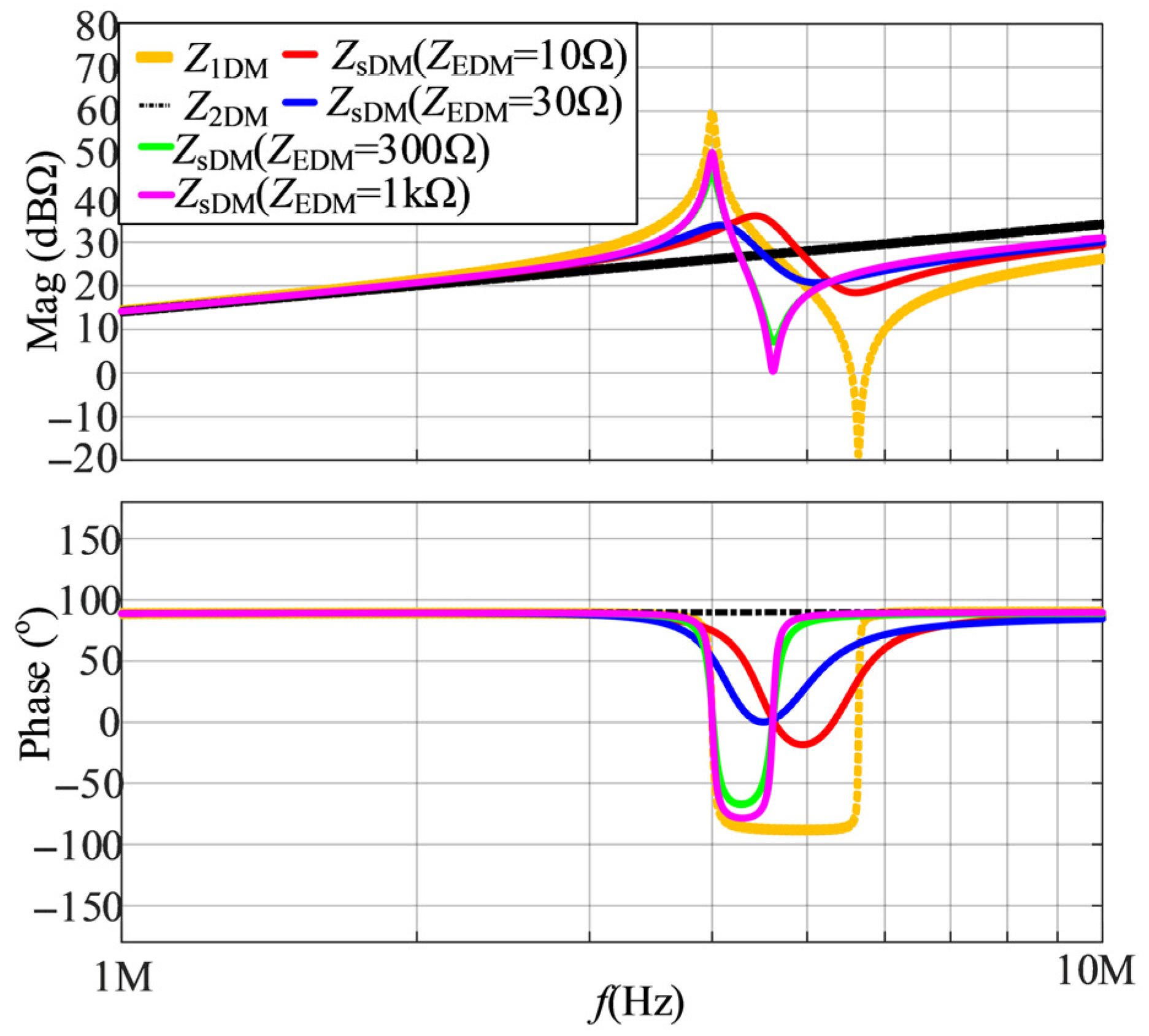
When the value of D1 is 0.5 and ZEDM are resistors of 10 Ω, 30 Ω, 300 Ω, and 1 kΩ, the calculated results of DM impedances are shown in Figure 8. It is shown that as ZEDM increases, both of the two resonant frequencies of ZsDM decrease, while the phase variation of ZsDM first decreases and then increases.
Figure 8.
The calculated results of DM impedances when the value of D1 is 0.5 and ZEDM are resistors of 10 Ω, 30 Ω, 300 Ω, and 1 kΩ.
Extending the above conclusions to any SMPS with n switching modes, the following conclusions can be obtained:
- (1)
- The greater Di (i = 1, 2, …, n) is, the closer Zs approaches Zi (i = 1, 2, …, n);
- (2)
- When ZE is much greater than Zi, Zs approaches (32); when ZE is much smaller than Zi, Zs approaches (33).
4.2. Simulation Verification
To validate the above conclusions, the DM impedance of the buck converter shown in Figure 1 operating in CCM was selected for simulation verification. The inductive coupling approach was employed for simulation verification (13). Simulation parameters of the circuit are also listed in Table 1.
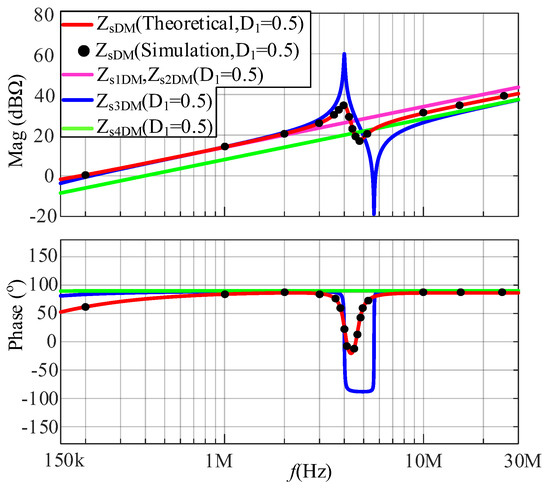
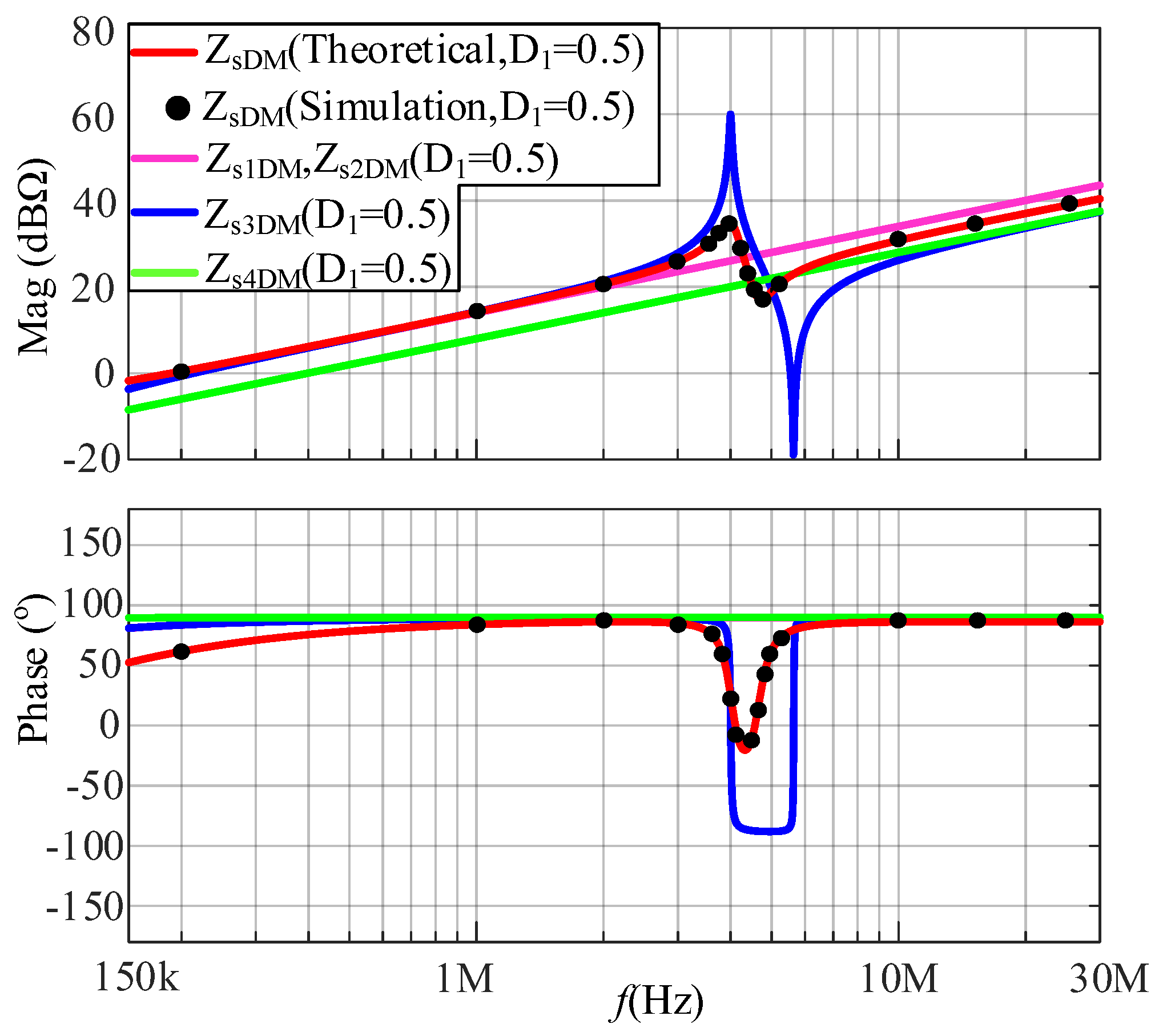
According to (20), the DM impedance at a duty cycle of 0.5 can be calculated. The comparison between the simulated and calculated results of the DM impedances is shown in Figure 9. It is shown that the calculated results are in good agreement with the simulated results, verifying the correctness of the proposed model. The DM impedances Zs1DM, Zs2DM, Zs3DM, and Zs4DM after four substitution methods are also shown in Figure 9. Judging from Figure 9, the noise source substitution approach fails to derive the correct in-circuit impedance with large parasitic parameters.
Figure 9.
The comparison between the simulated and calculated results of DM impedances at a duty cycle of 0.5.
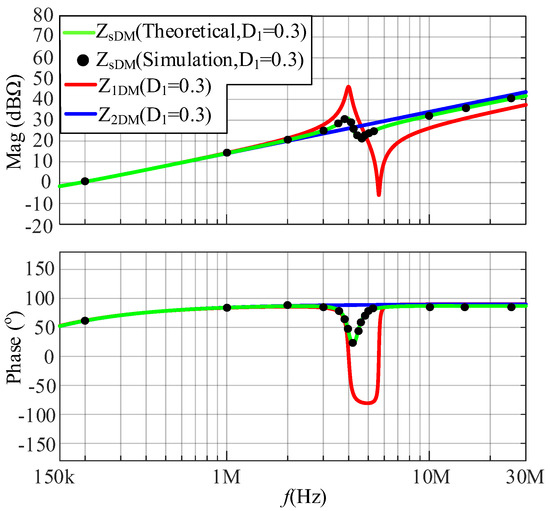
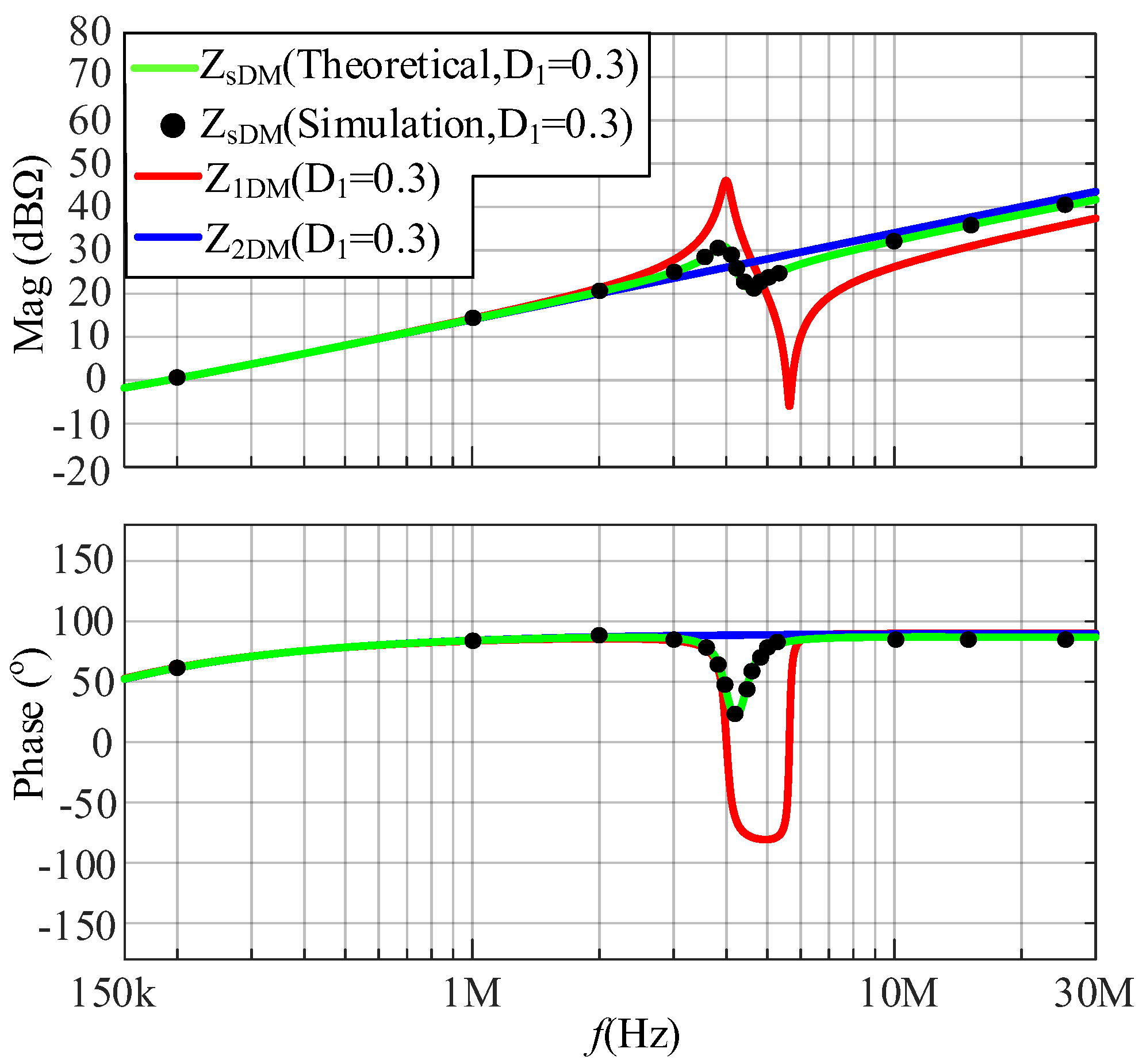
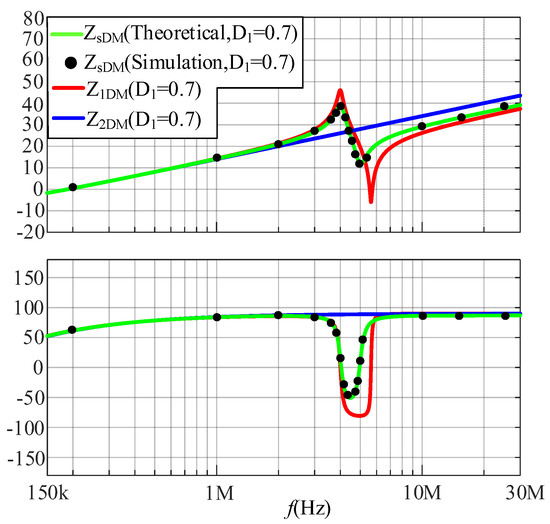
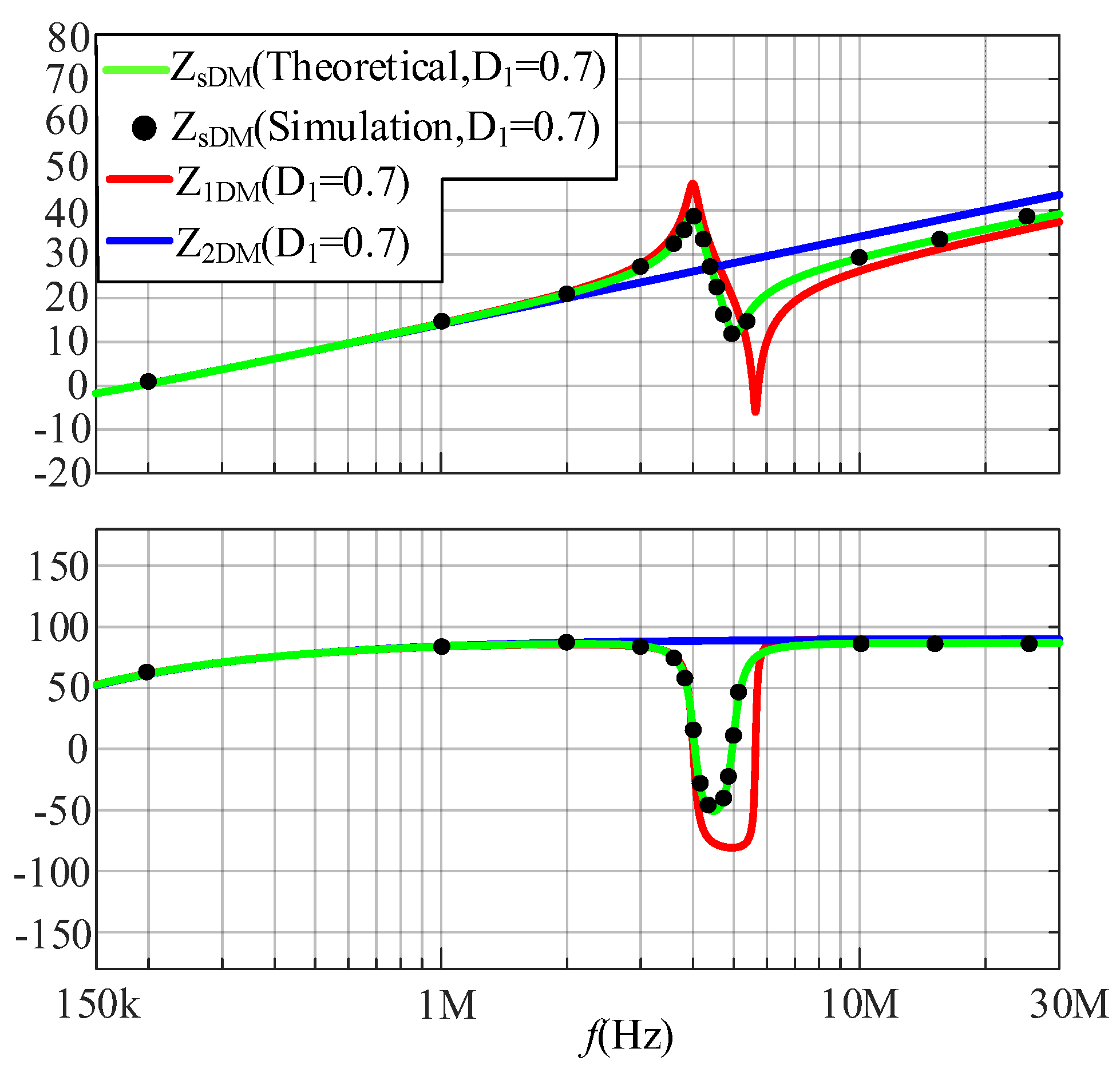
The comparisons between the simulated and calculated results of the DM impedance at a duty cycle of 0.3 and 0.7 are shown in Figure 10 and Figure 11, respectively. Based on Figure 10 and Figure 11, when D1 is 0.3 and D2 is 0.7, ZsDM is closer to Z2DM; when D1 is 0.7 and D2 is 0.3, ZsDM is closer to Z1DM. The following conclusion is verified: the greater Di is, the closer Zs approaches Zi.
Figure 10.
The comparison between the simulated and calculated results of DM impedances at a duty cycle of 0.3.
Figure 11.
The comparison between the simulated and calculated results of DM impedances at a duty cycle of 0.7.
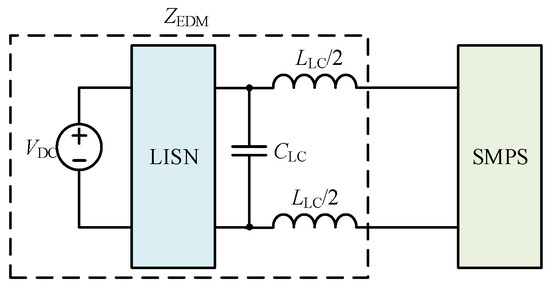
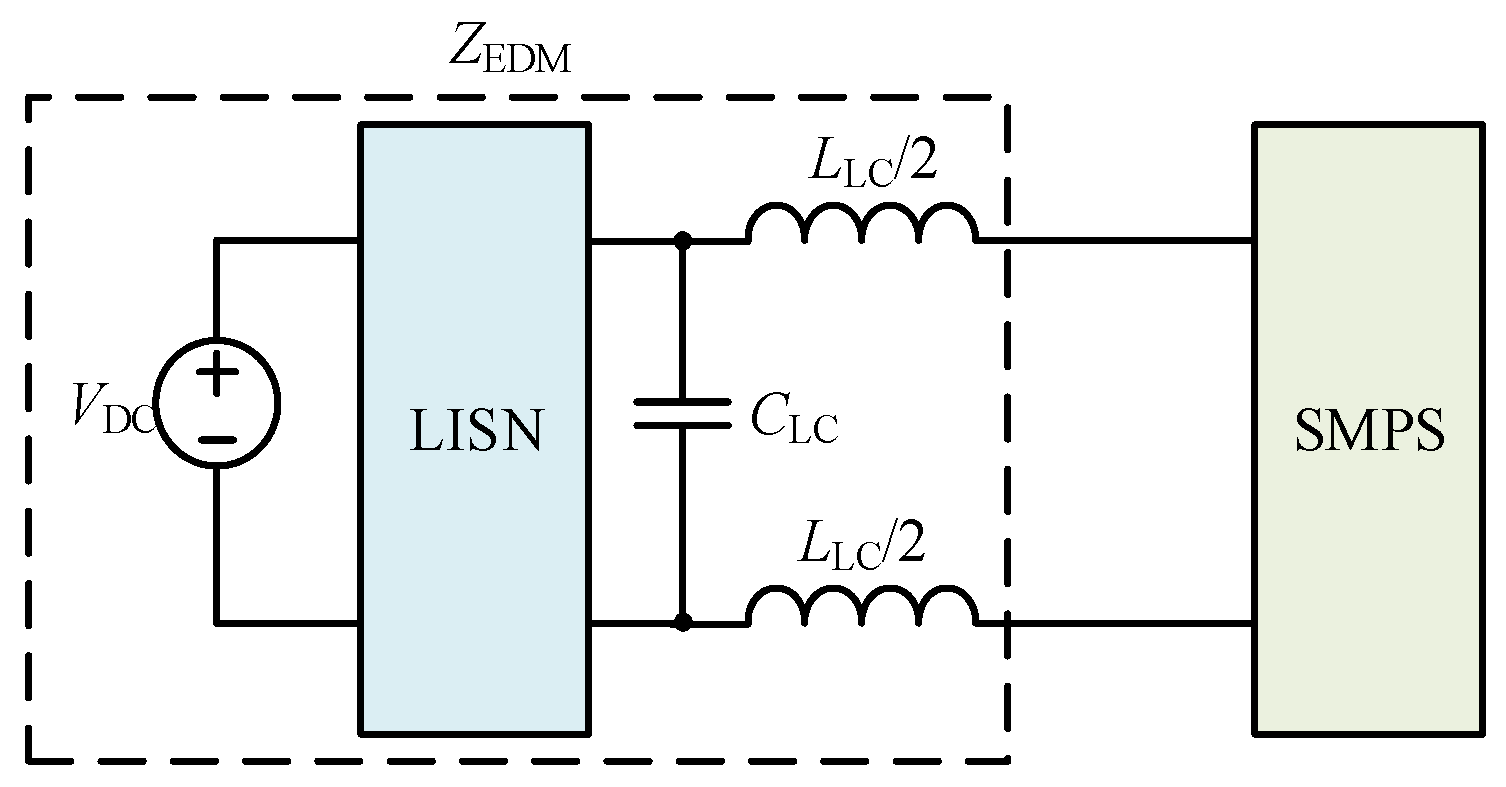
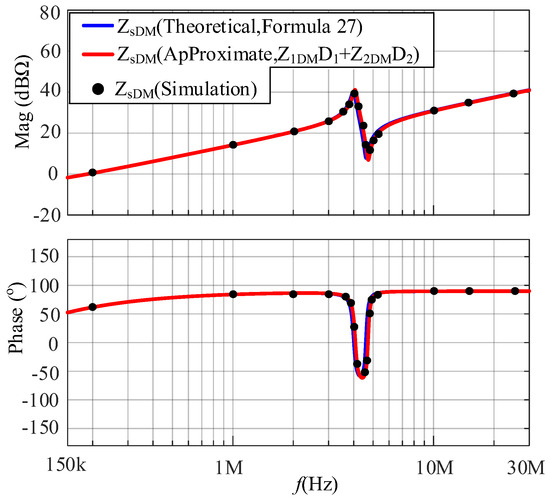
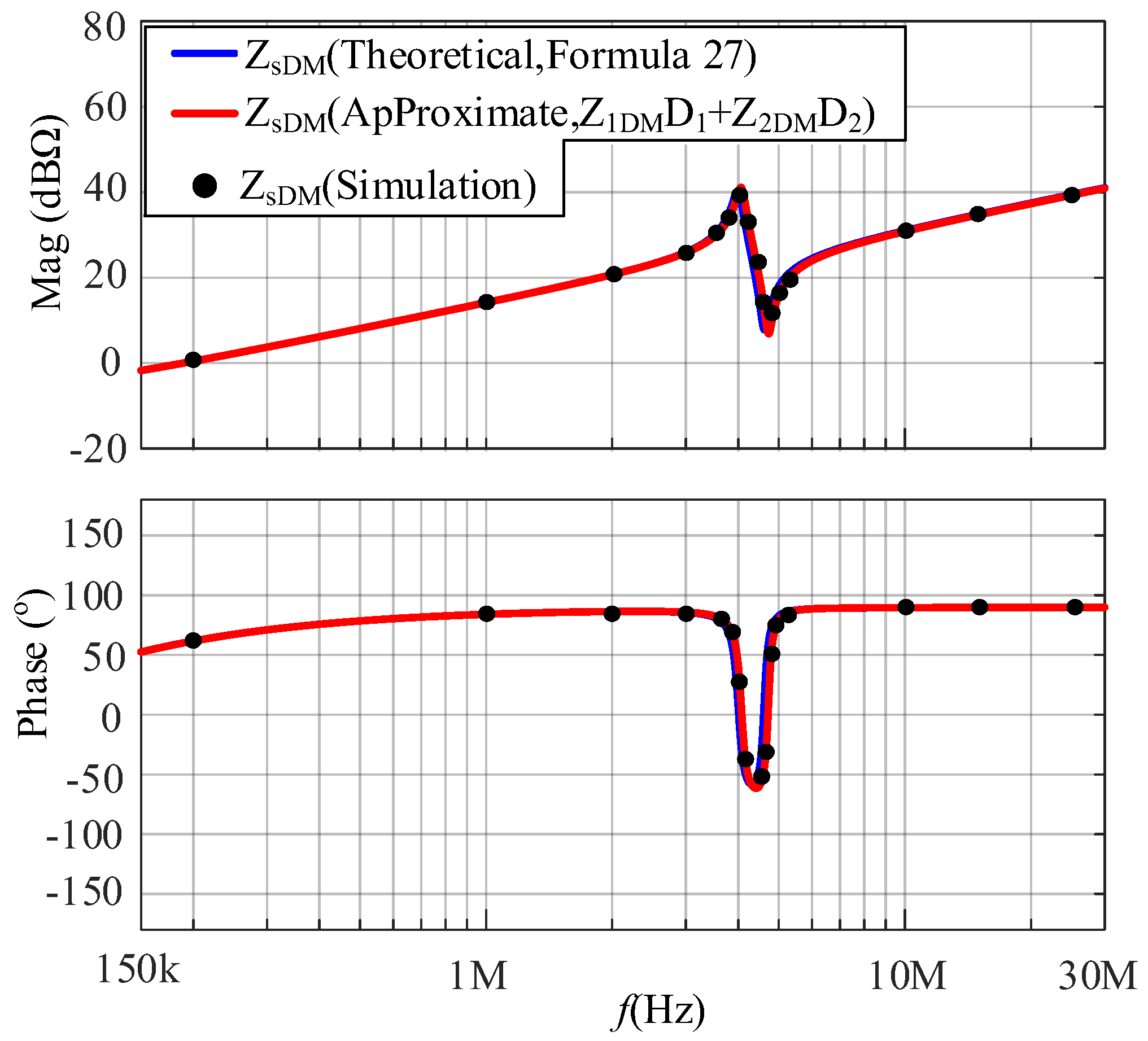
An LC DM EMI filter is inserted between the SMPS and the LISN as shown in Figure 12. The LC DM EMI filter is part of the ZEDM, with LLC and CLC values of 5 μH and 100 nF, respectively. In the frequency range of interest, ZEDM is much greater than Z1DM and Z2DM. The comparison between the simulated and calculated results of the DM impedance at a duty cycle of 0.5 after inserting an LC DM EMI filter is shown in Figure 13. Based on Figure 13, Zs approaches Z1D1 + Z2D2.
Figure 12.
The schematic diagram after the insertion of the LC DM EMI filter.
Figure 13.
The comparison between the simulated and calculated results of DM impedances after inserting an LC DM EMI filter.
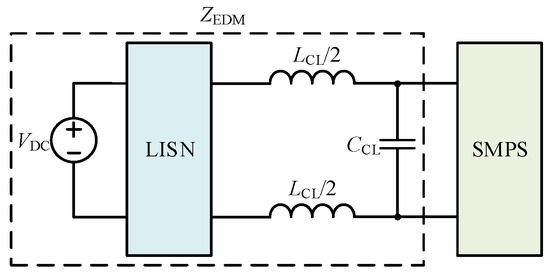
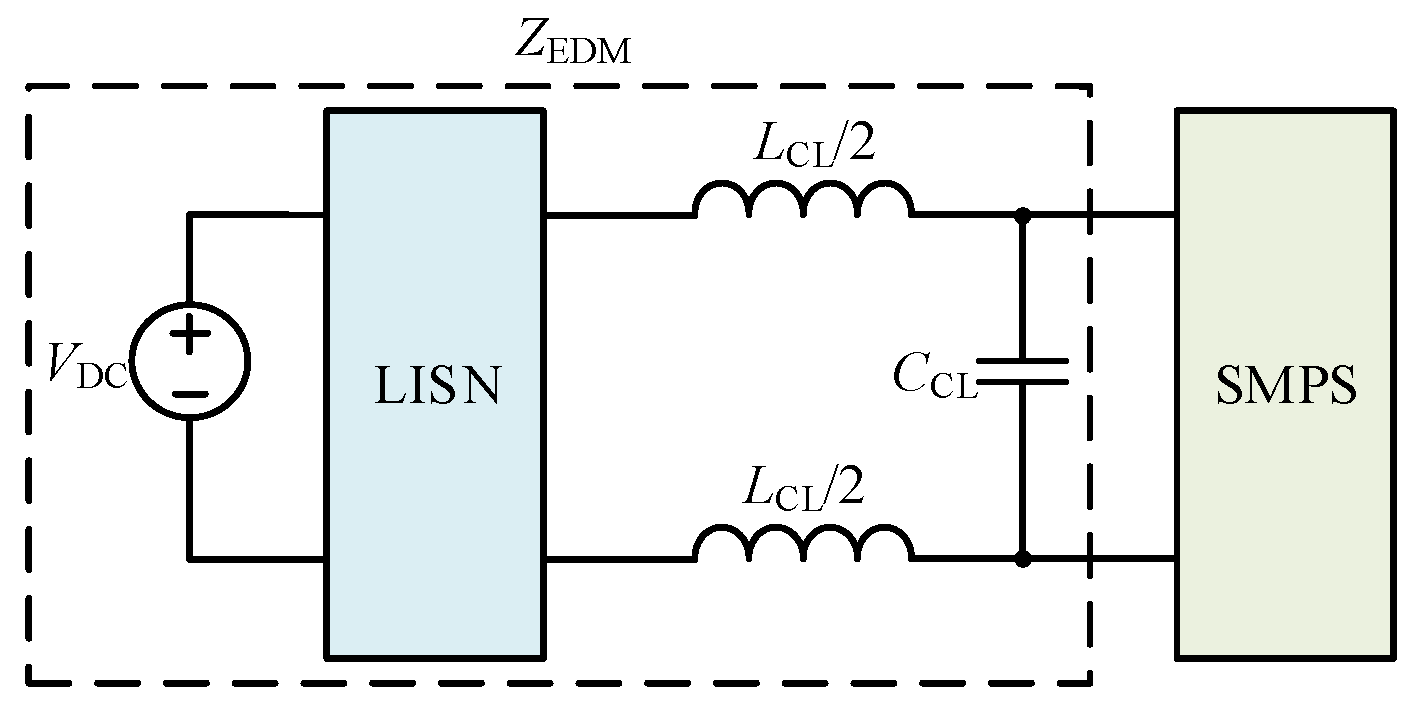
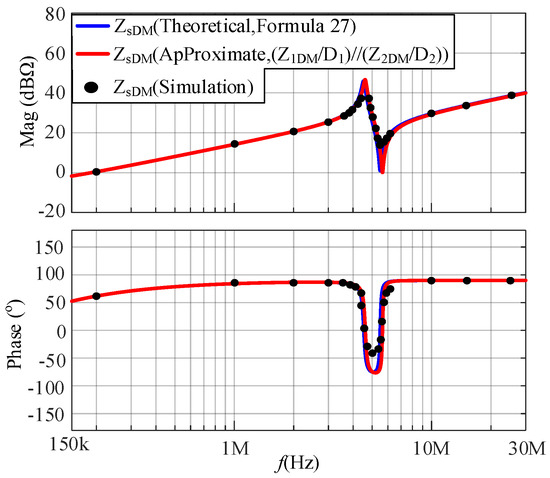
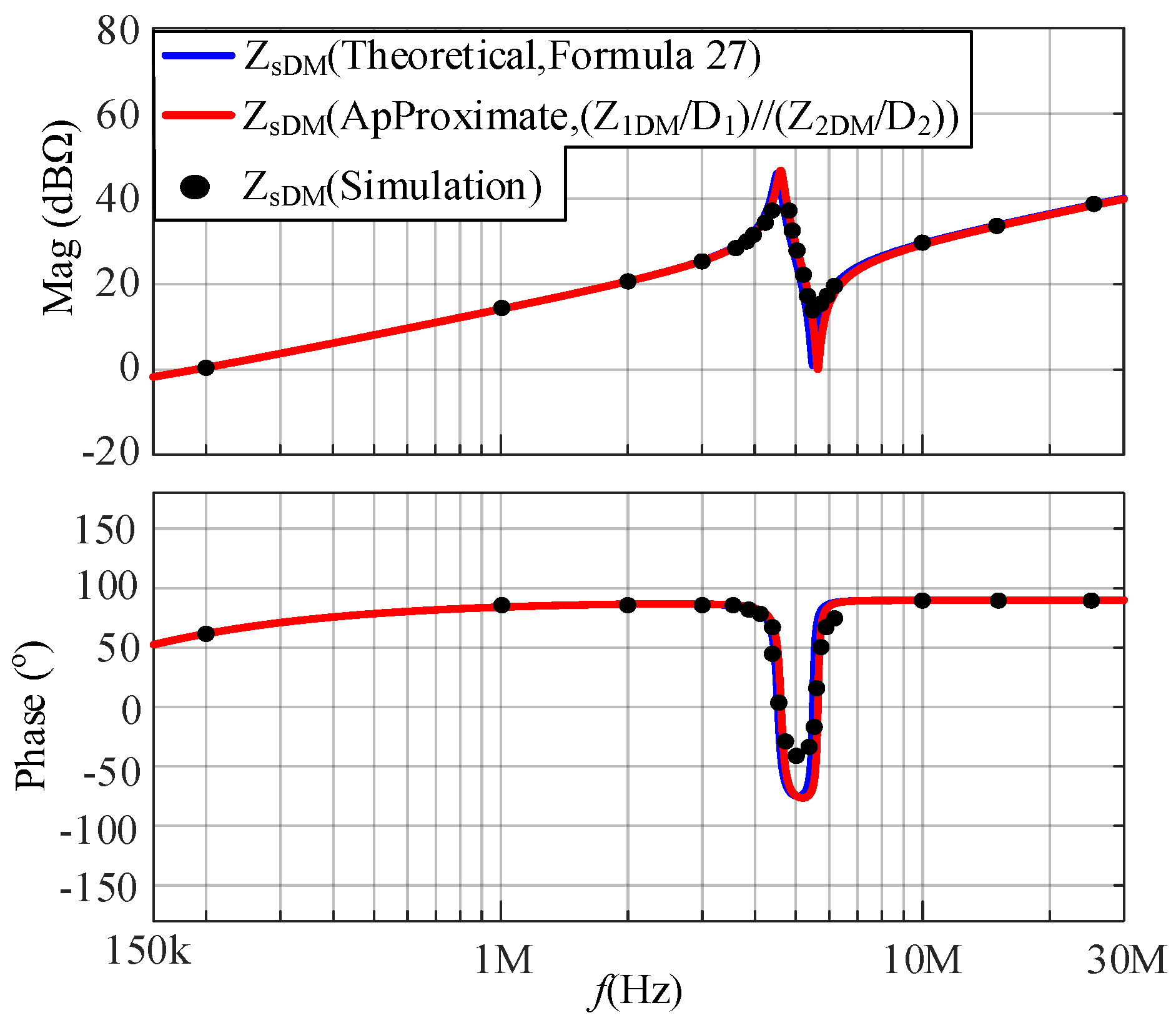
A CL DM EMI filter is inserted between the SMPS and the LISN as shown in Figure 14. The CL DM EMI filter is part of ZEDM, with LCL and CCL values of 100 μH and 100 nF, respectively. In the frequency range of concern, ZEDM is much smaller than Z1DM and Z2DM. The comparison between the simulated and calculated results of the DM impedance at a duty cycle of 0.5 after inserting a CL DM EMI filter is shown in Figure 15. Based on Figure 15, Zs approaches (Z1/D1)//(Z2/D2).
Figure 14.
The schematic diagram after the insertion of the CL DM EMI filter.
Figure 15.
The comparison between the simulated and calculated results of DM impedances after inserting a CL DM EMI filter.
5. Experimental Verification
To verify the correctness of the proposed model, a buck converter prototype operating in CCM was fabricated with the following specifications: input voltage Uin = 48 V, output power Pout = 400 W, and switching frequency fsw = 200 kHz.
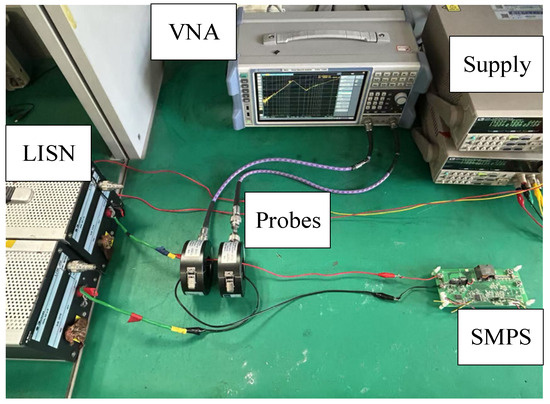
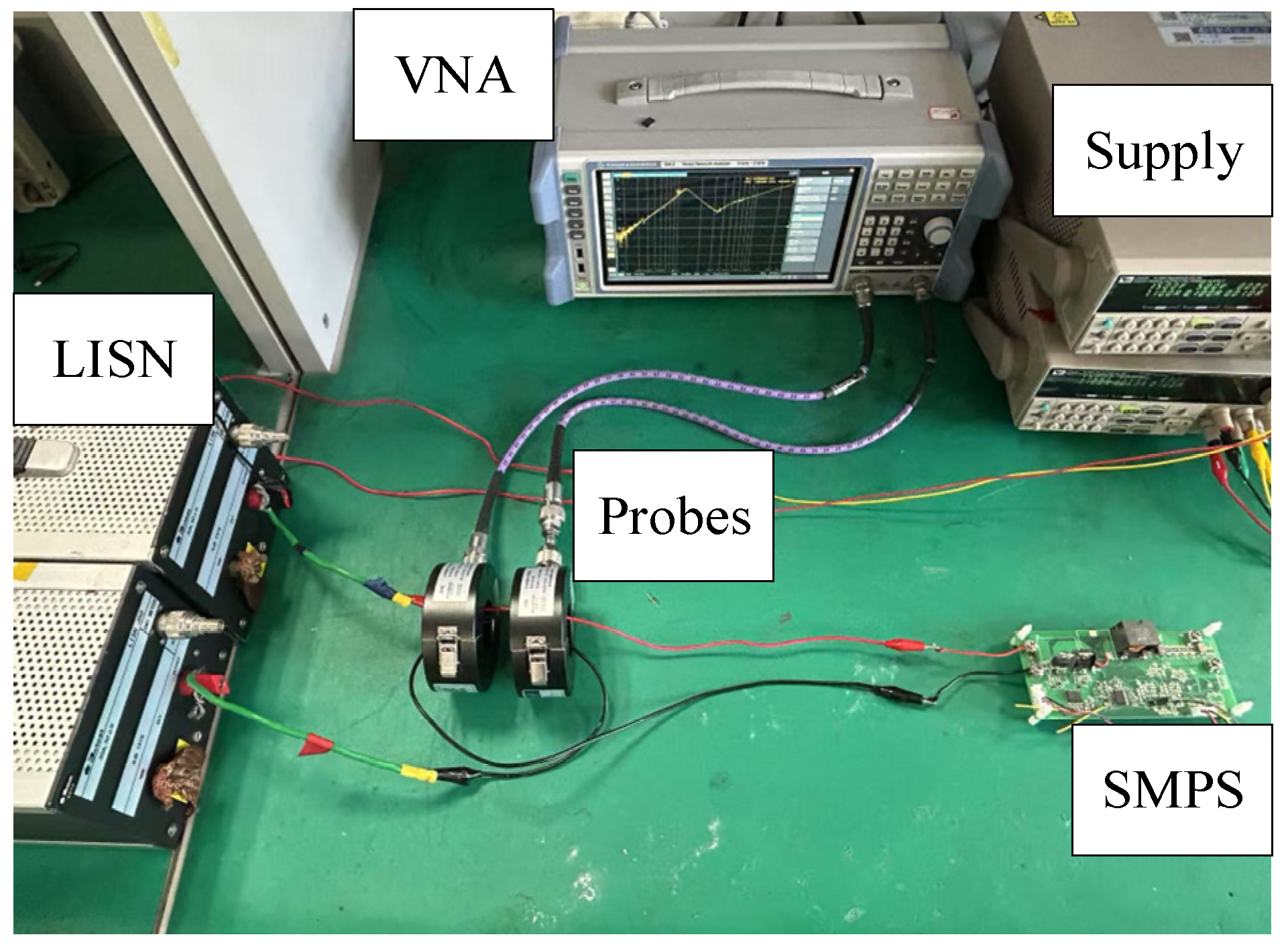
In this article, the inductive coupling approach is employed to extract the DM impedance of the experimental prototype (13). An R&S ZLN3 vector network analyzer, two MYCP01 current probes, and a 3Ctest LISN J50 are employed.
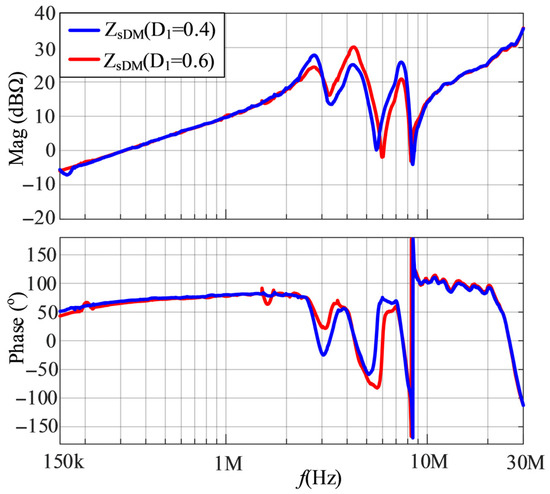
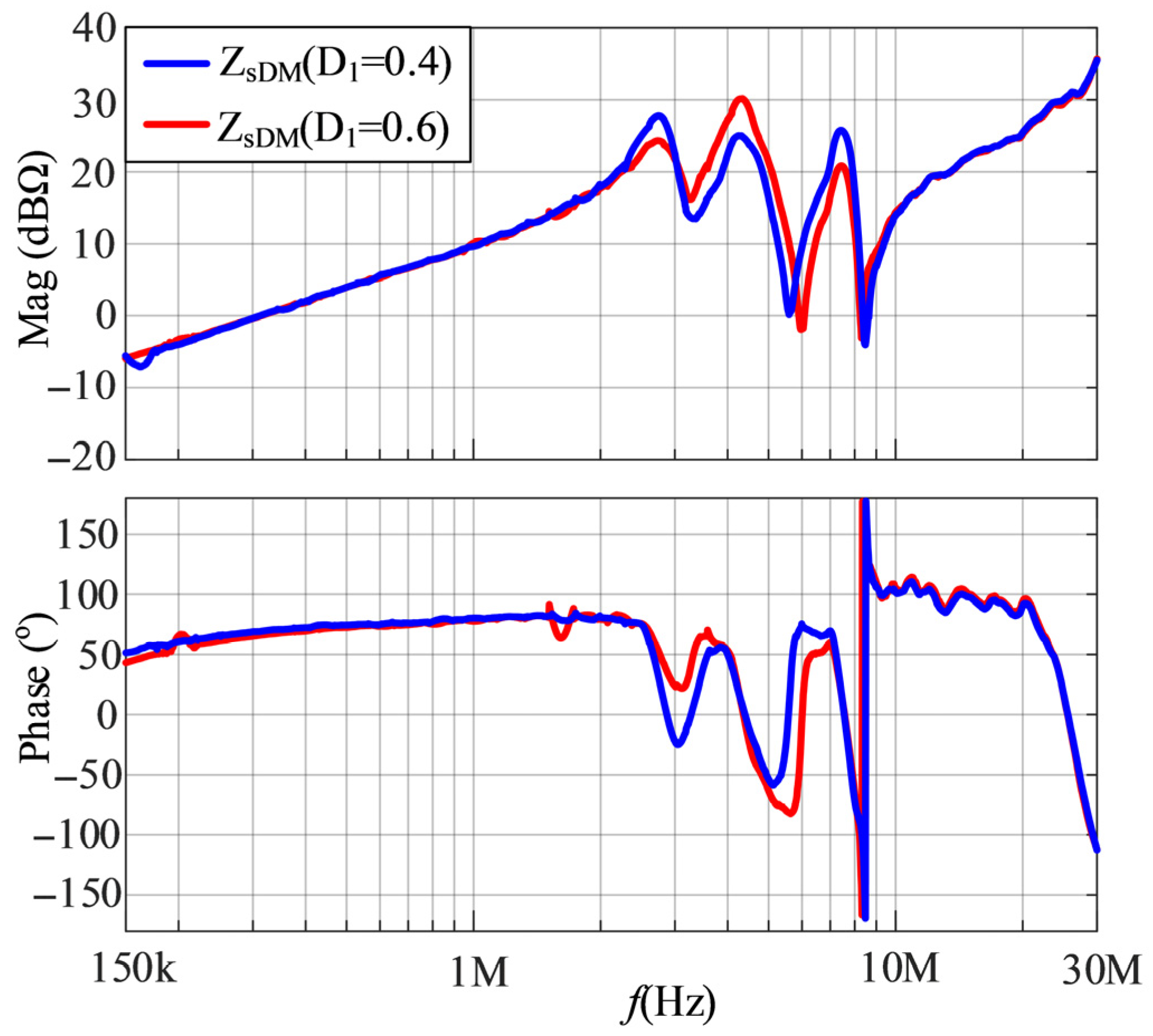
The in-circuit impedance measurement setup for the SMPS is shown in Figure 16. Due to the parasitic parameters of the switch and diode and the DC bias characteristics of the capacitors and inductors, Z1DM and Z2DM cannot be directly measured. Therefore, firstly, DM impedances of the SMPS with duty cycles of 0.4 and 0.6 are obtained by the inductive coupling approach, as shown in Figure 17. From Figure 17, it is shown that the in-circuit impedances exhibit certain differences under different duty cycles.
Figure 16.
The DM impedance measurement setup for the SMPS.
Figure 17.
The DM impedances of the SMPS with duty cycles of 0.4 and 0.6.
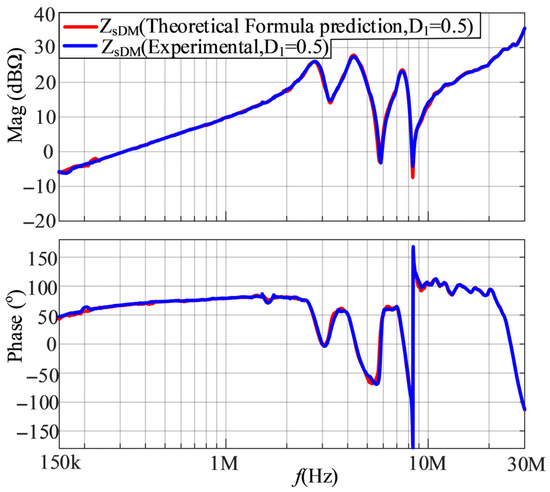
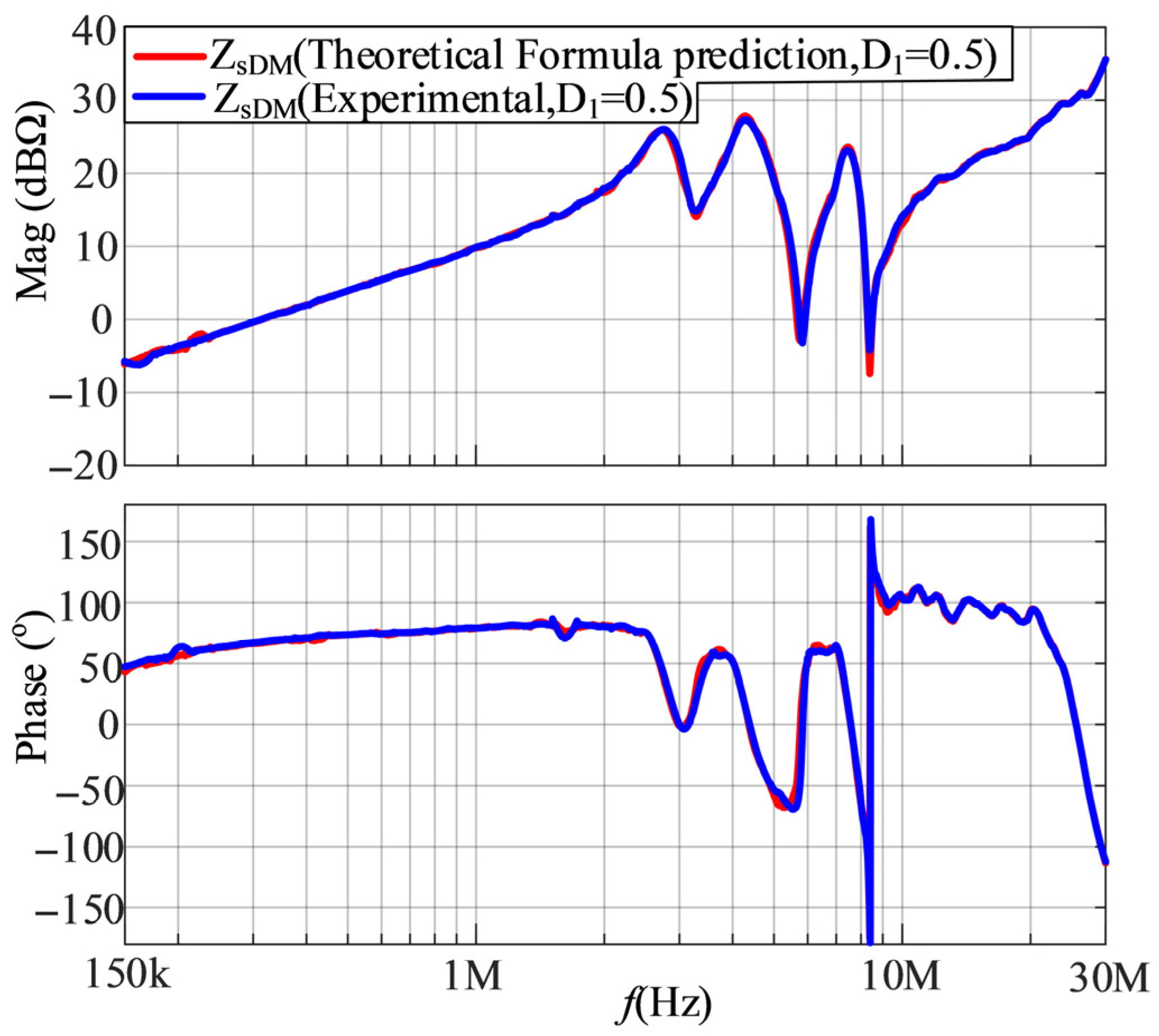
Given the DM impedances of the SMPS at duty cycles of 0.4 and 0.6, Z1DM and Z2DM can be derived by (20). Substituting Z1DM and Z2DM back into (20), the DM impedance of the SMPS at a duty cycle of 0.5 can be calculated. The comparison between the experimental and calculated results of DM impedances at a duty cycle of 0.5 is shown in Figure 18. Based on Figure 18, the calculated results are in good agreement with the experimental results, verifying the correctness of the proposed model.
Figure 18.
The comparison between the experimental and calculated results of DM impedances at a duty cycle of 0.5.
6. Conclusions
In order to explore the variation characteristics of the in-circuit impedance for an SMPS, a novel method for in-circuit impedance modeling is proposed in this article based on the concept of the inductive coupling approach. Through an in-depth analysis of this model, the primary conclusions obtained are as follows:
- (1)
- The in-circuit impedance of an SMPS is related to the external impedance, the modal impedance under different switching modes, and the proportion of each switching mode;
- (2)
- The greater Di is, the closer Zs approaches Zi;
- (3)
- When ZE is much greater than Zi, Zs approaches (32), and when ZE is much smaller than Zi, Zs approaches (33).
Through simulation and experimental verification, it is demonstrated that the proposed model can accurately characterize the in-circuit impedance of an SMPS, which can provide valuable guidance for the design of EMI suppression measures.
Author Contributions
Conceptualization, J.Z. and Z.Z.; methodology, J.Z.; software, J.Z. and Z.Z.; validation, J.Z., Z.Z., R.Z., C.G. and J.C.; formal analysis, J.Z., Z.Z. and J.C.; investigation, J.Z.; resources, J.Z.; data curation, J.Z.; writing—original draft preparation, J.Z. and Z.Z.; writing—review and editing, J.Z.; visualization, J.Z.; supervision, C.G. and J.C.; project administration, J.Z.; funding acquisition, C.G. and J.C. All authors have read and agreed to the published version of the manuscript.
Funding
This research received no external funding.
Informed Consent Statement
Not applicable.
Data Availability Statement
The datasets generated and analyzed during this study are not currently publicly available as they form part of an on-going research project and are planned for use in forthcoming publications.
Conflicts of Interest
The authors declare no conflicts of interest.
References
- Mainali, K.; Oruganti, R. Conducted EMI mitigation techniques for switch-mode power converters: A survey. IEEE Trans. Power Electron. 2010, 25, 2344–2356. [Google Scholar] [CrossRef] [Scilit]
- Borsalani, J.; Dastfan, A.; Ghalibafan, J. An integrated EMI choke with improved DM inductance. IEEE Trans. Power Electron. 2021, 36, 1646–1658. [Google Scholar] [CrossRef] [Scilit]
- Shin, D.; Jeong, S.; Kim, J. Quantified design guidelines of a compact transformerless active EMI filter for performance, stability, and high voltage immunity. IEEE Trans. Power Electron. 2018, 33, 6723–6737. [Google Scholar] [CrossRef] [Scilit]
- Chen, W.; Yang, X.; Wang, Z. A novel hybrid common-mode EMI filter with active impedance multiplication. IEEE Trans. Ind. Electron. 2011, 58, 1826–1834. [Google Scholar]
- Fan, F.; See, K.Y.; Liu, X.; Li, K.; Gupta, A.K. Systematic common-mode filter design for inverter-driven motor system based on in-circuit impedance extraction. IEEE Trans. Electromagn. Compat. 2020, 62, 1711–1722. [Google Scholar] [CrossRef] [Scilit]
- Tarateeraseth, V.; See, K.Y.; Canavero, F.G.; Chang, R.W. Systematic electromagnetic interference filter design based on information from in-circuit impedance measurements. IEEE Trans. Electromagn. Compat. 2010, 52, 588–598. [Google Scholar] [CrossRef] [Scilit]
- Hu, H.; Pan, P.; Song, Y.; He, Z. A novel controlled frequency band impedance measurement approach for single-phase railway traction power system. IEEE Trans. Ind. Electron. 2020, 67, 244–253. [Google Scholar] [CrossRef] [Scilit]
- Chen, H.; Yan, Y.; Zhao, H. Extraction of common-mode impedance of an inverter-fed induction motor. IEEE Trans. Electromagn. Compat. 2016, 58, 599–606. [Google Scholar] [CrossRef] [Scilit]
- Zheng, F.; Wang, W.; Zhao, X.; Cui, M.; Zhang, Q.; He, G. Identifying electromagnetic noise-source impedance using hybrid of measurement and calculation method. IEEE Trans. Power Electron. 2019, 34, 9609–9618. [Google Scholar] [CrossRef] [Scilit]
- Shang, X.; Su, D.; Xu, H.; Peng, Z. A Noise Source Impedance Extraction Method for Operating SMPS Using Modified LISN and Simplified Calibration Procedure. IEEE Trans. Power Electron. 2017, 32, 4132–4139. [Google Scholar]
- See, K.Y.; Deng, J. Measurement of noise source impedance of SMPS using a two probes approach. IEEE Trans. Power Electron. 2004, 19, 862–868. [Google Scholar] [CrossRef] [Scilit]
- Tarateeraseth, V.; Hu, B.; See, K.Y.; Canavero, F.G. Accurate Extraction of Noise Source Impedance of an SMPS Under Operating Conditions. IEEE Trans. Power Electron. 2010, 25, 111–117. [Google Scholar]
- Zhao, Z.; Weerasinghe, A.; Wang, W.; Chua, E.K.; See, K.Y. Eliminating the Effect of Probe-to-Probe Coupling in Inductive Coupling Method for In-Circuit Impedance Measurement. IEEE Trans. Instrum. Meas. 2021, 70, 1000908. [Google Scholar] [CrossRef] [Scilit]
- Ji, J.; Zhang, D.; Li, T.; Lu, J. Modeling of In-Circuit Impedance Measurement for SMPS Considering Power Noise Source. IEEE Trans. Instrum. Meas. 2025, 74, 9000310. [Google Scholar] [CrossRef] [Scilit]
- Negri, S.; Spadacini, G.; Grassi, F.; Pignari, S.A. Inductively Coupled in-Circuit Measurement of Two-Port Admittance Parameters. IEEE Trans. Ind. Electron. 2024, 71, 13351–13360. [Google Scholar] [CrossRef] [Scilit]
- Zhao, Z.; See, K.Y.; Chua, E.K.; Narayanan, A.S.; Chen, W.; Weerasinghe, A. Time-Variant In-Circuit Impedance Monitoring Based on the Inductive Coupling Method. IEEE Trans. Instrum. Meas. 2019, 68, 169–176. [Google Scholar] [CrossRef] [Scilit]
- Weerasinghe, A.; Zhao, Z.; Sun, Q.; Fan, F.; Tu, P.; Wang, W.; See, K.Y. A Novel Single-Probe Setup for Multifrequency Simultaneous Measurement of In-Circuit Impedance. IEEE Trans. Ind. Electron. 2023, 70, 9538–9549. [Google Scholar] [CrossRef] [Scilit]
- Yang, L.; Zhao, H.; Wang, S.; Zhi, Y. Common-Mode EMI Noise Analysis and Reduction for AC–DC–AC Systems With Paralleled Power Modules. IEEE Trans. Power Electron. 2020, 35, 6989–7000. [Google Scholar] [CrossRef] [Scilit]
- Li, Y.; Wang, S.; Sheng, H.; Lakshmikanthan, S. Investigate and Reduce Capacitive Couplings in a Flyback Adapter with a DC-Bus Filter to Reduce EMI. IEEE Trans. Power Electron. 2020, 35, 6963–6973. [Google Scholar]
- Li, Y.; Zhang, H.; Wang, S.; Sheng, H.; Chng, C.P.; Lakshmikanthan, S. Investigating Switching Transformers for Common Mode EMI Reduction to Remove Common Mode EMI Filters and Y-Capacitors in Flyback Converters. IEEE J. Emerg. Sel. Top. Ind. Electron. 2018, 6, 2287–2301. [Google Scholar] [CrossRef] [Scilit]

Disclaimer/Publisher’s Note: The statements, opinions and data contained in all publications are solely those of the individual author(s) and contributor(s) and not of MDPI and/or the editor(s). MDPI and/or the editor(s) disclaim responsibility for any injury to people or property resulting from any ideas, methods, instructions or products referred to in the content. |
© 2026 by the authors. Licensee MDPI, Basel, Switzerland. This article is an open access article distributed under the terms and conditions of the Creative Commons Attribution (CC BY) license.