From Spheroids to Tumor-on-a-Chip for Cancer Modeling and Therapeutic Testing




Abstract
1. Introduction
2. Current Methods to Obtain Cancer Spheroids
2.1. Traditional Methods to Obtain Cancer Spheroids
2.2. Microfluidic Strategies for Spheroid Generation
3. Engineering the Tumor Microenvironment with Microfluidic Platforms
- •
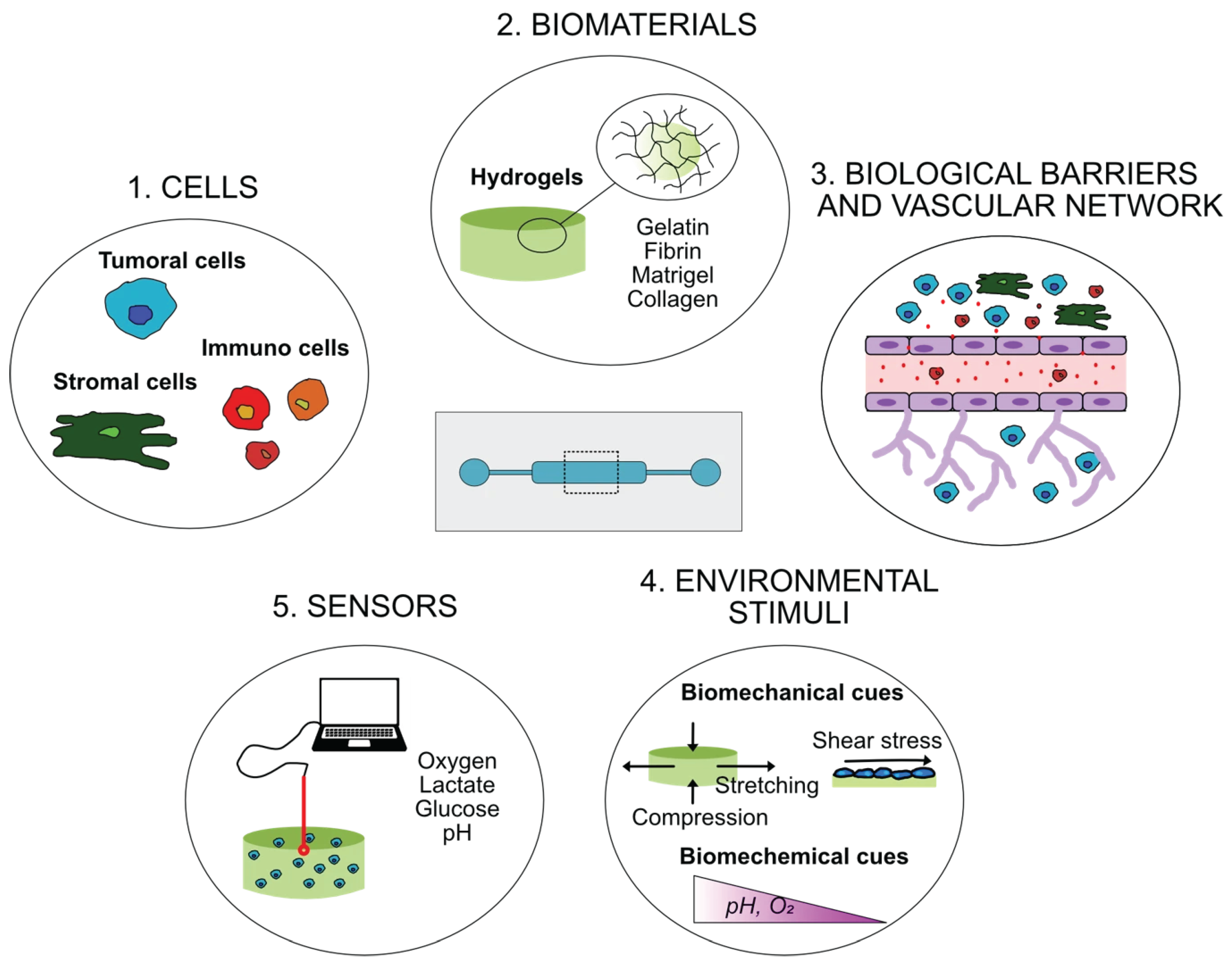
- Multiple Cell Types: Tumor-on-a-chip devices can host various cell populations—tumor, stromal, and immune cells—mimicking both primary and metastatic niches. Stroma-rich or heterotypic spheroids often display reduced drug penetration and increased chemo resistance, underscoring the importance of stroma-derived ECM and stromal components in predictive modeling [28,36,37]. Interestingly, these systems are increasingly used to study tumor–immune interactions and test immunotherapies, including checkpoint inhibitors [38], and enable personalized applications using patient-derived cells thanks to their miniaturization and low cell requirements [22,34,39].
- •
- Biomaterials: Incorporating biomaterials that mimic the native ECM is crucial. Injectable hydrogels such as collagen, Matrigel™, GelMA, and fibrin can be functionalized with ECM components like glycosaminoglycan, elastin, laminine, fibronectin, and various collagens (I, II, IV). Inorganic elements such as hydroxyapatite nanocrystals (in stoichiometric or biomimetic forms) can also be added to reproduce tissue-specific properties, such as bone rigidity [40,41,42]. ECM composition strongly affects stiffness, oxygen gradients, interstitial flow, nutrient diffusion, spheroid morphology, proliferation, and chemosensitivity [43,44].
- •
- •
- •
- Biological Barriers: Devices can replicate key physiological barriers, such as endothelial, epithelial, or blood–brain barriers, allowing investigation of invasion, metastasis, and drug permeability—for instance, in glioblastoma (BBB models) or metastasis research (endothelial permeability) [50].
- •
- •
- Sensors: Integrated sensors enable monitoring of chemical and mechanical parameters within the TME—such as oxygen, pH, and shear stress—and real-time detection of cell-derived factors like cytokines, and signaling molecules [51]. Sensor-equipped tumor-on-a-chip systems have also been used for continuous measurement of metabolites, like glucose, lactate, and oxygen levels, providing quantitative insights into metabolism and drug response to agents such as doxorubicin, paclitaxel, fulvestrant, 4-hydroxy-tamoxifen (4-OHT), and tamoxifen [39,52].
4. State-of-the-Art Tumor Spheroid-on-Chip Platforms for Drug Screening
4.1. Carcinomas

4.2. Sarcomas
5. Current Limitations in Using Spheroids Cultured in Microfluidic Devices
6. Conclusions and Future Perspectives
Author Contributions
Funding
Data Availability Statement
Conflicts of Interest
References
- Li, W.; Zhou, Z.; Zhou, X.; Khoo, B.L.; Gunawan, R.; Chin, Y.R.; Zhang, L.; Yi, C.; Guan, X.; Yang, M. 3D Biomimetic Models to Reconstitute Tumor Microenvironment In Vitro: Spheroids, Organoids, and Tumor-on-a-Chip. Adv. Healthc. Mater. 2023, 12, e2202609. [Google Scholar] [CrossRef] [PubMed]
- Monteduro, A.G.; Rizzato, S.; Caragnano, G.; Trapani, A.; Giannelli, G.; Maruccio, G. Organs-on-chips technologies—A guide from disease models to opportunities for drug development. Biosens. Bioelectron. 2023, 231, 115271. [Google Scholar] [CrossRef]
- Aboulkheyr Es, H.; Aref, A.R.; Warkiani, M.E. Generation and Culture of Organotypic Breast Carcinoma Spheroids for the Study of Drug Response in a 3D Microfluidic Device. In Cancer Drug Resistance. Methods in Molecular Biology; Baiocchi, M., Ed.; Humana: New York, NY, USA, 2022; Volume 2535, pp. 49–57. [Google Scholar] [CrossRef]
- Fontana, F.; Marzagalli, M.; Sommariva, M.; Gagliano, N.; Limonta, P. In Vitro 3D Cultures to Model the Tumor Microenvironment. Cancers 2021, 13, 2970. [Google Scholar] [CrossRef]
- Rodrigues, J.; Heinrich, M.A.; Teixeira, L.M.; Prakash, J. 3D In Vitro Model (R)evolution: Unveiling Tumor-Stroma Interactions. Trends Cancer 2021, 7, 249–264. [Google Scholar] [CrossRef]
- Ferreira, L.P.; Gaspar, V.M.; Mano, J.F. Design of spherically structured 3D in vitro tumor models -Advances and prospects. Acta Biomater. 2018, 75, 11–34. [Google Scholar] [CrossRef] [PubMed]
- Pinto, B.; Henriques, A.C.; Silva, P.M.A.; Bousbaa, H. Three-Dimensional Spheroids as In Vitro Preclinical Models for Cancer Research. Pharmaceutics 2020, 12, 1186. [Google Scholar] [CrossRef] [PubMed]
- Sandstrom, N.; Carannante, V.; Olofsson, K.; Sandoz, P.A.; Moussaud-Lamodiere, E.L.; Seashore-Ludlow, B.; Van Ooijen, H.; Verron, Q.; Frisk, T.; Takai, M.; et al. Miniaturized and multiplexed high-content screening of drug and immune sensitivity in a multichambered microwell chip. Cell Rep. Methods 2022, 2, 100256. [Google Scholar] [CrossRef]
- El Harane, S.; Zidi, B.; El Harane, N.; Krause, K.H.; Matthes, T.; Preynat-Seauve, O. Cancer Spheroids and Organoids as Novel Tools for Research and Therapy: State of the Art and Challenges to Guide Precision Medicine. Cells 2023, 12, 1001. [Google Scholar] [CrossRef]
- Dauphin, T.; de Beaurepaire, L.; Salama, A.; Pruvost, Q.; Claire, C.; Haurogne, K.; Sourice, S.; Dupont, A.; Bach, J.M.; Herve, J.; et al. Scalability of spheroid-derived small extracellular vesicles production in stirred systems. Front. Bioeng. Biotechnol. 2025, 13, 1516482. [Google Scholar] [CrossRef]
- Nath, S.; Devi, G.R. Three-dimensional culture systems in cancer research: Focus on tumor spheroid model. Pharmacol. Ther. 2016, 163, 94–108. [Google Scholar] [CrossRef]
- Raghavan, S.; Mehta, P.; Horst, E.N.; Ward, M.R.; Rowley, K.R.; Mehta, G. Comparative analysis of tumor spheroid generation techniques for differential in vitro drug toxicity. Oncotarget 2016, 7, 16948–16961. [Google Scholar] [CrossRef]
- Lemarie, L.; Courtial, E.J.; Sohier, J. Method for Large-scale Production of hIPSC Spheroids. Bio-Protocol 2024, 14, e4965. [Google Scholar] [CrossRef] [PubMed]
- Marques, I.A.; Fernandes, C.; Tavares, N.T.; Pires, A.S.; Abrantes, A.M.; Botelho, M.F. Magnetic-Based Human Tissue 3D Cell Culture: A Systematic Review. Int. J. Mol. Sci. 2022, 23, 2681. [Google Scholar] [CrossRef]
- Anil-Inevi, M.; Ozcivici, E. Ring Magnet-Guided Magnetic Manipulation for Biofabrication of 3D Cellular Structures. In Methods in Molecular Biology; Springer Nature: Berlin/Heidelberg, Germany, 2025. [Google Scholar] [CrossRef]
- Tevis, K.M.; Colson, Y.L.; Grinstaff, M.W. Embedded Spheroids as Models of the Cancer Microenvironment. Adv. Biosyst. 2017, 1, 1700083. [Google Scholar] [CrossRef] [PubMed]
- Badea, M.A.; Balas, M.; Hermenean, A.; Ciceu, A.; Herman, H.; Ionita, D.; Dinischiotu, A. Influence of Matrigel on Single- and Multiple-Spheroid Cultures in Breast Cancer Research. SLAS Discov. 2019, 24, 563–578. [Google Scholar] [CrossRef]
- Sarkar, S.; Peng, C.C.; Tung, Y.C. Comparison of VEGF-A secretion from tumor cells under cellular stresses in conventional monolayer culture and microfluidic three-dimensional spheroid models. PLoS ONE 2020, 15, e0240833. [Google Scholar] [CrossRef] [PubMed]
- Lu, C.; Jin, A.; Gao, C.; Qiao, H.; Liu, H.; Zhang, Y.; Sun, W.; Yang, S.M.; Liu, Y. Synergistic Approach of High-Precision 3D Printing and Low Cell Adhesion for Enhanced Self-Assembled Spheroid Formation. Biosensors 2024, 15, 7. [Google Scholar] [CrossRef]
- Zhou, G.; Lin, X.; Li, H.; Sun, W.; Li, W.; Zhang, Q.; Bian, F.; Lin, J. Assessment of drug treatment response using primary human colon cancer cell spheroids cultivated in a microfluidic mixer chip. Biosens. Bioelectron. 2025, 269, 116944. [Google Scholar] [CrossRef]
- Liu, M.; Wang, Y.; Wang, C.; Li, P.; Qiu, J.; Yang, N.; Sun, M.; Han, L. A Microfluidic 3D-Tumor-Spheroid Model for the Evaluation of Targeted Therapies from Angiogenesis-Related Cytokines at the Single Spheroid Level. Adv. Healthc. Mater. 2024, 13, e2402321. [Google Scholar] [CrossRef]
- Lipreri, M.V.; Totaro, M.T.; Boos, J.A.; Basile, M.S.; Baldini, N.; Avnet, S. A Novel Microfluidic Platform for Personalized Anticancer Drug Screening Through Image Analysis. Micromachines 2024, 15, 1521. [Google Scholar] [CrossRef]
- Kieda, J.; Appak-Baskoy, S.; Jeyhani, M.; Navi, M.; Chan, K.W.Y.; Tsai, S.S.H. Microfluidically-generated Encapsulated Spheroids (mu-GELS): An All-Aqueous Droplet Microfluidics Platform for Multicellular Spheroids Generation. ACS Biomater. Sci. Eng. 2023, 9, 1043–1052. [Google Scholar] [CrossRef]
- Sabhachandani, P.; Motwani, V.; Cohen, N.; Sarkar, S.; Torchilin, V.; Konry, T. Generation and functional assessment of 3D multicellular spheroids in droplet based microfluidics platform. Lab. Chip 2016, 16, 497–505. [Google Scholar] [CrossRef] [PubMed]
- Lee, J.M.; Choi, J.W.; Ahrberg, C.D.; Choi, H.W.; Ha, J.H.; Mun, S.G.; Mo, S.J.; Chung, B.G. Generation of tumor spheroids using a droplet-based microfluidic device for photothermal therapy. Microsyst. Nanoeng. 2020, 6, 52. [Google Scholar] [CrossRef]
- Rodoplu, D.; Matahum, J.S.; Hsu, C.H. A microfluidic hanging drop-based spheroid co-culture platform for probing tumor angiogenesis. Lab. Chip 2022, 22, 1275–1285. [Google Scholar] [CrossRef]
- Boos, J.A.; Misun, P.M.; Brunoldi, G.; Furer, L.A.; Aengenheister, L.; Modena, M.; Rousset, N.; Buerki-Thurnherr, T.; Hierlemann, A. Microfluidic Co-Culture Platform to Recapitulate the Maternal-Placental-Embryonic Axis. Adv. Biol. 2021, 5, e2100609. [Google Scholar] [CrossRef]
- Sun, Q.; Tan, S.H.; Chen, Q.; Ran, R.; Hui, Y.; Chen, D.; Zhao, C.X. Microfluidic Formation of Coculture Tumor Spheroids with Stromal Cells As a Novel 3D Tumor Model for Drug Testing. ACS Biomater. Sci. Eng. 2018, 4, 4425–4433. [Google Scholar] [CrossRef]
- Wu, Z.; Gong, Z.; Ao, Z.; Xu, J.; Cai, H.; Muhsen, M.; Heaps, S.; Bondesson, M.; Guo, S.; Guo, F. Rapid Microfluidic Formation of Uniform Patient-Derived Breast Tumor Spheroids. ACS Appl. Bio Mater. 2020, 3, 6273–6283. [Google Scholar] [CrossRef] [PubMed]
- Kim, S.; Yeop Baek, S.; Cha, C. Bioactive Microgels with Tunable Microenvironment as a 3D Platform to Guide the Complex Physiology of Hepatocellular Carcinoma Spheroids. Chembiochem 2024, 25, e202400482. [Google Scholar] [CrossRef]
- Dorrigiv, D.; Goyette, P.A.; St-Georges-Robillard, A.; Mes-Masson, A.M.; Gervais, T. Pixelated Microfluidics for Drug Screening on Tumour Spheroids and Ex Vivo Microdissected Tumour Explants. Cancers 2023, 15, 1060. [Google Scholar] [CrossRef]
- Cheng, Y.W.; Hsieh, Y.C.; Sun, Y.S.; Wang, Y.H.; Yang, Y.W.; Lo, K.Y. Using microfluidic and conventional platforms to evaluate the effects of lanthanides on spheroid formation. Toxicology 2024, 508, 153931. [Google Scholar] [CrossRef] [PubMed]
- Pong, K.C.C.; Lai, Y.S.; Wong, R.C.H.; Lee, A.C.K.; Chow, S.C.T.; Lam, J.C.W.; Ho, H.P.; Wong, C.T.T. Automated Uniform Spheroid Generation Platform for High Throughput Drug Screening Process. Biosensors 2024, 14, 392. [Google Scholar] [CrossRef]
- Prince, E.; Kheiri, S.; Wang, Y.; Xu, F.; Cruickshank, J.; Topolskaia, V.; Tao, H.; Young, E.W.K.; McGuigan, A.P.; Cescon, D.W.; et al. Microfluidic Arrays of Breast Tumor Spheroids for Drug Screening and Personalized Cancer Therapies. Adv. Healthc. Mater. 2022, 11, e2101085. [Google Scholar] [CrossRef]
- Ko, J.; Ahn, J.; Kim, S.; Lee, Y.; Lee, J.; Park, D.; Jeon, N.L. Tumor spheroid-on-a-chip: A standardized microfluidic culture platform for investigating tumor angiogenesis. Lab. Chip 2019, 19, 2822–2833. [Google Scholar] [CrossRef]
- Jeong, S.Y.; Lee, J.H.; Shin, Y.; Chung, S.; Kuh, H.J. Co-Culture of Tumor Spheroids and Fibroblasts in a Collagen Matrix-Incorporated Microfluidic Chip Mimics Reciprocal Activation in Solid Tumor Microenvironment. PLoS ONE 2016, 11, e0159013. [Google Scholar] [CrossRef] [PubMed]
- Ro, J.; Kim, J.; Cho, Y.K. Recent advances in spheroid-based microfluidic models to mimic the tumour microenvironment. Analyst 2022, 147, 2023–2034. [Google Scholar] [CrossRef]
- Revach, O.Y.; Cicerchia, A.M.; Shorer, O.; Petrova, B.; Anderson, S.; Park, J.; Chen, L.; Mehta, A.; Wright, S.J.; McNamee, N.; et al. Disrupting CD38-driven T cell dysfunction restores sensitivity to cancer immunotherapy. bioRxiv 2024. [Google Scholar] [CrossRef]
- Dadgar, N.; Gonzalez-Suarez, A.M.; Fattahi, P.; Hou, X.; Weroha, J.S.; Gaspar-Maia, A.; Stybayeva, G.; Revzin, A. A microfluidic platform for cultivating ovarian cancer spheroids and testing their responses to chemotherapies. Microsyst. Nanoeng. 2020, 6, 93. [Google Scholar] [CrossRef]
- Jin, J.; Chen, W.; Li, J.; Yang, J.; Dai, R.; Tang, J.; Li, M.; Chen, Y.; Zhang, C.; Liu, J. Engineered tumor microspheres via microfluidics and decellularized extracellular matrix for high-throughput organoid-based drug screening. Biofabrication 2025, 17, 045003. [Google Scholar] [CrossRef] [PubMed]
- Zhang, X.; Li, L.; Luo, C. Gel integration for microfluidic applications. Lab. Chip 2016, 16, 1757–1776. [Google Scholar] [CrossRef] [PubMed]
- Lipreri, M.V.; Di Pompo, G.; Boanini, E.; Graziani, G.; Sassoni, E.; Baldini, N.; Avnet, S. Bone on-a-chip: A 3D dendritic network in a screening platform for osteocyte-targeted drugs. Biofabrication 2023, 15, 45019. [Google Scholar] [CrossRef]
- Dornhof, J.; Kieninger, J.; Muralidharan, H.; Maurer, J.; Urban, G.A.; Weltin, A. Microfluidic organ-on-chip system for multi-analyte monitoring of metabolites in 3D cell cultures. Lab. Chip 2022, 22, 225–239. [Google Scholar] [CrossRef] [PubMed]
- Berger Fridman, I.; Ugolini, G.S.; VanDelinder, V.; Cohen, S.; Konry, T. High throughput microfluidic system with multiple oxygen levels for the study of hypoxia in tumor spheroids. Biofabrication 2021, 13, 35037. [Google Scholar] [CrossRef] [PubMed]
- Ortega Quesada, B.A.; Cuccia, J.; Coates, R.; Nassar, B.; Littlefield, E.; Martin, E.C.; Melvin, A.T. A modular microfluidic platform to study how fluid shear stress alters estrogen receptor phenotype in ER(+) breast cancer cells. Microsyst. Nanoeng. 2024, 10, 25. [Google Scholar] [CrossRef]
- Yu, Z.; Chen, Y.; Li, J.; Chen, C.; Lu, H.; Chen, S.; Zhang, T.; Guo, T.; Zhu, Y.; Jin, J.; et al. A tempo-spatial controllable microfluidic shear-stress generator for in-vitro mimicking of the thrombus. J. Nanobiotechnol. 2024, 22, 187. [Google Scholar] [CrossRef]
- Margari, A.; Konig, S.; Jayarajan, V.; Rizzato, S.; Maruccio, G.; Moeendarbary, E. Examining Stromal Cell Interactions in an In Vitro Blood-Brain Barrier Model with Human Umbilical Vein Endothelial Cells. Cells 2025, 14, 759. [Google Scholar] [CrossRef]
- Bang, J.; Yeo, J.; Lee, S.J.; Lee, H.; Kim, J.; Jeong, S.; Kang, E.; Rho, H.S.; Kim, Y.; Park, J.O. A 3D vascularized tumor spheroid microfluidic platform for head and neck cancer research: New insights. Biomed. Microdevices 2025, 27, 25. [Google Scholar] [CrossRef]
- Zhao, L.; Liu, Y.; Liu, Y.; Zhang, M.; Zhang, X. Microfluidic Control of Tumor and Stromal Cell Spheroids Pairing and Merging for Three-Dimensional Metastasis Study. Anal. Chem. 2020, 92, 7638–7645. [Google Scholar] [CrossRef]
- Oddo, A.; Peng, B.; Tong, Z.; Wei, Y.; Tong, W.Y.; Thissen, H.; Voelcker, N.H. Advances in Microfluidic Blood-Brain Barrier (BBB) Models. Trends Biotechnol. 2019, 37, 1295–1314. [Google Scholar] [CrossRef]
- Buttkewitz, M.A.; Heuer, C.; Bahnemann, J. Sensor integration into microfluidic systems: Trends and challenges. Curr. Opin. Biotechnol. 2023, 83, 102978. [Google Scholar] [CrossRef] [PubMed]
- Tevlek, A.; Kibar, G.; Cetin, B. Assessment of Anticancer Effects of Aloe vera on 3D Liver Tumor Spheroids in a Microfluidic Platform. Biotechnol. Bioeng. 2025, 122, 2592–2608. [Google Scholar] [CrossRef]
- Olofsson, K.; Carannante, V.; Ohlin, M.; Frisk, T.; Kushiro, K.; Takai, M.; Lundqvist, A.; Onfelt, B.; Wiklund, M. Acoustic formation of multicellular tumor spheroids enabling on-chip functional and structural imaging. Lab. Chip 2018, 18, 2466–2476. [Google Scholar] [CrossRef] [PubMed]
- Ro, J.; Kim, J.; Park, J.; Choi, Y.; Cho, Y.K. ODSEI Chip: An Open 3D Microfluidic Platform for Studying Tumor Spheroid-Endothelial Interactions. Adv. Sci. 2025, 12, e2410659. [Google Scholar] [CrossRef]
- Seeto, W.J.; Tian, Y.; Pradhan, S.; Minond, D.; Lipke, E.A. Droplet Microfluidics-Based Fabrication of Monodisperse Poly(ethylene glycol)-Fibrinogen Breast Cancer Microspheres for Automated Drug Screening Applications. ACS Biomater. Sci. Eng. 2022, 8, 3831–3841. [Google Scholar] [CrossRef] [PubMed]
- Hou, Y.; Zheng, Y.; Zheng, X.; Sun, Y.; Yi, X.; Wu, Z.; Lin, J.M. Multidimensional controllable fabrication of tumor spheroids based on a microfluidic device. Lab. Chip 2023, 23, 2654–2663. [Google Scholar] [CrossRef]
- Bregigeon, P.; Riviere, C.; Franqueville, L.; Vollaire, C.; Marchalot, J.; Frenea-Robin, M. Integrated platform for culture, observation, and parallelized electroporation of spheroids. Lab. Chip 2022, 22, 2489–2501. [Google Scholar] [CrossRef]
- Goodarzi, S.; Prunet, A.; Rossetti, F.; Bort, G.; Tillement, O.; Porcel, E.; Lacombe, S.; Wu, T.D.; Guerquin-Kern, J.L.; Delanoe-Ayari, H.; et al. Quantifying nanotherapeutic penetration using a hydrogel-based microsystem as a new 3D in vitro platform. Lab. Chip 2021, 21, 2495–2510. [Google Scholar] [CrossRef]
- Bourn, M.D.; Batchelor, D.V.B.; Ingram, N.; McLaughlan, J.R.; Coletta, P.L.; Evans, S.D.; Peyman, S.A. High-throughput microfluidics for evaluating microbubble enhanced delivery of cancer therapeutics in spheroid cultures. J. Control. Release 2020, 326, 13–24. [Google Scholar] [CrossRef]
- Komen, J.; van Neerven, S.M.; Bossink, E.; de Groot, N.E.; Nijman, L.E.; van den Berg, A.; Vermeulen, L.; van der Meer, A.D. The Effect of Dynamic, In Vivo-like Oxaliplatin on HCT116 Spheroids in a Cancer-on-Chip Model Is Representative of the Response in Xenografts. Micromachines 2022, 13, 739. [Google Scholar] [CrossRef]
- Ong, L.J.Y.; Chia, S.; Wong, S.Q.R.; Zhang, X.; Chua, H.; Loo, J.M.; Chua, W.Y.; Chua, C.; Tan, E.; Hentze, H.; et al. A comparative study of tumour-on-chip models with patient-derived xenografts for predicting chemotherapy efficacy in colorectal cancer patients. Front. Bioeng. Biotechnol. 2022, 10, 952726. [Google Scholar] [CrossRef]
- Lu, Z.; Priya Rajan, S.A.; Song, Q.; Zhao, Y.; Wan, M.; Aleman, J.; Skardal, A.; Bishop, C.; Atala, A.; Lu, B. 3D scaffold-free microlivers with drug metabolic function generated by lineage-reprogrammed hepatocytes from human fibroblasts. Biomaterials 2021, 269, 120668. [Google Scholar] [CrossRef] [PubMed]
- Yang, Z.; Zhou, L.; Si, T.; Chen, S.; Liu, C.; Ng, K.K.; Wang, Z.; Chen, Z.; Qiu, C.; Liu, G.; et al. Lysyl hydroxylase LH1 promotes confined migration and metastasis of cancer cells by stabilizing Septin2 to enhance actin network. Mol. Cancer 2023, 22, 21. [Google Scholar] [CrossRef]
- Liu, T.; Zhou, C.; Ji, J.; Xu, X.; Xing, Z.; Shinohara, M.; Sakai, Y.; Sun, T.; Feng, X.; Yu, Z.; et al. Spheroid on-demand printing and drug screening of endothelialized hepatocellular carcinoma model at different stages. Biofabrication 2023, 15, 44102. [Google Scholar] [CrossRef] [PubMed]
- Zhu, L.; Shao, C.; Chen, H.; Chen, Z.; Zhao, Y. Hierarchical Hydrogels with Ordered Micro-Nano Structures for Cancer-on-a-Chip Construction. Research 2021, 2021, 9845679. [Google Scholar] [CrossRef] [PubMed]
- Catalano, A.; Ceramella, J.; Iacopetta, D.; Marra, M.; Conforti, F.; Lupi, F.R.; Gabriele, D.; Borges, F.; Sinicropi, M.S. Aloe vera-An Extensive Review Focused on Recent Studies. Foods 2024, 13, 2155. [Google Scholar] [CrossRef] [PubMed]
- Azizipour, N.; Avazpour, R.; Weber, M.H.; Sawan, M.; Ajji, A.; Rosenzweig, D.H. Uniform Tumor Spheroids on Surface-Optimized Microfluidic Biochips for Reproducible Drug Screening and Personalized Medicine. Micromachines 2022, 13, 587. [Google Scholar] [CrossRef]
- Yildiz-Ozturk, E.; Saglam-Metiner, P.; Yesil-Celiktas, O. Lung carcinoma spheroids embedded in a microfluidic platform. Cytotechnology 2021, 73, 457–471. [Google Scholar] [CrossRef]
- Kwak, T.J.; Lee, E. In vitro modeling of solid tumor interactions with perfused blood vessels. Sci. Rep. 2020, 10, 20142. [Google Scholar] [CrossRef]
- Wang, H.; Yuan, Y.; Qin, L.; Yue, M.; Xue, J.; Cui, Z.; Zhan, X.; Gai, J.; Zhang, X.; Guan, J.; et al. Tunable rigidity of PLGA shell-lipid core nanoparticles for enhanced pulmonary siRNA delivery in 2D and 3D lung cancer cell models. J. Control. Release 2024, 366, 746–760. [Google Scholar] [CrossRef]
- Nazir, F.; Munir, I.; Yesiloz, G. A Microfluidics-Assisted Double-Barreled Nanobioconjugate Synthesis Introducing Aprotinin as a New Moonlight Nanocarrier Protein: Tested toward Physiologically Relevant 3D-Spheroid Models. ACS Appl. Mater. Interfaces 2024, 16, 18311–18326. [Google Scholar] [CrossRef]
- Dhiman, N.; Shagaghi, N.; Bhave, M.; Sumer, H.; Kingshott, P.; Rath, S.N. Indirect co-culture of lung carcinoma cells with hyperthermia-treated mesenchymal stem cells influences tumor spheroid growth in a collagen-based 3-dimensional microfluidic model. Cytotherapy 2021, 23, 25–36. [Google Scholar] [CrossRef]
- Yeung, Y.W.S.; Ma, Y.; Deng, Y.; Khoo, B.L.; Chua, S.L. Bacterial Iron Siderophore Drives Tumor Survival and Ferroptosis Resistance in a Biofilm-Tumor Spheroid Coculture Model. Adv. Sci. 2024, 11, e2404467. [Google Scholar] [CrossRef]
- Gallegos-Martinez, S.; Choy-Buentello, D.; Perez-Alvarez, K.A.; Lara-Mayorga, I.M.; Aceves-Colin, A.E.; Zhang, Y.S.; Trujillo-de Santiago, G.; Alvarez, M.M. A 3D-printed tumor-on-chip: User-friendly platform for the culture of breast cancer spheroids and the evaluation of anti-cancer drugs. Biofabrication 2024, 16, 045010. [Google Scholar] [CrossRef]
- Lee, G.; Kim, S.J.; Park, J.K. Bioprinted Multi-Composition Array Mimicking Tumor Microenvironments to Evaluate Drug Efficacy with Multivariable Analysis. Adv. Healthc. Mater. 2024, 13, e2303716. [Google Scholar] [CrossRef] [PubMed]
- Yakavets, I.; Ayachit, M.; Kheiri, S.; Chen, Z.; Rakhshani, F.; McWhirter, S.; Young, E.W.K.; Walker, G.C.; Kumacheva, E. A Microfluidic Platform for Evaluating the Internalization of Liposome Drug Carriers in Tumor Spheroids. ACS Appl. Mater. Interfaces 2024, 16, 9690–9701. [Google Scholar] [CrossRef]
- Priwitaningrum, D.L.; Pednekar, K.; Gabriel, A.V.; Varela-Moreira, A.A.; Le Gac, S.; Vellekoop, I.; Storm, G.; Hennink, W.E.; Prakash, J. Evaluation of paclitaxel-loaded polymeric nanoparticles in 3D tumor model: Impact of tumor stroma on penetration and efficacy. Drug Deliv. Transl. Res. 2023, 13, 1470–1483. [Google Scholar] [CrossRef] [PubMed]
- Khan, A.H.; Zhou, S.P.; Moe, M.; Ortega Quesada, B.A.; Bajgiran, K.R.; Lassiter, H.R.; Dorman, J.A.; Martin, E.C.; Pojman, J.A.; Melvin, A.T. Generation of 3D Spheroids Using a Thiol-Acrylate Hydrogel Scaffold to Study Endocrine Response in ER(+) Breast Cancer. ACS Biomater. Sci. Eng. 2022, 8, 3977–3985. [Google Scholar] [CrossRef]
- Su, C.; Chuah, Y.J.; Ong, H.B.; Tay, H.M.; Dalan, R.; Hou, H.W. A Facile and Scalable Hydrogel Patterning Method for Microfluidic 3D Cell Culture and Spheroid-in-Gel Culture Array. Biosensors 2021, 11, 509. [Google Scholar] [CrossRef] [PubMed]
- Yusefi, M.; Lee-Kiun, M.S.; Shameli, K.; Teow, S.Y.; Ali, R.R.; Siew, K.K.; Chan, H.Y.; Wong, M.M.; Lim, W.L.; Kuca, K. 5-Fluorouracil loaded magnetic cellulose bionanocomposites for potential colorectal cancer treatment. Carbohydr. Polym. 2021, 273, 118523. [Google Scholar] [CrossRef]
- Hachey, S.J.; Movsesyan, S.; Nguyen, Q.H.; Burton-Sojo, G.; Tankazyan, A.; Wu, J.; Hoang, T.; Zhao, D.; Wang, S.; Hatch, M.M.; et al. An in vitro vascularized micro-tumor model of human colorectal cancer recapitulates in vivo responses to standard-of-care therapy. Lab. Chip 2021, 21, 1333–1351. [Google Scholar] [CrossRef]
- Lei, K.F.; Lin, Y.T.; Boreddy, S.K.R.; Pai, P.C. Analysis of chemosensitivity of tumor spheroids exposed to two-dimensional gradient of combination drugs in a hydrogel-based diffusion microfluidic platform. Anal. Chim. Acta 2024, 1332, 343371. [Google Scholar] [CrossRef]
- Kannan, S.; Peng, C.C.; Wu, H.M.; Tung, Y.C. Characterization of Single-Spheroid Oxygen Consumption Using a Microfluidic Platform and Fluorescence Lifetime Imaging Microscopy. Biosensors 2024, 14, 96. [Google Scholar] [CrossRef]
- Sarkar, S.; Peng, C.C.; Kuo, C.W.; Chueh, D.Y.; Wu, H.M.; Liu, Y.H.; Chen, P.; Tung, Y.C. Study of oxygen tension variation within live tumor spheroids using microfluidic devices and multi-photon laser scanning microscopy. RSC Adv. 2018, 8, 30320–30329. [Google Scholar] [CrossRef]
- Avnet, S.; Lemma, S.; Cortini, M.; Di Pompo, G.; Perut, F.; Lipreri, M.V.; Roncuzzi, L.; Columbaro, M.; Errani, C.; Longhi, A.; et al. The Release of Inflammatory Mediators from Acid-Stimulated Mesenchymal Stromal Cells Favours Tumour Invasiveness and Metastasis in Osteosarcoma. Cancers 2021, 13, 5855. [Google Scholar] [CrossRef]
- Su, H.; Chen, Y.; Xuan, Z.; Ren, H.; Lu, P.; Zhao, M.; Wang, H. Permeable Hydrogel Encapsulated Osteosarcoma-on-a-Chip for High-Throughput Multi-Drugs Screening. Smart Med. 2025, 4, e70013. [Google Scholar] [CrossRef]
- Bavoux, M.; Kamio, Y.; Vigneux-Foley, E.; Lafontaine, J.; Najyb, O.; Refet-Mollof, E.; Carrier, J.F.; Gervais, T.; Wong, P. X-ray on chip: Quantifying therapeutic synergies between radiotherapy and anticancer drugs using soft tissue sarcoma tumor spheroids. Radiother. Oncol. 2021, 157, 175–181. [Google Scholar] [CrossRef]
- Refet-Mollof, E.; Najyb, O.; Chermat, R.; Glory, A.; Lafontaine, J.; Wong, P.; Gervais, T. Hypoxic Jumbo Spheroids On-A-Chip (HOnAChip): Insights into Treatment Efficacy. Cancers 2021, 13, 4046. [Google Scholar] [CrossRef] [PubMed]
- Dogan, E.; Galifi, C.A.; Cecen, B.; Shukla, R.; Wood, T.L.; Miri, A.K. Extracellular matrix regulation of cell spheroid invasion in a 3D bioprinted solid tumor-on-a-chip. Acta Biomater. 2024, 186, 156–166. [Google Scholar] [CrossRef] [PubMed]
- Fevre, R.; Mary, G.; Vertti-Quintero, N.; Durand, A.; Tomasi, R.F.; Del Nery, E.; Baroud, C.N. Combinatorial drug screening on 3D Ewing sarcoma spheroids using droplet-based microfluidics. iScience 2023, 26, 106651. [Google Scholar] [CrossRef]
- Parent, C.; Honari, H.; Tocci, T.; Simon, F.; Zaidi, S.; Jan, A.; Aubert, V.; Delattre, O.; Isambert, H.; Wilhelm, C.; et al. Label-Free Machine Learning Prediction of Chemotherapy on Tumor Spheroids Using a Microfluidics Droplet Platform. Small Sci. 2025, 5, 2500173. [Google Scholar] [CrossRef] [PubMed]
- Chuaychob, S.; Lyu, R.; Tanaka, M.; Haginiwa, A.; Kitada, A.; Nakamura, T.; Yokokawa, R. Mimicking angiogenic microenvironment of alveolar soft-part sarcoma in a microfluidic coculture vasculature chip. Proc. Natl. Acad. Sci. USA 2024, 121, e2312472121. [Google Scholar] [CrossRef]
- Srivastava, S.K.; Foo, G.W.; Aggarwal, N.; Chang, M.W. Organ-on-chip technology: Opportunities and challenges. Biotechnol. Notes 2024, 5, 8–12. [Google Scholar] [CrossRef] [PubMed]
- Sontheimer-Phelps, A.; Hassell, B.A.; Ingber, D.E. Modelling cancer in microfluidic human organs-on-chips. Nat. Rev. Cancer 2019, 19, 65–81. [Google Scholar] [CrossRef] [PubMed]
- Allwardt, V.; Ainscough, A.J.; Viswanathan, P.; Sherrod, S.D.; McLean, J.A.; Haddrick, M.; Pensabene, V. Translational Roadmap for the Organs-on-a-Chip Industry toward Broad Adoption. Bioengineering 2020, 7, 112. [Google Scholar] [CrossRef]
- Piergiovanni, M.; Leite, S.B.; Corvi, R.; Whelan, M. Standardisation needs for organ on chip devices. Lab. Chip 2021, 21, 2857–2868. [Google Scholar] [CrossRef] [PubMed]



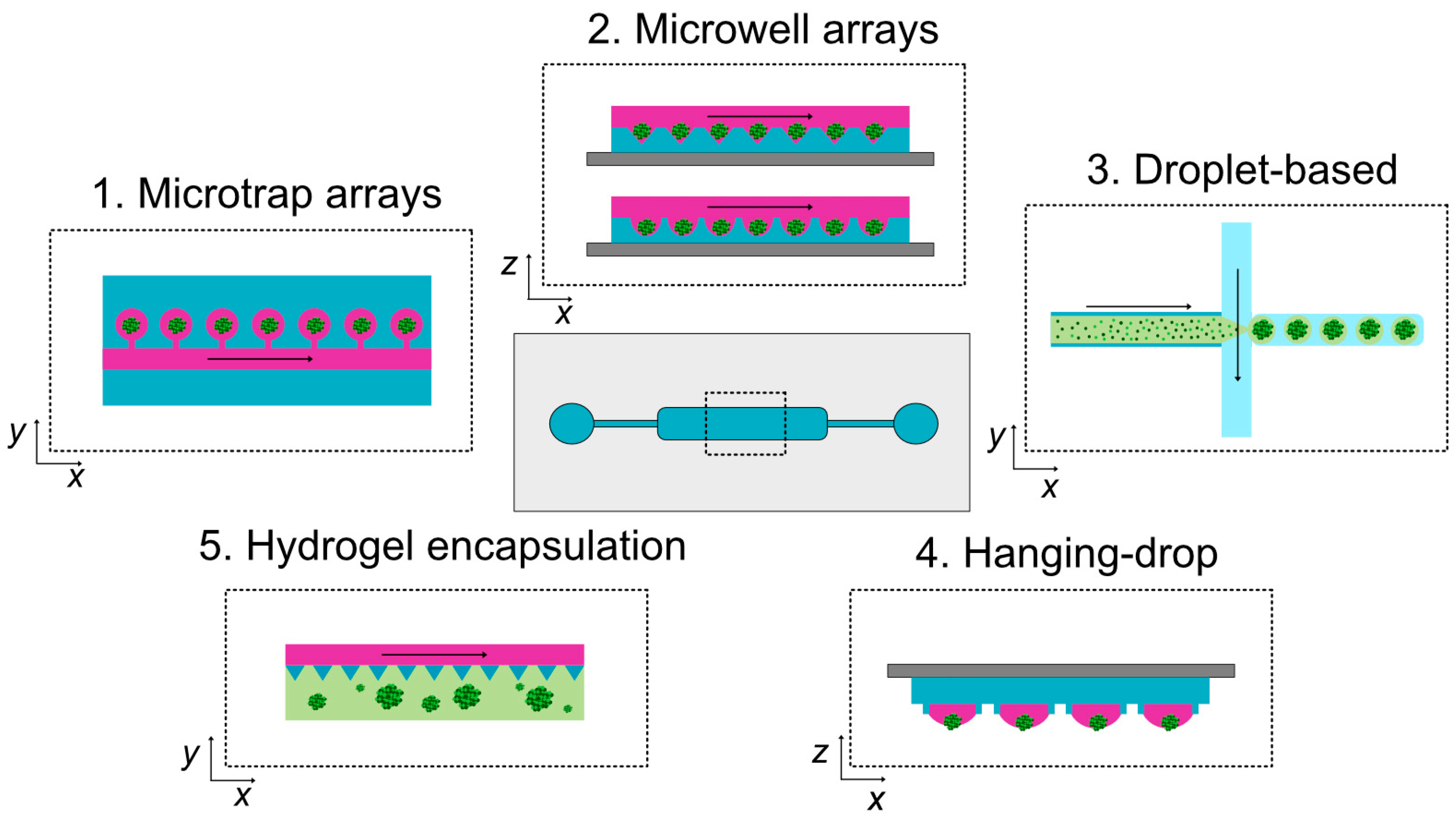
| Technique | Description | Pro | Cons | Ref. |
|---|---|---|---|---|
| Microtrap Arrays | Microfabricated wells or traps in a chip capture and aggregate cells into spheroids. Allows parallel formation, size control, and easy imaging | Simple, parallel, easy imaging | Limited to certain cell types; less dynamic environment | [18,19,20,21] |
| Agarose Microwell arrays | Microfabricated agarose wells in a chip capture and aggregate cells into spheroids. Allows parallel formation, size control, and easy imaging | Simple, parallel, easy imaging | Limited to certain cell types; less dynamic environment | [22] |
| Droplet-Based Microfluidics | Cells are encapsulated in uniform aqueous droplets (often with hydrogels) using flow-focusing or T-junctions. Enables high throughput, size control, and co-culture. Can use all-aqueous systems to avoid cytotoxic solvents | High-throughput, uniform size, automation-friendly | May require oil phases or surfactants, device complexity | [23,24,25] |
| Hanging Drop Microfluidics | Microfluidic chips create hanging drops where cells aggregate by gravity, enabling uniform spheroid formation and co-culture setups | Uniform spheroids; co-culture possible | Lower throughput, evaporation risk | [26,27] |
| Hydrogel Encapsulation | Cells are encapsulated in hydrogels (e.g., alginate, MatrigelTM ) within microfluidic channels or droplets, supporting 3D growth and mimicking the ECM | Mimics ECM; supports complex structures | Hydrogel handling, potential diffusion barriers | [28,29,30,31,32,33] |
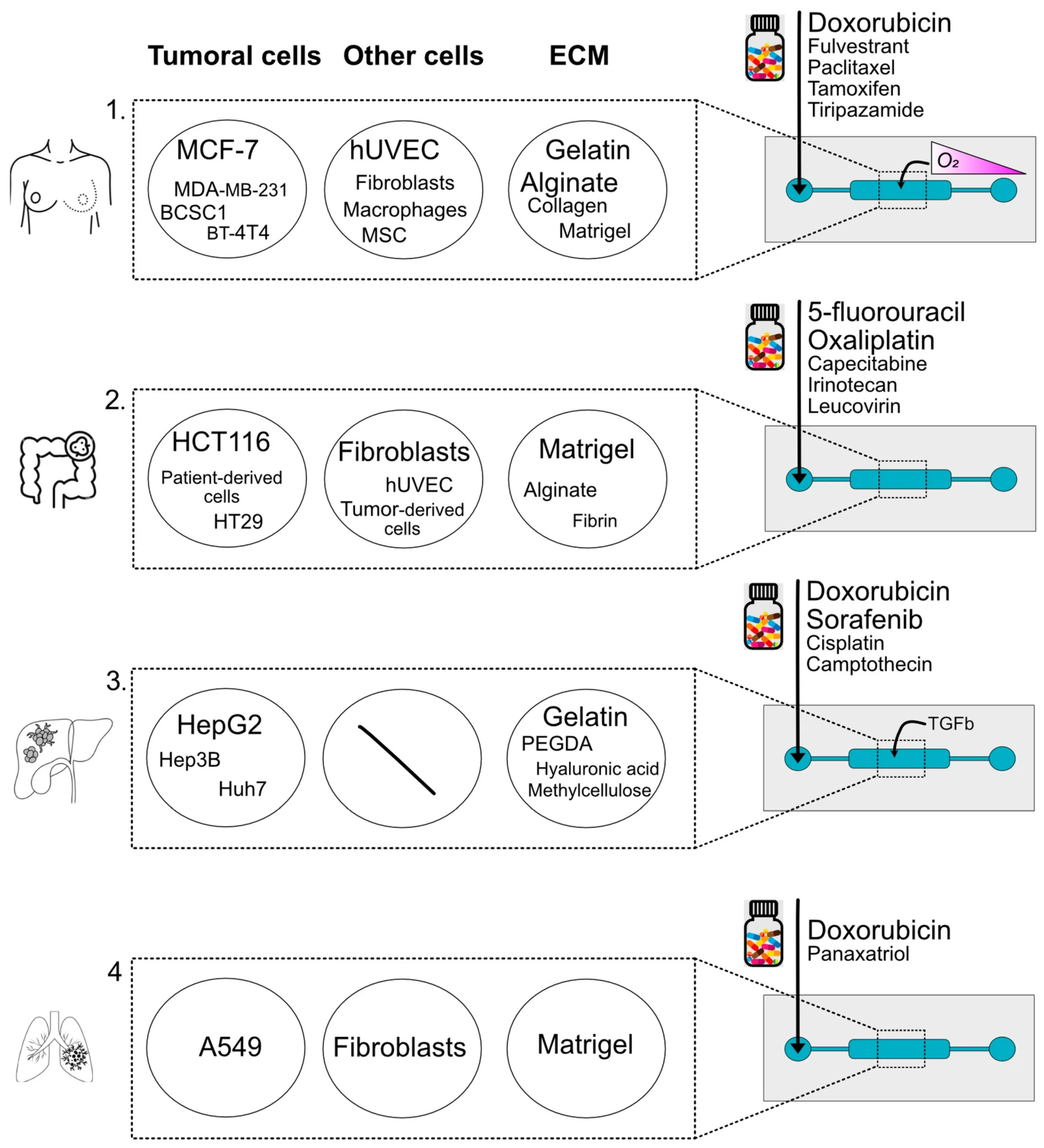
| Tumor | Cells | TME | Technique | Drug | Refs. |
|---|---|---|---|---|---|
| Breast cancer | MCF7 | - Stromal cells: hUVEC - Vascular endothelial barrier | Microtrap arrays | tamoxifen | [54] |
| MCF7 | - ECM: gelatin methacryloyl hydrogels - Stromal cells: fibroblasts | Gel-embedded | DXR | [74] | |
| BT-474 | - ECM: RGD-alginate and fibrin - Stromal cells: hUVEC - Vascular endothelial barrier | Droplet-based bioprinting | DXR | [75] | |
| MCF7 | - ECM: gelatin | Gel-embedded/microtrap arrays | DXR-loaded liposomes | [76] | |
| 4T1 mouse breast cancer cells | - Stromal cells: 3T3 fibroblasts | Microtrap arrays | paclitaxel-loaded polymeric micelles | [77] | |
| MCF7 | - ECM: dextran-alginate droplets surrounded by polyethylene glycol | Droplet-based microfluidics | DXR | [23] | |
| MCF7 | - ECM: thiol–acrylate hydrogel | Gel-embedded/microtrap arrays | fulvestrant | [78] | |
| MCF7 or MDA-MB-231 | - ECM: biosynthetic hybrid hydrogels composed of poly(ethylene glycol diacrylate) (PEGDA) covalently conjugated to natural protein (fibrinogen) | Droplet-based microfluidics | DXR | [55] | |
| Patient breast cancer cells | - ECM: collagen | Microtrap arrays | DXR, paclitaxel | [3] | |
| MDA-MB-231 and MCF-7 | - Stromal cells: mouse embryonic stem cell line ES-D3 | Hanging drop microfluidics | anti-angiogenesis drug | [26] | |
| MCF7 | - ECM: collagen and Matrigel - Stromal cells: hUVEC | Gel-embedded | paclitaxel | [79] | |
| BCSC1 eGFP | - ECM: Matrigel - Stromal cells: MSC - Real time monitoring: hypoxia | Gel-embedded | DXR, antimycin A | [43] | |
| MCF7/patient-derived cells | - ECM: gelatin and cellulose nanocrystals | Gel-embedded/microtrap arrays | DXR, 4-hydroxy-tamoxifen | [34] | |
| MCF7 | - ECM: alginate - Immune system: human M2-polarized macrophages - Biochemical cue: hypoxia - Real time monitoring: hypoxia | Gel-embedded/microtrap arrays | DXR, tirapazamine | [44] | |
| Colon cancer | Patient-derived cells | - ECM: Matrigel - Stromal cells: cells from tumoral tissue | Microtrap arrays | oxaliplatin, capecitabine | [20] |
| HCT116 | - ECM: alginate - Stromal cells: NIH3T3 fibroblasts | Droplet-based microfluidics | 5-fluorouracil | [56] | |
| PDX-derived | - ECM: Matrigel | Microtrap arrays | 5-fluorouracil, oxaliplatin, irinotecan | [61] | |
| HCT116, HT29 | - ECM: Matrigel | Gel-embedded | 5-fluorouracil loaded Fe3O4-nanoparticles | [80] | |
| HCT116 | - ECM: fibrin - Stromal cells: fibroblasts - Vascular network | Gel-embedded | 5-fluorouracil, leucovorin and oxaliplatin | [81] | |
| Hepatic cancer | Huh7 | - ECM: agarose gel, methylcellulose | Liquid overlay technique | DXR, sorafenib, cisplatin | [82] |
| HepG2, Hep3B | - ECM: gelatin, hyaluronic acid - Stimuli: TGF-β | Droplet-based microfluidics | sorafenib | [30] | |
| HepG2 | - ECM: polyethylene glycol diacrylate (PEGDA) and methacrylate gelatin (GelMA) | Scaffold-embedded | DXR, camptothecin | [65] | |
| Lung cancer | A549 | - Other cells: primary human osteoblasts or bone metastasis secondary to lung | Microtrap arrays | DXR | [67] |
| A549 | - ECM: Matrigel - Stromal cells: MRC-5 | Microtrap arrays | panaxatriol | [68] | |
| A549 | - Bacteria: Pseudomonas aeruginosa | Microtrap arrays | DXR + antimicrobial tobramycin | [73] |
Disclaimer/Publisher’s Note: The statements, opinions and data contained in all publications are solely those of the individual author(s) and contributor(s) and not of MDPI and/or the editor(s). MDPI and/or the editor(s) disclaim responsibility for any injury to people or property resulting from any ideas, methods, instructions or products referred to in the content. |
© 2025 by the authors. Licensee MDPI, Basel, Switzerland. This article is an open access article distributed under the terms and conditions of the Creative Commons Attribution (CC BY) license (https://creativecommons.org/licenses/by/4.0/).
Share and Cite
Lipreri, M.V.; Totaro, M.T.; Baldini, N.; Avnet, S. From Spheroids to Tumor-on-a-Chip for Cancer Modeling and Therapeutic Testing. Micromachines 2025, 16, 1343. https://doi.org/10.3390/mi16121343
Lipreri MV, Totaro MT, Baldini N, Avnet S. From Spheroids to Tumor-on-a-Chip for Cancer Modeling and Therapeutic Testing. Micromachines. 2025; 16(12):1343. https://doi.org/10.3390/mi16121343
Chicago/Turabian StyleLipreri, Maria Veronica, Marilina Tamara Totaro, Nicola Baldini, and Sofia Avnet. 2025. "From Spheroids to Tumor-on-a-Chip for Cancer Modeling and Therapeutic Testing" Micromachines 16, no. 12: 1343. https://doi.org/10.3390/mi16121343
APA StyleLipreri, M. V., Totaro, M. T., Baldini, N., & Avnet, S. (2025). From Spheroids to Tumor-on-a-Chip for Cancer Modeling and Therapeutic Testing. Micromachines, 16(12), 1343. https://doi.org/10.3390/mi16121343