First Clinical Report on Efficacy of Alternative European Viper Antivenoms in Treatment of Vipera ammodytes Envenomation in Croatia



Abstract
1. Introduction
2. Results
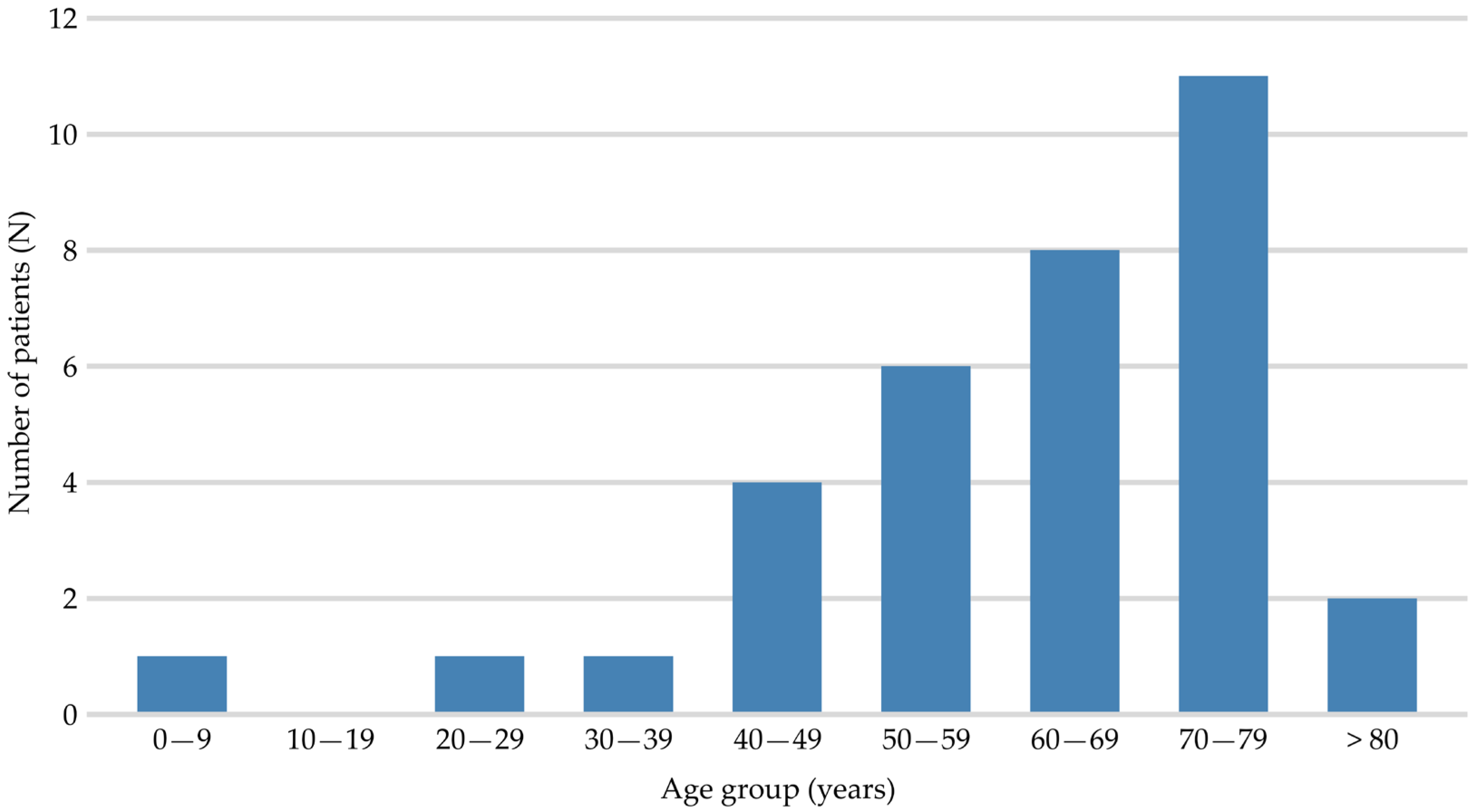
2.1. General and Demographic Results
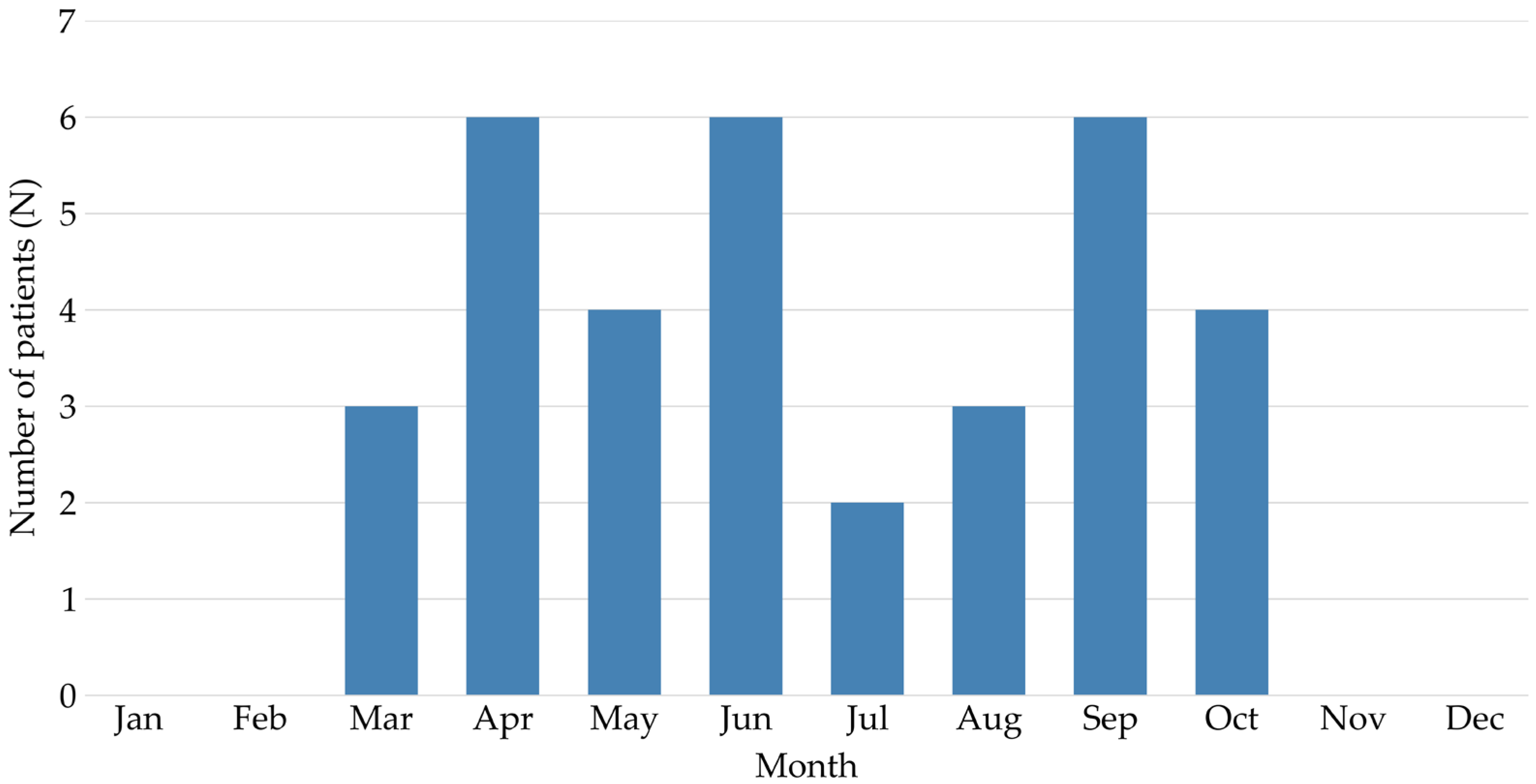
2.2. Epidemiological Data
2.3. Vital Parameters and Clinical Records on Admission to the ED
2.4. Local and Systemic Features and Complications of Envenomation
2.5. Laboratory Parameters
2.6. Treatment Data and Clinical Outcomes
3. Discussion
4. Conclusions
5. Materials and Methods
5.1. Antisera
5.1.1. Viperfav®
5.1.2. BulBio®
5.1.3. Viekvin®
5.2. General Information About the Study
5.3. Patients
- -
- grade 0 (dry bite): fang marks with no oedema or local reaction;
- -
- grade 1 (mild envenoming): local oedema around the bite area with no systemic symptoms;
- -
- grade 2 (moderate envenoming);
- -
- grade 2a: regional oedema (most of the bitten limb) or haematoma;
- -
- grade 2b: grade 2a features plus moderate general symptoms: mild hypotension, vomiting, diarrhoea, neurotoxicity, or laboratory findings indicating severity: platelets < 150 × 109/L, leukocytes > 15 × 109/L, INR > 1.5, fibrinogen < 2 g/L;
- -
- grade 3 (severe envenoming): extensive oedema spreading to the trunk or severe general symptoms, such as hypotension (systolic blood pressure < 80 mmHg), shock, and bleeding.
- -
- general and demographic records (gender; age group [0–9 years, 10–19 years, 20–29 years, 30–39 years, 40–49 years, 50–59 years, 60–69 years, 70–79 years, >80 years]);
- -
- epidemiological data (time of the day when the snakebite occurred [hour]; month of the snakebite; status as resident or non-resident citizen; circumstances of the snakebite: housework, leisure activities, playing outdoors; patients’ habits: cigarette and alcohol consumption);
- -
- vital parameters on admission to the ED (temperature [°C]; pulse [beats/min]; systolic and diastolic blood pressure (RR) [mmHg]; respiratory frequency [breaths/min]; peripheral oxygen saturation [%]; state of consciousness: awake, somnolent, stupor, coma; hypotension; tachycardia; dyspnoea; chest pain; changes in the electrocardiogram (ECG));
- -
- clinical records (location of the bite: upper, lower extremity, or other location; chronic diseases: cardiac and vascular disease, neurological diseases, pulmonary disease, liver diseases, mental illnesses, diabetes, malignant diseases, autoimmune disorders and/or immunosuppression, hypothyroidism, benign urological diseases; severity grade of envenomation; time from snakebite to ED admission [minutes]; time from snakebite to administration of antivenom [minutes]);
- -
- local symptoms and signs of envenomation (pain, oedema, redness, haematoma, enlarged regional lymph nodes);
- -
- systemic manifestations of envenomation (vomiting, diarrhoea, changes in mental status, state of shock);
- -
- local complications of envenomation (haemorrhagic blister, compartment syndrome, necrosis of the skin and/or muscle, thrombosis and/or thrombophlebitis, infections);
- -
- systemic complications of envenomation (paresis or paralysis of cranial nerves, disorders of consciousness, shock, clinically manifested bleeding disorder, laboratory-confirmed coagulation disorder, acute kidney disorder, acute liver damage, acute myocardial injury, acute respiratory failure, rhabdomyolysis and/or myositis, anaemia, thrombocytopenia, leucocytosis);
- -
- laboratory parameters (white blood cell count (WBC) [/L], neutrophil ratio [%], red blood cell count (RBC) [/L], haematocrit (Htc) [L/L], haemoglobin (Hgb) concentration [g/L], platelet count (Ptc) [/L], C-reactive protein (CRP) concentration [mg/L], glucose concentration [mmol/L], blood urea nitrogen (BUN) concentration [mmol/L], serum creatinine concentration [µmol/L], sodium (Na) concentration [mmol/L], potassium (K) concentration [mmol/L], chloride (Cl) concentration [mmol/L], aspartate aminotransferase (AST) activity [U/L], alanine aminotransferase (ALT) activity [U/L], ɣ-glutamyl transferase (GGT) activity [U/L], total bilirubin concentration [µmol/L], lactate dehydrogenase (LDH) activity [U/L], creatine kinase (CK) activity [U/L], high sensitive-troponin T (hs-TnT) concentration [ng/L], N-terminal pro B-type natriuretic peptide (NT-proBNP) concentration [pg/mL], prothrombin time (PT) [seconds], activated partial thromboplastin time (aPTT) [seconds], D-dimer concentration [mg/L], plasma fibrinogen concentration [g/L]);
- -
- treatment data (information about on-site assistance provided by emergency medical services: application of a tourniquet, limb immobilisation, administration of antivenom, other supportive therapy during transport to hospital; administration of antivenom in hospital; type of antivenom: Viperfav®, BulBio®, Viekvin®; total number of serum doses; route of antivenom administration: intravenous (IV), intramuscular (IM), subcutaneous (SC), combination of IM and SC (IM & SC); side-effects after antivenom administration: early and late; supportive therapy: antibiotics, human tetanus immunoglobulins (HTIG), tetanus vaccine—tetanus toxoid (TT), antihistamines, corticosteroids, oxygen therapy, platelet and/or erythrocyte transfusion, anticoagulants, vasopressors, mechanical ventilation; surgical intervention: incision of haemorrhagic blister, fasciotomy, necrectomy, limb amputation);
- -
- clinical outcomes (length of hospital stay [days]; mortality).
5.4. Antivenom Therapy
5.5. Statistical Analysis
Author Contributions
Funding
Institutional Review Board Statement
Informed Consent Statement
Data Availability Statement
Conflicts of Interest
Abbreviations
| ALT | Alanine aminotransferase |
| aPTT | Activated partial thromboplastin time |
| AST | Aspartate aminotransferase |
| BUN | Blood urea nitrogen |
| CK | Creatine kinase |
| Cl | Chloride |
| CRP | C-reactive protein |
| ECG | Electrocardiogram |
| ED | Emergency Department |
| ELISA | Enzyme-Linked Immunosorbent Assay |
| GGT | ɣ-glutamyl transferase |
| Hgb | Haemoglobin |
| hs-TnT | High sensitive-troponin T |
| Htc | Haematocrit |
| HTIG | Human tetanus immunoglobulins |
| ICU | Intensive Care Unit |
| IM | Intramuscular |
| IM & SC | Intramuscular and subcutaneous |
| INR | International Normalized Ratio |
| IV | Intravenous |
| K | Potassium |
| LD50 | Lethal dose, 50% |
| LDH | Lactate dehydrogenase |
| Max | Maximum |
| Min | Minimum |
| mL | Milliliters |
| Na | Sodium |
| NT-proBNP | N-terminal pro B-type natriuretic peptide |
| PT | Prothrombin time |
| Ptc | Platelets |
| RBC | Red blood cell |
| RR | Riva-Rocci (comes from the name of the person inventing the non-invasive measurement of blood pressure, and refers to blood pressure measurements taken using a traditional mercury sphygmomanometer) |
| SC | Subcutaneous |
| SD | Standard deviation |
| TT | Tetanus toxoid (tetanus vaccine) |
| UHC | University Hospital Centre |
| WBC | White blood cell |
References
- Chippaux, J.-P. Epidemiology of Snakebites in Europe: A Systematic Review of the Literature. Toxicon 2012, 59, 86–99. [Google Scholar] [CrossRef]
- Paolino, G.; Di Nicola, M.R.; Pontara, A.; Didona, D.; Moliterni, E.; Mercuri, S.R.; Grano, M.; Borgianni, N.; Kumar, R.; Pampena, R. Vipera snakebite in Europe: A systematic review of a neglected disease. J. Eur. Acad. Dermatol. Venereol. 2020, 34, 2247–2260. [Google Scholar] [CrossRef]
- Seifert, S.A.; Armitage, J.O.; Sanchez, E.E. Snake envenomation. N. Engl. J. Med. 2022, 386, 68–78. [Google Scholar] [CrossRef]
- Orlandi, G.; Rossi, N.; Chiarelli, F.; Di Filippo, P. Vipera snakebite in children: A focus on Europe. Children 2025, 12, 393. [Google Scholar] [CrossRef] [PubMed]
- Di Nicola, M.R.; Pontara, A.; Kass, G.E.N.; Kramer, N.I.; Avella, I.; Pampena, R.; Mercuri, S.R.; Dorne, J.L.C.M.; Paolino, G. Vipers of Major Clinical Relevance in Europe: Taxonomy, Venom Composition, Toxicology and Clinical Management of Human Bites. Toxicology 2021, 453, 152724. [Google Scholar] [CrossRef] [PubMed]
- Lukšić, B.; Bradarić, N.; Prgomet, S. Venomous Snakebites in Southern Croatia. Coll. Antropol. 2006, 30, 191–197. [Google Scholar]
- Lang Balija, M.; Vrdoljak, A.; Habjanec, L.; Dojnović, B.; Halassy, B.; Vranešić, B.; Tomašić, J. The variability of Vipera ammodytes ammodytes venoms from Croatia—Biochemical properties and biological activity. Comp. Biochem. Physiol. Part C Toxicol. Pharmacol. 2005, 140, 257–263. [Google Scholar] [CrossRef]
- Ivanović, S.R.; Rešetar Maslov, D.; Rubić, I.; Mrljak, V.; Živković, I.; Borozan, N.; Grujić-Milanović, J.; Borozan, S. The venom of Vipera ammodytes ammodytes: Proteomics, neurotoxic effect, and neutralization by antivenom. Vet. Sci. 2024, 11, 605. [Google Scholar] [CrossRef]
- Chowdhury, A.; Zdenek, C.N.; Lewin, M.R.; Carter, R.; Jagar, T.; Ostanek, E.; Harjen, H.; Aldridge, M.; Soria, R.; Haw, G.; et al. Venom-induced blood disturbances by Palearctic viperid snakes, and their relative neutralization by antivenoms and enzyme-inhibitors. Front. Immunol. 2021, 12, 688802. [Google Scholar] [CrossRef]
- Karabuva, S.; Vrkić, I.; Brizić, I.; Ivić, I.; Lukšić, B. Venomous Snakebites in Children in Southern Croatia. Toxicon 2016, 112, 8–15. [Google Scholar] [CrossRef]
- Lamb, T.; de Haro, L.; Lonati, D.; Brvar, M.; Eddleston, M. Antivenom for European Vipera species envenoming. Clin. Toxicol. 2017, 55, 557–568. [Google Scholar] [CrossRef]
- Dyugmedzhiev, A.; Naumov, B.; Tzankov, N. Sex- and age-related variations in seasonal and circadian activity of the nose-horned viper Vipera ammodytes (Linnaeus, 1758). Belg. J. Zool. 2022, 152, 139–156. [Google Scholar] [CrossRef]
- Frangides, C.Y.; Koulouras, V.; Kouni, S.N.; Tzortzatos, G.V.; Nikolaou, A.; Pneumaticos, J.; Pierrakeas, C.; Niarchos, C.; Kounis, N.G.; Koutsojannis, C.M. Snake venom poisoning in Greece. Experiences with 147 cases. Eur. J. Intern. Med. 2006, 17, 24–27. [Google Scholar] [CrossRef]
- de Haro, L.; Glaizal, M.; Tichadou, L.; Blanc-Brisset, I.; Hayek-Lanthois, M. Asp Viper (Vipera aspis) Envenomation: Experience of the Marseille Poison Centre from 1996 to 2008. Toxins 2009, 1, 100–112. [Google Scholar] [CrossRef]
- Dobaja Borak, M.; Babić, Ž.; Caganova, B.; Grenc, D.; Karabuva, S.; Kolpach, Z.; Krakowiak, A.; Kolesnikova, V.; Lukšić, B.; Pap, C.; et al. Viper Envenomation in Central and Southeastern Europe: A Multicentre Study. Clin. Toxicol. 2023, 61, 656–664. [Google Scholar] [CrossRef]
- Campbell, B.T.; Corsi, J.M.; Boneti, C.; Jackson, R.J.; Smith, S.D.; Kokoska, E.R. Pediatric Snakebites: Lessons Learned from 114 Cases. J. Pediatr. Surg. 2008, 43, 1338–1341. [Google Scholar] [CrossRef]
- Tekin, R.; Sula, B.; Cakırca, G.; Aktar, F.; Deveci, Ö.; Yolbas, I.; Çelen, M.K.; Bekcibasi, M.; Palancı, Y.; Dogan, E. Comparison of Snakebite Cases in Children and Adults. Eur. Rev. Med. Pharmacol. Sci. 2015, 19, 2711–2716. [Google Scholar]
- Lykissas, M.G.; Koulouvaris, P.; Kostas-Agnantis, I.; Gkiatas, I.; Milionis, H.J.; Mavrodontidis, A.N. Snakebites of fingers or toes by Viperidae family members: An orthopaedic approach. Acta Orthop. Belg. 2011, 77, 246–251. [Google Scholar] [PubMed]
- Malina, T.; Krecsák, L.; Korsós, Z.; Takács, Z. Snakebites in Hungary—Epidemiological and Clinical Aspects over the Past 36 Years. Toxicon 2008, 51, 943–951. [Google Scholar] [CrossRef] [PubMed]
- Jollivet, V.; Hamel, J.F.; de Haro, L.; Labadie, M.; Sapori, J.M.; Cordier, L.; Villa, A.; Nisse, P.; Puskarczyk, E.; Berthelon, L.; et al. European Viper Envenomation Recorded by French Poison Control Centers: A Clinical Assessment and Management Study. Toxicon 2015, 108, 97–103. [Google Scholar] [CrossRef] [PubMed]
- Lonati, D.; Giampreti, A.; Rossetto, O.; Petrolini, V.M.; Vecchio, S.; Buscaglia, E.; Mazzoleni, M.; Chiara, F.; Aloise, M.; Gentilli, A.; et al. Neurotoxicity of European Viperids in Italy: Pavia Poison Control Centre Case Series 2001–2011. Clin. Toxicol. 2014, 52, 269–276. [Google Scholar] [CrossRef]
- Reid, H.A. Adder Bites in Britain. Br. Med. J. 1976, 2, 153–156. [Google Scholar] [CrossRef]
- Persson, H.; Irestedt, B. A Study of 136 Cases of Adder Bite Treated in Swedish Hospitals during One Year. Acta Med. Scand. 1981, 210, 433–439. [Google Scholar] [CrossRef]
- Pozio, E. Venomous Snake Bites in Italy: Epidemiological and Clinical Aspects. Trop. Med. Parasitol. 1988, 39, 62–66. [Google Scholar]
- Zanetti, G.; Duregotti, E.; Locatelli, C.A.; Giampreti, A.; Lonati, D.; Rossetto, O.; Pirazzini, M. Variability in Venom Composition of European Viper Subspecies Limits the Cross-Effectiveness of Antivenoms. Sci. Rep. 2018, 8, 9818. [Google Scholar] [CrossRef] [PubMed]
- Nițescu, G.V.; Ulmeanu, C.E.; Crăciun, M.-D.; Ciucă, A.M.; Ulici, A.; Ghira, I.; Lonati, D. Neurotoxicity and Other Clinical Manifestations of a Common European Adder (Vipera Berus) Bite in Romania. Toxins 2022, 14, 500. [Google Scholar] [CrossRef] [PubMed]
- Kurtović, T.; Dobaja Borak, M.; Grenc, D.; Leonardi, A.; Križaj, I.; Lukšić, B.; Halassy, B.; Brvar, M. Clinical Efficacy and Pharmacokinetics of Antivenom Viperfav® in Vipera Ammodytes Ammodytes Envenomation. Pharmaceutics 2025, 17, 1431. [Google Scholar] [CrossRef] [PubMed]
- Bernasconi, L.; Schicchi, A.; Pirozzolo, R.; Negrini, V.; Scaravaggi, G.; Lonati, D.; Petrolini, V.M.; Locatelli, C.A. Coronary Thrombosis after European Adder Bite in a Patient on Dual Antiplatelet Therapy: A Case Report. Toxicon 2022, 220, 106961. [Google Scholar] [CrossRef]
- Lukšić, B.; Karabuva, S.; Markić, J.; Polić, B.; Kovačević, T.; Meštrović, J.; Križaj, I. Thrombocytopenic Purpura Following Envenomation by the Nose-Horned Viper (Vipera ammodytes ammodytes). Medicine 2018, 97, e13737. [Google Scholar] [CrossRef]
- Karabuva, S.; Brizić, I.; Latinović, Z.; Leonardi, A.; Križaj, I.; Lukšić, B. Cardiotoxic Effects of the Vipera ammodytes ammodytes Venom Fractions in the Isolated Perfused Rat Heart. Toxicon 2016, 121, 98–104. [Google Scholar] [CrossRef]
- Gamulin, E.; Mateljak Lukačević, S.; Halassy, B.; Kurtović, T. Snake Antivenoms—Toward Better Understanding of the Administration Route. Toxins 2023, 15, 398. [Google Scholar] [CrossRef]
- Gautam, A.; Indu, M.B.; Bhardwaj, A.; Sabitha, P.; Deepanjali, S.; Suryanarayana, B.S.; Bammigatti, C.; Kadhiravan, T. Clinically directed initiation versus routine use of amoxicillin-clavulanate and the risk of local complications among patients with haemotoxic snakebite envenomation treated at a teaching hospital in southern India: A randomised, non-inferiority trial. BMJ Open 2025, 15, e094409. [Google Scholar] [CrossRef] [PubMed]
- Rodrigo, C.; Gnanathasan, A. Adjunct treatment in snakebite envenoming: A systematic review of randomised controlled trials. Trans. R. Soc. Trop. Med. Hyg. 2020, 114, 847–857. [Google Scholar] [CrossRef] [PubMed]
- Mohammed, R.; Van Griensven, J.; Ambaw, A.A.; Yimer, T.Y.; Takarinda, K.C.; Kamau, E.M.; Zolfo, M.; Vanlerberghe, V. Snakebite case management: A cohort study in northwest Ethiopia, 2012–2020. J. Infect. Dev. Countries 2022, 16, S52–S59. [Google Scholar] [CrossRef]
- Senthilkumaran, S.; Salim, A.; Almeida, J.R.; Williams, J.; Vijayakumar, P.; Thirunavukarasu, A.; Christopoulos, M.A.; Williams, H.F.; Thirumalaikolundusubramanian, P.; Patel, K.; et al. The effectiveness of antibiotics in managing bacterial infections on bite sites following snakebite envenomation. Toxins 2023, 15, 190. [Google Scholar] [CrossRef]
- ViperFav® Micropharm. Equine European Viper Anti-Venom Immunoglobulin F(ab’)2 Fragments. Available online: https://www.antivenoms.toxinfo.med.tum.de/resources/antivenom_france-sanofipasteur-viperfav_2011-11-02.pdf (accessed on 24 October 2025).
- Gutiérrez, J.M.; León, G.; Lomonte, B. Pharmacokinetic-pharmacodynamic relationships of immunoglobulin therapy for envenomation. Clin. Pharmacokinet. 2003, 42, 721–741. [Google Scholar] [CrossRef]
- Pepin, S.; Lutsch, C.; Grandgeorge, M.; Scherrmann, J.M. Snake F(ab’)2 antivenom from hyperimmunized horse: Pharmacokinetics following intravenous and intramuscular administrations in rabbits. Pharm. Res. 1995, 12, 1470–1473. [Google Scholar] [CrossRef]
- Snake Venom Antiserum Bul Bio Solution for Injection—Vipera ammodytes Antivenom F(ab)2 Immunoglobulin Fragments. Available online: https://www.bulbio.com/en/serumi (accessed on 4 November 2025).
- Viekvin®. Patient Information Leaflet. Available online: https://torlak.rs/wp-content/uploads/2024/02/PIL-VIEKVIN-Eng.pdf (accessed on 10 November 2025).
- Audebert, F.; Sorkine, M.; Bon, C. Envenoming by Viper Bites in France: Clinical Gradation and Biological Quantification by ELISA. Toxicon 1992, 30, 599–609. [Google Scholar] [CrossRef]
- Boels, D.; Hamel, J.-F.; Bretaudeau Deguigne, M.; Harry, P. European Viper Envenomings: Assessment of ViperfavTM and Other Symptomatic Treatments. Clin. Toxicol. 2012, 50, 189–196. [Google Scholar] [CrossRef] [PubMed]



| Vital Parameter | ||||||
|---|---|---|---|---|---|---|
| Quantitative variables | Average ± SD | Min–Max | ||||
| Temperature [°C] | 36.5 ± 0.2 | 36.0–36.8 | ||||
| Pulse [beat/minute] | 86 ± 14 | 58–120 | ||||
| Systolic blood pressure [mmHg] | 130 ± 26 | 75–170 | ||||
| Diastolic blood pressure [mmHg] | 81 ± 13 | 49–100 | ||||
| Respiratory frequency [number/minute] | 15 ± 1 | 14–20 | ||||
| Peripheral oxygen saturation [%] | 97 ± 2 | 90–99 | ||||
| Categorical variables | N/34 | |||||
| State of consciousness | ||||||
| Awake | 33 | |||||
| Somnolence | 1 | |||||
| Stupor | 0 | |||||
| Coma | 0 | |||||
| Hypotension | 4 | |||||
| Tachycardia | 8 | |||||
| Dyspnoea | 1 | |||||
| Chest pain | 0 | |||||
| Changes in the electrocardiogram | 0 | |||||
| Clinical records | ||||||
| Localisation of the bite | N (%) | |||||
| Upper extremity | 23 (68) | |||||
| Forearm | Hand | Arm fingers | 1 | 6 | 16 | |
| Lower extremity | 11 (32) | |||||
| Crus | Foot | Toes | 2 | 5 | 4 | |
| Chronic diseases (N/34) | 15/34 | |||||
| Cardiac and vascular disease | 11 | |||||
| Neurological diseases | 0 | |||||
| Pulmonary disease | 0 | |||||
| Liver diseases | 0 | |||||
| Mental illnesses | 2 | |||||
| Diabetes | 5 | |||||
| Malignant diseases | 2 | |||||
| Autoimmune disorders and/or immunosuppression | 0 | |||||
| Hypothyroidism | 3 | |||||
| Benign urological diseases | 0 | |||||
| Grade of envenomation | N (%) | |||||
| 0 | 0 | |||||
| 1 | 0 | |||||
| 2a | 24 (71) | |||||
| 2b | 9 (26) | |||||
| 3 | 1 (3) | |||||
| Time from snakebite to ED—minute (median) | 168 | 60–1140 | ||||
| Time from snakebite to applying antivenom—minute (median) | 183 | 20–1170 | ||||
| Local symptoms and signs of envenomation | N (%) |
| Pain | 34 (100) |
| Oedema | 34 (100) |
| Redness | 21 (62) |
| Haematoma | 31 (91) |
| Enlarged regional lymph nodes | 2 (6) |
| Systemic manifestations of envenomation | N (%) |
| Vomiting | 11 (32) |
| Diarrhoea | 3 (9) |
| Changes in mental status | 1 (3) |
| State of shock | 1 (3) |
| Local complications of envenomation—N/34 (%) | 1/34 (3) |
| Haemorrhagic blister | 1 |
| Compartment syndrome | 0 |
| Necrosis of the skin and/or muscle | 0 |
| Thrombosis and/or thrombophlebitis | 0 |
| Infections | 0 |
| Systemic complications of envenomation—N/34 (%) | 24/34 (71) |
| Paresis or paralysis of cranial nerves | 8 |
| Disorder of the state of consciousness | 1 |
| Shock | 1 |
| Clinically manifested bleeding disorder | 0 |
| Laboratory-confirmed coagulation disorder | 16 |
| Acute kidney disorder | 0 |
| Acute liver damage | 0 |
| Acute myocardial injury | 0 |
| Acute respiratory failure | 0 |
| Rhabdomyolysis and/or myositis | 6 |
| Anaemia | 0 |
| Thrombocytopenia | 9 |
| Leucocytosis | 8 |
| Laboratory Parameter | Reference Interval | Average ± SD | Min–Max |
|---|---|---|---|
| White blood cell count (×109/L) | 3.4–9.7 × 10⁹/L | 9.9 ± 5.1 | 4.6–23.1 |
| Neutrophil ratio | 44–72% | 67.6 ± 15.2 | 41.0–93.2 |
| Red blood cell count (×1012/L) | 4.3–5.7 × 10¹²/L | 4.9 ± 0.5 | 4.1–6.2 |
| Haematocrit | 0.415–0.530 L/L | 0.430 ± 0.067 | 0.154–0.558 |
| Haemoglobin concentration | 120–175 g/L | 148 ± 17 | 120–189 |
| Platelet count (×109/L) | 158–424 × 109/L | 210 ± 86 | 48–340 |
| C-reactive protein concentration | <5.0 mg/L | 3.6 ± 1.2 | 0.6–39.9 |
| Glucose concentration | 4.4–6.4 mmol/L | 7.2 ± 3.1 | 4.6–19.2 |
| Blood urea nitrogen concentration | 2.8–8.3 mmol/L | 6.9 ± 1.9 | 3.2–11.6 |
| Serum creatinine concentration | 64–104 µmol/L | 81 ± 20 | 31–127 |
| Sodium concentration | 137–146 mmol/L | 140 ± 3 | 134–144 |
| Potassium concentration | 3.9–5.1 mmol/L | 4.0 ± 0.6 | 2.9–5.8 |
| Chloride concentration | 97–108 mmol/L | 103 ± 2 | 99–108 |
| Aspartate aminotransferase activity | 11–38 U/L | 31 ± 14 | 17–99 |
| Alanine aminotransferase activity | 12–48 U/L | 26 ± 17 | 9–107 |
| ɣ-glutamyl transferase activity | 11–55 U/L | 38 ± 22 | 8–147 |
| Total bilirubin concentration | 3–20 µmol/L | 8 ± 4 | 2–15 |
| Lactate dehydrogenase activity | 25–241 U/L | 192 ± 64 | 87–420 |
| Creatine kinase activity | 50–177 U/L | 215 ± 14 | 42–657 |
| High sensitive-troponin T concentration | <14 ng/L | 12.7 ± 8.9 | 3.0–41.4 |
| NT-proBNP concentration | <879 pg/mL | 280 ± 24 | 10–762 |
| Prothrombin time | >0.70 | 0.97 ± 0.20 | 0.46–1.31 |
| Activated partial thromboplastin time | 21.6–28.7 s | 22.7 ± 3.0 | 17.3–28.6 |
| D-dimers concentration | <0.50 mg/L | 1.79 ± 0.59 | 0.17–11.7 |
| Plasma fibrinogen concentration | 2.0–4.0 g/L | 3.30 ± 0.83 | 2.4–4.3 |
| Treatment Data | |||||||
|---|---|---|---|---|---|---|---|
| Pre-hospital treatment | N (%) | ||||||
| Placing a tourniquet | 0 | ||||||
| Limb immobilisation | 3 (9) | ||||||
| Receiving antivenom | 3 (9) | ||||||
| Applying supportive therapy | 24 (71) | ||||||
| Hospital treatment | |||||||
| Receiving antivenom | 34 (100) * | ||||||
| Envenomation grade | Type of antivenom | ||||||
| Viperfav® (N = 16) | BulBio® (N = 17) | Viekvin® (N = 1) | |||||
| 2a (N = 24) | 10 | 13 | 1 | ||||
| 1 dose | 2 doses | 10 | 0 | 13 | 0 | 1 | 0 |
| 2b (N = 9) | 6 | 3 | 0 | ||||
| 1 dose | 2 doses | 4 | 2 | 1 | 2 | / | / |
| 3 (N = 1) | 0 | 1 | 0 | ||||
| 1 dose | 2 doses | / | / | 0 | 1 | / | / |
| Route of applying antivenom | Viperfav® (N = 16) | BulBio® (N = 17) | Viekvin® (N = 1) | ||||
| IV (N = 16) | 16 | / | / | ||||
| IM (N = 9) | / | 8 | 1 | ||||
| IM & SC (N = 9) | / | 9 | / | ||||
| SC (N = 0) | / | / | / | ||||
| Supportive therapy | N (%) | ||||||
| Antibiotics | 18 (53) | ||||||
| Human tetanus immunoglobulins | 33 (97) | ||||||
| Tetanus vaccine | 33 (97) | ||||||
| Antihistamines | 31 (91) | ||||||
| Corticosteroids | 31 (91) | ||||||
| Oxygen therapy | 1 (3) | ||||||
| Platelets and/or erythrocyte transfusion | 0 | ||||||
| Anticoagulants | 0 | ||||||
| Vasopressors | 0 | ||||||
| Mechanical ventilation | 0 | ||||||
| Surgical intervention | 1 (3) | ||||||
| Incision of haemorrhagic blister | 1 | ||||||
| Fasciotomy | 0 | ||||||
| Necrectomy | 0 | ||||||
| Limb amputation | 0 | ||||||
| Side-effects after receiving antivenom | |||||||
| Early | 0 | ||||||
| Late | 0 | ||||||
| Clinical outcomes | Average ± SD | ||||||
| Length of hospital stay—days | 3.97 ± 1.41 | ||||||
| Mortality | 0 | ||||||
Disclaimer/Publisher’s Note: The statements, opinions and data contained in all publications are solely those of the individual author(s) and contributor(s) and not of MDPI and/or the editor(s). MDPI and/or the editor(s) disclaim responsibility for any injury to people or property resulting from any ideas, methods, instructions or products referred to in the content. |
© 2026 by the authors. Licensee MDPI, Basel, Switzerland. This article is an open access article distributed under the terms and conditions of the Creative Commons Attribution (CC BY) license.
Share and Cite
Čikeš Šimunković, M.; Leonardi, A.; Križaj, I.; Karabuva, S. First Clinical Report on Efficacy of Alternative European Viper Antivenoms in Treatment of Vipera ammodytes Envenomation in Croatia. Toxins 2026, 18, 178. https://doi.org/10.3390/toxins18040178
Čikeš Šimunković M, Leonardi A, Križaj I, Karabuva S. First Clinical Report on Efficacy of Alternative European Viper Antivenoms in Treatment of Vipera ammodytes Envenomation in Croatia. Toxins. 2026; 18(4):178. https://doi.org/10.3390/toxins18040178
Chicago/Turabian StyleČikeš Šimunković, Mihaela, Adrijana Leonardi, Igor Križaj, and Svjetlana Karabuva. 2026. "First Clinical Report on Efficacy of Alternative European Viper Antivenoms in Treatment of Vipera ammodytes Envenomation in Croatia" Toxins 18, no. 4: 178. https://doi.org/10.3390/toxins18040178
APA StyleČikeš Šimunković, M., Leonardi, A., Križaj, I., & Karabuva, S. (2026). First Clinical Report on Efficacy of Alternative European Viper Antivenoms in Treatment of Vipera ammodytes Envenomation in Croatia. Toxins, 18(4), 178. https://doi.org/10.3390/toxins18040178