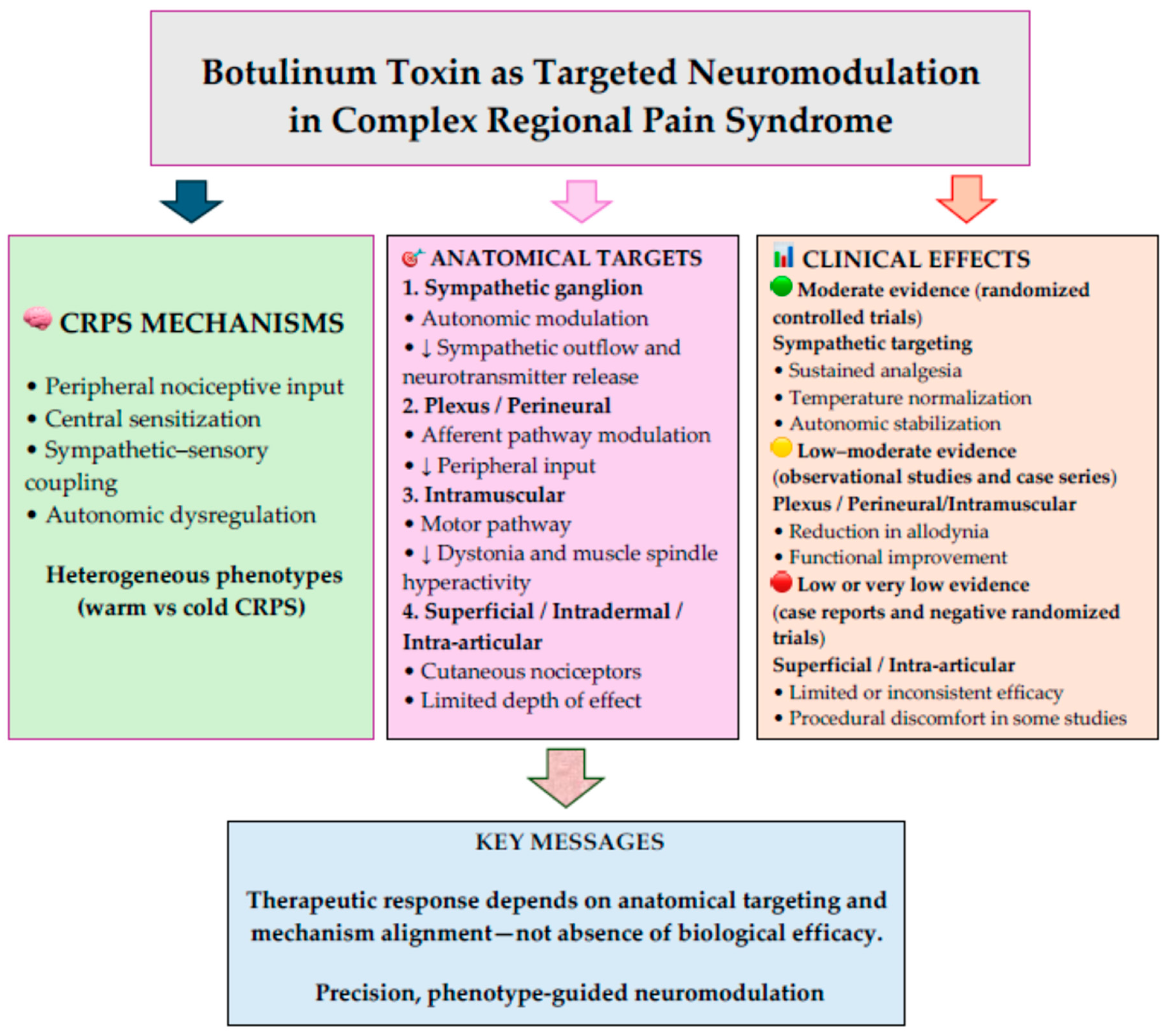
Botulinum Toxin as Targeted Neuromodulation in Complex Regional Pain Syndrome: An Anatomy-Informed Mechanistic Review


Abstract
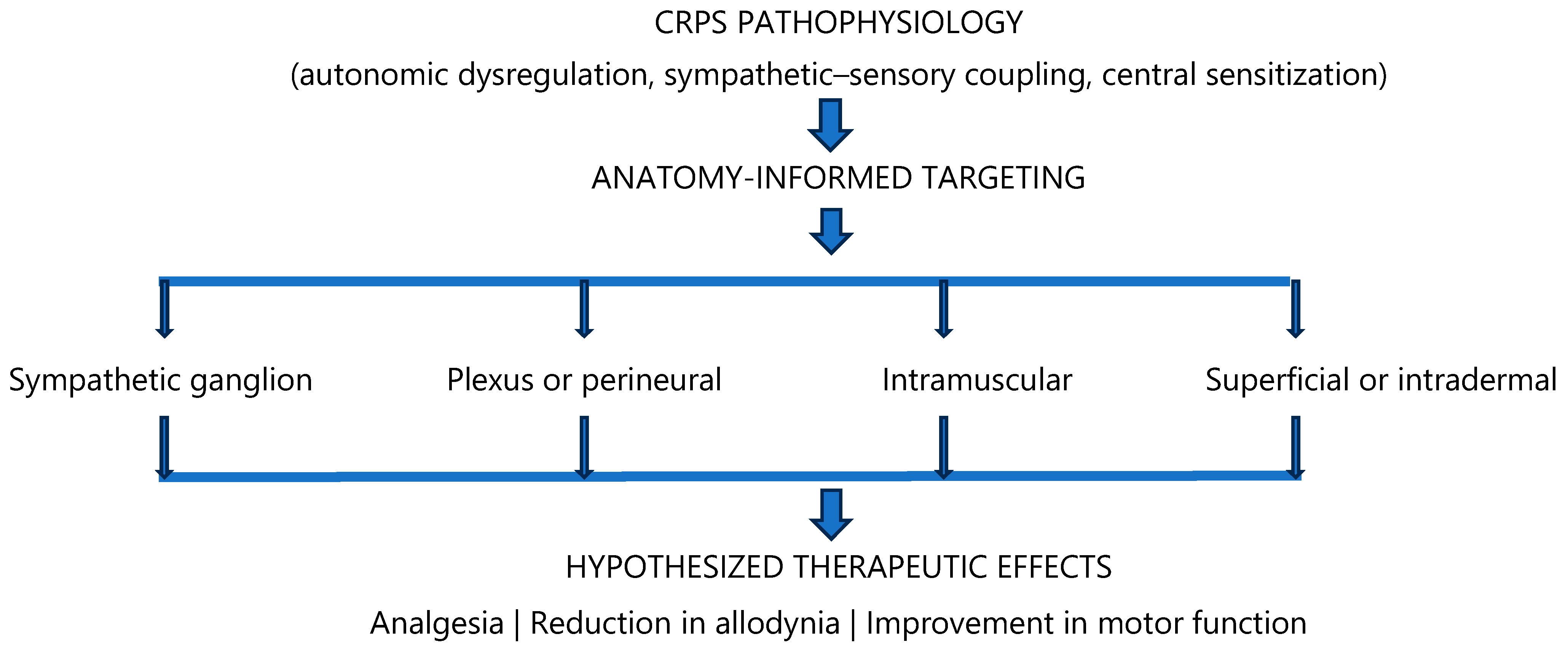
1. Introduction
2. Results
2.1. Sympathetic Nervous System-Targeted Delivery
2.2. Plexus-Level and Perineural Neuromodulation
2.3. Intramuscular Delivery in Motor-Dominant CRPS
2.4. Superficial and Peripheral Tissue Delivery
2.5. Intra-Articular Delivery
2.6. Procedural Anatomy and Safety Considerations
3. Discussion
4. Conclusions
5. Materials and Methods
Supplementary Materials
Funding
Institutional Review Board Statement
Informed Consent Statement
Data Availability Statement
Acknowledgments
Conflicts of Interest
Abbreviations
| BoNT/A | Botulinum toxin type A |
| BoNT/B | Botulinum toxin type B |
| CRPS | Complex regional pain syndrome |
| EMG | Electromyography |
| GRADE | Grading of Recommendations Assessment, Development and Evaluation |
| NOS | Newcastle–Ottawa Scale |
| ROB 2 | Risk of Bias 2 |
| ROBINS-I | Risk of Bias In Non-randomized Studies of Interventions |
References
- Harden, N.R.; Bruehl, S.; Perez, R.S.G.M.; Birklein, F.; Marinus, J.; Maihofner, C.; Lubenow, T.; Buvanendran, A.; Mackey, S.; Graciosa, J.; et al. Validation of proposed diagnostic criteria (the “Budapest Criteria”) for Complex Regional Pain Syndrome. Pain 2010, 150, 268–274. [Google Scholar] [CrossRef]
- Sobeeh, M.G.; Hassan, K.A.; Silva, A.G.; Bruehl, S. Impact of different CRPS phenotypes and diagnostic criteria on quantitative sensory testing outcomes: Systematic review and meta-analysis. Pain Med. 2024, 25, 211–225. [Google Scholar] [CrossRef]
- de Mos, M.; de Bruijn, A.G.; Huygen, F.J.; Dieleman, J.P.; Stricker, B.H.; Sturkenboom, M.C. The incidence of complex regional pain syndrome: A population-based study. Pain 2007, 129, 12–20. [Google Scholar] [CrossRef]
- Bean, D.J.; Johnson, M.H.; Heiss-Dunlop, W.; Kydd, R.R. Factors Associated with Disability and Sick Leave in Early Complex Regional Pain Syndrome Type-1. Clin. J. Pain 2016, 32, 130–138. [Google Scholar] [CrossRef] [PubMed]
- Bruehl, S. Complex regional pain syndrome. BMJ 2015, 351, h2730. [Google Scholar] [CrossRef]
- Birklein, F.; Schlereth, T. Complex regional pain syndrome-significant progress in understanding. Pain 2015, 156, S94–S103. [Google Scholar] [CrossRef]
- Baron, R.; Binder, A.; Wasner, G. Neuropathic pain: Diagnosis, pathophysiological mechanisms, and treatment. Lancet Neurol. 2010, 9, 807–819. [Google Scholar] [CrossRef]
- Maihöfner, C.; Seifert, F.; Markovic, K. Complex regional pain syndromes: New pathophysiological concepts and therapies. Eur. J. Neurol. 2010, 17, 649–660. [Google Scholar] [CrossRef]
- Bruehl, S. An update on the pathophysiology of complex regional pain syndrome. Anesthesiology 2010, 113, 713–725. [Google Scholar] [CrossRef] [PubMed]
- Grieve, S.; Adams, J.; McCabe, C. ‘What I Really Needed Was the Truth’. Exploring the Information Needs of People with Complex Regional Pain Syndrome. Musculoskelet. Care 2016, 14, 15–25. [Google Scholar] [CrossRef] [PubMed]
- Deer, T.R.; Levy, R.M.; Kramer, J.; Poree, L.; Amirdelfan, K.; Grigsby, E.; Staats, P.; Burton, A.W.; Burgher, A.H.; Obray, J.; et al. Dorsal root ganglion stimulation yielded higher treatment success rate for complex regional pain syndrome and causalgia at 3 and 12 months: A randomized comparative trial. Pain 2017, 158, 669–681. [Google Scholar] [CrossRef]
- Taylor, R.S.; Van Buyten, J.P.; Buchser, E. Spinal cord stimulation for complex regional pain syndrome: A systematic review of the clinical and cost-effectiveness literature and assessment of prognostic factors. Eur. J. Pain 2006, 10, 91–101. [Google Scholar] [CrossRef]
- Francisco, G.E.; Tan, H.; Green, M. Do botulinum toxins have a role in the management of neuropathic pain? A focused review. Am. J. Phys. Med. Rehabil. 2012, 91, 899–909. [Google Scholar] [CrossRef] [PubMed]
- Aoki, K.R. Review of a proposed mechanism for the antinociceptive action of botulinum toxin type A. Neurotoxicology 2005, 26, 785–793. [Google Scholar] [CrossRef] [PubMed]
- Matak, I.; Rossetto, O.; Lacković, Z. Botulinum toxin type A selectivity for certain types of pain is associated with capsaicin-sensitive neurons. Pain 2014, 155, 1516–1526. [Google Scholar] [CrossRef]
- Carroll, I.; Clark, J.D.; Mackey, S. Sympathetic block with botulinum toxin to treat complex regional pain syndrome. Ann. Neurol. 2009, 65, 348–351. [Google Scholar] [CrossRef] [PubMed]
- Yoo, Y.; Lee, C.S.; Kim, J.; Jo, D.; Moon, J.Y. Botulinum Toxin Type A for Lumbar Sympathetic Ganglion Block in Complex Regional Pain Syndrome: A Randomized Trial. Anesthesiology 2022, 136, 314–325. [Google Scholar] [CrossRef]
- Lee, Y.; Lee, C.J.; Choi, E.; Lee, P.B.; Lee, H.J.; Nahm, F.S. Lumbar Sympathetic Block with Botulinum Toxin Type A and Type B for the Complex Regional Pain Syndrome. Toxins 2018, 10, 164. [Google Scholar] [CrossRef] [PubMed]
- Moon, Y.E.; Choi, J.H.; Park, H.J.; Park, J.H.; Kim, J.H. Ultrasound-Guided Nerve Block with Botulinum Toxin Type A for Intractable Neuropathic Pain. Toxins 2016, 8, 18. [Google Scholar] [CrossRef] [PubMed]
- Meyer-Frießem, C.H.; Eitner, L.B.; Kaisler, M.; Maier, C.; Vollert, J.; Westermann, A.; Zahn, P.K.; Avila González, C.A. Perineural injection of botulinum toxin-A in painful peripheral nerve injury—A case series: Pain relief, safety, sensory profile and sample size recommendation. Curr. Med. Res. Opin. 2019, 35, 1793–1803. [Google Scholar] [CrossRef]
- Fallatah, S.M. Successful management of complex regional pain syndrome type 1 using single injection interscalene brachial plexus block. Saudi J. Anaesth. 2014, 8, 559–561. [Google Scholar] [CrossRef] [PubMed]
- Cordivari, C.; Misra, V.P.; Catania, S.; Lees, A.J. Treatment of dystonic clenched fist with botulinum toxin. Mov. Disord. 2001, 16, 907–913. [Google Scholar] [CrossRef]
- Kharkar, S.; Ambady, P.; Venkatesh, Y.; Schwartzman, R.J. Intramuscular botulinum toxin in complex regional pain syndrome: Case series and literature review. Pain Physician 2011, 14, 419–424. [Google Scholar] [CrossRef]
- Schilder, J.C.; van Dijk, J.G.; Dressler, D.; Koelman, J.H.; Marinus, J.; van Hilten, J.J. Responsiveness to botulinum toxin type A in muscles of complex regional pain patients with tonic dystonia. J. Neural Transm. 2014, 121, 761–767. [Google Scholar] [CrossRef]
- Lessard, L.; Bartow, M.J.; Lee, J.; Diaz-Abel, J.; Tessler, O.E.S. Botulinum Toxin A: A Novel Therapeutic Modality for Upper Extremity Chronic Regional Pain Syndrome. Plast. Reconstr. Surg. Glob. Open 2018, 6, e1847. [Google Scholar] [CrossRef] [PubMed]
- Safarpour, D.; Salardini, A.; Richardson, D.; Jabbari, B. Botulinum toxin A for treatment of allodynia of complex regional pain syndrome: A pilot study. Pain Med. 2010, 11, 1411–1414. [Google Scholar] [CrossRef]
- Tereshko, Y.; Dalla Torre, C.; Lettieri, C.; Belgrado, E.; Gigli, G.L.; Valente, M. Subcutaneous BoNT/A Injection for Intractable Pain and Disability in Complex Regional Pain Syndrome: A Case Report. Toxins 2022, 14, 411. [Google Scholar] [CrossRef]
- Bellon, G.; Venturin, A.; Masiero, S.; Del Felice, A. Intra-articular botulinum toxin injection in complex regional pain syndrome: Case report and review of the literature. Toxicon 2019, 159, 41–44. [Google Scholar] [CrossRef]
- Chen, C.P.C.; Hsu, C.C.; Cheng, C.H.; Huang, S.C.; Chen, J.L.; Lin, S.Y. The Lateral Decubitus Body Position Might Improve the Safety of Ultrasound-Guided Supraclavicular Brachial Plexus Nerve Block. J. Pain Res. 2021, 14, 75–82. [Google Scholar] [CrossRef]
- Wasner, G.; Schattschneider, J.; Binder, A.; Baron, R. Complex regional pain syndrome–diagnostic, mechanisms, CNS involvement and therapy. Spinal Cord 2003, 41, 61–75. [Google Scholar] [CrossRef] [PubMed]
- Chen, C.H.; Chen, C.P.C.; Chen, J.L.; Cheng, W.J.; Suputtitada, A. The Change in Body Positioning to Improve Safety in Performing Ultrasound-Guided Supraclavicular Brachial Plexus Nerve Block. Am. J. Phys. Med. Rehabil. 2021, 100, e60–e61. [Google Scholar] [CrossRef] [PubMed]
- Petersen, P.B.; Mikkelsen, K.L.; Lauritzen, J.B.; Krogsgaard, M.R. Risk Factors for Post-treatment Complex Regional Pain Syndrome (CRPS): An Analysis of 647 Cases of CRPS from the Danish Patient Compensation Association. Pain Pract. 2018, 18, 341–349. [Google Scholar] [CrossRef]
- Klee, M.; Karottki, N.C.; Biering-Sørensen, B. Intramuscular Botulinum Toxin for Complex Regional Pain Syndrome: A Narrative Review of Published Cases. Toxins 2025, 17, 350. [Google Scholar] [CrossRef]
- Harden, R.N.; McCabe, C.S.; Goebel, A.; Massey, M.; Suvar, T.; Grieve, S.; Bruehl, S. Complex Regional Pain Syndrome: Practical Diagnostic and Treatment Guidelines, 5th Edition. Pain Med. 2022, 23, S1–S53. [Google Scholar] [CrossRef] [PubMed]
- Su, Y.C.; Hsieh, P.C.; Guo, Y.H.; Lin, Y.C. Meta-Analysis of Effectiveness and Safety of Botulinum Toxin in the Treatment of Complex Regional Pain Syndrome. Life 2022, 12, 2037. [Google Scholar] [CrossRef] [PubMed]


| Anatomical Target | Study (Ref) | Study Design (n) | CRPS Site/Phenotype | BoNT Formulation/Dose/Route/Guidance | Follow-Up | Principal Findings |
|---|---|---|---|---|---|---|
| Sympathetic ganglion | Carroll et al. [16] | Randomized, double-blind, controlled crossover trial (n = 9) | Lower-limb CRPS | BoNT-A 75 U + bupivacaine; lumbar sympathetic block; fluoroscopic guidance | Median time to analgesic failure: 71 days (95% CI 12–253) | Prolonged analgesia compared with local anesthetic alone |
| Yoo et al. [17] | Randomized, double-blind controlled trial (n = 47) | Lower-limb CRPS, predominantly cold phenotype | BoNT-A 75 U + levobupivacaine (8 mL); lumbar sympathetic ganglion block; fluoroscopic guidance | 1 and 3 months | Sustained pain reduction, increased skin temperature, and improved cold intolerance | |
| Lee et al. [18] | Randomized, double-blind comparative study (n = 18; 9 per group) | Lower-limb CRPS | BoNT-A 100 U or BoNT-B 5000 U; lumbar sympathetic block; fluoroscopic guidance | up to 8 weeks (56 days) | Both serotypes prolonged analgesia, with longer duration observed in the BoNT-B group | |
| Plexus or perineural | Moon et al. [19] | Case series (n = 7) | Neuropathic pain including CRPS | BoNT-A; ultrasound-guided nerve block | not clearly specified | Analgesia exceeding expected duration of nerve block |
| Meyer-Frießem et al. [20] | Case series (n = 60) | Peripheral neuropathic pain (including CRPS subset) | BoNT-A; perineural injection; ultrasound-guided | ≥7 days to several months |
| |
| Intramuscular | Fallatah [21] | Case report (n = 1) | Upper-limb CRPS | Interscalene brachial plexus block (bupivacaine); ultrasound-guided; adjunct BoNT-A trigger point injection | up to 3 months | Rapid and complete pain relief with functional recovery; sustained improvement over follow-up |
| Cordivari et al. [22] | Case series (n = 14; CRPS subset n = 4) | Dystonia-associated CRPS and other movement disorders | AbobotulinumtoxinA 450–1200 U; EMG-guided intramuscular injection (lumbricals and forearm muscles) | NR | Pain reduction and muscle relaxation; functional improvement in selected cases | |
| Kharkar et al. [23] | Case series (n = 37) | CRPS with dystonia (motor-dominant phenotype) | BoNT-A (dose individualized); intramuscular; EMG-guided | ~4 weeks | Reduction in pain and dystonia with functional improvement | |
| Schilder et al. [24] | Prospective experimental study (n = 17) | CRPS with tonic dystonia | OnabotulinumtoxinA 20 U; intramuscular injection (extensor digitorum brevis) | 2 weeks | Normal BoNT-A responsiveness (CMAP reduction > 20%); slightly reduced effect vs controls | |
| Superficial or peripheral tissue | Lessard et al. [25] | Case series (n = 20) | Upper-limb CRPS (refractory to sympathetic blocks) | OnabotulinumtoxinA < 100 U/session; subcutaneous grid injection (10 IU/cm2; max 100 IU/session) | Monthly repeated sessions (mean 8.85) | Mean VAS reduction 2.05 (~22.9%); significant improvement (p < 0.01); cumulative effect over repeated treatments |
| Safarpour et al. [26] | Pilot randomized double-blind controlled study (n = 14; RCT n = 8 + open-label n = 6) | CRPS with allodynia | BoNT-A; intradermal and subcutaneous injection (5 U/site; total 40–200 U) | 3 weeks–2 months | No significant analgesic benefit; poor tolerability | |
| Tereshko et al. [27] | Case report (n = 1) | Upper-limb CRPS type 1 | BoNT-A 50–80 IU; subcutaneous multi-site injection (hand and forearm; non–image-guided) | Up to ~2–3 months | Repeated injections improved pain, allodynia, and motor function with no adverse effects | |
| Intraarticular | Bellon et al. [28] | Case report (n = 1) | CRPS (upper limb; shoulder involvement) | BoNT-A 100 U; intra-articular injection (glenohumeral joint) | Up to 4 months | Pain reduction and improved ROM; no effect on autonomic or trophic changes |
| Anatomical Target | Primary Neuromodulatory Mechanism | Dominant Pathophysiological Process Addressed | Expected Clinical Effect | Evidence Context |
|---|---|---|---|---|
| Sympathetic ganglion | Inhibition of cholinergic sympathetic transmission and downstream autonomic neurotransmitter release | Sympathetic–sensory coupling, vasomotor instability, and cold-type autonomic dysregulation | Sustained analgesia with improvement in vasomotor symptoms and skin temperature asymmetry | Randomized controlled and comparative studies [16,17,18] |
| Plexus or perineural | Attenuation of proximal nociceptive afferent signaling and ectopic peripheral input | Persistent peripheral afferent drive sustaining central sensitization and mechanical allodynia | Rapid pain relief, reduction in allodynia, and functional improvement beyond expected anesthetic duration | Case series and clinical reports [19,20] |
| Intramuscular | Reduction of abnormal muscle overactivity and spindle-related afferent discharge | Motor-driven nociceptive input in dystonia-associated or spasm-predominant CRPS | Improvement in pain, dystonia, abnormal posturing, and functional outcomes | Observational series and mechanistic studies [21,22,23,24] |
| Superficial or intradermal/subcutaneous | Modulation of superficial nociceptor activity and neurogenic inflammatory mediators | Cutaneous hypersensitivity, allodynia, and heterogeneous peripheral sensitization | Variable analgesic response; may improve selected phenotypes but limited or poorly tolerated in severe allodynia | Pilot randomized studies, case series, and case reports [25,26,27] |
| Intra-articular | Local inhibition of nociceptive mediator release within the joint microenvironment | Joint-related peripheral nociceptive input contributing to pain and restricted mobility | Reduction in pain and improved range of motion, with minimal effect on autonomic or trophic changes | Case-based evidence [28] |
Disclaimer/Publisher’s Note: The statements, opinions and data contained in all publications are solely those of the individual author(s) and contributor(s) and not of MDPI and/or the editor(s). MDPI and/or the editor(s) disclaim responsibility for any injury to people or property resulting from any ideas, methods, instructions or products referred to in the content. |
© 2026 by the author. Licensee MDPI, Basel, Switzerland. This article is an open access article distributed under the terms and conditions of the Creative Commons Attribution (CC BY) license.
Share and Cite
Suputtitada, A. Botulinum Toxin as Targeted Neuromodulation in Complex Regional Pain Syndrome: An Anatomy-Informed Mechanistic Review. Toxins 2026, 18, 160. https://doi.org/10.3390/toxins18040160
Suputtitada A. Botulinum Toxin as Targeted Neuromodulation in Complex Regional Pain Syndrome: An Anatomy-Informed Mechanistic Review. Toxins. 2026; 18(4):160. https://doi.org/10.3390/toxins18040160
Chicago/Turabian StyleSuputtitada, Areerat. 2026. "Botulinum Toxin as Targeted Neuromodulation in Complex Regional Pain Syndrome: An Anatomy-Informed Mechanistic Review" Toxins 18, no. 4: 160. https://doi.org/10.3390/toxins18040160
APA StyleSuputtitada, A. (2026). Botulinum Toxin as Targeted Neuromodulation in Complex Regional Pain Syndrome: An Anatomy-Informed Mechanistic Review. Toxins, 18(4), 160. https://doi.org/10.3390/toxins18040160