1. Introduction
Apples are one of the most important fruits worldwide, with an annual production of 97 million tonnes [
1]. Both the fresh fruit and its numerous food products (juice, purées, compote, and dried apples) are consumed in a wide variety of countries, due to their high nutritional value and pleasant taste [
2]. This fruit is highly vulnerable to fungal infections throughout the various stages of production, from cultivation and harvesting to transport and storage, with a particularly high incidence of rotting during the post-harvest period [
3]. Several species of the genus
Alternaria are considered among the most relevant pathogens in the post-harvest stage of apples, with infection rates reaching up to 41% in commercial fruits of the Red Delicious variety in Argentina [
4]. The development of these fungi in fresh apples is a major concern, not only because of the deterioration of the fruit, but also because of their ability to produce mycotoxins [
5]. This pathogen not only infects the fruit on the exterior; mouldy core (MC) is also a frequent disease that favours mycotoxin accumulation even at refrigeration temperatures inside the fruit, usually in the seed and carpel wall. In a previous study [
6], the legislation on
Alternaria mycotoxins in apple by-products was suggested since a risk for consumers was demonstrated, particularly for the vulnerable group of children. Nonetheless, legislation alone does not prevent the accumulation of toxins; controls in the process of apple by-products are necessary for producers to be able to comply with future legislation.
The incidence of
Alternaria increases during the post-harvest stage [
4]. Thus, storing fruits for shorter periods and processing freshly harvested apples would be an effective strategy for reducing mycotoxin concentration in the final products, but it is not always possible or profitable. Recent advances in mass spectrometry-based analytical strategies have expanded the applications of both untargeted and targeted metabolomics in food and agricultural research. Targeted approaches allow sensitive and quantitative determination of predetermined metabolites relevant to contamination, whereas untargeted fingerprinting enables the detection of unknown markers and broad biochemical changes associated with food quality and safety risks. These complementary strategies have been successfully applied to identify biomarkers, detect adulterants, and assess secondary metabolites that may pose food safety concerns [
7]. The application of untargeted metabolomics towards food safety strategies is still in early stages, but the work done to date shows promising results. These studies employ various analytical hardware and software—many using high-resolution mass spectrometry (HRMS) [
8]—and enable the identification of unique metabolic markers that can be applied in the early detection of a phytopathogen or its metabolites as a fingerprint of infection [
9]. Therefore, untargeted metabolomics can be used to develop strategies to tackle the issue of the contamination of food and feed with mycotoxins through an understanding of the plant–pathogen interaction [
10,
11].
The aim of this study was to set the basis for a control strategy based on liquid chromatography tandem HRMS to detect apples infected with Alternaria tenuissima through metabolomic signatures associated with fungal infection and potential mycotoxin production. To this end, untargeted HRMS analyses were carried out in positive and negative ionisation modes and combined with chemometric tools to discriminate between infected and uninfected apples in a single analysis. The ability of the proposed approach to differentiate between different strains, storage conditions (temperature) and the area of the fruit affected was also evaluated by analysing the individual effects of these factors and their possible interactions.
2. Results
Composite ion maps which contained 21,804 and 21,506 metabolomic features in ESI
+ and ESI
− mode, respectively, were obtained. Filtering of the features according to the ANOVA
p-value < 0.05 decreased the number to 9308 and 10,505 metabolites in ESI
+ and ESI
−, respectively.
Supplementary Tables S1 and S2 present all selected features used for downstream analysis in ESI
+ and ESI
− modes, respectively. This data reduction allowed the study to focus on features that clearly discriminate infected from non-infected apples by principal component analysis (PCA).
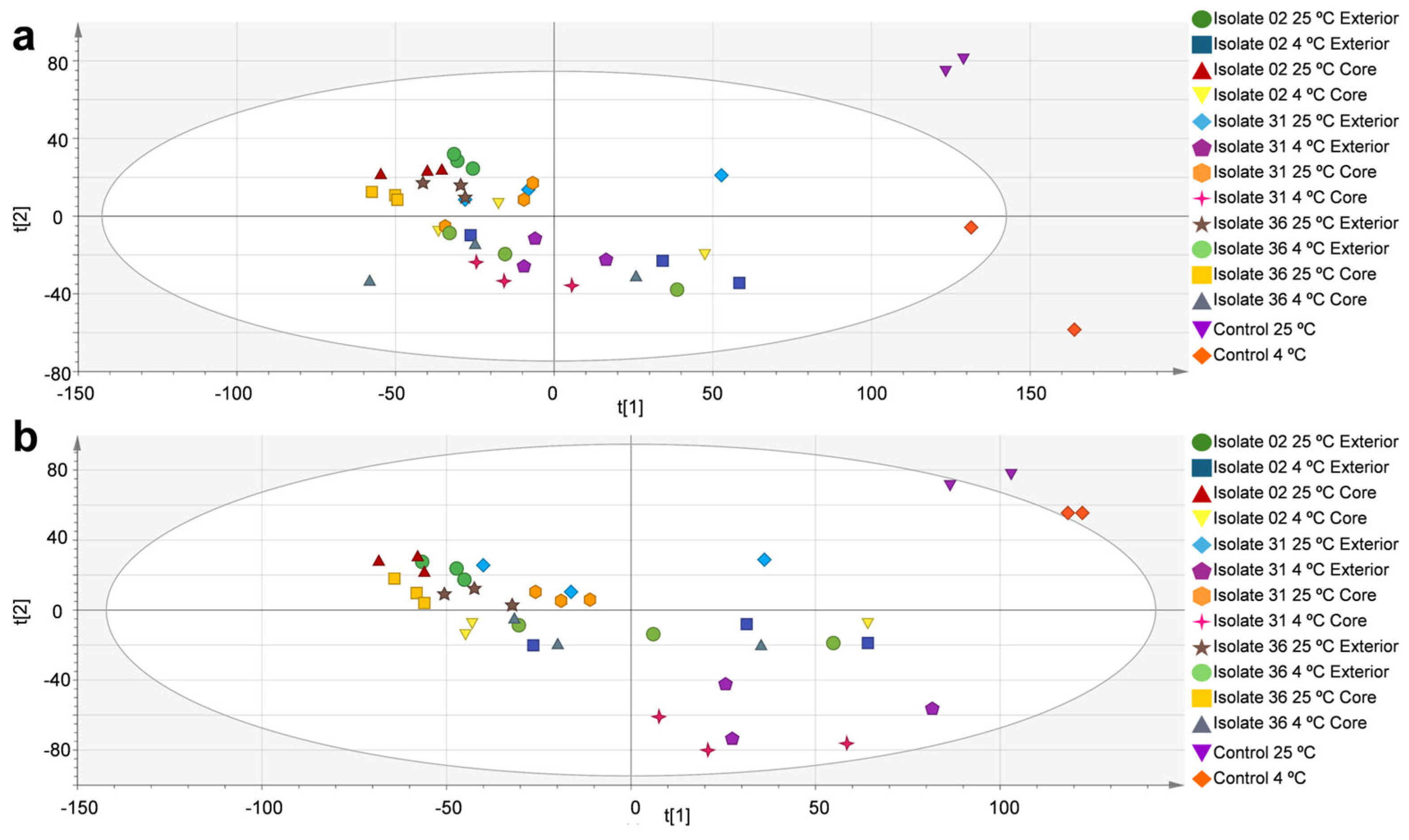
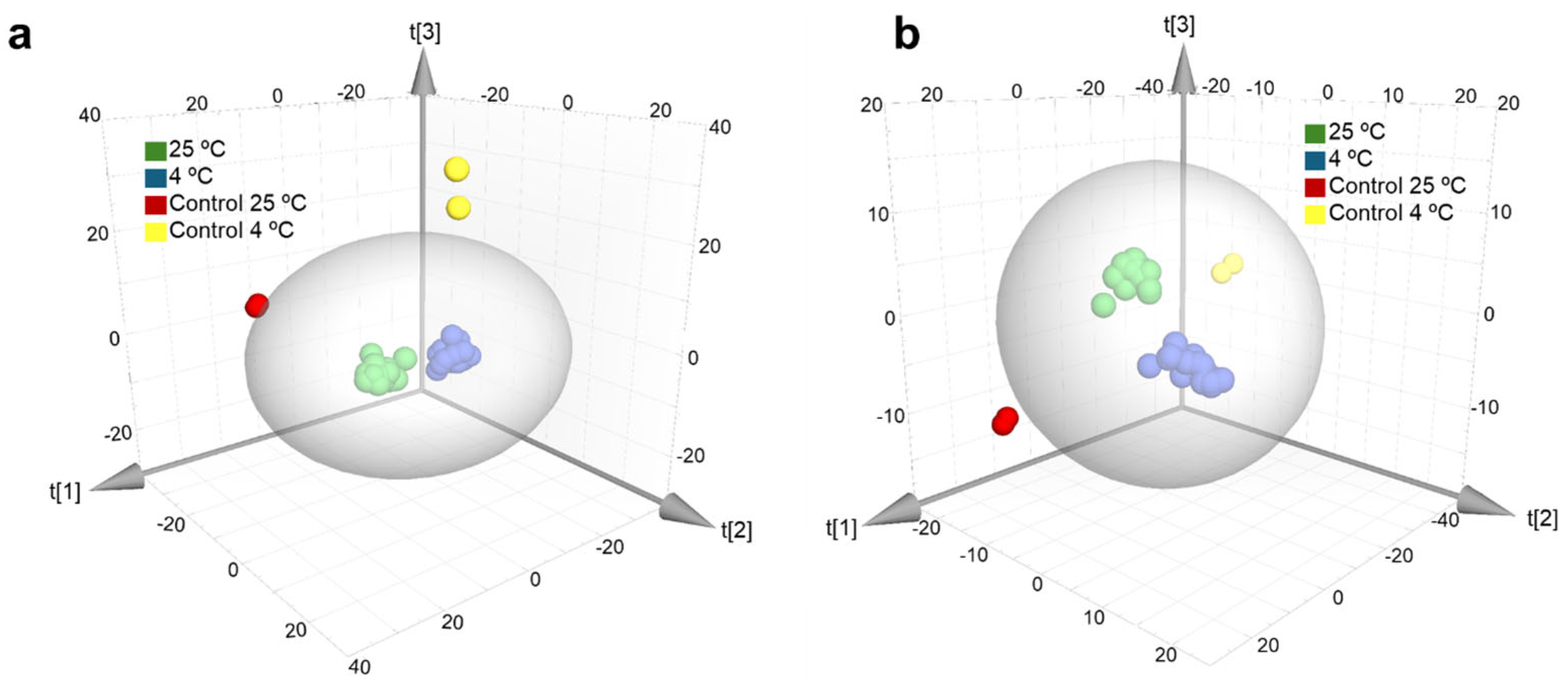
Figure 1a shows the PCA of metabolomic features detected in infected and non-infected (control) apples in ESI
+ mode, and
Figure 1b in ESI
− mode. In the ESI
+ analysis, the model consisted of seven components (R2X = 0.684, Q2 = 0.379), with the first two components explaining 42% of the total variance (33% and 9%, respectively). In the case of ESI
−, the seven-component model (R2X = 0.682, Q2 = 0.382) captured 41% of the variance in the two principal axes (29% for t [
1] and 12% for t [
2]). In both analyses, the control samples (at 25 °C and 4 °C) were separated from the infected apples, regardless of strain, inoculation site or incubation temperature. The control samples were consistently grouped at the right end of the score plots, where the highest positive values were found for principal component 1 (t [
1]). This differential distribution confirms that infection is the predominant factor in the variation in the metabolic profile captured by the model. The ellipses shown in the PCA score plots represent the 95% confidence interval of the Hotelling T
2 statistic. In both modes, the control samples at 25 °C and 4 °C showed group separation with the infected apples, independently from the strain, site of inoculation or incubation temperature.
Based on the trend observed in the PCA (
Figure 1), a PLS-DA model was constructed to discriminate between infected samples (regardless of strain, inoculation zone or storage temperature) and non-infected samples used as controls. The initial models, constructed using all features with a
p-value < 0.05, showed good predictive capacity, with Q2 values greater than 0.8 in both ionisation modes, 100% cross-validation and statistical significance confirmed by CV-ANOVA (
p-value < 10
−9) (
Table S3). However, the relatively low R2X values suggest the high complexity of the model, associated with the large number of features included.
In order to improve the models, the number of features used to construct them was reduced based on VIP values. The models were then reconstructed using features with VIP > 1 (2837 features in positive mode and 4061 in negative mode). This reduction led to an improvement in the model parameters overall, particularly the R2X values, while maintaining high predictive power and statistical significance. Applying a more restrictive criterion (VIP > 1.5) reduced the number of features to 1400 in positive mode and 735 in negative mode. This resulted in highly robust models with Q2 values greater than 0.93, showing a clear improvement in the balance between descriptive and predictive capacity (
Table S3). Furthermore, the validity and robustness of the model were confirmed by permutation tests, which were based on 50 random permutations per class (fungal infection samples and controls). The original R2 and Q2 values were consistently higher than those obtained in the permuted models, demonstrating that the observed high performance was not due to chance (
Figures S1 and S2). These results suggest that a small subset of markers is sufficient for effectively discriminating between infected and uninfected samples.
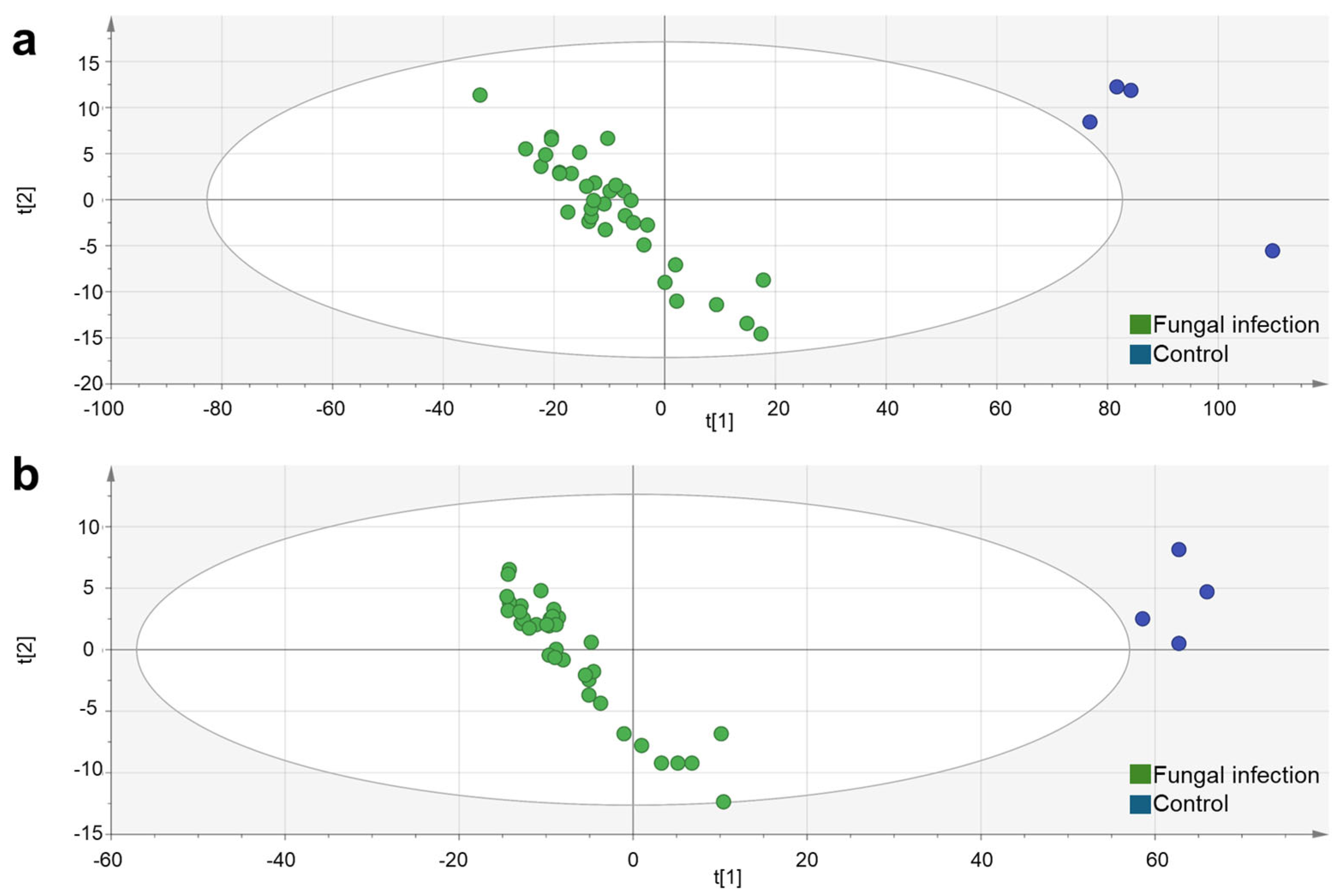
Figure 2 shows the PLS-DA score that discriminates between infected and uninfected samples using a reduced number of features (VIP > 1.5). The first latent variable (
x-axis) distinguishes between both classes.
Next, the ability of the metabolomic profile to distinguish between samples based on the
Alternaria strain responsible for the infection was assessed. To achieve this, new PLS-DA models were created using the data obtained in both ionisation modes. The modelling and validation strategy used was similar to that which was previously described. Initially, models were constructed using all features with a
p-value lower than 0.05 and then optimised through progressive variable selection based on VIPs with thresholds greater than 1 and 1.5. The adjustment parameters, predictive capacity and statistical validation of the different models are summarised in
Table S4.
The PLS-DA models demonstrated sufficient discriminatory capacity to distinguish between the Alternaria strains responsible for infection in both ionisation modes. In the ESI− mode, all models were statistically significant, with high R2Y and Q2 values indicating excellent explanatory and predictive capacity. In ESI+ mode, using all features did not produce a statistically significant model. However, reducing the number of markers to the most relevant ones significantly improved the model’s performance, achieving high Q2 values and highly significant p-values. These results demonstrate the importance of feature selection in optimising discrimination between strains. To verify the accuracy of both models, permutation tests were conducted to ensure that the outcomes were not the result of chance.
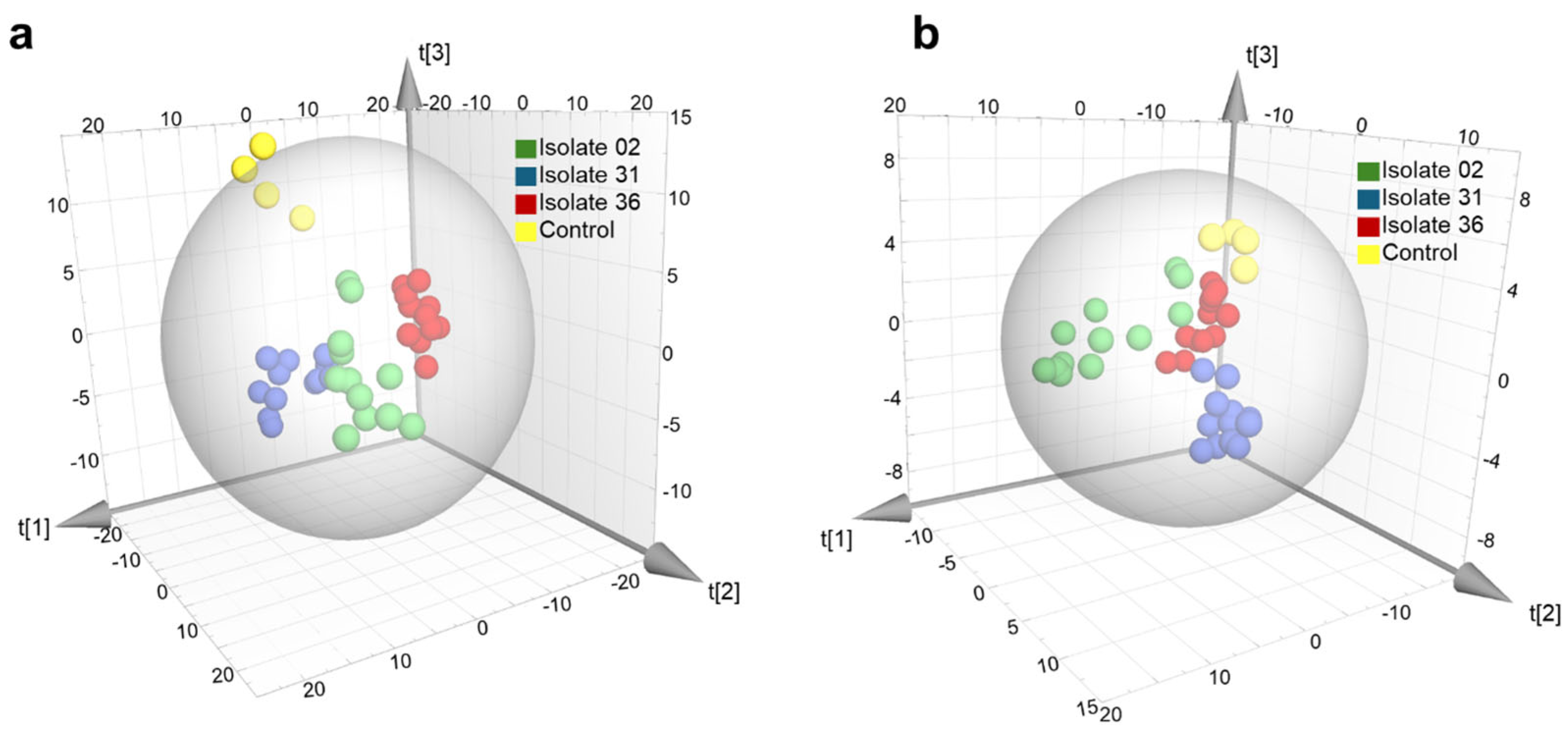
Figure 3 shows the PLS-DA score used to discriminate between the
Alternaria strains responsible for apple infections using a reduced number of features (VIP > 1.5).
The next objective of the study was to determine whether the metabolic profile could be used to differentiate between infections that occurred on the exterior of the apple and those that occurred in the core. The results obtained for the different models are shown in
Table S5. When considering all features, only the ESI
+ model proved to be statistically significant, whereas no statistically significant
p-value was observed in ESI
−s mode. Reducing the number of features (VIP > 1 and VIP > 1.5) considerably improved the performance of the models, with high Q2 values and significant
p-values obtained in both the ESI
+ and ESI
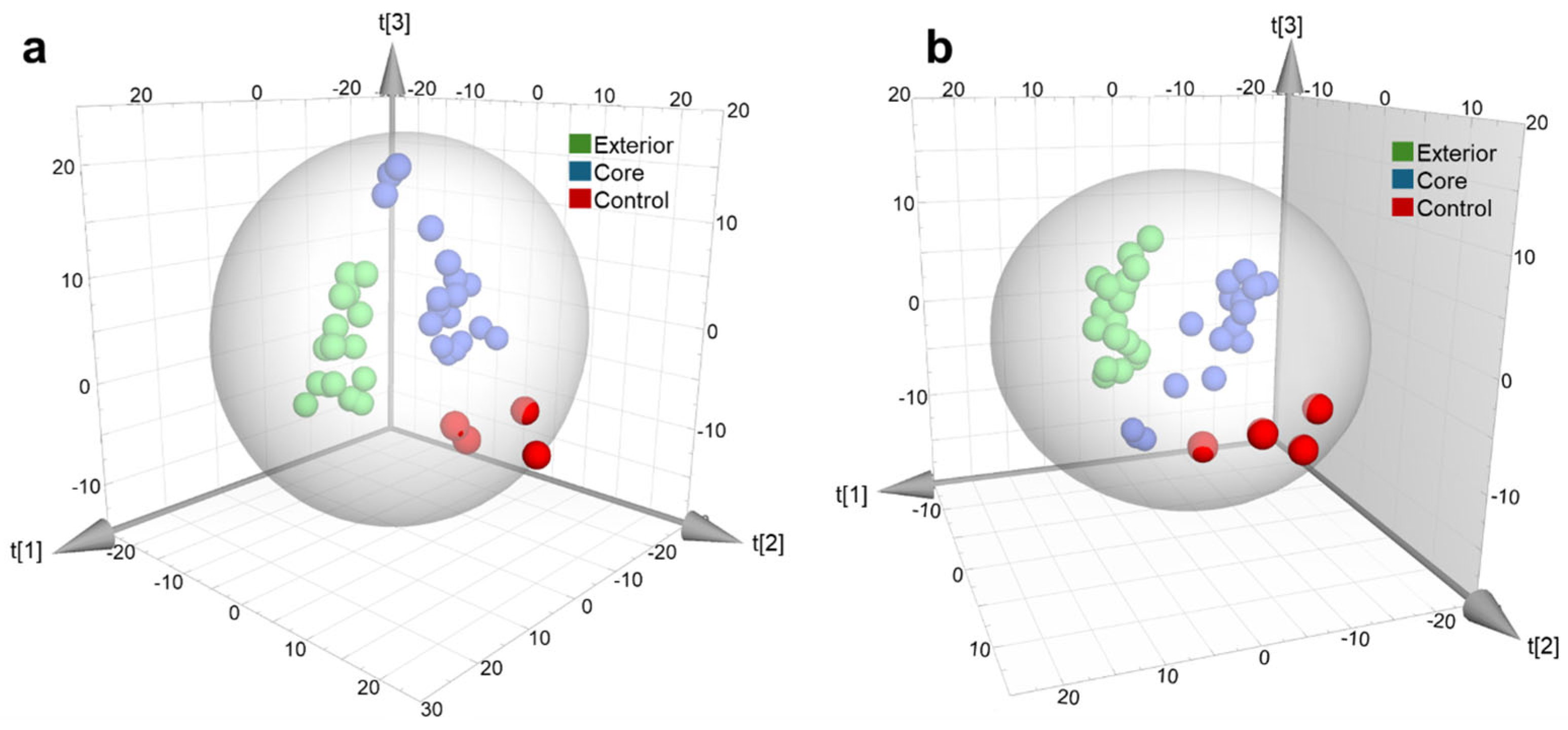
− models. These results suggest that the metabolomic profile can discriminate according to the infected area. However, this depends on the adequate refinement of the selected features since using the complete profile introduces noise that masks the relevant variables and leads to less robust models. Permutation tests reaffirmed the validity of both models and the corresponding PLS-DA scores using a reduced number of features (VIP > 1.5) are shown in
Figure 4.
Then, the study examined whether the metabolomic profile could be discriminated based on the temperature at which the apples had been incubated. The results of the PLS-DA models using data acquired in ESI
+ and ESI
− modes are presented in
Table S6. The PLS-DA models exhibited robust behaviour, demonstrating high Q2 values and highly significant
p-values in both ionisation modes, even when utilising all features. Subsequent variable reduction using VIPs maintained and even slightly improved the models’ predictive capacity without compromising their stability. These results highlight the significant impact of incubation temperature on the metabolomic profile of the samples, enabling clear discrimination. Permutation tests confirmed the validity of the models again, and the corresponding PLS-DA scores using a reduced number of features (VIP > 1.5) are shown in
Figure 5.
Finally, the study examined whether the metabolomic profile could discriminate simultaneously between incubation temperature and the infected area (
Table S7),
Alternaria strain and infected area (
Table S8), and
Alternaria strain and incubation temperature (
Table S9). The PLS-DA models generally exhibited lower discriminatory power than unifactorial analyses. In the combined analysis of incubation temperature and infected area (
Table S7), statistically significant models with acceptable Q2 values were obtained in both ionisation modes only after selecting features with VIP > 1.5, indicating that it is possible to discriminate between these two factors together using a reduced number of features. In the analysis combining
Alternaria strain and infected area (
Table S8), the models showed limited performance with low Q2 values and a lack of statistical significance, even when the number of features was reduced. By contrast, combining the
Alternaria strain and incubation temperature (
Table S9) produced more robust models, particularly when the number of features was reduced (VIP > 1.5). This achieved acceptable Q2 values and significant
p-values, highlighting an interaction between these factors in the metabolomic profile.
Figures S3–S5 show the PLS-DA scores for these last three studies, using a reduced number of features (VIP > 1.5).
3. Discussion
Recent studies have confirmed that
Alternaria contamination remains a relevant issue in apples, with several mycotoxins detected in apple products, highlighting the need for improved monitoring strategies throughout the production chain [
3]. Moreover, previous results suggested the need for control strategies to prevent the presence of
Alternaria mycotoxins in apple products [
6]. The application of fungicides both in pre- and post-harvest stages does not provide an effective solution; moreover, fungicide resistance is increasing and new fungicide regulations are gaining more relevance [
12,
13]. There is a growing understanding that knowledge about the diversity in natural ecosystems can contribute to more sustainable crop production [
14]. Since long-term storage increases the incidence of MC, an effective selection of raw material could prevent the incorporation of infected fruit into the process line. Several automated methods have been proposed for non-destructive detection of this disease. Hu et al. [
15] recently developed a frequency domain diffuse optical tomography method for detecting underlying lesions of apple. The mouldy lesions not deeper than 20 mm from the peel were resolvable on the absorption images, but the model still presented several limitations. Yang and Yang [
16] and Kadowaki et al. [
17] developed non-destructive methods based on X-ray for detecting early stages of core rot in Japanese pear and suggested it could also be applied for apples. Methods based on transmittance spectroscopy were developed for the detection of single fruit with MC [
18,
19,
20]; an online detection method based on visible and near-infrared spectroscopy full-transmittance spectra of MC apples was also developed [
21]. All these methods are promising for fresh retail apples or to be applied by packhouses to prevent storage of fruit with early stages of MC. Nonetheless, none of them detect mycotoxin accumulation and therefore would not provide a comprehensive tool for processing industries.
The untargeted approach presented here, involving HRMS analysis, allowed detection of metabolomic features from the non-infected apples, the fungi, and their interaction. It clearly separated
Alternaria tenuissima-infected from uninfected fruits, regardless of incubation temperature or place of inoculation, even in the conditions in which mycotoxin accumulation was lower (e.g., exterior infection, 9 months storage) [
22]. This separation can be related to a group of metabolomic features produced by
Alternaria’s interaction with the apples that are not present in the healthy apples incubated under any conditions. PC1 discriminated infected from not infected apples, and the conditions that favoured fungal secondary metabolites production were displaced to the left, taking negative values. Under these conditions, a more diverse metabolite production was detected, originating from the apple–fungal interaction.
Figure 2 presents a supervised PLS-DA model in which class labels are incorporated to maximise discrimination between infected and control samples, resulting in an enhanced separation and demonstrating the strong predictive capacity of the metabolomic profile.
Although all strains used in this study were classified as
Alternaria tenuissima, metabolic differences between apples infected with different strains were observed. Similarly, strain-dependent variability in secondary metabolite production has been previously reported for
Alternaria [
23,
24]. In the present study, supervised PLS-DA modelling enabled the discrimination of strain-specific metabolic profiles, indicating differences in the metabolic responses elicited by distinct isolates.
The ability to discriminate between core and exterior infections only after refinement of the metabolomic feature set suggests that the location of the infection influences the metabolic profile in a subtle but consistent manner. MC represents a distinct ecological niche within the fruit, characterised by reduced oxygen availability, limited host defence responses, and prolonged moisture retention, all of which favour sustained fungal metabolism and toxin accumulation [
25]. Our previous study showed that infections originating in the seed cavity are associated with higher and more persistent mycotoxin levels than surface infections, particularly during cold storage [
22]. The necessity for variable reduction in the present study indicates that only a subset of metabolites is specifically associated with the infection site, while the full metabolomic profile contains substantial background variability related to apple tissue heterogeneity. These results support the concept that metabolomic discrimination of infection site is biologically meaningful but requires targeted marker selection to overcome matrix-driven noise.
Temperature emerged as one of the most influential factors shaping the metabolomic profile of infected apples, as demonstrated by the strong discriminatory performance of the PLS-DA models even before variable reduction. This observation is consistent with previous studies showing that storage temperature strongly modulates both fungal growth dynamics and secondary metabolite production in
Alternaria-infected apples. Mao et al. [
26] and Pavicich et al. [
22] demonstrated that low-temperature storage does not suppress
Alternaria activity but instead selects strains capable of sustained metabolic activity, including mycotoxin biosynthesis, over prolonged periods. In parallel, cold storage induces marked physiological and metabolic changes in apple tissue itself, including alterations in organic acids, phenolic compounds, and stress-related metabolites, which may further amplify differences between temperature conditions [
27,
28]. Therefore, the strong temperature-driven separation observed here likely reflects the combined effects of fungal metabolic adaptation and host stress responses during prolonged storage, reinforcing temperature as a critical determinant of the apple–
Alternaria metabolomic interaction rather than a simple modulatory factor.
Differences observed between positive and negative ionisation modes across the various models highlight the complementary nature of these acquisition strategies. In particular, the superior performance of ESI
− in discriminating between
Alternaria strains is consistent with the predominance of acidic secondary metabolites produced by
Alternaria species, including dibenzo-α-pyrones, tetramic acids, and other polyketide-derived compounds, which are more efficiently ionised in negative mode. Previous chemical characterisations of
Alternaria metabolite profiles have similarly reported improved detection and differentiation of strains when negative ionisation is employed [
5]. Conversely, positive ionisation captured a broader range of host-derived metabolites, which may explain its stronger sensitivity to infection status but weaker initial strain discrimination. These findings underline the importance of dual-polarity acquisition in untargeted workflows and suggest that future method optimisation could prioritise negative ionisation for strain-level differentiation while retaining positive mode for comprehensive infection screening.
The reduced discriminatory power observed in multifactorial models combining Alternaria strain with infection site contrasts with the more robust performance obtained when strain was combined with incubation temperature. This suggests that temperature exerts a stronger and more systematic influence on the metabolomic outcome than infection location, potentially overriding strain-specific metabolic signatures in certain contexts.
The consistent improvement in model robustness following variable reduction highlights the relevance of focusing on a limited set of discriminatory markers rather than the full untargeted profile. High-complexity models based on thousands of features exhibited lower R2X values, reflecting the intrinsic variability of apple matrices and untargeted datasets. By contrast, models based on VIP-selected features achieved a more balanced descriptive and predictive performance, indicating that a relatively small subset of metabolomic features captures most of the biologically relevant information [
29]. This has important implications for practical implementation, as it supports the future development of targeted or semi-targeted screening methods that retain discriminatory power while reducing analytical complexity, data processing time, and cost.
The present study was designed as a feature-based metabolomic screening approach aimed at evaluating the discriminatory potential of untargeted LC-HRMS fingerprints rather than performing structural metabolite identification. The variables selected through VIP-based reduction correspond to mass–retention time features detected in untargeted mode and were not subjected to compound annotation beyond feature level. Because these discriminant features are model-dependent and differ according to the specific comparison performed (infection status, strain, infection site, or storage temperature), they cannot yet be interpreted as validated biomarkers of
A. tenuissima infection. Structural elucidation and confirmation of the most relevant signals would require additional targeted MS/MS experiments, spectral library matching, and reference standard verification. Such work represents a logical next step toward biological interpretation and the development of simplified targeted screening methods but that was beyond the scope of the present proof-of-concept study. Although the metabolomic features responsible for discrimination were not structurally identified in the present study, the consistent classification performance indicates that the observed patterns are not random but reflect reproducible metabolic responses. Untargeted metabolomics has repeatedly shown that robust discrimination can be achieved even in the absence of full compound identification, particularly in complex plant–pathogen systems [
10]. Nevertheless, the construction of a database focused on
Alternaria secondary metabolites and apple defence compounds would significantly enhance interpretability and facilitate biomarker validation. Similar untargeted-to-targeted transitions have enabled the identification of early infection markers in other fruit–fungus systems and represent a logical next step for translating the present findings into applied control strategies [
11,
30].
This HRMS method sets the basis for further development of targeted analysis to prevent the presence of
Alternaria mycotoxins in the final products. Moreover, this HRMS-based approach could be used by apple-processing industries as a screening strategy to flag batches showing metabolomic signatures associated with
Alternaria infection and an increased risk of mycotoxin presence in the final products. After raw material is incorporated in the process line, the first step consists of grinding the fruit, from which a representative sample could be analysed. Within a 15 min chromatographic run, batches exhibiting infection-related metabolomic signatures could be identified. These flagged batches could then be subjected to mycotoxin quantification to support decisions regarding their subsequent processing or destination. When low levels of
Alternaria toxins are detected, the batch could be destined for the production of clarified apple products, since clarification reduces their concentration [
31]. If high levels of mycotoxin are found in contaminated batches, then an alternative use as compost should be evaluated [
32]. Additionally, detoxification methods, such as UV radiation, which proved to degrade patulin in apple juice [
33], or treatments with fungal enzymes that were effective in the degradation of other mycotoxins [
34], could be investigated. The proposed workflow represents a proof-of-concept screening strategy rather than a validated industrial method and would require further validation across different apple cultivars, harvest seasons, production batches, and processing conditions prior to routine implementation.



 ,
,