Impact of Early Versus Late Treatment with Botulinum Toxin A on Goal Attainment in Post-Stroke Spasticity: A Retrospective Cohort Study

 , , , , and
Abstract
1. Introduction
2. Results
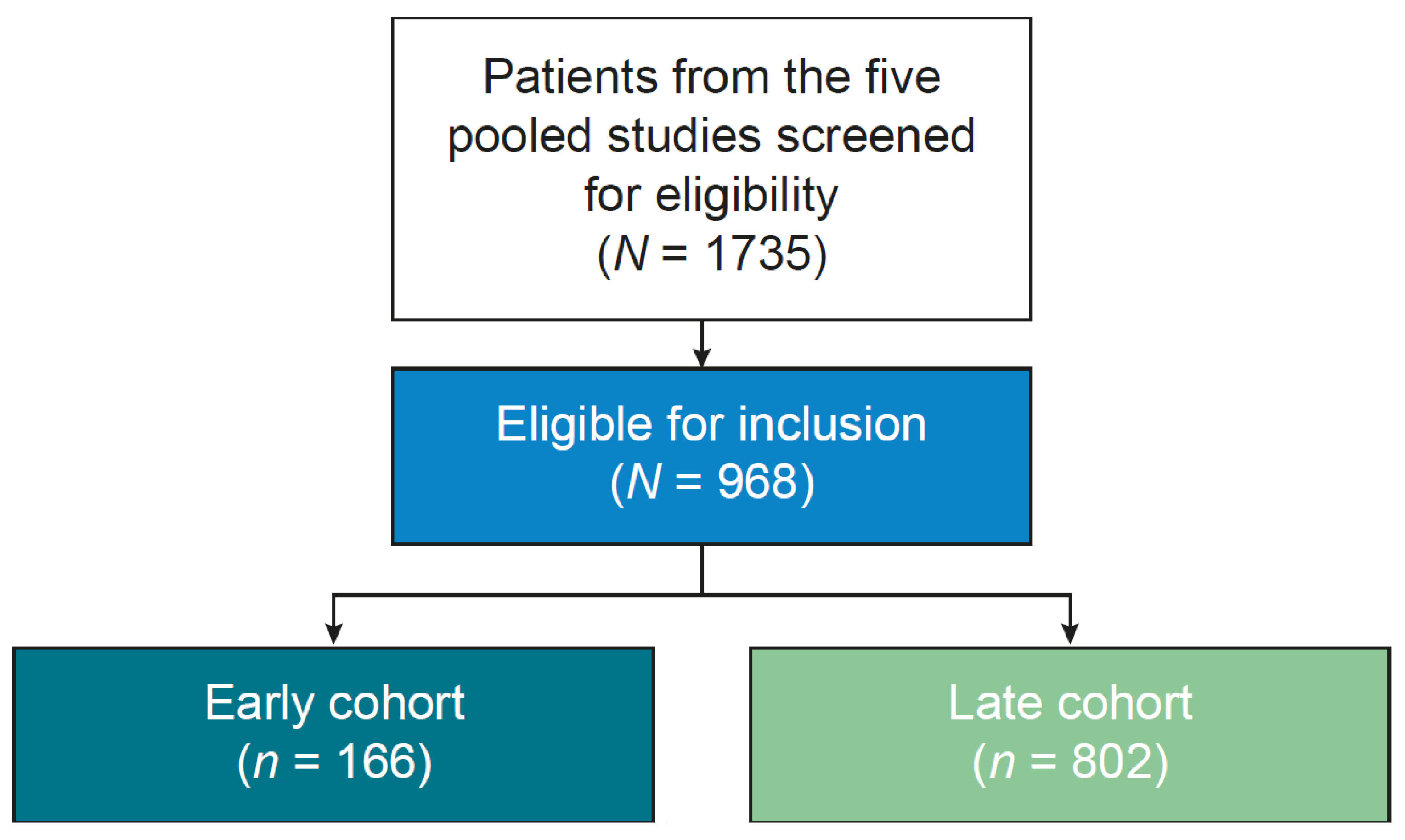
2.1. Patient Population and Characteristics
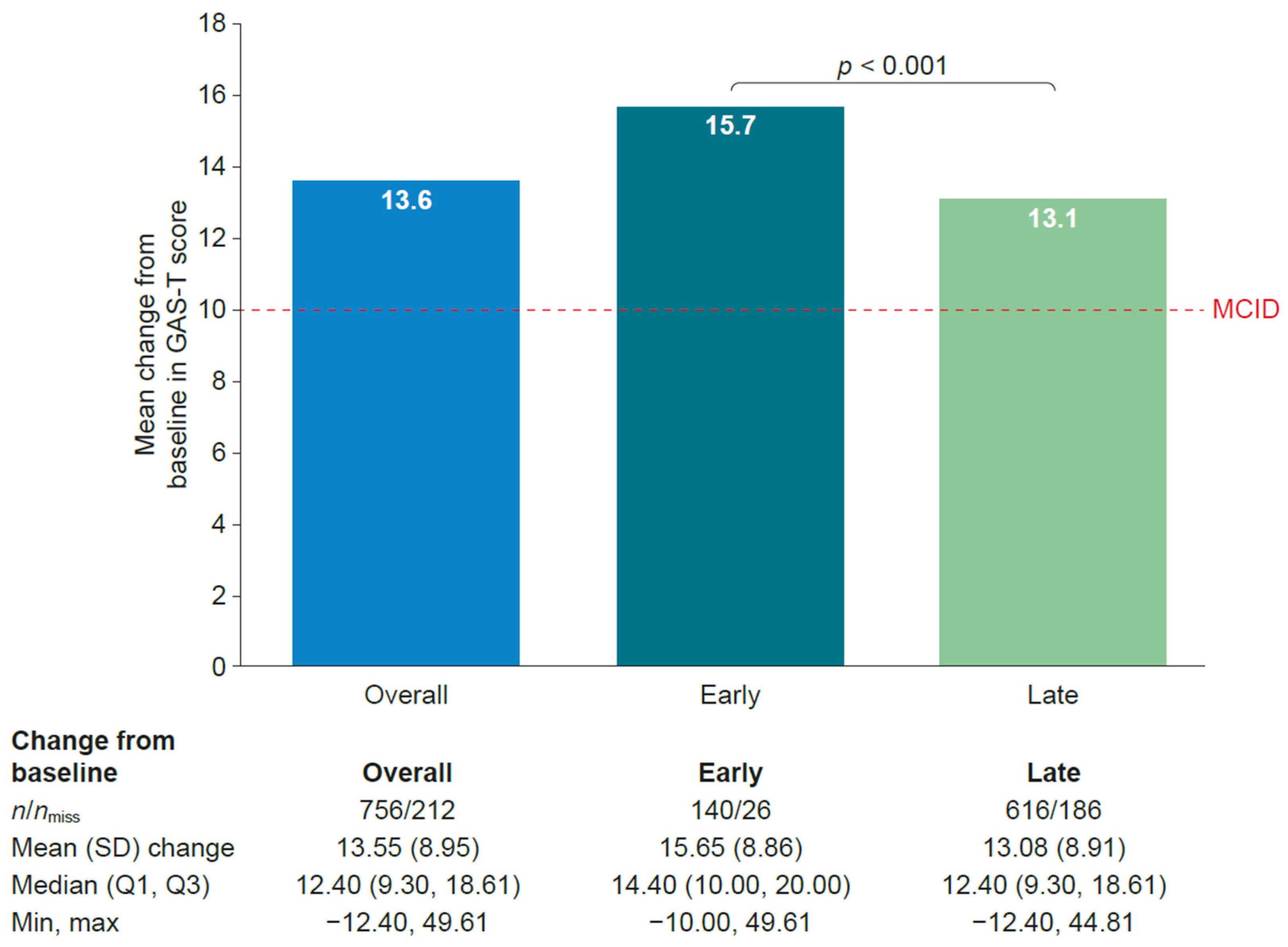
2.2. Primary Endpoint
2.3. Secondary Endpoints
2.3.1. Functional Endpoint
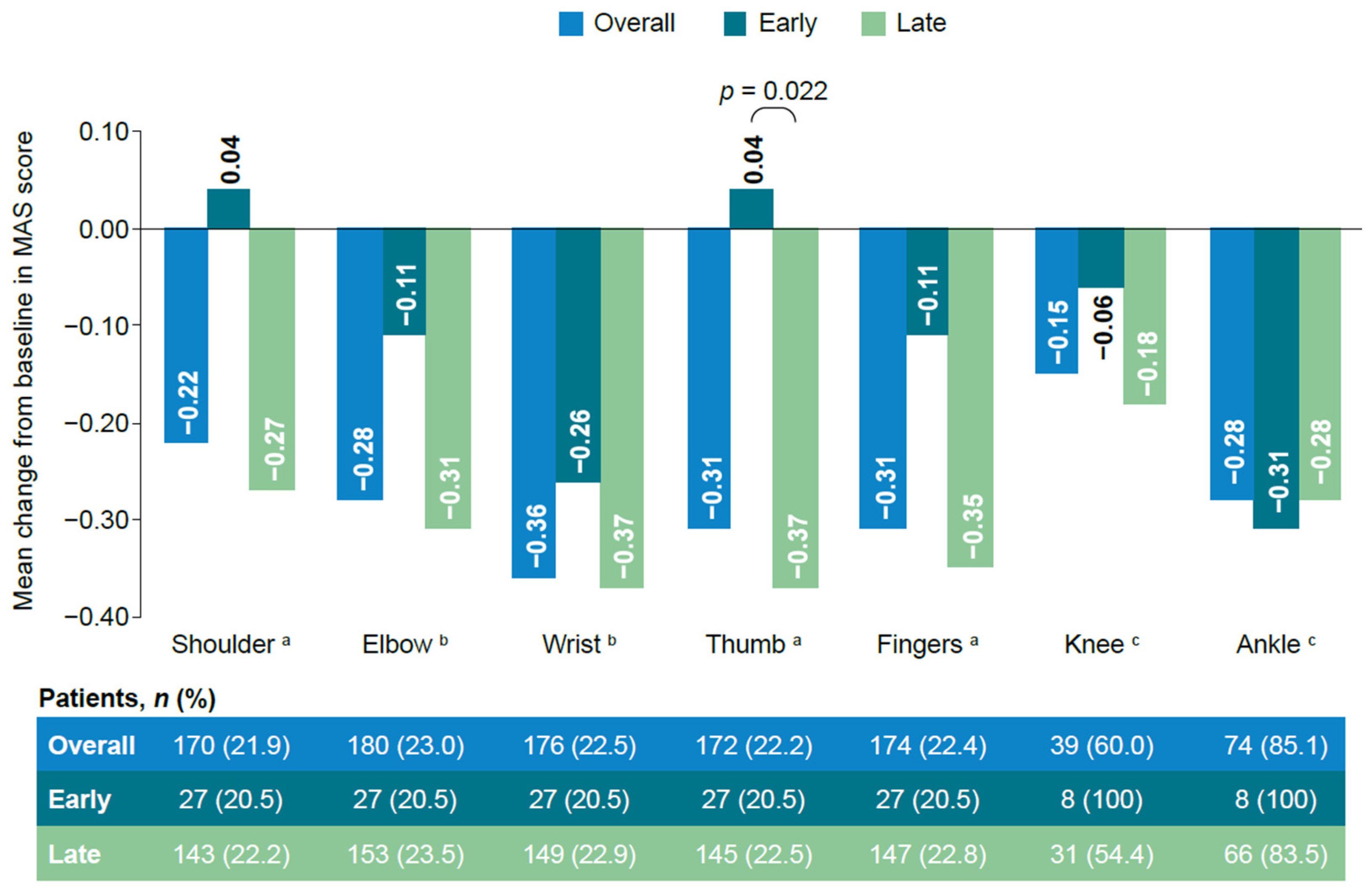
2.3.2. Muscle Tone
2.4. Exploratory Endpoints
2.5. Safety
3. Discussion
4. Conclusions
5. Materials and Methods
5.1. Study Design and Data Source
5.2. Patients
5.3. Endpoints
5.4. Sample Size and Statistical Analysis
Supplementary Materials
Author Contributions
Funding
Institutional Review Board Statement
Informed Consent Statement
Data Availability Statement
Acknowledgments
Conflicts of Interest
Abbreviations
| aboBoNT-A | AbobotulinumtoxinA |
| AE | Adverse event |
| BoNT-A | Botulinum toxin A |
| GAS | Goal attainment scaling |
| GAS-T | Total Goal Attainment Scaling |
| ICH | International Council for Harmonisation of Technical Requirements for Pharmaceuticals for Human Use |
| LLS | Lower limb spasticity |
| MAS | Modified Ashworth Scale |
| MCID | Minimal clinically important difference |
| PGA | Physician’s Global Assessment |
| PSS | Post-stroke spasticity |
| TEAE | Treatment-emergent adverse event |
| ULS | Upper limb spasticity |
References
- Royal College of Physicians. Spasticity in Adults: Management Using Botulinum Toxin. National Guidelines. 2018. Available online: https://www.rcp.ac.uk/media/i1ijs0tm/spasticity-in-adults_final-version_march-2019.pdf (accessed on 20 June 2025).
- Pandyan, A.D.; Gregoric, M.; Barnes, M.P.; Wood, D.; Van Wijck, F.; Burridge, J.; Hermens, H.; Johnson, G.R. Spasticity: Clinical perceptions, neurological realities and meaningful measurement. Disabil. Rehabil. 2005, 27, 2–6. [Google Scholar] [CrossRef] [PubMed]
- Zeng, H.; Chen, J.; Guo, Y.; Tan, S. Prevalence and risk factors for spasticity after stroke: A systematic review and meta-analysis. Front. Neurol. 2020, 11, 616097. [Google Scholar] [CrossRef] [PubMed]
- Kuo, C.-L.; Hu, G.-C. Post-stroke spasticity: A review of epidemiology, pathophysiology, and treatments. Int. J. Gerontol. 2018, 12, 280–284. [Google Scholar] [CrossRef]
- Simpson, D.M.; Hallett, M.; Ashman, E.J.; Comella, C.L.; Green, M.W.; Gronseth, G.S.; Armstrong, M.J.; Gloss, D.; Potrebic, S.; Jankovic, J.; et al. Practice guideline update summary: Botulinum neurotoxin for the treatment of blepharospasm, cervical dystonia, adult spasticity, and headache: Report of the Guideline Development Subcommittee of the American Academy of Neurology. Neurology 2016, 86, 1818–1826. [Google Scholar] [CrossRef]
- Bowers, D.; Fheodoroff, K.; Khan, P.; Harriss, J.; Dashtipour, K.; Bahroo, L.; Lee, M.; Zakharov, D.; Balcaitiene, J.; Evidente, V. Spastic paresis and rehabilitation—The patient journey. Eur. Neurol. Rev. 2016, 11, 87–95. [Google Scholar] [CrossRef]
- Tamayo, F.M.; Rosales, R.; Wissel, J.; Biering-Sorensen, B.; Ellano, J.N.; Simpson, D. Botulinum Toxin in Pain-Related Post-Stroke Limb Spasticity: A Meta-Analysis of Early and Late Injections. Toxins 2025, 17, 258. [Google Scholar] [CrossRef]
- Rosales, R.L.; Efendy, F.; Teleg, E.S.; Delos Santos, M.M.; Rosales, M.C.; Ostrea, M.; Tanglao, M.J.; Ng, A.R. Botulinum toxin as early intervention for spasticity after stroke or non-progressive brain lesion: A meta-analysis. J. Neurol. Sci. 2016, 371, 6–14. [Google Scholar] [CrossRef]
- Ismail, F.; Boulias, C.; Phadke, C.; Dagher, J.; Ethans, K.; Khan, O.; Kleiner, G.; Pi Shan, R.L.; Liem, N.; Lo, A.; et al. Early Botulinum Toxin Injections for Spasticity Management Post-stroke: A Delphi-based Canadian Consensus. Arch. Phys. Med. Rehabil. 2019, 100, e175. [Google Scholar] [CrossRef]
- Tilborg, N.; de Groot, V.; Meskers, C.G.M. The effectiveness of early interventions for post-stroke spasticity: A systematic review. Disabil. Rehabil. 2025, 47, 900–911. [Google Scholar] [CrossRef]
- Picelli, A.; Santamato, A.; Cosma, M.; Baricich, A.; Chisari, C.; Millevolte, M.; Del Prete, C.; Mazzu, I.; Di Censo, R.; Smania, N.; et al. Early Botulinum Toxin Type A Injection May Improve Motor Recovery in Patients with Post-Stroke Spasticity: A Secondary Analysis from a Longitudinal Cohort Study. Toxins 2025, 17, 558. [Google Scholar] [CrossRef]
- Turner-Stokes, L. Goal attainment scaling (GAS) in rehabilitation: A practical guide. Clin. Rehabil. 2009, 23, 362–370. [Google Scholar] [CrossRef]
- Krasny-Pacini, A.; Hiebel, J.; Pauly, F.; Godon, S.; Chevignard, M. Goal attainment scaling in rehabilitation: A literature-based update. Ann. Phys. Rehabil. Med. 2013, 56, 212–230. [Google Scholar] [CrossRef] [PubMed]
- Choudhry, S.; Patritti, B.L.; Woodman, R.; Hakendorf, P.; Huang, L. Goal Attainment: A Clinically Meaningful Measure of Success of Botulinum Toxin-A Treatment for Lower Limb Spasticity in Ambulatory Patients. Arch. Rehabil. Res. Clin. Transl. 2021, 3, 100129. [Google Scholar] [CrossRef] [PubMed]
- Clarkson, K.; Barnett, N. Goal attainment scaling to facilitate person-centred, medicines-related consultations. Eur. J. Hosp. Pharm. 2021, 28, 106–108. [Google Scholar] [CrossRef] [PubMed]
- Ashford, S.; Turner-Stokes, L. Goal attainment for spasticity management using botulinum toxin. Physiother. Res. Int. 2006, 11, 24–34. [Google Scholar] [CrossRef]
- Wissel, J.; Fheodoroff, K.; Hoonhorst, M.; Mungersdorf, M.; Gallien, P.; Meier, N.; Hamacher, J.; Hefter, H.; Maisonobe, P.; Koch, M. Effectiveness of abobotulinumtoxinA in post-stroke upper limb spasticity in relation to timing of treatment. Front. Neurol. 2020, 11, 104. [Google Scholar] [CrossRef]
- Rosales, R.L.; Balcaitiene, J.; Berard, H.; Maisonobe, P.; Goh, K.J.; Kumthornthip, W.; Mazlan, M.; Latif, L.A.; Delos Santos, M.M.D.; Chotiyarnwong, C.; et al. Early abobotulinumtoxinA (Dysport®) in post-stroke adult upper limb spasticity: ONTIME pilot study. Toxins 2018, 10, 253. [Google Scholar] [CrossRef]
- Patel, A.T.; Ward, A.B.; Geis, C.; Jost, W.H.; Liu, C.; Dimitrova, R. Impact of early intervention with onabotulinumtoxinA treatment in adult patients with post-stroke lower limb spasticity: Results from the double-blind, placebo-controlled, phase 3 REFLEX study. J. Neural Transm. 2020, 127, 1619–1629. [Google Scholar] [CrossRef]
- Picelli, A.; Santamato, A.; Cosma, M.; Baricich, A.; Chisari, C.; Millevolte, M.; Prete, C.D.; Mazzu, I.; Girardi, P.; Smania, N. Early botulinum toxin type A injection for post-stroke spasticity: A longitudinal cohort study. Toxins 2021, 13, 374. [Google Scholar] [CrossRef]
- Zorowitz, R.D.; Barrenechea, L.S.; Butet, S.; Groppa, S.; Hernandez Herrero, D.; Prasad, R.; Sandars, S.; Meloni, S.; Page, S.; Maisonobe, P.; et al. How many stroke survivors develop problematic spasticity requiring pharmacological therapy? An international (Europe and USA) observational study protocol. BMJ Open 2025, 15, e087404. [Google Scholar] [CrossRef]
- Jacinto, J.; Balbert, A.; Bensmail, D.; Carda, S.; Draulans, N.; Deltombe, T.; Ketchum, N.; Molteni, F.; Reebye, R. Selecting Goals and Target Muscles for Botulinum Toxin A Injection Using the Goal Oriented Facilitated Approach to Spasticity Treatment (GO-FAST) Tool. Toxins 2023, 15, 676. [Google Scholar] [CrossRef]
- Rosales, R.L.; Kong, K.H.; Goh, K.J.; Kumthornthip, W.; Mok, V.C.; Delgado-De Los Santos, M.M.; Chua, K.S.; Abdullah, S.J.; Zakine, B.; Maisonobe, P.; et al. Botulinum toxin injection for hypertonicity of the upper extremity within 12 weeks after stroke: A randomized controlled trial. Neurorehabilit. Neural Repair 2012, 26, 812–821. [Google Scholar] [CrossRef] [PubMed]
- Cousins, E.; Ward, A.; Roffe, C.; Rimington, L.; Pandyan, A. Does low-dose botulinum toxin help the recovery of arm function when given early after stroke? A phase II randomized controlled pilot study to estimate effect size. Clin. Rehabil. 2010, 24, 501–513. [Google Scholar] [CrossRef] [PubMed]
- Hesse, S.; Mach, H.; Frohlich, S.; Behrend, S.; Werner, C.; Melzer, I. An early botulinum toxin A treatment in subacute stroke patients may prevent a disabling finger flexor stiffness six months later: A randomized controlled trial. Clin. Rehabil. 2012, 26, 237–245. [Google Scholar] [CrossRef] [PubMed]
- Xu, Q.; Xiao, H.; Zhu, Z.; Guan, Y.; Wang, Y. Research progress in the use of botulinum toxin type a for post-stroke spasticity rehabilitation: A narrative review. Ann. Med. 2025, 57, 2521427. [Google Scholar] [CrossRef]
- Wissel, J.; Kivi, A. Post-Stroke Spastic Movement Disorder and Botulinum Toxin A Therapy: Early Detection And Early Injection. Ann. Rehabil. Med. 2023, 47, 326–336. [Google Scholar] [CrossRef]
- Turner-Stokes, L.; Ashford, S.; Jacinto, J.; Maisonobe, P.; Balcaitiene, J.; Fheodoroff, K. Impact of integrated upper limb spasticity management including botulinum toxin A on patient-centred goal attainment: Rationale and protocol for an international prospective, longitudinal cohort study (ULIS-III). BMJ Open 2016, 6, e011157. [Google Scholar] [CrossRef]
- Esquenazi, A.; Zorowitz, R.D.; Ashford, S.; Maisonobe, P.; Page, S.; Jacinto, J. Clinical presentation of patients with lower limb spasticity undergoing routine treatment with botulinum toxin: Baseline findings from an international observational study. J. Rehabil. Med. 2023, 55, jrm4257. [Google Scholar] [CrossRef]
- Rekand, T.; Biering-Sorensen, B.; He, J.; Vilholm, O.J.; Christensen, P.B.; Ulfarsson, T.; Belusa, R.; Strom, T.; Myrenfors, P.; Maisonobe, P.; et al. Botulinum toxin treatment of spasticity targeted to muscle endplates: An international, randomised, evaluator-blinded study comparing two different botulinum toxin injection strategies for the treatment of upper limb spasticity. BMJ Open 2019, 9, e024340. [Google Scholar] [CrossRef]



| Characteristic | Overall (n = 968) | Early Treatment (<1 year) (n = 166) | Late Treatment (≥1 year) (n = 802) | p Value |
|---|---|---|---|---|
| Study, n (%) | ||||
| 1. NCT02454803 | 776 (80.2) | 132 (80.0) | 644 (80.3) | Not calculated |
| 2. NCT04050527 | 147 (15.2) | 29 (17.5) | 118 (14.7) | |
| 3. NCT02020980 | 28 (2.9) | 0 (0) | 28 (34.9) | |
| 4. NCT01682148 | 6 (0.6) | 0 (0) | 6 (0.7) | |
| 5. Study 5 | 11 (1.1) | 5 (3.0) | 6 (0.7) | |
| Male sex, n (%) | 565 (58.4) | 109 (65.7) | 456 (56.9) | 0.045 |
| Age group, years, n (%) | ||||
| 18–34 | 96 (9.9) | 15 (9.0) | 81 (10.1) | >0.9 |
| 35–44 | 122 (12.6) | 19 (11.4) | 103 (12.8) | |
| 45–49 | 97 (10.0) | 18 (10.8) | 79 (9.9) | |
| 50–54 | 137 (14.2) | 27 (16.3) | 110 (13.7) | |
| 55–59 | 148 (15.3) | 24 (14.5) | 124 (15.5) | |
| 60–64 | 99 (10.2) | 18 (10.8) | 81 (10.1) | |
| 65–69 | 119 (12.3) | 18 (10.8) | 101 (12.6) | |
| ≥70 | 150 (15.5) | 27 (16.3) | 123 (15.3) | |
| Region, n (%) | ||||
| America | 150 (15.5) | 20 (12.0) | 130 (16.2) | <0.001 |
| Asia or Australia | 154 (15.9) | 32 (19.3) | 122 (15.2) | |
| Europe | 460 (47.5) | 52 (31.3) | 408 (50.9) | |
| Russia | 204 (21.1) | 62 (37.3) | 142 (17.7) | |
| Location of spasticity, n (%) | ||||
| Upper limb only | 793 (81.9) | 137 (82.5) | 656 (81.8) | 0.2 |
| Lower limb only | 26 (2.7) | 1 (0.6) | 25 (3.1) | |
| Upper and lower limb | 149 (15.4) | 28 (16.9) | 121 (15.1) | |
| Time from spasticity diagnosis to BoNT-A treatment, years a | ||||
| n (%) | 676 (69.8) | 125 (75.3) | 551 (68.7) | <0.001 |
| Mean (SD) | 5.91 (7.39) | 0.50 (1.28) | 7.14 (7.64) | |
| Median (Q1, Q3) | 3.49 (1.16, 7.63) | 0.36 (0.20, 0.59) | 4.79 (2.06, 8.63) | |
| Min, max | 0.01, 52.02 | 0.01, 13.93 | 0.12, 52.02 | |
| Time from stroke to BoNT-A treatment, years | ||||
| Mean (SD) | 6.67 (8.05) | 0.50 (0.26) | 7.95 (8.29) | <0.001 |
| Median (Q1, Q3) | 4.00 (1.46, 8.57) | 0.47 (0.27, 0.73) | 5.42 (2.61, 9.94) | |
| Min, max | 0.02, 64.65 | 0.02, 0.99 | 1.01, 64.65 | |
| Previously treated with BoNT-A for spasticity, n (%) | ||||
| Yes | 667 (68.9) | 48 (28.9) | 619 (77.2) | <0.001 |
| No | 301 (31.1) | 118 (71.1) | 183 (22.8) | |
| Baseline unweighted GAS scores | ||||
| Mean (SD) | 36.87 (3.62) | 36.90 (3.53) | 36.86 (3.64) | 0.900 |
| Median (Q1, Q3) | 37.60 (36.31, 40.00) | 37.60 (36.31, 40.00) | 37.60 (36.31, 40.00) | |
| Min, max | 22.61, 40.00 | 24.83, 40.00 | 22.61, 40.00 | |
| Rating | Overall (n = 968) | Early Treatment (<1 year) (n = 166) | Late Treatment (≥1 year) (n = 802) | p Value |
|---|---|---|---|---|
| Total patients | 237 (24.5) | 53 (31.9) | 184 (22.9) | |
| Much better | 69 (7.1) | 27 (16.3) | 42 (5.2) | <0.001 |
| A bit better | 127 (13.1) | 20 (12.0) | 107 (13.3) | |
| Same | 39 (4.0) | 5 (3.0) | 34 (4.2) | |
| Worse | 2 (0.2) | 1 (0.6) | 1 (0.1) | |
| Much worse | 0 (0) | 0 (0) | 0 (0) |
| Study | Study Design | Objective | Population |
|---|---|---|---|
| 1. NCT02454803 ULIS III [28] | International, multicenter, observational, prospective, longitudinal cohort study conducted at 60 centers in countries with a Marketing Authorization for at least one BoNT-A preparation approved for ULS treatment | To assess the impact of integrated ULS management (including BoNT-A injections) on patient-centered goal attainment in patients | Patients aged ≥ 18 years over a period of 2 years |
| 2. NCT04050527 AboLiSh [29] | International, multicenter, observational, prospective, longitudinal study conducted at 51 centers in 9 countries in Europe, the Americas, Australia, and Russia | To assess the effectiveness (longitudinal attainment of person-centered and function-related goals) of aboBoNT-A injections in patients | Patients aged ≥ 18 years with LLS over a period of 16 months |
| 3. NCT02020980 RELIEF | National, prospective, multicenter, post-marketing observational study conducted at 23 centers in Spain | To demonstrate the effect of intramuscular BoNT-A injections in relieving pain consequent to post-stroke LLS as per routine clinical practice | Patients aged ≥ 18 years with post-stroke LLS |
| 4. NCT01682148 [30] | A randomized, evaluator-blinded, comparative, parallel-group, multicenter study conducted in 4 countries (Denmark, Finland, Norway, and Sweden) | To compare aboBoNT-A treatment results in the elbow joint 4 weeks post-treatment using MAS with the following two techniques: current clinical practice (300 U/mL) versus neuromuscular junction-targeted injection (100 U/mL) | Patients aged ≥ 18 years with ULS with an elbow flexor muscle spasticity position pattern type 1, 3, or 4 post-stroke or traumatic brain injury |
| 5. A-92-52120-168 | A post-marketing, national, multicenter, prospective, observational, longitudinal, open, and single-cohort study conducted at 6 centers in Spain | To evaluate post-stroke ULS patterns in patients before and after treatment with BoNT-A, according to the determined postural and movement patterns | Patients aged ≥ 18 years with post-stroke ULS |
Disclaimer/Publisher’s Note: The statements, opinions and data contained in all publications are solely those of the individual author(s) and contributor(s) and not of MDPI and/or the editor(s). MDPI and/or the editor(s) disclaim responsibility for any injury to people or property resulting from any ideas, methods, instructions or products referred to in the content. |
© 2026 by the authors. Licensee MDPI, Basel, Switzerland. This article is an open access article distributed under the terms and conditions of the Creative Commons Attribution (CC BY) license.
Share and Cite
Patel, A.; Zhang, J.; Page, S.; Harding, S.; Beneteau, M.; Navickas, C.; Esquenazi, A. Impact of Early Versus Late Treatment with Botulinum Toxin A on Goal Attainment in Post-Stroke Spasticity: A Retrospective Cohort Study. Toxins 2026, 18, 68. https://doi.org/10.3390/toxins18020068
Patel A, Zhang J, Page S, Harding S, Beneteau M, Navickas C, Esquenazi A. Impact of Early Versus Late Treatment with Botulinum Toxin A on Goal Attainment in Post-Stroke Spasticity: A Retrospective Cohort Study. Toxins. 2026; 18(2):68. https://doi.org/10.3390/toxins18020068
Chicago/Turabian StylePatel, Atul, Jinming Zhang, Simon Page, Sarah Harding, Mathieu Beneteau, Colin Navickas, and Alberto Esquenazi. 2026. "Impact of Early Versus Late Treatment with Botulinum Toxin A on Goal Attainment in Post-Stroke Spasticity: A Retrospective Cohort Study" Toxins 18, no. 2: 68. https://doi.org/10.3390/toxins18020068
APA StylePatel, A., Zhang, J., Page, S., Harding, S., Beneteau, M., Navickas, C., & Esquenazi, A. (2026). Impact of Early Versus Late Treatment with Botulinum Toxin A on Goal Attainment in Post-Stroke Spasticity: A Retrospective Cohort Study. Toxins, 18(2), 68. https://doi.org/10.3390/toxins18020068